Thursday, June 16, 2011

Dealing with the problematic piyut Ma'oz Tzur in the 19th century.

One of the great siddurim of the 19th century is סדור הגיון לב (Koenigsberg 1845). It was published by Hirsch Edelmann who is probably most famous for his Ginze Oxford, jointly published with Leib Dukes, and also his גדולת שאול (London 1854), about Saul Wahl, alleged by legend to have been king of Poland for a day. This work includes approbations and letters from big names, like Rabbis Yaakov Meir Padua of Brisk, Zvi Hirsch Chajes of Zolkiew, Yaakov Zvi Mecklenburg of Koenigsberg, Yisrael Lipschitz of Danzig, Michael Sachs, Samuel David Luzzatto, Isak Markus Jost, Leib Dukes, Eliezer Rosenthal and a lengthy letter from someone named Rubenstein, originally from Grodno but now writing from New Orleans (which he writes as "נוא אלינס"). I will get back to the siddur in a moment, but readers who are interested in knowing more about Saul Wahl can consult the following Olomeinu cartoon:


Although Edelmann was the publisher of the aforementioned siddur, and a scholar in his own right, the work is noted because of its excellent commentary מקור ברכה by Leser Landshuth, a great expert on the liturgy an its inclusion of the kuntres נועם מגדים by R. Yosef Teomim, the Pri Megadim (this fact led whomever catalogs at HebrewBooks.org to erroneously list him as the author of this siddur).

Landshuth's commentary is the first comprehensive modern historical exploration of the daily prayers (in his introduction Landshuth mentions his predecessors, but points out that their comments are spread out over many writings).

For all it's good qualities, it is also a product of its time. Edelmann's General Introduction is a 2000 word essay about how the sources (from R. Y. Lampronti to R. Y. Emden to R. E. Fleckeles) support the statement that there is a difference between non-Jews in ancient times and today and anything which casts any aspersions on the former only applied to ancient times.

In some places, where a declaration to that effect was not enough, the text of the siddur is modified slightly. For example:


As you can see, in the Ma'oz Tzur piyut the familiar stanza Yevanim nikbetzu alay ("Greeks gathered to attack me") is changed to Yehirim nikbetzu alay ("Arrogant ones gathered to attack me"). The final Messianic stanza, Chashof zeroa qodshecha ("Bare your holy arms"), which contains the phrase "nekom nikmas avadecha mimalchus harshaah," ("Avenge your servant from the wicked ruler") is missing. Granted that it is unclear if this last stanza was added later, even though most think it was.

Many siddurim don't include the last stanza, just like this one. The Singer siddur didn't. Siddur Safar Verurah by Heidenheim also doesn't include it, and neither did R. Yaakov of Lissa's siddur, and many others. Artscroll notes that it was "subject to much censorship by Christian authorities," since it refers to Israel's foes. Now why would they think that? In fact it was also subject to much internal Jewish censorship, as you can see. Interestingly, in the Birnbaum siddur the last stanza is preceded by a note which says "The following stanza is a comparatively late addition" and it alone is not translated.

Speaking of untranslated phrases, recently I came across R. Eliyahu Touger's English translation of the Siddur Yaavetz. The introduction is an amazing back and forth about whether it's possible or desirable to translate everything, and how on the one hand R. Yaakov Emden was trying to produce a clear, user friendly siddur but somehow on the other hand it's very obscure. It was for regular people, but it was also talmide chachomim. Regular people need a translation, but talmide chachomim don't. On the one hand later editions messed up by adding new material and even changing the nusach. On the other hand, he decided that most people who will want to buy his translation will want it to be nussach sefard, so that's what it is. And so forth. It's an amazing introduction.

In R. Emden's introduction to the siddur itself I noticed that not everything is translated even though the Hebrew is right next to it. For example, there is a passage where R. Yaavetz discussed grammar and proper pronunciation. On the one hand, he writes, the Ashkenazim have a disadvantage in their pronunciation - they pronounce ס and ת the same, and this they should not do. However, in vowels the Ashkenazim pronounce them better than the Sefardim; one example he gives is that the Sefardim do not differentiate between seghol and tzere. He also says that the Ashkenazim have a better way of singing the trope. Everyone has an opinion. He then says מה נעים גורלנו בהבדילנו ביניהם. Admittedly I am not 100% sure what he intends here. Is he saying that the Ashkenazim are fortunate to be distinct from the Sefardim? Or is he referring to differentiating between the things which the Sefardim don't differentiate? At any rate, R. Emden continues to note that people should differentiate between the two types of sheva. I think that R. Touger at least took it to mean differentiating between the Ashkenazim and Sefardim, because he did not translate those words altogether. Yet they are printed in Hebrew right next to the translation. צ"ע.

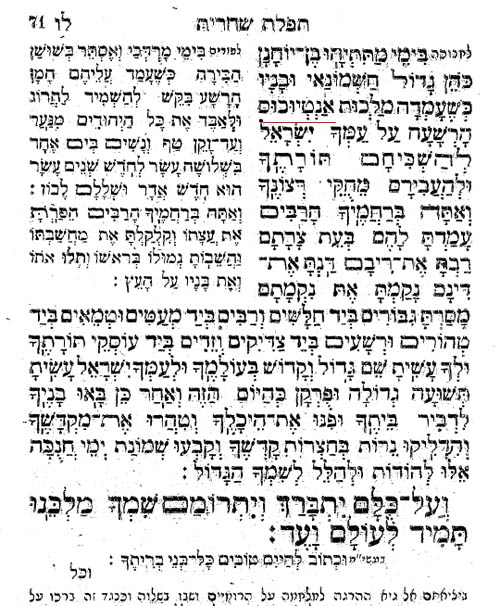
Getting back to Yehirim/ Yevanim, the problem seems to be that in Russia "Greek" had the connotation of referring to the Russian Orthdox Church. In the Jewish Encylopedia article on Censorship it is claimed that the book יון מצולה, about the Chmielnitski persecutions, was illegal in the 18th century because of the name! I don't know if that's a joke (Yavan and Yeven are two different words, but they are written with the same consonants). More likely it was forbidden because of the content. But you can see elsewhere in the Edelmann/ Landhuth siddur that the word Yavan was changed to Antiochus:


Similarly, I found a derasha of R. Aryeh Leib Zinz, printed in Warsaw in 1902 which matter of factly refers to the stanza יהירים נקבצו עלי:


Here is the title page of that sefer:


I found a Dutch siddur which translates Yevanim as "Syrische Grieken," which is technically correct, but pretty wordy.

Finally, the second edition of the collected poems of the Chasam Sofer, , (Vienna/ Budapest 1902) includes many poems by his son R. Shimon Sofer, including this one, which is his reworked version of Ma'oz Tzur, with instruction to sing it to the same tune: "Shochen shamayim be-ezrasi . . ."

Tuesday, June 14, 2011

It was quite a week in the history of American Orthodox Judaism.


This is from Hapardes June 1941. Quite a lot of the plot of the second half of the 20th century was charted here. At least symbolically.

Why do Jews sway when they pray? Some notes on Shokeling.

I have discussed davening, so now it's time for shokeling. Shokeling (the Anglicized form of this Yiddish word) or swaying during prayer and Torah study has been treated in many places, all of which bring the same sources. I'm going to bring some of these too, since they are interesting, but what I also found interesting was the various approaches which the individuals discussing them brought to the table.

Later sources connect it with specific verses and the like, and since the existence of the custom is already documented and since I don't think a 16th century source giving yet another verse which hints to the idea of movement is likely to be the actual source which inspired Jews to move during prayer and study, I won't mention them.

The early sources which are incidentally Spanish are as follows.

The first source is critical. This is not surprising since very often the first time anyone takes the time to document something is to knock it. The first source is a poem of Shemuel Ha-naggid. In this poem he is criticizing the degeneration of Torah study since the time of Rav and Rava, and the students and their roshei yeshiva nowadays who are sub-par in wisdom. Nowadays, writes this man of the 11th century, one only needs tzitzis a turban and a beard to be a rosh yeshiva (ידמו כי בציציות וזקן ומגבעת יהי איש ראש מתיבה). As an example of their lack of orderliness he mentions their shokeling:

והנה רב ותלמידים מנידים לראשיהם כערער בערבה
"The teacher and students were bobbing their head like a tamarisk in the wilderness."
The poem is pretty scathing. It even accuses them of basically murdering Hillel and Shammai and Rabbi Akiva (in the sense that we say that a horrible singer "murders" the tune).

This then is the first incidental mention of shokeling, at least in Jewish sources. Notice that it only mentions it in connection with studying.

Next is the Kuzari, who is kinder. He comes not to criticize or praise but to explain. Rabbi Yehuda Ha-levi, who was born some time after Shmuel Ha-nagid died, deals with it in his book. Here it is, in Hartwig Hirschfeld's translation:
79. Al-Khazari: I should like to ask whether thou knowest the reason why Jews move to and fro when reading the Bible?

80. The Rabbi: It is said that it is done in order to arouse natural heat. My personal belief is that it stands in connexion with the subject under discussion. As it often happened that many persons read at the same time, it was possible that ten or more read from one volume. This is the reason why our books are so large. Each of them was obliged to bend down in his turn in order to read a passage, and to turn back again. This resulted in a continual bending and sitting up, the book lying on the ground. This was one reason. Then it became a habit through constant seeing, observing and imitating, which is in man's nature. Other people read each out of his own book, either bringing it near to his eyes, or, if he pleased, bending down to it without inconveniencing his neighbour. There was, therefore, no necessity of bending and sitting up. We will now discuss the importance of the accents, the orthographic value of the seven principal vowel signs, the grammatical accuracy resulting from them as well as from the distinction between Qames, Patah, Sere and Segol.
I left in the last part because I love that transition! "Enough shokeling, let's talk about nekkudot and te'amim!"

We see that R. Yehuda Ha-levi too only discusses it in the context of studying, but doesn't mention praying. He gives two reasons. The first is one which people say, that it is to arouse heat in the body, I guess like a form of exercise. Alternatively, he means to arouse passion, to get into it. Then there is the reason preferred by the author, which is his suspicion that originally it was because people shared books and they moved in and our of the way so they could read and give others a chance to read and ultimately this became the habit and spread.

Interestingly, the context in which this question is asked is as follows: the King was asking about Hebrew poetry using Arabic meter. This was a pet peeve of R. Yehuda Ha-levi, so he laments it and explains it as an unfortunate fact of the exile among foreign nations. He opines that piyut, which employs only rhyme, can remedy the situation. However, notes R. Yehuda, authentic Jewish chant is exquisite. He says that you can see 100 Jews reciting the Bible together flawlessly, and the King agrees that you can see that. Immediately following R. Yehuda's explanation that the poetry he disapproves of is due to non-Jewish influence, the King asks about shokeling. Evidently he wanted to know why it is that only Jews do this, if they have been influenced. I'm sure many readers have seen videos of Islamic madrassahs were the students seem to shokel when they study. Apparently this was not the case 1000 years ago, or at least not in Spain.

The Zohar mentions it too, but we will return to that. Further Spanish sources are the Ba'al Haturim (recognizing that he was born in France) and Abudraham. These gives associations with verses and are later (and also associate with praying).

The Zohar (Parashas Pinchas) gives the following:
We arose and went on our way, the sun becoming stronger and more oppressive. We saw some trees in the wilderness with water underneath, and we sat down in the shade of one of them. I asked him: How is it that of all peoples of the world, only the Jews sway to and fro when they study the Torah, a habit which seems to come natural to them, and they are unable to keep still? He replied: You have reminded me of a very deep idea which very few people know. He pondered for a moment and wept. Then he continued: Alas for mankind who go about like cattle without understanding. This thing alone is sufficient to distinguish the holy souls of Israel from the souls of heathen peoples. The souls of Israel have been hewn from the Holy Lamp, as is written, “The spirit of man is the lamp of the Lord” (Prov. xx, 27). Now once this lamp has been kindled from the supernal Torah, the light upon it never ceases for an instant, like the flame of a wick which is never still for an instant. So when an Israelite has said one word of the Torah, a light is kindled and he cannot keep still but sways to and fro like the flame of a wick. But the souls of heathens are like the burning of stubble, which gives no flame, and therefore they keep still like wood burning without a flame.’ Said R. Jose: ‘That is a good explanation; happy am I to have heard this.’ (Soncino translation.)
We see here, once again, only mention of swaying during Torah study, but not prayer. Furthermore, we also see the idea that only Jews shokel, like in the Kuzari. The answer given here is that a Jew shokels like a flame dances.

One of the best accounts of shokeling, where all these sources are discussed in depth, is Senior Sach's article in Alexander Zederbaum's מצפה (St. Petersburg 1885). Sachs is of the opinion that the Zohar is a 13th century Spanish work, so he explains that here we see the influence of the Kuzari on the Zohar, which has R. Jose asking the King's question, why do only Jews sway when they study? Furthermore, he interestingly notes that the בוצינא קדישא (who replies to R. Jose in the quoted passage) is a translation of Gabirol's concept of אש השכל, his terminology for the divine flame from which the soul is in part created. Sachs cites this as further evidence of Spanish influence on the Zohar.

Sachs goes on to show that while in Spain apparently they only swayed during Torah study, in France it became the practice to sway during prayer also, and from there to Germany, East Europe, etc. (He also asks how the Vilna Gaon can cite the Zohar for swaying during prayer, as he does in OH 48, to the Rema's comment that the medakdekim are accustomed to sway during Torah study. So who says the chokrim aren't interested in the Shulchan Aruch and its commentaries?)

Sachs also brings later critics of shokeling, such as R. Menachem Azaryah and the Shelah. He concludes by noting that many early sources who mention it positively give it as the practice of special people, rabbanim, medakdekim, chasidim, vasikin, perushim, etc. But now we all do it, because we are all medakdekim, chasidim, vasikin, etc. and we do it sitting, standing, praying, studying, for joyous praise, for lamentations, etc. He finishes by stating that it does not have an early source (in contrast, the Artscroll siddur commentary has no problem calling even something which dates to the time of the Ge'onim "ancient") and no one can really explain its origin. And he notes that even the Rema, who sanctified this custom, quotes the Rambam in literally his very first note to the Shulchan Aruch, Moreh Nevukhim III.52 that a person must conduct himself with a special comportment in the presence of God, even much more so than how a person conducts himself differently before a king than he does in the privacy of his home. So, says, Sachs, just as one would not fidget in front of a king all the more so is it inappropriate in prayer before God! Readers who are interested in his essay should email me and request a copy.

Stepping a little out of chronological order, in the Encyclopedia Otzar Yisrael, Eisenstein begins his entry נענוא Vol. 7 pg. 87 saying that the practice is very ancient, and rather than citing the Kuzari or Shmuel Ha-nagid, he cites the Zohar. For him the Zohar is a very ancient source. Since almost all of his material is from Sachs, it would seem that he presented it this was on purpose and to show preference to the Zohar. Eisenstein adds an additional source, which is simply a curiosity. He cites the physician Simon Brainin's popular medical book ארח לחיים (Vilna 1883) who explains that shokeling is healthy exercise! Indeed, it may well be for people who don't otherwise get much else. (See here pg. 126.)

After Sachs was Abraham Berliner, who sees it as an issue related to printing of all things. He included his views in his essay on the influence of printing on Jewish practice, which was included in the 1893-94 yearbook of the Hildesheimer Rabbinical Seminary where he taught. In addition to the German original (Über den Einfluss des ersten hebräischen Buchdrucks auf den Cultus und die Cultur der Juden) the essay is available in Hebrew translation (השפעת ספרי-הדפוס הראשונים על תרבות היהודים) in Ketavim Nivcharim, a translated collection of his essays. Berliner cites the same sources, but he got them from Salomon Plessner's 1839 book on prayer אבן טובה.

Evidently he assumes the true origin was the personal explanation of the Chaver in the Kuzari, namely the dearth of manuscripts, which meant that people had to share them, and they began to move out of the way to give others a chance to read. Berliner sees this practice as interesting because even though, in his view, it began due to a lack which printing addressed, the practice persists even after printing. This is why he included his comments about shokeling in his essay.

This reminds me of an explanation given by the Rogachover for why the ten sons of Haman are read by everyone. The practice is for everyone to read them out loud before the ba'al keriah reads it. Normally you are yotze with his reading (shome'ah ke-oneh), but here it is a special case because in addition to the reading there is a special requirement to read it in one breath. So there is no shome'ah ke-oneh for this requirement, and that's why we read it ourselves (in one breath, according to the view that everyone should read it). Someone pointed out that maybe this explains why the words are written large. Not everyone has a kosher megillah, and you would not fufill the obligation from reading in a Chumash. Therefore perhaps these words are written very large so that you can read them in one breath from the megillah of someone sitting near you. But I digress.

Berliner does add one interesting point, but he fails to give a source. He claims that there are Islamic sources warning against Judaizing, who mention the practice as something to avoid. They cited a hadith where Muhammad allegedly shouted to his followers, Do not be like the Jews who move back and forth when they read the Torah! Without knowing what this source is, one doesn't know if it is earlier than Shmuel Ha-nagid or the Kuzari.

The Wikipedia entry, which admittedly is only a stub, mentions that the practice can be traced at least as far back as the 8th century, and possibly Talmudic times. It gives no source, but appears to be referring to the JPS Guide to Jewish Traditions by Ronald Eisenberg (pg. 360). Eisenberg does refer to Rabbi Akiva's intense prayer movements (Berachos 31a) which has indeed been given as one of those later sources which seek to give a Talmudic anchor for a custom, but I can't make out where the 8th century is supposed to come in. Maybe the implication is that the Talmud existed already in the 8th century?

Finally, here are some Frum Satire videos and a post on shokel style.

Monday, June 13, 2011

Some notes about the Vilna Gaon's librarian, or, Math is fun.

In Solomon Maimon's justly-famous autobiography he writes that after teaching himself to read German, and after getting a vague sense of science in traditional books he had the following problem: no science books.
I wished to get an insight into the sciences, not as they are veiled in fables, but in their natural light. I had already, though very imperfectly, learned to read German; but where was I to obtain German books in Lithuania? Fortunately for me I learned that the chief rabbi of a neighbouring town, who in his youth had lived for a while in Germany, and learned the German language there, and made himself in some measure acquainted with the sciences, continued still, though in secret, to work at the sciences, and had a fair library of German books.

I resolved therefore to make a pilgrimage to S___, inorder to see the chief rabbi, and beg of him a few scientific books. I was tolerably accustomed to such journeys, and had gone once thirty miles [the English translator explains that this is equivalent to 150 English miles] on foot to see a Hebrew work of the tenth century on the Peripatetic philosophy. Without therefore troubling myself in the least about travelling expenses or means of conveyance, and without saying a word to my family on the subject, I set out upon the journey to this town in the middle of winter. As soon as I arrived at the place, I went to the chief rabbi, told him my desire, and begged him earnestly for assistance. He was not a little astonished; for, during the thirty one years which had passed since his return from Germany, not a single individual had ever made such a request. He promised to lend me some old German books. The most important among these were an old work on Optics, and Sturm's Physics.

I could not sufficiently express my gratitude to this excellent chief rabbi; I pocketed the few books, and returned home in rapture. After I had studied these books thoroughly, my eyes were all at once opened. I believed that I had found a key to all the secrets of nature, as I now knew the origin of storms, of dew, of rain, and such phenomena. I looked down with pride on all others, who did not yet know these things, laughed at their prejudices and superstitions, and proposed to clear up their ideas on these subjects and to enlighten their understanding.
Although Maimon (b. 1754) obscured most of the names of people and places in his book (for example, he refers to the Maggid of Mezerich as B___ of M____) their identity has long been known. Here too, the identity of this chief rabbi of S___ is known. "S___" is Slonim, and it's chief rabbi was Shimshon ben Mordechai, who is known to have possessed a fabulous library, which was unfortunately destroyed in a fire in 1780 (he was later chief rabbi of Koenigsberg, where he died in 1794).

Solomon Maimon is not the only one to borrow books from the bibliophile rabbi of Slonim - the Vilna Gaon, too, borrowed his books. See here in the book גבורות הארי (Vilna 1870): והיה לו ספרים הרבה עד אין מספר עד שהגרא מווילנא דרש מאתו לשלוח לו איזה ספרים וסיפר לי איש אמונים שראה בעצמו המכתב אשר שלח הגר"א להגאון מוהר"ר שמשון שישלח לו איזה ספרים אך שכח איזה ספרים דרש מאתו

The author continues to relate how the library was lost in the fire, and R. Shimshon eulogized his loss in the synagogue and cried bitter tears.

Here is a brief account of Rabbi Shimshon given by Moses Mendelssohn (Frankfurter) of Hamburg's book Pene Tevel (pg. 246). This author, by the way, was the uncle of R. Samson Rafael Hirsch. He was named Moshe ben Menachem Mendel, so even though his father used the surname Frankfurter, he wrote under the name Moses Mendelssohn in tribute to the original Moses Mendelssohn, who was some decades his senior.


This particular paragraph is part of an essay called רב עם חכם ונבון הגוי הגדול הזה, which is exactly what it sounds like; a list of various rabbis and scholars who combined Torah and secular knowledge in the prior generation, when compared to Mendelssohn and Wessely everyone walked in darkness. But his point is that even in those dreary times, there were scholars who were like sparks of light, including those who esteemed secular knowledge, even if they themselves did not know these subjects well. In case you are wondering, his list begins with R. Yonasan Eybeschutz, followed by R. Yaakov Emden, followed by the Vilna Gaon.

Moses Mendelssohn fleshes out essentially the same account, but he adds the detail that Rabbi Shimshon possessed a priceless manuscript - the unpublished book בשמת בת שלמה by Yasha"r of Candia, who called this book his best work. It was the loss of this book over all the others that he lamented. Mendelssohn adds that Rabbi Shimshon was an ardent misnaged, or opponent of the Chassidim. He adds some derisive words about Chassidism in general, but makes an exception for certain scholars among the Chassidim, in particular R. Shneur Zalman of Lyadi. Of course he does not call R. Shimshon a misnaged. He calls R. Schneur Zalman a misnaged (of the Vilna Gaon).

Speaking of the book בשמת בת שלמה, in his מצרף לחכמה Yashar refers to it in the following way:
ואין שום רב או אב שמגיד לתלמידו או לבנו כל מה שבלבו ככמו אלה הענינים ותהי אמת נעדרת אבל אני נשבעתי שבספר בשמת לא אשא פנים לשום אדם ואגלה דעתי בכל דרוש ואם שגיתי ה הטוב יכפר בעד

There's no rabbi or father who tells his student or son all that is in his heart, so the complete truth is compromised. But I swear that in my book Bosmat I will hide nothing and reveal my views; if I make a mistake, God will atone for me.
Mendelssohn's essay was translated from the German original, which was serialized in the literary supplement to the Orient in 1848. Here is the paragraph about R. Shimshon, from the Literaturblatt des Orients 9 pg. 124, where the essay is called Mendelssohn's und Wessely's Zeit:


As you can see, Mendelssohn also writes that Rabbi Shimshon was an expert in geometry, astronomy and chess-playing. He also makes reference to R. Shimshon's haskamah which was printed in the Hebrew translation of the first six parts of Euclid. This refers to the 1780 Hague edition of Rabbi Baruch Schick of Shklov. This edition is well known because it contains Schick's famous statement that the Vilna Gaon told him, in January of 1778, that:


When he was in Vilna, he writes, he met the Gaon and he heard from his holy mouth that to the extent that one lacks in understanding the sciences, he will lack 100 measures in understanding the Torah, because the Torah and science are intertwined. He gave a parable of a man who is constipated, and so he sees all food as abhorrent. He also writes that the Gaon charged him to translate all he could of the sciences into Hebrew in order to stop them (i.e., the gentiles) from viewing the Jews as devoid of knowledge, and for promoting knowledge among the Jews themselves.

There is much more to discuss about this statement, but we must move on. In any case, in this book (Euclid's Elements) there are approbations from the rabbi of Hague, where the book was printed, and the rabbis of Amsterdam, as to be expected, but also one from the aforementioned R. Shimshon of Slonim.

Here is how it begins, with a historical note "explaining" to the reader that Euclid was a contemporary of Mordechai and Esther:


He goes on to continue with the same theme which Schick deals and attributes to the Gaon, the idea that the gentiles see the Jews as devoid of knowledge, and such books can remedy this, can show that the Hebrew language can handle these subjects, and enhance the standing and reputation of the Jews as a wise people. This was before Nobel prizes, you see.

Incidentally, I found a copy of the book for sale. This book store blames the lack of the original plates in this book on "orthodox readers."
First Hebrew translation of Euclid's Elements. With the three folding mathematical plates in facsimile, as usual, since orthodox readers, studying in hiding, used to tear them off lest they be accused of reading forbidden literature. Institutional stamps on title. Text unusually clean and crisp. Rare.
This is nonsense. I mean, maybe it's true that some books were defaced by "orthodox readers," but any "orthodox reader" of this book was already reading Euclid. A much better explanation is that foldout plates in 230 year old books are often missing because 230 years is a very long time and like all valuable things, books attract vandals and thieves.

Here's an example of one of the missing pages in that copy:


Also of interest are Schick's other writings, such as דרך ישרה (Hague 1779), which included a medical lexicon, translating the Latin terms to Hebrew. For example, if you ever wondered how one would say anorexia or flatulence in the 18th century in Hebrew, simply flip to page 22 of this book:


The purpose of this section, and similar works, is to enhance the Hebrew language's potential. The fact that such activity was occurring in the 18th century (and indeed had occurred throughout all the centuries) calls into question the notion that modern Hebrew is an impious artifact of the 19th century.

Friday, June 10, 2011

Tuesday, June 07, 2011

Jerusalem paszkwile now digitized and online.

There's been some media attention to the fact that the JNUL has purchased scanning rights to Yoelish Krauss's pashkevil collection. 5000 items have already been placed online here. (It was originally reported that the JNUL is buying the collection, but as far as I can tell they are only scanning it.)

Here's a random sampling; a sale at a store for women who are dressed modestly only, a gematria showing that Sheikh Abdallah Yosef equals "viper," a notice for Brisker men to remember that wigs are forbidden, as are celebrations for Yom Ha'atzmut in girl's schools, and a notice from the Chief Rabbinate that using electricity on Shabbos and Yom Tov is forbidden, unless a timer was set up prior to Shabbos.


Monday, June 06, 2011

Rabbi Marcus Lehmann's suggested memorial to a deceased Kaiser.

Here are two pieces in the Jewish Standard (July 20, 1888).

The first is by Marshallik, the blogging name of Israel Zangwill. I haven't traced the original report, but he is saying that following the death of Kaiser Frederick III on June 15 Rabbi Marcus Lehmann suggested that all Jewish boys born between the day of his death and July 15 should be named Frederick. Zangwill has some fun at Lehmann's expense.


The second is a letter called Wanted, a Dayan. The anonymous writer acknowledges that "Aristocrats who ride on Shabbos, and eat, drink and enjoy themselves in non-Jewish hotels, want, of course, neither a Dayan nor kosher meat. As, however, no law in England prevents anyone from being a pious Baptist, no law yet prevents anyone from being a pious Jew." He signs with a very interesting initial, which he explains. I'm telling you, these guys had style.

When Israel Abrahams was hissed at.

The Jewish Standard (May 4, 1888) included a lengthy review of a lecture on Reuchlin and Pfefferkorn and the Talmud delivered by Samuel Hirsch at Jews' College in London. Following the review, it gave a summary of the ensuing discussion by scholars:


As you can see, the biggest names in Jewish scholarship in England were all there and had something to say; Solomon Schechter, Elkan Nathan Adler, etc. Israel Abrahams opined that the Jews had been accused of using blood to cure some kind of skin disease, and the Jews in turn accused Pharaoh of using blood of Jewish children for the same purpose (Sefer Hayashar). Michael Friedlander replied that the negative words about the Egyptians were said by the victims whom they oppressed, while it was the Christians who oppressed the Jews, and not the reverse.

The review did not state what the reaction to Abrahams remark was in the audience. But someone wrote a letter and tells us that it provoked great . . . hissing.


The same issue also features a letter from one Annie Schwabe about "Ladies as Minyan-Men."

Sunday, June 05, 2011

An ode to Yeshivos from the Chofetz Chaim's biographer, 1940.

Here's an essay called The Yeshivah: Its Historical and Cultural Significance by Rabbi Moshe Yoshor (b. 1896-1978) who is probably best known for his biography of the Chofetz Chaim, "Saint and Sage" (1937). (His other best-known work is "Israel in the Ranks: A Religious Guide of Faith and Practice for the Jewish Soldier," (1943) which he based on his teacher the Chofetz Chaim's Machaneh Yisrael (1881). He also wrote many other books and articles, including a 2 volume biography of Malbim.)

Before I get to it, allow me to quote something from his Chofetz Chaim biography. But first I will preface it with Jacob Katz's famous quip that if he would be called by the name of his book, like a traditional talmid chochom, then he'd be known as the Shabbos Goy. It seems this is an old joke. On pg. 105 Yoshor writes:
It is related that Shumor, writer of Yiddish novels, once introduced himself to a well-known rabbi as an author. "So you are an author! What kind of books do you write?" Thereupon Shumor drew from his bosom his latest work, entitled The Defiant Renegade (Meshumad Le'haachis). The rabbi glanced at him askance. "Well, well, my dear man, you have created a queer monument for yourself. As you know, it is customary among Jews to call the author after the name of his book, also to inscribe the adopted name on his tombstone. Thus we have: 'Here rests the Magen Avraham, the Pene Yehoshua, the Peri Megadim, etc.' Whereas your tombstone will bear the inscription 'Here Rests the Defiant Renegade.'"
Yoshor adds a footnote where he related that R. Jacob Sapir (author of Even Sapir) was said to have been quarelling with Peretz Smolenskin, who had written a book called Kevuras Chamor ("The Burial of the Ass") and Sapir told him "Peretz, here is the difference between you and me. On my tombstone they're going to write 'Here lies the Even Sapir,' but on yours they will right 'Here is the Burial of an Ass.' The reason why he brings these up is of course to explain how a rabbi is supposed to embody the book he is identified with.

As an aside, the name of the actual short story is Mumar Le-hach'is, not Meshumad Le-hach'is (link). amusingly, the version I linked to on Google Books - from the Princeton Library - has stamps indicating that its first home was Rabbi Isaac Elhanan Theological Seminary - see the first page.)

In any event, here is his article on Yeshivas, which appeared in the pages of a periodical called Ha-mesilah in Vol. 5 May-June 1940 (link.) This issue was dedicated to Yeshivos, because of the ravages of the war in Europe. This article is not particularly historically illuminating, but it includes a paen to Torah and Derech Eretz, where Yoshor takes the position that in the view of the Sages, yeshiva students are engaged in a life of Torah and Derech Eretz (for they are termed 'builders.') He also quotes verse from Bialik.


Thursday, June 02, 2011

An S"T from Vilna? More notes on an ethnic acronym.

Seemingly the topic which will never go away, the meaning of the traditional Sefardic acronym S"T (see here most recently), I have found another piece of interesting evidence to present. The evidence is doubly interesting because not only is it used by an obviously non-Sefardic rabbi from Vilna, but his signature is right next to Chacham Tzvi's, who does not use it here.

It goes back to a famous incident in 1703. The rabbi of the Sefardic congregation Sha'ar Hashamayim in London, David Nieto, had given a sermon in which he said that God is nature and nature is God. Or at least that's how his accusers framed it when they accused him of pantheism, which was Spinoza's heresy. Historians have concluded that his accusers were probably motivated by other things, as apparently many heresy hunters are. The sermon itself was actually an argument against Deism, which saw nature as intermediary between God and man. Nieto said that this is contrary to Judaism. That which we now call "Nature" was originally called by the rabbis "God." In other words, now we would talk about an earthquake being an event of nature, whereas Judaism teaches that it is an act of God. If this sounds like apologetics, I would say that it is unlikely that he was promoting Pantheism in his argument against Deism. In addition, in all other respects David Nieto exhibited piety, and was a "zealous advocate of Judaism, the stalwart champion of the oral law," in the words of David Kaufmann, referring to Nieto's Matteh Dan - Kuzari Sheni.

It seems that the Sefardic rabbis of Amsterdam were applied to to mediate the dispute, but they declined to get involved. Controversial Ashkenazi big shot Aberle Hamburger of London, who was respected by London Sefardim, wrote Chacham Zvi, who was personally known by the London Sefardim and respected by them (his name is usually given as "Aberle," but I myself wonder if it was not pronounced "Avrele). We know this from the book Urim ve-Tumim by R. Uri Shraga Pheobus Hamburger of London, printed in 1707:


In any event, you can see that Chacham Zvi replied that the disputants should send him letters
explaining their sides. Can you imagine? He said that he would not give his reply in a dispute over heresy until he heard both sides?

To summarize: Nieto says that his idea comes straight out of Psalm 147, and that the word "nature" is only 4 or 500 years old (which shows that he had a sensitive linguistic ear). If there formerly was no word "nature," and all understood that God causes everything in nature, then there really is no such independent thing called "nature." All is Divine Providence.

This was done, and several months later Chacham Zvi returned his reply, in which he vindicated Nieto completely and that seems to have ended the matter. When Chacham Zvi printed his responsa in 1712, his reply was included as #18 (along with Nieto's own words explaining what he had said).

Chacham Tzvi replies that Nieto's words are the same as the Kuzari in 1:76 and 77 as explained by R. Judah Moscato. He then gives him a yasher koach for giving such a sermon, which shows that he knows the views of the philosophers on nature, and rejects their bad opinion and accepts the good opinions of our sages. He doesn't understand what the complainers are complaining about. He offers some suggestions as to what their problem may be, and rejects them. Then he quotes the Shnei Luchos Habris (a book which the whole Jewish world accepts lovingly, notes Chacham Zvi) who in turn quotes the author of Avodas Hakodesh (whom Chacham Zvi notes was a Sefardi) to the effect that the rewards and punishments for those who do or spurn mitzvos are natural. He end by congratulating Nieto, wishing him good luck, and warns that those who keep accusing him after this are to be suspected of sinners.

Finally, he closes by noting that although these points are clear and certain, to strengthen the vindication he invited two great talmidei chachomim of his city, Altona, to discuss the matter with him, and they all agreed with his words.

In the She'elos U-Teshuvos Chacham Tzvi the responsum is signed צבי אשכנזי ס"ט בהרב המובהק כמוה"רר יעקב זלה"ה and the names of the two scholars he consulted are not given. However, the response was not first printed in 1712. The responsum is dated 15 Av 5465, and it was circulated in print in a special pamphlet printed in London in Elul. Here is the cover of the pamphlet:


Here is how it is signed at the end:


Thus, we can see that the responsum was actually co-signed by the aforementioned two talmidei chachomim, who were R. Shlomo ben Nathan and R. Aryeh ben Simcha of Vilna S"T (ס"ט). Interestingly, Chacham Zvi himself does not sign with ס"ט here. I was tempted to say that it's a printer error, and mistakenly it was omitted from his name and added to R. Aryeh ben Simcha of Vilna, but in fact the pamphlet was printed twice. I have copies of both and there are slight differences, which show that the type was set a second time, and both are signed exactly the same way. Also, even though it was printed by the Sefardim in London, there should be no grounds for saying that they added it, because there is no reason to apply it after the name of one but not all. Furthermore, Sefardim certainly were well aware that Sefardim used S"T but not Ashkenazim, at least not generally.

Thus, I believe we have another example of an Ashkenazi using S"T, this one from Vilna. Most interestingly, his signature appears juxtaposed with Chacham Zvi's, who does not use it here.

Chocolate, Cream of Tartar, Freemasons and Gibraltar.

Here's an update to yesterday's post Kiruv, 1790s style, about a Moroccan rabbi who moved to Bokhara and revitalized the religious commitment and education of its Jews. The quoted excerpt was from the diaries of the Christian missionary Joseph Wolf. A prolific traveler, his diaries were extremely popular in the 1820s and 30s, and were frequently excerpted in magazines. Because of this, sometimes you will find one version which includes details that had been omitted in another account. This has happened here. Here is a fuller account, where we are also given some pearls of wisdom of Rabbi Joseph Maimon, who unlike the people of his adopted community, had traveled extensively and had some education and experience which they did not. For example, "Chocolate gives strength, and is useful for the propagation of children." "Cremodi Tatar is a very powerful medicine!" The wisdom of the Farmasoon (Free Masons) has been taught by Solomon!" "One meditates best in walking about in the room!" "Gibraltar is the greatest fortress in the world!"


Wednesday, June 01, 2011

Not to be too topical, but the Skverer Rebbe wears a ring? Does anyone know why?


Detail:


In Bologna in 1416 the takkanos limited rings to three for women and one for men.

Kiruv, 1790s style.

Here is Wolf's account of Moroccan-born religious revivalist Rabbi Joseph Maimon (1741-1822) who revitalized religious life in Bokhara when he arrived there in 1793 and discovered that the Jews were ignorant of their religion. The story is reminiscent of the better-known R. Chizkiya Mediniwho revitalized the Rabbanite Jewish community in Crimea in the 1860s.

Wolf includes something which is less-than-flattering. It's hard to square it with what would seem to make sense about the man. So I'll assume it's a mistake, but this is how it was reported only ten years after he died, in 1832.

See here for something about R. Medini, the Sdei Chemed.


Tuesday, May 31, 2011

A critical voice on Moses Montefiore's collection for relief of the famine-stricken in Jerusalem.

There was a big discussion at Rationalist Judaism today about one of the favorite and perennial topics, the economic plight and educational status of Chareidim in Israel (link).

Here's a notice in the Israelite, March 25, 1870, where Isaac M. Wise passes along a message that money is being collected to ameliorate the plight of the needy in Jerusalem but strongly objects to the idea that this must be a permanent economic problem:

Not the Moses Sofer you were thinking of.

Here is a pair of unfortunate stories about a man named Moses Sopher.


Moses Sopher gunned down and was gunned down in 1900 himself by a man who had arrested him two years earlier. But this would not be the first life he took. It appears that in 1884 he and his father - also named Moses Sopher - got drunk, quarreled and the elder Sopher wound up stabbed to death.

Chassidei Ashkenaz named Adolph?

This is a flyleaf from a book published in 1747:


Ed Ve-aluf (Witness and Leader) [punning on "Adolf"]

An essay entitled Ed Ve-aluf, written by the godly sage Father
Adolph
A fellow of the German Pietist Yeshiva in Moravia.
Printed in the year 5507

The Latin name of this book is Testis et Doctor (which means that to the author at least Aluf here meant Teacher). The author was Adolph Groll (1681-1743), who was rector of the Piaristenkollegiums in Vienna. The book was originally printed in 1711, but this is from the 1747 edition.

The חסידים אשכנזי, or German Pietists were a 17th and 18th century Christian revival movement which found a parallel of sorts you-know-where. Am I allowed to quote Wikipedia?
"The Pietists wanted a deeper emotional experience rather than a preset adherence to form (no matter how genuine). They stressed a personal experience of salvation and a continuous openness to new spiritual illumination.They also taught that personal holiness (piety), spiritual maturity, Bible study, prayer, and fasting were essential towards "feeling the effects" of grace."
This book, עד ואלוף, is a pretty run of the mill Christian Pietist text, except that it is in Hebrew and makes extensive use of Jewish sources to try to prove the truth of Christianity, which is why it was printed by missionary Johann Heinrich Callenberg, who also printed a Yiddish dictionary, and other missionary texts.

For example, the first chapter is called "How in the Future Hakadosh Baruch Hu will sit in Gan Eden and expound a new Torah, which is destined to be revealed through the Messiah," citing Midrash Yeshayahu 26. This is a real Midrash (link).

Modest, too.

Monday, May 30, 2011

British "semi Polaken" are advised to mind their own business, in 1887. Also, a Lower East Side pickle review.

It's hard to beat the 19th century for nastiness - and hilarity - in polemics. People knew how to wield a pen like a machete in those days. The following is from Isaac Mayer Wise's American Reform newspaper the Israelite, and concerns a criticism the London Jewish Chronicle had made of a description of the ordination ceremony of a Reform rabbi in the Hebrew Union College in 1887.


As you can see, Wise was annoyed that the Jewish Chronicle had the chutzpah to criticize the Hebrew Union College ordination ceremony as theatrical, even as it admits that in England they can use a little bit of an upgrade in their own ordination ceremony in Jews' College, which fortunately acting Chief Rabbi Herman Adler is going to fix. Wise says that they've already fixed it in America.

Furthermore,
"It is a religious service and no theatrical peformance, only that in England they understand a religious ceremony to mean wrapping up in a Talith, shaking and rocking the upper body, making a hideous noise, which we call here a farce; while we, having more aesthetical taste and more modern manners, are in your eyes theatrical, while you are in our estimation farcical, הכל לפי מנהג המדינה.
And, adds Wise, we don't tell you what to do across the ocean. 350,000 American Jews can get along just fine with paternalistic advice from "all the semi Polaken of Great Britian." So, mind your own business.

Wow. This is what he was responding to, in the Jewish Chronicle July 29, 1887:


Further points of interest: on the same page of the Israelite we find a review of William Wickes' second book on the prose accents of the Bible. Wise writes that Wickes was preceded by Heidenheim and Ben Ze'ev in such a treatise, but is unaware of any earlier such work in English. If it was 1887 I would point Wise toward a book from 1698 on the "Taghmical Art" (link). Wise remarks that "the system of accentuation was so well known and so thoroughly mastered among some learned Jews that we ourselves have known one Rabbi who, if one wrote down a series of accents occurring anywhere in the Bible, would write down to it the Bible text without ever making a mistake." I imagine Wise would not have believed that such a phenomenon still existed, and that in only 4 years a boy would be born in Lithuania who was reputed as a young teenager to be able to do a similar thing; in his son's version in Making of a Godol (pp. 81-82 and 1155-56), he says that his father was able to figure out the correct trope after being shown only one trope sign in the verse. I remember reading that Shachbadal (Shamuel Chai Lolli) who was the elder cousin, and mentor, of Shadal could be given a series of accents and determine which verses they are from. I don't have the reference offhand.

Elsewhere on the page there is a notice that the Swiss parliament reversed a legal ruling in Zurich to ban shechitah. Likely in 100 years this will still be an issue.

And, there's a review of kosher pickles for sale on the Lower East Side. Wise* likes them. He says that they are prepared just the way that his mother, now resting in Gan-Eden, prepared them. He says that one pickle in particular almost seemed to smile at him and he was about to spend his nickel when suddenly the vendor and a boy plunged their hands into the barrel and he lost his appetite. Now that we have penicillin I would for sure taken my chances. I mean, to eat a late 19th century perfect Lower East Side pickle? Is he kidding? Crunch.


*Or a New York correspondent? It's unclear to me.

Friday, May 27, 2011

Karl Marx's Galicianischer roots in a page of haskamos.

Here's a page of haskamos to a book printed in Metz, 1777. Signers are the author of Sha'agas Aryeh and R. Moses Lvov (d. 1788), the grandfather of Karl Marx's mother.


You can read another such haskamah from Marx's urgroßvater Rabbi Moshe Lvov, av beis din of Trier, here.

Thursday, May 26, 2011

Google tries its hand at translating a page of Gemara, Rashi and Tosafos

Using Google Translate, I thought I'd see what it did with a random text page of Talmud. For no special reason I chose Brachos 18a. You have to admit, Google almost gets pshat in Tosafos about Rabbenu Tam's sister:

When the rabbis became doctors part II

Continued from here.

Funny, I forgot one of my good sources which I had intended to include in my first post - I even cited the book which I'm about to refer to again!

The issue refers to a famous quip that "Judaism used to be healthy until the rabbis became "doctors," and then Judaism became sick." The first post discussed possible origins of that line. I also referred to Henry Illoway's introduction to his father, American Rabbi Bernard Illowy's book of collected articles and responsa, the Battles of God.

In the very same book the son prints a letter from his father to Reform Rabbi Isaac Mayer Wise's newspaper the Israelite, dated November 14, 1855. Here it is:


As you can see, Rabbi Illowy quotes "an old Hasid" living in his city (so yes, there was at least on Chassid living in St. Louis in 1855):
The ancient rabbis, he says, had foreseen that a time will come when there will be no more rabbis; doctors will replace them. Only doctors and no rabbis will reign; doctors who will cure the eyes, and leave the heart and soul sick, and in a burst of passion and jealousy they scolded these doctors, saying, "The best of doctors should go to hell."
This then is a "Chassidishe vort" on a famous saying in the Talmud (Kiddushin 30a and elsewhere) that the best doctors are destined or deserve to go to hell. The Chassid homiletically interpreted it as if the rabbis were prescient and referring to the 19th century phenomenon of Reformed rabbis using the title "Doctor," rather than "Rabbi."

Interestingly, R. Illowy, in discussing this, and a saying in the Mechilta to the effect that the best snakes (?) should have their heads crushed, gives a textual emendation, changing the word שבנחשים, serpents, to שבלחשים, [charm-]whisperers. You then find a perfect parallelism: the "best physicians" means (according to its traditional interpretation) those doctors who arrogantly attribute their successes to their own skill, rather than to God, and instead of talking about snakes (what are "the best snakes?" and why should they be crushed?) you have the best shamans.

Truth be told, in my opinion the emendation is not necessary for Rabbi Illowy's explanation; one can even interpret "נחשים" to mean diviners, can't one?

Note that the context is a discussion in the pages of the Israelite on the question "Is the Talmud Anti-Social?" This particular debate deserves a post of its own. It's very interesting. In the meantime, here is a very interesting quote from the response by Bernard Felsenthal (July 13, 1855):

"At present I am not in possession of the necessary literary resources, (my own Hebrew library contains scarcely half a dozen of books) and also talmudical and rabbinical writings are not accessible to me in this country. Although I can well remember from former days, that a very considerable number of decisions is found in the Talmud and in the Poskim, which do not agree with the ethics of the present time."

Is this not interesting? - the account of seforim-accessibility in this country in 1855.

Felsenthal goes on to contend that the presence of such things
"don't prove anything against us . . . As well as Eisenmenger could write his "Entdecktes Judenthum," (Discovered Judaism,) we yet easier could write a Discovered Catholicism or Protestantism. But every unprejudiced man must name such a production scandalous."
At this point Wise inserts an editorial paragraph stating that quoting from Poskim proves nothing for or against the Talmud. The explanation for the bad things in the Poskim is that they are from the Middle Ages, and its no wonder that in those dark times, with its persecutions, the Poskim chose the worst, least representative views in the Talmud as binding and normative. However, the Talmud itself is by far "the views of the numerous, excellent, humane and wise interpreters of the law."

And Orthodox rabbis think they have problems today?

Wednesday, May 25, 2011

The death of a rosh yeshiva of Volozhin in a Hawaiian newspaper?

News travels far. Did you know that the Netziv's death was reported in a Hawaiian newspaper? I didn't. And yet:


For those who would want it, here is the full page. The little piece about the Neziv is all the way on the bottom.

R. Solomon Hanau's offbeat Hebrew pointing practically applied; and how R. Michel Chassid's apostate son ripped him off.

Here's something interesting; it's a page from a machzor published in Metz in 1769 (which included the haskamah of the Sha'agas Aryeh, who was then the Chief Rabbi of Metz):


As you can see, "rabbi" in the Beraita de-r*bbi Yishma'el is spelled in a most unusual manner, with a קבוץ vowel. This accords with the view of R. Zalman Hanau (1687-1746), and I've never seen it in an actual siddur or machzor not published by Hanau himself (or published with his name, as in here) and this includes the Chabad siddurim which purport to follow his grammatical principles. This fairly maverick view, which would make the Hebrew word for "rabbi" something like "roubby" comes from his derivation of the word from the word רב (of the root רבב) rather than רבה.

Here's the nice title page of the machzor in question, printed by Moshe May:


In addition to printing all the Hebrew books in Metz, Moshe May also printed the first Yiddish translation of Robinson Crusoe there in 1764 (called בשרייבונג דאש לעבנש. . . פון רובינסאהן קריזאה, according to Steinschneider). So I guess maybe there is some traditional precedent for including, rather than excising, Robinson Crusoe (see here).

(Additional points of interest: this edition gives שלא עשני עכו"ם, as it's particular version, and includes in small type the blessing שעשני כרצונו and that long lost blessing המגביה שפלים, which it says is recited in "some places." Despite this being France, of all places, the Baruch She-amar reads המהלל בפי עמו.)

Getting back to Hanau, recently I came across Alois von Sonnenfels' "אבן בוחן Lapis Lydius oder Prüff-Stein," which completely steals Hanau's most famous and compelling original idea. More on that in a moment. Alois von Sonnenfels (1705-68) was the son of the Chief Rabbi of Berlin, Rabbi Michel Chassid (which was not a surname in those days!). His own name was Lipmann P[b]erlin and he converted to Roman Catholicism in 1735, with his three young sons, assumed the name Alois Wiener and was appointed professor of oriental languages and literature in the University of Vienna in 1745. He was given the noble title Baron von Sonnenfels the following year. Two of his children, achieved prominence in Austrian society, Joseph, in particular.

In any case, in the particular book we are discussing, which was published in 1757, Sonnenfels propounds upon the tenuah kallah (which he calls "de vocalibus minoribus" in Latin and "mindern vocalen" in German) for 30 pages (eventually he calls תנועה קלה it too, so it is 100% clear that he got it from Hanau, only he does not mention him even once).

The tenuah kallah is R. Zalman Hanau's particularly famous (and possibly dubious) discovery. The idea is that in biblical Hebrew the rules of sheva na and nach are supposed to reliably predict when the b'g'd'k'p't' letters are hard or soft. But for some reason, according to the Masoretic text, there are dozens and hundreds of examples where the rules do not work. Until Hanau they were seen as exceptions, possibly due to some quirk of the language. However Hanau realized that hundreds of exceptions are not a quirk, they must be governed by a rule. So he came up with the idea of the tenuah kallah, the light vowel. When a light vowel is followed by a sheva, although it may seem that it ought to be a sheva na, instead it is nach and doesn't transform a hard b'g'd'k'p't letter into a soft one. This is what Alois expounds, evidently his own discovery.

Poor Alois. His own name is misspelled in his Hebrew introduction:


I guess the bochur ha-zetser (typesetter) didn't know his zayins from his vavs. Haha. In case it isn't clear what I'm getting at, in Hebrew the two letters vav and zayin look very similar. So instead of writing "Sayeth Aloysius of [von] Sonnenfels, the author . . ." what it actually says is "Sayeth Alsoysoius of [von] Vonnenfels, the author . . . "

You can read his entire book here.

Of course there are those who would say that this is poetic justice since Hanau accepted the grading system of the accents developed by Christian Hebraists, and he certainly didn't mention them. On the other hand, the system of grading the accents was common knowledge at the time (albeit perhaps not to the Jews), whereas the tenuah kallah was definitely his innovation alone.

Which gets us into the next question: did he know Latin? Samuel David Luzzatto assumed he didn't: "[Hanau] deserves credit most of all for his Sha'arei Zimra, in which he sheds very clear light on the immensely complicated laws of the Accents, which he untangled with more precision and with more clarity and brevity than did Ledebuhr, Wasmuth, and Oesel, whose works, written in Latin, were most probably unintelligible to him." (From his Prolegomeni ad una grammatica ragionata della lingua ebraica, as translated by Aaron Rubin.) However, if he did adopt the grading system of the Hebraists, then perhaps he did know Latin.

Another piece of circumstantial evidence that he knew Latin was the fact that (it is claimed) that he moonlit as a teacher of Hebrew in universities in Holland. This report was written by his contemporary, the Hebraist Andreas Cnollen, in his personal copy of Hanau's Binyan Shlomo, and published in 1903 here. One presumes that if he was hired in some capacity to teach Hebrew in universities in the early 18th century that he could read Latin. On the other hand, as an unquestioned authority on grammar it is theoretically possible that his expertise was the only qualification he needed. Furthermore, it also means that he had contacts with Christians on the topics of Hebrew grammar and accents, and perhaps these contacts were sufficient for him to have learned their system of grading, and accepted it.

LinkWithin

Related Posts with Thumbnails
'