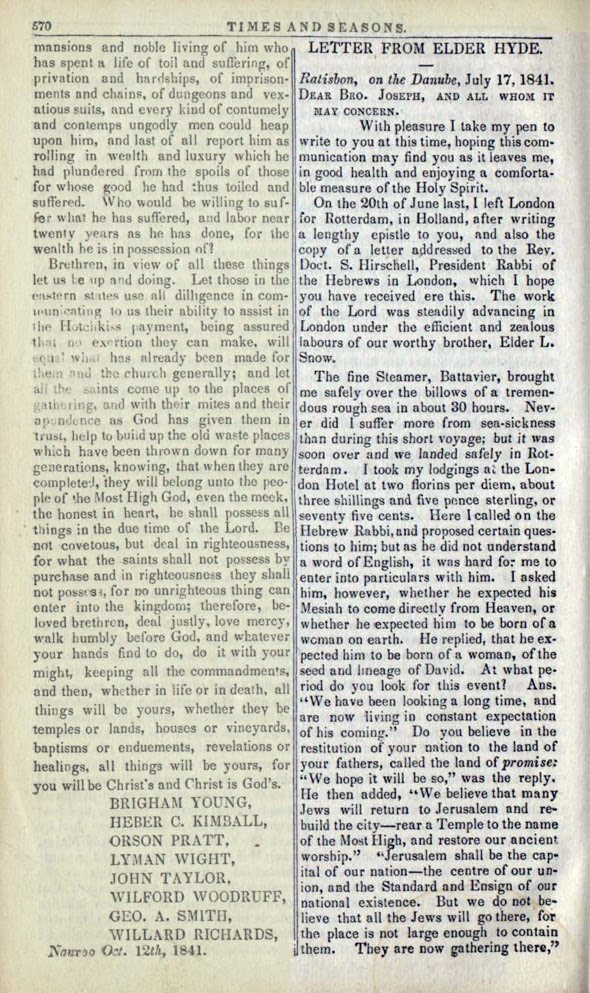
1. The land of Israel is not really big enough for all the Jews.
2. He connected the messianic era with the aliyot taking place in the 19th century.




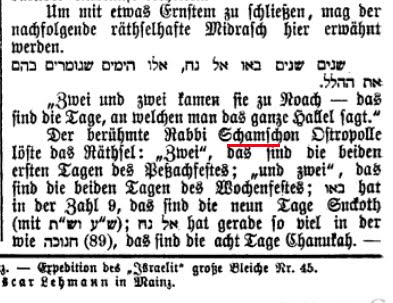

Rabbi Samson Wertheimer employed a tutor for his family named David, who was an apt Talmudist. He later received a position in the rabbinate, on R. Samson's recommendation. Since he was just the tutor working for him, he couldn't bear to call him "Rabbi," but continued to call him David, as before. Once R. Samson was on a trip, and stayed in the community where David was. He visited him, and saw that Rabbi David was studying Mishnah Shabbat 3:12, where it says "If he wrote [two letters; the name] 'Shem' (shin-mem) of 'Shimon' or of 'Shemuel'." So he asked Rabbi David, why didn't Rabbi, the Redactor of the Mishnah (and in fact the direct source of this statement!) say "Shimon, Shmuel, or Shimshon"?David answered, "The reasons seems to be that Rabbi did not say "Shimshon," because Shimshon did not say "Rabbi!"


"La mia fiducia fu anche per qualche temp alimentata da un accidente da nulla accadutomi nel 3 Ottobre (la notte di Kippur), del 1816, e da me, dietro il Talmud (in fine di Joma) superstiziosamente interpretato qual pegno della celeste protezione. Anche questo avvenimento fu da me nell'Ottobre del 1817 celebrato in un- Ode di ringraziamento a Dio.""My confidence was fueled by an accident which happened to me on October 3, 1816 (the night of Yom Kippur), which I superstitiously interpreted as a pledge of heavenly protection, following the Talmud in Yoma. This event was celebrated by me in October of 1817 in an ode of thanks to God."

After Kol Nidre he said Viduy and the four chapters of Tehillim considered a segulah against a nocturnal emission, and then he went to sleep. He awoke, and his heart sank because of what he saw. He'd have to worry all year . . . "Don't laugh at me," he warns the reader. He continues that he was terrified and haunted. For the next 30 days he recited a certain litany of prayers meant to counteract the evil effects of what he experienced. Evidently this mentally exhausted him. He says he throw himself back into Shas and Poskim.אחרי תפלת "כל-נדרי" התודיתי את הוידוי הגדול, קראתי את הארבע פרשיות הראשונות של תהלים, כדרכי תמיד, שהן סגולה למקרה לא טהור – ועליתי על משכבי לישון. באמצע שנתי נתעוררתי בחזקה, וימת לבי בקרבי... ראיתי... כי חייב אני לדאוג כל השנה
.אל תשחק, קורא משכיל, שמא תלבין פני ברבים
[negative responses aren't] directed toward me; they are toward my Autobiography, because they are of the view that I expound on minor and irrelevent things. I know that many readers feel this way. However, I will not change from my way, and if the reader won't be receptive, I won't respond. But to tell my autobiography without referring to small matters, and minor things that are in my memory, what I did and what I thought in my childhood - God forbid that I would not - for my purpose is to reveal the truth, and now that I am engaged in that enterprise, should I not fulfil it? All my days I have been disturbed by the sparse records of our earlier and more recent ones, which we only know through spotty references and legends. So should I not do what depends completely on me? How much good has been lost through fear of the scoffers! In my old age I shall not neglect this important duty. Is there anything more unappealing than a nocturnal emission? But see the recent edition of Kochebe Yizchak, where I published my hymn of thanksgiving that I wrote 46 years ago. I was not ashamed to see it in print. I was glad to see what my contemporaries have to say about it. Maybe now, people will be forthcoming. I'm also glad that now that I have written about it, there is a context for that hymn which I published, which otherwise would be lost on readers. (Igg. Shadal Vol. II pg. 1388 - 89).
I'm surprised that a scholar of your caliber, engaged in careful researches into antiquities, how could you rob the historians of 800 years from now of such gems as these [that I wrote in the letter]? Wouldn't you yourself rejoice if you found a letter like it from the ancients? - even an insignificant one like myself (if it were possible for a rishon to be minor, like an acharon) although us Jews know that "there is no generation which doesn't have one like an Abraham, a Jacob, a Moses, or a Samuel" (Midrash Samuel 9).


"Chief Rabbi, Nathan Adler, the uncle and namesake of the president Chief Rabbi of London. Among his fellow students two were particularly distinguished and attained considerable eminence - R' Abraham Bing, subsequently the Chief Rabbi at Wurzburg in Bavaria, and the celebrated translator and commentator of the Machsor, R' Wolf Heidenheim at Rodelheim. With these two great men, I. B. K. was held in equal estimation by their gifted teacher, who used to say that R' Abraham was a churiph (acute logician), R' Wolf was a medackdeck (grammarian and philologist), bur R' Israel was a chochem, a wise man, because his attainments were universal."I, of course, preserved the original spelling. I normally would like to post an image of the actual page, being a lover of typography and all, but in this case I only have a badly photocopied page, which was subsequently sent as a fax, and then scanned into a pdf. My thanks to Dr. Yitzchok Levine who sent it to, and indeed, wrote a fine article on Kursheedt (link and here).

There was a certain Sadducee who saw Raba engrossed in his studies while the finger[s] of his hand were under his feet, and he ground them down, so that his fingers spurted blood. ‘Ye rash people,’ he exclaimed, ‘who gave precedence to your mouth over your ears: ye still persist in your rashness. first ye should have listened, if within your powers, accept; if not, ye should not have accepted.’ Said he to him, ‘We who walked in integrity, of us it is written, The integrity of the upright shall guide them. But of others, who walked in perversity, it is written, but the perverseness of the treacherous shall destroy them.

"(33) There were no Sadducces in Raba's time, and the word is probably a censor's substitute for Gentile. In J.E. X, 633 bottom it is suggested that he was probably a Manichean. [MS.M: Min (v. Glos.)]."Artscroll ignores it altogether, not even acknowledging the difficulty.

I doubt there was anyone among theTalmudical authorities of his generation who spent so much effort in establishing a correct reading, and who was able to solve as many problems by ascertaining the right Girsa. Characteristic of his attitude was a story about the Gaon and great scholar, Professor David Hofman זצ"ל. I heard it first from Dr. Wohlgemuth זצ"ל, but again and again from the lips of Rabbi Weinberg זצ"ל himself. Professor Hofman was spending a summer vacation in one of the resort in Germany which was also frequented by numerous Rabbis from eastern Europe, among them many Gedolei Torah (Torah authorities). One morning he was asked for the explanation of a difficult passage in Rashi. Professor Hofman looked at it and answered simply that there was a misprint in the text which caused all the difficulty. The questioner remained unconvinced. He did not feel that it was proper to explain a diffculty by a misprint. He called on one of the Gedolei Hatorah from eastern Europe who-interpreting the difficulty-proceeded to construct a proposition of the Gag-al-Gag type and thus solved the problem. The questioner, however, could not withstand the temptation of telling that eastern European Gadol the answer which Professor Hofman gave him. When the two happened to meet, Professor Hofman listened with respect to the Gadol's interpretation. When the latter finished, Professor Hofman said to him: "Do you know what the difference is between you and me? In one-hundred twenty years we shall both come to the Olam Ha'emet. When I enter and they announce that I have arrived, the saintly Rashi will come to greet me. The printers distorted his meaning; I have restored it. Out of gratitude, Rashi will bid me welcome. But when you arrive and will be announced, who will come to greet you? The printers! You have explained and justified them extremely well." Rabbi Weinberg relished this story. It illustrated his own attitude to both Pilpul and the fundamental importance which he attached to the correct Girsa.


I will dress in vengeance [with] the flame of God,Not surprisingly this was seen to be an attack on Christians. If not them, it surely meant the Muslims in the Holy Land. (I'm not sure, and here I'm speculating, but it could be that this is indeed what is meant. "Beis ha-Mitzris," which means "those who afflict" could be a pun meaning the Muslims, since "Mitzris" also means an Egyptian. Thus it means the churches and mosques.
and I will burn the house of akum, and those who afflict.
I will repay half the blood of those killed and captured,
and this will be my consolation.


"Similar to Aramaic. I say that this is the dialect with which the Jerusalem Talmud is written. The Gentiles call it lingua syria."


Moses Henriques is my name,Random, but cool. Actually, what is cool is that it may have actually said "G-d" (with the dash) because in the entry it has "dwelling" spelled "dwel(l)ing," indicating that an "l" was actually missing. There were many Moses Henriques, so sadly I can't know when this was written, but I'm sure it was at least 19th century. If so, that makes Gee-dash-dee older than I imagined.
England is my nation,
London is my dwelling place
and G-d my salvation.


 Posts
All Comments
Posts
All Comments