Showing posts with label Shadal series. Show all posts

Thursday, January 03, 2013

Shadal series #16 - A partial translation of Shadal's letter about the Samaritans and their script

Actually, I plan to complete the translation, but for today it is partial.

In 1851 Raphael Kirchheim - see here about Kirchheim and his cholent - was working on his annotated edition of the Seven Minor Tractates (link) as well as a work about the Samaritans, intended as an introduction to Massekhet Kutim (link). Before these works were finalized at the printer, he asked Shadal to look it over and give comment. Shadal replied that he did not have the time for that, but he would be happy to send him whatever material he had written about the Samaritans, based on his own researches. Most of it was written in Italian, but Shadal rewrote it in Hebrew. Kirchheim printed the entire letter as an appendix in his Karmei Shomron. It contains some interesting thoughts, and here is my partial translation:

I was overjoyed when I heard the news that you are publishing the Seven Minor Tractates, which for many generations languished in obscurity. Today is a holiday! - to find that you are printing them with explanations and notes; among them, your great book Karmei Shomron which, through your broad learning, you elaborated on the history of the Samaritans and all that pertains to them. In your humility, you asked if I would present you with all that I have to say on your words. However, dear friend, time is short, and your printer is demanding. How can I carefully look over and plumb the depths of your work with all the research that your 'pleasant garden' requires [and respond in time]? Therefore, I thought that it would be sufficient for me to present you with all that I have already written (in Italian, for my Grammar of Hebrew, which has yet to be printed) regarding the Samaritan or Old Hebrew script, and on the very old debate about whether the Hebrew script was changed or not. Without elaborating on the matters well known, I will add to that which the researchers have already stated, that if the script was not changed, then it is incomprehensible on what grounds some of the Mishnaic and Talmudic sages would say, from their own minds, such a strange opinion as this, to say that the script with which we write Holy Scriptures is not the original which the Prophets used. Quite the contrary, if the script truly was changed, and some of those sages denied it, we can understand why they would say it: to remove a stumbling block before the masses, for if our Torah is written in a different script from the one Moshe wrote in, this would be bizarre to the weak minded.
However, this proof is external, meaning that it relies on the testimony of the Mishnaic and Talmudic sages. I have an internal proof, from the Holy Scriptures themselves. In my researches, plumbing the depths of our Prophets and Sages, using the critical method, which seeks the truth alone, [this method] not appealing to the old [i.e., traditional Jews] and also not popular among the new [i.e., the Reform Jews], I looked all over the Bible (specifically in the Prophets and Hagiographa, which is not known to them, due to their excess love for the Torah) and found certain words which are errors due to the incompetence of the scribes who copied the books. I did not rush to disclose my findings to the public, because I know about the challenge which such critical research poses, and the many errors which are easy to make. Many scholars and so-called scholars, both uncircumcised and circumcised, boast that they make emendations, but they make errors. In many biblical passages I found what I myself thought was a scribal error, but after days and years I changed my mind and saw that the books' reading was true and correct. With all this, a small bit of the readings which I established in the texts still seem to me correct (now, as a 50 year old man, and after I have passed the passion of my youth) and sustained, above all doubt. Now, of some of these, I discovered that the mistakes happened through the similar appearance of letters, but not in our Hebrew script, but in the Samaritan script.
See how different is the appearance of a yud and a tzade in our Hebrew script (ketav ashuri), but it is the opposite in the Samaritan script, the two letters are almost identical. In Isaiah (11:15) we find: וְהֵנִיף יָדוֹ עַל-הַנָּהָר בַּעְיָם רוּחוֹ (and with His scorching wind will He shake His hand over the River). The root עים is neither Hebrew, nor one of its cognate languages. Therefore it seems to me that Isaiah did not write בעים, but בּעֹצֶם. I wrote this in my notes to Isaiah which I sent the scholar Rosenmueller, alav ha-shalom, and he printed in his 1835 book. Gesenius, in his W?rterbuch, explained עים (following Rabbi Jonah [ibn Janach]) from אָיֹם, but he reversed himself in his great Lexicon, and he took this explanation from me, and wrote that it seems that be-ayam ought to be emended to be-otzem, due to the graphic similarity between the yud and tzade in the Samaritan and other early Near Eastern scripts. [1]
[1] If someone says, maybe Gesenius did not see what you wrote and came up with it independently, much the same way you yourself, [Shadal], in your youth derived "tanur" from "aton nora" without seeing Gesenius - the response is, I have a Latin letter from Rosenmueller dated 24 April 1835, and he wrote this: "Gesenius reviewed all the pages, including your notes, and approved of them." This is not the only thing which Gesenius took from me [Shadal gives three more examples, and the places they can be found in Gesenius' writings - S.]. 
Also the aleph and tav are of similar appearance in the Samaritan alphabet, and from this we can understand what we find in Jeremiah 3:8, "  וָאֵרֶא, כִּי עַל-כָּל-אֹדוֹת אֲשֶׁר נִאֲפָה מְשֻׁבָה יִשְׂרָאֵל, שִׁלַּחְתִּיהָ, וָאֶתֵּן אֶת-סֵפֶר כְּרִיתֻתֶיהָ אֵלֶיהָ; וְלֹא יָרְאָה בֹּגֵדָה יְהוּדָה, אֲחוֹתָהּ--וַתֵּלֶךְ, וַתִּזֶן גַּם-הִיא," "And I saw, when, forasmuch as backsliding Israel had committed adultery, I had put her away and given her a bill of divorcement, that yet treacherous Judah her sister feared not; but she also went and played the harlot." There is no doubt that Jeremiah did not write "וָאֵרֶא," "And I saw," but ותרא, "And she saw." The opposite (e.g., a tav replacing a proper aleph) occurs in 1 Samuel 24:11[sic; it's actually 10]: "וְאָמַר לַהֲרָגְךָ, וַתָּחָס עָלֶיךָ," "and some bade me kill thee; but mine eye spared thee." But its true reading is "."
Next follows quite a few other example, which I will return to and translate, but in the meantime, the two (one and a half, actually) above will suffice. 
Returning to our subject, that the scribal errors we mentioned arose, without a doubt, because of the graphic similarity of letters [only] in the Samaritan alphabet, is in my view a faithful witness that the script changed and that our books were not originally written in our Ashuri script, but in the one which remained in use among the Samaritans. It is true that changing the script, and writing the holy books in a new script, not previously used by the Prophets for their books, does seem extremely odd. Not for nothing was the matter difficult to accept for many Jewish scholars and non-Jewish ones, so it seemed to them false, and they accepted the wrong opinion [i.e., that Ashuri was older]. But all this is because they didn't understand the reason, they merely heard the idea that the Jews changed the script, but lacked any idea about why, until they were left with the wrong view, that it never happened. If they had known the reason, and the circumstances which caused the Jewish sages to change the script, they would have been able to accept it, and would actually have thanked their predecessors [i.e., the sages, for changing it]. For it is known that the Samaritans tampered with their Torah and introduced many changes into it, large and small. This thing was a stumbling block for the simple Jews, because the Samaritans could, for example, point to what is written in their Torah at the end of the Ten Commandments, "And it will be when the Lord, your God, will bring you to the land of Canaan, which you have come to inherit, and you will establish large stone monuments and write this song upon them, etc. and when you will cross the Jordan you should establish these stones which I command you this day on Mt. Gerizim and build their an altar, etc. - from here is proof to say that their Temple [on Mt. Gerizim] was the spot chosen by God, and not the Temple in Jerusalem. So because of such changes by the Samaritans, the Jewish sages were smart and figured out a way to stop this problem and make a clear, lasting change between our proper books and their improper ones. They found no greater change than to write our scrolls in another script, so that even a simple person could see a Torah of a Samaritan and discern immediately that it is unfit. 
This reason for the change of script was hypothesized by my beloved son Ohev Ger, the Lord keep and strengthen him. It is possible that this was what was intended by Jerome on Ezra (from his version of the Chronicon by Eusebius): "[Ezra] collected the holy Scripture, that they might not be mingled with the Samaritans, [and] changed the Jewish letters." [I reject] the understanding of this passage in Eusebius by Rabbi Azariah, that the  script was changed in order to prevent the physical mixing of the Jews and Samaritans, but in order that the Torahs should not mix! - as he wrote, "divinas scripturas"  
Actually, the change in the script did not occur in the days of Ezra, but later, for we find also in the book of Ezra and Chronicles scribal errors which are due to the similarity of lettes in the Samaritan script. Furthermore, when they changed the script they only prohibited its use for Scriptures, but they still used it for other writing (like the rabbis said, it was left for the plain folk). This is the cause of why we find coins from the Hasmonean era in the Samaritan script. In those times there were two Jewish scripts, one used for secular and one for holy writing. In the end the holy script prevailed, and the earlier script which was left for plain folk, was also abandoned, and remained in use among the Samaritans only. 
Now we will discuss the names which the Samaritan script was known by in earlier times. In the Talmud we find it called Ktav Ivri, and also the Samaritans themselves called it Ktav Ivri, for they called our script Ktav Ezra; see their letter to Scaliger of the year 5349 (1589), which was printed in the book Repertorium fur biblische und Morgendlaendische Litteratur vol. 13 [pp. 257 - &c.]. Now, Rashi to Sanhedrin 21 explained "Ktav Ivri" as "of the people who dwelled over the river [i.e., Euphrates]." This explanation is justified on account of Sabbath 115 and Megillah 18, which refer to Coptic, Ivrit, Elamit, Medite, and Greek, and the intention there is to foreign languages. But how could this explanation pertain to the script in which the Torah was given, which was the ancient Jewish script, similar to the Phoenician script used by the people of Tyre and Sidon? Perhaps Rashi believed that the Samaritan script truly came from over the river, and was used in Eretz Yisrael in the time of Abraham, and from their it came to Israel, only he did not know (and it was impossible for him to know) that also the people of Tyre and Sidon used this script. And when I looked into it, and realized that Ktav Ivri [in this Talmudic text] did not mean a script used in the Land of Israel, and this was at the beginning of the Second Temple era, when Israel was reigned by the Persians. The Persians, who dwelled in the east, called the land of Israel and her environs to the west, "Ever Nahara" (Ezra 4, 5, 6, 7). From the expression of the king and the nobles, the Jews themselves, as well as the Samaritans, began calling their script by the name Ktav Ivri; note that the expression "ever ha-nahar" doesn't refer to any one side of the river. It's primary meaning is either side of the river, and depends upon the perspective of the speaker or listener. (To learn more in depth about "ever" see Gesenius' Thesaurus p. 986 and also what I wrote in Hamishtadel at the beginning of Deuteronomy) After the dissolution of the Persian Empire, the term "Ivri" returned slowly but surely to its original meaning, Aram Naharayim (hence the Talmudic list, Ivrit, Elamit, Medit) and the word "Ivri" as referring to Israel was from then only used in the phrase "eved Ivri" (for so it is called in the Torah), and Ktav Ivri (for this was its name as it was used by the Samaritans, who actually used the script). For this reason R. Abraham de Balmes, R. Azariah de Rossi and others who did not call the Samaritan script "Ivri" but "Ktav Ever Hanahar" were being inexact. 
Sanhedrin 22, we find Ktav Ivri called "Ro'etz," and in Yerushalmi Megillah (first chapter) we find it called "Ra'atz" (i.e., without the vav). The scholar R. Moses Landau writes in his book Geist und Sprache, p. 104, that Ra'atz is like La'az. However, the word "la'az" was well known and used constantly in the language of the Mishnah and Talmud, so who could believe that it was mistakenly changed to ra'atz? Or to say, as a few scholars do, that the idea of ra'atz means a broken script (Fractur) is impossible, since the root of ra'atz doesn't mean broken in scriputral Hebrew, but only in the Hebrew language of the Mishnah and Talmud. When I looked into it, this is what I concluded. Now, the Samaritans refer to our script as "Ktav Ezra Ha-arur", the Script of Ezra the Accursed, (see their letter in the aforementioned Repertorium 13 pg. 273). Therefore the Jews, to retaliate, also coined a term of opprobrium for their script, and took the name of Ezra, which they used in referring to ours, and changed the letters around, also exchanging the letter zayin for a tzade, and came up with the term ra etz, intending "breaking." What is this like? Like Bar Kokhba, whose name they changed to Bar Koziva, or like Evangelion, which they changed to Even Gilyon - even though the terms "kazav" and "aven" are atypical for Mishnaic language, and are only used in Biblical Hebrew. [i.e., so it does mean "Broken" after all, and a clever inversion of "Ktav Ezra"] 
When the Talmud asked, "What is Ktav Ivri?" Rav Hisda replied, "Ktav Livuna'ah." Many think this is one of the names for Ktav Ivri (including Gesenius). To me it seems that as the Samaritans lived in Israel, and not in Babylonia, and Ktav Ivri was unknown in Babylonia, so when they asked Rav Hisda "what are the hedyotot" he answered "the Samaritans." Then they asked him, "What is Ktav Ivri" but Rav Hisda did not know to answer "the Samaritan script," since he was unfamiliar with it. So he answered "Ktav Livuna'ah," which did not mean exclusively the Samaritan script, and it must have been a script known at the time in Babylonia, and [perhaps] it was somewhat similar to the Samaritan. And truly these writings are found in the ruins of Babylon and Nineveh on bricks. Some of these [=cuneiform] slightly resemble the Phoenician and Samaritan (see Kopp "Bilder und Schriften" II 152, 154) and Layard in "Nineveh" (Paris 1850) p. 173). R. Moses Landau in his book Ma'archei Lashon (p. 875) explained the word "Livuna'ah" from the term "levenah," (brick), but this is impossible. First, because of the vav after the beit, as it is written in the earlier printed editions, as well as my old manuscript of the Aruch, under the entry Ktav. The second reason is that the bricks [=tablets] in Babylon are not at all similar to the Samaritan, most are written in cuneiform, only the tiniest fraction are alphabetic. So I say that the term Livuna'ah does not refer to the Samaritan alphabet, but another script, and the true meaning of it is not possible for us to determine.
After this follows several pages on the poetic language of the Samaritans.
This is sufficient because of the lack of time. You my dear lerned friend, rejoice in your work, and rejoice all who love Torah and her aids. Peace to you and yours, signed Padua 9 Sivan 5611, your friend Shadal.

Monday, November 26, 2012

Shadal series #15 - On Shadal's unusual rabbinic ordination - a guest post by Daniel A. Klein

One day I was lazily browsing through a microfiche reel and I suddenly stopped. It was the long lost semicha certificate of Samuel David Luzzatto! I copied it and promptly took it home and asked Dan Klein to translate it for me. 
Actually, I kid. I was looking for it of course. After Shadal's passing in 1865, his son Isaia made it his business to collect and publish as much of his father's literary legacy as he could (or wanted to; I've seen one too many references to letters in archives that contained more material than was actually published in, e.g., Igrot Shadal). One interesting thing, which he evidently considered fairly ephemeral, he chose to publish in August of 1877 in a magazine called the Corriere Israelitico (and, unfortunately, only in Italian translation without the original Hebrew). This was the text of a certificate of rabbinic ordination awarded to Shadal by the Chief Rabbi of Gorizia. 
In his own memoirs Shadal writes that his primary teacher, Rabbi Eliezer Abraham Ha-levi of Trieste, informed him at age 15 that he could be on track to receive rabbinic ordination at age 20 if he chooses. Shadal, however, did not consider himself suited for the rabbinate, being shy on the one hand, and dramatic and harboring lofty visions of scholarship for its own sake, on the other. So he declined. To which his rabbi remarked: "Luzzatto wants to be a hakham, but not a rav." 
As shocking as this sounds now, apparently in Italy one was called to the Torah as one had been ordained. (I know!) Thus, even if you were already a world-renowned talmid hakham, and even the teacher of a rising percentage of all the Italian rabbis to-be, without rabbinic ordination one could not be called to the Torah as a rabbi, not even Shadal. 
So digging through the dusty, squeaky, heat-emitting microfilms I located Isaia's article, took it home, and shared it with my friend Dan Klein who was inspired to translate it. Read - or skip - to the end. 
Actually, the article consists of two separate documents, and a short letter by Shadal. Isaia explains that the first is a recommendation letter by the Chief Rabbi of Trieste (Abram de Cologna, formerly the Chief Rabbi of Paris) and the second is the text of a semicha granted to his father by Isaac Samuel Reggio's (Yashar) father, Rabbi Abraham Reggio. Included is SDL's reply to the elder Reggio. Although Isaia is not completely sure, he guesses that the reason this ordination was given to his 38 year old father was  that the powers-that-be at the Rabbinical Seminary where Shadal taught considered it unseemly for him, one of its two teachers, to lack ordination, and instructed him to get it. This would make sense, as why else would he have gotten such an honorary degree, so to speak, from his friend's father? Perhaps the rabbi was the only one he didn't feel like a fool writing to ask for it. On the other hand, perhaps someone else (the younger Reggio himself, for example) was the one who asked for it. The latter interpretation might be inferred from Shadal's response to the semicha, also included here, in which he says it was "unexpected." Taken literally  - it was unexpected. In any case, here it is. 
Thanks, Dan! - S. 
PS A partial translation of this article did appear once before, but it is long lost, I believe. If and when I publish my Shadal essays both versions will appear, at least if Dan is kind enough to give his permission to me.


A Certificate and a Diploma for Samuel David Luzzatto

I believe I am doing something that will be appreciated by the readers of the Corriere, and especially by the people of Trieste, by offering them two unedited documents regarding the life of my revered father and their illustrious fellow citizen, extracting these documents from a long series of Materials Concerning the Life of Samuel David Luzzatto that I am busily collecting, and for the compilation of which I appeal for the cooperation of all the friends of S.D.L., but especially that of his scholars, those of the Schools of Padua and Trieste, some of whom have already accepted my proposal most eagerly.

It is only proper that these documents should see the light of day for the first time in that Trieste which gave him birth, and which still preserves so vividly the traditions of that Samuel David son of the "tornidor" of Pondares,1 who, as long as he lived, gloried in being its son.

The first of these documents is in Italian, because it evidently was made use of in the application for the professorship at the Istituto Rabbinico of Padua.

The second, which is actually a rabbinic diploma, set forth in Hebrew and written in the antique style on parchment, was translated into Italian at my request by my dear friend, His Excellency Moisè Coen Porto, Chief Rabbi of Venice,2 overcoming more than a few difficulties that arose in the translation process whenever an exact and faithful version was sought to be made, rather than a free paraphrase. Whenever a request is made to me to publish the original itself in some Hebrew publication, I will willingly furnish a copy.

This document was written on April 26, 1838, and in a letter written two weeks later (May 10, 1838) by the illustrious Isaac Reggio to my father, I find the following postscript: "After having written the present letter, today your paper directly reached His Excellency my father [Abraham Reggio], who renders thanks to you for the courteous expressions used in his regard."

Concerning the relevant request that must have been made by my father, I have found nothing, either in the copies of his letters or the letters in his own hand in my possession. However, from a letter of his of April 19, 1838, I perceive that on the previous day he had arrived in Gorizia, taking lodging in the Reggio home.

With respect to the motive that could have induced him to seek this title of Hakham, although it was quite alien to his nature to seek titles, lacking for the time being any positive information, I will make a simple hypothesis: I suppose that since his distinguished colleague, Prof. Lelio della Torre, had already been bestowed with the title of Rabbi, while my father possessed merely that of Maskil ve-Navon, as may be inferred from this document itself, the director of the Institute wanted my father, for the sake of the Institute's own dignity, to procure a similar title from some distinguished rabbi, especially for the solemnities attending the opening and closing of the Collegio, which were probably conducted in the synagogue, and that my father, having gone to Trieste and Gorizia in April 1838, spoke about it with Reggio.
Dr. Isaia Luzzatto
Padua, June 27, 1877*

* After having written the above, I found within a bundle of various autograph writings of my father a rough copy of a letter addressed, on May 8, 1838, to His Excellency R. Abraham Reggio, which I transcribe here in its entirety:

Most excellent Sir:

The most honorable letter of Your exalted Excellency3 and the attached Diploma were as sweet to me as they were unexpected4, and they afforded me a new proof of that goodness which so eminently distinguishes your character. I will always regard as the greatest of my honors the approbation of the venerable Nestor5 of the Rabbis of our age, whose wisdom, piety, and virtue I affirm as equally exemplary, notable, and renowned.

May Your exalted Excellency continue to inspire, for many more happy years, the joy of all those who have the good fortune of knowing you, and to receive the deserved homage of your admirers and devotees, among whom will always have the glory of being counted.

Your humble and most obedient servant,
S.D.L.
Padua, May 8, 1838

Here, then, are the two documents:

Certificate by Rabbi Cologna

I attest that Signor Samuel David Luzzatto, a native of Trieste, is recognized here as a man of exemplary morality and of the finest character; that he is distinguished for his vast knowledge in various branches of literature, both sacred and secular; that he is a professor of Hebrew language and sacred exegesis, and is a profound philologist; and that he has acquired a distinguished reputation as the author of various compositions published by him, which have obtained full approbation on the part of the literary public.

I attest, then, that the said S. D. Luzzatto is, in my judgment, indisputably capable of occupying, with respect to said subjects, the chair of Professor in a Rabbinical Institute.
Chief Rabbi A. Cologna
Trieste, November 11, 1827


Diploma
In the Name of God

O contemporaries, see this new flask that is full of old wine, the oldest, without adulteration. An all-containing cluster, a reasoning thinker and intellectual like Halcol and Darda†, in Bible as well as in Mishnah and Gemara.

This star that emits a splendid light is the wise and intelligent Signor Samuel David Luzzatto, Professor at the Collegio Rabbinico of the famed city of Padua. The lion of society, who points the plain way to men of heart who eagerly learn in his school the statutes and laws of God in clear language. Renowned grammarian of the twenty-four books, celebrated poet in rhyme and meter. Behold, it is he who, from the chair of instruction, guides them on the path so that they may know and make known the things prohibited and lawful, together with morality, until they become chiefs of communities, in whatever places they may find shelter; hence (it may be deduced that) he who causes to be done is greater and more honorable than he who does. Seeing this great phenomenon, of which there has not been the like for centuries upon centuries, and his great wisdom in all and for all, to his friends and acquaintances I say that clear are the courses of the river of his wisdom, and that he has force and vigor. I say, let not his erudition be enclosed in a corner, notwithstanding his pure humility, and notwithstanding that titles and ranks of dignity have no importance to him; everyone should take hold of him as a shield and buckler, and thus the inhabitants of the world will see how great is the office of the law.

Therefore my heart tells me, and I have the word (ready) on my tongue, to exalt him and to crown him, throughout the regions of Israel, with the Rabbinic cloak of royalty, for to him pertains the firstborn's share; and with the assent of the Heavenly King and of the Tanna and Amora‡, I place my two hands upon him and invest him with a glorious crown, and I authorize him to be called to the Torah with the title of "the most excellent, learned, intelligent, and wise Signor Samuel David Luzzatto (Magnalad Achacham)6; this is an honor that comes of its own accord to one who bears the heavy weight; let this be done so that all the Community of Israel may hear and say, "This is the Law, and this its recompense."

And now, with palms stretched forth to Heaven in awe, I pray that God may render great and mighty the Professor of His just law, and that He raise him to all the rabbinical degrees in abundant and overflowing measure, with long life, plentiful sustenance, and riches of every kind. Amen, may this be His will.
These are the words of the weak voice of the one who is placed in the position of religious authority here in Gorizia and its environs, who writes and subscribes with his seal, today, the first of the month of Iyyar of this year (whose number is derived from numerical value of the plene form of the word biyrushalayim in the verse [Zech. 2:16]), "And He shall again choose Jerusalem" ([5]598).

The words of the Hebrew servant whose name is Abraham Reggio.

1 "Tornidor" is evidently the Trieste dialect's equivalent of the standard Italian "tornitore," meaning "turner" or "woodworker." This was the occupation of Hezekiah Luzzatto, Shadal's father. The family lived at 1306 Contrada Pondares in Trieste.
2 Porto (1834-1918) was a student of Shadal at the Collegio Rabbinico.
3 In the original, "Sua Magnalad Ecc.ma," a combination of Hebrew and Italian; magnalad is the Italian Jewish pronunciation of ma'alat.
4 Emphasis in the original as transcribed by Isaia Luzzatto.
5 Nestor, a character in Homer's Iliad and Odyssey, came to be a proverbial figure of an elder statesman and wise counselor.
† Names of wise men in the time of Solomon, see I Kings 5:11 [note by M. Coen Porto].
‡ "Tanna" is the author of the Mishnah and "Amora" is the author of the Gemara; here this means, with the assent of the greatest celebrated Rabbis [note by M. Coen Porto].
6 The Italian Jewish pronunciation of ma'alat ha-hakham, "the exalted scholar," i.e. Rabbi.

Wednesday, May 16, 2012

Shadal's series #11 - coping with the loss of a daughter.

Certainly not to minimize the many tragic losses people suffer every day, yet there can be little doubt that in earlier times untimely death was lurking ever closer, with minor illnesses posing greater threats. Hardly a family was untouched by the Grim Reaper and the loss of a child or more. So it was with Shadal, who lost several of his children. Originally, the apple of his eye was his eldest son, Ohev Ger, who many believed (the father included) was possessed with an even greater mind than his father. He died in 1853, aged 23, and with him Shadal's dream of a scholarly successor. 

Of his other children's deaths, one which struck him particularly hard was the loss of his 18 year old daughter Miriam, who died the night after Shavuot, 1862. He had grown extremely close to Miriam, his oldest child by his second wife, and as we shall see, he studied with her, and of her own initiative she made herself very helpful to him. Always a man dealing with his own illnesses, he had become blind in one eye as a relatively young man. In his middle age he also lost most sight in his good eye, and of course this constrained him, since pretty much all he did was read and write. Miriam stepped up and from that point on she copied all his letters (his practice had been to actually write two copies of each letter, one to send and one to save). From time to time Shadal letters turn up on the market. If you have one from those later years, it may have been written by Miriam.

When she suddenly became sick and then died, he was heartbroken, as all parents are. He wrote movingly of this loss several times.

In the 1870s Shadal's son, the physician Isaia Luzzatto, began to publish many of his father's letters and writings. In 1878 he had an index of Shadal's letters printed, the Index raisonné des livres de correspondance de feu Samuel David Luzzatto, which not only lists all (or at least many) of Shadal's letters, broken down by date and language, but also includes short notes describing the content of many of them. The purpose of this index was to pave the way and whet the appetite of the public for the actual collected letters, which were eventually published in two separate collections; Igrot in Hebrew, and Epistolario, which gathered letters written in Italian, French and Latin. Isaia also included some specimens of letters at the end of the Index, as well as a couple of French poems, of a personal nature. One of them was written on the loss of Miriam and is dated the day after she died. Here is my translation:
6 June 1862 
My Daughter is No More 
After thirteen days of illness
(Febris miliaris)
At 2:30 this morning 
She ceased living.
She was a force of brightness,
A superior mind.
Disregarding human weaknesses
(without affectations)
Extremely rare for her sex. 
Like that! my last hope vanished
I had hoped for a son, my pupil. (I had a lot of trouble with this line. Help?) 
She studied with me all of the Torah,
Also half of Kohelet
And after learning that 'all is Vanity,'
At eighteen years
She left this world.


He wrote at least two more letters describing her virtues and his devastation at the loss. One was written in French, the same month, and is printed on the next page in the Index:

It describes how he continued to cope with the loss. Here is my translation:
". . . the world lost an angel of virtue, intelligence, diligence, modesty and beauty. A mind superior to its age and sex. She lived 18 happy years, then began to suffer, for her mind was above rank. Death delivered its inevitable sentence. Her father and mother remain forever inconsolable; this affliction will not fail to produce its positive effects. . . The wise man knows he is an instrument for the Most High, and he sees this.  
"At first he is angered when events do not go his own way: לאויל יהרג כעש ('Anger kills the foolish man' Job 5.2). Then he adjust to the will of one wiser than his, and strives to task it imposes on him. It does not yield to blind necessity - it obeys the supreme wisdom. He is not a Stoic. He is not a bigot. He sees the final reasons, he loves the eternal wisdom, and is happy to go where it calls, ודי בזה, and this is enough.  
"Sir, I received your two letters. Your words, your sympathy have relieved my pain . . ."

Finally, he wrote a Hebrew letter to Eliezer Lipmann Silbermann about one month after Miriam died. Here it is:


"God's hand touched me and took her from me these 30 days ago, the eve after Shavuot - the beloved of my soul, my only daughter[1] Miriam, aged 18. None was like her with her combined qualities of intelligence, good character and beauty. This has further weakened and aged me, all the more as I see my wife in great sadness, inconsolable.  My daughter had no other teacher but her mother, who read with her French, Italian, and German authors, and with all this, she was constantly involved in the housework, major and minor work, ironing and so forth. She even taught herself to write in Rashi script and to read and write Greek. She began to copy my letters, for her desire all her days was to help and assist, without any self-aggrandizement. Her face appeared like God's angel, delightful to all who saw her. Her wisdom and righteousness were apparent in her countenance, while she was modest and quiet. She was healthy and strong all her life, and in 13 days she took ill and died, and no one knows what her illness was. "
[1] His first daughter, Regina Malkah, was born in 1833 and died in 1851, also aged 18.

Sunday, January 15, 2012

Shadal series #10 - historical notes to a book on 2nd Temple sects, and how the Master understood the story of Shimon ben Shetach and the 80 witches.

In 1844 Aurelio Bianchi-Giovini (1799-1862) pulbished a history of the Jews and their sects during the 2nd Temple period (Storia degli Ebrei e delle loro sette e dottrine religiose durante il Secondo Tempio; link).

Here is Giovini, who was a Protestant convert, and is noted as a very anticlerical (specifically anti-Catholic) writer:


This book includes an appendix of thirty pages of notes by Shadal, whom Bianchi-Giovini calls "mio amico." The author writes that most of the notes only correct small things, and some of the more major ones are just differences of opinion relating to their differing worldview. However, he says, this isn't the place for a controversy, where everyone ends up still thinking as they did before anyway, so he prints them so that the reader can read them and decide and form their own opinion. Nice!

On pp. 108 - 09 of his book there is the following paragraph:
A tradition has been preserved documenting the bloody tendencies of the time, when passions and prejudices reigned. Under Alessandra, her brother Giuda [sic] Ben Scetah and Giuda Ben Tabai ascended to power as Nasi and Patriarch of the Sanhedrin. In charge of that body, they allowed violence of all kinds, under the veil of religion and justice. Under the pretext of sorcery, Simone once arrested 80 women in Ashkelon, who fled to a cave, and he hanged them all in one day. To justify this atrocity, it was said that Simone was incited by a holy man who told him of his vision of Hell, where he saw the punishment for the Nasi of Sanhedrin if he did not exterminate the witches.
For his part, Giuda Ben Tabai cut of the head of a man accused of being a false witness, solely to refute the view of the Sadducees who did not subject a false witness to extreme punishment unless he had caused the death of the accused through false testimony. The public was very upset by this act, and word spread among the masses that you could hear groans every night at the tomb of the executed man. Simone Ben Scetah confronted his colleague, who it is said did penance, but Giuda did not fail to rebuke him too for being quick to shed blood. Each one complained to the other of cruelty, and both pretended to be more moderate and pious. It is said that Simone was so quick in judgment that the sentence was often not sufficiently established to prevent an unfortunate death. Because of the incident with the witches, his son was falsely accused in retaliation, and the council condemned him to death according to the code set by its Nasi. Realizing that he was at fault, [Simone] condemned the extreme sentence for the youth, and with the sorrow of a father, the execution would have proceeded if the false accusers had not admitted the truth.
In the table of contents, this section is called "Simon Ben Scetah e Giuda Ben Tabai, loro severita," "Shimon ben Shetach and Yehuda ben Tabbai, on Their Severity."

Shadal inserts a note for this section (pp. 606 - 08). Here is what he writes, quoting directly from the book, and commenting afterward:
On pp. 108 - 9 - Giuda ben Tabbai and Simeone ben Sciatach (Note: I have preserved both of their Italian spellings of these two names, as I did in the text translated above) are gratuitously represented here as men who "allowed violence of all kinds under the veil of religion and justice." Jost, a sufficiently bold writer, paints a very different picture (III, 84 - 93). "Under the pretext of sorcery, Simone once arrested 80 women in Ashkelon, who fled to a cave, and he hanged them all in one day." Why on a pretext? What militates against a legal presumption in favor of the judge's sentence? Is it likely that a man (and note that this is not a celibate monk, but the father of a family) secretly harbored deadly hatred toward 80 women? But — it will be argued, the accusation is itself absurd — imaginary accusations of witchcraft is a crime no less than water poisoning, and the like, which in barbarous times served as a pretext for many, many atrocities.

My answer: I do not know if witchcraft (its effects, apart from the causes to which they are attributed) is absolutely absurd (see Ennemoser "Geschichte der Magie," Leipzig 1844). Suppose it is. But the Mosaic Law expressly recommends (Exodus 22:17) to not allow a witch live. What could this judge do? He had left things alone for a long time, but when this scandal came out among the people who began to dream or say that he deserved Hell for his negligence, he could not help but to make legal inquiries into the matter, and he found that those women were practicing what was then called witchcraft and he could do nothing but condemn them to death. It happened then that his son was falsely accused of a capital offense and also sentenced to death. As the innocent young man was about to be executed, the accusers recanted. Simeone wanted to save his innocent son, but the son said: Father, if you want to do something positive for the public good, let me be like the threshold that is stepped on by everyone, without regard for me. Simeone let his son perish according to the law so that this terrible example would ensure respect for the law. It would frighten slanderers and also the wealthy, who would fear playing the courts if they would make them pay dearly for their retractions. (i.e., it shows that false testimony, where witnesses can't retract, is a grave matter. - S.)

Moving on to Giuda ben Tabbai. The Sadducees claimed that false witnesses were not to suffer the penalty of death (to which the Mosaic Law already condemned them) unless the accused had already suffered that undeserved punishment. It happened that only one of the two witnesses in this case could be proved false. The testimony was therefore left ineffective, and the slandered one was acquitted. But the witness was not found less guilty [even though the other witness was not discredited]. Giuda ben Tabbai wanted to punish the false witness to give an example, so that all should realize that the law punishes false witnesses. Despite Giuda's good intention, Simeone reproved him rigorously, and reminded him that the traditional law acknowledged that the witnesses did not incur the death penalty for slander when both of them were not proven false. The book says: "something positive for the public good," etc. Why not report it as it says in the Talmud (the only source for these stories)? It says that Giuda was going to prostrate himself on the tomb of that witness asking forgiveness. A voice was heard. The people believed that it was the voice of the dead, and Giuda said: The voice, when I am dead, you will not hear it anymore. " (i.e., it was Giuda's own voice, lamenting his guilt.) But "Giuda did not fail to rebuke [Simone] too for being quick to shed blood," the Talmud does not say this.
His reference to Jost may be unclear. Jost was a very celebrated Jewish historian who wrote a multi-volume History of the Jews (and translated the Misnah into German, which is interesting because the Tiferes Yisrael sometimes cites him, unnamed of course). He was not exactly particularly sympathetic to the Talmudic rabbis and could hardly be called an apologist for the rabbis or Talmudic tradition. Zinberg writes of him "בכלל, די פירושים, ווי זייערע גייסטיקע יורשים - די רבנים פון די שפעטערע דורות, זיינען יאסטן ניט וויניקער פארהאסט ווי [דוד] פרידלענדען," "In general, he hated the Pharisees and their spiritual heirs, the rabbis of later generation, no less than [David] Friedlaender . . . " Even if Zinberg exaggerates, this is what Shadal meant by noting that Jost was a "bold" writer, and it is therefore worth citing him since his non-apologetic portrait of Shimon ben Shatach and Yehuda ben Tabbay portrait is softer. Shadal's personal relationship with Jost is interesting. This is not the place to explore it in full, but suffice it to note that when Shadal assumed his post as Professor at the Padua Rabbinical Seminary he was recommended Jost's volumes of history to use for teaching his students, and he was appalled by what he read. So he began to write his own teaching material.

A lot of the Shadal correspondence to Bianchi Giovini is printed in Epistolario, his collected Italian, French and Latin letters. On page 441 is a letter dated Dec. 18, 1844, apparently Shadal had not heard from him in a few weeks, so he writes: "Nel mentre che il di Lei silenzio mi faceva temere che le 80 streghe fatta avessero qualche malia a danno della nostra amicizia" "Your silence made me think that 80 witches and their witchcraft came between our friendship." He then goes on to discuss his son, whom he was very proud of, who was "conceived amid criticism and antiquities" and his work on the Ethiopian Jews.

Writing once more, Feb. 3, 1845, Shadal congratulates Bianchi Giovini for the immanent appearance in Italy, for the first time, of a volume on the history of the Jews written in a spirit of fairness and impartiality. He then returns to the Talmudic story discussed in in this post, writing that he simply can't resist returning to the 80 witches.

Admittedly, he says, it is possible that some Pharisees took advantage of their favorable political moment to break down their opponents (though not with the same cruelty as the Sadducees dealt with their opponents). He says that it isn't impossible that some partisan female Sadducees were changed by legend into a coven of witches. But, we may ask, how could the Sadducees, who denied angels and demons as part of their doctrine, be susceptible to the charge of sorcery? Assuming than that the Pharisees had acted on a pretext to attack the Sadducees, something other than witchcraft would have been invented, for it is a crime which was incompatible with the principles of that sect. Why were women hiding together in a cave altogether? To practice their esoteric arts. Also, the fact that they lived in Ashkelon and not Jerusalem is significant, for they lived far away from the Court, and could hardly have aroused in the Pharisees a politically motivated hatred. As for the Pharisees, if following the law and putting criminals to death is cruel, then they are cruel and vindictive. If they do not pursue the law vigorously and make few executions, then they are the cause for the demoralization of the people through lawlessness.

Peace out,
SDL

Since Dr. Alan Brill recently posted about Chief Rabbi Hertz's treatment of "Haggadah" in his introduction the Soncino Talmud, which he calls "legend pure and simple." On pg. 313 of the Hertz Pentateuch there is nearly one-and-a-half columns about Witchcraft (Ex. 22:17 'Thou shalt not suffer a sorceress to live'). The comment

- denies there was any reality to witchcraft
- asserts that it negated the unity of God and was "an abominable form of idolatry"
- points out the Septuagint translated "mechashefa" as "poisoner"
- notes that some commentators understand it as a prohibition to allowing witches to thrive, rather than a command to put them to death
- denies that the medieval horrors associated with witch-hunts can be traced to this verse
- asserts that witchcraft, as a "sinister danger to Jewish social life" had ceased long before the 2nd Temple period
- affirms that "both-Jewish and non-Jewish scholars" have studied the Shimon ben Shetach episode and concluded that "it is merely Haggadic"
- that medieval Jewish sages denied the existence of witchcraft
- that torture to exact a confession was unknown and impossible in Jewish judicial procedure
- that Christianity casually disregards the Old Testament, even including portions of the Ten Commandments, and therefore its attitude toward any one thing cannot possibly be based entirely on a single verse in the Old Testament
- the New Testament is a demon-haunted book
- that is is estimated that in Germany alone 100,000 women and girls were killed for witchcraft over the ages
- that as late as 1709 a woman and her daughter were hung in Huntingdon for causing storms by witchcraft

Got that?

For further details on Jewish scholars who concluded that the Shimon ben Shatach story is historical, see the footnote on pg. 220 of Harvey Meirovich's A Vindication of Judaism the polemics of the Hertz Pentateuch.

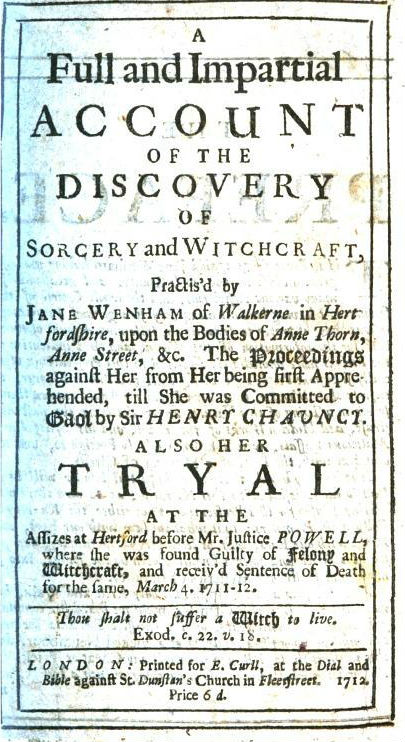
By the way, I am not certain, but I think that the Hertz Pentateuch is mistaken about Huntingdon in 1709. It seems to me that the said witches were hung in 1593. However, it is no joke that a woman named Jane Wenham ran into a whole lot of legal trouble in 1712. Her case aroused a great debate about whether witchcraft was real.


Finally, I include an 1883 representation of Jost's presentation of the Shimon ben Shatach/ Judah ben Tabbai story. I include it especially because of what is written at the end which shows how their story was definitely viewed in those times, an "illustration of the hatred of the two parties, both zealous for the written law, but sacrificing their own lives and those of others for their own interpretation of it. "


Thursday, January 12, 2012

Shadal series #9 - Samuel David Luzzatto's Letter to the Ethiopian Jews

This post is going to have a second part, since there is some intrigue about this letter, which I will mention at the end. First, here is my translation of a fascinating letter printed in Iggerot Shadal Volume II, pp. 1027-29.
19 May 1847 4 Sivan 5607

To His Honor the Great Sage Abba Yshaq, Father and Teacher to our Brethren the Israelites in Abyssinia, Blessings and Peace without Limit:

We learned with great joy that even in Abyssinia there are Jacob's children who observe the Torah of Moses, the Man of God. However, the news which has arrived from your land has been through the medium of men who are not Israelites, and their words are unclear and insufficient to quench our thirst to know the true facts. Therefore I, the small Samuel David Luzzatto who dwells in Padua, Italy, who instructs our God's Torah and is a father and teacher to the youths who study Torah in this land, have sent this epistle to you, inquiring from you to do us a kindness and enlighten us with your reply to the questions which I send to you this day.

First, I ask you to tells us what is the meaning of the name "Falasha" and how did you come to be called by this name.

Second, I ask you when did your branch of the Israelites arrive in Abyssinia.

Third, I ask if the Israelites came to Abyssinia at one time, or gradually, in disparate groups, and if they came in large or small numbers.

Fourth, I inquire of you to know if the Israelites were ever self-ruled in Abyssinia, and if so at what point did you become subjects to others? Were there Israelites who kept their self-rule, and if so are there any today? Are you at peace with the gentiles surrounding you; are you beloved or hated by them?

Fifth, I am yearning to know what language you speak. Is it the Holy Tongue, biblical Hebrew, with which the Torah is written, or another language? What is the origin of the language among you? Would you please write me a bilingual sample of your language, in Hebrew and the language you speak.

Sixth, please tell me when you circumcise your children, and is it true that you also circumcise the girls.

Seventh, please tell me how many months are in your year, what are their names, how many days are in a month, and if your years and months are always the same, or if occasionally you have a longer year than others, and a longer month than others.

Eighth, please inform me which festivals and holidays do you observe, and the month and day in which you practice each one of them. What are your fast days when you refrain from eating and drinking in memory of the travails of your ancient fathers?

Ninth, I ask of you if you have the books of Torah and Prophets, written in their original language, the language of Moses and the Prophets, and what is the number and the names of your prophetic and other holy books?

Tenth, please inform me if you have books other than the Torah and Prophets, and if you have prayer books with which you pray to God?

Eleventh, I ask you to know if you believe as us in the coming of a redeemer, the messiah, who will gather the scattered Israelites from the four corners of the earth, and return us to the land of our forefathers, the Holy Land?

Twelfth, I ask you to inform me if all the Israelites in Abyssinia are called 'Falasha,' or if some are called by another name. Also, do all of you share the same faith and Torah, or are there various sects and customs?

Please do me a kindness and write a learned response to my twelve questions, and give the letter to the man who brings my letter to you. I am also prepared to assist you and do anything good for you in my power. The God of Israel will bless you and all the Israelites who dwell in your land. God bless and keep your eternally, Amen. These are the words of your brother who desires good for you, written here in Padua, 4 Sivan 5607 years from the creation of Heaven and Earth as we reckon it.

The small Samuel David ben Hezekiah Luzzatto.
Now, the context is that at this time reports were reaching Europe about practicing Jews in Ethiopia. Their existence had not been unknown by any means, but only in the mid-19th century was there a sufficient and consistent European presence in Africa. There were reports printed in newspapers and journals about the Beta Israel, and this intrigued Samuel David Luzzatto and, especially, his son Filosseno. The latter, who was only 17 when this letter was sent to Abba Ishak, a Beta Israel elder, became a noted expert on that community, authoring an important book - to the extent that one could be an expert without having actually traveled there.

What is especially interesting about this letter is that Filosseno would also send such a letter; or at least that is what all the literature on the subject says. His letter is extremely similar (but not identical). A couple of years later his letter and the reply from Abba Ishak - there is a reply - were printed in journals and newspapers. My next post will show these. But I wanted to mention here that I have not found a single reference in any scholarly literature on the Beta Israel that acknowledges this letter in Iggerot Shadal. My conjecture is that Filosseno's famous letter was written by his father, Shadal, and he allowed his son to use it to help make a name for himself, or else that letter was a guide for his son. It's really quite amazing that no one seemed to have noticed this before. Stay tuned.

Thursday, December 22, 2011

Shadal series #8 - To what does "Nothing Jewish is Alien to Me" refer?

People say that Franz Rosenzweig said "Nothing Jewish is alien to me" (Google rosenzweig "nothing jewish"), and perhaps he did. This was a play on a famed quotation from Terence (Terentius) "Homo sum, humani nil a me alienum puto" - "I am a human, I hold that nothing human is alien to me."

Some people, but not everyone, know that this Jewish twist on Terence was apparently first stated by Shadal (although it needn't take a genius to have punned it, and perhaps others before or after did so independently). Before I get to the location and context of Shadal's version, Judaeus sum, judaici nihil a me alienium puto - I want to show something wacky. Here is the first page of a missionary magazine called The Peculiar People:


As you can see, the motto of this magazine from Plainfield, New Jersey is "I am Jewish," etc. This is dated 1898. Shadal's letter, from 1842, was printed in the second volume of Igrot Shadal, published in 1894. However, we should not be misled in assuming that the magazine got it from Igrot Shadal, because it existed for a few years before 1894. Writing in 1892, a book about evangelism to the Jews explains that "Die Zeitschrift "Peculiar People" aber, an welcher auch Lucky, ohne seinen Namen zu nennen, mitgearbeitet hatte, wird von dem Sabbatharier Rev. William L. Daland (Westerly, Rhode Island) unter dem Motto: "Judaeus sum, Judaici nihil a me alienum puto" fortgesetzt." This may be before the second volume of the Igrot was published. I say may, because even though the second part was completed in a single volume 1894, it had been appearing in sections first.

In any case, writing in 1842 to Michael Sachs (the piyyut scholar and preacher about whom I wrote here; the same Sachs who was contemplated in Frankfurt as rabbi of the separatists, before hiring Hirsch) Shadal says the following:


"Since you mentioned in your letter the Hiddushei Maharsha, I will tell you a new thought I had about the Maharsha this week. 'About the Maharsha? What do you have to do with the Maharsha,' you ask?

"I reply, "Judeus sum, judaici nihil a me alienum puto" - "I am a Jew, nothing Jewish is foreign to me."

"In Tractate Makkot 3b Rashi writes "if a borrower asks, 'Loan me money on condition that the Shemitta will not cancel my debt. . . " The Maharsha emends this Rashi to read "if a lender says . . ."

"At first though I agreed that this seemed correct, since it would be the lender who would need to say to the borrower "I loan it to you for ten years, on condition that you cannot default claiming that the Shemitta [which occurs every seven years] cancels it." But this explanation is difficult for me, since it seems to me that we should not ascribe this to a copyist's error. While it's possible that a scribe wrote "borrower" instead of "lender" (in Hebrew the difference is the addition or omission of a single letter), but to add the word[s] "loan me" would have to be his own invention, and this is uncommon [for a scribe to add something, rather than merely omit a letter by mistake]. So without another option, I said that Rashi did not write carefully due to haste. After that I thought, that perhaps he was old at the time, and his strength had waned, since when he reached page 19 of Tactate Makkot [it is written that] he died. After that I changed my mind and returned to Rashi's side, because his words seem to me to mean the following: in truth it is the borrower who needs to make this condition, not the lender, for the pauper required the sum for ten years and it is he who requests the loan. Because of the Shemitta, he would need to stipulate to the wealthy man that he will wave his right to the Shemitta cancellation of all debts. Then I considered that the requirement of release falls onto the lender (Deut. 15:2), not the borrower. Then my eyes were opened and I noticed that the language of this passage of the Gemara says "on condition that the Shemitta does not cancel it to me" meaning "that you should not cancel it to me." Rashi found himself compelled to to explain that it was the borrower who said this to the lender, for the lender is unable to say "on condition that the Shemitta should not cancel it to you," he could only say "on condition that the shemitta should not cancel it to me." Thus was Rashi blessed, that to the end of his days his words were pure, and they require study and exactitude. I said to myself, see how far a critic must go in moderately assessing something before passing judgment on the words of God-fearing men, who do not write their books in haste, for financial reward, or for honor. They write constantly to pursue the truth or that which is good."
And before anyone says anything, yes, I am aware that he is acting like he discovered America, while this is, at least in theory, the way a Talmudist is supposed to read Rishonim and do this all day every day. However, Shadal's point here was that he of course knew that no one would have thought that he spent his spare time learning Gemara with Maharsha. In reality he was someone who went through Shas in 18 months beginning at age 16, and it is pretty clear that he knew his way in the sea of Talmud, even if he had instrumental motives for studying it - for example, he could not have written his grammar of Aramaic without becoming totally familiar with the language of the Gemara, and he could not have become familiar with it without studying it. Also, throughout his writings he exhibits a very great broadness in all types of Jewish learning; he quotes the Bavli, Yerushalmi, Tosafot, Rif, Tur, Zohar, She'elot u-teshuvot, and much more. While one imagines that this meant that he knew when, how and where to look things up when he needed to (like most scholars) it is apparent that he was no stranger to the traditional canon.

All in all, this is a most interesting aside and it appears to be the origin of the saying ascribed to Franz Rosenzweig (and others): "I am Jewish, and nothing Jewish is alien to me." It was written by Shadal in 1842 to explain to someone that they shouldn't be surprised that he knows the Maharsha.

Tuesday, December 06, 2011

Shadal series #7 - on alienation from his teachers, and a public retraction.

Shadal was largely an autodidact, but he had four primary teachers. One was his father, with whom he studied Torah from the time he was 3 years old. Another was his adult cousin, with whom he studied daily for two and a half years beginning from the time he was 16. In between he also had some formal schooling in the persons of Rabbi Mordechai Yitzhak Cologna[1] and Rabbi Abram Halevi.

Cologna taught in the local Talmud Torah school, and from him he learned Mishnah, Dikduk, Rashi, Radak, and Latin. As I've mentioned before, he wrote at least three separate autobiographies. In the first one, written in Hebrew in 1837, he says that he felt the following about Cologna: את המלמד הזה היה ש"ד ירא יראת הרוממות גדולה מאד, והיה עושה אזנו כאפרכסת לכל דבריו ולכל שיחה קלה שהיה מדבר עם מי שהיה, והיה האיש ההוא בעיניו לאות ומופת and Shadal credits him with arousing within him a love and appreciation for Hebrew grammar and other good qualities ממנו באה לש"ד אהבת חכמת הדקדוק ואהבת הדיוק בכל פעולותיו ובכל עניניו, וגבורה למשול ברוחו ולכבוש את יצרו ולמאוס בתענוגים; והתכונה הזאת היתה לו לישועה גדולה ולפורקן בימי בחורותיו. Not surprisingly, if someone is viewed with such awe they can fall far from the lofty view, especially if the person is very sensitive, as we shall see.

Shadal stopped attending the school due to an illness at age 13. While in school, he had been studying Talmud with Rabbi Avraham Eleazar Halevi, the Chief Rabbi of Trieste. After recovering from this illness, he continued studying him for several years, until an incident occurred which caused him to stop coming to him.

He writes that sometimes his fellow students misbehaved and would horse around, and at times he would also join in. For example, he writes, sometimes he would say something very pretentious and intellectual sounding and give his friends cause to laugh. The rabbi would rebuke the students when this occurred. One time he mistakenly chastised Shadal, saying "Se non avete a venire che per fare il לייצן (buffone) potete fare a meno di venire," "If you came here to play the fool, don't bother coming." Evidently this was more than this sensitive boy could take, so he stopped coming.

In the meantime, he had been visiting Cologna, who had become blind in his advanced age. He would read to him and assist him in other ways, such as taking dictation. After he had stopped going to his Gemara shiur, naturally he still continued to visit Cologna. He writes that unfortunately coming into close contact with this teacher, whom he venerated as a child, caused him to diminish his opinion of him. One or two months after the incident with the rabbi, when it happened to be Shadal's 16th birthday, Rabbi Avraham had returned home from his summer vacation, and Cologna asked Shadal to send him his greetings. This he was unwilling to do, as he had stopped coming to his class! He says that he lacked the courage to either send the greeting or confess to Cologna the reason why he would not go. Finally, in disgust, Cologna instructed him to accompany him to the rabbi himself, and all the while he lectured him in the finer points of Derech Eretz, how it precedes Torah, etc. Shadal said he became more and more embarrassed and apprehensive, but he had no choice but to go along with him.

Lucky for him, the rabbi was out. His widowed daughter answered the door, and Cologna conveyed a very poetic greeting, quoting the Talmud Taanit 5a "Tree, O Tree, with what shall I bless thee? Shall I say to thee, ‘May thy fruits be sweet’? They are sweet already; that thy shade be pleasant? It is already pleasant; that a stream of water may flow beneath thee? Lo, a stream of water flows already beneath thee; therefore [I say], ‘May it be [God's] will that all the shoots taken from thee be like unto thee’. So also with you . . ." He added, to the daughter, who was simple and unlearned, that he knows that she understood what he had said in Hebrew. All the way back he continued lecturing Shadal on Derech Eretz. Shadal felt nauseated by the display. He felt it was not Derech Eretz at all, but a form of false flattery since he was of the belief that Cologna didn't really hold such a high opinion of the rabbi, who had been born in Eretz Yisrael, and dressed and acted in typical 'Asian', rather than Italian, fashion. It was also a showy display which in reality shamed the daughter. So he stopped coming to him. It was at this time, he writes, that God sent him his older cousin with whom he would study daily . . .

Not surprisingly, when this appeared in print - all the sources will be shown below - there were other students of Cologna who were appalled by this, notwithstanding that Shadal had prefaced the good, the bad and the ugly in his autobiography with a kind of disclaimer about how, gosh, he has no choice but to speak the truth. After speaking to some of these people on a visit to his hometown of Trieste, he sent Hamaggid a public retraction, where he sings Cologna's praises and notes that his other students experiences him in a different way, and they are the fine products of his tutelage. However, he hardly denies that he experienced what he experienced. This is interesting, because Shadal's general way was that he was ready, willing and able to retract his opinion publicly when he became convinced that he had been mistaken. This seems to me to be the only example where he budged on his opinion at all, where he was not quite convinced that he had been mistaken!

In any case, here are some of the sources. The first, below, was written before the Hebrew, but was published second, in 1878:


The second was published in Hamaggid in 1859 (August 16):


As you can see, he explains that before forming his negative opinion he had viewed Cologna as almost an oracle. He also says that he became convinced that his sermons were empty, because he eschewed the peshat, favoring the style of derash. Furthermore, they were designed to show off his bekius (breadth) and charifus (sharpness) rather than to discover the truth. He says that his concept of Derech Eretz was political, and he saw him as a flatterer.

A little over a year later, Shadal sent in his retraction, as described before. Here it is:


He basically says "In Trieste I heard from some honest and honorable men, students of Rabbi Mordechai Yitzhak Cologna z"l, that they were a bit pained by my detraction from his honor. What could I do? The love of truth caused me to tell things which aren't Derech Eretz to say. But for the honor of the truth, I will reiterate that this scholar, apart for his great knowledge in Torah, secular subjects, and languages, was a tzaddik and chassid, a propounder of Torah to many, and implanted in the hearts of his students yirat shamayim and good traits; lucky is the community which had a man like him dwelling in their midst. I see that the negative impression which he formed on me from his sort of Derech Eretz was not formed on his other students; not even one of them attributed it to him. Not even one of them was able to accept a dimunition of his ways and attributes, and they studied and assisted this scholar. From this I see that the man was guiltless, and his manners elevated all who were close to him. Therefore, he was good and lofty in all his ways; and this one student annuls his . . . " Now, I know that some could be forgiven for seeing this as sarcastic. I suspect though that it isn't, since I truly think he would not have thought twice about openly standing by what he wrote. I assume that he was genuinely surprised that the others didn't perceive Cologna this way, but seeing as they didn't, he took it back.

I thought it would be interesting to bring up an unrelated context, where Shadal mentioned Cologna as an exemplar of an Italian rabbinic type. In 1840 the Archives israélites has written a little bit about the Rabbinical College in Padua (which Shadal co-headed) and described it negatively as belonging to the last century, being inspired by the principles of reason espoused by Mendelssohn, and the "Biourim et des Measphim" (the Biurists, i.e., Mendelssohn and his circle, and the Meassephim, i.e., the early Hebrew Haskalah writers). But, it continued, real successors are supposed to take the end point as a starting point. The school may decline to listen to the voice of Reason calling out, "March, March!" but no amount of training in oratory or flowery poetry is powerful enough to drown out that voice. In other words, the school is too frum.

So Shadal sent Jost a letter, which was printed in his Israelitische Annalen (1840 p. 320) and later in the original Italian in Epistolario (p. 375) in which this is quoted, along with Shadal's reply, which was as follows:
If under the rubric of Mendelssohn's principles is the belief that Moses was a true prophet, worker of true miracles, and that his law is still binding for all of Israel, then he is quite right that Reggio and Luzzatto adopt the principles of Mendelssohn. But they do not recognize these principles by Mendelssohn; they recognize them from the same ancient source which Mendelssohn took them.

This great man exercised a great influence over the Jews of Germany and the Northern countries, but only a little over the Jews in Italy, who were not in any century strangers to scientific culture. My principle teacher, Rabbi Mordechai Isac Cologna, was a profound Latinist and a good surveyor. My father, only a turner by trade, knew mechanics well, and studied the works on physics by Benjamin Martin . . .
Getting back to R. Abraham Eliezer, although it doesn't take a genius to read between the lines and realize there was more going on besides a perceived insult, Shadal never wrote a negative word about him. In fact, everything he wrote about him shows that he admired him. He describes how when the rabbi was pained with gout, he didn't cancel the lessons; he would have the pupils come to him while he lay in bed, in pain, and taught. Although his style of learning and teaching didn't match with Shadal's conception of peshat to say the least, he praises him for it. In the Italian, he writes: "Era profondo ed acutissimo nel Pilpul, ma era un Pilpul rotto, nòn mai sofistico, come pure la sua religiosità era rigida, ma sincera./ His style was deep and sharp Pilpul, but not a broken sort of Pilpul, and without sophistry. His style of religion was rigid, but sincere."

Indeed, part of the Cologna incident was over the fact that he felt that Cologna didn't sufficiently respect Rabbi Avraham! He does, however, write that after he stopped coming to his class, he didn't speak to him again for another 9 years, when some communal leader gave the rabbi a copy of Shadal's newly published Kinnor Na'im. Evidently the rabbi liked it, for he bestowed upon him the title Maskil (the Italian equivalent of Chaver). the practical implication is that the title would be used when he would be called to the Torah. He also wrote that while he was still learning with him, the rabbi encouraged him to learn, promising him that if he did he would ordain him at age 20. Shadal, however, had other plans. So the rabbi remarked, "Luzzatto wants to be a Chacham, not a Rav."

Here is what he writes about him in Hamaggid:


I will have more to say about Rabbi Avraham Eliezer of Trieste, who corresponded with the Chasam Sofer, in another post.

Finally, here is Sabato Morais's fine English translation of the incidents, from the Italian:
But while frequenting Rabbi Levy's school I had been in the habit of visiting Cologna—he who had in my childhood inspired me with love for Hebrew grammar. The unfortunate man had become blind, and I would read to him, or write under his dictation what he needed. For, though deprived of sight, the old man continued preaching every Sabbath, and in his lectures he used to quote not only Hebrew authors, but also Italian and Latin.

And here let me acknowledge that the profound veneration I had conceived in my earliest days for that teacher of mine lost much of its depth when I learnt to know him thoroughly. What I had deemed vast knowledge seemed to me now to have been an effort of the memory to retain a given number of things rather than the offspring of a far-reaching intellect. The ideas, which his mind created and which ran through the whole of his sermon, were hair-splitting arguments. His character also, assumed in my eyes the appearance of Egotism, when I perceived that he never would ask me to read what might have contributed to my improvement, but only what proved to his advantage. I felt so, more particularly, because my father had begged that he would let me practice Latin occasionally. His self-love was of a lower grade, for he enjoyed hugely the applause of shallow-pated fellows who admired some of his hackneyed remarks.

The poor man might deserve a less severe judgment, and I do not mean to set myself up for a judge; but as my own historian I register the opinion formed upwards of thirty years ago. The opinion was strengthened by what follows.

Rabbi Levy, who had been staying for some time in the country, had returned to the city. Cologna requested that I would go and welcome him in his name. I, who had left abruptly and not attended the Talmudical lessons for several months, did not have the heart to do the errand, nor could I summon moral courage to confess the cause. Cologna noticed my embarrassment and attributing it to my natural timidity and want of politeness launched into a long dissertation on Derech Eretz (good breeding), quoting the Sages to show that even before the Law had been delivered the world was governed by the inborn sentiment of what is due to one another, and so he went on, preparing to go himself, under my lead, to the Rabbi's house. My embarrassment increased, but there was no alternative, I had to submit. Luckily Rabbi Levy had gone out. His widowed daughter, however, was in, and Cologna lavished upon her compliments, which he asked might be conveyed likewise to her father, concluding with the Talmudical parable of the traveler and the tree. “O tree! What blessing shall I bestow on thee?....... May thy fruit be always as sweet as it is now;” adding, that he knew well she understood what he had said in Hebrew, though he knew better than that. We left the house together and going back he did nothing the whole way but preach to me his “Derech Eretz,” the meaning of which, if I had not rightly caught before, I learnt perfectly from the visit just made.

It was flattery and vile deception. So nauseated did I get with it, that I did not repeat my visits to Cologna's from that very day, which happened to be the 25th of August corresponding with the 1st of Elul, the anniversary of my birthday. The disgust I experienced at that false politeness, practiced towards a man, lightly esteemed—because he was Asiatic and deficient in European culture—and little loved by Cologna, stirred within me a sense of greater appreciation for the unvarnished virtue of him who had been born in Jerusalem, and of distrust for very polished manners.
[1] In some sources he is called Angelo Isach. 'Angelo' was the common Italian kinnui for Mordechai, some say because the Talmud identifies Mordechai and Malachai. As it happens, Shadal himself calls him "Marco Isac" or "Mordechai Isac" in his own writings in Italian, never Angelo. In any case, this aforementioned rabbi died in 1824. I'm not sure what year he was born (even Asher Salah doesn't seem to know, for he doesn't mention a year of birth (or death) in his Le république des lettres: rabbins, écrivains et médecins juifs en Italie au XVIIIe siecle).

However, Cologna's half brother was the more famous Rabbi Abram Hai de Cologna, who served as a leader in Napoleon's Sanhedrin, and subsequently as Chief Rabbi of Paris, and eventually Padua. He was born in 1755 and died in 1832. Presumably then Mordechai Yitzhak was born a little before or after 1755. In addition to teaching in the Trieste Talmud Torah, he also served as the interim Chief Rabbi, before R. Avraham Elazar Halevi was picked. Afterwards, he served as a kind of vice-rabbi; for example, one of his duties was delivering sermons in the synagogue.

I don't know of any picture of Cologna, but here is one of his brother:

LinkWithin

Related Posts with Thumbnails
'