Thursday, September 25, 2008

Another face: R' Chiyos

I'd never seen a portrait of R. Zvi Hirsch Chajes other than the one in the 1906 Jewish Encyclopedia:


Here's another (or, perhaps, a better quality version of the same):

Tuesday, September 16, 2008

Rambama"n's glasses


From here.

By the way, to all those who are concerned - I'm fine, I've just been too busy to really blog. Thanks for asking. Hopefully I'll have more time - the blog is not shutting down, either overtly or due to benign neglect.

Tuesday, August 12, 2008

Italian wedding poetry: Shadal's piyyut in honor of a monarch and his consort

I once posted about the excellent JTS Digital site, and the wedding poem in honor of R. Moshe Chaim Luzzatto that I found there (see here).

I discovered an interesting - error? I'm not exactly sure that what follows was placed in the wedding poem section in error, but judge for yourself.

The following description appears for this poem: Wedding poem for Joseph Franz and Elisheva by Samuel David Luzzatto (Shadal). The description is no different from the other poems. For example, here is another poem by Shadal in honor of Avraham Shalom and Rosa Cohen (written in Syriac, no less, with Hebrew translation).

Here is the poem in honor of the choson Joseph Franz and his kalloh, Elisheva:


(Click to enlarge)

As you can see, this is not a typical wedding poem for a local couple. Franz Joseph, of course, was the emperor of Austria, and Elisheva was his wife, Elisabeth [Amalie Eugenie of Bavaria]. I guess it's kind of funny that the this is not apparent from the listing.

Can you imagine living in a society where good citizenship and patriotism, or the appearance of that, called for the writing of such poetry?

Here is the poem for Avraham Shalom and Roza Cohen. Note how they become "Avraham Shalum and Roza Chahen," ostensibly in accordance with the requirements of Syriac grammar:

Thursday, July 31, 2008

Youthful textual criticism of the Targum to Joshua 9.4 by R. Yaakov Kamenetsky

Here's an interesting excerpt from the Artscroll biography of R. Yaakov Kamenecki, Reb Yaakov: The Life and Times of HaGaon Rabbi Yaakov Kamenetsky by Yonason Rosenblum Based on the research of Rabbi Nosson Kamenetsky (NY, 1993), pg.53:

The following is from the Slabodka period, which begun in 1906.

Another time he used his knowledge of Aramaic to refute aspersions cast by maskilim on the accuracy of the Masoretic text that we have today. In Yehoshua (9:4) the word וַיִּצְטַיָּרוּ appears. Rashi interprets the verb as referring to making oneself an agent. But the maskilim pointed to the Targum ואזדודו which means to load oneself with provisions and is the Aramaic for the Hebrew ויצטידו Thus they concluded that our text is corrupt and that the Hebrew letter reish, ר replaced a dalet, ד. But Reb Yaakov noted that by changing only one letter in the Targum it would become ואזדגדו, which is the Aramaic translation of our text and conforms perfectly to Rashi's understanding. Thus the error was in the Targum not the text of Yehoshua.

Incidentally, the King James Version translates according to Rashi: "and made as if they had been ambassadors."

However, Gesenius, notes the problem:


See also what Emanuel Tov writes on pg. 168 of Textual Criticism of the Hebrew Bible:


Note that some Masoretic manuscripts do read ויצטידו, and also that "all the ancient translations" translate "provisions" as against the masoretic text, a point which is not mentioned in the book, which makes it a purely a Targum vs. Masoretic text issue.

Furthermore, although the solution is brilliant (especially considering his youth) it may or may not be the case that the error was in the transmission of the Targum (that is, the Targum originally read ואזדגדו but a textual corruption caused it to read ואזדודו , which happened to agree with all the other ancient translations - Septuagint, Vulgate, Peshitta - but not the Masoretic). Conversely, this may be what happened after all. Either way, it's a good example of responsible - some would say maddening - conservatism in textual criticism of the Bible. However, it must be noted that this conjectural emendation comes at the expense of a less than conservative attitude toward the Targum, coming against the manuscripts and against other witnesses, of the Targum.
Incidentally, the prior paragraphs in the book read:

The Alter built up individuals to such an extent that they could even reject his advice. He once walked into a room as Reb Yaakov was demonstrating to Reb Laizer Yudel, the Alter's son, that if he knew the trop (cantillation) on the first two words of any verse in Tanach he could work out the trop for the rest of the verse. The Alter grew furious at what he considered to be, at best, a diversion from more important Gemara studies.

Yet the Alter's displeasure did not deter Reb Yaakov from continuing to pursue his studies in Biblical grammar. Many of his published chiddushim reflect his unparalleled knowledge of this subject. He once amazed the students in Torah Vodaath by reading the Haftarah flawlessly from a scroll without prior preparation. One time he showed Rabbi Joseph Elias how a respected posek had erred with respect to an issue of the correct halachic measure because of a failure to distinguish between an etzba beinoni, the finger of an average sized person, an an etzba beinonis, the middle finger.

Sunday, July 06, 2008

Hebrew by the hand of a 17th century Christian Hebraist

I've always been interested in seeing Hebrew as written by non-Jews. More on that another time. Here's an interesting excerpt from a Hebrew letter by Joannes Stephanus Rittangel to fellow Christian Hebraist John Selden, sent in 1641:


Note the honorific Seldenus כמהר"ר on the 10th line!

An image of the entire letter, along with transcription and translation, was published by Daniel Lasker in Karaism and Christian Hebraism: A New Document, Renaissance Quarterly 59.4 (2006). The content of the letter concerns Rittangel's request for Selden's assistance in publishing Karaite manuscripts. The content is interesting, and you can download a copy here, but I think the beautiful appearance is what really makes it post-worthy. Note the hybrid Ashkenazi-Rashi character of the script itself.

Wednesday, July 02, 2008

Like a stiletto

Haven't done one of these in a while.

Sharp (?) comment:

David Zevi Hoffman demolished it,
Modern literary approaches offer a unity,
You can use Rav Breuer if you want.
You see, the critics were wrong- camels were known in the time of Abraham.
Look the Daat Hamikra does use historical data.
Bar-Ilan is "orthopax" and you dont want to wind up like them.
Nahmanides, as interpreted by the Shem mishmuel, presents Devarim as a different voice.
We cant really do Pentatuch history but to question Abraham would be a post-modern attack against Judiasm [and Zionism].
One can pick holes in the theories of the minimalists.
Rebbe Tsadok had a historical apporach.
We can only do the Dead Sea Scrolls.
We understand the text through hazal or meforshim and then there are not real problems.
Using modern literary techniques to explain meforshim makes us very modern and up to date- unlike the Biblical critics who are still in the 19th century.
Rav Bin-Nun [or Leibtag] will be visiting in town next week, save your question and ask him.
Look there is an entire cadre of Orthodox Bible scholars, like Grumet, Leibtag, Helfgot, Zornberg, and Carmy- if they are not bothered by your question then it is not a real question.


link

Friday, June 27, 2008

Photoshopping women out of the Chofetz Chaim's vicinity

Ishim ve-shitos notes that a yeshiva mailed a photograph of the Chofetz Chaim that was visited by the Photoshop Fairy:

Original:


Doctored:


Of course it is not clear if this particular yeshiva was responsible for removing the women from the photo. Perhaps their source (e.g., a book) was the photo already doctored. But one thing is certain: someone removed two women from the private garden photo.

Some aspects of the Netziv's youthful bookshelf

Holy Hyrax called my attention to the 5th annual Ariel Avrech z"l Yahrzeit Lecture at the Young Israel of Century City (listen).

The lecturer was Gil S. Perl; the topic "What Was the Rosh Yeshiva Reading? Intellectual Openness in 19th Century Lithuania?" Drawn from his research for his dissertation on the Neziv (see my prior post On the alleged average intelligence of the Neziv), a couple of points he raised are worth mentioning (although this should not absolve you of listening to the very interesting talk - but if you don't want to, here is a summary of the lecture topic: link).

The first point (discussed in his dissertation on pp. 345-46) concerns the great depth and breadth of Hebrew grammatical knowledge in possession of the Neziv. The memoir by his nephew R. Baruch Epstein contains the following story:

The maskil Joshua Steinberg asked the Neziv how it was that he was had become so adept at grammar, Bible and cognate studies, when clearly he was a traditional talmid chochom who occupied his time entirely with Talmud and rabbinic literature? Furthermore, he - Steinberg - achieved his expertise in these subjects only after many years of hard toil in these subjects.

The Neziv, says Epstein, replied with a parable of two linen merchants. One has a huge business, the other barely anything. Noticing that the bales of linen in the stock of the larger merchant are bound by fine straps that are worth something in and of themselves, the lesser merchant asks the other where he gets those straps. He is told that he gets them from his supplier. Thinking of an opportunity the small merchant tries to get many straps from the supplier, who charges for them in accordance with what they're worth. The merchant doesn't understand; why are they thrown in for free for the larger merchant? He is told that they are free if you buy a great amount of linen, but not if you only came for the straps.

Is the message of the parable not clear?

(It does not need to take up four pages, as it does in the memoir. Therefore I put them in a pdf, which you can read if you like: link)

Now, it is not possible to know if this exchange took place or not, or if it did exactly as recounted, but the implication is certainly that the Neziv kind of acquired this great knowledge by osmosis, and with divine help. It certainly does not imply that he learned grammar by reading books on grammar, for example, or at least it skirts the issue.

Yet Perl notes that the Neziv quotes such works in his early work on the Sifre (which was published under the title עמק הנצי"ב fifty years after his death). For example, see the following (Shoftim, vol. iii, pg 189):


As you can see, he directs the reader to the introduction of the grammatical work אשכול הכופר by the Karaite scholar Yehuda Ha-dassi, which obviously was on his reading list. The commentary contains references to other works, like Levita's Massores Ha-massores, so it's obvious that the Neziv was familiar with high level standard grammatical and massoretic works.

It should be noted that even though the Neziv's knowledge is therefore no mystery, that doesn't mean that the exchange never took place - only that the significance of it is not as it appears. This is similar to a popular belief that the Chazon Ish was very knowledgeable about medical topics, without having perused medical literature. In fact, it appears that he was very knowledgeable about medical topics, and he had perused medical literature.

The second interesting point concerns the very same passage (this is discussed on pp. 56-58 of the dissertation).

As you can see, another source is the introduction of חומש באסו ות"א. This looks like a chumash with Targum Onkelos, but the title or publication place of the chumash is unclear. באסו? Besso? Bessau?

Of course readers of this blog already understand that its an error and should read דאסו, Dessau, and that means that ת"א stands for Targum Ashkenaz, with German translation. This means that the reference is to the introduction of Mendelssohn's edition of the chumash, the אור לנתיבה. As there seems to be no באסו chumash in existence, and as Perl looked up the reference and found it in the אור לנתיבה, it seems beyond doubt that this is what was meant. The only question is whether it was an honest error (for example, the ב looked like a ד in the manuscript or just a simple typo) or a willful one.

Perhaps the latter is less likely, because removing the reference would have accomplished the same purpose without possibility of discovery (the manuscript is in possession of descendants of the Neziv). However, Perl found that when he wished to see the manuscript he was allowed by them to do so, but under difficult conditions.* First, he was seated in between two people. Second, he was not allowed to actually look at it freely. He had to tell them what he wanted to see, then they looked at it and decided if he could see it, sometimes letting him, sometimes not letting him. Perl realized what was going on, so he began to ask to see passages a little before the ones he was interested in, hoping that what he was interested in would be on the same page. In this particular case, he only got a quick glance at the reference and he couldn't see if it was written with a ד or a ב, or a ד that looked like a ב. But he did see that it was underlined in pink pencil, which suggests at least that this passage was noted by someone, perhaps the publisher of the work, and perhaps it was a willful distortion of the text.
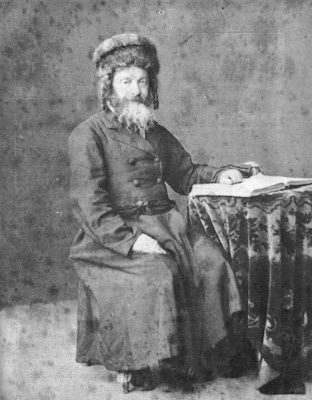


Paranthetical side point: can you imagine today's gedolei yisrael posing for a studio portrait with an open sefer sitting on a table next to them? Times (and conventions) do, indeed, change.

* Of course, it was nice of them to give him the time of day at all, especially considering the fact of their own religious sensibilities and that his research was for a university doctorate.

Wednesday, June 25, 2008

So, was Aharon ben Moshe ben Asher a Karaite?

I doubt it.

In the comments in the Rema post below the issue of Karaism and masoretes was raised, so I thought it's an opportune moment to review some of the discussion concerning this matter.

It seems that ever since Simcha Pinsker published his monumental and groundbreaking history of Karaites and Karaite literature Likute Kadmoniot (Vienna 1860) , the following assertion by him was widely accepted as reasonable: when dealing with the grammarians and masoretes (including Ben Asher and BEn Naftali) of the ge'onic period if there is otherwise no indication that they had anything to do with the Talmud then they should be suspected of Karaism, or at least Karaitic leanings, since Rabbanites did not solely occupy themselves with Bible and grammar to the exclusion of Talmudic learning! This applies before R Saadya especially. Of course once Rabbanites began to more closely study the Bible exegetically and grammatically in response to the challenge of Karaism this rule loses it's force, even without evidence that such grammarians engaged in Talmudic learning as well.

Pg. ל"ב:


So this view was accepted and applied to Ben Asher by Graetz, and accepted ever after (although Aron Dotan notes that O.H. Schorr rightly dismissed Pinsker's axiom as arbitrary in his review of the book):


(Unfortunately the German original of this volume (V) of Graetz's History isn't yet digitally available. Although my German is limited, the popular English translation is insufficient - it is much, much less scholarly, and in this case all the evidence Graetz marshaled is omitted, but it will have to do for an illustration.)

His arguments are that in some texts Ben Asher is titled "מלמד" (see post below!), and that was a Karaite title of the time, Dunash records that Rav Saadya wrote responsa directed against a Ben Asher, whom he did not respect. (Paranthetically, Harry Orlinsky used to say that the authority of Ben Asher over Ben Naftali lies solely on the basis of Maimonides' endorsement - not that this is really true - and really Rav Saadya would have been a better judge, and he would have endoresed Ben Naftali over Ben Asher!) Additionally, Dunash and his students did not mention Ben Asher in their arguments with Menachem and his students, despite being Palestinian and therefore surely familiar with him. They would have done mentioned him, unless they realized he was a Karaite! Finally, a bonafide Karaite (Yehuda Ha-dassi) seems to have thought Ben Asher was a Karaite, judging by the favorable and respectful ways he refers to him.

Other arguments, brought by other scholars, included the evidence found in the treatise Dikduke ha-te'amim (said to be written by Ben Asher), where it seems to be say that all of Tanakh is useful for determining halakhah, not just the Torah.1 This is the Karaite, not Rabbanite view. Additionally, he sometimes uses specifically Karaitic hermeneutical terminology. Finally (and rather lame) is the argument that since the colophon of the Cairo Codex of the Prophets (codex written by Moshe ben Asher) said that it was commissioned by a Karaite, and indeed this codex remained in possession of Karaites, that he himself must have been a Karaite!

Suffice it to say these arguments are insufficient, as Aron Dotan meticulously showed half a century ago in Sinai 41 (his article ? האמנם היה בן-אשר קראי was expanded and published in English as Ben Asher's Creed).

Dotan reviews in detail all the arguments that were made until his time, pro and con. Some of the arguments that Ben Asher was not a Karaite focused on the idea that Maimonides would not have considered him authoritative if he was a Karaite. The insufficiency of this idea on several grounds needn't be stated. More potently, no Rabbanite ever accused Ben Asher of being a Karaite until 1860! Others disputed that the Ben Asher that Saadya argued against was our Ben Asher.

Dotan's work is really well argued, but I will only review his specific objections to Graetz's proofs.

- it can be shown that מלמד was not only a Karaite title, but also a technical term - teacher - also used by Rabbanites

- the fact that Dunash doesn't mention Ben Asher is meaningless. Neither does Menachem (who was not Palestinian and therefore would be unlikely, according to the argument, to know that he was actually a Karaite)

- Ha-dassi's respectful language is not unusual. Fortunately outside of polemics we do find cordial references between Karaites and Rabbanites. The same Ha-dassi also refers to Yehuda Hayyuj and Yonah ibn Janach (known Rabbanites) in a pleasant, cordial way.

- the idea that Ben Asher's expression that the Prophets "complement" the Torah is Karaitic in intent is faulty, since Karaites viewed the Prophets as Torah itself - there was no tripartite division in the Bible for the Karaites. Rather, this is a Rabbanite view. In addition, the Hagiographa is not included here, and that is not a Karaite view. In addition, the issue of halakhah being derived from the Prophets is far more complex than Graetz presents.

In all, Dotan convincingly refutes the contention (originally based on little more than a tantalizing and contrarian assumption) that Ben Asher was a Karaite. Yet prior to his work it was almost a dogma that Ben Asher was a Karaite. For example, Paul Kahle wrote (1956) "We know with certainty that Moshe b. Asherand his son belonged to the community of Karaites and it is therefore very likely that also the other members of the Ben Asher family were Karaites." ("The Masoretic Text of the Bible and the Pronunciation of Hebrew, JJS 7).

We do not know this with certainty.

Finally, a note to potential Karaite readers of this blog (and I know I have such readers): I personally would not mind at all if Ben Asher was a Karaite. It's only a matter of the evidence and arguments for me. For another point of view, see the following post and comment in this post by Nachum::

"Oh, and one more thing- it seems there's a growing number of Orthodox (again, leaning right, not part of any of the categories listed above) who have taken a real interest in Masoretic issues. An offhand reference to Ben Asher and Karaism by a speaker at the conference brought an impassioned reaction from one audience member, for example, and I've been seeing quite a bit of this in recent times. I'm getting the strong feeling that a lot of people are starting to grasp that something's not quite right with the party line ("every letter from Sinai" is just the tip of the iceberg). Lord knows where it will end, especially when combined with the other sentiments above."

I asked what that was about and was told:

"One of the speakers made an offhand reference to the Leningrad Codex as having been written by a Karaite. One audience member (no one was asking questions mid-speech) protested vehemently, and wouldn't let it go, even though it was off-topic and the speaker conceded the point."


1 סדר הנביאים האשמרת התיכונה שלום התורה כמעמד התורה ומורים מהם הוריה כתורה


Tuesday, June 24, 2008

A copy of the Aleppo Codex in the Rema's synagogue in Cracow; also, minor C.D. Ginsburg errors

There's an interesting bit in C.D. Ginsburg's Introduction to the Massoretico-Critical Bible (pp. 241-242):


As you can see, he calls attention to an interesting fact (top pg. 242): The Rema synagogue in Cracow had a Bible manuscript which belonged to him (Rema = R. Moshe Isserles). The particular manuscript cost 100 ducats (that must have been expensive).

Ginsburg gives the reference (Ha-maggid) and from there we can see that he made some mistakes. First of all, the manuscript was not a copy of the Cairo Codex by Moshe ben Asher. It was a copy of the Aleppo Codex, written partly by his son Aharon (ben Moshe ben Asher). A minor quibble is that according to the Ha-maggid article Ginsburg refers to, this codex was sent to R. Isserles in the year ש"ל corresponding to 1569/ 70, and not 1530 (when Rema was only 10 years old). Either math was not his suit, or the ל through him off, which is understandable. He also left out a couple of interesting points, namely that the manuscript was sent to Rema by R. Yosef Caro (!), and Rema used the manuscript to write a Torah scroll. Both the manuscript and Torah were still in that synagogue in the 20th century, only to disappear during the Holocaust.

Although one must be careful to say that this manuscript was allegedly copied from the Aleppo Codex, it did contain part of the lost colophon of the Aleppo Codex, in conformity with a scribal practice of copying colophons from manuscripts for proof of its provenance.

The relevant column in Ha-maggid (26 Marcheshvan 5718/ 13 November 1857; two part column on Kracow by Mordechai Weissmann) follows:


Weissmann copied it from the manuscript (תיקון סופרים) , which he says he could not completely read, so I'm not sure how reliable his transcription is, but it is interesting that he gives אהרון בן מר רב אשי, an Aramaic diminutive form of the name, instead of אהרן בן מר רב אשר. In the first issue of Textus (1960) Izhak Ben-Zvi published the complete text of this colophon as copied carefully by R. Meir Nehmad (and printed in his book מאמר חקירה על הכתר היקר הנקרא כתר ארם צובה Aleppo, 1933). There it is given as אשר and not אשי. Paranthetically, Ben-Zvi (d. 1963) asked anyone who had any information about either the Rema's Torah or the manuscript to contact him.

Learn Hebrew. Learn Greeke. Learn Latine. Learn Chaldean. Learn the Rabbinicall.


Excerpt from a 1646 Treatise Concerning Tongues Appertaining to Learning: viz. The Hebrew, Greeke, Latine, Chaldead, Syrian, and Arabian

Vintage Solomon Schechter/ JTS as viewed from the Lower East Side


Here's a really interesting cartoon. It depicts Solomon Schechter grinding up Lower East Side immigrant boys (with the help of Jacob Schiff, who is providing the "gold oil" to lubricate the grinder, which itself is marked "Jewish Theological Seminary") and churning out Reform rabbis, one of whom holds a Bible and another a ham sandwich!

The caption reads:

"The Jewish Theological Seminary, established to provide the East Side with Orthodox rabbonim, manufacturing Reform rabbis for the West and South."

Shaul Raskin (1878-1966), Der Groyser Kibitzer, 22 January 1909

I can't find a lot of information about Der Groyser Kibitzer, but it appears to have been just what it sounds like: a Yiddish parody sheet. I copied this image from David Weinberg's article on the JTS and "Downtown Jews" in Tradition Renewed.

Wednesday, June 18, 2008

From the Chasam Sofer's hair, to the Sdei Chemed's shoes

Continuing my series of posts where I present images of people-you-know-but-I-think-are-little-seen --

This portrait of R. Moses Sofer (1762-1839), the Chasam Sofer, was made in 5571 - 1811. I have only one thing to say: that can't all be peyos.


The following is R. Samuel Strashun (1794-1872), more commonly known as Rashash. Most well known because of the inclusion of his Talmudic notes in the Romm Press's Vilna Shas. To see how his slightly left-of-center orientation (or left-of-right, as the case may be) means that he is a slightly controversial figure in some circles today see here, including an oft-repeated rumor about why his notes are in that Talmud edition (and therefore almost all editions since) Also here.


Finally, for tonight, here is a beautiful portrait of R. Chaim Chizkiyahu Medini (1833-1904), author of Sdei Chemed. Just note his truly awesome Ottoman shoes!


Coming soon: what color was Rashi's shirt?

Third post in a series. II

Vintage coverage on the death of the Chafetz Chaim; a new digitization project

Tel Aviv University is now hosting a digital newspaper project (link), and there's a very promising beginning. Although some of the newspapers are in French, which means that for me personally it's not very useful, also included are 19th century Hebrew newspaper's Ha-Maggid and Ha-Levanon, which were already digitized by the JNUL. However, TAU's interface and search are actually far more useful. In addition, they've also got the English language Palestine Post (forerunner of the Jerusalem Post). Not bad!

So I've done some poking around and found a few nice things. To start with, here is the notice of the Chofetz Chaim's funeral (11/19/33):


Nothing more than a blurb, but the following day they ran a tribute headed The Jewish Gandhi (!), which is quite an interesting read:


(click image to enlarge and read - be advised that it's two images.)

Finally, here's an interesting image from the funeral itself - note from the newspaper! (click to enlarge for detail).

Note the seforim in his casket. Also, my eyes must be deceiving me, but it seems that there is a women in the crowd. How could that be?).


(Also, see this old English Hebraica post: link.)

Update: better photo from here:

Tuesday, June 17, 2008

כט אלסאמרה

This is a Samaritan alphabet abecedary from a medieval Jewish manuscript called Sha'ar Ha-razim, written in the late 1460s. The reading in the margin (in Arabic and Hebrew) is כט אלסאמרה והו כתב עברי, 'the Samaritan alphabet, that is Old Hebrew.'


(From Haham Moses Gaster's Jewish Knowledge of the Samaritan Alphabet in the Middle Ages Journal of the Royal Asiatic Society 1913, reprinted in Studies and Texts.)

Who?

Monday, June 16, 2008

The pronunciation of 'Ehud' at the BBC

Sometimes a rabbinic derashah allows the letters ח and ה interchange with one another. They're so close in sound (and appearance) that it's understandable. (See here for a post which supplies an example and sources for further research.)

The average person probably doesn't realize that in Semitic languages there are consonants which are not found in Western languages until it is pointed out to them (although they may have some sense that Middle Easterners seem to be clearing their throat a lot when they talk). Of the two letters already mentioned, one (the ה) is more or less pronounced just the same as the H is in English, while the other (ח) is nowhere to be found. But it's close to the same sound. That's why in English transliteration words containing these two consonants usually just write them with an H: 'Hanukkah', '[Shalom] Haver,' 'Hizbullah' and so forth, although they all begin with a ח rather than a ה.

Why do I mention this? Because I say that the average person probably doesn't know it, but not everyone is average and some people know this well. But that doesn't stop some of them from making mistakes. It seems that BBC reporters in the Middle East forgot that there is an H sound in Hebrew as well as a ח (leaving aside the question of how the ח is actually pronounced in MIH (=Modern Israeli Hebrew).

It must be five or six times already that I have heard a BBC correspondent in Israel refer to the Israeli Prime Minister as Echud (אחוד) Olmert. Some of these reporters can do a pretty good Middle Eastern ח, and they spit out "אחוד" in a way that would sound clear and authentic from Baghdad to Beirut. Others can't do it and pronounce it the way Ashkenazim and Israelis would: ח, and they spit out "אכוד".

But both, of course, are wrong. It's Ehud (אהוד) with the actual H. No need to get fancy (and wrong). Of course, I've also heard it pronounced correctly!

Another milestone


Thank you! (I)

LinkWithin

Related Posts with Thumbnails
'