Thursday, March 21, 2013
Horseradish? Horsefeathers!
Trying to get in a little Pesach learning, and I came across this. From Rodkinson's Talmud, Pesachim 39. Such a curious mix of scholarly (the notes) and completely uncritical (the translation of marror as "horseradish").


Monday, March 18, 2013
A 400-year old description of the cleaning of dishes and utensils for Passover
Here is Johannes Buxtorf's description of hagalat kelim, the purging of vessels, for Passover. From the English version of his Synagoga Judaica, which was originally published in 1603.


Friday, March 15, 2013
Rabbi Joseph Saul Nathansohn, the Sho'el U-meishiv's obituary
From the Jewish Messenger May 14, 1875.


Wednesday, March 13, 2013
On Napoleon's restoration of the Jews, and the Simchat Torah that holiday firecrackers led to a boy's being shot by a blunderbuss
Below are a couple of lines from a very interesting poem - okay, let's face it, these are the only interesting lines - from 1799. The poem is called Buonaparte. It begins -
Good courteous reader, I am sure the name
Of Buonaparte must have reach'd thine ear;
But, lest thou be deceived in his fame,
E'en from my Muse his glories shalt thou hear.
- and appended to it is a note which says "The verses upon this renowned chief were written before he had assumed the new part which he is not playing in the political drama of the French Revolution; and if our readers should relish his past history, as we have given it, we do not absolutely despair of his supplying them with further amusement."
Oh, and how Napoleon was about to "supply [readers] with further amusement." No one could have dreamed.
The poem is in a periodical called The Meteors (Vol. 12). The other noteworthy thing about this book is that it contains a drama with characters called Tom Paragraph and Zoilus Dogsear, which I have to say are pretty fantastic names. In any case, here is the verse from the Napoleon poem to which I wanted to call attention:

This is a reference to Napoleon's campaign in Egypt and Syria in which it was thought that he was somehow going to bring about the liberation of the Jews and establish them in Palestine. (Somehow=a thought deliberately encouraged by Napoleon himself.) Being that these are British verses, the reference to "In ev'ry Syrian town to raise Duke's Place" referring to the Great Synagogue in London, and several smaller synagogues, at Duke's Place. You know, a way of saying that Syria (Palestine) would be Jewified.
Speaking of Duke's Place, I came across several accounts of an astonishing incident which occurred on October 7, 1784, which was Shemini Atzeret (the first day of Simchat Torah). Although there are conflicting accounts, so we cannot say for sure if this involved adults and children as some say, or only children, but the basic idea is that near Duke's Place a crowd was letting off various kinds of firecrackers in celebration (simchas yontef). A neighbor who owned a distillery, named Joseph Pridhouse, was very upset. Apparently he had been dealing with this annual disturbance for twenty years. While the exact details are subject to dispute (was he just annoyed by the noise, or did he fear his establishment would catch fire? after the chastised the crowd, did they beat him up and did he fear for his life?) but what happened is not in dispute. He grabbed his carbine and shot into the crowd, killing a 13 year old boy named Moses Lazarus (and wounding others).
Here is a news account from the monthly Gentleman's Magazine:

The accounts of the indictment and court proceedings were printed in the annual Proceedings of the Old Bailey (which are online). Here is how it begins:
PORTER RIDOUT was indicted for that he, not having the fear of God before his eyes, but being moved and seduced by the instigation of the Devil, on the 7th of October , in the 24th year of his Majesty's reign, with force and arms, at London, in the parish of St. James's, Duke's-place, upon Moses Lazarus, in the peace of God and our Lord the King then and there being, did make an assault, and with a certain gun, value 1 s. then and there loaded with gun-powder and leaden shot, which he held in both his hands, to, at and against the said Moses, feloniously, wilfully, and of his malice aforethought, did shoot and discharge, and him the said Moses in and upon the right breast, and in and upon the right side of the body, near the upper part of the belly, did then and there feloniously, wilfully, and of his malice aforethought, strike and wound giving to him the said Moses in and upon the said right side of the breast, one mortal wound of the depth of four inches and of the width of one half quarter of an inch, and in and upon the right side of the body near the upper part of the belly, another mortal wound of the depth of three inches and of the width of one half quarter of an inch, of which he instantly died: and the Jurors say that the said Porter Ridout, him the said Moses Lazarus did kill and murder. He was likewise charged on the coroner's inquisition with the like murder.
Following this, the prosecutor got up, informed the jury the facts of the case and instructed them to keep in mind that firing a gun indiscriminately into a crowd without intent to kill any specific person also can constiute murder. Here are his words to the jury:
The Jews have an annual festivity religiously observed on their part, some time in the month of October; the prisoner lives in the neighbourhood, where that festivity creates necessarily some little disorder, he has lived there I believe twenty years, and has been constantly a witness of the return of it. In this festivity some persons unquestionably had exceeded the strict bounds of propriety, squibs and crackers had been thrown, and it seems Mr. Ridout in this last month on the last return of that festivity endeavoured to apprehend some persons who had fired those squibs, in doing so a little scuffle ensued, several fell, and among others Mr. Ridout, they arose however from the ground seemingly without injury, and Mr. Ridout returned to his house and shut the door; some few minutes afterwards he appeared at the window of the room on the first floor, and from thence discharged a gun loaded with shot among the crowd, several were wounded and some fell; and one unfortunate youth of the age of thirteen instantly expired: you will hear the law much more accurately delivered from the learned Judge after you are possessed of the evidence, and therefore can with more correctness apply it; it is however my duty just to observe, that it is not necessary to constitute the crime of murder that there should be a malignity directed against an individual; if a man commits an act from which death may ensue, which from the nature of it marks a wanton disregard of the safety of others, that is equally immoral, and the public safety requires it should be classed in an equal degree of guilt with the premeditated destruction of an individual; I fear it will be difficult for the prisoner to extenuate this case: some expressions will be given in evidence that seemed to shew a deliberate purpose of longer duration than the day; but as these expressions ought not to make any impression upon your mind till you have them in proof, I shall not mention them, but wish you to hear them only from the witnesses.
The first witness was called, a Jew named Jonas Levy. Here is what he was asked, and said, about the venerable minhag of Simchat Torah firecrackers:
Pros.: I shall not ask you unless I think it necessary any other question, but state yourself what you saw pass on that day?Levy: I was going to synagogue the 7th of October between five and six in the evening and I saw a parcel of boys as usual, setting off squibs and crackers.Pros:. I believe I must desire you will explain that expression as usual?Levy: As they do among our people once a year, that is at the feast of Tabernacles, and I stood there a little time to see them.Pros.: Is this a customary annual sport?Levy: Yes
The next witness, Moses Israel, related what he heard the dying boy say:
I saw Mr. Ridout open the window gradually, and fire a piece, the little boy, Moses Lazarus , stood by me, and said, O Lord! he has killed me! those were the three words that he said.
The next witness, Elias Aaron, quotes the dying boy this way:
I saw Mr. Ridout go into his house, he was waving his hands, and he went in doors and shut the door, and went up stairs, and in about a minute or two after, he opened the window, and a blunderbuss or firelock, I cannot tell which, he fired, and the boy fell down by me, and cried out, O Lord! O Lord! I am dead!
Every person testifying, incidentally - including the Jews who knew Ridout - up to this point, said he was a gentle and peaceable person, and this was surprising to them. Then follows some really interesting an odd testimony, from Saul Mordecai. He says that he and Ridout spoke in Hebrew! - which requires some interpretation. But before I do, a note about surnames. Except for Jonas Levy, every Jew thus far has a first name for a last name. The dead boy, Moses Lazarus (Elazar), Moses Israel, Elias Aaron, and Saul Mordecai. The reason for this is that the most Ashkenazic English Jews in the 18th century adopted their father's first name as a surname. Thus, Moses Lazarus's father was probably named Lazarus, Moses Israel's father was most certainly Israel, and so on. Since this was 1784 it is possible that for some of them these names were already used for more than one generation - but in all cases, an ancestor's first name was the name these people used for their last. Back to Saul Mordecai:
Here is what he said:
I have known [Ridout] these twenty years, and upwards; about a fortnight or three weeks before this affair happened, I happened to go into Mr. Ridout's house for some liquors, the discorse fell out about some holliday, he asked me in Hebrew, what I meant to make Skoke yanck of, that is, we always preserve fruit, a fruit which we never eat till that time comes, it being the new year, to make a blessing off; I told him, your time is coming on, that you think so troublesome, that is, Simka sacra we call it in Hebrew, it is the Rejoicing of the Lord, in English; I asked him, if he remembered the time that he run after a boy into the Synagogue, with either a sword or cutlass, he said, he was better provided for them now, for he had a piece that would carry a ball or two now nicely; and he would take care some of them should have it among them.
The Hebrew. This is from the published transcripts of the trial, which were obviously written by a court stenographer, or whatever they were then. So clearly Saul Mordecai did not say "Skoke yanck" - which is exactly how it is printed - but he said "Shehechiyanu." So he said that Ridout asked him what he was using to make a Shehechiyanu on a new fruit for the New Year. Secondly, Mordecai very likely did not say "Simka sacra" but he said "Simchas Torah" and he probably said "Rejoicing of the Law," and not "Rejoicing of the Lord." It's interesting to note. In any case, the point is that Mordecai says he talked about the upcoming Simchat Torah, and he knew that Ridout really did not like it. He also says that he mentioned that one time when Ridout chased a boy into the synagogue with a sword! And Ridout said he had a firearm now.
Another testimony, from a man called David Levy - apparently a constable, which is interesting - also claimed that Ridout had made a threat of violence:
About five or six weeks ago, Mr. Ridout says to me, as you are a constable now, I hope you will take care of the boys, and prevent them from firing squibs, and take some of them into custody; says I, go to the Lord Mayor and get a warrant, and I will summon all the constables and do all I can, says he, no, I shall not, I shall provide myself, and if they fire I will fire too, that is all that I know about it.
A note about Jewish constables. Apparently there were - Jewish constables. It isn't entirely clear to me if they were regular constables (=lowest ranked police officers) or specially appointed to keep the peace in Jewish areas. In about 1833 we find the following:
On Saturday last, the Lord Mayor having observed two men taking the oaths of constables with their hats on, inquired the reason, and was informed that they were Jews.
The Lord Mayor asked how it was that they took a Christian oath!
The officer replied, that they converted the oath into a Jewish one, by using at the end of it, "So help me God, as a true Jew!" instead of "true Christian!"
The Lord Mayor—" I am not satisfied, by any means, with the validity of such an oath, and shall not allow it to be taken. How can the words of an oath, officially administered, be changed!"
The officer said, the Jew constables were in the habit of taking the oath according to the form just mentioned, and the Recorder had considered it quite sufficient. The Jews who presented themselves were beadles of the Synagogue, appointed to prevent the peace from being broken there.
So while this was fully 50 years later...
Next testified a man named John Chapman:
I was, by Mr. Ridout at near six o'clock; when I came, he desired me to get the mob dispersed, I found it was impossible with all I could do, I then went to look for some Jew constables, knowing their people could disperse them better than ours, but I found none.
He and others testified about the disturbance and violence meted out by the mob of firecracker throwing Jews against Ridout. His servant girl, named Ann Hebditch, produced his torn clothing and said that she heard the crowd, who chased him into his home say "Damn their eyes, they would have his life." Several other witnesses were produced who testified that Ridout was beaten badly. And a number of character witnesses were called who said that he was a gentle person. When all was said and done:
(The prisoner shewed his leg.)
Prisoner. While I was down they robbed me of fourteen pounds six shillings, they stamped upon my leg and wanted to break it.
Court. If the prisoner wishes to say anything, I am ready to hear it.
Prisoner. I was in danger of my life, and they tore my pockets open, and took out all my money, fourteen pounds six shillings; it was with a great deal of trouble I got to my door, and they knew I had a great deal of property in the house, and they wanted to get it from me; they threatened my life while I was down in the kennel.
NOT GUILTY.
Not Guilty on the Coroner's Inquisition.
Tuesday, March 12, 2013


Thursday, March 07, 2013
A cholent/kugel ode from 1889.
Here is a fantastically witty and interesting article about cholent and kugel from 1889. Since it mentions Heine and Boerne's take on it, here's a link to my earlier post on Heine on cholent (link). Jewish Messenger July 5, 1889.


Wednesday, March 06, 2013
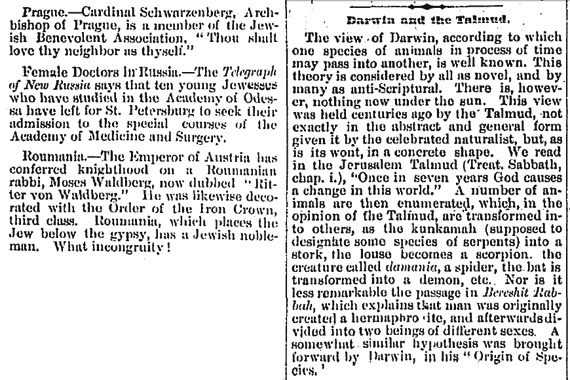
On Darwin and the Talmud
Interesting little piece on Darwin and the Talmud in the American Israelite, 10.22.1875. Not necessarily what one would expect.
Tuesday, March 05, 2013
On Frumetel Fleckeles's effort to ask an Empress to allow the Jewish sick and new mothers to remain in Prague, even after being expelled
Here is a fascinating entry in a book about the graves in Prague's Jewish cemetery (more below).
It says:
[Grave entry 3661] 5505 Tammuz (July 1745). Frumetel, wife of Mr. Wolf Fleckeles. She wished to lobby the Sovereign, May Her Glory Increase (!), at the time of the expulsion [from Prague], on behalf of the sick and newly birthed, to allow them to remain in Prague. The daughter of Mr. Joseph Harfmer.
Not that it requires much more explanation, but what it says is that at the time that Empress Maria Theresa decreed the expulsion of the Jews from Prague - late 1744 - Frumetel Fleckeles attempted to petition her to allow the sick Jews, and new mothers, to stay. She herself died in July of 1745 - in Prague, obviously.
It is worth pointing out that even in these circumstances the acronym Jews traditionally appended to kings and queens - ירום הודה, יר"ה - is added. Now the simple explanation may just be that of course you were going to add it to a reference to the Queen, even while she was in middle of expelling the entire community. You can curse her in private, but not omit it from a tombstone. Nevertheless, I can't help but feeling that to a certain degree the idea of omitting such an honorific would barely have occurred to Jews, who at the time still had not dreamed of emancipation and equal rights. No, of course they did not want to be expelled - but they also did not really expect to be treated otherwise. They knew that they were given rights of residency not because they were liked, not because they had rights, and not because they were brothers of the people in whose midst they lived. They were mostly allowed to live and prosper where they did because a ruling sovereign permitted it because it was economically advantageous. And usually this was despite the wishes of the masses, who would have preferred if the Jews were not allowed to live there. So, maybe I am wrong, but I suspect that the thought of not referring to an Empress with "May Her Glory Increase" simply because she was being cruel at the moment - and, indeed, in 1748 she allowed the Jews to return to Prague - would not have occurred to them.

So just like that, we learn of one woman's heroism by her tombstone inscription. I wish more details were provided, but this is plenty. The above comes from the book Die Familien Prags. This book was published by David Kaufmann, based on the research of Simon (Sinai) Hock, a prominent Prague communal leader, who was an amateur historian (hmm). With notebook in hand Hock copied thousands of gravestones in the Prague cemetery, and after he passed away, Kaufmann published them. Basing himself in part on Hock's gruntwork/research, Kaufmann published an article called Der Stammbaum des R. Eleasar Fleckeles, and he refers to Frimet Fleckeles' actions. He adds nothing new, so I assume he got it off her tombstone inscription as copied by Hock.
Here is Simon Hock:


Here is a post I once did about the reaction of English Jews (and eventually the British government) to Maria Theres's expulsion order, and how they tried to persuade her to rescind it (link).
Monday, March 04, 2013
A visit to a Hasidic rebbe in Philadelphia in 1914
This article from the American Israelite dated almost exactly 99 years ago is called A Visit to the Wunder Rabbi, translated from Yiddish by Gotthard Deutsch, as it originally appeared in the Forverts. The visit is to the Talner Rebbe who had recently arrived in Philadelphia, and would spend the next 43 years, the rest of his life, in the United States (see here about his emigration to the United States).
Interesting quotes from the Rebbe:
"When I left Russia I did not anticipate finding one-tenth of the number of sincerely religious Jews, whom I found in the city of New York. The longer I remain in America, the more I see of the personal freedom, the more I understand how natural it is for sincerely religious Jews to become more devoted to their religion here than they were at home."
and
"We already have at home what you call presidents of synagogues, who keep their stores open on Sabbath, and nobody demands their resignation."
Here is an excerpt concerning the kind of Americanized visitor the Rebbe was receiving while the reporter waited his turn:

The entire article below - if it is hard to read, I also uploaded it as a PDF which you can read or download here.

Thursday, February 28, 2013
On the Hebrew pronunciation of Chinese Jews
Here's some interesting information about the way the Jews of Kaifeng, China pronounced Hebrew. Note the careful (?) transcription of how they named the five books of the Torah in the footnote:
Pe-lesh-itze (Bereshit)
Shemeot-ze (Shemot)
Va-yi-ke-lo (Vayikra)
Pe-me-ze-paul (Bamidbar)
Te-ve-liim (Devarim)

The same book also mentions that they divided the Torah in 53 portions, not 54, uniting Nitzavim and Veyelech. Which is interesting, because I think that was the original custom; they were combined. It is also claimed that when asked why their Torahs do not have nekkudot, the answer they gave was that God recited the Torah too fast for Moses to transcribe with vowels, but the wise men of the West supplied them later.
Help the Main Line out with your feedback
I recently installed one of those not-so-newfangled feedback poll options that appear on the bottom of each post, as follows:

My hope is that these three options are enough to capture a reader's impression of any given post. Did you like it or not, or is there a "Yes, but" or "No, but" sort of reaction; to keep it simple I combined that into the "It's Complicated" option.
If lots of people take the extra second to click one of these after looking at a post, I will learn a lot. Thank you.
Tuesday, February 26, 2013
On a Jewish 'sign of the cross' and the Sephardic provenance of the name "Shneor" occasioned by a 17th century prayer book
In 1687 Benjamin Senior Godines published a book from a manuscript he found in the home library of Rabbi Yshack Abohab. The core of the book is the 100 blessings a Jew should recite daily, but with many more additions and explanations, and all translated by Godines into Spanish. Thus, the book is called מאה and סדר ברכות Orden de Bendiciones. Frontispiece illustration and title page:


Godines was an artist (and scribe) so the illustration must be his - you can see that it is initialed B. G.
Now, on pp. 203 - 204 there is something very interesting, which I'd never heard of before. It is basically instructions for making a Jewish sign of the cross, so to speak, as a way of warding off fear - hard to see how else to interpret it. Who knows if this sign was even specifically invented to wean Conversos off from making the sign of the cross. If anyone has ever seen this before, please do tell.
It says,
"If you are see a person whose approach frightens you, make a Shaddai with your right hand; place the thumb out like the form of a daleth and the three middle fingers will form the shape of a shin and the little finger will be as a yud; place this on your face and recite..."


Finally, a word about Godines' name. As mentioned, he was Benjamin Senior. It is worth pointing out that in Hebrew it was בנימין שניאור. Now, שניאור is a name used by some Ashkenazic Jews of European descent, especially Chabad-Lubavitch, given that the first Chabad rebbe was named שניאור. There is a somewhat popular belief that this name is the grammatically dubious composite from the Hebrew words שני אור, to denote Two Lights (whatever that is supposed to mean). See, for example, Beis Shmuel who claims that the name was invented on account of a baby boy being born with two ancestors named Meir to be named after, and also the entry שניאור in Shem Ha-gedolim, where Chida quotes a similar thing in the name of Maharshal, who said that it was for grandfathers named Meir and Uri. Chida continues by noting that the name Shneor actually precedes this, because Rabbenu Jonah (Spanish rabbi, 13th century) quotes his own teacher, Rabbi Shneor.
Be that as it may, Spanish Portuguese Jews used this name and there is no question that they thought it meant Senior, despite the respectful hearing of the Ashkenazic idea of its etymology by Chida, and here is one of many such examples where this can be seen.


Pesach is in the air, so... Civil War seder, 1862
This is a well-known story, but very moving nonetheless. Here is J. A. Joel's account of the Passover seder he and twenty fellow Union soldiers who were Jewish were able to hold (for both nights) in West Virginia in 1862.
Only 19 years old at the time, he writes about securing permission to take off, and the manner in which they were able to acquire matzos, their delight when it arrived containing haggados and prayer books, and some - but not all - of the necessary food. They could find no horseradish, but used a very bitter weed. In lieu of charoses, they used a brick. Not knowing which part of the lamb to use for the zeroah, they put an entire lamb on the table (and ate it afterward). He describes how some of them got drunk from the cider, which they used for the four cups (or, possibly, more). His letter was printed in the Jewish Messenger April 1866.
As I was preparing this post, I discovered there is even a children's book loosely based on this letter and the event described:


And here is Joseph Joel, apparently he sent this photograph to his friend Rutherford B. Hayes (link):

Sunday, February 24, 2013
Interesting Purim-y thing in a book of Psalms printed in 1723
I was perusing R. Yechiel Michl Epstein's edition of Psalms (Frankfurt 1723) and I noticed the following on the last page:

After the ma'amadot additions in this book, after the table for prayers at the very end, is a list of the verses recited aloud by the congregation at the megillah reading on Purim. The megillah itself is not printed in this book. The explanation I could think of was that in 1723 printed humashim or Bibles which included Esther, much less personal megillah scrolls, were sufficiently rare that many people - presumably women, especially (?) - could be present at the megillah reading with no text to follow along with.So here, at the end of a book of Psalms, it was deemed appropriate to list these verses for those who had their Psalter with them, but no Esther so that they could say them aloud with everyone. What do you think?
Friday, February 22, 2013
In honor of Purim, let's parody 19th century Reform prayerbooks
Or so this is. Here is a hilarious parody of a siddur review for Purim 1875 in the American Hebrew (February 19, 1875/ 14 Adar 5635). It's long, but in my opinion entirely worth reading.
The background is that in those times there was a glut of new siddurim, each purporting to be a new minhag, or liturgy, that somehow improved on both the traditional siddur and all the competing reformed versions. Although my guess is that two or three volumes of equal size can be written to exhaustively discuss the topic, especially to include America, the definitive work is Petuchowski's Prayerbook Reform in Europe: the Liturgy of European liberal and Reform Judaism. From reading that work, one thing which cannot fail to escape the reader's attention is that however sympathetic one may be toward the concept of prayerbook reform, if one is, the unavoidable result is dozens if not hundreds of liturgies. As far as I can tell, this was not the desired goal of any of the prayer book reformers. Many of them surely must have rationalized that there wasn't really a traditional liturgy anyway, but there were dozens, and indeed in polemical discussions this was often pointed out. However, these new siddurim were so different from one another that the unintended effect of all of them was to render the synagogue service unfamiliar to all.
So here we have a review of "Pulver's New Prayer-Book." Although there was a Louis Pulver in Australia who produced books for Jewish children, he never produced a prayer book. This review is completely fictional, as are the other names and periodicals and so on which appear in it. It appeared, as I said, in 14 Adar edition of the American Hebrew.
So Caleb, the reviewer, says that he is grateful to receive such a beautiful book, and he is sure it will became famous, unlike the siddurim of Joram, Dumsprach, Kleinfuss and Swartzkopf (all fake). He hopes Pulver will succeed better in the "minhag making business" than his predecessors. Then he pulls out the knives and enumerates all of the shortcomings of this new siddur, the Prayers for the Congregation Men of Uprightness.
There's no point in rewriting the review, but one sentence is worth pointing out:
"Look here, Pulver, in what respect does your prayer book excel the old Roedelheim tefila? It is more adapted to the spirit of the age, you think. Don't be a fool. Speak out what you mean. It has less Hebrew, yes, and more doggerel English and German."
In short, it is humorous, but a very serious statement and a sign of the times.


Thursday, February 21, 2013
A description of the internet* from 1889
*Okay, not exactly, but it is the same kind of breathless, optimistic description of emerging technology.
An interesting reflection from 1889 on cutting edge technology, like the phonograph, and its presumed future uses. I'm sure there a thousand like it, but I thought the call to study electricity in every school as a basic, necessary form of education is interesting, like calls to teach computer programming. From the Jewish Messenger.

Wednesday, February 20, 2013
Sabbathian memories from the 1830s
Here's a fascinating bit of testimony about Sabbateans, real and imagined, in Prossnitz in the 1830s. Prossnitz was known from the prior century as a place of Sabbateans.
This is excerpted from an article in the American Hebrew 3.27.1896 by Gotthard Deutsch, in honor of Moritz Steinschneider's 80th birthday.

No Tefillin, No Leah - San Francisco Jewish wit Maftir on yahrzeits, Rabbi Jacob Joseph and 19th century American Yiddish
The San Francisco correspondent for the American Israelite signed his dispatches Maftir, but he was actually Bavarian-born Isidor Nathan Choynski (c. 1835 - 1899). Here is Maftir:

From the book Jewish Voices of the California Gold Rush: A Documentary History, 1849-1880 by Ava Fran Kahn.
His pieces were quite witty and irreverent. Here is one fascinating piece from December 21, 1888, where he tells of his attempt at getting an aliya in shul on his father's yahrzeit, only he had no tefillin, even though he did own a pair written by "the finest sofer of Vilna" - so "No Tefillin, no Leah." (Leah = 'liyah = aliyah)
Worth reading. I included another little excerpt from elsewhere in his column, because he refers to Rabbi Jacob Joseph, newly brought to New York to be Chief Rabbi as "the chief Chariff of the nation, His Excellency, Reb. Joseffele Yankele." Rabbi Jacob Joseph was, of course, known as R. Yaakov Charif in his native Vilna, and being a charif, a sharp Talmudic dialectician was deemed hilariously irrelevant to those American Jews who could not fathom appointing a maggid from Vilna as an alleged Chief Rabbi of the Jews in New York, much less seeing him - or anyone - as a chief rabbi of the United States.

Also of interest to Maftir was the emerging Yiddish press in America, and he frequently pointed out what he thought were hilarious examples of American Yiddish. Thus, in one column from 1879 he refers to an expression by the editor of the Yudishe Gazetten:

Tuesday, February 19, 2013
Gotthard Deutsch's interesting historical musings on Rabbenu Tam's grandma's socks, Neo-Orthodoxy, Solomon Schechter and Napoleon
Moravian-American Reform Rabbi Gotthard Deutsch was a very entertaining writer. Two volumes of his articles were published in the work Scrolls, and they're just a lot of fun to read. But much much more remains, scattered in various periodicals. A voracious reader of traditional responsa, which he gleaned for sources and polemics, and countless other works, his articles were written in a kind of very whimsical, chatty, personal and arrogant way which I like. Can't beat a piece by Gotthard Deutsch for a good anecdote. For fun, someone should mine his articles the same way he mined the Sdei Chemed (his favorite). Maybe one day I will collect them.
In any case, I came across a polemical article in the American Israelite (Sep. 4, 1913) in which Deutsch responds to his conservative critics, specifically, to Solomon Schechter. Now, Reform rabbis like Deutsch had something of an obsession with so-called Neo-Orthodoxy, because it seemed to pull the carpet out from the central arguments of Reform Judaism. Deutsch and many others believed that Neo-Orthodox Judaism is no more authentic, no more traditional, and no more continuous with pre-modern rabbinic tradition than Reform Judaism is, but unlike Reform, it is not honest because it pretends that it is. Furthermore, the half-measure reforms of Neo-Orthodoxy did nothing to solve the modern dilemmas of the modern Jews, let us say, because according to them Jews must still miss two months of working days out of the calendar year, and so on. People like Deutsch intentionally used the term Neo-Orthodox to highlight the discontinuity with what they saw as the genuine traditional Orthodoxy of old and, in Deutsch's case, of his own childhood. A Noda Beyehuda, a Chasam Sofer, a R. Mordechai Banet - they were really Orthodox.
Now, Solomon Schechter had given a speech in which he was talking about how "cultured conservative Jews . . . are sometimes stigmatized as neo orthodox." Schechter said that this taunt can only hit its mark if the idea of something like an orthodox Jew taking a college degree is something new, and a paradox. But, said Schechter, "a better knowledge of Jewish history would have taught them that culture combined with religion was the rule with the Jews. Culture without religion was an exception."
Taking this personally, Deutsch assumed that it was he who was being told he needed "a better knowledge of history." So he wrote an article in which he listed source after source of traditional Orthodox rabbis who were decidedly against culture and secular education.
Of course both positions can be defended in different ways, because the truth is that the truth is complex. Neither Schechter nor Deutsch wanted to truck in complexities, so there you have it. In any case, toward the end of his piece Deutsch has this wonderful nugget about history-as-dry-facts. And that's really the purpose of this post:
"...the idea that history in general...is a dry array of indifferent facts. This argument, used by an orthodox, is on one level with a statement ascribed to Rabbi J. J. Oettinger of Berling, who said of Zunz: "If you wish to know what color Rashi's trousers were you ask Zunz, but if you wish to know what Rashi taught, you ak me." Similarly one of the leading liberals is fond of amusing his audiences with an attack on those who write volumes on the color of the socks which Rabbenu Tam's grandmother wore on Sabbath Hanukah. You see that this is the same clever speculation on the vanity of the Philistine. He is to be told that he is just as well, or even better, off for not knowing the results of painstaking scholarship, and naturally, Mr. Philistine appreciates the compliment.
The actual situation is this. There are indeed a number of facts that are brought out by historical research that are in themselves indifferent. At the same time it goes with these things, as with furniture in a well arranged household. Every piece has to have its place, because our aesthetic sense, our love of order, demands it so. It may be, and in all likelihood, it is is indifferent, whether Alfred Sutro, the English playwright, was born in 1870, as the Jewish Encyclopedia states, or in 1863, as I found out recently, but there is no reason why we should not state a fact correctly, as long as we know it.
In some instances such a trivial fact may be a valuable point in determining an important historical fact. Napoleon was of late often praised as a liberator of the Jews. Quite recently someone published reminiscences of his physician in St. Helena, who reports that Napoleon claimed credit for his work in emancipating the Jews. The emancipation, however, took place in 1791, while Napoleon did not become first consul until 1799. In this way we establish proof that the reports of this physician are not reliable.
In another instance somebody-again I do not name him because I wish my statement to be understood, free from all personal prejudice-claimed Zunz for the conservatives. Such a general statement is easily made, and not one out of a hundred, perhaps out of a thousand readers, will have reason for doubting. I prove with quotations from chapter and verse, that Zunz said, he had no interest in Judaism, that rabbis, priests, lamas, fortune tellers, etc., were all the same to him, that all he cared for was Jews. I further proved with chapter and verse that Zunz dated Leviticus from post exilic times, which would result in making Yom Kippur an institution with which Moses had no more to do than he had with Hanukah or with Thanksgiving. I admit that such insistence on cold facts is occasionally inconvenient, but it's the only sound method of presenting history.
It goes without saying that while I think Deutsch is right abut lots in this, once again, he is incapable of nuance and also it does not occur to him that his interpretation might be incorrect. To take the reminiscences of Napoleon's physician. Is it really the case that because France emancipated its Jews in 1791, and Napoleon only became first consul in 1799 that the physician made it up? Can we not imagine that Napoleon himself may have given himself more credit than was due him? My goodness, Napoleon exaggerate? Never! Or, perhaps, even though technically the emancipation of Jews in France happened in 1791, Napoleon might have been referring to other acts and initiatives he took concerning the civil rights of the Jews in France and conquered territories? Dismissing the testimony of the physician (and presumably all else he said) because two dates do not work the way he thinks it should is more of a failure of deeper thinking, or at least imagination, than good critical historical thinking. Same with Zunz. While maybe it did not occur to him in 1913, Zunz's opposition to Reform-style reform may well have been more significant in how to characterize him overall than his view of rabbis or the Torah's origin.
Subscribe to:
Posts (Atom)
LinkWithin

Subscribe To On the Main Line


 Posts
All Comments