Wednesday, September 21, 2005

DovBear posts on ketav ivri.

The story in his post makes his "Mood: Pessimistic", but I'm just happy that one of my geeky loves is being discussed.

Conservative gedolim stories

I found the following somewhere online:
There's an amazing story about Shaul Lieberman, which made his reputation. He took a really corrupt and incomprehensible section of the Jerusalem Talmud and reconstructed it by suggesting some 30 radical changes (e.g. the opinions of authorities X and Y are reversed, this word "not" should be deleted, the phrase Z should be inserted here, section 3 should precede section 1 etc.). All the difficulties were resolved, and it made perfect sense and had continuity with what came before and after. It was a tour-de-force and widely admired, but considered extremely speculative. Many years later, an old manuscript was discovered which had all 30 of his changes.
For all I know this is true. For all I know. But it certainly seems like this is a wildly exaggerated version of what might have occurred, if it did at all. I mean, thirty changes?

Its striking because this is exactly parallel to the type of "feats of the mind" gedolim stories routinely traded and recounted in the oilam ha-yeshiva.

Why not mashicha?

Diqduq alert:

When a patah is under a het that ends a word, it becomes "ach" rather than "cha". Classic examples: mashiach, tzemach etc. but not "mashichah" or "tzemachah".

My question is simple: why?

And how do we know?

Azariah de' Rossi's ancient Hebrew aleph-bet

Something that fascinates me is the errors in very old books, works that were meticulously and scrupulously researched. Why the errors? Simply because the available facts were limited.

Here we see a chart that shows the ancient Hebrew alphabet from R. Azariah de' Rossi's 16th century opus Me'or Enayim.


In fact, while clearly there is something to de' Rossi's rendering, this isn't actually the ancient ketav ivri script. De' Rossi's best available source, like the Ramban before him, was the script used by the Samaritans. The script was presumed to be identical to ketav ivri, while it's actually a descendent of it, but not the same. That de' Rossi's illustration comes from Samaritan can be shown by a comparison of his chart with the Samaritan alphabet:


When the Ramban was 'oleh he discovered that to truly understand much of Tanakh requires actually being in the land of Israel. Some of his prior held views, mainly relating to geography, were debunked simply by his being able to actually see and experience what until then were only words. Another interesting consequence of his move to Eretz Yisrael was his revised understanding of the shiur of the Biblical shekel ha-kodesh. There was an ancient shekel possessed by Jews in Acco, with ancient Hebrew writing on it. With the help of Samaritans, he was told that the writing confirmed that it was indeed a shekel. After weighing it, the Ramban concluded that Rashi's view of the shekel's weight (in Shemos 21:32) was correct, while his own view (in Shemos 30:13) was inccorect.

Here is de' Rossi's rendering of the shekel:


Interestingly, the Ramban's opinion was quoted a number of times by Christian writers in the 18th century in studies regarding the antiquity of the Hebrew alphabets. Here is an example, from Robert Spearman's "Letters to a friend, concerning the Septuagint translation, and the heathen mythology" (1759):


and another discussion in"Sketches of Hebrew and Egyptian antiquity, intended as an introduction to the Pentateuch" by John Walsh, Vicar of Cloncurry and Kilcock (1793)


On the Main Line, now with tags:

Tuesday, September 20, 2005

Brave new world


Analysis of a Google map led to the discovery of a Roman villa like this one in Parma, Italy.

"Using satellite images from Google Maps and Google Earth, an Italian computer programmer has stumbled upon the remains of an ancient villa. Luca Mori was studying maps of the region around his town of Sorbolo, near Parma, when he noticed a prominent, oval, shaded form more than 500 metres long. It was the meander of an ancient river, visible because former watercourses absorb different amounts of moisture from the air than their surroundings do."

more

edit: I tip my black hat to Mis-nagid.

Monday, September 19, 2005

Five out of Thirteen ain't bad

In July I began a series of posts on the Rambam's principles of faith, 13 in all. It kind of petered out after just 5 of them (refresh your memory: I, II, III, IV and V.).

I intend to resume and continue. Stay tuned.

Thursday, September 15, 2005

Tzenarena was for women anyway


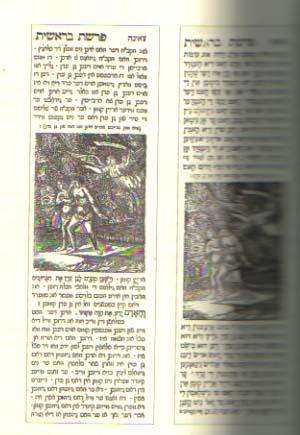
In this mid-19th century Romm edition of the Tzenarena Adam and Eve are dressed in fig leafs and hands. How could the venerable Romm printing press, creator of the inspired Vilna Shas print an illustration of Chava with her pupik visible? It's disillusioning, really.

As they say, you can't ask a kasha on a ma'aseh.

An encounter with Prof. Saul Lieberman

Came across an interesting thing on pg. 28 of The Rav: The World of Rabbi Joseph B. Soleveitchik by Aaron Rakeffet-Rothkoff and Joseph Epstein, a speech delivered by R. Soleveitchik to the RCA in 1974:
I remind myself, I had an encounter quite a number of years ago with a representative of the so-called Hokhmat Yisrael [Wissenschaft des Judentums]. He was a very outstanding scholar. (At this point, a footnote tells us that "the scholar whom the Rav was referring to was Professor Saul Lieberman (1898-1983) of the Jewish Theological Seminary of America. The Rav and Professor Lieberman, who were related by marriage, met at a brit milah. Professor Lieberman was married to Judith Berlin, the granddaughter of the Netziv.") He told me that lately they had discovered a parchment, a megillah, in which it was stated unequivocally that a kohen is enjoined from defiling himself with a sheretz*.

So I said to him: "Do you take it seriously?"

"Of course," he answered, "very seriously." You know, they [the devotees of Hokhmat Yisrael] have the answer right away. It is a different kabbalah, a different tradition. They operate with "traditions" in the plural.

So I mentioned a name to him. The name was known to him, and I knew that he did not like the person. I asked him: "Do you know him?"

"Yes," he answered.

"Is he a scholar?" I asked.

"No, he is a boor and an am ha-aretz mide-oraita," he answered.

I said to him: "So only we have a monopoly on boors and amei ha-aretz mideo-oraita? Fifteen hundred years ago there were also boors and amei ha-aretz. Since there was no paper, the boor had to write on parchment. So you found a nice hiddushei Torah, so what!"
*The halakhah is that a kohen is permitted to have contact with a sheretz.

Paranthetically, I wish I knew more about Prof. Lieberman. Of those who know, is it fair to say that if he'd chosen to become a rebbe in a traditional yeshiva environment (if I am not mistaken, he considered teaching at Chaim Berlin) that ultimately he'd have been considered in the yeshiva world another one of those idiosyncratic rabbis like R. Chaim Heller (he of the Peshitta obsession)? Or is that impossible? I've read his classic "...In Jewish Palestine" books.

Tuesday, September 13, 2005

Israeli kollel numbers

The Jewish worker quotes Mishpacha magazine, citing Israeli government sources, on the number of people learning Torah full-time in Israel:
53,500 learning in Kollel
41,000 learning in Yeshiva
23,000 learning in Yeshiva Ketana
Putting aside politics and everyting, 117,000 people learning Torah is phenomenal.

But these numbers--how is this possible? In a society with more children than adults there are more married men learning full-time then kids or unmarried Beis Midrash bochurim?

Monday, September 12, 2005

Censorship and self-censorship conference

The New York Metropolitan Area Chapter of the Association of Jewish
Libraries (AJL/NYMA) will hold its Fall 2005 Conference on Monday,
September 19, 1-4 pm, at The New York Public Library's South Court
Auditorium. Use the staff entrance on 40th Street between Fifth Avenue and
Bryant Park. *Bring picture ID.*

CENSORSHIP AND SELF-CENSORSHIP: DRAWING THE RED LINES

Intra-Jewish Dialogue: Problems and Perspectives - Rabbi Ammiel Hirsch,
Rabbi, Stephen Wise Free Synagogue

Orthodoxy and Censorship - Professor Marc B. Shapiro, Weinberg Chair of
Judaic Studies, University of Scranton

For further information, contact Marlene Schiffman: E-mail Protected; (212)
960-5381.
I plan to be there!

Ammiel Hirsch, is of course, co-author of One People, Two Worlds with Yosef Reinman.

Regarding Marc Shapiro (R. Jacob Jehiel Weinberg biography, the Limits of Orthodox Theology, many papers etc) I t
horoughly enjoyed his books, but am I the only one who gets the impression that he can't figure out why no one will ban his books?

Nitpicking Karen Armstrong; We all make mistakes

Time and again I've noticed that when I read something that I know a lot about I'll inevitably catch a factual error (especially if the thing I'm reading wasn't written by a specialist in that subject). This shouldn't be surprising. After all no one's perfect. If a treatment of some subject gets 98% right that's really good. But if this is true of what I do know, what about what I didn't know? Surely everything contains factual errors.

Karen Armstrong's "The Battle For God" is a good example. The book treats the rise of fundamentalism in Christianity, Judaism and Islam worldwide over the past 50 years, a phenomenon that virtually no one predicted. It's a pretty good book. She is a thorough scholar. According to Amazon.com she cited 175 works. The bibliography is 17 pages long, each one containing about 36 entried. Thats more than 612 sources, plenty of them good ones. But on page 101, discussing the beginning of Chassidus, she writes of
"....a powerful figure: Elijah ben Solomon Zalman (1720-97), head (gaon) of the Academy of Vilna."
I'm not sure its an exaggeration to say that any twelve year old kid in yeshiva knows that this is nonsense. The Vilna Gaon most certainly was not the head of the Academy of Vilna (nor was there an 'Academy of Vilna').

Now I'm not saying this is an unreasonable screw-up. Armstrong probably read a hundred and one times over the years that a gaon was an academy head. She probably didn't even realize that she was making the Vilna Gaon a rosh yeshiva without having read it in any source. But a mistake it is, and not a minor one in that to understand the Vilna Gaon is to know first of all that he was an independent, secluded scholar. Even his having disciples meant something completely different than having disciples normally does.

It's understandable how Armstrong got this wrong, but of course it means that she probably has no concept of the Vilna Gaon apart from some dry facts, namely that he was reputedly a genius, extremely influential and an opposer of Chassidus.

So what else does she misunderstand and what else does she get wrong, especially in the parts of the book that deal with Christianity and Islam, which I have less intimate knowledge of? This is a problem native to any work of this kind, al achas kamma ve-kamma, articles in the daily newspapers or popular magazine.

Verses of Talmud for so-called self-hating Jews

(it's clickable)

Its pretty obvious that one can cherry-pick through a vast corpus like the Talmud and rabbinic literature to find nearly any opinion, or something that resembles it. Yes, I do it sometimes too--but I'm not sure the response to this unfortunate phenomenon is to arm yet more people with more talking points, more "famous" Talmudic sayings they can use to support any position, political or otherwise.

(For some reason I'm reminded of "Tzedek tzedek tirdof" (Deut. 16:20), from last week's sidra, which happens to have thirteen words in that verse, not three; you can look it up).

And what the heck is a "verse of Talmud"?

Friday, September 09, 2005

The end of R.L. Burnside


R.L. Burnside died a few days ago. He was 78.

Hope he's in heaven sittin' down

On acid....tests

In DovBear's Orthodox Acid Test many suggestions are made to define the question that could determine if one is an Orthodox Jew. This invariably led to the observation that the boundaries between Orthdoox and Conservative are sometimes imprecise at the left-wing and right-wing edges respectively. I offered up that some such Jews say that the only real dividing line is mixed tefillah.

Reb Yudel says its this:

There's a very clear line. It's Rosh Hashanah, you don't have a shofar, and the only shul in town is three miles away and a member of the United Synagogue of Conservative Judaism and doesn't have a mechitza.

If you walk to shul to hear the shofar, you're Conservative.

If you stay at home, you're Orthodox.

Man's got a point.

On Hebrew in Ashkenaz

I love history. One of the things that fascinates me about history is the way it is layered. Imagine if you photographed the view outside your front door every minute for an entire day. With nearly 1500 photographs, some would look exactly the same, but if you lay them out next to each other you'd see the changes in the view from your front door. In this frame there is a man that wasn't there, in that frame its late afternoon etc. That's like a tiny microcosm of the layers of history.

What also fascinates me is the layers that develop in things like language, in this case, Hebrew as spoken in the lands of Ashkenaz. Ashkenazic Hebrew gets no respect. It was rejected by early Reformers, maskilim and Zionists as a ghetto pronunciation(s), a Eurofied shprache that removed the Semitic character of Hebrew (and by extension, Aramaic pronunciation). I'm not going to comment on that, but I find the layers in Hebrew Ashkenaz to be worth noting.

For starters, there is a great deal of evidence that Hebrew was voiced in Ashkenaz much like that of the Sephardim until the 14th century. For example, they did not distinguish between kamatz and patah or tzere and segol (albeit in the opposite way that the modern Chassidic pronunciation doesn't make the distinction). This is attested to by Ashkenazi grammarians, like Yekusiel of Prague, as well as the massive confounding of those nekudos in many pointed manuscripts from Ashkenaz.

An interesting historical point was how the pronunciation of the letter ח (hes, spelled חית) came to be pronounced in Ashkenaz. By midieval times it had lost its Semitic character, but in the two great Ashkenazic communities it came to be pronounced differently. In the one, that of the Rhineland in the West (called at the time Shu"m, after Speyers, Worms and Mayence), the sound had migrated toward that of H. In the other community, that of Rothenberg, Nuremberg and Prague, it had come to be pronounced with the familiar Asheknazi way, like the "ch" in "Bach". As a result, the Eastern Ashkenazim made fun of their Western brethren, calling them בני הית (Benei Hes). The Westerners countered by referring to the Easterners as בני כית (Benei Khes) as if to say, "Hey buddies, a ח isn't a ה, granted, but it ain't a כ either." This was, of course, a sly reference to the Children of Heth, in Gen. 23. Midieval humor; gotta love it.

It should be noted that there is sometimes a difference between the formal and popular pronunciations, and sometimes this difference preserves something interesting, a residue of an earlier Ashkenazic pronunciation. When reading the Torah (formal) people will usually read carefully and literally according to the vowels but modify them informally, as in when studying Torah. An example of this is how the word דם "dam" (blood) is pronounced. It is written with a kamatz and should logically be read as "dum" (or "dawm")--and when reading the Torah it invariably will be, as it will when the list of plagues at the seder is recited. But popularly it will invariably be pronounced as "dam", as if there is a patah. That's a left-over from long ago. Another example is Jerusalem; formally pronounced as Yerusholoyim but popularly almost always as Yerushalayim.

A well known example of a residue is the name "Yankev" for Ya'akov, which preserves a remnant of the Semitic pronunciation of the consonant ע, long lost among Ashkenazim. An interesting example is how the fourth letter of the Aleph-Bet, the ד (daled) is pronounced. As a child I could not figure out why it was spelled דלת (dales) yet pronounced daled. It is, of course, the remnant of the earlier dalet, only it migrated toward daled instead of dales (although the 18th century Bibliophilus dictionary has dales).

Finally, a note about the changed shuruq/ kibutz (u, oo) toward "i", present today among Chassidim mainly. As early as the 16th century this was remarked on, by the Maharal among others. Some defended it, as it originally preserved a distinction between the shuruq and the shorter kibutz, others were appalled by it as a corruption. Be that as it may, its interesting that in some cases, even among those who pronounced it as "i" they made one exception: for the word רוח (ruach, riach). In Yiddish, "riach" is a curse word, as in a riach in zayn tatn, "Damn his father." When the Torah was read רוח would be pronounced "ruach", which is evidence of a self-awareness that is probably since lost.

In the main, most of this info is from The Phonology of Ashkenaz by Dovid Katz.

On the Main Line, now with tags:

Thursday, September 08, 2005

Maimonides' grandson

It says in Yoma 71b, regarding Hillel: He saw a skull floating on the surface of the water. He said to it: "For drowning others you were drowned; and in the end they that drowned you will be drowned."

That's a famous obscure Gemara.

One commentator said on it the following:
Hillel, may he rest in peace, saw Pharaoh's skull floating on the water. It was Pharaoh who used to take one hundred and fifty young children of Israel very morning, and another hundred and fifty every evening and cast them into the sea. That is why the Lord slew him and drowned him. And the ancients tell us that the Hillel referred to in the Mishna is really Moses our master, may he rest in peace....And he said to the skull, "Because you slew human beings and threw them into the water, the Lord has slain you and cast you into the water"....The is the hidden [mystical] meaning of this statement.
What's really interesting is that the above commentator was R. David Ha-Nagid, a grandson of the Rambam. (Midrash David of R. David Ha-Nagid, trans B.Z. Krynfiss (Jerusalem, 5704), p. 34)

Far be it for me to judge whether the Rambam would have liked this peshat, but suffice it to say that it is of the sort that is entirely different from the rationalist approach of the Rambam, that's for sure.
[James Henry] Breasted, when asked by a student, How does one become an Egyptologist? replied, "First, he must marry a rich woman."
Goldin Judah, Several Sidelights of a Torah Education (Philadelphia: Jewish Publication Society, 1988), pp.203 in Studies in Midrash and Related Literature

Tuesday, September 06, 2005

Solve an ancient abecedary mystery!


We live in a strange world, don't we? As expected, there are strange things that really defy explanation.

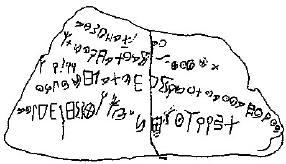
In 1976 an excavation of an ancient Israelite village uncovered written on a piece of pottery what is now called the 'Izbet Sartah abecedary (an abecedary is a list of the alphabet in order). The inscription was dated to 1200-1000 BCE and it looks like the above image.

Actually, only the bottom line is the abecedary. What is unusual about this (aside from its existence in and of itself!) is that it is written from left-to-right (that's an 'aleph all the way to the left, and the crossy looking thing at the right is the tav). That itself isn't so unusual in ancient writing. The ancient Greeks sometimes wrote using boustrophedon, which means that the text alternates in direction depending on the line.

For example you would start writing from left-to-right
enil txen eht ni tfel-ot-thgir eunitnoc dna
and then reverse on the next line, etc.

Of course that was how the early Greeks did it, but this is the only example of such Israelite writing.

More puzzles:

The zayin and hes are reversed, as are the 'ayin and peh. And then it seems to repeat kuf twice, while omitting resh. If written in modern Hebrew it would look like this: תשקקצעפסנמלכיטזחוהדגבא

Interestingly, the first four peraqim of Eicha are acrostics; each verse or group of verses begins with a letter of the aleph-bet and the chapter is 22 verses long. The second through fourths pereqs actually reverse the פ and the ע for no apparent reason (while the first doesn't). Perhaps taken with the 'Izbet Sartah abecedary we can postulate that the order of the alphabet simply wasn't fully stable until a later date. Of course that's not a very complete answer.

Another puzzle is that the first four lines above the abecedary are gibberish, or at least it seems like it thus far. Some have said that it may be a student's practice, the ordering may be simple error. But of course there's no evidence for that. Wanna solve an ancient mystery that has experts baffled? What's the deal?

On the Main Line, now with tags: ,

Friday, September 02, 2005

Fill the earth and subdue it!

The August 22 New Yorker had a very interesting article on Billy and Franklin Graham and American Protestantism. It quotes an apparently famous sermon called 'Shall the Fundamentalists Win?' given by Harry Emerson Fosdick on May 21, 1922 at the First Presbytarian Church on W. 12th street in New York City. Fosdick was "a Baptist minister raised in the old orthodoxy" who "found his faith transformed by a study of the orthodoxy's hindrance to the progress of mankind".

He said that Liberal Christians (of his era)
have assimilated as part of the divine revelation the exhilarating insight which these recent generations have given to us, that development is God’s way of working out his will. They see that the most desirable elements in human life have come through the method of development. Man’s music has developed from the rhythmic noise of beaten sticks until we have in melody and harmony possibilities once undreamed. Man’s painting has developed from the crude outlines of the cavemen until in line and color we have achieved unforeseen results and possess latent beauties yet unfolded. Man’s architecture has developed from the crude huts of primitive men until our cathedrals and business buildings reveal alike an incalculable advance and an unimaginable future. Development does seem to be the way in which God works.
There is much to pick apart, to be sure. Ancient forms of music still extant, such as Indian sitar music is hardly primitive. There is much to be commended from the past as well as in the present and future. But Fosdick worded a good point well.

Thursday, September 01, 2005

Professors on the Parashah

I can't tell if they're trying to be cute or provocative with the title, but its kind of both. Lemaasah, you'd know what the book was even if they only called (or should I say spelled) it "parashah".

Contributors: Zohar Amar, Aryeh Arazi, Nathan Aviezer, Yonah Bar Maoz, Yair Barkai, Menachem Ben-Yashar, Hayyim Borgansky, Yaakov Charlap, Yuval Cherlow, Aaron Demsky, David Elgavish, Yehuda Feliks, Amos Frisch, Devorah Gan,z Haim Genizi, Israel Zvi Gilat, David Henshke, Carmi Horowitz, Avigdor Hurovitz, Hannah Kasher, Moshe Kaveh, Alexander Klein, Admiel Kosman, Dov Landau, Rachel Lifshitz, Yosef Ofer, Yossi Peretz, Rivka Raviv, Shaul Regev, Yisrael Samet, Yaron Seri, Yael Shemesh, Daniel Sperber, Shubert Spero, Yaakov Spiegel, Hayyim Talbi, Yael Tzohar, Itamar Wahrhaftig, Abraham Walfish and Judah Zoldan

This could be interesting.

LinkWithin

Related Posts with Thumbnails
'