Showing posts with label Gaon of Vilna. Show all posts

Tuesday, December 05, 2006

The importance of the Vilna Ga'on to Haskalah

You can find some interesting stuff on Google book search nowadays, as they scan more and more books. I found a chapter from The gaon of Wilna; a review of his life and influence by Mendel Silber (1905), which I decided to upload:

'Elijah Gaon of Wilna; His Importance.' You can download it or read it here.

Aside from the interest of the information contained in these ten pages in itself, it might also be of interest to readers in that it is a lucid example of how non-traditionalist Jews idealized the Vilna Gaon from an entirely different angle than traditionalists (Silber was an American Reform rabbi in St. Louis).

Excerpts:


It really is worth reading the entire chapter.

The phenomenon of individuals who people with all sorts of opposing views feel kinship with is interesting. I have previously posted about how the Rambam was one such figure. The Ga'on was another. More recent figure were R. Samson Raphael Hirsch and R. J.B. Soloveitchik. Interesting it would be to investigate all such figures and contrast them with those who opposites never tried to co-opt for their own.

Thursday, June 22, 2006

The Gaon's Gemara (and his emendations)


Now here's something interesting. This page of Gemara belonged to the Vilna Gaon and contains marginal notes and textual emendations in his own hand. (click to enlarge)

It is from Talmud Yerushalmi Maaser Sheni 5b. According to the notes accompanying this image, "Rabbi Elijah has excised a phrase (lines 13-14) then rearranged the phrasing and reinserted the emended text at the point (line 16) marked by three dots in a triangular shape." The margin contains notes explicating the passage. Although the tect doesn't mention it, there is another excision on the second to last line marked by parantheses, which means it should be moved. Then there is line above the word נטמאו, which means that it should be removed, as well as another line over other words which should be removed.

This image comes from the book which accompanied the Yeshiva Univerity Museum's exhibit on printed Talmuds.

Monday, June 19, 2006

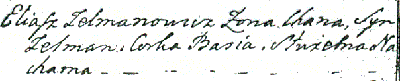
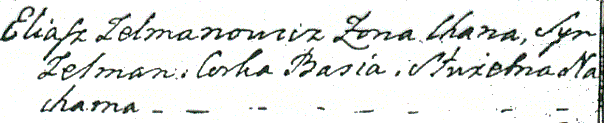
Eliasz Zelmanowicz, Gaon of Vilna

Here is an interesting record from the Jewish Family History web site:


It is from the 1765 census list of Vilna showing the Vilna Gaon (Eliasz Zelmanowicz, wife Chana, son Zelman, daughter Basia, and servant Nechama).

This page has more census records, including one from 1784 and one from 1795, listing his second wife Gitel.

I hope I am not insulting my erudite readers by pointing out that Zelmanowicz was not his true surname, but rather means "son of Zalman."

Monday, September 12, 2005

Nitpicking Karen Armstrong; We all make mistakes

Time and again I've noticed that when I read something that I know a lot about I'll inevitably catch a factual error (especially if the thing I'm reading wasn't written by a specialist in that subject). This shouldn't be surprising. After all no one's perfect. If a treatment of some subject gets 98% right that's really good. But if this is true of what I do know, what about what I didn't know? Surely everything contains factual errors.

Karen Armstrong's "The Battle For God" is a good example. The book treats the rise of fundamentalism in Christianity, Judaism and Islam worldwide over the past 50 years, a phenomenon that virtually no one predicted. It's a pretty good book. She is a thorough scholar. According to Amazon.com she cited 175 works. The bibliography is 17 pages long, each one containing about 36 entried. Thats more than 612 sources, plenty of them good ones. But on page 101, discussing the beginning of Chassidus, she writes of
"....a powerful figure: Elijah ben Solomon Zalman (1720-97), head (gaon) of the Academy of Vilna."
I'm not sure its an exaggeration to say that any twelve year old kid in yeshiva knows that this is nonsense. The Vilna Gaon most certainly was not the head of the Academy of Vilna (nor was there an 'Academy of Vilna').

Now I'm not saying this is an unreasonable screw-up. Armstrong probably read a hundred and one times over the years that a gaon was an academy head. She probably didn't even realize that she was making the Vilna Gaon a rosh yeshiva without having read it in any source. But a mistake it is, and not a minor one in that to understand the Vilna Gaon is to know first of all that he was an independent, secluded scholar. Even his having disciples meant something completely different than having disciples normally does.

It's understandable how Armstrong got this wrong, but of course it means that she probably has no concept of the Vilna Gaon apart from some dry facts, namely that he was reputedly a genius, extremely influential and an opposer of Chassidus.

So what else does she misunderstand and what else does she get wrong, especially in the parts of the book that deal with Christianity and Islam, which I have less intimate knowledge of? This is a problem native to any work of this kind, al achas kamma ve-kamma, articles in the daily newspapers or popular magazine.

LinkWithin

Related Posts with Thumbnails
'