Thursday, August 18, 2011

A method of dehumanizing Siberian prisoners described in an 1853 anti-Reform responsum.

The Jewish press arose more or less in the 1830s (link). What the Jewish Encylopedia calls "the first successful Orthodox paper was "Der Treue Zionswächter" (1845-55), with a Hebrew supplement, "Shomer Ẓiyyon ha-Ne'eman." Its founder was Rabbi Jacob Ettlinger, although he was not the editor. The name of Rabbi Ettlinger and the editor Dr. Joseph Enoch appear on the masthead of the Hebrew section, the aforementioned שומר ציון הנאמן. This was published bi-weekly and, according to Judith Bleich, 220 issues were printed (each with roughly 4 pages). Naturally you can find bound editions in libraries and in 1962 an edition containing all of them was printed. Most of them are on hebrewbooks.org.

This Hebrew literary journal featured writing by the famous and non-so-famous Orthodox rabbis in Germany (and even Hungarian rabbis like R. Moshe Schick) on a variety of topics, ranging from responsa, to chiddushim, to polemics, to poetry, to educational concerns, as well as news.

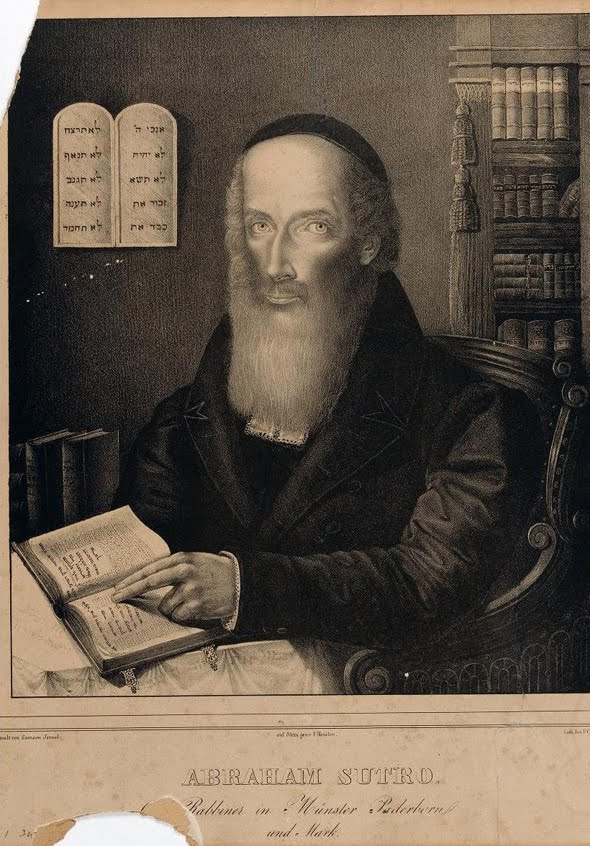
There's a fascinating section in one particular responsum printed in the 5 Shevat 1853 number (#144, pg. 287). The piece is called תשובה במה שחדשו המתחדשים בעניני בית הכנסת, "Responsum concerning the synagogue innovations of the Reform," by Rabbi Abraham Sutro, av beis din of Münster (1784-186). Rabbi Sutro happens to have been the teacher of Isaac Leeser who was already the leading exponent of traditional Judaism in the United States, a one-man literary whirlwind. Rabbi Sutro was an early exponent of Torah 'im Derech Eretz, propounding it as the proper path and using that precise term for it, even before Hirsch. See, e.g., his first volume of 'מלחמות ה (Hanover 1836; subsequently he published three more volumes with that name between 1862 and 64). He writes the following on page 11:


In any case, in the responsum on synagogue Reforms, he answers three questions. Is it permitted to use an organ on Shabbos? Is it proper to summon people to the Torah by means of a card (קארטען) instead of calling them by their Hebrew name, א ben ב? Is it proper for the synagogue gabbaim to hush people and prevent them from praying loudly and with intensity? You know what the answers are.

Specifically regarding the second question, he begins by stating that the intention of the Reformers is to wipe out Jewish names - "דע כי כל מגמת המחדשים אלו שלא הזכיר שם ישראל עוד ." After a lengthy paragraph citing his halachic sources - this is the lengthiest of the three responsa - he adds another reason why it is a bad thing to give cards and refrain from calling up people by name:


"They also do not realize what anyone who knows current events does, regarding prisons, specifically in Siberia, where the harshness of the punishment for rebels and murderers is that they are no longer referrred to by their name. They are only called "1st, 2nd, 3rd" in order that they should not be remembered and counted any more. Think of the foolishess of these fools. They think by calling people to the Torah in this way that they're honoring them, but actually they are degrading them, causing them to be like people without names like low people. Really we should be very sad for them; and by maintaining our practice we fulfill 'forsake not the teaching of thy mother.'
I thought the reference to Siberian prisons and the dehumanization of prisoners by only calling them by number was interesting.

Here are two pictures of Rabbi Sutro:


No doubt you are wondering what it says in the open volume. The import of his surname was not lost on anyone. Here it is:


The medal he is wearing in the second picture, from 1861, signifies his being awarded membership by the Prussian king in the Order of the Red Eagle, fourth class - whatever that means.

Monday, August 15, 2011

Shadal series #5 - What does Morenu really mean?

In Julius Furst's Der Orient (Literaturblatt des Orients No. 7, February 15, 1840) pg. 108 we find the following short note by Shadal asking a very fair question: Was the rabbinic title originally מוֹרֵנוּ, that is "our Teacher," or מֳרֵנוּ, that is "our Lord?"


Shadal says that of course we find Morenu (מורנו) all the time, but the question arises from older manuscripts where there is something which gives rise to his question. For example, in Rabbi Yehuda Ha-levi's Diwan (a rare manuscript which he purchased and was about to publish) we always find מרנו (lacking a vav). Sometimes we even find it abbreviated and including nekkudot, like this: ' מֳרֵ. He points out that very old manuscripts sometimes have older readings, so such things are not mistakes at all.

In fact he concludes that this is the primary reading, and we see from this that the term מורנו is really מֳרנו and derives from the word denoting lordship rather than teacher. The term actually comes from the Aramaic phrase מרנא ורבנא, where the absolute form of the word is מָר, master, not מוֹרֶה, teacher. The "German-Polish" (Ashkenazic) pronunciation of the kametz with each failure to differentiate between the two kinds of kametz lead to the pronunciation as Morenu, rather than Marenu. From this it was but a small step to spell it maleh with a vav, מורנו, and this implied that the word means to say "Our Teacher." This is essentially what happened with the word haftarah (הפטרה) which is often pronounced and written haftorah (הפטורה), but there is no doubt whatsoever that the correct reading is the former.

Shadal included this, slightly expanded, as a footnote to his edition of the Diwan (link), which I will get to soon.

What he did not mention (or know) is that there is actually a whole spiel about the correct pointing of the word מר, which undoubtedly means 'master.' Although we Ashkenazim pronounce it "Mar" the Sephardim pronounce it "Mor," with a holem. The first explicit reference to this I could find says it's a mistake (naturally). In R. Elijah Levita's Tishby we find the following entry:


He says that there are those who write it מֹר, but this must be a mistake, because if this were the correct reading why not [ever] write it with a vav?

The answer to his objection is that they definitely do write it with a vav, he just never saw it.

Although many people will want to point to the writings of the ge'onim (as I will) you can actually find it numerous times in the Mishnah commentary of R. Ovadiah Bertinoro. Here is one example from the first printed edition (Venice 1548):


If you don't find it in your copy - it is spelled מר rather than מור in the Bar Ilan database - it's because later editions corrected it, but this is how Bertinoro always spelled it (or at least how it is spelled in the earliest printed editions).

We can find it spelled מור in numerous manuscripts from the time of the ge'onim. Here are but two examples:


The first is a description of a manuscript in Ohel Dawid, the catalog of the Sassoon collection. The second, below, is from Halakhot Pesukot. There are many more such examples, including the Sefardic rescension of Iggereth Rav Sherira Ga'on.


Thus we see that Shadal did not seem to realize that pointing with a holem (Mor) is undoubtedly possible. Practically speaking I'm nor sure what difference that makes, since he'd be right in any case that it meant "master" and not "teacher." Actually the Sefardic pointing supports him.


Interestingly one can find a clear support for Shadal in Rashi on Kiddushin 31b which discusses the proper way a person should refer to his father. Rashi ד"ה ואמוריה explains אבא מרי to mean אביו ואדוניו. Not only that, as it happens in our texts of Rashi מרי is written with a vav, מורי. I will leave it to the text experts to get to the bottom of it and determine if this is the correct reading of Rashi. Incidentally, Soncino translations מרי as "teacher" and Artscroll translates it as "master." Also see Rashi Bava Kamma 49b where he gives the exact same translation for מורי (this time the Gemara reads it with a vav).

Interstingly enough in the 2005 edition of the Tishbi there is a note in this entry by Rabbi Meir Mazuz which says that he heard from his father R. Mazliach that the Ashkenazic reading "Mar" is correct, but the Sefardim changed it to "Mor" because "Mar" connotes bitterness. And, I would add, "Mor" means "myrrh." Actually, he brings a quotation from the Tikkunei Zohar which makes a play on "Mor" as both "master" and "myrrh," which implies that the Zohar (*coughSpaincough*) read "Mor." (Link; this wordplay is very sbutle, but I agree with him. It is a nice catch. Almost as if sensing that the wordplay doesn't really work with Ashkenazic pointing, the editor of this 1909 edition with nekkudot doesn't point "Mar," seemingly the only unpointed word on the page! That's pretty cool, except that he was Sefardi. צ"ע.) I also want to point out that this edition (Machon Harav Mazliach 2005) is the one to get, if you ever wanted a Tishbi. The only criticism I have is that for some reason they changed R. Elijah's unique vowelization of many of the entries, a major major error on their part. I can't begin to fathom why they did that, and if they had to do it they should have noted each change in the notes. Apart for that, it is simply the edition to own with its manifold notes and supplements.

Here's Shadal's comment in his Betulat Bat Yehudah (Vienna 1840) pg. 111:


I would just note that the typesetter spelled the book Besulath Bath Jehuda, as you can see. In other words, in the same word (בתולת) he renders a תי"ו רפויה as /s/ and also /th/. That's enough to drive a pedant crazy.

In this footnote he expands his thought, mentioned only briefly in German, that we have a great source in old manuscripts to teach us how the ancients read, and from this we can learn many things. He gives another example which I admit that I find puzzling. The example is גאוון, which he says is a faulty modern spelling, for in old spellings it is always גאון with one vav. He says that the old readings prove that the traditional spelling with one vav is correct. I think I'd have a better idea of what he was getting at if I could find many examples of "גאוון" in print but I cannot. So I'm not sure which moderns he has in mind. I guess unwittingly his own writing became an example of what he is talking about. We now see that in 1840 people were spelling it "גאוון," evidently a passing fad.

Did the "Vilna Gaon's 'rebbe' the Pnei Moshe enroll in a university to study botany?

Here's the abstract: did Rabbi Moshe ben Shimon Margolis (circa 1710-1780) author of the Pne Moshe/ Ma'areh ha-Panim commentary on Talmud Yerushalmi, and reputed rebbe/ tutor of the boy who grew up to be the Vilna Gaon, actually enroll in a course on botany at the University of Frankfurt-an-der-Oder?

Let me explain. Originally the title of this post was going to be "Quasi-factual facts," and it was going to have the following introduction:
As the title indicates, there is a phenomenon of facts that may not be so factual, yet which get repeated so often they become fact. One such example is the following: Rabbi Moshe Margaliot (d. 1780), author of the Pne Moshe commentary on Talmud Yerushalmi and a rebbe/ tutor of the child who would grow up to the Vilna Gaon, enrolled in the University of Frankfurt an der Oder when he was middle aged to study botany so that he could better comprehend the agricultural content of the Jerusalem Talmud!
I'll give the rest of the introduction in a minute, but I want to say here that I thought the evidence was far flimsier than it actually is. After looking into it I am now convinced that it is more probable that he did than that he did not. So I no longer think that this is a good example of a questionable "fact." I continue:

For example, Elchanan Reiner writes:
Apparently Margolis used manuscripts to clarify textual variants and spent no little time in the Department of Botany at the University of Frankfurt an der Oder in order to prepare himself for the composition of his commentary on Seder Zera'im.
(Reiner, Elchanan "Beyond the Realm of the Haskalah - Changing Learning Patters in Jewish Traditional Society," Jahrbuch Des Simon-Dubnow-Instituts VI 2007, pg. 130.)

He gives no source, but likely his sources were either the Encyclopedia Judaica ("In 1779, when he was nearly 70 years of age, his name is found among the students enrolled in the botanical department of the University of Frankfurt on the Oder. ") or one of its sources, Dr. Louis Ginzberg's English introduction to his commentary on the Yerushalmi, which reads as follows:


Since this is a general introduction, he doesn't have footnotes. But the statement is pretty clear-cut:
"We know very little about the life of the great commentator on the Palestinian Talmud. I shall, however, mention one very interesting fact about him. On August 11, 1779, shortly before his death - he must have been about seventy! - he registered under the name of Moses Margelit (in his native country he certainly pronounced his name Margolis!) as a student of botany at the University of Frankfort-on-the-Oder. One is safe in assuming that his eagerness to acquire botanical knowledge was prompted by his desire to be better prepared for the study of the first order of the Palestinian Talmud, which deals chiefly with agricultural laws, for the understanding of which some botanical knowledge is indispensable. For the same reason "the Gaon of Wilna" had spent some time with farmers, for in Poland no opportunity was given to a Jew to register at a University."
There are a lot of assumptions here! But one thing seems clear-cut, given that the exact date of his registration is known.

But how do we know it? And is "Moses Margelit" indeed the 70-year-old author of Pnei Moshe? How do we know that?

Indeed, some sense that nothing is certain here. On page 149 of Heshey Zelcer's Guide to the Jerusalem Talmud, footnote 225 says
"According to the records of the University of Frankfort-on-the-order [sic], on August 11, 1779, an M. Margoliot enrolled as a student. If this is indeed our M. Margoliot then shortly before his death, at the age of about 69, he registered as a student of botany presumably because he hoped thereby to gain a better understanding of the first order of the Palestinian Talmud which deals chiefly with agricultural law."
Presumably the fact rests on the university record. But where is the university record? Obviously it must have been published somewhere, and indeed it has. Ginzberg (and everyone else) most likely saw it in a 1923 article, which I am going to show and excerpt - but through the miracle of modern digitization technology I can first show you the 1923 article's source.

In 1888 an exceedingly dry, telephone-book sort of work was published, called Aeltere Universitäts-Matrikeln: 1649-1811 by Ernst Friedländer. The book is exactly what it sounds like, endless lists of students' registration information in German universities from 1649-1811. The first volume happens to be for the university of Frankfurt a.d. Oder. Here is what you will see on page 477:


Here's what we learn. On August 11, 1779 "Moses Margelit Rubin" enrolled. His course of study was "botan." and his father was "Simon Margelit." His father's residence is Kalvarde, which could well be Kalvarija, Lithuania (which is near Kovno; in fact as close to Kovno as Keidan, where he lived when he tutored the Gra). As for the strange idea that his father's or his nationality is "Italien" (it is in the column "Heimath oder Herkunst," "Home or Descent"), this actually fits well with the Pnei Moshe. In 1765 he had moved to Italy, where he remained for years. It isn't impossible to imagine him putting down Italy in his registration. As for the name "Margelit Rubin," which I don't think he is known as anywhere else, presumably it is an attempt at giving a German version of what is after all a Hebrew word for a surname, מרגלית. Now I know that it still doesn't exactly say "The author of Penei Moshe" nor does it allude to his advanced age. Still, this is a far better than a coincidental same name.

In any case, Rabbi Louis Lewin was the one who called attention to this in a really fascinating article called Die juedischen Studenten an der Universitaet Frankurt a. d. Oder (Jahrbuch der Jüdisch-Literarischen Gesellschaft 15 1923). Based mostly on the aforementioned book, Louis Lewin lists all the Jewish students of the University of Frankfurt a.d. Oder in the 18th century and as much biographical information about them as available.

As far as I'm concerned there is a good chance that this is the Penei Moshe, better than I'd thought. Certainly the weak link is extrapolating his motivations and stating them with certainty, but on the other hand it is doubtful that this 69 year old master of the Jerusalem Talmud registered for botany classes so that he could study tulips and start his own garden. Furthermore, if he died in 1780 then there is no telling how much time, if any, he actually spent there, certainly not enough to say that he "spent no little time in the Department of Botany."

Incidentally, I began looking into this about a year ago, and sort of got sidetracked. At the time, a friend of mine asked "a leading expert on Yerushalmi" and this was his reply:
No, the evidence is definitely not solid, and the critical point is indeed whether the Moshe Marg. mentioned as enrolling at U. of Frank. am Oder is the same as the author of Pnei Moshe.
That sounded pretty convincing to me a year ago, but of course this is an expert on Yerushalmi, not an expert on German university registration records, and I don't know if he even saw the entry.
To me it sounds like he thinks that it simply says the name, but as I have shown it also has the father's name, mentions his place of residence and origin very close to an area of Lithuania where he is known to have lived, and also mentions his Italian collection, although this is unclear. To me this is a more pregnant piece of evidence than a mere name.

There is an article on the Penei Moshe in the Proceedings of the 11th World Congress of Jewish Studies called ר׳ משה מרגלית ופירושו פני משה על התלמוד הירושלמי, by Aviad Hacohen. I haven't seen it. He must discuss this. Maybe he brings additional facts, maybe he concludes differently from me. Although I will probably track down the article to see for myself, I think it's likely that my conclusion will be what it is: a less quasi-factual fact then I thought, and more likely a factual fact. Still, one wishes there was at least one more piece of evidence and I can understand if someone is less persuaded.

Sunday, August 14, 2011

17th century Jewish haircuts?

Here's an interesting illustration from a 1695 book on the biblical prohibitions of various kinds of shaving called 'Comam Hebraeorum licitam & interdictam,' or, Lawful and Forbidden Haircuts of the Hebrews, by Theodorus Dassovius.

The illustrations show the parts of a man's beard and sides which are forbidden by Leviticus 19:27 to cut. I can't make out the full caption for the woman, but I'm assuming that Dassovius does not assume, unlike rabbinic law, that women are exempt from this prohibition and therefore illustrates how he sees the prohibition on the hair of a Jewish woman. Below them is the specific kind of haircut that, according to him, Leviticus 19:27 forbids. In the book everyone from Alshech to Martin Luther is cited.

Thursday, August 11, 2011

Shadal series #4 - disapproving of R. Samson Raphael Hirsch's predilection for German.

One the things which really annoyed Shadal was German. He didn't like it, he claimed that he couldn't read the Blackletter type well, he often said that he never read a complete German book until 1829, and although he wrote hundreds of letters in Italian, French and even Latin, when a Jew sent him a letter in German, he invariably answered in Hebrew. Although he did write articles for publication in German, his attitude was generally negative toward that language, corresponding to his perception that German Jews were becoming too assimilated and too cavalier toward Hebrew (shared by many non-German Jews of a traditionalist orientation all over Europe; indeed, in eastern Europe a modern Jew was often called a דייטשער, that is, a German, in Yiddish; and, ironically, in German).

Having recently posted about Shadal's reception of Hirsch's 19 Letters (written in German; Shadal was impressed by it and expressed love for its author, who was then unknown to him), here is an interesting little poem that he wrote, apparently in response to a letter he received from Rabbi Hirsch written in . . . German.


(Chinor Nahim v.2 pg. 295. Padua 1879.)

Loose translation (forgive me):
What's up with the author of the Letters Ten-Plus-Nine?
Has he switched and become Geiger or Holdheim?
For he wrote to Shadal in the language of Germania,
Not in the language of Jerusalem and Judea.
At the end of the book (compiled by his son Isaia) is an index stating where and if the poems in this collection were written or printed. This one? It was a ditty included in an 1847 letter to Geiger! Unfortunately the letter appears neither in Iggerot Shadal or Epistolario, so I don't know what the rest of the letter was about.

Wednesday, August 10, 2011

On the Napoleon Tisha B'av legend - tracing it back in print to 1891.

Indefatigable medieval traveler Benjamin of Tudela recently posted about "Napoleon and Tisha Be'av Myth," or the story that Napoleon visited a synagogue in [usually Russia, but I've also seen versions which say Paris] on Tisha B'Av. Noticing the lamentations and expressions of mourning of the Jews, Napoleon asked the very question that a didactic folk tale would require him to ask: What's up with the Jews? It was explained that they are mourning for the destruction of their Temple. As per the requirements of the story, Napoleon asked when this Temple was destroyed. Informed that it was 1700 years earlier, Napoleon said that if indeed this people is mourning their Temple after 1700 years, such a people so attached to their history, will indeed be restored to their land and their Temple rebuilt. Or some such thing.

Benjamin of Tudela mentioned that in a search for the origin of this story, he came "across this very same question, posed to J. David Markham - President of the International Napoleonic Society . . . The noted historian of Napoleon answered that he had never heard that story. You can draw your own conclusions."

While there are many reasons why the story is probably only a story, it is a story, and the question is how old is it? And are there variations? To me it's a pity that the president of the International Napoleonic Society should have never even heard of the story, since I would think that the folklore and legends surrounding Napoleon should be of interest and known to him. And this is definitely a piece of Napoleon folklore.

Benjamin cited a book from 1954 which has the story, but has Napoleon not really getting it at all. In this version Napoleon is skeptical that mourning and lamenting will accomplish anything, but the author writes that he was mistaken - those who mourn the destruction will see it rebuilt.

In 1946 the YIVO Annual (Vol. 1) printed an English excerpt from the 1942 book Yidn in Frankraykh by Shmuel Zanvil Pipe called Napoleon in Jewish Folklore. The article contains 43 pieces of Napoleon folklore collected from "correspondents from all parts of Poland, as well as several from Palestine and one from Bagdad, Irak." It gives two versions of the Napoleon legend. The first is as I described, and the second is an elaboration of the 1954 version mentioned by Benjamin. In this version, Napoleon visits a synagogue in Vilna and cannot understand what wailing will accomplish. Seeing the lamentation, which he considers aimless, Napoleon points to his own sword and says "This is how to redeem Palestine."

Getting a little earlier - this article in the American Jewish Yearbook 26 (1924) pg. 306, translates a Yiddish article from January 1912 in a periodical called Warheit, and includes the legend - the version where Napoleon tells them that they will not regain the land by lamentation, but by force. This Yiddish article is all about how Jewish boys should join the Boy Scouts, mind you.

It existed in the 40s, it existed in 1912. Obviously the story was around. We cannot be sure of how old it is, and one version seems possibly to have been compromised by Zionist sentiment. To be sure, we cannot say if the Zionist version is the original, and the other version a pious retelling of that, or if the opposite is the case.

The earliest I have been able to find it in print is as an aside in an article on the Corfu esrogim controversy, in Hamaggid October 29, 1891:


In fact it is such an aside that the author of this piece doesn't even mention the contents of the story, only that he recalled Napoleon's words on Tisha B'av. On the one hand this is good. To be so flippant shows that it was perfectly well known in 1891, a cliche to the point that it only needed to be alluded to. On the other hand, we are unsure what Napoleon's words were, although if I had to guess from the context it is the version where Napoleon advocates force rather than passivity.

The Corfu esrogim controversy in this context refers not to the grafting issue, or high prices, but to the 1891 blood libel, which raised the issue of economically supporting antisemites.

In any case, the point seems to be that some version of this legend must have existed for some time, perhaps decades, before 1891. If an earlier source in print should turn up, I'll keep you posted.

On writing 'Elohim' with a heh or a kuph; an early, negative assessment of Louis Loewe.

Rabbi M. Torczyner has a post about why he prefers to write "God" as "Gd" (link). I don't agree with him, but I certainly agree with having reasons for doing things.

It reminded me of something in two fascinating letters in איגרות סופרים (Vienna 1929).

Before I get to the letters, let me preface it by explaining that the aforementioned book is a compilation of documents and letters to and from Rabbi Akiva Eger and the Chasam Sofer, as well as some of their children, the two rabbis being the grandfather and great-grandfather of R. Shlomo Sofer, who edited this volume. Dots appear above some of the letters in the book title ('Letters of Writers') showing that the title is allusive to the last names Eger and Sofer -איגרות סופרים- of his ancestors.

The letters are from Rabbi Solomon Hirschel of London to the Chasam Sofer who, incidentally, was the Chasam Sofer's relative by marriage at the time. If you are interested in this complex marital relationship, scroll all the way to the end of the post.[1]

The letters, dated Chanukah 1835 and February of 1836, are to the Chasam Sofer and primarily concern a problem which the rabbi had encountered. What happened was a 25 year old man had shown up in London, called
"אליעזר Dr. Löwy." The young man conducted himself with great piety (והוא כמתחסד ביתר שאת). He knows ten languages, including English. He is reputed to be a big talmid chochom, and claims that he was a candidate for rabbinic positions in Altona and Cassel. Although he had visited the Chief Rabbi a number of times, they had never spoken in learning. Only recently the man's friends had rebuked him, saying that he must visit the Av Beis Din, who would love to discuss Torah with you. So it was that two weeks prior he came, and presented the Chief Rabbi with a pamphlet he'd written, which included pilpulim concerning various Torah topics. When the Chief Rabbi tried to discuss what he'd written, the young man excused himself saying that he had a headache.

After he left he noticed in the pamphlet some biographical information about the young man, and the fact that he received semicha Morenu from the Chasam Sofer. It further stated that he had studied secular subjects in Vienna for three years. Given all that is occurring these days (an allusion to Reform and such), and as he claims to ordained by the Chasam Sofer, he wishes to know what sort of man he is. Was he a proper student? Was he learned and sharp? Can he be trusted that he wrote the pamphlet - as opposed to them being left over from his father's writings? If he is appointed to a position of authority, can he be trusted not to implement reforms? He further explains that it's amazing to see a young man who is so pious, who knows many languages. He therefore asks the Chasam Sofer to tell him what the man is all about. He closes by giving a testimonial of conduct of his own, telling the Chasam Sofer that "Dr. Piner" (i.e., E.M. Pinner) conducted himself entirely appropriately when he was in London, and it would have been better if the Chasam Sofer had left him alone (i.e., instead of knocking him).

Before I get to the second letter, I will point out that"אליעזר Dr. Löwy" is none other than Louis Loewe, who would soon become the secretary and interpreter of Moses Montefiore, accompanying him on his trips to the Middle East and Russia. In addition to writing many scholarly monographs, he also translated Isaac Baer Levinsohn's Effes Damim (against the blood libel) and part of Haham David Nieto's Matteh Dan (as part of the polemic against Reform in England), and eventually he published some of the diaries of Moses Montefiore. In addition, he was the first Principal of Jews' College.

In any case, it doesn't take too much imagination to see that the Chief Rabbi Hirschel wasn't taken by this young man, who acted so piously, was so educated, was cultivating an amazing reputation in London, and wasn't exactly paying a great deal of courtesy and respect to himself, who was almost fifty years his senior.

The second letter in Iggeros Soferim is a response to the Chasam Sofer's reply. Although we do not know exactly what he replied, it is apparent that he basically said there was nothing wrong with Loewe as far as he knew. Not necessarily a ringing endorsement, but certainly if Hirschel was looking for something negative it was not given to him. So in his reply to this letter, he tries again. He zeroes in on the Chasam Sofer's words that he saw nothing bad openly (assuming this is a direct quote - לא נראה ממנו רע בפרהסיא) and asserts that the Chasam Sofer must have decided to be nice and not go into detail about what is bad about Loewe. He continues that it's really bad for a person to act outwardly piously but conceal his negativity in his heart. I'm not exactly sure what to make of what appears next, but it seems that Hirschel took the following as evidence that Loewe was "concealing." He writes that he had been "concealing" his rabbinic diplomas from him, until Loewe's friends convinced him to show them to him. So he saw his semicha from the Chasam Sofer (called עטרת בחורים, presumably because he was unmarried) as well as a התרת הוראה from two others. Apparently he felt the language in these diplomas were over the top, and that perforce such a young man could not be such a great scholar. Furthermore, when Loewe showed him something else he had written - in London - he once again declined to discuss it with him, sort of fumbling with the pages and saying that he wasn't well. Up to this point he has yet to discuss a word of Torah with him.

Apparently Hirschel had found irrefutable evidence of Louis Loewe's deficient piety. Furthermore, writes Hirschel, what does the Chasam Sofer have to say about this? What does he think of the piety of a man who writes אשר חנני אלקים with a ה instead of a ק? Is he not guilty of transgressing the Third Commandment לא תשא?

Apparently Hirschel had also heard rumors, because he then asks the Chasam Sofer to do him a favor and tell him what happened with Loewe and the police in Vienna. Evidently realizing that he sounded like he was in a persecuting mood, if not paranoid, Hirschel then tells the Chasam Sofer not to be concerned that he's going to be hard on Loewe, he will not "repulse him with two hands," because he is not like that. He closes by asking the Chasam Sofer not to write letters for people without researching them thoroughly ("sifting thirteen times," to use the Talmudic idiom as he does).

Anyway, this is the general content of these most curious letters.

Here is a photo of the much-older Loewe (who died in 1888):


[1] Hirschel's daughter Fanny married a grandson of Rabbi Akiva Eger in 1827, although the marriage ended in divorce in 1837. As a grandson of RAE, the husband was therefore also a nephew of Rebbetzin Chasam Sofer, being a daughter of RAE. Thus, upon marriage, Hirschel's daughter became a niece of the Chasam Sofer. Rabbi Hirschel was noted at the time for his prestigious rabbinic post, piety, scholarship, yichus, and wealth, not necessarily in that order, and his was therefore a highly desirable family to marry into (his being the brother of Saul Berlin was evidently not such a black mark).

Artscroll's grammatical correction of the Bobover Rebbe.

In the Artscroll edition of the Kinnos (The Complete Tisha B'Av Service) there is a kinnah for the Holocaust by Rabbi Shlomo Halberstam, admo"r of Bobov. Artscroll included the Bobover Rebbe's account of how he came to write this kinnah. For decades he felt unworthy of writing one until he happened across this passage in Seder Ha-yom, which states that whoever can compose kinnos should do so. As a public service Artscroll makes this kinnah available for free download (link).

I noticed something interesting. In the translation one Hebrew phrase is transliterated into English rather than translated. But obviously "Roshei Yeshiva" is not exactly a transliteration of "ראשי ישיבות." It is surprising that Artscroll not only chose to make a grammatical correction but to do it so visibly.

Click the image below to enlarge:


(If anyone is curious, in the Otzar Ha-chochma "roshei yeshiva" returned 795 results, "roshei yeshivos" returned 2890 (both spelled in Hebrew, of course). I'd say this makes a decent case that "roshei yeshivos" is acceptable rabbinic Hebrew. Included in the "roshei yeshivos" users were people like R. Yaakov Emden, and Italian rabbis like R. Samson Morpurgo and R. Aviad Sar Shalom Basilea, who knew about grammar.

For comparison purposes I also searched hebrewbooks.org and the Bar Ilan Responsa database, which essentially confirmed that "roshei yeshivos" is, descriptively speaking, rabbinic Hebrew. Spelling it in English, or in Hebrew, Google returns results for "roshei yeshiva" by the tens of thousands more than "roshei yeshivos.")

Monday, August 08, 2011

A cantillated Mishnah.

Here's a page of the 1553 Sabbioneta edition of Kiddushin, which included cantillation symbols for reading the Mishnah.


The editor explained on the title page that cantillation marks were added וכלפי מה שאמרו רז"ל סוף מסכת מגילה דהקורא בלא נעימה ושונה בלא זמרה עליו הכתוב אומר וגם אני נתתי להם חקים לא טובים ומשפטים לא יחיו בהם נתאזר עז לתת הטעמ"ים במשני"ות כדי להחזיר העטרה ליושנה וצדקה וטוב וחיים יהיה לנו כי נשמור ללמוד המשניות כאשר צוו אותנו חכמינו ז"ל.

Thursday, July 28, 2011

A strange Hebrew Benjamin Franklin story.

The following is from A.M. Habermann's Masekhet Sofrim ve-Sifrut (Jerusalem 1976) pg. 269, in a section on the love of books:

"The letters themselves contain secret magical properties. Gazing at them, even without understanding penetrate the heart and soul. Benjamin Franklin related: 'One time I was sitting and reading books, and a Jew named Peretz was also bent over a book. I knew that this Peretz was illiterate. Being curious by nature I asked him about it. He responded that it is due to God's benevolence that man can be involved with books, even if he does not know how to read!'"
Does anyone have any idea what the source for this Benjamin Franklin story is? I'd never heard of it. It even has the Jew's name?! Most strange.

The only thing I can think of is that it actually refers to Benjamin Franklin Peixotto (1834-1890), U.S. consul to Romania during a period of terrible persecution of the Jews. In Bucharest he did much for the rights of the local Jews.

Wednesday, July 27, 2011

An unusual paraphrased poetic rendition of Psalm 119 by an early 20th century socialite.

Here's a really unusual book called "PSALM CXIX The Hebrew Alphabet A Rosary An Inventory The Kabbalah." The title hardly makes sense, but the book is actually an artistic gem. Here is the title page:


The book is apparently hand written (and lithographed, I guess) and was published around 1913. The author's name is Grace Sanders Keefer (she was also known by other names). The book is her own poetic rendition of Psalm 119 in English, preserving the alphabetic character of this 176-verse Psalm. Thus, the aleph verses begin with the letter A, beis with B, etc. She carries it all the way through, with some creative license.

To illustrate what I mean, here is how the JPS 1917 translates Psalm 119:1-2:
1 Happy are they that are upright in the way, who walk in the law of the LORD
2 Happy are they that keep His testimonies, that seek Him with the whole heart.
3 Yea, they do no unrighteousness; they walk in His ways.
Here is how she paraphrases these, so that they begins with an A:
1 A straight man goeth about in perfect equanimity: he keeps on going in the Law of Jahweh.
2 A straight man guards The Spirit (of The Law) with all his heart expressing it.
3 Added to this he does not leave behing him a trail of crookedness.
Here are two sample pages:


The copy of the book (owned by U Mich) has the following inscription by the author:


Since that probably isn't easy to read, here is what it says:
Rabbi Emanuel Sternheim,

The purpose of this translation is to testify in I-Am-ness: Individualism the Equilateral Concepts/ Symbolism of AREALISM JUDAISM ROMANISM and to open the "Sealed Orders," "The Veil of The Temple", To The Light of the Simple Truth.

Grace Sanders Keefer
No, that doesn't make any more sense to me. Still, the translation is very creative, the lettering very nice (I assume she did it herself). Unfortunately I wasn't able to uncover much about her other than that she was a socialite based in Atlanta and New York and involved in two messy divorces, which made the newspapers (her first husband was of the Macy family, as in Macy's). Judging by the year of her first marriage (1905) I'll guess that she was about 30, or in her early 30s when this book was produced.

Incidentally, the idea of re-writing Psalms has a long history. For example, see כהנת אברהם (1719) by Abraham Hakohen ben Shabbetai of Zante, which features lengthy poems based on all 150 Psalms. It also includes poems based on Perek Shirah, which is usually not mentioned when this book is discussed.

Tuesday, July 26, 2011

Midnight Intruders - I review Avner Gold's historical novel about Chacham Tzvi and Nechemia Chayun.

Almost one year ago I referenced Midnight Intruders (Artscroll 2009) by Avner Gold (pseudonym for Yosef Reinman). I said that I would review it shortly. Recently someone reminded me that 11 months later is not shortly. So here is my review.

Midnight Intruders is a historical novel set during the early period of Chacham Tzvi Ashkenazi's life, climaxing during his rabbinate in Amsterdam where he was initially popular and respected. It did not take long though before he made some enemies. An unsuccessful attempt was even made to dismiss him. Then when a genuine scandal/ machlokes erupted, Chacham Tzvi's enemies whipped up a situation to the point where he felt compelled to literally flee Amsterdam clandestinely.

In brief, Nehemiah Hiyya Hayun (sometimes described as a 'Heresiarch') appeared in Amsterdam in 1713. Hayun was in Amsterdam aiming to print a book called Mehemnuta de-Kula (which some think was actually written by Shabbetai Tzvi himself) with his own commentaries. Chacham Tzvi (and R. Moshe Hagiz, although we will leave him out of this abstract) examined the book and declared it heretical. He informed the Sephardim of this decision, and their rabbi, Solomon Ayllon, became very angry, insisting that it was a major slight to the Sephardim that Tzvi should feel that he can dictate to the Sephardim, who were the older and better community. The reverse should be true.

So the Mahamad (the lay leadership of the Sephardim) appointed a commission of 7 members, including Ayllon, who would investigate Hayun's book and make an independent judgment. Each member received a copy.

In the meantime, Chacham Tzvi (and Hagiz) were trying to procure a copy of the book so that they could set out the case against Hayun clearly, and wrote to those who had given approbations to determine the circumstances, if they were authentic, etc. Then they wrote an official ban on the book, which angered Ayllon further. In response, he and his committee declared that Hayun is free of guilt, and that the book was fine and should be considered a standard Kabbalistic book. They apologized to Hayun and then he was treated like a respected guest.

One thing led to another, letters from near and far, bans, broadsheets, insults, interest from the secular authorities - when all was said and done, Chacham Tzvi and his family slipped out of Amsterdam, lest he be arrested on grounds of disturbing the peace.

Midnight Intruders is set against this background, although the first part of the book takes place earlier in Chacham Tzvi's life. The main character of the book is a fictional person called Rabbi Amos Strasbourg, who Gold/ Reinman sets as a close personal friend of Chacham Tzvi. Rabbi Amos Strasbourg is a character in several other books of the same series. Therefore Gold is able to set him up as a witness to the events, and to a certain extent they are seen through his eyes. There's a bit of a thriller element to the plot, but I assume readers of this blog are not going to be particularly interested in my take on that, so I decided not to summarize it - except for a little bit at the end.

I will point out here that I have a possible quibble with Amos Strasbourg's name. The book is set in the late 17th and early 18th century. As far as I can tell Jews were not allowed to live in Strasbourg until the late 18th century, making this surname impossible, I think. But of course I could be mistaken.

The narrative is colorful, and full of historical tidbits, Jewish and non-Jewish. It is definitely of acceptable quality, and often even better than that. On the other hand, the book makes heavy use of what they call "the exposition fairy," that is, when characters explain things which in reality would not be explained by the real characters. "The exposition fairy" is when a cop tells another cop what an "alibi" means, or explains an interrogation technique to a colleague, or some such thing. So, for example, on pg. 45 we read of a conversation where young Chacham Tzvi explains the meaning of the acronym "zak" (zerah kodesh) in his grandfather's name to Amos, who says that it is "an unsual name." On pg. 127 there is a random aside where one character explains that the Italian minhag is older than both the Sephardic and Ashkenazic.

I'll admit it is somewhat odd to read of the youngish Chacham Tzvi "grin[ning]" and telling Amos "I can't let you carry your own bags. I mean, what kind of host would I be if I did that?" Actually, in my opinion Gold has Chacham Tzvi acting too young at first. He treats him almost like he's a little bit giddy, but he's 30 years old at the time. I guess the narrative could have been impossible if it had been set any earlier, but in my opinion Chacham Tzvi acts like he's in his 20, not 30. That said this is only my impression. It is evident that Gold did not mean to do this. As he writes in the introduction, "I would not presume to put words into the mouth of Chacham Tzvi other than ordinary conversation, which I labored to portray in a manner suitable to a rabbi of such stellar stature." As we shall see he does not *entirely* succeed. That's understandable. Gold asks for Chacham Tzvi's forgiveness if he unintentionally wrote anything which impinges upon his honor. I'd say he is covered.

When he discussed R. Elijah of Chelm's golem (pg. 47) Gold makes the all-too-common mistake of taking "zikni" literally, and calls him his "grandfather." But this "grandfather" of Chacham Tzvi died in 1583, or approximately 73 years before Tzvi was born. Nearly impossible, and very improbable. R. Elijah was not his grandfather, but his ancestor.

I also take issue with Gold's reinforcing the historical truth of this golem, as he does by having Amos react mildly skeptically, and then Tzvi assuring him that it is "Absolutely" true, since "everyone the story passed through was a reliable talmid chacham." He then seals the deal by citing the Gemara that Rava made a golem. Although I'm not fully within my rights to complain about it since obviously Gold believes it himself, in my opinion this is not a good thing to reinforce in children, because it endlessly creates generations of children, many of whom will go through various kinds of painful withdrawals from such beliefs.

On pg. 49 there is a nice little message, that "it's good to know something about the Jewish people outside your own little circle," which is placed in the mouth of Tzvi, explaining why his father sent him to the Sephardic yeshiva in Salonica. Gold clearly believes this, as he has written numerous books describing upstanding Jews with Spanish names and manners and so forth. I will go out on a limb and say that I believe more than one frum kid has learned a little bit about the diversity of the Jewish world and history from his books. Just to throw out one random example, on pg. 134 we hear tell of a young lady named "Signora Raquel Tarantella," who is obviously not a Bais Yaakov girl, but presumably a kallah nangeh vaasuda.

On the same page he - surprisingly, I think - has Chacham Tzvi say that when he was 8 years old - the year of Shabbetai Tsvi - he was disappointed, having held out hope that maybe he was the Messiah. As far as I can tell there is nothing historical to support this, but this is a didactic moment for Gold, who then has Tzvi saying that afterward "there was nothing more to talk about," people were disappointed, they went on with their lives, and continued to pray and yearn for the Messiah. This also is an opportunity to explain about the Donmeh and other Sabbatians.

There's nothing wrong with colloquialisms, and the characters certainly speak in a mixture of 21st century English and Yeshivish, but I have to smile at Tzvi saying "there were many talmidei chachamim in Amsterdam with whom to talk in learning" and the like. (pg. 51) Incidentally, on the same page Gold has Amos opine that 25 is a good age to get married, with the caveat that "there's no guarantee that you'll get married within six months" if you start looking at 25. Tzvi agrees.

On pg. 73 & 78 he indulges very mildly in a stereotype which made me a little uncomforable, when Amos promises a Dutch captain who helped him with a night of drinking on his tab. The captain agrees, but says he'll take two nights. Amos agrees once more. Then later he reminds Amos that he expects him to pay up, "I want those free drinks." To be sure, many good qualities of this captain, as well as the Dutch in general, are enumerated, and Amos specifically says that he knows that the captain helped him because of his kind heart, and not becuase he needed free drinks. And yet, we can well imagine a parallel scenario with a Jew and money or some such thing, and I've no doubt that Gold himself would feel uncomfortable by that. I don't think any harm was meant here at all. I'm just saying. Not being totally PC is not the crime of the century, but it rubbed me wrong, especially as this is a book for children and an opportunity to reinforce values and ideas, which is clearly not lost on Gold.

On pg. 85 Tzvi is telling Amos about the pain of losing his wife and child, and how he recalls her. He lists her good qualities, and then says that he remembers her sitting with pleasure at the Shabbos table, listening to him and his father discuss a very complicated sugya "even though she really couldn't be expected to understand what we were saying." Although from a historical perspective this is almost certainly true, one can't help but feeling that here the Chacham Tzvi is Gold commenting about the 21st century as well. The whole scene is actually very moving, but I had to mention it.

Referring to what I wrote earlier, that Gold labored not to put thoughts and ideas into Tzvi that you can't find in his own writings, he also writes that he took the liberty of including some of his own Torah, putting it in the mouth of Strasbourg, as he does for example on pg. 130-31. Clever, and nothing wrong with it, but I thought the idea of having Chacham Tzvi approve is a little . . . self-confident. To be sure, he actually has another historical rabbi, Rabbi Shmuel Aboab, do the approving, while Chacham Tzvi stands by and listens (except to say "And I," seconding the rabbi's agreeing with Amos/ Gold's description of a certain human experience). Obviosuly Chacham Tzvi doesn't disagree. It's okay, really, but it is what it is: Gold says over his Torah while the Chacham Tzvi listens and does not object. On pg 182 - 3 he does this again, and this time Chacham Tzvi claps his hands together with delight upon hearing a Torah thought from Gold. He even says "I love [the explanation], and I believe it is true."

On pg. 138 we meet a "Rebbetzin," which I suspect (but I am not certain) is not a term in use yet. I know people will point to the Romance suffix -etze, but I'd need to see some proof. Since I know that the burden of proof can't be on him unless I have some good grounds for doubting that this word was used, I mention it only so that some reader might be able to set the record straight. He has this Rebbetzin say a certain Yiddish saying in the name of her grandmother. I doubt this saying goes back to the early 1600s.

On pg. 139 there is a little dig at early modern medicine, the four humors and so forth. Hm.

On pg. 149 Gold has one of his main protagonists in earlier books, Rabbi Shlomo Pulichev, clarify that some people don't have the temperament to learn Gemara all day, and that they should set aside some time daily, and learn what appeals to them. Further, if the main pillar in one's life is not Torah, then they should build up the pillar of kindness. If they cannot learn Torah every minute, then live Torah.

On pg. 157 he has Hayun taking in people by posing as a holy man. He declares a baby a gilgul (reincarnated soul). And herein lies the rub. You can't really tell the difference between a fake kabbalist and a real one, can you? Later in the book Gold will make an effort to explain that Hayun's teachings are only subtly different from actual kabbalah, but of course his are very bad and very dangerous. Of course he doesn't explain what those teachings are, or why they should be only subtly different from authentic kabbalah. Point of interest: Hayun's teaching combined a sort of Deism and a Triune conception of God. He felt that God is three; one is called Atika Kadisha, the Ancient Holy One. This aspect of God is removed from the creation, and indeed did not even create. But emanating from Atika Kadisha is Elohei Yisrael, the God of Israel who is the God of cretion and history who is not remote from creation, and Shechinah, or the Presence. Not sure what the Presence does, but of course Elohei Yisrael and Shechinah have to be united, etc. Is this is subtly different from Kabbalah?

On pg. 183 the fact that Chacham Tzvi constantly eschewed gifts and "extras" routinely offered to rabbis is stressed (as it is in several other places in the book) with the explanation that accepting largesse (apart from an earned salary) results in corruption and the tainting of leadership, even subtly. In case the point isn't clear, Gold mentions "money, honors, favors" as well as "support for our yeshivos and charities," all of which are in order to gain some control over [them].

This is an authentic view of Chacham Tzvi, at least how he conducted himself personally, and the reader can be forgiven for wondering if/ how it applies to contemporary times and the community which Gold himself lives in and associates with.

On pg. 187 he mentions the nature of Chacham Tzvi's klaus in Altona, as described by his son. There the study was "Gemara, Rishonim, Halachah, Aggadah, Midrash and even the rules of grammar." Again, thinking of contemporary times, what is a young reader supposed to think when his Beis Midrash studies, well, a very different sort of curriculum?

On pg. 198 the exposition fairy comes to explain to the reader what Sabbatians are all about (this time its Amos who suddenly knows nothing about Sabbatians). Chacham Tzvi tells him that "Believe me, they sound just like you and me. Even when they discuss Kabbalah, it's hard to recognize their true colors." He also states that their understanding of the nature of God "in a certain way, it has a strong resemblance to Christianity." In any case, this leads to an opportunity for them to dicuss a situation which would appear as #13 in Shu"th Chacham Tzvi.

On pg. 204 the fine quality of printing in Amsterdam is mentioned, along with R. Moshe Frankfurt, who published the 1724 Amsterdam edition of the Mikrah Gedola, called Kehillat Moshe.

On pg. 210 there is mention of a character (known from earlier books, apparently) formerly called Felipe, now known as Rabbi Pinhas Dominguez, an up-and-coming Dayan. "Who knows? Maybe someday they'll be calling him Chacham Pinhas?" says a character. In my opinion this is a mischaracterization of the nature of the Western Sephardim, using the behavior of present-day ba'alei teshuva as a model. Today ba'alei teshuva are likely to take or begin using a Hebrew name. As far as I can tell, the Western Sephardim used their Hebrew name in Hebrew, whether in writing or when called to the Torah, but their Spanish name when the language was spoken or written. This is not in fact substantially different from the Ashkenazim, who also used Hebrew names in Hebrew and their Yiddish (i.e., Germanic) name when that language was spoken or written. Don't be fooled by the Hebrew letters. Thus I don't think that Felipe to Pinhas was a sign of a change for the better, of increased piety and religiosity. I think that Haham Pinhas probably continued to be called Felipe - as long as Spanish (or Portuguese, of course) was being used.

On pg. 214 there's a black man dressed in a cape and a wide white felt hat with purple plumes. I'm sure Gold meant well, as the character (who is also from earlier books) is clearly meant to be portrayed positively, and Amos and the man embrace. Nevertheless, the imagery is interesting, albeit unintentional I'm sure.

Pg. 238 is interesting, because here Chacham Tzvi talks about the famous case of the "chicken with no heart." Gold has Tzvi says that "It most certainly had a heart. Chickens cannot live without hearts. Any rational person can understand that, but I wrote back many proofs from the Zohar and the Maharal to make sure they accept my ruling. Can you imagine what I have to contend with?" - which encapsulates his position very well, but is a little surprising in view of the fact that other rabbis disagreed, including most famously a young R. Yonasan Eybeschutz, who presumably is considered a rational person.

The treatment of Rabbi Solomon Ayllon is interesting. On the one hand he was the Chief Rabbi of the Sephardim of Amsterdam, a very important community and rabbinate. On the other hand he really was a Sabbatian, and an antagonist of Chacham Tzvi. Yet I am guessing that in a book for children, to portray him as totally a bad guy does not do wonders for the institution of the rabbinate. So Gold downplays Ayllon's Sabbatianism, only allowing that he dabbled in it in his youth. Give this, his youthful - rather than ongoing - Sabbatianism, how to explain his support for Hayun? Was it stupidity? Honor? Gold concocts an explanation that Hayun had something on him and forced him to support him. He even has Ayllon refuse to write a haskmah for Hayun outright.

Furthermore, Ayllon was one of the early "recognizers" of Chacham Tzvi's worth as a great scholar, dating to his time in London, and Gold realizes that this is useful. So why do away with him? Instead of portraying him as you'd expect, a really bad guy, he portrays him as basically innocent, kind of doddering (at age 50!) and the object of blackmail. In my opinion this works for fiction, but doesn't match the history.

On pg. 281 once again the "subtle" differences from the teachings of Hayun and Sabbatian kabbalah from the genuine article is stressed. The youthful reader must be awfully intrigued at this point!

On pg. 284 - 86 a meeting between Tzvi and Hayun is described (indeed, the meeting is depicted on the book's cover).

This brings us back to pg. 11, where Gold writes that "there seems to be some confusion [in the historical sources] about whether Chacham Tzvi and Chayun had met previously in Sarajevo and if they had a face-to-face confrontation in Amsterdam. For the purposes of this book I have assumed that both events took place, and I have described them." In my opinion there is no confusion. Before Hayun even arrived in Amsterdam, but his impending arrival was known, Chacham Tzvi initially thought that he was the very same Hiyya Hayun - a different man know as "ha-Arukh," "the Tall One" - with whom he had an argument earlier in his life in Sarajevo (and as a result of which he had to leave that rabbinate). Hearing that Hayun was set to arrive, Chacham Tzvi informed the Portuguese Jews that he was a bad man and no assistance should be given to him. When he was refused entry to the synagogue by the Sephardim, he came to Chacham Tzvi, who realized that he had been mistaken, and so he retracted his statement. Of course this got everything off to a bad foot. However, it is difficult to argue that what resulted would not have occurred anyway. That this occurred can be proven by documents published by Freimann, in which the episode concerning Chacham Tzvi's initial warning about Hayun, and then his retraction when he realized that he mistook him for his earlier enemy are published.

Gold portrays the whole situation very differently. I can only conclude that Gold decided to assume that he was the same man because if he wasn't then Chacham Tzvi looks a tiny bit bad. Yes, he was right about Hayun in general, but before reading one word he wrote or meeting him, he declared him treif-possul - thinking he was a man that he himself had quarreled with previously. The fact that he retracted his criticism might make him look very honorable, but the problem is that the real Hayun turned out to be someone who you would not want to apologize to. So the matter disappears entirely if you assume that they were the same person, and don't mention anything about the initial accusation and retraction.

In any case, when all is said and done the book ends with a deathbed confession by a fictional character called Gunther Wieselthier, a German printer, who appears throughout the book and is described as a very nice guy. It turns out that he was really a character called Sergio Setubal, from an earlier story. Apparently he had a personal problem with one of the characters, and so he decided to reinvent himself and plotted for nearly thirty years to take his revenge, not only against this man, but against the entire Jewish community of Amsterdam. He confesses that he basically used Hayun in Amsterdam, and that he was responsible for many of the broadsides on both sides once the controversy erupted. He had used his knowledge of the community, gained by a network of spies whom he had employed, to set people against one another. In other words, the entire Hayun episode was really orchestrated by this fictional character. He does express regret as he lay there dying, and Gold even makes the man's conscience cause him to make sure that Chacham Tzvi know that he was about to be arrested, enabling him to sneak out of Amsterdam. But there is something unsettling about an entirely invented character, who happens not to be Jewish, responsible for a series of unfortunate events which, sadly, all indications are that they were the responsibility of those involved.

A couple of more comments and then the bottom line. The primary source for the historical events is the account provided by Chacham Tzvi's son R. Yaakov Emden in Megillas Sefer (I will review the new English edition soon). Obviously this source is one-sided, but Gold also acknowledges that he used "secular sources" or "general sources which I have not enumerated." An explanation of this might be nice. There are a few dozen footnotes and, as indicated, the only historical source cited is Megillas Sefer (apart for Shu"th Chacham Tzvi). I don't know which other sources he used. Did he use the Encyclopedia Judaica? Freimann's Inyanei Shabbetai Sevi (which is a collection of primary sources, so I'm not sure why it would be "general" or "secular)? The articles on Hayun or Ayllon in Sefunot (including the latter's Sabbatian writings)? Judith Bleich's MA dissertation on Chacham Tzvi in Amsterdam? Elisheva Carlebach's The Pursuit of Heresy? He doesn't say. So on the one hand, it would have been nice to know what he used. On the other hand, it is good that he acknowledged that these sources exist and that he used them. The footnotes are a positive step for historical fiction, and especially for a book for frum kids. Even the very fact of referencing Megillas Sefer is a good thing.

When all is said and done, the book is acceptable. I think on balance it does more good for kids than not. I will acknowledge that I myself was very drawn to certain books by Avner Gold when I was a child. He certainly succeeds in whetting appetites for historical knowledge of a very interesting period in Jewish history. His own love for history is apparent. His use of responsa to derive historical information is sound. The plot and narrative are fine for children. The prose is uneven, but sometimes it's very good. I obviously have my quibbles, but when all is said and done the balance sheet is in Avner Gold/ Yosef Reinman's favor. I know some will say that I am damning with faint praise, but I like to think that I used תוכחת מגולה ואהבה מסותרה (Ramban's introduction to the Torah, regarding Ibn Ezra). I commend and encourage Avner Gold/ Reinman to keep on keeping on.

Monday, July 25, 2011

On Rabbi Moses Kunitz's interesting responsa.

In my opinion one of the most interesting works of responsa literature is R. Moshe Kunitz's המצרף (Vienna 1820; Vol II. Prague 1857). A good chunk of it deals with questions he received concerning his book בן יוחאי (Vienna 1815), which he wrote to prove that the Zohar was really the work of Rabbi Shimon ben Yochai, although the work is much more than that since it also deals with all of Rabbi Shimon's statements in rabbinic literature. Judging by the amount of questions asked and the variety of the correspondents, the book had made a very big splash.

Here is his picture:


R. Moshe Kunitz was not entirely "traditional," for lack of a better term. However, we might take his book as a defense of the traditional opinion about the Zohar, and R. Yaakov Emden's book מטפחת ספרים as championing the non-traditional view. Along these lines, there is a statement attributed to the Chasam Sofer by his son R. Shimon, to the effect that his father had wished that the authorship of these two books were reversed, to which Dan Rabinowitz called attention. I'm not entirely convinced that the meaning of this statement, assuming it's true, can be understood. I see it as having two possible meanings.

1) The Chasam Sofer felt that Ben Yochai was the stronger and better book, only he wished that it could have had the authority it would have received by being written by a stronger and better rabbi. Conversely, Mitpachas Sefarim would have been taken considerably less seriously if it had been written by someone like R. Moshe Kunitz.

2) The Chasam Sofer felt that Mitpachas Sefarim was the stronger and better book, but attacks on the Zohar were harmful to the traditionalist cause, while defenses were helpful. Therefore even though the stronger book was the one attacking the Zohar, it would have been more helpful to the traditionalist cause if it had not been written by an authority such as R. Yaakov Emden, but only a R. Moshe Kunitz. Conversely the defense of the Zohar would have been better for the traditionalists had it been written by the greater authority, Emden.

Here is the statement mentioned before, and after this I digress:


In Hamatzref, R. Kunitz responds to many queries over a broad range of topics. Many of the questions are from famous Maskilim. Here are some:

#3 some rabbis prefer that Jews call the city Lvov by that name, rather than "Lemberg," (its German name). Why is that, considering that Lvov is not a name in Hebrew? R. Kunitz answers that we can see in rabbinic literature "הר שומרון" is sometimes referred to by its Roman name "סבסטי." If it was not important for our ancestors who used the Hebrew language in their own land, to refer to a certain place by its Hebrew name, all the more so is it unimportant to prefer one gentile name for a place over another. He adds the caveat that his comment is not intended to give any ruling about writing a get in Lvov/ Lemberg.

#14 Herz Homberg asks, when did the Jews begin counting in writing using Hebrew letters?

#19. Judah Leib Benzeev asks, with regard to 1 Kings 17:19, when Elijah resurrected a boy from the dead, how was this permitted in light of Chazal who taught that Elijah was a kohen, and thus contact with the dead not permitted?

#23 is from - you cannot make this up - Dr. Frankenstein of Vienna (מו"ה יצחק אייזק פראנקענשטיין רופא אומן בווין הבירה), who asks regarding if it is preferable for a mohel to also be a physician.

#41 is from Moses Israel Landau, who asks why precisely the age of 13 and a day is when the obligation for mitzvos commences.

#56 is from a Christian scholar (מופלג בתורה) named Ferdinandus Bonadi [? sic] of Klausenberg, who asks to explain a passage in Eruvin 21b concerning Solomon's 3000 proverbs for every word of the Torah and 5 reasons for every word of the Sofrim.

#63 is from Yitzchak Shmuel Reggio. At the time this was printed (1820) Reggio was still a staunch believer in Kabbalah, and his questions concern Ben Yochai, which he was much taken by. He even writes that had Mendelssohn read Kunitz's Ben Yochai then perhaps he would not have written in Ohr Le-netiva (his introduction to the Torah) that the Zohar did not enjoy the sanction of all Jews once it was revealed!

Here is as good a place as any to point out that Mendelssohn believed in the authenticity of Kabbalah, or at least did not disbelieve in it. The context of Reggio's remark concerns a passage in the Ohr Le-netiva about the nekkudot and te'amim (see here). Mendelssohn mentions the view of R. Eliyahu Bachur that the signs and accents were invented after the Talmud. Mendelssohn writes that R. Azariah de Rossi refuted his view using the writings of the Zohar, Bahir, etc. and - writes Mendelssohn - these preceded not only the Talmud, but even the Mishnah's composition.

He then mentions a defense one might offer for Levita's (Bachur's) opinion, that the books of the Mekubalim were not yet printed and widely circulated in his day. However, had he lived now (i.e., 1770 or so) he surely would have admitted his mistake! However, admits Mendelssohn, the reality is that the proofs from the Zohar and related works are problematic because 1) the books of Kabbalah do not have the same authority as the Mishnah and Talmud and 2) they undoubtedly include later additions, as proved by R. Yaakov Emden in Mitpachas Soferim. However, ultimately R. Eliyahu's view has been refuted and rejected by later authors, and the passages cited by R. Azariah de Rossi from the Zohar and such works is sufficient to defeat his view.

Contrast this with Rabbi Dov Eliach's tendentious view expressed here, to show that of Mendelssohn's circle Solomon Dubno alone was righteous:
It is known that all the individual members of the Berlin haskalah were tainted with either false ideas, Bible criticism, reform-style demands for change, or a combination of these. Reb Shlomo Dubno however, has never been accused of harboring any such ideas. His sole occupation was with Torah, either in explaining the pesukim according to the rishonim or studying their grammar and the traditions for reading them. Throughout his life, he was scrupulous in his mitzvah observance. A list of the volumes and manuscripts in Dubno's library, which was published prior to the library's sale in Amsterdam in 5574 (1875), contains the names of many works on kabolo, which their owner studied during his lifetime. This is further evidence of his dissimilarity from his former colleagues, who denied the authenticity of the kabolo to a man. (This was pointed out to me by my friend Rabbi Dovid Kamenetsky.)
The argument is that "to a man" the Mendelssohn circle denied the authenticity of kabbalah. On what basis other than a stereotype could Rabbi Eliach say that Dubno's former colleagues denied Kabbalah "to a man?" Instead we see that Mendelssohn accepted the authenticity of the Kabbalah (at least as much as did Yaavetz), and we have even stronger proof of this than the fact that Solomon Dubno owned works on Kabbalah - as did, no doubt, Mendelssohn too.

#96 - 99 concerns the Targum to Amos 6:1 which laments those who name their children with gentile names. Kunitz was asked if this is not a basis for those who are opposed in their own time to Jews using non-Jewish names. Kunitz finds that it is not. #99 in particular justifies such use, giving a laundry list of Talmudic sages who used non-Jewish names. In addition, he shows that 'modern' Yiddish names are German. Kunitz writes that this was the Jewish practice in all ages, and if they are not prophets than they are the sons of prophets.

#119 is an interesting question, concerning the fact that in Poland the rabbis call the laymen "Rabbi." Isn't this מחזי כיהורא, religious haughtiness? R. Kunitz answers rather ingeniously, quoting Avoth de-Rabbi Nathan, that Eve used to call Adam "Rabbi" (i.e., My master). Kunitz points out that this is equivalent to "Adoni," which is Scriptural usage for "Sir." Therefore it is not inappropriate to call laymen in Poland "Rabbi" at all.

In Pt. II (printed by his son in 1857):

#131 Shimshon Bloch asks where certain ma'amarei Chazal concerning how a person is supposed to view forbidden things (with desire, but resolve to abstain for them because God so decreed). I guess this is a graphic reminded that at the time indexes, thesauri and encyclopedias of rabbinic literature were lacking. Today it's very easy to pretend you know everything.

#152 Judah Leib Benzeev asks a very interesting question. The Talmud Berachos 55b says "לקיים מה שנאמר כל החלומות הולכין אחר הפה." Nothing like it is found in Tanach. He paranthetically adds that given his own interests (Bible expert, translator of Ben Sira) you can believe that he searched carefully, including in the Apocrypha. While noting that the Gemara itself in this very spot seems to recognize the problem, what is the real answer?

#167 is from Herz Homberg, who asks when the Jews adopted the month names and why.

#231 Shlomo Pergamenter asks why Mah Nishtana begins with "mah" rather than "lemah." Secondly, how could the son ask about things he hasn't yet seen?

The book includes many, many more interesting things. For example, it includes a written teshuva from R. Nosson Adler, to a question asked by Kunitz (#20); Kunitz includes as well a letter from the Chasam Sofer certifying that it is authentic. It includes (#42) a question on Kunitz's Ben Yochai from R. Yaakov Emden's Mitpachas Sefarim by a student of R. Yaakov Emden, signed from Berlin "ידידיה בנ אבישלום מבית מדרש של יעב"ץ." There are many letters from R. Elazar Fleckeles, R. Bezalel Ranschburg, and many concerning לימוד תורה לעכו"ם. Also, as I said, by far most questions concern his Ben Yochai.

Although this post is about the book, not the man, I would be remiss if I did not mention that Kunitz had the misfortune of having a letter of his included in the Reformist book Nogah Ha-tzedek. Being a somewhat liberal rabbi, it is not surprising that he had some positive things to say in response to some suggestions of reform. Thus, he supported the suggestions of using the organ in prayer, reserving the silent Shemoneh Esrei for recitation at home (this is most interesting, since today there are many Orthodox Jews who have little use for the Reader's repetition. But my guess is they would never have thought of retaining it but omitting the silent Shemoneh Esrei instead.) and for changing the Hebrew pronunciation from Ashkenazic to Sepharadic. On the last point he makes the amazing claim - from our perspective - that 7/8ths of the world's Jews were Sephardim. Although I don't know if anyone in 1818 could have known one way or the other, in actual fact the situation was almost exactly the opposite. He also mentions the fact that R. Nosson Adler prayed using the Sefardic pronunciation, which he personally witnessed. Interestingly in a letter printed directly before R. Kunitz's. R. Aharon Chorin also says that he witnessed R. Adler pray in this fashion many times when he visited Vienna.

When all is said and done Kunitz does not seem to have been remembered by Orthodox history as a Reform rabbi, unlike Choriner (and Reform history). In addition, you can see from many of the rabbinic letters in the second volume of Hamatzref (the letters all date to after the publication of the first volume, and thus after his letter was printed in Eliezer Libermann's Nogah Hatzedek) that he remained in the good graces of his colleagues. Ultimately Kunitz remains one of those rabbis who one can cite if one likes what he has to say, or one can dismiss and condemn if someone else quotes something by him that one doesn't like, after the fashion of certain writers.

LinkWithin

Related Posts with Thumbnails
'