Thursday, July 21, 2011

On Chutzpah.

Michelle Bachman's mispronunciation of "חוצפה" of as "choot spa" made the news recently. She is hardly the first to make this mistake. In "Onward and upward: a biography of Katharine S. White," by Linda H. Davis (pg. 3) we see that S.N. Behrman always called White "Madame C." It seems the genesis of this nickname came about in 1954 when she mispronounced "the Yiddish colloquialism chutzpah, which the usually correct [New Yorker] editor called "chootsbah." White herself recalled that "It tickled Sam [Behrman] pink and he later told me I was known all over Broadway as Mme. C."

Regarding chutzpah, in a review essay of several books on and about the Jews in an 1896 issue of the Quarterly Review, called The Modern Jews, we read the following:
The Berlin salons, though never equal to the French in wit or politeness, soon gained a reputation; it was chiefly in them that the peculiar effluence called 'Geist' might be discerned. For this kind of light sarcastic humour, smart but superficial, and manufactured every day according to a recipe which is simple enough when stated, the fashionable Jew has always shown his aptitude. We cannot overlook it in Disraeli's novels; and French writers like Drumont confess with a sigh that the young Hebrew of the 'Gaulois' or the 'Figaro' is, in this respect, more Parisian than the Parisians themselves. Its native name is chutzbah, or—to translate very mildly—' self-confidence.' Schopenhauer has remarked, with his usual acuteness, that there is one quality which is conspicuous by its absence from the Jewish character,—it is verecundia, modesty, the shy feeling which in true genius resembles the blush on a maiden's cheek, and heightens the grace that it seems to render uncertain. Compare, from this point of view, Shelley's or even Shakespeare's lyric verse with Heine's,—and yet Heine, in the ' Buch der Lieder,' is supreme among the New-Hebrew singers. But he is never diffident, not in the most troubled or the most passionate hour of his serenading. And his prose, with its Oriental richness, its epigrams, its lightning-flashes, abounds in chutzbah; it has the insolence of a parvenu that has ' arrived,' not by reason of his wealth, but thanks to his undeniable gifts of genius.
The modern reader is no doubt perplexed by such passages. What is wrong with "self-confidence?" Or "undeniable gifts of genius?" The writer also states that "It has taken some thirty centuries to make the modern Jew. Will it take fewer to unmake him? Jacob reforms his Liturgy in Hamburg and New York; but himself neither he, nor we, can reform."

The rabbinic family with the 'Christian' surname Kristianpoller.

Without a doubt one of the most unusual Jewish surnames is Kristianpoller. People bearing this name originate from Krystynopol. A famous Galician rabbinic family bore this surname, particularly R. Meir Kristianpoller (1740-1815) and his son R. Yechiel Michel (?-1863), both rabbis of Brody.

While is is true that this town was known by many names (according to this source), there can be little doubt that the family used , Kristianpoller. See, for example, the title page of this dirge which R. Yechiel Michl wrote for the death of Kayser Franz I. (You can read it here. Oddly, it is bound - or at least the pdf is included with - the 1809 edition of the letters of the Rashba.)


Similarly, you can see how he spelled his name in this letter included in Hirsch Edelmann's biography of Saul Wahl, Poland's Jewish "king for a day."


It's interesting, if not somewhat suspicious, how the name is spelled in Rabbi Meir Wunder's אנציקלופדיה לחכמי גליציה (Vol. 4. Column 618).


קריסנפולר instead of קריסטיאנפאללער or some modern Hebrew variant of it. There's even a bit of a discussion about the spelling here. I'm not going to be so quick to assume that an attempt was made to cover up the name, because the following does appear in Vol. 2 of Rabbi Wunder's Encyclopedia:


This could be the result of a clash of sources. Another example of the name spelled קריסנפולר can be seen here.

In any case, there can be no question that this surname is surprising. As I have shown before in some circles there was a reluctance to use + as a plus sign. Here's an example of a math book from 1829 which uses an inverted kometz for a plus sign, as it explains here:


I can't say for sure that it is out of reluctance to use a regular + symbol, but it seems likely. In one of the missionary journals I recall reading about a tumult that was caused by the footnote symbols used in a Hebrew Tanach which the missionaries were distributing, as was their custom. Often Jews were happy to receive such a free gift which ostensibly came without conditions. (The missionaries felt that there was value in the Jews having a Tanach unmediated with rabbinic interpretations, thus no Onkelos, Rashi, etc.) However, in this case the people were very disturbed that one of the symbols was a cross.

In any case, whether or not it can be argued that the name is similar or different, it seems a little odd (and, I might add, whether or not the name of the town technically means what it sounds like).

Leopold Zunz also knew it was odd, so he made mention of it in his 1837 book Namen der Juden. Namen der Juden was written to counter a Prussian decree banning Jews from using German names. So Zunz investigated the history of Jewish naming practices and showed that the Jews continuously adopted the names - including German ones - from the surrounding culture. (What do you think "Zalman" is?) Conversely, loads of "German" names were actually Jewish names, being derived from the Bible. It worked; the decree was modified to only forbid specifically Christian names. Thus Jews were allowed to continue to call themselves Heinrich, if they wanted to, but not Peter. On pg. 124-5 of his book, Zunz concludes with a passionate defense of a parent's right to name children as they see fit. He says that this is not a religious issue, as Christians can name their children highly religious Christian names if they want (such as Dodjeschu (דודישו), which he points out is a Syriac Christian name, or Christbold and the like). But is a Jew going to name their child Christlieb? Such names would be very, very unusual. So nothing to worry about, from a Christian perspective. "Christian" is a less distinctively Christian name (from a religious point of view) and it is rare among Jews. Here Zunz mentions 'the living "Rabbiner zu Brody,"' that is, R. Yechiel Michel Kristianpoller. Note though that he does not mention his name.

In 1843 a book about the Galician Jews called Galizisch-jüdische Zustände appeared anonymously, but obviously written by a Jew (he quotes Baba Bathra 89b, אוי לי אם אומר אוי לי אם לא אומר, on the title page). Writing about the rabbi of Brody, the author says:
At the top of the spiritual hierarchy [in Brody] is the honorable rabbi Herr Michel Kristianpoller, a man of justice and truth. His noble virtues, dignified demeanor, his impeccable reputation for deep Talmudic erudition, make him a man loved by the people. His bright views on the issues of life, his sharp attention to the conditions of his environment, his openly expressed tolerance for people of different religious viewpoints, his gratitude to people, make him a man of the time. He was almost unanimously elected to his position [av beth din] after the death of his predecessor, the revered rabbi Herr Lazarus Landau.
The author footnotes his name, and says
I must criticize a little mistake in Dr. Zunz's work on the origin of Jewish names. The doctor studied the widely-held misimpression concerning the Germanization of Jewish names, even proving the remarkable fact that the rabbi of Brody uses the name "Christian." The Galician Jews are not so culturally advanced. The first name of the rabbi is Michel. The surname "Kristianpoller" is merely the town, Krystianpol, where the rabbi's family comes from.
In any case, R. Michel Kristianpoller's daughter Breindel married Nathan Kallir (1821-1866), a man who eventually would be knighted (and known as Nathan Ritter von Kallir) and became the first Jewish member of the Austrian parliament. She was renowned for being very very pious. Him, observant, but less pious. In fact, according to this memoir (dictated in 1929), Breindele Kristianpoller Kallir was known as a tzadekes and her grave was a site of pilgrimage and prayer. The story goes that she was concerned that her husband should put on his tallis and tefillin every day. But as a very busy man constantly traveling to Vienna, without deep piety, she felt that he needed coaxing. One time she packed his clothes, but he could not find his woolen underwear which he would need as it was winter. He wrote back to his wife asking her where she packed it. Her response: "Go pray to God and you'll have your prayer answered." He understood: he opened his not-so-used tallis bag and found the underwear inside.

On that note, in the Artscroll book Aleppo City of Scholars a story is told of how the lack of piety of an Alliance Israélite Universelle school teacher was exposed when a piece of meat was put into his tallis bag. When it began to rot and the smell spread all over the school it was proved that he did not put on tefillin.

EDIT 7.22.11

In the comments someone asked about "Satmar," which is allegedly "St. Mary." While most people now know that it doesn't mean that at all, the idea that it meant St. Mary is not something new. Many Jews called it "Sakmar," including the most famous Satmar Jew of all, R. Yoel Teitelbaum. See, e.g., this letter from him from 1934:


סאקמיר, not סאטמיר. You can do a search for both terms (and other spellings) at hebrewbooks.org and see many examples, both ways.

It also bears pointing out that Jews generally referred to "St. Petersburg" as "Peterburg" in Yiddish. One hears of "R. Itzele Peterburger," not "R. Itzele St. Peterburger." However, not too much can be made of such things, as in most cases the Yiddish names of cities and towns did not exactly match the name in the local language, particularly if there was a long history of Jewish settlement.

Wednesday, July 20, 2011

AJ Heschel and the Philosopher's Dictionary

Abraham J. Heschel's A Concise Dictionary of Hebrew Philosophical Terms (Cincinnati, 1941) was recently added to archive.org. This 86 page mimeographed booklet was apparently composed by himself and students at the Hebrew Union College. It's largely based on Klatzkin, but it is in English. It's quite interesting, and very probably still useful to people.

Here's a sample page:


Monday, July 18, 2011

Tractate Reds; a Talmudic parody of Russian Communism from 1923.

Here's the first page of מסכת אדמונים מן תלמוד בולשבי. This parody Talmud was signed by Avshalom bar Daroma, which is a pen name of Abraham Solomon Melamed (who wrote another Talmud parody about twenty years earlier). It was published in Tel Aviv in 1923. The Massekhet is 24 dafim, encompassing 5 perakim. Naturally it would be humorous if it wasn't so horrifying; the parody is dedicated to a certain person who, we are told, was killed by the Communists in 1920. This individual requested that he be hung first so as not to witness the executions of his companions. On that same page is a quotation from Megillah 25a: אמר רב נחמן כל ליצנותא אסירא בר מליצנותא דעבודת כוכבים דשריא.

The 'Mishnah' begins 'All are Red. There is no difference between Red and White, apart for the name alone. Rabbi Yarkan says the Yerokin (Greens) are included. 'Rashi' says that the Gemara will explain who the Yerokim are. On 3a, for example, we see that 'the Whites call 'Zhid!' loudly, while the Reds say it quietly.' i.e., they are both antisemitic.

In the 'Gemara' (3b) Rabbi Yarkon 'darshens' Lev. 13:49 ('If the plague be greenish or reddish') to prove that in regards to plagues both Green and Red are the same. By 'Green' he means the http://en.wikipedia.org/wiki/Green_armies, armed peasants.


The first part of the last 'Mishnah' (daf 23b) says 'Three things were decreed by the followers of the Reds for Israel: That they should not teach faith and religion to their children, until they are 18 years old. It is prohibited to teach Hebrew with Tanach, and any school which teaches Torah must be closed, and the teachers and parents arrested and tried. And it is prohibited for a father to go with his child to the synagogue until he is eighteen years old. An incident occurred in Strodov (?), someone circumcised his Communist daughter's son, and the case was brought before the followers of the Reds. They arrested and tried the grandfather and imprisoned him.' The second part continues, 'Even though it is prohibited to teach children Torah, but it is permitted to teach politics . . .' Then the 'Gemara' asks, 'What is politics? To teach them to distinguish between the Bourgeois and the Communist . . . '

If anyone is interested in the entire thing, you can read it here; it doesn't appear on Google Books.

And to those who asked, I am going to resume a full schedule of posting soon. Thanks.

Tuesday, July 12, 2011

Shadal series #3 - On the important role played by printing never-published old works.

In 1845 R. Eliezer Ashkenazi published a 16th century supercommentary to Rashi by R. Abraham Bacrat. His ספר הזכרון, written (or completed) in the year 1507 in Tunis, his place of exile from Spain, had never before been printed, although there were several manuscript copies and the work was not unknown in North Africa. In his introduction, Ashkenazi writes that he prints many never-before-printed works, and he beautifully states that he likes to make Ashkenazic works known in the Sefardic lands, and Sefardic works known in the Ashkenazic lands.

The book was printed in Livorno, as were many North African and Italian books of the time. It featured three different sets of haskamos, by Italian, Tunisian and Moroccan rabbis, for those three respective book markets. The approbations in the Italian version were written by R. Isaac Samuel Reggio (Yashar) of Gorizia, R. Mordecai Samuel Ghirondi of Padua, and Shadal. In his introduction, Ashkenazi singles out Yashar and Shadal for their publications of never-published material; Yashar having published the shorter Ibn Ezra commentary to Exodus, and Shadal having published the Divan of R. Yehuda Ha-levi.

You can see there was a mutual hotzi la-or appreciation society of sorts. Since printing was invented, it took some time for it to become widespread enough and cheap enough. The result being that many works in earlier centuries fell behind, having never been printed. These manuscripts lay all over the Jewish world, in private libraries, in genizot, in the hands of people who know what they were, in the hands of people who had no idea. So it was that in the 19th century there was an explosion of acquiring and printing these manuscripts for the first time, which has never abated.

Shadal's haskamah is very interesting because it contains his attitude toward uncovering and printing these old works. He believed they are like a gift from God, who is providentially ensuring that the present generation receives Torah instruction from the earlier generations.


He begins by praising God for the depth of his wisdom. God sees how topsy-turvy the present (=mid-19th century) is and he acts for the good of his creation, knowing that each generation needs its teachers and judges. To understand how God acts, think of a king who rules over a vast empire. When he sees that his subjects in the farthest reaches lack proper supervision, he sends them leaders and judges from other provinces. So it is that God saw that the generation is orphaned, with many following nothing and nonsense. Even the sages and wise men are ineffective as leaders. So what does God do? He sends them sages and leaders from another generation. He causes old books to be lifted out of the dust piles, in order that their voices can be heard in a later generation. It is as if he returns the soul to the dead, breathing new life into the hearts of those that are straying. He turns the heart of the fathers - already dead - to the children, in order to turn the heart of the children toward their fathers. This is just in time before it's too late and the generation all goes to waste. This is divine providence, good medicine for the present generation, which is a vain one, a generation which forgot Zion, and is pining for Emancipation (check out that font size). Then he refers to his own publication of R. Yehuda Ha-levi's poems which are full of love for Torah (and Zion, although he does not mention this). Those poems were a big hit, with people even translating them to the vernacular. Thus, good teachings from the past are spreading among the Jews, to counter the bad tendencies of the age.

He then praises the present work, R. Abraham Halevi Bakrat's Sefer Ha-zikaron, for his commentary on Rashi ("Rosh Shivtei Yisrael," - Ghirondi calls Rashi "Hamelech Shlomo Yitzchaki" in his haskamah),which was written in clear language, with straight reasoning, manifesting a love for the truth, pursuing the peshat, eschewing pilpul, showing his expertise in all areas of Hebrew grammar, as well as Aramaic, Arabic, and Mishnaic Hebrew. He also enumerates various other qualities of this commentary, such as explaining matters through textual criticism of the Targum, supplying an example or two for each one. Can you imagine? A haskmah which actually shows that the muskam read it, and even tells the reader were some of the good material is to be found! Finally, he closes by assuring everyone who purchases this book and reads it that they will not regret it!

(This letter is also printed in Penine Shadal (Przemsyl 1888) pp. 47-49. Monford Harris quoted a little bit of it in his article "The Theologico- Historical Thinking of Samuel David Luzzatto," JQR 52 (1961-62), but the entire letter needs to be seen for its full context. My thanks to Leor Jacobi who copied the letter for me from Penine Shadal - which seems to be the only important Shadal source which is not yet digitized. Harris gave no indication of where the letter originally appeared, but Penine Shadal told me where to find the haskamah itself. Without knowing where it was originally printed, and the attitude of the publisher himself, much important context would be missing.)

Thursday, June 30, 2011

Gone fishin'

Not really, but I'll be out of town for about a week. Limited or no email access. Consider this my automated reply.

So, catch you later.

A working mohel's list arranged by age order; 18th century Sephardic organization.

This is pretty interesting. It's some pages from the book ברית יצחק (Amsterdam 1768), published by Selomoh Levy Maduro. In addition to the complete service for a bris milah, a nice part where everyone is supposed to pledge donations for the poor of Eretz Yisrael and Pidyon Shevuim according to one's ability, and a section for a service to say for a conversion - Amsterdam being the one place in Europe where it was legal to convert to Judaism - it also includes three pages listing all the mohelim currently serving the Sefardic communities of Western Europe and New World colonies. Not only that, it lists each one's year of birth, for the convenience of parents who want to know about such things. Among the list of 33 (!) mohelim in Amsterdam alone appears David Franco Mendes who is otherwise famed for his poetry and being Rabbi Moshe Chaim Luzzatto's closest disciple in Amsterdam. I did not know that he was a mohel also. I don't think it appears in his biographies.


Wednesday, June 29, 2011

Bibliographer bashing

Here is an interesting little line in Kaufmann Kohler's Personal Reminiscences of My Early Life (Cincinnati, 1918):


Here's a photo of the great man himself:


The person who sent it to me was surprised that Steinschneider was wearing a - let's call it a yarmulke - I was as well. So was everyone, probably, when the picture was making the email rounds. To give credit as far back as I can, the picture was distributed by Professor Menachem Kellner, who said that this was taken at the Royal Library in Berlin.

Tuesday, June 28, 2011

The Yoshkes of medieval England

One of the interesting Jewish historical sources is the published volumes of the Calendar of the plea rolls of the Exchequer of the Jews preserved in the Public Record Office. Okay, it's tedious. But interesting. These are basically public legal and financial records from medieval England, translated from the Latin, and as indicated by the title, the records concerning Jews are extracted. Here's a note from Vol. I:


This note, from 1218, refers to Rabbi Josce (Josce Presbyter), who shared a name with his grandfather, known in English records as Rubigotsce. Joseph Jacobs identified the grandfather as Rabbi Joseph Bechor Shor (!). I think that's much too speculative, but I mention it as a curiosity.[1] That said, this family was definitely French, and they even maintained ownership of a house in Roeun, where the family originated.

Another recurring name in the sources is "Josce fil Copin," (Joseph ben Jacob, Yoshke ben Koppel if for some reason we're trying to make it sound more Yiddish).

Note that this Josce Presbyter's son-in-law is also named Josce. Guess they hadn't heard of the tzavaah of R. Yehuda Hachassid.[1] Yes, I'm kidding.

Also note that one of the attourneys is called Abraham ben Muriel.

[1] For his reasoning see his The Jews of Angevin England pg. 409-411.
[2] His ethical will, which prohibits marrying a person sharing a name with your parent; he died in 1217. #26.

Monday, June 27, 2011

Shadal series #2 - On Hirsch's 19 Letters and a controversy about the meaning of it's Hebrew title.

Everyone knows - or claims to know - that the Hebrew title of Rabbi Samson Raphael Hirsch's "19 Letters," or "אגרות צפון Neunzehn Briefe über Judenthum" (Altona 1836) means "Concealed Letters" and not "Letters From the North." Why, everyone should easily realize this. The book was printed anonymously and it's a witty and skillful allusion to this fact. (To clarify, צָפוֹן, tzafon, means "North,"while צָפוּן, tzafun, means "concealed.")

The reason why I point this out is because in two prominent places scholars who knew a great deal about Hirsch severely criticized a third author, who wrote a book about Hirsch, for not only thinking it meant "Letters from the North," but even claimed that Hirsch consciously meant to parallel the Rambam's Iggeret Teiman, or "Letter to Yemen," since תימן, teiman also means "South" in Hebrew.

First of all, what's the hava amina, why would someone think it meant North in the first place? Tzafon is a far more common word than tzafun; in fact, most people would assume the primary meaning of צפון is North. Secondly, "North" makes sense because of the geographical origin of these letters by a young rabbi in Germany (in Norddeutschland, no less).

Here is the title page:

And here is the title page of the 1890 Hebrew translation, where it is pointed tzafon, north:


This edition, translated by Rabbi Moshe Zalman Aaronsohn, contains an approbation by R. Yitzchak Elchanan who writes that he himself encouraged the author to make this translation while Hirsch was yet alive. He writes that Aaronsohn has a letter from him to that effect.

In 1976 Rabbi Noah H. Rosenbloom published his book Tradition in an Age of Reform: the Religious Philosophy of Samson Raphael Hirsch. In a 1o-page review in Tradition, Mordechai Breuer (the eminent historian, not the Masorete) fiercely criticizes the book (and, truth to be told, the author). Breuer, who happened to be a great-grandson of R. Hirsch himself, was qualified to write such a critical review. In addition to being an accomplished historian, he was an expert in German Jewry and Hirsch. I am not, but I decided to focus on one narrow point of his harsh review.

Rosenbloom felt that there were many parallels between Hirsch and Maimonides, and he thought the former consciously modeled himself on the latter. Here is a lengthy quote from the review:
Hirsch, Rosenbloom reveals to us, was driven by an unquenchable ambition to emulate Maimonides, to assume Maimonides's mantle, to become the Maimonides of the modern era (pp. 126, 398). What are the facts underlying this psychoanalysis? Hirsch consciously or subconsciously selected titles and pen names that cannot be explained unless we presuppose this innermost desire to become a second Maimonides. To take only one example out of many: "The Hebrew title of Hirsch's . . . Nineteen Letters . . . - Igrot Tzafon (Letters to the North) - parallels Maimonides's Iggeret Teman (Letter to the South). It suggests that Ben Uziel - Hirsch's pen name - hoped to resolve the religious dilemma for the Jews of the North, a euphemism for Germany in Haskalah literature, just as Ben Maimon - Maimonides - had helped to solve the religious problem of the Jews of the South approximately seven centuries earlier" (p. 125). Very good! Only that there is one little mishap, caused by the annoying habit of Hirsch's to omit supplying vowel points for his Hebrew titles. Hirsch never called his book Igrot Tzafon but Igrot Tzafun (Letters of the Concealed One, i.e., one who conceals his name),11 and it is really a pity to make Rosenbloom's psychoanalytical edifice come tumbling down over just one tiny vowel dot. It would have been pointless to dwell on Rosenbloom's jeux d'esprit at any length had he at least had the good sense to confine them to a footnote. But no! he roams on for pages, including plenty of learned notes (see especially p. 428 n. 41 !), with his pseudonymystic pilpul - "mountains suspended on a hair" which on closer examination turns out to be non-existent.
Ouch.

You always need to look up footnotes. So if you look at number 11, which supports the point that the title means "concealed," not "North," you'll see the following:
11. See M. Cohen, loc. cit., Hirsch's letter to Z.H. May, 8th September 1835."
The loc. cit. refers to "M. Cohen, "Hundert Jahre Neunzehn Briefe," in Jahrbuch fur die Judischen Gemeinden in Schleswig Holstein, Nr. 8, 1936-37, p. 20.

In other words, to know that Iggerot Tzaf_n is TzafUn you'll need to look at a letter of R. Hirsch's which was published 100 years after the book. Okay, Rosenbloom should have looked at a wider amount of literature, including this letter, but perhaps it isn't wrong to say that his error wasn't astounding, unbelievable, ridiculous.

It seems like a reasonable mistake, one which in fact almost required reading the author's mind, if not his private correspondence. Naturally one wished to look up "M. Cohen, "Hundert Jahre Neunzehn Briefe," in Jahrbuch fur die Judischen Gemeinden in Schleswig Holstein, Nr. 8, 1936-37, p. 20. Strangely, the Google oracle turns up only one single result - Breuer's own review in Tradition - for the following search: "Hundert Jahre Neunzehn Briefe" +cohen. Searching for the Jahrbuch itself also reveals that it is a very obscure source.

So I submit that not only before 1936-7 did most people not realize it was "Concealed," as R. Hirsch evidently said in his private letter, but even after 1936-7 most people would not have realized this, and they could be forgiven for it. In fact to me it seems that it is Breuer himself who widely disseminated the true meaning of the title.

Secondly, if most people probably didn't realize the true nature of the title until 1936 (or later) then how did R. Hirsch expect people to realize it? I submit that he did not. He was therefore probably making a pun - it means both "North" AND "Concealed." I did in fact research how people understood the title before Breuer and as far as I can tell NO ONE ever understood it to mean "Concealed," which is possibly the reason why Breuer can only cite a 1936 source for it (even though it is actually an 1835 letter). That said, I do not preclude the possibility that the Hirsch family kept a tradition of what it meant and Breuer was simply citing the only thing he could cite. But if so, the alleged family tradition seems to have been unknown outside of it.

The point is, it isn't as if loads of people throughout the years correctly understood it. Rosenbloom was just following the meaning that probably even Breuer himself would have subscribed to except that he had seen the obscure source (or had a tradition, which he himself did not claim). Like I said, although the letter shows that it meant "Concealed" to Hirsch, I am pretty sure it also meant "North," in which case the mountain has a resting place after all.

The next source, which simply follows Breuer and acts as if of course everyone who knows anything knows that it means "Concealed," is Joseph Elias in his annotated edition of the 19 Letters. He writes that "This secretiveness about the author was underlined by the Hebrew title, Iggros Tzafun, Letters of the Concealed One - not Iggros Tzafon, Letters to the North, as misread by Professor Rosenbloom. Here, as elsewhere, he was misled by his thesis that Rabbi S.R. Hirsch was aspiring to the mantle of the Rambam and therefore wrote this work as a counterpart to the latter's Iggeres Teiman."

As an aside, Dayan I. Grunfeld compares the 19 Letters to Maimonides' Guide to the Perplexed in his edition of Horeb - the same edition which Elias goes on to cite in the next few sentences. Again, perhaps Rosenbloom was not so audaciously incompetent after all.

******

So why is this a Shadal post? Because I noticed an interesting letter in Shadal's Epistolario (his collected letters in Italian, French and Latin) all about the 19 Letters, which also assumes that it meant "Letters from the North." Writing to A. V. Randegger on January 29, 1837, Shadal writes "La da voi procuratami lettura delle letter del Nord (אגרות צפון) mi fece godere alcuni momenti deliziosissimi." In other words, Randegger had sent him some excerpts from the book, and Shadal loved it. He thought it was delicious (his words).

This indicates, once again, that the average reader could be forgiven for thinking it was tzafon since even Shadal, no casual reader of Hebrew, also thought so. Again, not only was Rosenbloom perhaps making a reasonable error, he may well have even been right, if Hirsch was punning as I think he might have been.

I have to say that I came across this letter well before I looked into any of the other stuff, and initially I though "Cool, even the great Shadal could make a mistake," since I "knew" that it was tzafun/ concealed. But then I began thinking, wait, how did I know that? It turned out that I knew it because it was what I had read or heard. And if you trace the source it all seems to go right back to this one letter published 100 years after the book itself was published and Breuer's publicizing the letter in Tradition in 1977.

That said, I will acknowledge that it was after all possible to get the meaning correctly and perhaps some did. But if so, it seems that no one pointed it out. In fact in 1927 another person published a book in Satmar with almost the same name, and it seems that he must have meant "concealed." However he was not anonymous (don't be misled by "Ish Yehudi" on the title page - link).

As for the Shadal letter (pg. 214), here are some excerpts, translated by mi amico Dan Klein:
Now this noble pride, which no Jew feels any more--or if he feels it he tries to hide it so as not to be derided for it and shamed by all--the author of the Letters of the North dares to feel it and dares to make a public profession of it. In my eyes this makes him supremely worthy of being loved and admired; that is, he is supremely loved and admired by me.

If I could believe that these letters could make an equal or similar lasting impression on the souls of a good number of contemporaries, and especially young people . . . I would content myself with this deserved tribute of praise . . .

But finding the author's principles too incompatible with the spirit of the age to be able to hope for any influence by them on the thought and actions of our contemporaries, I will make no scruple of telling you, since you have asked me, what I think of those principles.

The fundamental principles of the Letters of the North are two: one concerns the destiny of Man, the other, that of the Israelite.
At this point Dan summarizes:
Hirsch says the destiny of man is to serve God, but very few actually do. This would seem to indicate a failing on God's part. But even assuming that serving God is merely a high goal that relatively few attain, what does it actually mean? God does not need us to serve him. If it means to obey God, every individual will think that he is obeying God merely by being true to one's own nature and personality [a very 21st century attitude!]. If it means specifically to obey God's revealed commandments, Shadal agrees that this is a worthy goal, but since Revelation is not a natural phenomenon but a supernatural one, we can't speak of man's "natural" destiny to serve God. Besides, such Revelation is not recognized or believed in by everyone, so obedience to it can't be regarded as a universal goal. Shadal goes on to say that he will reserve his thoughts about the "destiny of the Israelite" for another letter (but I wonder if he ever wrote it).
Dan concluded by pointing out to me that "It seems a little odd to me that Shadal chose to harp on one point (correctly or not) when there is so much more to speak about in the Nineteen Letters. But as we know, he liked to call them as he saw them, and if that's what he felt was most important, so be it."

I would reply to Dan that it seems to me that Shadal was not writing about the book, but only excerpts which his correspondent has copied for him. He probably would have had more to say about the book if he had read it. However, it is interesting that in the one letter from Shadal to Hirsch (Iggerot Shadal pg. 1063-64) we see the following salutation:

,לכבוד הרב הגדול, החכם מפואר, היקר בדורו כבן עוזיאל, מן השרידים אשר ה' קורא לנהל את עמו בימי הנסיון כש"ת מהר"ר הירש רועה צאן קדשים בעיר ואם בישראל ניקאלסבורג והגליל נרו יאיר ויזהר בקהל מצדיקי הרבים ככוכבים לעולם ועד

This 1849 letter is not that remarkable, for it is merely a recommendation for his close student L. E. Igel. Igel was a native Galician. Here's an interesting letter by Igel regarding the Italian method of learning (link). Also, see pp. 52b -53a of Lev Ha-ivri about Rabbi Meir Ash's letter severely criticizing the Padua Seminary and Igel's יובל שי in particular.

Thursday, June 23, 2011

A late 17th century "Yiddish" Bible informs us about Da'as Torah and education.

At present we are accustomed to debates about rabbinic authority, especially the idea termed "Daas Torah," what Jacob Katz called "the unqualified authority claimed for halachists." Lawrence Kaplan termed it "a modern conception of rabbinic authority." Historians who discussed it have tended to show the ways in which the term and the concept arose in the 19th or 20th centuries. Stated or unstated in such studies is the idea that in Chareidi circles certain rabbis have assumed a level of authority which is unprecedented. "My inner Torah conviction says that women must wear a particular style of stocking," seems to these scholars a departure for the traditional norm of how rabbis shepherded the public.

In an of itself this understanding could not determine if such authority is good or bad. Who says unprecedented is intrinsically negative? But since those who personally accept the idea of Daas Torah tend to see themselves as staunchly traditionalist, and they also tend to feel that there hasn't been a change in the type of authority wielded by rabbis, those who argue the opposite point are implicitly rejecting the concept of Daas Torah even if, as I said, it could be correct and good even as a modern type of authority.

Not surprisingly several historical precedents have been identified by proponents of the Daas Torah type of authority, one of which is the Council of the Four Lands, or Va'as Arba'ah Aratzos (of Poland and Lithuania), a 16th-18th century Jewish governing council, which is seen as a kind of rabbinic government. For example, in an article on the Oppenheim family in Ohr Yisrael 12:4 (2007) a writer refers to the Council as one of many rabbinic synods which were customary among Ashkenazim since the time of Rabbenu Gershom (all 'sics' in the original):

באשכנז של ימי קדם קבר מזמן הראשונים כמלאכים החל מתקופת רבינו גרשון מאור הגולה, נהגו גדולי האומה אדירי התורה להתאסף מזמן לזמן לטכס עצה ולחזק עניני הכלל. וועדים אלו התקיימו באחד מערי אשכנז בהשתתפות רבני וגאוני המדינה על דרך וועד ארבעה ארצות דפולין וליטא בתקופה מאוחרת

In many other sources you'll find phrases like רבני ועד ארבע ארצות or גאוני ועד ארבע ארצות. You'll also find references to the takkanos enacted by them in various books, often Chassidic minhagim books.

Actually the Va'ad was not really a Rabbinical Congress which dispensed laws and justice, consisting of none but the gedolei hador, but a combined lay and rabbinic council. While this does show that rabbis truly were involved in the governing aspects of some Jewish communities, it also shows that they did so with laymen. (Really, really rich ones.) I suspect when pressed with this fact most who use phrases like "גאוני ועד ארבע ארצות" would disagree that it really makes a difference, since the salient point is that the great rabbis were involved in governing, but nevertheless I wanted to correct a misperception. If the idea of Daas Torah is flexible enough to include rabbis and laymen acting in concert, so be it.

Here is a page of haskama for a very famous Tanach with Yiddish translation (click to enlarge):


As you can see, the paper declares that this is an approbation of the chiefs, leaders, nobles, etc. of the Council, along with the great rabbis' ban of copyright violation. And, indeed, there are separate lists of signatures. The first are the lay leaders and below it are the rabbis. The title page spells it out clearly, הסכמת המאורות הגדולים ראש ישיבות בצירוף הרוזנים וקצינים ארבע ארצות מדינות פולין, this edition features the "Approbation of the great lights, the Gedolim, the Roshei Yeshivos, conjoined with the Nobles and Leaders of the Four Lands of Poland:


The Tanach in question was printed in Amsterdam in 1686/ 7 by the famous printer Athias. The translation itself was undertaken by Joseph Witzenhausen (יוסף בן אלכסנדר המכונה יוזלן וויצן הויזן), who saw himself as the translator from "Leshon Ha-kodesh Le-leshon Ashkenaz," with linguistic corrections by Rabbi Shabbetai Bass. The idea was to make sure that Witzenhausen's Dutch Yiddish (or German, if you will) would be comprehensible to a wider readership. It also includes an introduction by the printer, Joseph Athias, and Witzenhausen himself.

Athias's introduction has some interesting content. Firstly, he signs his name in the beginning, as follows: אמר יוסף בן לא'א הקדוש אברהם עטיאש ז'צל שנשרף על קדושת שם המיוחד. בעיר קורדובא. שנת חמשת אלפים וארבע מאות ועשרים ושבעה, adding the fact that his father Abraham Athias was burned by the Inquisition in Cordoba in 5427 (1671). His introduction is in Yiddish (or German, טייטש as he styles it) which shows that this Sephardic printer, son of a recent martyr, must have known Yiddish, which was not so common among Western Sephardim.

He discusses first of all the rabbinic explanation of Deut. 27:7 that the inscriptions on the stones refer to translations of the Torah into 70 languages. He then continues to note the great need for a translation in Poland and Moravia. He writes that because of our sins, the Written Torah is almost is if it is put into the corner. Almost everywhere in Poland and Bohemia, and other lands, the following is what happens in schools:

לערינט דער רבי איין פרשה אודר עטוואש מער חומש מיט אים דא נאך היבט מאן משניות אונ' גמרא מיט אים אן אונ' ליגט זיך אויך חריפות אונ' חילוקים אביר דאן עיקר יסוד דען באר מים חיים דיא תורה שבכתב לאזט מאן שטין

That is, the rebbe teaches a parasha or two of Chumash, and then moves on to Mishna and Gemara, with charifus and chilukim, but the main foundation, the well of living waters, the Written Torah, is neglected.

He continues to note the prevalence of Polish melamdim in the land of Ashkenaz (which I assume also includes Holland) who are ill equipped to teach the kids. He says that because of this the Torah is, God forbid, in danger of being forgotten. He then knocks the Tzeenah Ureena, which is so nostalgically remembered today because of its association with bygone beloved grandmothers, saying that it's [too] full of Gemaros and Midrashim, and translates only "al pi ha-derash." But, he says, this is not the "ikkar fun der Torah." He continues in this vein, explaining why other translations are also not good enough (don't worry, it's not all negative). He refers to the aforementioned R. Shabbetai Bass as follows

הקרה ה' לפני האלוף התורני כהר'ר שבתי משורר באס מק'ק פראג איש תם וישר ירא אלהים וסר מרע איש חכם ונבון יודע כמעט כל הספרים שלנו

He writes that he is a 'baki' in the languages of [the Jews of] Bohemia, Moravia, Austria, Poland and Germany. Since the book is being produced in Friesland in Holland, he is in a position to make sure that all the Jews of the other countries will be able to use it. He then writes some praises for R. Yoseln Witzen Hausen, the translator, and praises of this beauty of this edition in particular. Athias signs off with a note of Sefardic pride: כה דברי יוסף עטיאס מגזע ספרדים.

Here's the frontispiece, by the way, bareheaded Moshe Rabbenu, flying babies and all:


Witzenhausen too has an introduction. For his part, Witzenhausen says that bad translations are a קיין פתחון פה צו דען אומות צו געבן דאס מיר דיא תורה חס ושלום פאר פעלשן, an opening for the Gentiles to say that we falsify the Torah, God forbid, when such a translation adds more than what דער הייליגי תורה שטיט, the Holy Torah states. Therefore, he claims, he worked with painstaking effort day and night, with great depth of research and great exactness, and he went over the translation time and again so that the translation is exact without any additions or omissions.

No, this Tanach (without the Hebrew text, without any meforshim, or Targum, with these introductions) was not published in Berlin 100 years later. It is from the 1680s and has the aforementioned haskamah of the Va'ad.

Speaking of a translation which was published almost 100 years later, in the introduction to Mendelssohn's edition of the Pentateuch he includes an overview of translations which existed prior to his. He refers to several earlier editions, one of which is relevant because it is this one. Here's what he wrote:

אחרי כן נדפסו ספרי תנ"ך בלשון אשכנז ואותיות עבריות ע"י המתרגם ר' יוזל וויצנהויזן באמשטרדם בשנת תל"ט, וחזר ונדפס שם בשנת תמ"ז

Interestingly, he neither condemns nor praises it - interesting, because just prior he referred to R. Eliyahu Bachur's translation of the Chumash which he had not seen, but was severely criticized by R. Yekusiel Blitz. However, adds Mendelssohn, Blitz's own translation is terribly flawed. The Blitz translation was also published in Amsterdam a little earlier than the Witzenhausen one, and it also had a haskamah from the Council of Four Lands, albeit a less dramatic one. Thus the contrast between the way he mentions these two "Yiddish" translations is interesting. Mendelssohn knocks one, but not the other. On the other hand, perhaps the reason why he knocked Blitz specifically is because Blitz dared to criticize Bachur. Maybe if Blitz hadn't said anything he'd have only noted the existence of the Blitz translation since, obviously, Mendelssohn felt that the Witzenhausen translation of approximately 90 years earlier was also no longer adequate. I don't remember where I read this, but someone had an interesting point about the shelf life of Bible translations being something like 60 years before they become antiquated to the ears of a new generation. At any rate, from quickly skimming them I was able to see that the Blitz translation is inferior but of course they should really be examined carefully.

It gets even more interesting, because although Mendelssohn did not criticize the Witzenhausen translation - the one we are discussing in this post - the one haskamah which he received for his own Pentateuch does criticize it. I am speaking of the approbation by R. Tzvi Hirsch Lewin (also known as Hart Lyon), the Chief Rabbi of Berlin. He wrote as follows:

ועיני ראו הביבליאה הנדפסת באמשטרדם ברשיון גאוני עולם דד' ארצות פולין ז"ל בשנת תל"ט, גם זה כמו עשרים שנה נעתק באמשטרדם, וכל אלו אינם מספיקים כלל בפרט בחבור הכתובים ליישב דבר דבור על אפניו

Thus, he criticizes the quality of this translation (and Blitz's), albeit his criticism is directed mostly toward the way they translated the Kethuvim, the Hagoiographia. He continues that because only such flawed translations were available, people [now] turn to non-Jewish German translations, which are obviously far more problematic (being embedded with Christian theology and interpretations far removed from those of Judaism, although he does not say this specifically). Therefore it's great that Mendelssohn has made his correct translation . . . etc.

Here's an interesting sample from the Witzenhausen Pentateuch:


As you can see, care is taken to separate the non-German words with parentheses. Yet in some cases they are not exactly Hebrew either. So here, in Lev. 23:4 ("Eleh mo'adei adonay . . . "), we see the words "יומים טובים" used as the translation. By way of contrast, Mendelssohn translates it as פעסטע. Also, let there be no doubt that is exactly what is intended and not a typo. The Blitz translation also has יומים טובים.

In the truth-is-really-stranger-than-fiction department - in 1711 a Bible was printed with no less than five translations of the Old and New Testament side by side. The edition, called the Biblia Pentapla, included Martin Luther's translation as well as a German Catholic one, a Dutch Protestant one, and another Protestant German translation. However, the fifth one was a Jewish translation, ascribed to "Joseph Atiae." This translation is of course the one by Witzenhausen. Here is the title page, and the first page of the Bible:


In case you are wondering, in the Pentapla it says "Jomim Tobhim."

אחרון אחרון חביב, here is a page of the Witzenhausen Bible:


Yes, that's נבואה for רוח. Blitz translated it as "ווינד." Here's a link to the Blitz translation, for your reference.

The incompetent management of the Jacobs Affair - a guest post by Ben Elton.

‘If I would have been Chief Rabbi the Jacobs Affair would never have happened’

Lord Jakobovits to Paul Shaviv, reported on On The Main Line June 2011 (link)

There are two primary aspects to understanding the Jacobs Affair. The first concerns whether it demonstrates a theological movement in Anglo-Jewish Orthodoxy. I have argued elsewhere that it does not.

But there is another aspect, and that is to what extent the Affair was due to communal mismanagement. Any analysis of the Jacobs Affair must come to the conclusion that it was handled extremely badly, from start to finish, by the Orthodox establishment. I suggest this is, for the most part, what Lord Jakobovits meant when he said the Affair would never have happened had he been Chief Rabbi at the time.

To begin at the beginning: In 1957 Louis Jacobs published We have reason to believe in which he argued that despite the truth (a controversial term, but what Jacobs believed) of the Documentary Hypothesis, the Torah remained Divine and halakha remained binding. The book did not attract much attention and no action was taken against Jacobs. Had be been disciplined or sacked in 1957 there would have been some fuss, but nothing on the scale of what followed.

In 1959 Jacobs was appointed Moral Tutor at Jews’ College, of which Chief Rabbi Israel Brodie was the President. This appointment was made despite the public nature of Jacobs’ views, probably in order to ease out the then Principal Isidore Epstein. I do not understand how this could have happened given Brodie’s stated views on the subject of revelation. My best guess is that it was engineered by Jacobs’ supporters in order to prevent him going to the JTS and in order to move Anglo-Jewry towards Conservative Judaism. I suspect that Brodie took his eye off the ball, or was distracted by his wish to replace Epstein.

Had Jacobs not been appointed, and remained at the New West End Synagogue, there would have been no Affair and no controversy. He would have continued very much as he had since 1957 and without attracting much attention. Theology has never been of great interest to English Jews. His scholarly reputation would have risen, but most of his output at this time was not controversial. He may have remained in London, or gone to the United States at some point, either to the JTS or to a Conservative synagogue, as Chaim Pearl, his successor at the New West End did after him. But who has ever heard of the Pearl Affair?

The London Beth Din seemed unconcerned with Jacobs’ initial appointed at Jews’ College. Most of the dayanim had very little time for the College and refused to have anything to do with it. For some reason, though, when it looked in 1961 as though Jacobs’ would be made Principal they took a stand, or at any rate Dayan Grunfeld did. He brought a copy of We have reason to believe to Brodie with all the heresies underlined in red. When Jacobs refused to recant, Brodie barred the appointment because he could not allow the seminary for Anglo-Orthodox ministers to be headed by someone with openly non-Orthodox views. The rest of the Jacobs Affair, until he founded the New London Synagogue in 1964, was a prolonged exercise in shutting the stable door after the horse had bolted.

The implication was that Jacobs was fit to be Moral Tutor but not Principal, which was always a difficult argument, and made the Chief Rabbi look inconsistent, if not foolish. Clearly Brodie could not appoint Jacobs Principal, but the matter should never have been allowed to get that far. Brodie disappearing to Australia in the middle of the Affair and not making firm decisions on dealing with it also did not help matters.

Worse was to follow. When in 1962 Jacobs wished to return to the New West End Brodie vetoed his appointment. At this point Brodie had no choice, but it seemed extraordinary that Jacobs could serve as the Minister of the synagogue quite unmolested even after the publication of We have reason to believe but could not do so now. The dayanim wanted to let Jacobs return. They considered the New West End a lost cause where Jacobs could do little harm. Brodie realised that as the Affair rolled on, positions became more entrenched and statements more hard-line the stakes grew higher. Given a rabbinical position in the United Synagogue (US) Jacobs would be used as the centre of a campaign to turn the US towards Conservative Judaism. It would be argued that if he could be a rabbi in the US he could be Chief Rabbi, and as Chief Rabbi he would introduce a new theological position. That is why, as Lord Jacobovits also said, ‘if Jacobs had got away with it’ he would have made the US a Conservative body, and why Jakobovits supported Brodie’s stance.
The New West End wanted Jacobs back and dug in its heels, which led to the unpleasantness of the US deposing its Honorary Officers, installing new ones in a form of direct rule, banning Jacobs from wearing canonicals (!), preaching and occupying the Minister’s seat. Eventually it resulted in the foundation of a new synagogue. This congregation met initially in the hall of the Spanish and Portuguese Synagogue, Lauderdale Road, until Brodie pressured the Haham, Solomon Gaon, to move it on. When the congregation was firmly established in its own premises Brodie refused to recognised it as a Jewish congregation so it could perform marriages according to English law.

It was all immensely unseemly and harmful. When he became Chief Rabbi in 1967 Jakobovits launched an urgent damage limitation exercise. He recognised the New London Synagogue for the purposes of marriage solemnisation and probably felt that had he been in charge from the start the problems need never have arisen. He could have nipped the Affair in the bud in 1957 by disciplining Jacobs then, or by containing Jacobs at the New West End, or by encouraging him to find a more suitable berth outside the United Synagogue. Chimen Abramsky told me that his father (i.e., R. Chazkel Abramsky – S.) also said that had he still been in London the Jacobs Affair would never have happened, perhaps for the same reasons.

Interestingly, when he became Chief Rabbi Jakobovits offered Jacobs a deal. The New London could join the United Synagogue as long as Jacobs accepted the halakhic authority of the London Beth Din. Crucially, Jacobs would not be required to toe an Orthodox theological line. Jakobovits was proposing, in effect, the creation of a grossgemeinde on the German model, in which different synagogues, each with their own rabbi, liturgical practices and theologies, would exist within the same umbrella organisation and would all submit to Orthodox standards on matters of personal status such as conversion, marriage and divorce. Jakobovits father, Joel Jakobovits, had been a grossgemeinde Orthodox rabbi in Konigsberg and Berlin before becoming a dayan on the London Beth Din. When Jakobovits jnr. was appointed Chief Rabbi the dayanim were worried that he would try to introduce the grossgemeinde model to Britain. Had Jacobs accepted the offer he might have done so. Eventually the Reform and even Liberal movements could have been brought into some sort of pan-communal religious body. Alongside the prospect of Chief Rabbi Jacobs, this is one of the great counterfactuals of Anglo-Jewish religious history.

Wednesday, June 22, 2011

Shadal series #1 - How was the Tetragrammaton actually pronounced?

Once upon a time I planned to have another blog called Shadalian (link) which would be all about the wit and wisdom of Samuel David Luzzatto (Shadal). Since that never happened, I thought that a series of posts with some interesting things about and by Shadal would be a nice idea. I know that given how frequently I already mention him in posts some people might think that I already do this, but this is an attempt at something different.

So here begins post #1 in this series.

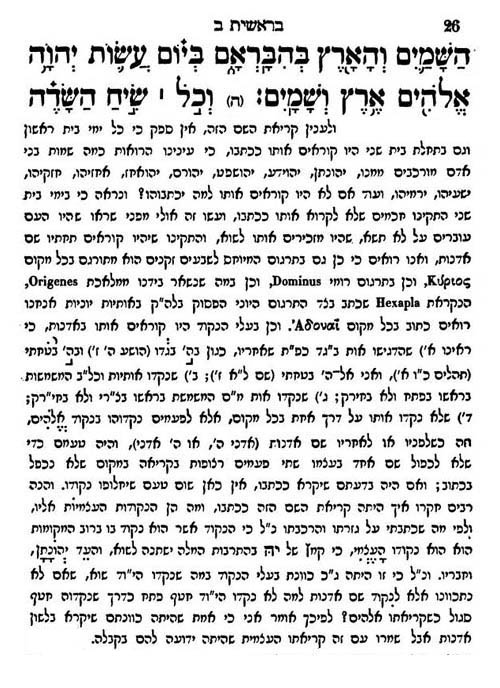
Shadal's comment to Genesis 2:4 is quite interesting, because he tries to determine the correct pronunciation of the Tetragrammaton (YHVH) using internal evidence. Strictly speaking the first part doesn't pertain to the pronunciation, but as an introduction to his view which he gives later it is essential. I'll give an image of the comment as it appears in the Pentateuch published in Padua 1871, followed by my rendering of it, followed by some remarks.


Regarding the pronunciation of this name [YHVH] there is no doubt that all through the days of the First Temple and also in the early days of the Second Temple this name was pronounced as it is written, for we see that there are many theoporic names formed from this word (i.e, YHV- or -YHV) during that period. For example, Yehonatan, Yehoyada, Yehoshaphat, Yehoram, Yehoachaz, Achazyahu, Chizkiyahu, Yeshayahu, Yirmiyahu, etc. Also, if they did not read it then why would they write it?
It seems that sometime during the Second Temple period the Sages ordained that one should not read it as it is written. Perhaps they did this because they saw that the people were transgressing the Third Commandment, taking God's name in vain. They decreed that the word connoting Lordship should be said instead (i.e., Adonay). We see evidence of this from the Greek translation ascribed to the 70 where the name YHVH is translated in each place as Κύριος. So too in the Latin Vulgate it is translated as Dominus. Similarly in what remains of the work of Origen called the Hexapla we see next to his Greek translation a column of Hebrew words transcribed with Greek letters. In each place where it is written YHWH we see Αδοναι.

Similarly those who added the nekkudot to the Biblical text meant for us to pronounce it using the term denoting Lordship, for which we find four proofs:

1) They treated the בג"ד כפ"ת letters following YHWH as hard (pointed with a dagesh), rather than soft. (He supplies three biblical texts illustrating this to be the case, which shows that even though the last vowel of the Tetrragrammaton is pointed -ah they meant for it to be pronounced -ay as in adonay.)

2) They pointed the letters וכל"ב appearing before it (i.e., YHVH, meant to be pronounced adonay) with a patach and not a chirik (i.e., vadonay, ladonay, etc. This shows that the first vowel should be Ah-. Showing this is necessary because in truth YHVH is written with a sheva for the first vowel).

3) They pointed a מ at the beginning with a tzéré rather than a chirik (i.e., méadonay, showing, again, that the first vowel should be Ah-).

4) They did not point YHVH in the same way in every place. Sometimes they pointed it with the same vowels used in Elohim; this usage is found before and after the name of Lordship (adonay) is actually written in the text itself, either before or after YHVH (so as not to repeat the word adonay where it isn't written this way in the text, i.e., unlike places where YHVH is repeated twice in the text itself, when it is meant to be pronounced "adonay adonay"). They ordained that in this case YHVH is to be pronounced aloud as Elohim, which is indicated by the vowels. If their intention was otherwise, then they would not have had any reason for changing the pointing.

Many have researched how the name is supposed to be pronounced as it is written, namely what are its actual vowels? Following what I have written , the consonants as they are written in most places (sheva-cholem-kometz) is actually the authentic vocalization. The reason is because the kometz of /yah/ (which we find at the end of theoporic names) at the start of a word is changed to sheva, such as in Yehonatan and the like. It seems to me that this was the intention of the pointers of the text by pointing the yud with a sheva. For if this was not what they had intended, but simply to point according to the name of Lordship (i.e., the vowels of adonay) then why wouldn't they have voweled the yud with a chataph patach in the same manner that they applied a chataph segol when it was meant to be pronounced /elohim/? Therefore I say that it is true that they wanted to show that it should be read /adonay/ but this pointing managed at the same time to preserve its actual pronunciation, which was known to them through tradition.
In other words he is saying that the true, original pronunciation really is Jehovah. We might also add that there is other old evidence for the substitution adonay, as we find in the Yerushalmi Sanhedrin 10 "ר' יעקב בר אחא אמר נכתב ביו"ד ה"א ונקרא באל"ף דל"ת."

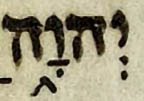
As it happens the primary problem with his admittedly strange idea that "Yehovah," as it is pointed, was really its pronunciation (while also alluding to adonay) is the fact that in the oldest Masoretic manuscripts known to us the Tetragrammaton isn't pointed as if it would read Yehovah. It is pointed as if it would be read Yehva. For example, here is a typical example in the Aleppo Codex:


He couldn't have known this, for even though he saw many old manuscripts he probably never saw a Tiberian manuscript as old as the Aleppo Codex. What he did see must have had the later pointing, with sheva-cholem-kometz and he reasonably assumed that this is how it was always pointed. Scholars conjecture that the explanation for thepointing in these early manuscripts is that they were not meant to indicate to pronounce adonay at all, but שמא (shema), which is the Aramaic equivalent of shem (as in Hashem, "the name," in Hebrew). The vowels here certainly work for shema. It should also be noted that the Samaritans say Shema for YHVH and there is early medieval evidence that they did so a long time ago.

Shadal's early evidence from the Septuagint, Hexapla, etc. can't be ignored though, so we should bear in mind that adonay is clearly the ancient substitution and not shema. What is being posited then is really a change from adonay to shema and then back again! If this can be explained, that would be nice.

Interestingly, another sort of witness was available in a limited fashion to Shadal, but as we shall see it would not have been helpful. I am speaking namely of non-Tiberian texts with superlinear pointing. To give an illustration of how obscure many things were which we are privileged in our time to see with ease, in an 1839 article Shadal quoted the Machzor Vitri, which itself had never been printed and only existed in three known manuscripts. He was one of the privileged few who had access to one of those manuscripts, so he was able to quote from it and he printed the following excerpt (Kerem Chemed 4 pg. 203):
אין ניקוד נוברני דומה לניקוד שלנו ולא שניהם לניקוד ארץ ישראל
The Novernian [sic] pointing is not like ours, and both of them are not like the pointing of Eretz Yisrael."
Shadal has two footnotes here. The first emends נוברני ("Novernian," which is meaningless) to טברני ("Tiberian"). Thus the comment, which is speaking of nikkud, states that "The Tiberian pointing is not like [the Babylonian] and both of them are not like the pointing of Eretz Yisrael." Shadal's second footnote makes the observation that these reported facts are a חדוש גדול, הצריך עיון וחפוש הרבה, or a "very surprising assertion which calls for research and much searching" to explain its meaning of. Today you can find examples of the various kinds of pointings in seconds, yet in 1839 even a man with relatively elite access to rare materials had no idea what a statement like that could have meant. He would not have to wait very long to have the beginnings of an idea, for at precisely that time Karaite scholar Abraham Firkowicz was traveling through Crimea and obtaining old Hebrew manuscripts. Some of them had superlinear pointing.

In 1841 the periodical Zion printed the following exciting notice in its Sivan issue (page 152):


As far as I can see the sample of this text was actually printed in the Elul issue, and not Tammuz as stated here. In any case, here is what they printed:


How intriguing this must have been! In fact I remember the first time I learned that there were other pointing systems besides for the Tiberian one we used (who knew it was "Tiberian?") so I can well imagine what seeing something like this must have been like. The one instance of the Tetragrammaton here is preceded by adonay, so it is pointed to read elohim and therefore useless!

The next early example we find in print is in Efraim Moses Pinner's Prospectus der der Odessaer Gesellschaft, etc. (Odessa 1845) which included a facsimile of a page from Habakkuk from one of Firkowicz's manuscripts with superlinear pointing. Unfortunately the copy of this book online doesn't have the facsimile, however in 1877 Hermann Strack printed another facsimile of the same manuscript in the pages of the 5th volume of the Transactions of the Society of Biblical Archæology, so I will show it for the sake of illustration. Being Hosea and not Habakkuk this isn't what Shadal would have seen, but no doubt he saw the page in Pinner's book:


Here's a detail:


The point is that there is no nikkud at all. (The note at the top is a trope sign.)

Since Pinner's other claim to fame is his Talmud translation, of which only one volume appeared, it is worthwhile here to post a picture of his portrait. I think it will be of great interest to people, most having not seen what he looked like before:


See here, here, here, here and here for more about Pinner and the Chasam Sofer, which is the angle of interest with which most people approach that episode.

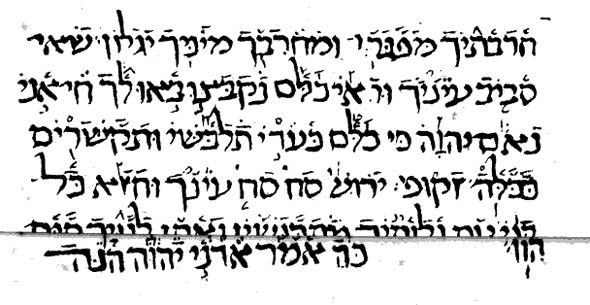
Between the publication of the small sample in Zion (1841) and Pinner's book (1845) we see from a letter from Shadal to Gabriel Isaac Polak (dated 30 Tishri 5504/ 1843) that he came to possess a hand drawn copy of one the pages from this manuscript. The book was printed in Amsterdam 1846 and includes a facsimile making this probably the third time a page of superlinear pointing appeared in print. Shadal writes in his letter that this particular text was hand-copied by Shadal's cousin and mentor Shmuel Chaim Lolli. He writes that his friend Isaac Samuel Reggio managed to acquire an actual page of this manuscript after the small sample appeared in Zion. His cousin then hand copied (probably traced) it. Shadal attests that it is copied perfectly. In between pages 26 and 27 of Halichos Kedem is the facsimile of this piece of the Bible manuscript found in Crimea. Here is the picture, which we can see is from Isaiah and includes the Targum interpolated in the pages. The Tetragrammaton appears twice. The first time with no pointing and the second with the points for elohim. Once again, interesting, but sheds no light on how to point the divine name:


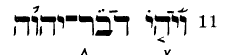
The next relevent text is Simcha Pinsker's Mavo el ha-nikud ha-Ashuri o ha-Bavli (1863) which includes a facsimile of a couple of texts and some transcriptions using the pointing. Pinsker is the scholar who had studied the complete manuscript, as well as some others, in depth for years. Therefore he published his findings, including the keys to the nikkud and trope. As we see in the small samples, the overwhelming majority of times YHVH is not pointed at all. However, I noticed that a handful of cases of his transcription there *is* a single nikkud in the word, and that is the equivalent of a patach over the letter vav. So we'd be talking about something like YHVaH. Probably this is nothing, but I do not know if anyone pointed this out before - make of that what you will. Here's what it looks like:


The point is that whatever limited exposure Shadal had to this pointing in his time would not have proven illuminating. But with the evidence available to him and some careful reasoning he came upon an almost plausible solution. I also think his choice to place this comment on the verse he did - Gen. 2:4 - was very felicitous.

Monday, June 20, 2011

The great Mixed Dancing Controversy of 1960-61.

Unlike my post on the "Wives and Wigs" controversy on the pages of the Jewish Standard in 1890, I am not claiming that every shred of material on the "Mixed Dancing" controversy of 1960-61 has been uncovered here. In fact, a good article about it is waiting to be written and there is much more material to be collected. Nevertheless, here are many parts of this controversy which played out on the pages of the Jewish Chronicle and, eventually, in the pages of R. Yitzchak Weiss's responsa collection מנחת יצחק Volume 3. No 'Footloose' jokes, please. And definitely no jokes about what leads to mixed dancing.

Here's the abstract: by 1960, in Great Britain, like in the United States, the majority of Orthodox Jews saw nothing religiously wrong with mixed dancing at social events, even in the synagogue. Although such a practice would be exceedingly difficult if not impossible to justify from halachic sources, the rabbis either saw nothing really wrong with it, or justified it as a lesser of evils or they saw nothing at all. Yet in September of 1960 the Beth Din of Manchester took a stand against it. Following this, and feeling that they did not go far enough, some months later other rabbis held a conference in Leeds, criticized mixed and dancing and publicly called for a ban on it. This generated a heated correspondence (including the assertion that mixed dancing causes illegitimate children) and a heated editorial in the pages of the Jewish Chronicle. The editorial in particular was very intemperate, being an editorial, saying that the action of those rabbis raises questions about their "emotional stability" and "mental hygiene." This was too much for the rabbis, who included R. Yitzchak Weiss, and collectively they wrote the Jewish Chronicle a letter (dated December 19, 1960) stating that they demanded a prominently placed apology, which in itself would not be enough, and therefore they also demand monetary compensation for defamation. In addition, they served notice that the editor was hereby called to a Din Torah. The editor responded that first of all the facts are in his favor, and secondly he cannot submit to the will of a Din Torah as this is a matter of Freedom of the Press, and a free press is integral to society. The editor himself did, however, appear before the London Beth Din in what he called "an act of courtesy to the Chief Rabbi and his court," to tell them that he must decline to take part in a Din Torah.

The controversy itself continued pro and con in the Letters pages of the paper. Meanwhile, R. Weiss wrote a responsum (dated the last day of Chanukah, or December 21, 1960) in which the matter ("of the editor of a Jewish newspaper who brazenly insulted famed rabbis, who reproached [Jews] regarding the great breech in so-called Orthodox synagogues, who hold dances with youths and young ladies dancing together, God help us. And this editor did not see fit to [help] repair the breech in Israel, on the contrary, he opened his trap in a lead editorial in this popular newspaper to speak words opposing the rabbis who are exerting their souls to try to uproot this practice which has spread in Israel, God help us.") and the penalty for insulting a talmid chochom (a litra of gold) is discussed. The precise weight of the fine in gold is also discussed. One assumes that no liter of gold was every paid, although the responsum was printed for posterity and halachic precedent.

Here is the editorial (December 2, 1960) and the rabbinic response (January 13, 1961), followed by some earlier and later discussions:


Friday, June 17, 2011

R. Jacob Ettlinger as school superintendent.

In 1828 R. Jacob Ettlinger was appointed Clausprimator in Mannheim, where he was the rabbi. This fancy title seems to mean something like school superintendent. You can see the appointment noted in one of those boring government journals, the Grossherzoglich-Badisches Staats- und Regierungs-Blatt, Volume 26:


In Abraham Geiger's "Life Through Letters" published by his son Ludwig, we see the following anecdote:


Geiger witnessed R. Ettlinger come in to observe a school examination. The teacher, named Rosenfeld, was dealing with the story of Joseph and his brothers, and he said harsh things about them because of their actions. R. Ettlinger was very upset at the way the teacher spoke of "den Stämmen Israels" (the Tribes of Israel) and confronted the teacher.

LinkWithin

Related Posts with Thumbnails
'