Many people are aware of the Living Torah Museum in Boro Park. On the other hand, many are not.
A couple of years ago Hershel Shanks profiled this museum in his Biblical Archaeology Review (30:06, Nov/ Dec 2004):
I have often lamented that, although there are thousands of museums in the United States devoted to every conceivable topic, there is not a single museum here devoted to Biblical archaeology.
I have recently been challenged on this assertion—and from a most unlikely source. I am wrong, I am told. There is a Biblical archaeology museum above a little shtibl in Boro Park, led by a chasidic rabbi.
The article describes it as the brainchild of its founder, Shaul Deutsch. How did he get interested in Biblical archaeology? Why did he create this museum (which has some impressive artifacts)?
When Rabbi Deutsch was eight years old...Shaul and his teacher were studying the [Mishna] tractate on damages, Baba Kama. The particular passage concerned what would happen if a person left a kad in a public place: What if someone stumbled over it and broke it: Was the man who stumbled over it and broke it liable for damages? What if someone slipped on the water released by the kad and injured himself or was hurt by the broken pieces of the kad? Was the owner of the kad liable to the injured person for his injuries? In English translations, kad is variously translated pitcher, jug or pot. Shaul asked his teacher what a kad looked like. The teacher slapped him twice across the face. His teacher thought he was “acting up,” being a smart aleck, questioning the text. According to traditional study, everything is there in the text—no need to ask a question like this.
As Rabbi Deutsch now puts it, he was never one to take “no” for an answer. So he kept asking. Gradually, he looked at books. And he found answers—in archaeology. And he asked other questions. And he found more answers. And he became fascinated with archaeology. He was not becoming an apikoros (a heretic); he simply wanted to see the realia (although he would not use that word) that the holy texts were describing.
Read the rest of the BAR article.
He says he has had no opposition from the observant, devout community in which he lives. Yeshiva students (a yeshiva is a traditional rabbinic academy) are flocking to the museum, he says. He recalls for them a passage or an episode from the holy texts and then points to the item that is being referred to in the text. That is what he wants to do, he says: to teach Torah (in its broadest sense, all religious learning) through archaeology. Even the heads of leading yeshivot have come to see and admire his museum, he says.
A dissenting view by Freelance Kiruv Maniac (surprised?).
The museum is located at 1601 41st Street in Brooklyn. Hours: 9 a.m. to 6 p.m. and 8 p.m. to 11 p.m. daily. Closed Friday afternoon and Saturday until 1 hour after sundown and on Jewish holidays. Telephone: 718–686-8174. Website: www.torahmuseum.com.
Monday, April 23, 2007


Thursday, April 19, 2007
'Pardes,' from a 'Talmud Babylonicum' introduction: complete with a gaping anachronism.
In the October 1867 issue of the British periodical the Quarterly Review appeared an article called "Talmud Babylonicum," which meant to inform readers "What is the Talmud?" The article noted (claimed?) that "Turn where we may in the realms of modern learning, we seem to be haunted by it," and "that strange production of which the name, imperceptibly almost, is beginning to take its place among the household words of Europe." In short, this article was meant for the curious.
I uploaded the whole thing for download.
Here is an interesting excerpt:


Nothing new, of course, but it is noteworthy that at this relatively late date (1867) Jewish learning was still sufficiently shrouded in mystery that a simple anachronism is committed: pardes as an acronym for peshat, remez, derush and sod is a medieval mnemonic and thus does not apply to anything related to the Talmud, much less to the period of Chronicles (given that the term midrash first appears in that book), when this article assumes the term came into use!
I uploaded the whole thing for download.
Here is an interesting excerpt:
Nothing new, of course, but it is noteworthy that at this relatively late date (1867) Jewish learning was still sufficiently shrouded in mystery that a simple anachronism is committed: pardes as an acronym for peshat, remez, derush and sod is a medieval mnemonic and thus does not apply to anything related to the Talmud, much less to the period of Chronicles (given that the term midrash first appears in that book), when this article assumes the term came into use!
Wednesday, April 18, 2007
What's peshat with the Peshitta, Part III: Jewish? Christian?
Having twice posted about the פשיטתא, Peshitta ('What's peshat with the Peshitta I, II) I now return for round three.
As previously mentioned, an interesting (and to my mind) attractive theory of the origins of this Syriac translation of the Bible ascribes is to Jewish origin; perhaps it was even prepared for the Syriac-speaking Jewish converts of the royal house of Adiabene (חדיב) in the 1st century CE.
In any case, J. Perles, in 1859, first advanced the notion of a Jewish origins for the Peshitta in his doctoral dissertation Meletemata Peschitthoniana.
He noted many quirks which, he felt, could only be explained by a Jewish origin. Here are several examples:
1) Gen. 8:4. Ararat, אררט, given as Qardu, קרדו, in Targum Onqelos. So too in the Peshitta.
2) Gen. 30:28. Noqbhoh, נקבה, translated as 'appoint' in JPS, 'name' in Kaplan's Living Torah, and so forth, is rendered פריש, which literally means 'to separate' or 'set aside.' This is just what the Peshitta translates it as. Evidently this usage comports with a Jewish dialect of Aramaic.
So much for lone words. Now comes the matter of translation which is looser, but richer in interpretation.
3) ii Chr. 33:7. 'he set the graven image of the idol,' (JPS). The Peshitta takes this further and writes לצלמא דארבעה אפין (I didn't actually do my homework yet, and I need to look up the exact wording and spelling; this is from memory), 'a statue of four faces.' This is found in BT Sanhederin 103b (look it up!), commenting on this verse:
[Scripture writes, And he set] the graven image,' but it is also stated, [And the groves and the] graven images, [which he had set up].R. Johanan said: At first he made it with one face, but subsequently he made it with four faces. (Soncino)
4) Ezra 9:4. The verse says "at the evening offering," (JPS). The Peshitta foreshadows BT Berakhos 26a, in that it renders this as 'at the ninth hour,' i.e., the precise rabbinical time of the 'afternoon.'
Seems Jewish, doesn't it? However, another school of thought (begun by Gesenius) held that it did not have Christian origins. In response to these things this school modified its position a bit and allowed that the translator(s) might have been Jewish, but could well have been a Jewish Christian.
They noted that the Peshitta includes christological translations, such as in Is. 7:14, giving `almah as betulta (virgin) instead of tselaymeta, as used elsewhere for `almah. The response to this, naturally, is that it might have been a later interpolation. Of course this may be, but there obviously is no proof that it is.
Secondly, Is. 53:8 (the suffering servant part) translates lamo as to him, instead of to them, which is theoretically the Christian and not Jewish interpretation of this chapter. This is, in my opinion, a particularly slender reed.
Finally, an interesting piece of evidence for the Christian side was advanced by L. Hirzel in 1825: that the list of unclean birds in Lev. 11 sometimes transliterates from the Hebrew, rather than translates, and in some cases skips terms entirely. The interpretation given to this fact was that this sort of negligence could only have come from a Christian translator who was a) less fluent in the Hebrew original than would be expected of a Jew, and b) such matters as the dietary laws of the Old Testament would be of great concern to a Jew, but of considerably less to a Christian, therefore this sort of haphazard translation must have been the work of a Christian.
The reply to this, of course, is perhaps the translator was merely at a loss for the correct Syriac word to use.
As previously mentioned, an interesting (and to my mind) attractive theory of the origins of this Syriac translation of the Bible ascribes is to Jewish origin; perhaps it was even prepared for the Syriac-speaking Jewish converts of the royal house of Adiabene (חדיב) in the 1st century CE.
In any case, J. Perles, in 1859, first advanced the notion of a Jewish origins for the Peshitta in his doctoral dissertation Meletemata Peschitthoniana.
He noted many quirks which, he felt, could only be explained by a Jewish origin. Here are several examples:
1) Gen. 8:4. Ararat, אררט, given as Qardu, קרדו, in Targum Onqelos. So too in the Peshitta.
2) Gen. 30:28. Noqbhoh, נקבה, translated as 'appoint' in JPS, 'name' in Kaplan's Living Torah, and so forth, is rendered פריש, which literally means 'to separate' or 'set aside.' This is just what the Peshitta translates it as. Evidently this usage comports with a Jewish dialect of Aramaic.
So much for lone words. Now comes the matter of translation which is looser, but richer in interpretation.
3) ii Chr. 33:7. 'he set the graven image of the idol,' (JPS). The Peshitta takes this further and writes לצלמא דארבעה אפין (I didn't actually do my homework yet, and I need to look up the exact wording and spelling; this is from memory), 'a statue of four faces.' This is found in BT Sanhederin 103b (look it up!), commenting on this verse:
[Scripture writes, And he set] the graven image,' but it is also stated, [And the groves and the] graven images, [which he had set up].R. Johanan said: At first he made it with one face, but subsequently he made it with four faces. (Soncino)
4) Ezra 9:4. The verse says "at the evening offering," (JPS). The Peshitta foreshadows BT Berakhos 26a, in that it renders this as 'at the ninth hour,' i.e., the precise rabbinical time of the 'afternoon.'
Seems Jewish, doesn't it? However, another school of thought (begun by Gesenius) held that it did not have Christian origins. In response to these things this school modified its position a bit and allowed that the translator(s) might have been Jewish, but could well have been a Jewish Christian.
They noted that the Peshitta includes christological translations, such as in Is. 7:14, giving `almah as betulta (virgin) instead of tselaymeta, as used elsewhere for `almah. The response to this, naturally, is that it might have been a later interpolation. Of course this may be, but there obviously is no proof that it is.
Secondly, Is. 53:8 (the suffering servant part) translates lamo as to him, instead of to them, which is theoretically the Christian and not Jewish interpretation of this chapter. This is, in my opinion, a particularly slender reed.
Finally, an interesting piece of evidence for the Christian side was advanced by L. Hirzel in 1825: that the list of unclean birds in Lev. 11 sometimes transliterates from the Hebrew, rather than translates, and in some cases skips terms entirely. The interpretation given to this fact was that this sort of negligence could only have come from a Christian translator who was a) less fluent in the Hebrew original than would be expected of a Jew, and b) such matters as the dietary laws of the Old Testament would be of great concern to a Jew, but of considerably less to a Christian, therefore this sort of haphazard translation must have been the work of a Christian.
The reply to this, of course, is perhaps the translator was merely at a loss for the correct Syriac word to use.
Tuesday, April 17, 2007
Rashi tells us how Amen is pronounced according to Old Ashkenazic Hebrew
It's well known that Ashkenazim distinguish between the qomatz and patah vowels (אָ and אַ), while the Sepharadim and Mizrahim don't, pronouncing both as a patah (with the notable exception of the Yemenite Jews who do distinguish between them, pronouncing the qomatz much like the Ashkenazim).
For those who are not following, here is a graphic illustration: Ashkenazim would pronounce the word 'luck' and 'lock' as we are accustome, but Sepharadim would pronounce them both as 'lock,' were these two words Hebrew.
These two distinct pronunciations is paralleled in the two ways that Syriac is spoken by Christian Aramaic-speakers; a point noticed by Samuel David Luzzatto, which he took as evidence in favor of the correctness (in the sense of conforming to Tiberian Hebrew) of the Ashkenazic qomatz, at a time when Ashkenazic Hebrew was viewed with disfavor (early 19th century, but that view never seems to have properly faded). The difference: there are those Syriac Christians who say 'Abun di-bishmayo' and those who say 'Abun di-bishmayah,' in The Lord's Prayer (both mean 'Our Father who art in Heaven').
An interesting fact in the history of Ashkenazic Hebrew is that, apparently, Ashkenazim (Franco-German Jews) did not always distinguish between these two vowels, like their Spanish, North African and Middle Eastern counterparts. This is attested in early Ashkenazic manuscripts in which confusion between these two vowel's graphic symbols (ָ and ַ) are found in great abundance, exactly as in Sepharadic manuscripts. Although I don't have a handy example of a genuine Ashkenazic manuscript, a picture is worth a thousand words, and I reproduce an image which adorned my post How a 12th century English gentile vocalized Hebrew:
 (click to enlarge; the heh in the last word on the second line should have a qomatz, but it has a patah, reflecting the vocalizer's pronunciation.)
But manuscripts are only part of the evidence.
A juicy piece of evidence[1] for this can also be found in Rashi's (1040-1105) comment on TB Berakhos (or should I say Berakhoth, in homage to early Ashkenazis?) 47A. There the Gemara discusses amens, and says ...אין עונין לא אמן חטופה , "the Amen uttered in response should be neither hurried..." To this Rashi gives the interpretation of what an hurried Amen is: שקורין את האלף בחתף ולא בפתח ואמר אמן והוא שצריך לומר אמן, "He reads the 'aleph with a sheva (אְמֵן, [short first sylabble] E'mein) and not with a patah (Ahmein)" (presumably in Rashi's text the two אמןs were vocalized, but in the standard printed editions Rashi is never pointed).
Thus, we see that Rashi said a word written אָמֵן as if it were written אַמֵן, just like the Sepharadim. Rashi said ahmein, not ohmein. It should be noted that in Artscroll's Schottenstein Talmud the explanatory notes say that Rashi terms the qomatz godol a patah and gives several references; but it does not explain why. Patah itself means that the mouth is to be opened wide; that is how the ah sound results.
Rabbi Dr HJ Zimmels, in his classic Ashkenazim and Sephardim: Their Relations, Differences, and Problems As Reflected in the Rabbinical Responsa discusses their respective pronunciations and adduces other proofs, among them the fact that Rabbenu Asher (13th century), who moved from Ashkenaz to Sepharad, becoming one of the foremost leaders in Spain, discusses the differences between the Hebrew scripts used by the respective communities but doesn't seem to notice any difference in pronunciation at all.
In any event, following Rashi, over the last hundreds of years Ashkenazic Jews pronounced, and still pronounce, amen as something sort of like 'ohmein.' But evidently at this early period in Ashkenazic history the qomatz was not yet pronounced distinctly, and pronounced ah, like the Sepharadim.
The question is when and why and how did this change? Did this come about due to a happy accident, normal sound shifting? That seems unlikely if these two vowels were pronounced identically. How could normal changes come about conforming correctly to the graphic differences in the written texts? Rather it seems like a deliberate effort to conform to the Tiberian pronunciation. Could this have really happened? I don't think there is any evidence that it did. But perhaps gradually it was noticed that Hebrew was spoken in a 'mistaken' fashion, meaning that it did not conform with the graphic symbols, the signs devised by the Tiberian Masoretes. Like other, periodic efforts to improve spoken Hebrew, perhaps somehow this change occurred. Maybe it first occurred among exacting Torah readers. Maybe some pedantic melamdim (children's teachers) taught it to their 3 and 4 year old charges. In any case, it seems irrefutable that at some point in the past 900 years (and perhaps in the past 700 or even more recently) Ashkenazim begun pronouncing the qomatz properly, in the sense that it is distinct from the patah, and in the sense that Tiberian Hebrew is proper Hebrew.
However one lingering doubt remains in my mind: it is generally believed that Ashkenazic Jewry had roots in Eretz Yisrael at a later date than Mizrahi and Sephardi Jewry, whose roots seem to be in Bavel. This is reflected in various Ashkenazic customs and liturgies which stem or seem to stem from an Eretz Yisrael origin. Historically and politically it makes some sense as well, since it is generally presumed that the core Ashkenazic community emigrated from Italy and other areas of Europe which were Christian and thus this Jewry was under the influence of Eretz Yisrael, also under Christian rule, rather than Bavel, then under Islamic rule. If so, it would seem natural that Ashkenazic Hebrew would be more greatly influence by Tiberian Hebrew at the outset. צריך עיון.
( By the way, I recently had my two year Bloggiversary.)
[1] Credit where credit is due. I came across this reference in a Mail-Jewish post by Mechy Frankel.
For those who are not following, here is a graphic illustration: Ashkenazim would pronounce the word 'luck' and 'lock' as we are accustome, but Sepharadim would pronounce them both as 'lock,' were these two words Hebrew.
These two distinct pronunciations is paralleled in the two ways that Syriac is spoken by Christian Aramaic-speakers; a point noticed by Samuel David Luzzatto, which he took as evidence in favor of the correctness (in the sense of conforming to Tiberian Hebrew) of the Ashkenazic qomatz, at a time when Ashkenazic Hebrew was viewed with disfavor (early 19th century, but that view never seems to have properly faded). The difference: there are those Syriac Christians who say 'Abun di-bishmayo' and those who say 'Abun di-bishmayah,' in The Lord's Prayer (both mean 'Our Father who art in Heaven').
An interesting fact in the history of Ashkenazic Hebrew is that, apparently, Ashkenazim (Franco-German Jews) did not always distinguish between these two vowels, like their Spanish, North African and Middle Eastern counterparts. This is attested in early Ashkenazic manuscripts in which confusion between these two vowel's graphic symbols (ָ and ַ) are found in great abundance, exactly as in Sepharadic manuscripts. Although I don't have a handy example of a genuine Ashkenazic manuscript, a picture is worth a thousand words, and I reproduce an image which adorned my post How a 12th century English gentile vocalized Hebrew:
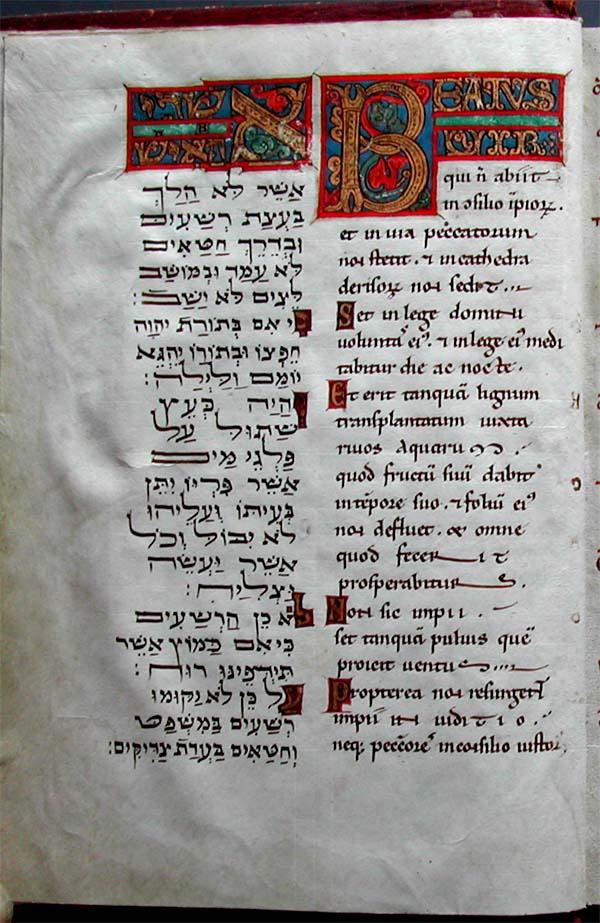 (click to enlarge; the heh in the last word on the second line should have a qomatz, but it has a patah, reflecting the vocalizer's pronunciation.)
But manuscripts are only part of the evidence.
A juicy piece of evidence[1] for this can also be found in Rashi's (1040-1105) comment on TB Berakhos (or should I say Berakhoth, in homage to early Ashkenazis?) 47A. There the Gemara discusses amens, and says ...אין עונין לא אמן חטופה , "the Amen uttered in response should be neither hurried..." To this Rashi gives the interpretation of what an hurried Amen is: שקורין את האלף בחתף ולא בפתח ואמר אמן והוא שצריך לומר אמן, "He reads the 'aleph with a sheva (אְמֵן, [short first sylabble] E'mein) and not with a patah (Ahmein)" (presumably in Rashi's text the two אמןs were vocalized, but in the standard printed editions Rashi is never pointed).
Thus, we see that Rashi said a word written אָמֵן as if it were written אַמֵן, just like the Sepharadim. Rashi said ahmein, not ohmein. It should be noted that in Artscroll's Schottenstein Talmud the explanatory notes say that Rashi terms the qomatz godol a patah and gives several references; but it does not explain why. Patah itself means that the mouth is to be opened wide; that is how the ah sound results.
Rabbi Dr HJ Zimmels, in his classic Ashkenazim and Sephardim: Their Relations, Differences, and Problems As Reflected in the Rabbinical Responsa discusses their respective pronunciations and adduces other proofs, among them the fact that Rabbenu Asher (13th century), who moved from Ashkenaz to Sepharad, becoming one of the foremost leaders in Spain, discusses the differences between the Hebrew scripts used by the respective communities but doesn't seem to notice any difference in pronunciation at all.
In any event, following Rashi, over the last hundreds of years Ashkenazic Jews pronounced, and still pronounce, amen as something sort of like 'ohmein.' But evidently at this early period in Ashkenazic history the qomatz was not yet pronounced distinctly, and pronounced ah, like the Sepharadim.
The question is when and why and how did this change? Did this come about due to a happy accident, normal sound shifting? That seems unlikely if these two vowels were pronounced identically. How could normal changes come about conforming correctly to the graphic differences in the written texts? Rather it seems like a deliberate effort to conform to the Tiberian pronunciation. Could this have really happened? I don't think there is any evidence that it did. But perhaps gradually it was noticed that Hebrew was spoken in a 'mistaken' fashion, meaning that it did not conform with the graphic symbols, the signs devised by the Tiberian Masoretes. Like other, periodic efforts to improve spoken Hebrew, perhaps somehow this change occurred. Maybe it first occurred among exacting Torah readers. Maybe some pedantic melamdim (children's teachers) taught it to their 3 and 4 year old charges. In any case, it seems irrefutable that at some point in the past 900 years (and perhaps in the past 700 or even more recently) Ashkenazim begun pronouncing the qomatz properly, in the sense that it is distinct from the patah, and in the sense that Tiberian Hebrew is proper Hebrew.
However one lingering doubt remains in my mind: it is generally believed that Ashkenazic Jewry had roots in Eretz Yisrael at a later date than Mizrahi and Sephardi Jewry, whose roots seem to be in Bavel. This is reflected in various Ashkenazic customs and liturgies which stem or seem to stem from an Eretz Yisrael origin. Historically and politically it makes some sense as well, since it is generally presumed that the core Ashkenazic community emigrated from Italy and other areas of Europe which were Christian and thus this Jewry was under the influence of Eretz Yisrael, also under Christian rule, rather than Bavel, then under Islamic rule. If so, it would seem natural that Ashkenazic Hebrew would be more greatly influence by Tiberian Hebrew at the outset. צריך עיון.
( By the way, I recently had my two year Bloggiversary.)
[1] Credit where credit is due. I came across this reference in a Mail-Jewish post by Mechy Frankel.
Friday, April 13, 2007
Baltimore rabbis take a clear, emulation-worthy first step
on sex abuse in their community.
On the one hand it's a local matter so it's none of my business. On the other hand--well, you know the other hand.
Yasher koah.
Via Presence.


On the one hand it's a local matter so it's none of my business. On the other hand--well, you know the other hand.
Yasher koah.
Via Presence.
Yiyshar kohakhah, Artscroll.
Perusing The Early Acharonim by R. Hersh Goldwurm z'l I learned that Dinim de Sehita y Bedica was written by R. Menasseh Ben Israel.
Electric menorah in the Beis Hamikdosh?

"I hold it to be clear and simple that, if electrical lighting had been extant in Temple times, most certainly it would have been employed in the Temple candelabrum. for it is inconceivable that we should illuminate our private homes with that great, wonderful electric light, which is verily after a heavenly model - and yet illuminate God's holy palace with olive-oil, which even the poorest of the poor despise in our time. It is therefore obvious that we shall illuminate the future Temple, may it be built speedily in our days, with electrical lights. Amen"
(R. Yosef Messas; Ner Mitzvah, 1939. Trans. Zvi Zohar: Jews of the Middle East and North Africa in Modern Times, p.76)
Via Pierre Sogol, who likes the "seemingly "modernist-romantic" sentiment towards electrical light."
Thursday, April 12, 2007
The man who knew too much
Krum As A Bagel finds that the best answer to many vortlach type questions is that they shouldn't have been asked in the first place. link

Friday, March 30, 2007
Busy, busy, busy
*Head explodes*
No, not really. Still, not being sure that I'll have the time, dear readers (lurkers and commenters alike), have a wonderful Yom Tov. I'll be back, probably with Pesah on my mind!
No, not really. Still, not being sure that I'll have the time, dear readers (lurkers and commenters alike), have a wonderful Yom Tov. I'll be back, probably with Pesah on my mind!
Thursday, March 29, 2007
Wacky Hebrew etymologies
From a review of the 1837 Complete Hebrew and English Critical and Pronouncing Dictionary by William L. Roy:
Take a look, particularly, at the etymology it gives for the word mol מל, to circumcise:
"From yom, a day, an al, a yoke" et cetera
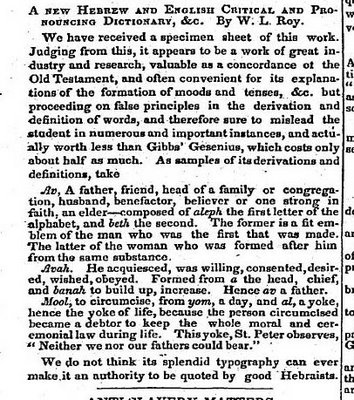
Take a look, particularly, at the etymology it gives for the word mol מל, to circumcise:
"From yom, a day, an al, a yoke" et cetera

Monday, March 26, 2007
Why Mendelssohn? A Chassidic tradition. Fascinating Footnotes I
It was reported in the name of Rabbi Chaim of Zanz that Mendelssohn was a great Torah scholar and potentially had the power to do tremendous good, but his soul's source was intrinsically evil and therefore he sinned and caused others to sin as well. In fact he was a reincarnation of "Oto ha-Ish" who had visited the world three times: Before the destruction of the Second Temple, as Mendelssohn and as one of the Maskilim of Italy [the writer had forgotten his name. Possibly Samuel David Luzzatto (Shadal)]. To counter Mendelssohn, God had sent the soul of the Chasam Sofer to the world. (She'elot u-Teshuvot Levushei Mordechai, Yoreh De'ah (Tolcsva 1912), Siman 88.)R. Y. Tassuig, Beit Yisrael ha-Shalem, 4 (Jerusalem 1976), p. 100, cited in the name of his rabbi, Rabbi Shmuel Rosenberg of Hunsdorf.
Sunday, March 25, 2007
Artscroll on the Golem of Prague
There is a tradition which has not been established, that in the face of these threats, Maharal created a Golem, a humanoid figure formed from mud and brought to life by secret prayers and Kabbalistic sayings.
link
Or, if you like
The illustrious Maharal of Prague is best known as the creator of the famous Golem, but that was hardly his greatest accomplishment. He composed an enormous body of dazzling literature that forms the essence of much Torah thought to this day.
link
link
Or, if you like
The illustrious Maharal of Prague is best known as the creator of the famous Golem, but that was hardly his greatest accomplishment. He composed an enormous body of dazzling literature that forms the essence of much Torah thought to this day.
link
The Reb Chaim Brisker Of Bible Scholars
Rabbi Shalom Carmy's tribute to Rabbi Mordechai Breuer.
There are great teachers whose impact is limited to their students. Greater still are those whose students initiate students of their own. The greatest teachers, however, influence not only the direct line descending from them, but an entire climate of thinking. All of us are their talmidim.
Twentieth-century Orthodox Bible study boasts two such figures. Nechama Leibowitz’s writing, teaching and broadcasting turned the exacting, microscopic study of Jewish parshanut into an exciting and popular pursuit. And Rabbi Mordechai Breuer fashioned the tools that enabled Orthodox students to confront the literary problems raised by modern biblical criticism. He entered a situation where the Orthodox approach was an apologetic one, in which the Torah was to be defended against heretical assault.
By the time he died last month, Rabbi Breuer had transformed the encounter with kefira into a positive act of Torah study. Where his influence is felt, the literary questions posed by the Bible critics are treated no different from other interesting questions endemic to Torah study: questions are a spur to chiddush and deeper understanding rather than a cause for discomfort or panic.
Read the rest (Jewish Press 3/21/07)
Rabbi Shalom Carmy is professor of Jewish studies and Jewish philosophy at Yeshiva University and editor of the Torah journal Tradition.
There are great teachers whose impact is limited to their students. Greater still are those whose students initiate students of their own. The greatest teachers, however, influence not only the direct line descending from them, but an entire climate of thinking. All of us are their talmidim.
Twentieth-century Orthodox Bible study boasts two such figures. Nechama Leibowitz’s writing, teaching and broadcasting turned the exacting, microscopic study of Jewish parshanut into an exciting and popular pursuit. And Rabbi Mordechai Breuer fashioned the tools that enabled Orthodox students to confront the literary problems raised by modern biblical criticism. He entered a situation where the Orthodox approach was an apologetic one, in which the Torah was to be defended against heretical assault.
By the time he died last month, Rabbi Breuer had transformed the encounter with kefira into a positive act of Torah study. Where his influence is felt, the literary questions posed by the Bible critics are treated no different from other interesting questions endemic to Torah study: questions are a spur to chiddush and deeper understanding rather than a cause for discomfort or panic.
Read the rest (Jewish Press 3/21/07)
Rabbi Shalom Carmy is professor of Jewish studies and Jewish philosophy at Yeshiva University and editor of the Torah journal Tradition.
Friday, March 23, 2007
A rebbeshe tale from the JTS rare book room
When I was working in the JTS rare book room a rebbe came in one day with his gabbai. the gabbai asked me if we had any holograph kisve yad from gedolim. I asked him to be specific and he asked me if I understood what a gadol was. I said yes, but that I could only bring him a ms. if he requested a specific one. After going back and forth I asked exactly why he needed a gadol's ms. and he responded that the rebbe needed some mss. in order to commune with the spirits of their authors.
...in this situation should I really have pulled for him an original Rambam autograph letter so he could commune with the Rambam's neshamah?
There are good comments.
...in this situation should I really have pulled for him an original Rambam autograph letter so he could commune with the Rambam's neshamah?
There are good comments.
Did Ben Tsitsis Ha-kesses have long, curly hair? What can we learn from Aramaic and Greek and simple, careful readings of texts?
Avakesh posting about Jewish names quoted a very interesting Avodah post from six years ago, by Yisrael Dubitsky, regarding the name of the Talmudic sage Rabbi Kruspadai, כרוספדאי. (mentioned, e.g, BT Rosh Hashana 16b -- א"ר כרוספדאי א"ר יוחנן שלשה ספרים נפתחין בר"ה אחד של רשעים גמורין ואחד של צדיקים גמורין ואחד של בינוניים).
What sort of name is this?
Targum Onkelos gives the Armaic for tsitsis (Bemidbar 15:38) as כרוספדין.
The learned Dubitsky reminds of the character Ben Tsitsis Ha-keseth, בן ציצית הכסת, one of the wealthy men of Jerusalem, familiar to all children who have spent the Three Weeks at sleepaway camp or who have learned Gittin 56a (the story here). The Gemara there explains his name
"Ben Zizith Hakeseth was so called because his fringes [zizith] used to trail on cushions [keseth]. Others say he derived the name from the fact that his seat [kise] was among those of the nobility of Rome."
Reb Yisrael notes that there is good reason to think that Kruspadai, כרוספדאי essentially meant tsitsis. Alexander Kohut in his Artscroll-approved Arukh Completum notes that in other places in Chazal this Rabbi Kruspadai's name appears in the variants Kryspa or Kruspa. To Kohut this might be a variation of the Greek name Crispus, meaning curly-haired. Was Rabbi Kruspadai curly-haired? Maybe. Note that Ezekiel 8:3 uses the word ציצית to denote a lock, perhaps curl, of hair. (וַיִּשְׁלַח תַּבְנִית יָד, וַיִּקָּחֵנִי בְּצִיצִת רֹאשִׁי And the form of a hand was put forth, and I was taken by a lock of my head.)
But even more interesting might be to get back to Ben Tsitsis Ha-keseth's name. The translation used above (Soncino) follows Rashi, that the tsitsit on his garments dragged on fine cushions as he walked.
But if tsitsit means curly hair too, and if people were so named because of it....perhaps he was so-called because his tsitsit, his long, curly hair dragged on fine cushions as he sat or lay.
Incidentally, it might be nice to quote Israel Abrahams in his By-paths in Hebraic Bookland (pg 64-65) on the Arukh:
It is remarkable, indeed, how well the sense of Greek words was transmitted by Jewish writers who were ignorant of Greek. They often are not even aware that the words are Greek at all; they suggest the most impossible Semitic derivations; but they very rarely give the meanings incorrectly.
Now that's mesorah!
What sort of name is this?
Targum Onkelos gives the Armaic for tsitsis (Bemidbar 15:38) as כרוספדין.
The learned Dubitsky reminds of the character Ben Tsitsis Ha-keseth, בן ציצית הכסת, one of the wealthy men of Jerusalem, familiar to all children who have spent the Three Weeks at sleepaway camp or who have learned Gittin 56a (the story here). The Gemara there explains his name
"Ben Zizith Hakeseth was so called because his fringes [zizith] used to trail on cushions [keseth]. Others say he derived the name from the fact that his seat [kise] was among those of the nobility of Rome."
Reb Yisrael notes that there is good reason to think that Kruspadai, כרוספדאי essentially meant tsitsis. Alexander Kohut in his Artscroll-approved Arukh Completum notes that in other places in Chazal this Rabbi Kruspadai's name appears in the variants Kryspa or Kruspa. To Kohut this might be a variation of the Greek name Crispus, meaning curly-haired. Was Rabbi Kruspadai curly-haired? Maybe. Note that Ezekiel 8:3 uses the word ציצית to denote a lock, perhaps curl, of hair. (וַיִּשְׁלַח תַּבְנִית יָד, וַיִּקָּחֵנִי בְּצִיצִת רֹאשִׁי And the form of a hand was put forth, and I was taken by a lock of my head.)
But even more interesting might be to get back to Ben Tsitsis Ha-keseth's name. The translation used above (Soncino) follows Rashi, that the tsitsit on his garments dragged on fine cushions as he walked.
But if tsitsit means curly hair too, and if people were so named because of it....perhaps he was so-called because his tsitsit, his long, curly hair dragged on fine cushions as he sat or lay.
Incidentally, it might be nice to quote Israel Abrahams in his By-paths in Hebraic Bookland (pg 64-65) on the Arukh:
It is remarkable, indeed, how well the sense of Greek words was transmitted by Jewish writers who were ignorant of Greek. They often are not even aware that the words are Greek at all; they suggest the most impossible Semitic derivations; but they very rarely give the meanings incorrectly.
Now that's mesorah!
Thursday, March 22, 2007
Horseradish in Syria
"So, erev Pesach, when you stand there grating the horseradish and tears flow down your cheeks, think of your grandparents performing the same function, the same way, in some little town in Lithuania, Poland, Hungary or Syria."
Link.
The gist of the above, from an article by the Yated editor Rabbi Pinchos Lipschutz is that the YCT brouhaha comes down to one thing: mesorah. YCT ignores it, says Rabbi Lipschutz, while all other authentic Orthodox Jews don't.
"It is our conviction that the rank and file of contemporary Orthodox Jewry - Modern, Chareidi and everything in between - still possess authentic Torah sensibilities which are repulsed by the erasing of historic conceptual boundaries on the part of YCT faculty and students. "
Now let me say that horseradish in Syria is a minor thing. It is. It is no big deal that the Syrians don't grate horseradish for marror. But the problem is that this minor thing is symptomatic of a larger thing. Much (how much?) of what Rabbi Lipschutz is convicted is mesorah is projection and not mesorah. As someone on the Areivim mailing list astutely pointed out, Rabbi Lipschutz presupposes that an intellectual approach to Yiddishkeit (hey, did you know that "Yiddishkeit" doesn't mean Judaism, but Jewish culture and was coined by secular Yiddishists?) is against the mesorah.
"RPL is certainly within his rights to espouse the avowedly anti-intellectual hashkafa; like it or not, there is certainly such a strain within Torah hashkafoth. However, when he implies that anyone who is unwilling to accept this approach places himself outside the pale, this is another matter. There are other legitimate hashkafoth, even within the haredi world. "
Now I know that will be argued that the approach at YCT is not equivalent to "an intellectual approach to Yiddishkeit," but my point is that if mimeticism would lead one to project the present onto the past, sometimes in a very misleading way, well, sometimes something a bit more critical and a bit more investigative can also lead to some emes, maybe sometimes to even more.
c.f, "What’s the Truth about ... Using Horseradish for Maror? "via Parsha Blog
Link.
The gist of the above, from an article by the Yated editor Rabbi Pinchos Lipschutz is that the YCT brouhaha comes down to one thing: mesorah. YCT ignores it, says Rabbi Lipschutz, while all other authentic Orthodox Jews don't.
"It is our conviction that the rank and file of contemporary Orthodox Jewry - Modern, Chareidi and everything in between - still possess authentic Torah sensibilities which are repulsed by the erasing of historic conceptual boundaries on the part of YCT faculty and students. "
Now let me say that horseradish in Syria is a minor thing. It is. It is no big deal that the Syrians don't grate horseradish for marror. But the problem is that this minor thing is symptomatic of a larger thing. Much (how much?) of what Rabbi Lipschutz is convicted is mesorah is projection and not mesorah. As someone on the Areivim mailing list astutely pointed out, Rabbi Lipschutz presupposes that an intellectual approach to Yiddishkeit (hey, did you know that "Yiddishkeit" doesn't mean Judaism, but Jewish culture and was coined by secular Yiddishists?) is against the mesorah.
"RPL is certainly within his rights to espouse the avowedly anti-intellectual hashkafa; like it or not, there is certainly such a strain within Torah hashkafoth. However, when he implies that anyone who is unwilling to accept this approach places himself outside the pale, this is another matter. There are other legitimate hashkafoth, even within the haredi world. "
Now I know that will be argued that the approach at YCT is not equivalent to "an intellectual approach to Yiddishkeit," but my point is that if mimeticism would lead one to project the present onto the past, sometimes in a very misleading way, well, sometimes something a bit more critical and a bit more investigative can also lead to some emes, maybe sometimes to even more.
c.f, "What’s the Truth about ... Using Horseradish for Maror? "via Parsha Blog
Hoard your old books because you never know if you've got Yellin's Aleppo Codex Bible
Ari Kinsberg has a great post about the famed Bible of Rabbi Shalom Shachne Yellin (1790-1874) (via Ha'aretz.)
Rabbi Yellin was a Lithuanian expert in Tanakh (a "scroll checker") who emigrated to Israel in 1854 with the express purpose of traveling from there to Aleppo (Halab, Aram Soba), Syria in order to examine the Taj, the Crown, of Aleppo; the Aleppo Codex. His wish was to copy all the minute details of that famed text. He received for that purpose a letter of introduction from the prominent rabbanim of Jerusalem. And here it is (click to enlarge):

In any event, as fate would have it Rabbi Yellin was unable to make the trip due to ill health. Instead, ten years after the project was initiated, his son-in-law Yehoshua Kimchi made the trip, armed with a Tanakh belonging to his father-in-law and with detailed instructions he succeeded in noting all the notable details in the Keter. Evidently this Tanakh was consulted in Jerusalem until it disappeared in 1915.* It resurfaced in 1987 when Aleppo Codex scholar Yosef Opher learned that a house belonging to a family called Yellin was slated for demolition and that some old books from the attic could be purchased. A lightbulb went off in this keen Massoretic scholar's head, as the name "Yellin" should. He learned that, in fact, some books had been sold to a book store in Meah Shearim. At the book store he found his prize: Yellin's Tanakh with detailed notes!
Ofer returned the Tanakh to the family (who donated it the Ben Zvi Institute in Jerusalem), who allowed him to study it and publish its readings.
Here is a page from this plain-looking but important Bible (click to enlarge):

The importance of this Tanakh is that most of the Pentateuch (and other portions) is presently missing in the Aleppo Codex. So a missing witness to the textual details (most importantly, the pesuchot and setummot) was recovered and was an added, much missed piece of the puzzle that is used to reconstruct the text of the Aleppo Codex as in, for example, the Keter Yerushalayim Bible.
As Ari says, never throw anything out!
(On the teacher of Yoseph Ofer, the late Massorete Rabbi Mordechai Breuer's acquisition of facsimiles of the Codex in a time when only insiders were given access, from Ha'aretz:
And then he managed to get hold of facsimiles of the Aleppo Codex. The circumstances are unclear even to his son and his student, Ofer. The son knows only that "the day Dad came home with a copy of the Aleppo Codex, he was acting like an accomplice to a crime." )
*A great article on this subject by a descendant, Tamar Yellin.
Rabbi Yellin was a Lithuanian expert in Tanakh (a "scroll checker") who emigrated to Israel in 1854 with the express purpose of traveling from there to Aleppo (Halab, Aram Soba), Syria in order to examine the Taj, the Crown, of Aleppo; the Aleppo Codex. His wish was to copy all the minute details of that famed text. He received for that purpose a letter of introduction from the prominent rabbanim of Jerusalem. And here it is (click to enlarge):

In any event, as fate would have it Rabbi Yellin was unable to make the trip due to ill health. Instead, ten years after the project was initiated, his son-in-law Yehoshua Kimchi made the trip, armed with a Tanakh belonging to his father-in-law and with detailed instructions he succeeded in noting all the notable details in the Keter. Evidently this Tanakh was consulted in Jerusalem until it disappeared in 1915.* It resurfaced in 1987 when Aleppo Codex scholar Yosef Opher learned that a house belonging to a family called Yellin was slated for demolition and that some old books from the attic could be purchased. A lightbulb went off in this keen Massoretic scholar's head, as the name "Yellin" should. He learned that, in fact, some books had been sold to a book store in Meah Shearim. At the book store he found his prize: Yellin's Tanakh with detailed notes!
Ofer returned the Tanakh to the family (who donated it the Ben Zvi Institute in Jerusalem), who allowed him to study it and publish its readings.
Here is a page from this plain-looking but important Bible (click to enlarge):

The importance of this Tanakh is that most of the Pentateuch (and other portions) is presently missing in the Aleppo Codex. So a missing witness to the textual details (most importantly, the pesuchot and setummot) was recovered and was an added, much missed piece of the puzzle that is used to reconstruct the text of the Aleppo Codex as in, for example, the Keter Yerushalayim Bible.
As Ari says, never throw anything out!
(On the teacher of Yoseph Ofer, the late Massorete Rabbi Mordechai Breuer's acquisition of facsimiles of the Codex in a time when only insiders were given access, from Ha'aretz:
And then he managed to get hold of facsimiles of the Aleppo Codex. The circumstances are unclear even to his son and his student, Ofer. The son knows only that "the day Dad came home with a copy of the Aleppo Codex, he was acting like an accomplice to a crime." )
*A great article on this subject by a descendant, Tamar Yellin.
Wednesday, March 21, 2007
Living in an Aramaic World (also, where does “עבודה זרה” come from?)
I started out by proceeding from the better known Hebrew to the lesser known Aramaic. I used Hebrew to understand Aramaic, which was only natural. But, at a certain point, I realized that I could use Aramaic to understand Hebrew. I do not remember exactly when it was that I learned that Hebrew עבודה זרה “foreign, hateful worship” was a back translation of the Aramaic פולחנא נכראה, but when I did, I had effectively become aware of the cultural universe of Aramaic. Once again, I realized that Jews used Aramaic because they lived in an Aramaic world. In retrospect, it is all so obvious, and yet it took me some time to switch gears.
Baruch A. Levine reflecting on his youthful studies in the Epilogue to Semitic Papyrology in Context : A Climate of Creativity: Papers from a New York University Conference Marking the Retirement of Baruch A. Levine, ed. Lawrence Schiffman, pg. 272.
Baruch A. Levine reflecting on his youthful studies in the Epilogue to Semitic Papyrology in Context : A Climate of Creativity: Papers from a New York University Conference Marking the Retirement of Baruch A. Levine, ed. Lawrence Schiffman, pg. 272.


Tuesday, March 20, 2007
There's more to life than Gemara?
At YNet Uri Orbach writes as an adult recalling the pure torture that learning Gemara was for him and, he says, many other kids in school (he is writing about Israeli schools).
“What can I say? Gemara classes bored me. Hours upon wasted hours, I would sit there in my yeshiva high school, as words like “sugyot”, “braitot”, “Rashi”, “Tosefot”, and even “Shev Shmateta” (I received three copies of the latter for my bar mitzvah) swirled around my head.”
His complaint is certainly nothing new. I've heard it voiced countless times. I've even voiced variations of it myself. The question is this: is the Gemara meant for everyman (child)? If it is, why is it that so many kids never "get" it? Why are so many kids bored? Why are potentially more interesting topics skipped? Does it make sense to begin instruction without any knowledge of the language (to say nothing of the idiosyncratic syntax)? Complaints and questions of this nature have seemingly been voiced since time immemorial. One can trace distant echoes of this question in the pedagogic reforms advocated by the Maharal in the 16th century (to dethrone the Tosafos from quite the place of prominence) or against authentic Polish pilpul (opposed by the Gra). I once posted what amounts to a first cousin of this lament: Are Some Yeshivos using Archaic Methods?--about an article written by Ludwig Blau one hundred ten years ago.
Orbach would like to see yeshivos for children concentrating on other classic Jewish texts that may better capture the interest of students:
For instance, they should delve into “The Kuzari”, “Duties of the Heart”, and “Path of the Just”.
“Students should be introduced to entire chapters of Maimonides’ “Mishneh Torah” and should probe the “Sefer HaChinuch” and works by Rabbi Kook and the Chafetz Chayim. The boys must study the laws of Shabbat and kashrut, Mishnah, the reasons behind the mitzvot, and Bible with the commentaries.”
“Do they know what to respond and what to ask? Are they familiar with the prayers and the fundamental principles of the Jewish home? Have they become acquainted with our land through the Bible and with the Bible via the land?”
“Orthodox girls do all of these things and much more. Thus, their religious world is more complete and more vital than the boys’ world – even without wholesale Gemara. ”
and then he draws a questionable conclusion
“And that’s why the girls are likelier to remain observant.”
His experience and plaint is summed up thus
“Why squander 1,000 hours a year (!) on a mere 30 to 40 Gemara folios?”
“In hindsight, we graduated high school with a limited amount of Torah-related knowledge and a great deal of frustration.”
Why indeed?
“If they learn Gemara now – in Aramaic and without Rabbi Steinsaltz’s translation – they’ll have an easier time later. Why? Again, just because. Stalemate, or as they say in the yeshivas, “Teku” (i.e., Elijah the Prophet will come and resolve the dilemma).”
He essentially says that the Talmud properly belongs in advanced yeshivos, to rabbis and judges and to people who voluntarily go to Talmud classes in the synagogue, a point I am ambivalent about, to say the least.
He has overlooked one thing which should not be overlooked. Although he has perhaps shown that the Talmud isn't for everyone, he overlooks the fact of popularization of what had always been a closed text for most Jews, and yet the most important text! Or more importantly, what would be the effect on the common man of rolling back its popularization? He is an observant, Orthodox Jew which means that whether it bores him or not the Talmud will continually be relevant to his life. Does he really wish that the foundational text of halakhic Judaism become even more esoteric than it already is, in an era when more people are accessing it? While שור שנגח את הפרה ("An ox that gored a cow," Massekhet Babba Kamma 5) doesn't fire the interest of too many children who nevertheless must study it without, necessarily, demonstration that the best methods are being employed or that the intellectual justification for it has been made--be careful what you ask for.
Related.
“What can I say? Gemara classes bored me. Hours upon wasted hours, I would sit there in my yeshiva high school, as words like “sugyot”, “braitot”, “Rashi”, “Tosefot”, and even “Shev Shmateta” (I received three copies of the latter for my bar mitzvah) swirled around my head.”
His complaint is certainly nothing new. I've heard it voiced countless times. I've even voiced variations of it myself. The question is this: is the Gemara meant for everyman (child)? If it is, why is it that so many kids never "get" it? Why are so many kids bored? Why are potentially more interesting topics skipped? Does it make sense to begin instruction without any knowledge of the language (to say nothing of the idiosyncratic syntax)? Complaints and questions of this nature have seemingly been voiced since time immemorial. One can trace distant echoes of this question in the pedagogic reforms advocated by the Maharal in the 16th century (to dethrone the Tosafos from quite the place of prominence) or against authentic Polish pilpul (opposed by the Gra). I once posted what amounts to a first cousin of this lament: Are Some Yeshivos using Archaic Methods?--about an article written by Ludwig Blau one hundred ten years ago.
Orbach would like to see yeshivos for children concentrating on other classic Jewish texts that may better capture the interest of students:
For instance, they should delve into “The Kuzari”, “Duties of the Heart”, and “Path of the Just”.
“Students should be introduced to entire chapters of Maimonides’ “Mishneh Torah” and should probe the “Sefer HaChinuch” and works by Rabbi Kook and the Chafetz Chayim. The boys must study the laws of Shabbat and kashrut, Mishnah, the reasons behind the mitzvot, and Bible with the commentaries.”
“Do they know what to respond and what to ask? Are they familiar with the prayers and the fundamental principles of the Jewish home? Have they become acquainted with our land through the Bible and with the Bible via the land?”
“Orthodox girls do all of these things and much more. Thus, their religious world is more complete and more vital than the boys’ world – even without wholesale Gemara. ”
and then he draws a questionable conclusion
“And that’s why the girls are likelier to remain observant.”
His experience and plaint is summed up thus
“Why squander 1,000 hours a year (!) on a mere 30 to 40 Gemara folios?”
“In hindsight, we graduated high school with a limited amount of Torah-related knowledge and a great deal of frustration.”
Why indeed?
“If they learn Gemara now – in Aramaic and without Rabbi Steinsaltz’s translation – they’ll have an easier time later. Why? Again, just because. Stalemate, or as they say in the yeshivas, “Teku” (i.e., Elijah the Prophet will come and resolve the dilemma).”
He essentially says that the Talmud properly belongs in advanced yeshivos, to rabbis and judges and to people who voluntarily go to Talmud classes in the synagogue, a point I am ambivalent about, to say the least.
He has overlooked one thing which should not be overlooked. Although he has perhaps shown that the Talmud isn't for everyone, he overlooks the fact of popularization of what had always been a closed text for most Jews, and yet the most important text! Or more importantly, what would be the effect on the common man of rolling back its popularization? He is an observant, Orthodox Jew which means that whether it bores him or not the Talmud will continually be relevant to his life. Does he really wish that the foundational text of halakhic Judaism become even more esoteric than it already is, in an era when more people are accessing it? While שור שנגח את הפרה ("An ox that gored a cow," Massekhet Babba Kamma 5) doesn't fire the interest of too many children who nevertheless must study it without, necessarily, demonstration that the best methods are being employed or that the intellectual justification for it has been made--be careful what you ask for.
Related.
Friday, March 16, 2007
The Da Vinci Codization of Jewish history
Presence links to a review by Allan Nadler in the Forward of a book called A Murder in Lemberg: Politics, Religion, and Violence in Modern Jewish History by Michael Stanislawski.
"On September 6, 1848, a young Orthodox Jew with the very inauspicious name of A.B. Pilpel (Hebrew for pepper), bearded with sidelocks and dressed in a black hat and a long caftan, entered the kitchen of the district rabbi of Lemberg, Abraham Cohen, and, pretending to light his cigar from the stove, poured arsenic into the Cohen family’s soup. Within hours of their supper later that evening, the entire Cohen family was severely ill. And by 3 o’clock the next morning, Rabbi Cohen and his infant daughter, Teresa, were dead."
Stanislawski tries to connect this incident with the Rabin assassination (you know, exceptions that prove the rule) and makes entirely too much hay out of it. It struck me as a bit of a Da Vinci Code tendency in modern semi-scholarly literature. Get the sexy angle, in this case Orthodox Jewish violence, and hopefully more people will notice your book about 19th century Lemberg. zZzZz
I read it because it's the type of thing *I* read--but without the Rabin angle, how many people might read it?
"On September 6, 1848, a young Orthodox Jew with the very inauspicious name of A.B. Pilpel (Hebrew for pepper), bearded with sidelocks and dressed in a black hat and a long caftan, entered the kitchen of the district rabbi of Lemberg, Abraham Cohen, and, pretending to light his cigar from the stove, poured arsenic into the Cohen family’s soup. Within hours of their supper later that evening, the entire Cohen family was severely ill. And by 3 o’clock the next morning, Rabbi Cohen and his infant daughter, Teresa, were dead."
Stanislawski tries to connect this incident with the Rabin assassination (you know, exceptions that prove the rule) and makes entirely too much hay out of it. It struck me as a bit of a Da Vinci Code tendency in modern semi-scholarly literature. Get the sexy angle, in this case Orthodox Jewish violence, and hopefully more people will notice your book about 19th century Lemberg. zZzZz
I read it because it's the type of thing *I* read--but without the Rabin angle, how many people might read it?
Thursday, March 15, 2007
Kupat Ha-`ir sinks to a new low in scare tactic fund raising
In essence: Daf Yomi participants put themselves in danger by learning Massekheth Mo'ed Katan (laws of mourning). So give charity to Kupat Ha-`ir.
@Jewish Worker
@Jewish Worker
Wednesday, March 14, 2007
Rapoport's tombstones


Thanks to Google you can read Rabbi Shlomo Yehuda Loeb (Shir) Rapoport's survey of medieval tombstones, ranging from the year 941 to 1787: Anthology of One Hundred Seventy Tombstones in the Old Cemetary of Prague, Gal ʻed: ḳovets meʾah ṿe-shivʻim kitve luḥot avne zikaron bi-śedeh ha-ḳevurah גל עד קובץ מאה ושבעים כתבי לוחות אבני זכרון בשדה הקבורה ישן נושן ק''ק פראג . In German and Hebrew.
Tuesday, March 13, 2007
Eleazar Ha-kalir's name: Cyril?
The great poetan* Eleazar Ha-qalir אלעזר הקליר wrote many of the liturgical poems of Judaism, some used by Ashkenazim on the High Holy Days.
However, this suggestion is difficult because in his acrostics Kalir typically spells out אלעזר ברבי קליר ** indicating that קליר is to be understood by us as his father's name. As an aside, in a few of his acrostics קליר is spelled קיליר, indicating that is Kilir is probably more correctly how this name was pronounced.
Another derivation is suggested by Paul Kahle (The Cairo Geniza pg. 20 n.3):
[I]n old Geniza fragments the name is given in the acrostics as Kilirr (קילירר) with double r, and this shows clearly that the name goes back to Cyrillus, with metathesis of r and l.
I'm not sure how clearly it shows it relative to how clearly it is claimed, but we're getting somewhere. Least compelling in my view is that it is derived from the name of the Italian city Cagliari.
*Poetan פיטן; to use the charming orthography preferred by English writers of the 19th century
** Eleazar son of Rabbi Qalir
What sort of name is קליר? There have been several suggestions. The first, quoted in the Jewish Encyclopedia, is in the name of the 'Arukh (11th century), who derives the name from the Greek kollura κολλuρα "a small cake," claiming that he obtained his name from eating a cake inscribed with Biblical verses, which was given to him to eat (as a child?) as a sort of charm to obtain wisdom: יש מקום שקורין לעוגה קליר על כן נקרא רבי אליעזר הקליר שאכל עוגה שהיה כתוב בה קמיעא ונתפקח
However, this suggestion is difficult because in his acrostics Kalir typically spells out אלעזר ברבי קליר ** indicating that קליר is to be understood by us as his father's name. As an aside, in a few of his acrostics קליר is spelled קיליר, indicating that is Kilir is probably more correctly how this name was pronounced.
Another derivation is suggested by Paul Kahle (The Cairo Geniza pg. 20 n.3):
[I]n old Geniza fragments the name is given in the acrostics as Kilirr (קילירר) with double r, and this shows clearly that the name goes back to Cyrillus, with metathesis of r and l.
I'm not sure how clearly it shows it relative to how clearly it is claimed, but we're getting somewhere. Least compelling in my view is that it is derived from the name of the Italian city Cagliari.
*Poetan פיטן; to use the charming orthography preferred by English writers of the 19th century
** Eleazar son of Rabbi Qalir
Monday, March 12, 2007
An academic Talmud primer I
Someone asked me if I would do a post on academic Talmud. What is it about and why is it opposed by, for lack of a better term, traditionalists? Two points, so I think I will do two posts.
At the outset let me clarify three things (which turned into six by the time I was done with this post):
1. There isn't any one thing called academic Talmud (henceforth, AT). Although I will try to describe some things about it, AT isn't really an "it"
2. That I don't know that much about academic Talmud. I was not trained in it and, personally, when I learn Talmud I don't use academic methods very much. A little bit, but not substantially so. Any errors are to be understood in this light.
3. When I speak of "traditionalists" I am not talking about a monochromatic group. To the extent that AT is opposed there might be some reasons in common but others which aren't shared. For example, a Chassidic opponent might be more concerned with something that seems mystical (eg, AT surrounds the Gemara with impure klippos) while a Yeshivish opponent might not be so much concerned with something like that but may consider AT to be in opposition with mesorah, tradition.
4. While here I call them opponents, in truth AT is not necessarily on the radar of such people as I have in mind all the time, if at all. There are opponents who know a great deal about AT, who might even sometimes glean some things from it, and their opposition is informed and conscious. Others, probably most, are either scarcely aware of it, don't really understand it but by the form and method of their own Talmud study show that they implicitly oppose AT.
5. Much, if not all of what I am going to write apply more generally to academic Jewish studies of classic or canonical Jewish texts and not only to AT.
6. Finally, I'm not really so thrilled with the label traditionalist at all, since that itself cedes ground I don't necessarily agree deserves to be ceded. To the extent that traditionalism is an important Jewish value and is not something to be conceded lightly, why must I agree that text studies are not traditional? But more later.
In any case, onto AT. I think its fair to speak of three general categories.
1. As in all historical disciplines AT is first of all concerned with establishing a correct text. It is important to remember a principle articulated well by R. Saul Lieberman:
"There may be one historical truth, but the truth of a text is the truth peculiar to its one literary or oral tradition." (quoted by Dov Zlotnick in his introduction to Greek In Jewish Palestine/ Hellenism in Jewish Palestine, New York: 1994).
However, that depends upon what you are trying to do. If you are trying to establish how the Talmud was understood in Catholic Europe in the century following its censure by the Catholic Church then one is not looking for what the Talmud text looked like in Babylonia circa 600 CE, but what it looked like in the hands of those who studied the Talmud in the century and places in question, errors and all. Here the Lieberman principle would apply. Similarly, if one wants to understand a comment by Rashi, one is interested in which reading Rashi had before him and not what the earliest possible reading is. But if one is interested in a historical-critical interpretation of something in the Talmud then one will wish to know what the text in question looked like or sounded like at the earliest possible time.
How does one go about establishing a correct text? Here the usual canons of textual criticism applies. Witnesses for the text are sought. This doesn't only mean manuscripts (or printed copies). Other witnesses include text cited by others, whether in responsa or commentaries, whether by ge'onim or rishonim. For example, Nathan ben Yehiel's 11th century 'Arukh contains copious citations from the Talmud, a lot of it differing from our text. All this evidence must be scrutinized, without neglecting the fact that the witnesses themselves might have their own textual issues. When this work is done, a critical edition of the text may be produced.
2. Once one is reasonably sure that the text reads correctly, then other AT methods come into play. At the simplest level there is the question of peshat, as in Bible study. What does the text mean? Although usually each word of a passage can be translated reasonably accurately taken in sum each word does not always add up to a sure coherent whole. This is precisely what the great Talmud commentators like Rashi were interested in elucidating. To the extent that this work has already been done, thanks to the great commentators, we can get through the Talmud. But that doesn't mean that obscurities and problems don't remain, especially if our text reads differently from Rashi (and we don't have good reason for preferring his). Furthermore, resultant studies or comparison with parallel rabbinic texts sometimes raise issues which might call into question an earlier understanding and require a renewed investigation (perhaps here the reader may anticipate one of the traditionalist objections to the entire enterprise). Here philology can help. Perhaps the full range of a word or technical term was not previously appreciated and once its mystery is revealed the peshat will be clear. Perhaps some historical knowledge about the realia of the period and place in question will elucidate the obscure. Perhaps a Jewish opinion quoted in a non-Jewish source will reveal the necessary information to yield the true meaning, or more probable meaning of the text. Scholars who have and continue to use such methods include the aforementioned R. Saul Lieberman and R. Yaakov Elman.
3. Getting into the composition of the Talmud. If the first task is what the Talmud says and the second is what it means then the third is the history of the text itself. It is quite clear that in the Talmud we have a most unusual text. Ready comparisons are not in abundance (which, by the way, is a point exploited by AT opponents). Those of us who are familiar with how the Talmud reads know that there are countless quotations and an anonymous 'narrator,' usually referred to in the yeshivos as "the Gemara." So anonymous is this narrator (whom I don't really mean to imply is one person) that its very presence can easily be overlooked. When "the Gemara" says that Rabbi so-and-so asked something of Rabbi such-and-such someone or someones actually placed that information at our disposal. Historically speaking Rabbi so-and-so may have asked Rabbi such-and-such, but neither of them are the voice in the Talmud informing the reader of that conversation. Beyond this the anonymous narrator asks questions, proposes solutions, brings prooftexts and essentially structures the Talmud in the form that it is.
This leads to the obvious questions. Who, what, where, when, how and why? Is this voice from one place at one time? What relationship did this voice have with the people cited? How did the voice know what belongs where? Is the voice always using prooftexts in a way meant by the original voices of those texts? A thousand other questions along these lines can be adduced.
In this third way the scholar seeks to answer some of these questions and to see if in so doing some other questions might not be answered. The scholar might detect in the Talmud's composition a text created over many generations with new layers added to it, layers which can be separated to reveal earlier 'versions' of the Talmud. An exemplar of this approach in AT is R. David Weiss-Halivni (see, a critique) ) who, I might add, was Chaim Potok's model for Reuven's father David Malter in The Chosen.
Pt II to follow.
At the outset let me clarify three things (which turned into six by the time I was done with this post):
1. There isn't any one thing called academic Talmud (henceforth, AT). Although I will try to describe some things about it, AT isn't really an "it"
2. That I don't know that much about academic Talmud. I was not trained in it and, personally, when I learn Talmud I don't use academic methods very much. A little bit, but not substantially so. Any errors are to be understood in this light.
3. When I speak of "traditionalists" I am not talking about a monochromatic group. To the extent that AT is opposed there might be some reasons in common but others which aren't shared. For example, a Chassidic opponent might be more concerned with something that seems mystical (eg, AT surrounds the Gemara with impure klippos) while a Yeshivish opponent might not be so much concerned with something like that but may consider AT to be in opposition with mesorah, tradition.
4. While here I call them opponents, in truth AT is not necessarily on the radar of such people as I have in mind all the time, if at all. There are opponents who know a great deal about AT, who might even sometimes glean some things from it, and their opposition is informed and conscious. Others, probably most, are either scarcely aware of it, don't really understand it but by the form and method of their own Talmud study show that they implicitly oppose AT.
5. Much, if not all of what I am going to write apply more generally to academic Jewish studies of classic or canonical Jewish texts and not only to AT.
6. Finally, I'm not really so thrilled with the label traditionalist at all, since that itself cedes ground I don't necessarily agree deserves to be ceded. To the extent that traditionalism is an important Jewish value and is not something to be conceded lightly, why must I agree that text studies are not traditional? But more later.
In any case, onto AT. I think its fair to speak of three general categories.
1. As in all historical disciplines AT is first of all concerned with establishing a correct text. It is important to remember a principle articulated well by R. Saul Lieberman:
"There may be one historical truth, but the truth of a text is the truth peculiar to its one literary or oral tradition." (quoted by Dov Zlotnick in his introduction to Greek In Jewish Palestine/ Hellenism in Jewish Palestine, New York: 1994).
However, that depends upon what you are trying to do. If you are trying to establish how the Talmud was understood in Catholic Europe in the century following its censure by the Catholic Church then one is not looking for what the Talmud text looked like in Babylonia circa 600 CE, but what it looked like in the hands of those who studied the Talmud in the century and places in question, errors and all. Here the Lieberman principle would apply. Similarly, if one wants to understand a comment by Rashi, one is interested in which reading Rashi had before him and not what the earliest possible reading is. But if one is interested in a historical-critical interpretation of something in the Talmud then one will wish to know what the text in question looked like or sounded like at the earliest possible time.
How does one go about establishing a correct text? Here the usual canons of textual criticism applies. Witnesses for the text are sought. This doesn't only mean manuscripts (or printed copies). Other witnesses include text cited by others, whether in responsa or commentaries, whether by ge'onim or rishonim. For example, Nathan ben Yehiel's 11th century 'Arukh contains copious citations from the Talmud, a lot of it differing from our text. All this evidence must be scrutinized, without neglecting the fact that the witnesses themselves might have their own textual issues. When this work is done, a critical edition of the text may be produced.
2. Once one is reasonably sure that the text reads correctly, then other AT methods come into play. At the simplest level there is the question of peshat, as in Bible study. What does the text mean? Although usually each word of a passage can be translated reasonably accurately taken in sum each word does not always add up to a sure coherent whole. This is precisely what the great Talmud commentators like Rashi were interested in elucidating. To the extent that this work has already been done, thanks to the great commentators, we can get through the Talmud. But that doesn't mean that obscurities and problems don't remain, especially if our text reads differently from Rashi (and we don't have good reason for preferring his). Furthermore, resultant studies or comparison with parallel rabbinic texts sometimes raise issues which might call into question an earlier understanding and require a renewed investigation (perhaps here the reader may anticipate one of the traditionalist objections to the entire enterprise). Here philology can help. Perhaps the full range of a word or technical term was not previously appreciated and once its mystery is revealed the peshat will be clear. Perhaps some historical knowledge about the realia of the period and place in question will elucidate the obscure. Perhaps a Jewish opinion quoted in a non-Jewish source will reveal the necessary information to yield the true meaning, or more probable meaning of the text. Scholars who have and continue to use such methods include the aforementioned R. Saul Lieberman and R. Yaakov Elman.
3. Getting into the composition of the Talmud. If the first task is what the Talmud says and the second is what it means then the third is the history of the text itself. It is quite clear that in the Talmud we have a most unusual text. Ready comparisons are not in abundance (which, by the way, is a point exploited by AT opponents). Those of us who are familiar with how the Talmud reads know that there are countless quotations and an anonymous 'narrator,' usually referred to in the yeshivos as "the Gemara." So anonymous is this narrator (whom I don't really mean to imply is one person) that its very presence can easily be overlooked. When "the Gemara" says that Rabbi so-and-so asked something of Rabbi such-and-such someone or someones actually placed that information at our disposal. Historically speaking Rabbi so-and-so may have asked Rabbi such-and-such, but neither of them are the voice in the Talmud informing the reader of that conversation. Beyond this the anonymous narrator asks questions, proposes solutions, brings prooftexts and essentially structures the Talmud in the form that it is.
This leads to the obvious questions. Who, what, where, when, how and why? Is this voice from one place at one time? What relationship did this voice have with the people cited? How did the voice know what belongs where? Is the voice always using prooftexts in a way meant by the original voices of those texts? A thousand other questions along these lines can be adduced.
In this third way the scholar seeks to answer some of these questions and to see if in so doing some other questions might not be answered. The scholar might detect in the Talmud's composition a text created over many generations with new layers added to it, layers which can be separated to reveal earlier 'versions' of the Talmud. An exemplar of this approach in AT is R. David Weiss-Halivni (see, a critique) ) who, I might add, was Chaim Potok's model for Reuven's father David Malter in The Chosen.
Pt II to follow.
Thursday, March 08, 2007
Four more who entered the Pardes
Wolfish Musings has a good post about a BAR discussion on how modern Bible scholarship and archaeology has impacted the faith of Bart Ehrman, James F. Strange, Lawrence H. Schiffman and William G. Dever.
Edit: Apparently this topic is not poised to be the hottest thing since sliced Slifkin.
XGH, Hirhurim and DovBear and probably more to come. When five blogs post about the same topic its a siman tov, so make a wish.
Edit: Apparently this topic is not poised to be the hottest thing since sliced Slifkin.
XGH, Hirhurim and DovBear and probably more to come. When five blogs post about the same topic its a siman tov, so make a wish.
Judeo-English? So why would it be any easier to transliterate Hebrew into Latin letters?
היסטאריקאלי יווז ספוק תא וורנקיולר אב וויטשאבר לאנד תאיי הפנד טו בי ריזיידינג אין. סינץ תיז סטיילז אב ספיץ וויר יוזואלי אנאיידנטיקל ווית תא אקטואל לוקל וורנקיולר תיי הב בין טררמד יודיו דיאלקץ. פור סקיולר פורפוסס תאיי יוזד תיז דיאלקץ אין וורייטינג, באט אלמוסט אלוויז ווית היברו קרקטרז אינסטד אוף תא לוקל אלפאבט, וותר ארביק אור לטין אור קריליק. מנדלסאהן'ז פיימוס ביור טרנסלייטאד תא תורה אינטו אימפקיבל, אריודייט גרמאן--אין היברו לאטרז. תאז, אז ריסנטלי אז 200 ירז אגו תיז וואז תא ווי אוף תא יויז.
דו יו תינק תיס קסטום קולד אבאר ריאפיר?י
דו יו תינק תיס קסטום קולד אבאר ריאפיר?י
Rabbi Revel's Dropsie College thesis on Karaism
You can download Rabbi Bernard Revel זצ''ל's doctoral thesis The Karaite Halakah and its Relation to Sadducean, Samaritan and Philonian Halakah, Philadelphia, 1913.
I haven't read it yet, but here is an interesting excerpt from pg.2
The question of the origin of Karaism, its causes and early development is still awaiting solution. That Karaism is not the result of Anan's desire to revenge himself on Babylonian official Jewry, need not be said. Karaite literature affords us not data; there is a marked lack of historical sense among them. They have no tradition as to their origin, and their opinions are conflicting. The belief that Karaism is but an echo of a similar movement during this period in the Islamic world is now generally given up owing to the advance made in the knowledge of the inner development of Islam, and, particularly, the nature of the Shiite heterodoxy.
I haven't read it yet, but here is an interesting excerpt from pg.2
The question of the origin of Karaism, its causes and early development is still awaiting solution. That Karaism is not the result of Anan's desire to revenge himself on Babylonian official Jewry, need not be said. Karaite literature affords us not data; there is a marked lack of historical sense among them. They have no tradition as to their origin, and their opinions are conflicting. The belief that Karaism is but an echo of a similar movement during this period in the Islamic world is now generally given up owing to the advance made in the knowledge of the inner development of Islam, and, particularly, the nature of the Shiite heterodoxy.
Wednesday, March 07, 2007
My English Hebraica precursor
Early blogger Israel Abrahams (1858-1925) seems to have written one of the first English Hebraica posts, which I reproduce below.
(As an aside--Milton? Paging Rav Aharon Lichtenstein!)
(Second aside, this is what Milton looked like? [1] I seriously would have thought something more like this. [2])


[1]
[2]
And to make it text searchable (gotta feed Google):
In April, 1648, Milton tried his hand at a rendering of nine Psalms (lxxx.-lxxxviii.), and it is from this work that we can see how Milton pronounced Hebrew. Strange to say, Milton's attempt, except in the case of the eighty-fourth Psalm, has scanty poetical merit, and, as a literal translation, it is not altogether successful. He prides himself on the fact that his verses are such that "all, but what is in a different character, are the very words of the Text, translated from the original." The inserted words in italics are, nevertheless, almost as numerous as the roman type that represents the original Hebrew. Such conventional mistakes as Rous's _cherubims_ are, however, conspicuously absent from Milton's more scholarly work. Milton writes _cherubs_.
Now, in the margin of Psalms lxxx., lxxxi., lxxxii., and lxxxiii., Milton inserts a transliteration of some of the words of the original Hebrew text. The first point that strikes one is the extraordinary accuracy of the transliteration. One word appears as _Jimmotu_, thus showing that Milton appreciated the force of the dagesh. Again, _Shiphtu-dal_, _bag-nadath-el_ show that Milton observed the presence of the Makkef. Actual mistakes are very rare, and, as Dr. Davidson has suggested, they may be due to misprints. This certainly accounts for _Tishphetu_ instead of _Tishpetu_ (lxxxii. 2), but when we find _Be Sether_ appearing as two words instead of one, the capital _S_ is rather against this explanation, while _Shifta_ (in the last verse of Psalm lxxxii.) looks like a misreading.
It is curious to see that Milton adopted the nasal intonation of the _Ayin_. And he adopted it in the least defensible form. He invariably writes _gn_ for the Hebrew _Ayin_. Now _ng_ is bad enough, but _gn_ seems a worse barbarism. Milton read the vowels, as might have been expected from one living after Reuchlin, who introduced the Italian pronunciation to Christian students in Europe, in the "Portuguese" manner, even to the point of making little, if any, distinction between the _Zere_ and the _Sheva_. As to the consonants, he read _Tav_ as _th_, _Teth_ as _t_, _Qof_ as _k_, and _Vav_ and _Beth_ equally as _v_. In this latter point he followed the "German" usage. The letter _Cheth_ Milton read as _ch_, but _Kaf_ he read as _c_, sounded hard probably, as so many English readers of Hebrew do at the present day. I have even noted among Jewish boys an amusing affectation of inability to pronounce the _Kaf_ in any other way. The somewhat inaccurate but unavoidable _ts_ for _Zadde_ was already established in Milton's time, while the letter _Yod_ appears regularly as _j_, which Milton must have sounded as _y_. On the whole, it is quite clear that Milton read his Hebrew with minute precision. To see how just this verdict is, let anyone compare Milton's exactness with the erratic and slovenly transliterations in Edmund Chidmead's English edition of Leon Modena's _Riti Ebraici_, which was published only two years later than Milton's paraphrase of the Psalms.
The result, then, of an examination of the twenty-six words thus transliterated, is to deepen the conviction that the great Puritan poet, who derived so much inspiration from the Old Testament, drew at least some of it from the pure well of Hebrew undefiled.
Note:
Milton’s transliterations are printed in several editions of his poems; the version used in this book is that given in D. Masson’s “Poetical Works of Milton,” in, pp. 5-11. The notes of the late A.B. Davidson on Milton’s Hebrew knowledge are cited in the same volume by Masson (p. 483). Landor had no high opinion of Milton as a translator. “Milton,” he said, "was never so much a regicide as when he lifted up his hand and smote King David.” But there can be no doubt of Milton’s familiarity with the original, whatever be the merit of the translations. To me, Milton’s rendering of Psalm lxxxiv seems very fine.
The controversy between the advocates of the versions of Rous and Barton–which led to Milton’s effort–is described in Masson, ii, p. 312.
Reuchlin’s influence on the pronunciation of Hebrew in England is discussed by Dr. S.A. Hirsch, in his “Book of Essays” (London, 1905), p. 60. Roger Bacon, at a far earlier date, must have pronounced Hebrew in much the same way, but he was not guilty of the monstrosity of turning the Ayin into a nasal. Bacon (as may be seen from the facsimile printed by Dr. Hirsch) left the letter Ayin unpronounced, which is by far the best course for Westerns to adopt.
(As an aside--Milton? Paging Rav Aharon Lichtenstein!)
(Second aside, this is what Milton looked like? [1] I seriously would have thought something more like this. [2])
[1]
[2]
And to make it text searchable (gotta feed Google):
In April, 1648, Milton tried his hand at a rendering of nine Psalms (lxxx.-lxxxviii.), and it is from this work that we can see how Milton pronounced Hebrew. Strange to say, Milton's attempt, except in the case of the eighty-fourth Psalm, has scanty poetical merit, and, as a literal translation, it is not altogether successful. He prides himself on the fact that his verses are such that "all, but what is in a different character, are the very words of the Text, translated from the original." The inserted words in italics are, nevertheless, almost as numerous as the roman type that represents the original Hebrew. Such conventional mistakes as Rous's _cherubims_ are, however, conspicuously absent from Milton's more scholarly work. Milton writes _cherubs_.
Now, in the margin of Psalms lxxx., lxxxi., lxxxii., and lxxxiii., Milton inserts a transliteration of some of the words of the original Hebrew text. The first point that strikes one is the extraordinary accuracy of the transliteration. One word appears as _Jimmotu_, thus showing that Milton appreciated the force of the dagesh. Again, _Shiphtu-dal_, _bag-nadath-el_ show that Milton observed the presence of the Makkef. Actual mistakes are very rare, and, as Dr. Davidson has suggested, they may be due to misprints. This certainly accounts for _Tishphetu_ instead of _Tishpetu_ (lxxxii. 2), but when we find _Be Sether_ appearing as two words instead of one, the capital _S_ is rather against this explanation, while _Shifta_ (in the last verse of Psalm lxxxii.) looks like a misreading.
It is curious to see that Milton adopted the nasal intonation of the _Ayin_. And he adopted it in the least defensible form. He invariably writes _gn_ for the Hebrew _Ayin_. Now _ng_ is bad enough, but _gn_ seems a worse barbarism. Milton read the vowels, as might have been expected from one living after Reuchlin, who introduced the Italian pronunciation to Christian students in Europe, in the "Portuguese" manner, even to the point of making little, if any, distinction between the _Zere_ and the _Sheva_. As to the consonants, he read _Tav_ as _th_, _Teth_ as _t_, _Qof_ as _k_, and _Vav_ and _Beth_ equally as _v_. In this latter point he followed the "German" usage. The letter _Cheth_ Milton read as _ch_, but _Kaf_ he read as _c_, sounded hard probably, as so many English readers of Hebrew do at the present day. I have even noted among Jewish boys an amusing affectation of inability to pronounce the _Kaf_ in any other way. The somewhat inaccurate but unavoidable _ts_ for _Zadde_ was already established in Milton's time, while the letter _Yod_ appears regularly as _j_, which Milton must have sounded as _y_. On the whole, it is quite clear that Milton read his Hebrew with minute precision. To see how just this verdict is, let anyone compare Milton's exactness with the erratic and slovenly transliterations in Edmund Chidmead's English edition of Leon Modena's _Riti Ebraici_, which was published only two years later than Milton's paraphrase of the Psalms.
The result, then, of an examination of the twenty-six words thus transliterated, is to deepen the conviction that the great Puritan poet, who derived so much inspiration from the Old Testament, drew at least some of it from the pure well of Hebrew undefiled.
Note:
Milton’s transliterations are printed in several editions of his poems; the version used in this book is that given in D. Masson’s “Poetical Works of Milton,” in, pp. 5-11. The notes of the late A.B. Davidson on Milton’s Hebrew knowledge are cited in the same volume by Masson (p. 483). Landor had no high opinion of Milton as a translator. “Milton,” he said, "was never so much a regicide as when he lifted up his hand and smote King David.” But there can be no doubt of Milton’s familiarity with the original, whatever be the merit of the translations. To me, Milton’s rendering of Psalm lxxxiv seems very fine.
The controversy between the advocates of the versions of Rous and Barton–which led to Milton’s effort–is described in Masson, ii, p. 312.
Reuchlin’s influence on the pronunciation of Hebrew in England is discussed by Dr. S.A. Hirsch, in his “Book of Essays” (London, 1905), p. 60. Roger Bacon, at a far earlier date, must have pronounced Hebrew in much the same way, but he was not guilty of the monstrosity of turning the Ayin into a nasal. Bacon (as may be seen from the facsimile printed by Dr. Hirsch) left the letter Ayin unpronounced, which is by far the best course for Westerns to adopt.
How Christian David Ginsburg romanticized Jewish maskilic scholars: a contrast between apostate attitudes towards Jews and Judaism
Through the ages Jewish apostates have often been a thorn in the side of Jewish communities they left behind. Names such as Donin and Pfefferkorn (to mention a small sampling) evoke bad memories, not only because they were perceived as traitors and followers of falsehood but also because men such as these waged war on the Jews they left behind. Nicholas Donin and Pablo Christiani goaded secular authorities in forcing Jews to debate them. If the speech of the Jewish disputant wasn't restricted, one or even both hands were still tied behind their back since they could not be sure that debating freely wouldn't lead to severe consequences. Johannnes Pfefferkorn waged a war on the Talmud and managed to obtain edicts against the Talmud. (See further in Rodkinson's Talmud introduction.)
However, not all apostates were antisemitic or anti-Judaism. Benjamin D'Israeli maintained fond feelings for Jews and Judaism throughout his life (his father, who converted him as a child? Well, not so much. "[The Talmud] is a complete fyftem of barbarous learning of the Jews.")
Christian David Ginsburg was one of the most famous and accomplished Bible scholars of the 19th century. Born a Jew in Warsaw in 1831 (as you'd imagine, they said "Duvid" at his bris and not Christian David) and in receipt of a traditional yeshiva education, he eventually converted to Christianity while a teenager (under what influence and circumstances, I have no idea) and parlayed his early education into a career as a Bible scholar and missionary of note. He prepared a Hebrew translation of the New Testament intended, obviously, to aid in converting Jews. He wrote a still-valuable introduction to Tanakh called the "Introduction to the Massoretico-critical edition of the Hebrew Bible." Working with rare and valuable Hebrew manuscripts at the British Museum (now the British Library) he produced a monumental four volume work called "The Massorah, compiled from manuscripts alphabetically and lexically arranged," which you can download here). He produced high quality Bibles, wrote numerous essays on Jewish subjects and many entries for the excellent "Cyclopaedia of Biblical Literature," originally edited by John Kitto (1862-66). He was involved in debunking the Shapira forgery (posted about here, here, here and here).
In any case, let us get to the point of this post already! There is no question that valuable though some of his contributions were, he fairly well assimilated into British society (but for de eccent, I guess) and apart from trying to convert Jews (which they always love, dontcha know?) he as most definitely a Christian David, not a Duvid. But he obviously always maintained an abiding and respectful interest in his heritage and he also knew a thing or two and most importantly, he usually managed to avoid letting his personal religious bias color his interpretation of Judaism's sacred texts when explicating the Jewish point of view.
Furthermore, he seems to have had some romantic notions about Jewish scholars. Read the following excerpt from his entry on the book of Ecclesiastes in Kitto's Cyclopaedia. Note that the audience was to be Christian.

Since I would like this text to be google searchable, I will post some of it:
"[literary Jew[s like] Geiger...Luzzatto...Zunz...Krochmal...Jost...Steinschneider...Graetz...and a host of others affirm that this book is one of the latest productions in the O.T. canon. And be it remembered that these are men to whom Hebrew is almost vernacular, and that some of them write better Hebrew, and in purer style, than that of Coheleth."
One imagines a tiny swell of pride in his chest as he wrote this exaggeration for his learned audience.
(On the attitude of Jews toward him, see this post and also this one. On a translating blunder made by him because of religious bias, see here.)

However, not all apostates were antisemitic or anti-Judaism. Benjamin D'Israeli maintained fond feelings for Jews and Judaism throughout his life (his father, who converted him as a child? Well, not so much. "[The Talmud] is a complete fyftem of barbarous learning of the Jews.")
Christian David Ginsburg was one of the most famous and accomplished Bible scholars of the 19th century. Born a Jew in Warsaw in 1831 (as you'd imagine, they said "Duvid" at his bris and not Christian David) and in receipt of a traditional yeshiva education, he eventually converted to Christianity while a teenager (under what influence and circumstances, I have no idea) and parlayed his early education into a career as a Bible scholar and missionary of note. He prepared a Hebrew translation of the New Testament intended, obviously, to aid in converting Jews. He wrote a still-valuable introduction to Tanakh called the "Introduction to the Massoretico-critical edition of the Hebrew Bible." Working with rare and valuable Hebrew manuscripts at the British Museum (now the British Library) he produced a monumental four volume work called "The Massorah, compiled from manuscripts alphabetically and lexically arranged," which you can download here). He produced high quality Bibles, wrote numerous essays on Jewish subjects and many entries for the excellent "Cyclopaedia of Biblical Literature," originally edited by John Kitto (1862-66). He was involved in debunking the Shapira forgery (posted about here, here, here and here).
In any case, let us get to the point of this post already! There is no question that valuable though some of his contributions were, he fairly well assimilated into British society (but for de eccent, I guess) and apart from trying to convert Jews (which they always love, dontcha know?) he as most definitely a Christian David, not a Duvid. But he obviously always maintained an abiding and respectful interest in his heritage and he also knew a thing or two and most importantly, he usually managed to avoid letting his personal religious bias color his interpretation of Judaism's sacred texts when explicating the Jewish point of view.
Furthermore, he seems to have had some romantic notions about Jewish scholars. Read the following excerpt from his entry on the book of Ecclesiastes in Kitto's Cyclopaedia. Note that the audience was to be Christian.
Since I would like this text to be google searchable, I will post some of it:
"[literary Jew[s like] Geiger...Luzzatto...Zunz...Krochmal...Jost...Steinschneider...Graetz...and a host of others affirm that this book is one of the latest productions in the O.T. canon. And be it remembered that these are men to whom Hebrew is almost vernacular, and that some of them write better Hebrew, and in purer style, than that of Coheleth."
One imagines a tiny swell of pride in his chest as he wrote this exaggeration for his learned audience.
(On the attitude of Jews toward him, see this post and also this one. On a translating blunder made by him because of religious bias, see here.)
Tuesday, March 06, 2007
Do you subscribe to the London Jewish Chronicle?
If so, perhaps you will do me a favor (and perhaps I will do you a favor one day!).
If so, pllease email me. Thank you!
If so, pllease email me. Thank you!
Monday, March 05, 2007
גדול מרב רבי גדול מרבי רבן גדול מרבן שמו
gadol me-rav rabbi, gadol me-rabbi rabban, gadol me-rabban shemo
The title rabbi is greater than the title rav. Rabban is greater than rabbi and a name is greater than the title rabbi.
If a sentence like "Maimonides, at first was termed only Ben Maimon after his degree, then was he called by his own name, added to his fathers, Moses Ben Maimon: at last being licensed to teach, then was he called רמבם , which abbreviature consisting of Capital Letters, signifieth" fires your imagination, then read A 17th century Hebraist imagines how rabbis receive their titles at English Hebraica.
The title rabbi is greater than the title rav. Rabban is greater than rabbi and a name is greater than the title rabbi.
If a sentence like "Maimonides, at first was termed only Ben Maimon after his degree, then was he called by his own name, added to his fathers, Moses Ben Maimon: at last being licensed to teach, then was he called רמבם , which abbreviature consisting of Capital Letters, signifieth" fires your imagination, then read A 17th century Hebraist imagines how rabbis receive their titles at English Hebraica.
A 17th century Hebraist imagines how rabbis receive their titles.
The historical critical sense of Christian Hebraists of the early modern period is appropriate to the era they lived in, which means that one often finds little awareness on their part of the differences between rabbinic practices of the Talmudic period and the periods following, even including to their own present. It was generally assumed that a statement about rabbinic culture from the Talmud would be true for rabbinic culture of their own day.
An illustration of this point can be made by perusing a very interesting excerpt from a 1678 English book called Moses and Aaron: Civil and Ecclesiastical Rites, Used by the Ancient Hebrews by Thomas Goodwin. (Note his reliance on the 10th century Arukh [1] of R. Nathan ben Yechiel of Rome)


As you can see, on the second page Goodwin illustrates the naming principle he just outlined using the example of Maimonides and Gersonides: "Maimonides, at first was termed only Ben Maimon, the son of Maimon, after his degree, then was he called by his own name, added to his fathers, Moses Ben Maimon, Moses the son of Maimon: at last being licenses to teach, then was he called רמבם Rambam, which abbreviature consisting of Capital Letters, signifieth, Rabbi Moses Ben Maimon, Rabbi Moses the son of Maimon. So Rabbi Levi, the son of Gersom, in his minority was called the son of Gersom, afterward Levi the son of Gersom at last רלבג, Ralbag, Rabbi Levi the son of Gersom. This distinction of Scholars, Companions & Rabbies, appeareth by that speech of an ancient Rabbi, saying I learned much of my Rabbies, or Masters, more of my companions, most of all of my Scholars."
Whatever one makes of Goodwin's interpretation of rabbinic literature (ספרי חז''ל)--certainly he is correct to reference the Arukh which cites R. Sherira Gaon (אדונינו שרירא ראש ישיבת גאון יעקב) on the different titles used by the חכמי התלמוד, the sages of the Talmud, I am most certain his scenario of How the Rambam Got His Name was wholly imaginary.
Modern historical research, of course, shows that rabbinic titles and how they are conferred vary from time to time and from place to place. For example, Moreinu was a European title no longer extant (so was haver).
[1] Here is the entry under the heading אביי Abbaye (from the 1553 edition of the Arukh printed in Venice by Alvise Bragadin):


An illustration of this point can be made by perusing a very interesting excerpt from a 1678 English book called Moses and Aaron: Civil and Ecclesiastical Rites, Used by the Ancient Hebrews by Thomas Goodwin. (Note his reliance on the 10th century Arukh [1] of R. Nathan ben Yechiel of Rome)
As you can see, on the second page Goodwin illustrates the naming principle he just outlined using the example of Maimonides and Gersonides: "Maimonides, at first was termed only Ben Maimon, the son of Maimon, after his degree, then was he called by his own name, added to his fathers, Moses Ben Maimon, Moses the son of Maimon: at last being licenses to teach, then was he called רמבם Rambam, which abbreviature consisting of Capital Letters, signifieth, Rabbi Moses Ben Maimon, Rabbi Moses the son of Maimon. So Rabbi Levi, the son of Gersom, in his minority was called the son of Gersom, afterward Levi the son of Gersom at last רלבג, Ralbag, Rabbi Levi the son of Gersom. This distinction of Scholars, Companions & Rabbies, appeareth by that speech of an ancient Rabbi, saying I learned much of my Rabbies, or Masters, more of my companions, most of all of my Scholars."
Whatever one makes of Goodwin's interpretation of rabbinic literature (ספרי חז''ל)--certainly he is correct to reference the Arukh which cites R. Sherira Gaon (אדונינו שרירא ראש ישיבת גאון יעקב) on the different titles used by the חכמי התלמוד, the sages of the Talmud, I am most certain his scenario of How the Rambam Got His Name was wholly imaginary.
Modern historical research, of course, shows that rabbinic titles and how they are conferred vary from time to time and from place to place. For example, Moreinu was a European title no longer extant (so was haver).
[1] Here is the entry under the heading אביי Abbaye (from the 1553 edition of the Arukh printed in Venice by Alvise Bragadin):
A King Jamesism in Artscroll's Esther
Artscroll consistently translates סריס (eunuch) as chamberlain, following the JPS as it is wont to do, which followed most English Bibles in rendering סריס as chamberlain after the King James. 14th century English Bible translator John Wycliffe translates as "onest seruant."
(The Latin Vulgate translates as eunuchi; the Greek LXX as ευνονχω.)
(The Latin Vulgate translates as eunuchi; the Greek LXX as ευνονχω.)
Michael, write me
A little while ago a reader named Michael wrote me a lengthy email with much food for thought that deserved a good response. Unfortunately I never did respond, although I meant to, and the email has since disappeared. If you are still reading, please resend that email. I really would love to respond to you, and my apologies for not having done so already!
Didja hear the one about...
An American girl boarded an Egged bus in Jerusalem, asking the driver “כמה ממון? Kama mamon?”. Without missing a blink, the driver snapped “תרי זוזי - Trei zuzei!” link
I hear your dad can get one little kid for תרי זוזי as well.
I hear your dad can get one little kid for תרי זוזי as well.
Friday, March 02, 2007
Why should we prefer the Masoretic text? Should we? An ahalakhic defense...kind of.
On another post a reader posed the following question:
"If there are many earlier translations from which we can infer a non-masoretic underlying text, or if we have different non- masoretic versions of the text as in the case of the Dead Sea Scrolls, & if some/many of these agree that a word is X and not the masoretic Y, can you explain one more time why Y is to be preferred to X. Most if not all non-Orthodox bible scholars, Jews and non Jews do not accept this rule and frequently choose the word X over Y. Are they all making a fundamental mistake?"
I started to type a short reply but it turned into a long reply. And here it is:
Y as in the whole (masoretic) text or Y is in the (masoretic) reading? If for the text, the answer is simple. Pound for pound its a better text than all the others. If for readings, you are correct, sometimes the others have the better reading. Why, whether and how Y (ie, masoretic) should be preferred then is a good question, and I will address that (although first let's get this point out of the way: if you mean from a halakhic point of view[1], it isn't even a question. The halakhah can't get into revising the Bible text every few years, so it simply has to prefer one stable text and that text is the masoretic text. I will get to Bible scholarship soon).
>Most if not all non-Orthodox bible scholars, Jews and non Jews do not accept this rule and frequently choose the word X over Y. Are they all making a fundamental mistake?
I assume then that you meant the readings and not the text. In other words, to prefer specfic non-masoretic readings over specific masoretic ones. There are a few issues involved.
First of all, it sounds like you're advocating what's called an eclectic text, that is, a Bible text with eclectic readings, the best readings, culled from the different versions, witnesses and, perhaps, the most sound textual emendations. Now, you should know that you are not alone in this opinion--but it is a minority opinion. Bible scholars mainly prefer to append variant readings as notes to the masoretic text rather than changing the text and presenting a new Hebrew text. A new text, by the way, which is a projection as to what a text might have looked like at some point. The exception is in Bible translations. Some Bible translations are happy to present a variant in the notes, but some are willing to incorporate the variant into the translation itself, and present the masoretic reading in the notes. That's a form of back door emendation that is not uncommon. But changing the Hebrew text itself is rare. Right now work is being done on a critical edition of the Bible which uses an eclectic text rather than the masoretic text as its base, but that's a departure from the norm.
Now obviously this is a conservative position. But conservatism is not necessarily a bad thing. For one thing, we have to determine what you're aiming for. Although the hunt used to be for the urtext, the presumed original text of biblical books, it is now widely believed that such an urtext is a chimera because it never existed. Like my siddur example[2] earlier. If you're trying to find what, say, Tehillim looked like when only one single text of it existed you may well be chasing after a rainbow if no original Tehillim ever existed. Based on the evidence of the Dead Sea Scrolls basically three families of Bible texts have been detected. One is like the Septuagint (but in Hebrew), one is proto-Samaritan (ie, like the Samaritan text but without the Samaritan changes) and one is proto-masoretic. Now, it used to be assumed that all families emerged from one text, but what if it didn't and these three emerged from three traditions, just as three siddurim based on three minhagim did? So an eclectic text, if this be true, is compiling a Bible which never existed. That's certainly one compelling reason not to do it.
Another thing to consider is that one of the canons of textual criticism is that difficult readings are generally to be preferred, unless it is an impossible reading. Why? Because we know that sometimes readings which seem strange to us aren't.
Here are two quick examples. In 1992 when Clinton ran for president his affair with Gennifer Flowers was revealed. Now, in 2000 years when someone finds a copy of the New York Post with her name on it, what should he do? Should he assume Geniffer is a typo? He should be cautious before doing that, and he'd be right to since it is not a typo. That's this principle in action with regards to spelling. But what about with regard to word choice, when the word seems to be a mistake? Well, before deciding it is a high level of proof needs to be met, otherwise you might just be projecting our own present ignorance onto the past. Do we correctly understand the full range of meaning of the Hebrew word or phrase? If not, perhaps the word or phrase is not an error at all.
An example I find interesting is this one. When the Oxford English Dictionary was being compiled, its idea was to scour English literature for every word, to judge what it meant from the context of how it was used. This was a departure from earlier dictionaries which kind of relied on the judgment of what the compiler thought the word meant or should mean (prescriptivism). The people who wanted to make the OED thought a superior method would be to find out how people use words and then present that as the meaning (descriptivism). To comb through almost all of English literature (books, newspapers, letters, manuals--you name it) required volunteers who agreed to write down words they read along with citations and the full quote. These were to be sent in and then the millions of slips of paper were edited and these were used in defining the words. The project took 70 years to complete! (By which time, of course, extensive appendices were already required) In any case, the head of the project was a guy named James Murray (quite a character, read about him in Simon Winchester's "The Meaning of Everything"). One of the OED's greatest volunteer contributors was a guy named Dr William Minor, an American physician who happened to be incarcerated in England in an asylum for the criminally insane for a murder he committed. The man was insane. He was haunted by demons (and Irishmen) and eventually he castrated himself. But he was brilliant. In any case, Minor had some money and was able to cultivate an extensive library of rare books in his confinement, and he dutifully sent in slips for something like twenty years. He was the most prolific and best organized contributor. Murray always wanted to meet him and he had no idea that he was 1) locked up 2) a murderer 3) mentally ill. The letters would arrive bearing a return address with the name of the asylum (and the word asylum) on it. But the thing is, in the 19th century asylum did not mean or imply anything about mental illness. It simply meant refuge (which is still one of its meanings). So Murray assumed that Minor lived in some retreat. Boy, was he in for a surprise when he finally went to visit him! (Read Winchester's "The Professor and the Madman")
Assuming your eyes haven't glazed over by now, my point was that it would be a mistake to read the word "asylum" in a 19th century text through 21st century eyes. If you read that someone lived in, I don't know, Shadybrook Asylum in 1878 we might assume something about him that is simply unwarranted. Now, multiply the ambiguities which come from changing languages manifold in the case of Hebrew and the passage of time. Before we can say "This text is corrupt" we need to have a high degree or probability to be sure the corruption isn't in *our* understanding of what might have been a perfectly fine Hebrew idiom. By the way, I see people making this mistake all the time, whether its reading the famous Gemara about the four tannaim who entered the "Pardes" in light of the medieval acronym Pardes (peshat, remez, derush and sod) or, say, assuming that "talmid chochom" in the Mishna means what it does today.
How about two simple, famous examples from the Torah? In Gen. 22:13 it says "וַיַּרְא וְהִנֵּה-אַיִל אַחַר נֶאֱחַז בַּסְּבַךְ בְּקַרְנָיו" - which the 1917 JPS translates as "And Abraham lifted up his eyes, and looked, and behold behind him a ram caught in the thicket by his horns." The difficulty is the word אַחַר. Although the JPS kvetched that word in such a way that the sentence makes sense in English, it is difficult to see how he looked up and saw a ram behind him. It is particularly difficult when you consider that all the versions translate as "one ram," which means that they had איל אחד before them (presumably) and not איל אחר. When you consider that the daleth and resh look extremely similar, only a drop of ink separates them in both modern and paleo Hebrew characters, when you consider that in speaking /r/ and /d/ can sometimes be confused (at least by veddy British people) and when you consider that he looked up and saw "a ram," which is what איל אחד means it seems overwhelmingly likely that originally the Torah actually said איל אחד, and not איל אחר.
But the thing is this: not necessarily. It is the more difficult reading, but it is plausibly the more original one. Can we truly say that we understand the sentence enough to know that it isn't a perfectly fine sentence with a perfectly sensible meaning for the time it was written? It could be that by the time of the Septuagint the sentence didn't make sense and so daleth was substituted for resh, assuming that was correct. It could be that someone reading it out loud to a scribe made the mistake. In short, even though I think this is as close as you can get to 100%, that the original reading is ehad and not ahar, it isn't 100%. Perhaps further research will reveal that it is the correct reading, as the difficult ones often are.
My second example is the confusion between the people the Torah calls Dodanim (Gen. 10:4) and Chronicles calls Rodanim (Chronicles 1:7). Part of the question is which ancient people are these to be identified? No one knows for sure, but if indeed it is the Rhodians then it would seem that Gen. 10:4 has a textual error (and, by the way, all the versions have Rodanim instead of Dodanim). It would therefore seem that Chronicles reads correctly and not the Torah. Putting aside that it might not be the Rhodians--another candidate is the Dardanians, in which case either could be correct--what if it was? Is the masoretic Genesis an error?
Not necessarily, if we want to know what the text originally said. As I alluded to earlier, /d/ and /r/ actually can be confused in speech. Unless you can tell me with certainty how ancient Israelites pronounced Hebrew, I am not at all sure that /d/ and /r/ were not sometimes interchangeable in speech, or at least in writing, when spelling had not yet been standardized. In fact, English spelling wasn't standardized until the 18th century, and even then spelling keeps changing and standardization continues up until the present. So I am not at all sure that when ancient Israelites thought of those sea people we are talking about some might have thought it proper to spell it with a daleth and some with a resh and each could have correctly been representing the sound they heard their own mouths make. It would be sort of like trying to decide, sight unseen, to use a het or a khaf in spelling an unfamiliar word. Again, the question is what the very first Torah text had. Can we say with 100% certainty that it was spelled with a resh and not a daleth? I submit: no. It's close, maybe, but not 100%. (see for a 19th century take on it)
In any case, the question is, what does it mean to favor an eclectic text? To replace the Bible or book with it? Because obviously unless you are doing that the question is which of the many versions to prefer, and the answer will be the masoretic every time. Why? Because it is the best text. Period. Pound for pound it beats the Septuagint (its projected Hebrew vorlage). It beats the Peshitta, it beats the various Dead Sea texts. It is simply the text with the best integrity.
There was an 1882 article by Willis Beecher in The Hebrew Student called "Had the Massorites the Critical Instinct? and he more or less concluded they did. But, of course, in reality that's somewhat anachronistic. Not only that, the joke is on Beecher of whom we may ask "Had Beecher the Critical Instinct?," if he was seriously asking if men of the 7th-10th centuries might have approached text or reasoning in a manner similar to 19th century critical thinking. It's like conflating what being a rationalist meant in the 12th century and what it does today, or conflating what "asylum" means in two different eras. Which leads me to another point: in the 19th century there was a very, very great sense of self-assuredness in the world of scholarship. Man, they thought they knew everything and they thought they were just sooooo critical. Not to minimize the fact that an amazing amount of great, sound scholarship and thinking did take place, but surely we know that man's critical instinct had yet then--as now--to improve. In fact I would argue that the very fact that today we understand this while then they did not perceive that they were not as detached, not as critical as they could be, is proof that they were specifically lacking in something we have developed. And who knows how much off the mark we are in this regard? In the 19th century many brilliant people posited many brilliant emendations of the Bible, a lot of which turned out to be sound thanks to the Dead Sea Scrolls. Kol ha-kavod to them. They were shown to be brilliant and right (for the record, Wellhausen was a fantastic textual critic, contra. apologists whom I have heard claim he didn't even know Hebrew[!]).
But a lot were dead ends and were mistakes, often because of faulty information or methodology. For example, until the second half of the 19th century and the discovery of paleo-Hebrew inscriptions it was believed that the Samaritan script was basically identical with paleo-Hebrew and on that basis lots of emendations were made. Sometimes it makes no difference, since indeed these emendations are borne out whether we are dealing with the actual paleo-Hebrew of the Biblical period or the Samaritan. But sometimes it does. For example, in the Samaritan a heh and a yud look awfully similar and can be confused by a scribe. But in paleo-Hebrew they do not look that similar and won't be confused. So if one were to suggest that a yud and a heh got mixed up on the basis of how the Samaritan script looks one would be wrong, wouldn't one? On the other hand, daleth and resh are awfully close in both scripts, so that wouldn't make a difference. Another difference is that we possess written as opposed to inscribed paleo-Hebrew and we know that the script was not written on leather or papyrus exactly the same way that it was chiseled into stone. (See)
And, of course, we now know a TON more about Hebrew philology then they did then. Back then there was an overemphasis on Arabic, which was thought to be the most useful Semitic language to compare Hebrew with as it was a spoken language and might have preserved many nuances of Semitic roots. We've since discovered an ancient Semitic language in Ugaritic which they didn't know existed. The relationship between Hebrew and Aramaic is better understood and a sense of proportion has been restored. The study of language in general is far more advanced.
The point is that an eclectic text from then would have made major blunders. Why would not an eclectic text of today not make major blunders too on the basis of unyet made discoveries? Sure, we could revise the text again and again, but en le-dovor sof. It happens to be that producing a serious critical text of a Bible book, to say nothing of the whole thing, takes years and enormous mental energy. It's hard to see how a version which probably would need to be revised as soon as it is done is practical. So, the minhag is to show the best masoretic text possible (usually today it is the Codex Leningrad B 19a; Hebrew U likes the Aleppo Codex, as we all do) and note the variants in the bottom or be sneaky and put them into the translations.
But putting all that aside, that doesn't mean that there aren't better and more original readings in other texts. It doesn't mean that emendations are worthless (many have been confirmed by witnesses). But as I said before, one has to be careful not to produce a "better" text which happens to be a fake text, not one which ever existed. Does the rebel in me like seeing variants? Yes, I do. I enjoy a good emendation. I wouldn't mind seeing that eclectic text when its produced. But it doesn't make good sense, to me, to replace the Bible with an eclectic text. If your goal is more accuracy, you might be able to fine tune it in slight ways, but to mix Septuagint and Peshitta, a reading attested to in a midrash and a conjectural emendation is not likely going to produce the original Bible. (and don't forget that each version and each witness have their own textual problems that are even graver in all cases than the masoretic text)
[1] This is different from the question of whether playing with textual criticism for intellectual reasons or homiletical reason (like to derive a new peshat to tell over), is halakhically permissible, rather than changing the text itself. In the latter case it simpy isn't, in the former there were posekim who felt that there is nothing wrong with textual criticism, without actually changing the text--for Nevi'im and Kethuvim (I am thinking specifically ofR. Dovid Zvi Hoffmann* and R. Chaim Hirschensohn; not to mention R. Shmuel David Luzzatto, who wasn't a posek, but was an ehrliche Yid)--but as far as I know no one extends this to the Torah, for various reasons.
[2] The question of "urtext," what the original copy of the Bible books looked like is disputed, with some asserting that no such urtext ever existed, but that from the very beginning biblical books were circulated in (perhaps slightly) different versions. Before one can say that's impossible, I would point out that this is exactly the case with siddurim (Hebrew prayer books, which exist in versions according to regional custom). There is simply no way one can say that there was ever an ur-siddur. Rather, as Jewish prayer books came to be written (perhaps a thousand-ish years ago) the different versions emerged, all of which are clearly representing the same prayers, albeit differently.
*This is a later edit. R. Hoffmann indulged in emendations of rabbinic, not biblical texts, which he did not approve of.


"If there are many earlier translations from which we can infer a non-masoretic underlying text, or if we have different non- masoretic versions of the text as in the case of the Dead Sea Scrolls, & if some/many of these agree that a word is X and not the masoretic Y, can you explain one more time why Y is to be preferred to X. Most if not all non-Orthodox bible scholars, Jews and non Jews do not accept this rule and frequently choose the word X over Y. Are they all making a fundamental mistake?"
I started to type a short reply but it turned into a long reply. And here it is:
Y as in the whole (masoretic) text or Y is in the (masoretic) reading? If for the text, the answer is simple. Pound for pound its a better text than all the others. If for readings, you are correct, sometimes the others have the better reading. Why, whether and how Y (ie, masoretic) should be preferred then is a good question, and I will address that (although first let's get this point out of the way: if you mean from a halakhic point of view[1], it isn't even a question. The halakhah can't get into revising the Bible text every few years, so it simply has to prefer one stable text and that text is the masoretic text. I will get to Bible scholarship soon).
>Most if not all non-Orthodox bible scholars, Jews and non Jews do not accept this rule and frequently choose the word X over Y. Are they all making a fundamental mistake?
I assume then that you meant the readings and not the text. In other words, to prefer specfic non-masoretic readings over specific masoretic ones. There are a few issues involved.
First of all, it sounds like you're advocating what's called an eclectic text, that is, a Bible text with eclectic readings, the best readings, culled from the different versions, witnesses and, perhaps, the most sound textual emendations. Now, you should know that you are not alone in this opinion--but it is a minority opinion. Bible scholars mainly prefer to append variant readings as notes to the masoretic text rather than changing the text and presenting a new Hebrew text. A new text, by the way, which is a projection as to what a text might have looked like at some point. The exception is in Bible translations. Some Bible translations are happy to present a variant in the notes, but some are willing to incorporate the variant into the translation itself, and present the masoretic reading in the notes. That's a form of back door emendation that is not uncommon. But changing the Hebrew text itself is rare. Right now work is being done on a critical edition of the Bible which uses an eclectic text rather than the masoretic text as its base, but that's a departure from the norm.
Now obviously this is a conservative position. But conservatism is not necessarily a bad thing. For one thing, we have to determine what you're aiming for. Although the hunt used to be for the urtext, the presumed original text of biblical books, it is now widely believed that such an urtext is a chimera because it never existed. Like my siddur example[2] earlier. If you're trying to find what, say, Tehillim looked like when only one single text of it existed you may well be chasing after a rainbow if no original Tehillim ever existed. Based on the evidence of the Dead Sea Scrolls basically three families of Bible texts have been detected. One is like the Septuagint (but in Hebrew), one is proto-Samaritan (ie, like the Samaritan text but without the Samaritan changes) and one is proto-masoretic. Now, it used to be assumed that all families emerged from one text, but what if it didn't and these three emerged from three traditions, just as three siddurim based on three minhagim did? So an eclectic text, if this be true, is compiling a Bible which never existed. That's certainly one compelling reason not to do it.
Another thing to consider is that one of the canons of textual criticism is that difficult readings are generally to be preferred, unless it is an impossible reading. Why? Because we know that sometimes readings which seem strange to us aren't.
Here are two quick examples. In 1992 when Clinton ran for president his affair with Gennifer Flowers was revealed. Now, in 2000 years when someone finds a copy of the New York Post with her name on it, what should he do? Should he assume Geniffer is a typo? He should be cautious before doing that, and he'd be right to since it is not a typo. That's this principle in action with regards to spelling. But what about with regard to word choice, when the word seems to be a mistake? Well, before deciding it is a high level of proof needs to be met, otherwise you might just be projecting our own present ignorance onto the past. Do we correctly understand the full range of meaning of the Hebrew word or phrase? If not, perhaps the word or phrase is not an error at all.
An example I find interesting is this one. When the Oxford English Dictionary was being compiled, its idea was to scour English literature for every word, to judge what it meant from the context of how it was used. This was a departure from earlier dictionaries which kind of relied on the judgment of what the compiler thought the word meant or should mean (prescriptivism). The people who wanted to make the OED thought a superior method would be to find out how people use words and then present that as the meaning (descriptivism). To comb through almost all of English literature (books, newspapers, letters, manuals--you name it) required volunteers who agreed to write down words they read along with citations and the full quote. These were to be sent in and then the millions of slips of paper were edited and these were used in defining the words. The project took 70 years to complete! (By which time, of course, extensive appendices were already required) In any case, the head of the project was a guy named James Murray (quite a character, read about him in Simon Winchester's "The Meaning of Everything"). One of the OED's greatest volunteer contributors was a guy named Dr William Minor, an American physician who happened to be incarcerated in England in an asylum for the criminally insane for a murder he committed. The man was insane. He was haunted by demons (and Irishmen) and eventually he castrated himself. But he was brilliant. In any case, Minor had some money and was able to cultivate an extensive library of rare books in his confinement, and he dutifully sent in slips for something like twenty years. He was the most prolific and best organized contributor. Murray always wanted to meet him and he had no idea that he was 1) locked up 2) a murderer 3) mentally ill. The letters would arrive bearing a return address with the name of the asylum (and the word asylum) on it. But the thing is, in the 19th century asylum did not mean or imply anything about mental illness. It simply meant refuge (which is still one of its meanings). So Murray assumed that Minor lived in some retreat. Boy, was he in for a surprise when he finally went to visit him! (Read Winchester's "The Professor and the Madman")
Assuming your eyes haven't glazed over by now, my point was that it would be a mistake to read the word "asylum" in a 19th century text through 21st century eyes. If you read that someone lived in, I don't know, Shadybrook Asylum in 1878 we might assume something about him that is simply unwarranted. Now, multiply the ambiguities which come from changing languages manifold in the case of Hebrew and the passage of time. Before we can say "This text is corrupt" we need to have a high degree or probability to be sure the corruption isn't in *our* understanding of what might have been a perfectly fine Hebrew idiom. By the way, I see people making this mistake all the time, whether its reading the famous Gemara about the four tannaim who entered the "Pardes" in light of the medieval acronym Pardes (peshat, remez, derush and sod) or, say, assuming that "talmid chochom" in the Mishna means what it does today.
How about two simple, famous examples from the Torah? In Gen. 22:13 it says "וַיַּרְא וְהִנֵּה-אַיִל אַחַר נֶאֱחַז בַּסְּבַךְ בְּקַרְנָיו" - which the 1917 JPS translates as "And Abraham lifted up his eyes, and looked, and behold behind him a ram caught in the thicket by his horns." The difficulty is the word אַחַר. Although the JPS kvetched that word in such a way that the sentence makes sense in English, it is difficult to see how he looked up and saw a ram behind him. It is particularly difficult when you consider that all the versions translate as "one ram," which means that they had איל אחד before them (presumably) and not איל אחר. When you consider that the daleth and resh look extremely similar, only a drop of ink separates them in both modern and paleo Hebrew characters, when you consider that in speaking /r/ and /d/ can sometimes be confused (at least by veddy British people) and when you consider that he looked up and saw "a ram," which is what איל אחד means it seems overwhelmingly likely that originally the Torah actually said איל אחד, and not איל אחר.
But the thing is this: not necessarily. It is the more difficult reading, but it is plausibly the more original one. Can we truly say that we understand the sentence enough to know that it isn't a perfectly fine sentence with a perfectly sensible meaning for the time it was written? It could be that by the time of the Septuagint the sentence didn't make sense and so daleth was substituted for resh, assuming that was correct. It could be that someone reading it out loud to a scribe made the mistake. In short, even though I think this is as close as you can get to 100%, that the original reading is ehad and not ahar, it isn't 100%. Perhaps further research will reveal that it is the correct reading, as the difficult ones often are.
My second example is the confusion between the people the Torah calls Dodanim (Gen. 10:4) and Chronicles calls Rodanim (Chronicles 1:7). Part of the question is which ancient people are these to be identified? No one knows for sure, but if indeed it is the Rhodians then it would seem that Gen. 10:4 has a textual error (and, by the way, all the versions have Rodanim instead of Dodanim). It would therefore seem that Chronicles reads correctly and not the Torah. Putting aside that it might not be the Rhodians--another candidate is the Dardanians, in which case either could be correct--what if it was? Is the masoretic Genesis an error?
Not necessarily, if we want to know what the text originally said. As I alluded to earlier, /d/ and /r/ actually can be confused in speech. Unless you can tell me with certainty how ancient Israelites pronounced Hebrew, I am not at all sure that /d/ and /r/ were not sometimes interchangeable in speech, or at least in writing, when spelling had not yet been standardized. In fact, English spelling wasn't standardized until the 18th century, and even then spelling keeps changing and standardization continues up until the present. So I am not at all sure that when ancient Israelites thought of those sea people we are talking about some might have thought it proper to spell it with a daleth and some with a resh and each could have correctly been representing the sound they heard their own mouths make. It would be sort of like trying to decide, sight unseen, to use a het or a khaf in spelling an unfamiliar word. Again, the question is what the very first Torah text had. Can we say with 100% certainty that it was spelled with a resh and not a daleth? I submit: no. It's close, maybe, but not 100%. (see for a 19th century take on it)
In any case, the question is, what does it mean to favor an eclectic text? To replace the Bible or book with it? Because obviously unless you are doing that the question is which of the many versions to prefer, and the answer will be the masoretic every time. Why? Because it is the best text. Period. Pound for pound it beats the Septuagint (its projected Hebrew vorlage). It beats the Peshitta, it beats the various Dead Sea texts. It is simply the text with the best integrity.
There was an 1882 article by Willis Beecher in The Hebrew Student called "Had the Massorites the Critical Instinct? and he more or less concluded they did. But, of course, in reality that's somewhat anachronistic. Not only that, the joke is on Beecher of whom we may ask "Had Beecher the Critical Instinct?," if he was seriously asking if men of the 7th-10th centuries might have approached text or reasoning in a manner similar to 19th century critical thinking. It's like conflating what being a rationalist meant in the 12th century and what it does today, or conflating what "asylum" means in two different eras. Which leads me to another point: in the 19th century there was a very, very great sense of self-assuredness in the world of scholarship. Man, they thought they knew everything and they thought they were just sooooo critical. Not to minimize the fact that an amazing amount of great, sound scholarship and thinking did take place, but surely we know that man's critical instinct had yet then--as now--to improve. In fact I would argue that the very fact that today we understand this while then they did not perceive that they were not as detached, not as critical as they could be, is proof that they were specifically lacking in something we have developed. And who knows how much off the mark we are in this regard? In the 19th century many brilliant people posited many brilliant emendations of the Bible, a lot of which turned out to be sound thanks to the Dead Sea Scrolls. Kol ha-kavod to them. They were shown to be brilliant and right (for the record, Wellhausen was a fantastic textual critic, contra. apologists whom I have heard claim he didn't even know Hebrew[!]).
But a lot were dead ends and were mistakes, often because of faulty information or methodology. For example, until the second half of the 19th century and the discovery of paleo-Hebrew inscriptions it was believed that the Samaritan script was basically identical with paleo-Hebrew and on that basis lots of emendations were made. Sometimes it makes no difference, since indeed these emendations are borne out whether we are dealing with the actual paleo-Hebrew of the Biblical period or the Samaritan. But sometimes it does. For example, in the Samaritan a heh and a yud look awfully similar and can be confused by a scribe. But in paleo-Hebrew they do not look that similar and won't be confused. So if one were to suggest that a yud and a heh got mixed up on the basis of how the Samaritan script looks one would be wrong, wouldn't one? On the other hand, daleth and resh are awfully close in both scripts, so that wouldn't make a difference. Another difference is that we possess written as opposed to inscribed paleo-Hebrew and we know that the script was not written on leather or papyrus exactly the same way that it was chiseled into stone. (See)
And, of course, we now know a TON more about Hebrew philology then they did then. Back then there was an overemphasis on Arabic, which was thought to be the most useful Semitic language to compare Hebrew with as it was a spoken language and might have preserved many nuances of Semitic roots. We've since discovered an ancient Semitic language in Ugaritic which they didn't know existed. The relationship between Hebrew and Aramaic is better understood and a sense of proportion has been restored. The study of language in general is far more advanced.
The point is that an eclectic text from then would have made major blunders. Why would not an eclectic text of today not make major blunders too on the basis of unyet made discoveries? Sure, we could revise the text again and again, but en le-dovor sof. It happens to be that producing a serious critical text of a Bible book, to say nothing of the whole thing, takes years and enormous mental energy. It's hard to see how a version which probably would need to be revised as soon as it is done is practical. So, the minhag is to show the best masoretic text possible (usually today it is the Codex Leningrad B 19a; Hebrew U likes the Aleppo Codex, as we all do) and note the variants in the bottom or be sneaky and put them into the translations.
But putting all that aside, that doesn't mean that there aren't better and more original readings in other texts. It doesn't mean that emendations are worthless (many have been confirmed by witnesses). But as I said before, one has to be careful not to produce a "better" text which happens to be a fake text, not one which ever existed. Does the rebel in me like seeing variants? Yes, I do. I enjoy a good emendation. I wouldn't mind seeing that eclectic text when its produced. But it doesn't make good sense, to me, to replace the Bible with an eclectic text. If your goal is more accuracy, you might be able to fine tune it in slight ways, but to mix Septuagint and Peshitta, a reading attested to in a midrash and a conjectural emendation is not likely going to produce the original Bible. (and don't forget that each version and each witness have their own textual problems that are even graver in all cases than the masoretic text)
[1] This is different from the question of whether playing with textual criticism for intellectual reasons or homiletical reason (like to derive a new peshat to tell over), is halakhically permissible, rather than changing the text itself. In the latter case it simpy isn't, in the former there were posekim who felt that there is nothing wrong with textual criticism, without actually changing the text--for Nevi'im and Kethuvim (I am thinking specifically of
[2] The question of "urtext," what the original copy of the Bible books looked like is disputed, with some asserting that no such urtext ever existed, but that from the very beginning biblical books were circulated in (perhaps slightly) different versions. Before one can say that's impossible, I would point out that this is exactly the case with siddurim (Hebrew prayer books, which exist in versions according to regional custom). There is simply no way one can say that there was ever an ur-siddur. Rather, as Jewish prayer books came to be written (perhaps a thousand-ish years ago) the different versions emerged, all of which are clearly representing the same prayers, albeit differently.
*This is a later edit. R. Hoffmann indulged in emendations of rabbinic, not biblical texts, which he did not approve of.
Subscribe to:
Posts (Atom)
LinkWithin

Subscribe To On the Main Line


 Posts
All Comments
Posts
All Comments