Wednesday, November 02, 2005

Ba'al Tshuvas Anonymous

New blog on the block: Ba'al Tshuvas Anonymous.

Hopefully we can all learn something from it.

edit: it should, but probably doesn't, go without saying that I am not thrilled with the other title "off the derech". But I do contend with some of the apparent excesses in the kiruv world from a failure to articulate an intelligent Orthodoxy that holds up to scrutiny. Much good is done, apparently, but also much harm. Hopefully this blog will result in some constructive criticism of the ways that Orthodoxy has tried to attract outsiders and result in improvement--and in any case, one person's honest thoughts about his true experiences are what they are.

Tuesday, November 01, 2005

All the Jews who ever lived

People who know how to calculate these kinds of things have determined that there have been about 80 billion people that have lived. Whatever the methodology and whether they're counting Neanderthal estimates or not, the number is a good illustration.

Anyone who knows these things, including population stats, want to take a stab at guessing how many Jews have lived (even with the many complicated questions about defining Jewishness)? Mathematicians?

Blog suggestions

I find myself going to the same blogs over and over again. Anything really good out there that not a lot of people don't know about?

Biblical Hebrew fun facts

Some interesting info about Lashon ha-qodesh/ Biblical Hebrew I came across:
  • Tanakh uses about 8,000 different Hebrew words
  • 2,000 of them appear only once
  • the estimated available Hebrew vocabulary for our Biblical ancestors is 30-40,000 words
  • Mishnaic Hebrew uses words that were likely used in the Biblical period, but aren't in Tanakh. The word "mash-chezet", a "grinding stone", appears in the Mishna (source anyone?) and is found in the very ancient Tel-Amarna letters which were written in Akkadian.

An earlier post that touched on this.

On the Main Line, now with tags:

Monday, October 31, 2005

Of Canaanites and kings and anachronism (and Artscroll!)

It is well known that the Torah contains appearances of anachronisms. I chose the word appearances specifically, because not every one so designated is really problematic (from the Mosaic versus mosaic standpoint). For example, the references to Pelishtim in Bereishis. It is now known that the Pelishtim of Tanakh were Aegean “Sea Peoples” who migrated to Canaan after the Patriarchal period making it quite unclear how the Avos interacted with Pelishtim.

However, it has rightly been observed by Shalom Carmy and others that carefully reading Tanakh shows that the Pelishtim in Bereishis live in a completely different coastal region of Canaan from the Pelsishtim of David’s time. Furthermore, while the leaders of the Pelishtim in David’s time are called “serannos”, thought to be a variation of the Greek tyrannos, in Bereishis the leader is a melekh, which is what the Semitic word would be. Also, these leaders had Hellenic type name and elsehwere in Tanakh the origin of the Pelishtim is given as Caphtor (Crete) which would indicate an awareness of their origin among the Israelites.

That means that there is good reason to regard the Pelishtim of Bereishis as a different, earlier people entirely. It would be not unlike modern British people who are mostly descended from Angles and Saxons rather than aboriginal Britons. Same name, different people. As far as I am concerned this is unconvincing as an anachronism.


An anachronism such “And the Canaanites were then in the land” (Gen. 12:6) is more problematic. It seems like it can only be explained away by disputing that translation, or speculating as Ibn Ezra did, that the Canaanites of that time were actually invaders who displaced earlier inhabitants. It seems to me that this one is more difficult than the one about the Pelishtim. Whether there is a satisfactory explanation for this one is in the eye of the beholder. But the anachronisms become more difficult.


There is the mentioned of the place called Dan in Gen. 14:14, despite that the place is renamed that by Israelites in the book of Joshua and ostensibly called so after Shevet Dan. Not so easy to explain that one. The usual explanations for these more difficult anachronisms is that they were prophetically written. That may be, but that is forced by the question and not the plain meaning. Why isn’t Salem then called Jerusalem in Genesis? There are any number of verses that could have been written anachronistically but prophetically. In short, this answer seems to be applied with out any rule or method.


Even more difficult, perhaps, is the one in Gen 36:32 “Now these were the kings who reigned in the land of Edom before any king reigned over the children of Israel”. The meforshim say that Moshe could have been considered the king of Israel. Well yes, but….you know. The kashya is better than the teyrutz.


Anyway, I plan to treat the issue of so-called anachronisms and Moshaic authorship in a better post at a later date. For now I thought it would be interesting to simply compare the treatment of these three—Gen. 12:6, 14:14 and 36:32—in three popular Orthodox chumashim in English. Just a sampler.

Initially I had planned to include everything in this one post, but it really is too long for a blog post. To read the full treatment in the Aryeh Kaplan, Hertz and Artscroll chumashim you can click here. Here are summaries:

The one about the Canaanim:

  1. Kaplan - nothing
  2. Hertz - takes issue with the one way of translating the verse, but points out that even if you translate it the usual way, the Canaanites were not really displaced from the land in the days of Tanakh anyway
  3. Artscroll - nothing

The one about Dan:

  1. Kaplan - lots of geographical info, quotes speculation by Radak that an ancient place called Dan may have been their anyway, more geography
  2. Hertz - name of Dan was given by 'anticipation' (?), cites places in Tanakh in which the original name(s) for the region is given
  3. Artscroll - Avraham saw prophetically that his descendents would succumb to idolatry in that place, which would be called Dan, and that this was "an insufficiency" in Avraham

And the kings:

  1. Kaplan - quotes the meforshim who say that the king of Israel here referred is Moshe, but rejects this answer because b) there were Edomite kings contemporary with Moshe and b) Moshe was not in fact considered a king, gets onto a tangent
  2. Hertz - quotes Ibn Ezra that Moshe was the king, but gives a 'more satisfactory' explanation that this is a reference to a promise God gave to Ya'akov in the chapter before that his descendents would be kings, therefore the Benei Yisrael had hope that they would one day have a king and kingdom; this verse was an assurance to them that it would come to pass, also retranslates the verse to read 'whilst as yet the children of Israel have no king’ saying that this is a legitimate reading
  3. Artscroll - prophecy, of course, in this case cites Rashi that this refers to the prophecy given to Rebecca about the see-saw relationship between Edom and Israel, goes off on a tangent about 2000 years of galus

As you can see, these are treated differently in the different chumashim. Sometimes tackling the problem head on, sometimes ignoring it entirely, sometimes raising the problem but getting wordy and adding interesting peripheral tidbits of information without addressing it.

But I bet he knows lots of Shev Shmaitza!

Reb Gil encountered a mesivta rebbe who seemed unaware either that Immanuel is a Hebrew name and/ or that is from Yeshaya 7:14 (I'd like to see this rebbe debate a missionary!).

The joke in yeshiva was that one learned Tanakh from scriptural references in the Gemara.

Why learn if you don't have to?

Orthoprax writes of a conversation among frum girls discussing Gemara that he overheard*:
they weren't talking about something within the Gemara but about how girls aren't "supposed" to study it....one girl said about it, "Why would you learn Gemara if you didn't have to?" She was referring to the belief that learning Gemara is a mandated obligation that Jewish men have to perform, but which Jewish women do not. But I thought that was a terrible approach to learning and is what is wrong with so much of the world today.
Obviously this girl seems vapid and intellectually incurious. Lots of people are. And since she was probably a teenager, not at the peak of her intellectual potential. But its just as likely that its less that and more that she's convinced herself that "there's nothing to see, move along" in the Talmud because it makes the fact that she will never engage with the most important Jewish primary source which a great deal of her lifestyle and beliefs come from a smoother pill to swallow.

If so, a pity.

*A literary device, perhaps? ;)

Duck duck, Gosse

The theme developed by Gosse, that the physical evidences of an old earth were but a plant by God making the earth look old while it really is young, recurs often in the blogosphere. The usual rebuttal is that God didn't/ wouldn't fool humans. Why should God have created a universe that looks 15 billion years old if it's really 6000 years old, and worse, we're required to believe that its 6000 years old? Furthermore, there is no indication in Tanakh that God operates in this manner.

Well there is. One word: anthropomorphism. At least according to the Rambam. Whether on dogmatic or philosophical grounds, most Jews today over age ten probably do consider the physical references to God in the Torah to be non-literal, as per the Rambam. But the facts are that the Torah gives the impression of God having a face, back, hands, emotions, speech etc. Rabbinic literature develops this even more, with God wearing tefillin, for instance. The skeptic will say that the Torah does in fact mean these things literally, but that isn't the point. Jews don't take the anthropomorphism literally today and Orthodox Jews certainly tend not to believe that the intent of the Torah is to assert that God has a finger or nose or gets angry.

Le-shitaso, doesn't this demonstrate, at least in principle, that Orthodox Jews like myself who are doubtful that God would create a universe looking old while requiring us to believe that it is young can't really claim that God wouldn't do that? That's like saying God wouldn't say that He has a face if He didn't have one.

Obviously there are ways of side-stepping the issue entirely, for example by claiming that the Torah doesn't say or assert that the universe is presently about 6000 years old. If so, the appearance of the universe isn't a matter of fooling anyone, only a matter of beliving a flawed chronology to be a required dogma. That may be true, but my point is specifically about Gosse and the easy dismissal of him that everyone has given.

Update: Mark reminded me of the parsha about nabhi sheqer in the Torah. Here, the Torah specifically says that God uses the medium of false prophets (without obviously sending them) to test us. Another good example; probably a better one.

Rosh Chodesh Merachshewan this Wed.-Thurs.

In light of the upcoming Biblical month of Bul (I Melakhim 6:38), known to us as Marcheshvan, I remembered an interesting article in Jewish Action a few years ago by Rabbi Ari Z. Zivotofsky about the origin of the term for this month. Pointing out how in Akkadian the waw and mem sounds interchanged, 'Marcheshvan', in Babylonian, derived from Akkadian 'w'rach sh'man' which is cognate of the Hebrew 'yerech shemini,' or 'eight month'. You know, like our ineptly named 10th month October. Zivotofsky speculates that the Yemenite Jewish pronunciation of something like 'M'rachsh'wan' might be closer to the original than the Marcheshvan of Ashkenazi tradition.

He also discusses the popular folk etymology which holds that the month is really called Cheshvan, with 'mar', meaning 'bitter' in Hebrew an addition much like 'menachem' is often popularly added to 'Av'. Various reasons were given why Cheshvan is 'bitter', including that this is the only month without some sort of holy-day, Biblical or rabbinic. Naturally this is what I was taught as a child, so what else is new. The posekim permit either Marcheshvan or Cheshvan in legal documents, because popular use has made even Cheshvan correct. Languages develop, you know.

Obviously drawing conclusions from googled terms have their limits, but try googling cheshvan versus marcheshvan. The former is favored, literally, ten to one.

Thursday, October 27, 2005

When H became a K

A fleeting thought came to me when Bereishis was read in schul on Yom Tov. The words are "be-tzelem elohim" and not "be-tzelem elokim". I mean, of course I knew that already. But it's interesting how conditioned we become to things. The phrase "be-tzelem elokim" is so popular that it and not the real thing sounds authentic to me.
Satmar chassidism use microphones on Yom Tov. I didn't know that either.

There is a famous Rashi

Rabbis and laymen alike often cite "famous Rashis". It would be interesting if some kind of research on what are considered "famous Rashis", and by whom, and why were undertaken. Alas, all I have at my disposal at the moment is google. A very preliminary search reveals some examples, such as:

  • There is a very famous Rashi on the words "And these".
  • There is another famous Rashi [Vayikra 25:1] on the words "On Mount Sinai"
  • This is a famous Rashi quote. In Hebrew it is 'Acharon, acharon, chaviv."
  • Rav Tatz once quoted the famous Rashi which asks the question, "Why is the story of the spies juxtaposed with the punishment of Miriam?"
  • Remember another famous Rashi from this parsha (6, 11):
  • Quite often, when Rabbis speak, the refer to a " famous Rashi," a "famous Gemara" or some other source which they refer to as "famous." I realized that what "famous" really means is "I learned it!"
Oops, that last one is an observation on the phenomena. Anyway, I think to reduce it to "I learned it!" is to misunderstand the useage of the term. It's true that sometimes its clearly used because the speaker wants to lend that particular Rashi some kind of elevated level authority. But in some sense, there really are famous Rashis, Rashis that have been repeated so many times that they are well known, while others are not "famous" at all.

A study of the phenomena and any patterns and values it may reveal might well prove fascinating.

(Also see famous midrash and especially famous medrash, not to mention the famous gemoras, famous gemaras and famous chazals and rambans.)

Monday, October 24, 2005

Is a plus sign against halakhah, or offensive?

Philologos writes that
the arithmetic textbooks of the Israeli ministry of education have, under Orthodox pressure, lopped off the top of the plus sign.
I assume this is true, although its unclear if this is only for certain textbooks in certain schools in Israel.

Wow. It's a good thing we use Aramaic and not Hebrew script, because the ancient letter tav was in fact more or less the cruci-plus sign: +.

Sunday, October 23, 2005

Simhath Torah stuff

Miriam posts some interesting and surprising info about the historical development of Simchas Torah, the most recent Jewish holiday, also one of the most lovely in my opinion.

Monday, October 17, 2005

I've been memed

I've been memed by Krum as a Bagel and Wolf .

That means I have to respond, of course, and I'll do just that after the hag.

A thought: RSRH used to encourage the 'well-bred' among his constituents to set an example by carrying their lulav and esrog to shul through the streets without shame. I don't think many of us are living in a place where one even thinks of feeling ashamed of being seen with a lulav. Nevertheless, we can be proud of our beautiful mitzvos as we carry our lulavim and esrogim to shul. Have a happy yom tov!

Sunday, October 16, 2005

More Slifkinatica

Moshe points out that he's "sure that the Netziv was much greater than R' Slifkin. On the other hand, I am sure that R' Slifkin gave much more thought to the topic of the camel, hare and hyrax than the Netziv did."

That's a very interesting point, one which is kind of the elephant in the living room that no one mentions. What exactly makes gedolei Torah who have not thoroughly researched a narrow Torah topic more knowledgable about that topic then someone who has? There are areas of Torah where individual experts quite frankly know more about that one topic than anyone else, even though there are those who are qualitatively and cumulatively greater in Torah then them.

Now Onkelos is being written out of the masorah?

The Slifkin story just won't disappear. And I'm not sure it should.

The latest development has sparked more discussion about the subject. It concerns a shiur delievered by R. Moshe Meiselman, rosh yeshivas Toras Moshe, a shiur delievered in his yeshiva concerning the topic of Nosson Slifkin and the book ban. Although I haven't heard the shiur--something I need to stress--I have read R. Slifkin's letter in response. I have to stress that even though R. Slifkin quotes verbatim from the shiur, in fairness to R. Meiselman, it must be recognized that these quotes are not entirely in context. It is very hard to imagine the context in which the quotes do not speak for themselves, but fairness dictates that I acknowledge the possibility that hearing the shiur would clarify what sound like ad-hominem attacks on R. Slifkin and reveal them to be something else. I should also mention that from these quotes it appears that R. Meiselman was in a virtual panic about R. Slifkin's positions. But I digress...

Anyway, a talmid of R. Meiselman took it upon himself to respond via a blog. He does not disguise that his purpose is to defend R. Meiselman and it takes the form of defending his position that R. Slifkin's books indeed contain heresy and disresepct toward tradition.

Some of the controversy seems to revolve around R. Slifkin's citation of a peshat by Targum Onkelos, the venerable "targum" of Shenayim Miqra ve-Ehad Targum, the ancient Aramaic translation of Torah that is virtually never absent in printed editions of the Chumash. The issue concerns the fact that Tosafot gives a different peshat than Onkelos (technical details can be read elsewhere) and R. Meiselman feels that R. Slifkin is not entitled to accept a different peshat from that of Tosafos, even if that peshat comes from Onkelos. Why? Because to do so is to contradict the mesorah of Torah she-be-al peh. In the words of the talmid of R. Meiselman:

Targum Onkelos is not an indication of what is or is not a tradition from Sinai. Rav Meiselman explained that Targum Onkelos was written before the dispensation of Rabi Yehudah HaNasi to make public written records of the Oral traditions that explain the written Torah. Onkelos had to confine himself for the most part to literal translation come what may.
This is the only part of the issue that I want to concern myself with for now. Is this not a surprising and novel declaration? Again, this is the talmid's paraphrase of the rebbe's position, but taking it as it is, the position is this: Targum Onkelos is a) not an authorized Torah she-be-al peh translation and 2) Targum Onkelos is a literal translation, one that, presumably a Karaite or a Protestant Christian could have made.

Now, I know that the qualification of "for the most part" conveniently explains why Onkelos is not in fact a literal translation. Who is to say what "for the most part" means? Well, I'll say this: "for the most part" it is a "literal translation" doesn't apply to Targum Onkelos, which often deviates from the literal meaning! I'm not sure what is more startling, the idea that R. Meiselman doesn't recognize that Onkelos is a very Midrashic translation or that he does but says that Onkelos is not a valid source of Torah she-be-al peh anyway.

edit: A clarification by a talmid of R. Meiselman regarding his views on Onkelos.

Friday, October 14, 2005

Religious immaturity

R. Yosef Dov Soloveitchik said
I will tell you frankly, the American ben torah has achieved great heights on an intellectual level. However, experientially he is simply immature. When it comes to Jewish religious experience, people of thirty or even forty years of age are immature. They act like children and experience religion like children. As a result, Jewish youth is inclined and very disposed to accept extremist views. They do this to such an extent that my own students examine my zizit to see whether they are long enough! [Laughter] The youth is extremely pious, but also very inconsiderate. Sometimes they drive matters to absurdity. Why? Because they have no experience. Their experience is very childish, simply infantile. When it comes to experiencing the emotional component of religion, boys who are really learned simply act like children. This is why they accept all types of fanaticism and superstition. Sometimes, they are even ready to do things which border on the immoral. They lack the experiential component of religion, and simply subsitute obscurantism for it. I have never seen such obscurantism as I see among some of my students today. After all, I come from the ghetto. Yet I have never seen such naive and uncritical commitment to people and to ideas as I see in America. This is the main problem we have today.
R. Soloveitchik's son-in-law, R. A. Lichtenstein remarked that
In a moment of striking candor; when my colleague Rav Yehuda Amital first visited these shores almost twenty years ago (that is, around the same time the above remarks were made, in 1974, ed.) the Rav commented to him: "You know, I have devoted talmidim....If I were to announce a shiur at two o'clock in the morning, they would come en bloc. And yet, deep in their hears they think I'm an apikoros." The remark was laced with characteristic humor and confined, presumably, to a select group. Nevertheless, it gave vent to a genuine, if painful, sentiment.
The Rav, Vol. II, pp. 238-241

Yom Ha-kippurim reflection

  1. Yom Kippur was awesome. I find that as I get older the fasting really helps create a proper mood, for one thing. For another, despite lousy weather, it was a cleansing experience exactly as it should be, or as a mikva should be (mikva does nothing for me that I notice). I also found that the more I struggle with, if not faith per se then auxiliary issues during the year, the more I feel like I have a right to sit in shul in a tallis and kittul for an entire night and day, and the more affective tefillah is for me (that "affective" with an "a").
  2. I am an anonymous blogger and plan to stay that way. Other than my wife I don't know if a single person knows I'm me. Which means, also, that out in the cold, real world I don't talk much about blogs. Which means that I don't know J-bloggers 'in real life', or at least I don't know if I do. But yesterday after mussaf a fellow in shul and I got to talking and he asked me some questions about certain issues that are regularly raised in the J-blogosphere, and we had an interesting conversation. Now, I don't think I have a scarlet B on my forehead and it didn't really come off like he was fishing for anything. I wonder if he is a blogger--even a blogger that I 'know'. In fact, I wonder if I know any of you folks out there. Hmm.

Wednesday, October 12, 2005

כִּי-בַיּוֹם הַזֶּה יְכַפֵּר עֲלֵיכֶם, לְטַהֵר אֶתְכֶם מִכֹּל, חַטֹּאתֵיכֶם, לִפְנֵי יְהוָה, תִּטְהָרוּ

Gemar chasima tova.

Tuesday, October 11, 2005

The politics of etymology

Modern Orthodox Woman writes:
I started a conversational ulpan today as a way of improving my Hebrew-speaking skills. Don't ask me why, but one of the words which we started discussing is the Hebrew word for husband - ba'al. As it turns out, ba'al also means owner in Hebrew, and this dual meaning does not make for the most politically correct of terms.

Of course, as a friend pointed out, "husband" is also a word which does not have the greatest of connotations. Husbandry is a term used for someone who takes care of a farm or animals (now I'm not sure which is worse, husband or ba'al!) But the difference, it seems to me, is that the word husband is not used so frequently for animal husbandry (at least not in my circles). When one says husband, whatever its original meaning, we think husband and wife. Ba'al however, easily can mean husband or owner in modern Hebrew. (And if you are a student of the ancient Near East you might also associate the word ba'al with that ancient Near Eastern storm god, ba'al).


It turns out, my ulpan teacher told us, that there is some movement within the young Israeli community, to put an end to calling one's husband ba'al, and to replace it with the phrase ben-zug for husband, and bat-zug for wife. Ben or bat zug means partner or spouse, and although I have never heard anyone actually use this term, I think it has quite a nice ring to it.
I agree, ben-zug and bat-zug do sound pretty. And if you think about it, ba'al isn't very PC. While not a woman I am part of a group that ostensibly has to deal with words like "jew" used as a verb meaning "cheat" and "pharisee" as a synonym for hypocrite. I think I do understand why words might rub one the wrong way. But I can't seem to agree for something like this. Putting aside the lashon ha-kodesh angle--this is arguing with etymology! Whatever the word connoted in the ancient Near East millenia ago today it connotes a husband in the sense of an equal relationship where neither party owns the other, certainly when it is used in the context of marriage. Does anyone really think of property when marriage is discussed in Hebrew?

On the Main Line, now with tags:

Kiss, kiss

I've never read the Shomer Negiah blog (although I was kind of aware of its existence). Apparently she's had her first kiss (and it was a good one).

I didn't read through all the comments yet, but truly the ba'alat ha-blog, her story and the reactions to it reflect the condition of our community today, whatever that may be.

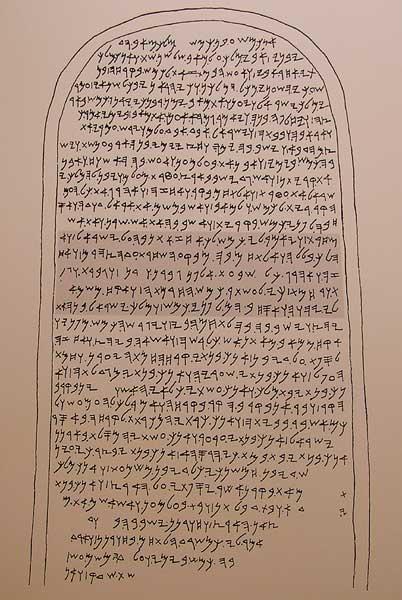
Mesha (no, not the Litvak way of saying Moses) Stele

(click for a larger, readable image)

In 1868 a large inscribed stone was found by a German named F.A. Klein in Dhiban in the Judean desert. It came to be known (then) as the Moabite Stone and is now called the Mesha Stele.The stele was soon broken by overeager Bedouin who broke it into pieces, either for luck or because they thought they could get more money for more pieces. Fortunately a papier-mache squeeze had already been made of it, so we still have (a copy of) it. This inscription is important because it is one of only a few examples of ancient Hebrew (called, in this case, Moabite largely for political reasons--the dialect is almost identical to the Hebrew of the Torah). It also provides a Moabite point of view. Mesha was the 9th century BCE king of Moav mentioned in 2 Melachim 3.

Lately I've been trying to polish up my ketav ivri reading and writing skills, so I was recently reading (okay, transcribing, really) the Mesha Stele (without having read a full translation of its contents). Coming across the first instance of the world Yisrael was awesome (5th line, looks like this: ). Seeing the name of Hashem (yes, "the name of the name, I know) on line 18--wow! I don't know if I'd describe the feeling as a religious experience per se, but it made me swell with satisfaction. I can't even put into words how moving it was to read that word (and Yisrael, mentioned six times) in ketav ivri from the days of the Nevi'im, even if it was "one of theirs" and not one of ours.
To read a translation and transcription of the letters into Hebrew check out Wikipedia.

Worth noting is the almost complete absence of plene spelling (ma'aleh) in the stele, evident from the very first word, אנכ , which is spelled without the י that would make it a proper Biblical Hebrew אנכי . In fact, one of the distinguishing features of ancient Hebrew is that it employed letters like ה, ו and י as vowels to indicate proper pronunciation, a feature that was a revolution in alphabetic writing. This is almost totaly absent in the Mesha Stele.

On the Main Line, now with tags: ,

Monday, October 10, 2005

Lakewood kollel members barred from internet

According to their IRS filings, Lakewood's Beth Medrash Govoha's "Primary Exempt Purpose" is: Educational institution involved in Academic Talmudic Research with undergraduate and graduate programs (Info cribbed from the old Protocols).

Now it seems the Lakewood internet ban has been expanded.

An academic research institution with undergraduate and graduate programs without internet access? Yes, absolutely.
Reconstructing the Bush doublet. Who was this George W. Bush?

Hehehe.

Friday, October 07, 2005

Lulav profiteer steals Sukkot

Lone importer hogs lulav market
The local wholesale lulav market is in uproar because a single importer, who has managed to corner the local market, is set to charge five times the normal wholesale price for the palm fronds used on Succot.

Avi Belali, of Moshav Segula near Kiryat Gat, accomplished the impossible, said local wholesalers. While hundreds of lulav traders and their customers have failed in their attempts to put pressure on Egypt to loosen the ban on the export of lulavs by enlisting politicians, diplomats and Jewish interest groups both locally and in the US, Belali succeeded in importing 250,000 lulavs.

Instead of charging the accepted $1 per lulav to wholesalers, Belali has let it be known that he will charge at least $5.

How lovely.

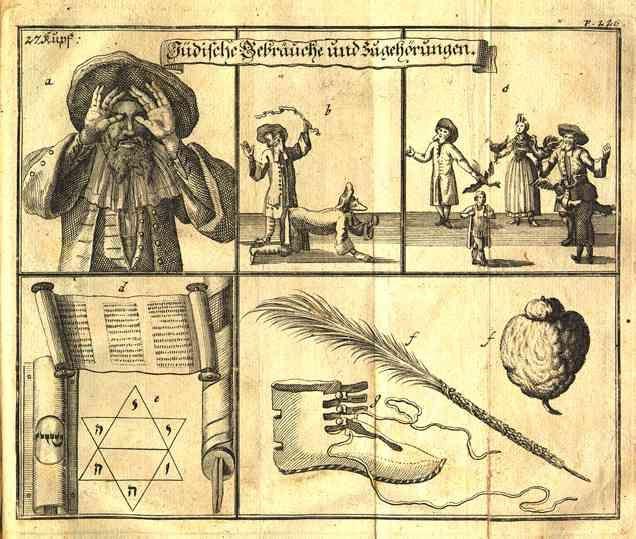
Judische illustrations from the 18th century


Judisches Ceremoniel, oder, Beschreibung dererjenigen Gebrduche.
Nurnberg : Verlegts Peter Conrad Monath, 1724.

This book is an example of a specific genre in the writings of Christian Hebraists, which includes works that describe the customs, ceremonies and rituals of contemporary Jews. Like many writers of these books, Paul Christian Kirchner was a convert. Beside this book he published a work in 1719 that was aimed to help with the conversion of the Jews, entitled Lehar'ot or emet la-yehudim. The Judisches Ceremoniel was originally published in 1717 and later on was revised and enlarged by Sebastian Jacob Jungendres (1684-1765). According to Jungendres the original work by Kirchner was inaccurate and biased because he wanted to prove the evilness of the Jews. Another addition to this imprint are 27 engravings that portray various customs and ceremonies held by the Jews. The book was published at least eleven times between 1717 and 1734, including a Dutch translation, and was reprinted in 1974 by Olms and in 1999 by the Reprint-Verlag, Leipzig.
The phenomenon of Christian Hebraism before the modern era fascinates me. Although strictly speaking this work is not from before the modern era and its author was actually an apostate Jew, I think the illustration is really interesting. As you can see, it shows a kohen duchaning, men giving malkos, a kappara ceremony, a Torah, mezuzah and magen david, lulav and esrog and a halitzah boot. Great illustrations although it must be said that the lulav looks suspiciously like a feather.

Great bibliophile link

Catalogue your books or look at others at Library Thing.

Hey, it's new to me.

On Narnia

In this Wolfish Musings post about the Lakewood internet ban a commenter called Queeniesmom mentioned C.S. Lewis's Chronicles of Narnia series.
i was severely chastised for letting my 7yr. old read the narnia chronilces. silly me, i was happy she was reading and that she wanted to read. we read many of the books together and i still don't see how this would warp her. to her it was a fun story - any symbolism it might have had (i'm not sure i buy it but that's another whole story) was lost on her.
Now I happen to think that the Chronicles of Narnia is good reading for children and that any Christian symbolism is completely lost on Jewish children--certainly at seven years old. However, despite Queeniesmom's skepticism, the Chronicles is certainly a Christian allegory. Apart from the obvious parallels (and less obvious ones, including the name of Aslan, which means 'lion' as in 'Lion of Judah') C.S. Lewis, as a Christian theologian, openly regarded them as a Christian tale--a fantasy rendering of much of the Greek Testament in fact. The books are as full of Christian Biblical symbolism and interpretation as pomegranates are full of seeds.

Since we're on the topic, I wonder what a Jewish Chronicles of Narnia might look like. Any Jewish writers want to give it a go?

Thursday, October 06, 2005

Artscroll's RCA siddur

Here's an interesting review of Artscroll's RCA version of the siddur. It is a typical critique of Artscroll, the kind I thoroughly enjoy. I have to say that the reviewer, Arnold Jacob Wolf, gave me a good laugh. This siddur makes him so mad and apparently drives him crazy and that's what's funny. Wolf cleverly calls Artscroll "neo-frum". He says that it is " fascinating, and infuriating" and, of course, "too obscurantist to accept". He notes that "All of the Song of Songs is given with a richly allegorical interpretation that borders on the ludicrous" and that "God created the whole world with the Hebrew alphabet (whatever that may mean) and if you don't believe it, you must refer to the Artscroll volume on "The Hebrew Alphabet, An Overview" (p. 1196)" Tachanun is midieval: "Many physical responses are mandated: bowing, stepping back, holding one's face in one's hand. Imaginative typography and bright, rather gaudy, covers, do not obscure the medievalizing sensibility of the RCA Siddur or its retrograde implications."

Read it.

King James and Artscroll

Interesting comment:
[A]t Mesorah Publications, Orthodox publishers of Artscroll Library's Stone Edition Tanach (1996), general editor Rabbi Nosson Scherman says he has seen a demand for an English-only Tanakh, much of it from the non-Jewish world, especially evangelical Protestants and Catholics. "There is an increased interest on the part of many people, possibly people who are interested in the Bible as literature, who want to know how the Bible was understood by Jews before King James got around to it," [Rabbi Nosson] Scherman notes.
Okay, R. Scherman is clearly referring to the anthology-commentary in the Stone Edition. But the translation uses a great deal of terms taken straight from the King James! An early example is the translation of Genesis 4:9, hashomer ahi anokhi, as "Am I my brother's keeper?" I can promise that if the KJV had never existed and someone was translating the Torah into English for the very first time today they wouldn't have naturally employed that sentence. It would be interesting to search the Stone Edition for KJV phrases, but someone else will have to do that. Suffice it to say that the King James shadows it throughout.

It's certainly possible, if not likely, that the anonymous translators of the Artscroll chumash did not consult the KJV even once because to a very real extent the King James Version is the template in English through which each Bible translated into that language must pay its respect. Who among English speakers does not know that Cain's retort to God was "Am I my brother's keeper?"

Traditionally one of the fast days, 10 Teves, was taken to mark the translation of the Torah into Greek, an event deplored according to this tradition and likened to the caging of a lion.Apparently an English rendition of the Torah, even one produced by Orthodoxy's RW publishing giant can't escape it.

Other Jewish translations use the phrase, and not just ones like the JPS translation. R. Aryeh Kaplan's Living Torah has "am I my brother's keeper" as well--but he has the King James in his bibliography. There is no James, kingly or otherwise, in the back of Artscroll's Chumash--but its presence is certainly there.

Monday, October 03, 2005

Lakewood attempts to prescribe a return to 1994

It's probably rapidly going to become a hashed-to-death cliche to dissect the Lakewood internet ban. But clearly I'm not going to let this by without commenting.

Obviously this is draconian. But rather than just being prescriptive, let's be descriptive. Firstly, no one should deny that the internet truly is a threat to traditional ways of life. It is. Secondly, the internet is not all amazon.com and online bill paying and [insert the newspaper of your choice]. It's got dark corners, probably most of it is dark.

The truth is that if Lakewood will continue to be Lakewood (and if Lancaster, PA will continue to be Lancaster, PA or if Riyadh will continue to be Riyadh) then it probably can do so only without widespread internet use. However, it's difficult to believe that this ban is being promulgated from a position of strength. I don't pretend to have some kind of proactive formula for them that will work, but it's hard to see how the reactionary approach they've taken will really succeed in the long run. The language of the ban clearly recognizes the unescapable fact: many people really need internet access. And many people will have it. Even if having internet access requires rabbinic approval, I can assure you that they will be unable to monitor people's private use.

On the other hand, maybe this ban is really meant only as a da'as Torah litmus test, a kind of periodic status report on the haredi world of Lakewood, NJ by the powers that be. Or maybe its only meant for the taye'reh temimusdike yungerman and especially their children and families, the people who will take the ban very seriously but who otherwise might have innocently slipped that free AOL disc into their computer and double-clicked setup.exe.

Sunday, October 02, 2005

What a hundred halakah committes cannot do

I came across an interesting bit of mussar by Rabbi Joseph H. Lookstein directed toward Conservative rabbis in the Summer 1977 edition of the journal Judaism. The issue was "devoted to an extensive symposium on Conservative Judaism on the occasion of the 90th anniversary of the founding of the Jewish Theological Seminary. Rabbi Lookstein was asked by the journal to give, if not mussar, then an assessment on Conservative Judaism. The article is called 'The View From the Right: A Critique and a Plea.'

An excerpt:

I need not remind my Conservative colleagues what is kavod for a teacher and how the Talmud cautions us against "pronouncing judgement in the presence of one's teacher." A hundred halakah committees cannot overrule one Professor Saul Lieberman! Jewish law is not decided by the raising of hands at a rabbinic convention. Modification and interpretation of Jewish law are vested with acknowledged authorities. These authorities, for the Orthodox rabbis, are in the yeshivah which trained him, and, for the Conservative rabbi is it, and should be, his Seminary.

Jews who arguably rock

A few years ago in a book store I came across a mostly silly little book called "Jews Who Rock". It's about, yes, Jews Who Rock. Well known are the Bob Dylans (nee Zimmerman) or Paul Stanleys (nee Eisen) but lesser known are the Mike Bloomfields and Sylvain Sylvains, all Jews Who Rock.

Anyway, the afterward of the book was written by Perry Farrell (Jane's Addiction). An excerpt:

Last night I sat with a friend who has a tremendous passion for searching out the truth. He is a very intense fellow who sometimes leans a bit far out with his conspiracy theories. We discussed different topics, varying from the origins of HIV virus to real cures for cancer. He believes that a lot of misinformation is being disseminated by pharmaceutical corporations who want to drive the drug industry. As the night grew more heated my friend began bearing down on the theory that Jesus never existed, nor did Moses. He claimed they were invented by the powers that be to control the masses. That people need myths. Something to believe in. The Bible, he said, was written and edited by so many people that there isn't any real truth to it.

Here was a fellow that I enjoyed speaking with, and I appreciated his thirst for knowledge. But at that moment I broke down. I said to him, "You know when you tell me that the Bible was invented by someone....and it never happened, that is like telling me that I am not real, because you are speaking about my family. Because that book is a history of my family. My name, Peretz, was chosen in honor of one of those relatives. You see, the Jewish people, whether they understand it or not, are living proof that they are not myths but real history. And because we are kept alive this very day is in fact proof that God exists because, if it weren't for his intervention, we wouldn't be here. And that is a reason to praise his name."

I like it.

Friday, September 30, 2005

Will Israelis topple Chomsky?

Four Israelis might have refuted Noam Chomsky's theory of "innate grammar". Linguistics geeks read on.

Oh, the irony! *L*

What does your child aspire to be?

Wolfish Musings posts about a disconcerting encounter with his son's yeshiva principal. Wolf's son loves animals and so far aspires to be zoologist. In short, he is a child with normal interests and aspirations.
As it turns out, my wife (W) had to go to the boys yeshiva to speak to the Menahel about a matter concerning my son (unrelated to the hamster). While she was there, she also mentioned the fact that his hamster had died and that he may be "out of sorts" for a day or so.

Now, this Menahel is a very fine gentleman, one for whom I have respect. In all the years that our kids have been in the yeshiva, he has always shown to have our children's best interests at heart. While other officials in the yeshiva are seemingly ready to knock the kids down (figuratively) whenever possible, he always looks to build them up. Of course, he is very Chareidi and has one view of the world, as was again illustrated to us this day.

So, W told the Menahel about the hamster and S1's attachment to it. She explained to him that he *really* loves animals and that he has aspirations to be a zoologist one day.

He looked at her and said "We had hopes that he'd aspire to be a Rosh Yeshiva."

It goes without saying that if the first paragraph had described Wolf's son as loving learning and aspiring to be a Rosh Yeshiva then he would also have normal interests and aspirations (okay, I lied--it didn't go without saying or else I wouldn't have said it). But the point is that there are other normal goals for children besides being a Rosh Yeshiva!

Allowing that the principal wasn't trying to make any kind of radical statement, and certainly taking into account that Wolf writes that he is a fine person, worthy of respect, one who seeks to build children up etc.--still, this is almost the kind of stale thinking that Eliezer Berkovitz deplored, particularly in his history of Halakhah, Lo Bashamayim Hi: The Nature and Function of Halakhah. He points out that in a real society there simply must--must!--be doctors as well as sanitation workers as well as scholars as well as even artists and poets--and zoologists too. The Torah envisions us as having a real society. Sadly, too many in communal leadership positions don't get that.

Thursday, September 29, 2005

I am not a manuscript boy...

I have never entered the world of manuscripts (Biblical, rabbinic etc) for several reasons: lack of access, training, time--but not for lack of interest.

But I recently came across something interesting that I had to share.

Mishna Avos 5:32 is a good example of a 'famous' Mishna, one that quotes Ben Bag Bag saying that one should investigate Torah from every perspective, hafokh ba ve-hapekh bah.

The reason for doing so can be found in essentially three textual versions:

1) The most common one, found in most manuscripts and printed edition, the one usually cited is: de-kolah bah, "because everything is in it".

2) A second version found in manuscripts is de-kolah bah ve-kolakh bah, "because everything is in it, and all of you is in it."

3) A third, more rare version is de-kolah bakh ve-kolakh bah, "because all of it is in you, and all of you is in it."

As you can see, these are quite different. Why did Ben Bag Bag say "hafokh ba ve-hapekh bah"? I don't know exactly, but there are at least two possibilities besides that which we normally ascribe to him.

Wednesday, September 28, 2005

If you don't know what 'MOAG' stands for, don't bother

Steven I. Weiss interviews R. Nosson Kamenetzky about the newly published edition of The Making of a Godol.

R. Kamenetzky calls those that instigated the ban "yinglakh".

R. Elyashiv is "non-English-reading Rabbi Elyashiv".

Great line: "I am gratified that people in the Modern Orthodox world have become my fans". LOL!

Tuesday, September 27, 2005

Yom Kippur without Kol Nidrei

There is a whole infamous chapter of Jewish history surrounding the Kol Nidrei prayer with which Yom Kippur begins. To begin with, have a look at what link this is to. That already says plenty.

From the Jewish Encylopedia of 1906:

The Kol Nidre has been one of the means used by Jewish apostates and by enemies of the Jews to cast suspicion on the trustworthiness of an oath taken by a Jew. This charge was leveled so much that many non-Jewish legislators considered it necessary to have a special form of oath administered to Jews ("Jew's oath"), and many judges refused to allow them to take a supplementary oath, basing their objections chiefly on this prayer. As early as 1240 Jehiel of Paris was obliged to defend the "Kol Nidre" against these charges. It can not be denied that, according to the usual wording of the formula, someome might think that it offers a means of escape from the obligations and promises which he had assumed and made in regard to others.
In fact, its possible that individual Jews throughout the ages themselves interpreted Kol Nidre in this way. It's no great shock that people are capable of being moreh heter le-atzmo all kinds of misdeeds. However, the prayer has a history, one view is that it traces back to instances of forced apostacy by the Visigoths among Iberian Jews in the 7th century. The prayer was written for them (or by them?) as a recitation of contrition on Yom Kippur, a renunciation of declarations in allegiance to other gods that they were forced to make. To be fair, there are not a few Jewish sources that were opposed to the prayer since it could so easily be misinterpreted. And it was. Pgs. 730-731 of the Hertz Chumash has an impassioned defense of Kol Nidre as well as a plea for to retain it. This was certainly an issue, even among Orthodox Jews in the West in the 1930s, when the Hertz Chumash first appeared.

From Artscroll's biography of Rabbi Samson Raphael Hirsch (of the same name):

There was one instance where Rabbi Hirsch did omit a traditional prayer. In 1839, Rabbi Hirsch deleted the recitation of Kol Nidrei in Oldenberg....Rabbi Hirsch explained it in writing to the correspondent of the liberal Allgemeine Zeitung des Judentums: "Although last year the Kol Nidrei was deleted for halachic reasons, neverthless I came to the conclusion that this change, although halachically grounded, would better not be instituted by an individual rabbi. Therefore I requested that the congregation recite it, but only once, not three times." In any event, he reinstated Kol Nidrei the following year.
An interesting cultural artifact is the centrality of the Kol Nidrei in the alleged first talking picture, Al Jolson's The Jazz Singer from 1927. To me, that seems to indicate a refreshing lack of prejudice against Jews in the United States, this despite the more benign country club variety antisemitism that was quite prevalent. Surely it would have been unthinkable for such a film to be produced overseas at that time.

More importantly, today many Jews are completely unaware that there ever was a controversy. While it says something about their own Jewish education, it also says something about the society in which we now live (David Duke notwithstanding).

Hillel Halkin's review of the Etz Hayim Chumash

It boils down to this: 'How long will you keep shifting from one opinion to the other?' Or at least that's my summary of Hillel Halkin's interesting review of the Etz Hayim Torah and Commentary in Commentary. It's long so I decided to split this into two posts, but its worth reading.

Read the rest:
'Boiling a Kid': Reflections on a New Bible Commentary , By: Halkin, Hillel, Commentary, 00102601, Apr2003, Vol. 115, Issue 4

Well? Wellhausen!

I finally read the infamous Prolegomena to the History of Ancient Israel by Julius Wellhausen. I bet not more than a thousand people have actually read the book itself in the past fifty years.

Some observations:

*It was exactly as wordy in that 19th century Germanic way that I expected.

*It was far less boring and technical then I expected.

*Wellhausen is as antisemitic as expected, but it doesn't overwhelm the work.

*It is competely true that many of his observations were well noted by classical Jewish sources.

*It is no mere apologetic to point out that a great deal of the contradictions, anachronisms and doublets which he noted were also noted by Chazal and our commentators (as well as the nature of Elokim and YHVH).

*However, much the way in which R. Aharon Feldman noted that the world really does appear to be billions of years old, by looking at the stars, Wellhausen's notes these problems (and others) and they need not be inherently antisemitic. If they were obvious to Chazal, why shouldn't they be obvious to Wellhausen--and more importantly, not based on dishonest reading?

*He indeed conjectures many things for which he has no basis conjecturing.

*His views kohanim as nothing but papal priests, which I needn't point out is an anachronism.

*Wellahusen looks exactly as you'd imagine he would:

Close to fifty years ago Herman Wouk wrote in his majestic This Is My God (one of my favorite books):

[Wellahusen's Prolegomena] is a museum piece now....Serious Bible scholarship has dropped it...
It is true that other respected methods of Bible scholarship are pursued today, including the literary method that treats it as a seamless document for the purpose of literary analysis (e.g., Robert Alter), and many of Wellhausen's assumptions have long been proved false, and neither a J nor an E nor a P nor a D has yet been found, but the documentary hypothesis did not wither and die and not every problem has been given a solution.

In the words of Dr. Shnayer Z. Leiman:
Some well-meaning Orthodox defenders of the faith delight in repeating the canard that through the heroic efforts of Rabbis David Hoffman and Hayyim Heller, the death knell was sounded for the documentary hypothesis decades ago--and it need no longer be taken seriously. Nothing could be further from the truth.
(Response to Rabbi Breuer by Shnayer Z. Leiman in Modern Scholarship in the Study of Torah: Contributions and Limitations)

Since Wellhausen's documentary hypothesis isn't dead and has not been definitively rebutted, despite what we might wish, I plan to post more about it*; on problems with it and problems without it. After all, I didn't plow through the Prolegomena because it was fun, believe me.

*probably in my post on the 8th of the Rambam's principles)

Window into the Yeshiva, Pt. I: the 10th century

This begins a series of posts which I hope to make consisting mainly of primary source descriptions of Yeshivoth throughout the ages.

This first one is a description of the Geonic yeshiva of Sura at Baghdad, from the late 10th century, by a R. Nathan ha-Bavli. R. Nathan was present during one of the two kallah months during which people would travel to the yeshivoth for intensive learning.
And this is the order in which they sit. The Head of the Academy stands [var.: sits] at the head, and before him are ten men [comprising] what is called the "first row," all facing the Head of the Academy. Of the ten who sit before him, seven of them are "Heads of the Kallah" and three are associates....

...And the seventy [comprising] the Sanhedrin are the seven rows. The first row sits as we mentioned. In back of them are [another] ten [and so on] until [there are] seven rows, all of them facing the Head of the Academy. All the disciples sit behind them without any fixed places. But in the seven rows each one has a fixed place, and no one sits in the place of his colleague....

When the Head of the Academy wants to test them in their studies, they all meet with him during the four Sabbaths of Adar. He sits and the first row recite before him while the remaining rows listen in silence. When they reach a section requiring comment, they discuss it among themselves while the Head of the Academy listens and considers their words. Then he reads and they are silent, for they know that he has already discerned the matter of their disagreement. When he finishes reading, he expounds the tractate which they studied during the winter, each one at home, and in the process he explains what the disciples had disagreed over. Sometimes he asks them the interpretation of laws. They defer to one another and then to the Head of the Academy, asking him the answer. And no one can speak to him until he gives permission. And [then] each one of them speaks according to his wisdom....

(translation by David Goodblatt in Rabbinic Instruction in Sasanian Babylonia. Leiden: Brill 1975.)

Thursday, September 22, 2005

Can you think of 1200 names?

Came across an interesting article by Jeffrey Tigay in Bible Review (Feb. 2004) called "What's In A Name?".

The article discusses the instances of theophoric names* among the ancient Benei Yisrael. The purpose of the article was to draw conclusions about the instances of idolatry among the Israelites in the Biblical period by studying the names. For example, inferences are made about personal names that include "baal", although Tigay acknowledges that these are not necessarily intended to invoke the Canaanite deity of that name.

What I find interesting is a bit of trivia; the sheer volume of available names he studied. There are, he says, 521 individual theophoric names in Tanakh. He also studied more than 700 names found in ancient inscriptions, but not in Tanakh. I had no idea there were so many names from inscriptions. In short, over 1200 names, which I'd love to have a list of. Anyway, more than half of these 1200 names, 671 contained a theophoric element.

*personal names that include the name of a god, e.g., Shmuel or Eliyahu or Yechezkel etc.

When in Rome...

Menachem Butler mentions Artscroll's R. Nosson Scherman's talk at YU's beis midrash.

Nachum Lamm recalls R. Scherman's speech at the opening of the YU Museum's Printing the Talmud exhibit:
He spoke at the opening of the YU Museum exhibit on the Talmud, and contributed an essay to the catalog. Hearing him correct himself- "Shabbos" became "Shabbat"- to a largely non-Orthodox audience was interesting.

The black hat


A black hat is a Jewish ritual item.

I feel like I should say something about group identity blah blah blah or rabbinical garb blah blah blah, or the Mishna Berura.

I remember getting one (two, actually) before my bar mitzvah. It was definitely considered a rite of passage, and probably was for a generation or two before me. The hat separates the men from the 12 year olds.

Have you got one? Do you wear one? When? Why? Why did you? Why don't you? Why do you sometimes?

Zugt the Gemara and nothing else

Let's speculate.

Imagine that for some reason someone has enough money to publish a Talmud without any commentaries whatsoever, just the text.Yes, it isn't practical. Yes, only five people would even want to buy it, but imagine anyway that it was printed and distributed.

What would the reaction to a Gemara like that be, if you can imagine that it gets detected on the radar screens?

Are esrogim cheaper on Mt. Gerizim? ;)

Jameel at the the Muqata has a very interesting post about a visit he took with his family on sukkos to some Samaritans who were kind enough to invite them into their home.

Great photos, including one of their version of a sukka (theirs are indoors):


Jameel says it smelled amazing, with all those fruit on the ceiling, including many esrogim.

All I could think when I saw the picture is that I bet they don't pay what I do for an esrog!

Wednesday, September 21, 2005

DovBear posts on ketav ivri.

The story in his post makes his "Mood: Pessimistic", but I'm just happy that one of my geeky loves is being discussed.

Conservative gedolim stories

I found the following somewhere online:
There's an amazing story about Shaul Lieberman, which made his reputation. He took a really corrupt and incomprehensible section of the Jerusalem Talmud and reconstructed it by suggesting some 30 radical changes (e.g. the opinions of authorities X and Y are reversed, this word "not" should be deleted, the phrase Z should be inserted here, section 3 should precede section 1 etc.). All the difficulties were resolved, and it made perfect sense and had continuity with what came before and after. It was a tour-de-force and widely admired, but considered extremely speculative. Many years later, an old manuscript was discovered which had all 30 of his changes.
For all I know this is true. For all I know. But it certainly seems like this is a wildly exaggerated version of what might have occurred, if it did at all. I mean, thirty changes?

Its striking because this is exactly parallel to the type of "feats of the mind" gedolim stories routinely traded and recounted in the oilam ha-yeshiva.

Why not mashicha?

Diqduq alert:

When a patah is under a het that ends a word, it becomes "ach" rather than "cha". Classic examples: mashiach, tzemach etc. but not "mashichah" or "tzemachah".

My question is simple: why?

And how do we know?

Azariah de' Rossi's ancient Hebrew aleph-bet

Something that fascinates me is the errors in very old books, works that were meticulously and scrupulously researched. Why the errors? Simply because the available facts were limited.

Here we see a chart that shows the ancient Hebrew alphabet from R. Azariah de' Rossi's 16th century opus Me'or Enayim.


In fact, while clearly there is something to de' Rossi's rendering, this isn't actually the ancient ketav ivri script. De' Rossi's best available source, like the Ramban before him, was the script used by the Samaritans. The script was presumed to be identical to ketav ivri, while it's actually a descendent of it, but not the same. That de' Rossi's illustration comes from Samaritan can be shown by a comparison of his chart with the Samaritan alphabet:


When the Ramban was 'oleh he discovered that to truly understand much of Tanakh requires actually being in the land of Israel. Some of his prior held views, mainly relating to geography, were debunked simply by his being able to actually see and experience what until then were only words. Another interesting consequence of his move to Eretz Yisrael was his revised understanding of the shiur of the Biblical shekel ha-kodesh. There was an ancient shekel possessed by Jews in Acco, with ancient Hebrew writing on it. With the help of Samaritans, he was told that the writing confirmed that it was indeed a shekel. After weighing it, the Ramban concluded that Rashi's view of the shekel's weight (in Shemos 21:32) was correct, while his own view (in Shemos 30:13) was inccorect.

Here is de' Rossi's rendering of the shekel:


Interestingly, the Ramban's opinion was quoted a number of times by Christian writers in the 18th century in studies regarding the antiquity of the Hebrew alphabets. Here is an example, from Robert Spearman's "Letters to a friend, concerning the Septuagint translation, and the heathen mythology" (1759):


and another discussion in"Sketches of Hebrew and Egyptian antiquity, intended as an introduction to the Pentateuch" by John Walsh, Vicar of Cloncurry and Kilcock (1793)


On the Main Line, now with tags:

Tuesday, September 20, 2005

Brave new world


Analysis of a Google map led to the discovery of a Roman villa like this one in Parma, Italy.

"Using satellite images from Google Maps and Google Earth, an Italian computer programmer has stumbled upon the remains of an ancient villa. Luca Mori was studying maps of the region around his town of Sorbolo, near Parma, when he noticed a prominent, oval, shaded form more than 500 metres long. It was the meander of an ancient river, visible because former watercourses absorb different amounts of moisture from the air than their surroundings do."

more

edit: I tip my black hat to Mis-nagid.

Monday, September 19, 2005

Five out of Thirteen ain't bad

In July I began a series of posts on the Rambam's principles of faith, 13 in all. It kind of petered out after just 5 of them (refresh your memory: I, II, III, IV and V.).

I intend to resume and continue. Stay tuned.

Thursday, September 15, 2005

Tzenarena was for women anyway


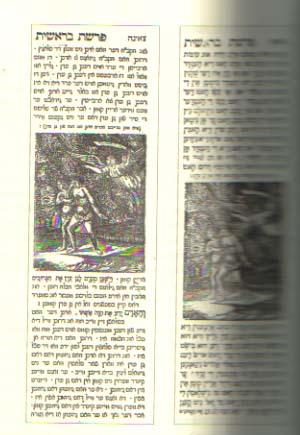
In this mid-19th century Romm edition of the Tzenarena Adam and Eve are dressed in fig leafs and hands. How could the venerable Romm printing press, creator of the inspired Vilna Shas print an illustration of Chava with her pupik visible? It's disillusioning, really.

As they say, you can't ask a kasha on a ma'aseh.

An encounter with Prof. Saul Lieberman

Came across an interesting thing on pg. 28 of The Rav: The World of Rabbi Joseph B. Soleveitchik by Aaron Rakeffet-Rothkoff and Joseph Epstein, a speech delivered by R. Soleveitchik to the RCA in 1974:
I remind myself, I had an encounter quite a number of years ago with a representative of the so-called Hokhmat Yisrael [Wissenschaft des Judentums]. He was a very outstanding scholar. (At this point, a footnote tells us that "the scholar whom the Rav was referring to was Professor Saul Lieberman (1898-1983) of the Jewish Theological Seminary of America. The Rav and Professor Lieberman, who were related by marriage, met at a brit milah. Professor Lieberman was married to Judith Berlin, the granddaughter of the Netziv.") He told me that lately they had discovered a parchment, a megillah, in which it was stated unequivocally that a kohen is enjoined from defiling himself with a sheretz*.

So I said to him: "Do you take it seriously?"

"Of course," he answered, "very seriously." You know, they [the devotees of Hokhmat Yisrael] have the answer right away. It is a different kabbalah, a different tradition. They operate with "traditions" in the plural.

So I mentioned a name to him. The name was known to him, and I knew that he did not like the person. I asked him: "Do you know him?"

"Yes," he answered.

"Is he a scholar?" I asked.

"No, he is a boor and an am ha-aretz mide-oraita," he answered.

I said to him: "So only we have a monopoly on boors and amei ha-aretz mideo-oraita? Fifteen hundred years ago there were also boors and amei ha-aretz. Since there was no paper, the boor had to write on parchment. So you found a nice hiddushei Torah, so what!"
*The halakhah is that a kohen is permitted to have contact with a sheretz.

Paranthetically, I wish I knew more about Prof. Lieberman. Of those who know, is it fair to say that if he'd chosen to become a rebbe in a traditional yeshiva environment (if I am not mistaken, he considered teaching at Chaim Berlin) that ultimately he'd have been considered in the yeshiva world another one of those idiosyncratic rabbis like R. Chaim Heller (he of the Peshitta obsession)? Or is that impossible? I've read his classic "...In Jewish Palestine" books.

Tuesday, September 13, 2005

Israeli kollel numbers

The Jewish worker quotes Mishpacha magazine, citing Israeli government sources, on the number of people learning Torah full-time in Israel:
53,500 learning in Kollel
41,000 learning in Yeshiva
23,000 learning in Yeshiva Ketana
Putting aside politics and everyting, 117,000 people learning Torah is phenomenal.

But these numbers--how is this possible? In a society with more children than adults there are more married men learning full-time then kids or unmarried Beis Midrash bochurim?

Monday, September 12, 2005

Censorship and self-censorship conference

The New York Metropolitan Area Chapter of the Association of Jewish
Libraries (AJL/NYMA) will hold its Fall 2005 Conference on Monday,
September 19, 1-4 pm, at The New York Public Library's South Court
Auditorium. Use the staff entrance on 40th Street between Fifth Avenue and
Bryant Park. *Bring picture ID.*

CENSORSHIP AND SELF-CENSORSHIP: DRAWING THE RED LINES

Intra-Jewish Dialogue: Problems and Perspectives - Rabbi Ammiel Hirsch,
Rabbi, Stephen Wise Free Synagogue

Orthodoxy and Censorship - Professor Marc B. Shapiro, Weinberg Chair of
Judaic Studies, University of Scranton

For further information, contact Marlene Schiffman: E-mail Protected; (212)
960-5381.
I plan to be there!

Ammiel Hirsch, is of course, co-author of One People, Two Worlds with Yosef Reinman.

Regarding Marc Shapiro (R. Jacob Jehiel Weinberg biography, the Limits of Orthodox Theology, many papers etc) I t
horoughly enjoyed his books, but am I the only one who gets the impression that he can't figure out why no one will ban his books?

Nitpicking Karen Armstrong; We all make mistakes

Time and again I've noticed that when I read something that I know a lot about I'll inevitably catch a factual error (especially if the thing I'm reading wasn't written by a specialist in that subject). This shouldn't be surprising. After all no one's perfect. If a treatment of some subject gets 98% right that's really good. But if this is true of what I do know, what about what I didn't know? Surely everything contains factual errors.

Karen Armstrong's "The Battle For God" is a good example. The book treats the rise of fundamentalism in Christianity, Judaism and Islam worldwide over the past 50 years, a phenomenon that virtually no one predicted. It's a pretty good book. She is a thorough scholar. According to Amazon.com she cited 175 works. The bibliography is 17 pages long, each one containing about 36 entried. Thats more than 612 sources, plenty of them good ones. But on page 101, discussing the beginning of Chassidus, she writes of
"....a powerful figure: Elijah ben Solomon Zalman (1720-97), head (gaon) of the Academy of Vilna."
I'm not sure its an exaggeration to say that any twelve year old kid in yeshiva knows that this is nonsense. The Vilna Gaon most certainly was not the head of the Academy of Vilna (nor was there an 'Academy of Vilna').

Now I'm not saying this is an unreasonable screw-up. Armstrong probably read a hundred and one times over the years that a gaon was an academy head. She probably didn't even realize that she was making the Vilna Gaon a rosh yeshiva without having read it in any source. But a mistake it is, and not a minor one in that to understand the Vilna Gaon is to know first of all that he was an independent, secluded scholar. Even his having disciples meant something completely different than having disciples normally does.

It's understandable how Armstrong got this wrong, but of course it means that she probably has no concept of the Vilna Gaon apart from some dry facts, namely that he was reputedly a genius, extremely influential and an opposer of Chassidus.

So what else does she misunderstand and what else does she get wrong, especially in the parts of the book that deal with Christianity and Islam, which I have less intimate knowledge of? This is a problem native to any work of this kind, al achas kamma ve-kamma, articles in the daily newspapers or popular magazine.

Verses of Talmud for so-called self-hating Jews

(it's clickable)

Its pretty obvious that one can cherry-pick through a vast corpus like the Talmud and rabbinic literature to find nearly any opinion, or something that resembles it. Yes, I do it sometimes too--but I'm not sure the response to this unfortunate phenomenon is to arm yet more people with more talking points, more "famous" Talmudic sayings they can use to support any position, political or otherwise.

(For some reason I'm reminded of "Tzedek tzedek tirdof" (Deut. 16:20), from last week's sidra, which happens to have thirteen words in that verse, not three; you can look it up).

And what the heck is a "verse of Talmud"?

Friday, September 09, 2005

The end of R.L. Burnside


R.L. Burnside died a few days ago. He was 78.

Hope he's in heaven sittin' down

On acid....tests

In DovBear's Orthodox Acid Test many suggestions are made to define the question that could determine if one is an Orthodox Jew. This invariably led to the observation that the boundaries between Orthdoox and Conservative are sometimes imprecise at the left-wing and right-wing edges respectively. I offered up that some such Jews say that the only real dividing line is mixed tefillah.

Reb Yudel says its this:

There's a very clear line. It's Rosh Hashanah, you don't have a shofar, and the only shul in town is three miles away and a member of the United Synagogue of Conservative Judaism and doesn't have a mechitza.

If you walk to shul to hear the shofar, you're Conservative.

If you stay at home, you're Orthodox.

Man's got a point.

On Hebrew in Ashkenaz

I love history. One of the things that fascinates me about history is the way it is layered. Imagine if you photographed the view outside your front door every minute for an entire day. With nearly 1500 photographs, some would look exactly the same, but if you lay them out next to each other you'd see the changes in the view from your front door. In this frame there is a man that wasn't there, in that frame its late afternoon etc. That's like a tiny microcosm of the layers of history.

What also fascinates me is the layers that develop in things like language, in this case, Hebrew as spoken in the lands of Ashkenaz. Ashkenazic Hebrew gets no respect. It was rejected by early Reformers, maskilim and Zionists as a ghetto pronunciation(s), a Eurofied shprache that removed the Semitic character of Hebrew (and by extension, Aramaic pronunciation). I'm not going to comment on that, but I find the layers in Hebrew Ashkenaz to be worth noting.

For starters, there is a great deal of evidence that Hebrew was voiced in Ashkenaz much like that of the Sephardim until the 14th century. For example, they did not distinguish between kamatz and patah or tzere and segol (albeit in the opposite way that the modern Chassidic pronunciation doesn't make the distinction). This is attested to by Ashkenazi grammarians, like Yekusiel of Prague, as well as the massive confounding of those nekudos in many pointed manuscripts from Ashkenaz.

An interesting historical point was how the pronunciation of the letter ח (hes, spelled חית) came to be pronounced in Ashkenaz. By midieval times it had lost its Semitic character, but in the two great Ashkenazic communities it came to be pronounced differently. In the one, that of the Rhineland in the West (called at the time Shu"m, after Speyers, Worms and Mayence), the sound had migrated toward that of H. In the other community, that of Rothenberg, Nuremberg and Prague, it had come to be pronounced with the familiar Asheknazi way, like the "ch" in "Bach". As a result, the Eastern Ashkenazim made fun of their Western brethren, calling them בני הית (Benei Hes). The Westerners countered by referring to the Easterners as בני כית (Benei Khes) as if to say, "Hey buddies, a ח isn't a ה, granted, but it ain't a כ either." This was, of course, a sly reference to the Children of Heth, in Gen. 23. Midieval humor; gotta love it.

It should be noted that there is sometimes a difference between the formal and popular pronunciations, and sometimes this difference preserves something interesting, a residue of an earlier Ashkenazic pronunciation. When reading the Torah (formal) people will usually read carefully and literally according to the vowels but modify them informally, as in when studying Torah. An example of this is how the word דם "dam" (blood) is pronounced. It is written with a kamatz and should logically be read as "dum" (or "dawm")--and when reading the Torah it invariably will be, as it will when the list of plagues at the seder is recited. But popularly it will invariably be pronounced as "dam", as if there is a patah. That's a left-over from long ago. Another example is Jerusalem; formally pronounced as Yerusholoyim but popularly almost always as Yerushalayim.

A well known example of a residue is the name "Yankev" for Ya'akov, which preserves a remnant of the Semitic pronunciation of the consonant ע, long lost among Ashkenazim. An interesting example is how the fourth letter of the Aleph-Bet, the ד (daled) is pronounced. As a child I could not figure out why it was spelled דלת (dales) yet pronounced daled. It is, of course, the remnant of the earlier dalet, only it migrated toward daled instead of dales (although the 18th century Bibliophilus dictionary has dales).

Finally, a note about the changed shuruq/ kibutz (u, oo) toward "i", present today among Chassidim mainly. As early as the 16th century this was remarked on, by the Maharal among others. Some defended it, as it originally preserved a distinction between the shuruq and the shorter kibutz, others were appalled by it as a corruption. Be that as it may, its interesting that in some cases, even among those who pronounced it as "i" they made one exception: for the word רוח (ruach, riach). In Yiddish, "riach" is a curse word, as in a riach in zayn tatn, "Damn his father." When the Torah was read רוח would be pronounced "ruach", which is evidence of a self-awareness that is probably since lost.

In the main, most of this info is from The Phonology of Ashkenaz by Dovid Katz.

On the Main Line, now with tags:

Thursday, September 08, 2005

Maimonides' grandson

It says in Yoma 71b, regarding Hillel: He saw a skull floating on the surface of the water. He said to it: "For drowning others you were drowned; and in the end they that drowned you will be drowned."

That's a famous obscure Gemara.

One commentator said on it the following:
Hillel, may he rest in peace, saw Pharaoh's skull floating on the water. It was Pharaoh who used to take one hundred and fifty young children of Israel very morning, and another hundred and fifty every evening and cast them into the sea. That is why the Lord slew him and drowned him. And the ancients tell us that the Hillel referred to in the Mishna is really Moses our master, may he rest in peace....And he said to the skull, "Because you slew human beings and threw them into the water, the Lord has slain you and cast you into the water"....The is the hidden [mystical] meaning of this statement.
What's really interesting is that the above commentator was R. David Ha-Nagid, a grandson of the Rambam. (Midrash David of R. David Ha-Nagid, trans B.Z. Krynfiss (Jerusalem, 5704), p. 34)

Far be it for me to judge whether the Rambam would have liked this peshat, but suffice it to say that it is of the sort that is entirely different from the rationalist approach of the Rambam, that's for sure.
[James Henry] Breasted, when asked by a student, How does one become an Egyptologist? replied, "First, he must marry a rich woman."
Goldin Judah, Several Sidelights of a Torah Education (Philadelphia: Jewish Publication Society, 1988), pp.203 in Studies in Midrash and Related Literature

Tuesday, September 06, 2005

Solve an ancient abecedary mystery!


We live in a strange world, don't we? As expected, there are strange things that really defy explanation.

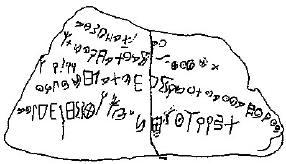
In 1976 an excavation of an ancient Israelite village uncovered written on a piece of pottery what is now called the 'Izbet Sartah abecedary (an abecedary is a list of the alphabet in order). The inscription was dated to 1200-1000 BCE and it looks like the above image.

Actually, only the bottom line is the abecedary. What is unusual about this (aside from its existence in and of itself!) is that it is written from left-to-right (that's an 'aleph all the way to the left, and the crossy looking thing at the right is the tav). That itself isn't so unusual in ancient writing. The ancient Greeks sometimes wrote using boustrophedon, which means that the text alternates in direction depending on the line.

For example you would start writing from left-to-right
enil txen eht ni tfel-ot-thgir eunitnoc dna
and then reverse on the next line, etc.

Of course that was how the early Greeks did it, but this is the only example of such Israelite writing.

More puzzles:

The zayin and hes are reversed, as are the 'ayin and peh. And then it seems to repeat kuf twice, while omitting resh. If written in modern Hebrew it would look like this: תשקקצעפסנמלכיטזחוהדגבא

Interestingly, the first four peraqim of Eicha are acrostics; each verse or group of verses begins with a letter of the aleph-bet and the chapter is 22 verses long. The second through fourths pereqs actually reverse the פ and the ע for no apparent reason (while the first doesn't). Perhaps taken with the 'Izbet Sartah abecedary we can postulate that the order of the alphabet simply wasn't fully stable until a later date. Of course that's not a very complete answer.

Another puzzle is that the first four lines above the abecedary are gibberish, or at least it seems like it thus far. Some have said that it may be a student's practice, the ordering may be simple error. But of course there's no evidence for that. Wanna solve an ancient mystery that has experts baffled? What's the deal?

On the Main Line, now with tags: ,

Friday, September 02, 2005

Fill the earth and subdue it!

The August 22 New Yorker had a very interesting article on Billy and Franklin Graham and American Protestantism. It quotes an apparently famous sermon called 'Shall the Fundamentalists Win?' given by Harry Emerson Fosdick on May 21, 1922 at the First Presbytarian Church on W. 12th street in New York City. Fosdick was "a Baptist minister raised in the old orthodoxy" who "found his faith transformed by a study of the orthodoxy's hindrance to the progress of mankind".

He said that Liberal Christians (of his era)
have assimilated as part of the divine revelation the exhilarating insight which these recent generations have given to us, that development is God’s way of working out his will. They see that the most desirable elements in human life have come through the method of development. Man’s music has developed from the rhythmic noise of beaten sticks until we have in melody and harmony possibilities once undreamed. Man’s painting has developed from the crude outlines of the cavemen until in line and color we have achieved unforeseen results and possess latent beauties yet unfolded. Man’s architecture has developed from the crude huts of primitive men until our cathedrals and business buildings reveal alike an incalculable advance and an unimaginable future. Development does seem to be the way in which God works.
There is much to pick apart, to be sure. Ancient forms of music still extant, such as Indian sitar music is hardly primitive. There is much to be commended from the past as well as in the present and future. But Fosdick worded a good point well.

Thursday, September 01, 2005

Professors on the Parashah

I can't tell if they're trying to be cute or provocative with the title, but its kind of both. Lemaasah, you'd know what the book was even if they only called (or should I say spelled) it "parashah".

Contributors: Zohar Amar, Aryeh Arazi, Nathan Aviezer, Yonah Bar Maoz, Yair Barkai, Menachem Ben-Yashar, Hayyim Borgansky, Yaakov Charlap, Yuval Cherlow, Aaron Demsky, David Elgavish, Yehuda Feliks, Amos Frisch, Devorah Gan,z Haim Genizi, Israel Zvi Gilat, David Henshke, Carmi Horowitz, Avigdor Hurovitz, Hannah Kasher, Moshe Kaveh, Alexander Klein, Admiel Kosman, Dov Landau, Rachel Lifshitz, Yosef Ofer, Yossi Peretz, Rivka Raviv, Shaul Regev, Yisrael Samet, Yaron Seri, Yael Shemesh, Daniel Sperber, Shubert Spero, Yaakov Spiegel, Hayyim Talbi, Yael Tzohar, Itamar Wahrhaftig, Abraham Walfish and Judah Zoldan

This could be interesting.

LinkWithin

Related Posts with Thumbnails
'