Showing posts sorted by date for query samaritan. Sort by relevance Show all posts

Thursday, January 03, 2013

Shadal series #16 - A partial translation of Shadal's letter about the Samaritans and their script

Actually, I plan to complete the translation, but for today it is partial.

In 1851 Raphael Kirchheim - see here about Kirchheim and his cholent - was working on his annotated edition of the Seven Minor Tractates (link) as well as a work about the Samaritans, intended as an introduction to Massekhet Kutim (link). Before these works were finalized at the printer, he asked Shadal to look it over and give comment. Shadal replied that he did not have the time for that, but he would be happy to send him whatever material he had written about the Samaritans, based on his own researches. Most of it was written in Italian, but Shadal rewrote it in Hebrew. Kirchheim printed the entire letter as an appendix in his Karmei Shomron. It contains some interesting thoughts, and here is my partial translation:

I was overjoyed when I heard the news that you are publishing the Seven Minor Tractates, which for many generations languished in obscurity. Today is a holiday! - to find that you are printing them with explanations and notes; among them, your great book Karmei Shomron which, through your broad learning, you elaborated on the history of the Samaritans and all that pertains to them. In your humility, you asked if I would present you with all that I have to say on your words. However, dear friend, time is short, and your printer is demanding. How can I carefully look over and plumb the depths of your work with all the research that your 'pleasant garden' requires [and respond in time]? Therefore, I thought that it would be sufficient for me to present you with all that I have already written (in Italian, for my Grammar of Hebrew, which has yet to be printed) regarding the Samaritan or Old Hebrew script, and on the very old debate about whether the Hebrew script was changed or not. Without elaborating on the matters well known, I will add to that which the researchers have already stated, that if the script was not changed, then it is incomprehensible on what grounds some of the Mishnaic and Talmudic sages would say, from their own minds, such a strange opinion as this, to say that the script with which we write Holy Scriptures is not the original which the Prophets used. Quite the contrary, if the script truly was changed, and some of those sages denied it, we can understand why they would say it: to remove a stumbling block before the masses, for if our Torah is written in a different script from the one Moshe wrote in, this would be bizarre to the weak minded.
However, this proof is external, meaning that it relies on the testimony of the Mishnaic and Talmudic sages. I have an internal proof, from the Holy Scriptures themselves. In my researches, plumbing the depths of our Prophets and Sages, using the critical method, which seeks the truth alone, [this method] not appealing to the old [i.e., traditional Jews] and also not popular among the new [i.e., the Reform Jews], I looked all over the Bible (specifically in the Prophets and Hagiographa, which is not known to them, due to their excess love for the Torah) and found certain words which are errors due to the incompetence of the scribes who copied the books. I did not rush to disclose my findings to the public, because I know about the challenge which such critical research poses, and the many errors which are easy to make. Many scholars and so-called scholars, both uncircumcised and circumcised, boast that they make emendations, but they make errors. In many biblical passages I found what I myself thought was a scribal error, but after days and years I changed my mind and saw that the books' reading was true and correct. With all this, a small bit of the readings which I established in the texts still seem to me correct (now, as a 50 year old man, and after I have passed the passion of my youth) and sustained, above all doubt. Now, of some of these, I discovered that the mistakes happened through the similar appearance of letters, but not in our Hebrew script, but in the Samaritan script.
See how different is the appearance of a yud and a tzade in our Hebrew script (ketav ashuri), but it is the opposite in the Samaritan script, the two letters are almost identical. In Isaiah (11:15) we find: וְהֵנִיף יָדוֹ עַל-הַנָּהָר בַּעְיָם רוּחוֹ (and with His scorching wind will He shake His hand over the River). The root עים is neither Hebrew, nor one of its cognate languages. Therefore it seems to me that Isaiah did not write בעים, but בּעֹצֶם. I wrote this in my notes to Isaiah which I sent the scholar Rosenmueller, alav ha-shalom, and he printed in his 1835 book. Gesenius, in his W?rterbuch, explained עים (following Rabbi Jonah [ibn Janach]) from אָיֹם, but he reversed himself in his great Lexicon, and he took this explanation from me, and wrote that it seems that be-ayam ought to be emended to be-otzem, due to the graphic similarity between the yud and tzade in the Samaritan and other early Near Eastern scripts. [1]
[1] If someone says, maybe Gesenius did not see what you wrote and came up with it independently, much the same way you yourself, [Shadal], in your youth derived "tanur" from "aton nora" without seeing Gesenius - the response is, I have a Latin letter from Rosenmueller dated 24 April 1835, and he wrote this: "Gesenius reviewed all the pages, including your notes, and approved of them." This is not the only thing which Gesenius took from me [Shadal gives three more examples, and the places they can be found in Gesenius' writings - S.]. 
Also the aleph and tav are of similar appearance in the Samaritan alphabet, and from this we can understand what we find in Jeremiah 3:8, "  וָאֵרֶא, כִּי עַל-כָּל-אֹדוֹת אֲשֶׁר נִאֲפָה מְשֻׁבָה יִשְׂרָאֵל, שִׁלַּחְתִּיהָ, וָאֶתֵּן אֶת-סֵפֶר כְּרִיתֻתֶיהָ אֵלֶיהָ; וְלֹא יָרְאָה בֹּגֵדָה יְהוּדָה, אֲחוֹתָהּ--וַתֵּלֶךְ, וַתִּזֶן גַּם-הִיא," "And I saw, when, forasmuch as backsliding Israel had committed adultery, I had put her away and given her a bill of divorcement, that yet treacherous Judah her sister feared not; but she also went and played the harlot." There is no doubt that Jeremiah did not write "וָאֵרֶא," "And I saw," but ותרא, "And she saw." The opposite (e.g., a tav replacing a proper aleph) occurs in 1 Samuel 24:11[sic; it's actually 10]: "וְאָמַר לַהֲרָגְךָ, וַתָּחָס עָלֶיךָ," "and some bade me kill thee; but mine eye spared thee." But its true reading is "."
Next follows quite a few other example, which I will return to and translate, but in the meantime, the two (one and a half, actually) above will suffice. 
Returning to our subject, that the scribal errors we mentioned arose, without a doubt, because of the graphic similarity of letters [only] in the Samaritan alphabet, is in my view a faithful witness that the script changed and that our books were not originally written in our Ashuri script, but in the one which remained in use among the Samaritans. It is true that changing the script, and writing the holy books in a new script, not previously used by the Prophets for their books, does seem extremely odd. Not for nothing was the matter difficult to accept for many Jewish scholars and non-Jewish ones, so it seemed to them false, and they accepted the wrong opinion [i.e., that Ashuri was older]. But all this is because they didn't understand the reason, they merely heard the idea that the Jews changed the script, but lacked any idea about why, until they were left with the wrong view, that it never happened. If they had known the reason, and the circumstances which caused the Jewish sages to change the script, they would have been able to accept it, and would actually have thanked their predecessors [i.e., the sages, for changing it]. For it is known that the Samaritans tampered with their Torah and introduced many changes into it, large and small. This thing was a stumbling block for the simple Jews, because the Samaritans could, for example, point to what is written in their Torah at the end of the Ten Commandments, "And it will be when the Lord, your God, will bring you to the land of Canaan, which you have come to inherit, and you will establish large stone monuments and write this song upon them, etc. and when you will cross the Jordan you should establish these stones which I command you this day on Mt. Gerizim and build their an altar, etc. - from here is proof to say that their Temple [on Mt. Gerizim] was the spot chosen by God, and not the Temple in Jerusalem. So because of such changes by the Samaritans, the Jewish sages were smart and figured out a way to stop this problem and make a clear, lasting change between our proper books and their improper ones. They found no greater change than to write our scrolls in another script, so that even a simple person could see a Torah of a Samaritan and discern immediately that it is unfit. 
This reason for the change of script was hypothesized by my beloved son Ohev Ger, the Lord keep and strengthen him. It is possible that this was what was intended by Jerome on Ezra (from his version of the Chronicon by Eusebius): "[Ezra] collected the holy Scripture, that they might not be mingled with the Samaritans, [and] changed the Jewish letters." [I reject] the understanding of this passage in Eusebius by Rabbi Azariah, that the  script was changed in order to prevent the physical mixing of the Jews and Samaritans, but in order that the Torahs should not mix! - as he wrote, "divinas scripturas"  
Actually, the change in the script did not occur in the days of Ezra, but later, for we find also in the book of Ezra and Chronicles scribal errors which are due to the similarity of lettes in the Samaritan script. Furthermore, when they changed the script they only prohibited its use for Scriptures, but they still used it for other writing (like the rabbis said, it was left for the plain folk). This is the cause of why we find coins from the Hasmonean era in the Samaritan script. In those times there were two Jewish scripts, one used for secular and one for holy writing. In the end the holy script prevailed, and the earlier script which was left for plain folk, was also abandoned, and remained in use among the Samaritans only. 
Now we will discuss the names which the Samaritan script was known by in earlier times. In the Talmud we find it called Ktav Ivri, and also the Samaritans themselves called it Ktav Ivri, for they called our script Ktav Ezra; see their letter to Scaliger of the year 5349 (1589), which was printed in the book Repertorium fur biblische und Morgendlaendische Litteratur vol. 13 [pp. 257 - &c.]. Now, Rashi to Sanhedrin 21 explained "Ktav Ivri" as "of the people who dwelled over the river [i.e., Euphrates]." This explanation is justified on account of Sabbath 115 and Megillah 18, which refer to Coptic, Ivrit, Elamit, Medite, and Greek, and the intention there is to foreign languages. But how could this explanation pertain to the script in which the Torah was given, which was the ancient Jewish script, similar to the Phoenician script used by the people of Tyre and Sidon? Perhaps Rashi believed that the Samaritan script truly came from over the river, and was used in Eretz Yisrael in the time of Abraham, and from their it came to Israel, only he did not know (and it was impossible for him to know) that also the people of Tyre and Sidon used this script. And when I looked into it, and realized that Ktav Ivri [in this Talmudic text] did not mean a script used in the Land of Israel, and this was at the beginning of the Second Temple era, when Israel was reigned by the Persians. The Persians, who dwelled in the east, called the land of Israel and her environs to the west, "Ever Nahara" (Ezra 4, 5, 6, 7). From the expression of the king and the nobles, the Jews themselves, as well as the Samaritans, began calling their script by the name Ktav Ivri; note that the expression "ever ha-nahar" doesn't refer to any one side of the river. It's primary meaning is either side of the river, and depends upon the perspective of the speaker or listener. (To learn more in depth about "ever" see Gesenius' Thesaurus p. 986 and also what I wrote in Hamishtadel at the beginning of Deuteronomy) After the dissolution of the Persian Empire, the term "Ivri" returned slowly but surely to its original meaning, Aram Naharayim (hence the Talmudic list, Ivrit, Elamit, Medit) and the word "Ivri" as referring to Israel was from then only used in the phrase "eved Ivri" (for so it is called in the Torah), and Ktav Ivri (for this was its name as it was used by the Samaritans, who actually used the script). For this reason R. Abraham de Balmes, R. Azariah de Rossi and others who did not call the Samaritan script "Ivri" but "Ktav Ever Hanahar" were being inexact. 
Sanhedrin 22, we find Ktav Ivri called "Ro'etz," and in Yerushalmi Megillah (first chapter) we find it called "Ra'atz" (i.e., without the vav). The scholar R. Moses Landau writes in his book Geist und Sprache, p. 104, that Ra'atz is like La'az. However, the word "la'az" was well known and used constantly in the language of the Mishnah and Talmud, so who could believe that it was mistakenly changed to ra'atz? Or to say, as a few scholars do, that the idea of ra'atz means a broken script (Fractur) is impossible, since the root of ra'atz doesn't mean broken in scriputral Hebrew, but only in the Hebrew language of the Mishnah and Talmud. When I looked into it, this is what I concluded. Now, the Samaritans refer to our script as "Ktav Ezra Ha-arur", the Script of Ezra the Accursed, (see their letter in the aforementioned Repertorium 13 pg. 273). Therefore the Jews, to retaliate, also coined a term of opprobrium for their script, and took the name of Ezra, which they used in referring to ours, and changed the letters around, also exchanging the letter zayin for a tzade, and came up with the term ra etz, intending "breaking." What is this like? Like Bar Kokhba, whose name they changed to Bar Koziva, or like Evangelion, which they changed to Even Gilyon - even though the terms "kazav" and "aven" are atypical for Mishnaic language, and are only used in Biblical Hebrew. [i.e., so it does mean "Broken" after all, and a clever inversion of "Ktav Ezra"] 
When the Talmud asked, "What is Ktav Ivri?" Rav Hisda replied, "Ktav Livuna'ah." Many think this is one of the names for Ktav Ivri (including Gesenius). To me it seems that as the Samaritans lived in Israel, and not in Babylonia, and Ktav Ivri was unknown in Babylonia, so when they asked Rav Hisda "what are the hedyotot" he answered "the Samaritans." Then they asked him, "What is Ktav Ivri" but Rav Hisda did not know to answer "the Samaritan script," since he was unfamiliar with it. So he answered "Ktav Livuna'ah," which did not mean exclusively the Samaritan script, and it must have been a script known at the time in Babylonia, and [perhaps] it was somewhat similar to the Samaritan. And truly these writings are found in the ruins of Babylon and Nineveh on bricks. Some of these [=cuneiform] slightly resemble the Phoenician and Samaritan (see Kopp "Bilder und Schriften" II 152, 154) and Layard in "Nineveh" (Paris 1850) p. 173). R. Moses Landau in his book Ma'archei Lashon (p. 875) explained the word "Livuna'ah" from the term "levenah," (brick), but this is impossible. First, because of the vav after the beit, as it is written in the earlier printed editions, as well as my old manuscript of the Aruch, under the entry Ktav. The second reason is that the bricks [=tablets] in Babylon are not at all similar to the Samaritan, most are written in cuneiform, only the tiniest fraction are alphabetic. So I say that the term Livuna'ah does not refer to the Samaritan alphabet, but another script, and the true meaning of it is not possible for us to determine.
After this follows several pages on the poetic language of the Samaritans.
This is sufficient because of the lack of time. You my dear lerned friend, rejoice in your work, and rejoice all who love Torah and her aids. Peace to you and yours, signed Padua 9 Sivan 5611, your friend Shadal.

Monday, July 23, 2012

How's that for a logical inference?

It's from the time of Rashi
+ it contains Rashi's commentary
_________________________
= Rashi probably wrote it:


This is from Kennicott's annual Collation of the Hebrew [Manuscripts] of the Old Testament (1769). Kennicott collated Bible manuscripts for his master work Vetus Testamentum Hebraicum (1776), a critical edition of Tanakh comparing the masoretic and samaritan text, with all the variants he and his researches found in the many manuscripts they looked at.

Monday, January 30, 2012

The unwanted Samaritan Pentateuch notes in Bibles distributed in Jerusalem in the 1820s.

Recently I've been posting some interesting material from the journals kept by Joseph Wolff, a Jewish-born missionary active all over Asia in the 1820 - 40s, distributing tracts and Bibles (including Hebrew, Arabic and Persian translations of the New Testament) and engaging infidels in conversation and disputation.

He spent considerable time in the Holy Land in 1822. He writes about a controversy which occurred because of the specific content of the Hebrew Bibles which he was distributing (here we are talking about Tanakh, not the New Testament). The Bibles used a variety of symbols to indicate footnotes, one of which was a cross. In addition, the specific edition he was distributing also included the readings from the Samaritan Pentateuch.

Here's what he writes:


That is, as soon as his shipment of Bibles arrived, a fellow named Abraham ben David (Schleifer, as he writes elsewhere) whom he had converted (or more accurately, was in the early stages) bought 5 copies, and when he tried to distribute them, the cross was seen in the margins, and the people became very angry and flogged him (on the feet!) one time for every piastre he spent. So Abraham returned the Bibles.

He continues, discussing what happened when he met with a rabbi named Joseph ben Wolf, to discuss the Zohar with him. He noticed that a few pages of his copy of one of the Bibles were ripped out, and Joseph told him that an "enthusiastic Jew" (wouldn't it be great if we started calling the kannaim "enthusiastic Jews?") had torn them out because of the cross markings. He continues to relate how a rabbi, Solomon ben Menachem Shapira, substantially critiqued the specific edition of the Bible for its errors. (Read more about this student of R. Chaim Volozhin here.)


Next follows a situation where the aforementioned Abraham Schleifer informed Wolff that the rabbis had declared that the Jews must burn the Bibles, because of the cross marks and the Samaritan text in the notes. As we will see, while the crosses were bothering the masses, the quotation from the Samaritan text seems to have been the chief reason that it bothered the rabbis:


Wolff, alarmed, wrote a Hebrew letter to "Rabbi Iom Toph Danum, Morenu Meyahis and Abraham Hadid" the foremost Sephardic rabbis. He informed them that he would rather the Bibles returned to him than burned. If not, he demanded that they pay for them. He said that he distributed them so that people should learn from them, not burn them. "Woe be to you shepherds of Israel" is how he closes, and adds a postscript that the sign of the cross is simply meant to mark the Keri and Ketib.

The rabbis asked him to meet with them and drink coffee. They addressed him in Spanish and asked him if they could talk in Hebrew, and Wolff replied that they could. One of the rabbis began, explaining that many of the poor Jews are ignorant, and they (the rabbis) are not "bad shepherds" but they have a problem with the notes that print the text of the Samaritan Pentateuch, particularly to Duet. 5 (the Ten Commandments). The rabbi said that the rabbis know full well that the Samaritan version referring to Mt. Gerizim is not in the text, and "that it is not the intention of the English nation to make us believe in the Samaritan Codex." However, he said, only us rabbis know this. There is a fear that the unlearned young people, who might learn Hebrew from this edition, will be led to believe the Samaritan text. Without even mentioning the signs of the cross, he added that New Testaments are simply out of the question.

Wolff's rejoinder is that he received permission from Rabbi Mendel of Shklov to distribute Hebrew Bibles. As for New Testaments, although he vigorously disagrees with them, he said that since he doesn't want them burned he's going to stop giving them away for free, and he signed a paper to that effect.

The rabbis finished the conversation on a conciliatory note, one of them adding that they would be glad to receive Bibles from the English, "but without notes, without comment, without any preface, and without any Latin character." Wolff agrees to this.

At this point Rabbi Mendel arrived, and Wolff says that he asked him if it's true that he granted him permission to distribute Tanakhs, and Rabbi Mendel affirmed it. The other rabbis then explained their position, and Rabbi Mendel conceded it. He did, however, praise the edition of the Prophets and Psalms. They closed by asking him once again not to distribute the New Testament, and he agreed since they would burn them. No doubt he crossed his fingers when he said this (and signed) because "this does not prevent my lending copies of the New Testament to those, who, I am sure, will not burn them."


Although this is not the precise edition of the Bible which he distributed (there are no signs of the cross in it, for example) that edition is based on this one - and here you can see the disputed Samaritan text in the notes:


Finally, here is Wolff, a couple of decades later:

Thursday, November 03, 2011

The controversial acronym "akum." Also, how censored texts play with the meaning of the Gemara.

Having recently posted about the Dikduke Soferim, the first great collection of variant Talmudic readings based on an important complete Talmud manuscript, I thought I'd discuss how these variants can make a difference in our understanding of the text, even if only in a minor way.

People who study Talmud, whether they learn it or read it (wink, wink) will notice occasionally that suddenly a Samaritan (a Kuthi) shows up, or a Sadducee, or a min, and many other such terms. It isn't always clear why so-and-so is identified the way they are, and sometimes it seems to make little sense and seems arbitrary. As a point of fact, many of these terms are arbitrary and they were changed by Christian censors. Other examples are changing the names of nationalities, Bavel for Edom and so forth. Does it always really make a difference? No. But let's look at one passage, Shabbos 88a - 88b.

ההוא צדוקי דחזייה לרבא דקא מעיין בשמעתא ויתבה אצבעתא דידיה תותי כרעא וקא מייץ בהו וקא מבען אצבעתיה דמא א"ל עמא פזיזא דקדמיתו פומייכו לאודנייכו אכתי בפחזותייכו קיימיתו ברישא איבעי' לכו למשמע אי מציתו קבליתו ואי לא לא קבליתו א"ל אנן דסגינן דסגינן בשלימותא כתיב בן תומת ישרים תנחם הנך אינשי דסגן בעלילותא כתיב בהו וסלף בוגדים ישדם

The text was taken from the Shas on HebrewBooks.org, which uses Moznaim - Vaghsal, a very standard text. Here is how Soncino translated it:
There was a certain Sadducee who saw Raba engrossed in his studies while the finger[s] of his hand were under his feet, and he ground them down, so that his fingers spurted blood. ‘Ye rash people,’ he exclaimed, ‘who gave precedence to your mouth over your ears: ye still persist in your rashness. first ye should have listened, if within your powers, accept; if not, ye should not have accepted.’ Said he to him, ‘We who walked in integrity, of us it is written, The integrity of the upright shall guide them. But of others, who walked in perversity, it is written, but the perverseness of the treacherous shall destroy them.
So what happened was, a Sadducee saw Raba (=Rava) shteiging intensely, so engaged in his Torah study that he drew blood from his own hands. The Sadducee believed that this was wild behavior, and chastised Rava, saying that "You people (i.e., the Jews) are impulsive; just as you spoke before you heard (a reference to na'aseh ve-nishma [Exodus 24.7], 'we will perform the Torahs laws and we will hear', which had just been discussed) you are still impulsive. You should have listened first and only then agreed to accept the Torah. Rava, of course, has a ready reply.

It should instantly be wondered why it was a Sadducee. Where there actually Sadducees in the generation of Rava, a Babylonian Amora born 200 years after the Temple's destruction (link)? Even if this could be explained away, that 'Sadducee' was a generic term for a heretic, as it was during the time of the Karaites and - in fact - during the rise of Reform Judaism, the next question must be how could a Sadducee refer to the Jews as "Ye people?" The Sadducees were Jews. In fact, there own ancestors also said na'aseh ve-nishma. The first explanation could be sufficient for some references to Sadducees in the Talmud, but not where it is evident that he isn't Jewish, as in this case.

This is so obvious, that I once heard a talmid chochom quote this Gemara and he derived a didactic point from it: See how far heretics stray? This Tzedoki, a Jew, refers to the Jews who are on the proper path as "You people." This explanation is something along the lines of how in the Haggadah the Wicked Son refers to "you" doing mitzvos, and excludes himself.

To me it was clear that this is not what is going on. Since I well knew that these sorts of terms are all mixed up in the Talmud, I decided to call this to the rabbi's attention. But first I wanted some kind of proof backing me up. Fortunately there was an Ein Ya'akov on hand, and I found the passage, and in no time I could see that in the Ein Ya'akov it says ההוא מינא, a certain min, not ההוא צדוקי, a certain Sadducee. I felt that I had backed up my point fairly well in a preliminary sort of way.

Here is the Ein Ya'akov inside (link):


I later checked the Soncino and here is what it footnotes:
"(33) There were no Sadducces in Raba's time, and the word is probably a censor's substitute for Gentile. In J.E. X, 633 bottom it is suggested that he was probably a Manichean. [MS.M: Min (v. Glos.)]."
Artscroll ignores it altogether, not even acknowledging the difficulty.

I also checked the Dikduke Sofrim, and naturally it also says hahu mina:


Thus there is no difficulty whatever, it was not a Jew. And from this there is no jibe at heretics who are so far gone that they don't even include themselves as Jews and taunt other Jews for accepting the yoke of the Torah. (Paranthetically, if this had been the correct, original reading, then it could comport well with the the Doros Ha-rishonim's view of the Tzedokim as opportunists and not even a real religious sect.)

Then I heard him the rabbi say it again a few weeks later.

Is this a really huge deal? Not at all. But (1) knowing that these sort of terms are to be suspected in the first place and (2) recognizing the difficulty, we could correctly understand the Gemara, or at least avoid understanding it incorrectly. Speaking of such textual issues, there is a story which exists in two versions, about Rabbi David Zvi Hoffmann. In Dr. Eliezer Berkovits's appreciation for "Rabbi Yechiel Yakob Weinberg זצ"ל My Teacher and Master" (Tradition 8:2 (Summer 1966) we see the following:
I doubt there was anyone among theTalmudical authorities of his generation who spent so much effort in establishing a correct reading, and who was able to solve as many problems by ascertaining the right Girsa. Characteristic of his attitude was a story about the Gaon and great scholar, Professor David Hofman זצ"ל. I heard it first from Dr. Wohlgemuth זצ"ל, but again and again from the lips of Rabbi Weinberg זצ"ל himself. Professor Hofman was spending a summer vacation in one of the resort in Germany which was also frequented by numerous Rabbis from eastern Europe, among them many Gedolei Torah (Torah authorities). One morning he was asked for the explanation of a difficult passage in Rashi. Professor Hofman looked at it and answered simply that there was a misprint in the text which caused all the difficulty. The questioner remained unconvinced. He did not feel that it was proper to explain a diffculty by a misprint. He called on one of the Gedolei Hatorah from eastern Europe who-interpreting the difficulty-proceeded to construct a proposition of the Gag-al-Gag type and thus solved the problem. The questioner, however, could not withstand the temptation of telling that eastern European Gadol the answer which Professor Hofman gave him. When the two happened to meet, Professor Hofman listened with respect to the Gadol's interpretation. When the latter finished, Professor Hofman said to him: "Do you know what the difference is between you and me? In one-hundred twenty years we shall both come to the Olam Ha'emet. When I enter and they announce that I have arrived, the saintly Rashi will come to greet me. The printers distorted his meaning; I have restored it. Out of gratitude, Rashi will bid me welcome. But when you arrive and will be announced, who will come to greet you? The printers! You have explained and justified them extremely well." Rabbi Weinberg relished this story. It illustrated his own attitude to both Pilpul and the fundamental importance which he attached to the correct Girsa.
Let it only be noted that in Rabbi Weinberg's own version of the story, which he himself printed, in Seride Esh v. 1 pg. 364, he says it was an explanation of the Bertinoro, as well as more details. I give this from memory, as I don't have a copy handy. I haven't had the chance to look up the page number, which was supplied to me by someone who did, and I will name him if he wants.

Also see David Zilberberg's excellent post at the Seforim Blog about the way a censored Talmud text changes it's meaning of (link).

Getting back to the topic at hand, it makes sense to discuss "akum" now. The acronymous and, as well shall see, acrimonious, term עכו"ם is not native to rabbinic learning at all. Standing for עובדי כוכבים ומזלות, Star -and Constellation Idolaters, the term frequently appears in rabbinic literature. It is entirely absent in early manuscripts and printed editions. If it does appear in an old manuscript, it is evident that what was originally written was erased and the term added. It appears to have been an invention of Christian censors of Jewish literature. This was certainly known to later Church censors, who considered the term acceptable, as they should have given that they themselves had invented it. For example, Domenico 'Yerushalmi,' the author of the censorship manual Sefer Ha-zikuk (see here) gives to this term as an acceptable replacement for 'goy.' As you can see in the guidelines sketched in that post, that Yerushalmi actually took care to instruct censors to not be wanton with this term, for sometimes the texts are clearly referring to contemporary gentiles, and it would ruin the whole point by calling contemporary Christians "akum."

It should surprise no one that despite the origin of this acronym, specifically designed by Christians to differentiate Christians from ancient pagans, people with an uncharitable attitude toward the Jews accused the Jews of meaning by this term not עובדי כוכבים ומזלות, but עובדי כריסטוס ומרים, Worshippers of Christ and Mary (in some versions ומריא). For example, here is Wagenseil in Tela ignea Satanae (1681; p. 120), disagreeing with Buxtorf who explained it as Star Worshippers:


Whether it could be argued, as I'm sure it was, that Jews reinterpreted the acronym this way I cannot say. But this understanding on the part of scholars hostile to the Jews ended up having dangerous practical application. In his old age the famed scholar and printer Rabbi Shabbetai Bass (author of Sifsei Chachamim on Rashi and the Sifsei Yeshenim bibliography) was actually arrested in Prague because of a book which he had printed, which the Jesuits claimed was full of blasphemies, including the use of the term akum, and he was required to answer the charges. He was acquitted and released, both because of his own testimony and Christian experts on rabbinic literature. The entire matter is discussed in Ludwig Oelsner's R. Sabbathai Bassista und sein Prozess (Leipzig 1858), and the transcripts from the testimony is printed.

But first, a little about the specific charge. What had happened was, Bass had reprinted שערי ציון (Prague 1692) by R. Nathan Nata Hanover, which contained the tikkun chatzos service. This book, in fact, was how tikkun chatzos spread from Italy to the rest of Europe.


Inside was the poem Dodi Yerad Legano, written by Rabbi Chaim Cohen, a disciple of Rabbi Chaim Vital:


Among other things, the following problem was noted:


This means:
I will dress in vengeance [with] the flame of God,
and I will burn the house of akum, and those who afflict.
I will repay half the blood of those killed and captured,
and this will be my consolation.
Not surprisingly this was seen to be an attack on Christians. If not them, it surely meant the Muslims in the Holy Land. (I'm not sure, and here I'm speculating, but it could be that this is indeed what is meant. "Beis ha-Mitzris," which means "those who afflict" could be a pun meaning the Muslims, since "Mitzris" also means an Egyptian. Thus it means the churches and mosques.

So R. Shabbetai found himself arrested (along with his son), the books impounded, and compelled to defend himself. The first charge, as mentioned, was that akum is an acronym for "ovdei christos u-miram." He of course argued that it stood for "ovdei kokhavim u-mazalos." The other two charges were, in the second line of the Aleph stanza, the words "אשת זנונים" appear. The accusation was that the poem compares the church to a harlot. The defense, as amazing as this seems, is that the term refers to a wife. That this is a quote from Hosea 1:2, where it means "wife of harlotry," should be obvious. Genesis 16 was also cited, to show that the term אשת always means wife. How this answered anything I don't know, but I must stress that the charges were dropped. The other charge was that it compared the church to "ass flesh" (see the Kaph stanza). Here is was pointed out that since it is a Jerusalem song, how could it be talking about the church?

Note that the testimony was given to two experts, not the judges, because how could they rule on something they didn't understand? Gottfried Pahl, the Christian Hebraist who took the testimony, ruled that there was no reference to Christianity in the book whatsoever. He too argued that Turks, not Christians, controlled Jerusalem, and that akum doesn't mean ovdei kristos u-miriam, and if it did it would be spelled with a quf, not a kaf, עקו"ם, not עכו"ם! Furthermore, the acronym was used in the Frankfurt edition of the Talmud, which was approved by the Emperor himself - who had commanded the investigation in the first place. Note that it is possible that Pahl didn't really think it was so completely free of invective against Christianity. Even though this was 1712, there were certainly people who would find such a proceeding to be unjust, and Pahl may have been a man like that.

The matter hardly ended in the first decade of the 18th century (1712, actually, when the event just described occurred). So we find the following in a lexicon by Joseph Jacobs included in his 1897 Jewish Year Book:


He didn't appear to know that it isn't even an authentic rabbinic term in the first place.

It's also worth pointing out that later there were those who said that for all the accusers knew the Jews meant "עובדי כוראן ומוחמד." August Rohling, in his famous attacks on the Talmud, actually refuted this using Pahl's argument! It can't stand for "Koran," otherwise it would be spelled with a quf. And כריסטוס?

Before I return to akum, I also want to point out that the censors were also allergic to the term avodah zara (idolatry) and under their influence an entire Talmudic tractate was renamed. There are many examples, but here are two. The first is from a Tikkun Leil Shavuos printed in 1727, called Yad Kol Bo:


The second is R. Yisrael Lipschuetz's Mishnayos Tiferes Yisrael (Danzig 1845):


As you can see, Masseches Avodah Zara became Masseches Avodas Kokhavim (Star Worshippers).

In 1855 Yitzchak Baer Levinsohn printed the second edition of his Te'udah Be-yisrael, with some additions (see here where I posted about his addition of a footnote in the 2nd ed. of his Beis Yehuda [1859]), which tackled the contention that the Torah was written by Ezra and not Moses). One such newly added footnote is the following:


Here he notes that in the Slavuta edition of the Talmud contains many absurdities due the overzealousness of a foolish censor who didn't understand the material. He gives some examples. I didn't find an actual Slavita Talmud to show these examples, but here is one of them from the Warsaw 1864 edition. The background is a very interesting pair of statements on language, which incidentally was cited many times in the controversies over Yiddish and German (or Russian, Polish, etc.). A Beraisa is quoted, "Rabbi said, why speak Syriac in Eretz Yisrael? Speak Hebrew or Greek! Rabbi Yose said, why speak Aramaic in Babylon? Speak Hebrew or Persian!"

Here is how it appears in that 1864 Talmud:


So sensitive were the censors about any perceived slight against Russian (Greek) Orthodoxy, that instead of saying "Speak Hebrew or speak Greek," it says "Speak Hebrew or speak the Akum language." You couldn't even say the word "Greek." And here is it unquestionably a positive connotation!

A very interesting comment of Rashi should be pointed out. In the parallel passage, Sota 49b, Rashi writes explains what "לשון סורסי" means:

קרוב הוא ללשון ארמי ואומר אני שזה לשון גמרת ירושלמי ואומות העולם קורין אותו לינג"א שוריי"א
"Similar to Aramaic. I say that this is the dialect with which the Jerusalem Talmud is written. The Gentiles call it lingua syria."
Note that Tosafos here here (Bava Kamma 49a) also explains Syriac to be Aramaic, albeit an altered form, according to Rabbenu Tam, since Onkelos translated the famous two Aramaic words in the Torah into dialectically different Aramaic. So Rabbenu Tam gives his opinion that the words spoken by Lavan were Syriac! Interested readers will surely want to know that the Syriac Peshitta renders יגר שהדותא as יגרא דסהדותא.

Back to akum. As we saw, Yitzchak Bar Levinsohn was the first to call attention to these absurdities in the Slavuta Talmud. Many later writers have done so as well, but they are all repeating one another. A second source bringing this information is Shafan Ha-sofer (Shmuel Shraga Feigensohn), editor and general manager of the Romm Printing Press in Vilna. In his Elbona Shel Torah (Vilna 1929) pg. 11 he wrote the following, concerning the Vilna Talmud of 1840-5:


He actually names the censor, an apostate named Rosen. In his additions to the Essay on the Printed Talmud in an updated edition of the Dikukei Soferim, A. M. Haberman added a parenthetical remark concerning this Talmud, quoting Shafan Ha-sofer. He in turn was quoted by R. Dovid Cohen in Avraham Yagel Yitzchak Yeranen (p. 102 - 3), only he doesn't cite where he read this, and he decided that the apostate was actually a "maskil." Yes, I know, they all look alike.


Interestingly enough, it is possible that Levinsohn was not the first to publicize these things. (I say publicize, since plainly many people noticed them. Here we are discussing who first called them to the attention of the public.) I saw that "akum kitniyos" (instead of "min kitniyos") and a few others are supposed to be mentioned by Steinschneider in his catalog of the printed Hebrew books in the Bodleian Library. I haven't seen it. But it was issued in parts from 1852 to 1860. If this entry came before 1855, then Steinschneider gets the prize. If not, then Levinsohn does. In either case, there is a possibility that the one got it from the other. I see that Levinsohn doesn't mention Steinschneider. It remains to be seen if S. mentioned L., if he indeed came in second.

When a post reaches this length, it's best to stop.

Tuesday, May 10, 2011

An 1850s response to biblical criticism in Yitzchak Baer Levinsohn's Guide to the Perplexed.

In 1839 Isaac Baer Levinsohn printed his book Beis Yehuda, which he had written ten years earlier. It was a sort of history of and explanation about Judaism and a sequel to his Te'uda Be-yisrael. (It's the book which I quoted in one of my favorite posts, about the word "daven.") Ostensibly written in answer to queries from an official of the Russian government - the questions are in the beginning; indeed, the book is subtitled "Collected responses which I sent on 1 Iyyar 1837 to the great scholar and Nobleman, the wonderful Christian teacher, Immanuel Liven" - it was in reality nothing of the sort and Immanuel Liven wasn't a real person.

What happened was that once Levinsohn sent his sheets to the printer and word got out what was contained within them the rabbis became upset. The printer then refused to print it. So Levinsohn, in his letter to some of the rabbis opposed to the book, told them that the aforementioned government official had asked him those questions, and this was his responses. The person didn't exist, but his name was very similar to the actual minister of education, so the opposition was withdrawn. These facts arise from a letter printed 36 years after his death, where he explains to a friend what had happened.

I think it's reasonable to note that it was not, evidently, the content of the answers per se which were opposed, but the very format in which they were discussed together. After all, once it was "known" that the questions were posed by the government, if the answers were totally objectionable then how could opposition to it be withdrawn? I think the problem was a book of this style was not appreciated, much the way contemporary books raising questions and giving answers in accordance with classical and traditional sources may well be opposed. Perhaps you will agree with me once you read the questions (at the end).

Interestingly, when it was reprinted in 1859 I noticed that it included an interesting footnote that was not present in the first edition (1839). It says page 579, but it's really 179. Here it is:


and by comparison, here is the same passage, without the footnote, in 1839:


As you can see, the footnote attempts to refute nascent biblical criticism, specifically the idea that Ezra really wrote the Torah, not Moshe. It should be noted that nothing had changed in Western European bible scholarship between 1839 and 1859 in the sense that in 1839 it was accepted that Moses wrote the Torah, but not in 1859. On the contrary. So my guess is that what had changed in those 20 years is what Jews in Eastern Europe had been, or could have been, reading.

Levinsohn provides four objections to the suggestion that the Torah is the work of Ezra. They are

1) The Samaritan Torah is in essence the same as ours, except for some minor differences, including many that are clearly intentional changes. The Samaritans arrived on the scene some 200 years before Ezra, and there was great mutual hatred between them and the Jews, and especially between them and Ezra.

2) How could Ezra have fooled the remnants of the Kohanim and Levi'im, who were the elders and sages of the generation? Even after the building of the Second Temple there were many elders among them who remembered the First Temple. They knew the Torah and its commandments, and were raised on it. Furthermore, Chagai, Zechariah and Malachai, Daniel, Chanania, Mishal, Azariah, Nechemia, Mordechai and Zerubavel were around, and these knew Yirmiyahu, Yechezkel and Baruch.

3) All the books of the Early and Later Prophets, and the Hagiographa, are intimately tied to one another, and all are connected with the Torah of Moshe, and its commandments and narratives. Those who argue that Ezra wrote the Torah implicitly must claim that these books and Psalms, and Proverbs, all were written by Ezra. It is also known that every prophet and writer and poet has a distinct writing style, and all differ greatly in terms of clarity, strengths, etc. So how could Ezra have written so much literature in so many styles?

4) Isn't the books of Ezra and most of Chronicles, which were written by Ezra, written in a different style from the Torah and the Prophets? Not only that, Ezra's writings are inferior in quality.

All these responses are sufficient to shut the mouths of these allegedly wise men who sow doubt amongst people, says Levinsohn.

================================

Here is a vintage postcard (?) of Levinsohn who, incidentally, considered his greatest works to be his works against the blood libel (Efes Damim) and against Alexander McCaul's Old Paths, the 19th century's most successful and widely disseminated missionary attack on Judaism (Zerubavel):


================================

Here are the questions which the book is supposed to answer - and, incidentally, after the 1858 edition the subsequent editions do not even give the questions:

1) What are the fundamentals of the faith of the religion of Moses according to the Talmudic rabbis and their counterparts among the rabbis who followed them?

2) Is it true that the Jews possess books that are earlier in time than the Torah? If this is the case, why didn't Moses or another prophet mention them?

3) With which form of script was the Torah written?

4) Are they other books apart from the Bible, but from the same period?

5) Is it true that the commandments in the Torah, according to the view of the Talmudic rabbis, lack any rational explanation? If so, what about the fact that the Torah itself gives reasons for many mitzvos?

6) Is it true that the Talmudic and later rabbis considered the commandments in the Torah regarding behavior between people, to apply only concerning Jews, but not people of other religions? Is it permitted for a Jew to to do any bad thing to a non-Jews, particularly against Christians whom they harbor a great hatred toward; that it is even a mitzvah to wrong them?

7) What is the Talmud like? What's it about? What can it be compared to? Which time and place and in what language is it?

8) Which books are considered "the Talmud"? Do you have other books considered to be as important? If so, who wrote them and what are they about?

9) Are there wise things in the Talmud? Because rumor has it that it is filled with disgusting things and baseless, irrational stories?

10) How did the sages of the Talmud permit themselves to add and subtract from the commandments of the Torah, to the extent that today the rule of the Torah appears different from what is inside it, although the Torah says one may not add or subtract from it? And many of these things are built upon explanations of the verses which go against the plain meaning of the text and the rules of the Hebrew language? And an amazing thing - the sages did not enact leniencies, only stringencies?

11) Are there any remnants today of the Jewish sects which were around during the Second Temple period? What are the Karaites? When did they begin?

12) Is it true that today there are Jews of the sect of the Pharisees of the Second Temple period?

13) What are these millions of laws and fences which you are concerned with all your days?

14) Who enacted millions of baseless customs, and is there not a spirit of idolatry in them? What is the Pesach Seder like, with all its practices, about which Jews were at times suspected of consuming the blood of Christians on that night?

15) Is it true that in the Jewish books there are passages against the Christian religion in general, against its savior and apostles, which generate great hatred against us [Christians] and against the relgion in general, and our Messiah in particular? This is alleged by many Jews who converted, and by certain Christian writers.

16) Is it true that according to the Talmud and related rabbinic literature to learn foreign languages, or secular wisdom, or mathematics, of farming and the like? This is what many Jewish scholars who converted allege in their books. Similarly, such is alleged by born Christians who have mastered the Talmud and rabbinic literature - specifically the Italian priest Chiarini, who tried to translate the Talmud into French in order to prove to everyone that the Talmud is that cause of every aforementioned bad habit of the Jews. Furthermore, we see that today's Karaites, who did not accept the Talmud, are very honest men, for they pursue the Torah of Moses alone, a Torah of truth which is in their mouth, the source of which is the living God, master of the universe. Apparently this priest admired them very much. We see that they are multilingual, whereas the greatest rabbis do not even know the vernacular of their country, and certainly no foreign language, and a fortiori secular knowledge they do not know, and all the more so the masses of Jews. For it is prohibited according to Talmudic law? Is it true that you don't have any thinkers or farmers? If one were to teach them languages or some sort of wisdom, is it true that in your view they are heretics and excluded from the grouping of the Jews?

17) Who established the prayers of the Jews? What are they like?

18) Who established the melodies for prayers which seem to have no order and whomever hears them believes they hear wailing? Why are there many small minyanim? Isn't it better to pray together in one synagogue? Do you not conduct yourself frivolously in the synagogue?

19) Is it true that your prayers contain content against believers of other faiths?

20) What is the Zohar? Who wrote it? What is Kabbalah, both theoretical and practical? Who originated it? When?

21) What is the "Shechina"? What are Kelipos and Satanim? What are the 'secrets,
the kavvanot and the kabbalistic names?

22) Is it true that the Zohar and the Kabbalists consider the Torah of Moses to be entirely allegorical, both in its commandments and in its narratives?

23) Is it true that the Zohar contains material opposed to the religion of the Talmud? And that it took some of its principles from other religions? That it's holier in your eyes and more accepted than the Talmud, for it is believed that its teachings come from Elijah the Prophet, angels and God Himself? It is alleged that it contains much that is far stranger than things in the Talmud, and practices that are bizarre to God and man?

24) Is it true what I heard from one rabbi, a great Kabbalist, famed among the Jews, who derived from the Kabbalah the Christian belief in the Trinity, which can be found in the Zohar and other Kabbalistic books?

25) Are they secular books of learning among the Jews? Who wrote them? When? What do the masses think of them and their authors? After all, without a doubt the masses must consider them to be opposed by the Talmudists and the rabbis?

26) Do the Jews have schools of secular learning?

27) Is it true that the faith of Shabbetai Zvi still exists today?

28) Is it true that the Shabbatian faith is premised on the Zohar and Kabbalah?

29) Are there good takkanot which Jews established for the benefit of their poor, their sick and their poor students? Are there today schools for those in need?

30) What about the Chassidim of this country? Who established them and when? Which cities are they found? Do they have separatist synagogues?

31) How many sects are they divided into today?

32) Are there still new sects being established among the Jews these days?

33) Is there yet hope that the Jews will be able to repair many of their ills? How?

34) What is the Messiah which they hope and pray for? Who is the Messiah, son of Joseph, who will be killed? If it is true that they hope to rule the world when their Messiah comes? Is it true that because of the belief in the Messiah the Jews do not labor for the good of the country which they live in? Is it not for this reason that many monarchs will not give them citizenship?

35) How can Jews become closer to the Christians, if the Jews distance themselves from them every way possible? If it is prohibited, as I wrote, according to the Talmud to learn any language or secular subject, or even manners? And all the customs which Jews learn from their babyhood, even good ones, aren't their instances where they ought to accept good customs and manners of the nations?

================================

You can see that these "questions" are designed to elicit the answers, i.e., the discussions in the book. For example, what kind of questions are the 2nd and 4th one? Clearly they are meant to generate a discussion about the books mentioned in the Torah and other Prophets, which we do not possess, as well as the Apocrypha.

Lest one thinks from the content of these questions that Levinsohn's book is a gigantic attack on rabbinic Judaism, it is nothing of the sort. It is a defense of it. The antisemitism and so forth was highly plausible in the mouth of a Russian official, and Levinsohn's points were that the answer to questions of the "Aren't the Jews just awful?" sort is no, to the contrary. Is it true that the Jews are forbidden to learn languages? No, on the contrary, etc.

Monday, May 09, 2011

Maimonides and his faithful frum servant Peter.

If you are like me, there is a good chance that you heard the following legend concerning Maimonides as a child. My version:
Maimonides was suspected of heresy by the rabbis of Spain. The rabbis of Germany decided to send an emissary to meet him personally and see if the charges were founded (I know!). They sent a Rabbi Meir. Upon arriving, Rabbi Meir was, uh, perplexed at the things he witnessed in the Maimonides household. First, a servant placed food which looked like human hands on the table. Secondly, the Rambam summoned another servant, named Peter, to fetch wine for the guest. Finally, Maimonides ordered that a calf be slaughtered for him in a quite unlawful fashion. Completely shocked at the obviously unkosher food (human hands, wine served by a non-Jew, and unschechted meat) Rabbi Meir managed to mumble excuses and didn't eat. Later Maimonides approached him and asked him his impressions. Not being able to answer for fear of offending his host, but obviously assuming that Maimonides was guilty of preparing the treifest of treif dishes, the Rambam explained. First of all, the human hand was a special kind of vegetable which only looks like it is a human hand. Secondly, his faithful servant Peter is Jewish. Hasn't Rabbi Meir ever heard of the Talmudic sage Rabbi Yose ben Patrus? Thirdly, the calf was removed from the womb of a pregnant cow that was slaughtered according to halacha. As you know, the law is that such a calf does not need to be slaughtered according to the method of shechita. Rabbi Meir understood the lesson: do not jump to conclusions about other people without understanding the complete picture. Having learned this great lesson, he returned to Germany and reported that the Rambam is no heretic.
This is only the quickie version. A more fleshed-out version of the story can be read here. If you are like me, you probably read this story in the Tales of the Geonim section of the Jewish Press. Perhaps you read it in Nathan Ausubel's Treasury of Jewish Folklore, or even in Moses Gaster's Ma'aseh Book. I somehow remember someone trying to explain that the food which looked like a hand must have been asparagus. Apparently taking this story as historical, someone suggests that it was a Chinese citron which is, admittedly, a pretty crazy etrog (also known as Buddha's hand):


The aforementioned Ma'aseh Book is in fact the written source of this story[1].

The Ma'aseh Buch was first printed in Basel in 1602. It is a compendium of nearly 300 stories from the Talmud, Midrashim and later sources. For example, there are many stories about Rabbi Yehuda Ha-chassid, and some about Rashi. Some of them are from known written works, others seem to have been passed down orally (or invented). Here is the title page:


As you can see, the full title was Ein Schein Maaseh Buch ("A Beautiful Story Book"). The title page begins by asking the "dear Men and Women to come here" and peruse the book. The stories, it says, are all from the Gemara, with some from the Midrash Rabbos, Bachya, and that the stories about Rabbi Yehuda Ha-chassid are not to be missed. In addition, there are stories from the Sefer Chassidim, Sefer Mussar and the Yalkut. Then comes a great line: איר ליבן ארויאן איר האט פון דיא טייטשי ביכר אל ואר איצונדר האט איר אך דיא טייטשי גמרא / Dear ladies, you already had German books; now you will have the German Gemara! And who published it? A Litvak. Okay - he was from Mezerich.

Interestingly, on the inside page are some other words explaining that the hope is that the reader will read this pious book, but not read from the Book of Cows. The reference it to the קויא בוך, which was printed in Verona a few years earlier, in 1595. Evidently the Cow Book was popular enough that the compiler of the Story Book hoped that it would supplant the other in popularity. In addition and in particular, it was hoped that such books would not be read on Shabbos. The publisher advises women to buy it quickly before it sells out. Here is the Koy Buch's title page:


I don't know how many copies of the 1602 Maaseh Buch there are, but the first edition of this book would seem to be incredibly rare. In a late 19th century catalog of the Bodleian Library I saw it claimed that only one copy was known (its copy). A few decades later Israel Zinberg writes in History of Jewish Literature that there are three known copies. For all I know a few more have turned up. In addition, there are extant a couple of manuscripts of the book. Gaster's English translation (1934) was preceded by Bertha Pappenheim's translation of the 1723 Amsterdam edition into German (which you can read here).

In any case, here is the story about the Rambam as it appeared in the 1703(?) ורנקבורט edition (click to enlarge):


Some random tidbits. Throughout this version (and three other Maseeh Buchs I looked at) the Rambam is called רבי משה מיימנו. No, that is not a typo. מיימנו. Evidently for the not-so-learned audience, just who he is is explained very carefully. He is a "Gevaltiger Herr in der Torah." As in the Jewish Press version, the story takes place in Spain (which the Rambam fled as a young man). The משרת, or servant, is called פיטר (so all those fancy versions which call him Patros aren't actually being faithful to the source). Not surprisingly he is not called a גוי but איין כותי, a "Samaritan." The Rambam informs Rabbi Meir that Peter is not only Jewish, but he is איין פרומר יוד, he is a pious Jew! The identity of the Talmudic rabbi named Peter (the father, really) is not given. Rather, we are told that a talmid chochom in the Gemara was called Rabbi Peter. After asserting that this Rabbi Meir is the one who coined the famous aporophism that "From Moshe to Moshe there was none like Moshe," at the end the reader is exhorted that חושד בכשרים לוקה בגופו, for suspecting the innocent, the penalty is flogging.

Here is the title page:


Incidentally, the Maaseh Buch was so interesting and so popular, that only a few years after it was printed Christoph Helwig translated dozens of its stories, in two volumes (1611 and 1617) called the Juedischer Historien der Thalmudischer Rabbinischer wunderbarlicher Legenden. Interestingly, while the Maaseh Buch does not carefully list its sources, Helwig apparently researched them, because he gives the rabbinic source of each legend. Before each story he gives the number that it appears in the Maaseh Buch and its source in the Talmud or Midrash, if there is one. In case anyone was wondering, the Rambam story is supposed to be #200. Unfortunately Helwig left it out (but see the note [1]). By the time of the Frankfurt 1703 edition, which I used, it is #214! The Maaseh Buch grew some maasehs. Here is Helwig's title page:


In case anyone thought that the idea that the content and doings of a Chassidisher newspaper in New York can quickly become general knowledge is something new (for example), one should consider that many oral tales of the Jews were already available in translation only 9 years after their first printing. The pace may have quickened, but the concept is really the same.

[1] Or the supplement Ma'asei Adonoi, which was subsequently incorporated in later editions. Since I could not see the original 1602 edition of the Ma'aseh Buch, or a copy of Ma'asei Adonoi, I'm not sure where it first appears. Steinschneider in his article on the Maaseh Buch in Serapaeum seems to say that it's in the original, but I'm not 100% sure.

Tuesday, February 15, 2011

Aish Das; 'fiery law' as seen by one 18th century English Jewish exegete and others throughout the ages. Being a Review of Delgado's 1789 Torah ed.

In the 18th century a very popular scholarly past time was to plan to revise the Authorised Version - the King James Bible - in accord with scholarly advancements in language and other things, that had been made over 200 years.

One such scholar was an English Jew named Isaac Delgado, who published his New Translation of the Pentateuch Being a Thorough Correction of the Present Translation, Wherever it deviates from the Sense of the Hebrew Expressions, or where it renders obscure the Meaning of the Text ; or, lastly, when it occasions a seeming Contradiction ; Proving the Validity of such Emdendations by Critical Remarks and Illustrations, Grounded on other Instances in Scripture where the like Words of Phrases occur : Together with a Comment on Such Passages as cannot be sufficiently understood by a mere Translation. Being a Work highly useful, and never before attempted (London, 1789).

His qualification is written by him on the title page: "Teacher of the Hebrew language." The subscription lists about 166 names, mostly Jewish, but with a significant percentage of Christians as well. The subscribers are English and Dutch. One interesting entry is the Society of Talmide Sadic in the Hague. There are two or three female subscribers and, interestingly, the name of no rabbi (whom I can identify) appears. There are a few middle to low-level familiar names, but they don't get more famous than Granville Sharp or Levy Alexander. There's no Thomas Jefferson here.

In the introduction he explains why he wrote this work. His reason amounts to a variation of במקום שאין אנשים השתדל להיות איש, or, "in a place without men, strive to be a man." He writes that even though many Bibles promise corrections on the title page, really they only make a few corrections, and usually leave the real difficulties untouched. He is well aware that doing it properly is difficult and, in reality, probably beyond the ability of one person. This may be the reason why others have neglected it. "However," writes Delgado, "I conceive that it is every man's duty, who is a proficient in the Hebrew language, to begin such a work, and proceed, as far as his abilities will permit him, in correcting the several errors in the present translation."

He lists 8 causes of difficulty in translating the Hebrew Bible, one of which I'll give here. He refers to the fact that in Biblical Hebrew it is not uncommon for letters to be transposed in words. For example, both כבש and כשב mean lamb. In Psalm 76:5 - he gives it as verse 4, since it is verse 4 in the KJV - the verse reads נאור אתה אדיר מהררי טרף, which is translated as Thou art more glorious and excellent then the mountaines of pray. Delgado contends that the Hebrew נאור means to say נורא, or "terrible ; for, with what propriety can glory or beauty be compared to mountaints of prey?"

He blames the "many seeming contradictions and absurdities" on translators not paying attention to the 8 rules. He defends the Masoretic text, writing that if after consulting all the commentators he still cannot explain something, he will leave it unexplained rather than
"avail [him]self of that pernicious method of supposing an error in Scripture, committed by transcribers after the compilation of the Bible by Ezra and his synod, who faithfully handed it down to us as they found it, without venturing to alter a single letter, and was since preserved by the Massorites as pure as they received it, which will be proved by my observations on Joshua chap. xxi. ver 36. And it is worthy of notice, that all over the world, wherever there is a congregation of Jews, there is not any material difference in their Hebrew Bibles. But, to pretend to correct the original Hebrew by the different readings found in manuscripts lodged in private hands, which may have received many alterations by being copied from other manuscripts, (in which some annotations, having been interlined, may have been introduced into the text,) I think it prophane, as it would give us a spurious copy, instead of a divine narrative. However, I cannot deny that there are some apparent errors in Scripture, but am firmly persuaded that they have been so ab origine, I mean before the compilation of the Bible by Ezra, and not committed since by transcribers : but this refers only to the rest of the Bible, exclusive of the Pentateuch, which was written by Moses; - therefore I cannot admit of any error in it : besides, they are kept in the synagogues to be read weekly ; and every copy is carefully examined, that there be not a letter too much nor any missing in it ; and, if an error is found at the time of its being read, it is laid aside, and another is taken out, and the first is given to a scribe to correct it : so that it seems to me almost impossible that there should be any error in it : whereas, the other parts of the Bible, we do not know to a certainty who wrote them ; for, several of those books were certainly not written by those whose names they bear."
To me this lengthy paragraph almost reads like he had really only wanted to write that he believes the Masoretic text is sound, but passion would not allow him to rest his pen. It is a lengthy polemic against Benjamin Kennicott, and the tendencies he represented. He continues in this vein, arguing that even though he agrees that in the biblical books besides for the Pentateuch there may be errors, but only errors from before the time of Ezra, nevertheless he is not even sure that they were mistakes. Rather, he inclines to think that they were purposely introduced into the text to indicate certain information apart for what the text itself says, even if with the passage of so much time we may not be able to know what extraneous information was intended.

He then goes on to contradict himself by supplying a possible example of what he meant from the Pentateuch, Gen. 23:1, where the term חַיֵּי שָׂרָה, "the life of Sarah," appears at the beginning and end of the verse. He explains that this seemingly insignificant repetition might be intended to convey other information, such as Isaac's age when sacrificed, and the date of Rebecca's birth, since these two seemingly unrelated events were related in the prior chapter. If this is so, the verse can be understood in the following way: "Then (referring to the two events) the life of Sara was an hundred years, (of course, Isaac was ten years old, and Rebecca was then born,) and twenty-seven years (more) were the years of the life of Sara." If so, then the first "life of Sarah" refers to her age at 100, and the latter "life of Sarah" refers to her whole life, aged 127 years. This is an interesting interpretation in its own right, somewhat reminiscent of a traditional Jewish interpretation which also sees the binding of Isaac and Rebecca's birth as simultaneous events. However, traditionally Sarah also died then. This meant that Isaac was 37 years old at the time of the binding, which is difficult, as is the idea that he was 37 years older than Rebecca, whom he married. Yet in Delgado's interesting and somewhat ingenious interpretation, Isaac was only 10 years old at the binding, and only 10 years older than Rebecca. However, in his view Sarah lived another 27 years, and it seems fairly clear that she was dead already when Isaac married If you ask me, it is hard to explain why Isaac waited to marry Rebecca until she was 27 (and he was 37). However, if you look at the text closely, you'll notice that Abraham remarries Keturah in the chapter after Isaac marries Rebecca. Did Delgado think that Sarah was still alive when Isaac married? If you thought he clarifies any of this in the body of the book proper, you'd be mistaken. However, I think I can prove he did think Sarah was still alive. In a complicated calculation he explains that Isaac had been married already 20 years in the year 2086, when his sons were born, and that Abraham died in 2121 aged 175. That means Isaac married in 2066, when Abraham was 120. That means Sarah was then 110. So she has 17 more years alive. What a pity, since Sarah missed the birth of Esau and Jacob by only three years. This means then that according to Delgado, what actually happened was that 20 year old Isaac married 10 year old Rebecca.

Finally, recall that his interesting example doesn't explain the errors which he admits can be found all over the Bible, apart for the Pentateuch, and which may be explained as hinting at additional information.

Readers will note that he promised to give an explanation for why and how he contends that the Masoretic text was transmitted very exactly in his note to Joshua 21:36. Unfortunately this was the only book he produced, so I have no idea what he intended to say, although it obviously has to do with the two verses missing here in the Masoretic text, which appeared in some Hebrew texts and in the KJV, following the Septuagint.

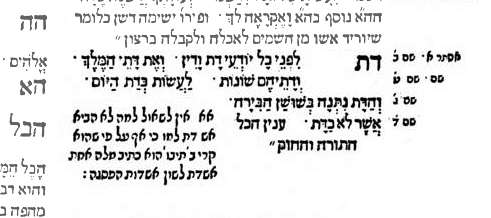
Here is the Radak, printed in the 2nd Rabbinic Bible. As you can see, he points out that although these verses are paralleled in 1 Chronicles 6:63-64, the Masorah omits it here:


Readers who are interested should know these verses are simply missing in the Aleppo Codex and other Masoretic sources. The 2nd Rabbinic Bible omits them as well. To this day, some Hebrew Bibles print them at the bottom, or in parentheses, but all follow the Masorah and maintain that they do not really belong here. By contrast, Christian Bibles generally print the verses. See the end of this post for a note in one such edition.[1] Getting back to Delgado, at the very end he writes that he wishes to print three more volumes, which will contain the entire Hebrew Bible. He claims it is already written, just waiting subscribers and the press. If so, then his observations on this verse might exist in manuscript somewhere. Just saying.

Now, his book isn't really a new translation per se. Instead, it lists the "Old Translation" in a parallel column with the "New Translation." The New gives a verse of phrase where he differs from the KJV, with the differences printed in italics. Below the two columns is a section called Observations, where he explains and justifies his proposed translation. For example, in the very first verse, he gives the Original as In the beginning God created the heaven and the earth. His New Translation is In the beginning God produced the heavens and the earth. We see two changes. The first is to render heaven in the plural, and the second is to change created to produced. His Observations is a little philological and a little philosophical. He explain that the word ברא signify the production of something which only has the appearance of being. As an example, he notes (claims) that evil is not an actual thing, but the absence of goodness, just as darkness is the absence of light. Yet Isaiah 45:7 expresses this negative existence in terms of ברא, or God's producing evil (and darkness). Since the heavens and earth were not created until the second day, it must mean that whatever it is that God did here, it was not created. Rather, he produced the heavens and earth. Delgado does not note that he changes heaven to heavens, but he is simply rendering the Hebrew shamayim into a plural in English, which is perhaps justifiable.

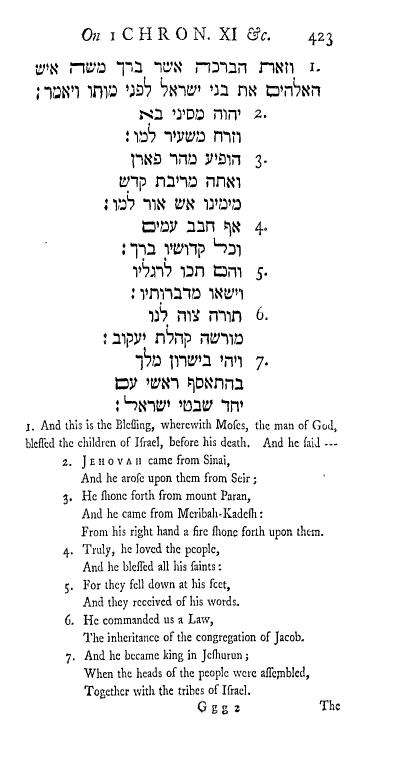
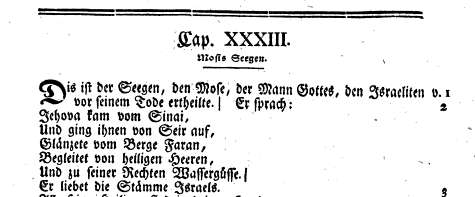
To me, a far more interesting example is found way at the end. Deuteronomy 33:2 in the Hebrew contains a big obscurity, namely אשדת למו, which the Masorah breaks into the words אש דת למו, or a "fiery law unto them." Were the keri not "esh das" then presumably the unpointed אשדת would be read "ashedos," which is a fine biblical Hebrew word, meaning slope, or perhaps waterfall (derived from אשדה). Indeed, many modern Bibles translate here according to the kesiv אשדת.

An additional problem is that דת is a word which only appears in the late biblical books, and appears to be Persian. Thus, the keri actually raises the question of how, if the Torah is the oldest books in the Bible, it contains a word which otherwise does not occur in the Torah, and doesn't even occur until the very last books.

In any case, before I get to Delgado, here is an appropriate moment to quote Rabbi Aryeh Kaplan in his The Living Torah (New York/ Jerusalem, 1979), who translated it as "From the holy myriads, He brought the fire of a religion to them from His right hand." His note indicates that he is translating according to Rashi and Ibn Ezra. He gives several other renderings: "Fire becomes law" (Hirsch), "a law of fire" (Ramban), or "a Torah of light" (Saadia). Artscroll, incidentally, translates "a fiery Torah," and speaks in its silence by not even gently calling attention to what Kaplan does forthrightly, namely the following:
"Some see eshdath as a single word, indicating a waterfall as in Numbers 21:15, above 3:17 (Eliahu Levitas [! sic]; cf. Ibn Janach who rejects this), and hence, "from His right hand a waterfall to them." He also offers three additional interpretations, the Targum, Septuagint and Abarbanel.
First of all, when I first read this it blew my mind. Not that Kaplan called Eliyahu Levita "Levitas," but that he claims that he - Rabbi Eliyahu Bachur - interpreted it as one word. That's amazing. Could there be a Jewish exegete (or, really, Hebraist) in the 16th century who openly maintained that the pshat in the word was according to the kesiv and not the keri? Furthermore, why didn't I already know it? You'd think this would be famous.

Now, I knew that Shadal takes the only liberty he allowed himself with the Torah, to occasionally interpret it against the Masorah, and he gives this precise explanation. He translates this word "pendice," or "slope." In his Hebrew commentary he explains that "from the right" refers to the slope of the mountain, which Moshe was standing upon right then - Nebo. He goes on to explain why it is from the right, namely because Sinai, Seir, and Paran are all to the south of Nebo, and the south is termed "yamin," or right, in biblical Hebrew. He explains that he rejects the explanation that Moshe was referring to Sinai, rather than Nebo, because then the verse would not have begun with "mi-sinai ba," but "al Sinai," so therefore the verse was not speaking of the Revelation at Sinai, and it certainly is not referring to God's right side. He then explains why he also cannot translate according to the keri: the word das is not Hebrew, or even Aramaic - it's Persian. Furthermore, in his view, the cantillation does not support the keri. Although he does not say it, he obviously feels that the keri is a kind of Midrashic explanation, and not really the Torah's intent. When you compound that with the problem that the presence of a Persian word has unattractive implications for the Mosaic authorship of this verse, he rightly - according to the situation in which he finds himself - translates and interprets according to the kesiv.

But this is a 19th century explanation. Did any Jew suggest it in the 16th? So, again, I was astonished to learn that Levita should interpret it the same way. After searching his books, in expected and unexpected places, and after inquiring of a very expert scholar, I concluded that Kaplan is mistaken. My guess is that he meant Shadal. I think he confused them because Shadal is closely identified with the famous position of Levita (Bachur) that the vowels and accents were written down very late, in fact after the compilation of the Talmud. But I digress.

==

2.17.2011 Important update regarding the above, please see end of post.

==

How does Delgado interpret this verse?


As you can see, he translates it as "a constant fire," on the authority of Ibn Ezra. Delgado notes that das does not mean law (or Torah) in Hebrew, although he errs - though understandably - in seeing it as having that meaning in Chaldee, or Aramaic. Ibn Ezra explained that das comes from omedes, that is, the fire is omedes tamid, or burning constantly. To be sure, Ibn Ezra initially interprets the words as referring to the Torah, which was given amidst fire and thunder.

I think what you see here is kind of a transitional type of interpretation. Traditionalist, but not entirely. Delgado knows that das as Torah is unlikely. Yet he will not interpret against the Masorah, so he latched onto an alternate explanation which is sort of traditional, yet does not require him to explain das as law. It should be noted that in the late 18th century there was a scholarly rebellion against explaining this according to the keri, a fiery law (the KJV originally read "a fierie Law.") For example, embodying both tendencies which Delgado opposed, Kennicott in 1753 had devoted several very interesting pages to the difficulty of this phrase, remarking that the verses are "remarkably unintelligible." He therefore suggests "the following Correction:"


As you can see, אשדת למו has disappeared, no more אשדת and no more אש דת. Instead we see אש אור, and he translates it as "a fire shone forth" (among other emendations). Kennicott also claims that the word das is Chaldee, and that frankly the phrase esh das really doesn't make much sense. He further notes that in verse 4. the word torah is used. In addition, neither the Septuagint nor the Peshitta translate it this way. He then gives parallel parts of Scripture where light is streaming from the hand of God. Finally, he builds his case with Samaritan text. First he notes that in some manuscripts the word is written דות, (this is of interest - he downplays it, but the point is that in the Samaritan texts the word is separated into אש דת, according to the keri of the Masoretic text). Secondly, he cites the Samaritan Targum which translates the phrase as מימינה נור אורה גון, which for his purposes is the same as he wants to translate it. How to tease the Hebrew אור out of נור אורה, which after all means fire and light, same as אש? In other words, how to show that this isn't only an interpetive translation, but can be shown to stem from an original uncorrupted Hebrew text? The key is דות, which he contends is not just an odd error, but a very special one. There is no way to explain that extra vav, except as follows: it is a remnant of the original, uncorrupted word which was אור. However, the first and third letters were corrupted. The tav is very similar to resh in the (Jewish!) Hebrew alphabet, which can plausibly explain the substitution of at least one of these letters. Thus, esh or lamo.

By the way, how should we understand these Samaritan manuscripts which write דות? In my opinion, very simply. The Samaritan text has no nekudos, and if das is a unique word in the Jewish Torah, at least it appears in other books in the Bible, meaning law. The Samaritans have no other books, thus they do not have the word das in their Bible, except for right here. How are Samaritans supposed to understand אש דת? Well, we have the Samaritan Targum mentioned by Kennicott. That's one way. Another way is אשדת, as one word (even though it is separated into two in their text, at least according to Kennicott and Blayney). Since they have no points, the insertion of a vav hints that it should be read ashdos, or אשדות. Thus, in my opinion, these variant Samaritan texts are interpreting themselves, to mean slope.

In a letter written early in 1773 to a like-minded contemporary, Moses Mendelssohn alluded to Kennicott with this very example, as typical of the decadence of biblical emendation in his time.
"Who is supposed to buy a rabbinic commentary in our clever age, when every student of Hebrew is permitted to change the text at will? If . . . [another example] seems incomprehensible, an English reviser is immediately at hand who reads [an emendation], and rabbinic skills are no longer needed. Is 'esh dat lamo difficult to explain? No problem. Read 'or instead of dat and everything is clear. I do not know where this audacity will end." (Translation by Alexander Altmann on pg. 286 of his Mendelssohn biography.)
Mendelssohn continues by saying that one must allow a fashion to run its course, for novelty is alluring. Eventually people will lose their taste for it, and then they may be led back to the path of sound reason. Here is his letter, from the 5th volume of his Gessamalte Schriften:


Not surprisingly, in his own version of the Bible, Mendelssohn translates esh das as Feuerslutreligion (פייארסגלוטרעליגאָן ; isn't German gorgeous?).

A contemporary and sometime correspondent of Mendelssohn, the Bible scholar Michaelis, translated as "Rechten Wassergüsse," or a waterfall to his right:


Incidentally, in my opinion Michaelis got carried away with the fact that the word ashedos could mean waterfall, but over here, does it? Which waterfall? It's beautiful poetry, but so is esh das, a fiery law.

Incidentally, the following is a very interesting treatment, written by Ignaz Goldziher and his teacher Heymann Steinthal. In the English translation of their work, "Mythology among the Hebrews and its historical development," we find the following:
"If the reading esh dath in the Blessing of Moses v. 2 is correct, the word dath points to a society accessible to Persian words; and the passage in Deut. XXXII. 39, where the doctrine of the resurrection of the dead is mentioned as a recognised article of faith, confirms this impression."
This book was written in refutation of bible critics, particularly Renan, who had denied the existence of Hebrew mythology. What do you mean we had no mythology? asked this work. I'll give you mythology! Secondly, although I am not sure this is intended, it perfectly illustrates the problem Shadal had with interpreting it as two separate words. Goldizher and Steinthal spell it out clearly. "If" the reading is correct then "the word dath points to a society accessible to Persian words." They do not say it, but if the reading is not correct, then it doesn't point to it at all. (Goldziher may not have really believed the Torah was written by Moshe, but he definitely knew how to observe Tisha B'av; see here.)
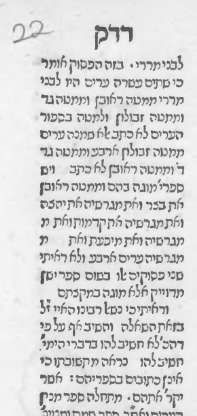
Finally, the 2009 paper jointly published by Richard Steiner and Sid Z. Leiman, The Lost Meaning of Deuteronomy 33:2 as Preserved in the Palestinian Targum of the Decalogue, must be mentioned. In this paper it is argued that esh dat (whether together or separate) is the correct original reading, but never meant a fiery law. This, rather, was the midrashic interpretation. The argument is that דת is a contraction of דאת, an archaic term meaning "flew." Thus the original peshat was "fire flew," and this had become forgotten when "דת was midrashically identified with the homonymous Aramaic loanword of Iranian origin meaning 'law.'
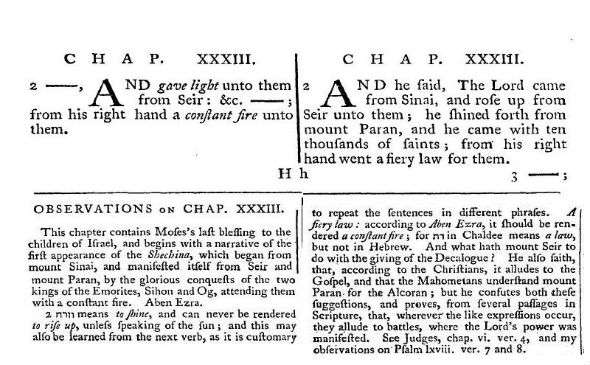
[1] The aforementioned note on Joshua 21:36-37, from the "Keil and Delitzsch Biblical Commentary on the Old Testament":
Note: R. Jacob ben Chajim has omitted Joshua 21:36 and Joshua 21:37 from his Rabbinical Bible of the year 1525 as spurious, upon the authority of Kimchi and the larger Masora; but upon insufficient grounds, as these verses are to be found in many good MSS and old editions of an earlier date than 1525, as well as in all the ancient versions, and could not possibly have been wanting from the very first, since the Merarites received twelve towns, which included the four that belonged to Reuben. In those MSS in which they are wanting, the omission was, no doubt, a copyist's error, occasioned by the homoioteleuton (see de Rossi variae lect. ad loc., and J. H. Michaelis' Note to his Hebrew Bible).

2.17.2011 Important update: Moshe Maimon informs me that I overlooked a very important source - Levita's notes to Kimchi's Shorashim! This is from the 1547 edition:


As you can see, he does indeed say - or rather imply - that the word is really "ashdos." This is his explanation for why the Radak (Kimchi) did not cite Deut. 33:2 as a source for the word das.

Thus, I was mistaken and Rabbi Aryeh Kaplan correctly points to him. It would seem then that R. Eliyahu Bachur understood that "esh das" is really Midrashic, and if he is right, so did the Radak - the other possibility simply being that the Radak would understandably only write words written in the Bible, and "esh das" is only read. Perhaps this is all he meant as well.

LinkWithin

Related Posts with Thumbnails
'