Showing posts sorted by date for query 1840. Sort by relevance Show all posts
Showing posts sorted by date for query 1840. Sort by relevance Show all posts
Monday, April 28, 2014
A Messianic prophecy for 1840-1, Pt. II
Here's an update to this post, about a 17th century Messianic prophecy for the year 1840-1, apparently predicting the French Revolution, some kind of Russian revolution, Jewish independence, and then the Messiah. This is a copy of the document discussed in that post, copied for some reason, by Isaac Leeser's. See here. Leeser must have had hopes for the year 5601.


Sunday, January 27, 2013
On an unusual attempt to sell the Hebrew poems of a living poet to Moses Mendelssohn's son, as the work of his father
The other day I did one of my "Who am I?" posts (link), and the answer, which no one guessed but my thanks to those who tried, was Moses Mendelssohn of Hamburg (or, Mendelson, as he actually spelled his name). Here was the complete picture in which he is captioned:

You can find this picture in the Jubilee volume of the Israelit commemorating the 100th anniversary of the birth of R. Samson Raphael Hirsch, here. Mendelson (1780-1861), who was really surnamed Frankfurt, was Hirsch's maternal uncle. The reason why he is holding a book with the title Columbus is because Mendelson's chief work was his translation of Campe's Die Entdeckung von Amerika into Hebrew, which was his מציאת הארץ החדשה, printed in Altona in 1807. The rest of Mendelson's output was mostly scatterings of poems and little articles in various journals. Notable exceptions included a short, anonymously published pamphlet, which contained a lengthy poem called בקשת הלמדין, featuring the letter lamed in each word, and what is supposed to be a Torah commentary called Schuschan-Eduth of which, I think, only one of two projected volumes appeared. I haven't seen this book, but the interesting introduction to this volume, as well as the aforementioned בקשת הלמדין, and basically most of his poems and essays, many of which are quite clever and fascinating, were collected and published after his death as פני תבל - מוסר השכל, which was printed in Amsterdam in 1872. (The Torah introduction from Schuschan Eduth is, for some reason, two essays on preachers - basically parodying and excoriating the new style praedigers (preachers) and the old style maggidim.)
His book about Columbus has many interesting things about it, naturally, so here are a couple. In his introduction he writes about meeting Wessely in his hometown of Hamburg the year before the latter died. The aged master, certainly seen as the expert Hebrew poet of the age, gave him advice in writing Hebrew. Do not, he told him, merely cobble together biblical verses. Although we should understand this ourselves, Mendelson explains that he in fact means the newfangled melitzah style, which consisted of little more than that, weaving together pre-existing phrases from the Bible into a confusing and imprecise text that was supposed to be meaningful and poetic.
The book also includes a neat little glossary in the beginning, for naturally in a work such as this using Hebrew in new ways would be required. Clearly desiring to write only in Hebrew, or as much as possible, Mendelson explains, for example, that when he writes Rifat he means England! - and gives his source for the identification of this biblical land with England as Ben Gorion. Similarly, he used Elul for August - which is not at all something unusual.You find this quite often; Adar is March and so on. However, his glossary is the only time where I saw someone who used the Hebrew months this way point out that he is well aware that the months are not a perfect match, but that most of the days overlap in the Hebrew and English months. He uses the term Dagim Me-ofafim for flying fish, Kumar Romi for pope - although there is a Hebrew word for pope, אפיפיור, this word is not pure Hebrew (See E. Ben Yehuda Milon v. 1 pg. 346). Mendelson used Mored Ha-har for waterfall (and he adds in parentheses that he knows that the rabbinic Hebrew term is Hardalit (sort of) but apparently chooses not to use it because its origin is Greek).
Finally, the book also comes with a - not quite haskama, but a rishyon, apparently some formal necessity for printing a Hebrew book in Altona at the time, by its rabbi, Zvi Hirsch Zamosc (d. 1807), who was the last rabbi of the united triple community Altona-Wandsbeck-Hamburg. Zamosc gives his license and says something like "Whomever wishes to read it, those people who are edified by reading stories like this, permission is granted." The rishyon is given to "the delightful bachelor, maskil, the honorable Moses, son of the wonderful rabbi Mendel F"F [Frankfurt]."
In any case, hopefully people are still reading because here is where the fun part begins. In 1841 Moses Mendelssohn's son Joseph placed advertisements in journals and newspapers all over Germany requesting the public's assistance on a project in which he was engaged, namely the printing of his father's collected writings. So he asked the public to please send him any manuscript they might have written by his father, and he will purchase them for a fair price, or to send and he ensures its safe return. Here is an example of such an ad:

One of the people who responded sent him some Hebrew poems by Moses Mendelson. Of Hamburg. And this person wanted to charge Joseph Mendelssohn for them and, as we shall see, he knew full well that they were written by the living poet - who was his friend, in fact - and not by the philosopher who had been dead for nearly 60 years. Joseph showed them to one of the editors who had been hired for the project, one Heymann Jolowicz, and he realized the deception. The story was originally reported in a Hamburg newspaper, but I cannot find this newspaper. So instead I will give you the version as it is was given in a "Hey, isn't this crazy!" kind of story in an American periodical called Bizarre, in 1855 (and this story was in fact copied from a French magazine from the same year, not the Hamburg newspaper).

As you can see, the story does not identify who made this deception; he is but "Dr. H..... of Berlin." The story makes a big deal about how Jolowicz (his last name cheerfully Americanized to "Jallowitz") was a great detective, and knew how rare poetic verse was in the Mendelssohn oeuvre. He discovered that Dr. H had actually published a Hebrew periodical 40 years earlier, and had included Hebrew poetry by Moses Mendelson of Hamburg, and these that were sent to Joseph Mendelssohn were unpublished poems by MM of Hamburg, that Dr. H tried to pass off as authentic. Actually, I am a little bewildered by how this deception was meant to happen for it seems that MM of Hamburg nearly always signed his work the same way, Moshe ben ha-torani ve-harabbni mohr"r Mendel F"F, or some variety. Not to mention that they were not in Moses Mendelssohn's handwriting. Were they supposed to be copies? Didn't Dr. H expect questions? While I guess Dr. H maybe thought he could fool Joseph Mendelssohn, it doesn't seem like it would have been a great feat for Jolowicz to detect the fraud and so of course he did.
But anyway, although Dr. H is not identified, we realize exactly who it is. But first, a portrait of Joseph Mendelssohn from 1830, aged 60:

Dr. H, who tried to sell poems under false pretenses, is none other than Dr. Jeremias Heinemann, a very interesting individual whom, I will have to guess, was in financial straits when he tried to sell the work of his living friend off as the original Hebrew poems of Moses Mendelssohn himself. Heinemann was an educator and scholar, a publisher, a bible commentator, involved in the earliest stages of Reform as a member of the Westphalian consistory, moved away from that early position to the point that even Rabbi Akiva Eger was willing to give a haskama of sorts to his edition of Mendelssohn's Pentateuch, see below, and someone who had spent a good deal of his life involved with Mendelssohn's writings - both Mendelssohns, in fact. Here is a portrait of Heinemann's father, a rabbi named Rabbi Meinster (or Joachim) Heinemann (1747-1825). And yes, I give this because I don't have one of Dr. Heinemann himself:

Here is Rabbi Akiva Eger's haskamah - or really not-quite haskamah - to one of the volumes of Heinemann's chumash, called Mekor Hachajim, published in Berlin between 1830 and 1833 Although we will acknowledge that he is not exactly turning cartwheels with enthusiasm, reportedly Rabbi Akiva Eger did order a copy, as he listed in the subscribers. However, one might also grant that it is possible that Heinemann simply sent him a copy. I often wonder if the big league rabbis actually ordered the copies they are listed as having subscribed to or if, at least in some cases, they are listed because a copy was simply sent to them. You know, it's like how a musician struggles for years then makes it big and suddenly Gibson is sending them truckloads of free gear. In any case, it is certainly a nice letter and it is much more than a sentence or two. No wonder Heinemann printed it.

In any case, so here's what happened. In the late 1810s Heinemann had a periodical called Jedidja. It was not a Hebrew journal, as Bizarre says; it was in German. However, it did have quite a nice amount of Hebrew material, poems and so on. It notably contains a little poetic translation by none other than Leopold Zunz, a very early literary production by him. Here it is:

So this poem, Halayla (the night), is a translation of Sommernacht (Summer Night) by Klopstock. Compare the above with an English translation of Sommernacht:


So Jedidja. Many interesting things, including work by Moses Mendelson of Hamburg. I will show the following, though, because I love finding English in non-English works. So here we have the following. What happened was, in 1815 the Duke of Sussex became a Patron of the Jews' Hospital and Orphan Asylum in London (link), which had the Hebrew title נוה הצדק. Sussex, a son of King George III, was a real ohev yisrael, which was not necessarily common in England at the time without a missionary motive, and a collector of Hebrew books. In 1817 at the annual meeting of Jews' Hospital, Sussex came, apparently, and to celebrate this momentous occasion - poetry! And pageantry. A Hebrew poem was composed, and perhaps read, along with an English poem to be "recited by One of the Girls of the Institution." Another poem was written by Shalom Hakohen, one of the patron saints of the Haskalah (last editor of Hameasseph, later to publish Bikkurei Haittim, and several noted works of his own) who was living in London at the time (on him, and the London Chief Rabbi's haskamah to his book for children, see here). So the next year in Berlin Heinemann printed the poems for this occasion, including the English ode to be recited by a girl. Try to imagine a little Jewish orphan girl with her London accent of whatever manner it was, in 1817, reciting,
"Behold, we cry, our smiles of health,
Our moral minds, our means of trade;
Here have ye treasured up your wealth,
And thus your offerings are repaid."

I should have given this above, but here is the title page for Jedidja:

Now, in addition to publishing many letters by Mendelssohn (the first one) it also included a poem or two by Mendelson of Hamburg. Here is the end of one:

Now, some 20 years later Heinemann revived the Jedidja periodical in Berlin. In the second go-around he included much interesting material, some recycled, some new. Apparently he was strapped for cash, or at least had a lot of copies of his Chumash Mekor Hachajim he was trying to sell, because he kept including ads for it, and descriptions of it. It is of some interest that he felt like pointing out that it included a map of Israel, following the Vilna Gaon:

In any case, only a few years earlier (1833) the following appeared in one of the volumes of the Chumash Mekor Chajim; a friendly letter from Moses Mendelson of Hamburg. That is, they were firm friends.


So it was that Dr. Jeremias Heinemann in Berlin allegedly tried to sell Joseph Mendelssohn Hebrew poems written by his friend Moses Mendelson of Hamburg, and this deception was discovered by Heymann Jolowicz whom, I might add, was one of the Reform rabbis in the synod I posted about the other day (link). His grand contribution to the Simchat Torah question was: "We should read Vezot Habracha once every three years."
It should be noted that when the Collected Writings of Mendelssohn were published a couple of years later, the volume which included the entire German translation of the Pentateuch (in German, not Hebrew letters) came with an extensive introduction by Jolowicz, and he mentions Heinemann's Berlin edition of the Chumash in very nice terms, but does not mention this attempted fraud. Truth be told I feel a little badly about it myself, seeing as how even Jolowicz saw fit not to mention it. But as I said, I strongly suspect that Heinemann was motivated by economic desperation and should not be judged harshly.
Since previously I had mentioned Jolowicz's prize comment that "We should read Vezot Habracha once every three years," and he was a better scholar than that suggests, we should talk about him. Eventually he moved to England, where his credentials as a learned scholar enabled him to receive a government stipend (interestingly, the materials relating to this process are online - it involved testimonials, a sponsor, personal statements, and a list of his published work). I would just like to call attention to a paper he delivered for the German Oriental Society in England in 1855. Here is the title page of the published version:

In the introduction, W. H. Black recommends the paper, writing that that "For many years I have been convinced that the printed text of some parts of the Hebrew Scriptures may be fairly subject to critical emendation, especially the Psalms, and other poetical portions of the Bible." He continues, that Jolowicz presents the evidence for the position that the Bible contains errors in need of emendation from rabbinic sources.
In the paper itself, Jolowicz refers to the different Versions, and the variants found in the collations of Kennicott and De Rossi, which prove that the text as found in the manuscripts have been subject to corruption. But also "the Talmudists, and the latter Rabbis, as well as the Chaldee parphrast [sic] Jonathan ben Uziel, not only knew various readings most strikingly different from our Canonical Text, but also determined by the interpretations of the same most important usages of religious life." He begins by declaring that the Talmud gives as authors of the books mostly different people from those for whom the books are named. The reason he mentions this is to set the stage for the idea that certain words had to have been interpolated by later copyists, such as Proverbs 25:1 ("King of Judah") words which, as he points out, are missing in some manuscript variants found by Kennicott. He continues by asserting that many "among the most orthodox and greatest authorities of post-Talmudical rabbis . . . did not less practice a strict criticism of the Biblical Text." And conveniently he writes "But this subject will be more conveniently treated of in another place." He goes on to list several dozen variants implied by the Targum called Jonathan, and in the Talmud, Midrash and Zohar, and a few instances in Rashi. He closes with a much-cited passage in Massechet Sopherim, which shows that there were variant readings in the Torah. He closes by quoting a letter from Leib Dukes which notes that one of the Oppenheim manuscripts at Oxford actually contains a masoretic note which gives an interesting variant for Number 12:16, saying that this variant is a more correct reading. Jolowicz notes that one such text corrected according to this manuscript was listed by Kennicott. The paper may be read here.
EDIT: To give Heinemann more his due as an interesting and creative person, I'd to call attention to the second half of my post here, where I refer to an interesting book by him which "I have never seen anything quite like," I wrote, and that "on the face of it it seems like one of the most effective methods of learning what the prayers mean that I have ever seen." Do take a look.
EDIT II: Another angle. Here is fascinating poem by Moses Mendelson of Hamburg, in tribute to Johannes Gutenberg on the occasion of the 400th anniversary of Gutenberg's use of moveable type printing. This was printed in the Algeimeine Zeitung des Judentums May 2, 1840. Click them to enlarge and read:


What makes this all the more interesting is that Heinemann printed the same poem in his revived Jedidja in 1842. And there is no mention of Mendelson's authorship, not on the poem and not in the table of contents. Here is the first page from that reprinting.

Friday, July 06, 2012
Shadal series #13 - on Sambatyon, then under English dominion (probably)
Here's a sarcastic and amusing excerpt from a letter which Shadal sent to Yehash[1] dated January 14, 1840.[2]


A. Asher writes in his 1840 edition that Gerrans "understood very little if any thing of hebrew, and that all his learning was derived from B. Arias Montanus, L'Emperuer and Barratier." He even claimed not to have seen Baratier's edition before printing the first chapter of his own! On Baratier, a Christian child prodigy/ iluy, see here and here. Remember, Baratier was 12 years old when his scholarly, annotated translation of Masaaos Rabbi Binyamin appeared.
Anyway, after showing how Gerrans ripped off Baratier rather liberally, he gives an example of his poor Hebrew scholarship:
[1] Yehoshua Heschel [Osias] Schorr
[2] Iggerot Shadal V. I. pp. 656 - 59.
[3] This seems to be referring to A. Asher's edition of the Itinerary of Benjamin of Tudela (London 1840). The second volume contains dozens of notes by Shir, which were obviously translated into English by Asher, who thanks him for his correspondence in the first volume. In the second volume, pg. vi, he writes that
[4] This is probably a reference to Ibn Ezra's comment that he was imprisoned in India and he and the other prisoners were fed something similar to matzah, thus Shadal means "obscure Ibn Ezra manuscripts written by him while imprisoned in India." My thanks to Dan Klein who pointed this out to me.
"I heard about, but did not understand the reason, for translating into English Rapoport's essay on the Ten Tribes.[3] Perhaps they sent a communique from across the Sambatyon River, which is undoubtedly under British dominion. Then "from beyond the rivers of Ethiopia shall they bring My suppliants, even the daughter of My dispersed" (Zeph. 3:10), a great offering to the wonderful Ga'on [i.e., Shir], and request that he come with them and become their chief. When this news reaches you, my friend, write me! Then I will immediately send you a wonderful poem which I will compose in his honor. The Sambatyonites will hear it and rejoice. My heart swells with the great joy which I will feel when the Gaon goes to the Land of the Ten Tribes and he will find countless precious books; manuscripts written by Ibn Ezra while he was eating matzah,[4] which reached the custodianship of the men of Ethiopia. But woe is me! What have I seen? A god is rising from the earth! An old man arises, and he dons a cloak - without a doubt it's Rabbenu Saadiah - with the Ten Tribes at hand, and he is shooting arrows through Ibn Ezra and Rapoport's heart (2 Sam. 28:14), since I brought them ill repute, saying that the mathematics of our ancestors were inexact. But the opposite is the case! It is a law from Moses on Sinai."Whoa. What gives? This letter is from Shadal's Angry Period. As you can see, he is mocking the idea that an essay of Shir might be translated to English, that is, the importance of this essay and of Shir's antiquarian research altogether. Shadal and Shir, BFFs, had a major falling out. It is nice to see how as soon as he gets mad at him, the man becomes worthless. Mind you, the essay he refers to was published in Bikure Haitim in the 1820s. It was those essays which impressed Shadal in the first place and caused him to make contact with him. So, the man was touchy, but his hurt certainly manifested itself in a clever way.
Interestingly, 1838 a book appeared in Ofen called Haroeh. This was a journal published by a group of four young friends, disciples of Nachman Krochmal, who decided to take on the elder maskilim and expose flaws in their scholarship. In the second volume (link), dedicated to attacking both Shadal and Shir, the latter is actually taken to task for casting aspersions on the truth of the legend of Sambatyon (pg. 62): במאמרו על דבר היהודים החפשים העיר בהערתו ספקות רבות ע"ד נהר
סמבטיון והחליט שאין אמת בהספור ממנו ע"ש והנה מלבד שהדברים האלה לא לו המה. "In his essay on the Free Arabian Jews in the footnotes he raises many doubts about the river Sambation and concludes that it is not true." The author of this piece, Nachman Yitzchak Fishman, goes on to note that Eisenmenger brings many of these things - implying that Rapoport plagiarized from this notorious antisemite - and and in any case it is inappropriate for a Jewish scholar to cast doubt upon this matter openly before all the Jewish public, for much evil can come from this if it were revealed to the Jewish masses!
Note that in the 19th century (and the 20th; future post) there were Jews who were very much involved and invested in the Sambatyon idea.
Speaking of Sambatyon, here is an interesting footnote concerning the name of this river from an 1783 English edition of The Travels of Rabbi Benjamin of Tudela.
A. Asher writes in his 1840 edition that Gerrans "understood very little if any thing of hebrew, and that all his learning was derived from B. Arias Montanus, L'Emperuer and Barratier." He even claimed not to have seen Baratier's edition before printing the first chapter of his own! On Baratier, a Christian child prodigy/ iluy, see here and here. Remember, Baratier was 12 years old when his scholarly, annotated translation of Masaaos Rabbi Binyamin appeared.
Anyway, after showing how Gerrans ripped off Baratier rather liberally, he gives an example of his poor Hebrew scholarship:
When in Lunel, Rabbi Benjamin writes in his Masaaos, about people he met: והוא חכם הגדול בתלמוד והרב רבי משה גיסו ורבי שמואל החזן ורבי שלמה הכהן. Gerrans translates this as "This man is well skilled in the Talmudic writings. Here you likewise meet with that great R. Moses Gisso and R. Samuel (Hhasan) R. Salomon the Priest." גיסו of course means "his brother-in-law". Then in the footnote Gerrans gives a whole speech about how this רבי שלמה הכהן was Rashi, but "This is one of Benjamins Errors in Chronology, for רשי was dead long before." Asher says there are almost as many errors as words in the passage, and that Gerrans 'explains' in the footnote that חזן means "sometimes a reader and sometimes an executioner." He then lists 5 separate mistakes Gerrans made about Rashi, and what arrogance he has to attribute his own error to Rabbi Benjamin himself! And of course this one line is a but a sampler of the whole book.
Much more to say about searches for Sambatyon. For starters, see Mevaseret Tziyon, published by Eliakim Carmoly in 1841. Read, e.g., the letter that "messengers of the scholars of the Ashkenazim in Eretz Yisrael sent to the Bene Moshe and the Ten Tribes." It is dated Rosh Chodesh Marcheshvan 5691/ 1831 and signed by R. Yisrael of Shklov, author of Pe'as Ha-shulchan, among others (link).
_______________________________________________[1] Yehoshua Heschel [Osias] Schorr
[2] Iggerot Shadal V. I. pp. 656 - 59.
[3] This seems to be referring to A. Asher's edition of the Itinerary of Benjamin of Tudela (London 1840). The second volume contains dozens of notes by Shir, which were obviously translated into English by Asher, who thanks him for his correspondence in the first volume. In the second volume, pg. vi, he writes that
"The next volume of notes will contain the papers by the Revd. Rabbi Rapaport, Mr. S. Munk and Mr. Lebrecht, which from circumstances over which I had no control, it was impossible to introduce into the present volume, although I allude to them."Unfortunately there never was a third volume! However, the essay which he had translated was על דבר יהודים חפשים הנמצאים בארץ ערב ("On the Tribes of Free Jews in Arabia") which appeared in Bikkure Haittim 4 (Vienna 5584/ 1823).
[4] This is probably a reference to Ibn Ezra's comment that he was imprisoned in India and he and the other prisoners were fed something similar to matzah, thus Shadal means "obscure Ibn Ezra manuscripts written by him while imprisoned in India." My thanks to Dan Klein who pointed this out to me.
Wednesday, February 22, 2012
Why did Seligmann Baer prepare an edition of the Bible with Franz Delitzsch?
Many thanks to my friend Reuven Brauner who enriched my life by sending over these amazing photos.
Seligmann Baer is a name well-known to Jewish liturgy and masorah buffs (and even many of those who do not know him do not know that they know him, since they still know his siddur Seder Avodat Yisrael). Reuven informed me that not only is he well-known and respected in his hometown of Biebrich, and his birth house marked with a plaque, but his portrait is painted on the wall of a local beer-hall. Part of a series of locals who did well, I guess.


Now that we have seen such an oddity (a very cool one at that) I thought it might be interesting to discuss something unusual about Baer. His edition of Tanakh was produced in collaboration with Franz Delitzsch, each volume including an extensive Latin preface by that great scholar. Baer was a pious Orthodox Jew, and Delitzsch was a pious Christian - but one involved in missionary activity. Here is the title page and the first page of the preface of one volume:


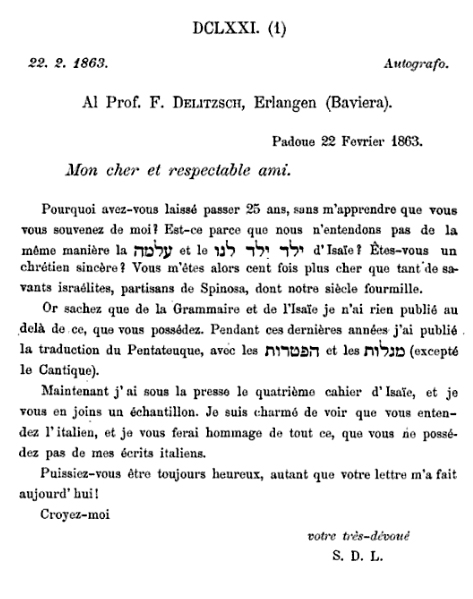
Before I get to that, here is something which I've been waiting for years for the right moment to post. In Delitzsch's Commentary to Isaiah he refers, in an appendix, to Shadal, who had sent him a copy of his own perush to a part of Isaiah. Since Shadal had recently died, Delitzsch took the opportunity of recalling the assistance he was given from him as early as 1836. Nearly twenty five years had elapsed between that period and when Delitzsch wrote him again, and when he did Shadal replied and asked him why he hadn't written for so long? He then asked "Is it because we form different opinions of the עלמה and the ילד ילד לנו of Isaiah?" Shadal continues that if he is a sincere Christian than he is 100 times more dear to him than a Jewish Spinozist.
One can find this letter in Epistolario, Shadal's collected letters in European languages, which was published in 1890. We see that Delitzsch really liked those words.

And here is the part from that letter in Epistolario:
This in turn reminded me of another letter from Shadal. This is an excerpt from an 1856 letter to Heinrich Graetz:

Evidently Graetz had suggested to him that it would be a good idea to print his commentary to Isaiah in square Hebrew letters, rather than the Rashi script which he used. He says:
I have my speculative reasons, but I also found out what Delitzsch's perspective was. I do not think they contradict one another. So first, here is my contextual speculation. My tentative thought is that Jews act differently when in a position of political power than in a position without such power. In the 19th century in Europe there were philosemites, as well as antisemites. But almost to a man the philosemitic gentiles had a missionary motivation. These were men who weren't merely political liberals, but Hebrew scholars, and scholars of rabbinic texts. It was they who argued against the blood libel, who defended the Talmud from calumny (an example of such a man is Hermann Strack). These scholars came in different flavors, of course. Some were men like Alexander McCaul, who on the one hand wrote a scathing critique of rabbinic Judaism ("Nesivot Olam/ The Old Paths") which was circulated among Jews in Hebrew, Yiddish, German and English. But the same man forthrightly and loudly defended the Jews during the period of the Damascus Blood Libel. On the other hand there were men like Strack and, especially, Delitzsch, who did not criticize Judaism as such, even though they were missionaries. They also endowed Jews and Judaism with grandeur and dignity. There is, for example, a book in which Delitzsch write enraptured about the Hebrew attitude toward color, and he writes without irony about - of all things - the descriptive colors of different kinds of female discharges mentioned in rabbinic literature. See this post.
This is an attitude toward rabbinic Judaism that is quite different from the antisemites, and even philosemitic missionaries like McCaul. In addition, Delitzch's aforementioned first book was on Hebrew poetry, including modern (i.e. up to 1836) poetry, where he also wrote with much praise and sentiment about the Jews and their talents, and how they eclipsed the scholarly non-Jews in knowledge of Hebrew and the Bible. He also would regularly and respectfully quote his contemporary Malbim in his own commentaries (obviously from a later period), not only earlier Jewish scholars like Radak and Rashi, who were familiar to Christian Hebraists. Also see this post.
In short, he was a special man. In addition, I will say that as far as I can tell Franz Delitzsch was not a sneaky or a deceptive man, nor did he prey on the ignorant Jew. Perhaps this, or some combination of all this, was key. You also see relations and collaboration with missionaries - of a far less respectful and sincere kind - among the leaders of the Perushim in Jerusalem in the early part of the century (before 1840). I've posted about that several times. I would say also that if Jews have more principled policies toward Christian missionaries now, it is with knowing more in hindsight and also that Jews have more friends who are not trying to convert us. In addition, in a manner of speaking Jews simply are less in need of friends today. A paradox - we have more friends and we also don't need every one as much as we did 150 years ago. I'm sure some will dispute this.
I also have in mind a story about the Netziv. It is related in Mekor Baruch that some Jews wanted to give some kind of honor to Daniel Chwolson. Chwolson was the head librarian in the Judaica section of the St. Petersburg library, and a proven friend of the Jews, defender against slander, blood libel, etc. He also happened to be an apostate. It is claimed that he once was asked if he converted out of conviction, and he responded "Yes, out of the conviction that it's better to be chief librarian in Petersburg than a melamed in Shklov" (or some place like that). Whether he was a sincere convert or not I don't know, but it is not impossible that this story arose to explain how come he was such a "good" apostate.
Be that as it may, unlike many other meshumadim, he really was a friend of the Jews. When people wanted to honor him, the Netziv was asked his opinion and replied with a parable. A girl was ill and the physician said the only remedy is for her to eat pork. The girl was reluctant, to say the least. Finally she agreed on condition that even though it is pig, it should be shechted and salted according to all the dinim of shechita. Since they knew it was the only way for her to eat it, they complied. Lo and behold the shochet, while doing the bedika, noticed a she'ela. He brought it to the rav who looked at it and concluded that the particular issue was fine, however, he said "I can't bring myself to say the word "kasher!"
I think that he point of the story is not only that the Netziv was *against* showing honor to Chwolson. The point is that others thought they should show him honor! I don't know who, but I think we can all agree that today few if any Jews would think of showing honor to a famous meshumad!
Thus far my speculation, although it should be pointed out that Baer was not the only non-Christian Jew to assist missionary scholars with Bible work.
In any case, we have an account by Delitzsch about how he came to know and work with Baer. It was printed in the Zeitschrift für die gesammte lutherische Theologie und Kirche, edited by Delitzsch, in 1863.
What he says is that in 1852 Baer's Hebrew work Torat Emet on the cantillation appeared. It included a learned letter from Shadal and a preface from I.M. Jost, who spoke exceedingly highly of Baer's devotion and expertise, and that this small work was only a sample of his much greater research and capabilities. The letter aroused Delitzsch's curiosity, and he sought out Baer. He found that he was indeed a very meritorious scholar, laboring in obscurity, working as a teacher of children, and without a lot of financial remuneration (which makes sense, since it would also explain Baer's foray in publishing popular history books). For twenty years Baer had been accumulating an important library, which cost him the little money he had., and which bought him nothing in return. Delitzsch also found him to be of good character, working lishma as it were, sacrificing himself for a labor of love, to work on God's Word, the Old Testament. They had many fruitful scholarly discussions, and he discovered that this man, Baer, possessed more knowledge in grammar and masorah than any scholar, Jewish or Christian. Since he liked to promote scholars that's just what he did. A student of Delitszch also added, in a memorial to him after he died, that Delitzsch even secured a doctorate for him. Thus, if he is called Dr. Baer (as he often is) it is because of Delitzsch.


Although I am sure that some would read all this and boil it down to "he did it for money" - and how much money could he have even made? - I think it's not quite as simple as that.
Seligmann Baer is a name well-known to Jewish liturgy and masorah buffs (and even many of those who do not know him do not know that they know him, since they still know his siddur Seder Avodat Yisrael). Reuven informed me that not only is he well-known and respected in his hometown of Biebrich, and his birth house marked with a plaque, but his portrait is painted on the wall of a local beer-hall. Part of a series of locals who did well, I guess.


Now that we have seen such an oddity (a very cool one at that) I thought it might be interesting to discuss something unusual about Baer. His edition of Tanakh was produced in collaboration with Franz Delitzsch, each volume including an extensive Latin preface by that great scholar. Baer was a pious Orthodox Jew, and Delitzsch was a pious Christian - but one involved in missionary activity. Here is the title page and the first page of the preface of one volume:
Before I get to that, here is something which I've been waiting for years for the right moment to post. In Delitzsch's Commentary to Isaiah he refers, in an appendix, to Shadal, who had sent him a copy of his own perush to a part of Isaiah. Since Shadal had recently died, Delitzsch took the opportunity of recalling the assistance he was given from him as early as 1836. Nearly twenty five years had elapsed between that period and when Delitzsch wrote him again, and when he did Shadal replied and asked him why he hadn't written for so long? He then asked "Is it because we form different opinions of the עלמה and the ילד ילד לנו of Isaiah?" Shadal continues that if he is a sincere Christian than he is 100 times more dear to him than a Jewish Spinozist.
One can find this letter in Epistolario, Shadal's collected letters in European languages, which was published in 1890. We see that Delitzsch really liked those words.
And here is the part from that letter in Epistolario:
This in turn reminded me of another letter from Shadal. This is an excerpt from an 1856 letter to Heinrich Graetz:
Evidently Graetz had suggested to him that it would be a good idea to print his commentary to Isaiah in square Hebrew letters, rather than the Rashi script which he used. He says:
"You mentioned that I ought to print my commentary in square script, for the ease of the non-Jewish scholars. Is it for the non-Jews that I explicate Isaiah? Goodness, no! My intention is not to distance a man from the faith of his fathers. If a Christian believes that "Behold an alma shall be pregnant" was said about Mary, I do not seek to challenge him. And if the Rationalists say, etc., I also do not mean to debate them. I know there is no fix for them. My only intention is to benefit my people, the ketanim if not the gedolim, in order to accustom them to taste of the sweet honey that are the words of the Prophets, and not to resort to false prophets and the commentaries of unbelievers.Back to Baer. Why did he collaborate with Delitzsch? To put it another way, today a Jew who is not Messianic would not produce a Bible with a Christian actively engaged in missionary activity.
Bless you and yours, Padua, 18 Shevat 5516, 1:00 AM.
Your Friend and Servant,
Shadal
I have my speculative reasons, but I also found out what Delitzsch's perspective was. I do not think they contradict one another. So first, here is my contextual speculation. My tentative thought is that Jews act differently when in a position of political power than in a position without such power. In the 19th century in Europe there were philosemites, as well as antisemites. But almost to a man the philosemitic gentiles had a missionary motivation. These were men who weren't merely political liberals, but Hebrew scholars, and scholars of rabbinic texts. It was they who argued against the blood libel, who defended the Talmud from calumny (an example of such a man is Hermann Strack). These scholars came in different flavors, of course. Some were men like Alexander McCaul, who on the one hand wrote a scathing critique of rabbinic Judaism ("Nesivot Olam/ The Old Paths") which was circulated among Jews in Hebrew, Yiddish, German and English. But the same man forthrightly and loudly defended the Jews during the period of the Damascus Blood Libel. On the other hand there were men like Strack and, especially, Delitzsch, who did not criticize Judaism as such, even though they were missionaries. They also endowed Jews and Judaism with grandeur and dignity. There is, for example, a book in which Delitzsch write enraptured about the Hebrew attitude toward color, and he writes without irony about - of all things - the descriptive colors of different kinds of female discharges mentioned in rabbinic literature. See this post.
This is an attitude toward rabbinic Judaism that is quite different from the antisemites, and even philosemitic missionaries like McCaul. In addition, Delitzch's aforementioned first book was on Hebrew poetry, including modern (i.e. up to 1836) poetry, where he also wrote with much praise and sentiment about the Jews and their talents, and how they eclipsed the scholarly non-Jews in knowledge of Hebrew and the Bible. He also would regularly and respectfully quote his contemporary Malbim in his own commentaries (obviously from a later period), not only earlier Jewish scholars like Radak and Rashi, who were familiar to Christian Hebraists. Also see this post.
In short, he was a special man. In addition, I will say that as far as I can tell Franz Delitzsch was not a sneaky or a deceptive man, nor did he prey on the ignorant Jew. Perhaps this, or some combination of all this, was key. You also see relations and collaboration with missionaries - of a far less respectful and sincere kind - among the leaders of the Perushim in Jerusalem in the early part of the century (before 1840). I've posted about that several times. I would say also that if Jews have more principled policies toward Christian missionaries now, it is with knowing more in hindsight and also that Jews have more friends who are not trying to convert us. In addition, in a manner of speaking Jews simply are less in need of friends today. A paradox - we have more friends and we also don't need every one as much as we did 150 years ago. I'm sure some will dispute this.
I also have in mind a story about the Netziv. It is related in Mekor Baruch that some Jews wanted to give some kind of honor to Daniel Chwolson. Chwolson was the head librarian in the Judaica section of the St. Petersburg library, and a proven friend of the Jews, defender against slander, blood libel, etc. He also happened to be an apostate. It is claimed that he once was asked if he converted out of conviction, and he responded "Yes, out of the conviction that it's better to be chief librarian in Petersburg than a melamed in Shklov" (or some place like that). Whether he was a sincere convert or not I don't know, but it is not impossible that this story arose to explain how come he was such a "good" apostate.
Be that as it may, unlike many other meshumadim, he really was a friend of the Jews. When people wanted to honor him, the Netziv was asked his opinion and replied with a parable. A girl was ill and the physician said the only remedy is for her to eat pork. The girl was reluctant, to say the least. Finally she agreed on condition that even though it is pig, it should be shechted and salted according to all the dinim of shechita. Since they knew it was the only way for her to eat it, they complied. Lo and behold the shochet, while doing the bedika, noticed a she'ela. He brought it to the rav who looked at it and concluded that the particular issue was fine, however, he said "I can't bring myself to say the word "kasher!"
I think that he point of the story is not only that the Netziv was *against* showing honor to Chwolson. The point is that others thought they should show him honor! I don't know who, but I think we can all agree that today few if any Jews would think of showing honor to a famous meshumad!
Thus far my speculation, although it should be pointed out that Baer was not the only non-Christian Jew to assist missionary scholars with Bible work.
In any case, we have an account by Delitzsch about how he came to know and work with Baer. It was printed in the Zeitschrift für die gesammte lutherische Theologie und Kirche, edited by Delitzsch, in 1863.
What he says is that in 1852 Baer's Hebrew work Torat Emet on the cantillation appeared. It included a learned letter from Shadal and a preface from I.M. Jost, who spoke exceedingly highly of Baer's devotion and expertise, and that this small work was only a sample of his much greater research and capabilities. The letter aroused Delitzsch's curiosity, and he sought out Baer. He found that he was indeed a very meritorious scholar, laboring in obscurity, working as a teacher of children, and without a lot of financial remuneration (which makes sense, since it would also explain Baer's foray in publishing popular history books). For twenty years Baer had been accumulating an important library, which cost him the little money he had., and which bought him nothing in return. Delitzsch also found him to be of good character, working lishma as it were, sacrificing himself for a labor of love, to work on God's Word, the Old Testament. They had many fruitful scholarly discussions, and he discovered that this man, Baer, possessed more knowledge in grammar and masorah than any scholar, Jewish or Christian. Since he liked to promote scholars that's just what he did. A student of Delitszch also added, in a memorial to him after he died, that Delitzsch even secured a doctorate for him. Thus, if he is called Dr. Baer (as he often is) it is because of Delitzsch.
Although I am sure that some would read all this and boil it down to "he did it for money" - and how much money could he have even made? - I think it's not quite as simple as that.
Tuesday, December 06, 2011
Shadal series #7 - on alienation from his teachers, and a public retraction.
Shadal was largely an autodidact, but he had four primary teachers. One was his father, with whom he studied Torah from the time he was 3 years old. Another was his adult cousin, with whom he studied daily for two and a half years beginning from the time he was 16. In between he also had some formal schooling in the persons of Rabbi Mordechai Yitzhak Cologna[1] and Rabbi Abram Halevi.
Cologna taught in the local Talmud Torah school, and from him he learned Mishnah, Dikduk, Rashi, Radak, and Latin. As I've mentioned before, he wrote at least three separate autobiographies. In the first one, written in Hebrew in 1837, he says that he felt the following about Cologna: את המלמד הזה היה ש"ד ירא יראת הרוממות גדולה מאד, והיה עושה אזנו כאפרכסת לכל דבריו ולכל שיחה קלה שהיה מדבר עם מי שהיה, והיה האיש ההוא בעיניו לאות ומופת and Shadal credits him with arousing within him a love and appreciation for Hebrew grammar and other good qualities ממנו באה לש"ד אהבת חכמת הדקדוק ואהבת הדיוק בכל פעולותיו ובכל עניניו, וגבורה למשול ברוחו ולכבוש את יצרו ולמאוס בתענוגים; והתכונה הזאת היתה לו לישועה גדולה ולפורקן בימי בחורותיו. Not surprisingly, if someone is viewed with such awe they can fall far from the lofty view, especially if the person is very sensitive, as we shall see.
Shadal stopped attending the school due to an illness at age 13. While in school, he had been studying Talmud with Rabbi Avraham Eleazar Halevi, the Chief Rabbi of Trieste. After recovering from this illness, he continued studying him for several years, until an incident occurred which caused him to stop coming to him.
He writes that sometimes his fellow students misbehaved and would horse around, and at times he would also join in. For example, he writes, sometimes he would say something very pretentious and intellectual sounding and give his friends cause to laugh. The rabbi would rebuke the students when this occurred. One time he mistakenly chastised Shadal, saying "Se non avete a venire che per fare il לייצן (buffone) potete fare a meno di venire," "If you came here to play the fool, don't bother coming." Evidently this was more than this sensitive boy could take, so he stopped coming.
In the meantime, he had been visiting Cologna, who had become blind in his advanced age. He would read to him and assist him in other ways, such as taking dictation. After he had stopped going to his Gemara shiur, naturally he still continued to visit Cologna. He writes that unfortunately coming into close contact with this teacher, whom he venerated as a child, caused him to diminish his opinion of him. One or two months after the incident with the rabbi, when it happened to be Shadal's 16th birthday, Rabbi Avraham had returned home from his summer vacation, and Cologna asked Shadal to send him his greetings. This he was unwilling to do, as he had stopped coming to his class! He says that he lacked the courage to either send the greeting or confess to Cologna the reason why he would not go. Finally, in disgust, Cologna instructed him to accompany him to the rabbi himself, and all the while he lectured him in the finer points of Derech Eretz, how it precedes Torah, etc. Shadal said he became more and more embarrassed and apprehensive, but he had no choice but to go along with him.
Lucky for him, the rabbi was out. His widowed daughter answered the door, and Cologna conveyed a very poetic greeting, quoting the Talmud Taanit 5a "Tree, O Tree, with what shall I bless thee? Shall I say to thee, ‘May thy fruits be sweet’? They are sweet already; that thy shade be pleasant? It is already pleasant; that a stream of water may flow beneath thee? Lo, a stream of water flows already beneath thee; therefore [I say], ‘May it be [God's] will that all the shoots taken from thee be like unto thee’. So also with you . . ." He added, to the daughter, who was simple and unlearned, that he knows that she understood what he had said in Hebrew. All the way back he continued lecturing Shadal on Derech Eretz. Shadal felt nauseated by the display. He felt it was not Derech Eretz at all, but a form of false flattery since he was of the belief that Cologna didn't really hold such a high opinion of the rabbi, who had been born in Eretz Yisrael, and dressed and acted in typical 'Asian', rather than Italian, fashion. It was also a showy display which in reality shamed the daughter. So he stopped coming to him. It was at this time, he writes, that God sent him his older cousin with whom he would study daily . . .
Not surprisingly, when this appeared in print - all the sources will be shown below - there were other students of Cologna who were appalled by this, notwithstanding that Shadal had prefaced the good, the bad and the ugly in his autobiography with a kind of disclaimer about how, gosh, he has no choice but to speak the truth. After speaking to some of these people on a visit to his hometown of Trieste, he sent Hamaggid a public retraction, where he sings Cologna's praises and notes that his other students experiences him in a different way, and they are the fine products of his tutelage. However, he hardly denies that he experienced what he experienced. This is interesting, because Shadal's general way was that he was ready, willing and able to retract his opinion publicly when he became convinced that he had been mistaken. This seems to me to be the only example where he budged on his opinion at all, where he was not quite convinced that he had been mistaken!
In any case, here are some of the sources. The first, below, was written before the Hebrew, but was published second, in 1878:

The second was published in Hamaggid in 1859 (August 16):

As you can see, he explains that before forming his negative opinion he had viewed Cologna as almost an oracle. He also says that he became convinced that his sermons were empty, because he eschewed the peshat, favoring the style of derash. Furthermore, they were designed to show off his bekius (breadth) and charifus (sharpness) rather than to discover the truth. He says that his concept of Derech Eretz was political, and he saw him as a flatterer.
A little over a year later, Shadal sent in his retraction, as described before. Here it is:

He basically says "In Trieste I heard from some honest and honorable men, students of Rabbi Mordechai Yitzhak Cologna z"l, that they were a bit pained by my detraction from his honor. What could I do? The love of truth caused me to tell things which aren't Derech Eretz to say. But for the honor of the truth, I will reiterate that this scholar, apart for his great knowledge in Torah, secular subjects, and languages, was a tzaddik and chassid, a propounder of Torah to many, and implanted in the hearts of his students yirat shamayim and good traits; lucky is the community which had a man like him dwelling in their midst. I see that the negative impression which he formed on me from his sort of Derech Eretz was not formed on his other students; not even one of them attributed it to him. Not even one of them was able to accept a dimunition of his ways and attributes, and they studied and assisted this scholar. From this I see that the man was guiltless, and his manners elevated all who were close to him. Therefore, he was good and lofty in all his ways; and this one student annuls his . . . " Now, I know that some could be forgiven for seeing this as sarcastic. I suspect though that it isn't, since I truly think he would not have thought twice about openly standing by what he wrote. I assume that he was genuinely surprised that the others didn't perceive Cologna this way, but seeing as they didn't, he took it back.
I thought it would be interesting to bring up an unrelated context, where Shadal mentioned Cologna as an exemplar of an Italian rabbinic type. In 1840 the Archives israélites has written a little bit about the Rabbinical College in Padua (which Shadal co-headed) and described it negatively as belonging to the last century, being inspired by the principles of reason espoused by Mendelssohn, and the "Biourim et des Measphim" (the Biurists, i.e., Mendelssohn and his circle, and the Meassephim, i.e., the early Hebrew Haskalah writers). But, it continued, real successors are supposed to take the end point as a starting point. The school may decline to listen to the voice of Reason calling out, "March, March!" but no amount of training in oratory or flowery poetry is powerful enough to drown out that voice. In other words, the school is too frum.
So Shadal sent Jost a letter, which was printed in his Israelitische Annalen (1840 p. 320) and later in the original Italian in Epistolario (p. 375) in which this is quoted, along with Shadal's reply, which was as follows:
Indeed, part of the Cologna incident was over the fact that he felt that Cologna didn't sufficiently respect Rabbi Avraham! He does, however, write that after he stopped coming to his class, he didn't speak to him again for another 9 years, when some communal leader gave the rabbi a copy of Shadal's newly published Kinnor Na'im. Evidently the rabbi liked it, for he bestowed upon him the title Maskil (the Italian equivalent of Chaver). the practical implication is that the title would be used when he would be called to the Torah. He also wrote that while he was still learning with him, the rabbi encouraged him to learn, promising him that if he did he would ordain him at age 20. Shadal, however, had other plans. So the rabbi remarked, "Luzzatto wants to be a Chacham, not a Rav."
Here is what he writes about him in Hamaggid:

I will have more to say about Rabbi Avraham Eliezer of Trieste, who corresponded with the Chasam Sofer, in another post.
Finally, here is Sabato Morais's fine English translation of the incidents, from the Italian:
However, Cologna's half brother was the more famous Rabbi Abram Hai de Cologna, who served as a leader in Napoleon's Sanhedrin, and subsequently as Chief Rabbi of Paris, and eventually Padua. He was born in 1755 and died in 1832. Presumably then Mordechai Yitzhak was born a little before or after 1755. In addition to teaching in the Trieste Talmud Torah, he also served as the interim Chief Rabbi, before R. Avraham Elazar Halevi was picked. Afterwards, he served as a kind of vice-rabbi; for example, one of his duties was delivering sermons in the synagogue.
I don't know of any picture of Cologna, but here is one of his brother:

Cologna taught in the local Talmud Torah school, and from him he learned Mishnah, Dikduk, Rashi, Radak, and Latin. As I've mentioned before, he wrote at least three separate autobiographies. In the first one, written in Hebrew in 1837, he says that he felt the following about Cologna: את המלמד הזה היה ש"ד ירא יראת הרוממות גדולה מאד, והיה עושה אזנו כאפרכסת לכל דבריו ולכל שיחה קלה שהיה מדבר עם מי שהיה, והיה האיש ההוא בעיניו לאות ומופת and Shadal credits him with arousing within him a love and appreciation for Hebrew grammar and other good qualities ממנו באה לש"ד אהבת חכמת הדקדוק ואהבת הדיוק בכל פעולותיו ובכל עניניו, וגבורה למשול ברוחו ולכבוש את יצרו ולמאוס בתענוגים; והתכונה הזאת היתה לו לישועה גדולה ולפורקן בימי בחורותיו. Not surprisingly, if someone is viewed with such awe they can fall far from the lofty view, especially if the person is very sensitive, as we shall see.
Shadal stopped attending the school due to an illness at age 13. While in school, he had been studying Talmud with Rabbi Avraham Eleazar Halevi, the Chief Rabbi of Trieste. After recovering from this illness, he continued studying him for several years, until an incident occurred which caused him to stop coming to him.
He writes that sometimes his fellow students misbehaved and would horse around, and at times he would also join in. For example, he writes, sometimes he would say something very pretentious and intellectual sounding and give his friends cause to laugh. The rabbi would rebuke the students when this occurred. One time he mistakenly chastised Shadal, saying "Se non avete a venire che per fare il לייצן (buffone) potete fare a meno di venire," "If you came here to play the fool, don't bother coming." Evidently this was more than this sensitive boy could take, so he stopped coming.
In the meantime, he had been visiting Cologna, who had become blind in his advanced age. He would read to him and assist him in other ways, such as taking dictation. After he had stopped going to his Gemara shiur, naturally he still continued to visit Cologna. He writes that unfortunately coming into close contact with this teacher, whom he venerated as a child, caused him to diminish his opinion of him. One or two months after the incident with the rabbi, when it happened to be Shadal's 16th birthday, Rabbi Avraham had returned home from his summer vacation, and Cologna asked Shadal to send him his greetings. This he was unwilling to do, as he had stopped coming to his class! He says that he lacked the courage to either send the greeting or confess to Cologna the reason why he would not go. Finally, in disgust, Cologna instructed him to accompany him to the rabbi himself, and all the while he lectured him in the finer points of Derech Eretz, how it precedes Torah, etc. Shadal said he became more and more embarrassed and apprehensive, but he had no choice but to go along with him.
Lucky for him, the rabbi was out. His widowed daughter answered the door, and Cologna conveyed a very poetic greeting, quoting the Talmud Taanit 5a "Tree, O Tree, with what shall I bless thee? Shall I say to thee, ‘May thy fruits be sweet’? They are sweet already; that thy shade be pleasant? It is already pleasant; that a stream of water may flow beneath thee? Lo, a stream of water flows already beneath thee; therefore [I say], ‘May it be [God's] will that all the shoots taken from thee be like unto thee’. So also with you . . ." He added, to the daughter, who was simple and unlearned, that he knows that she understood what he had said in Hebrew. All the way back he continued lecturing Shadal on Derech Eretz. Shadal felt nauseated by the display. He felt it was not Derech Eretz at all, but a form of false flattery since he was of the belief that Cologna didn't really hold such a high opinion of the rabbi, who had been born in Eretz Yisrael, and dressed and acted in typical 'Asian', rather than Italian, fashion. It was also a showy display which in reality shamed the daughter. So he stopped coming to him. It was at this time, he writes, that God sent him his older cousin with whom he would study daily . . .
Not surprisingly, when this appeared in print - all the sources will be shown below - there were other students of Cologna who were appalled by this, notwithstanding that Shadal had prefaced the good, the bad and the ugly in his autobiography with a kind of disclaimer about how, gosh, he has no choice but to speak the truth. After speaking to some of these people on a visit to his hometown of Trieste, he sent Hamaggid a public retraction, where he sings Cologna's praises and notes that his other students experiences him in a different way, and they are the fine products of his tutelage. However, he hardly denies that he experienced what he experienced. This is interesting, because Shadal's general way was that he was ready, willing and able to retract his opinion publicly when he became convinced that he had been mistaken. This seems to me to be the only example where he budged on his opinion at all, where he was not quite convinced that he had been mistaken!
In any case, here are some of the sources. The first, below, was written before the Hebrew, but was published second, in 1878:
The second was published in Hamaggid in 1859 (August 16):
As you can see, he explains that before forming his negative opinion he had viewed Cologna as almost an oracle. He also says that he became convinced that his sermons were empty, because he eschewed the peshat, favoring the style of derash. Furthermore, they were designed to show off his bekius (breadth) and charifus (sharpness) rather than to discover the truth. He says that his concept of Derech Eretz was political, and he saw him as a flatterer.
A little over a year later, Shadal sent in his retraction, as described before. Here it is:
He basically says "In Trieste I heard from some honest and honorable men, students of Rabbi Mordechai Yitzhak Cologna z"l, that they were a bit pained by my detraction from his honor. What could I do? The love of truth caused me to tell things which aren't Derech Eretz to say. But for the honor of the truth, I will reiterate that this scholar, apart for his great knowledge in Torah, secular subjects, and languages, was a tzaddik and chassid, a propounder of Torah to many, and implanted in the hearts of his students yirat shamayim and good traits; lucky is the community which had a man like him dwelling in their midst. I see that the negative impression which he formed on me from his sort of Derech Eretz was not formed on his other students; not even one of them attributed it to him. Not even one of them was able to accept a dimunition of his ways and attributes, and they studied and assisted this scholar. From this I see that the man was guiltless, and his manners elevated all who were close to him. Therefore, he was good and lofty in all his ways; and this one student annuls his . . . " Now, I know that some could be forgiven for seeing this as sarcastic. I suspect though that it isn't, since I truly think he would not have thought twice about openly standing by what he wrote. I assume that he was genuinely surprised that the others didn't perceive Cologna this way, but seeing as they didn't, he took it back.
I thought it would be interesting to bring up an unrelated context, where Shadal mentioned Cologna as an exemplar of an Italian rabbinic type. In 1840 the Archives israélites has written a little bit about the Rabbinical College in Padua (which Shadal co-headed) and described it negatively as belonging to the last century, being inspired by the principles of reason espoused by Mendelssohn, and the "Biourim et des Measphim" (the Biurists, i.e., Mendelssohn and his circle, and the Meassephim, i.e., the early Hebrew Haskalah writers). But, it continued, real successors are supposed to take the end point as a starting point. The school may decline to listen to the voice of Reason calling out, "March, March!" but no amount of training in oratory or flowery poetry is powerful enough to drown out that voice. In other words, the school is too frum.
So Shadal sent Jost a letter, which was printed in his Israelitische Annalen (1840 p. 320) and later in the original Italian in Epistolario (p. 375) in which this is quoted, along with Shadal's reply, which was as follows:
If under the rubric of Mendelssohn's principles is the belief that Moses was a true prophet, worker of true miracles, and that his law is still binding for all of Israel, then he is quite right that Reggio and Luzzatto adopt the principles of Mendelssohn. But they do not recognize these principles by Mendelssohn; they recognize them from the same ancient source which Mendelssohn took them.Getting back to R. Abraham Eliezer, although it doesn't take a genius to read between the lines and realize there was more going on besides a perceived insult, Shadal never wrote a negative word about him. In fact, everything he wrote about him shows that he admired him. He describes how when the rabbi was pained with gout, he didn't cancel the lessons; he would have the pupils come to him while he lay in bed, in pain, and taught. Although his style of learning and teaching didn't match with Shadal's conception of peshat to say the least, he praises him for it. In the Italian, he writes: "Era profondo ed acutissimo nel Pilpul, ma era un Pilpul rotto, nòn mai sofistico, come pure la sua religiosità era rigida, ma sincera./ His style was deep and sharp Pilpul, but not a broken sort of Pilpul, and without sophistry. His style of religion was rigid, but sincere."
This great man exercised a great influence over the Jews of Germany and the Northern countries, but only a little over the Jews in Italy, who were not in any century strangers to scientific culture. My principle teacher, Rabbi Mordechai Isac Cologna, was a profound Latinist and a good surveyor. My father, only a turner by trade, knew mechanics well, and studied the works on physics by Benjamin Martin . . .
Indeed, part of the Cologna incident was over the fact that he felt that Cologna didn't sufficiently respect Rabbi Avraham! He does, however, write that after he stopped coming to his class, he didn't speak to him again for another 9 years, when some communal leader gave the rabbi a copy of Shadal's newly published Kinnor Na'im. Evidently the rabbi liked it, for he bestowed upon him the title Maskil (the Italian equivalent of Chaver). the practical implication is that the title would be used when he would be called to the Torah. He also wrote that while he was still learning with him, the rabbi encouraged him to learn, promising him that if he did he would ordain him at age 20. Shadal, however, had other plans. So the rabbi remarked, "Luzzatto wants to be a Chacham, not a Rav."
Here is what he writes about him in Hamaggid:
I will have more to say about Rabbi Avraham Eliezer of Trieste, who corresponded with the Chasam Sofer, in another post.
Finally, here is Sabato Morais's fine English translation of the incidents, from the Italian:
But while frequenting Rabbi Levy's school I had been in the habit of visiting Cologna—he who had in my childhood inspired me with love for Hebrew grammar. The unfortunate man had become blind, and I would read to him, or write under his dictation what he needed. For, though deprived of sight, the old man continued preaching every Sabbath, and in his lectures he used to quote not only Hebrew authors, but also Italian and Latin.[1] In some sources he is called Angelo Isach. 'Angelo' was the common Italian kinnui for Mordechai, some say because the Talmud identifies Mordechai and Malachai. As it happens, Shadal himself calls him "Marco Isac" or "Mordechai Isac" in his own writings in Italian, never Angelo. In any case, this aforementioned rabbi died in 1824. I'm not sure what year he was born (even Asher Salah doesn't seem to know, for he doesn't mention a year of birth (or death) in his Le république des lettres: rabbins, écrivains et médecins juifs en Italie au XVIIIe siecle).
And here let me acknowledge that the profound veneration I had conceived in my earliest days for that teacher of mine lost much of its depth when I learnt to know him thoroughly. What I had deemed vast knowledge seemed to me now to have been an effort of the memory to retain a given number of things rather than the offspring of a far-reaching intellect. The ideas, which his mind created and which ran through the whole of his sermon, were hair-splitting arguments. His character also, assumed in my eyes the appearance of Egotism, when I perceived that he never would ask me to read what might have contributed to my improvement, but only what proved to his advantage. I felt so, more particularly, because my father had begged that he would let me practice Latin occasionally. His self-love was of a lower grade, for he enjoyed hugely the applause of shallow-pated fellows who admired some of his hackneyed remarks.
The poor man might deserve a less severe judgment, and I do not mean to set myself up for a judge; but as my own historian I register the opinion formed upwards of thirty years ago. The opinion was strengthened by what follows.
Rabbi Levy, who had been staying for some time in the country, had returned to the city. Cologna requested that I would go and welcome him in his name. I, who had left abruptly and not attended the Talmudical lessons for several months, did not have the heart to do the errand, nor could I summon moral courage to confess the cause. Cologna noticed my embarrassment and attributing it to my natural timidity and want of politeness launched into a long dissertation on Derech Eretz (good breeding), quoting the Sages to show that even before the Law had been delivered the world was governed by the inborn sentiment of what is due to one another, and so he went on, preparing to go himself, under my lead, to the Rabbi's house. My embarrassment increased, but there was no alternative, I had to submit. Luckily Rabbi Levy had gone out. His widowed daughter, however, was in, and Cologna lavished upon her compliments, which he asked might be conveyed likewise to her father, concluding with the Talmudical parable of the traveler and the tree. “O tree! What blessing shall I bestow on thee?....... May thy fruit be always as sweet as it is now;” adding, that he knew well she understood what he had said in Hebrew, though he knew better than that. We left the house together and going back he did nothing the whole way but preach to me his “Derech Eretz,” the meaning of which, if I had not rightly caught before, I learnt perfectly from the visit just made.
It was flattery and vile deception. So nauseated did I get with it, that I did not repeat my visits to Cologna's from that very day, which happened to be the 25th of August corresponding with the 1st of Elul, the anniversary of my birthday. The disgust I experienced at that false politeness, practiced towards a man, lightly esteemed—because he was Asiatic and deficient in European culture—and little loved by Cologna, stirred within me a sense of greater appreciation for the unvarnished virtue of him who had been born in Jerusalem, and of distrust for very polished manners.
However, Cologna's half brother was the more famous Rabbi Abram Hai de Cologna, who served as a leader in Napoleon's Sanhedrin, and subsequently as Chief Rabbi of Paris, and eventually Padua. He was born in 1755 and died in 1832. Presumably then Mordechai Yitzhak was born a little before or after 1755. In addition to teaching in the Trieste Talmud Torah, he also served as the interim Chief Rabbi, before R. Avraham Elazar Halevi was picked. Afterwards, he served as a kind of vice-rabbi; for example, one of his duties was delivering sermons in the synagogue.
I don't know of any picture of Cologna, but here is one of his brother:

Subscribe to:
Posts (Atom)
LinkWithin

Subscribe To On the Main Line


 Posts
All Comments