Showing posts sorted by relevance for query 1840. Sort by date Show all posts

Monday, April 04, 2011

On the Damascus Blood Libel Haggadah and a Kafkaesque Yom Kippur in Upstate New York, 1928.

I once posted about the "Haggadah" the Times of London posted on its page 3 on August 17, 1840. Since I'm having computer woes, and since it's still interesting and timely, here goes another round.

Here it is, click to enlarge, and also feel free to download it as a pdf (here, or even view it as a Google Doc here):


The background is the Damascus Affair of 1840 where Jews were accused of killing a priest who disappeared in February of that year. Jews were arrested and tortured, and confessions extracted. Since, as far as Western Europe was concerned (or at least the liberal elements), this was 1840, the fact that such a medieval and irrational event was occurring was seen as profoundly disturbing.

The Times carried a lengthy translation of most of the Haggadah, following a story on the Persecution of the Jews at Damascus and a couple of letters, one of whom basically writes that whatever the facts in Damascus are, you can't prove or disprove it from Jewish texts and teachings! His point is that people don't always do what books say they do or do not do, and if we're going to try to marshal evidence from books then we're not really following the proper rules of evidence, and this can blow back in disastrous ways. Although he does throw in a few not-very-nice remarks about Judaism, I hate to say it, but the man is kind of correct. But I digress.

Although it may be true that the facts of one particular case can't be proved or disproved from texts, the fact is that when such an accusation is made people want to know what it is those accused believe and what it is they read. So the Times felt it was a good idea to print a translation of the Haggadah sent in by a correspondent. Admittedly I don't know why anyone would have thought that the Haggadah made any sort of open reference to using Christian blood; and if it did then of course no one defending the Jews would have produced it. Still, given the association of the blood accusation and Passover, apparently it was thought a good idea to show exactly what takes place at the Passover night ritual.

As I mentioned in my older post, the truth is that it left out the שפוך חמתך. But I think it's understandable, since this is an apologetic piece and there was no room for nuance. Furthermore, the reality is that readers of the Times of London in 1840 would almost certainly not believe that Englishmen could possibly be included in הגוים אשר לא ידעוך (the nations that don't know [God]) or described as a ממלכת אשר בשמך לא קראו ([a] kingdom which does not call out in [God's] name). These are clearly speaking about heathens and since Western Europe was busy exploiting and tutoring the heathens all over the world at that particular moment in time, it never would have occurred to anyone that it might have meant Europeans.

Furthermore, even if all this is not true, of course שפוך חמתך still has nothing to do with blood. There's nothing about drops of wine though. I guess the best you can say is that this was before Wikipedia and it really was possible to present edited, apologetic material. Note for readers who may not be understanding everything: nothing of any grave importance was omitted and nothing changes. Just two or three moments that would require to much explanation or make people uncomfortable. So, there is no mention of the prayer Shefoch Chamascha, which asks God to pour out his wrath on the nations which don't know God, no mention of the dripping of wine, no reference to "Blood, fire and plumes of smoke," and no reference to some optional songs at the end, which were in any case certainly well known (at the time they were still trying to sort out if Chad Gadya comes from the House That Jack Built or the reverse. See here for my attempt to do just that, from last year). As I put it in the 2008 post, 1840 "was a time of almost comical erudition about all sorts of obscure topics in the mainstream press." So no deception was or could have been intended. It was simply an effort to help spread the truth about the Damascus incident in particular and blood libels generally.

Most people probably don't know that there was a blood libel; or a near one, in New York in 1928. You can read my friend Dr. Yitzchok Levine's article An American Blood Libel - It Did Happen!

The event is the Massena blood libel. What happened was, a 4-year old girl disappeared. Somehow a rumor began that the Jews of Massena (19 families) had killed her for some ritual purpose. One Jew, who was possibly mentally challenged, was questioned by the police, and he did not leave the state trooper convinced that Jews do not make ritual murders. He told the police that he doesn't know very much about Judaism, and when was asked if "it was true that in the old country Jews had the custom of using Christian blood in the holiday services, passing it on to the members of the congregation," apparently he replied that he didn't know if there was such a custom in the old country, but he knows there is no custom like it in America.

So (!) they hauled in the town's rabbi, named Berel Brennglass, for questioning. It was Erev Yom Kippur. According to one report a crowd of 300 to 400 people were outside the police station, who made some kind of menacing remarks when he was brought in. Time Magazine quotes the line of questioning as follows:
"Is tomorrow a big holiday, a fast day? Can you give any information as to whether your people in the old country offer human sacrifices?"
Naturally he was not only outraged, but shocked, and told them so. It is not only you and I who did not expect a blood libel in the United States, but also Rabbi Berel Brennglass in 1928.

Oh, and thankfully the young girl was found the next day - alive. Here is one record of what occurred in the police station, and afterwards:


To continue where this clipping leaves off, after the girl was found and doctors determined that she was uninjured, she explained that she had wandered into the woods to find her 7-year old brother. She became lost, and fell asleep in the woods over night. In the morning she woke up and wandered around, trying to find her way out, until she was discovered.

On Tuesday - the day after Yom Kippur - the mayor met with some of the Jew in the synagogue, and he admitted that the idea that the Jews may have been responsible for the missing girl was his, and that he regretted it. They told him that they can't accept his apology, because it's not just a local matter.

So national publicity was drawn to the case, after which, the mayor of Massena apologized to Brennglass, and the state trooper was reprimanded and suspended. He apologized, too. Here is what he wrote:
October 4, 1928
Rabbi Berel Brennglass.
Massena, New York,

My Dear Rabbi,

I am writing to say that I regret more than I can tell you and am very, very sorry for my part in the incident at Massena.

After the hearing today, I realized as I did not before, how wrong it was of me to request you to come to the Police Station of Massena to be questioned concerning a rumor which I should have known to be absolutely false. I was terribly excited and fatigued at the time, having been on duty for many hours without food or rest. Otherwise I would have thought of the consequences of such an act and would not have done what I did.

I mean every word of this apology and I hope you will take it in the spirit in which it is written.

Sincerely,
Corporal H. M. McCann
Sounds to me like the mayor was a real moron.

Tuesday, September 06, 2011

A Messianic prophecy for 1840.

Here is a most unusual Messianic prophecy in the name of Rabbi Shimon of Ostropoli, predicting 1840 as the year. As you can see this prophecy, commenting on Numbers 24:24, apparently predicts the French Revolution, some might see Napoleon, and some other stuff, including a free Jewish kingdom in Russia, and finally the Messiah, in the year 1840-41. This was printed in 1829, when "the fulfilment, being fixed for A. M. 5601, occurs in eleven years from this time." The author errs when he writes that Rabbi Shimshon lived 300 years earlier (ca. 1529), as he was killed in 1648.


I transcribe it for posterity:

ומדינת צרפת יהרגו מלכם מאד יצליחו דרכם כתר תפארתם יגדל מאד ועמדו עליהם נצחם ויהריבם אשכנז שפני ומלכות רוסי ואז עני נקרא וימלוך על בני רוסי ואז גמר מלכותם 5601 עברים דרור יקראו אז בא דויד

This was printed in The Morning watch: or, Quarterly journal on prophecy December 1829.

For more on Jewish messianic expectations for the year 5601/ 1840-41 see Hastening Redemption by Arie Morgenstern.

Sunday, September 19, 2010

Heinrich Heine on the magical powers of cholent (schalet) circa 1840.

Apropos Paul Shaviv's post (directly above), below is an image of an inscribed Ashkenazic cooking pot. This is one is dated, because its inscription gives the date. My thanks to Tsadik613 for providing the image:


The catalog which this is from gives the following inscription הירץ פופרט זיין ב[ת] ז[וג] בת משה צור ליטר בשאלט לפק, or, "Hirtz Popert's s[pouse], daughter of Moses zur Leiter, in [the year 5]340 (=1579/80)."

What's especially cool is that the year 340 is written as שאלט instead of שם so that it reads schalet, or the original German Jewish word for that familiar dish known as . . . cholent.

Speaking of schalet/ cholent, a lot of people think that 20th century Jews involved in Kiruv (outreach) discovered the seductive powers of cholent. In fact Heinrich Heine knew all about it well over 150 years ago, when he wrote a poetic odes to cholent (schalet):

For example, these lines from his poem Princess Sabbath ("she" in the poem is the Sabbath itself):

She allows her lover all things
Save this one, — tobacco-smoking:
" Loved one ! smoking is forbidden,
" For today the Sabbath is.

" But at noon, in compensation,
" Thou a steaming dish shalt taste of,
" Which is perfectly delicious —
" Thou shalt eat today some Schalet! "

" Schalet, beauteous spark immortal,
" Daughter of Elysium !"
Thus would Schiller's song have sung it,
Had he ever tasted Schalet.

Schalet is the food of heaven,
Which the Lord Himself taught Moses
How to cook, when on that visit
To the summit of Mount Sinai,

Where the Lord Almighty also
Every good religious doctrine
And the holy ten commandments
Publish'd in a storm of lightning.

Schalet is the pure ambrosia
That the food of heaven composes—
Is the bread of Paradise;
And compared with food so glorious,

The ambrosia of the spurious
Heathen gods whom Greece once worshipp'd
And were naught but muffled devils,
Was but wretched devil's dung.

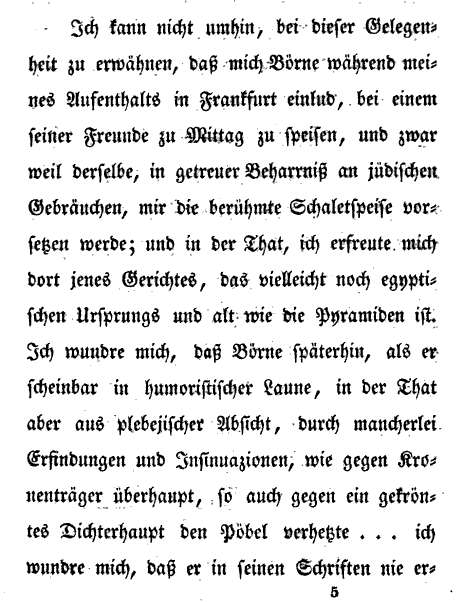
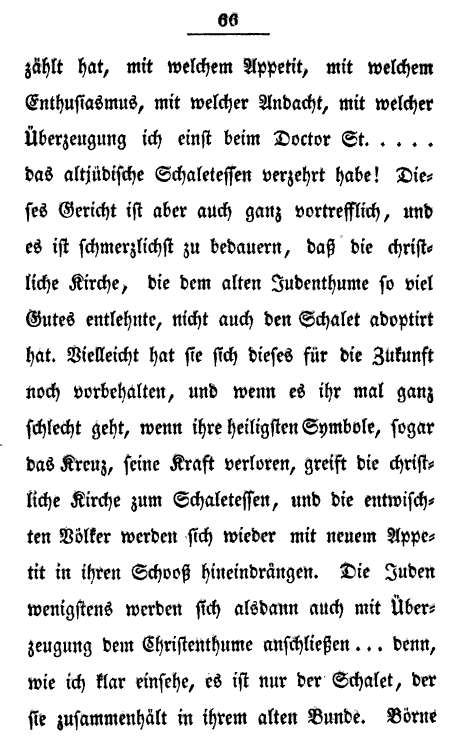
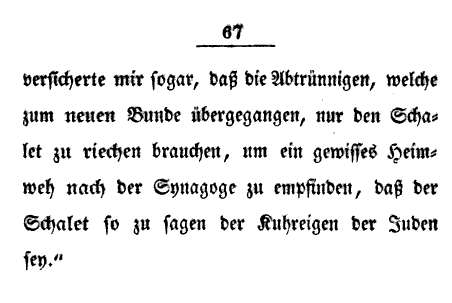
In 1840 Heine wrote a book, a tribute to another very Germanized converted Jew, Ludwig Börne (born ליב ברוך). He writes the following:
I cannot help remarking in this connection that Börne invited me during my stay in Frankfurt to dine at midday with a friend, because the latter, in persistent loyalty to Jewish customs, would set before me the cholent stew (schalet); and indeed I enjoyed there the dish that is perhaps of Egyptian origin and as old as the Pyramids. I am surprised that Börne later, when, apparently in a humorous mood but in truth out of plebian intention, agitated the mob not only against crowned monarchs but also against a crowned poet - I am surprised that he has never told in his writings with what appetite, with what enthusiasm, with what devotion I once devoured the ancient Jewish cholent meal at the home of Doctor St....! This dish is indeed quite excellent, and it is most painfully to be regretted that the Christian church, which has borrowed so many good things from ancient Judaism, has not adopted cholent as well. Perhaps it is reserving it for the future, and when things are really going badly for it, when its most sacred symbols, even the Cross, will have lost their power, the Christian will grasp at the cholent meal, and the peoples who have fled will crowd back to its womb with renewed appetite. At least the Jews will then join Christianity with conviction, for, as I can clearly see, it is only cholent that keeps them in their old covenant. Börne even assured me that the apostates who had gone over to the new covenant had only to smell cholent in order to feel a certain nostalgia for the synagogue, that cholent was, so to speak, the cowherd's melody of the Jews.
Lest one doubt that this tribute to cholent was really written in 1840, complete with Heine's (half-kidding) and ironically wrong prediction that cholent would bring Jews to the church, here are the pages


Wednesday, April 09, 2008

Haggadah of the Times of London, 1840: a civilised response to the Damascus Blood Libel.

The background to the Damascus Affair (ie, the 1840 blood libel against Jews that became famous around the world) is or should be well known. If not, click the link.

What is most interesting is that in reaction the Times of London printed a translation of virtually the entire Haggadah on page 3 (August 17, 1840 edition) titled "Celebration of the Passover by the Jews."

It begins "A correspondent has furnished the annexed very minute account of this ceremony, which will be exceedingly curious in itself to most of our readers, and has at the same time an evident bearing on the Damascus case. It repels strongly the barbarous notion that human blood, or blood of any kind, is essential to its celebration:-- (click below to enlarge)


It must be noted that shefoch chamoscha is not mentioned (nor Chad Gadya, the other songs at the end or the declaration of Lshana Habaah be-Yerushalayim). One cannot help but get the impression that it was not mentioned not because the editors of the Times were duped by whomever prepared this translation and account. It was a time of almost comical erudition about all sorts of obscure topics in the mainstream press.

As Simon Winchester writes of a slightly later period in "The Meaning of Everything: the Story of the Oxford English Dictionary," "[F]or very many they were also cultured and learned times besides. . . . It is perhaps worth recalling just how very well educated people were in those days - or at least to recall how very well educated the educated clases were. . . . [p]eople, or people of a certain kind in the Britain of the day, were quite simply possessed of much time and much learning, and in far greater abundance than many like people possess it today. Items from the newspapers of the time hint at the almost incidental, quite casual cleverness of the cleverest of the reading public. An illustration of the kind of things appears that day in the 'Telegrams in Brief' section of The Times, in which it reports, without explanation or adornment, that:

Further hostilities are reported between the Zaranik tribe and the forces of the Zaidi Imam Yahya of Sana'. The Zaranik attacked a Zaidi detachment at Mansuria, near Hodeida, and have been plundering caravans trading with Sana'.

No further details are offered to suggest where all this fighting was (Yemen, one imagines), nor the identities of the parties to the feud. The newspaper's editor presumes that readers, quite simply, had sufficient education to know.

In short, I suspect that the reason why the last hour of the seder is summed up in a paragraph mentioning birchas ha-mazon, but not what can legitimately be seen as a dark moment of the seder (shfoch chamoscha), or the messianic hopes of the Jews (leshana habaah be-Yerushalayim) was because the editor thought it best not to mention it, fearing that such moments would distract from the thesis the paper was trying to present: that what actually happens and what is actualy said by a Pesach seder "repels strongly the barbarous notion that human blood, or blood of any kind, is essential to its celebration."

Further reading: 1841 English translation of Effés Dammim: A Series of Conversations at Jerusalem Between a Patriarch of the Greek Church and a Chief Rabbi of the Jews, Concerning the Malicious Charge against the Jews of using Christian Blood by the maskil Rival (Yitzchak Baer Levinsohn), author of Teudah Be-yisrael. Appended to this particular book is a must-read: extracts from "Reuchlin's defense of the Talmud," pp. 201-208.

Friday, July 06, 2012

Shadal series #13 - on Sambatyon, then under English dominion (probably)

Here's a sarcastic and amusing excerpt from a letter which Shadal sent to Yehash[1] dated January 14, 1840.[2]


"I heard about, but did not understand the reason, for translating into English Rapoport's essay on the Ten Tribes.[3] Perhaps they sent a communique from across the Sambatyon River, which is undoubtedly under British dominion. Then "from beyond the rivers of Ethiopia shall they bring My suppliants, even the daughter of My dispersed" (Zeph. 3:10), a great offering to the wonderful Ga'on [i.e., Shir], and request that he come with them and become their chief. When this news reaches you, my friend, write me! Then I will immediately send you a wonderful poem which I will compose in his honor. The Sambatyonites will hear it and rejoice. My heart swells with the great joy which I will feel when the Gaon goes to the Land of the Ten Tribes and he will find countless precious books; manuscripts written by Ibn Ezra while he was eating matzah,[4] which reached the custodianship of the men of Ethiopia. But woe is me! What have I seen? A god is rising from the earth! An old man arises, and he dons a cloak - without a doubt it's Rabbenu Saadiah - with the Ten Tribes at hand, and he is shooting arrows through Ibn Ezra and Rapoport's heart (2 Sam. 28:14), since I brought them ill repute, saying that the mathematics of our ancestors were inexact. But the opposite is the case! It is a law from Moses on Sinai."
Whoa. What gives? This letter is from Shadal's Angry Period. As you can see, he is mocking the idea that an essay of Shir might be translated to English, that is, the importance of this essay and of Shir's antiquarian research altogether. Shadal and Shir, BFFs, had a major falling out. It is nice to see how as soon as he gets mad at him, the man becomes worthless. Mind you, the essay he refers to was published in Bikure Haitim in the 1820s. It was those essays which impressed Shadal in the first place and caused him to make contact with him. So, the man was touchy, but his hurt certainly manifested itself in a clever way.

Interestingly, 1838 a book appeared in Ofen called Haroeh. This was a journal published by a group of four young friends, disciples of Nachman Krochmal, who decided to take on the elder maskilim and expose flaws in their scholarship. In the second volume (link), dedicated to attacking both Shadal and Shir, the latter is actually taken to task for casting aspersions on the truth of the legend of Sambatyon (pg. 62): במאמרו על דבר היהודים החפשים העיר בהערתו ספקות רבות ע"ד נהר  סמבטיון והחליט שאין אמת בהספור ממנו ע"ש והנה מלבד שהדברים  האלה לא לו המה. "In his essay on the Free Arabian Jews in the footnotes he raises many doubts about the river Sambation and concludes that it is not true." The author of this piece, Nachman Yitzchak Fishman, goes on to note that Eisenmenger brings many of these things - implying that Rapoport plagiarized from this notorious antisemite - and and in any case it is inappropriate for a Jewish scholar to cast doubt upon this matter openly before all the Jewish public, for much evil can come from this if it were revealed to the Jewish masses!

Note that in the 19th century (and the 20th; future post) there were Jews who were very much involved and invested in the Sambatyon idea.

Speaking of Sambatyon, here is an interesting footnote concerning the name of this river from an 1783 English edition of The Travels of Rabbi Benjamin of Tudela.


A. Asher writes in his 1840 edition that Gerrans "understood very little if any thing of hebrew, and that all his learning was derived from B. Arias Montanus, L'Emperuer and Barratier." He even claimed not to have seen Baratier's edition before printing the first chapter of his own! On Baratier, a Christian child prodigy/ iluy, see here and here. Remember, Baratier was 12 years old when his scholarly, annotated translation of Masaaos Rabbi Binyamin appeared.

Anyway, after showing how Gerrans ripped off Baratier rather liberally, he gives an example of his poor Hebrew scholarship:

When in Lunel, Rabbi Benjamin writes in his Masaaos, about people he met:  והוא חכם הגדול בתלמוד והרב רבי משה גיסו ורבי שמואל החזן ורבי שלמה הכהן. Gerrans translates this as "This man is well skilled in the Talmudic writings. Here you likewise meet with that great R. Moses Gisso and R. Samuel (Hhasan) R. Salomon the Priest." גיסו of course means "his brother-in-law". Then in the footnote Gerrans gives a whole speech about how this רבי שלמה הכהן was Rashi, but "This is one of Benjamins Errors in Chronology, for רשי  was dead long before." Asher says there are almost as many errors as words in the passage, and that Gerrans 'explains' in the footnote that חזן means "sometimes a reader and sometimes an executioner." He then lists 5 separate mistakes Gerrans made about Rashi, and what arrogance he has to attribute his own error to Rabbi Benjamin himself! And of course this one line is a but a sampler of the whole book.

Much more to say about searches for Sambatyon. For starters, see Mevaseret Tziyon, published by Eliakim Carmoly in 1841. Read, e.g., the letter that "messengers of the scholars of the Ashkenazim in Eretz Yisrael sent to the Bene Moshe and the Ten Tribes." It is dated Rosh Chodesh Marcheshvan 5691/ 1831 and signed by R. Yisrael of Shklov, author of Pe'as Ha-shulchan, among others (link).
_______________________________________________

[1] Yehoshua Heschel [Osias] Schorr
[2] Iggerot Shadal V. I. pp. 656 - 59.
[3] This seems to be referring to A. Asher's edition of the Itinerary of Benjamin of Tudela (London 1840). The second volume contains dozens of notes by Shir, which were obviously translated into English by Asher, who thanks him for his correspondence in the first volume. In the second volume, pg. vi, he writes that
"The next volume of notes will contain the papers by the Revd. Rabbi Rapaport, Mr. S. Munk and Mr. Lebrecht, which from circumstances over which I had no control, it was impossible to introduce into the present volume, although I allude to them." 
Unfortunately there never was a third volume! However, the essay which he had translated was על דבר יהודים חפשים הנמצאים בארץ ערב ("On the Tribes of Free Jews in Arabia") which appeared in Bikkure Haittim 4 (Vienna 5584/ 1823).
[4] This is probably a reference to Ibn Ezra's comment that he was imprisoned in India and he and the other prisoners were fed something similar to matzah, thus Shadal means "obscure Ibn Ezra manuscripts written by him while imprisoned in India." My thanks to Dan Klein who pointed this out to me.

Tuesday, January 19, 2010

Some notes on a famous penitent apostate, Ezekiel Stanislau Hoga.

Having previously written about the apostate Stanislaw Hoga, I thought it would be interesting to revisit the topic. in Nahum Sokolow's History of Zionism, 1600-1918 Vol. 1 (1919) offers a most useful, albeit factually flawed, biographical summary of the man:
[Hoga] had been a Government Censor of the Hebrew press in Russia. On coming to London, he came under the influence of the Rev. Alexander McCaul (Father-in-law of James Finn, the British Consul at Jerusalem), who induced him to become an apostate. They co-operated in the production of " The Old Paths "... London : . . . 1836-1837, which Hoga translated into Hebrew. He died repentant about the end of the year 1849. The Hebrew translation he had made of " The Old Paths," entitled נתיבות עולם was not published until 1851. ("The evil that men do lives after them ; . . .")
Actually Hoga had converted in 1824 or 25, well before moving to London, and thus before he met McCaul. In addition, the Hebrew edition of Old Paths was first published in 1839 (see). Presumably Sokolow was misled by seeing a later edition. For example, here is a Hebrew edition published in 1870. Similarly, Beth-Zion Lask Abrahams's detailed article "Stanislaus Hoga—Apostate and Penitent" (lecture in 1943) in the 1945 issue of the JHSE mistakenly gives 1845 as the year of its publication.

In the July 1839 issue of the Missionary Intelligence column of The Orthodox Presbyterian theological review and missionary recorder one sees the following:


In any case, it should be noted that it was not I who caught the mistaken publication date, but Dr. Sid Leiman nearly 25 years ago. See his The Baal Teshuvah and the Emden-Eibeschuetz Controversy, Judaic Studies 1 (1985), pp. 3-26, where the entire story is approached through the lens of how Hoga appears in modern rabbinic legend.

In a book written against the Old Paths, published in 1864, we see the following:


The interested reader is directed here to continue.

Hoga's name appeared on a most interesting list. In 1840 the Damascus Affair, a then-shocking modern revival of the long forgotten Blood Libel, flared up. The aforementioned Alexander McCaul, author of "Old Paths" wrote a book called Reasons for believing that the charge lately revived against the Jewish People is a Baseless Falsehood (dedicated by permission to Queen Victoria), London, 1840.

This brief work sketches six reasons why the charge must be rejected as false. They are as follows:

1. The charge is made only in times and places of ignorance, and in places lacking justice, or where confessions elicited by torture are accepted as testimony. As he asks, "Why is it that no case of this kind now occurs in France, or Holland, or Prussia, or England?" He continues, that [anti-Christian] bigotry is still strong among "a mass of the Jewish people," and "the prejudices of the unedicated multitude against the Jews are, generally speaking, as strong," and yet it does not occur.

2. The charge is confined to certain places in the world. If the requirement of Christian blood was really a part of Judaism, then the charge should have spread as far as Judaism itself. However, notes M'Caul, as far as he knows the charge has never been made in Asia or Africa until now.

3. The charge is comparatively new, only since the 13th century. Although Apion brought a similar charge against Jews in ancient times, and this may indeed have served as the model, for many, many centuries of the Christian age the charge was never brought. Why would the Jews crucify Christians in later ages, and right under the noses of Christian governments, while in earlier times they were under the government of heathen emperors, and presumably such a crime would have seemed less heinous to them?

4. The Blood Libel is part of a pack of medieval charges lodged against Jews, and all the others are now seen as ridiculous, such as piercing the host, poisoning the wells, and causing the madness of Charles VI of France and numerous others.

5. The reason given for why Jews need blood is one of many ridiculous ones. For example, not only was it alleged that the need was to bake unleavened bread for Passover, but "it used to also be gravely asserted that they used Christian blood to free them from an ill odour, which it was supposed, was common to the Jewish nation." Other popular reasons were that the blood was used in love potions, or to stop the bleeding of circumcision, and many more.

6. Finally, there is a total absence of credible testimony. The only evidence in the Damascus case was extracted through torture, and that method could cause anyone to confess to anything, including being personally responsible for an earthquake!

He could not be more clear:


McCaul then produced a letter signed by "competent witnesses" which he collected. It includes a list of names of Jewish apostates, described in the following mannner:
"Here are persons, neither afraid nor ashamed to give their names and the place of their birth, some of whom command respect by the offices which they now fill, many of whom have been rabbies, readers in synagogues, Jewish schoolmasters, candidates for the rabbinate,—all of whom are ready, if it were necessary, to give evidence on oath,— men born in Judaism, and educated in various parts of the world, who all declare their ignorance of the crime here imputed to the Jewish people,— witnesses who gain nothing by giving this testimony, and would lose nothing by testifying the contrary, if their conscience allowed them. Amongst them are those who have conducted all the religious ceremonies to which the monk refers, who have ministered at circumcision— watched over the preparation of the Passover cakes,—and performed the last sad offices for the dead. Some of them once members of that most fanatical of Jewish sects, the Chasidim, to some of whom, if any use of Christian blood existed, it must have become known, but who have thankfully and zealously embraced the opportunity now afforded them of protesting against the falsehood of the accusation. They all answer as, with the one exception already stated, all converts have done for the nineteen years that I have had an opportunity of being intimately acquainted with the Jewish people. They have earnestly and solemnly denied the charge.

Such testimony far outweighs the evidence produced on the other side. "


As you can see, Hoga is on this list, described as "son of the Rabbi of Casimir."

An appendix is included which adds signatures of "believing Jews," which from my perspective probably should read "disbelieving Jews":


This list was brought in a different form by Moses Margoliouth in 1847 in his periodical The Star of Jacob. Compare:


Getting back to Hoga, among his other literary productions was a book printed in 1840 called שפת בריטאניא, subtitled also titled "A grammar of the English language, for the use of Hebrews." The book is notable for being written in Hebrew, rather than Yiddish, which means that his intended audience was fairly scholarly. It is also written in Rashi letters (with the occasional Vayberteitsch note, for example:

)


It includes such interesting examples as these:


Monday, August 15, 2011

Shadal series #5 - What does Morenu really mean?

In Julius Furst's Der Orient (Literaturblatt des Orients No. 7, February 15, 1840) pg. 108 we find the following short note by Shadal asking a very fair question: Was the rabbinic title originally מוֹרֵנוּ, that is "our Teacher," or מֳרֵנוּ, that is "our Lord?"


Shadal says that of course we find Morenu (מורנו) all the time, but the question arises from older manuscripts where there is something which gives rise to his question. For example, in Rabbi Yehuda Ha-levi's Diwan (a rare manuscript which he purchased and was about to publish) we always find מרנו (lacking a vav). Sometimes we even find it abbreviated and including nekkudot, like this: ' מֳרֵ. He points out that very old manuscripts sometimes have older readings, so such things are not mistakes at all.

In fact he concludes that this is the primary reading, and we see from this that the term מורנו is really מֳרנו and derives from the word denoting lordship rather than teacher. The term actually comes from the Aramaic phrase מרנא ורבנא, where the absolute form of the word is מָר, master, not מוֹרֶה, teacher. The "German-Polish" (Ashkenazic) pronunciation of the kametz with each failure to differentiate between the two kinds of kametz lead to the pronunciation as Morenu, rather than Marenu. From this it was but a small step to spell it maleh with a vav, מורנו, and this implied that the word means to say "Our Teacher." This is essentially what happened with the word haftarah (הפטרה) which is often pronounced and written haftorah (הפטורה), but there is no doubt whatsoever that the correct reading is the former.

Shadal included this, slightly expanded, as a footnote to his edition of the Diwan (link), which I will get to soon.

What he did not mention (or know) is that there is actually a whole spiel about the correct pointing of the word מר, which undoubtedly means 'master.' Although we Ashkenazim pronounce it "Mar" the Sephardim pronounce it "Mor," with a holem. The first explicit reference to this I could find says it's a mistake (naturally). In R. Elijah Levita's Tishby we find the following entry:


He says that there are those who write it מֹר, but this must be a mistake, because if this were the correct reading why not [ever] write it with a vav?

The answer to his objection is that they definitely do write it with a vav, he just never saw it.

Although many people will want to point to the writings of the ge'onim (as I will) you can actually find it numerous times in the Mishnah commentary of R. Ovadiah Bertinoro. Here is one example from the first printed edition (Venice 1548):


If you don't find it in your copy - it is spelled מר rather than מור in the Bar Ilan database - it's because later editions corrected it, but this is how Bertinoro always spelled it (or at least how it is spelled in the earliest printed editions).

We can find it spelled מור in numerous manuscripts from the time of the ge'onim. Here are but two examples:


The first is a description of a manuscript in Ohel Dawid, the catalog of the Sassoon collection. The second, below, is from Halakhot Pesukot. There are many more such examples, including the Sefardic rescension of Iggereth Rav Sherira Ga'on.


Thus we see that Shadal did not seem to realize that pointing with a holem (Mor) is undoubtedly possible. Practically speaking I'm nor sure what difference that makes, since he'd be right in any case that it meant "master" and not "teacher." Actually the Sefardic pointing supports him.


Interestingly one can find a clear support for Shadal in Rashi on Kiddushin 31b which discusses the proper way a person should refer to his father. Rashi ד"ה ואמוריה explains אבא מרי to mean אביו ואדוניו. Not only that, as it happens in our texts of Rashi מרי is written with a vav, מורי. I will leave it to the text experts to get to the bottom of it and determine if this is the correct reading of Rashi. Incidentally, Soncino translations מרי as "teacher" and Artscroll translates it as "master." Also see Rashi Bava Kamma 49b where he gives the exact same translation for מורי (this time the Gemara reads it with a vav).

Interstingly enough in the 2005 edition of the Tishbi there is a note in this entry by Rabbi Meir Mazuz which says that he heard from his father R. Mazliach that the Ashkenazic reading "Mar" is correct, but the Sefardim changed it to "Mor" because "Mar" connotes bitterness. And, I would add, "Mor" means "myrrh." Actually, he brings a quotation from the Tikkunei Zohar which makes a play on "Mor" as both "master" and "myrrh," which implies that the Zohar (*coughSpaincough*) read "Mor." (Link; this wordplay is very sbutle, but I agree with him. It is a nice catch. Almost as if sensing that the wordplay doesn't really work with Ashkenazic pointing, the editor of this 1909 edition with nekkudot doesn't point "Mar," seemingly the only unpointed word on the page! That's pretty cool, except that he was Sefardi. צ"ע.) I also want to point out that this edition (Machon Harav Mazliach 2005) is the one to get, if you ever wanted a Tishbi. The only criticism I have is that for some reason they changed R. Elijah's unique vowelization of many of the entries, a major major error on their part. I can't begin to fathom why they did that, and if they had to do it they should have noted each change in the notes. Apart for that, it is simply the edition to own with its manifold notes and supplements.

Here's Shadal's comment in his Betulat Bat Yehudah (Vienna 1840) pg. 111:


I would just note that the typesetter spelled the book Besulath Bath Jehuda, as you can see. In other words, in the same word (בתולת) he renders a תי"ו רפויה as /s/ and also /th/. That's enough to drive a pedant crazy.

In this footnote he expands his thought, mentioned only briefly in German, that we have a great source in old manuscripts to teach us how the ancients read, and from this we can learn many things. He gives another example which I admit that I find puzzling. The example is גאוון, which he says is a faulty modern spelling, for in old spellings it is always גאון with one vav. He says that the old readings prove that the traditional spelling with one vav is correct. I think I'd have a better idea of what he was getting at if I could find many examples of "גאוון" in print but I cannot. So I'm not sure which moderns he has in mind. I guess unwittingly his own writing became an example of what he is talking about. We now see that in 1840 people were spelling it "גאוון," evidently a passing fad.

Wednesday, December 09, 2009

A portrait of the Chida's grandson.

Giuessepe Leonini Azulay (1767?-1840), was the eldest son of H. Raphael Isaiah Azulai, who was himself the eldest son of H. Haim Joseph David Azulai (1724-1806), known as חיד"א.

Below is part of the English text from his tombstone:

In Memory of
Signor Yitzhak Leonini Azulay, M.A.
22 years Professor Regius to the Institute of Noble Cadets
in Berlin, Tutor to H.R.H. Princess Royal of Prussia
Member of several Learned Societies, etc., etc.
Born at Leghorn, 2nd day of Succoth
Died 16th day of Tamus, 17th July, 1840
and his last words were
להגיד כי ישר ה’ צורי ולא עולתה בו

The portrait was made in 1790, which would make him about 23 years old. His name Giuseppe, or Joseph, would seem to indicate that he was named for his grandfather, but actually his שם קודש was יצחק ליאן.


Do I see a facial similarity with his grandfather? Compare and decide for yourself:


The information from this post was obtained from R.D. Barnett's paper "Isaac Leonini Azulay," ("in collaboration with Gertrude Azulay, A. Schischa and Jacob Jacobson") in the JHSE 19. Incidentally, Barnett shows that he probably wasn't born in Livorno (i.e., Leghorn, as on the tombstone) but in Jerusalem. He quotes "Dr. Johnson that ‘a man in lapidary inscriptions, is not upon oath’."

Here's an interesting letter to the Jewish Chronicle, sent by Bondy Yomtob Azulay, the subject of our post's son:

Wednesday, June 17, 2009

A shocking doctor's prescription written by Ephraim Luzzatto

In 1840 Franz Delitsch asked David Aaron de Sola to write a piece on the poet and physician Ephraim Luzzatto (1729-1792) for the Literaturblatt des Orients. Below is a shocking, if not entertaining excerpt (Literaturblatt des Orients I (Jan 4, 1840), pp 9:


For the benefit of those who don't read Blackletter, here is my translation.
One Saturday, summoned to the Chief Rabbi, [Luzzatto] requested a quill, ink and paper so he could write a prescription; but neither the rabbi nor anyone in his family would give these to him, because he was only a little inconvenienced, and he had his office nearby1. But he had quill and ink in his bag, and tore out a page from his book and wrote something like this:

"Today on this holy Sabbath day, in the month of Shevat, in the year 5500 (ie, 1740) , [when the weekly reading containing the verse, Ex. 21.19, Parshas Mishpatim) וְרַפֹּא יְרַפֵּא, healing for the perfect haham, the distinguished judge, the pious, the modest, etc. "greater than the title 'rabbi' is the name," his honor, the rabbi . . . the Lord will send him healing . . . "

Then came the prescription in Latin, followed by four satirical lines in Hebrew, which could no longer be recalled by the person who told me about this. This was rude and callous to play with the patient's feelings and beliefs. I hope this anecdote is not true and question it's authenticity, especially because of the well-known saying de mortuis nihil nisi bene, which מליצים have given with the same truth and more wit: אחרי מות קדושים אמור.2
1 I assume this meant that Dr. Luzzatto could have gone to his office and gotten the medication, rather than write out a prescription. Alternatively, maybe they wanted him to go to the office and get the ink, etc. himself rather than handle it for him. Or maybe it means that the rabbi's illness was itself only an inconvenience and not life-threatening, therefore no prescription should have been written at all?

2 On the one hand this is surprising. It would seem to indicate that the story was true. After all, if אחרי מות קדושים אמור holds water then would the story be said if it weren't true, despite that tendency? On the other hand, I suppose it depends on why the story was being told. It certainly seems to bolster Luzzatto's quick wit and way with a pen, thus in that sense it could be a case of inflating his reputation after death. In addition, it is worth having a look at what Rashi comments on those two words (see here). Razor sharp! In any case, at least one detail of the story is obviously wrong, the date. In 1740 Ephraim Luzzatto was all of 11 years old. In addition, the overly flowery prose in the rabbi's title raises questions (גדול מרבן שמו כמהו"רר ? You've gotta be kidding me.) Indeed, one scholar identified the rabbi as Moses Cohen d'Azevedo (which would place the story after 1761) on the basis of the poor esteem which he was held as a scholar (which even caused a distinguished dayan to resign when d'Azevedo was appointed to the Bet Din).

Monday, April 28, 2014

A Messianic prophecy for 1840-1, Pt. II

Here's an update to this post, about a 17th century Messianic prophecy for the year 1840-1, apparently predicting the French Revolution, some kind of Russian revolution, Jewish independence, and then the Messiah. This is a copy of the document discussed in that post, copied for some reason, by Isaac Leeser's. See here. Leeser must have had hopes for the year 5601.


Wednesday, October 27, 2010

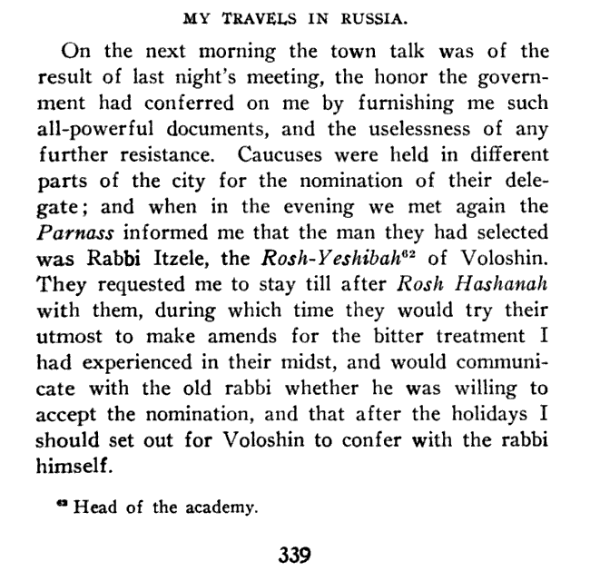
Impressions of the Volozhin Yeshiva and it's head, Rabbi Itzele, from Max Lilienthal's visit in 1840.

I'm sure Max Lilienthal (1815-1882) needs no introduction, but for the purposes of this post, it's worth giving a brief explanation for what follows. Lilienthal was a young PhD who was appointed schoolmaster of a modern Jewish school in 1839. Given his talents and successes there, and a recommendation by Ludwig Philippson, editor of the Algemeine Zeitung des Judenthusm, the Russian government appointed him in 1840 to try to reform Jewish education and establish modern schools. Lilienthal was no dope and knew that this could only succeed if he could convince the rabbonim and rebbes to support it. For this purpose he undertook a trip to the traditional communities in Russia, to learn, listen and try to persuade.

He was unsuccessful, etc. His own official account is that he realized that the Russian government did not have the best interest of the Jews in mind. The "Making of a Godol account" is that while he subsequently gave this as the reason, in fact he was suspected of some illegal economic activities and had to depart Russia. I don't see these as mutually exclusive. Either way, he settled in the United States where he became an Orthodox rabbi - he really was exactly that, even organizing a Chevra Shas in his schul - although he soon began leaning toward Reform, eventually becoming one of the pioneering American Reform rabbis. See also Hyman Grinstein's article "The minute book of Lilienthal's union of German synagogues in New York " (HUCA 18, 1944).

In the mid 1850s he published an English translation of extracts from his diary of his travels in Russia in the newspaper the Israelite. These were reprinted in David Philipson's 1915 book Max Lilienthal, American Rabbi.

Below are the passages concerning his meetings with R. Itzele Volozhiner, R. Chaim of Volozhin's son, rosh yeshiva of the famed Volozhin Yeshiva. The account is interesting for many reasons; it included his impressions of R. Itzele, and his son-in-law Reb Lebele (i.e., the 30-year old Neziv).

His description of the first day of Selichos is amazing. He was awoken at 3 AM for the Selichos which were to commence at 4 AM. In the street he witnessed a mass of women dressed in white, carrying lanterns through the streets of Vilna, to the synagogues.

He records that he was given maftir in the main (?) synagogue in Vilna - where he was seated in the absent rabbi's seat - but told not to read the haftarah himself. Lilienthal says that this was the practice so as not to embarrass anyone who couldn't read, but one wonders if it was because the haftarah was read on a klaf (handwritten, unvocalized parchment roll) as per the Gra (which is doubtful to me anyway). But if so, it really would be the same reason anyway ("not to confound the ignorant.") But of course it's strange to think that an unprepared Lilienthal could have read it from a klaf in the first place, and he implies that he would have read the haftarah if he had not been told not to. If they did read it on a klaf it seems a little odd that he didn't notice it or think to remark on it, so it probably wasn't read on a klaf at all. Another possibility, judging by a comment R. Itzele made about how he read Hebrew (see below), after reading the beracha and thus demonstrating how he recited Hebrew someone in charge decided that he shouldn't read the haftarah. However, the second day of Rosh Hashanah he was given an aliya in another minyan and asked to read the Torah, so it's probably like he said in the first place: only the ba'al keriah read the haftarah in the main synagogue so as not to "confound the ignorant." He visited the Gra's kloiz on the first day of Rosh Hashanah, and noted that the angels are not mention in the prayers related to the blowing of the shofar, as per the Vilna Gaon himself. Lilienthal seems to have taken this positively, seeing it as directed against superstition.

Upon arriving in Volozhin, he also was met with many ("a hundred") people for whom his reputation had preceded him. They asked him if he was the "Datsche Rof" (German rabbi). Here it might be appropriate to mention something I read recently in the first volume of Bialik's folklore journal Reshumos, but haven't seen quoted anywhere else. This concerns a later period, probably the 1860s. It seems there was a person named Mendele who was known as the Baal Gematrios, because he could quickly come up with a Gematriya for anything. One time Mendele walked into an inn and came upon a group of bareheaded Jews dressed in modern clothing eating and drinking. So he said to them, "Sholom Aleichem, Berliners!" One of them answered, "Aleichem Sholom, Karliner!" He thought for a second, and said that to the guy that he is right. The difference between a ברלינער and a קרלינער is כובע (a hat; Gematria is 98).

Getting back to Volozhin, other points of interest is that he quotes R. Itzele as telling him, after he has him recite the zimun, that he reads Hebrew "like a proselyte." For his part, Lilienthal thought he himself was reading it German-style. He also (famously at this point) quotes R. Itzele as explaining to him that in a typical morning in the yeshiva he gives a Chumash-Rashi shiur, in which he includes some of his own remarks and some things from the Mendelssohn Be'ur commentary. One wonders if this was true, or said to impress Lilienthal - but in a way it's a distinction without a difference. Kosher enough to tell him, is the point. As for whether it's a sheer fabrication on Lilienthal's part, that seems very unlikely, as all it did was serve to make R. Itzele seem a little bit enlightened, and what did Lilienthal gain, writing in his own diary - or in English in Ohio in 1856 - by fabricating this?

He also notes that R. Itzele invited him Erev Yom Kippur to join him at the mikva, which he declined.

Wednesday, November 24, 2010

The masses with a historical sense have needs too - a reflection on YouTubegate.

A YouTube video called Yeshiva guy says over a vort has been making the rounds. Incredibly for our little circles it has 30000+ views in one week. By the J-blogosphere standards, that's like Miley-Cyrus-getting-caught-wth-cocaine-at-a-traffic-stop viral. Clearly it struck a chord of some sort.

For some reason this was deemed worthy of a public response (here) "after consultation with Gedolei HaPoskim."

The author of the response, Rabbi Yair Hoffman, does not focus at all on the target of the video "Yeshiva guy says over a vort" since he realizes that the reason why "Yeshiva guy says over a vort" is because this is what he is taught. Therefore he intuits that the video is aiming for higher hanging fruit, and responds accordingly.

He summarizes three positions on how to interpret the Gemara Yoma 28b that states that the Avos (patriarchs) kept the Torah. Not surpisingly, there are three positions, which he terms maximalist, minimalist and middle-position.

Writing about the minimalist view, he says "The minimalist position believes that this Gemorah should be understood in a somewhat allegorical sense – in other words we should and must look and view the Avos and their children in the sense that they actually did perform all of the Mitzvos. Why so? There might be a tendency among the masses to view the patriarchs of Klal Yisroel in a somewhat lesser light because they did not have the sophisticated and more developed aspects of Avodas Hashem that we might have. “For Avrohom Avinu – a Bris Milah was a nisayon – for me – it is a spiritual experience that I look forward to..” – might be an example of such thinking."

After summarizing these positions he concludes "The overwhelming majority of Torah authorities, however, clearly and completely hold of the maximalist position, and this is the general position that should be taught in our Torah institutions. When one is involved in Kiruv or deals with people that have been raised in secular environments, it is the opinion of this author that all three positions should be presented. None of the positions, however, should ever be mocked or derided. This is not the Torah way."

This is extremely interesting to me. The part I bolded speaks of catering to the needs of the masses. What I believe happened here is that Hoffman doesn't realize, or care, that this is a contradiction to his conclusion. It is not only "people raised in a secular environment" in a "kiruv" setting who cannot stomach the maximalist position - and that's why the video was created.

Putting aside the contradiction or disparity - the "mainstream" default should be to teach only one position - the maximalist - while for assimilated people all three should be taught rather than only one - the minimalist or the middle position - Hoffman sees no need for catering to the masses who can't take the maximalist position, the type who made the video viral by 1) identifying with its message and 2) passing it on. He only sees the scoffers (secretly ensconced within the Orthodox community) but not the people, who are also the masses, who also need their religion and their teachers to make sense to them.

Interestingly, there is a parallel to my position in the work of Nachman Krochmal ("Renak"). In his posthumously published Moreh Nevuchei Ha-zeman he teaches some things which are still considered controversial at best within Orthodoxy to this day; the Deutero-Isaiah hypothesis, the idea that not only weren't the Psalms written by David, but many of them were written as late as the Hasmonean period, etc. His thesis was as follows: first of all, these things are the truth and can be demonstrated through careful analysis of the books themselves. Secondly, these facts were known to Chazal and other exegetes as well, and this too can be demonstrated through careful analysis of the sources. However, they concealed these views from the masses and did not teach the historical truth about the authors of these books. Rather, they taught an edifying literary history which would inspire the masses and spoke to their spiritual needs of the time.

He conjectures, for example, that belief in the Davidic authorship of Psalm 137 (Al naharot Bavel/ By the rivers of Babylon) at one time enhanced one's appreciation of prophecy. However in our own time (Krochmal died in 1840) all this was to the contrary. Given the rise of the critical spirit the contention that David wrote that Psalm is no longer plausible, thus teaching it as historical fact is not inspiring and does not enhance one's appreciation for prophecy - it has the opposite effect on the reader. Therefore the time had come to investigate and teach the actual literary history of the Bible and this would be appropriate and inspiring for the times - and true.

This does sound wacky, but I think it is fair to understand the internal logic behind positions, whether they seem wacky or not. At the time the Jews did not yet possess their own modern scholarly literature. So if you were looking for a scholarly, "critical" discussion of Judaism written with modern research methods and principles you essentially had to read the productions of German Protestants, or Jews who basically copied them or translated their works into Hebrew. If you read these, you'd learn that rabbinic Judaism was borne in the wake of an anemic, arid and declining biblical religion corrupted by petty legalism and unspiritual priests. At that time there was a renewal of pristine religion - Christianity - waiting in the wings. Thus the Second Temple period was viewed as a period of Jewish decline, lacking in creativity and vitality.

But what if some of the best works of the Bible were produced in this period? Everyone agreed the Psalms were awesome. What if they were produced for singing in the Temple during this period? What if the productions of the early rabbis were not the remaining embers of a dying creed, but a glorious bonfire of renewed creativity?

Thus Krochmal - who firmly believed that the modern critical approach was correctly discovering the true literary history of these books - was fully able to offer a counter-approach to modern anti-Jewish scholarship. Judaism was vital after all. The 2nd Temple period was not the end of Judaism - it was the beginning of Judaism! By contrast, in earlier times the idea that all of Judaism was of the greatest antiquity was inspiring, and for that reason alone the rabbis taught it. I suspect Krokhmal would have been shocked to learn that in 2010 there would still be plenty of Jews who found the old approach inspiring, but facts are facts. People may couch questions of authorship in terms of heresy, but it's hard to make a convincing case that there's a dogma about who wrote Psalms. Who cares if some Psalms were Hasmonean? Answer: the people who care. I think that it's really a question of which religion people prefer - one substantially developed and similar to what it's like today in the very earliest times, or one in which development also occurs later.

Unfortunately it gets murky, because its no longer 1840 and Krochmal had the luxury of believing fully that the Torah was revealed to and written by Moshe even while adopting the critical approach, while at the same time today the scholarly position does not pass judgment on how vital or spiritual Judaism was in relation to Christianity.

Here is Krochmal's introduction:


Tuesday, December 06, 2011

Shadal series #7 - on alienation from his teachers, and a public retraction.

Shadal was largely an autodidact, but he had four primary teachers. One was his father, with whom he studied Torah from the time he was 3 years old. Another was his adult cousin, with whom he studied daily for two and a half years beginning from the time he was 16. In between he also had some formal schooling in the persons of Rabbi Mordechai Yitzhak Cologna[1] and Rabbi Abram Halevi.

Cologna taught in the local Talmud Torah school, and from him he learned Mishnah, Dikduk, Rashi, Radak, and Latin. As I've mentioned before, he wrote at least three separate autobiographies. In the first one, written in Hebrew in 1837, he says that he felt the following about Cologna: את המלמד הזה היה ש"ד ירא יראת הרוממות גדולה מאד, והיה עושה אזנו כאפרכסת לכל דבריו ולכל שיחה קלה שהיה מדבר עם מי שהיה, והיה האיש ההוא בעיניו לאות ומופת and Shadal credits him with arousing within him a love and appreciation for Hebrew grammar and other good qualities ממנו באה לש"ד אהבת חכמת הדקדוק ואהבת הדיוק בכל פעולותיו ובכל עניניו, וגבורה למשול ברוחו ולכבוש את יצרו ולמאוס בתענוגים; והתכונה הזאת היתה לו לישועה גדולה ולפורקן בימי בחורותיו. Not surprisingly, if someone is viewed with such awe they can fall far from the lofty view, especially if the person is very sensitive, as we shall see.

Shadal stopped attending the school due to an illness at age 13. While in school, he had been studying Talmud with Rabbi Avraham Eleazar Halevi, the Chief Rabbi of Trieste. After recovering from this illness, he continued studying him for several years, until an incident occurred which caused him to stop coming to him.

He writes that sometimes his fellow students misbehaved and would horse around, and at times he would also join in. For example, he writes, sometimes he would say something very pretentious and intellectual sounding and give his friends cause to laugh. The rabbi would rebuke the students when this occurred. One time he mistakenly chastised Shadal, saying "Se non avete a venire che per fare il לייצן (buffone) potete fare a meno di venire," "If you came here to play the fool, don't bother coming." Evidently this was more than this sensitive boy could take, so he stopped coming.

In the meantime, he had been visiting Cologna, who had become blind in his advanced age. He would read to him and assist him in other ways, such as taking dictation. After he had stopped going to his Gemara shiur, naturally he still continued to visit Cologna. He writes that unfortunately coming into close contact with this teacher, whom he venerated as a child, caused him to diminish his opinion of him. One or two months after the incident with the rabbi, when it happened to be Shadal's 16th birthday, Rabbi Avraham had returned home from his summer vacation, and Cologna asked Shadal to send him his greetings. This he was unwilling to do, as he had stopped coming to his class! He says that he lacked the courage to either send the greeting or confess to Cologna the reason why he would not go. Finally, in disgust, Cologna instructed him to accompany him to the rabbi himself, and all the while he lectured him in the finer points of Derech Eretz, how it precedes Torah, etc. Shadal said he became more and more embarrassed and apprehensive, but he had no choice but to go along with him.

Lucky for him, the rabbi was out. His widowed daughter answered the door, and Cologna conveyed a very poetic greeting, quoting the Talmud Taanit 5a "Tree, O Tree, with what shall I bless thee? Shall I say to thee, ‘May thy fruits be sweet’? They are sweet already; that thy shade be pleasant? It is already pleasant; that a stream of water may flow beneath thee? Lo, a stream of water flows already beneath thee; therefore [I say], ‘May it be [God's] will that all the shoots taken from thee be like unto thee’. So also with you . . ." He added, to the daughter, who was simple and unlearned, that he knows that she understood what he had said in Hebrew. All the way back he continued lecturing Shadal on Derech Eretz. Shadal felt nauseated by the display. He felt it was not Derech Eretz at all, but a form of false flattery since he was of the belief that Cologna didn't really hold such a high opinion of the rabbi, who had been born in Eretz Yisrael, and dressed and acted in typical 'Asian', rather than Italian, fashion. It was also a showy display which in reality shamed the daughter. So he stopped coming to him. It was at this time, he writes, that God sent him his older cousin with whom he would study daily . . .

Not surprisingly, when this appeared in print - all the sources will be shown below - there were other students of Cologna who were appalled by this, notwithstanding that Shadal had prefaced the good, the bad and the ugly in his autobiography with a kind of disclaimer about how, gosh, he has no choice but to speak the truth. After speaking to some of these people on a visit to his hometown of Trieste, he sent Hamaggid a public retraction, where he sings Cologna's praises and notes that his other students experiences him in a different way, and they are the fine products of his tutelage. However, he hardly denies that he experienced what he experienced. This is interesting, because Shadal's general way was that he was ready, willing and able to retract his opinion publicly when he became convinced that he had been mistaken. This seems to me to be the only example where he budged on his opinion at all, where he was not quite convinced that he had been mistaken!

In any case, here are some of the sources. The first, below, was written before the Hebrew, but was published second, in 1878:


The second was published in Hamaggid in 1859 (August 16):


As you can see, he explains that before forming his negative opinion he had viewed Cologna as almost an oracle. He also says that he became convinced that his sermons were empty, because he eschewed the peshat, favoring the style of derash. Furthermore, they were designed to show off his bekius (breadth) and charifus (sharpness) rather than to discover the truth. He says that his concept of Derech Eretz was political, and he saw him as a flatterer.

A little over a year later, Shadal sent in his retraction, as described before. Here it is:


He basically says "In Trieste I heard from some honest and honorable men, students of Rabbi Mordechai Yitzhak Cologna z"l, that they were a bit pained by my detraction from his honor. What could I do? The love of truth caused me to tell things which aren't Derech Eretz to say. But for the honor of the truth, I will reiterate that this scholar, apart for his great knowledge in Torah, secular subjects, and languages, was a tzaddik and chassid, a propounder of Torah to many, and implanted in the hearts of his students yirat shamayim and good traits; lucky is the community which had a man like him dwelling in their midst. I see that the negative impression which he formed on me from his sort of Derech Eretz was not formed on his other students; not even one of them attributed it to him. Not even one of them was able to accept a dimunition of his ways and attributes, and they studied and assisted this scholar. From this I see that the man was guiltless, and his manners elevated all who were close to him. Therefore, he was good and lofty in all his ways; and this one student annuls his . . . " Now, I know that some could be forgiven for seeing this as sarcastic. I suspect though that it isn't, since I truly think he would not have thought twice about openly standing by what he wrote. I assume that he was genuinely surprised that the others didn't perceive Cologna this way, but seeing as they didn't, he took it back.

I thought it would be interesting to bring up an unrelated context, where Shadal mentioned Cologna as an exemplar of an Italian rabbinic type. In 1840 the Archives israélites has written a little bit about the Rabbinical College in Padua (which Shadal co-headed) and described it negatively as belonging to the last century, being inspired by the principles of reason espoused by Mendelssohn, and the "Biourim et des Measphim" (the Biurists, i.e., Mendelssohn and his circle, and the Meassephim, i.e., the early Hebrew Haskalah writers). But, it continued, real successors are supposed to take the end point as a starting point. The school may decline to listen to the voice of Reason calling out, "March, March!" but no amount of training in oratory or flowery poetry is powerful enough to drown out that voice. In other words, the school is too frum.

So Shadal sent Jost a letter, which was printed in his Israelitische Annalen (1840 p. 320) and later in the original Italian in Epistolario (p. 375) in which this is quoted, along with Shadal's reply, which was as follows:
If under the rubric of Mendelssohn's principles is the belief that Moses was a true prophet, worker of true miracles, and that his law is still binding for all of Israel, then he is quite right that Reggio and Luzzatto adopt the principles of Mendelssohn. But they do not recognize these principles by Mendelssohn; they recognize them from the same ancient source which Mendelssohn took them.

This great man exercised a great influence over the Jews of Germany and the Northern countries, but only a little over the Jews in Italy, who were not in any century strangers to scientific culture. My principle teacher, Rabbi Mordechai Isac Cologna, was a profound Latinist and a good surveyor. My father, only a turner by trade, knew mechanics well, and studied the works on physics by Benjamin Martin . . .
Getting back to R. Abraham Eliezer, although it doesn't take a genius to read between the lines and realize there was more going on besides a perceived insult, Shadal never wrote a negative word about him. In fact, everything he wrote about him shows that he admired him. He describes how when the rabbi was pained with gout, he didn't cancel the lessons; he would have the pupils come to him while he lay in bed, in pain, and taught. Although his style of learning and teaching didn't match with Shadal's conception of peshat to say the least, he praises him for it. In the Italian, he writes: "Era profondo ed acutissimo nel Pilpul, ma era un Pilpul rotto, nòn mai sofistico, come pure la sua religiosità era rigida, ma sincera./ His style was deep and sharp Pilpul, but not a broken sort of Pilpul, and without sophistry. His style of religion was rigid, but sincere."

Indeed, part of the Cologna incident was over the fact that he felt that Cologna didn't sufficiently respect Rabbi Avraham! He does, however, write that after he stopped coming to his class, he didn't speak to him again for another 9 years, when some communal leader gave the rabbi a copy of Shadal's newly published Kinnor Na'im. Evidently the rabbi liked it, for he bestowed upon him the title Maskil (the Italian equivalent of Chaver). the practical implication is that the title would be used when he would be called to the Torah. He also wrote that while he was still learning with him, the rabbi encouraged him to learn, promising him that if he did he would ordain him at age 20. Shadal, however, had other plans. So the rabbi remarked, "Luzzatto wants to be a Chacham, not a Rav."

Here is what he writes about him in Hamaggid:


I will have more to say about Rabbi Avraham Eliezer of Trieste, who corresponded with the Chasam Sofer, in another post.

Finally, here is Sabato Morais's fine English translation of the incidents, from the Italian:
But while frequenting Rabbi Levy's school I had been in the habit of visiting Cologna—he who had in my childhood inspired me with love for Hebrew grammar. The unfortunate man had become blind, and I would read to him, or write under his dictation what he needed. For, though deprived of sight, the old man continued preaching every Sabbath, and in his lectures he used to quote not only Hebrew authors, but also Italian and Latin.

And here let me acknowledge that the profound veneration I had conceived in my earliest days for that teacher of mine lost much of its depth when I learnt to know him thoroughly. What I had deemed vast knowledge seemed to me now to have been an effort of the memory to retain a given number of things rather than the offspring of a far-reaching intellect. The ideas, which his mind created and which ran through the whole of his sermon, were hair-splitting arguments. His character also, assumed in my eyes the appearance of Egotism, when I perceived that he never would ask me to read what might have contributed to my improvement, but only what proved to his advantage. I felt so, more particularly, because my father had begged that he would let me practice Latin occasionally. His self-love was of a lower grade, for he enjoyed hugely the applause of shallow-pated fellows who admired some of his hackneyed remarks.

The poor man might deserve a less severe judgment, and I do not mean to set myself up for a judge; but as my own historian I register the opinion formed upwards of thirty years ago. The opinion was strengthened by what follows.

Rabbi Levy, who had been staying for some time in the country, had returned to the city. Cologna requested that I would go and welcome him in his name. I, who had left abruptly and not attended the Talmudical lessons for several months, did not have the heart to do the errand, nor could I summon moral courage to confess the cause. Cologna noticed my embarrassment and attributing it to my natural timidity and want of politeness launched into a long dissertation on Derech Eretz (good breeding), quoting the Sages to show that even before the Law had been delivered the world was governed by the inborn sentiment of what is due to one another, and so he went on, preparing to go himself, under my lead, to the Rabbi's house. My embarrassment increased, but there was no alternative, I had to submit. Luckily Rabbi Levy had gone out. His widowed daughter, however, was in, and Cologna lavished upon her compliments, which he asked might be conveyed likewise to her father, concluding with the Talmudical parable of the traveler and the tree. “O tree! What blessing shall I bestow on thee?....... May thy fruit be always as sweet as it is now;” adding, that he knew well she understood what he had said in Hebrew, though he knew better than that. We left the house together and going back he did nothing the whole way but preach to me his “Derech Eretz,” the meaning of which, if I had not rightly caught before, I learnt perfectly from the visit just made.

It was flattery and vile deception. So nauseated did I get with it, that I did not repeat my visits to Cologna's from that very day, which happened to be the 25th of August corresponding with the 1st of Elul, the anniversary of my birthday. The disgust I experienced at that false politeness, practiced towards a man, lightly esteemed—because he was Asiatic and deficient in European culture—and little loved by Cologna, stirred within me a sense of greater appreciation for the unvarnished virtue of him who had been born in Jerusalem, and of distrust for very polished manners.
[1] In some sources he is called Angelo Isach. 'Angelo' was the common Italian kinnui for Mordechai, some say because the Talmud identifies Mordechai and Malachai. As it happens, Shadal himself calls him "Marco Isac" or "Mordechai Isac" in his own writings in Italian, never Angelo. In any case, this aforementioned rabbi died in 1824. I'm not sure what year he was born (even Asher Salah doesn't seem to know, for he doesn't mention a year of birth (or death) in his Le république des lettres: rabbins, écrivains et médecins juifs en Italie au XVIIIe siecle).

However, Cologna's half brother was the more famous Rabbi Abram Hai de Cologna, who served as a leader in Napoleon's Sanhedrin, and subsequently as Chief Rabbi of Paris, and eventually Padua. He was born in 1755 and died in 1832. Presumably then Mordechai Yitzhak was born a little before or after 1755. In addition to teaching in the Trieste Talmud Torah, he also served as the interim Chief Rabbi, before R. Avraham Elazar Halevi was picked. Afterwards, he served as a kind of vice-rabbi; for example, one of his duties was delivering sermons in the synagogue.

I don't know of any picture of Cologna, but here is one of his brother:

LinkWithin

Related Posts with Thumbnails
'