Showing posts with label Samuel David Luzzatto. Show all posts

Tuesday, January 23, 2007

Something about Deutero-Isaiah and Orthodoxy

A couple of days ago a post by DovBear contained the following exchange in the comments.
- "Many people, even frum people say Isaiah must have two authors."

- "Any Orthodox Jew who believes in Deutero-Isaiah is a hypocrite."

- "Hmmm.... I am orthodox and believe in Deutero-Isaiah. So, you are calling me a hypocrite?"

- "Well, either that or not Orthodox. Pick what you prefer. "


then the baal ha-blog wrote

- "Im aware of nothing that prevents or prohibits an Orthodox Jew from accepting that the book Of Isaiah had (at least) two authors who lived hundreds of years apart."

At which point I chimed in noting that there is a history to the issue and that we are talking about Orthodox hashkafah. Further exchange led to the claim (not by me) that there is nothing in Orthodox halakhah to prohibit this belief. I merely noted that one should try advising a potential convert to disclose to the Orthodox bet din that he believes in Deutero-Isaiah. Try, that is, if one wants to give bad advice.

Since this is an issue with a history, I thought it might be interesting to discuss some of that history and then to relate it to a historical conflict between two great friends.

To begin with, it doesn't take great literary analysis to notice that what we call Isaiah 40-66, beginning with נחמו נחמו עמי, takes a different tone from what we call Isaiah 1-39. That isn't the issue per se, since no one denies this. In addition, the second part discusses the post-exilic period and even names the Persian king Cyrus by name (44:28 and 45-1), two hundred years before this king lived. The question is how to interpret these facts. Obviously if one believes in prophecy and the prophetic ability to predict the future then it is possible that this is such a true prophecy and could well have been written by the prophet Isaiah. Obviously if one doesn't believe in prophecy or the prophetic ability to predict the future then these chapters could not have been written by Isaiah, but by someone else who was reflecting on current or past conditions rather then predicting future ones.

It should be noted that Chazal viewed the book as written by Isaiah, and as far back as we can trace this entire book was viewed as written by Isaiah. Ben Sira 48:27-28 (in the version I found online) notes that Isaiah prophecied the prophecy of Isaiah 44 ("With a great spirit [Isais] saw the things that are to come to pass at last, and comforted the mourners in Sion. He shewed what should come to pass for ever, and secret things before they came."). There is definitely no smoking gun ancient text or fragment in which Isaiah is two works.

There is no need to get into the particulars of the history or even really to drop names, but suffice it to say that by the nineteenth century the modern view was firmly established that Isaiah 1-39 and 44-66 were the work of two (or perhaps three) people. The first could have been Isaiah, the second had to be someone else who for the sake of convenience could be called Deutero- or Pseudo-Isaiah.

Before I discuss the Jewish reaction to this view and who adopted it and who eschewed it, I want to quote myself. Above I wrote "if one believes in prophecy and the prophetic ability to predict the future then it is possible that this is such a true prophecy and could well have been written by the prophet Isaiah." I wrote these words deliberately, because I wanted to note that believing in prophecy or the prophetic ability to predict the future per se does not guarantee that 1) those latter 26 chapters were written by Isaiah or 2) that a believer accepts the unified authorship of Isaiah. The reason for (1) is that one's belief in prophecy doesn't guarantee the authorship of any work. And for (2) is because there absolutely were (and perhaps are) believers in prophecy, including its predictive power, who didn't believe that 40-66 were written by Isaiah. So it's important to note this, even though in the final analysis most believers in prophecy would not doubt it and would consider Isaiah to be one work by one prophet.

It seems that before the 18th and 19th century there was a Jewish exegete who doubted that the whole book was prophecied by Isaiah, and I think there can be no doubt that he did believe in prophecy (hence (2) above)--'Ibn 'Ezra.

(Before I discuss his words, let me anticipate some reaction in the comments denying that Ibn Ezra meant what I and many others think he meant.)

Ibn Ezra comments on Isaiah 40:1 (I snipped a bit from the beginning, am freely translating and explaining what he means)

נחמו נחמו עמי. .... ודע כי מעתיקי המצות ז״ל אמרו כי ספר שמואל כתבו שמואל והוא אמת עד [וימת] שמואל והנה דברי הימים יוכיח ששם דור אחר דור (לפני) [לבני] זרובבל והעד מלכים יראו וקמו שרים וישתחוו ויש להשיב כאשר ישמעו שם הנביא ואם איננו והמשכיל יבין׃

Know that Chazal said that the book of Samuel was written by Samuel, and this is true until the verse "And Samuel died" (i Sam. 25:1). And Chronicles proves the point where it lists the generations of the descendents of Zerubbavel (i Chr. 3:19-24). [since it list ten generations, obviously these verses are later interpolations] And here in Isaiah we see it from the verse "Kings shall see and arise, princes shall bow" (Is. 49:7). Although you could say that the kings and princes will do this when they hear the name of the prophet, long after he died, if not, then the maskil will understand what I mean.

His points are

1. Even though Chazal ascribe Samuel to Samuel, that's true only up until where it says he died. Obviously another hand wrote the rest.
2. In Chronicles we're given a list of ten generations of Zerubbavel's descendents. That must mean that these few verses were written after these people lived. Since no one ascribes Chronicles to the tenth generation after Zerubbavel (200-300 years after he lived, I suppose) then it must be a later interpolation. (The Gemara says that Chronicles was written by Ezra up until the point where it records his own geneology, and then it was written by Nechemia and both were more or less contemporaries of Zerubbavel)
3. In Isaiah itself, the prophet prophecies that when his prophecies come true, kings will show respect to the prophet who was despised. Since the prophecy would come true 200 years after Isaiah, could you say that they would then show respect and bow to him? Ibn Ezra notes that you could say that--but if not, then he who is enlightened will understand what he means.

All in all, there is no question that this Ibn Ezra has been understood to mean one thing: two prophets. If there is a more convincing explanation of what he meant, I'm all ears.

As I said, Ibn Ezra did believe in prophecy and presumably believed that prophecy could be predictive. His evident opposition was based on literary sensitivity and not opposition to prophecy.

Be that as it may, this was not the traditional view. When the 19th century and modern Bible criticism rolled around Jews who accepted modern Bible criticism adopted this view while traditionalists continued to believe that Isaiah was the work of one prophet. As noted in an earlier post R. Samson Raphael Hirsch wrote in 1854 "Orthodox Judaism...knows neither of the various authors of the Pentateuch, nor of Pseudo-Isaiah." [1] But if this were so, what about Orthodox Jews? Here the matter is sketchy only because we are in a transition period between traditional and modern culture. No Jew was ever called Orthodox, nor were they called Reform before this period. During this period though there were Jews who are not easily categorized, as there still are today!

I want to highlight an issue of contention between two 19th century Jewish scholars over this very issue. I think a case could be made about either one either being or not being Orthodox, but certainly not in the sense that an Orthodox Jew sensitive to denominational divisions could consider either one to be beyond the pale for not being Orthodox.

I am talking about my favorite Shadal [2] and his intimate friend (and briefly enemy) Shir (R. Shlomo Yehuda Loeb Rapoport. Both were seminal Haskalah figures who get much credit for the development of Wissenschaft style Jewish learning. Shadal was more of a textual scholar while Shir was more of a historian, but each was a font of learning and, dare I say, piety. (The truth is that I can see how this last bit could be disputed about Shir, but definitely not Shadal who was a supremely religious and pious person. However, even if one were to doubt that Shir was particularly pious, even if one were to be unimpressed by his strict halakhic observance, there can be no doubt that he fought for Torah, he remained committed to Hebrew as the language of Jewish learning, despite ridicule and he held fast to the truth as he saw it despite the pressure and attacks from his right and his left.)

Be that as it may, Shir accepted the idea of Deutero-Isaiah, probably initially because his mentor R. Nachman Krochmal propounded it, and Shadal thought it was simply horrific, a horrific idea and horrific of Shir. Shadal's issue was strictly the matter of prophecy, although he claimed that he had other reasons too. Why, he felt, would anyone who believes in prophecy have reason to doubt that chapters 40-66 were written by Isaiah? Furthermore, Shadal happened to have disliked Ibn Ezra [3] (even though to an outside observer Shadal's own work bore closest resemblance to Ibn Ezra of many of the medieval meforshim; but Shadal idolized Rashi). He believed that Ibn Ezra was disingenuous in presenting himself as more pious than he was. He believed that Ibn Ezra flirted with biblical criticsm (in a proto- sense, obviously) and then tried to mask it with coy comments about secrets which the wise would understand. At the same time, and perhaps this is a contradiction without reconciliation, Shadal unapologetically thought in ways which broke with traditional modes of thinking. He believed that Kohellet was not written by Shlomo, but by someone named Kohellet from a much later period. As noted earlier in this blog, he suggested conjectural emendations for the Bible. I'm sure R. Hirsch thought highly of him--except not.

In contrast, Ibn Ezra was a model for Shir. (But his particular hero was the Rambam, who Shadal also was critical of.) Although I admit that I favor Shadal in the sense that he's very important to me, I certainly cannot fault Shir for doing exactly as Shadal did, following his own intellect, pursuing the truth as he saw it and holding a great exegete as a role model.

Shadal and Shir carried on a written correspondence (the two never met; Shadal's son Philosseno did meet Shir one time). Quite often Shadal would tell Shir how upset his view of Deutero-Isaiah made him. (Note that Shadal corresponded with anyone who was interested or interesting--but his correspondence with Shir was especially personal and fruitful--I doubt that Abraham Geiger, another correspondent's, acceptance of Deutero-Isaiah not to mention Pentateuchal criticism particularly troubled him per se. I guess it's a matter of expectations. Geiger was a moderate-radical Reformer, while Shir was one who battled Reform, along with Shadal)

Shadal would constantly bring it up and Shir would constantly remind him that he is only being true to his sense of truth. Furthermore, Shir would defend Ibn Ezra, once writing that "From Abraham to Abraham there was no one like Abraham [ibn Ezra]," paraphrasing the aphorism comparing Moses to Moses [Maimonides]. On occasion Shir, sensing Shadal's getting hot under the collar, would remind him that he harbored no ill will and only warm feelings toward him even though Shadal "could not imagine that anyone who disagrees with you on any matter can still harbor friendship toward you."

Although the Deutero-Isaiah issue was always present, the matter of Ibn Ezra was an even greater source of tension and even led to a two-year interruption in their correspondence, ostensibly spurred on by another matter, but not to be removed from the context of the already frosty bones of contention between them.

In 1839 Shadal was informed that Shir was publishing an essay critical of him and that the reason was that Shir was getting heat from his own community over his friendship with Shadal, given that he had criticized the Rambam. When such an essay did appear in the journal Keren Hemed, although not authored by Shir, edited by him, Shadal got very upset and fired off an angry, and hurtful, letter which he couched in terms of a bill of divorce. Some overtures on the part of Shir and some attempts at peacemaking were made and eventually they resumed their friendship.

In any event, getting back to Deutero-Isaiah, Shir believed in it. As I said, his mentor propounded it, but he also offered reasons.

1. Where the Talmud lists the order of the prophets Isaiah is placed after Ezekiel. Therefore Chazal must have considered the second part of Isaiah to have been contemporary with events following Ezekiel, ie, post exilic.

1b. Shadal countered that if the Talmud intended to list books chronologically then wouldn't Job, given in the same passage as authored by Moses, be listed before Psalms?

2. The prophets never describe the distant future with such great detail. There is no other example of someone not yet born named by a prophet.

2b. Shadal countered that there are examples like this. For example, it is told in the Torah that Zebulun "shall dwell on the sea-shore." King Josiah's burning the bones of the prophets of Baal is predicted before his birth, and he is named.

3. The prophecies in chs. 40-66 would not have been intelligible to the contemporaries of Isaiah. For example, there was no Persian empire. To put it in contemporary terms, how would we understand a prophet today telling us about the El Salvadorian superpower?

3b. Shadal countered that these later prophecies were not intended for public consumption until later generations. Perhaps they had only been written down, but not spoken to the people.

4. Stylistic. The first part is more esoteric and cryptic, while the second part is written more clearly and elaborate.

4b. Shadal countered with the same argument as in number 3: since the first part was meant for public consumption it was not esoteric to its original audience, but only to us who don't get the allusions. But since the second part was prophecied at the time only for an initiated audience, it had to be spelled out more clearly so that its prophecy could be correctly understood by them.

This is the gist of the arguments traded between Shir and Shadal (as taken from Morris Margolie's marvelous biography of Shadal).

Getting back to the beginning of the post, and hopefully closing the circle, what of Orthodox believe in Deutero-Isaiah? Now, its true that a handful of Orthodox scholars publically accepted this view. A name that keeps on recurring in this regard is Jacob Barth, son-in-law of R. Azriel Hildesheimer who evidently taught this even at the Orthodox rabbinical seminary in Berlin. The idea behind bringing this up is to create an association with this idea and Orthodoxy. I suppose it works in the "limits of Orthodox theology" sense. I'm sure you'll find much veiled acceptance of Deutero-Isaiah by many Orthodox Jews, not only in academia, but even in some more right wing circles. But I still feel justified in saying that it runs counter to Orthodox hashkafah and it would probably create a huge speed bump for a potential Orthodox convert, if not scuttle his chances altogether. That said, probably this is the kind of view that needs to be judged in context. Some Orthodox Jews can probably believe this somewhat public ally without their Orthodoxy questioned. Others would run into trouble.

[1] On the other hand, Encyclopedia Judaica quotes the Hertz Chumash "This question can be considered dispassionately. It touches no dogma, or any religious principle in Judaism; and, moreover, does not materially affect the understanding of the prophecies, or of the human conditions of the Jewish people that they have in view." cf the comments by R. Sabato Morais, who probably occupied space somewhat on the same religious spectrum of Orthodoxy as R. Hertz here.

[2] An 1866 Bible dictionary sums up Shadal's viewpoint with the following: "A more recent Jewish expositor, Samuel David Luzzatto in Padua, says beautifully and strikingly: "As if Isaiah had foreseen that later scepticism will decide against the half of his prophecies, he has impressed his seal on all, and has interwoven the name of God, "Holy One of Israel," with the second part just as with the first, and even still oftener."

[3] Firstly, if this seems shocking to contemporary Orthodox ears his arrogating to himself the right to judge someone like the Ibn Ezra itself is a good example of why a transition figure like him could be considered Orthodox or non-Orthodox. By the same token, one hears of others who did this, including R. Hirsch about the Rambam and more recently R. JB Soloveitchik about Abarbanel and perhaps too the Meiri. But according to Orthodox manners one does not have opinions about the persons of canonical rabbinic figures.

Secondly, Shadal could be admiring toward Ibn Ezra too, writing once about him "there is no need to adduce proof of his incalculable erudition." But his view of Ibn Ezra can't be said better than this other quote: "Ibn Ezra sold himself as a slave to Greek and Arab philosophy and like a blundering fool, he derides the likes of Sa'adia."

Monday, December 04, 2006

Look it up!

"Reading and translating with my young teacher the book of Job, I commenced in my eighth year to enjoy a foretaste of poetical beauties, and, incited by the political events of the time, I would scribble wretched rhymes in both Hebrew and Italian. "

"The study of Job impressed me forcibly with the necessity of new elucidations to the Scriptures, and I can distinctly recall having said one day to my schoolmates, that as I grew older, I would write comments better than those of Rashi. "

"To give a specimen of the forthcoming exegesis, I told him that I would prove that the country of Job was Beth-El; for, I added, in Genesis we read that "Utz" was formerly the name for "Beth-El." To convince my juvenile audience, who listened closely, I opened the Bible; but what was my surprise and confusion when I found that Luz and not "Utz" was the appellation by which Beth El went previous to Jacobs' vision! The childish arrogance received then a due reprimand, but the spirit of research and criticism was not quenched nor discouraged."


From Autobiografia di S.D. Luzzatto (Autobiography of Samuel David Luzzatto). Translation into English by Sabato Morais, published in The Jewish Record, Philadelphia, August 3-10, 1877.

Monday, November 20, 2006

Why didn't Shadal want to change the Kedusha? Text emendations in theory and in practice.

A correspondent asked me my opinion as to why Shadal defended the wording of the Kedusha barukh kevod versus his emendation berum kevod (as discussed here).

Thinking about it, this was my reply: Shadal was personally very conservative. Even though if we look at him in the light of the past it is clear that in many ways he wasn't traditional, he was totally unaware of that. It was he who came up with the quip, upon hearing of the removal of the yikum purkan by Reformers, that they fulfilled va-yimah et kol ha-yequm (Gen. 7:23). On the other hand, in 1821 the Austrian Emperor required that the Italian Jews under his dominion produce a siddur with translation according to the Italian minhag, and as the editor and translator he was keenly aware of the fluidity of tephillah itself (as well as its rigidity).

In addition, although he believed that text criticism of Nakh was totally permissible and even desirable, like pretty much all traditionalists who took this attitude, it stopped when it came to changing the texts themselves, as opposed to just noting the emendation for the sake of knowledge and truth. His ability to recognize the corruptness of the transmission of (some of) the texts and his need to suggest emendations was driven by his notion of truth, as was his desire to seek out the meaning of the texts according to how they were understood by the original audience. If that didn't mean that how the original audience understood it needs to inform how we understand it, this was so long as we know the difference and do not confuse the two kinds of understandings. Also, this particular emendation was only conjectural. To this day there are no ancient versions, no Dead Sea Scroll fragment which attests to this emendation (berum instead of barukh).

So, to round up, Kedusha might have come from the Navi, but it is not the Navi: it is liturgy. I would not be surprised if he had sensed a corruption in the liturgy on its own terms then he would have advocated emending it; this calls to mind something R. Saul Lieberman said: "There may be one historical truth, but the truth of a text is the truth peculiar to its one literary or oral tradition." (quoted by Dov Zlotnick in his introduction to Greek In Jewish Palestine/ Hellenism in Jewish Palestine, New York: 1994).

In other words, it is the right wording in Kedusha, even if it is not what the Navi said!

PS if you think I'm overdoing the Shadal, you ain't seen nothing yet. Shadalian: coming soon.

Tuesday, August 22, 2006

Shadal's 10 Principles for commenting on Tanakh part I

I recently came across a wonderful piece by Shadal from his introduction to ספר ישעיה, his ten principles for parshanut ha-miqra (interpreting Scripture).

They are:
  1. Believe in God as creator *
  2. Believe in the divine providence of reward and punishment *
  3. Believe in miracles and prophecy *
  4. Dedicate oneself to the true interpretation of the text rather than reading in your worldview onto it *
  5. Put oneself back in time in order to understand Tanakh in the context in which it was understood by its original biblical audience *
  6. Be fluent in reading and writing Hebrew and ancient Jewish texts *
  7. Be expert in the טעמי המקרא, (cantillation) and know how to derive meaning from them *
  8. Have or nurture a poetic spirit in order to understand biblical poetry *
  9. The explanation of חז"ל might not be the פשט *
  10. The ספרי הקודש were always faithfully guarded and maintained *
(each asterisk links to an image of the text.)

This is a very interesting and wonderful list. Of course my short summary is only that. At this time I have not prepared a translation of his principles, but a better summary can be read here (click for easier reading) :


(from Samuel David Luzzatto as Exegete by Israel Abrahams in JQR 57:2 (Oct. 1966)

Some are rather straightforward but some need additional explanation and background. For example, the fifth יסוד seems to be identical to the historical-critical method, but it is not, because Shadal accepted upon himself dogmatic constraints. Furthermore, what reasonably seemed to be in no way reading into texts in the 19th century might very well be considered to be that today and that ought to be kept in mind.

The tenth is open to question since there is a minimalist and maximalist interpretation of that idea expecially given Shadal's own practices one must wonder what he meant by that.

I intend to explore some of the principles as well as seeming contradictions in Shadal in the next post, Part II.

Tuesday, July 25, 2006

Shadal on his father and kabbalah

In Shadal's autobiography the following interesting paragraph appears (translation into English courtesy of R. Sabato Morais from The Jewish Record, Philadelphia, Aug. 3, -Oct. 26, 1877):
Before my father had given up his Cabbalistic notions, he invented a very singular method for explaining the text of the Pentateuch, which we occasionally read together for our mutual edification. The first twenty-five chapters of Genesis contain, on each sentence, a number of remarks of a mystic nature, accompanied with a corresponding number of elucidations. I present here some illustrations of the queer system chosen. My parent would reckon how many times the letter "Aleph" was found in the same verse; how many times "beth," then the "Gimel," and so on. Having done that, he would arrange such letters this way. The one which occurred oftener than the rest, was placed first in rank, that which happened with less frequency next, ending with that which was met only once. Setting them all in array, according to alphabetical order, my father would then proceed in coining novel words. But as the fantastic plan did not produce words to which any sense might be attached, he tried by having recourse to the rules of permutation, to make what was devoid of meaning, convey new ideas. I myself filled many a sheet of paper with these monstrosities, not because I believed in mysterious interpretations, but because I wished to spare my parent the hard labor of finding out what he eagerly sought after. At length the author of that odd system of exegesis, recognized its groundlessness and drew two perpendicular lines across his magical notes.*

*(Trans. footnote) In a Hebrew manuscript, which _____ had forwarded, our autobiography illustrates the results of his father's method by quoting words forced to signify what bears no analogy whatever with the original. For instance, by exchanging one letter for another, the sentence "In the beginning God created the heavens and the earth." was made to foretell that "instead of a righteous son, (Isaac) a ram would (in future) be offered."


The footnote goes on to explain that by "permutation" is meant the system of at-bash (only calling it "temurah"), and discusses the famous "sheshech"and "Lev Kami" in Jer. 51.

You can download his ויכוח על חכמת הקבלה.

Thursday, June 29, 2006

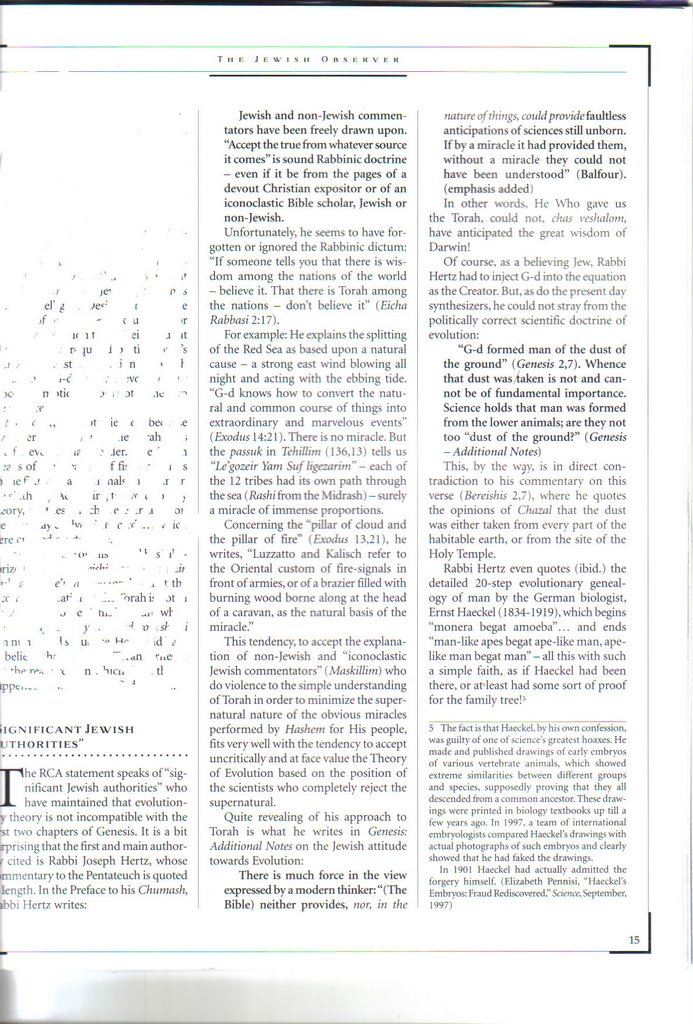
Jewish Observer targets Hertz Chumash, Shadal &c.

This month's Jewish Observer features a symposium on "The Cosmic Question: Random Evolution or an Intelligent Designer," which features a three-part article by Telshe Chicago rosh yeshiva R. Chaim Dov Keller. In it he damns discusses the Hertz Chumash, taking on the idea of שמע האמת ממי שאמרה because R. Keller interprets תורה בגוים אל תאמין differently than the rishonim do.

He also bites off quite a bit to chew in dismissing Shadal, among others, as "an 'iconoclastic Jewish commentator[s]' (Maskillim) who do violence to the simple understanding of Torah in order to minimize the supernatural nature of the obvious miracles performed by Hashem for His people."

This isn't a great scan, but then, it isn't a great attack on the beleaguered and admittedly dated (but heroic) Hertz Chumash.


As usual, click to enlarge.

The editor of Jewish Observer, R. Nosson Wolpin, has a close relationship with Artscroll, a competing enterprise which partly succeeded in burying the Hertz but I sincerely believe the Jewish Observer would put the Hertz Chumash into its sights even if he did not have anything to do with Artscroll.

PS there is substance of the critique I agree with. I mean, I do not think that an eclipse in New York City in the 1925 (pg. 251) really offers much insight into makat choshech, for example.

Tuesday, April 25, 2006

חכמת ישראל : Eat the fruit, throw away the shell

"If you wish to know what brand of tobacco Rashi used, ask Leopold Zunz. If you wish to know the interpretation of Rashi's writings, ask me."

--remark traditionally attributed to...R. Jacob Ettlinger (1798-1871) of Altona (quoted from "Bernard Revel Builder of American Jewish Orthodoxy" by Aaron Rothkoff, pg. 241)
"The great historian of the Jewish past, Heinrich Graetz, got most of his facts right in his monumental work, History of the Jews. But his obvious bias against traditional Judaism and his almost obsessive hatred of the rabbis of Israel spawned a school of Jewish history that did great damage to the Jewish people. They may have known what color shirt Rashi wore, but they ignored what Rashi really stood for and his immortal contribution to Jewish survival and destiny."

--R. Berel Wein, published originally in the Jerusalem Post and reprinted here
Paranthetically, and at the outset, it's worth pointing out that tobacco is native to North America and therefore the brand of tobacco Rashi smoked was none at all. This fact oddly and unwittingly illustrates R. Ettlinger's point in a way he probably didn't intend!

But getting back to the matter at hand: Wissenschaft des Judentums, or חכמת ישראל, and its modern descendent, academic Jewish studies.

R. Yitzchok Adlerstein posts today at Cross Currents about thoughts he had about the media coverage of the Gospel of Judas, one of many so-called Gnostic Gospels, which were texts of early Christian heresies. The Gospel of Judas, for example, presents Judas Iscariot as the most beloved disciple of Jesus who remained faithful to the end, "betraying" his master at his command.

Writes R. Adlerstein, "The general attitude [of Christians and institutional Christianity]I have noticed is, “What, we should be disturbed by a bunch of meshugaim suffering from desert heat-stroke? What makes their version more valuable or authentic than ours? For this you want us to discard a tradition of thousands of years?”

"I’m jealous. In the Jewish world, we often don’t react as calmly and sanely."

Unlike us Jews, who sold our birthright for a small price, by accepting the so-called scientific investigation of Judaism over tradition (that is, those of us who did and who do).

The truth is there is a lot to be said for that point, even though the Gospel of Judas is roughly equivalent to a late Sadduccean document rather than a fragment from a book of J. There is also a lot to be said in defense of חכמת ישראל.

Like most things, there is a lot more nuance to this subject than presenting it in terms of light and darkness, which does no justice to it. It is certainly true that Wissenschaft did violence to traditions. It's also true that many of its favorite sons had motives which one can disagree with, and that the movement spawned, directly and indirectly, plenty of crises for Jews and Judaism. But at the same time, it came about because of historical circumstances (there I go again!). There is a reason why it arose in the 19th century and not, say, the 14th.

A quote from "American Judaism" by Nahum Glatzer (pg. 69). It concerns the title character of Abraham Cahan's novel The Rise of David Levinsky, a young Russian yeshiva student who emigrates to the United States. On the boat he eats only kosher and davens regularly. Once in America he immediately seeks out a shul. But he also cuts his peyot, then shaves, then abandons the synagogue for night school--and "soon nothing is left--and with practically no soul searching":
The case of David Levinsky illustrates the crucial point that Judaism in eastern Europe, as in Germany, tended to ignore everything that might be considered theology. Only the practices of Judaism were taught. One was brought up to observe the commandments, and, for this reasons, as soon as one came in touch with a kind of thought which questioned fundamentals, one was at a loss. In other words, it may be said Jews lost their faith so easily because they had no faith to lose: that is, they had no doctrine, no collection of dogmas to which they could cling and with which they could resist argument. All they had, surrounding them like armor, was a complete set of practices, each presumably as holy as the next (emph. mine).
Whether this happened in America in the 1880s or another version of the same story in Altona in the 1780s or in Vilna in the 1920s, it is what happened. And in fact, the sentence I italicized in the above paragraph was a key element. מנהג ישראל תורה הוא may have been a rallying cry in response, but it was one that just illustrated how the two kinds of Jews couldn't communicate.

Here is worth repeating the reaction of Shadal to the news that Reformers in Germany had eliminated the second "יקום פורקן" from the liturgy: They fulfilled that which is written "וימח את כל היקום" (Gen. 7:23). Shadal, ever the traditionalist--but the irony is that he was also very modern, and very much engaged in his own brand of the scientific investigation of Judaism. In fact, this is one area where the lack of clear lines comes to the fore: lots of talmidei chachamim with yirat shamayim engaged in Wissenschaft, including an original member of the Agudah's moetzes gedolei ha-Torah, R. David Zevi Hoffman.

The question is, why? Is it just an evil way to approach religion? It is useless? Some of the people who would have applauded Shadal's witty remark would say just that, and that its forbidden also. But likely many of those people would have felt that way about some of his writings!

(Parenthetically, on doing some research for this post I came across this statement, by R. Adlerstein: "Alas, it has been a long time since Rav Dovid Tzvi Hoffman and his headlong charge against Higher Criticism and Jewish Wissenschaft." This is very curious. It's true that R. Hoffman fought against source criticism of the Bible. But he personally engaged in Wissenschaft, and taught it as a core component of his rabbinical seminary. A big part of his personal style of learning Gemara was חכמת ישראל. And not only that, his book "Mar Samuel" was branded apikorsus by R. Samson Rafael Hirsch.)

There are no easy answers. The truth lies somewhere in the middle. אין הכי נמי, R. Adlerstein has a point. To have a healthy Judaism we shouldn't destroy it! But neither should we totally interdict modern methods of study and investigation. Like R. Meir, when we find a רמון then תוכו אכל קליפתו זרק (Chag. 15b).

Thursday, March 30, 2006

What should a non-kabbalist do about kabbalah?

Shadal--R. Samuele Davide Luzzatto--was a great-nephew of another Luzzatto--Ramchal, author of Messilat Yesharim. He was an iconoclast in the sense that he was totally unafraid to be an original thinker. Given the intellectual climate some of us are familiar with today, some of the things he wrote seem shocking. But there is no evidence that he had a rebellious bone in his body. Eearly-mid 19th century Italy was not early-21st century Brooklyn. He wrote, for example, "I esteem Maimonides very greatly, but Moses the Lawgiver never dreamed of philosophy and the dreams of Aristotle." (Letters no. 83, quoted in J. Enc.) True, the Vilna Gaon held a similar view about the Rambam, but today many people would say "[the Vilna Gaon] could say it," but certainly not Shadal (who?)!

Unlike his uncle, who was a kabbalist, Shadal was very skeptical of kabbalah in general, something he arrived at an early age--before his bar mitzvah. In 1814 his mother took ill and his father, who was very much into kabbalah, wanted him to pray certain kabbalistic tefillos (or perhaps pray with kabbalistic kavanot) for his mother. His father believed that his tefillos had a certain purity due to his age. Young Shmuel David refused, because he did not accept kabbalah!

This certainly would seem to be cruel, but at the time he was personally taking care of her, cleaning the house etc. And it is said that when his poor mother would cough up blood he was the only one in the family who could stand to be there to clean her up.

Anyway, this gets to the matter of kabbalah. To many people kabbalah is the holiest of holy. To say that it is authentic would be an understatement. But alas, not everyone shares this view. Others are totally antagonistic toward kabbalah. Some think it is pure bunk. Some think it is a type of philosophical search, perhaps analagous to alchemy as a proto-scientific field. In that sense, it isn't "true" but neither is it false and forgery.

Precisely where I personally fall isn't important, but let's say simply that I am not kabbalistically inclined. The thing about that is that so MUCH halakhic praxis derives from the kabbalah! Today is Rosh Hodesh. Removing the tefillin before mussaf is a kabbalistic practice. Reciting the ana bekoach prayer, the berich shemei are kabbalistic. Friday night kabbalat shabbat is kabbalistic. And on and on it goes.

The question is, if [I] lean away from kabbalah, should I follow kabbalistic practices?

The answer for me is yes. Putting aside the fact that there is plain beauty in a lot of kabbalistic ideas and practices, which would seem to justify them in their own right, I coulnd't stop these things personally not because I "believe" in kabbalah, but also because it is close to impossible to perform kabbalah-removal surgery on halakhic praxis because it is so infused with kabbalah! In addition, I personally feel that to tamper with nussach and halakhah while I am still far from learned enough or perfect enough would be the height of yohora (religious haughtiness) for me. When it comes to things that aren't minhag avoseinu, e.g., inserting a passuk relating to my name at the end of shemona esrei (as per Shnei Luchot Ha-brit), I don't feel compelled to adopt it. But if we're talking about something like kabbalas shabbos or saying brich shemei, I'm not going to take out a scalpel!

Of course I've delicately avoided more touchy kabbalistic issues, such as saying a "le-shem yichud," before performing a mitzvah. Most of the practices I cited aren't really anything one way or the other. But when it comes to intending to perform a mitzvah "in the name of the unity" of God (last I checked, there was no problem with God's unity) or not wearing tefillin on chol ha-moed, a real halakhic issue, I have but to refer to the principle I outlined before: if my family does it, so will I.

LinkWithin

Related Posts with Thumbnails
'