In the comments section of Gil's review of Richard Elliott Friedman's Who Wrote the Bible, "The Jewish Da Vinci Code, some commenters were hostile to the idea that different voices or threads or sources or whateveryouwannacallit can as a point of fact be detected in the תורה, whether or not one lends credence to some or all of the assumptions of source criticism of the Torah (J, E, P, D + R in its most well known form). Others, including myself, believe that these voices etc. can be found.
Professor Lawrence Kaplan mentioned "frum Jewish scholars associated with the Orthodox community" in Israel who espouse a critical reading of the Torah.
To which commenter Andy asked "prof kaplan- I don't suppose it matters much, but how is a layman like me supposed to know if a scholar is frum or not? Maybe it should be posted on their institution's website along with their other info."
This is a strange commented to be directed at a leading Judaic studies scholar.
It seems to me that this is an archetypal negation of the Rambam's dictum to accept the truth from whomever speaks it, שמע האמת ממי שאמרה (from the introduction to שמונה פרקים. I've been around enough to know that not everyone agrees with this dictum, preferring to receive truth (and perhaps other things) from sources that pass some sort of test.
Still, its an odd comment to direct at someone whose work obviously depends on the sentiment which drove the Rambam to glean truth where it is found.
Someone pointed out to me that this comment is vaguely reminiscent of another kind of ideologically driven intellectual isolationism, notably the German movement called Deutsche Physik which rejected advances in physics as "Jewish science" and was directed particularly at the work of Albert Einstein. Proponents worried how to determine the Jewishness of the authors of articles on physics.
Getting back to the Rambam it must be noted that in explaining that his approach was to שמע האמת ממי שאמרה he didn't cite his sources, precisely so that מי שאין לו חך, those without experience*, would consider those ideas rather than dismissing them because of who said them, thinking that there must be some rotten inner meaning to it which they can't discern. While this violates the modern need to cite sources, as well as the ancient and modern need to מביא גאולה לעולם, at least it causes people to become familiar with things that are true and, I suppose, a case can be made that this is the lesser evil.
*This neat translation courtesy of Ethical Writings of Maimonides, ed. Raymond L. Weiss and Charles E. Butterworth. The translation came to my attention in a footnote in Marc Shapiro's Saul Lieberman & the Orthodox.
Wednesday, May 31, 2006


Tuesday, May 30, 2006
Artscroll advertising blitz in Israel
Artscroll Advertising Heavily in Eretz Yisroel
by Yated Ne'eman Staff
Artscroll is launching a sales campaign in Israel for all of its books through heavy advertising in the press, in botei knesses and via direct mail. The company has already distributed over 120,000 brochures in the form of newspaper inserts in the Hebrew editions of Yated Ne'eman and Hamodia as well as samples in botei knesses. The company plans to focus its marketing efforts on the Schottenstein Edition of the gemora, considered the Jewish publishing project on the largest scale (over 15 years and running), with the greatest investment (total cost of over $20 million) and the highest demand (about 20,000 copies of each volume are sold) ever. The new Compact Size Edition is a precise replica of the Full Size Edition designed to make available a more lighter, portable version to complement the home edition.
The new entirely Hebrew siddur, Ner Naftoli, is also being heavily marketed. Sales have been brisk in Chutz La'aretz and now an Israeli edition has been published based on the halochos and customs practiced in Eretz Yisroel.
To promote sales, 1,000 copies of the siddur have been distributed for free at selected locations around the country, including 150 at the Kosel Maarovi, 70 at Beis Knesses Itzkovitz in Bnei Brak and dozens at Beis Haknesses Hagodol. The advertising account has been handed over to Chen Advertising, which has worked with Artscroll for years. According to Chen Advertising some $150,000 will be invested in advertising over the coming months.
from Dei'ah VediburFriday, May 26, 2006


Are some yeshivos using archaic methods?
In 1902 the Jewish Quarterly Review published the following article, which was written by Ludwig Blau* in 1897:

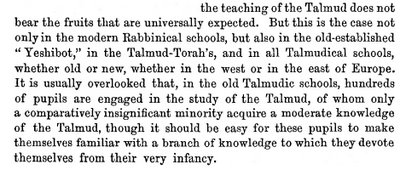
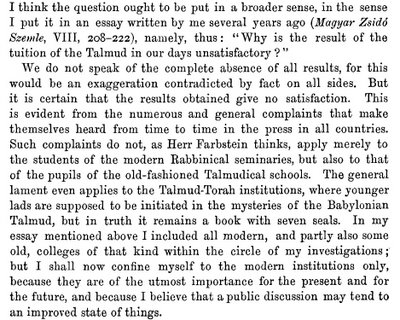
This is only an excerpt. Read the whole article here.
The article seeks to answer the question posed in the bit I excerpted and looks for solutions. Bear in mind that Ludwig Blau was not Orthodox, was not concerned here with the state of yeshivos. Furthermore, it is obvious that this system does produce talmidei chachamim--but most do not become that, not after being exposed to this material for many hours a day for many years. I once posted about someone who went through the system and called himself illiterate.
The question is, why? Why should this be?
The comments in this post on Emes Ve-Emunah speaks of the archaic curriculum in yeshivos (across the spectrum).
In my opinion this is less of a problem in elementary school, believe it or not, where there is more likely to be some program of study. In many high schools and certainly beyond the program amounts to all Gemara all day with little guidance. It is assumed that by a certain age (say, 15 or 16) the student can "make a leining" (leynen is Yiddish, leining is Yeshivish), which means to be able to independtly prepare a piece of Gemara. Given my own experience I can tell you that for many boys--but by no means all--it was pure illusion that they could make a leining. Of course there are those who simply can't, but there are also those who can translate all or some or most of the words but really can't independently understand what they're learning.
There is no systematic way the boys are taught, no systematic way they study, prepare, review etc. I believe that those who thrive in this system do so despite it, not because of it.
The truth is that the reason this is archaic is not simply because it isn't modern, but because it is a carryover from when yeshivos were mostly institutions attended by those who were motivated and able to learn the material. It may well be that its success was mixed, but there is no question that every 15 year old boy learning Talmud in a yeshiva a hundred years ago was probably on average above what today is average. Or else, you wouldn't be in a yeshiva. Today, yeshivos are in general mass institutions, even though there are elite yeshivos. Every 15 year old is expected to be in one, learning with a program that can be best be characterized as no real program, rather then apprenticing with a blacksmith. In that sense the system is archaic: it is still geared toward the assumption that the boys can make a leining, that they have a basic grasp of how the Gemara works, that they can do well despite the haphazardness.
The shame of it is that Blau's article was written in 1897 and there isn't essentially a better system in 2006 (keeping in mind also that Blau was trying to make Talmud "work" in Seminaries, not yeshivos and talmud Torahs, which he probably didn't much care about).
I know there are great exceptions. I know there is more structure in a lot of yeshivos than I protrayed, but even so, they are mostly general: e.g., be'iyun (in depth study) in the morning, be-kiyus (broad study) in the afternoon or evening.
Hopefully the methods of teaching and learning will improve such that the needs of popular, mass institutions are met.
*Encyclopedia Judaica entry:
BLAU, LUDWIG LAJOS (1861–1936), scholar. Blau studied at yeshivot, the Jewish Theological Seminary of Budapest, and the University of Budapest. As a student he was invited to teach at the Seminary where in 1889 he became a full professor. In 1914 Blau became director of the Seminary. For 40 years he was the editor of the Hungarian Jewish scholarly journal, Magyar Zsid\ Szemle. In 1911 he founded the Hebrew review Ha-Zofeh le-Hokhmat Yisrael be-Erez Hagar, which he edited until 1931. Blau was a prolific Jewish scholar who contributed to almost every aspect of Jewish learning. He was a regular contributor to most of the Jewish and non-Jewish scholarly periodicals dedicated to theology and philology. His bibliography includes 887 items and in the Zsid\ Szemle he reviewed 1,383 books. He was among the first to evaluate the talmudic information on the Bible and the masorah (Masoretische Untersuchungen, 1891; Zur Einleitung in die Heilige Schrift, 1894). He also investigated the information contained in traditional literature on ancient Hebrew booklore (Studien zum althebraeischen Buchwesen, 1902). His works subsequently gained added importance in light of interest in old Hebrew scrolls. Blau enriched general folklore by his book Das altjuedische Zauberwesen (1898). Equally his Juedische Ehescheidung und der juedische Scheidebrief (2 vols., 1911–12) broke new ground; with the discovery of divorce documents among the Bar Kokhba finds, this work takes on new relevance. Blau was among the first to make use of Greek papyri for the evaluation of talmudic law (Papyri und Talmud in gegenseitiger Beleuchtung, 1913; Prosbul im Lichte der griechischen Papyri und der Rechtsgeschichte, in Festschrift der Landesrabbinerschule, 1927). He also published the letters of Leone Modena (Leo Modenas Briefe und Schriftstuecke, 2 vols., 1905–06).
[Alexander Scheiber]
On the Main Line in Yiddish
Someone linked here at Yiddish forum Hyde Park under the heading "אינטערעסאנטע לינקס", "interesting links."
My blog, אן די מעין ליין , is described as
Thank you!
My blog, אן די מעין ליין , is described as
רואיגער; געשמאקער; אינטערסאנט; פראפעשענעל; אפען; אינפארמאטיוו; און באלערענדער; בלאג
Thank you!
Thursday, May 25, 2006
Historical context of stories inTalmud
I heard a tape of a fascinating shiur by R. Yaakov Elman called "Historical Context & Background of the Talmud." In it he analyzes a fairly well known incident in Babna Qamma 117a (translation here by Jeffrey Rubenstein):
Rav Yohanan was an old man and his eyelids sagged [over his eyes]. He said to them, "Lift up my eyes that I may see him." They lifted up [his eyelids] with a silver stick. He saw that his [Rav Kahana's] lip was split. He thought that he was laughing at him. He became embarrassed and he [Rav Kahana] died [as divine punishment for causing Rav Yohanan to feel ashamed].
Rav Yohannan was then informed that Rav Kahana wasn't smirking at him, but that his normal facial expression just gave that appearance. Given that, R. Yohannan tried to get forgiveness from Rav Kahana, but was unable to until he acknowledged Rav Kahana as his superior!
=================================================
R. Elman points out several things.
First, in the year 226 CE there had been a regime change. Babylonian Jewry came under control of a new dynasty, the Sassanians. The Sassanians were different then their predecessors who didn't interfere in minority communities internal affairs. Had this incident happened before 226 then the Parthian rulers would not have cared in the slightest if one Jew killed another. However, under the new regime Rav Kahana needed to skip town.
Secondly, there is ample evidence that the Jews in Eretz Yisrael, well, didn't really care for the Babylonian Jews. That isn't to say they hated them, but we all know about ethnic tensions. Furthermore, Rav Yohannan is quoted in numerous places saying derogatory things about Babylonian Jews.
Thirdly, the successors of the initial Sassanian rulers cooled things down considerably, which means that this incident happened after 226 but probably not more than 10 years later then that.
Fourthly, Rav Yohannan died in the year 279, having been born in 180 (actually, I got those dates from EJ; R. Elman may have qualified them slightly, but I don't remember, because he said that Rav Yohannan was 90 when he died) Given that, he would have been in his fifties when this story happened. True, we are talking about the 3rd century here, but hardly the old man described in the story!
Fifth, the motif of an old person's eyelids that can't be lifted by themselves is paralleled in Persian literature. In addition, the use of a silver instrument is signifigant, in that silver was considered a particularly noble metal by the Persians, even more than gold (which was still worth more!). In addition, a Persian word appears.
So, how did a typically Persian story happen to an amora of Eretz Yisrael who seems not to have been nearly as old as described?
According to R. Elman, the story is paralleled in the Yerushalmi, with no mention of the eyelids. Furthermore, one of the best Talmud manuscripts, the Hamburg ms--which I tried to get access to in order to verify the following, but haven't been able to)--has the story but without the Persian motifs (the eyelids, the silver)! This particular mss is not that old, its from the 14th century, but it was copied from a very, very old Talmud manuscript and preserves a lot of pristine readings.
Says R. Elman, the theory proposed by R. Daniel Sperber (and someone else whose name escapes me) is that the eyelids and the silver, that whole part of the episode, was an interpolation from ge'onic times! It is well known that there was something of a power struggle between proponents of the Talmud Yerushalmi and the Talmud Bavli. For example, Pirkoi Ben Baboi, student of R. Yehudai Ga'on, wrote a famous iggeret which was highly influential in establishing the supremacy of the Bavli.
Perhaps this was somehow added to the original story, for it seems to be a later interpolation, to make Rav Yohannan, the Eretz Yisraeli amora par excellence look less than flattering.
Note: I dashed this off without having heard the shiur that recently and without having taken notes. I'm sure I made mistakes and didn't do it justice; those errors are mine.
A certain man intended to reveal another man's straw [to the Persian tax authorities.] He came before Rav. He [Rav] said to him, "Do not reveal it! Do not reveal it." He said to him, "I will reveal it! I will reveal it!"This is a bit of a long story, and I know that not everyone reads long blog posts, although many will already be familiar with this story. So you could just read the bolded part. The background is basically that Rav Kahana, a Bavli (Babylonian), killed a man who threatened to inform on another man to the authorities. His rebbe, Rav, sent him to Eretz Yisrael, to the yeshiva of Rav Yohannan in Tiberius. As a sort of penance for the killing, Rav Kahana was supposed to be sort of incognito for seven years! But he was quickly discovered to be a great scholar-a lion, in fact! He bested Rav Yohannan in class and here is where you should read the bolded text:
Rav Kahana was sitting before Rav. He stood up and tore out his [the man's] windpipe. [He said,] “Your sons lie in a swoon at the corner of every street, like an antelope caught in a net (Isa 51:20). Just as they never show mercy to an antelope once it has fallen into a net, so the idolators never show mercy to the money of Jews once it has fallen into their hands."
Rav said to him, "Kahana, until now there was the Kingdom of the Greeks who were not strict about bloodshed [and allowed us to administer capital punishment]. But now there is the [Kingdom of the] Persians, who are strict about bloodshed. Rise and go up to the Land of Israel and accept upon yourself that you do not raise objections to [the teaching of] R. Yohanan for seven years."
He [Rav Kahana] went there [to the Land of Israel] and came upon Resh Laqish who was sitting and reviewing the daily lesson before the rabbis. He [Rav Kahana] said to them, "Where is Resh Laqish?" They said to him, "What for?" He told them this objection and that objection, this solution and that solution. They went and told Resh Laqish. Resh Laqish went and said to R. Yohanan, "A lion had come up from Babylonia. Let the Master look deeply into the lesson for tomorrow."
The next day they seated him [Rav Kahana] in the first row [of sages]. He [R. Yohanan] said a tradition and he [Rav Kahana] did not object. He said [another] tradition and he did not object. They seated him back through seven rows until he was in the last row. R. Yohanan said to Resh Laqish, “The lion you mentioned has become a fox.”
He [Rav Kahana] said, “May it be [God’s] will that these seven rows take the place of the seven years that Rav told me [not to raise objections].” He stood up on his feet. He said, “Let the master go back to the beginning.”
He [R. Yohanan] said a tradition and he [Rav Kahana] objected [until] they placed him in the first row. He said a tradition and he objected. R. Yohanan was sitting on seven cushions. They removed a cushion from under him. He said a tradition and he objected to him, until they removed all the cushions from under him and he was sitting on the ground.
R. Yohanan was an old man and his eyelids sagged [over his eyes]. He said to them, "Lift up my eyes that I may see him." They lifted up [his eyelids] with a silver stick. He saw that his [Rav Kahana's] lip was split. He thought that he was laughing at him. He became embarrassed and he [Rav Kahana] died [as divine punishment for causing R. Yohanan to feel ashamed].
The next day R. Yohanan said to the rabbis, "Did you see how that Babylonian acted?" They said to him, "That's the way he is [he has a split lip]." He [R. Yohanan] went to his [burial] cave. He saw that a snake was coiled about it. He said, "Snake! Snake! Open the door and let the master approach his student." It did not open. [He said,] "Let a colleague approach his colleague." It did not open. [He said,] "Let a student approach his teacher." It opened for him.
He prayed and revived him. He said to him, "Had I known that that is the way you are, I would not have felt embarrassed. Now, Sir, come with us to the academy." He said, "If you can pray that I will never die again [because of you], I will go with you. If not, I won't go." He said, "I cannot, for when times change, that which changes, changes.,
He [R. Yohanan] asked him [Rav Kahana] all his doubts [regarding points of law] and he [Rav Kahana] resolved them for him. This is [the meaning] of what R. Yohanan said, "What I thought was yours [=I thought the Torah was the Palestinians'] was theirs [the Babylonians']."
Rav Yohanan was an old man and his eyelids sagged [over his eyes]. He said to them, "Lift up my eyes that I may see him." They lifted up [his eyelids] with a silver stick. He saw that his [Rav Kahana's] lip was split. He thought that he was laughing at him. He became embarrassed and he [Rav Kahana] died [as divine punishment for causing Rav Yohanan to feel ashamed].
Rav Yohannan was then informed that Rav Kahana wasn't smirking at him, but that his normal facial expression just gave that appearance. Given that, R. Yohannan tried to get forgiveness from Rav Kahana, but was unable to until he acknowledged Rav Kahana as his superior!
=================================================
R. Elman points out several things.
First, in the year 226 CE there had been a regime change. Babylonian Jewry came under control of a new dynasty, the Sassanians. The Sassanians were different then their predecessors who didn't interfere in minority communities internal affairs. Had this incident happened before 226 then the Parthian rulers would not have cared in the slightest if one Jew killed another. However, under the new regime Rav Kahana needed to skip town.
Secondly, there is ample evidence that the Jews in Eretz Yisrael, well, didn't really care for the Babylonian Jews. That isn't to say they hated them, but we all know about ethnic tensions. Furthermore, Rav Yohannan is quoted in numerous places saying derogatory things about Babylonian Jews.
Thirdly, the successors of the initial Sassanian rulers cooled things down considerably, which means that this incident happened after 226 but probably not more than 10 years later then that.
Fourthly, Rav Yohannan died in the year 279, having been born in 180 (actually, I got those dates from EJ; R. Elman may have qualified them slightly, but I don't remember, because he said that Rav Yohannan was 90 when he died) Given that, he would have been in his fifties when this story happened. True, we are talking about the 3rd century here, but hardly the old man described in the story!
Fifth, the motif of an old person's eyelids that can't be lifted by themselves is paralleled in Persian literature. In addition, the use of a silver instrument is signifigant, in that silver was considered a particularly noble metal by the Persians, even more than gold (which was still worth more!). In addition, a Persian word appears.
So, how did a typically Persian story happen to an amora of Eretz Yisrael who seems not to have been nearly as old as described?
According to R. Elman, the story is paralleled in the Yerushalmi, with no mention of the eyelids. Furthermore, one of the best Talmud manuscripts, the Hamburg ms--which I tried to get access to in order to verify the following, but haven't been able to)--has the story but without the Persian motifs (the eyelids, the silver)! This particular mss is not that old, its from the 14th century, but it was copied from a very, very old Talmud manuscript and preserves a lot of pristine readings.
Says R. Elman, the theory proposed by R. Daniel Sperber (and someone else whose name escapes me) is that the eyelids and the silver, that whole part of the episode, was an interpolation from ge'onic times! It is well known that there was something of a power struggle between proponents of the Talmud Yerushalmi and the Talmud Bavli. For example, Pirkoi Ben Baboi, student of R. Yehudai Ga'on, wrote a famous iggeret which was highly influential in establishing the supremacy of the Bavli.
Perhaps this was somehow added to the original story, for it seems to be a later interpolation, to make Rav Yohannan, the Eretz Yisraeli amora par excellence look less than flattering.
Note: I dashed this off without having heard the shiur that recently and without having taken notes. I'm sure I made mistakes and didn't do it justice; those errors are mine.
Wednesday, May 24, 2006
'Off the Derech' by Faranak Margolese reviewed by me
I started writing this review months ago but for some reason didn't finish it. Well, here 'tis:
Off the Derech by Faranak Margolese has been getting some attention, and for good reason. The book is more than four hundred pages long and seeks to explain Orthodox attrition and what is to be done about it. Her central thesis is that people raised Orthodox leave Orthodoxy (go "off the derech") because of factors in their life which cause them to associate Orthodoxy (that is to say, in her view, Torah, halakhah, Judaism) with pain, whether the pain is caused by stifling conformity or rejection or other reasons.
In addition to doing a good amount of research, meticulously documented in the bibliography, she conducted personal interviews with Orthodox educators, mental health professionals and most importantly, many "off the derech" people from a wide range of backgrounds. In addition, in researching for the book she conducted a web survey which returned more than 450 valid results from those defined as "off the derech" (but non-scientific, by her own admission). Essentially defining "observant" as "keeps kashruth and shabbath in an Orthodox manner," she defined "off the derech" as abandoning one or both those things. While acknowledging the imprecision of such criteria, it is useful. She also added a person touch by including her own story, being raised in a traditional (but not particularly observant) Sephardi family, her experiences both highly positive and highly negative in yeshivoth and seminaries.
All in all, her findings essentially reiterated the recurring theme of the book: it is mistakes parents and teachers and Orthodox society makes which pushes some of our young away. Her solution then, meticulously detailed, would involve reversing the negatives which children can be exposed to, by increasing tolerance, understanding, creating an association of warmth and love with observance, overlooking minor infractions so as not to miss the big picture etc. Very little is left unexplored in this book, whether the presence of racism or fanaticism, hypocrisy and anti-intellectualism (although regretably the issue of sexuality barely comes up).
It seems to me that she is onto somethig. It is clear from beginning to end that the author is a kind, warm, friendly person. She advocates honesty, joy and removing stress and pressure in the environment in which we raise and teach our children. Truly, if all the Orthodox world were like her, things would be swell.
To begin with, her approach is rather tolerant of diverse points of view. Her book quotes from the Chazon Ish to Sussanah Heschel to Dennis Prager to Rav Shach. Obviously she believes the Rambam's dictum of accepting the truth from whoever says it--שמע האמת ממי שאמרה (from his intro. to Shemoneh Peraqim). This is a healthy Orthodoxy, in my view. Unfortunately much of the real Orthodoxy is highly fragmented. In 'Off the Derech' Rav Shach is quoted, and so is R. Menachem Mendel Schneerson. It is hard to imagine that Rav Shach would be pleased. In addition, one part of the book quotes a man who went "off the derech" who remembered that he was told by rabbeim in yeshivoth he applied to that "real bachurim don't read newspapers." This is an example of the intolerance that drives some people away. Yet Rav Shach is quoted here saying much the same thing. At the very least, this sort of ethic came from somewhere. There is nothing wrong with quoting Rav Shach at his warmest and most tolerant, as she does, but it is hard to forget that there is a larger context for such quotes. Later she quotes R. Eliyahu Dessler. In 1951 Rav Dessler wrote the following (translated by R. Aryeh Carmell in Vol. III pp. 355-60 of Michtav Me-eliyahu):
That said, her modus seems to be to ignore that which divides us, and to ignore that which is unpleasant in what rabbinic leaders have offered. If we could all do that and focus more on what unites us, and most importantly, live up to our own hype then perhaps the 'off the derech' phenomenon could be reversed. After all, it is precisely the good things that are real and the hype for things that ought to be which leads people towards Orthodoxy.
In addition to doing a good amount of research, meticulously documented in the bibliography, she conducted personal interviews with Orthodox educators, mental health professionals and most importantly, many "off the derech" people from a wide range of backgrounds. In addition, in researching for the book she conducted a web survey which returned more than 450 valid results from those defined as "off the derech" (but non-scientific, by her own admission). Essentially defining "observant" as "keeps kashruth and shabbath in an Orthodox manner," she defined "off the derech" as abandoning one or both those things. While acknowledging the imprecision of such criteria, it is useful. She also added a person touch by including her own story, being raised in a traditional (but not particularly observant) Sephardi family, her experiences both highly positive and highly negative in yeshivoth and seminaries.
All in all, her findings essentially reiterated the recurring theme of the book: it is mistakes parents and teachers and Orthodox society makes which pushes some of our young away. Her solution then, meticulously detailed, would involve reversing the negatives which children can be exposed to, by increasing tolerance, understanding, creating an association of warmth and love with observance, overlooking minor infractions so as not to miss the big picture etc. Very little is left unexplored in this book, whether the presence of racism or fanaticism, hypocrisy and anti-intellectualism (although regretably the issue of sexuality barely comes up).
It seems to me that she is onto somethig. It is clear from beginning to end that the author is a kind, warm, friendly person. She advocates honesty, joy and removing stress and pressure in the environment in which we raise and teach our children. Truly, if all the Orthodox world were like her, things would be swell.
To begin with, her approach is rather tolerant of diverse points of view. Her book quotes from the Chazon Ish to Sussanah Heschel to Dennis Prager to Rav Shach. Obviously she believes the Rambam's dictum of accepting the truth from whoever says it--שמע האמת ממי שאמרה (from his intro. to Shemoneh Peraqim). This is a healthy Orthodoxy, in my view. Unfortunately much of the real Orthodoxy is highly fragmented. In 'Off the Derech' Rav Shach is quoted, and so is R. Menachem Mendel Schneerson. It is hard to imagine that Rav Shach would be pleased. In addition, one part of the book quotes a man who went "off the derech" who remembered that he was told by rabbeim in yeshivoth he applied to that "real bachurim don't read newspapers." This is an example of the intolerance that drives some people away. Yet Rav Shach is quoted here saying much the same thing. At the very least, this sort of ethic came from somewhere. There is nothing wrong with quoting Rav Shach at his warmest and most tolerant, as she does, but it is hard to forget that there is a larger context for such quotes. Later she quotes R. Eliyahu Dessler. In 1951 Rav Dessler wrote the following (translated by R. Aryeh Carmell in Vol. III pp. 355-60 of Michtav Me-eliyahu):
"...the philosophy of Yeshiva education is directed towards one objective alone, to nurture Gedolei Torah and Yirei Shamayim in tandem. For this reason university was prohibited to their students, because [the Gedolim] could not see how to nurture Gedolei Torah unless they directed all education towards Torah exclusively. However, do not think that they did not know in advance that through this approach, G-d forbid, many (students) will be ruined, since they will be unable to survive such an extreme position, and [therefore] separate from the path of Torah. However, this is the price that must be paid for [producing] Gedolei Torah."This would seem to me to be the very practice which this book seems to counter. Again, why not quote Rav Dessler where he is warm and tolerant? I understand that. Surely we have much to learn from R. Dessler, and she is right for quoting him! But the trouble is that some of the attitudes she identifies as destructive came from somewhere.
That said, her modus seems to be to ignore that which divides us, and to ignore that which is unpleasant in what rabbinic leaders have offered. If we could all do that and focus more on what unites us, and most importantly, live up to our own hype then perhaps the 'off the derech' phenomenon could be reversed. After all, it is precisely the good things that are real and the hype for things that ought to be which leads people towards Orthodoxy.
Tuesday, May 23, 2006
emails of canaanites?
What are emails of canaanites? Someone found my blog using that search string. Which is odd.
Monday, May 22, 2006
A fisking of 'The Dangers of Midrash'
Josh at Parsha Blog has a great post which fisks an article by Rabbi Pinchas Rosenthal in last week's 5 Towns Jewish Times called The Dangers of Midrashim (download the article ).
R. Rosenthal's point is that children should know that midrashim are homiletic and non-literal and that this is the only correct way to approach midrash. However, Josh points out that as the only way, it is a distortion of tradition.
An excerpt from the article:
His post is long, and like most posts on his excellent Parsha Blog is, well, excellent. And like most posts at Parsha Blog if people are reading, they aren't talking. Read this post, read the original article. Good points all around!
I can't really add more except to say that both analyses are a real sign of the times. R. Rosenthal is reacting to the fact that no one seems to know what to do with midrash, but so is Josh.
One thing to think about is that while not all midrashim are of the same antiquity or authority or reliability, without midrash aggadah we would know very little about what Chazal in various periods believed and how they approached Torah. Every bit of teaching that we have offers keys to unlocking hitherto unknowns, and neither glib dismissal nor a superficial, uncritical approach does the Jewish understanding of Torah and, indeed, Judaism justice.
Edit: Having thought about it more, I would say that R. Rosenthal is also addressing an effect that I once blogged about, the "lucky midrash." Basically, it isn't only that children and then adults believe that all midrash aggadah is literal and exchangeable with the peshat, but that there exists a selection of midrashic explanations that "everyone knows," midrashim like כפה עליהם הר כגיגית or רבקה בת שלשה or the about the pharaoh's daughter's arm. And then there is the rest of the midrashic literature, which average people are unfamiliar with.
In effect, the Torah becomes rewoven with some midrashim. If there are three midrashic views, often one will be the "lucky" one, the one which fills in the cracks in the text. In effect, many people are educated to view the Torah as if it were a page of Artscroll Talmud, where the main text is the words in bold and a predictable selection from the vast body of midrashic material supplements and makes it intelligible (see an example of this technique in Artscroll's Talmud--by the way, in the case of this Talmud the technique is praiseworthy since it clearly distinguishes between the text and Artscroll's interpretation of the text).
All in all, R. Rosenthal is decrying a consequence of a very superficial approach to derash, while Josh (R. Josh, really :) ) is asking some very sophisticated questions that suppose a sophisticated approach. I guess if one had to ask which is preferable, I'd say without a doubt Josh's is. But what if it isn't between superficial one way and sophisticated, but between superficial one way and superficial another way?
R. Rosenthal's point is that children should know that midrashim are homiletic and non-literal and that this is the only correct way to approach midrash. However, Josh points out that as the only way, it is a distortion of tradition.
An excerpt from the article:
The other day, the student was an eager young lady named Leah. I asked her the following question: If you were able to go back in time to the moment when Pharaoh’s daughter saw baby Moshe in his basket, what would you see? Would you see Pharaoh’s daughter requesting her maidservant to fetch the basket—as the pasuk tells us—or would you see her arm grow 25 feet long (like Mister Fantastic) and rope in the basket—as the Midrash says?An exceprt from Josh:
I felt at that moment as if I had asked Leah to choose between her two parents at a divorce proceeding. She knew that the Torah was an authority and correct and the Midrash was an authority and correct. Her mind was telling her both versions could not be simultaneously true! Therefore, she was frozen and unable to respond.
...
Let me fast-forward to an anthropology class at Queens College. The professor is discussing ancient Egypt. He mentions there is a legend among the Jews about the daughter of Pharaoh concerning her arm stretching out to retrieve baby Moses. Leah raises her hand. She says that it was a miracle and the daughter of Pharaoh had her arm stretched out to save Moshe. Suddenly, all 53 members of her class turn to her and stare. Her face turns crimson. The professor asks her, “Do you believe that actually happened?” Leah feels the temperature rising. She knows that her beliefs are under attack, and that she has been publicly put on the spot. She desperately wants to explain the Torah position in a cogent way, and yet she finds that despite 15 years of yeshiva education, she is unable to do so.
Let me fast-forward to an anthropology class at Queens College. The professor is discussing ancient Egypt. He mentions there is a legend among the Jews about the Nile turning to blood. Leah raises her hand. She says that it was a miracle and Aaron stretched his hand over the waters and they turned to blood. Suddenly, all 53 members of her class turn to her and stare. Her face turns crimson. The professor asks her, “Do you believe that actually happened?” Leah feels the temperature rising. She knows that her beliefs are under attack, and that she has been publicly put on the spot. She desperately wants to explain the Torah position in a cogent way, and yet she finds that despite 15 years of yeshiva education, she is unable to do so.The gist of Josh's point is that there is definitely not one monolithic way to teach and to approach derash and that R. Rosenthal is correct that students are ill-equipped to deal with serious Bible scholarship (whether traditional or not) because they aren't being taught and enabled to.
Yes, Rabbi Rosenthal, not only midrashim speak of miracles. This I think is your real trouble, as evident by your earlier jibe "like Mr. Fantastic." Will Leah have an easier time explaining the many miracles written in the actual text of the Torah than the miracles mentioned in midrashim? What about all of the plagues? What of the splitting of the reed sea? The destruction of Sodom? The angels blinding the residents of Sodom? The giving of the Torah on Mt. Sinai? The manna falling every day? The clouds of Glory and the Heavenly fire leading the Israelites in the desert? The widow pouring oil from one vessels into many other vessels? Eliyahu ascending in a chariot of fire? The list goes on. To all these, the anthropology professor can ask, "Do you believe that actually happened?" Jewish beliefs are not determined by anthropology professors at Queens College.
His post is long, and like most posts on his excellent Parsha Blog is, well, excellent. And like most posts at Parsha Blog if people are reading, they aren't talking. Read this post, read the original article. Good points all around!
I can't really add more except to say that both analyses are a real sign of the times. R. Rosenthal is reacting to the fact that no one seems to know what to do with midrash, but so is Josh.
One thing to think about is that while not all midrashim are of the same antiquity or authority or reliability, without midrash aggadah we would know very little about what Chazal in various periods believed and how they approached Torah. Every bit of teaching that we have offers keys to unlocking hitherto unknowns, and neither glib dismissal nor a superficial, uncritical approach does the Jewish understanding of Torah and, indeed, Judaism justice.
Edit: Having thought about it more, I would say that R. Rosenthal is also addressing an effect that I once blogged about, the "lucky midrash." Basically, it isn't only that children and then adults believe that all midrash aggadah is literal and exchangeable with the peshat, but that there exists a selection of midrashic explanations that "everyone knows," midrashim like כפה עליהם הר כגיגית or רבקה בת שלשה or the about the pharaoh's daughter's arm. And then there is the rest of the midrashic literature, which average people are unfamiliar with.
In effect, the Torah becomes rewoven with some midrashim. If there are three midrashic views, often one will be the "lucky" one, the one which fills in the cracks in the text. In effect, many people are educated to view the Torah as if it were a page of Artscroll Talmud, where the main text is the words in bold and a predictable selection from the vast body of midrashic material supplements and makes it intelligible (see an example of this technique in Artscroll's Talmud--by the way, in the case of this Talmud the technique is praiseworthy since it clearly distinguishes between the text and Artscroll's interpretation of the text).
All in all, R. Rosenthal is decrying a consequence of a very superficial approach to derash, while Josh (R. Josh, really :) ) is asking some very sophisticated questions that suppose a sophisticated approach. I guess if one had to ask which is preferable, I'd say without a doubt Josh's is. But what if it isn't between superficial one way and sophisticated, but between superficial one way and superficial another way?
What is the legacy of R. Joseph Hertz?
A friend sent me an article about R. Joseph Hertz, whom I recently blogged about indirectly at What's Bothering Artscroll?. After all these years, there still seems to be a lot of interest in R. Hertz. Including a book about him.
You can read three forwards he wrote for the Soncino Talmud translation: Nezikin, Moed and Nashim. (The usual caveats about that site apply, nevertheless, this is the text) Here is the article:
You can read three forwards he wrote for the Soncino Talmud translation: Nezikin, Moed and Nashim. (The usual caveats about that site apply, nevertheless, this is the text) Here is the article:
A champion of tradition who was no Conservative
By Benjamin Elton

The Jewish Chronicle, May 5 2006


Like many great men, Hertz's legacy is the subject of dispute. Different
Jewish groups have claimed him as one of their own. In particular, the
Conservative/Masorti movement associates itself with his theology.

A quick review of what he said and did as Chief Rabbi will reveal a
different picture to the image often presented of him as progressively
minded and only moderately traditional, a man who would have been more at
home at the New North London than the North Hendon Adath.

If the mark of Orthodoxy is a belief that the Torah was given to Moses on
Sinai, then Hertz passes the test. "Judaism stands or falls with the
historical actuality of the revelation at Sinai," he said. A third of the
Additional Notes in the Chumash attack Biblical Criticism (which rejected
the divine authorship of the Torah).

Hertz deals with all the major problems: the two accounts of Creation, the
historicity of the Exodus from Egypt, the possibility that the Code of
Hammurabi was the source of biblical law, and the age of the books of
Leviticus and Deuteronomy. In each case Hertz argued for the traditional
position.

As well as the Written Law, Judaism depends on the Oral Law, which Orthodoxy
also holds was given on Sinai. Hertz supported this view of the Oral
Tradition, writing that it was "handed down from the earliest days by word
of mouth, until it was codified in the Mishnah." When Hertz came across
individuals or institutions who disagreed with these principles, he attacked
them ferociously. In 1926 he delivered a blistering series of sermons
against Liberal Judaism, which would cause outrage today. In 1915 he forced
out of office the Rev Dr Joseph Hockman of the New West End for expressing
unorthodox views, very similar to those Louis Jacobs would later propound.

Hertz did hold some views that today would be rejected by many Orthodox
rabbis. He believed that halachah had developed over time, he thought that
some Psalms were written after the time of David and Solomon, and did not
think it necessary to believe that the book of Isaiah was by one author. But
these views were also held by such giants of modern Orthodoxy as Rabbis
Esriel Hildesheimer and David Hoffman.

Against all this evidence, the fact that Hertz used the term "progressive
conservatism," which meant something different then than it does now, or
that he attended the Jewish Theological Seminary, then a modern Orthodox
institution, are trivial. Hertz had some modern views, but he was firmly
rooted in tradition. His own definition of his religious commitments should
settle all doubt: "The teachings and practices which have come down to the
House of Israel through the ages; the positive Jewish beliefs concerning
God, the Torah and Israel; the sacred festivals; the holy resolve to
maintain Israel's identity; and the life consecrated by Jewish observances."


Benjamin Elton is currently completing a PhD on the British Chief Rabbinate
Pied Pipers: charismatic rabbis/ teachers
Educator Paul Shaviv posted an excerpt from his forthcoming book on running Jewish high schools at Hirhurim. The excerpts are about charismatic rabbis/ teachers. The excerpt takes up three comments: I, II, III.
The charismatic teacher (the ‘Pied-Piper”) is one of the most difficult situations for a Principal to deal with. A charismatic teacher will deeply affect and influence some students – but will almost always leave a trail of emotional wreckage in is/her wake .A very interesting perspective from a principal with 1400 students,
read the rest
Thursday, May 18, 2006





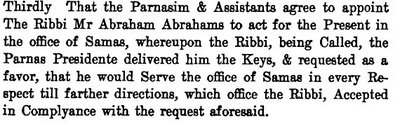
An 18th century English language witness to "ribbi"
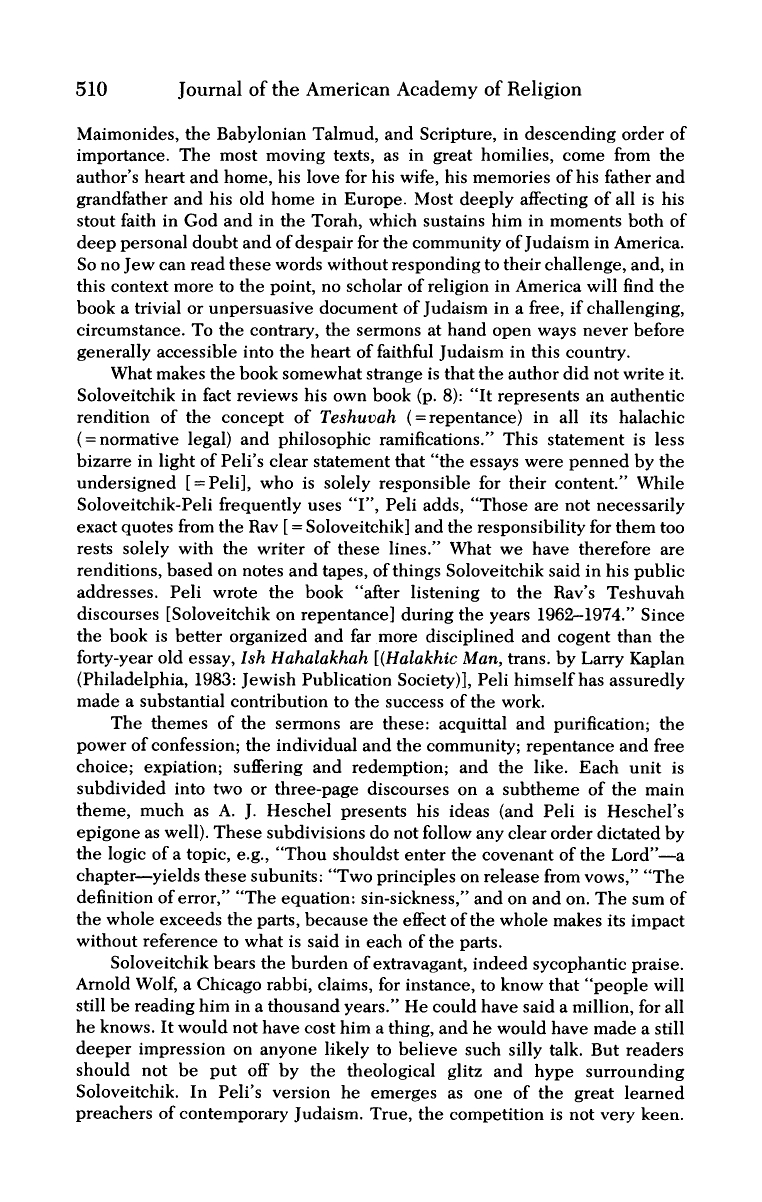
Not that witnesses are needed given that centuries old Hebrew mss vocalize r-b-y as ribbi, but appropos this post, here is an interesting thing from the "Minute Book of the Spanish and Portuguese Congregation Shearith Israel in New York, 1760-1786" published by American Jewish Historical Society, Publications, 21 (1913) p.83.
This particular bit is dated The fourth day of the month of Adar, year 5528 [February 22, 1768]. The occasion was "a Meeting of the Parnassim, and Mr Daniel Gomez, Joseph Simson, Hayman Levy, assistants."
This particular bit is dated The fourth day of the month of Adar, year 5528 [February 22, 1768]. The occasion was "a Meeting of the Parnassim, and Mr Daniel Gomez, Joseph Simson, Hayman Levy, assistants."

Those funny squiggly letters

This image is explained in this post and this post.
I'm reposting this so that I can then link to this post on my sidebar, since its a recurring subject that I get emails about.
Briefly, it spells "On the Main Line" in paleo-Hebrew letters, and for no reason other than I like it. I made the image using a font based on a particular Phoenician inscription. Further, I didn't divide the words with dots, which would be how an actual ancient Hebrew text would read: on.the.main.line. The reason why is because it didn't look that good! However, some ancient Phoenician (as opposed to Israelite) inscriptions don't divide words using lines, and the Ramban was of the opinion that the original Hebrew of the Torah didn't divide words, so I felt free to use a little creative license.
As for the transcription, it doesn't make a lot of sense if you consider that I transcribe "the" as "תחה." Now, why would I do that?
The answer is because there really is no good way of writing English using Hebrew characters, since the sounds don't match. That's why the great American president becomes "לינקולן" in Hebrew--and Hebrew doesn't have a silent ל!
So I decided to use the equivalent letter as best as possible. Since the Roman alphabet which is used in modern English is descended from Greek, which is descended from Phoenician, which is the same as Hebrew, it is possible to find some sort of one-to-one correspondence.
Thus, for "the" I was faced with two choices. I could have considered that the "th" sound in English is similar to the Greek "theta," which is based on ת, and then used a ה which became an "epsilon" in Greek and an "e" in Roman/ English, or I could have done what I did, which was note that the ת was the ancestor of "t," the ח the ancestor of "h," the ה the ancestor of "e" &c.
Truth is, I think its time for a revision of that image, but meanwhile here is the explanation anew.
Tuesday, May 16, 2006
Rabbi versus Ribbi
There are two dominant traditional pronunciations for "רבי" the rabbinic Hebrew word and title, as found in vocalized manuscripts of the mishnah and perpetuated in siddurim: ribbi (ribee) and rabbi (rahbee). Roughly speaking, Jews of eastern descent have ribbi and those of western, rabbi. This point was briefly touched upon in this English Hebraica post.
How did this happen? Which is original, in the sense of what the tannaic rabbis were actually called?
To illustrate this, its worth listening to some audio examples:
Here is an Iraqi version of the Lag B-Omer song ואמרתם כה לחי רבי שמעון בר יוחאי (as sung by Eliyahu Barazani) and a Iranian version (by Yonah Dardashty--although this version has musical accompaniment, as does this Moroccan version. The Moroccan one is especially interesting because (to these ears) the singer's pronunciation doesn't sound quite like a hirik (ribbi) and it doesn't sound quite like a seghol (rebbe). It's some vowel that somehow seems to be a combination of the two.
Which is it, rabbi or ribbi? More to come in another post, with sources, examples, some early witnesses, philology and speculation.
R. Shim'on ben Shetach saw the trees and the forest
The story in yesterday's New York magazine is making the rounds. One issue that is being discussed is comments attributed to an elderly rosh yeshiva, who I will not name here since I can't be certain he made those comments or what he intended if he did. In any case, the comment was to the effect that child molestation that doesn't involve actual penetration is not actionable in halakhah. Now, the report makes the claim that this "pesaq" was used to intimidate victims into silence. Perhaps the comment was never made. Perhaps it was made in a theoretical sense and then used to silence victims, without this rosh yeshiva's knowledge.
However, that is what I want to comment on. Suppose it was only theoretical. What then?
I'm reminded of the Gemara Yerushalmi Baba Metzia 2:5.
R. Shim'on ben Shetach made a living by selling linen. His students decided to buy a donkey for him to make it easier for him. They purchased a donkey from a bandit and it turned out that there was a precious stone dangling from it. They told him about it and said that he doesn't need to work hard anymore. R. Shimon ben Shetach said: Return it! They said to him, although gezel akum is prohibited, returning an avedah to an akum is not required!
So he said:
!?מה אתון סברין שמעון בן שטח ברברין הוה
Should they say "Shim'on ben Shetach is a barbarian?!"
בעי הוה שמעון בן שטח משמע בריך אלההון דיהודאי מאגר כל הדין עלמא
"Shim'on ben Shetach wants to hear Blessed is the God of the Jews more than anything in the world."
Monday, May 15, 2006
The heroic Hertz Chumash
A few years ago there was article article by Ami Eden in The Forward about new Torah translations.
The piece quoted Artscroll general editor R. Nosson Scherman on the archaic Hertz Chumash, the one Chumash that could be found in many, if not most, English speaking Orthodox, Conservative and Reform synagogues for decades.
This is a very frank quotation. Would that I could have heard the entire conversation, but this is all I've got. It's an interesting admission of the point of view of R. Sherman, who authors most of the Overviews [sic] in Artscroll books, a POV which is so very different from the output of Artscroll's press. One thing to consider is to what extent Artscroll itself hasn't contributed to the idea that this approach is offensive, as well as yeshiva education.
That said, it should be pointed out that the Hertz Chumash was an apologetic commentary that used modern scholarship rather than engaged in it (discussed here).
The piece quoted Artscroll general editor R. Nosson Scherman on the archaic Hertz Chumash, the one Chumash that could be found in many, if not most, English speaking Orthodox, Conservative and Reform synagogues for decades.
"The Hertz was a masterpiece in its time, a piece of literature. What he did was heroic," said ArtScroll's Rabbi Scherman. "He was trying to convince people that the Chumash was worthwhile. He would quote Shakespeare, church fathers and other Christian sources. Nowadays, people are offended by that. Now you have people with a yeshiva education. They want to know what the Chumash means to Jews, what the traditional sources have to say."Essentially, R. Sherman says that quoting Shakespeare, church fathers and other Christian sources in the service of promoting Torah is heroic, albeit offensive to people nowadays.
This is a very frank quotation. Would that I could have heard the entire conversation, but this is all I've got. It's an interesting admission of the point of view of R. Sherman, who authors most of the Overviews [sic] in Artscroll books, a POV which is so very different from the output of Artscroll's press. One thing to consider is to what extent Artscroll itself hasn't contributed to the idea that this approach is offensive, as well as yeshiva education.
That said, it should be pointed out that the Hertz Chumash was an apologetic commentary that used modern scholarship rather than engaged in it (discussed here).
Did a textual error cause Lag B'Omer to become R. Shimon ben Yohai's yahrzeit?
I say, not necessarily.
The j-blogosphere is abuzz about the article that appeared in Makor Rishon which suggests that the pre-existing Lag B'Omer celebration was converted to the yahrzeit of R. Shimon ben Yohai due to a textual error in the copying of R. Hayyim Vital's manuscripts (with "יום שמחת רשב"י" being abbreviated as "יום שמ' רשב"י" and then misunderstood as "יום שמת רשב"י."
(Discussed by My Ober Dicta, who is concerned with whether "cold water" should be thrown on well established customs, Jameel, who translated the article, DovBear & GH, who are reporting the issue, and who knows who else.)
I haven't seen the manuscripts, but I assume that they bear out this claim. After all, either documents showing this exist or they don't. But let's say it is true that such a textual error occurred. Is it then impossible that in the original, "יום שמתת רשב"י" could not have referred to the yahrzeit of, but the celebration of רשב"י?
To this I say: not necessarily. There is a well known phenomenon in language in which words acquire opposite meanings. Whether it's in pop slang or Tanakh (Job 2:9). The phenomenon is called לשון סגי נהור in rabbinic literature. It means "the language of a lot of light," with סגי נהור, a lot of light being a euphemism for blind, and the expression itself basically means "euphemism."
A good article on the topic is "Some Effects of Primitive Thought on Language" by Robert Gordis (AJSLL Vol. 55, No. 3 (Jul., 1938) , pp. 270-284) which begins discussing "words of mutually opposed meaning" noting "the existence of a large number of roots that possess mutually opposed meanings either within the same language or in different members of the same group."
What I am suggesting is that along these lines maybe "יום שמתת רשב"י" was intended as a euphemism for his yahrzeit, in which case there could have been a textual error, but not a change in the intent. At the very least, in keeping with the text criticism principle lectio difficilior*, the more difficult reading is preferred, this possibility should have been explored.
That said, I realize that there is no ancient tradition that R. Shimon ben Yohai died on the 33rd day of the Omer, but the question here is whether the 16th century kabbalists of Safed considered that to be his yahrzeit or not.
*This was noted by Jeffrey Woolf at My Ober Dicta.
Friday, May 12, 2006
Hebrew dialects in the Hebrew Bible?
There are traces of different spoken dialects of Biblical Hebrew in Tanakh. The most famous one, indeed, one of the most famous incident pertaining to language in recorded history, is in Judges 12:5-6:
5 And the Gileadites took the fords of the Jordan against the Ephraimites; and it was so, that when any of the fugitives of Ephraim said: 'Let me go over,' the men of Gilead said unto him: 'Art thou an Ephraimite?' If he said: 'Nay'; 6 then said they unto him: 'Say now Shibboleth'; and he said 'Sibboleth'; for he could not frame to pronounce it right; then they laid hold on him, and slew him at the fords of the Jordan; and there fell at that time of Ephraim forty and two thousand.
In fact, this incident gave birth to the English words shibboleth and possibly sibilant (my own suspicion, anyway).
But this isn't all. Other clues about variation in pronunciation and even vocabulary are found in Tanakh.
Here are a couple of nifty examples, which I picked up in an essay by Steven Fassberg called Languages of the Bible.
There might be traces of difference in dialect in the northern kingdom of Yisrael and the southern kingdom of Yehudah. This can be discerned in Bible stories which take place in the north, such a the Elijah and Elisha narrative in Kings.
Example: in northern stories the feminine form of the Hebrew "you" ( 'at, עת) can be found written as 'aty , אתי, as in 2 Kings 4:16:
Then there is extra-biblical evidence of a northern dialect found in an ostraca (a piece of pottery with writing on it) from Samaria. In it, "year" is written as sht, שת instead of shanah, שנה and "wine" is spelled yn, ין as opposed to yyn, יין.
"Thus the Lord God showed me; and behold a basket of summer fruit. And He said: 'Amos, what seest thou?' And I said: 'A basket of summer fruit.' Then said the Lord unto me: The end is come upon My people Israel; I will not again pardon them any more."
This may have sounded quite nice in northern Biblical Hebrew--that is, if one didn't think about the message!
EDIT:
It has come to my attention that in Samaritan Hebrew the feminine "you" is none other than 'aty , אתי.
ויאמר למועד הזה כעת חיה אתי חבקת בןThis, by the way, reflects the ketibh (how it is written), while the keri (how it is read) is the more usual את. Other examples of this useage are 1 Kings 14:2 and 2 Kings 8:1. Is this definitive proof another useage in the north? I'm not sure, but its an echo.
Then there is extra-biblical evidence of a northern dialect found in an ostraca (a piece of pottery with writing on it) from Samaria. In it, "year" is written as sht, שת instead of shanah, שנה and "wine" is spelled yn, ין as opposed to yyn, יין.
Because of this evidence, its been proposed that we can understand a prophecy of Amos in a new light. Amos 8:1-2:
כה הראני אדוני ה' והנה כלוב קיץ
ויאמר מה אתה ראה עמוס ואמר כלוב קיץ
ויאמר יהוה אליי בא הקץ אל עמי ישראל לא אוסיף עוד עבור לו
The bolded words mean "summer," which is pronounced qayitz and "end," which is pronounced qeitz. So if we understand the situation correctly, and in the north ay was contracted to ei, then we may have here a pun. Amos was using words which sounded identical to convey the message:
The bolded words mean "summer," which is pronounced qayitz and "end," which is pronounced qeitz. So if we understand the situation correctly, and in the north ay was contracted to ei, then we may have here a pun. Amos was using words which sounded identical to convey the message:
"Thus the Lord God showed me; and behold a basket of summer fruit. And He said: 'Amos, what seest thou?' And I said: 'A basket of summer fruit.' Then said the Lord unto me: The end is come upon My people Israel; I will not again pardon them any more."
This may have sounded quite nice in northern Biblical Hebrew--that is, if one didn't think about the message!
EDIT:
It has come to my attention that in Samaritan Hebrew the feminine "you" is none other than 'aty , אתי.
Thursday, May 11, 2006
Why black clothes?
An amusing post by the 'Ish ha-mehqar that I overlooked, concering the signifigance of black clothing. Essentially, there are two shittos: One, because black was the color of Yissachar's stone. Two, because it is a group identity thing. And three, Yissachar's stone was blue.
Read his post!
Read his post!
Subscribe to:
Posts (Atom)
LinkWithin

Subscribe To On the Main Line


 Posts
All Comments