Larry Lennhoff presents a beautiful fable:
"When the time came for Hashem to give the Torah, he went to all the species of dinosaurs. Hashem approached Tyrannosaurus Rex and asked "Will you accept my torah?" T. Rex asked "What does it say?" Hashem said "Of all the animals that walk on the land, these you may eat..." T. Rex said "I am the mightiest carnivore to ever walk on the land. Anything and everything is my prey. I will not accept the Torah."
Then Hashem approached the Apatosaurus. "Will you accept my Torah?" "What does it say?" "The fire shall be kept burning on the altar continually, it may not be extinguished." "Oh no", the Aptosaurus replied. "Fire is wild and uncontrolled, and when the land burns we must flee before it or die. I couldn't keep a fire burning. I won't accept the Torah."
Hashem went to the Velociraptor, from there to all the other species of dinosaurs. None would accept the Torah.
Then a small Hadrocodium wui, the earliest mammal spoke up. "I will accept the Torah, Hashem". Hashem said "But you are too small and feeble - you cannot fulfill the mitzvot. But because your desire to serve me exceeds your ability, I will make sure your descendants have the ability you desire. And the dinosaurs shall learn that without my Torah they have no purpose."
This could have come from the Hertz Chumash, והמשכיל ידום.
Showing posts with label Hertz. Show all posts
Showing posts with label Hertz. Show all posts
Tuesday, April 24, 2007


Tuesday, January 23, 2007
Something about Deutero-Isaiah and Orthodoxy
A couple of days ago a post by DovBear contained the following exchange in the comments.
- "Many people, even frum people say Isaiah must have two authors."
- "Any Orthodox Jew who believes in Deutero-Isaiah is a hypocrite."
- "Hmmm.... I am orthodox and believe in Deutero-Isaiah. So, you are calling me a hypocrite?"
- "Well, either that or not Orthodox. Pick what you prefer. "
"
then the baal ha-blog wrote
- "Im aware of nothing that prevents or prohibits an Orthodox Jew from accepting that the book Of Isaiah had (at least) two authors who lived hundreds of years apart."
At which point I chimed in noting that there is a history to the issue and that we are talking about Orthodox hashkafah. Further exchange led to the claim (not by me) that there is nothing in Orthodox halakhah to prohibit this belief. I merely noted that one should try advising a potential convert to disclose to the Orthodox bet din that he believes in Deutero-Isaiah. Try, that is, if one wants to give bad advice.
Since this is an issue with a history, I thought it might be interesting to discuss some of that history and then to relate it to a historical conflict between two great friends.
To begin with, it doesn't take great literary analysis to notice that what we call Isaiah 40-66, beginning with נחמו נחמו עמי, takes a different tone from what we call Isaiah 1-39. That isn't the issue per se, since no one denies this. In addition, the second part discusses the post-exilic period and even names the Persian king Cyrus by name (44:28 and 45-1), two hundred years before this king lived. The question is how to interpret these facts. Obviously if one believes in prophecy and the prophetic ability to predict the future then it is possible that this is such a true prophecy and could well have been written by the prophet Isaiah. Obviously if one doesn't believe in prophecy or the prophetic ability to predict the future then these chapters could not have been written by Isaiah, but by someone else who was reflecting on current or past conditions rather then predicting future ones.
It should be noted that Chazal viewed the book as written by Isaiah, and as far back as we can trace this entire book was viewed as written by Isaiah. Ben Sira 48:27-28 (in the version I found online) notes that Isaiah prophecied the prophecy of Isaiah 44 ("With a great spirit [Isais] saw the things that are to come to pass at last, and comforted the mourners in Sion. He shewed what should come to pass for ever, and secret things before they came."). There is definitely no smoking gun ancient text or fragment in which Isaiah is two works.
There is no need to get into the particulars of the history or even really to drop names, but suffice it to say that by the nineteenth century the modern view was firmly established that Isaiah 1-39 and 44-66 were the work of two (or perhaps three) people. The first could have been Isaiah, the second had to be someone else who for the sake of convenience could be called Deutero- or Pseudo-Isaiah.
Before I discuss the Jewish reaction to this view and who adopted it and who eschewed it, I want to quote myself. Above I wrote "if one believes in prophecy and the prophetic ability to predict the future then it is possible that this is such a true prophecy and could well have been written by the prophet Isaiah." I wrote these words deliberately, because I wanted to note that believing in prophecy or the prophetic ability to predict the future per se does not guarantee that 1) those latter 26 chapters were written by Isaiah or 2) that a believer accepts the unified authorship of Isaiah. The reason for (1) is that one's belief in prophecy doesn't guarantee the authorship of any work. And for (2) is because there absolutely were (and perhaps are) believers in prophecy, including its predictive power, who didn't believe that 40-66 were written by Isaiah. So it's important to note this, even though in the final analysis most believers in prophecy would not doubt it and would consider Isaiah to be one work by one prophet.
It seems that before the 18th and 19th century there was a Jewish exegete who doubted that the whole book was prophecied by Isaiah, and I think there can be no doubt that he did believe in prophecy (hence (2) above)--'Ibn 'Ezra.
(Before I discuss his words, let me anticipate some reaction in the comments denying that Ibn Ezra meant what I and many others think he meant.)
Ibn Ezra comments on Isaiah 40:1 (I snipped a bit from the beginning, am freely translating and explaining what he means)
Know that Chazal said that the book of Samuel was written by Samuel, and this is true until the verse "And Samuel died" (i Sam. 25:1). And Chronicles proves the point where it lists the generations of the descendents of Zerubbavel (i Chr. 3:19-24). [since it list ten generations, obviously these verses are later interpolations] And here in Isaiah we see it from the verse "Kings shall see and arise, princes shall bow" (Is. 49:7). Although you could say that the kings and princes will do this when they hear the name of the prophet, long after he died, if not, then the maskil will understand what I mean.
His points are
1. Even though Chazal ascribe Samuel to Samuel, that's true only up until where it says he died. Obviously another hand wrote the rest.
2. In Chronicles we're given a list of ten generations of Zerubbavel's descendents. That must mean that these few verses were written after these people lived. Since no one ascribes Chronicles to the tenth generation after Zerubbavel (200-300 years after he lived, I suppose) then it must be a later interpolation. (The Gemara says that Chronicles was written by Ezra up until the point where it records his own geneology, and then it was written by Nechemia and both were more or less contemporaries of Zerubbavel)
3. In Isaiah itself, the prophet prophecies that when his prophecies come true, kings will show respect to the prophet who was despised. Since the prophecy would come true 200 years after Isaiah, could you say that they would then show respect and bow to him? Ibn Ezra notes that you could say that--but if not, then he who is enlightened will understand what he means.
All in all, there is no question that this Ibn Ezra has been understood to mean one thing: two prophets. If there is a more convincing explanation of what he meant, I'm all ears.
As I said, Ibn Ezra did believe in prophecy and presumably believed that prophecy could be predictive. His evident opposition was based on literary sensitivity and not opposition to prophecy.
Be that as it may, this was not the traditional view. When the 19th century and modern Bible criticism rolled around Jews who accepted modern Bible criticism adopted this view while traditionalists continued to believe that Isaiah was the work of one prophet. As noted in an earlier post R. Samson Raphael Hirsch wrote in 1854 "Orthodox Judaism...knows neither of the various authors of the Pentateuch, nor of Pseudo-Isaiah." [1] But if this were so, what about Orthodox Jews? Here the matter is sketchy only because we are in a transition period between traditional and modern culture. No Jew was ever called Orthodox, nor were they called Reform before this period. During this period though there were Jews who are not easily categorized, as there still are today!
I want to highlight an issue of contention between two 19th century Jewish scholars over this very issue. I think a case could be made about either one either being or not being Orthodox, but certainly not in the sense that an Orthodox Jew sensitive to denominational divisions could consider either one to be beyond the pale for not being Orthodox.
I am talking about my favorite Shadal [2] and his intimate friend (and briefly enemy) Shir (R. Shlomo Yehuda Loeb Rapoport. Both were seminal Haskalah figures who get much credit for the development of Wissenschaft style Jewish learning. Shadal was more of a textual scholar while Shir was more of a historian, but each was a font of learning and, dare I say, piety. (The truth is that I can see how this last bit could be disputed about Shir, but definitely not Shadal who was a supremely religious and pious person. However, even if one were to doubt that Shir was particularly pious, even if one were to be unimpressed by his strict halakhic observance, there can be no doubt that he fought for Torah, he remained committed to Hebrew as the language of Jewish learning, despite ridicule and he held fast to the truth as he saw it despite the pressure and attacks from his right and his left.)
Be that as it may, Shir accepted the idea of Deutero-Isaiah, probably initially because his mentor R. Nachman Krochmal propounded it, and Shadal thought it was simply horrific, a horrific idea and horrific of Shir. Shadal's issue was strictly the matter of prophecy, although he claimed that he had other reasons too. Why, he felt, would anyone who believes in prophecy have reason to doubt that chapters 40-66 were written by Isaiah? Furthermore, Shadal happened to have disliked Ibn Ezra [3] (even though to an outside observer Shadal's own work bore closest resemblance to Ibn Ezra of many of the medieval meforshim; but Shadal idolized Rashi). He believed that Ibn Ezra was disingenuous in presenting himself as more pious than he was. He believed that Ibn Ezra flirted with biblical criticsm (in a proto- sense, obviously) and then tried to mask it with coy comments about secrets which the wise would understand. At the same time, and perhaps this is a contradiction without reconciliation, Shadal unapologetically thought in ways which broke with traditional modes of thinking. He believed that Kohellet was not written by Shlomo, but by someone named Kohellet from a much later period. As noted earlier in this blog, he suggested conjectural emendations for the Bible. I'm sure R. Hirsch thought highly of him--except not.
In contrast, Ibn Ezra was a model for Shir. (But his particular hero was the Rambam, who Shadal also was critical of.) Although I admit that I favor Shadal in the sense that he's very important to me, I certainly cannot fault Shir for doing exactly as Shadal did, following his own intellect, pursuing the truth as he saw it and holding a great exegete as a role model.
Shadal and Shir carried on a written correspondence (the two never met; Shadal's son Philosseno did meet Shir one time). Quite often Shadal would tell Shir how upset his view of Deutero-Isaiah made him. (Note that Shadal corresponded with anyone who was interested or interesting--but his correspondence with Shir was especially personal and fruitful--I doubt that Abraham Geiger, another correspondent's, acceptance of Deutero-Isaiah not to mention Pentateuchal criticism particularly troubled him per se. I guess it's a matter of expectations. Geiger was a moderate-radical Reformer, while Shir was one who battled Reform, along with Shadal)
Shadal would constantly bring it up and Shir would constantly remind him that he is only being true to his sense of truth. Furthermore, Shir would defend Ibn Ezra, once writing that "From Abraham to Abraham there was no one like Abraham [ibn Ezra]," paraphrasing the aphorism comparing Moses to Moses [Maimonides]. On occasion Shir, sensing Shadal's getting hot under the collar, would remind him that he harbored no ill will and only warm feelings toward him even though Shadal "could not imagine that anyone who disagrees with you on any matter can still harbor friendship toward you."
Although the Deutero-Isaiah issue was always present, the matter of Ibn Ezra was an even greater source of tension and even led to a two-year interruption in their correspondence, ostensibly spurred on by another matter, but not to be removed from the context of the already frosty bones of contention between them.
In 1839 Shadal was informed that Shir was publishing an essay critical of him and that the reason was that Shir was getting heat from his own community over his friendship with Shadal, given that he had criticized the Rambam. When such an essay did appear in the journal Keren Hemed, although not authored by Shir, edited by him, Shadal got very upset and fired off an angry, and hurtful, letter which he couched in terms of a bill of divorce. Some overtures on the part of Shir and some attempts at peacemaking were made and eventually they resumed their friendship.
In any event, getting back to Deutero-Isaiah, Shir believed in it. As I said, his mentor propounded it, but he also offered reasons.
1. Where the Talmud lists the order of the prophets Isaiah is placed after Ezekiel. Therefore Chazal must have considered the second part of Isaiah to have been contemporary with events following Ezekiel, ie, post exilic.
1b. Shadal countered that if the Talmud intended to list books chronologically then wouldn't Job, given in the same passage as authored by Moses, be listed before Psalms?
2. The prophets never describe the distant future with such great detail. There is no other example of someone not yet born named by a prophet.
2b. Shadal countered that there are examples like this. For example, it is told in the Torah that Zebulun "shall dwell on the sea-shore." King Josiah's burning the bones of the prophets of Baal is predicted before his birth, and he is named.
3. The prophecies in chs. 40-66 would not have been intelligible to the contemporaries of Isaiah. For example, there was no Persian empire. To put it in contemporary terms, how would we understand a prophet today telling us about the El Salvadorian superpower?
3b. Shadal countered that these later prophecies were not intended for public consumption until later generations. Perhaps they had only been written down, but not spoken to the people.
4. Stylistic. The first part is more esoteric and cryptic, while the second part is written more clearly and elaborate.
4b. Shadal countered with the same argument as in number 3: since the first part was meant for public consumption it was not esoteric to its original audience, but only to us who don't get the allusions. But since the second part was prophecied at the time only for an initiated audience, it had to be spelled out more clearly so that its prophecy could be correctly understood by them.
This is the gist of the arguments traded between Shir and Shadal (as taken from Morris Margolie's marvelous biography of Shadal).
Getting back to the beginning of the post, and hopefully closing the circle, what of Orthodox believe in Deutero-Isaiah? Now, its true that a handful of Orthodox scholars publically accepted this view. A name that keeps on recurring in this regard is Jacob Barth, son-in-law of R. Azriel Hildesheimer who evidently taught this even at the Orthodox rabbinical seminary in Berlin. The idea behind bringing this up is to create an association with this idea and Orthodoxy. I suppose it works in the "limits of Orthodox theology" sense. I'm sure you'll find much veiled acceptance of Deutero-Isaiah by many Orthodox Jews, not only in academia, but even in some more right wing circles. But I still feel justified in saying that it runs counter to Orthodox hashkafah and it would probably create a huge speed bump for a potential Orthodox convert, if not scuttle his chances altogether. That said, probably this is the kind of view that needs to be judged in context. Some Orthodox Jews can probably believe this somewhat public ally without their Orthodoxy questioned. Others would run into trouble.
[1] On the other hand, Encyclopedia Judaica quotes the Hertz Chumash "This question can be considered dispassionately. It touches no dogma, or any religious principle in Judaism; and, moreover, does not materially affect the understanding of the prophecies, or of the human conditions of the Jewish people that they have in view." cf the comments by R. Sabato Morais, who probably occupied space somewhat on the same religious spectrum of Orthodoxy as R. Hertz here.
[2] An 1866 Bible dictionary sums up Shadal's viewpoint with the following: "A more recent Jewish expositor, Samuel David Luzzatto in Padua, says beautifully and strikingly: "As if Isaiah had foreseen that later scepticism will decide against the half of his prophecies, he has impressed his seal on all, and has interwoven the name of God, "Holy One of Israel," with the second part just as with the first, and even still oftener."
[3] Firstly, if this seems shocking to contemporary Orthodox ears his arrogating to himself the right to judge someone like the Ibn Ezra itself is a good example of why a transition figure like him could be considered Orthodox or non-Orthodox. By the same token, one hears of others who did this, including R. Hirsch about the Rambam and more recently R. JB Soloveitchik about Abarbanel and perhaps too the Meiri. But according to Orthodox manners one does not have opinions about the persons of canonical rabbinic figures.
Secondly, Shadal could be admiring toward Ibn Ezra too, writing once about him "there is no need to adduce proof of his incalculable erudition." But his view of Ibn Ezra can't be said better than this other quote: "Ibn Ezra sold himself as a slave to Greek and Arab philosophy and like a blundering fool, he derides the likes of Sa'adia."
- "Many people, even frum people say Isaiah must have two authors."
- "Any Orthodox Jew who believes in Deutero-Isaiah is a hypocrite."
- "Hmmm.... I am orthodox and believe in Deutero-Isaiah. So, you are calling me a hypocrite?"
- "Well, either that or not Orthodox. Pick what you prefer.
"then the baal ha-blog wrote
- "Im aware of nothing that prevents or prohibits an Orthodox Jew from accepting that the book Of Isaiah had (at least) two authors who lived hundreds of years apart."
At which point I chimed in noting that there is a history to the issue and that we are talking about Orthodox hashkafah. Further exchange led to the claim (not by me) that there is nothing in Orthodox halakhah to prohibit this belief. I merely noted that one should try advising a potential convert to disclose to the Orthodox bet din that he believes in Deutero-Isaiah. Try, that is, if one wants to give bad advice.
Since this is an issue with a history, I thought it might be interesting to discuss some of that history and then to relate it to a historical conflict between two great friends.
To begin with, it doesn't take great literary analysis to notice that what we call Isaiah 40-66, beginning with נחמו נחמו עמי, takes a different tone from what we call Isaiah 1-39. That isn't the issue per se, since no one denies this. In addition, the second part discusses the post-exilic period and even names the Persian king Cyrus by name (44:28 and 45-1), two hundred years before this king lived. The question is how to interpret these facts. Obviously if one believes in prophecy and the prophetic ability to predict the future then it is possible that this is such a true prophecy and could well have been written by the prophet Isaiah. Obviously if one doesn't believe in prophecy or the prophetic ability to predict the future then these chapters could not have been written by Isaiah, but by someone else who was reflecting on current or past conditions rather then predicting future ones.
It should be noted that Chazal viewed the book as written by Isaiah, and as far back as we can trace this entire book was viewed as written by Isaiah. Ben Sira 48:27-28 (in the version I found online) notes that Isaiah prophecied the prophecy of Isaiah 44 ("With a great spirit [Isais] saw the things that are to come to pass at last, and comforted the mourners in Sion. He shewed what should come to pass for ever, and secret things before they came."). There is definitely no smoking gun ancient text or fragment in which Isaiah is two works.
There is no need to get into the particulars of the history or even really to drop names, but suffice it to say that by the nineteenth century the modern view was firmly established that Isaiah 1-39 and 44-66 were the work of two (or perhaps three) people. The first could have been Isaiah, the second had to be someone else who for the sake of convenience could be called Deutero- or Pseudo-Isaiah.
Before I discuss the Jewish reaction to this view and who adopted it and who eschewed it, I want to quote myself. Above I wrote "if one believes in prophecy and the prophetic ability to predict the future then it is possible that this is such a true prophecy and could well have been written by the prophet Isaiah." I wrote these words deliberately, because I wanted to note that believing in prophecy or the prophetic ability to predict the future per se does not guarantee that 1) those latter 26 chapters were written by Isaiah or 2) that a believer accepts the unified authorship of Isaiah. The reason for (1) is that one's belief in prophecy doesn't guarantee the authorship of any work. And for (2) is because there absolutely were (and perhaps are) believers in prophecy, including its predictive power, who didn't believe that 40-66 were written by Isaiah. So it's important to note this, even though in the final analysis most believers in prophecy would not doubt it and would consider Isaiah to be one work by one prophet.
It seems that before the 18th and 19th century there was a Jewish exegete who doubted that the whole book was prophecied by Isaiah, and I think there can be no doubt that he did believe in prophecy (hence (2) above)--'Ibn 'Ezra.
(Before I discuss his words, let me anticipate some reaction in the comments denying that Ibn Ezra meant what I and many others think he meant.)
Ibn Ezra comments on Isaiah 40:1 (I snipped a bit from the beginning, am freely translating and explaining what he means)
נחמו נחמו עמי. .... ודע כי מעתיקי המצות ז״ל אמרו כי ספר שמואל כתבו שמואל והוא אמת עד [וימת] שמואל והנה דברי הימים יוכיח ששם דור אחר דור (לפני) [לבני] זרובבל והעד מלכים יראו וקמו שרים וישתחוו ויש להשיב כאשר ישמעו שם הנביא ואם איננו והמשכיל יבין׃
Know that Chazal said that the book of Samuel was written by Samuel, and this is true until the verse "And Samuel died" (i Sam. 25:1). And Chronicles proves the point where it lists the generations of the descendents of Zerubbavel (i Chr. 3:19-24). [since it list ten generations, obviously these verses are later interpolations] And here in Isaiah we see it from the verse "Kings shall see and arise, princes shall bow" (Is. 49:7). Although you could say that the kings and princes will do this when they hear the name of the prophet, long after he died, if not, then the maskil will understand what I mean.
His points are
1. Even though Chazal ascribe Samuel to Samuel, that's true only up until where it says he died. Obviously another hand wrote the rest.
2. In Chronicles we're given a list of ten generations of Zerubbavel's descendents. That must mean that these few verses were written after these people lived. Since no one ascribes Chronicles to the tenth generation after Zerubbavel (200-300 years after he lived, I suppose) then it must be a later interpolation. (The Gemara says that Chronicles was written by Ezra up until the point where it records his own geneology, and then it was written by Nechemia and both were more or less contemporaries of Zerubbavel)
3. In Isaiah itself, the prophet prophecies that when his prophecies come true, kings will show respect to the prophet who was despised. Since the prophecy would come true 200 years after Isaiah, could you say that they would then show respect and bow to him? Ibn Ezra notes that you could say that--but if not, then he who is enlightened will understand what he means.
All in all, there is no question that this Ibn Ezra has been understood to mean one thing: two prophets. If there is a more convincing explanation of what he meant, I'm all ears.
As I said, Ibn Ezra did believe in prophecy and presumably believed that prophecy could be predictive. His evident opposition was based on literary sensitivity and not opposition to prophecy.
Be that as it may, this was not the traditional view. When the 19th century and modern Bible criticism rolled around Jews who accepted modern Bible criticism adopted this view while traditionalists continued to believe that Isaiah was the work of one prophet. As noted in an earlier post R. Samson Raphael Hirsch wrote in 1854 "Orthodox Judaism...knows neither of the various authors of the Pentateuch, nor of Pseudo-Isaiah." [1] But if this were so, what about Orthodox Jews? Here the matter is sketchy only because we are in a transition period between traditional and modern culture. No Jew was ever called Orthodox, nor were they called Reform before this period. During this period though there were Jews who are not easily categorized, as there still are today!
I want to highlight an issue of contention between two 19th century Jewish scholars over this very issue. I think a case could be made about either one either being or not being Orthodox, but certainly not in the sense that an Orthodox Jew sensitive to denominational divisions could consider either one to be beyond the pale for not being Orthodox.
I am talking about my favorite Shadal [2] and his intimate friend (and briefly enemy) Shir (R. Shlomo Yehuda Loeb Rapoport. Both were seminal Haskalah figures who get much credit for the development of Wissenschaft style Jewish learning. Shadal was more of a textual scholar while Shir was more of a historian, but each was a font of learning and, dare I say, piety. (The truth is that I can see how this last bit could be disputed about Shir, but definitely not Shadal who was a supremely religious and pious person. However, even if one were to doubt that Shir was particularly pious, even if one were to be unimpressed by his strict halakhic observance, there can be no doubt that he fought for Torah, he remained committed to Hebrew as the language of Jewish learning, despite ridicule and he held fast to the truth as he saw it despite the pressure and attacks from his right and his left.)
Be that as it may, Shir accepted the idea of Deutero-Isaiah, probably initially because his mentor R. Nachman Krochmal propounded it, and Shadal thought it was simply horrific, a horrific idea and horrific of Shir. Shadal's issue was strictly the matter of prophecy, although he claimed that he had other reasons too. Why, he felt, would anyone who believes in prophecy have reason to doubt that chapters 40-66 were written by Isaiah? Furthermore, Shadal happened to have disliked Ibn Ezra [3] (even though to an outside observer Shadal's own work bore closest resemblance to Ibn Ezra of many of the medieval meforshim; but Shadal idolized Rashi). He believed that Ibn Ezra was disingenuous in presenting himself as more pious than he was. He believed that Ibn Ezra flirted with biblical criticsm (in a proto- sense, obviously) and then tried to mask it with coy comments about secrets which the wise would understand. At the same time, and perhaps this is a contradiction without reconciliation, Shadal unapologetically thought in ways which broke with traditional modes of thinking. He believed that Kohellet was not written by Shlomo, but by someone named Kohellet from a much later period. As noted earlier in this blog, he suggested conjectural emendations for the Bible. I'm sure R. Hirsch thought highly of him--except not.
In contrast, Ibn Ezra was a model for Shir. (But his particular hero was the Rambam, who Shadal also was critical of.) Although I admit that I favor Shadal in the sense that he's very important to me, I certainly cannot fault Shir for doing exactly as Shadal did, following his own intellect, pursuing the truth as he saw it and holding a great exegete as a role model.
Shadal and Shir carried on a written correspondence (the two never met; Shadal's son Philosseno did meet Shir one time). Quite often Shadal would tell Shir how upset his view of Deutero-Isaiah made him. (Note that Shadal corresponded with anyone who was interested or interesting--but his correspondence with Shir was especially personal and fruitful--I doubt that Abraham Geiger, another correspondent's, acceptance of Deutero-Isaiah not to mention Pentateuchal criticism particularly troubled him per se. I guess it's a matter of expectations. Geiger was a moderate-radical Reformer, while Shir was one who battled Reform, along with Shadal)
Shadal would constantly bring it up and Shir would constantly remind him that he is only being true to his sense of truth. Furthermore, Shir would defend Ibn Ezra, once writing that "From Abraham to Abraham there was no one like Abraham [ibn Ezra]," paraphrasing the aphorism comparing Moses to Moses [Maimonides]. On occasion Shir, sensing Shadal's getting hot under the collar, would remind him that he harbored no ill will and only warm feelings toward him even though Shadal "could not imagine that anyone who disagrees with you on any matter can still harbor friendship toward you."
Although the Deutero-Isaiah issue was always present, the matter of Ibn Ezra was an even greater source of tension and even led to a two-year interruption in their correspondence, ostensibly spurred on by another matter, but not to be removed from the context of the already frosty bones of contention between them.
In 1839 Shadal was informed that Shir was publishing an essay critical of him and that the reason was that Shir was getting heat from his own community over his friendship with Shadal, given that he had criticized the Rambam. When such an essay did appear in the journal Keren Hemed, although not authored by Shir, edited by him, Shadal got very upset and fired off an angry, and hurtful, letter which he couched in terms of a bill of divorce. Some overtures on the part of Shir and some attempts at peacemaking were made and eventually they resumed their friendship.
In any event, getting back to Deutero-Isaiah, Shir believed in it. As I said, his mentor propounded it, but he also offered reasons.
1. Where the Talmud lists the order of the prophets Isaiah is placed after Ezekiel. Therefore Chazal must have considered the second part of Isaiah to have been contemporary with events following Ezekiel, ie, post exilic.
1b. Shadal countered that if the Talmud intended to list books chronologically then wouldn't Job, given in the same passage as authored by Moses, be listed before Psalms?
2. The prophets never describe the distant future with such great detail. There is no other example of someone not yet born named by a prophet.
2b. Shadal countered that there are examples like this. For example, it is told in the Torah that Zebulun "shall dwell on the sea-shore." King Josiah's burning the bones of the prophets of Baal is predicted before his birth, and he is named.
3. The prophecies in chs. 40-66 would not have been intelligible to the contemporaries of Isaiah. For example, there was no Persian empire. To put it in contemporary terms, how would we understand a prophet today telling us about the El Salvadorian superpower?
3b. Shadal countered that these later prophecies were not intended for public consumption until later generations. Perhaps they had only been written down, but not spoken to the people.
4. Stylistic. The first part is more esoteric and cryptic, while the second part is written more clearly and elaborate.
4b. Shadal countered with the same argument as in number 3: since the first part was meant for public consumption it was not esoteric to its original audience, but only to us who don't get the allusions. But since the second part was prophecied at the time only for an initiated audience, it had to be spelled out more clearly so that its prophecy could be correctly understood by them.
This is the gist of the arguments traded between Shir and Shadal (as taken from Morris Margolie's marvelous biography of Shadal).
Getting back to the beginning of the post, and hopefully closing the circle, what of Orthodox believe in Deutero-Isaiah? Now, its true that a handful of Orthodox scholars publically accepted this view. A name that keeps on recurring in this regard is Jacob Barth, son-in-law of R. Azriel Hildesheimer who evidently taught this even at the Orthodox rabbinical seminary in Berlin. The idea behind bringing this up is to create an association with this idea and Orthodoxy. I suppose it works in the "limits of Orthodox theology" sense. I'm sure you'll find much veiled acceptance of Deutero-Isaiah by many Orthodox Jews, not only in academia, but even in some more right wing circles. But I still feel justified in saying that it runs counter to Orthodox hashkafah and it would probably create a huge speed bump for a potential Orthodox convert, if not scuttle his chances altogether. That said, probably this is the kind of view that needs to be judged in context. Some Orthodox Jews can probably believe this somewhat public ally without their Orthodoxy questioned. Others would run into trouble.
[1] On the other hand, Encyclopedia Judaica quotes the Hertz Chumash "This question can be considered dispassionately. It touches no dogma, or any religious principle in Judaism; and, moreover, does not materially affect the understanding of the prophecies, or of the human conditions of the Jewish people that they have in view." cf the comments by R. Sabato Morais, who probably occupied space somewhat on the same religious spectrum of Orthodoxy as R. Hertz here.
[2] An 1866 Bible dictionary sums up Shadal's viewpoint with the following: "A more recent Jewish expositor, Samuel David Luzzatto in Padua, says beautifully and strikingly: "As if Isaiah had foreseen that later scepticism will decide against the half of his prophecies, he has impressed his seal on all, and has interwoven the name of God, "Holy One of Israel," with the second part just as with the first, and even still oftener."
[3] Firstly, if this seems shocking to contemporary Orthodox ears his arrogating to himself the right to judge someone like the Ibn Ezra itself is a good example of why a transition figure like him could be considered Orthodox or non-Orthodox. By the same token, one hears of others who did this, including R. Hirsch about the Rambam and more recently R. JB Soloveitchik about Abarbanel and perhaps too the Meiri. But according to Orthodox manners one does not have opinions about the persons of canonical rabbinic figures.
Secondly, Shadal could be admiring toward Ibn Ezra too, writing once about him "there is no need to adduce proof of his incalculable erudition." But his view of Ibn Ezra can't be said better than this other quote: "Ibn Ezra sold himself as a slave to Greek and Arab philosophy and like a blundering fool, he derides the likes of Sa'adia."
Thursday, June 29, 2006
Jewish Observer targets Hertz Chumash, Shadal &c.
This month's Jewish Observer features a symposium on "The Cosmic Question: Random Evolution or an Intelligent Designer," which features a three-part article by Telshe Chicago rosh yeshiva R. Chaim Dov Keller. In it he damns discusses the Hertz Chumash, taking on the idea of שמע האמת ממי שאמרה because R. Keller interprets תורה בגוים אל תאמין differently than the rishonim do.
He also bites off quite a bit to chew in dismissing Shadal, among others, as "an 'iconoclastic Jewish commentator[s]' (Maskillim) who do violence to the simple understanding of Torah in order to minimize the supernatural nature of the obvious miracles performed by Hashem for His people."
This isn't a great scan, but then, it isn't a great attack on the beleaguered and admittedly dated (but heroic) Hertz Chumash.
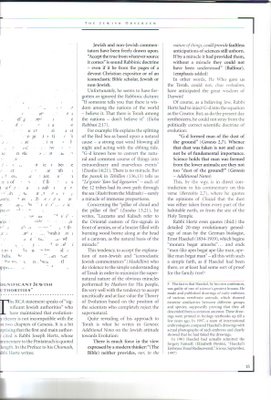
As usual, click to enlarge.
The editor of Jewish Observer, R. Nosson Wolpin, has a close relationship with Artscroll, a competing enterprise which partly succeeded in burying the Hertz but I sincerely believe the Jewish Observer would put the Hertz Chumash into its sights even if he did not have anything to do with Artscroll.
PS there is substance of the critique I agree with. I mean, I do not think that an eclipse in New York City in the 1925 (pg. 251) really offers much insight into makat choshech, for example.
He also bites off quite a bit to chew in dismissing Shadal, among others, as "an 'iconoclastic Jewish commentator[s]' (Maskillim) who do violence to the simple understanding of Torah in order to minimize the supernatural nature of the obvious miracles performed by Hashem for His people."
This isn't a great scan, but then, it isn't a great attack on the beleaguered and admittedly dated (but heroic) Hertz Chumash.
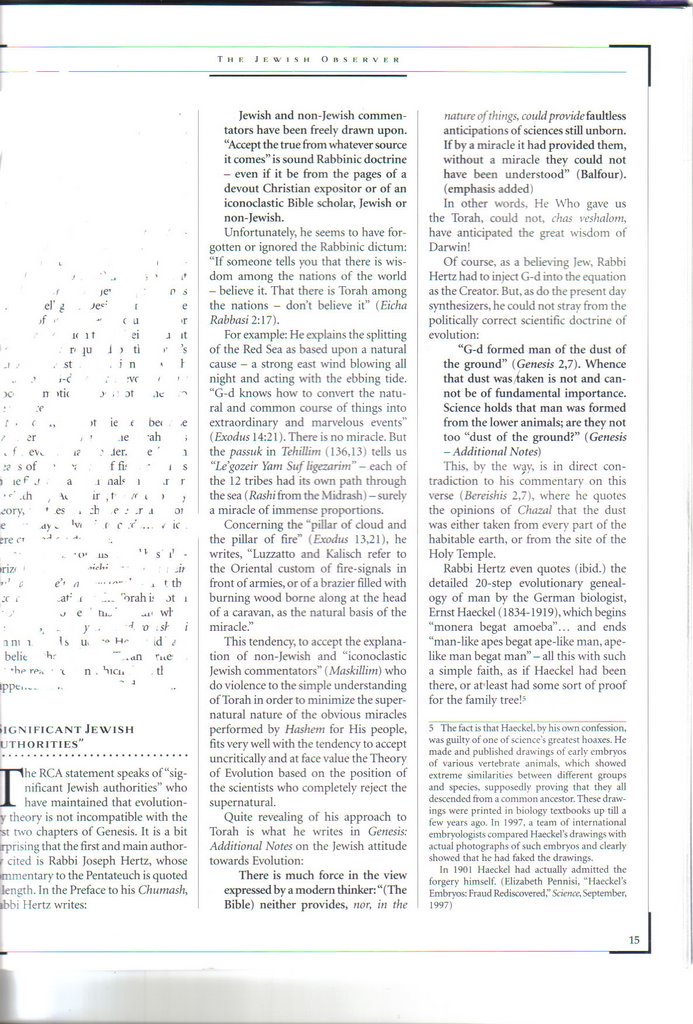
As usual, click to enlarge.
The editor of Jewish Observer, R. Nosson Wolpin, has a close relationship with Artscroll, a competing enterprise which partly succeeded in burying the Hertz but I sincerely believe the Jewish Observer would put the Hertz Chumash into its sights even if he did not have anything to do with Artscroll.
PS there is substance of the critique I agree with. I mean, I do not think that an eclipse in New York City in the 1925 (pg. 251) really offers much insight into makat choshech, for example.
Monday, May 22, 2006
What is the legacy of R. Joseph Hertz?
A friend sent me an article about R. Joseph Hertz, whom I recently blogged about indirectly at What's Bothering Artscroll?. After all these years, there still seems to be a lot of interest in R. Hertz. Including a book about him.
You can read three forwards he wrote for the Soncino Talmud translation: Nezikin, Moed and Nashim. (The usual caveats about that site apply, nevertheless, this is the text) Here is the article:
You can read three forwards he wrote for the Soncino Talmud translation: Nezikin, Moed and Nashim. (The usual caveats about that site apply, nevertheless, this is the text) Here is the article:
A champion of tradition who was no Conservative
By Benjamin Elton

The Jewish Chronicle, May 5 2006


Like many great men, Hertz's legacy is the subject of dispute. Different
Jewish groups have claimed him as one of their own. In particular, the
Conservative/Masorti movement associates itself with his theology.

A quick review of what he said and did as Chief Rabbi will reveal a
different picture to the image often presented of him as progressively
minded and only moderately traditional, a man who would have been more at
home at the New North London than the North Hendon Adath.

If the mark of Orthodoxy is a belief that the Torah was given to Moses on
Sinai, then Hertz passes the test. "Judaism stands or falls with the
historical actuality of the revelation at Sinai," he said. A third of the
Additional Notes in the Chumash attack Biblical Criticism (which rejected
the divine authorship of the Torah).

Hertz deals with all the major problems: the two accounts of Creation, the
historicity of the Exodus from Egypt, the possibility that the Code of
Hammurabi was the source of biblical law, and the age of the books of
Leviticus and Deuteronomy. In each case Hertz argued for the traditional
position.

As well as the Written Law, Judaism depends on the Oral Law, which Orthodoxy
also holds was given on Sinai. Hertz supported this view of the Oral
Tradition, writing that it was "handed down from the earliest days by word
of mouth, until it was codified in the Mishnah." When Hertz came across
individuals or institutions who disagreed with these principles, he attacked
them ferociously. In 1926 he delivered a blistering series of sermons
against Liberal Judaism, which would cause outrage today. In 1915 he forced
out of office the Rev Dr Joseph Hockman of the New West End for expressing
unorthodox views, very similar to those Louis Jacobs would later propound.

Hertz did hold some views that today would be rejected by many Orthodox
rabbis. He believed that halachah had developed over time, he thought that
some Psalms were written after the time of David and Solomon, and did not
think it necessary to believe that the book of Isaiah was by one author. But
these views were also held by such giants of modern Orthodoxy as Rabbis
Esriel Hildesheimer and David Hoffman.

Against all this evidence, the fact that Hertz used the term "progressive
conservatism," which meant something different then than it does now, or
that he attended the Jewish Theological Seminary, then a modern Orthodox
institution, are trivial. Hertz had some modern views, but he was firmly
rooted in tradition. His own definition of his religious commitments should
settle all doubt: "The teachings and practices which have come down to the
House of Israel through the ages; the positive Jewish beliefs concerning
God, the Torah and Israel; the sacred festivals; the holy resolve to
maintain Israel's identity; and the life consecrated by Jewish observances."


Benjamin Elton is currently completing a PhD on the British Chief Rabbinate
Subscribe to:
Posts (Atom)
LinkWithin

Subscribe To On the Main Line


 Posts
All Comments
Posts
All Comments