As you can see, it embeds words meant to read ani moshe beribbi maimon chazak, "I, Moses, the son of Rabbi Maimon, Chazak." The reason why I posted this image is to show how it looks when these key words are not highlighted by arranging the verses in a more poetic fashion and when they are. You can also see that the poem begins, or seems to begin, with a verse that reads et sha'arei ratzon le-hipateach, "It's a good time to begin..." The scholars of poetry are divided as to whether these words are Maimonides' or not since, actually, they are not originally by Maimonides and belong to another well-known liturgical poem. So the question is, did Maimonides himself begin with borrowing from another poem, and is his poem really called, so to speak, Et Shaaret Ratzon, or is it Ani Maskir Ha-yom?
We will return to this, but first we turn to 1750.
In Berlin, after 1750, Jewish courts were only recognized by the Prussian government as an arbitration. Prior to that time they had been fully recognized as real courts for Jews in their civil cases. It was seen as desirable for Jews to decide such affairs amongst themselves. But what this change meant was that the law now permitted Jews to appeal the arbitration (that is, a Din Torah) in a non-Jewish court. However, in a position which probably seems downright strange today, the Berlin State Council wished to enable Christian judges to decide the law in an appeal between Jews according to Jewish law. This was not unprecedented; the same had been the case in Metz, and the reason for this was to discourage Jewish misuse of the courts. Once Jews knew that on appeal their case would still be decided according to halacha, they would be less likely to turn away from the decision of the Bet Din in the first place.


Back to our subject. This leads us to several questions. First, what does the Arabic word/ name Maimon mean? Second, what's this business with the piyut (really pizmon) written by Maimonides?


But of course Christian judges could hardly be expected to know Jewish civil law, so eventually a request was made of Berlin's Chief Rabbi Hirschel Lewin to provide a digest in German of Jewish laws of inheritance, wills, marriage and property rights. The rabbi tasked his friend Moses Mendelssohn to write the work for him (and presumably he reviewed it) and it was published as the Ritualgesetze der Juden, the Ritual Laws of Judaism concerning inheritance, etc. To read more about the relationship of these two men, see here, but this really is not what this post is about. In the introduction of the Ritualgesetze we find the following exceedingly quaint passage (or name, really). First line:
That is, Mendelssohn calls the Rambam "R. Moses Majemonssohn." The passage in translation means something like
R. Moses Majemonssohn, who lived in the fiftieth century after the creation of the world (in the twelfth century of Christian era), by omitting from the Talmud all disputes and [legal] investigations created a complete system of law and ritual with the title Jad chasakah, a book which received uncommon acclaim, although also some opposition, and therefore acquired authority as a legal code."
I think we may agree that Majemonssohn is going a little far, and the judges could have handled it if he called him Maimonides. But I digress.
Jacob Reifmann (1818-1894) was one of the 19th century's great chokerim, with his field of interest being more or less everything Jewish. He made his early reputation through his many articles and short notes which appeared in the Hebrew periodical literature, but also in German translation. Here is what he looked like in the picture included in his autobiography in Kenesset Yisrael 3 (1888):
Here is a good place to post the same image, culled from an online source:
In my opinion, he looks angry in the poorer scan, whereas in the real image he merely looks fatigued. Although you obviously should not draw conclusions about a person based entirely on how they look, I think readers (as well as myself) would have gotten a very different impression of him from only seeing the second image. This is a good example of why scan quality matters!
In any case, Reifmann was an accomplished scholar who worked under poor conditions. For example, in the Shevat 1841 edition of Jost and Creizenach's periodical Zion we see the following note introducing an article by Reifman, and basically the man himself:

It describes how he toils without books or people to discuss scholarly matters with. Yet at the same time, in the same volume of Zion young Reifmann was able to publish an important scholarly finding , showing that a commentary on Proverbs which had been attributed to Ibn Ezra was really by R. Moses Kimchi. Israel Zinberg, writing about Reifmann in even later years, calls attention to a letter by Freimann to SJH Halberstamm in which he describes how he works: he lives in one small room, where he also works, filled with children and chickens.
As I said, in his early career many of his pieces appeared in German. In the literary supplement of the Orient (the Literaturblatt des Orients #28; July 11, 1843, pg. 439) we find the following tidbit by Reifmann:

In English, Reifmann writes:
In any case, Reifmann was an accomplished scholar who worked under poor conditions. For example, in the Shevat 1841 edition of Jost and Creizenach's periodical Zion we see the following note introducing an article by Reifman, and basically the man himself:
It describes how he toils without books or people to discuss scholarly matters with. Yet at the same time, in the same volume of Zion young Reifmann was able to publish an important scholarly finding , showing that a commentary on Proverbs which had been attributed to Ibn Ezra was really by R. Moses Kimchi. Israel Zinberg, writing about Reifmann in even later years, calls attention to a letter by Freimann to SJH Halberstamm in which he describes how he works: he lives in one small room, where he also works, filled with children and chickens.
As I said, in his early career many of his pieces appeared in German. In the literary supplement of the Orient (the Literaturblatt des Orients #28; July 11, 1843, pg. 439) we find the following tidbit by Reifmann:
In English, Reifmann writes:
The Name Maimon (מיימון) *). This name is usually written with double Yud and Vav, and I've never been able to give a good explanation of its origin. However, it is very notable that in the piyut written by Maimonides which begins עת שערי רצון (in the Sephardic Mahzor for Yom Kippur), the embedded signature is אני משה ברבי מימן חזק, with only one Yud and no Vav. As this is his own signature, this led me to conjecture that this name is probably Hebrew, as in Neh. 10.8 מִיָּמִן, and therefore we should properly say Mijaminides.In other words, Reifmann was suggesting that really Maimon, the father of Maimonides, might have been named Miyamin, which is an obscure biblical name, and if so, shouldn't we say Miyaminides? The evidence is in the form of the piyut, or synagogal poem, written by Maimonides which included his signature embedded within it. Since Maimonides himself writes his father's name "מימן" rather than "מיימון," perhaps the correct explanation is that really his father was named מִיָּמִן.
Reifmann
The first little editor's note at the bottom (by Julius Fuerst) notes that he had received this and another Hebrew note from the author. He praises Reifmann very highly as a young man from Galicia with an extraordinary knowledge of the liturgy. Then comes the smack:
That the name Maimun is Arabic and that Moses himself wrote it מימון in his writings in (Judeo) Arabic, is known. Herr Reifmann is in error; but at any rate, it all depends on the acrostic in the one song.In other words, even if we ignore the fact that we already know that the name is Arabic and it is Maimun, Reifmann just did not present enough evidence for his conjecture - he only gives one piece.
In the following issue someone who signed his name "A. Ink."- and if anyone can tell me who that is I'd appreciate it - sent in another response:
The meaning is approximately as follows:
Maimonides or Mijaminides? Herr Reifmann wants ميمون (i.e., Maimun) to be seen as identical with מִיָּמִן (i.e., Miyamin) of Neh. 10:8, and his primary argument rests on the piyut עת שערי רצון, etc. He goes on to point out three things.1) The words embedded in the poem - אני משה ברבי מימן חזק - form a part of the poem. So of course the و (the Arabic equivalent of vav) isn't there. Where is there room for a vav in the phrase מִי מַן?2) Many of the other words are not properly vocalized as real words. For example, in the piyut the word is מְשֵׁה, not מֹשֶׁה. In other words - hello, this is poetry! And which Arab Jew will see מימן in a poem such as this and not realize it is supposed to double as ميمون (=Maymun)?3) If this was all a great big mistake, would Maimonides have allowed everyone to think his father's name was the Arabic maymun - which meant the same thing as the Latin felix, or happy - if it was really Miyamin? But Maimonides never corrected this error - because it is no error!
Still, Reifmann was using his head, and it sure was an interesting suggestion. When I was 24 I don't think I was hairsplitting piyutim and drawing analogies to, face it, obscure biblical names.
Now, a few things are in order. First, it must be noted that Reifmann really did not discover this. There is a little known branch of Jewish learning on onomastics, that is, the proper spelling and origin of names. The reason why this field exists is because of the stringent halachic requirements of writing a get, or writ of divorce. In a get names must be spelled very precisely, and there are all kinds of questions about nicknames, which gives rise to deep study about the origin of names. Hence the rise of guides to the proper spelling of names for writing a get. So people who love to investigate names have a whole literature all about them, spelling, etymologies and so on.
Actually, the observation regarding the spelling of the name Maimon really comes straight out of the Rabbi Simcha Ha-kohen's Sefer Shemos (Book of Names) of 1657 - although most likely Reifmann was familiar with Rabbi Simcha's remarks through the later 17th century work, the Bais Shmuel on Even Ha-ezer, in the portion of the work called Shemot Anashim/ Nashim ('Names of Men and Women' printed in the second edition of 1696 after EH 129). Bais Shmuel, by Rabbi Shmuel Shay ben Ohr Shraga Phoebus of Fuerth incorporated the findings of Rabbi Simcha into his work, which he acknowledges, as later halachic writers on names would incorporate the Bais Shmuel itself.
Of course Rabbi Simcha does not actually make Reifmann's suggestion, that Maimon/ Maimun was really the obscure biblical name Miyamin. But priority of noticing the spelling of the name in this piyut definitely goes to him. The passage in the Sefer Shemos is as follows:
He quotes R. Isaiah di Trani as establishing the proper spelling of Maimon as Mem-yud-mem-vav-nun, even though we find in many rabbinic works, such as Mordechai, that it is spelled with two yuds - but that's really no big deal. So R. Simcha asks that in the aforementioned Yom Kippur piyut it is also spelled with no vav? He answers that names which aren't scriptural can be spelled plene to give a visual aid in its pronunciation. Not much of an answer, if we're trying to say that מימון is best, rather that מיימון or מימן. But the point is that R. Simcha definitely noticed the spelling in the Rambam's piyut and brought it to the attention of the world. His discussion was in turn adopted by R. Shmuel, and that work became an appendix to the Shulchan Aruch Even Hae-zer and also as the basic text of works later like Tiv Gittin. Reifman almost certainly noticed it in the Shulchan Aruch.
I suppose that since Reifmann did not mention the Bais Shmuel, it is poetic justice that his exact suggestion was eventually incorporated into a halachic work about names - only without mentioning him. I am speaking of the שלחן המערכת (Warsaw 1876) by R. Isaac Notowich. I don't know much about him, but he was the rabbi of Simferopol in the Crimea, and I saw that he is listed as a pre-subscriber to the Karaite Firkowich's Avne Zikaron (he is listed as "Moreh dat be-veit ha-sepher me-ha-memshalah be-ir Simferopol"). At the same time, Efraim Deinard says that he wrote a work against Firkowich. It seems from this description, and the fact that he seems to have been a fellow traveler with rabbis like Yosef Zecharya Stern, that he was one of those quasi-maskilim rabbis who existed in large number in those days, thus it would be know surprise if he had read this passage in the Orient or discussed it with someone, rather than independently reaching the same conclusion, that Maimon could really have been Miyamin (although he rejects it).
In any case, on page 108 of Shulchan Ha-ma'areches he discusses the Bais Shmuel's quotation from R. Simcha in Sefer Ha-shemos. He cites the book Ezras Nashim which also had much to say about the proper spelling of the name. The material that R. Notowich refers to deals with the modern publication of responsa of the Rambam which actually featured a facsimile of his signature, and it read like this: "הוגה מספרי אני משה ברבי מימוני ז"ל." See my earlier post, Maimonides's Own True signature, about the history and dissemination of this facsimile before the revelations of the Genizah.
Speaking of the discussions of a signature in this book by Notowich, I came across a really interesting note in the biography of R. Mordechai Banet. Basically, the problem is this. We know that in official government documents R. Mordechai Banet signed his name "Markus Benedict." The question then, of course, is how could this ga'on and tzadik change his name, when we know that Israel was redeemed on account of their never changing their names?!


Back to our subject. This leads us to several questions. First, what does the Arabic word/ name Maimon mean? Second, what's this business with the piyut (really pizmon) written by Maimonides?
As we said, Maymun means "happy" or "fortunate," similar to the name Felix (the name, which comes from the Latin word). Since there are a number of Hebrew names with a similar meaning, some have conjectured that Maymun is an Arabic form of Matzliach or Baruch. The idea here is similar to Yiddish, which used German words and names as a parallel to Hebrew. So, for example, the German Selig was paired with the Hebrew Asher, which have similar meanings.
Here is L.M. Simmons writing in the Jewish Quarterly Review in 1890. In his opinion this name is equivalent to Baruch:
As is to be expected, Moritz Steinschneider is more meticulous and, frankly, more plausible. He writes (same publication) that it is the Hebrew equivalent of Matzliach, as mentioned.
Not only is it a more exact equivalent linguistically, the name מצליח was not uncommon in the Ge'onic, Arab milieu.
As a curiosity, I will point out that in Turkish maymun means monkey!
See this passage from an Illustrated Natural History from 1865:
If you doubt this, see this Google translator generated page:
The Illustrated Natural History correctly pointed out that it comes from Greek, where μαϊμού (mayimu) means monkey to this day. I don't know why or when it meant "hobgoblin," but there it is. Thus the name. But what of the Rambam's piyut?
First, Rabbi Simcha may have made a mistake here - a common mistake. The Rambam's piyut - pizmon, really - properly begins אני מזכיר היום חסדי אבותי, not עת שערי רצון להפתח. There is another pizmon, which is also part of the Sefardic liturgy, which begins עת שערי רצון להפתח. This pizmon was written by Yehuda Shmuel Abbas. In printed editions the Rambam's pizmon begins with Yehuda Shmuel Abbas's first paragraph, with slight variations. Here are two of several possible reasons for this. The first is that it was added by chance or by accident. The second is that the Rambam, well, plagiarized those lines. Or if you prefer, adopted his form. It is certainly better to assume the latter - and actually it might be plausible, if Yehuda Shmuel Abbas' piyut was already well known. Speaking of Yehuda Shmuel Abbas, it's interesting to note that there used to be a strange idea that his piyut was written by three brothers, one called Yehuda, one Shmuel and one Abbas. We now know full well that there was a man Yehuda (ben) Shmuel (ibn) Abbas - and what a story there was with his son - and the strange idea that one pizmon would be written by three brothers is basically ruled out.
Here's an early printed Sefardic machzor with YSA's piyut. This is the 1526 Salonica edition, which claimed to be the "nussach Barcelona" and "minhag Catalonia":
And here is the Rambam's pizmon in the same machzor:
Here is the Rambam's pizmon, as I began the post, printed in awful fashion, in 1860. If not for the fact that I highlighted the key words in red, you'd hardly be able to read the signature. Compare them, from the same machzor. Note that the introduction is now identical to Abbas, whereas originally there were some differences:
Interestingly, there've even been those who doubted that the Rambam really wrote this pizmon because "he didn't have the soul of a poet!" So who wrote it? Another Rabbi Moshe ben Maimon! Not to mention the Rambam's famous disdain for poetry.
However, this seems to be no objection to me. My theory is that the Rambam may not have had "the soul of a poet," but he was born in Spain in 1135. After the Golden Age, true, but it's not like he was born in Brooklyn in 1930. He was born into a society which valued Hebrew verse, and it is not unreasonable that non poets also tried their hand at some verse. In the Spain which the Rambam grew up as far as I can tell everyone "did" poetry. It was a basic part of education. Furthermore, there is poetic verse which is undoubtedly written by the Rambam. See, for example, Bacher's article on verse in the writings of the Rambam. (link) and also Steinschneider's collection of verse by the Rambam (link). I also noticed that Joel Kraemer very aptly writes that "although the scholarly consensus takes Maimonides' negative references to poetry as a token that he held this genre in disdain . . . This, for an Andalusian, is prima facie implausible. Maimonides' exquisitely rhymed prose in a letter to Joseph b. Judah and his own poetry indicate otherwise." (Six Letters from the Cairo Geniza in Maimonidean Studies, Volume 2 edited by Arthur Hyman)
However, this seems to be no objection to me. My theory is that the Rambam may not have had "the soul of a poet," but he was born in Spain in 1135. After the Golden Age, true, but it's not like he was born in Brooklyn in 1930. He was born into a society which valued Hebrew verse, and it is not unreasonable that non poets also tried their hand at some verse. In the Spain which the Rambam grew up as far as I can tell everyone "did" poetry. It was a basic part of education. Furthermore, there is poetic verse which is undoubtedly written by the Rambam. See, for example, Bacher's article on verse in the writings of the Rambam. (link) and also Steinschneider's collection of verse by the Rambam (link). I also noticed that Joel Kraemer very aptly writes that "although the scholarly consensus takes Maimonides' negative references to poetry as a token that he held this genre in disdain . . . This, for an Andalusian, is prima facie implausible. Maimonides' exquisitely rhymed prose in a letter to Joseph b. Judah and his own poetry indicate otherwise." (Six Letters from the Cairo Geniza in Maimonidean Studies, Volume 2 edited by Arthur Hyman)
In R. Lippman Prinz's Tashlum Abudarham, the erudite author offers some linguistic evidence (pg.135) from the Rambam's own writings to try to establish that he was indeed the author of this pizmon. He leaves out the עת שערי רצון verse entirely, so I think he must have believed that it was added later to the Rambam's verses as an introduction to his pizmon.
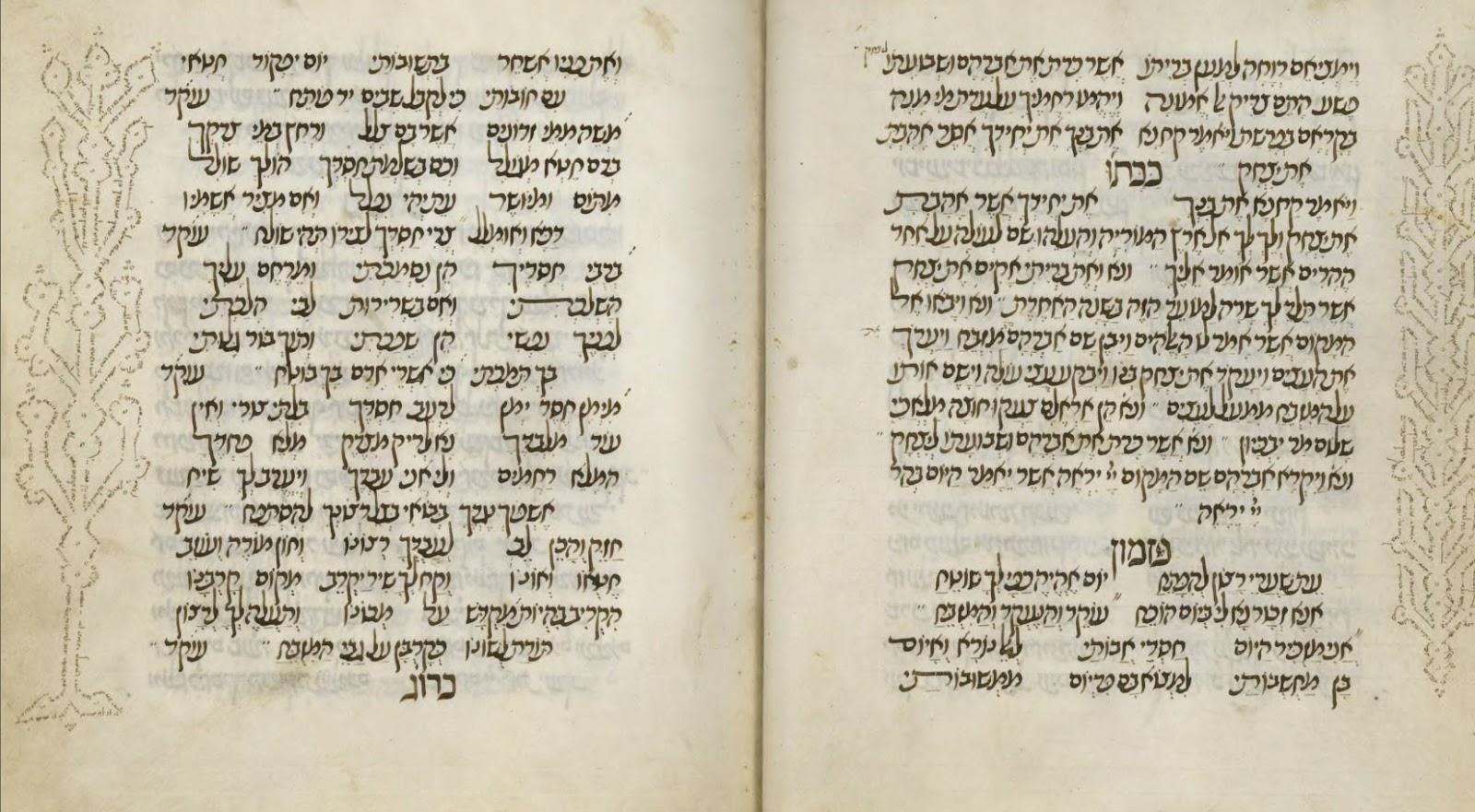
Incidentally, I think there is a problem that can't simply be brushed away with assuming that this pizmon was written by the Rambam, which is that the old machzorim don't say so. Sephardic machzorim are chock full of author identifications, Ibn Gabirol, Ibn Ezra, R. Yehuda Halevi, etc., and they note the names of more obscure payetanim as well. Yet, where is the Rambam identified? Not only isn't it in this one (Salonica 1526), but it also isn't in the Catalon machzor manuscript from circa 1280, which gives the names of many authors. The Rambam died in 1204. To put this in perspective, it would be like a machzor today printing a poem by a man who died in 1935. That's recent. We would probably know who the author is, particularly if he is so prominent. If the Rambam actually wrote this pizmon, why isn't he mentioned? Now there are possible answers, and we don't have to resort to a far-fetched suggestion like that the ani moshe be-ribbi maymun chazak signature is a coincidence and imaginary. However, I do find it interesting that rather early on one does not see him necessarily identified as the author. On the contrary, the identification happens the later we get.
Here is the aforementioned machzor. No ID given - other authors are mentioned in this manuscript::


Here is the aforementioned machzor. No ID given - other authors are mentioned in this manuscript::
Finally, here is some miscellaneous material I collected relating to this post.
1. In a didactic book written in German with Hebrew letters from 1846 by David Ottensosser, called Sippure Musar Minei Kedem Moralische Erzählungen aus der Vorzeitwe see that he adds gershayim to the name Maimon showing that he considered it a foreign name:
2. Here's some pages from a Karaite siddur from 1890, which includes the other, original version of the pizmon (which Rambam may or may not have borrowed the opening lines from), and it identifies the author as R. Judah Halevi:
3. It should be noted that there is a textual issue with the name Miyamin and an apparent variant in the Bible (Minyamin) itself. Furthermore, the name Minyamin makes appearances in the Talmud, and all this could be incorporated into this discussion.
4. It should be pointed out that Reifmann's scholarly credits also include anticipating actual Hebrew words which were to later be discovered in the original Hebrew of Ben Sirach pulled out of the Geniza.
Finally, there is much more to write about this fascinating subject and how it relates to scholarship and speculation about the author of Yigdal, as well as other musings about the Rambam's pizmon itself - but all posts must come to an end.


 Posts
Posts