The Agudah monthly The Jewish Observer has a section devoted to the problem of "Adults at-risk." In the present issue there is an article called “Will Your Grandfather be Jewish?” by R. Mordechai Becher and R. Chanan (Antony) Gordon.
An excerpt:
"A yeshiva student was happily dancing at his former room-mate’s wedding, and pushed his way “to the middle of the circle” to entertain the chosen and kallah (successfully, we should add) with a break-dance (ask your teenager if you don’t know what this is). He was in a great mood, full of simchah, full of love for his fellow Jews,and feeling good about himself, until his Rosh Yeshivah pulled him aside at the chasanah and strongly criticized him for a dance step “from the street.”
"What will the Rosh Yeshiva say after 120 years when he learns that his comment was one of a series of little pushes, and perhaps even “the last straw,” that eventually sent this promising student “out of the circle completely” and out of Torah observance?"
"(The authors do not, of course, condone a ben Torah break-dancing or engaging in any other behavior derived from secular culture that isn't consistent with Torah value.)"
This last bit was an editorial insertion, according to the author of the article."
"...the JO placed it there without consulting me. Breakdancing does not bother me in the least.... just some "frum" editing by JO."
The editors unaccountably sides with the Rosh Yeshiva who nudged the boy in the wrong direction, even as they print an article which offers it as an example of what not to do and a diagnosis that such an incident was indeed a cause in nurturing the phenomenon this issue is trying to counter.
Read it here (without the comment that undermines the article).
Hat-tip: Neo-Haskalah
Friday, October 12, 2007


The Upside Down Bible: Mendelssohn's Bi'ur with its legs sticking up in the air
Commenter Daniel Scheide informs that the famous and controversial ספר נתיבות השלום Pentateuch, otherwise known as the Bi'ur (after its commentary), edited by Moses Mendelssohn (רמבמ"ן , רמ"ד) was digitized by Google (here).
This is great. No edition of this historical Chumash was previously available online, and believe me, I looked.
This edition, the 1846 Vienna printing includes Targum Onqelos and Rashi, which were absent in the original, but printed in many subsequent printings, as well as the Ha-mishtadel commentary by Samuel David Luzzatto and בוצר עוללות by Simon Szántó, and another appendix called הכורם.
Actually, this is only the fifth volume, Deuteronomy, with Haftaros and the five Megillos.
Here's the fun part: it is upside down. Take a look:

It obviously should look like this:

Incidentally, here is a page. Not everyone has seen what the German translation with Hebrew letters looks like:

So it's upside down. It must be a sign.
Perhaps Google will correct it. In the meantime, it's not at all impossible to download it as a PDF and correct it yourself, as I did.
This is great. No edition of this historical Chumash was previously available online, and believe me, I looked.
This edition, the 1846 Vienna printing includes Targum Onqelos and Rashi, which were absent in the original, but printed in many subsequent printings, as well as the Ha-mishtadel commentary by Samuel David Luzzatto and בוצר עוללות by Simon Szántó, and another appendix called הכורם.
Actually, this is only the fifth volume, Deuteronomy, with Haftaros and the five Megillos.
Here's the fun part: it is upside down. Take a look:
It obviously should look like this:
Incidentally, here is a page. Not everyone has seen what the German translation with Hebrew letters looks like:
So it's upside down. It must be a sign.
Perhaps Google will correct it. In the meantime, it's not at all impossible to download it as a PDF and correct it yourself, as I did.
Thursday, October 11, 2007
Shakespeare, oft-repeated tropes, long Ss, Google Books and digitization.
Volokh Conspiracy has a good post called 'How much did Shakespeare embiggen* the English vocabulary?'
Basically, there is an old trope that the great English moshel William Shakespeare introduced a huge amount of neologisms (words which he himself coined) into the language. Many of them are still in use. While this is true, it seems that the number is vastly overstated. Sources which Volokh cites claim that fully 1700 words were created by Shkspr, words like "majestic," "pious" and "obscene."
Nowadays digitization is all the rage in information dissemination. There are all sorts of companies working on digitizing an amazing range of literature, and it's no secret that my blogging is highly influenced by the opportunity this affords. Anyway, using Chadwyck-Healey's Early English Books Online [EEBO] Volokh can show that many of these words were not coined by Shakespeare, but are found in published works that precede him.
The source for this trope (apart for its grain of truth) is the majestic** Oxford English Dictionary, which often cites Shakespeare as the first usage of a word in literature. Now, this is not the OED's fault. First of all, it doesn't make the claim that the earliest usage they were able to find is the earliest usage in all of literature. Secondly, the earliest usage in print or handwriting is evidence of usage but not coinage.
So it's very cool that non-professionals (and professionals) now have tools at their tips to do research that normally would require trips to great libraries and jumping through hoops for access to 500 year old books that one may look at (but not touch) so long as one could explain to someone else why exactly you need to look at them.
However, it's crucial not to think of digitization as a panacea. For one thing, things exist even if they haven't been scanned. For another, OCR (Optical character recognition) is still in its infancy. One small example: in Hebrew, teaching a computer to tell apart a ג and a נ or a ד and a ר is hard enough. But not only in non-Latin alphabets.
Go to Google Books and try to find all the references to the word "masorah" that occurs in the books published between 1700 and 1900 that they've digitized. 504 results. But don't forget also to search for maforah.
You try telling a computer that there is no difference between an "s" and a long S, or rather that an f (long ess) isn't an f (eff).
This will be fixed,*** but that will take time.
* If you get the Simpsons reference, you get it. NDY LKWMEV
** That's the leitwort of this post.
*** In fact, EEBO's technology pretty nicely distinguishes between long s and f; however, Google's doesn't.
Basically, there is an old trope that the great English moshel William Shakespeare introduced a huge amount of neologisms (words which he himself coined) into the language. Many of them are still in use. While this is true, it seems that the number is vastly overstated. Sources which Volokh cites claim that fully 1700 words were created by Shkspr, words like "majestic," "pious" and "obscene."
Nowadays digitization is all the rage in information dissemination. There are all sorts of companies working on digitizing an amazing range of literature, and it's no secret that my blogging is highly influenced by the opportunity this affords. Anyway, using Chadwyck-Healey's Early English Books Online [EEBO] Volokh can show that many of these words were not coined by Shakespeare, but are found in published works that precede him.
The source for this trope (apart for its grain of truth) is the majestic** Oxford English Dictionary, which often cites Shakespeare as the first usage of a word in literature. Now, this is not the OED's fault. First of all, it doesn't make the claim that the earliest usage they were able to find is the earliest usage in all of literature. Secondly, the earliest usage in print or handwriting is evidence of usage but not coinage.
So it's very cool that non-professionals (and professionals) now have tools at their tips to do research that normally would require trips to great libraries and jumping through hoops for access to 500 year old books that one may look at (but not touch) so long as one could explain to someone else why exactly you need to look at them.
However, it's crucial not to think of digitization as a panacea. For one thing, things exist even if they haven't been scanned. For another, OCR (Optical character recognition) is still in its infancy. One small example: in Hebrew, teaching a computer to tell apart a ג and a נ or a ד and a ר is hard enough. But not only in non-Latin alphabets.
Go to Google Books and try to find all the references to the word "masorah" that occurs in the books published between 1700 and 1900 that they've digitized. 504 results. But don't forget also to search for maforah.
You try telling a computer that there is no difference between an "s" and a long S, or rather that an f (long ess) isn't an f (eff).
This will be fixed,*** but that will take time.
* If you get the Simpsons reference, you get it. NDY LKWMEV
** That's the leitwort of this post.
*** In fact, EEBO's technology pretty nicely distinguishes between long s and f; however, Google's doesn't.
The unexpected flexibility and fluidity in the laws of writing a Torah scroll
Halakhah can be minutely precise. So it seems, and so it is. Thus it is interesting when it fails to be precise, especially in an area where one would expect rigorous precision. Particularly in an area where not only does one expect rigorous precision, but rigorous precision is actually mandated. I mean, specifically, the halakhot of writing a Sefer Torah, a Torah scroll.
Here is an excerpt from the Anchor Bible Dictionary Vol. IV (K-N), pg. 212, entry "Language (Hebrew)" by Gene M. Schramm:
"In copying a Torah scroll, the scribe was bound to copy his text as a virtual facsimile of all other authorized Torah scrolls, with leeway to do little more than reduce or enlarge the page size of the parchment leaves. Everything else had to be true and exact and scaled to the template. The copyist faithfully began each line with the same first word, ended each line with the exact last word, and included the same number of lines and the same blank spaces which indicated the pericopes. An oversized letter was reproduced as oversized, a miniscule was copied as a miniscule. Upside-down letters, backward letters, and flawed letters--all were faithfully reproduced as seen. Even the mysterious dots that appear here and there over letters were copied. A Torah scroll that failed to be a faithful replica of its authentic prototype was unfit for use and had to be duly corrected."
This is actually a good description (as an aside, Schramm uses a good analogy in describing masoretic notes. He compares them to the modern editorial comment sic). But as you surely know, that which I highlighted in red is a mistake.
Indeed, there are conventions with the force of law designed to produce highly faithful reproductions of other kosher Torah scrolls. The general thrust of this paragraph is true. But the halakhah actually does not mandate which word begins and ends lines, only that a line includes a defined range of letters, namely it must have enough room to write the longest word in the Torah, לְמִשְׁפּחֹתֵיהֶם (Gen 8:19) three times. This obviously leaves room to write a range of words on each line, and scribes may write more or less in the space of that size. (Exceptions, of course, are where a word ends a pericope called pesuha, for the next word must begin on a new line, and the poetic songs in Exodus and Deuteronomy, which require a specific formatting.)
In addition, no specific number of lines per column, or columns per scroll is mandated, something which I first realized after seeing a very old Torah on display at the Jewish Museum. Knowing that there are 42 lines per column, I was surprised to see that this one had many more. This led me to learn Torah and discover that, indeed, the number is not standardized by halakhah.
It is, however, standardized by convention (why do you think I thought it had to be 42 lines? It's because just about all Torahs use 42 lines per column!). From the Encylopedia Judaica entry Sefer Torah:
Although there is no law regulating the number of pages or columns a Torah must have, from the beginning of the 19th century a standard pattern of 248 columns of 42 lines each was established.
(The above was written by Louis Rabinowitz and R. Aharon Rakefet-Rothkoff, back when he was Rabbi Dr. Arnie Rothkoff, rabbi and Wissenschafty type. ;)
I assume (should I?) that this practice is in R. Shlomo Ganzfried's Keset ha-Sofer (1835), which has been enormously influential in standardizing those areas of safrut which remained unregulated.
And, of course, although there are detailed instructions for adorning the letters with תגין, they are not מעכב.
Here is an excerpt from the Anchor Bible Dictionary Vol. IV (K-N), pg. 212, entry "Language (Hebrew)" by Gene M. Schramm:
"In copying a Torah scroll, the scribe was bound to copy his text as a virtual facsimile of all other authorized Torah scrolls, with leeway to do little more than reduce or enlarge the page size of the parchment leaves. Everything else had to be true and exact and scaled to the template. The copyist faithfully began each line with the same first word, ended each line with the exact last word, and included the same number of lines and the same blank spaces which indicated the pericopes. An oversized letter was reproduced as oversized, a miniscule was copied as a miniscule. Upside-down letters, backward letters, and flawed letters--all were faithfully reproduced as seen. Even the mysterious dots that appear here and there over letters were copied. A Torah scroll that failed to be a faithful replica of its authentic prototype was unfit for use and had to be duly corrected."
This is actually a good description (as an aside, Schramm uses a good analogy in describing masoretic notes. He compares them to the modern editorial comment sic). But as you surely know, that which I highlighted in red is a mistake.
Indeed, there are conventions with the force of law designed to produce highly faithful reproductions of other kosher Torah scrolls. The general thrust of this paragraph is true. But the halakhah actually does not mandate which word begins and ends lines, only that a line includes a defined range of letters, namely it must have enough room to write the longest word in the Torah, לְמִשְׁפּחֹתֵיהֶם (Gen 8:19) three times. This obviously leaves room to write a range of words on each line, and scribes may write more or less in the space of that size. (Exceptions, of course, are where a word ends a pericope called pesuha, for the next word must begin on a new line, and the poetic songs in Exodus and Deuteronomy, which require a specific formatting.)
In addition, no specific number of lines per column, or columns per scroll is mandated, something which I first realized after seeing a very old Torah on display at the Jewish Museum. Knowing that there are 42 lines per column, I was surprised to see that this one had many more. This led me to learn Torah and discover that, indeed, the number is not standardized by halakhah.
It is, however, standardized by convention (why do you think I thought it had to be 42 lines? It's because just about all Torahs use 42 lines per column!). From the Encylopedia Judaica entry Sefer Torah:
Although there is no law regulating the number of pages or columns a Torah must have, from the beginning of the 19th century a standard pattern of 248 columns of 42 lines each was established.
(The above was written by Louis Rabinowitz and R. Aharon Rakefet-Rothkoff, back when he was Rabbi Dr. Arnie Rothkoff, rabbi and Wissenschafty type. ;)
I assume (should I?) that this practice is in R. Shlomo Ganzfried's Keset ha-Sofer (1835), which has been enormously influential in standardizing those areas of safrut which remained unregulated.
And, of course, although there are detailed instructions for adorning the letters with תגין, they are not מעכב.
Tuesday, October 09, 2007
James Kugel on Neusner, or Neusner Knives II: When knives are turned back at "a certain prolific but misguided student of rabbinic Judaism"
החכם Evanstonjew pointed out that in James Kugel's new book* How to Read the Bible: A Guide to Scripture, Then and Now there is a reference (almost certain) to Jacob Neusner.
Kugel is discussing Gunkel's theory that the Psalms were formulaic liturgy for the Temple, which meant they lack specificity (see). By way of illustration, he points out how he, James Kugel, would pray to God for the downfall of his enemies in a specific way (as opposed to the Psalms, which are general).
Pg. 464

* Haven't read it.
Kugel is discussing Gunkel's theory that the Psalms were formulaic liturgy for the Temple, which meant they lack specificity (see). By way of illustration, he points out how he, James Kugel, would pray to God for the downfall of his enemies in a specific way (as opposed to the Psalms, which are general).
Pg. 464
* Haven't read it.
Monday, October 08, 2007
Maccabean Psalms in the Birnbaum Siddur? An unorthodox comment in an Orthodox prayer book, via Nachman Krochmal's influence
The Birnbaum Siddur (Ha-Siddur Ha-Shalem, 1949, edited by Philip Birnbaum used to be ubiquitous in English speaking Orthodox synagogues. Due to a variety of historical circumstances, use of this particular prayer book in synagogues has waned.
Be that as it may, many still use, appreciate or at least fondly remember this siddur.
In addition to its clean printing and strong binding (mine is from 1949 and in great shape), the siddur featured a fine translation, along with interesting notes that offered commentary as well as historical information about the liturgy. Birnbaum was, in my estimation, a good scholar, possessing a poetic mind, and a gifted translator.
One should make no mistake, the siddur is Orthodox, despite occasional citations from Wissenschaft scholars like Zunz (these are, in any event, essential to presenting any sort of historical view of the liturgy). There is no deviation or omission from the "standard" text. Passages that could call for an apologetic or critical comment receive neither. It quotes well known homiletical explanations (like the reason for the number of knots and strings in tzitzis).
However it is most interesting that he occasionally slips in something rather unorthodox (or subtly makes an emendation via the translation--post forthcoming). For example:

(click to enlarge) Readers will recognize this as part of the daily Pesukei De-zimra, the morning recitation of a selection of Psalms. Psalm 149 is part of that liturgy.
Commentary detail:


Readers will know that according to tradition the entire book of Psalms was written by King David. More perceptive readers will know that many Psalms are ascribed to other figures, such as Moses, Assaf, the sons of Korach. Indeed, the Talmud states that the collection of Psalms include compositions by ten people, David included, who also collected them and compiled it as one book.
Orthodox Judaism holds to this position, despite the presence of a psalm like 'By the rivers of Babylon, there we sat down, yea, we wept, when we remembered Zion, ' (Psalm 137), which plainly is set in the post-exilic period, centuries after David. Traditionally this psalm was (and is) seen as written by David, however with prophetic inspiration and insight.
With the rise of biblical criticism in the 17th through 19th centuries, the ascription of this psalm (among others) to David became untenable. Among Jews an early figure who taught that psalms were written in the 2nd Temple period was Nachman Krochmal (Ranak).
In his posthumously published Moreh Nevukhei Ha-zeman (Guide for Today's Perplexed, being one possible translation) he offers the view that many of the modern discoveries in Bible scholarship were known to the rabbis of the Talmud (proofs, as he saw it, supplied) but they explicitly taught otherwise, for the needs of their own time were better served by the older teachings. Thus, the people in the time of the Talmud were edified to think of a psalm like 'By the rivers of Babylon' as written by David, as it enhanced people's perception of divine involvement with the world, and that is why the Sages, who knew better, taught such things. These days (Ranak died in 1840) people realize that a psalm like this one was not written by David, thus it is no longer edifying or useful to maintain this view. Therefore the actual authorship of these and other psalms--which were known by the Sages--ought now be revealed and expounded, as the new knowledge and keener historical understanding is what edifies people these days.
Krochmal, who wrote the book for 'kol ohev sekhel ve-shomer torah,' wrote the following in his introduction:

In the book there is a section which deals with the authorship of many of the psalms. Paralleling the Talmudic designation (BT Shabbos 118b) of Psalms 113-118 an 'Egyptian Hallel,' Krochmal thought that the last five psalms (146-150) also formed a unit, a 'Greek Hallel,' being that they were written in the Hasmonean period to commemorate the Maccebean victories over the Seleucids of Syria, and were in fact modeled after the Egyptian Hallel.
Let us then revisit the Birnbaum Siddur, commentary on Psalm 149:
'The Maccabean warriors were described as "fighting with their hands and praying with their hearts.' Where do Maccabeans come into the picture? This, I submit, is a very subtle allusion to the idea that this psalm (and presumably others) were written in that period. Birnbaum doesn't mention it, but the Psalm also mentions חֲסִידִים, otherwise known as Assideans, players in the Maccabean revolt.
Here is Krochmal's treatment of Psalm 149:

One last word:
"Orthodox Judaism believes in the divine authenticity of whole Bible and knows neither of the various authors of the Pentateuch, nor of Pseudo-Isaiah, nor of Maccabean songs under the name of David, or of Solomon's Ecclesiastes from the days of the second Temple, and so forth."
I quote Samson Raphael Hirsch here not because he personally was entitled to define what is and is not Orthodox, but because this post provides the context in which he wrote the above. Indeed, if we are simply describing the Orthodox position, rather than fighting for what it can encompass or may one day be, he was no doubt right.
Ranak's view was unorthodox and so was Paltiel Birnbaum's comment on pages 63-64 of his Siddur Ha-shalem.
Suggestion for further reading:
[I] Moreh Nevukhei Ha-zeman
[II] Nachman Krochmal: Guiding the Perplexed of the Modern Age by Jay Michael Harris
[III] All roads lead back to On the Main Line
Be that as it may, many still use, appreciate or at least fondly remember this siddur.
In addition to its clean printing and strong binding (mine is from 1949 and in great shape), the siddur featured a fine translation, along with interesting notes that offered commentary as well as historical information about the liturgy. Birnbaum was, in my estimation, a good scholar, possessing a poetic mind, and a gifted translator.
One should make no mistake, the siddur is Orthodox, despite occasional citations from Wissenschaft scholars like Zunz (these are, in any event, essential to presenting any sort of historical view of the liturgy). There is no deviation or omission from the "standard" text. Passages that could call for an apologetic or critical comment receive neither. It quotes well known homiletical explanations (like the reason for the number of knots and strings in tzitzis).
However it is most interesting that he occasionally slips in something rather unorthodox (or subtly makes an emendation via the translation--post forthcoming). For example:

(click to enlarge) Readers will recognize this as part of the daily Pesukei De-zimra, the morning recitation of a selection of Psalms. Psalm 149 is part of that liturgy.
Commentary detail:
Readers will know that according to tradition the entire book of Psalms was written by King David. More perceptive readers will know that many Psalms are ascribed to other figures, such as Moses, Assaf, the sons of Korach. Indeed, the Talmud states that the collection of Psalms include compositions by ten people, David included, who also collected them and compiled it as one book.
Orthodox Judaism holds to this position, despite the presence of a psalm like 'By the rivers of Babylon, there we sat down, yea, we wept, when we remembered Zion, ' (Psalm 137), which plainly is set in the post-exilic period, centuries after David. Traditionally this psalm was (and is) seen as written by David, however with prophetic inspiration and insight.
With the rise of biblical criticism in the 17th through 19th centuries, the ascription of this psalm (among others) to David became untenable. Among Jews an early figure who taught that psalms were written in the 2nd Temple period was Nachman Krochmal (Ranak).
In his posthumously published Moreh Nevukhei Ha-zeman (Guide for Today's Perplexed, being one possible translation) he offers the view that many of the modern discoveries in Bible scholarship were known to the rabbis of the Talmud (proofs, as he saw it, supplied) but they explicitly taught otherwise, for the needs of their own time were better served by the older teachings. Thus, the people in the time of the Talmud were edified to think of a psalm like 'By the rivers of Babylon' as written by David, as it enhanced people's perception of divine involvement with the world, and that is why the Sages, who knew better, taught such things. These days (Ranak died in 1840) people realize that a psalm like this one was not written by David, thus it is no longer edifying or useful to maintain this view. Therefore the actual authorship of these and other psalms--which were known by the Sages--ought now be revealed and expounded, as the new knowledge and keener historical understanding is what edifies people these days.
Krochmal, who wrote the book for 'kol ohev sekhel ve-shomer torah,' wrote the following in his introduction:
In the book there is a section which deals with the authorship of many of the psalms. Paralleling the Talmudic designation (BT Shabbos 118b) of Psalms 113-118 an 'Egyptian Hallel,' Krochmal thought that the last five psalms (146-150) also formed a unit, a 'Greek Hallel,' being that they were written in the Hasmonean period to commemorate the Maccebean victories over the Seleucids of Syria, and were in fact modeled after the Egyptian Hallel.
Let us then revisit the Birnbaum Siddur, commentary on Psalm 149:
'The Maccabean warriors were described as "fighting with their hands and praying with their hearts.' Where do Maccabeans come into the picture? This, I submit, is a very subtle allusion to the idea that this psalm (and presumably others) were written in that period. Birnbaum doesn't mention it, but the Psalm also mentions חֲסִידִים, otherwise known as Assideans, players in the Maccabean revolt.
Here is Krochmal's treatment of Psalm 149:

One last word:
"Orthodox Judaism believes in the divine authenticity of whole Bible and knows neither of the various authors of the Pentateuch, nor of Pseudo-Isaiah, nor of Maccabean songs under the name of David, or of Solomon's Ecclesiastes from the days of the second Temple, and so forth."
I quote Samson Raphael Hirsch here not because he personally was entitled to define what is and is not Orthodox, but because this post provides the context in which he wrote the above. Indeed, if we are simply describing the Orthodox position, rather than fighting for what it can encompass or may one day be, he was no doubt right.
Ranak's view was unorthodox and so was Paltiel Birnbaum's comment on pages 63-64 of his Siddur Ha-shalem.
Suggestion for further reading:
[I] Moreh Nevukhei Ha-zeman
[II] Nachman Krochmal: Guiding the Perplexed of the Modern Age by Jay Michael Harris
[III] All roads lead back to On the Main Line
Wednesday, October 03, 2007
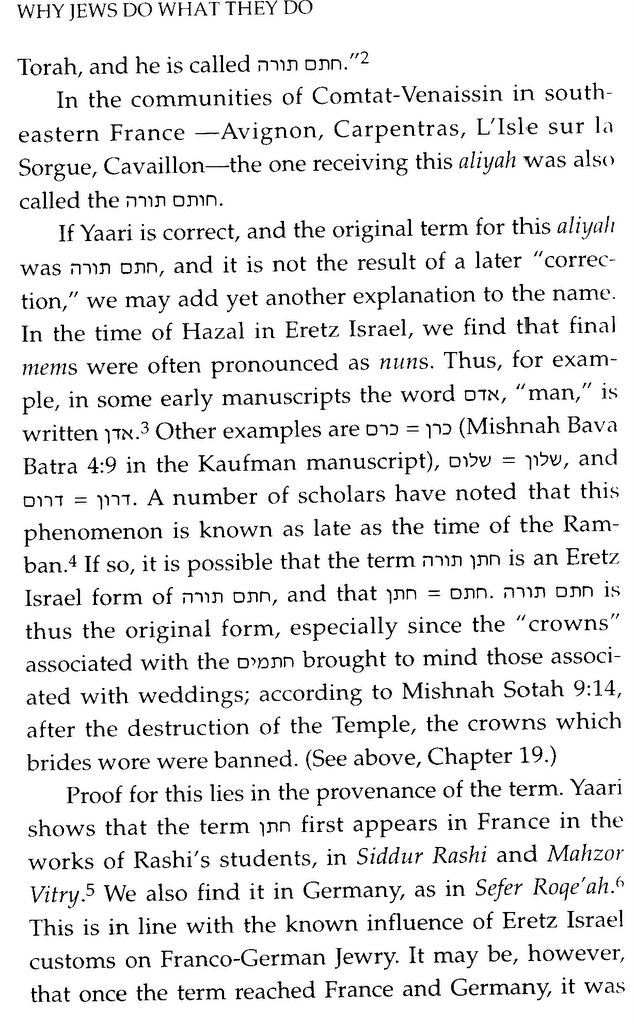
Simchas Torah repost: חתן חתם תורה
From last year.
An interesting excerpt from R. Daniel Sperber's Minhagei Yisrael (from the excerpts in the English version translated by R. Yaakov Elman). (click to enlarge, or download it as a more readable pdf)


An interesting excerpt from R. Daniel Sperber's Minhagei Yisrael (from the excerpts in the English version translated by R. Yaakov Elman). (click to enlarge, or download it as a more readable pdf)


Monday, October 01, 2007
On average? Hyperbole, apologetics or reasonable characterization? Yeshiva education in 'One People, Two Worlds'
In One People, Two Worlds: A Reform Rabbi and an Orthodox Rabbi Explore the Issues That Divide Them (Ammiel Hirsch and Yaakov Yosef Reinman) the following passages by R. Reinman appear in praise of yeshiva education:

and

Granting that the second passage (which occurs first in the book) concerns his son in particular, who may be exceptional and can really be described as understanding Aramaic, for example, does anyone think these passages are reasonably accurate or at least defensible?
Would, perhaps, parents of children this age weigh in?
and
Granting that the second passage (which occurs first in the book) concerns his son in particular, who may be exceptional and can really be described as understanding Aramaic, for example, does anyone think these passages are reasonably accurate or at least defensible?
Would, perhaps, parents of children this age weigh in?
Dear Reader
Do you subscribe to the London Jewish Chronicle?
If so, perhaps you can help me. Please email me. Thank you!
If so, perhaps you can help me. Please email me. Thank you!
A second source for Jacob ben Chaim's conversion, reported by Shadal.
A few days ago I posted about R. Eliyahu Bahur (Elijah Levita) and, invariably, the apostasy of Jacob ben Hayyim came up. I said, in the comments, that the sole evidence for this piece of information was Levita himself.
However, I was mistaken. There is another source.
The following is the response Shadal (Samuel David Luzzatto) sent to Solomon Frensdorff, who asked him this very question (printed in Otzar Nechmad Vol. III, p. 112):
Free translation:
"About Bahur's words in his poetical introduction to Massoreth Ha-massoreth: "One of the learned, whose name among Jews used to be Jacob--may his soul be wrapped in a bag with holes..."--you're asking me if I believe his intention was to say that R. Jacob ben Hayyim ibn Adoniyahu converted--it is absolutely true [ie, that is what Bahur meant].
"This matter gave me reason to delay replying to your letter, because I was really quite perturbed, since the implication of the aforementioned words of R. Elijah is that [Ibn Adoniyahu] converted, and I did not want to publicize something negative about this great scholar [Ibn Adoniyahu] before I had another witness [ie, more proof].
"Last year my friend, the maskil R. Moshe Soave of Venice, discovered a Mishnayos printed in Venice by Giustiniani, 1546, with the commentaries of Rambam and R. Shimshon [of Sens]. At the end of Seder Taharos the following was written (I saw it myself): "And these are the words of the first proofreader, whose name among Jews used to be Jacob bar Hayyiim, who proofread Seder Taharos with R. Shimshon's commentary. Since the Sage [ie, Maimonides] taught that the wise accept the truth from whoever speaks it, we thought it appropriate to print his words here..."
"Can you also deny this testimony, or does it establish the fact?
"Before this I had been very happy when I acquired a Pentateuch with Targum, printed by Bomberg in Venice, 1543-44, at the end of which are seven pages about the Targum. They begin "Jacob ben Hayyim ben Isaac Ibn Adoniyahu says..." and I thought this showed that in the years 1543-44 he was alive--and a Jew! So how could it be that in 1538 (the year that Massoreth Ha-massoreth was printed) his soul should have been bound (ie, he'd already died)?
"But when I saw this Mishnayos, what was I to think? How could I reconcile it; aren't two witnesses establishment of proof? So I figured that Ibn Adoniyahu wrote his essay on the Targum while he was a Jew, and perhaps it was printed in an edition of the Pentateuch that I haven't seen, or wasn't printed during his lifetime, but was kept by Bomberg until he printed the edition of Chumash with Targum in my possession, and he printed the essay at the end.
Here's the reference to the 1546 Venice Mishnah:

In fact, according to the Wikipedia page on Ben Hayyim, Bomberg's 1527 edition of the Chumash included the essay on the Targum, so at least one of Shadal's conjectures was correct (that it had been printed earlier, in an edition he hadn't seen; the 1527 edition). Furthermore, it may well be that he hadn't converted by 1527 (he certainly hadn't by 1525, when his famous edition was printed.) Thus, this piece of evidence which gave Shadal pause would seem to be immaterial, just as he surmised.
It also must be considered - and I don't know why Shadal missed this - that the writer of these words in 1546 may have gotten his information from Levita's 1538 edition of Masoret ha-Massoret, so it's not a second witness.
However, I was mistaken. There is another source.
The following is the response Shadal (Samuel David Luzzatto) sent to Solomon Frensdorff, who asked him this very question (printed in Otzar Nechmad Vol. III, p. 112):
ולענין דברי הבחור שכתב בהקדמתו החרוזית למסורת המסורת "אחד מהנבונים היה שמו לפנים בישראל נקרא יעקב תהי נשמתו צרורה בצרור נקוב" ששאלת אם אאמין שכוונתו לומר שר יעקב בר חיים ן' אדניהו המיר דתו---ודאי כן הוא. והדבר הזה היה סבה שנמנעתי מהשיב למכתבך כי הרבה הייתי נבוך בענין הזה כי אמנם משמעות דברי ר' אליה הנ"ל היא בלא ספק כי ר' יעקב המיר דתו. ולא הייתי רוצה להוציא לעז על חכם כמהו בטרם אשמע עד שני. ואולם בשנה שעברה מצא אחד מידידי המשכיל ר' משה סואבי מעיר ויניציאה משניות עם פירוש הר"ם והר"ש דפוס ויניציאה 'יוסטיניאן' שנת ש"ו. ובסוף סדר טהרות כתוב כך (וכן ראיתי גם אני בעיני) "ואלה הם דברי המגיה הראשון שהיה שמו לפנים בישראל יעקב בר חיים שהגיה סדר טהרות עם פירוש רבינו שמשון ז"ל. ולפי שאמר החכם קבל האמת ממי שעמרו ראינו להדפיס דבריו פה"---היתכן להכזיב גם העדות הזאת, להוציאה ממשמעות דבריה.י:
ואני קודם לכן ששתי כמוצא שלל רב כי קניתי חומש עם תרגום דפוס בומבירג שנת ש"ג וש"ד ובסופו ז' דפים על התרגום, תחלתם "אמר יעקב בן חיים בן יצחק ן' אדניהו יש"י עמה"ן" ואמרתי הרי מבואר כי בשנת ש"ג וש"ד היה חי והיה יהודי, ואיך בשנת רצ"ח (כשנדפס ס' מסרת המסרת) כבר היתה נשמתו צרורה?---אבל כשראיתי המשניות הנ"ל, אמרתי מה אדבר? ובמה אצידקהו? הלא על פי שנים עדים יומת המת ואז אמרת: אין ספק כי ן' אדניהו כתב מאמרו על התרגום כשהיה יהודי, ואולי כבר נדפס בחייו בחומש אחר שלא בא עדיין לידי. ואולי ג"כ לא נדפס בחייו, אבל נשאר ביד דניאל בומבירג קצת שנים עד שהדפיס חומש עם תרגום ואז הדפיס המאמר ההוא בסופו.י
Free translation:
"About Bahur's words in his poetical introduction to Massoreth Ha-massoreth: "One of the learned, whose name among Jews used to be Jacob--may his soul be wrapped in a bag with holes..."--you're asking me if I believe his intention was to say that R. Jacob ben Hayyim ibn Adoniyahu converted--it is absolutely true [ie, that is what Bahur meant].
"This matter gave me reason to delay replying to your letter, because I was really quite perturbed, since the implication of the aforementioned words of R. Elijah is that [Ibn Adoniyahu] converted, and I did not want to publicize something negative about this great scholar [Ibn Adoniyahu] before I had another witness [ie, more proof].
"Last year my friend, the maskil R. Moshe Soave of Venice, discovered a Mishnayos printed in Venice by Giustiniani, 1546, with the commentaries of Rambam and R. Shimshon [of Sens]. At the end of Seder Taharos the following was written (I saw it myself): "And these are the words of the first proofreader, whose name among Jews used to be Jacob bar Hayyiim, who proofread Seder Taharos with R. Shimshon's commentary. Since the Sage [ie, Maimonides] taught that the wise accept the truth from whoever speaks it, we thought it appropriate to print his words here..."
"Can you also deny this testimony, or does it establish the fact?
"Before this I had been very happy when I acquired a Pentateuch with Targum, printed by Bomberg in Venice, 1543-44, at the end of which are seven pages about the Targum. They begin "Jacob ben Hayyim ben Isaac Ibn Adoniyahu says..." and I thought this showed that in the years 1543-44 he was alive--and a Jew! So how could it be that in 1538 (the year that Massoreth Ha-massoreth was printed) his soul should have been bound (ie, he'd already died)?
"But when I saw this Mishnayos, what was I to think? How could I reconcile it; aren't two witnesses establishment of proof? So I figured that Ibn Adoniyahu wrote his essay on the Targum while he was a Jew, and perhaps it was printed in an edition of the Pentateuch that I haven't seen, or wasn't printed during his lifetime, but was kept by Bomberg until he printed the edition of Chumash with Targum in my possession, and he printed the essay at the end.
Here's the reference to the 1546 Venice Mishnah:

In fact, according to the Wikipedia page on Ben Hayyim, Bomberg's 1527 edition of the Chumash included the essay on the Targum, so at least one of Shadal's conjectures was correct (that it had been printed earlier, in an edition he hadn't seen; the 1527 edition). Furthermore, it may well be that he hadn't converted by 1527 (he certainly hadn't by 1525, when his famous edition was printed.) Thus, this piece of evidence which gave Shadal pause would seem to be immaterial, just as he surmised.
It also must be considered - and I don't know why Shadal missed this - that the writer of these words in 1546 may have gotten his information from Levita's 1538 edition of Masoret ha-Massoret, so it's not a second witness.
Monday, September 24, 2007
Some info about the 93 Maidens of Cracow's Beis Ya'akov
There's a discussion in the comments to this thread about the Soloveitchik-Twersky Rabad thing.
Someone opined that the Soloveitchik review revealed some bad blood, a grudge or a feud, since it's otherwise difficult to see why S. would choose to write a review (and a harsh one at that) of his brother-in-law T.'s book, thirty five years after it had been published. Similarly, R. JJ Schacter must have had some sort of a grudge against R. Leo Jung, whose pulpit he filled, since he co-wrote a lengthy article called "The 93 Beth Jacob Girls of Cracow: History or Typology?," ( Reverence, Righteousness, and Rahamanut: Essays in Memory of Rabbi Dr. Leo Jung, New York: Jason Aronson, 1992, pp. 93-130).
The story of the "93 Beth Jacob Girls of Cracow," is that 93 Beis Yaakov students and teachers killed themselves, rather than be forced into Nazi brothel. It is based on a letter written by one of the girls, Chaje Feldman. The incident was apparently first publicized in America during WWII by R. Jung himself. R. Schacter makes the case that this specific event did not occur.
In other words, the contention is that the story or legend of the 93 girls is highly associated with R. Jung. Thus, debunking the legend has to mean something deeper, some enmity.
R. Schacter edited this volume in memory of R. Jung, and frankly, I think it's crazy to accuse him of harboring some sort of grudge against R Jung, who he seems to have had a great deal of affection and admiration for.
In any event, this is what was reported in the New York Times on January 8,, 1943:

(Download the entire Times article.)
The text of the letter was translated from Yiddish into Hebrew and appeared in Hadoar 23,12, and an English translation of that letter appeared in the Reconstructionist:

(Download this as well.)
Someone opined that the Soloveitchik review revealed some bad blood, a grudge or a feud, since it's otherwise difficult to see why S. would choose to write a review (and a harsh one at that) of his brother-in-law T.'s book, thirty five years after it had been published. Similarly, R. JJ Schacter must have had some sort of a grudge against R. Leo Jung, whose pulpit he filled, since he co-wrote a lengthy article called "The 93 Beth Jacob Girls of Cracow: History or Typology?," ( Reverence, Righteousness, and Rahamanut: Essays in Memory of Rabbi Dr. Leo Jung, New York: Jason Aronson, 1992, pp. 93-130).
The story of the "93 Beth Jacob Girls of Cracow," is that 93 Beis Yaakov students and teachers killed themselves, rather than be forced into Nazi brothel. It is based on a letter written by one of the girls, Chaje Feldman. The incident was apparently first publicized in America during WWII by R. Jung himself. R. Schacter makes the case that this specific event did not occur.
In other words, the contention is that the story or legend of the 93 girls is highly associated with R. Jung. Thus, debunking the legend has to mean something deeper, some enmity.
R. Schacter edited this volume in memory of R. Jung, and frankly, I think it's crazy to accuse him of harboring some sort of grudge against R Jung, who he seems to have had a great deal of affection and admiration for.
In any event, this is what was reported in the New York Times on January 8,, 1943:
(Download the entire Times article.)
The text of the letter was translated from Yiddish into Hebrew and appeared in Hadoar 23,12, and an English translation of that letter appeared in the Reconstructionist:
(Download this as well.)
Sunday, September 23, 2007


Thursday, September 20, 2007
From Moshe to Moshe...From Paul to Paul? And inside look at R. Eliyah Bahur's (Elijah Levita) preface to the Hebrew lexicon Tishby
Here is a very interesting excerpt from the introduction of R. Eliyahu Bahur's1 (Elijah Levita 1469-1549) Hebrew lexicon Tishbi.
This work was published in Isny, Germany by the Christian printer Paul Fagius. It features Hebrew words that require clarification, such as words stemming from foreign languages, and words that were not defined in earlier lexicons like the Aruch of R. Nathan ben Yechiel of Rome.

As you can see, he effusively praises Fagius, with whom he developed a close relationship.
It's really quite extraordinary that he writes, of Paul Fagius:
"The truth is it would be fitting for his people (e.g., Christians) to say of him what we say about Maimonides--'From Moses to Moses, there has been none like Moses--they should say about him 'From Paul to Paul, there has been none like Paul.'"
Since it is important to be as inclusive of as many readers as possible, here is a translation of the entire excerpted passage:
Upon coming here I examined his barrel and found it full of old wine. I hadn't been told of even half his wisdom and knowledge. Many draw from the wells of his instruction, he teaches good to his people. He expounds and interprets nicely. The truth is it would be fitting for his people (e.g., Christians) to say of him what we say about Maimonides--'From Moses to Moses, there has been none like Moses--they should say about him 'From Paul to Paul, there has been none like Paul. When he saw this book that I'd written, and recognized its great worth and utility, he hastened to translate it into Latin, which our ancestors called Leshon Romi (e.g., 'Roman'), and he put the two languages together, facing pages, and he didn't add or omit. We agreed to print them together, and we will put our concentration and great efforts into it, he from one side, and me from another. And each of us calls to our God that we might succeed in our work.
(Image is from page ד in the Grodno תקס"ה edition [1815]. Indeed, the original edition featured Hebrew with Latin translation on facing pages.)
A sample of Levita's writing:

1 I posted about Elias Levita (רבי אליה' הבחור אשכנזי) here.
This work was published in Isny, Germany by the Christian printer Paul Fagius. It features Hebrew words that require clarification, such as words stemming from foreign languages, and words that were not defined in earlier lexicons like the Aruch of R. Nathan ben Yechiel of Rome.
As you can see, he effusively praises Fagius, with whom he developed a close relationship.
It's really quite extraordinary that he writes, of Paul Fagius:
באמת ראוי שבני עמו יקראו עליו כמו שאנו קוראין על רבינו משה בן מיימון ממשה עד משה לא קם כמשה כך יאמרו עליו מפאולוש עד פאולוש לא קם כפאולוש
"The truth is it would be fitting for his people (e.g., Christians) to say of him what we say about Maimonides--'From Moses to Moses, there has been none like Moses--they should say about him 'From Paul to Paul, there has been none like Paul.'"
Since it is important to be as inclusive of as many readers as possible, here is a translation of the entire excerpted passage:
Upon coming here I examined his barrel and found it full of old wine. I hadn't been told of even half his wisdom and knowledge. Many draw from the wells of his instruction, he teaches good to his people. He expounds and interprets nicely. The truth is it would be fitting for his people (e.g., Christians) to say of him what we say about Maimonides--'From Moses to Moses, there has been none like Moses--they should say about him 'From Paul to Paul, there has been none like Paul. When he saw this book that I'd written, and recognized its great worth and utility, he hastened to translate it into Latin, which our ancestors called Leshon Romi (e.g., 'Roman'), and he put the two languages together, facing pages, and he didn't add or omit. We agreed to print them together, and we will put our concentration and great efforts into it, he from one side, and me from another. And each of us calls to our God that we might succeed in our work.
(Image is from page ד in the Grodno תקס"ה edition [1815]. Indeed, the original edition featured Hebrew with Latin translation on facing pages.)
A sample of Levita's writing:
1 I posted about Elias Levita (רבי אליה' הבחור אשכנזי) here.
Tuesday, September 18, 2007
When Rav Elyashiv says to print something, Artscroll prints it
But doesn't necessarily translate it...

This note appears at the beginning of the haskama (rabbinic approbation) section of some volumes of their Schottenstein Talmud translation (this is from Babba Metziah).
As you can see, Artscroll quotes R. Eliashiv saying that "Because of the times we live in it is a great mitzvah to proceed with this project." Indeed, from the verbatim Hebrew text of his message, which he requested be inserted, the last five words say this.
But that's five words out of thirty three. What do the other 85% of the words mean?
Well, if you can understand Hebrew, you know. So there is it. But what if you can't?
I find this interesting because it seems to sort of typify the approach one sometimes finds in Artscroll publications. The Hebrew text is the Hebrew text; they aren't going to tamper with the text. It's there for you to see, and very literally, המבין יבין. But much of the audience of these publications cannot understand much Hebrew, or any, and in that case abridgments must suffice.
Before I translate the words (noting that most of this audience doesn't need the translation and already sees what I'm getting at) I'd like to point out that Artscroll doesn't translate any of the haskamos that appear in these books. While it certainly would be useful if they did, it doesn't seem like any sort of big deal that they don't. It seems like this is common practice in English books that are accompanied by Hebrew haskamos. Surely sometimes haskamos are not as unqualified or praising as one would like, and therefore authors and publishers often would like readers to look at the names rather than the content of the approbations, and that's true across the board. So nothing funny here, or at least nothing funnier than usual.
What's interesting is that while R. Elyashiv does commend the work (Talmud translation)--"because of the times we live in it is a great mitzvah to proceed with this project"--he also explains what sort of times he is referring to.
"Since we live in a breached generation with many translations by lightweights who put their hands on the holiness of the Talmud and the Oral Law, I think there is no es la'asos le-Hashem1 greater than this, and it's a great mitzvah to proceed with this project."
In other words, the complete context of R. Eliashiv's strong suggestion that Artscroll go ahead with their project to translate the Talmud is that this is something that is necessitated by other, bad translations of the Talmud. (I am sure he had in mind the Steinsaltz edition; I am less certain if he also meant the older Soncino or academic editions like Neusner's. That would be a question of whether it was on the Rav's radar or not, and I am in no position to speculate about that.)
All in all, most interesting. As I said, it's right there, black on gray. Obviously a sizable portion of the buying public knows exactly what it said. But many don't, and won't. It's understandable why they don't translate large haskamos (R. Aharon Schechter, rosh yeshiva Yeshivas Chaim Berlin wrote a particularly long one, for example). But this is less than 35 words. I suppose that the editors didn't necessarily want to make a big deal about the fact that R. Elyashiv gave what amounts to very qualified support for their work. No big deal, but interesting, and the wise will understand.
1 The reference is to Psalm 119:126:
קכו עֵת לַעֲשׂוֹת לַיקוָק הֵפֵרוּ תּוֹרָתֶךָ 126 It is time for the LORD to work; they have made void Thy law.
Rabbinically this verse is given as justification for--at times--'making void Thy law,' that is, to violate halakhah because "It is time" to do the Lord's work, that is, to repair a breach, to safeguard the Torah, sometimes the time gives no other choice than to breach it.
In this case, R. Elyashiv is asserting that in this time a translations of the Talmud [like Artscroll's]--which normally, in other times, is undesirable at best, if not forbidden--is necessary and a great mitzvah.
This note appears at the beginning of the haskama (rabbinic approbation) section of some volumes of their Schottenstein Talmud translation (this is from Babba Metziah).
As you can see, Artscroll quotes R. Eliashiv saying that "Because of the times we live in it is a great mitzvah to proceed with this project." Indeed, from the verbatim Hebrew text of his message, which he requested be inserted, the last five words say this.
But that's five words out of thirty three. What do the other 85% of the words mean?
Well, if you can understand Hebrew, you know. So there is it. But what if you can't?
I find this interesting because it seems to sort of typify the approach one sometimes finds in Artscroll publications. The Hebrew text is the Hebrew text; they aren't going to tamper with the text. It's there for you to see, and very literally, המבין יבין. But much of the audience of these publications cannot understand much Hebrew, or any, and in that case abridgments must suffice.
Before I translate the words (noting that most of this audience doesn't need the translation and already sees what I'm getting at) I'd like to point out that Artscroll doesn't translate any of the haskamos that appear in these books. While it certainly would be useful if they did, it doesn't seem like any sort of big deal that they don't. It seems like this is common practice in English books that are accompanied by Hebrew haskamos. Surely sometimes haskamos are not as unqualified or praising as one would like, and therefore authors and publishers often would like readers to look at the names rather than the content of the approbations, and that's true across the board. So nothing funny here, or at least nothing funnier than usual.
What's interesting is that while R. Elyashiv does commend the work (Talmud translation)--"because of the times we live in it is a great mitzvah to proceed with this project"--he also explains what sort of times he is referring to.
"Since we live in a breached generation with many translations by lightweights who put their hands on the holiness of the Talmud and the Oral Law, I think there is no es la'asos le-Hashem1 greater than this, and it's a great mitzvah to proceed with this project."
In other words, the complete context of R. Eliashiv's strong suggestion that Artscroll go ahead with their project to translate the Talmud is that this is something that is necessitated by other, bad translations of the Talmud. (I am sure he had in mind the Steinsaltz edition; I am less certain if he also meant the older Soncino or academic editions like Neusner's. That would be a question of whether it was on the Rav's radar or not, and I am in no position to speculate about that.)
All in all, most interesting. As I said, it's right there, black on gray. Obviously a sizable portion of the buying public knows exactly what it said. But many don't, and won't. It's understandable why they don't translate large haskamos (R. Aharon Schechter, rosh yeshiva Yeshivas Chaim Berlin wrote a particularly long one, for example). But this is less than 35 words. I suppose that the editors didn't necessarily want to make a big deal about the fact that R. Elyashiv gave what amounts to very qualified support for their work. No big deal, but interesting, and the wise will understand.
1 The reference is to Psalm 119:126:
קכו עֵת לַעֲשׂוֹת לַיקוָק הֵפֵרוּ תּוֹרָתֶךָ 126 It is time for the LORD to work; they have made void Thy law.
Rabbinically this verse is given as justification for--at times--'making void Thy law,' that is, to violate halakhah because "It is time" to do the Lord's work, that is, to repair a breach, to safeguard the Torah, sometimes the time gives no other choice than to breach it.
In this case, R. Elyashiv is asserting that in this time a translations of the Talmud [like Artscroll's]--which normally, in other times, is undesirable at best, if not forbidden--is necessary and a great mitzvah.
Wednesday, September 12, 2007
Sometimes you have time...
...sometimes you don't.
A güt yontov and shanah tovah to all my friends, adversaries, lurkers, commenters and everyone. :)
A güt yontov and shanah tovah to all my friends, adversaries, lurkers, commenters and everyone. :)
Thursday, September 06, 2007
Maimonides was the first what?
The Rev. S. Lee, B.D. (in his GRAMMAR
OF THE
HEBREW LANGUAGE,
COMPRISED IN A
SERIES OF LECTURES;
COMPILED FROM THE BEST AUTHORITIES, AND DRAWN
PRINCIPALLY
From Oriental Sources,
DESIGNED
FOR THE USE OF STUDENTS IN THE UNIVERSITIES, London 1832):

Me, to Lee: Yes, I'm sure you were a genius. :)
OF THE
HEBREW LANGUAGE,
COMPRISED IN A
SERIES OF LECTURES;
COMPILED FROM THE BEST AUTHORITIES, AND DRAWN
PRINCIPALLY
From Oriental Sources,
DESIGNED
FOR THE USE OF STUDENTS IN THE UNIVERSITIES, London 1832):

Me, to Lee: Yes, I'm sure you were a genius. :)
Weise rabbis? Historical studies of Judaism and Orthodoxy, part 250
Having previously posted about the controversy about Rabbi Dr. David Zvi Hoffmann's thesis Mar Samuel (and, really, his approach to his non-biblical and non-halakhic* studies of Judaism), I thought it worthwhile to quote a selection from David Ellenson's book Rabbi Esriel Hildesheimer and the Creation of a Modern Jewish Orthodoxy:
What, however, was the nature of Hoffmann's scholarship in his other major field of academic study, rabbinics, which Hirsch had labeled "heretical"? In examining this area of Hoffmann's academic work, it is clear that some of the same patterns evident in his biblical studies are present here, too. In nearly all of his works, the same, seemingly obligatory statements about the nature of authentic Jewish faith are found. In his rabbinic investigations, in contrast to his biblical studies, however, Hoffmann appears to be more of the contemporary academic. Throughout his works he cites the scholarship of Rappoport, Frankel, Geiger, and Graetz, sometimes approvingly, sometimes disapprovingly--but never, it seems, tendentiously. In this way, Hoffmann becomes one among several academic scholars involved in a community of research. In addition, Hoffmann often employs an approach to the field of rabbinic history which marks him as a practitioner of Religions-Wissenschaft in the broadest cultural sense, an approach that allowed him to consider the ways in which the surrounding culture of the ancient Near East may have influenced rabbinic civilization, something he would never have considered doing in his biblical studies. For example, in his Mar Samuel, Hoffmann points out that the rabbis were identified as Hachamim, "Weise." Then, in a footnote, he states, "One also designated the Savants of other peoples with the selfsame title." It was remarks such as this, along with his citation of "heretics" such as Graetz and Frankel, which undoubtedly aroused the ire of Orthodox colleagues like Hirsch and caused them to view at least this work of Hoffmann as kefirah, heresy.
Hoffmann's writings on the evolution of the literary structures, forms, terminology, and modes of interpretation in both midrash and Mishnah would seemingly be even more dangerous to the foundations of Orthodox Jewish faith. Yet there is no question that Hoffmann did investigate these texts in a manner that makes it difficult to distinguish him from Frankel, Geiger, or other scholars of rabbinic literature. This does not mean that Hoffmann agreed with them either on particular points or specific theories. But Hoffmann was clearly involved in discourse with these men. Like Frankel Darkhe HaMishnah, Hoffmann First Mishna reveals that he saw development and variety in the different strata of mishnaic literature. His notion that there was a "First Mishna" before the destruction of the Second Temple and that there were disagreements among the later tannaim as to its form; his efforts to reconstruct and discover that form; his willingness to investigate the disparate strata which undergirded that form; as well as his work on the halakhic midrashim, all combine to reveal the seminal nature of his studies in the academic area of rabbinics. Proactive as opposed to reactive, his scholarship in this area is clearly distinct from his efforts in the discipline of Bible.
* I mean not relating to halakhah, rather than against halakhah!
What, however, was the nature of Hoffmann's scholarship in his other major field of academic study, rabbinics, which Hirsch had labeled "heretical"? In examining this area of Hoffmann's academic work, it is clear that some of the same patterns evident in his biblical studies are present here, too. In nearly all of his works, the same, seemingly obligatory statements about the nature of authentic Jewish faith are found. In his rabbinic investigations, in contrast to his biblical studies, however, Hoffmann appears to be more of the contemporary academic. Throughout his works he cites the scholarship of Rappoport, Frankel, Geiger, and Graetz, sometimes approvingly, sometimes disapprovingly--but never, it seems, tendentiously. In this way, Hoffmann becomes one among several academic scholars involved in a community of research. In addition, Hoffmann often employs an approach to the field of rabbinic history which marks him as a practitioner of Religions-Wissenschaft in the broadest cultural sense, an approach that allowed him to consider the ways in which the surrounding culture of the ancient Near East may have influenced rabbinic civilization, something he would never have considered doing in his biblical studies. For example, in his Mar Samuel, Hoffmann points out that the rabbis were identified as Hachamim, "Weise." Then, in a footnote, he states, "One also designated the Savants of other peoples with the selfsame title." It was remarks such as this, along with his citation of "heretics" such as Graetz and Frankel, which undoubtedly aroused the ire of Orthodox colleagues like Hirsch and caused them to view at least this work of Hoffmann as kefirah, heresy.
Hoffmann's writings on the evolution of the literary structures, forms, terminology, and modes of interpretation in both midrash and Mishnah would seemingly be even more dangerous to the foundations of Orthodox Jewish faith. Yet there is no question that Hoffmann did investigate these texts in a manner that makes it difficult to distinguish him from Frankel, Geiger, or other scholars of rabbinic literature. This does not mean that Hoffmann agreed with them either on particular points or specific theories. But Hoffmann was clearly involved in discourse with these men. Like Frankel Darkhe HaMishnah, Hoffmann First Mishna reveals that he saw development and variety in the different strata of mishnaic literature. His notion that there was a "First Mishna" before the destruction of the Second Temple and that there were disagreements among the later tannaim as to its form; his efforts to reconstruct and discover that form; his willingness to investigate the disparate strata which undergirded that form; as well as his work on the halakhic midrashim, all combine to reveal the seminal nature of his studies in the academic area of rabbinics. Proactive as opposed to reactive, his scholarship in this area is clearly distinct from his efforts in the discipline of Bible.
* I mean not relating to halakhah, rather than against halakhah!
Wednesday, September 05, 2007
Pinner prospectus
Regarding the aborted Pinner Talmud of the 19th century, I came across a prospectus, translated into English, published in an 1835 edition of R. Morris Raphall's Hebrew Review and Magazine of Rabbinical Literature.

Download it here.

Morris J. Raphall (1798-1868) Link

Download it here.
Morris J. Raphall (1798-1868) Link
Tuesday, September 04, 2007
I never say "ontological" (and I try to dial back on the "mimetic")*
"If the obscurantists are not yet shaking in their feet, once they see our ever-forthcoming translation of the Arukh ha-Shulhan, which will bring back the 1950’s and the “mimetic tradition”, this will put them in their place."
"For a while I thought that I could impress those ever-impressionable Shabbat guests by pointing out that contrary to what the Arscroll siddur, p. 807, states, R. Eleazar Kalir was not a tanna. But again, this is not something that most people care about. Besides, someone always ended up pointing out that no less than Tosafot claims that he was a tanna, and my protestations about what Shir proved were always met with blank stares, for what does a Prague song have to do with anything?"
Good post with a hilarious introduction by Marc Shapiro, at Seforim.
* Not that I'm a Modern Orthodox intellectual.
"For a while I thought that I could impress those ever-impressionable Shabbat guests by pointing out that contrary to what the Arscroll siddur, p. 807, states, R. Eleazar Kalir was not a tanna. But again, this is not something that most people care about. Besides, someone always ended up pointing out that no less than Tosafot claims that he was a tanna, and my protestations about what Shir proved were always met with blank stares, for what does a Prague song have to do with anything?"
Good post with a hilarious introduction by Marc Shapiro, at Seforim.
* Not that I'm a Modern Orthodox intellectual.
Thursday, August 30, 2007
Rashi script* and other Hebrew examples in Pantographia from 1799
Over at the Main Line I posted about a beautiful book called Pantographia; containing accurate copies of all the known alphabets in the world; together with an English explanation of the peculiar force or power of each letter (by Edmund Fry, London, 1799).
Great examples of many different kinds of alphabets included, with sources given. In addition, the Lord's Prayer is presented in each alphabet (and language) along with English transliteration. It is the nature of the beast that such a work would include lots of examples which look a little bit strange to the modern eye that has seen many of the actual scripts, as opposed to Western renderings of them (see, e.g.).
From his presentation of Hebrew (pp. 142-151):
1. The regular Hebrew script:

The source given for this example is Claude Duret, which is to say it is from a 16th century book.
Later an example of the modern Hebrew is given:

2. This one, also from Duret, is described "very early used by the Jewish Rabbis
in Germany, by whom it was much esteemed, as a handsome current letter, and easy to be written on account of its roundness, wherefore they generally used it in their commentaries-
and translations."
That is, it's purports to be an Ashkenazic script.**

3. This one is a Sephardic script, also from Duret, but it cites as an authority notable Hebraist Sebastian Muenster.**

4. To me this one is the most interesting. As you can see, it's the script we call Rashi script:
"The alphabet of Rabbinical Hebrew, of which there are three sizes at the Type-Street Foundery."

And a typical printed example is supplied (but no source is given):

* I know; don't hassle me. Mashait, blah blah.
**It's worth comparing with these two charts from the Jewish Encylopedia entry on the Hebrew alphabet (click to enlarge):


Great examples of many different kinds of alphabets included, with sources given. In addition, the Lord's Prayer is presented in each alphabet (and language) along with English transliteration. It is the nature of the beast that such a work would include lots of examples which look a little bit strange to the modern eye that has seen many of the actual scripts, as opposed to Western renderings of them (see, e.g.).
From his presentation of Hebrew (pp. 142-151):
1. The regular Hebrew script:
The source given for this example is Claude Duret, which is to say it is from a 16th century book.
Later an example of the modern Hebrew is given:
2. This one, also from Duret, is described "very early used by the Jewish Rabbis
in Germany, by whom it was much esteemed, as a handsome current letter, and easy to be written on account of its roundness, wherefore they generally used it in their commentaries-
and translations."
That is, it's purports to be an Ashkenazic script.**
3. This one is a Sephardic script, also from Duret, but it cites as an authority notable Hebraist Sebastian Muenster.**
4. To me this one is the most interesting. As you can see, it's the script we call Rashi script:
"The alphabet of Rabbinical Hebrew, of which there are three sizes at the Type-Street Foundery."
And a typical printed example is supplied (but no source is given):
* I know; don't hassle me. Mashait, blah blah.
**It's worth comparing with these two charts from the Jewish Encylopedia entry on the Hebrew alphabet (click to enlarge):


An 18th century English version of Raschi script
What's this about?
Rashi script* and other Hebrew examples in Pantographia at English Hebraica.
*See asterisk over there.
A 1500 year old list of Hebrew Bible books in Latin characters
As one of the early Church Hebraists, Jerome's writings contain many interesting elements to people interested in Hebrew and Tanakh, among them issues of pronunciation.
Here is a list of the names of the books of Tanakh, as the Jews called them, in his introduction to Kings:
Bresith
Hellesmoth
Vaiecra
Vaiedabber
Addabarim
Iosue Bennum
Sopthim
Ruth
Samuhel
Malachim
Esaias
Hieremias
Cinoth
Hiezecihel
Thareasra
Iob
Psalmorum
Masaloth
Accoeleth
Sirassirim
Danihel
Dabreiamin
Ezras
Hester
It should be noted thatI merely copied this list from someone who translated his Latin introduction into English. I didn't compare it to any other versions; I realize the anachronism of using the letter J rather than I in some of the words (but then, it is also an anachronism to call him Jerome) (ed.--thanks to Reb Berel I was able to correct the list; minor things like Daniel to Danihel, I to J have been corrected). Furthermore, these words were obviously subject to the same potential copyist errors that all manuscripts are, particularly as most scribes over the years did not know Hebrew (which could account, for instance, for Iosue bennum or Dabreiamin).
I recently came across a wonderful and fascinating book called Pantographia; containing accurate copies of all the known alphabets in the world; together with an English explanation of the peculiar force or power of each letter (by Edmund Fry, London, 1799).
In the entry on Hebrew it contains the following, on the authority of Jerome:
"St. Jerom, in his preface to the books of Kings, puts
"this matter in a still stronger light : he says, the Samaritans
"often copy the five books of Moses, in the same number
"of letters as the Jews do, but their letters differ in form,
"and the use of points
This last line is interesting because Jerome lived in the 4th and 5th century. He did receive Hebrew instruction from Jews living in Israel. Doesn't this quote confirm the widely believed traditional view that the points, that is the nekkudot, were not invented by the Masoretes after the Talmudic period?
In fact, the Pantographia is in error, but it's understandable. Jerome wrote "The Samaritans still write the Pentateuch of Moses in the same number of letters, only they differ in shapes and points (apicibus). The misunderstanding is in the meaning of apicibus in this context. It can mean points, but it also means endings. Jerome's intention was to note the existence of final forms in Hebrew letters used by Jews (מנצפ"ך). See.
More on the Pantographia will be at English Hebraica.
Here is a list of the names of the books of Tanakh, as the Jews called them, in his introduction to Kings:
Bresith
Hellesmoth
Vaiecra
Vaiedabber
Addabarim
Iosue Bennum
Sopthim
Ruth
Samuhel
Malachim
Esaias
Hieremias
Cinoth
Hiezecihel
Thareasra
Iob
Psalmorum
Masaloth
Accoeleth
Sirassirim
Danihel
Dabreiamin
Ezras
Hester
It should be noted that
I recently came across a wonderful and fascinating book called Pantographia; containing accurate copies of all the known alphabets in the world; together with an English explanation of the peculiar force or power of each letter (by Edmund Fry, London, 1799).
In the entry on Hebrew it contains the following, on the authority of Jerome:
"St. Jerom, in his preface to the books of Kings, puts
"this matter in a still stronger light : he says, the Samaritans
"often copy the five books of Moses, in the same number
"of letters as the Jews do, but their letters differ in form,
"and the use of points
This last line is interesting because Jerome lived in the 4th and 5th century. He did receive Hebrew instruction from Jews living in Israel. Doesn't this quote confirm the widely believed traditional view that the points, that is the nekkudot, were not invented by the Masoretes after the Talmudic period?
In fact, the Pantographia is in error, but it's understandable. Jerome wrote "The Samaritans still write the Pentateuch of Moses in the same number of letters, only they differ in shapes and points (apicibus). The misunderstanding is in the meaning of apicibus in this context. It can mean points, but it also means endings. Jerome's intention was to note the existence of final forms in Hebrew letters used by Jews (מנצפ"ך). See.
More on the Pantographia will be at English Hebraica.
Palm reading in pre-war Eastern Europe

There's a historical point in these Shana Tova cards (click to enlarge). Does anyone know what it is?
Louis Ginzberg: Good historians avoid a common pitfall
R. Moses Sofer combined all the great virtues of the old Jewish scholar with fighting courage and determination, and therefore he was not only the head of a Yeshibah, but also the leader of a strong party, especially strong in Hungary, which opposed the new tendency in Judaism with success. It was not lack of comprehension of the new tendency that made Sofer its violent opponent; his keen vision gave him insight sooner than anyone else into the radicalism into which it would degenerate. And it was [Eisik Hirsch] Weiss who, in his sketch of Sofer in the Hebrew monthly Mi-Misrah umi-Ma'arab (Vienna, 1896) meted out full justice to this great personality, although Weiss did not adopt Sofer's conception of Judaism as his own. Moreover, Weiss did not descend to the manner of the so-called historians who are incapable of appreciating a great personality or a spiritual movement in its totality, but lose themselves in details and designate as characteristic the most insignificant points if they are bizarre, and the most unessential minutiae if they are curious. They judge accordingly, and as a result we hear opinions of the Jewish past and of certain tendencies in Judaism which, if the same logic were applied to the interpretation of general history, would give something like the following: Aristotle was a fool; he believed that the heavenly spheres were animated. Kepler understood nothing at all of physics, because he did not know so much as the law of gravitation, which is now known to every school-boy. And the fathers of the Dutch Republic were mischievous reactionaries, for in their political program they did not adopt universal suffrage.
Louis Ginzberg, 'Isaac Hirsch Weiss' in Students, Scholars, Saints (Philadelphia, 1928), pp. 235-236.
Louis Ginzberg, 'Isaac Hirsch Weiss' in Students, Scholars, Saints (Philadelphia, 1928), pp. 235-236.
Wednesday, August 29, 2007
Fascinating Footnotes II
It may be somewhat remarkable that Bernard of Clairvaux, who records so many miracles of his friend St. Malachi, never takes notice of his own, which in their turn, however, are carefully related by his companions and disciples.
Chap. 15, n. 81, Edward Gibbon, History of the Decline and Fall of the Roman Empire, 474.
Chap. 15, n. 81, Edward Gibbon, History of the Decline and Fall of the Roman Empire, 474.
Monday, August 27, 2007
Who drew Rashi and when?

Zev asked me (and others) if I knew where this ubiquitous image of Rashi comes from and hold old it was. More specifically, could I point to somewhere from before the 20th century?
I could not. However, in the Jewish Encyclopedia (1901-05) entry on Rashi this image is not include, while other Rashi-related images are. Furthermore, the ubiquitous image of Maimonides is included, as are images of the Rif, Maharsha, the Gaon of Wilno and many images of lesser figures. Therefore I think I do not draw an unwarranted conclusion that when the JE was prepared the image either didn't yet exist, or at least wasn't popular.
This question is almost as important as knowing what color shirt Rashi wore or what brand of tobacco he smoked. Anyone know anything about where this image came from, and when?
Friday, August 24, 2007
Another Ari K. post: A Geonic Precursor of Wissenschaft?
Ari posts: A Geonic Precursor of Wissenschaft? -- about an 11th century Ga'on's critical reading of a text.
I commented that the טענה of Wissenschaft pioneers (at least the more pious ones among them) was that many of their methods had noble antecedents in traditional sources.
This of course continues today--with Ari's post, for example (however tongue-in-cheek he meant it). But it also continues with nearly every volume of the Orthodox Forum series, it continued with the writings of Louis Jacobs, it continues all over the place, including my own posts. "Look, Rashi interpreted a passuk against the interpretation of Chazal." "Look, Heidenheim changed the nussach based on grammatical principles." et cetera
These scholarly pioneers often posited a Jewish Dark Age beginning right about the end of the European one and lasting until their own period. Let's say from 1600 to 1800. They pointed to poets and playwrights and physicians and astronomers in the Jewish past; to correct vernacular usage (overstating the case) and reasoned that present state of Jewry around them was not the traditional one.
Of course not only Wissenschafters and Reformers posited this. R. Samson Raphael Hirsch did as well. It was a self-serving claim, but not totally lacking in all merit. (It should be borne in mind that in truth these centuries were very creative ones for Jews. They were just centuries that were diametrically opposed to rationalism and various things which they advocated. They perceived the earlier period as one of liturgical creativity, and the later period as one of liturgical freezing. The earlier period as more conducive to critical study of rabbinic texts, the latter the age of pilpul, etc. Of course the dates were not fixed and figures who flourished in that period--such as the Ga'on of Vilna--were regarded as precursors to their type of thinking.)
In any case, certainly manuscript criticism dates back to the time when all books were ms! Before printing, any literate person would have been puzzled by the idea that all texts don't need correcting.
I commented that the טענה of Wissenschaft pioneers (at least the more pious ones among them) was that many of their methods had noble antecedents in traditional sources.
This of course continues today--with Ari's post, for example (however tongue-in-cheek he meant it). But it also continues with nearly every volume of the Orthodox Forum series, it continued with the writings of Louis Jacobs, it continues all over the place, including my own posts. "Look, Rashi interpreted a passuk against the interpretation of Chazal." "Look, Heidenheim changed the nussach based on grammatical principles." et cetera
These scholarly pioneers often posited a Jewish Dark Age beginning right about the end of the European one and lasting until their own period. Let's say from 1600 to 1800. They pointed to poets and playwrights and physicians and astronomers in the Jewish past; to correct vernacular usage (overstating the case) and reasoned that present state of Jewry around them was not the traditional one.
Of course not only Wissenschafters and Reformers posited this. R. Samson Raphael Hirsch did as well. It was a self-serving claim, but not totally lacking in all merit. (It should be borne in mind that in truth these centuries were very creative ones for Jews. They were just centuries that were diametrically opposed to rationalism and various things which they advocated. They perceived the earlier period as one of liturgical creativity, and the later period as one of liturgical freezing. The earlier period as more conducive to critical study of rabbinic texts, the latter the age of pilpul, etc. Of course the dates were not fixed and figures who flourished in that period--such as the Ga'on of Vilna--were regarded as precursors to their type of thinking.)
In any case, certainly manuscript criticism dates back to the time when all books were ms! Before printing, any literate person would have been puzzled by the idea that all texts don't need correcting.
Thursday, August 23, 2007
In the eye of the beholder
Reading the same old texts, there are many people who see only this:
and there are many people who see only this:
Not as many see both.
(From סדר רב עמרם גאון סדר תפילה Seder Rav Amram Ga'on, two representative samples.)
ברוך אתה ה' אלהינו ואלהי אבותינו אלהי אברהם אלהי יצחק ואלהי יעקב האל הגדול הגבור והנורא אל עליון גומל חסדים טובים וקונה הכל וזוכר חסדי אבות ומביא גואל לבני בניהם למען שמו באהבה מלך עוזר ומושיע ומגן ברוך אתה ה' מגן אברהם
and there are many people who see only this:
תקע בשופר גדול לחירותנו ושא נס לקבץ גלויותינו וקרא דרור לקבצנו יחד מארבע כנפות הארץ לארצנו ברוך אתה ה' מקבץ נדחי עמו ישראל
Not as many see both.
(From סדר רב עמרם גאון סדר תפילה Seder Rav Amram Ga'on, two representative samples.)
R. Zecharias Frankel's piety described by Hermann Cohen (Frankel/ Hirsch Pt. II)
Pt. I

Jeschurun 7 (1861): p. 297

In this article, R. Hirsch quotes a young Hermann Cohen's letter that he received which described R. Frankel as a pious Jew: "mit dem Tallith über dem kopf in der Synagoge stehe," praying with the tallis over his head, "Freitag Abend Semiroth singe," singing zemiros on schabbos, and even "auch beim Schiur bei Gelegenheit eifrig bemerke: ein Jere Schamaim muesse hier machmir sein!," sometimes saying in his shiurim that Yarei Shamayim should be machmir!
Hermann Cohen* (1842-1918) was then a young student in R. Frankel's rabbinical seminary in Breslau at the time when the controversy between R. Hirsch's Neo-Orthodoxy and R. Frankel (representing the so-called Historical School) was raging. At that particular time the issue was not the seminary, but Frankel's Darkhei Ha-Mishnah (1859). Cohen sent this letter to R. Hirsch in his teacher's defense. R. Hirsch, of course, responded that Frankel's pious behavior are entirely besides the point. Indeed, no negligible number of those attracted to R. Hirsch's teachings and leadership were hardly scrupulously observant. But they were Orthodox, and in those times (and R. Hirsch would say in all times) that was the ikkar.
* A possibly interesting footnote: Hermann Cohen was the subject of the young R. J.B. Soloveitchik's doctorate.

Jeschurun 7 (1861): p. 297
In this article, R. Hirsch quotes a young Hermann Cohen's letter that he received which described R. Frankel as a pious Jew: "mit dem Tallith über dem kopf in der Synagoge stehe," praying with the tallis over his head, "Freitag Abend Semiroth singe," singing zemiros on schabbos, and even "auch beim Schiur bei Gelegenheit eifrig bemerke: ein Jere Schamaim muesse hier machmir sein!," sometimes saying in his shiurim that Yarei Shamayim should be machmir!
Hermann Cohen* (1842-1918) was then a young student in R. Frankel's rabbinical seminary in Breslau at the time when the controversy between R. Hirsch's Neo-Orthodoxy and R. Frankel (representing the so-called Historical School) was raging. At that particular time the issue was not the seminary, but Frankel's Darkhei Ha-Mishnah (1859). Cohen sent this letter to R. Hirsch in his teacher's defense. R. Hirsch, of course, responded that Frankel's pious behavior are entirely besides the point. Indeed, no negligible number of those attracted to R. Hirsch's teachings and leadership were hardly scrupulously observant. But they were Orthodox, and in those times (and R. Hirsch would say in all times) that was the ikkar.
* A possibly interesting footnote: Hermann Cohen was the subject of the young R. J.B. Soloveitchik's doctorate.
Arabic with Hebrew letters
Interesting, and useful chart at Omniglot depicting how the Hebrew alphabet was used to write Judeo-Arabic:

Useful if you ever want to write about שריעת מוסא.
Useful if you ever want to write about שריעת מוסא.
Tuesday, August 21, 2007
No hint of textual criticism of the Bible in Artscroll's siddur; Psalm 34, shabbat davening's missing (?) vav.
Alphabetical acrostics are not an uncommon form of Biblical poetry. In this form each stanza begins with a letter of the aleph beis (alphabet), either in descending or ascending order. There are many such examples, including what is perhaps the most famous one*, Psalm 145, beginning אֲרומִמְךָ אֱלוהַי הַמֶּלֶךְ. The next verse begins with a בְּכָל יום אֲבָרְכֶךָּ; ב, and then a ג and so forth. Other examples include each chapter in Lamentations.
Another example from Psalms is Psalm 34.
As it happens, sometimes these poems are imperfect. That is, the precise order of the alphabet is not completely followed (see Lamentations 4:15-17, where נ ס פ ע is the order rather than נ ס ע פ (the equivalent** of M N P O rather than M N O P in the Latin alphabet). Or an expected verse is entirely missing (see: No nun--in ashrei).
Psalm 34 is interesting because the ו vav verse seems to be missing, but as the ו is the conjuctive in Hebrew, the ה verse naturally contains a word beginning with ו.
The entire verse (Psalm 34:6 reads הִבִּיטוּ אֵלָיו וְנָהָרו וּפְנֵיהֶם אַל יֶחְפָּרוּ They looked unto Him, and were radiant; and their faces shall never be abashed (JPS 1917). I only highlighted the ו in red to show that there is a ו in this verse; if you read on it will become clear why I point this our. However, the next verse (34:7) begins with a ז zayin. Thus, either we are missing the ו or somehow, for some reason, this verse is meant to be split in half and that way nothing is missing.
That is kind of weak, because not only does it involve splitting a verse into two it also ignores the mode of poetry used in this Psalm, parallelism. As the name implies, parallelism simply means that one stanza contains an essential idea stated two different ways or that the second part completes the thought begun in the first. Thus, Psalm 34:1 begins I will bless the LORD at all times and then His praise shall continually be in my mouth. The essential idea given in two forms. The second verse begins My soul shall glory in the LORD and then it is restated as the humble shall hear thereof, and be glad and so it continues.
Although the identification of this chief form of Biblical poetry is attributed to British bishop Robert Lowth's 1753 workLectures on the Sacred Poetry of the Hebrews, the phenomenon was of course noticed and remarked upon (albeit not systematically) by earlier exegetes. By the 19th century this feature was accepted as a given and it still is seen as such, although it has been subject to modification and even attack in modern scholarship. The reality of parallelism was accepted by modern Jewish exegetes, with the notable exception of Malbim. Central to his system of close reading of the Bible was the idea that there is no such thing as style choices in the language of the Bible; thus, there aren't really any synonyms--all similar words mean subtly different things. Similarly, parallelism isn't correct because the same essential idea could never be restated. That would be superfluous. Rather, a new idea is contained in what we see as restatement. Be that as it may, I think it's fair to say that even among Orthodox Jews Malbim's position about this is not regarded as authoritative and many will agree that there is parallelism in biblical poetry.
If you're still reading, then we now come to the point of this post. In the Artscroll commentary on the siddur*** we find the following comment on Psalm 34 (which is part of the liturgy for shabbos morning): "...David composed this beautiful and profound hymn. Its verses begin according to the letters of the Alef-Beis, to show that we are to praise God with our every faculty, and to acknowledge that whatever He created--from aleph to tav--is for the good."
In their commentary to the aforementioned אַשְׁרֵי prayer we find the following: "Beginning with the word אֲרומִמְךָ, the initials of the respective verses follow the order of the Aleph-Beis. According to Abudraham the Aleph-Beis structure symbolizes that we praise God with every sound available to the organs of speech. Midrash Tadshei records that the Psalmists and Sages used the Aleph-Beis formula in chapters they wanted people to follow more easily or memorize."
As noted in my Ashrei post **** the missing nun is explained as absent due to a specific reason in the Talmud; conversely, a nun verse is found in a Dead Sea Scroll psalter (perhaps an artificial one, perhaps the original one). Artscroll notes this in the commentary: "No verse in Ashrei begins with a נ, because in the context of this verse that speaks of God supporting the fallen, the letter נ can be taken as an allusion to נְפִילָה, Israel's future downfall, ח"ו, and the Psalmist refused to use a letter that could suggest such tragedy. Nevertheless, knowing that downfalls would take place, the Psalmist comforted Israel by saying God supports the fallen ones (i.e., the next verse--MFM). This is an implied guarantee that even when a dreaded downfall happens, the people can look forward to His support." Artscroll then attributes this explanation to the Talmud, Berachos 4b.
However, there is no Talmudic explanation for a missing vav verse in Psalm 34. Artscroll therefore does not mention it. In fact, Artscroll doesn't believe there is a missing vav verse. It prints this psalm the following way (I used red where bolded in their text):
As you can see, the editors chose to separate verse 6, הביטו אליו ונהרו; ופניהם, אל-יחפרו, into two lines--the only verse so separated--bolding the first letter of the second half of the verse, creating a vav verse, as it were. Obviously Artscroll could not go so far as to truly create a new verse, so the comma is found after the first part and a period only after the second. Technically the entirety of the verse is preserved. But now parallelism is lacking only in these two lines. And even if you choose not to accept that there is any such thing as parallelism in Biblical poetry, following Malbim, it certainly is curious that the acrostic was meant to include one complete verse as two distinct stanzas.
In my opinion the more likely explanation is that there is a vav verse missing, just as there is a nun verse missing in Ashrei. However, lacking an explanation from the Talmud Artscroll will not even draw attention to the missing vav verse! Instead, through creative formatting it appears that nothing is amiss. In the Birnbaum edition its absence is noted without ceremony, introducing neither Biblical textual criticism nor a new formatting that runs contrary to the idea of parallelism of the masoretic separation of the verses.
Paranthetically, I might add that the final verse of Psalm 34, after the ת verse, begins with a פ and may be an appendix of sorts or--and this is completely ad-hoc and discard it if you like--maybe there was some doubt as to whether this was the missing vav verse (itself missing its vav!) and was therefore appended to the end of the Psalm.
* Due to its prominence as the core of the אַשְׁרֵי prayer of the Jewish liturgy, recited three times each day.
** I don't mean a letter by letter correspondence; I simply thought that M through P provides a good English example, with some equivalence (e.g., נ and N).
*** As it happens, I've used the Artscroll Rosh Hashanah machzor, since I had it on hand. But the commentary for the parts of tefillah that are the same as the shabbos liturgy is the same here as in their siddur.
**** Interestingly enough, and I'm sure there is some reason for this, my post on the missing nun in Ashrei is probably the single most searched post I have ever done. For whatever reason a lot of people out there are looking for info about that missing nun!
EDIT: this post got lengthier than I intended, and in its wordiness I forgot to mention a point that I had planned to make; Mivami reminded me; the occasional lack of order in the alphabetical acrostics, like my example of Lamentations 4, may not be a corruption of the text. There is ample evidence (in the form of Semitic abecedaries) which indicate that at first the precise order of the Aleph Beis was not entirely stable. If so, a chapter like Lamentations 4 might have had verses in the order of נ ס פ ע rather than נ ס ע פ simply because the former was an acceptable alternative order at that time. This wouldn't be very unlike what one does with the final forms of the kaph, mem, nun, tsadei and peh letters in Hebrew. Is it appropriate to give them after the initial form or list them after the entire alphabet? The choice is entirely up to you, although conceivably in the future there will be some rigid convention which no one would dream of breaching.
Another example from Psalms is Psalm 34.
As it happens, sometimes these poems are imperfect. That is, the precise order of the alphabet is not completely followed (see Lamentations 4:15-17, where נ ס פ ע is the order rather than נ ס ע פ (the equivalent** of M N P O rather than M N O P in the Latin alphabet). Or an expected verse is entirely missing (see: No nun--in ashrei).
Psalm 34 is interesting because the ו vav verse seems to be missing, but as the ו is the conjuctive in Hebrew, the ה verse naturally contains a word beginning with ו.
The entire verse (Psalm 34:6 reads הִבִּיטוּ אֵלָיו וְנָהָרו וּפְנֵיהֶם אַל יֶחְפָּרוּ They looked unto Him, and were radiant; and their faces shall never be abashed (JPS 1917). I only highlighted the ו in red to show that there is a ו in this verse; if you read on it will become clear why I point this our. However, the next verse (34:7) begins with a ז zayin. Thus, either we are missing the ו or somehow, for some reason, this verse is meant to be split in half and that way nothing is missing.
That is kind of weak, because not only does it involve splitting a verse into two it also ignores the mode of poetry used in this Psalm, parallelism. As the name implies, parallelism simply means that one stanza contains an essential idea stated two different ways or that the second part completes the thought begun in the first. Thus, Psalm 34:1 begins I will bless the LORD at all times and then His praise shall continually be in my mouth. The essential idea given in two forms. The second verse begins My soul shall glory in the LORD and then it is restated as the humble shall hear thereof, and be glad and so it continues.
Although the identification of this chief form of Biblical poetry is attributed to British bishop Robert Lowth's 1753 workLectures on the Sacred Poetry of the Hebrews, the phenomenon was of course noticed and remarked upon (albeit not systematically) by earlier exegetes. By the 19th century this feature was accepted as a given and it still is seen as such, although it has been subject to modification and even attack in modern scholarship. The reality of parallelism was accepted by modern Jewish exegetes, with the notable exception of Malbim. Central to his system of close reading of the Bible was the idea that there is no such thing as style choices in the language of the Bible; thus, there aren't really any synonyms--all similar words mean subtly different things. Similarly, parallelism isn't correct because the same essential idea could never be restated. That would be superfluous. Rather, a new idea is contained in what we see as restatement. Be that as it may, I think it's fair to say that even among Orthodox Jews Malbim's position about this is not regarded as authoritative and many will agree that there is parallelism in biblical poetry.
If you're still reading, then we now come to the point of this post. In the Artscroll commentary on the siddur*** we find the following comment on Psalm 34 (which is part of the liturgy for shabbos morning): "...David composed this beautiful and profound hymn. Its verses begin according to the letters of the Alef-Beis, to show that we are to praise God with our every faculty, and to acknowledge that whatever He created--from aleph to tav--is for the good."
In their commentary to the aforementioned אַשְׁרֵי prayer we find the following: "Beginning with the word אֲרומִמְךָ, the initials of the respective verses follow the order of the Aleph-Beis. According to Abudraham the Aleph-Beis structure symbolizes that we praise God with every sound available to the organs of speech. Midrash Tadshei records that the Psalmists and Sages used the Aleph-Beis formula in chapters they wanted people to follow more easily or memorize."
As noted in my Ashrei post **** the missing nun is explained as absent due to a specific reason in the Talmud; conversely, a nun verse is found in a Dead Sea Scroll psalter (perhaps an artificial one, perhaps the original one). Artscroll notes this in the commentary: "No verse in Ashrei begins with a נ, because in the context of this verse that speaks of God supporting the fallen, the letter נ can be taken as an allusion to נְפִילָה, Israel's future downfall, ח"ו, and the Psalmist refused to use a letter that could suggest such tragedy. Nevertheless, knowing that downfalls would take place, the Psalmist comforted Israel by saying God supports the fallen ones (i.e., the next verse--MFM). This is an implied guarantee that even when a dreaded downfall happens, the people can look forward to His support." Artscroll then attributes this explanation to the Talmud, Berachos 4b.
However, there is no Talmudic explanation for a missing vav verse in Psalm 34. Artscroll therefore does not mention it. In fact, Artscroll doesn't believe there is a missing vav verse. It prints this psalm the following way (I used red where bolded in their text):
אברכה את-יהוה בכל-עת; תמיד, תהלתו בפי
ביהוה, תתהלל נפשי; ישמעו ענוים וישמחו
גדלו ליהוה אתי; ונרוממה שמו יחדו
דרשתי את-יהוה וענני; ומכל-מגורותי הצילני
הביטו אליו ונהרו;
ופניהם, אל-יחפרו
זה עני קרא, ויהוה שמע; ומכל-צרותיו, הושיעו
ביהוה, תתהלל נפשי; ישמעו ענוים וישמחו
גדלו ליהוה אתי; ונרוממה שמו יחדו
דרשתי את-יהוה וענני; ומכל-מגורותי הצילני
הביטו אליו ונהרו;
ופניהם, אל-יחפרו
זה עני קרא, ויהוה שמע; ומכל-צרותיו, הושיעו
As you can see, the editors chose to separate verse 6, הביטו אליו ונהרו; ופניהם, אל-יחפרו, into two lines--the only verse so separated--bolding the first letter of the second half of the verse, creating a vav verse, as it were. Obviously Artscroll could not go so far as to truly create a new verse, so the comma is found after the first part and a period only after the second. Technically the entirety of the verse is preserved. But now parallelism is lacking only in these two lines. And even if you choose not to accept that there is any such thing as parallelism in Biblical poetry, following Malbim, it certainly is curious that the acrostic was meant to include one complete verse as two distinct stanzas.
In my opinion the more likely explanation is that there is a vav verse missing, just as there is a nun verse missing in Ashrei. However, lacking an explanation from the Talmud Artscroll will not even draw attention to the missing vav verse! Instead, through creative formatting it appears that nothing is amiss. In the Birnbaum edition its absence is noted without ceremony, introducing neither Biblical textual criticism nor a new formatting that runs contrary to the idea of parallelism of the masoretic separation of the verses.
Paranthetically, I might add that the final verse of Psalm 34, after the ת verse, begins with a פ and may be an appendix of sorts or--and this is completely ad-hoc and discard it if you like--maybe there was some doubt as to whether this was the missing vav verse (itself missing its vav!) and was therefore appended to the end of the Psalm.
* Due to its prominence as the core of the אַשְׁרֵי prayer of the Jewish liturgy, recited three times each day.
** I don't mean a letter by letter correspondence; I simply thought that M through P provides a good English example, with some equivalence (e.g., נ and N).
*** As it happens, I've used the Artscroll Rosh Hashanah machzor, since I had it on hand. But the commentary for the parts of tefillah that are the same as the shabbos liturgy is the same here as in their siddur.
**** Interestingly enough, and I'm sure there is some reason for this, my post on the missing nun in Ashrei is probably the single most searched post I have ever done. For whatever reason a lot of people out there are looking for info about that missing nun!
EDIT: this post got lengthier than I intended, and in its wordiness I forgot to mention a point that I had planned to make; Mivami reminded me; the occasional lack of order in the alphabetical acrostics, like my example of Lamentations 4, may not be a corruption of the text. There is ample evidence (in the form of Semitic abecedaries) which indicate that at first the precise order of the Aleph Beis was not entirely stable. If so, a chapter like Lamentations 4 might have had verses in the order of נ ס פ ע rather than נ ס ע פ simply because the former was an acceptable alternative order at that time. This wouldn't be very unlike what one does with the final forms of the kaph, mem, nun, tsadei and peh letters in Hebrew. Is it appropriate to give them after the initial form or list them after the entire alphabet? The choice is entirely up to you, although conceivably in the future there will be some rigid convention which no one would dream of breaching.
Friday, August 03, 2007
Israel Zinberg's volkisch view of the Talmud
Read about Israel Zinberg, author of a multivolume tour-de-force in Yiddish, Die Geschichte fun der Literatur bei Yidn, which surveys Jewish literature from the 10th century to the 19th. It is available in Hebrew and in 12 beautiful volumes in English, and is best read, in my opinion, as a companion to Mayer Waxman's multivolume tour-de-force. And then you can add icing and read Klausner's multivolume tour-de-force Historia Shel Ha-Safrut ha-Ivirit ha-Hadasha if you are so inclined.
In any case:
"Because the Talmud is the result of many generations of collective effort, because the entire community built this mighty structure, there had to be in it all types of folk creativity--religious laws, philosophical ideas, and speculative doubts, together with popular stories, legends, magical incantations, proverbs, jokes, dancing songs, and the like. The Talmud also is, by its very nature, an anonymous work; its author is the entire people of Israel, from the greatest scholar to the meanest ignoramus. This great anthology is a monument of popular creativity as well as of national literature. The folkloristic and the national, the personal and the communal, the individual and the collective--all are fraternally braided together in it."
(History vol. VIII, pg 4., also in vol. I, I think)
There are obvious technical problems with this paragraph, but it contains an interesting idea.
See comments.
In any case:
"Because the Talmud is the result of many generations of collective effort, because the entire community built this mighty structure, there had to be in it all types of folk creativity--religious laws, philosophical ideas, and speculative doubts, together with popular stories, legends, magical incantations, proverbs, jokes, dancing songs, and the like. The Talmud also is, by its very nature, an anonymous work; its author is the entire people of Israel, from the greatest scholar to the meanest ignoramus. This great anthology is a monument of popular creativity as well as of national literature. The folkloristic and the national, the personal and the communal, the individual and the collective--all are fraternally braided together in it."
(History vol. VIII, pg 4., also in vol. I, I think)
There are obvious technical problems with this paragraph, but it contains an interesting idea.
See comments.
The limits of Orthodox Halacha
Interesting letter in last week's Jewish Week by Prof. Marc B. Shapiro regarding an ostracized Neturei Kartanik:
(07/27/2007)
Missing Element
The story about the fanatic Moishe Arye Friedman is missing one important element (“After Tehran, Paying A Steep Price,” July 13).
In defending their decision not to permit Friedman’s children to attend the local fervently Orthodox (and anti-Zionist) school, Friedman’s opponents have submitted to the court evidence that he is not Orthodox, a requirement for all parents who want to send their children to this school. They are correct in their assertion, as there are videos of Friedman speaking into a microphone, on Shabbat, at an Islamic anti-Israel rally.
Marc Shapiro
Scranton, Pa.
(07/27/2007)
Missing Element
The story about the fanatic Moishe Arye Friedman is missing one important element (“After Tehran, Paying A Steep Price,” July 13).
In defending their decision not to permit Friedman’s children to attend the local fervently Orthodox (and anti-Zionist) school, Friedman’s opponents have submitted to the court evidence that he is not Orthodox, a requirement for all parents who want to send their children to this school. They are correct in their assertion, as there are videos of Friedman speaking into a microphone, on Shabbat, at an Islamic anti-Israel rally.
Marc Shapiro
Scranton, Pa.
Thursday, August 02, 2007
אלסלאם עליכּם in Judaism and Islam
Someone asked me the following interesting question:
Jews say Shalom Aleichem, and Muslims say "As-Salamu Alaykum" (or something like that). Is it a cognate, or a loan translation? And if the latter, who borrowed from whom?
To rephrase that, the classic Jewish greeting in Hebrew is שלום עליכם and the classic Muslim greeting in Arabic is السلام عليكم / אלסלאם עליכּם . When returning this greeting Jews respond עליכם שלום and Muslims ועליכּם אלסלאם / وعليكم السلام. These are certainly parallel. The question is, cognate or loan?
In truth, I had no idea and I still have no idea. But I thought a good place to start would be to determine how old the Jewish greeting is. I honestly could not recall seeing it in the Talmud (Babylonian, that is) where the greeting Shalom שלום certainly appears.
If it didn't appear before the Islamic era, perhaps that would indicate that it was indeed a loan translation (=Arabic words and custom translated into Hebrew and becoming Jewish custom).
Using my vast bekius and geonus (yes, I am kidding) I discovered that שלום עליכם appears in some of the Massekhtot Ketanot (minor tractates appended to the Talmud which are post-Talmudic, that is, of the Islamic era). But I also discovered that it appears in the Thalmudh Jeruschalmi (presumably redacted at about 400 CE) as well ( three times, actually). Similarly it is found in Genesis Rabbah (now, why is the convention to translate בראשית וכו but not רבה? Things that make you go 'hm.'). But not even once in the Bavli, confirming my prodigious memory of things I didn't see.
This would indicate, if not a Palestinian origin, at least that it was a greeting in use in Talmudic Palestine (unless somehow these specific words are later interpolations, but we obviously shall not take that as a given). However, the reversal greeting (עליכם שלום) is not indicated in these sources. There is still no indication if it was of Jewish origin. It may seem likely, but we shall recall that there was no lack of contact with Arabs, especially in Southern Palestine, and attested amply in the Talmud.
That said, we can probably see that the greeting was in use by Jews, in Hebrew, well before the rise of Islam, which of course spread this Arabic greeting into China to the East and Spain to the West, and deep into North Africa to the South (and of course into post-Talmudic Babylon).
In addition, I looked up the Syriac for Matthew 13:10's "your peace return to you." In the Peshitta it's שלמכון עליכון. Now, I don't know exactly what the date of the Peshitta Matthew is, but it's obviously older than Islam as well (and also warrants discussion about it's place of origin, and its relations to Arabs). Of course this could merely have been a literal translation from the Greek Matthew--or even influenced by the greeting itself.
My questioner told me that he suspects it to be a loan translation (one way or the other) for the simple reason that it is so specific. It isn't merely two words meaning "peace" and "on you," but also the matter of reversal in response.
Finally, I wonder about the geographic distribution of the use of the greeting. Here is description from an 1867 visit to Mountain Jews of the Caucuses by Yehuda Chernyi:
"[When one such man arrives,] the host relieves him of his things, takes him to the guest room, shouls him the best place on the pillow to rest from the road, and then washes his feet. . . . Soon after, elders and respected people will gather in the house and offer the guest their hands with greetings in the biblical language: Shalom aleichem which means "I wish you health," or Barukh-gabo which means "May your stay be happy," and the guest must say Aleichem shalom which means "May you be healthy and happy!"
cited in Sascha L. Goluboff, Are They Jews or Asians? A Cautionary Tale about Mountain Jewish Ethnography, Slavic Review, Vol. 63, No. 1. (Spring, 2004), pp. 113-140.
In any event, what do you say? Note that I have said not a word about the age of the greeting in Arabic. This is because I don't know what it is.
Jews say Shalom Aleichem, and Muslims say "As-Salamu Alaykum" (or something like that). Is it a cognate, or a loan translation? And if the latter, who borrowed from whom?
To rephrase that, the classic Jewish greeting in Hebrew is שלום עליכם and the classic Muslim greeting in Arabic is السلام عليكم / אלסלאם עליכּם . When returning this greeting Jews respond עליכם שלום and Muslims ועליכּם אלסלאם / وعليكم السلام. These are certainly parallel. The question is, cognate or loan?
In truth, I had no idea and I still have no idea. But I thought a good place to start would be to determine how old the Jewish greeting is. I honestly could not recall seeing it in the Talmud (Babylonian, that is) where the greeting Shalom שלום certainly appears.
If it didn't appear before the Islamic era, perhaps that would indicate that it was indeed a loan translation (=Arabic words and custom translated into Hebrew and becoming Jewish custom).
Using my vast bekius and geonus (yes, I am kidding) I discovered that שלום עליכם appears in some of the Massekhtot Ketanot (minor tractates appended to the Talmud which are post-Talmudic, that is, of the Islamic era). But I also discovered that it appears in the Thalmudh Jeruschalmi (presumably redacted at about 400 CE) as well ( three times, actually). Similarly it is found in Genesis Rabbah (now, why is the convention to translate בראשית וכו but not רבה? Things that make you go 'hm.'). But not even once in the Bavli, confirming my prodigious memory of things I didn't see.
This would indicate, if not a Palestinian origin, at least that it was a greeting in use in Talmudic Palestine (unless somehow these specific words are later interpolations, but we obviously shall not take that as a given). However, the reversal greeting (עליכם שלום) is not indicated in these sources. There is still no indication if it was of Jewish origin. It may seem likely, but we shall recall that there was no lack of contact with Arabs, especially in Southern Palestine, and attested amply in the Talmud.
That said, we can probably see that the greeting was in use by Jews, in Hebrew, well before the rise of Islam, which of course spread this Arabic greeting into China to the East and Spain to the West, and deep into North Africa to the South (and of course into post-Talmudic Babylon).
In addition, I looked up the Syriac for Matthew 13:10's "your peace return to you." In the Peshitta it's שלמכון עליכון. Now, I don't know exactly what the date of the Peshitta Matthew is, but it's obviously older than Islam as well (and also warrants discussion about it's place of origin, and its relations to Arabs). Of course this could merely have been a literal translation from the Greek Matthew--or even influenced by the greeting itself.
My questioner told me that he suspects it to be a loan translation (one way or the other) for the simple reason that it is so specific. It isn't merely two words meaning "peace" and "on you," but also the matter of reversal in response.
Finally, I wonder about the geographic distribution of the use of the greeting. Here is description from an 1867 visit to Mountain Jews of the Caucuses by Yehuda Chernyi:
"[When one such man arrives,] the host relieves him of his things, takes him to the guest room, shouls him the best place on the pillow to rest from the road, and then washes his feet. . . . Soon after, elders and respected people will gather in the house and offer the guest their hands with greetings in the biblical language: Shalom aleichem which means "I wish you health," or Barukh-gabo which means "May your stay be happy," and the guest must say Aleichem shalom which means "May you be healthy and happy!"
cited in Sascha L. Goluboff, Are They Jews or Asians? A Cautionary Tale about Mountain Jewish Ethnography, Slavic Review, Vol. 63, No. 1. (Spring, 2004), pp. 113-140.
In any event, what do you say? Note that I have said not a word about the age of the greeting in Arabic. This is because I don't know what it is.
לא תקפו פאת ראשכם

Egypt: 1180 B. C. Libyan. Foreign prisoner tile. Cairo Museum. He wears side-locks and his body is tattooed.
Subscribe to:
Posts (Atom)
LinkWithin

Subscribe To On the Main Line


 Posts
All Comments
Posts
All Comments