I thought it might be interesting to review an article in the fourth volume of the Hakirah journal, which I was given an advance copy of. The article is called Are Our Children Too Worldly? by Aharon Hersh Fried. But first I want to say a few words about the journal itself.
Frankly--I think it's great; a great idea, great in execution, and getting better with each volume. It describes itself as 'The Flatbush Journal of Jewish Law and Thought,' and I must say, while Flatbush does not produce it, Flatbush can be proud that this work emanates from it. I don't think I'd be shocking anyone if I note that Flatbush does not enjoy the best reputation, whether there is some basis for it or not, not as a bastion of thought and not as a bastion of the thoughtful. But this journal is produced by thoughtful people, people who think, people of Flatbush.
Enough with the platitudes (which I hope were not condescending). The journal itself is unique in that, apparently, it is not bound by an ideology.* What do I mean by that? Well, there is ideology in the Torah U-Madda Journal, in Tradition, in Edah (newly reborn as Meorot), in the Jewish Observer, in Judaism--not that there is something wrong per se with some overall ideology. For example, why shouldn't the Jewish Observer basically advocate a yeshivish point of view? Why shouldn't TUM Journal publish articles strictly in a Torah U-Madda vein? We would expect a Zionist oriented journal to basically publish articles with a Zionist orientation; all these are fine. Furthermore, I realize that these journals aren't totally monochromatic. However, these journals suffer from a certain predictability that the ideological constraints impose upon it. Hakirah says that in looking for articles it wants "original, interesting, well-researched and well-organized" submissions "that provide new or more profound insights into areas of Jewish halakhah and hashkafah." Certainly all these other journals want that as well.
But in Hakirah we can expect articles that reflect a bit of variety. In one issue there might be an article about Metzitzah Be-feh, meant essentially to prove that it is not an essential component of bris milah. In the next issue there might be an article attempting to debunk academic (and Torah U-Maddish) efforts to portray the Chasam Sofer in a nuanced way as relating to modernity, Haskalah, Mendelssohn etc. (nuanced = 'inconsistent,' in the words of Nosson Dovid Rabinowich, present volume).**
In addition to the open-mindedness of the editors, a unique feature of this journal is designed to encourage a number of viewpoints: rather than asking contributors to adhere to one style of Hebrew transliteration, all it asks for is consistency. Thus writers who would typically write according to the rules set by the Encyclopedia Judaica (which is a fairly common requirement of Jewish journals) are free to do so; writers who prefer to write using an Ashkenazic dialect can do so as well. This might seem trivial, but I believe it is not. There are differences between people who would write "sepharad," "s'fard," or "seforad." All convey the same meaning, but all three represent different styles and possibly different types of people. People who feel comfortable writing about "hashkofo" may not be involved in a project in which they must write about "hashkafah." This is simply reality (okay; it's simply my impression).
I want to stress, however, that when I talk about them lacking ideology I don't mean to say that they are scattered or not coherent. No; I believe they genuinely are interested in truth-seeking, and that is the common denominator, and a powerful one. This is also not to say that ideological journals are not interested in searching for truth, only that ideology sometimes gets in truth's way, or at least stifles debate.
Random thought: I initially thought it was, well, dumb to name a journal something that requires an H with a dot under it. But after a couple years to mull it over I have reversed myself. It isn't dumb. The very name is a challenge. As I said, Hakirah does not ask its authors to bend their personality, only to be consistent. Thus, I would not be in the least shocked to find an author write "chakira" in an article itself, if he or she meant to use the word itself. But it puts 'hakirah' people together with "chakira" people and that's a good thing!
To the article: in general the article is a critical appraisal of the extreme insular approach to educating frum children. It is clear that the author is quite sympathetic to and shares the same goals as those who espouse the insular approach, but what the author objects to is that it is both ineffective in truly insulating people but also that some of the fruits borne of insularity are, well, rotten. The author says that the insular approach is only "half successful" and that we are "are reaping the wrong half." On history, neglect of, the author notes "when we take a totally ahistorical perspective..."
The article deplores the widespread lack of proficiency in the vernacular (which, by the way, I constantly note my own faults in this regard, including spelling. I do not assign blame, but I realize that in many respects my own problems in this area are partly due to receiving a similar education to the kind he asks for revision of). He notes an "anti-intellectual atmosphere," that children (who grow into adults) develop a monochromatic hashkafah, incapable of processing challenges to it from within the tradition; are served by teachers who discourage or disapprove of curious students.
I think this article is written by a "critic," in the words of Prof. B. Barry Levy (in Text and Context: Torah and Historical Truth in Edah Journal 2:1). In that article Levy defines three categories, believers, critics and heretics, and notes that sometimes believers write or say critical or heretical sounding things. Critics sometimes sound like believers and so forth. In this sense, it is clear that the author is a believer and a critic.
Interestingly enough, much of the article takes the tone of a classic Maskilic complaint about the state of Jewish education. The article even quotes an early-modern traditional Jewish source, Mor Uktzioh on SA OH 307:16, about concern for appearing boorish to goyim. I would not be surprised if the author would reject my analysis, perhaps arguing that the issues and battles of two-hundred years ago are different from today. That may be true, but nevertheless, the complaint and the method (ie, citing such a source) is simply classic. Furthermore, it is certainly possible that Avakesh's analysis, that there are many right-wing Maskilim among as is correct
"There are many frum Jews who are maskilim, in the sense that the values of Haskala are their values. We must remember that while Chareidi ideology barely survived, the Haskalah won. Haskalah had a right wing, fully Orthodox G-d fearing scholars who would never compromise one iota of religious observance. That is who we are now - right wing maskilim. We speak English, dress in the modern fashion and study secular subjects, at least through high school. The divide between the right wing of Haskala and its Chareidi detractors had never been bridged; it is just that the opponents of Haskala renamed the situations that they were willing to tolerate, so that they may survive."
Now, it is important to note a difference. The author bookends the article with the approach of R. Yaakov Kamenetzky to Jewish education (who, come to think of it, some would say inclined toward right-wing Haskalah). Obviously Reb Yaakov is very important to him. In general the maskilim did not try to root themselves in present and very recent authorities. Rather, they presented themselves as authorities in their own right, rooting their views in authorities of the distant and sometimes less distant past. I believe that citing R. Kamenetzky whom the author clearly sees as an authority, rather than a peg to hang his view onto, is behavior of a kind that is different from classic Haskalah. But I digress.
The author notes that our Sages say "chokhma ba-goyim ta'amin," ("if someone tells you the nations have 'wisdom, believe him.") but "Torah ba-goyim al ta'amin," ("if someone tells you the nations have torah, don't believe him.") Decrying the belief that there isn't 'wisdom' in the nations, he says that we must not delude ourselves, we must not allow children to delude themselves and go against common sense and divrei Chazal. At the same time, he writes, we must not believe "torah ba-goyim." In this vain, he explains 'wisdom' to mean 'facts' and 'torah' to mean 'theories' for life--which are to be rejected. If you think that the word 'theory' conjures up some things--you are correct. Read the article. Whether or not I think that it is possible to differentiate between "facts" and "theories" in this way is immaterial.
In any event, it is an interesting article which continues a consistent theme throughout the various volumes of Hakirah: the first issue featured an article by the aforementioned R. Rabinowich called "Are We Teaching Chumash Correctly to our Children?" which deplored the lack of interest and attention paid to matters like geography. The second, an analysis and critique of Daf Yomi by Heshey Zelcer called "Does Daf Yomi Exemplify Talmud Torah?" and the third, an article by R. Abe Kelman called "The Requirement of Peshat and the Challenge of Derash." (All of which can be downloaded at their web site)
Finally, and paranthetically, I must mention the amazing articles by Dan Rabinowitz of Seforim. In the second issue he wrote about the issue concerning the origin of the nekkudot, the challenge to tradition the debate provoked. In the present issue he writes about yarmulkes. I had seen an early version of the article awhile back, and I haven't seen the new article. But I think it is safe for me to quote from the early version now. Note that the article is not in any way a polemic against head covering--it is about the history of head covering:
"Those promoting the view that a head covering must be worn at all times have, in their erroneous depiction of history, inadvertently created situations that would, under the circumstances, cause the wearer of a head covering to be violating other halakhic requirements. The Mishna in Tractate Yoma records that a daily lottery took place in the Temple in Jerusalem. This lottery determined which priests would perform certain daily tasks. The priest in charge would choose a random number, and would keep that number secret. Each of the priests vying for a slot would then hold out their fingers. The priest in charge would start counting fingers; when he reached the predetermined number, that priest whose finger was counted would get a job. The priests stood in a circle, and in order to track where the counting started, the first counted priest would remove his hat. Thus, the first counted priest remained bareheaded while the counting continued. On this, Tosefot commented, "it is disgraceful to stand bareheaded in the courtyard of the Temple." Tosefot therefore concluded that the lottery took place outside of the courtyard. According to both a simple reading of the text and Tosefot, however, the priest remained bareheaded. "
"Publishers of a new illustrated Mishna ignored this understanding of the lottery. In the illustrated edition, the depiction of the lottery indeed showed the priest removing his hat. However, underneath the hat is a yarmulke. Thus the priest always had his head covered. Not only does this depiction run counter to Tosefot's understanding, it leads to a major halakhic transgression. The priest wearing the yarmulke underneath his hat is guilty of a capital crime: adding on to the priestly garments! Although being bareheaded did not pose a great problem for the Talmud or the major commentaries, it seems that for present-day audiences, the image of a bareheaded priest would be cause for concern."
Good luck to Hakirah, may it continue to illumine and enlighten and enrich.
* I wonder if there are any plans to include the word "Orthodox" somewhere, which is presently lacking.
** Currently I have only read the two page excerpt of this article posted at Hakirah.org; it is not enough to truly discuss the article, but I believe it is enough for me to correctly characterize that article's intention.
Wednesday, February 07, 2007


Tuesday, February 06, 2007
A conversation between Lawrence Schiffman and a Samaritan
Here is a very interesting interview of Prof. Lawrence H. Schiffman and a Samaritan Israelite for the A.B. Samaritan News publication.
Recommended reading by Schiffman:
The Samaritans in Tannaitic Halakhah, JQR 75 (1985), pp. 323-50
Who Was a Jew? Rabbinic and Halakhic Perspectives on the Jewish-Christian Schism, Hoboken: Ktav, 1985, pp. xii + 131.
Recommended reading by Schiffman:
The Samaritans in Tannaitic Halakhah, JQR 75 (1985), pp. 323-50
Who Was a Jew? Rabbinic and Halakhic Perspectives on the Jewish-Christian Schism, Hoboken: Ktav, 1985, pp. xii + 131.
Monday, February 05, 2007
Red Sea, Reed Sea, Jewish Sages with Greek and Persian names and Aristeas's letter
Hirhurim posts about the identification of the yam suph, which literally means something like reed sea but entered Western consciousness as the Red Sea, because that is what the Septuagint called it (ερυθραν θαλασσαν, erythra thalassa). Incidentally, from poking around a bit I learned that while erythra thalassa literally means "red" "sea", and there is a Red Sea, the Greeks also used that term for the Persian Gulf, the Indian Ocean, the Red Sea or any combination (see). It's quite possible that any perplexity at this translation is entirely misplaced: the translators believed that yam suph was a mighty sea, the erythra thalassa.
Since we're on the topic of the Septuagint, I thought it might be interesting to note that the Letter of Aristeas, which is a pseudepigraphal work explaining the origin of the Septuagint--purportedly written by a Greek gentile named Aristeas, but probably written by a Jew in the Hellenistic period, names the 72 translators!*
47 The following are the names of the elders: Of the first tribe, Joseph, Ezekiah, Zachariah, John, Ezekiah, Elisha. Of the second tribe, Judas, Simon, Samuel, Adaeus, Mattathias, Eschlemias. Of 48 the third tribe, Nehemiah, Joseph, Theodosius, Baseas, Ornias, Dakis. Of the fourth tribe, Jonathan, Abraeus, Elisha, Ananias, Chabrias.... Of the fifth tribe, Isaac, Jacob, Jesus, 49 Sabbataeus, Simon, Levi. Of the sixth tribe, Judas, Joseph, Simon, Zacharias, Samuel, Selemias. Of the seventh tribe, Sabbataeus, Zedekiah, Jacob, Isaac, Jesias, Natthaeus. Of the eighth tribe Theodosius, Jason, Jesus, Theodotus, John, Jonathan. Of the ninth tribe, Theophilus, Abraham 50 Arsamos, Jason, Endemias, Daniel. Of the tenth tribe, Jeremiah, Eleazar, Zachariah, Baneas, Elisha, Dathaeus. Of the eleventh tribe, Samuel, Joseph, Judas, Jonathes, Chabu, Dositheus. Of the twelfth tribe, Isaelus, John, Theodosius, Arsamos, Abietes, Ezekiel. They were seventy-two in all. Such was the answer which Eleazar and his friends gave to the king's letter.
The interesting thing about this list is---the names! It contains a mix of classical Hebrew, Persian, Aramaic and Greek names. As you can see, many of them are easy to identify, others less so. There are three elders named אלישע; three יוחנן; fully four named יוסף. Other popular names include שמואל, זכריה and שמעון. There are two each of יצחק ,יעקב and Jason. Perhaps surprising is that the name אברהם appears. Not only is אברהם entirely absent as a personal name in the Bible (apart from the obvious אברהם) it also does not occur as a personal name in Talmudic literature, unlike יעקב or יצחק. I took the liberty of alphabetizing the list.
There is an interesting article called by Naomi G. Cohen (Journal for the Study of Judaism in the Persian, Hellenistic and Roman Period, 15 (1984) p.32-64) called The Names of the Translators in the Letter of Aristeas: A Study in the Dynamics of Cultural Transition which analyzes this onomasticon, which she notes is a list of "authentic names of the third century."**
She says that some 10-15% of this list is Persian in origin; some are "obvious," such as Arsames, which appears twice. While what I have called יצחק appears twice, once it is spelled Isakos and once Isaxos. She notes that the k-x transposition probably reflects an Iranian influence.
Turning to the Greek names, she notes that there is not a single instance of several of the extremely popular Greek names later used by Jews, like Aristobolos, Nikanor or Nikodemos (נקדימון)--and that there isn't any instance of Alexander. But at least one of the names, Chabrias (Xabpias), is a very 4th century Greek name.
She then discusses several names which seem to be Semitic rather than Jewish per se, such as Adaios, which she identifies as עדיה (see ii Kings 22:1, where it is given as the name of Josiah's maternal grandfather). There are Jewish and non-Jewish attestations of this name, such as an Aramaic inscription on a tablet representing a funeral scene from Memphis (two miles down the road from Graceland) dated 482 BCE.
She then contends that Simon doesn't represent שמעון, which was not a name in use at the time; the current equivalents were שמעי ,שמעיה. Thus, in her view, what this is is a "translation" of a name like שמעיה into its Greek equivalent, Simon (Eiuwv), and was probably done to invoke its biblical שמעון.
There is much more of interest in her article, but this post is long enough.
*I am not implying that this can be used as a real historical source per se--but it does nevertheless tell us things; for example, Kahle (pg. 135-137 in Cairo Geniza) was me-dayyek and showed that the Letter of Aristeas is not talking about the first translation of the Bible into Greek, but a revised translation, as evidenced by the fact that the letter says that the translation was presented to and acclaimed by the Jews before being presented to the king. Since it would hardly have been presented to the people before the king who ordered it, Kahle takes it as evidence that even though this letter is about the first and famous translation, purportedly ordered by the king, it seems to mix another occasion, a revision, in with the legend of the translation's origins.
**In Albright's words.
Since we're on the topic of the Septuagint, I thought it might be interesting to note that the Letter of Aristeas, which is a pseudepigraphal work explaining the origin of the Septuagint--purportedly written by a Greek gentile named Aristeas, but probably written by a Jew in the Hellenistic period, names the 72 translators!*
47 The following are the names of the elders: Of the first tribe, Joseph, Ezekiah, Zachariah, John, Ezekiah, Elisha. Of the second tribe, Judas, Simon, Samuel, Adaeus, Mattathias, Eschlemias. Of 48 the third tribe, Nehemiah, Joseph, Theodosius, Baseas, Ornias, Dakis. Of the fourth tribe, Jonathan, Abraeus, Elisha, Ananias, Chabrias.... Of the fifth tribe, Isaac, Jacob, Jesus, 49 Sabbataeus, Simon, Levi. Of the sixth tribe, Judas, Joseph, Simon, Zacharias, Samuel, Selemias. Of the seventh tribe, Sabbataeus, Zedekiah, Jacob, Isaac, Jesias, Natthaeus. Of the eighth tribe Theodosius, Jason, Jesus, Theodotus, John, Jonathan. Of the ninth tribe, Theophilus, Abraham 50 Arsamos, Jason, Endemias, Daniel. Of the tenth tribe, Jeremiah, Eleazar, Zachariah, Baneas, Elisha, Dathaeus. Of the eleventh tribe, Samuel, Joseph, Judas, Jonathes, Chabu, Dositheus. Of the twelfth tribe, Isaelus, John, Theodosius, Arsamos, Abietes, Ezekiel. They were seventy-two in all. Such was the answer which Eleazar and his friends gave to the king's letter.
The interesting thing about this list is---the names! It contains a mix of classical Hebrew, Persian, Aramaic and Greek names. As you can see, many of them are easy to identify, others less so. There are three elders named אלישע; three יוחנן; fully four named יוסף. Other popular names include שמואל, זכריה and שמעון. There are two each of יצחק ,יעקב and Jason. Perhaps surprising is that the name אברהם appears. Not only is אברהם entirely absent as a personal name in the Bible (apart from the obvious אברהם) it also does not occur as a personal name in Talmudic literature, unlike יעקב or יצחק. I took the liberty of alphabetizing the list.
There is an interesting article called by Naomi G. Cohen (Journal for the Study of Judaism in the Persian, Hellenistic and Roman Period, 15 (1984) p.32-64) called The Names of the Translators in the Letter of Aristeas: A Study in the Dynamics of Cultural Transition which analyzes this onomasticon, which she notes is a list of "authentic names of the third century."**
She says that some 10-15% of this list is Persian in origin; some are "obvious," such as Arsames, which appears twice. While what I have called יצחק appears twice, once it is spelled Isakos and once Isaxos. She notes that the k-x transposition probably reflects an Iranian influence.
Turning to the Greek names, she notes that there is not a single instance of several of the extremely popular Greek names later used by Jews, like Aristobolos, Nikanor or Nikodemos (נקדימון)--and that there isn't any instance of Alexander. But at least one of the names, Chabrias (Xabpias), is a very 4th century Greek name.
She then discusses several names which seem to be Semitic rather than Jewish per se, such as Adaios, which she identifies as עדיה (see ii Kings 22:1, where it is given as the name of Josiah's maternal grandfather). There are Jewish and non-Jewish attestations of this name, such as an Aramaic inscription on a tablet representing a funeral scene from Memphis (two miles down the road from Graceland) dated 482 BCE.
She then contends that Simon doesn't represent שמעון, which was not a name in use at the time; the current equivalents were שמעי ,שמעיה. Thus, in her view, what this is is a "translation" of a name like שמעיה into its Greek equivalent, Simon (Eiuwv), and was probably done to invoke its biblical שמעון.
There is much more of interest in her article, but this post is long enough.
*I am not implying that this can be used as a real historical source per se--but it does nevertheless tell us things; for example, Kahle (pg. 135-137 in Cairo Geniza) was me-dayyek and showed that the Letter of Aristeas is not talking about the first translation of the Bible into Greek, but a revised translation, as evidenced by the fact that the letter says that the translation was presented to and acclaimed by the Jews before being presented to the king. Since it would hardly have been presented to the people before the king who ordered it, Kahle takes it as evidence that even though this letter is about the first and famous translation, purportedly ordered by the king, it seems to mix another occasion, a revision, in with the legend of the translation's origins.
**In Albright's words.
Why didn't Rabbis Nathan Adler and Samson Raphael Hirsch not find it necessary to become reformers?
In the 1891 issue of the Year Book of the Central Conference of American Rabbis Dr Aaron Hahn, rabbi of Cleveland's Temple Anshe Chesed (from 1874-1892) asks a question that was surely on the mind of many American Reform rabbis of the day:

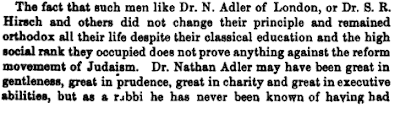
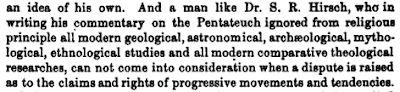
But, actually, this isn't the entire passage. The rest of it, which is his answer, is basically an ode to conviction: "Respect is due to every honest worker whether in the field of orthodoxy of reform. Let a man always be true to his conviction, be he a Sadducee or a Pharisee. Shame only upon the money-servers, the time-servers and man-servers."
This entire bit comes up in the context of these questions: ""...why do rabbis so often change their principle? Why have nearly all rabbis that come over from Europe so very orthodox, more or less changed?...Why do the rabbis not come out right at the start with the color and say this and that are our principles?"
All this is from a section called The Rabbi and Consistency; read it here. It is a unique artifact of the time.
Another quote, from Disseminating Darwinism: The Role of Place, Race, Religion, and Gender by Ronald L. Numbers and John Stenhouse:
In 1881, Rabbi Aaron Hahn joined the ranks of Reform opponents of evolution. Hahn...argued that if scientists proved evolution true, then "Jewish theology will bow its head before the majesty of truth and adopt it without further delay."....Nevertheless, Hahn firmly believed that the evolution of species was improbable, drawing support from [Isaac Mayer] Wise's The Cosmic God. He quoted passages from The Cosmic God that argued for a distinction in kind between animal and human minds and concluded that they "contain more common sense and more true philosophy than all the defenses of Darwinism together."


But, actually, this isn't the entire passage. The rest of it, which is his answer, is basically an ode to conviction: "Respect is due to every honest worker whether in the field of orthodoxy of reform. Let a man always be true to his conviction, be he a Sadducee or a Pharisee. Shame only upon the money-servers, the time-servers and man-servers."
This entire bit comes up in the context of these questions: ""...why do rabbis so often change their principle? Why have nearly all rabbis that come over from Europe so very orthodox, more or less changed?...Why do the rabbis not come out right at the start with the color and say this and that are our principles?"
All this is from a section called The Rabbi and Consistency; read it here. It is a unique artifact of the time.
Another quote, from Disseminating Darwinism: The Role of Place, Race, Religion, and Gender by Ronald L. Numbers and John Stenhouse:
In 1881, Rabbi Aaron Hahn joined the ranks of Reform opponents of evolution. Hahn...argued that if scientists proved evolution true, then "Jewish theology will bow its head before the majesty of truth and adopt it without further delay."....Nevertheless, Hahn firmly believed that the evolution of species was improbable, drawing support from [Isaac Mayer] Wise's The Cosmic God. He quoted passages from The Cosmic God that argued for a distinction in kind between animal and human minds and concluded that they "contain more common sense and more true philosophy than all the defenses of Darwinism together."
Friday, February 02, 2007
Thursday, February 01, 2007
Did the Samaritans "always have the Torah + Joshua," as per R. Avigdor Miller?
On pg. 38 of R. Avigdor Miller's Torah Nation we find
Because of their hostility towards Israel, the Samaritans are one of the many testimonials to the truth of Israel's traditions. The fact that they have always had the Five Books of the Torah and the book of Joshua testifies to the age of these books....in view of the fact that Solomon erected the Sanctuary a mere 440 years after Moses (much closer to them than Columbus to us), we may therefore consider ourselves as standing in the days of Solomon holding in our hands the books of Moses and Joshua which are only 440 years old and less...*
It is a common error that the Samaritans possess the book of Joshua (and that it forms the sixth and final book of their Bible). I noticed the same error in Wikipedia's article on the biblical canon, which read "The small community of the remnants of the Samaritans in Palestine includes only their version of the Torah and the book of Joshua in their canon. This grouping is sometimes referred to as the Hexateuch," until I corrected it.
While it certainly is romantic and appealing to think of the Samaritans as possessing a bible containing the Torah and Joshua, it isn't true. The Samaritans do possess a chronicle book called Joshua, but it is medieval, originally written in Arabic and it is not in any way canonical to them.
Moshe Florentin writes, pg. 357-58, in his Late Samaritan Hebrew: A Linguistic Analysis of Its Different Types
In 1908 M. Gaster published a Hebrew version of the Book of Joshua. Because of the impression of (imagined) antiquity, and because of the similarity to the contents of the Book of Joshua in the Masoretic version, Gaster felt that this Hebrew version was the original from which the Arabic Book of Joshua resulted.
But in reality the Hebrew version was translated from the Arabic in the late 19th--or early 20th century!
In fact, why not read an English translation of this book and see for yourself that it is not Sepher Yehoshua at all.
The mistake is understandable in the sense that it is one of those things that gets repeated often, seems more or less plausible, and who would think to check it, unless one happens to be interested in Samaritans (as opposed to, say, using them for polemics).
*Actually, this excerpt is part of a larger passage, as you can see by the .... I feel that this excerpt makes the point I want to address, however I don't want it to seem as if I distorted his words, so I scanned the entire passage which you can view here.
Because of their hostility towards Israel, the Samaritans are one of the many testimonials to the truth of Israel's traditions. The fact that they have always had the Five Books of the Torah and the book of Joshua testifies to the age of these books....in view of the fact that Solomon erected the Sanctuary a mere 440 years after Moses (much closer to them than Columbus to us), we may therefore consider ourselves as standing in the days of Solomon holding in our hands the books of Moses and Joshua which are only 440 years old and less...*
It is a common error that the Samaritans possess the book of Joshua (and that it forms the sixth and final book of their Bible). I noticed the same error in Wikipedia's article on the biblical canon, which read "The small community of the remnants of the Samaritans in Palestine includes only their version of the Torah and the book of Joshua in their canon. This grouping is sometimes referred to as the Hexateuch," until I corrected it.
While it certainly is romantic and appealing to think of the Samaritans as possessing a bible containing the Torah and Joshua, it isn't true. The Samaritans do possess a chronicle book called Joshua, but it is medieval, originally written in Arabic and it is not in any way canonical to them.
Moshe Florentin writes, pg. 357-58, in his Late Samaritan Hebrew: A Linguistic Analysis of Its Different Types
In 1908 M. Gaster published a Hebrew version of the Book of Joshua. Because of the impression of (imagined) antiquity, and because of the similarity to the contents of the Book of Joshua in the Masoretic version, Gaster felt that this Hebrew version was the original from which the Arabic Book of Joshua resulted.
But in reality the Hebrew version was translated from the Arabic in the late 19th--or early 20th century!
In fact, why not read an English translation of this book and see for yourself that it is not Sepher Yehoshua at all.
The mistake is understandable in the sense that it is one of those things that gets repeated often, seems more or less plausible, and who would think to check it, unless one happens to be interested in Samaritans (as opposed to, say, using them for polemics).
*Actually, this excerpt is part of a larger passage, as you can see by the .... I feel that this excerpt makes the point I want to address, however I don't want it to seem as if I distorted his words, so I scanned the entire passage which you can view here.
100 year old gossip: Louis Ginzberg on C.D. Ginsburg
From a letter from Ginzberg to Henrietta Szold, sent from Amsterdam on 9/15/08
By the way, I think Dr. Bloomfield has changed his good opinion of me. One evening he introduced me to my namesake, the meshumod Ginsberg and that old fool had nothing better to say to me than "Dear Dr., you have changed your name, you ought to spell it Guinsberg with an s and not with z" to which I replied: "There is no harm in changing a name as in my case a single letter only but I would not like to change myself for any consideration." Dr. Bloomfield reproached me later to say that he never would have believed me to be such a fanatic.
(pg. 169 in Lost Love: The Untold Story of Henrietta Szold : Unpublished Diary and Letters by Baila Round Shargel.)
By the way, I think Dr. Bloomfield has changed his good opinion of me. One evening he introduced me to my namesake, the meshumod Ginsberg and that old fool had nothing better to say to me than "Dear Dr., you have changed your name, you ought to spell it Guinsberg with an s and not with z" to which I replied: "There is no harm in changing a name as in my case a single letter only but I would not like to change myself for any consideration." Dr. Bloomfield reproached me later to say that he never would have believed me to be such a fanatic.
(pg. 169 in Lost Love: The Untold Story of Henrietta Szold : Unpublished Diary and Letters by Baila Round Shargel.)
Tuesday, January 30, 2007
Which is more impressive (debunking the Yerushalmi Kodshim)
I've long felt that "stories" are fascinating because, ostensibly, we can learn something about people who tell stories; what inspires them, what they dislike, what their values are like etc. Obviously its easy to play the pop shrink and come to all sorts of unfounded conclusions, but even so, the stories we tell tell stories about us....I think.
Another thing I find fascinating is the episode concerning the fraudulent Yerushalmi order of Kodshim which was published early in the 20th century and accepted by many gedolei Torah, as well as critical scholars, but also suspected and proved to be a forgery by....other gedolei Torah, as well as critical scholars. A fascinating overview of the case was written by R. Yosef Gavriel Bechhofer and can be downloaded here.
In brief, the one-time existence of the a Talmud Yerushalmi on Kodshim was known from references to it in rishonic literature, but the actual order itself was lost. A mysterious person calling himself Shlomo Yehuda Algazi-Friedlaender, claiming to be Sephardic (but was actually Lithuanian), turned up with a text he claimed was the Yerushalmi Kodshim. He had in fact forged it himself, and did so ingeniously, reworking actual texts from the Bavli, creating his own text out of unsourced halakhot quoted by rishonim, changing names etc. It's really worth reading R. Bechhofer's exceptional essay.
In the essay he notes a story (refer back to the first paragraph of this post), which he calls "an unverified legend related in the Yeshiva world," about how the Rogachover Gaon, R. Yosef Rozen, determined it to be a forgery based on a simple test: because of his encyclopedic knowledge of the Talmud, he noticed that each tractate contains the name of at least one amora which doesn't appear in any other tractate. In these tractates, there are no amoraic hapax legomena. Thus, it had to be fake.
The story is interesting (R. Bechhofer notes that R. Rozen's analysis and objections actually appears in his Tzafenas Paneach, #113-115). I think it's evident that underlying the story, or legend, is the idea of the Rogachever's encyclopedic knowledge but also his knowledge of arcane Talmudic trivia which would escape the attention of anyone but one who was somehow able to have in mind, as it were, the entire Talmud at one time in order to notice something like that. Presumably the Rogachever knew all kinds of other things which no one else knew about the Talmud, things which only a mind like his could notice and which he never had occasion to share.
But perhaps something else is underlying the story as well. The true nature of how the hoax was debunked involved more prosaic research. Even though great scholars accepted it--in R. Bechhofer's essay it is even mentioned that one great scholar in particular began wearing Rabbenu Tam tephillin because this work mentioned it--there were red flags which caused others to doubt it. Friedlaender did an impressive job, but his method wasn't foolproof (or else he wouldn't have gotten caught, right?). It was realized what sources he used. There was philological problems. His manuscript was allegedly seen by the Gerrer Rebbe who recognized it was not really old, but made to appear as such. All in all, it was detective work and not a Feat of the Mind in the push-a-pin-into-the-Talmud-and-I'll-guess-the-word way which revealed the work to be fraudulent. (Which is not to say that the legend is not actually true--it might be, but it wasn't the foundation of the Rogachever's case, and it certainly was not the reason why it was unmasked.)
In any event, which is more impressive, research or what I called a Feat of the Mind?
Another thing I find fascinating is the episode concerning the fraudulent Yerushalmi order of Kodshim which was published early in the 20th century and accepted by many gedolei Torah, as well as critical scholars, but also suspected and proved to be a forgery by....other gedolei Torah, as well as critical scholars. A fascinating overview of the case was written by R. Yosef Gavriel Bechhofer and can be downloaded here.
In brief, the one-time existence of the a Talmud Yerushalmi on Kodshim was known from references to it in rishonic literature, but the actual order itself was lost. A mysterious person calling himself Shlomo Yehuda Algazi-Friedlaender, claiming to be Sephardic (but was actually Lithuanian), turned up with a text he claimed was the Yerushalmi Kodshim. He had in fact forged it himself, and did so ingeniously, reworking actual texts from the Bavli, creating his own text out of unsourced halakhot quoted by rishonim, changing names etc. It's really worth reading R. Bechhofer's exceptional essay.
In the essay he notes a story (refer back to the first paragraph of this post), which he calls "an unverified legend related in the Yeshiva world," about how the Rogachover Gaon, R. Yosef Rozen, determined it to be a forgery based on a simple test: because of his encyclopedic knowledge of the Talmud, he noticed that each tractate contains the name of at least one amora which doesn't appear in any other tractate. In these tractates, there are no amoraic hapax legomena. Thus, it had to be fake.
The story is interesting (R. Bechhofer notes that R. Rozen's analysis and objections actually appears in his Tzafenas Paneach, #113-115). I think it's evident that underlying the story, or legend, is the idea of the Rogachever's encyclopedic knowledge but also his knowledge of arcane Talmudic trivia which would escape the attention of anyone but one who was somehow able to have in mind, as it were, the entire Talmud at one time in order to notice something like that. Presumably the Rogachever knew all kinds of other things which no one else knew about the Talmud, things which only a mind like his could notice and which he never had occasion to share.
But perhaps something else is underlying the story as well. The true nature of how the hoax was debunked involved more prosaic research. Even though great scholars accepted it--in R. Bechhofer's essay it is even mentioned that one great scholar in particular began wearing Rabbenu Tam tephillin because this work mentioned it--there were red flags which caused others to doubt it. Friedlaender did an impressive job, but his method wasn't foolproof (or else he wouldn't have gotten caught, right?). It was realized what sources he used. There was philological problems. His manuscript was allegedly seen by the Gerrer Rebbe who recognized it was not really old, but made to appear as such. All in all, it was detective work and not a Feat of the Mind in the push-a-pin-into-the-Talmud-and-I'll-guess-the-word way which revealed the work to be fraudulent. (Which is not to say that the legend is not actually true--it might be, but it wasn't the foundation of the Rogachever's case, and it certainly was not the reason why it was unmasked.)
In any event, which is more impressive, research or what I called a Feat of the Mind?
How to detect a forgery
With regard to the infamous Shapira Strips forgery (posted about here, here and here)--
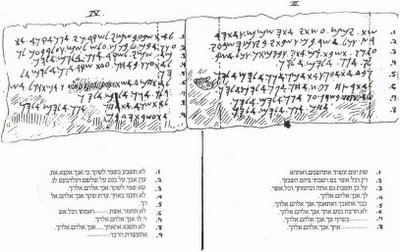
--something of interest was noticed subsequent to the time this forgery turned up. Paleo-Hebrew written on leather (or pottery) does not look like Paleo-Hebrew chiseled out of stone. With ink a cursive can develop and the thickness of the lines is influenced by the pen.
Carved in stone:
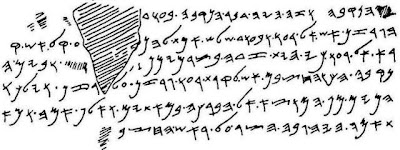
Ink on pottery:

Simply put, the real thing would have looked more like the second and less like the first. Instead, it looks exactly like the first. In the words of MH Goshen-Gottstein, " The Shapira Forgery and the Qumran Scrolls," JJS 7:3-4, 1956, "the forger imitated Paleo-Hebrew monumental letters, i.e. letters used on inscriptions (or coins). Neither he nor any scholar in the 1880s could know....that a written Paleo-Hebrew document exhibits altogether different characteristics."

--something of interest was noticed subsequent to the time this forgery turned up. Paleo-Hebrew written on leather (or pottery) does not look like Paleo-Hebrew chiseled out of stone. With ink a cursive can develop and the thickness of the lines is influenced by the pen.
Carved in stone:

Ink on pottery:

Simply put, the real thing would have looked more like the second and less like the first. Instead, it looks exactly like the first. In the words of MH Goshen-Gottstein, " The Shapira Forgery and the Qumran Scrolls," JJS 7:3-4, 1956, "the forger imitated Paleo-Hebrew monumental letters, i.e. letters used on inscriptions (or coins). Neither he nor any scholar in the 1880s could know....that a written Paleo-Hebrew document exhibits altogether different characteristics."
Friday, January 26, 2007
English Vilna Gaon
When was the Vilna Gaon first mentioned in print in English?
and
Something about Hebrew abbreviations, abbreviature, or, rashei tevot at English Hebraica.
א גוט שבת, dear reader!
and
Something about Hebrew abbreviations, abbreviature, or, rashei tevot at English Hebraica.
א גוט שבת, dear reader!
When was the Vilna Gaon first mentioned in print in the English language?
That's what I want to know, and I've been researching it for some time. Here is the earliest I've so far found:

This is from 1824, and is from a book called Missionary Journal and Memoir of the Rev. Joseph Wolf: Missionary to the Jews (nice, huh?).
The search is difficult because---what would he be called? Throughout the 19th century one finds him called many things; Elijah Wilno, Rabbi Elia, Elijah Gaon and more. I'm sure there's something earlier--and I will find it!

(click to enlarge)
This is from 1824, and is from a book called Missionary Journal and Memoir of the Rev. Joseph Wolf: Missionary to the Jews (nice, huh?).
The search is difficult because---what would he be called? Throughout the 19th century one finds him called many things; Elijah Wilno, Rabbi Elia, Elijah Gaon and more. I'm sure there's something earlier--and I will find it!
Tuesday, January 23, 2007
Something about Deutero-Isaiah and Orthodoxy
A couple of days ago a post by DovBear contained the following exchange in the comments.
- "Many people, even frum people say Isaiah must have two authors."
- "Any Orthodox Jew who believes in Deutero-Isaiah is a hypocrite."
- "Hmmm.... I am orthodox and believe in Deutero-Isaiah. So, you are calling me a hypocrite?"
- "Well, either that or not Orthodox. Pick what you prefer. "
"
then the baal ha-blog wrote
- "Im aware of nothing that prevents or prohibits an Orthodox Jew from accepting that the book Of Isaiah had (at least) two authors who lived hundreds of years apart."
At which point I chimed in noting that there is a history to the issue and that we are talking about Orthodox hashkafah. Further exchange led to the claim (not by me) that there is nothing in Orthodox halakhah to prohibit this belief. I merely noted that one should try advising a potential convert to disclose to the Orthodox bet din that he believes in Deutero-Isaiah. Try, that is, if one wants to give bad advice.
Since this is an issue with a history, I thought it might be interesting to discuss some of that history and then to relate it to a historical conflict between two great friends.
To begin with, it doesn't take great literary analysis to notice that what we call Isaiah 40-66, beginning with נחמו נחמו עמי, takes a different tone from what we call Isaiah 1-39. That isn't the issue per se, since no one denies this. In addition, the second part discusses the post-exilic period and even names the Persian king Cyrus by name (44:28 and 45-1), two hundred years before this king lived. The question is how to interpret these facts. Obviously if one believes in prophecy and the prophetic ability to predict the future then it is possible that this is such a true prophecy and could well have been written by the prophet Isaiah. Obviously if one doesn't believe in prophecy or the prophetic ability to predict the future then these chapters could not have been written by Isaiah, but by someone else who was reflecting on current or past conditions rather then predicting future ones.
It should be noted that Chazal viewed the book as written by Isaiah, and as far back as we can trace this entire book was viewed as written by Isaiah. Ben Sira 48:27-28 (in the version I found online) notes that Isaiah prophecied the prophecy of Isaiah 44 ("With a great spirit [Isais] saw the things that are to come to pass at last, and comforted the mourners in Sion. He shewed what should come to pass for ever, and secret things before they came."). There is definitely no smoking gun ancient text or fragment in which Isaiah is two works.
There is no need to get into the particulars of the history or even really to drop names, but suffice it to say that by the nineteenth century the modern view was firmly established that Isaiah 1-39 and 44-66 were the work of two (or perhaps three) people. The first could have been Isaiah, the second had to be someone else who for the sake of convenience could be called Deutero- or Pseudo-Isaiah.
Before I discuss the Jewish reaction to this view and who adopted it and who eschewed it, I want to quote myself. Above I wrote "if one believes in prophecy and the prophetic ability to predict the future then it is possible that this is such a true prophecy and could well have been written by the prophet Isaiah." I wrote these words deliberately, because I wanted to note that believing in prophecy or the prophetic ability to predict the future per se does not guarantee that 1) those latter 26 chapters were written by Isaiah or 2) that a believer accepts the unified authorship of Isaiah. The reason for (1) is that one's belief in prophecy doesn't guarantee the authorship of any work. And for (2) is because there absolutely were (and perhaps are) believers in prophecy, including its predictive power, who didn't believe that 40-66 were written by Isaiah. So it's important to note this, even though in the final analysis most believers in prophecy would not doubt it and would consider Isaiah to be one work by one prophet.
It seems that before the 18th and 19th century there was a Jewish exegete who doubted that the whole book was prophecied by Isaiah, and I think there can be no doubt that he did believe in prophecy (hence (2) above)--'Ibn 'Ezra.
(Before I discuss his words, let me anticipate some reaction in the comments denying that Ibn Ezra meant what I and many others think he meant.)
Ibn Ezra comments on Isaiah 40:1 (I snipped a bit from the beginning, am freely translating and explaining what he means)
Know that Chazal said that the book of Samuel was written by Samuel, and this is true until the verse "And Samuel died" (i Sam. 25:1). And Chronicles proves the point where it lists the generations of the descendents of Zerubbavel (i Chr. 3:19-24). [since it list ten generations, obviously these verses are later interpolations] And here in Isaiah we see it from the verse "Kings shall see and arise, princes shall bow" (Is. 49:7). Although you could say that the kings and princes will do this when they hear the name of the prophet, long after he died, if not, then the maskil will understand what I mean.
His points are
1. Even though Chazal ascribe Samuel to Samuel, that's true only up until where it says he died. Obviously another hand wrote the rest.
2. In Chronicles we're given a list of ten generations of Zerubbavel's descendents. That must mean that these few verses were written after these people lived. Since no one ascribes Chronicles to the tenth generation after Zerubbavel (200-300 years after he lived, I suppose) then it must be a later interpolation. (The Gemara says that Chronicles was written by Ezra up until the point where it records his own geneology, and then it was written by Nechemia and both were more or less contemporaries of Zerubbavel)
3. In Isaiah itself, the prophet prophecies that when his prophecies come true, kings will show respect to the prophet who was despised. Since the prophecy would come true 200 years after Isaiah, could you say that they would then show respect and bow to him? Ibn Ezra notes that you could say that--but if not, then he who is enlightened will understand what he means.
All in all, there is no question that this Ibn Ezra has been understood to mean one thing: two prophets. If there is a more convincing explanation of what he meant, I'm all ears.
As I said, Ibn Ezra did believe in prophecy and presumably believed that prophecy could be predictive. His evident opposition was based on literary sensitivity and not opposition to prophecy.
Be that as it may, this was not the traditional view. When the 19th century and modern Bible criticism rolled around Jews who accepted modern Bible criticism adopted this view while traditionalists continued to believe that Isaiah was the work of one prophet. As noted in an earlier post R. Samson Raphael Hirsch wrote in 1854 "Orthodox Judaism...knows neither of the various authors of the Pentateuch, nor of Pseudo-Isaiah." [1] But if this were so, what about Orthodox Jews? Here the matter is sketchy only because we are in a transition period between traditional and modern culture. No Jew was ever called Orthodox, nor were they called Reform before this period. During this period though there were Jews who are not easily categorized, as there still are today!
I want to highlight an issue of contention between two 19th century Jewish scholars over this very issue. I think a case could be made about either one either being or not being Orthodox, but certainly not in the sense that an Orthodox Jew sensitive to denominational divisions could consider either one to be beyond the pale for not being Orthodox.
I am talking about my favorite Shadal [2] and his intimate friend (and briefly enemy) Shir (R. Shlomo Yehuda Loeb Rapoport. Both were seminal Haskalah figures who get much credit for the development of Wissenschaft style Jewish learning. Shadal was more of a textual scholar while Shir was more of a historian, but each was a font of learning and, dare I say, piety. (The truth is that I can see how this last bit could be disputed about Shir, but definitely not Shadal who was a supremely religious and pious person. However, even if one were to doubt that Shir was particularly pious, even if one were to be unimpressed by his strict halakhic observance, there can be no doubt that he fought for Torah, he remained committed to Hebrew as the language of Jewish learning, despite ridicule and he held fast to the truth as he saw it despite the pressure and attacks from his right and his left.)
Be that as it may, Shir accepted the idea of Deutero-Isaiah, probably initially because his mentor R. Nachman Krochmal propounded it, and Shadal thought it was simply horrific, a horrific idea and horrific of Shir. Shadal's issue was strictly the matter of prophecy, although he claimed that he had other reasons too. Why, he felt, would anyone who believes in prophecy have reason to doubt that chapters 40-66 were written by Isaiah? Furthermore, Shadal happened to have disliked Ibn Ezra [3] (even though to an outside observer Shadal's own work bore closest resemblance to Ibn Ezra of many of the medieval meforshim; but Shadal idolized Rashi). He believed that Ibn Ezra was disingenuous in presenting himself as more pious than he was. He believed that Ibn Ezra flirted with biblical criticsm (in a proto- sense, obviously) and then tried to mask it with coy comments about secrets which the wise would understand. At the same time, and perhaps this is a contradiction without reconciliation, Shadal unapologetically thought in ways which broke with traditional modes of thinking. He believed that Kohellet was not written by Shlomo, but by someone named Kohellet from a much later period. As noted earlier in this blog, he suggested conjectural emendations for the Bible. I'm sure R. Hirsch thought highly of him--except not.
In contrast, Ibn Ezra was a model for Shir. (But his particular hero was the Rambam, who Shadal also was critical of.) Although I admit that I favor Shadal in the sense that he's very important to me, I certainly cannot fault Shir for doing exactly as Shadal did, following his own intellect, pursuing the truth as he saw it and holding a great exegete as a role model.
Shadal and Shir carried on a written correspondence (the two never met; Shadal's son Philosseno did meet Shir one time). Quite often Shadal would tell Shir how upset his view of Deutero-Isaiah made him. (Note that Shadal corresponded with anyone who was interested or interesting--but his correspondence with Shir was especially personal and fruitful--I doubt that Abraham Geiger, another correspondent's, acceptance of Deutero-Isaiah not to mention Pentateuchal criticism particularly troubled him per se. I guess it's a matter of expectations. Geiger was a moderate-radical Reformer, while Shir was one who battled Reform, along with Shadal)
Shadal would constantly bring it up and Shir would constantly remind him that he is only being true to his sense of truth. Furthermore, Shir would defend Ibn Ezra, once writing that "From Abraham to Abraham there was no one like Abraham [ibn Ezra]," paraphrasing the aphorism comparing Moses to Moses [Maimonides]. On occasion Shir, sensing Shadal's getting hot under the collar, would remind him that he harbored no ill will and only warm feelings toward him even though Shadal "could not imagine that anyone who disagrees with you on any matter can still harbor friendship toward you."
Although the Deutero-Isaiah issue was always present, the matter of Ibn Ezra was an even greater source of tension and even led to a two-year interruption in their correspondence, ostensibly spurred on by another matter, but not to be removed from the context of the already frosty bones of contention between them.
In 1839 Shadal was informed that Shir was publishing an essay critical of him and that the reason was that Shir was getting heat from his own community over his friendship with Shadal, given that he had criticized the Rambam. When such an essay did appear in the journal Keren Hemed, although not authored by Shir, edited by him, Shadal got very upset and fired off an angry, and hurtful, letter which he couched in terms of a bill of divorce. Some overtures on the part of Shir and some attempts at peacemaking were made and eventually they resumed their friendship.
In any event, getting back to Deutero-Isaiah, Shir believed in it. As I said, his mentor propounded it, but he also offered reasons.
1. Where the Talmud lists the order of the prophets Isaiah is placed after Ezekiel. Therefore Chazal must have considered the second part of Isaiah to have been contemporary with events following Ezekiel, ie, post exilic.
1b. Shadal countered that if the Talmud intended to list books chronologically then wouldn't Job, given in the same passage as authored by Moses, be listed before Psalms?
2. The prophets never describe the distant future with such great detail. There is no other example of someone not yet born named by a prophet.
2b. Shadal countered that there are examples like this. For example, it is told in the Torah that Zebulun "shall dwell on the sea-shore." King Josiah's burning the bones of the prophets of Baal is predicted before his birth, and he is named.
3. The prophecies in chs. 40-66 would not have been intelligible to the contemporaries of Isaiah. For example, there was no Persian empire. To put it in contemporary terms, how would we understand a prophet today telling us about the El Salvadorian superpower?
3b. Shadal countered that these later prophecies were not intended for public consumption until later generations. Perhaps they had only been written down, but not spoken to the people.
4. Stylistic. The first part is more esoteric and cryptic, while the second part is written more clearly and elaborate.
4b. Shadal countered with the same argument as in number 3: since the first part was meant for public consumption it was not esoteric to its original audience, but only to us who don't get the allusions. But since the second part was prophecied at the time only for an initiated audience, it had to be spelled out more clearly so that its prophecy could be correctly understood by them.
This is the gist of the arguments traded between Shir and Shadal (as taken from Morris Margolie's marvelous biography of Shadal).
Getting back to the beginning of the post, and hopefully closing the circle, what of Orthodox believe in Deutero-Isaiah? Now, its true that a handful of Orthodox scholars publically accepted this view. A name that keeps on recurring in this regard is Jacob Barth, son-in-law of R. Azriel Hildesheimer who evidently taught this even at the Orthodox rabbinical seminary in Berlin. The idea behind bringing this up is to create an association with this idea and Orthodoxy. I suppose it works in the "limits of Orthodox theology" sense. I'm sure you'll find much veiled acceptance of Deutero-Isaiah by many Orthodox Jews, not only in academia, but even in some more right wing circles. But I still feel justified in saying that it runs counter to Orthodox hashkafah and it would probably create a huge speed bump for a potential Orthodox convert, if not scuttle his chances altogether. That said, probably this is the kind of view that needs to be judged in context. Some Orthodox Jews can probably believe this somewhat public ally without their Orthodoxy questioned. Others would run into trouble.
[1] On the other hand, Encyclopedia Judaica quotes the Hertz Chumash "This question can be considered dispassionately. It touches no dogma, or any religious principle in Judaism; and, moreover, does not materially affect the understanding of the prophecies, or of the human conditions of the Jewish people that they have in view." cf the comments by R. Sabato Morais, who probably occupied space somewhat on the same religious spectrum of Orthodoxy as R. Hertz here.
[2] An 1866 Bible dictionary sums up Shadal's viewpoint with the following: "A more recent Jewish expositor, Samuel David Luzzatto in Padua, says beautifully and strikingly: "As if Isaiah had foreseen that later scepticism will decide against the half of his prophecies, he has impressed his seal on all, and has interwoven the name of God, "Holy One of Israel," with the second part just as with the first, and even still oftener."
[3] Firstly, if this seems shocking to contemporary Orthodox ears his arrogating to himself the right to judge someone like the Ibn Ezra itself is a good example of why a transition figure like him could be considered Orthodox or non-Orthodox. By the same token, one hears of others who did this, including R. Hirsch about the Rambam and more recently R. JB Soloveitchik about Abarbanel and perhaps too the Meiri. But according to Orthodox manners one does not have opinions about the persons of canonical rabbinic figures.
Secondly, Shadal could be admiring toward Ibn Ezra too, writing once about him "there is no need to adduce proof of his incalculable erudition." But his view of Ibn Ezra can't be said better than this other quote: "Ibn Ezra sold himself as a slave to Greek and Arab philosophy and like a blundering fool, he derides the likes of Sa'adia."
- "Many people, even frum people say Isaiah must have two authors."
- "Any Orthodox Jew who believes in Deutero-Isaiah is a hypocrite."
- "Hmmm.... I am orthodox and believe in Deutero-Isaiah. So, you are calling me a hypocrite?"
- "Well, either that or not Orthodox. Pick what you prefer.
"then the baal ha-blog wrote
- "Im aware of nothing that prevents or prohibits an Orthodox Jew from accepting that the book Of Isaiah had (at least) two authors who lived hundreds of years apart."
At which point I chimed in noting that there is a history to the issue and that we are talking about Orthodox hashkafah. Further exchange led to the claim (not by me) that there is nothing in Orthodox halakhah to prohibit this belief. I merely noted that one should try advising a potential convert to disclose to the Orthodox bet din that he believes in Deutero-Isaiah. Try, that is, if one wants to give bad advice.
Since this is an issue with a history, I thought it might be interesting to discuss some of that history and then to relate it to a historical conflict between two great friends.
To begin with, it doesn't take great literary analysis to notice that what we call Isaiah 40-66, beginning with נחמו נחמו עמי, takes a different tone from what we call Isaiah 1-39. That isn't the issue per se, since no one denies this. In addition, the second part discusses the post-exilic period and even names the Persian king Cyrus by name (44:28 and 45-1), two hundred years before this king lived. The question is how to interpret these facts. Obviously if one believes in prophecy and the prophetic ability to predict the future then it is possible that this is such a true prophecy and could well have been written by the prophet Isaiah. Obviously if one doesn't believe in prophecy or the prophetic ability to predict the future then these chapters could not have been written by Isaiah, but by someone else who was reflecting on current or past conditions rather then predicting future ones.
It should be noted that Chazal viewed the book as written by Isaiah, and as far back as we can trace this entire book was viewed as written by Isaiah. Ben Sira 48:27-28 (in the version I found online) notes that Isaiah prophecied the prophecy of Isaiah 44 ("With a great spirit [Isais] saw the things that are to come to pass at last, and comforted the mourners in Sion. He shewed what should come to pass for ever, and secret things before they came."). There is definitely no smoking gun ancient text or fragment in which Isaiah is two works.
There is no need to get into the particulars of the history or even really to drop names, but suffice it to say that by the nineteenth century the modern view was firmly established that Isaiah 1-39 and 44-66 were the work of two (or perhaps three) people. The first could have been Isaiah, the second had to be someone else who for the sake of convenience could be called Deutero- or Pseudo-Isaiah.
Before I discuss the Jewish reaction to this view and who adopted it and who eschewed it, I want to quote myself. Above I wrote "if one believes in prophecy and the prophetic ability to predict the future then it is possible that this is such a true prophecy and could well have been written by the prophet Isaiah." I wrote these words deliberately, because I wanted to note that believing in prophecy or the prophetic ability to predict the future per se does not guarantee that 1) those latter 26 chapters were written by Isaiah or 2) that a believer accepts the unified authorship of Isaiah. The reason for (1) is that one's belief in prophecy doesn't guarantee the authorship of any work. And for (2) is because there absolutely were (and perhaps are) believers in prophecy, including its predictive power, who didn't believe that 40-66 were written by Isaiah. So it's important to note this, even though in the final analysis most believers in prophecy would not doubt it and would consider Isaiah to be one work by one prophet.
It seems that before the 18th and 19th century there was a Jewish exegete who doubted that the whole book was prophecied by Isaiah, and I think there can be no doubt that he did believe in prophecy (hence (2) above)--'Ibn 'Ezra.
(Before I discuss his words, let me anticipate some reaction in the comments denying that Ibn Ezra meant what I and many others think he meant.)
Ibn Ezra comments on Isaiah 40:1 (I snipped a bit from the beginning, am freely translating and explaining what he means)
נחמו נחמו עמי. .... ודע כי מעתיקי המצות ז״ל אמרו כי ספר שמואל כתבו שמואל והוא אמת עד [וימת] שמואל והנה דברי הימים יוכיח ששם דור אחר דור (לפני) [לבני] זרובבל והעד מלכים יראו וקמו שרים וישתחוו ויש להשיב כאשר ישמעו שם הנביא ואם איננו והמשכיל יבין׃
Know that Chazal said that the book of Samuel was written by Samuel, and this is true until the verse "And Samuel died" (i Sam. 25:1). And Chronicles proves the point where it lists the generations of the descendents of Zerubbavel (i Chr. 3:19-24). [since it list ten generations, obviously these verses are later interpolations] And here in Isaiah we see it from the verse "Kings shall see and arise, princes shall bow" (Is. 49:7). Although you could say that the kings and princes will do this when they hear the name of the prophet, long after he died, if not, then the maskil will understand what I mean.
His points are
1. Even though Chazal ascribe Samuel to Samuel, that's true only up until where it says he died. Obviously another hand wrote the rest.
2. In Chronicles we're given a list of ten generations of Zerubbavel's descendents. That must mean that these few verses were written after these people lived. Since no one ascribes Chronicles to the tenth generation after Zerubbavel (200-300 years after he lived, I suppose) then it must be a later interpolation. (The Gemara says that Chronicles was written by Ezra up until the point where it records his own geneology, and then it was written by Nechemia and both were more or less contemporaries of Zerubbavel)
3. In Isaiah itself, the prophet prophecies that when his prophecies come true, kings will show respect to the prophet who was despised. Since the prophecy would come true 200 years after Isaiah, could you say that they would then show respect and bow to him? Ibn Ezra notes that you could say that--but if not, then he who is enlightened will understand what he means.
All in all, there is no question that this Ibn Ezra has been understood to mean one thing: two prophets. If there is a more convincing explanation of what he meant, I'm all ears.
As I said, Ibn Ezra did believe in prophecy and presumably believed that prophecy could be predictive. His evident opposition was based on literary sensitivity and not opposition to prophecy.
Be that as it may, this was not the traditional view. When the 19th century and modern Bible criticism rolled around Jews who accepted modern Bible criticism adopted this view while traditionalists continued to believe that Isaiah was the work of one prophet. As noted in an earlier post R. Samson Raphael Hirsch wrote in 1854 "Orthodox Judaism...knows neither of the various authors of the Pentateuch, nor of Pseudo-Isaiah." [1] But if this were so, what about Orthodox Jews? Here the matter is sketchy only because we are in a transition period between traditional and modern culture. No Jew was ever called Orthodox, nor were they called Reform before this period. During this period though there were Jews who are not easily categorized, as there still are today!
I want to highlight an issue of contention between two 19th century Jewish scholars over this very issue. I think a case could be made about either one either being or not being Orthodox, but certainly not in the sense that an Orthodox Jew sensitive to denominational divisions could consider either one to be beyond the pale for not being Orthodox.
I am talking about my favorite Shadal [2] and his intimate friend (and briefly enemy) Shir (R. Shlomo Yehuda Loeb Rapoport. Both were seminal Haskalah figures who get much credit for the development of Wissenschaft style Jewish learning. Shadal was more of a textual scholar while Shir was more of a historian, but each was a font of learning and, dare I say, piety. (The truth is that I can see how this last bit could be disputed about Shir, but definitely not Shadal who was a supremely religious and pious person. However, even if one were to doubt that Shir was particularly pious, even if one were to be unimpressed by his strict halakhic observance, there can be no doubt that he fought for Torah, he remained committed to Hebrew as the language of Jewish learning, despite ridicule and he held fast to the truth as he saw it despite the pressure and attacks from his right and his left.)
Be that as it may, Shir accepted the idea of Deutero-Isaiah, probably initially because his mentor R. Nachman Krochmal propounded it, and Shadal thought it was simply horrific, a horrific idea and horrific of Shir. Shadal's issue was strictly the matter of prophecy, although he claimed that he had other reasons too. Why, he felt, would anyone who believes in prophecy have reason to doubt that chapters 40-66 were written by Isaiah? Furthermore, Shadal happened to have disliked Ibn Ezra [3] (even though to an outside observer Shadal's own work bore closest resemblance to Ibn Ezra of many of the medieval meforshim; but Shadal idolized Rashi). He believed that Ibn Ezra was disingenuous in presenting himself as more pious than he was. He believed that Ibn Ezra flirted with biblical criticsm (in a proto- sense, obviously) and then tried to mask it with coy comments about secrets which the wise would understand. At the same time, and perhaps this is a contradiction without reconciliation, Shadal unapologetically thought in ways which broke with traditional modes of thinking. He believed that Kohellet was not written by Shlomo, but by someone named Kohellet from a much later period. As noted earlier in this blog, he suggested conjectural emendations for the Bible. I'm sure R. Hirsch thought highly of him--except not.
In contrast, Ibn Ezra was a model for Shir. (But his particular hero was the Rambam, who Shadal also was critical of.) Although I admit that I favor Shadal in the sense that he's very important to me, I certainly cannot fault Shir for doing exactly as Shadal did, following his own intellect, pursuing the truth as he saw it and holding a great exegete as a role model.
Shadal and Shir carried on a written correspondence (the two never met; Shadal's son Philosseno did meet Shir one time). Quite often Shadal would tell Shir how upset his view of Deutero-Isaiah made him. (Note that Shadal corresponded with anyone who was interested or interesting--but his correspondence with Shir was especially personal and fruitful--I doubt that Abraham Geiger, another correspondent's, acceptance of Deutero-Isaiah not to mention Pentateuchal criticism particularly troubled him per se. I guess it's a matter of expectations. Geiger was a moderate-radical Reformer, while Shir was one who battled Reform, along with Shadal)
Shadal would constantly bring it up and Shir would constantly remind him that he is only being true to his sense of truth. Furthermore, Shir would defend Ibn Ezra, once writing that "From Abraham to Abraham there was no one like Abraham [ibn Ezra]," paraphrasing the aphorism comparing Moses to Moses [Maimonides]. On occasion Shir, sensing Shadal's getting hot under the collar, would remind him that he harbored no ill will and only warm feelings toward him even though Shadal "could not imagine that anyone who disagrees with you on any matter can still harbor friendship toward you."
Although the Deutero-Isaiah issue was always present, the matter of Ibn Ezra was an even greater source of tension and even led to a two-year interruption in their correspondence, ostensibly spurred on by another matter, but not to be removed from the context of the already frosty bones of contention between them.
In 1839 Shadal was informed that Shir was publishing an essay critical of him and that the reason was that Shir was getting heat from his own community over his friendship with Shadal, given that he had criticized the Rambam. When such an essay did appear in the journal Keren Hemed, although not authored by Shir, edited by him, Shadal got very upset and fired off an angry, and hurtful, letter which he couched in terms of a bill of divorce. Some overtures on the part of Shir and some attempts at peacemaking were made and eventually they resumed their friendship.
In any event, getting back to Deutero-Isaiah, Shir believed in it. As I said, his mentor propounded it, but he also offered reasons.
1. Where the Talmud lists the order of the prophets Isaiah is placed after Ezekiel. Therefore Chazal must have considered the second part of Isaiah to have been contemporary with events following Ezekiel, ie, post exilic.
1b. Shadal countered that if the Talmud intended to list books chronologically then wouldn't Job, given in the same passage as authored by Moses, be listed before Psalms?
2. The prophets never describe the distant future with such great detail. There is no other example of someone not yet born named by a prophet.
2b. Shadal countered that there are examples like this. For example, it is told in the Torah that Zebulun "shall dwell on the sea-shore." King Josiah's burning the bones of the prophets of Baal is predicted before his birth, and he is named.
3. The prophecies in chs. 40-66 would not have been intelligible to the contemporaries of Isaiah. For example, there was no Persian empire. To put it in contemporary terms, how would we understand a prophet today telling us about the El Salvadorian superpower?
3b. Shadal countered that these later prophecies were not intended for public consumption until later generations. Perhaps they had only been written down, but not spoken to the people.
4. Stylistic. The first part is more esoteric and cryptic, while the second part is written more clearly and elaborate.
4b. Shadal countered with the same argument as in number 3: since the first part was meant for public consumption it was not esoteric to its original audience, but only to us who don't get the allusions. But since the second part was prophecied at the time only for an initiated audience, it had to be spelled out more clearly so that its prophecy could be correctly understood by them.
This is the gist of the arguments traded between Shir and Shadal (as taken from Morris Margolie's marvelous biography of Shadal).
Getting back to the beginning of the post, and hopefully closing the circle, what of Orthodox believe in Deutero-Isaiah? Now, its true that a handful of Orthodox scholars publically accepted this view. A name that keeps on recurring in this regard is Jacob Barth, son-in-law of R. Azriel Hildesheimer who evidently taught this even at the Orthodox rabbinical seminary in Berlin. The idea behind bringing this up is to create an association with this idea and Orthodoxy. I suppose it works in the "limits of Orthodox theology" sense. I'm sure you'll find much veiled acceptance of Deutero-Isaiah by many Orthodox Jews, not only in academia, but even in some more right wing circles. But I still feel justified in saying that it runs counter to Orthodox hashkafah and it would probably create a huge speed bump for a potential Orthodox convert, if not scuttle his chances altogether. That said, probably this is the kind of view that needs to be judged in context. Some Orthodox Jews can probably believe this somewhat public ally without their Orthodoxy questioned. Others would run into trouble.
[1] On the other hand, Encyclopedia Judaica quotes the Hertz Chumash "This question can be considered dispassionately. It touches no dogma, or any religious principle in Judaism; and, moreover, does not materially affect the understanding of the prophecies, or of the human conditions of the Jewish people that they have in view." cf the comments by R. Sabato Morais, who probably occupied space somewhat on the same religious spectrum of Orthodoxy as R. Hertz here.
[2] An 1866 Bible dictionary sums up Shadal's viewpoint with the following: "A more recent Jewish expositor, Samuel David Luzzatto in Padua, says beautifully and strikingly: "As if Isaiah had foreseen that later scepticism will decide against the half of his prophecies, he has impressed his seal on all, and has interwoven the name of God, "Holy One of Israel," with the second part just as with the first, and even still oftener."
[3] Firstly, if this seems shocking to contemporary Orthodox ears his arrogating to himself the right to judge someone like the Ibn Ezra itself is a good example of why a transition figure like him could be considered Orthodox or non-Orthodox. By the same token, one hears of others who did this, including R. Hirsch about the Rambam and more recently R. JB Soloveitchik about Abarbanel and perhaps too the Meiri. But according to Orthodox manners one does not have opinions about the persons of canonical rabbinic figures.
Secondly, Shadal could be admiring toward Ibn Ezra too, writing once about him "there is no need to adduce proof of his incalculable erudition." But his view of Ibn Ezra can't be said better than this other quote: "Ibn Ezra sold himself as a slave to Greek and Arab philosophy and like a blundering fool, he derides the likes of Sa'adia."
Something about Hebrew abbreviations, abbreviature, rashei tevot
If you're like me, you take ראשי תיבות, and other kinds of Hebrew abbreviations, for granted. רש''י, הנ''ל ,עמו''ש, וא''ת, וגו'י and much, much more. But it is an interesting convention nonetheless, if not necessarily unparalleled.
Apart from simply being interesting, fluency in such abbreviations is necessary for understanding rabbinic literature. So it was that the great Christian Hebraist Johann Buxtorf (the father) wrote De Abbreviaturis Hebraicis (published in 1640) as a key to these mysterious abbreviations.
Below is an interesting excerpt from a little book published in England in 1736 by John Gibbs called An historical account of compendious and swift writing.


The Encyclopedia Judaica has a fine article on Hebrew abbreviations. Here are two interesting excerpts:
Misunderstandings and Misinterpretations
The increasing and inconsistent use of abbreviations has inevitably led to occasional confusion and made the study of Hebrew texts more difficult, a fact recognized in the 16th century by Solomon Luria (Yam shel Shelomo, Hul. 6:6). Misinterpretations have occurred when ambiguous abbreviations were printed in full. In any case, difficulties arise when an abbreviation can be read in more than one way, so that, e.g., in a bibliographical context ד''ו could be read as דפוס ויניציאה (“Printed in Venice), or דפוס וורשא (“Printed in Warsaw”), or דפוס וילנה (“Printed in Vilna”), or דפוס וינה (“Printed in Vienna”). Because of the risk of misrepresentation, no abbreviations may be used in a bill of divorce (Git. 36a and Sh. Ar., EH 126) or other religious documents. Misrepresentations have also occurred in the work of censors and Christian scholars (e.g., three yod's have been taken to denote the trinity. Hebrew abbreviations have been found on Christian amulets, and Christian writers have used kabbalistic methods, such as regarding a complete word as notarikon (e.g., ברא as בן רוח אב). Because of the many obscurities in the Hebrew writings, which Christian scholars were anxious to study, a guide to abbreviations was needed and it was a non-Jew, Johannes Buxtorf the Elder, who produced the pioneer work De Abbreviaturis Hebraicis (1613). The first Jewish work of this kind, by Elijah Levita, concentrated mainly on the masoretic ambiguities; lists of abbreviations were eventually added to Hebrew works and were followed by independent, comprehensive compilations. Of these, the following are the most important: J. Ezekiel, Kethonet Yoseph. A Handbook of Hebrew Abbreviations (Heb.-Eng., 1887); G. H. Haendler, Erkhei ha-Notarikon (1897); M. Heilprin, Ha-Notarikon . . . (1872, 19302); A. Stern, Sefer Rashei Tevot (1926); S. Chajes, Ozar Beduyei ha-Shem (pseudonyms; 1933); S. Ashkenazi and D. Jarden, Ozar Rashei Tevot ... (1965); S. Ashkenazi, Mefa'ne'ah Ne'lamim (1969); A. Steinsalz, Rashei Tevot ve-Kizzurim be-Sifrut ha-Hasidut ve-ha-Kabbalah (1968).
[Ruth P. Lehmann]
Abbreviations in Jewish Folklore
Many abbreviations were misinterpreted (often quite intentionally) and caused misunderstandings which became part of the Jewish folklore. For example, the Yaknehaz abbreviation in the Passover Haggadah. denoting the order of the benedictions (yayin, kiddush, ner, havdalah, zeman), was understood as the German jag'n Has (“hunt the hare”) and pictures of a hare hunt accompany the relevant passage in the printed Haggadah. Many folk etymologies are based upon the notion that the obscure word is an abbreviation; so, for example, the word afikoman is explained by the Yemenite Haggadah as an abbreviation of egozim (“nuts), perot (“fruits”), yayin (“wine”), keliyyot (“parched grain”), u-vasar (“and meat”), mayim (“water”), nerd (“spices”). The abbreviation of Akum for Oved Kokhavim u-Mazzalot (“worshiper of the stars and constellations”) was interpreted by anti-Semitic propaganda (Rohling) as Oved Christum u-Miryam (“Worshiper of Christ and Mary”).
[David Niv]
Apart from simply being interesting, fluency in such abbreviations is necessary for understanding rabbinic literature. So it was that the great Christian Hebraist Johann Buxtorf (the father) wrote De Abbreviaturis Hebraicis (published in 1640) as a key to these mysterious abbreviations.
Below is an interesting excerpt from a little book published in England in 1736 by John Gibbs called An historical account of compendious and swift writing.
The Encyclopedia Judaica has a fine article on Hebrew abbreviations. Here are two interesting excerpts:
Misunderstandings and Misinterpretations
The increasing and inconsistent use of abbreviations has inevitably led to occasional confusion and made the study of Hebrew texts more difficult, a fact recognized in the 16th century by Solomon Luria (Yam shel Shelomo, Hul. 6:6). Misinterpretations have occurred when ambiguous abbreviations were printed in full. In any case, difficulties arise when an abbreviation can be read in more than one way, so that, e.g., in a bibliographical context ד''ו could be read as דפוס ויניציאה (“Printed in Venice), or דפוס וורשא (“Printed in Warsaw”), or דפוס וילנה (“Printed in Vilna”), or דפוס וינה (“Printed in Vienna”). Because of the risk of misrepresentation, no abbreviations may be used in a bill of divorce (Git. 36a and Sh. Ar., EH 126) or other religious documents. Misrepresentations have also occurred in the work of censors and Christian scholars (e.g., three yod's have been taken to denote the trinity. Hebrew abbreviations have been found on Christian amulets, and Christian writers have used kabbalistic methods, such as regarding a complete word as notarikon (e.g., ברא as בן רוח אב). Because of the many obscurities in the Hebrew writings, which Christian scholars were anxious to study, a guide to abbreviations was needed and it was a non-Jew, Johannes Buxtorf the Elder, who produced the pioneer work De Abbreviaturis Hebraicis (1613). The first Jewish work of this kind, by Elijah Levita, concentrated mainly on the masoretic ambiguities; lists of abbreviations were eventually added to Hebrew works and were followed by independent, comprehensive compilations. Of these, the following are the most important: J. Ezekiel, Kethonet Yoseph. A Handbook of Hebrew Abbreviations (Heb.-Eng., 1887); G. H. Haendler, Erkhei ha-Notarikon (1897); M. Heilprin, Ha-Notarikon . . . (1872, 19302); A. Stern, Sefer Rashei Tevot (1926); S. Chajes, Ozar Beduyei ha-Shem (pseudonyms; 1933); S. Ashkenazi and D. Jarden, Ozar Rashei Tevot ... (1965); S. Ashkenazi, Mefa'ne'ah Ne'lamim (1969); A. Steinsalz, Rashei Tevot ve-Kizzurim be-Sifrut ha-Hasidut ve-ha-Kabbalah (1968).
[Ruth P. Lehmann]
Abbreviations in Jewish Folklore
Many abbreviations were misinterpreted (often quite intentionally) and caused misunderstandings which became part of the Jewish folklore. For example, the Yaknehaz abbreviation in the Passover Haggadah. denoting the order of the benedictions (yayin, kiddush, ner, havdalah, zeman), was understood as the German jag'n Has (“hunt the hare”) and pictures of a hare hunt accompany the relevant passage in the printed Haggadah. Many folk etymologies are based upon the notion that the obscure word is an abbreviation; so, for example, the word afikoman is explained by the Yemenite Haggadah as an abbreviation of egozim (“nuts), perot (“fruits”), yayin (“wine”), keliyyot (“parched grain”), u-vasar (“and meat”), mayim (“water”), nerd (“spices”). The abbreviation of Akum for Oved Kokhavim u-Mazzalot (“worshiper of the stars and constellations”) was interpreted by anti-Semitic propaganda (Rohling) as Oved Christum u-Miryam (“Worshiper of Christ and Mary”).
[David Niv]
Monday, January 22, 2007
Stone Chumash bibliography: a window into Artscroll's corporate subconscious?
Artscroll's "leaders of Jewry" at What's Bothering Artscroll?
Artscroll's leaders of Jewry in the Stone Chumash
Artscroll's Stone Chumash contains a fascinating bibliography (pp. 1297-1303 in my edition). Although I did not count the sources apart from the first page (37) and another one at random (41), I average that to some 280 sources are cited in the commentary of this work. However, a good deal are the names of individual Talmudic tractates or sages, which means that the number of unique sources are less--I think we can agree that "Babba Kamma" or "Rabbi Akiva" perhaps should be combined under "Talmud Bavli," as it does for the Yerushalmi--so perhaps there are some 250 sources.
Still, the bibliography spans all periods and types of traditional sources: everything from midrashic collections to ge'onic works, from peshat oriented rishonim to kabbalistic rishonim; from homiletical commentaries to philological ones; from the Vilna Gaon to Chassidic rebbes; from modern traditionalist commentaries like Ha-kesav ve Ha-kabbalah and Netziv to R. David Zvi Hoffmann; from 20th century Litvishe roshei yeshivot to freelance 20th century talmidei chachamim. I would not be the first to notice that R. Kook, the Lubavitcher Rebbe, Nehama Leibowitz are absent, but this is unsurprising. R. JB Soloveitchik is included. There's no Benno Jacob and there's no S.R. Driver, but that is to be expected.
What's interesting about the bibliography is that Artscroll chose to write a short bio for each one. These are informative, largely accurate, but sometimes interesting in ways that they probably didn't intend.
For example, from these bios we learn that some (mostly) 20th century rabbis were "leaders," while, by omission, others are not.
- Chazon Ish "was acknowledged as a foremost leader of Jewry"
- Chofetz* Chaim "acknowledged as a foremost leader of Jewry" *an unusual departure from Artscroll's transliteration scheme
- R. Moshe Feinstein "a foremost leader of Jewry"
- R. Yaakov Kamenetzky "a foremost thinker and leader of Jewry"
- R. Aharon Kotler "a foremost leader and proponder of the primacy of Torah"
- Pachad Yitzchak (R. Yitzchak Hutner) "a foremost thinker and leader of Jewry"
- R. JB Soloveitchik "an original Talmudic scholar, thinker and leader"
These leaders are: not Chassidic and never "freelance" talmidei chachamim.
Interestingly enough this designation is left off of 'canonical gedolim,' like R. Eliyahu Dessler and most surprisingly, R. Gedaliah Schorr (although it does note that he was called "the first American-trained gadol").
I left off those who are "leading Torah scholars," as many, like R. Shlomo Kluger are called, or those called leaders with qualifiers, like geographic boundaries, such as the Chasam Sofer "acknowledged leader of Hungarian Jewry," R. Samson Raphael Hirsch "great leader of modern German-Jewish Orthodox," Imrei Emes "foremost leader of Polish Jewry," K'sav Sofer "leader of non-Chassidic Hungarian Orthodoxy in the middle decades of the nineteenth century,"
I think it's important not to read so much into who is not called a leader as to who is. The reason why is because it's pretty much clear that these bios were not written juxtaposed one next to the other (which is partly why its so fascinating--it almost seems like a window into Artscroll's corporate subconscious). Thus, I can not detect a hint of disrespect when R. Gedaliah Schorr is not noted as a leader of Jewry. In fact, there really is no disrespect in any of the bios, including R. Soloveitchik's (it is not a repeat of the Jewish Observer fiasco). To the extent that A. is guilty of omissions by not finding even one comment to cite in the name of R. Kook or the Lubavitcher Rebbe, I would note that the Satmar Rav and R. Shach are also absent--not that I think that R. Kook is going to make it out of Shaar Press. But I digress.
Also of note is that the bibliography cites Alexander Kohut's Aruch Hashalem (see comments in post below) and R. Wolf Heidenheim. Now, I know that there is nothing wrong with R. Wolf Heidenheim, but let's just say that there is a reason why Reform Judaism and Its Pioneers by Emanuel Schreiber (1892) mentions him as a moderate early Reformer of the second stage, of the generation following Mendelssohn. This is not to endorse this book's depiction of him, only to note that qualitatively there is no difference between citing Wolf Heidenheim and Moses Mendelssohn in the sense that certainly the former was not "frummer" than the latter. Both were modern, religious men of the Haskalah, in the positive sense which R. Jacob Emden called Mendelssohn a maskil (see R. Dr. JJ Schachter's PhD dissertation on R. Emden for more info). Except for one thing: only one of these two men became a symbol.
Still, the bibliography spans all periods and types of traditional sources: everything from midrashic collections to ge'onic works, from peshat oriented rishonim to kabbalistic rishonim; from homiletical commentaries to philological ones; from the Vilna Gaon to Chassidic rebbes; from modern traditionalist commentaries like Ha-kesav ve Ha-kabbalah and Netziv to R. David Zvi Hoffmann; from 20th century Litvishe roshei yeshivot to freelance 20th century talmidei chachamim. I would not be the first to notice that R. Kook, the Lubavitcher Rebbe, Nehama Leibowitz are absent, but this is unsurprising. R. JB Soloveitchik is included. There's no Benno Jacob and there's no S.R. Driver, but that is to be expected.
What's interesting about the bibliography is that Artscroll chose to write a short bio for each one. These are informative, largely accurate, but sometimes interesting in ways that they probably didn't intend.
For example, from these bios we learn that some (mostly) 20th century rabbis were "leaders," while, by omission, others are not.
- Chazon Ish "was acknowledged as a foremost leader of Jewry"
- Chofetz* Chaim "acknowledged as a foremost leader of Jewry" *an unusual departure from Artscroll's transliteration scheme
- R. Moshe Feinstein "a foremost leader of Jewry"
- R. Yaakov Kamenetzky "a foremost thinker and leader of Jewry"
- R. Aharon Kotler "a foremost leader and proponder of the primacy of Torah"
- Pachad Yitzchak (R. Yitzchak Hutner) "a foremost thinker and leader of Jewry"
- R. JB Soloveitchik "an original Talmudic scholar, thinker and leader"
These leaders are: not Chassidic and never "freelance" talmidei chachamim.
Interestingly enough this designation is left off of 'canonical gedolim,' like R. Eliyahu Dessler and most surprisingly, R. Gedaliah Schorr (although it does note that he was called "the first American-trained gadol").
I left off those who are "leading Torah scholars," as many, like R. Shlomo Kluger are called, or those called leaders with qualifiers, like geographic boundaries, such as the Chasam Sofer "acknowledged leader of Hungarian Jewry," R. Samson Raphael Hirsch "great leader of modern German-Jewish Orthodox," Imrei Emes "foremost leader of Polish Jewry," K'sav Sofer "leader of non-Chassidic Hungarian Orthodoxy in the middle decades of the nineteenth century,"
I think it's important not to read so much into who is not called a leader as to who is. The reason why is because it's pretty much clear that these bios were not written juxtaposed one next to the other (which is partly why its so fascinating--it almost seems like a window into Artscroll's corporate subconscious). Thus, I can not detect a hint of disrespect when R. Gedaliah Schorr is not noted as a leader of Jewry. In fact, there really is no disrespect in any of the bios, including R. Soloveitchik's (it is not a repeat of the Jewish Observer fiasco). To the extent that A. is guilty of omissions by not finding even one comment to cite in the name of R. Kook or the Lubavitcher Rebbe, I would note that the Satmar Rav and R. Shach are also absent--not that I think that R. Kook is going to make it out of Shaar Press. But I digress.
Also of note is that the bibliography cites Alexander Kohut's Aruch Hashalem (see comments in post below) and R. Wolf Heidenheim. Now, I know that there is nothing wrong with R. Wolf Heidenheim, but let's just say that there is a reason why Reform Judaism and Its Pioneers by Emanuel Schreiber (1892) mentions him as a moderate early Reformer of the second stage, of the generation following Mendelssohn. This is not to endorse this book's depiction of him, only to note that qualitatively there is no difference between citing Wolf Heidenheim and Moses Mendelssohn in the sense that certainly the former was not "frummer" than the latter. Both were modern, religious men of the Haskalah, in the positive sense which R. Jacob Emden called Mendelssohn a maskil (see R. Dr. JJ Schachter's PhD dissertation on R. Emden for more info). Except for one thing: only one of these two men became a symbol.

Tuesday, January 16, 2007
Pamphlet published by the London Bet Din in 1705 about Haham David Nieto
Gil posted here about his publication of a new translation of London's Bevis Marks synagogue Haham David Nieto's Matteh Dan ve-kuzari helek sheni, or second Kuzari, his defense of the Oral Torah published in 1714. (The new version is called The Rabbis' Advocate by R. Meir Levin [Yashar 2007]).


Haham Nieto himself was involved in a controversy in which he was accused of Spinozism by congregants because of a derasha he gave in 1703. In it, he attacked the Deist view that nature was a metaphysical entity separate from God. He noted that "Nature" was a term of fairly recent vintage and that it is only another name for God's providence and therefore God and nature are not separate (that is, it seemed, they are the same).
Appeal was made to the Haham Zevi [Ashkenazi] of Amsterdam, who reviewed the matter and cleared him of the charge. Haham Zevi's reason was that for Haham Nieto God created nature, whereas the view he was accused of, Spinoza's, was that God was nature. After the affair, Haham Nieto emerged unscathed and went on to enjoy 25 more years as the esteemed rabbi in London.
Here you can download a 13 page pamphlet from 1705, which includes the question and answer, published in Spanish and in Hebrew: download
(Note how the Haham Zevi is addressed as "el Eruditissimo, Doctissimo, y Excelentissimo, Senor; H.H.R." [Haham ha-rav] "Zevy Asquenazy.")
First page:

Note: Avakesh uses a picture of Hakham Nieto as his avatar. Maybe he can explain what that's about.
edit: A translation of the teshuva of the Hakham Tsevi in Solomon Freehof's "Treasury of Jewish Responsa":


Haham Nieto himself was involved in a controversy in which he was accused of Spinozism by congregants because of a derasha he gave in 1703. In it, he attacked the Deist view that nature was a metaphysical entity separate from God. He noted that "Nature" was a term of fairly recent vintage and that it is only another name for God's providence and therefore God and nature are not separate (that is, it seemed, they are the same).
Appeal was made to the Haham Zevi [Ashkenazi] of Amsterdam, who reviewed the matter and cleared him of the charge. Haham Zevi's reason was that for Haham Nieto God created nature, whereas the view he was accused of, Spinoza's, was that God was nature. After the affair, Haham Nieto emerged unscathed and went on to enjoy 25 more years as the esteemed rabbi in London.
Here you can download a 13 page pamphlet from 1705, which includes the question and answer, published in Spanish and in Hebrew: download
(Note how the Haham Zevi is addressed as "el Eruditissimo, Doctissimo, y Excelentissimo, Senor; H.H.R." [Haham ha-rav] "Zevy Asquenazy.")
First page:

Note: Avakesh uses a picture of Hakham Nieto as his avatar. Maybe he can explain what that's about.
edit: A translation of the teshuva of the Hakham Tsevi in Solomon Freehof's "Treasury of Jewish Responsa":
From the officers and leaders in the London congregation in England, the exalted and upright magnates, officers of the sacred congregation Gates of Heaven, in the great city of London. May God bless them with life and peace forever.
Your treasured letter seeking the word of the Lord for guidance has strengthened me and led me to speak on matters beyond my competence. You ask me regarding a dispute in a subject that I cannot search out. But we are commanded, Seek peace and pursue it. The following is the essence of your question.
Question:
The exalted sage, David Nieto, rabbi in the sacred congregation "Gates of Heaven," preached a sermon in the congregation. This is its essence translated from English into our sacred tongue:
"People say (these are the words of Nieto) that I said that God and Nature, and Nature and God, blessed be He, are both the same thing. I did say that, and I will defend and prove it, since David defends the same idea in Psalm 147, as follows: He who covereth the heaven with clouds, who prepareth the rain for the earth, who causeth the mountains to sprout froth grass, etc. But incline your ears to this, O children of Israel, for it is the first principle of our faith: the name 'nature' is only an invention of the later scholars of the last four or five hundred years. It is not found in the words of our older sages. But God causes the wind to blow and the rain to fall, so it is clear that God performs all these actions that the later scholars call 'nature.' There really is no such thing as 'nature.' That thing that they call 'nature' is really God's providence. That is what I mean when I say God and Nature are one. This opinion is right and pious and sacred, and those who do not believe it should be called heretics." (The rest of the question develops Nieto's ideas in his own words.)
Answer:
I note that the words of the exalted sage (i.e., Nieto) are the same as the words of the KuzariKuzari is in all the usual editions), writes after many premises, as follows: "He, blessed be He, is called 'nature' truly; as is mentioned there, He puts His seal on all created things." This, too, is the opinion of those who give exact attributes to God when they say that God sits and feeds all animals from beasts to insects (a phrase from the Talmud, Shab. 106b).
So we (says Ashkenazi) congratulate this sage who preached the sermon, since he knows the opinion of the philosophers who speak of nature. He despised the evil (of their opinion) and chose the good with intelligence (a phrase based upon Isa. 7.15), the sacred words of the holy ones of our people who say that everything comes from God's providence.
I have heard but I do not understand the complaints of those who murmur against him. Is it because he said that there is really no such thing as nature, which should include all existence outside of God? Do they consider this a diminution of God, that He works without intermediary? Let them know that those who seek the intermediation of nature for the general management of the world are close to falling over many stumbling blocks. But this is not so with those who believe in God's providence in everything, for wherever they go, they walk securely. Of course if they (the complainers) think that the words of the preacher referred to the detailed facts of nature -- as the heat of fire and the wetness of water -- and they wish to accuse the preacher that he meant to say that the heating or moisture is in itself God, as far as that is concerned there is not a single fool or boor among all the skeptics of the world who would believe that -- let alone a sage among the people of God, who believes in God and His holy Law? All the more then are the words of the preacher clear and definite (when he says) that they (the objects of nature) revolve around the axis of God's general providence, when he says that God alone causes the wind to blow and He causes the rain and dew to fall. From this it is proved that God makes all these things.
Let not the stubborn mocker object, thinking that it is not proper to describe the working of God by the name of nature, and think this is a diminution of His glory. What would they gain by shouting complaints against this preacher? Behold, the great sage, Isaiah Levi (Hurwitz), known for his wisdom and piety, in his famous book, Two Tablets of the Covenant, which is received with love throughout the scattered homes of Israel, wrote at the beginning of his book, in the name of the author of Abodat haKodesh ( Meir Gabbai, 15th century), who was a great and famous Sephardi rabbi and whose books were scattered all through the world, that the reward for those who do God's commandments and the punishment for those who violate them, are all natural rewards and punishments. To this all who have eyes and knowledge in the wisdom of truth agree.
(He continues with this argument:)
So we must congratulate the great sage, David Nieto, for the sermon which he preached, whose purpose it was to warn the whole people not to let their hearts go astray after those philosophers who speak of nature (i.e., as a separate force, as do the Deists), for many stumblings can come from that. He illumined their eyes with his true faith by saying that everything exists through God's providence. So I say to him, may his strength increase. Whoever murmureth against him after seeing my words, I suspect him of sinfulness. Now, although all these things are clear and plain, and do not need further support to refute every complainer, nevertheless, I invited two of the most educated scholars of our city to join me. After discussing the matter, all three of us agreed on the words mentioned above, that they are true and just.
Written here in Altona on the 6th day of the month of Ab, of the year 1705.
Signed,
Zvi Ashkenazi, S.T.
(The initials S.T. are generally used by the Sephardi scholars in signing their name. They are taken by some to mean Siman Tov, an omen of happiness; others take them to mean Sephardi Tahor, a pure Sephardi, which certainly Ashkenazi could not have used in his own name.)
Tuesday, January 09, 2007
Ravens and Arabians: Hebrew with and without points in English
I came across a fascinating explanation of Hebrew as an unvoweled language and the fucntion of the vowel points (nekkudot). Typically one sees an example like this: typclly n ss n xmpl lk ths.
While helpful, it doesn't really show what Hebrew is like.
This interesting book, The Parchments of the Faith by George Edmands Merrill published in 1894 by the American Baptist Publication Society, does the best job I've ever seen of it because it combined words in English as they would be in Hebrew ("and the ravens" are three words in English, but just one, והערבים, in Hebrew--"nd th rvns" less accurately shows what Hebrew is like than "ndthrvns"). In addition, the vowel letters are formatted the way nekkudot are, dotting the consonants.
Last but not least, the specific example, wherein it is pointed out that והארבים could read ve-ha-arabim, "and the Arabians," as well as ve-ha-orvim, "and the ravens" is quite interesting--but note: although its a great example which shows the usefulness of nekkudot, it is in fact misleading, as "and the Arabians" would be spelled והערבים and not והארבים. D'oh!
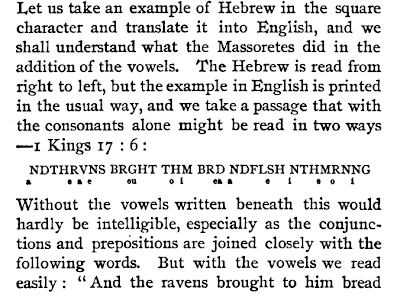
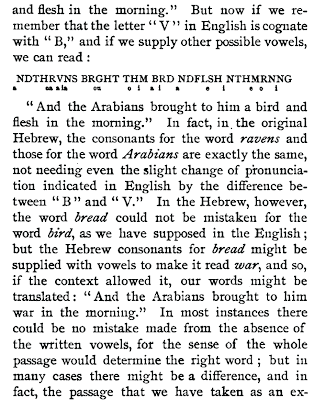
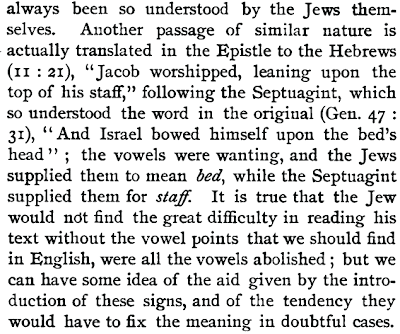
While helpful, it doesn't really show what Hebrew is like.
This interesting book, The Parchments of the Faith by George Edmands Merrill published in 1894 by the American Baptist Publication Society, does the best job I've ever seen of it because it combined words in English as they would be in Hebrew ("and the ravens" are three words in English, but just one, והערבים, in Hebrew--"nd th rvns" less accurately shows what Hebrew is like than "ndthrvns"). In addition, the vowel letters are formatted the way nekkudot are, dotting the consonants.


R. Zev Leff, question for: Is a person who does not believe that the zohar was revealed to shimon bar yochai counted as a heretic? —David, Bet Shemesh
That's question #1106 from R. Zev Leff's web site, which someone called to my attention. Interestingly enough, the category it is placed into is 'Halacha (General Jewish Law).'
Hear the answer. If not, here is my transcription:
"Is a person who does not believe that the Zohar was revealed to Shimon bar Yochai counted as a heretic--Dovid from Beit Shemesh--the authenticity of the Zohar has been accepted by Klal Yisrael, and therefore one who does not believe in the Zohar as being a part of Torah she-be-'al peh is, yes, a heretic."
In trying to understand his point of view, it occurred to me that the question was formulated a specific way and the answer restates the question another way, and then a third way.
The question uses this term:
"the Zohar was revealed to Shimon bar Yochai"
R. Leff then speaks of "the authenticity of the Zohar" and, finally, "the Zohar as being a part of Torah she-be-'al peh."
I'm not sure what to make of these, if there are distinctions, intended or not. Also interesting is that its authenticity being accepted by Klal Yisrael appears to be the deal maker here.
Hear the answer. If not, here is my transcription:
"Is a person who does not believe that the Zohar was revealed to Shimon bar Yochai counted as a heretic--Dovid from Beit Shemesh--the authenticity of the Zohar has been accepted by Klal Yisrael, and therefore one who does not believe in the Zohar as being a part of Torah she-be-'al peh is, yes, a heretic."
In trying to understand his point of view, it occurred to me that the question was formulated a specific way and the answer restates the question another way, and then a third way.
The question uses this term:
"the Zohar was revealed to Shimon bar Yochai"
R. Leff then speaks of "the authenticity of the Zohar" and, finally, "the Zohar as being a part of Torah she-be-'al peh."
I'm not sure what to make of these, if there are distinctions, intended or not. Also interesting is that its authenticity being accepted by Klal Yisrael appears to be the deal maker here.
Friday, January 05, 2007
Semi-talmidei hakhomim, or semi 'amei ha-'aretz: A unique modern challenge to rabbinic authority
There is currently a vibrant blog post about laypeople being critical of the gedolei Yisrael. This blog points out that laymen simply don't know what they are talking about, or rather whom they are talking about when they critique gedolei Yisrael, by way of analogy from the lack of respect shown by boxing fans toward fictional boxing champion Apollo Creed when he was acting in a way that seemed unseemly, in contrast to the respect that boxer Rocky had for him a that time, noting that the fans haven't got a clue. A boxer like Rocky knows who the champ is and what exactly about him is deserving of respect, no matter how unseemly he looks to the fans, who just aren't in a position to judge who is and who isn't a great boxer.
In another blog, someone posted that "What bothers me is when blogging laymen feel they can debate rabbis regarding halacha" and also "I've come across many blogs where the bloggers, sometimes women, quote pesukim and halachot to argue against gedolim. I think it is pathetic."
This subject is very interesting to me. I think it might be worthwhile to explore a phenomenon that I suspect is fairly modern, but even if it is not that new, it surely could have begun only since the advent of printing. I mean this: an entire class of Jews exist who have a relationship to the texts of Jewish learning which didn't exist, or at least not in such numbers, in earlier times.
Let us go back less than one hundred years to the fabled shtetl culture of eastern Europe. It is well known that there was a lot of Torah learning and there were many talmidei hakhomim of great depth, and there was a lot of love for Torah as well (putting aside the reality of the disintegration of this culture at the same time; it is still a fact that in this time these Jews still lived). Anyone reading any histories, chronicles or memoirs of this period finds that Torah classes and study groups were structure in a way which is quite foreign to anything contemporaries have seen. There were groups of Jews who studied Talmud; the chevra ha-shas. There were Jews who studied mishnayoth. There were Jews who studied chumash and there were even Jews who gathered together to recite Psalms--all according to their ability. Now, I am sure it is possible that a person who participated in a mishnayos group could have hacked it in the Talmud class. I am not asserting that there really was such a rigid stratification, but as far as I can tell, having seen this in many different places, as recently as a hundred years ago there were Jews who valued the Torah, who were pious and who hadn't a prayer of participating in or probably even understanding a Talmud class. Okay, it could be that those shas brotherhoods studied on a relatively high level, and that it was possible to teach Talmud to these less learned Jews, but it didn't happen.
I wonder if I even have to say more than two words, daf yomi, about today. There are countless laymen that attend a daily shiur and if they keep to it they are, at least, in the same room as people that will, in less than a decade, run through Shas. Yes, among daf yomi goers there is a broad spectrum. There are those who are capable of independently 'doing the daf' themselves. There are those who can hack it out with a study partner. There are those who are sufficiently learned that they can fill in when the maggid shiur is absent, if they have enough time to prepare. There are those who can fill in with the help of a Soncino or an Artscroll Gemara. There are those who have practically no idea what's going on. There are those who get some of it; or do well with certain parts of shas but not others. There is a broad spectrum, but the point is this: there are no fellowships of Psalm-sayers.
That is only the tiniest tip of the iceberg. Travel back to elementary school: I am assuming that the average yeshiva student, say, of ten years of age today is better prepared than his or her average counterpart a hundred years ago or a thousand years ago. Yes, there may have been some relative advantages in the old system lacking today. For example, there was no pop culture to distract and fill a young mind. But, conversely, there was really no pedagogical method for teaching broad masses. Individuals excelled, most gained very little. This can even be proven, I think, because we do possess materials that are very old which tell us some things about the literacy of Jews (and I don't mean only in eastern Europe, which was not the Jewish world). We find Jews who were apparently unable to write there own name. Not a great percentage, but they did exist. We find Jews who did not know how to write their own name correctly (eg, מרדחי for מרדכי), where it is obvious that such people did not read very much.
Today's child doesn't leave the heder forever at 12 or 13 or so (and the old heder did not produce average 12 year olds as learned as our average 12 year old), but has a high school Jewish education and even post-high school. Today's child or teenager is aware that there is a Rif and a Rashba that there is a Shulhan Arukh and what it looks like inside. Todays young adult may not be on the way to being a talmud hokhom but probably knows dozens of maamarei Chazal, a lot of midrashim, many 'famous' Rashis, perhaps a couple of sugyas in some shape. They acquire some hashkafah, they know about some famous shittos. They grow up and acquire some more. When you see, if you do, Joe Jew reading a translation of Maimonide's Guide you are looking at a new creature, or at least one that could not have existed when books were hand-copied manuscripts. You are talking about many, many, many thousands of people who know something about something with regards to Torah, Talmud, halakhah, hashkafah--and I do think this is something fairly new. In earlier times there were people who were very pious and as careful about halakhah as they could be, who asked rabbis halakhic questions, but who hadn't a clue what a Mishne Torah was, who the Raavad was, that the Shulhan Arukh is an abridgement of the Beis Yoseph, which itself is a commentary on the Tur and that R. Yoseph Karo had a method etc etc etc. Now, I am not saying that every Joe Jew who knows a little something, who attends a daf, who can and perhaps does, on their own, learn a lot of Torah, knows how the Shulhan Arukh works or knows what the Rif is and all of that. But such people are present in varying degrees, with various shades of knowledge. Heck, I am one of them! You get thousands of people sitting in a class, or reading on their own, in the Talmud 'הלכה ואין מורין כן,' 'don't disseminate this law'-- to whom? Everyone knows it. But there was a time when what was written in shas was not bound to become common knowledge.
My point is this: the existence of such people poses a unique challenge to rabbinic authority. No one can now tell them that the Rashbam doesn't say X, R. Hirsch didn't believe Y and the Nodah Be-yehuda didn't pasken this about that. People know these things. It may be that the laymen has a cacophony of knowledge with no ability to sytemetize them, no "mesorah," no right, an obligation to bittul daas etc.
But this is what many people are today and they're not going to not have opinions. The boxing fan may be wrong, but 1) some boxing fans are knowledgable enough that they do have a right to an opinion and 2) they're going to have an opinion regardless of whether they're right. More arcane fields, say, the study of Punic paleography, don't come with hangers on with stupid opinions.
If this isn't really the desirable way for things to be, the only solution is to stop the daf yomis, to stop the translations, to stop the laymen shiuring presenting the views of the rishonim, stop the mesivtos, and roll back the clock. When you tantalize the masses with some of the things studied in Harvard, they become semi-learned.
Reading that last bit back, it sounds more like a rant that I intended. Oh well. I meant to describe, but not prescribe. Just my two prutot.
Note: the genesis of these thoughts was from this Mishmar post and comments I made there, such as this one:
You know the expression a little knowledge is a dangerous thing? Well, be-zeman ha-zeh, the layman knows far, far more than ever before. On the one hand, laymen participation in Talmud shiurim is widely encouraged. On the other hand, the Gemara records halakhot that are en morin ken. Doesn't that imply that the assumption is simply that tens of thousands of Jews ought to be unaware of them? Yet here we are, and no one suggests that the laymen not learn some Gemara, learn some halakhah, learn some hashkafah etc.
This thing you decry is a direct consequence of that. Millions of Jews who faithfully observed the laws of taharas ha-mishpachah for many generations did not have a clue that there was anything to talk about; it's pashut, spouses are separated from their wives for a week after the period ends. Today that isn't the case. The people that in former times knew nothing of the origins of this reality now know something, even if not enough to make informed decisions, about it.
Does this somehow need to be balanced? Yes. But unless you're calling for a return to more widespread ignorance, to more tehillim zugging, you have got to expect that people who learn a little will have opinions. It is not arrogant or shameful--it is human nature, and the laymen would have opinions about medicine too if every layman was encouraged to dabble in advanced medical journals, indeed, to have a seder in medicine at least once a day, which is just what we are doing in the sphere of Torah, knowing full well as we do that not all laymen will ever develop into talmidei chachamim.
>I cannot disagree more. There were plenty of people in the prior generations who were quite learned -
I did not deny that. There were also plenty of people who lived fully halakhic lives, to the best of their ability, who didn't know as much Torah as a good 5th grader in a yeshiva, and I'm being generous. Circumstances were entirely different and that is what my comment was addressing. Today there are a lot more people who know "a little." As I said, "you have got to expect that people who learn a little will have opinions. It is not arrogant or shameful."
>and in this case you do not have to know much, it is clear from a review of the pesukim in Chumash that what we do le maaseh is far more machmir than that required by the Torah.
Of course; we're not talking about that. But we are talking about the fact that many, presumably most by far, had no idea about the nature of the shiva nekiin at all. Thus, it could scarcely have been a topic of discussion. Same applies to any major halakhic discussion. The reason why laymen enjoy discussing them is because they possess some basics. If you train someone to play a little piano, they'll play a little piano, even if they're not going to write symphonies.
>today many baalei batim would say
Nu, so reverse the trend. If the proper place in Judaism for baal habatim is to keep their minds from thinking about things they've no business thinking about, discourage them from learning Gemara. Discourage them from learning Orach Hayyim with Mishna Berura. Put 'em back into their place--you're right. It was better when pious baal habatim could read from a siddur and maybe a bissele Tzene Rena in Juedische-Deutsche (it was not written for women) and hear a rabbi give a derasha twice a year that he could not comprehend.
In another blog, someone posted that "What bothers me is when blogging laymen feel they can debate rabbis regarding halacha" and also "I've come across many blogs where the bloggers, sometimes women, quote pesukim and halachot to argue against gedolim. I think it is pathetic."
This subject is very interesting to me. I think it might be worthwhile to explore a phenomenon that I suspect is fairly modern, but even if it is not that new, it surely could have begun only since the advent of printing. I mean this: an entire class of Jews exist who have a relationship to the texts of Jewish learning which didn't exist, or at least not in such numbers, in earlier times.
Let us go back less than one hundred years to the fabled shtetl culture of eastern Europe. It is well known that there was a lot of Torah learning and there were many talmidei hakhomim of great depth, and there was a lot of love for Torah as well (putting aside the reality of the disintegration of this culture at the same time; it is still a fact that in this time these Jews still lived). Anyone reading any histories, chronicles or memoirs of this period finds that Torah classes and study groups were structure in a way which is quite foreign to anything contemporaries have seen. There were groups of Jews who studied Talmud; the chevra ha-shas. There were Jews who studied mishnayoth. There were Jews who studied chumash and there were even Jews who gathered together to recite Psalms--all according to their ability. Now, I am sure it is possible that a person who participated in a mishnayos group could have hacked it in the Talmud class. I am not asserting that there really was such a rigid stratification, but as far as I can tell, having seen this in many different places, as recently as a hundred years ago there were Jews who valued the Torah, who were pious and who hadn't a prayer of participating in or probably even understanding a Talmud class. Okay, it could be that those shas brotherhoods studied on a relatively high level, and that it was possible to teach Talmud to these less learned Jews, but it didn't happen.
I wonder if I even have to say more than two words, daf yomi, about today. There are countless laymen that attend a daily shiur and if they keep to it they are, at least, in the same room as people that will, in less than a decade, run through Shas. Yes, among daf yomi goers there is a broad spectrum. There are those who are capable of independently 'doing the daf' themselves. There are those who can hack it out with a study partner. There are those who are sufficiently learned that they can fill in when the maggid shiur is absent, if they have enough time to prepare. There are those who can fill in with the help of a Soncino or an Artscroll Gemara. There are those who have practically no idea what's going on. There are those who get some of it; or do well with certain parts of shas but not others. There is a broad spectrum, but the point is this: there are no fellowships of Psalm-sayers.
That is only the tiniest tip of the iceberg. Travel back to elementary school: I am assuming that the average yeshiva student, say, of ten years of age today is better prepared than his or her average counterpart a hundred years ago or a thousand years ago. Yes, there may have been some relative advantages in the old system lacking today. For example, there was no pop culture to distract and fill a young mind. But, conversely, there was really no pedagogical method for teaching broad masses. Individuals excelled, most gained very little. This can even be proven, I think, because we do possess materials that are very old which tell us some things about the literacy of Jews (and I don't mean only in eastern Europe, which was not the Jewish world). We find Jews who were apparently unable to write there own name. Not a great percentage, but they did exist. We find Jews who did not know how to write their own name correctly (eg, מרדחי for מרדכי), where it is obvious that such people did not read very much.
Today's child doesn't leave the heder forever at 12 or 13 or so (and the old heder did not produce average 12 year olds as learned as our average 12 year old), but has a high school Jewish education and even post-high school. Today's child or teenager is aware that there is a Rif and a Rashba that there is a Shulhan Arukh and what it looks like inside. Todays young adult may not be on the way to being a talmud hokhom but probably knows dozens of maamarei Chazal, a lot of midrashim, many 'famous' Rashis, perhaps a couple of sugyas in some shape. They acquire some hashkafah, they know about some famous shittos. They grow up and acquire some more. When you see, if you do, Joe Jew reading a translation of Maimonide's Guide you are looking at a new creature, or at least one that could not have existed when books were hand-copied manuscripts. You are talking about many, many, many thousands of people who know something about something with regards to Torah, Talmud, halakhah, hashkafah--and I do think this is something fairly new. In earlier times there were people who were very pious and as careful about halakhah as they could be, who asked rabbis halakhic questions, but who hadn't a clue what a Mishne Torah was, who the Raavad was, that the Shulhan Arukh is an abridgement of the Beis Yoseph, which itself is a commentary on the Tur and that R. Yoseph Karo had a method etc etc etc. Now, I am not saying that every Joe Jew who knows a little something, who attends a daf, who can and perhaps does, on their own, learn a lot of Torah, knows how the Shulhan Arukh works or knows what the Rif is and all of that. But such people are present in varying degrees, with various shades of knowledge. Heck, I am one of them! You get thousands of people sitting in a class, or reading on their own, in the Talmud 'הלכה ואין מורין כן,' 'don't disseminate this law'-- to whom? Everyone knows it. But there was a time when what was written in shas was not bound to become common knowledge.
My point is this: the existence of such people poses a unique challenge to rabbinic authority. No one can now tell them that the Rashbam doesn't say X, R. Hirsch didn't believe Y and the Nodah Be-yehuda didn't pasken this about that. People know these things. It may be that the laymen has a cacophony of knowledge with no ability to sytemetize them, no "mesorah," no right, an obligation to bittul daas etc.
But this is what many people are today and they're not going to not have opinions. The boxing fan may be wrong, but 1) some boxing fans are knowledgable enough that they do have a right to an opinion and 2) they're going to have an opinion regardless of whether they're right. More arcane fields, say, the study of Punic paleography, don't come with hangers on with stupid opinions.
If this isn't really the desirable way for things to be, the only solution is to stop the daf yomis, to stop the translations, to stop the laymen shiuring presenting the views of the rishonim, stop the mesivtos, and roll back the clock. When you tantalize the masses with some of the things studied in Harvard, they become semi-learned.
Reading that last bit back, it sounds more like a rant that I intended. Oh well. I meant to describe, but not prescribe. Just my two prutot.
Note: the genesis of these thoughts was from this Mishmar post and comments I made there, such as this one:
You know the expression a little knowledge is a dangerous thing? Well, be-zeman ha-zeh, the layman knows far, far more than ever before. On the one hand, laymen participation in Talmud shiurim is widely encouraged. On the other hand, the Gemara records halakhot that are en morin ken. Doesn't that imply that the assumption is simply that tens of thousands of Jews ought to be unaware of them? Yet here we are, and no one suggests that the laymen not learn some Gemara, learn some halakhah, learn some hashkafah etc.
This thing you decry is a direct consequence of that. Millions of Jews who faithfully observed the laws of taharas ha-mishpachah for many generations did not have a clue that there was anything to talk about; it's pashut, spouses are separated from their wives for a week after the period ends. Today that isn't the case. The people that in former times knew nothing of the origins of this reality now know something, even if not enough to make informed decisions, about it.
Does this somehow need to be balanced? Yes. But unless you're calling for a return to more widespread ignorance, to more tehillim zugging, you have got to expect that people who learn a little will have opinions. It is not arrogant or shameful--it is human nature, and the laymen would have opinions about medicine too if every layman was encouraged to dabble in advanced medical journals, indeed, to have a seder in medicine at least once a day, which is just what we are doing in the sphere of Torah, knowing full well as we do that not all laymen will ever develop into talmidei chachamim.
>I cannot disagree more. There were plenty of people in the prior generations who were quite learned -
I did not deny that. There were also plenty of people who lived fully halakhic lives, to the best of their ability, who didn't know as much Torah as a good 5th grader in a yeshiva, and I'm being generous. Circumstances were entirely different and that is what my comment was addressing. Today there are a lot more people who know "a little." As I said, "you have got to expect that people who learn a little will have opinions. It is not arrogant or shameful."
>and in this case you do not have to know much, it is clear from a review of the pesukim in Chumash that what we do le maaseh is far more machmir than that required by the Torah.
Of course; we're not talking about that. But we are talking about the fact that many, presumably most by far, had no idea about the nature of the shiva nekiin at all. Thus, it could scarcely have been a topic of discussion. Same applies to any major halakhic discussion. The reason why laymen enjoy discussing them is because they possess some basics. If you train someone to play a little piano, they'll play a little piano, even if they're not going to write symphonies.
>today many baalei batim would say
Nu, so reverse the trend. If the proper place in Judaism for baal habatim is to keep their minds from thinking about things they've no business thinking about, discourage them from learning Gemara. Discourage them from learning Orach Hayyim with Mishna Berura. Put 'em back into their place--you're right. It was better when pious baal habatim could read from a siddur and maybe a bissele Tzene Rena in Juedische-Deutsche (it was not written for women) and hear a rabbi give a derasha twice a year that he could not comprehend.
Thursday, January 04, 2007
Questions which R. Zecharya Frankel were asked by R. Hirsch: 19th century Neo-Orthodoxy defined

To this day when I hear the name Zecharya Frankel I think of the Chaim Potok book The Promise (and, I think also The Chosen) in which the Zechariah Frankel Seminary stands in for the Jewish Theological Seminary of America, and [Samson Raphael] Hirsch College, for RIETS.
You probably know, if you don't you can click the link, that R. Zecharya Frankel was a prime mover in a 19th century religious movement that called itself variously the Historical School or Positive-Historical Judaism. It rejected Reform, and in terms of halakhic practice could, by today's standard, be regarded as basically indistinguishable from Orthodoxy--and even in terms of hashkafah many things acceptable within parts of today's Orthodoxy would not be very different from this group. So much so, that--at least in America--a great many people were unaware of three interpretations of Judaism in the 19th century, knowing only of two: those who were not Reform and those who were. Of those who were not Reform, there could be Jews of the Historical bent. Of those who were Reform there might even be some. But basically it wasn't clear to all parties that this was a third approach, although many Reformers and many Orthodox recognized that it was.
One person who believed that it was not Orthodoxy was R. Samson Raphael Hirsch, who regarding R. Frankel with suspicion, posed the following open questions to him upon the news that he would head the about-to-be-established rabbinical seminary of Bresslau (to be called the Jüdisch-Theologisches Seminar / Jewish Theological Seminary):
1) What will revelation mean in the forthcoming Seminary? For Orthodox Judaism it is the direct word of the personal, one God to man; for it, "God spoke to Moses" is a simple supranatural fact just as one man speaks to another. Do the leaders of the Seminary acknowledge this Orthodox belief?
2) What will the Bible mean mean in the forthcoming Seminary? Orthodox Judaism believes in the divine authenticity of whole Bible and knows neither of the various authors of the Pentateuch, nor of Pseudo-Isaiah, nor of Maccabean songs under the name of David, or of Solomon's Ecclesiastes from the days of the second Temple, and so forth. What say the leaders of the Seminary of the authenticity of the Bible?
3) What will tradition mean in the forthcoming Seminary? For Orthodox Judaism it is the word which has its origin in God no less than the written word. Everything that is taught in the Talmud as d'oraita (of Torah origin) has in Orthodox Judaism the same origin and the same value as the biblical word. Orthodox Judaism knows nothing of a tradition that had a history in the course of the ages. It knows nothing of its founders who alleged the extension of the law to be divine tradition. It rejects with resentment any such thought as bringing our great and honorable forbears under undignified suspicion. How do the leaders of the Seminary stand in relation to this Orthodox principle?
4) What will be the meaning of derabbanan (rabbinic law) and minhag (custom) in the forthcoming Seminary? Orthodox Judaism recognizes it as divine obligation never to depart even from the statutes, and even minhagim (customs) have the same obligatory power as the category neder (vows). What say the leaders of the Seminary to this principle of Orthodox Judaism?*
R. Zecharya Frankel never answered these questions; although it could well be that he did not have an Orthodox answer to those questions, I assume he also regarded them as inquisitorial. Frankly, I'm not sure R. Hirsch even wanted them answered so much as to clarify his own point of view and vision of what the Seminary should be like, if it had a reason to exist.
It is interesting to see in a nutshell how R. Hirsch defined Orthodoxy, apparently vis-a-vis its positions on four key issues. Although there is no question that individual Orthodox Jews did and do not agree with all of the points in every particular, I think it's pretty fair to say that his formulation does basically reflect Orthodox positions that are still current.
There is more to this story, in that the Seminary would also employ as a member of its faculty a man with whom R. Hirsch had a personal history with, Heinreich Graetz, a former student-friend, a founder of modern Jewish historiography and author of a multi-volume magnum opus on Jewish history which R. Hirsch considered to be appalling.
* From The Growth of Reform Judaism: American and European Sources Until 1948 by W. Gunther Plaut
Tuesday, January 02, 2007
Artscroll on etymology, Paradise and the late dating of biblical books
Talmud Bavli Chagiga 14b
There were FOUR who ENTERED THE sublime ORCHARD[18]
[18]...[Accordingly one could also translate this sentence: There were four who entered Paradise. Indeed, the English word "Paradise" derives from a Greek word meaning both orchard and Paradise which in turn derives from the Hebrew pardeis.]
The above translation and note are from Artscroll's Schottenstein Talmud.
Now, it is true that the Schottenstein edition does not claim to be a scientific text. It is for this reason that I wouldn't harp on all the specifics of the note. For example, I won't fault it for noting that the English word paradise come from Greek, even though English did not come from Greek and therefore did not borrow this word from Greek; most English words which ultimately have an ancient Greek origin received it via an intermediary language, like Old French, which in turn received the word from Latin, which in turn received it from Greek. Thus, Latin received the Greek παραδεισος, paradeisos, as paradisus, and Old French had it from Latin as paradis etc.
I also will not fault Artscroll for describing the Greek word to mean orchard and Paradise; it certainly did not mean the latter in ancient Greek (the Septuagint translators used the word in the sense of Paradise). Whether orchard is the best meaning of παραδεισος, paradeisos is questionable.
These sort of generalizations are understandable. What I do not understand is where Artscroll got the idea that the Greek received it from the Hebrew פרדס. In fact, the best explanation is that Greek received it via the Persians. The OED notes that the Greeks received the word from "the Old Iranian base of Avestan pairidaeza- enclosure."
Given its long history with the Persians, and the relatively later encounter with the Jews, how and why would Greek have gotten the word from Hebrew rather than the Old Iranian? And why doesn't Artscroll cite any source for this assertion?
It occurred to me that it might have something to do with the location of the three places in Tanakh that pardes occurs: Nehemia 2:8, Ecclesiastes 2:5 and Songs 4:13. The first book was obviously written after the exile. Jews could certainly then have received a loanword from Persian. The other two books are traditionally ascribed to Solomon, who lived 500 years earlier. While it is not impossible for an Old Iranian word to end up in the vocabulary of a Judean Israelite of 3000 years ago, it is certainly less comfortable to a traditionalist sensibility than the idea that it is a native Hebrew word after all, especially coupled with the non-traditionalist view of the dating of all three books as post-Exilic.
So, am I proposing that Artscroll simply made up the assertion in note 18? Lacking a source, either traditional or modern, that seems to be the inescapable conslusion. As to the why, my guess is only that: a guess.
ארבעה נכנסו לפרדס
There were FOUR who ENTERED THE sublime ORCHARD[18]
[18]...[Accordingly one could also translate this sentence: There were four who entered Paradise. Indeed, the English word "Paradise" derives from a Greek word meaning both orchard and Paradise which in turn derives from the Hebrew pardeis.]
The above translation and note are from Artscroll's Schottenstein Talmud.
Now, it is true that the Schottenstein edition does not claim to be a scientific text. It is for this reason that I wouldn't harp on all the specifics of the note. For example, I won't fault it for noting that the English word paradise come from Greek, even though English did not come from Greek and therefore did not borrow this word from Greek; most English words which ultimately have an ancient Greek origin received it via an intermediary language, like Old French, which in turn received the word from Latin, which in turn received it from Greek. Thus, Latin received the Greek παραδεισος, paradeisos, as paradisus, and Old French had it from Latin as paradis etc.
I also will not fault Artscroll for describing the Greek word to mean orchard and Paradise; it certainly did not mean the latter in ancient Greek (the Septuagint translators used the word in the sense of Paradise). Whether orchard is the best meaning of παραδεισος, paradeisos is questionable.
These sort of generalizations are understandable. What I do not understand is where Artscroll got the idea that the Greek received it from the Hebrew פרדס. In fact, the best explanation is that Greek received it via the Persians. The OED notes that the Greeks received the word from "the Old Iranian base of Avestan pairidaeza- enclosure."
Given its long history with the Persians, and the relatively later encounter with the Jews, how and why would Greek have gotten the word from Hebrew rather than the Old Iranian? And why doesn't Artscroll cite any source for this assertion?
It occurred to me that it might have something to do with the location of the three places in Tanakh that pardes occurs: Nehemia 2:8, Ecclesiastes 2:5 and Songs 4:13. The first book was obviously written after the exile. Jews could certainly then have received a loanword from Persian. The other two books are traditionally ascribed to Solomon, who lived 500 years earlier. While it is not impossible for an Old Iranian word to end up in the vocabulary of a Judean Israelite of 3000 years ago, it is certainly less comfortable to a traditionalist sensibility than the idea that it is a native Hebrew word after all, especially coupled with the non-traditionalist view of the dating of all three books as post-Exilic.
So, am I proposing that Artscroll simply made up the assertion in note 18? Lacking a source, either traditional or modern, that seems to be the inescapable conslusion. As to the why, my guess is only that: a guess.
Subscribe to:
Posts (Atom)
LinkWithin

Subscribe To On the Main Line


 Posts
All Comments
Posts
All Comments