A correspondent asked me my opinion as to why Shadal defended the wording of the Kedusha barukh kevod versus his emendation berum kevod (as discussed here).
Thinking about it, this was my reply: Shadal was personally very conservative. Even though if we look at him in the light of the past it is clear that in many ways he wasn't traditional, he was totally unaware of that. It was he who came up with the quip, upon hearing of the removal of the yikum purkan by Reformers, that they fulfilled va-yimah et kol ha-yequm (Gen. 7:23). On the other hand, in 1821 the Austrian Emperor required that the Italian Jews under his dominion produce a siddur with translation according to the Italian minhag, and as the editor and translator he was keenly aware of the fluidity of tephillah itself (as well as its rigidity).
In addition, although he believed that text criticism of Nakh was totally permissible and even desirable, like pretty much all traditionalists who took this attitude, it stopped when it came to changing the texts themselves, as opposed to just noting the emendation for the sake of knowledge and truth. His ability to recognize the corruptness of the transmission of (some of) the texts and his need to suggest emendations was driven by his notion of truth, as was his desire to seek out the meaning of the texts according to how they were understood by the original audience. If that didn't mean that how the original audience understood it needs to inform how we understand it, this was so long as we know the difference and do not confuse the two kinds of understandings. Also, this particular emendation was only conjectural. To this day there are no ancient versions, no Dead Sea Scroll fragment which attests to this emendation (berum instead of barukh).
So, to round up, Kedusha might have come from the Navi, but it is not the Navi: it is liturgy. I would not be surprised if he had sensed a corruption in the liturgy on its own terms then he would have advocated emending it; this calls to mind something R. Saul Lieberman said: "There may be one historical truth, but the truth of a text is the truth peculiar to its one literary or oral tradition." (quoted by Dov Zlotnick in his introduction to Greek In Jewish Palestine/ Hellenism in Jewish Palestine, New York: 1994).
In other words, it is the right wording in Kedusha, even if it is not what the Navi said!
PS if you think I'm overdoing the Shadal, you ain't seen nothing yet. Shadalian: coming soon.
Monday, November 20, 2006


Thursday, November 16, 2006
Is the Agudah upset about "good" blogs too?
I wasn't sure if I was planning to post about the topic at the upcoming Agudah convention about blogging. As many people pointed out, the Agudah really isn't the pulse of any community anymore. The convention really is as much or more about networking and shidduchim as it is social responsibility. It isn't the momentous gathering of and about the community many presume it represents. I say that not as a dig at the Agudah, but rather to point out simply that the community it is thought it speaks for, American chareidim, are not accurately reflected by one entity.
It has already been covered here, here, here and here to mention only a few places. Orthomom was the first to post the title of the talk, as printed in a Hamodia ad: ...Have bloggers declared open season on Torah Authority?
But then Wolf posted on the topic and pointed out that its ludicrous to speak of "blogs" as a single entity anymore than to speak of books as an entity. There are good books and bad books. Good blogs and bad blogs.
While I agree, his post caused me to think more about what is objectionable about blogging. I think that unlike books which do not necessarily share a relationship, blogs do. For one thing, they are interactive. Even if the content is highly controlled (and approved) doesn't the blog link to other blogs? Even if all of them are approved, doesn't at least some of them link to ones which aren't? Even if none of them do, what prevents commenters from linking to their own blogs, which may not be approved? What about the fact that many people access new posts through aggregators like Jrants or Jblogosphere or JewishBlogging? Or through Google blog search? And if you click that last link, you'll see I had searched for the word "Torah." The first result as of this posting is called "Reading the Torah as Wisdom, Not Law." The second result is "Replacing Secular Values with Torah Values" on a different blog. It is very possible that the second post is something which, what I shall term Agudists for convenience, would love, maybe even print out and leave a pile in their shul. But the one right before it? Ay yi yi yi yi. And I haven't even mentioned content.
That is the point: the mixture. Even that which they'd generally consider good contains admixtures that would and does shock them. Everyone thinks Hirhurim is great, right? But even there in the comments you'll find people saying things that would literally make some people nauseous. (Putting aside the issue of a young man independently publishing his "musings" as he sees fit, which is simply an issue for Agudists.)
I can recall reading a book about peshat and derash which really didn't contain anything that untraditional. It was just in erudite English and by a person with a fancy, untraditional name who had a resume I would have considered suspect at the time. But I felt illicit. I felt lightheaded, even guilty and was sure I shouldn't be reading it. (It was a while ago.) To someone who is not used to things they have developed a sensitivity about even slight deviations, to say nothing about major ones, are shocking beyond belief.
Not that this is the Agudah attitude per se, but remember that there are people who wouldn't learn Torah from a sefer printed by specific publishing houses! Hypersensitive or not, even that which seems prima facie unobjectionable in the blogosphere is positively laced with what they think is hemlock. The best of it is still the worst of it.
In a way this is similar to the objection to `Torah U-Madda.' Yesterday Hirhurim posted a thought by R. Elhanan Wasserman. Now, R. Wasserman was known as one of the greatest critics of Yeshiva University. He repeatedly refused invitation from R. Dr. Bernard Revel to give a shiur at RIETS. Yet according to Hirhurim the thought in his post was given at the Hildesheimer Rabbinerseminar in Berlin, where students needed to get PhDs as a condition for receiving rabbinic ordination, where source criticism of rabbinic literature and philology were part of the curriculum, where even the Deutero-Isaiah position was taught by one instructor. This same seminary was actually looked down upon by Lithuanian rabbis. Why would R. Wasserman oppose RIETS more than that institution? Someone pointed out to me the simple explanation that I should not have overlooked: he objected to the idea of a Yeshiva University; to the fact that the same institution which granted academic degrees also granted rabbinic ordination. In other words, the mixture. Of course.
Agree or not, you can't just make them realize that some are good and some are bad. That would be projection onto them.
If I may borrow a graphic, here is Greg of the wonderful Presence's banner.

It has already been covered here, here, here and here to mention only a few places. Orthomom was the first to post the title of the talk, as printed in a Hamodia ad: ...Have bloggers declared open season on Torah Authority?
But then Wolf posted on the topic and pointed out that its ludicrous to speak of "blogs" as a single entity anymore than to speak of books as an entity. There are good books and bad books. Good blogs and bad blogs.
While I agree, his post caused me to think more about what is objectionable about blogging. I think that unlike books which do not necessarily share a relationship, blogs do. For one thing, they are interactive. Even if the content is highly controlled (and approved) doesn't the blog link to other blogs? Even if all of them are approved, doesn't at least some of them link to ones which aren't? Even if none of them do, what prevents commenters from linking to their own blogs, which may not be approved? What about the fact that many people access new posts through aggregators like Jrants or Jblogosphere or JewishBlogging? Or through Google blog search? And if you click that last link, you'll see I had searched for the word "Torah." The first result as of this posting is called "Reading the Torah as Wisdom, Not Law." The second result is "Replacing Secular Values with Torah Values" on a different blog. It is very possible that the second post is something which, what I shall term Agudists for convenience, would love, maybe even print out and leave a pile in their shul. But the one right before it? Ay yi yi yi yi. And I haven't even mentioned content.
That is the point: the mixture. Even that which they'd generally consider good contains admixtures that would and does shock them. Everyone thinks Hirhurim is great, right? But even there in the comments you'll find people saying things that would literally make some people nauseous. (Putting aside the issue of a young man independently publishing his "musings" as he sees fit, which is simply an issue for Agudists.)
I can recall reading a book about peshat and derash which really didn't contain anything that untraditional. It was just in erudite English and by a person with a fancy, untraditional name who had a resume I would have considered suspect at the time. But I felt illicit. I felt lightheaded, even guilty and was sure I shouldn't be reading it. (It was a while ago.) To someone who is not used to things they have developed a sensitivity about even slight deviations, to say nothing about major ones, are shocking beyond belief.
Not that this is the Agudah attitude per se, but remember that there are people who wouldn't learn Torah from a sefer printed by specific publishing houses! Hypersensitive or not, even that which seems prima facie unobjectionable in the blogosphere is positively laced with what they think is hemlock. The best of it is still the worst of it.
In a way this is similar to the objection to `Torah U-Madda.' Yesterday Hirhurim posted a thought by R. Elhanan Wasserman. Now, R. Wasserman was known as one of the greatest critics of Yeshiva University. He repeatedly refused invitation from R. Dr. Bernard Revel to give a shiur at RIETS. Yet according to Hirhurim the thought in his post was given at the Hildesheimer Rabbinerseminar in Berlin, where students needed to get PhDs as a condition for receiving rabbinic ordination, where source criticism of rabbinic literature and philology were part of the curriculum, where even the Deutero-Isaiah position was taught by one instructor. This same seminary was actually looked down upon by Lithuanian rabbis. Why would R. Wasserman oppose RIETS more than that institution? Someone pointed out to me the simple explanation that I should not have overlooked: he objected to the idea of a Yeshiva University; to the fact that the same institution which granted academic degrees also granted rabbinic ordination. In other words, the mixture. Of course.
Agree or not, you can't just make them realize that some are good and some are bad. That would be projection onto them.
If I may borrow a graphic, here is Greg of the wonderful Presence's banner.

Wednesday, November 15, 2006
Agnlicizing names; "Godlive" vs "Yechiel"; Heilman et cetera
In one of my very first posts, The Prophet Milton (PBUH) I registered my puzzlement at the convention of Anglicizing Jewish of names in English works, or really the lack of uniform convention for it. Why, asked I, should the Maharal of Prague be called Judah, something he never was called even one time in his life? (Even if it could be shown that he had a shem hol, a secular equivalent of Yehuda, like Loeb or even a direct Czech equivalent, the point is that /Joo-dah/ he never went by).
So I was perusing Dr Sam Heilman's book Sliding to the Right: The Contest for the Future of American Jewish Orthodoxy and wondered why, on pg 131 we find Joseph Caro and Solomon Ganzfried as well as Israel Kagan and Yechiel Michl Espstein.
Granted, there is no good way to Anglicize "Yechiel." But that leads to another question: why is the Hafetz Hayyim called "Israel," when he went by Yisrael Meir (so it should be written Israel Meir) and the author of the Arukh Ha-shulhan gets both his first and second name (Yechiel Michl Espstein)? If there is any rhyme or reason I don't see one, although it is noteworthy--maybe--that Dr Heilman seems to prefer R. Epstein's halakhic work to R. Kagan's.
Speaking of Anglicizing Yechiel, perhaps authors should pull a page from Rennaissance-era R Azaryah dei Rossi's Me'or 'Enayim who gave the Greek-named Philo a Hebrew name, its equivalent Yedidya. Why not "R. Godlive Michl Epstein"? I guess that would be too weird.
In any case, thinking about it, many of these persons didn't really use their Hebrew names either. Thus, Ha-Netziv, R. Naphtali Tzvi Yehuda Berlin, was known as R. Hirsch Leib (and that doesn't even take into account how "Hirsch Leib" was actually pronounced in his native Lithuanian Yiddishe). I guess it would not be so precise to write "Moshe Feinstein" rather than "Moyshe" (or "Meyseh"), so Moses suffices!
So I was perusing Dr Sam Heilman's book Sliding to the Right: The Contest for the Future of American Jewish Orthodoxy and wondered why, on pg 131 we find Joseph Caro and Solomon Ganzfried as well as Israel Kagan and Yechiel Michl Espstein.
Granted, there is no good way to Anglicize "Yechiel." But that leads to another question: why is the Hafetz Hayyim called "Israel," when he went by Yisrael Meir (so it should be written Israel Meir) and the author of the Arukh Ha-shulhan gets both his first and second name (Yechiel Michl Espstein)? If there is any rhyme or reason I don't see one, although it is noteworthy--maybe--that Dr Heilman seems to prefer R. Epstein's halakhic work to R. Kagan's.
Speaking of Anglicizing Yechiel, perhaps authors should pull a page from Rennaissance-era R Azaryah dei Rossi's Me'or 'Enayim who gave the Greek-named Philo a Hebrew name, its equivalent Yedidya. Why not "R. Godlive Michl Epstein"? I guess that would be too weird.
In any case, thinking about it, many of these persons didn't really use their Hebrew names either. Thus, Ha-Netziv, R. Naphtali Tzvi Yehuda Berlin, was known as R. Hirsch Leib (and that doesn't even take into account how "Hirsch Leib" was actually pronounced in his native Lithuanian Yiddishe). I guess it would not be so precise to write "Moshe Feinstein" rather than "Moyshe" (or "Meyseh"), so Moses suffices!
The problem with modern Orthodoxy is
that topics of interest to it are
1. Is Orthodox Judaism open to new ways of studying the Bible?
2. Is Orthodox Judaism open to critical study of the history of halakhah?
3. Is Orthodox Judasim open to new approaches to women's ritual roles?
per Freelance Kiruv Maniac.
1. Is Orthodox Judaism open to new ways of studying the Bible?
2. Is Orthodox Judaism open to critical study of the history of halakhah?
3. Is Orthodox Judasim open to new approaches to women's ritual roles?
per Freelance Kiruv Maniac.
Tuesday, November 14, 2006
Et tu The Midrash Says?
It's amazing what we don't notice when we are children.
The Midrash Says was and remains an extremely popular five-voume compendium of midrashic material on the Torah; sort of like Louis Ginzberg's Legends of the Jews. As far as I can see, children today mainly read The Little Midrash Says, which wasn't available when I was a kid, so The Midrash Says it was. It was enriching Shabbos reading; weekday reading too.
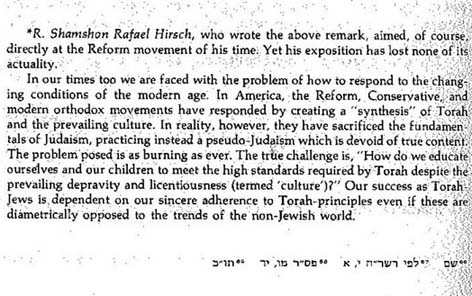
But it is more than just what the Midrash says. It is also what its compiler says the midrash means.
Equates and attacks Reform, Conservative and Modern Orthodoxy:
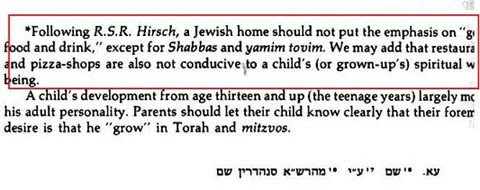
Attacks pizza shops:
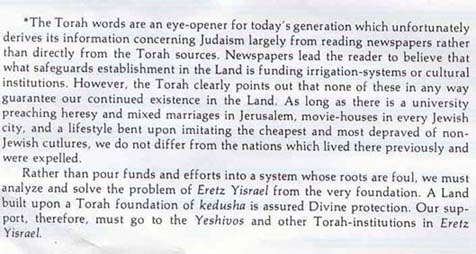
Attacks support for Israel's irrigation needs:
Against 'indiscriminate' Aliya:
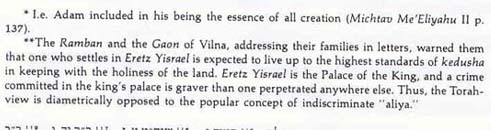
Zionism contravenes Torah-opinion (Daas Torah):
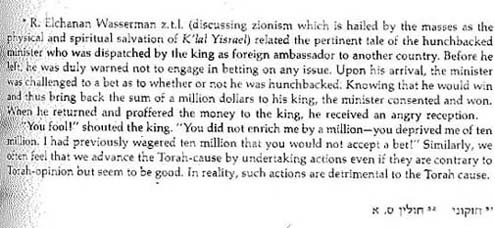
Interesting. It goes without saying, or should, that this post is not about anyone's right to hold these views or to publish them, neither of which I contest!
The Midrash Says was and remains an extremely popular five-voume compendium of midrashic material on the Torah; sort of like Louis Ginzberg's Legends of the Jews. As far as I can see, children today mainly read The Little Midrash Says, which wasn't available when I was a kid, so The Midrash Says it was. It was enriching Shabbos reading; weekday reading too.
But it is more than just what the Midrash says. It is also what its compiler says the midrash means.
Equates and attacks Reform, Conservative and Modern Orthodoxy:
Attacks pizza shops:
Attacks support for Israel's irrigation needs:
Against 'indiscriminate' Aliya:
Zionism contravenes Torah-opinion (Daas Torah):
Interesting. It goes without saying, or should, that this post is not about anyone's right to hold these views or to publish them, neither of which I contest!
Thursday, November 09, 2006
Rabbi David Zvi Hoffmann's yahrzeit
It is (or will be, in a matter of hours) Rabbi David Zvi Hoffman's 85th yahrzeit.
19 Marheshvan 5682/ November 20, 1921.
19 Marheshvan 5682/ November 20, 1921.
1863 Hebrew account of the Aleppo Codex, כתר ארם צובה
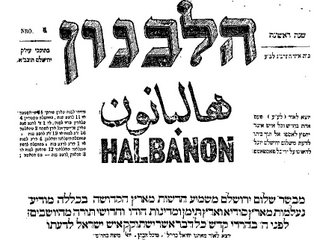
In Moshe H. Goshen-Gottstein's important article "The Authenticity of the Aleppo Codex" in Textus: Annual of the Hebrew University Bible Project, Vol. 1 (1961) he notes (pg. 3, note 5) that this famous codex was first publicized by R. Jacob Berlin in the first volume of the Hebrew periodical Libanon (הלבנון) f1863. pg. 23. Goshen-Gottstein noted that copies of this periodical were "extremely rare," but luckily the Early Hebrew Newspapers project is available, via the JNUL.
And here it is, or some of it at any rate (also cf. pp. 31 and 76 of the first volume from 1863).
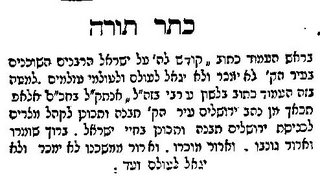
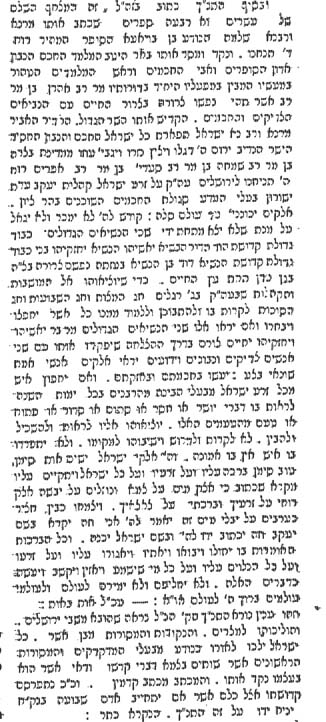
Goshen-Gottstein wrote that "No manuscript of the Hebrew Bible, apart from those discovered among the Dead Sea Scrolls, has been the subject of so heated a discussion as our Codex. Ever since information about it was published" above.
The controvery itself (What exactly is the codex? Who wrote it? What is its signifigance? Was it the text used by the Rambam? Is it really a Ben Asher text? The Ben Asher text?) has since been mostly settled since 1961, in no small measure to Goshen-Gottstein himself.
Incidentally, Ha-levanon was the first Hebrew newspaper in Jerusalem; its editor was Yehiel Brill.

And here it is, or some of it at any rate (also cf. pp. 31 and 76 of the first volume from 1863).


Goshen-Gottstein wrote that "No manuscript of the Hebrew Bible, apart from those discovered among the Dead Sea Scrolls, has been the subject of so heated a discussion as our Codex. Ever since information about it was published" above.
The controvery itself (What exactly is the codex? Who wrote it? What is its signifigance? Was it the text used by the Rambam? Is it really a Ben Asher text? The Ben Asher text?) has since been mostly settled since 1961, in no small measure to Goshen-Gottstein himself.
Incidentally, Ha-levanon was the first Hebrew newspaper in Jerusalem; its editor was Yehiel Brill.
Sunday, November 05, 2006
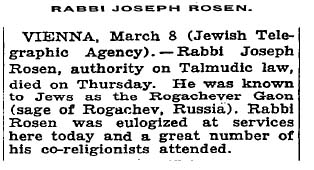

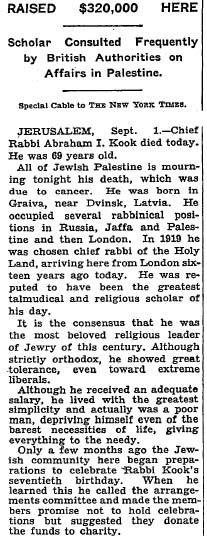

Friday, November 03, 2006
Reasonable revisited
Appropos Reb Gil's revival* of an issue I discussed in May, here are links to my two posts on R. Shmuel Waldman's Beyond a Reasonable Doubt: Covincing Evidence of the Truths of Judaism.
Unreasonable content in Beyond A Reasonable Doubt I
E.A. Speiser on the historicity of Avraham--add it to the next edition of Beyond A Reasonable Doubt II
*I'm only kidding. I am not accusing him of being influenced by my post.
Unreasonable content in Beyond A Reasonable Doubt I
E.A. Speiser on the historicity of Avraham--add it to the next edition of Beyond A Reasonable Doubt II
*I'm only kidding. I am not accusing him of being influenced by my post.
Thursday, November 02, 2006
Shadal's most famous biblical emendation
One of the cornerstones of our daily prayer is the קדושה. While familiar, it is worth showing one version of it (from abtorah.com):
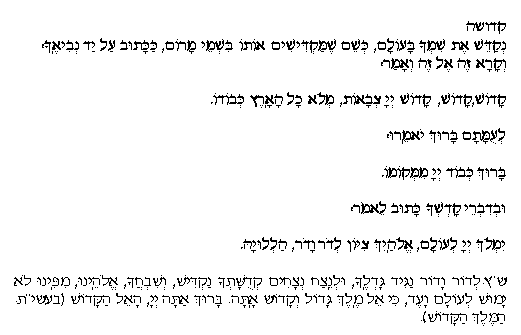
Our piece here concerns the sixth line (in that image). It is a quote from Ezekiel 3:12; the red is in the qedusha, the rest is to include the whole verse:
Then a spirit lifted me up, and I heard behind me the voice of a great rushing: 'Blessed be the glory of the LORD from His place'
Now, if we are used to thinking of the Bible as full of strange things we can chalk it up to yet another. As the spirit lifted the prophet up, he heard a great noise (angels, as it turns out) and the noise was them saying "Blessed be the glory of the Lord from His place." (Artscroll adds the explanatory word "saying" in brackets; that is to say, the noise was the saying of the blessing) The passage then contains to describe more great noise, the wing movements of the hayot and the noise of the ofanim. Okay, if that's what it says.
But exegetes are sensitive to strangeness, and R. Samuel David Luzzatto, Shadal, conjectured that בָּרוּךְ כְּבוֹד יְה' מִמְּקוֹמוֹ contains a scribal error. According to him the verse originally read בְּרוּם כְּבוֹד יְה' מִמְּקוֹמוֹ, and so it read "Then a spirit lifted me up, and I heard behind me the voice of a great rushing when the glory of the Lord rose from His place," rather than "Then a spirit lifted me up, and I heard behind me the voice of a great rushing: 'Blessed be the glory of the LORD from His place."
The error is a plausible scribal error, as the כ and מ looked very similar in the paleo-Hebrew script. Below is an illustration of what ברוך כבוד looked like in paleo-Hebrew (using a font modeled on the script of the Siloam inscription); directly below it is ברום כבוד.
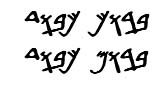
In July Codex noted that the New Revised Standard Version (NRSV) translates Ezekiel 3:12 as per this emendation, "As the glory of YHWH arose from its place."
It must now be noted that
- Shadal is supposedly the first Jew to suggest emendations to the Bible (although he never countenances making them in the text, it must be noted--the above did not lead him to suggest 'correcting' Ezekiel or the Qedusha).
- In addition he vehemently--and irrationally--was opposed to any conjectural emendation of the Torah, but not Nakh.
- Paranthetically, he really felt that almost no one was technically qualified to suggest emendations.
- On that note, it is said that he came to regret making (or perhaps making known his) emendations because it unwittingly undermined that which he upheld with every fiber of his being; the authority and integrity of the Bible and tradition. (sources: Graetz 'History of the Jews,' Shalom Spiegel 'Hebrew Reborn')
- Along those lines, however, it should also be noted that he 'sat' on his Sefer Vikuah al Hokhmat ha-Kabbalah for 25 years because even though he was completely convinced he was right (that the Kabbalah was antithetical to Judaism and that the Zohar was pseudepigrephal), he didn't want to undermine the simple faith of those Jews who were mystically inclined ("It was characteristic of Shadal that he held back the publication of this work because he felt that it might do harm to the strong religious feelings of Polish Jewry, for whom the Kabbalah was a great source of solace").
However--he did publish it, in 1851. "As a result of a conversation he had with a pupil of his, who had returned from a visit to Poland, Luzzatto was persuaded that the evils of the Kabbalah's mystic cult outweighed its benefits as a bulwark of piety." (source: Margolies "Traditionalist Scholar")
EDIT: A reader says "I imagine that if the [Masoretic Text] had read ברום, some clever fellow would have come along suggesting that it be emended to ברוך. And how would we know whether he was right or wrong?
To this I say ברום reads well and wouldn't have raised a question.
In any case, he is right. All sorts of unqualified persons engaged (and to a much lesser extent engage) in conjectural emendations. Note the past tense, because today the uncontrolled excesses of the past has been checked. In fact, as I noted in my post, Shadal apparently was uncomfortable if he was to be used as a vehicle through which the masoretic text would be attacked.
But it needs to be realized that *he* was not unqualified. He was a living concordance of Tanakh and possibly the world's greatest expert on Hebrew of his day. He still holds up well. In addition, his exegesis was very rigorous. He didn't make such suggestions lightly. In fact, he was fully cognizant of an important rule in textual criticism lectio difficilior potior, "the more difficult reading is the stronger," a rule which was widely disregarded for a very long time, but as I said, is more adhered to now. The intent of that rule is to highlight the fact that in copying texts the tendency is to smooth over errors and therefore if an APPARENT error remains in the text there is a good chance that it isn't an error at all, but it only remains to be shown why the difficult spelling or reading is actually the original.
Shadal was mindful of this. If he came across a difficult reading he exhausted his mental resources AND the large manuscript and witness evidence available to him first and only then did he put forth a conjectural emendation. He spent decades on his perushim, refusing to publish them until they were worked over and over again.
In short, he wasn't full of it. It can't be proven if this truly was the original reading, but without a doubt he could not resolve the difficulty with any satisfaction any other way.
Our piece here concerns the sixth line (in that image). It is a quote from Ezekiel 3:12; the red is in the qedusha, the rest is to include the whole verse:
וַתִּשָּׂאֵנִי רוּחַ--וָאֶשְׁמַע אַחֲרַי, קוֹל רַעַשׁ גָּדוֹל: בָּרוּךְ כְּבוֹד יְה' מִמְּקוֹמוֹ
Then a spirit lifted me up, and I heard behind me the voice of a great rushing: 'Blessed be the glory of the LORD from His place'
Now, if we are used to thinking of the Bible as full of strange things we can chalk it up to yet another. As the spirit lifted the prophet up, he heard a great noise (angels, as it turns out) and the noise was them saying "Blessed be the glory of the Lord from His place." (Artscroll adds the explanatory word "saying" in brackets; that is to say, the noise was the saying of the blessing) The passage then contains to describe more great noise, the wing movements of the hayot and the noise of the ofanim. Okay, if that's what it says.
But exegetes are sensitive to strangeness, and R. Samuel David Luzzatto, Shadal, conjectured that בָּרוּךְ כְּבוֹד יְה' מִמְּקוֹמוֹ contains a scribal error. According to him the verse originally read בְּרוּם כְּבוֹד יְה' מִמְּקוֹמוֹ, and so it read "Then a spirit lifted me up, and I heard behind me the voice of a great rushing when the glory of the Lord rose from His place," rather than "Then a spirit lifted me up, and I heard behind me the voice of a great rushing: 'Blessed be the glory of the LORD from His place."
The error is a plausible scribal error, as the כ and מ looked very similar in the paleo-Hebrew script. Below is an illustration of what ברוך כבוד looked like in paleo-Hebrew (using a font modeled on the script of the Siloam inscription); directly below it is ברום כבוד.
In July Codex noted that the New Revised Standard Version (NRSV) translates Ezekiel 3:12 as per this emendation, "As the glory of YHWH arose from its place."
It must now be noted that
- Shadal is supposedly the first Jew to suggest emendations to the Bible (although he never countenances making them in the text, it must be noted--the above did not lead him to suggest 'correcting' Ezekiel or the Qedusha).
- In addition he vehemently--and irrationally--was opposed to any conjectural emendation of the Torah, but not Nakh.
- Paranthetically, he really felt that almost no one was technically qualified to suggest emendations.
- On that note, it is said that he came to regret making (or perhaps making known his) emendations because it unwittingly undermined that which he upheld with every fiber of his being; the authority and integrity of the Bible and tradition. (sources: Graetz 'History of the Jews,' Shalom Spiegel 'Hebrew Reborn')
- Along those lines, however, it should also be noted that he 'sat' on his Sefer Vikuah al Hokhmat ha-Kabbalah for 25 years because even though he was completely convinced he was right (that the Kabbalah was antithetical to Judaism and that the Zohar was pseudepigrephal), he didn't want to undermine the simple faith of those Jews who were mystically inclined ("It was characteristic of Shadal that he held back the publication of this work because he felt that it might do harm to the strong religious feelings of Polish Jewry, for whom the Kabbalah was a great source of solace").
However--he did publish it, in 1851. "As a result of a conversation he had with a pupil of his, who had returned from a visit to Poland, Luzzatto was persuaded that the evils of the Kabbalah's mystic cult outweighed its benefits as a bulwark of piety." (source: Margolies "Traditionalist Scholar")
EDIT: A reader says "I imagine that if the [Masoretic Text] had read ברום, some clever fellow would have come along suggesting that it be emended to ברוך. And how would we know whether he was right or wrong?
To this I say ברום reads well and wouldn't have raised a question.
In any case, he is right. All sorts of unqualified persons engaged (and to a much lesser extent engage) in conjectural emendations. Note the past tense, because today the uncontrolled excesses of the past has been checked. In fact, as I noted in my post, Shadal apparently was uncomfortable if he was to be used as a vehicle through which the masoretic text would be attacked.
But it needs to be realized that *he* was not unqualified. He was a living concordance of Tanakh and possibly the world's greatest expert on Hebrew of his day. He still holds up well. In addition, his exegesis was very rigorous. He didn't make such suggestions lightly. In fact, he was fully cognizant of an important rule in textual criticism lectio difficilior potior, "the more difficult reading is the stronger," a rule which was widely disregarded for a very long time, but as I said, is more adhered to now. The intent of that rule is to highlight the fact that in copying texts the tendency is to smooth over errors and therefore if an APPARENT error remains in the text there is a good chance that it isn't an error at all, but it only remains to be shown why the difficult spelling or reading is actually the original.
Shadal was mindful of this. If he came across a difficult reading he exhausted his mental resources AND the large manuscript and witness evidence available to him first and only then did he put forth a conjectural emendation. He spent decades on his perushim, refusing to publish them until they were worked over and over again.
In short, he wasn't full of it. It can't be proven if this truly was the original reading, but without a doubt he could not resolve the difficulty with any satisfaction any other way.
Tuesday, October 31, 2006
Dinei mamonot or nefashot?
I don't normally do this, but since its my blog, its my platform. With regards to a recent, still-developing kashruth scandal, I was thinking of Mishna Sanhedrin 4:1:
In Dinei Mamonot anyone may speak on behalf of acquittal or condemnation, while in Dinei Nefashot anyone may speak on behalf of acquittal but not everyone may speak on behalf of condemnation.
I'm not certain in this case whether its dinei mamonot or dinei nefashot. It might be the latter, in which case unanimous is not a good thing.
דִּינֵי מָמוֹנוֹת הַכֹּל מְלַמְּדִין זְכוּת וְחוֹבָה, וְדִינֵי נְפָשׁוֹת הַכֹּל מְלַמְּדִין זְכוּת וְאֵין הַכֹּל מְלַמְּדִין חוֹבָה
In Dinei Mamonot anyone may speak on behalf of acquittal or condemnation, while in Dinei Nefashot anyone may speak on behalf of acquittal but not everyone may speak on behalf of condemnation.
I'm not certain in this case whether its dinei mamonot or dinei nefashot. It might be the latter, in which case unanimous is not a good thing.
Chafetz Chaim obit in NY Times: a Tale of Research and Results
A couple of people forwarded me the following email, and I think it bears posting:
I wanted to share the following with you:
About a year ago I heard a shiur in which reference was made to the Chofetz Chaim and Shmiras Halashon. The Baal Darshin mentioned the well-known fact that the Chofetz Chaim lost his hearing later in life and said "And he lived a very long life! According to the New York Times, he lived until 105!" The reference to this newspaper intrigued me - I was unsure if he was simply using the newspaper's name in jest or if the New York Times actually published an obituary for the Chofetz Chaim.
It crossed my mind again this Elul with the Chofetz Chaim's 73rd yohrtzeit. (The Chofetz Chaim Heritage Foundation hosted a brilliant nation-wide conference-call evening of shiurim. The participating rabbonim ranged in subject from Hilchos Shmiras Halashon to Inyonei D'Yoma to aprapos Elul mussar.)
My interest was piqued and I decided to visit the New York Public Library at 42nd Street, known for its vast research facilities: I wanted to see this obituary.
The search began with an alphabetical index of the NYT Obituaries in the Reference Department. I thought to look under "K" for Kagan. According to Artscroll and other American-based publications, The Chofetz Chaim is always refered to as Rabbi Yisroel Mayer Kagan. ('Kagan' being a derivative of 'Kohen' often used by Lithuanian and/or Polish jews). There was nothing under Kagan in the indicies, so I went to the Microfiche department in the back corner of the library's ground floor. I knew the civil date of death was Friday, September 15, 1933 (corresponding to the yiddish date: Elul 24, 5693) and searched the drawers of NYT microfiche for this date and the week that followed - how soon would a New York newspaper report on the death of a jewish rabbi in Radin?
Attached you will see my findings.
In addition to the feeling of accomplishment one feels in achieving a 'goal,' I was very inspired when reading the small article. I think it speaks volumes to see how a non-jewish publication in 1933 America reported in such a dignified fashion on the life of a eminent tzaddik and gadol ha'dor.
Enjoy!
I don't know who this originates from, but I like the idea; discovering the problem and doing the research and uncovering gold.
(click below to enlarge and read or download as a PDF)

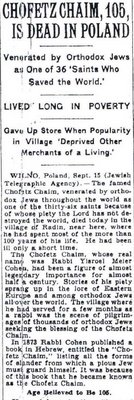
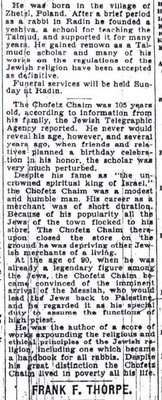
EDIT: I am pleased to be able to attribute this to Avigayil Meyer who notes that this research was hers and the email begun by her.
The research and letter above was done by ME! I sent the e-mail out to a couple of friends and now I see it all over the Internet without credit. Please post THIS response and spread worldwide. Credit should be given where credit is due!
Well done, Ms Meyer!
I wanted to share the following with you:
About a year ago I heard a shiur in which reference was made to the Chofetz Chaim and Shmiras Halashon. The Baal Darshin mentioned the well-known fact that the Chofetz Chaim lost his hearing later in life and said "And he lived a very long life! According to the New York Times, he lived until 105!" The reference to this newspaper intrigued me - I was unsure if he was simply using the newspaper's name in jest or if the New York Times actually published an obituary for the Chofetz Chaim.
It crossed my mind again this Elul with the Chofetz Chaim's 73rd yohrtzeit. (The Chofetz Chaim Heritage Foundation hosted a brilliant nation-wide conference-call evening of shiurim. The participating rabbonim ranged in subject from Hilchos Shmiras Halashon to Inyonei D'Yoma to aprapos Elul mussar.)
My interest was piqued and I decided to visit the New York Public Library at 42nd Street, known for its vast research facilities: I wanted to see this obituary.
The search began with an alphabetical index of the NYT Obituaries in the Reference Department. I thought to look under "K" for Kagan. According to Artscroll and other American-based publications, The Chofetz Chaim is always refered to as Rabbi Yisroel Mayer Kagan. ('Kagan' being a derivative of 'Kohen' often used by Lithuanian and/or Polish jews). There was nothing under Kagan in the indicies, so I went to the Microfiche department in the back corner of the library's ground floor. I knew the civil date of death was Friday, September 15, 1933 (corresponding to the yiddish date: Elul 24, 5693) and searched the drawers of NYT microfiche for this date and the week that followed - how soon would a New York newspaper report on the death of a jewish rabbi in Radin?
Attached you will see my findings.
In addition to the feeling of accomplishment one feels in achieving a 'goal,' I was very inspired when reading the small article. I think it speaks volumes to see how a non-jewish publication in 1933 America reported in such a dignified fashion on the life of a eminent tzaddik and gadol ha'dor.
Enjoy!
I don't know who this originates from, but I like the idea; discovering the problem and doing the research and uncovering gold.
(click below to enlarge and read or download as a PDF)

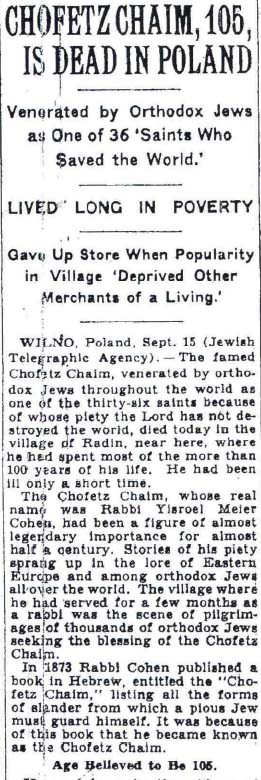

EDIT: I am pleased to be able to attribute this to Avigayil Meyer who notes that this research was hers and the email begun by her.
The research and letter above was done by ME! I sent the e-mail out to a couple of friends and now I see it all over the Internet without credit. Please post THIS response and spread worldwide. Credit should be given where credit is due!
Well done, Ms Meyer!
Do Artscroll transliterations work?
In the introduction of many Artscroll products the following is written, or something similar:
Transliteration presents a problem in all works of this sort. Ashkenazi, pure Sephardi, current Israeli, and generally accepted scholarly useages frequently diverge, and such familiar names as Isaac, Jacob, and Moses differs from them all. We have adopted a cross between the Sephardi and Ashkenazi transliterations, using Sephardi vowel and Ashkenazi pronunciations. Thus: Akeidas Yitzchak, rather than Akeidat Izhak or Akeidas Yitzchok. True, this blend may require some adjustment on the part of many readers, but it has proven successful.
Preface, pg xiv, Scherman, Nosson, 1993, Stone Edition Chumash (Brooklyn, New York, Mesorah Publicaitons, Ltd.)
What is Ashkenazi? While in general Jewish Hebrew pronunciation can be broken down into three major families (West, East and Yemenite) there is such divergences within each of these major families that its difficult to understand what was meant by Ashkenazi. My best guess is that it means the non-Chassidic American yeshiva dialect which developed in the 20th century. As for pure Sephardi, that seems meant to be juxtaposed against current Israeli since, at least in the popular conception, Israeli Hebrew is basically identical to the way Hebrew was pronounced by Middle Eastern Jews, popularly called Sephardim. And what are Ashkenazi pronunciations? I am pretty sure they mean Ashkenazi consonants.
Anecdotally I have heard people claim that they've heard people read Hebrew, while serving as shliach tzibur for example, with Artscroll havara, pronunciation. It sounds unbelievable to me, but the truth is that Artscroll has enabled Jews and non-Jews who knew very little about Judaism to pick themselves up by their bootstraps and encounter many classical texts and interpretations. Since I do not dispute the testimony of those who say they've heard people read Hebrew as per Artscroll transliteration, it seems they learned through this method which "has proven successful."
I don't know what yardstick was used to prove that it is successful (sales?). But given that Artscroll didn't experiment with a variety of methods at the outset it seems that it was an editorial decision from the start (the explanatory paragraph notwithstanding, I don't believe Artscroll ever contemplated either using Izhak or Yiṣḥāq instead of something more like Yitzchok or Yitzchak). The only explanation I can think of is that Artscroll didn't want to disenfranchise an entire market, people for whom standard Hebrew is Israeli pronunciation or a Sephardic variety, and certainly they wouldn't disenfranchise their own base. Thus, the compromise.
The Artscroll invention of a new way to read Hebrew has been criticized, and on good grounds if it is indeed propagating an artificial literary Hebrew among people, both for not being true to its own purported goal of representing Jewish tradition (ie, hypocricy) and for the misdeed itself.
However it is interesting to note that where it really counts, Artscroll's line of transliterated siddurim, prayer books, they use an entirely different transliteration method, as depicted below (click to enlarge):
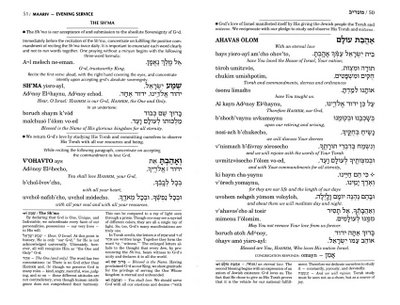
While I can't imagine that the above transliteration scheme is not confusing, both to layman and to scholar--they simply invented a transliteration scheme that is neither intuitive nor scholarly--it very nearly does reproduce what I have called the non-Chassidic American yeshiva dialect which developed in the 20th century. Not only are קמצין rendered with /o/, but even the חולם, rendered with an /o/ as well gets some kind of diacritic which either means that it is supposed to be pronounced /oy/ or as the long /o/ of 'home.' If the latter, then Artscroll has, for some reason, chosen to use the non-Chassidic American dialect which developed in the 20th century, but not the yeshiva dialect. It is the one used in many American day schools as well as in many American Beis Yaakov schools (incidentally, the phenomenon of the two ways to pronounce Hebrew as taught to brothers and sisters needs some exploration!).
Paranthetically, Steg notes that "Whether they meant it too or not, Artscrollese is very similar to the Pre-Ashkenazic dialect." That statement needs some qualification, but it is indeed the case that the the proto-Ashkenazic pronunciation had some similarities to its Eastern sister dialect particularly in the area of vowels. It seems, from the evidence of early Ashkenazic manuscripts which confusingly mix qomatz and patahs liberally, like their Eastern counterparts, that the adoption of the Tiberian distinction between /o/ and /a/ came at a later stage.
There's even a Wiki entry on Artscroll transliteration.
What do you say?
Transliteration presents a problem in all works of this sort. Ashkenazi, pure Sephardi, current Israeli, and generally accepted scholarly useages frequently diverge, and such familiar names as Isaac, Jacob, and Moses differs from them all. We have adopted a cross between the Sephardi and Ashkenazi transliterations, using Sephardi vowel and Ashkenazi pronunciations. Thus: Akeidas Yitzchak, rather than Akeidat Izhak or Akeidas Yitzchok. True, this blend may require some adjustment on the part of many readers, but it has proven successful.
Preface, pg xiv, Scherman, Nosson, 1993, Stone Edition Chumash (Brooklyn, New York, Mesorah Publicaitons, Ltd.)
What is Ashkenazi? While in general Jewish Hebrew pronunciation can be broken down into three major families (West, East and Yemenite) there is such divergences within each of these major families that its difficult to understand what was meant by Ashkenazi. My best guess is that it means the non-Chassidic American yeshiva dialect which developed in the 20th century. As for pure Sephardi, that seems meant to be juxtaposed against current Israeli since, at least in the popular conception, Israeli Hebrew is basically identical to the way Hebrew was pronounced by Middle Eastern Jews, popularly called Sephardim. And what are Ashkenazi pronunciations? I am pretty sure they mean Ashkenazi consonants.
Anecdotally I have heard people claim that they've heard people read Hebrew, while serving as shliach tzibur for example, with Artscroll havara, pronunciation. It sounds unbelievable to me, but the truth is that Artscroll has enabled Jews and non-Jews who knew very little about Judaism to pick themselves up by their bootstraps and encounter many classical texts and interpretations. Since I do not dispute the testimony of those who say they've heard people read Hebrew as per Artscroll transliteration, it seems they learned through this method which "has proven successful."
I don't know what yardstick was used to prove that it is successful (sales?). But given that Artscroll didn't experiment with a variety of methods at the outset it seems that it was an editorial decision from the start (the explanatory paragraph notwithstanding, I don't believe Artscroll ever contemplated either using Izhak or Yiṣḥāq instead of something more like Yitzchok or Yitzchak). The only explanation I can think of is that Artscroll didn't want to disenfranchise an entire market, people for whom standard Hebrew is Israeli pronunciation or a Sephardic variety, and certainly they wouldn't disenfranchise their own base. Thus, the compromise.
The Artscroll invention of a new way to read Hebrew has been criticized, and on good grounds if it is indeed propagating an artificial literary Hebrew among people, both for not being true to its own purported goal of representing Jewish tradition (ie, hypocricy) and for the misdeed itself.
However it is interesting to note that where it really counts, Artscroll's line of transliterated siddurim, prayer books, they use an entirely different transliteration method, as depicted below (click to enlarge):
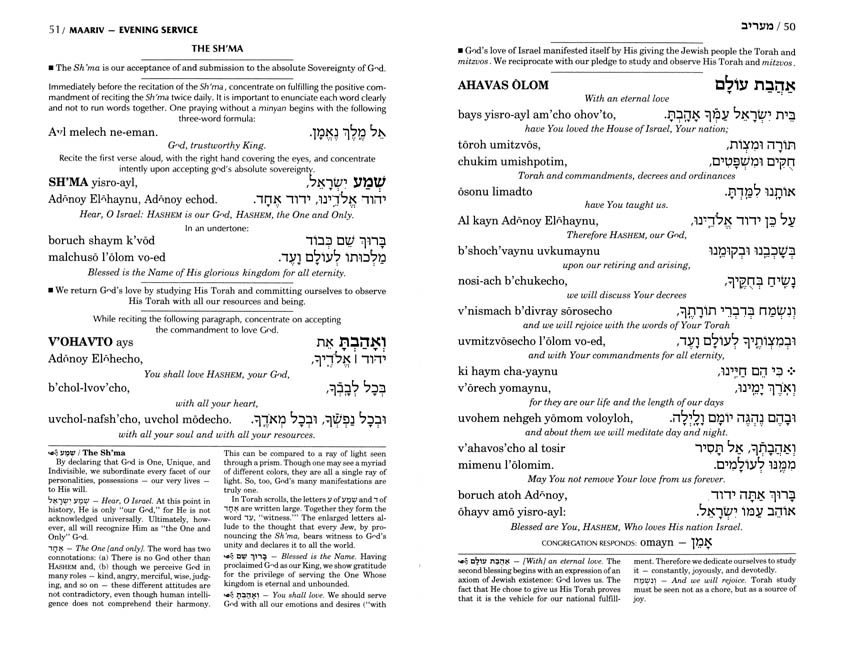
While I can't imagine that the above transliteration scheme is not confusing, both to layman and to scholar--they simply invented a transliteration scheme that is neither intuitive nor scholarly--it very nearly does reproduce what I have called the non-Chassidic American yeshiva dialect which developed in the 20th century. Not only are קמצין rendered with /o/, but even the חולם, rendered with an /o/ as well gets some kind of diacritic which either means that it is supposed to be pronounced /oy/ or as the long /o/ of 'home.' If the latter, then Artscroll has, for some reason, chosen to use the non-Chassidic American dialect which developed in the 20th century, but not the yeshiva dialect. It is the one used in many American day schools as well as in many American Beis Yaakov schools (incidentally, the phenomenon of the two ways to pronounce Hebrew as taught to brothers and sisters needs some exploration!).
Paranthetically, Steg notes that "Whether they meant it too or not, Artscrollese is very similar to the Pre-Ashkenazic dialect." That statement needs some qualification, but it is indeed the case that the the proto-Ashkenazic pronunciation had some similarities to its Eastern sister dialect particularly in the area of vowels. It seems, from the evidence of early Ashkenazic manuscripts which confusingly mix qomatz and patahs liberally, like their Eastern counterparts, that the adoption of the Tiberian distinction between /o/ and /a/ came at a later stage.
There's even a Wiki entry on Artscroll transliteration.
What do you say?
Wednesday, October 25, 2006
Can you help me find this article?
I've never tried this before, but let's see if any of my worthy readers can help me acquire a copy of the following article:
"The Attitude of the First Maskilim in Germany Toward the Talmud" by Moshe Pelli in The Leo Baeck Institute Yearbook 1982.
If you've got it and can scan it, pleas email it to me. It's worth a shot, isn't it? Thank you!
"The Attitude of the First Maskilim in Germany Toward the Talmud" by Moshe Pelli in The Leo Baeck Institute Yearbook 1982.
If you've got it and can scan it, pleas email it to me. It's worth a shot, isn't it? Thank you!
Tuesday, October 24, 2006
A Classic

From , Judith Bleich, 'Rabbi Yehi'el Ya'akov Weinberg; Innovator and Conservator' , WCJS- World Congress of Jewish Studies 11:B3, 1994
Monday, October 23, 2006
Cheshvan
It happened again. Sure enough, the hazzan in shul announced the coming of the new month in this way: ... ראש חודש חשוון יהיה ביום הראשון. I was half expecting it, actually. The issue? חשוון, rather than the actual name of the month, מרחשוון. And I bet many readers were expecting this post. :)
Put plainly, the issue concerns the 'fact' that the name of the eighth month on the Hebrew calendar is Marheshvan, while many people call it instead Heshvan or think that it is really two words, Mar Heshvan.
There are a lot of homiletics concerning the name of this month. Mar means drop, as in a drop of water. This month inaugurates the rainy season. Or mar means bitter. This month is bitter since it is the only month of the calendar without a special holiday of some sort. So mar, bitter, was added to the month. Or it is bitter because this was the month in which Jeroboam wages his rebellion, setting in motion the split between the Israelite and Judean kingdoms. Alternatively, the word mar was subtracted from the real name, marheshvan, because it means bitter Heshvan!
The names of the Hebrew months, as is well known, are of foreign, rather than indigenous Israelite, origin. In the Bible months are often simply called "first month" and so-forth. Sometimes names are given. For example, an alternate name for the first month is abhibh (Exodus 13:4). In the Tanakh, the second month is also called zibh (i Kings 6:1), &c. During the so-called First Exile the Jewish months assumed foreign names. This is best illustrated in the books Ezra and Esther, where the twelfth month is called adar (Ezra 6:15, Esther 3:7). Also named in Esther are the first month (no longer zibh, now called nisan, Esther 3:7) and the tenth month (now called tebheth, Esther 2:16). The names of these months come from the language we now call Akkadian.
The Akkadian names[1] were something like the following, in its order (with the Jewish months in their order next to them):
Nisanu.................................Nisan
Ayaru...................................Iyar
Simanu................................Sivan
Tamuzu...............................Tamuz
Abu.....................................Av
Ululu...................................Elul
Tashritu..............................Tishrei
Varahshamnu......................Marheshvan
Kislimu................................Kislev
Shabatu...............................Tevet
Tebetu.................................Shevat
Adaru..................................Adar
As you can see the lists are fairly close. In some cases most of the consonantal and vowel structure is the same (like Nisanu and Nisan). In one case the order is switched (the 10th and 11th months). In addition, there are some consonant shifts, more about that below.
This foreign origin was well known and never forgotten. Talmud Yerushalmi Rosh Ha-shana 1:2 says א"ר חנינה שמות חדשים עלו בידם מבבל, “the names of the months ascended with them [the returnees at the time of Ezra and Nehemiah] from Babylonia.”[3]
As can be plainly seen from the list, the consonants /m/ interchange with /b/ or /v/ (and those with /y/). Thus, Simanu becomes Sivan; Kislimu becomes Kislev. Talmudists or people who actually read Daniel (ch. 5:7) know that Hebrew argaman, ארגמן, purple, is Aramaic argavana, ארגוונא. Yeshiva schools are called yeshiva, ישיבה, or a mesivta, מתיבתא. (from Hebrew root ישב, to sit or Aramaic מתב, to sit). Another well known interchange is Hebrew Yavneh's Latin-English equivalent, Jamnia. As is probably clear by now, all these sounds are made with the same parts of the mouth , in this case the lips. I think Dave from Balashon once suggested pinching your nose and saying "Yabneh" out loud to hear your own mouth say what sounds more like "Yamneh."
In any case, it is clear that the month Marheshvan comes from the Akkadian Varahshamnu. What is that month's etymology? It seems that is is a compound of two words ורח שמנה, its Hebrew equivalent nothing more than ירח שמנה, the eighth month. There was a great article in Jewish Action a few years ago by Rabbi Ari Z. Zivotofsky about this etymology. He speculates that the pronunciation of the Yemenite Jews, something like 'Mrahshwan,' as opposed to Marheshvan, might be more accurate in that its pronunciation preserves this compound or in some way reflect its real origin. And yes this entire post is really nothing more than a repost of something I posted last October 31. What merited its revisiting was, as I said, that the month was announced on Shabbos from the bima as the coming of Cheshvan.
Let me say now that, at least in matters of language, I lean more towards being a descriptivist rather than a prescriptivist. If many people say חשוון then it is a valid alternate of מרחשוון. Not only that, it is probable that מרחשוון is the minority. If anything, we מרחשוון people need to defend it as a valid alternate name! I'm not sure how much Google mirrors reality, but if you google חשוון and מרחשוון (or its defective variants חשון and מרחשון) it is clear that מרחשוון loses. Big time.
To illustrate this graphically, take the case of the eighth French month, Ao?t. It is pronounced simply as /oo/. It descends, as does our eighth English month, August, from the Latin AVGVSTVS. In Italian it is Agosto. Apparently the proto-French people, Latin speakers, slurred their words more than the proto-Italians; Latin speakers. From Augustus evolved Ao?t. But it exists today frozen in a spelling in which more than just /oo/ was pronounced. The word evolved in French pronunciation until all that is left is a mere /oo/.[3]
Who will deny that in French the eighth month is indeed spelled Ao?t and indeed pronounced /oo/? Therefore it is ultimately fallacious to deny that the ninth Jewish month is not called חשוון, or at least cannot be called חשוון. It certainly can be.
In any case, אַ!אַ גוטן חודש
Update: The Jewish Worker notes that the Knesset will consider passing a bill to rename the month Cheshvan! You can't make this stuff up. Also noted by Jameel.
Update ii: R. Rich Wolpoe posted about this more than a month ago as well.
[1] Note that this is not nor is it intended to be a scientific transcription of the Akkadian names. See "The Fifth-Century Jewish Calendar at Elephantine" by S. H. Horn; L. H. Wood, Journal of Near Eastern Studies, Vol. 13, No. 1. (Jan., 1954), pp. 1-20.
[2] This handy translation, as well as some good discussion of the issue is from B. Barry Levy's "Contemporary Jewish Booklore: The Exegetical and Editorial Work of Rabbi Meir Zlotowitz and Rabbi Nosson Scherman."
[3] This handy example comes from Guy Deutscher's The Unfolding of Language: The Evolution of Mankind's Greatest Invention.
Put plainly, the issue concerns the 'fact' that the name of the eighth month on the Hebrew calendar is Marheshvan, while many people call it instead Heshvan or think that it is really two words, Mar Heshvan.
There are a lot of homiletics concerning the name of this month. Mar means drop, as in a drop of water. This month inaugurates the rainy season. Or mar means bitter. This month is bitter since it is the only month of the calendar without a special holiday of some sort. So mar, bitter, was added to the month. Or it is bitter because this was the month in which Jeroboam wages his rebellion, setting in motion the split between the Israelite and Judean kingdoms. Alternatively, the word mar was subtracted from the real name, marheshvan, because it means bitter Heshvan!
The names of the Hebrew months, as is well known, are of foreign, rather than indigenous Israelite, origin. In the Bible months are often simply called "first month" and so-forth. Sometimes names are given. For example, an alternate name for the first month is abhibh (Exodus 13:4). In the Tanakh, the second month is also called zibh (i Kings 6:1), &c. During the so-called First Exile the Jewish months assumed foreign names. This is best illustrated in the books Ezra and Esther, where the twelfth month is called adar (Ezra 6:15, Esther 3:7). Also named in Esther are the first month (no longer zibh, now called nisan, Esther 3:7) and the tenth month (now called tebheth, Esther 2:16). The names of these months come from the language we now call Akkadian.
The Akkadian names[1] were something like the following, in its order (with the Jewish months in their order next to them):
Nisanu.................................Nisan
Ayaru...................................Iyar
Simanu................................Sivan
Tamuzu...............................Tamuz
Abu.....................................Av
Ululu...................................Elul
Tashritu..............................Tishrei
Varahshamnu......................Marheshvan
Kislimu................................Kislev
Shabatu...............................Tevet
Tebetu.................................Shevat
Adaru..................................Adar
As you can see the lists are fairly close. In some cases most of the consonantal and vowel structure is the same (like Nisanu and Nisan). In one case the order is switched (the 10th and 11th months). In addition, there are some consonant shifts, more about that below.
This foreign origin was well known and never forgotten. Talmud Yerushalmi Rosh Ha-shana 1:2 says א"ר חנינה שמות חדשים עלו בידם מבבל, “the names of the months ascended with them [the returnees at the time of Ezra and Nehemiah] from Babylonia.”[3]
As can be plainly seen from the list, the consonants /m/ interchange with /b/ or /v/ (and those with /y/). Thus, Simanu becomes Sivan; Kislimu becomes Kislev. Talmudists or people who actually read Daniel (ch. 5:7) know that Hebrew argaman, ארגמן, purple, is Aramaic argavana, ארגוונא. Yeshiva schools are called yeshiva, ישיבה, or a mesivta, מתיבתא. (from Hebrew root ישב, to sit or Aramaic מתב, to sit). Another well known interchange is Hebrew Yavneh's Latin-English equivalent, Jamnia. As is probably clear by now, all these sounds are made with the same parts of the mouth , in this case the lips. I think Dave from Balashon once suggested pinching your nose and saying "Yabneh" out loud to hear your own mouth say what sounds more like "Yamneh."
In any case, it is clear that the month Marheshvan comes from the Akkadian Varahshamnu. What is that month's etymology? It seems that is is a compound of two words ורח שמנה, its Hebrew equivalent nothing more than ירח שמנה, the eighth month. There was a great article in Jewish Action a few years ago by Rabbi Ari Z. Zivotofsky about this etymology. He speculates that the pronunciation of the Yemenite Jews, something like 'Mrahshwan,' as opposed to Marheshvan, might be more accurate in that its pronunciation preserves this compound or in some way reflect its real origin. And yes this entire post is really nothing more than a repost of something I posted last October 31. What merited its revisiting was, as I said, that the month was announced on Shabbos from the bima as the coming of Cheshvan.
Let me say now that, at least in matters of language, I lean more towards being a descriptivist rather than a prescriptivist. If many people say חשוון then it is a valid alternate of מרחשוון. Not only that, it is probable that מרחשוון is the minority. If anything, we מרחשוון people need to defend it as a valid alternate name! I'm not sure how much Google mirrors reality, but if you google חשוון and מרחשוון (or its defective variants חשון and מרחשון) it is clear that מרחשוון loses. Big time.
To illustrate this graphically, take the case of the eighth French month, Ao?t. It is pronounced simply as /oo/. It descends, as does our eighth English month, August, from the Latin AVGVSTVS. In Italian it is Agosto. Apparently the proto-French people, Latin speakers, slurred their words more than the proto-Italians; Latin speakers. From Augustus evolved Ao?t. But it exists today frozen in a spelling in which more than just /oo/ was pronounced. The word evolved in French pronunciation until all that is left is a mere /oo/.[3]
Who will deny that in French the eighth month is indeed spelled Ao?t and indeed pronounced /oo/? Therefore it is ultimately fallacious to deny that the ninth Jewish month is not called חשוון, or at least cannot be called חשוון. It certainly can be.
In any case, אַ!אַ גוטן חודש
Update: The Jewish Worker notes that the Knesset will consider passing a bill to rename the month Cheshvan! You can't make this stuff up. Also noted by Jameel.
Update ii: R. Rich Wolpoe posted about this more than a month ago as well.
[1] Note that this is not nor is it intended to be a scientific transcription of the Akkadian names. See "The Fifth-Century Jewish Calendar at Elephantine" by S. H. Horn; L. H. Wood, Journal of Near Eastern Studies, Vol. 13, No. 1. (Jan., 1954), pp. 1-20.
[2] This handy translation, as well as some good discussion of the issue is from B. Barry Levy's "Contemporary Jewish Booklore: The Exegetical and Editorial Work of Rabbi Meir Zlotowitz and Rabbi Nosson Scherman."
[3] This handy example comes from Guy Deutscher's The Unfolding of Language: The Evolution of Mankind's Greatest Invention.
Friday, October 20, 2006
The Making of an Urban Legend re: the Shevach meat scandal
It has come to my attention that in the new Baltimore Jewish Times the following appears (no link at the moment):
Just prior to World War II in Switzerland, a law was passed that required Jews to stun chickens via electric shock before shechting them. It became questionable if, when the current was put through the chicken to make it unconcious, the chicken could possibly be dead from the shock prior to the shechting, and this led to the question of whether a Jew should be concerned about this procedure.
The question was brought to the rabbis of the city, and the gedolim ruled that Jews could not use this method of electric shock, and therefore kosher chicken had to be imported from another source, France.
In the heat of the war, since Jews could not import meat, they had none.
There was one shochet, however, who relied on a das yachid that allowed him to shecht the chickens. But when he did, the rav the city came out against his doing so, and he said he would not be surprised if a grandchild of this man would be caught selling treife meat.
This shochet was the grandfather of Moshe Finkel, former owner of Monsey's Shevach Meats!
The above story is recorded in the sefer of responsa Chavatzeles HaSharon and was relayed to the Baltimore Jewish News by Rabbi Moshe Heinemann.
Now, putting aside that shechita was banned completely in Switzerland in 1897, the story doesn't ring true for other reasons. For one thing, in the version I had heard a few weeks ago (yes, this has been circulating for weeks) it was R. Chaim Oyzer Grodzenski who said the prophecy. I suppose the more responsible version is this one, which doesn't tie a name to the prophecy. For another, although it certainly is possible that some version of something resembling the above incident is in "the sefer of responsa Chavatzeles HaSharon," would it really name the butcher? If not, how is it known to connect an unnamed man in an unnamed incident (since this could not have happened in Switzerland around WWII) with the Butcher of Monsey's grandfather? It also seems unlikely that someone would have said he "would not be surprised if a grandchild of this man would be caught selling treife meat."
At the very least all these unlikelys require investigation and confirmation or debunking rather than unison nodding at the awe-inspiring story.
נראה לי, it seems to me, that there is some desire to root this scandal in an unseeable world of רוחניות, where a cough in a spiritual matter in 1940 mystically becomes a tidal wave in a spiritual matter in 2006.
Of course, maybe I'm wrong and this is what happened.
Just prior to World War II in Switzerland, a law was passed that required Jews to stun chickens via electric shock before shechting them. It became questionable if, when the current was put through the chicken to make it unconcious, the chicken could possibly be dead from the shock prior to the shechting, and this led to the question of whether a Jew should be concerned about this procedure.
The question was brought to the rabbis of the city, and the gedolim ruled that Jews could not use this method of electric shock, and therefore kosher chicken had to be imported from another source, France.
In the heat of the war, since Jews could not import meat, they had none.
There was one shochet, however, who relied on a das yachid that allowed him to shecht the chickens. But when he did, the rav the city came out against his doing so, and he said he would not be surprised if a grandchild of this man would be caught selling treife meat.
This shochet was the grandfather of Moshe Finkel, former owner of Monsey's Shevach Meats!
The above story is recorded in the sefer of responsa Chavatzeles HaSharon and was relayed to the Baltimore Jewish News by Rabbi Moshe Heinemann.
Now, putting aside that shechita was banned completely in Switzerland in 1897, the story doesn't ring true for other reasons. For one thing, in the version I had heard a few weeks ago (yes, this has been circulating for weeks) it was R. Chaim Oyzer Grodzenski who said the prophecy. I suppose the more responsible version is this one, which doesn't tie a name to the prophecy. For another, although it certainly is possible that some version of something resembling the above incident is in "the sefer of responsa Chavatzeles HaSharon," would it really name the butcher? If not, how is it known to connect an unnamed man in an unnamed incident (since this could not have happened in Switzerland around WWII) with the Butcher of Monsey's grandfather? It also seems unlikely that someone would have said he "would not be surprised if a grandchild of this man would be caught selling treife meat."
At the very least all these unlikelys require investigation and confirmation or debunking rather than unison nodding at the awe-inspiring story.
נראה לי, it seems to me, that there is some desire to root this scandal in an unseeable world of רוחניות, where a cough in a spiritual matter in 1940 mystically becomes a tidal wave in a spiritual matter in 2006.
Of course, maybe I'm wrong and this is what happened.
Monday, October 16, 2006
Shout out to the Haskalah

The title of Ner Israel's R. Moshe Eisemann's recently published Ramban As A Guide To Today's Perplexed bears a passing resemblance to Nachman Krochmal's Moreh Nebukhe ha-Zeman.
No?
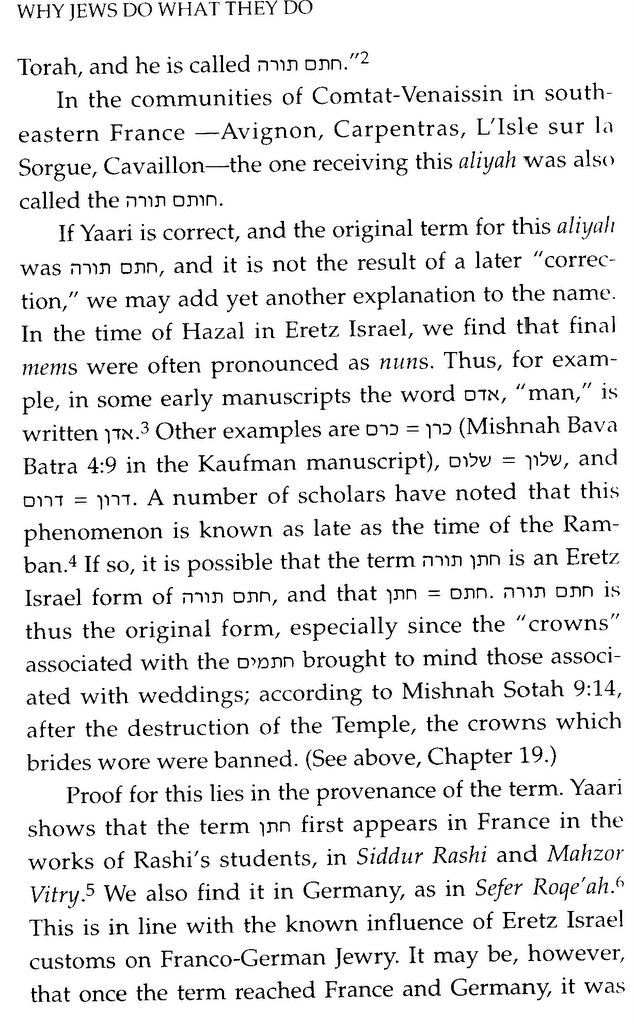
חתן חתם תורה
I think I'm a little late, but here's an interesting excerpt from R. Daniel Sperber's Minhagei Yisrael (from the excerpts in the English version translated by R. Yaakov Elman). (click to enlarge, or download it as a more readable pdf)



Thursday, October 05, 2006
The Wissenschaft Palindrome
April 25: R. Yitzchok Adlerstein at Cross Currents writes a post called The Gospel of Judas and Jewish Faith, which is basically a lament directed at academic Jewish scholarship because "there are too many Jewish scholars and liberal clergy eager to betray their legacy for thirty shekels worth of academic respectability."
April 25: Noting that R. Adlerstein had once written "Alas, it has been a long time since Rav Dovid Tzvi Hoffman and his headlong charge against Higher Criticism and Jewish Wissenschaft , I responded with my own post, called חכמת ישראל : Eat the fruit, throw away the shell, basically an apologia for academic Jewish scholarship . The allusion in the title was to the justification Rabbi Meir used in learning Torah from arch-apostate Aher (BT Chag. 15b). I also pointed out then that R. David Zevi Hoffman not only did not charge against Jewish Wissenschaft, he was one of its founders! His Wissenschaft writings are identical in form and even in content to those of Zunz or Geiger. Indeed, R. David Zevi Hoffman's scholarship could quote Rashi in one line, Geiger in the next--just like any academic scholarship properly should. Yes, different motivations did exist. And ff course, R. David Zevi Hoffman did lead a serious charge against Higher Criticism of the Torah. This attitude was shared by Solomon Schechter and many, if not most Jewish scholars of the day who took little truck with what they rightly perceived as an attack on Jews.
October 5: R. Yitzchok Adlerstein at Cross Currents writes a post called Hadasim, Aravos, and Bar Kochba Coins which begins by noting that "some people – perhaps wisely – stayed away from disciplines considered hostile to traditional beliefs, some intrepid souls managed, in the words of the Gemara, to discard the shells and take the kernels." An exemplar would be Dr. Lawrence Schiffman.
I do not know if I made a רושם (an impression), but you never know. That kernels and shells thing is powerful, that I know and this second post is practically a reversal of the first.
October 5: My response is not to disagree with him, but to laud his point, which is my own point as well.
In fact, I agree that there are pitfalls of academic scholarship. There is pseudo-scholarship, just as there is pseudo-divrei Torah. There is an iconoclastic tendency which sometimes breaks things for the sake of breaking them.
Three brief examples will suffice. Two will not name names, but they concern oft-repeated tropes never carefully examined in violation of a cardinal principle of critical scholarship; the other will name one name since that person is no longer among the living.
The first concerns every single writer who cites the same tired trope about the Chasam Soyfer, who coined the slogan of the 19th century proto-haredi Orthodox: חדש אסור מן התורה, chodosh assur min ha-Torah. The last three words are easily translated; they mean "prohibited by the Torah." The first word means new as in "that which is new." So the phrase means "That which is new is prohibited by the Torah." However, a more elegent translation is "Innovation is prohibited by the Torah." This slogan was directed at modernity and especially at the spirit of Reform in Judaism. The absolute best translation I have ever seen is "Modernity is forbidden by the Torah." However, here is the rub: the Chasam Soyfer didn't coin the phrase. It is mishnaic and means something completely different (See, for example, Mishna massekhet 'Orla 3:9). In other words the Chasam Soyfer's slogan was creative wordplay. It is clear from the ways in which his slogan is cited that many, many of the scholars are simply unaware that it is a wordplay. Given that, the phrase is considerably less austere then it sounds. It isn't quite saying "Innovation is forbidden," for which one can laughingly respond "But didn't you install lightbulbs in your kloyz?" It may not be a phrase we can agree with, but it is witty (even if also frightening) but there is evidently a lot of unawareness of this fact. Scholars who repeat the trope, "Hatam Sofer=reactionary Orthodox=forbade anything new" are not being critical. A tiny bit of searching would reveal a new dimension to the phrase. Of course one can wonder if some of said scholars even know the phrase from the original Hebrew or only in translation?
Second example is another trope which is repeated constantly. Here I will be lax myself and neither quote the original nor even the exact wording. There is a remarkable aggadic passage repeated very often, which has God saying that he'd rather his children (ie, the Jews) forget HIM but keep his Torah, because observance will lead back to him. Many a devar Torah has been launched from this. This has been used to launch the idea that Judaism has no dogmas (which may be true anyway) to any number of other ideas. And it is repeated often. A very precise scholar who I will not name repeated it in one of his books. But it is wrong. Didn't the guy even look up the Yerushalmi? It says study my Torah, not keep my Torah. Why don't all the scholars who have cited in English this aggadah just quote it correctly? It doesn't necessarily even change the implications that much. The answer is because of imprecision and slacking off. (Hey, I didn't do my homework in this and maybe I'll get nailed myself!--try me)
Third concerns longtime editor of the Jewish Quarterly Review, Solomon Zeitlin a"h. Dr. Zeitlin was very concerned with pseudo-scholarship and wrote constantly about it. He found many faults with the 1972 edition of the masterful Encyclopedia Judaica and wrote much about it, even if he was right or wrong about the details. He was right and justified in polemicizing against pseudo-scholarship. And yet--he also spent 25 years chasing a rainbow in his treatment of the megillot midbar yehuda (the Dead Sea Scrolls). Simply put, he was convinced from the beginning, from their discovery, that they were not ancient. They were medieval. Maybe they were Karaitic, maybe not. But certainly they were not 2000 years old and more! It didn't matter what evidence was brought. Paleography. Theology. Nothing. And he was WRONG. They most certainly are that ancient. And he invested a lot of ink in his bad premise.
But--and I can't stress this enough--this applies to all intellectual endeavors, whether a daf yomi shiur or a 9th grade rebbe transmitting his mesorah to his charges. This is about precision, whole truths, accuracy, closer to the mark, more astute research, more truth. It isn't a pitfall to be found only in academia. I have heard as many boich sevaras in academia as I heard in the yeshiva. That sentence was a palindrome.
April 25: Noting that R. Adlerstein had once written "Alas, it has been a long time since Rav Dovid Tzvi Hoffman and his headlong charge against Higher Criticism and Jewish Wissenschaft , I responded with my own post, called חכמת ישראל : Eat the fruit, throw away the shell, basically an apologia for academic Jewish scholarship . The allusion in the title was to the justification Rabbi Meir used in learning Torah from arch-apostate Aher (BT Chag. 15b). I also pointed out then that R. David Zevi Hoffman not only did not charge against Jewish Wissenschaft, he was one of its founders! His Wissenschaft writings are identical in form and even in content to those of Zunz or Geiger. Indeed, R. David Zevi Hoffman's scholarship could quote Rashi in one line, Geiger in the next--just like any academic scholarship properly should. Yes, different motivations did exist. And ff course, R. David Zevi Hoffman did lead a serious charge against Higher Criticism of the Torah. This attitude was shared by Solomon Schechter and many, if not most Jewish scholars of the day who took little truck with what they rightly perceived as an attack on Jews.
October 5: R. Yitzchok Adlerstein at Cross Currents writes a post called Hadasim, Aravos, and Bar Kochba Coins which begins by noting that "some people – perhaps wisely – stayed away from disciplines considered hostile to traditional beliefs, some intrepid souls managed, in the words of the Gemara, to discard the shells and take the kernels." An exemplar would be Dr. Lawrence Schiffman.
I do not know if I made a רושם (an impression), but you never know. That kernels and shells thing is powerful, that I know and this second post is practically a reversal of the first.
October 5: My response is not to disagree with him, but to laud his point, which is my own point as well.
In fact, I agree that there are pitfalls of academic scholarship. There is pseudo-scholarship, just as there is pseudo-divrei Torah. There is an iconoclastic tendency which sometimes breaks things for the sake of breaking them.
Three brief examples will suffice. Two will not name names, but they concern oft-repeated tropes never carefully examined in violation of a cardinal principle of critical scholarship; the other will name one name since that person is no longer among the living.
The first concerns every single writer who cites the same tired trope about the Chasam Soyfer, who coined the slogan of the 19th century proto-haredi Orthodox: חדש אסור מן התורה, chodosh assur min ha-Torah. The last three words are easily translated; they mean "prohibited by the Torah." The first word means new as in "that which is new." So the phrase means "That which is new is prohibited by the Torah." However, a more elegent translation is "Innovation is prohibited by the Torah." This slogan was directed at modernity and especially at the spirit of Reform in Judaism. The absolute best translation I have ever seen is "Modernity is forbidden by the Torah." However, here is the rub: the Chasam Soyfer didn't coin the phrase. It is mishnaic and means something completely different (See, for example, Mishna massekhet 'Orla 3:9). In other words the Chasam Soyfer's slogan was creative wordplay. It is clear from the ways in which his slogan is cited that many, many of the scholars are simply unaware that it is a wordplay. Given that, the phrase is considerably less austere then it sounds. It isn't quite saying "Innovation is forbidden," for which one can laughingly respond "But didn't you install lightbulbs in your kloyz?" It may not be a phrase we can agree with, but it is witty (even if also frightening) but there is evidently a lot of unawareness of this fact. Scholars who repeat the trope, "Hatam Sofer=reactionary Orthodox=forbade anything new" are not being critical. A tiny bit of searching would reveal a new dimension to the phrase. Of course one can wonder if some of said scholars even know the phrase from the original Hebrew or only in translation?
Second example is another trope which is repeated constantly. Here I will be lax myself and neither quote the original nor even the exact wording. There is a remarkable aggadic passage repeated very often, which has God saying that he'd rather his children (ie, the Jews) forget HIM but keep his Torah, because observance will lead back to him. Many a devar Torah has been launched from this. This has been used to launch the idea that Judaism has no dogmas (which may be true anyway) to any number of other ideas. And it is repeated often. A very precise scholar who I will not name repeated it in one of his books. But it is wrong. Didn't the guy even look up the Yerushalmi? It says study my Torah, not keep my Torah. Why don't all the scholars who have cited in English this aggadah just quote it correctly? It doesn't necessarily even change the implications that much. The answer is because of imprecision and slacking off. (Hey, I didn't do my homework in this and maybe I'll get nailed myself!--try me)
Third concerns longtime editor of the Jewish Quarterly Review, Solomon Zeitlin a"h. Dr. Zeitlin was very concerned with pseudo-scholarship and wrote constantly about it. He found many faults with the 1972 edition of the masterful Encyclopedia Judaica and wrote much about it, even if he was right or wrong about the details. He was right and justified in polemicizing against pseudo-scholarship. And yet--he also spent 25 years chasing a rainbow in his treatment of the megillot midbar yehuda (the Dead Sea Scrolls). Simply put, he was convinced from the beginning, from their discovery, that they were not ancient. They were medieval. Maybe they were Karaitic, maybe not. But certainly they were not 2000 years old and more! It didn't matter what evidence was brought. Paleography. Theology. Nothing. And he was WRONG. They most certainly are that ancient. And he invested a lot of ink in his bad premise.
But--and I can't stress this enough--this applies to all intellectual endeavors, whether a daf yomi shiur or a 9th grade rebbe transmitting his mesorah to his charges. This is about precision, whole truths, accuracy, closer to the mark, more astute research, more truth. It isn't a pitfall to be found only in academia. I have heard as many boich sevaras in academia as I heard in the yeshiva. That sentence was a palindrome.
Thursday, September 28, 2006
New blog to bookmark
Longtime insightful j-blogosphere commenter Larry Lenhoff has begin his own blog, Eclectic Jewish Thoughts and it is--you guessed it--insightful!
Begin with The Baby and the Bath Water.
Begin with The Baby and the Bath Water.
Tuesday, September 26, 2006
Bible cantillation news to Albert Schweitzer
(I shudder to think what sort of googling will turn up a post with this title!)
I know, why don't I just rename the blog English Hebraism already. ;)
I found this interesting letter by theologian, musician and philosopher Albert Schweitzer.
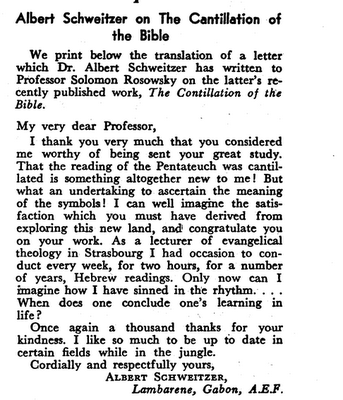
I know, why don't I just rename the blog English Hebraism already. ;)
I found this interesting letter by theologian, musician and philosopher Albert Schweitzer.

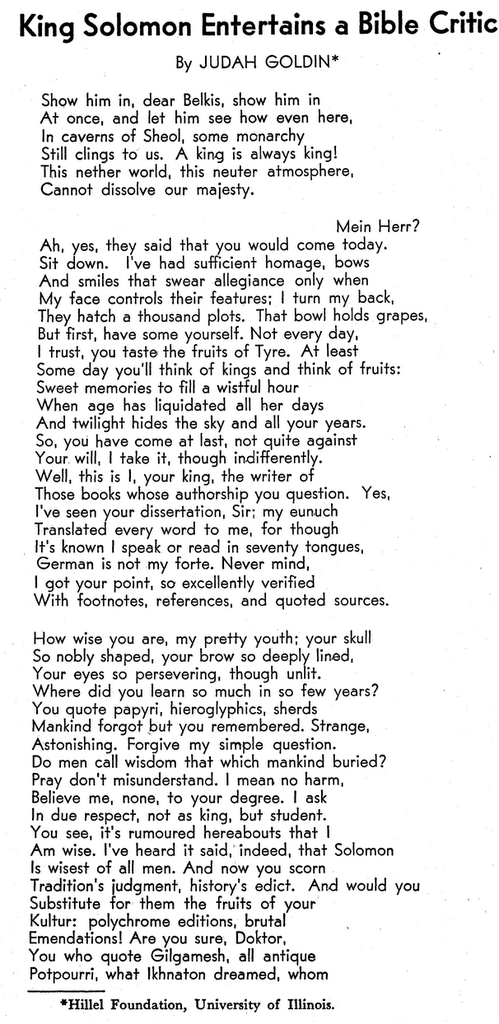

Monday, September 25, 2006
Today's shophar blasts projected onto the recent past
Than Book has an interesting post tracing the Ashkenazic customs of the number of shophar blasts; from suggestions of 40, 60 or 100 in the 12th century to later suggestions like 60 (the Gra) to the actual practice of eastern and western European Ashkenazim in the early 19th century; 42 and 40 respectively. Than writes that "by the end of the 19th century, most poskim were pushing for 100 to become universal," and thus about a hundred years ago it began to be correct that 100 was "almost universal," as the Artscroll mahzor says it is today.
What motivated the search? A friend's dispute with a daughter's teacher over how many shophar blasts are traditional for Ashkenazim.
Here is an interesting example of how even what was the norm 100 years ago can easily be forgotten and supplanted by something new; then projected back onto the past.
What motivated the search? A friend's dispute with a daughter's teacher over how many shophar blasts are traditional for Ashkenazim.
Here is an interesting example of how even what was the norm 100 years ago can easily be forgotten and supplanted by something new; then projected back onto the past.
Friday, September 22, 2006
Dear friends (aka Gentle Reader[s]),
I wish you all a Shana Tova. Remember that שנה, shana, year, comes from the root שנה which implies not just a year but also two-fold, repetition, change and even teaching. May the coming year bring all of you double blessings, repetition of the good things from the past, positive change and may you be open to learn new things and teach new things to others.
Yours,
Mississippi Fred MacDowell (not literally) ;)
Yours,
Mississippi Fred MacDowell (not literally) ;)
Thursday, September 21, 2006
Is Philo פלוני?
Is Philo of Alexandria mentioned in rabbinic literature?
Midrash Tannaim 6.7, Sifre Deut. 34 (in MSS.)
"And thou shalt speak of them: Make them thy main concern, and not ancillary to other things; so that thy discussions will be only about them, and thou shalt not mix other things with them, like Peloni*. Perhaps thou maysest say, I have studied the wisdom of Israel, I will now go and study the wisdom of the nations, therefore doth Scripture say, To go in them (Lev. 18:4), and not to turn away from them."
In JBL 53:2 R. Louis Finkelstein asked a very good question: who is meant here by פלוני, Peloni?
Some have suggested it referred to Aher, but Finkelstein rejects this because 'Aher' is itself a euphemism. Where do we find him called Peloni? Secondly, we do not actually find a decription of him as a Greek philosopher in the Talmud (despite popular conceptions).
We find him trying to get Jewish children to stop learning Torah (B. Hagigah 15b), reporting Jews who tried to minimize their hillul shabbat which was required by Roman decree (Jer. Hagigah ch. II). These depictions portray him as one who collaborated with the Romans. The story of him entering the pardes doesn't impy his engagement with Greek philosophy, because R. Akiva and others did the same. The Gemara does say that he carried סיפרי מינין, but מין refers to Jewish heretics, not the Greek philosophers.
Then who is intended by Peloni?
The answer might be that כפלוני, like Peloni, is a mistake that should have read כפילוני or כפילון, "like Philo." The passage becomes even more clear if this is so, because it is not discussing an apostate--Philo was certainly no such thing. If so, then this midrash disapproves of this person because he was a Torah u-Maddanik, not mamash a heretic! :)
R. Finkelstein tentatively suggests a couple of other references to Philo in rabbinic literature, of which he is less certain, but this one is cleaner.
*In rabbinic literature Peloni is used for "so-and-so." The origin is from Ruth 4:1, where פלני אלמני, meaning "such a one" ie, so-and-so is used.
Midrash Tannaim 6.7, Sifre Deut. 34 (in MSS.)
ודברת בם עשם עקר ואל תעשם טפלה שלא יהא משאך ומתנך אלא בהם שלא תערב בהם דברים אחרים כפלוני שמא תאמר למדתי חכמת ישראל אלך אלמד חכמת האומות תל ללכת בהם (ויקרא י"ח ד') ולא ליפטר מתוכן
"And thou shalt speak of them: Make them thy main concern, and not ancillary to other things; so that thy discussions will be only about them, and thou shalt not mix other things with them, like Peloni*. Perhaps thou maysest say, I have studied the wisdom of Israel, I will now go and study the wisdom of the nations, therefore doth Scripture say, To go in them (Lev. 18:4), and not to turn away from them."
In JBL 53:2 R. Louis Finkelstein asked a very good question: who is meant here by פלוני, Peloni?
Some have suggested it referred to Aher, but Finkelstein rejects this because 'Aher' is itself a euphemism. Where do we find him called Peloni? Secondly, we do not actually find a decription of him as a Greek philosopher in the Talmud (despite popular conceptions).
We find him trying to get Jewish children to stop learning Torah (B. Hagigah 15b), reporting Jews who tried to minimize their hillul shabbat which was required by Roman decree (Jer. Hagigah ch. II). These depictions portray him as one who collaborated with the Romans. The story of him entering the pardes doesn't impy his engagement with Greek philosophy, because R. Akiva and others did the same. The Gemara does say that he carried סיפרי מינין, but מין refers to Jewish heretics, not the Greek philosophers.
Then who is intended by Peloni?
The answer might be that כפלוני, like Peloni, is a mistake that should have read כפילוני or כפילון, "like Philo." The passage becomes even more clear if this is so, because it is not discussing an apostate--Philo was certainly no such thing. If so, then this midrash disapproves of this person because he was a Torah u-Maddanik, not mamash a heretic! :)
R. Finkelstein tentatively suggests a couple of other references to Philo in rabbinic literature, of which he is less certain, but this one is cleaner.
*In rabbinic literature Peloni is used for "so-and-so." The origin is from Ruth 4:1, where פלני אלמני, meaning "such a one" ie, so-and-so is used.
Tuesday, September 19, 2006
Autograph copy of Mishna Berura
As a kind of complement to the post directly below:
Jeffrey Saks at Lamed posts about a supposedly autograph copy of a volume of Mishna Berura with the word מוגה written inside the cover in the Chafetz Chaim's own hand. (I say supposedly since the provenance is unknown, according to Saks).
Cool!
Jeffrey Saks at Lamed posts about a supposedly autograph copy of a volume of Mishna Berura with the word מוגה written inside the cover in the Chafetz Chaim's own hand. (I say supposedly since the provenance is unknown, according to Saks).
I showed it to a rare Judaica dealer, who pointed out that in the upper right hand corner of the inside cover is the Hebrew word "mugah" (checked, inspected). He told me that the Chofetz Chaim himself (and his sons-in-law) inspected each volume as it came back form the printers to make sure there were no mistakes in the binding, etc. That notation, "mugah", is none other than the Chofetz Chaim's own handwriting (according to the book dealer).The photo of the inside cover is here.
Cool!
Hating a hagiography
I came across this rather unflattering review from 1940 of Saint and Sage the English language version of the biography of the Chafetz Chaim by Moshe Yoshor. As you can see, it basically says about this biography what many people say about many modern rabbinic biographies.
Artscroll reprinted a version of this book, and can be bought here. I was a little suprised that Artscroll writes that it was "first published in Yiddish in 1937 and considerably enhanced in a 1946 edition, the biography was published in Hebrew in 1959 with much additional material" without ever mentioning this English edition.
Incidentally, I read this book (the 1937 English edition) years ago and quite liked it myself.
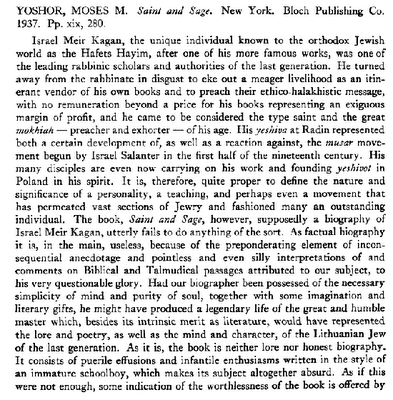

(click on photos to enlarge for easier reading)
Artscroll reprinted a version of this book, and can be bought here. I was a little suprised that Artscroll writes that it was "first published in Yiddish in 1937 and considerably enhanced in a 1946 edition, the biography was published in Hebrew in 1959 with much additional material" without ever mentioning this English edition.
Incidentally, I read this book (the 1937 English edition) years ago and quite liked it myself.


(click on photos to enlarge for easier reading)
Thursday, September 14, 2006
The Yated's scrapbook
This article, which Wolf posts about, proceeds from the premise that half of whatever is currently accepted in science is in reality false and will later be shown to be so to discredit science in toto (we are definitely not in Kansas anymore). The contrast, naturally, is between things like the "four categories of damagers — arba ovos nezikin (Bava Kama 2a)," which will not be revised in ten years.
The article lists several examples to illustrate this point.
Ad kan the leytzanus. In fairness, the same article makes the point that "If someone is a doctor, or an astronomer, or a professional oceanographer, or an archaeologist, then of course he or she must learn the conventional wisdom of their field." It just wants "we," meaning haredim, to have no part in those fields.
The article lists several examples to illustrate this point.
- the recent demotion of Pluto
- a marine report from December 1994
- an undated Biblical Archaeology Review story (its muttar to read that?) about the Qumran community
- a New York Times article about from August about poisonous fish
- a declaration from American Association of Pediatrics from about two years ago
Ad kan the leytzanus. In fairness, the same article makes the point that "If someone is a doctor, or an astronomer, or a professional oceanographer, or an archaeologist, then of course he or she must learn the conventional wisdom of their field." It just wants "we," meaning haredim, to have no part in those fields.
Tuesday, September 12, 2006
Areivim, a "Kosher pyramid scheme"
"It’s simple yet elegant idea: 10,000 haredi households combine into a cluster. When a cluster member dies, the others give five dollars a piece to each of the orphans..."
Interesting.
Interesting.
Monday, September 11, 2006
How could Yoseph have been named Yoseph? A theophoric* problem.
Shemot 6:2-3
| ב וַיְדַבֵּר אֱלֹהִים, אֶל-מֹשֶׁה; וַיֹּאמֶר אֵלָיו, אֲנִי יְהוָה. | 2 And God spoke unto Moses, and said unto him: 'I am the LORD; |
| ג וָאֵרָא, אֶל-אַבְרָהָם אֶל-יִצְחָק וְאֶל-יַעֲקֹב--בְּאֵל שַׁדָּי; וּשְׁמִי יְהוָה, לֹא נוֹדַעְתִּי לָהֶם. | 3 and I appeared unto Abraham, unto Isaac, and unto Jacob, as God Almighty, but by My name YHWH I made Me not known to them. |
Aren't the names יוסף (Yoseph) and יוכבד (Yocheved) theophoric, that is, aren't they shortened forms of יהוסף (Yehoseph) and יהוכבד (Yehocheved)? Although I am a little more hesitant to say that with certainty about the second name, I think its fairly certain that Yoseph is Yehoseph.
This phenomenon is not that dissimilar to how יהונתן (Yehonatan) and יהוחנן (Yehochanan) become יונתן (Yonatan) and יוחנן (Yochanan) respectively, especially in pronunciation--a later example is from European Jewish culture, in which יהודה (Yehuda) became יודה (Yuda) or even יהודא?
If "by My name YHWH I made Me not known to them," then how were Yoseph, if not Yocheved, named with the י-ו element in their name?
Interesting comment
Wait a second. Cassuto, in his Torat Hate'udot, says, and I quote from a thirty some year old memory, that "the consistency and brilliance demonstrated in the Torah understandably would lead one to believe,if not for the impossibility, that the Torah is min hashamayim." R' Yakov Weinberg gave me his copy to show me that a mummar knows he's wrong deep inside. Is there more than one scholarly Cassuto?
Sunday, September 10, 2006
R. Hirsch on R. David Zevi Hoffman's Mar Samuel
From Rabbiner Esriel Hildesheimer Briefe by Mordechai Eliav:
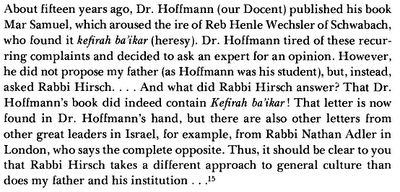
This translation comes from Scholarship and Faith: David Hoffman and His Relationship to "Wissenschaft des Judentums" by David Ellenson and Richard Jacobs.
This is from a letter written by R. Esriel Hildesheimer's son regarding the matter of how R. Samson Rafael Hirsch reacted to R. David Zevi Hoffman's book Mar Samuel.
Mar Samuel was a juedische Wissenschaft book; what we would today call an academic study of the third century 'amorah Shmuel. Although it must be stressed that R. Hirsch maintained cordial relations with R. Hoffman, who had taught in R. Hirsch's day school, he was a strident opponent of juedische Wissenschaft. As you can see, he believed it was heresy; it was heresy to write a biography of a Talmudic sage, to systematize his views, to correlate them with his environment and personality.
Thus, R. Hirsch's view. The corrolary, of course, is that R. David Zevi Hoffman felt otherwise.
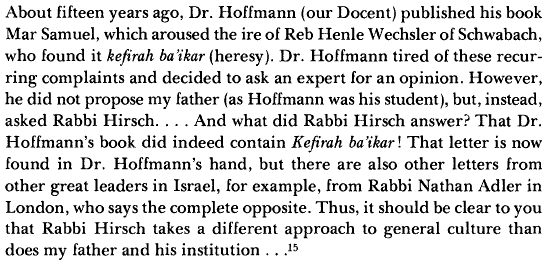
This translation comes from Scholarship and Faith: David Hoffman and His Relationship to "Wissenschaft des Judentums" by David Ellenson and Richard Jacobs.
This is from a letter written by R. Esriel Hildesheimer's son regarding the matter of how R. Samson Rafael Hirsch reacted to R. David Zevi Hoffman's book Mar Samuel.
Mar Samuel was a juedische Wissenschaft book; what we would today call an academic study of the third century 'amorah Shmuel. Although it must be stressed that R. Hirsch maintained cordial relations with R. Hoffman, who had taught in R. Hirsch's day school, he was a strident opponent of juedische Wissenschaft. As you can see, he believed it was heresy; it was heresy to write a biography of a Talmudic sage, to systematize his views, to correlate them with his environment and personality.
Thus, R. Hirsch's view. The corrolary, of course, is that R. David Zevi Hoffman felt otherwise.
Thursday, September 07, 2006
jewisharticles@...gmail.com
I have decided to initiate what I hope might turn into something fun and productive:
NoSpamjewisharticles*@*gmail*.*comNoSpam
Let me explain. Gmail offers an inbox with a whopping 2 gb of storage space. I have a lof of sundry articles in .pdf and .doc format about all sorts of Jewish topics: Talmud, Jewish history, seforim, Judaic studies, articles etc. I know a lot of people have similar collections which they've accumulated.
If we pool our resources together this email address can serve as a great database of great articles and essays, similar to web sites like seforimonline.org or hebrewbooks.org.
So I have set up this account jewisharticles@gmail.com. The password will be sent to anyone who is interested. You have only to You have only to email me to ask for the password. I will add interesting articles as soon as I can. The only condition I ask of anyone who is interested in joining is that they too add something. Be a contributor and not just a consumer. Add anything. There is no religious litmus test, no "That's not interesting" litmus test. It need only be Jewish themed and of interest to you.
How to add files to this email address? Well, I think the best way is to use the firefox browser and download the Gspace extension. Once downloaded, you can access Gspace under the tools menu and use it as a regular FTP client. You will need to know the user name (jewisharticles, obviously) and the password, which I will email upon request. Of course you can also send files via normal email.
One more thing: so that we all know what is going on, I ask that we adopt some sort of uniform system for labeling files. For example, suppose I wished to add the following (which will actually be the first file I add): the critical review of the Jastrow dictionary by R. Salomon Alter Halpern which appread in Hamoreh (which I received from Menachem Butler originally). It is presently titled "Jastrow_Pamphlet_by_Salomon_Alter_Halpern" but I might want to note that the name of the article is "Some Facts About Marcus Jastrow's Dictionary." So I renamed the file "Some_Facts_About_Marcus_Jastrows_Aramaic_English
_Dictionary_Salomon_Alter_Halpern_1970." This gives more info and will be better once many files are added and it searching by keyword becomes the only viable option. Thus, anyone who searched for "Aramaic" or "dictionary" will be able to download this file.
This is only the beginning, I intend to add more. Just make sure to add relevent keywords and perhaps the title to your file's name.
And finally, this will be an honor system project since obviously a malicious person can do all sorts of things. I will trust and hope that a circle of people comitted to spreading knowledge and sharing will develop.
NoSpamjewisharticles*@*gmail*.*comNoSpam
Let me explain. Gmail offers an inbox with a whopping 2 gb of storage space. I have a lof of sundry articles in .pdf and .doc format about all sorts of Jewish topics: Talmud, Jewish history, seforim, Judaic studies, articles etc. I know a lot of people have similar collections which they've accumulated.
If we pool our resources together this email address can serve as a great database of great articles and essays, similar to web sites like seforimonline.org or hebrewbooks.org.
So I have set up this account jewisharticles@gmail.com. The password will be sent to anyone who is interested. You have only to You have only to email me to ask for the password. I will add interesting articles as soon as I can. The only condition I ask of anyone who is interested in joining is that they too add something. Be a contributor and not just a consumer. Add anything. There is no religious litmus test, no "That's not interesting" litmus test. It need only be Jewish themed and of interest to you.
How to add files to this email address? Well, I think the best way is to use the firefox browser and download the Gspace extension. Once downloaded, you can access Gspace under the tools menu and use it as a regular FTP client. You will need to know the user name (jewisharticles, obviously) and the password, which I will email upon request. Of course you can also send files via normal email.
One more thing: so that we all know what is going on, I ask that we adopt some sort of uniform system for labeling files. For example, suppose I wished to add the following (which will actually be the first file I add): the critical review of the Jastrow dictionary by R. Salomon Alter Halpern which appread in Hamoreh (which I received from Menachem Butler originally). It is presently titled "Jastrow_Pamphlet_by_Salomon_Alter_Halpern" but I might want to note that the name of the article is "Some Facts About Marcus Jastrow's Dictionary." So I renamed the file "Some_Facts_About_Marcus_Jastrows_Aramaic_English
_Dictionary_Salomon_Alter_Halpern_1970." This gives more info and will be better once many files are added and it searching by keyword becomes the only viable option. Thus, anyone who searched for "Aramaic" or "dictionary" will be able to download this file.
This is only the beginning, I intend to add more. Just make sure to add relevent keywords and perhaps the title to your file's name.
And finally, this will be an honor system project since obviously a malicious person can do all sorts of things. I will trust and hope that a circle of people comitted to spreading knowledge and sharing will develop.
Remember
A couple of months ago I wondered if it is appropriate for a blogger to repost some old posts. I reasoned (imagined?) that "how a post is received depends a lot on mazal* as well as content." Given that I believe that "the best part of blogging is what goes on in the comments" it might not be a bad idea to sometimes repost something that I thought was good that either may have gotten overlooked or it would be great to talk about all over again. In the comments to that post people said its not a bad idea; they would have no problem with it.
So, I am doing that right now. I am reposting Remember, originally posted at Maven Yavin ten months (i.e., a blogging lifetime) ago.
Yosef Hayim Yerushalmi's classic big-little book ZAKHOR is subtitled 'Jewish History and Jewish Memory'; and that is what it is: an exploration of the fact that Jewish history and Jewish collective memory diverges and converges. The book begins with a reminder that to remember is commanded in the Torah: "altogether the verb zakhar appears one hundred and sixty-nine times" in Tanakh.
**lit. you can't ask questions on stories i.e., as imporable as it is, this is what happened; we just don't know this information even if we imagine that we should know it.
***vort literally means word in Yiddish, but idiomatically can mean a brief thought on a Torah topic, a devar Torah, and not necessarily a profound one.
So, I am doing that right now. I am reposting Remember, originally posted at Maven Yavin ten months (i.e., a blogging lifetime) ago.
Yosef Hayim Yerushalmi's classic big-little book ZAKHOR is subtitled 'Jewish History and Jewish Memory'; and that is what it is: an exploration of the fact that Jewish history and Jewish collective memory diverges and converges. The book begins with a reminder that to remember is commanded in the Torah: "altogether the verb zakhar appears one hundred and sixty-nine times" in Tanakh.
And yet as many of us are fully aware, the two--Jewish memory and Jewish history--do not always converge. This is today typified by the phenomenon of the 'Artscrollization' of east European Jewish history. While many of us who've caught the history bug deplore it, the simple truth is that the only way they can and do get away with it is because of the failure of collective Jewish memory. If everyone knew that the portrait of recent and distant Jewish history was being distorted then we would all reply, as in the 'Kuzari proof', "Hey, I don't remember that. My grandfather never told me that. You're making it up." The facts are that this doesn't occur. Only those of us who've chased down the history know it. In fact, I don't think there is much of a conscious effort to rewrite history. I think that in many cases, probably, the revisionists are wholly unaware that they're doing anything but recording history--they're recording memory.
This is only a recent example. Whether Jewish memory forgot nearly two centuries of the Bayit Sheni period or all but forgot an entire Diaspora Jewish culture, the Hellenic Jewish world typified by Philo of Alexandria, this concept of the disconnect between memory and history is very old--and is NOT a Jewish phenomenon in the least bit. It is a human phenomenon. (As an aside, the culture that was Jewish Hellenism is preserved within the tradition only in tantalizing hints, like the references to the Great Synagogue of Alexandria or the curious and notoriously ambiguous attitudes towards the Greek language and the Septuagint in the Talmud--these only became clear, or more clear, when the existence of that culture was essentially rediscovered in modern times. Imagine if in 2000 years Judaism in America was forgotten almost entirely--no Lakewood, Yeshiva University, Schottenstein Edition or Groucho Marx.)
A perfect example is the Jewish view of how the Talmud was written or edited or published or whatever you want to call it. The fact is, Jewish memory did not really preserve this information. To begin with, contrary to popular belief, the Talmud doesn't say (“Rav Ashi ve-Ravina sof hora'ah” is not the information that is missing). The little we do know comes primarily from the famous Iggeret R. Sharira Gaon, the 10th century letter, in which Sharira Gaon answered a query about the Talmud's origin. Were it not for the curiosity of Jews in Kairuan what the 10th century ge'onic view of this question would not be known to us. It is from R. Sherira that we learn of the existence of the mysterious Saboraim, the rabbis who, depending on your point of view, put the finishing touches on the Talmud or did much more than that. (More than one or two rabbis mentioned by name in the Talmud were Saboraim; the opening Gemara Kiddushin was Saboraic according to R. Sherira. Other parts were identified as Saboraic by classic Talmud commentators.)
The trouble is that there are two rescensions or versions of R. Sherira's letter! One Spanish and one French. In the French version the Mishna and Talmud were not written until after the crucial eras in question (e.g., the Mishna was composed about 200 CE, but wasn't written until the Talmud too was written centuries later--for that matter, according to this version of the letter, the Talmud was composed but not written until after the Talmudic period.) In the Spanish version, they were written at the same time as they were composed. These two opinions in turn lead to multiple possibilities as to how this great book, the Talmud, came to be. So we just don't know. But how can we not know? Answer: you can't ask a kashya on a ma'aseh.** These 'details' were forgotten, and attempted reconstructions by later authories like the Rambam (or critical Talmudic scholars) are not the result of Jewish memory regarding the Talmud's origin.
Many of us have been to a pesach seder in which someone offered an explanation of the story of the tannaim who have to be told that its time to recite keriat shema by their students. The explanation is that they were shut into a room without a window, because that seder was during an era of Roman persecution. This vort*** is an example of a modern attempt to recover history. Suffice it to say, the story says nothing about Roman persecution or if the room had windows. But even at traditional sedorim the modern urge to anchor the story into history is there. I assure you that a thousand years ago no one suggested Roman persecution as an element in this story (or the Lag Ba-'omer one).
Yerushalmi writes that "only in the modern era do we really find, for the first time, a Jewish historiography divorced from Jewish collective memory, and, in certain crucial respects, thoroughly at odds with it." (emphasis mine)
Yerushalmi gets it exactly right when he says that "modern Jewish historiography cannot address itself to those Jews who have never "fallen." The potential dialogue of the historian is with those who, consciously or unwittingly, have tasted the forbidden fruit and can never be the same."
I am among those who have ‘fallen,’ who have the history bug. I bet many of us are too. It makes for some haunting discomfort.
**lit. you can't ask questions on stories i.e., as imporable as it is, this is what happened; we just don't know this information even if we imagine that we should know it.
***vort literally means word in Yiddish, but idiomatically can mean a brief thought on a Torah topic, a devar Torah, and not necessarily a profound one.
Tuesday, September 05, 2006
Hebrew influencing Nathan Bailey's 18th century English dictionary
English is a very dynamic language. It expands at a rate no other language can (or wants to) match. By the 17th century literally thousands of words were being added yearly and people were very conscious of this fact. The language was in a state of ferment, England's power was on the rise and the French and Italians had already established language committees to keep their respective tongues pure (this, 300 years before there was a nation called Italy).
In England it was believed by many that the English tongue had reached a stage of sufficient maturation and magnificence that it now needed to be protected, for its fate would be degradation without some way of fixing it in place. While we now know that this is essentially impossible to do with a dynamic language, at that time, the scientific method was ascending and the necessity of defining and fixing all sorts of things was agreed. Exactly how long was a yard? What exactly is the color red? All those questions and more were being considered and the move was in the direction of precision. So although one might think Jonathan Swift stuffy for objecting to the contraction "couldn't" (*gasp*), few among us would think the idea of a uniform orthography (spelling) is stuffy. In fact, most people can't really understand how there could not have been one. Bear in mind also that at the time the flux and ferment in English was far more extensive, and more importantly, visible than it is for us.
This would mean, at the very least, the assembly of a lexicon or word list. Several modest attempts were made in this direction, such as Henry Cockeram's The English Dictionarie: or, an Interpreter of hard English Words (1623). By the eighteenth century English dictionaries were being produced with many tens of thousands of words. Naturally the most celebrated achievement in that century was Samuel Johnson's, but the march towards better dictionaries continued unabated before and since.
To backtrack before Johnson, one such dictionary of English was compiled by Nathan Bailey, whose Dictionarium Britannicum Or, A Compleat Etymological English Dictionary Being Also An Interpeter of Hard and Technical Words (1721) was a monumental work which served as the bedrock for Johnson's.
In it there are some interesting supposed Hebrew etymologies for English words. Some of them are fanciful and some are, of course, derived from Hebrew. Here are some:
1.
The root here, אבך, is meant in the sense of וַיִּתְאַבְּכוּ in Isa. 9:17 (to roll up, " they roll upward in thick clouds of smoke.") OED knows nothing about it.
2.
In modern Hebrew, אויר avir, certainly sounds a lot like air! Is אויר derived from ו?אור
3.
No comment.
Okay, one comment: I've seen some speculation that ערב is the same root as עבר with some natural letter transposition. In other words, think of Arabs as Herbews. Maybe.
4.
This word seemed interesting in its own right. Before the OED (Oxford English Dictionary) no serious attempt to catlogue every word in the English language was made. The task was too herculean to contemplate (see Simon Winchester's The Meaning of Everything for the ingenious solution the OED used to achieve the feat it did; which even then did not literally catalogue every word, and besides took almost 70 years to do it) . Bailey's dictionary, as others, were generally one-man attempts to catalogue as much as one could. Since they were not exhaustive, the words chosen do reveal some window into the worldview of the lexicographer as well as in some sense into the culture of the time. Words like this are included, as well as many, many other biblical allusions, Hebrew weights, ancient Near Eastern gods etc.
5.
This word is pretty archaic, but according to the OED an athanor is "a digesting furnace used by the alchemists[...]" and made its way into English through Arabic (hence the "a-" prefix) but a tannur תנור should be pretty recognizable to anyone who learns Talmud, or a six year old who learns Mishna (e.g, Akhnai's Oven (תנורו של עכנאי).
6.
Fun archaic word. I doubt that "cock-loft" is from גג. Call me a cynic.
7.
This one is a bit predictable, and interesting also because as far as I can tell a ד should be able to switch to a צ (shouldn't it?). But, alas, the English word "earth" didn't form fully from a Hebrew womb, but comes from a common Old German word. Biblical influences on English are very plausible. Biblical influences on ancient Teutons are less so. Edenics aren't my cup of ch'a.
8.
This one was chiefly interesting to me because I learned that the word comes from the coin it cost to read the newspaper. It would be as if many newspapers were called dimes or whatever they originally cost. The Daily Dime sounds nice.
9.
I think this etymology is a Bailey original. OED and the Online Etymology Dictionary basically have no clue where this one comes from, except that it shows up around 1300. Hebraism in England had already begun by that date, so I leave open the window about a millimeter on this one. If no one knows, then who knows?
10.
One of the many words which are English but are actually Hebrew, thanks to the Bible. Of interest is that its meaning reflects some of the debates in biblical scholarship of the day.
11.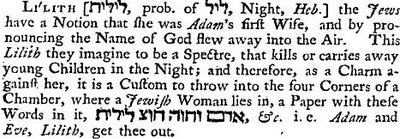
Outsider perception is always interesting.
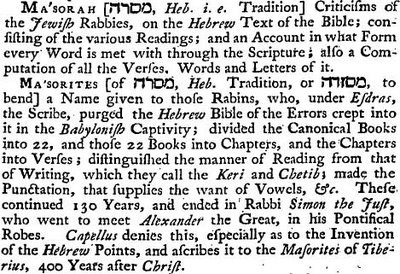
12.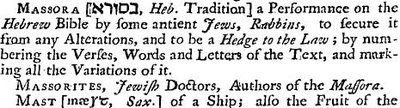
This reflects the debate which raged for a couple of centuries on the origin and authority of the nekkudot (see here and here). Bailey seems to favor the view that they were originated by Ezra (and in so doing indicates his more traditionalist bent), but is gracious enough to mention the other view.
13.
I have no idea if there is any relationship between the Greek and Semitic סתר, but I suppose its possible. After all, those two regions were only a sea away, and the two language groups did influence each other.
14.
This one is great!
To clarify, Nisan is the first month of the Jewish calendar and correlates, roughly, with April. However, the Jewish New Year is in the seventh month, Tishrei (don't ask! ;) ). Presumably Bailey knew that Nisan is the first month and knew of Rosh Hashanah in the seventh month. As there is no entry for Tishrei, he must have figured that Nisan is the seventh month in which the New Year occurs.
15.
Fanciful, but fun.
16.
This one is really something. I think there are parallels for such etymologies in rabbinic literature, although I can't offer an example at the moment.
17.
Sign of the times. Deism and free-thinking enjoyed a particularly good reputation in the 18th century, thus projecting themselves onto the ancient Sadducees.
In England it was believed by many that the English tongue had reached a stage of sufficient maturation and magnificence that it now needed to be protected, for its fate would be degradation without some way of fixing it in place. While we now know that this is essentially impossible to do with a dynamic language, at that time, the scientific method was ascending and the necessity of defining and fixing all sorts of things was agreed. Exactly how long was a yard? What exactly is the color red? All those questions and more were being considered and the move was in the direction of precision. So although one might think Jonathan Swift stuffy for objecting to the contraction "couldn't" (*gasp*), few among us would think the idea of a uniform orthography (spelling) is stuffy. In fact, most people can't really understand how there could not have been one. Bear in mind also that at the time the flux and ferment in English was far more extensive, and more importantly, visible than it is for us.
This would mean, at the very least, the assembly of a lexicon or word list. Several modest attempts were made in this direction, such as Henry Cockeram's The English Dictionarie: or, an Interpreter of hard English Words (1623). By the eighteenth century English dictionaries were being produced with many tens of thousands of words. Naturally the most celebrated achievement in that century was Samuel Johnson's, but the march towards better dictionaries continued unabated before and since.
To backtrack before Johnson, one such dictionary of English was compiled by Nathan Bailey, whose Dictionarium Britannicum Or, A Compleat Etymological English Dictionary Being Also An Interpeter of Hard and Technical Words (1721) was a monumental work which served as the bedrock for Johnson's.
In it there are some interesting supposed Hebrew etymologies for English words. Some of them are fanciful and some are, of course, derived from Hebrew. Here are some:
1.

The root here, אבך, is meant in the sense of וַיִּתְאַבְּכוּ in Isa. 9:17 (to roll up, " they roll upward in thick clouds of smoke.") OED knows nothing about it.
2.

In modern Hebrew, אויר avir, certainly sounds a lot like air! Is אויר derived from ו?אור
3.
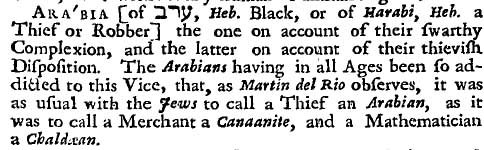
No comment.
Okay, one comment: I've seen some speculation that ערב is the same root as עבר with some natural letter transposition. In other words, think of Arabs as Herbews. Maybe.
4.
This word seemed interesting in its own right. Before the OED (Oxford English Dictionary) no serious attempt to catlogue every word in the English language was made. The task was too herculean to contemplate (see Simon Winchester's The Meaning of Everything for the ingenious solution the OED used to achieve the feat it did; which even then did not literally catalogue every word, and besides took almost 70 years to do it) . Bailey's dictionary, as others, were generally one-man attempts to catalogue as much as one could. Since they were not exhaustive, the words chosen do reveal some window into the worldview of the lexicographer as well as in some sense into the culture of the time. Words like this are included, as well as many, many other biblical allusions, Hebrew weights, ancient Near Eastern gods etc.
5.
This word is pretty archaic, but according to the OED an athanor is "a digesting furnace used by the alchemists[...]" and made its way into English through Arabic (hence the "a-" prefix) but a tannur תנור should be pretty recognizable to anyone who learns Talmud, or a six year old who learns Mishna (e.g, Akhnai's Oven (תנורו של עכנאי).
6.

Fun archaic word. I doubt that "cock-loft" is from גג. Call me a cynic.
7.
This one is a bit predictable, and interesting also because as far as I can tell a ד should be able to switch to a צ (shouldn't it?). But, alas, the English word "earth" didn't form fully from a Hebrew womb, but comes from a common Old German word. Biblical influences on English are very plausible. Biblical influences on ancient Teutons are less so. Edenics aren't my cup of ch'a.
8.

This one was chiefly interesting to me because I learned that the word comes from the coin it cost to read the newspaper. It would be as if many newspapers were called dimes or whatever they originally cost. The Daily Dime sounds nice.
9.

I think this etymology is a Bailey original. OED and the Online Etymology Dictionary basically have no clue where this one comes from, except that it shows up around 1300. Hebraism in England had already begun by that date, so I leave open the window about a millimeter on this one. If no one knows, then who knows?
10.

One of the many words which are English but are actually Hebrew, thanks to the Bible. Of interest is that its meaning reflects some of the debates in biblical scholarship of the day.
11.
Outsider perception is always interesting.
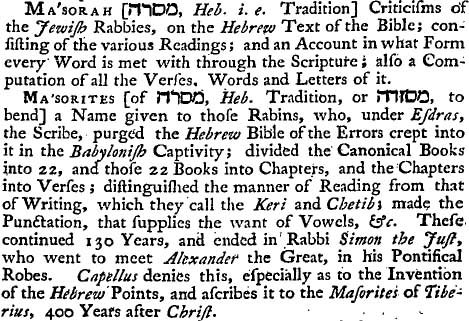
12.
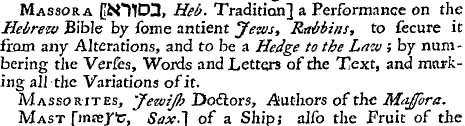
This reflects the debate which raged for a couple of centuries on the origin and authority of the nekkudot (see here and here). Bailey seems to favor the view that they were originated by Ezra (and in so doing indicates his more traditionalist bent), but is gracious enough to mention the other view.
13.

I have no idea if there is any relationship between the Greek and Semitic סתר, but I suppose its possible. After all, those two regions were only a sea away, and the two language groups did influence each other.
14.

This one is great!
To clarify, Nisan is the first month of the Jewish calendar and correlates, roughly, with April. However, the Jewish New Year is in the seventh month, Tishrei (don't ask! ;) ). Presumably Bailey knew that Nisan is the first month and knew of Rosh Hashanah in the seventh month. As there is no entry for Tishrei, he must have figured that Nisan is the seventh month in which the New Year occurs.
15.

Fanciful, but fun.
16.

This one is really something. I think there are parallels for such etymologies in rabbinic literature, although I can't offer an example at the moment.
17.

Sign of the times. Deism and free-thinking enjoyed a particularly good reputation in the 18th century, thus projecting themselves onto the ancient Sadducees.
Subscribe to:
Posts (Atom)
LinkWithin

Subscribe To On the Main Line


 Posts
All Comments
Posts
All Comments