Thursday, May 25, 2006

Historical context of stories inTalmud

I heard a tape of a fascinating shiur by R. Yaakov Elman called "Historical Context & Background of the Talmud." In it he analyzes a fairly well known incident in Babna Qamma 117a (translation here by Jeffrey Rubenstein):
A certain man intended to reveal another man's straw [to the Persian tax authorities.] He came before Rav. He [Rav] said to him, "Do not reveal it! Do not reveal it." He said to him, "I will reveal it! I will reveal it!"

Rav Kahana was sitting before Rav. He stood up and tore out his [the man's] windpipe. [He said,] “Your sons lie in a swoon at the corner of every street, like an antelope caught in a net (Isa 51:20). Just as they never show mercy to an antelope once it has fallen into a net, so the idolators never show mercy to the money of Jews once it has fallen into their hands."

Rav said to him, "Kahana, until now there was the Kingdom of the Greeks who were not strict about bloodshed [and allowed us to administer capital punishment]. But now there is the [Kingdom of the] Persians, who are strict about bloodshed. Rise and go up to the Land of Israel and accept upon yourself that you do not raise objections to [the teaching of] R. Yohanan for seven years."

He [Rav Kahana] went there [to the Land of Israel] and came upon Resh Laqish who was sitting and reviewing the daily lesson before the rabbis. He [Rav Kahana] said to them, "Where is Resh Laqish?" They said to him, "What for?" He told them this objection and that objection, this solution and that solution. They went and told Resh Laqish. Resh Laqish went and said to R. Yohanan, "A lion had come up from Babylonia. Let the Master look deeply into the lesson for tomorrow."

The next day they seated him [Rav Kahana] in the first row [of sages]. He [R. Yohanan] said a tradition and he [Rav Kahana] did not object. He said [another] tradition and he did not object. They seated him back through seven rows until he was in the last row. R. Yohanan said to Resh Laqish, “The lion you mentioned has become a fox.”

He [Rav Kahana] said, “May it be [God’s] will that these seven rows take the place of the seven years that Rav told me [not to raise objections].” He stood up on his feet. He said, “Let the master go back to the beginning.”

He [R. Yohanan] said a tradition and he [Rav Kahana] objected [until] they placed him in the first row. He said a tradition and he objected. R. Yohanan was sitting on seven cushions. They removed a cushion from under him. He said a tradition and he objected to him, until they removed all the cushions from under him and he was sitting on the ground.

R. Yohanan was an old man and his eyelids sagged [over his eyes]. He said to them, "Lift up my eyes that I may see him." They lifted up [his eyelids] with a silver stick. He saw that his [Rav Kahana's] lip was split. He thought that he was laughing at him. He became embarrassed and he [Rav Kahana] died [as divine punishment for causing R. Yohanan to feel ashamed].

The next day R. Yohanan said to the rabbis, "Did you see how that Babylonian acted?" They said to him, "That's the way he is [he has a split lip]." He [R. Yohanan] went to his [burial] cave. He saw that a snake was coiled about it. He said, "Snake! Snake! Open the door and let the master approach his student." It did not open. [He said,] "Let a colleague approach his colleague." It did not open. [He said,] "Let a student approach his teacher." It opened for him.

He prayed and revived him. He said to him, "Had I known that that is the way you are, I would not have felt embarrassed. Now, Sir, come with us to the academy." He said, "If you can pray that I will never die again [because of you], I will go with you. If not, I won't go." He said, "I cannot, for when times change, that which changes, changes.,

He [R. Yohanan] asked him [Rav Kahana] all his doubts [regarding points of law] and he [Rav Kahana] resolved them for him. This is [the meaning] of what R. Yohanan said, "What I thought was yours [=I thought the Torah was the Palestinians'] was theirs [the Babylonians']."
This is a bit of a long story, and I know that not everyone reads long blog posts, although many will already be familiar with this story. So you could just read the bolded part. The background is basically that Rav Kahana, a Bavli (Babylonian), killed a man who threatened to inform on another man to the authorities. His rebbe, Rav, sent him to Eretz Yisrael, to the yeshiva of Rav Yohannan in Tiberius. As a sort of penance for the killing, Rav Kahana was supposed to be sort of incognito for seven years! But he was quickly discovered to be a great scholar-a lion, in fact! He bested Rav Yohannan in class and here is where you should read the bolded text:

Rav Yohanan was an old man and his eyelids sagged [over his eyes]. He said to them, "Lift up my eyes that I may see him." They lifted up [his eyelids] with a silver stick. He saw that his [Rav Kahana's] lip was split. He thought that he was laughing at him. He became embarrassed and he [Rav Kahana] died [as divine punishment for causing Rav Yohanan to feel ashamed].

Rav Yohannan was then informed that Rav Kahana wasn't smirking at him, but that his normal facial expression just gave that appearance. Given that, R. Yohannan tried to get forgiveness from Rav Kahana, but was unable to until he acknowledged Rav Kahana as his superior!

=================================================

R. Elman points out several things.

First, in the year 226 CE there had been a regime change. Babylonian Jewry came under control of a new dynasty, the Sassanians. The Sassanians were different then their predecessors who didn't interfere in minority communities internal affairs. Had this incident happened before 226 then the Parthian rulers would not have cared in the slightest if one Jew killed another. However, under the new regime Rav Kahana needed to skip town.

Secondly, there is ample evidence that the Jews in Eretz Yisrael, well, didn't really care for the Babylonian Jews. That isn't to say they hated them, but we all know about ethnic tensions. Furthermore, Rav Yohannan is quoted in numerous places saying derogatory things about Babylonian Jews.

Thirdly, the successors of the initial Sassanian rulers cooled things down considerably, which means that this incident happened after 226 but probably not more than 10 years later then that.

Fourthly, Rav Yohannan died in the year 279, having been born in 180 (actually, I got those dates from EJ; R. Elman may have qualified them slightly, but I don't remember, because he said that Rav Yohannan was 90 when he died) Given that, he would have been in his fifties when this story happened. True, we are talking about the 3rd century here, but hardly the old man described in the story!

Fifth, the motif of an old person's eyelids that can't be lifted by themselves is paralleled in Persian literature. In addition, the use of a silver instrument is signifigant, in that silver was considered a particularly noble metal by the Persians, even more than gold (which was still worth more!). In addition, a Persian word appears.

So, how did a typically Persian story happen to an amora of Eretz Yisrael who seems not to have been nearly as old as described?

According to R. Elman, the story is paralleled in the Yerushalmi, with no mention of the eyelids. Furthermore, one of the best Talmud manuscripts, the Hamburg ms--which I tried to get access to in order to verify the following, but haven't been able to)--has the story but without the Persian motifs (the eyelids, the silver)! This particular mss is not that old, its from the 14th century, but it was copied from a very, very old Talmud manuscript and preserves a lot of pristine readings.

Says R. Elman, the theory proposed by R. Daniel Sperber (and someone else whose name escapes me) is that the eyelids and the silver, that whole part of the episode, was an interpolation from ge'onic times! It is well known that there was something of a power struggle between proponents of the Talmud Yerushalmi and the Talmud Bavli. For example, Pirkoi Ben Baboi, student of R. Yehudai Ga'on, wrote a famous iggeret which was highly influential in establishing the supremacy of the Bavli.

Perhaps this was somehow added to the original story, for it seems to be a later interpolation, to make Rav Yohannan, the Eretz Yisraeli amora par excellence look less than flattering.

Note: I dashed this off without having heard the shiur that recently and without having taken notes. I'm sure I made mistakes and didn't do it justice; those errors are mine.

Wednesday, May 24, 2006

'Off the Derech' by Faranak Margolese reviewed by me

I started writing this review months ago but for some reason didn't finish it. Well, here 'tis:

Off the Derech by Faranak Margolese has been getting some attention, and for good reason. The book is more than four hundred pages long and seeks to explain Orthodox attrition and what is to be done about it. Her central thesis is that people raised Orthodox leave Orthodoxy (go "off the derech") because of factors in their life which cause them to associate Orthodoxy (that is to say, in her view, Torah, halakhah, Judaism) with pain, whether the pain is caused by stifling conformity or rejection or other reasons.

In addition to doing a good amount of research, meticulously documented in the bibliography, she conducted personal interviews with Orthodox educators, mental health professionals and most importantly, many "off the derech" people from a wide range of backgrounds. In addition, in researching for the book she conducted a web survey which returned more than 450 valid results from those defined as "off the derech" (but non-scientific, by her own admission). Essentially defining "observant" as "keeps kashruth and shabbath in an Orthodox manner," she defined "off the derech" as abandoning one or both those things. While acknowledging the imprecision of such criteria, it is useful. She also added a person touch by including her own story, being raised in a traditional (but not particularly observant) Sephardi family, her experiences both highly positive and highly negative in yeshivoth and seminaries.

All in all, her findings essentially reiterated the recurring theme of the book: it is mistakes parents and teachers and Orthodox society makes which pushes some of our young away. Her solution then, meticulously detailed, would involve reversing the negatives which children can be exposed to, by increasing tolerance, understanding, creating an association of warmth and love with observance, overlooking minor infractions so as not to miss the big picture etc. Very little is left unexplored in this book, whether the presence of racism or fanaticism, hypocrisy and anti-intellectualism (although regretably the issue of sexuality barely comes up).

It seems to me that she is onto somethig. It is clear from beginning to end that the author is a kind, warm, friendly person. She advocates honesty, joy and removing stress and pressure in the environment in which we raise and teach our children. Truly, if all the Orthodox world were like her, things would be swell.

To begin with, her approach is rather tolerant of diverse points of view. Her book quotes from the Chazon Ish to Sussanah Heschel to Dennis Prager to Rav Shach. Obviously she believes the Rambam's dictum of accepting the truth from whoever says it--שמע האמת ממי שאמרה (from his intro. to Shemoneh Peraqim). This is a healthy Orthodoxy, in my view. Unfortunately much of the real Orthodoxy is highly fragmented. In 'Off the Derech' Rav Shach is quoted, and so is R. Menachem Mendel Schneerson. It is hard to imagine that Rav Shach would be pleased. In addition, one part of the book quotes a man who went "off the derech" who remembered that he was told by rabbeim in yeshivoth he applied to that "real bachurim don't read newspapers." This is an example of the intolerance that drives some people away. Yet Rav Shach is quoted here saying much the same thing. At the very least, this sort of ethic came from somewhere. There is nothing wrong with quoting Rav Shach at his warmest and most tolerant, as she does, but it is hard to forget that there is a larger context for such quotes. Later she quotes R. Eliyahu Dessler. In 1951 Rav Dessler wrote the following (translated by R. Aryeh Carmell in Vol. III pp. 355-60 of Michtav Me-eliyahu):
"...the philosophy of Yeshiva education is directed towards one objective alone, to nurture Gedolei Torah and Yirei Shamayim in tandem. For this reason university was prohibited to their students, because [the Gedolim] could not see how to nurture Gedolei Torah unless they directed all education towards Torah exclusively. However, do not think that they did not know in advance that through this approach, G-d forbid, many (students) will be ruined, since they will be unable to survive such an extreme position, and [therefore] separate from the path of Torah. However, this is the price that must be paid for [producing] Gedolei Torah."
This would seem to me to be the very practice which this book seems to counter. Again, why not quote Rav Dessler where he is warm and tolerant? I understand that. Surely we have much to learn from R. Dessler, and she is right for quoting him! But the trouble is that some of the attitudes she identifies as destructive came from somewhere.

That said, her modus seems to be to ignore that which divides us, and to ignore that which is unpleasant in what rabbinic leaders have offered. If we could all do that and focus more on what unites us, and most importantly, live up to our own hype then perhaps the 'off the derech' phenomenon could be reversed. After all, it is precisely the good things that are real and the hype for things that ought to be which leads people towards Orthodoxy.

Tuesday, May 23, 2006

Monday, May 22, 2006

A fisking of 'The Dangers of Midrash'

Josh at Parsha Blog has a great post which fisks an article by Rabbi Pinchas Rosenthal in last week's 5 Towns Jewish Times called The Dangers of Midrashim (download the article ).

R. Rosenthal's point is that children should know that midrashim are homiletic and non-literal and that this is the only correct way to approach midrash. However, Josh points out that as the only way, it is a distortion of tradition.

An excerpt from the article:
The other day, the student was an eager young lady named Leah. I asked her the following question: If you were able to go back in time to the moment when Pharaoh’s daughter saw baby Moshe in his basket, what would you see? Would you see Pharaoh’s daughter requesting her maidservant to fetch the basket—as the pasuk tells us—or would you see her arm grow 25 feet long (like Mister Fantastic) and rope in the basket—as the Midrash says?

I felt at that moment as if I had asked Leah to choose between her two parents at a divorce proceeding. She knew that the Torah was an authority and correct and the Midrash was an authority and correct. Her mind was telling her both versions could not be simultaneously true! Therefore, she was frozen and unable to respond.

...

Let me fast-forward to an anthropology class at Queens College. The professor is discussing ancient Egypt. He mentions there is a legend among the Jews about the daughter of Pharaoh concerning her arm stretching out to retrieve baby Moses. Leah raises her hand. She says that it was a miracle and the daughter of Pharaoh had her arm stretched out to save Moshe. Suddenly, all 53 members of her class turn to her and stare. Her face turns crimson. The professor asks her, “Do you believe that actually happened?” Leah feels the temperature rising. She knows that her beliefs are under attack, and that she has been publicly put on the spot. She desperately wants to explain the Torah position in a cogent way, and yet she finds that despite 15 years of yeshiva education, she is unable to do so.
An exceprt from Josh:
Let me fast-forward to an anthropology class at Queens College. The professor is discussing ancient Egypt. He mentions there is a legend among the Jews about the Nile turning to blood. Leah raises her hand. She says that it was a miracle and Aaron stretched his hand over the waters and they turned to blood. Suddenly, all 53 members of her class turn to her and stare. Her face turns crimson. The professor asks her, “Do you believe that actually happened?” Leah feels the temperature rising. She knows that her beliefs are under attack, and that she has been publicly put on the spot. She desperately wants to explain the Torah position in a cogent way, and yet she finds that despite 15 years of yeshiva education, she is unable to do so.

Yes, Rabbi Rosenthal, not only
midrashim speak of miracles. This I think is your real trouble, as evident by your earlier jibe "like Mr. Fantastic." Will Leah have an easier time explaining the many miracles written in the actual text of the Torah than the miracles mentioned in midrashim? What about all of the plagues? What of the splitting of the reed sea? The destruction of Sodom? The angels blinding the residents of Sodom? The giving of the Torah on Mt. Sinai? The manna falling every day? The clouds of Glory and the Heavenly fire leading the Israelites in the desert? The widow pouring oil from one vessels into many other vessels? Eliyahu ascending in a chariot of fire? The list goes on. To all these, the anthropology professor can ask, "Do you believe that actually happened?" Jewish beliefs are not determined by anthropology professors at Queens College.
The gist of Josh's point is that there is definitely not one monolithic way to teach and to approach derash and that R. Rosenthal is correct that students are ill-equipped to deal with serious Bible scholarship (whether traditional or not) because they aren't being taught and enabled to.

His post is long, and like most posts on his excellent Parsha Blog is, well, excellent. And like most posts at Parsha Blog if people are reading, they aren't talking. Read this post, read the original article. Good points all around!

I can't really add more except to say that both analyses are a real sign of the times. R. Rosenthal is reacting to the fact that no one seems to know what to do with midrash, but so is Josh.

One thing to think about is that while not all midrashim are of the same antiquity or authority or reliability, without midrash aggadah we would know very little about what Chazal in various periods believed and how they approached Torah. Every bit of teaching that we have offers keys to unlocking hitherto unknowns, and neither glib dismissal nor a superficial, uncritical approach does the Jewish understanding of Torah and, indeed, Judaism justice.

Edit: Having thought about it more, I would say that R. Rosenthal is also addressing an effect that I once blogged about, the "lucky midrash." Basically, it isn't only that children and then adults believe that all midrash aggadah is literal and exchangeable with the peshat, but that there exists a selection of midrashic explanations that "everyone knows," midrashim like כפה עליהם הר כגיגית or רבקה בת שלשה or the about the pharaoh's daughter's arm. And then there is the rest of the midrashic literature, which average people are unfamiliar with.

In effect, the Torah becomes rewoven with some midrashim. If there are three midrashic views, often one will be the "lucky" one, the one which fills in the cracks in the text. In effect, many people are educated to view the Torah as if it were a page of Artscroll Talmud, where the main text is the words in bold and a predictable selection from the vast body of midrashic material supplements and makes it intelligible (see an example of this technique in Artscroll's Talmud--by the way, in the case of this Talmud the technique is praiseworthy since it clearly distinguishes between the text and Artscroll's interpretation of the text).

All in all, R. Rosenthal is decrying a consequence of a very superficial approach to derash, while Josh (R. Josh, really :) ) is asking some very sophisticated questions that suppose a sophisticated approach. I guess if one had to ask which is preferable, I'd say without a doubt Josh's is. But what if it isn't between superficial one way and sophisticated, but between superficial one way and superficial another way?

What is the legacy of R. Joseph Hertz?

A friend sent me an article about R. Joseph Hertz, whom I recently blogged about indirectly at What's Bothering Artscroll?. After all these years, there still seems to be a lot of interest in R. Hertz. Including a book about him.

You can read three forwards he wrote for the Soncino Talmud translation: Nezikin, Moed and Nashim. (The usual caveats about that site apply, nevertheless, this is the text) Here is the article:
A champion of tradition who was no Conservative

By Benjamin Elton

The Jewish Chronicle, May 5 2006


Like many great men, Hertz's legacy is the subject of dispute. Different
Jewish groups have claimed him as one of their own. In particular, the
Conservative/Masorti movement associates itself with his theology.

A quick review of what he said and did as Chief Rabbi will reveal a
different picture to the image often presented of him as progressively
minded and only moderately traditional, a man who would have been more at
home at the New North London than the North Hendon Adath.

If the mark of Orthodoxy is a belief that the Torah was given to Moses on
Sinai, then Hertz passes the test. "Judaism stands or falls with the
historical actuality of the revelation at Sinai," he said. A third of the
Additional Notes in the Chumash attack Biblical Criticism (which rejected
the divine authorship of the Torah).

Hertz deals with all the major problems: the two accounts of Creation, the
historicity of the Exodus from Egypt, the possibility that the Code of
Hammurabi was the source of biblical law, and the age of the books of
Leviticus and Deuteronomy. In each case Hertz argued for the traditional
position.

As well as the Written Law, Judaism depends on the Oral Law, which Orthodoxy
also holds was given on Sinai. Hertz supported this view of the Oral
Tradition, writing that it was "handed down from the earliest days by word
of mouth, until it was codified in the Mishnah." When Hertz came across
individuals or institutions who disagreed with these principles, he attacked
them ferociously. In 1926 he delivered a blistering series of sermons
against Liberal Judaism, which would cause outrage today. In 1915 he forced
out of office the Rev Dr Joseph Hockman of the New West End for expressing
unorthodox views, very similar to those Louis Jacobs would later propound.

Hertz did hold some views that today would be rejected by many Orthodox
rabbis. He believed that halachah had developed over time, he thought that
some Psalms were written after the time of David and Solomon, and did not
think it necessary to believe that the book of Isaiah was by one author. But
these views were also held by such giants of modern Orthodoxy as Rabbis
Esriel Hildesheimer and David Hoffman.

Against all this evidence, the fact that Hertz used the term "progressive
conservatism," which meant something different then than it does now, or
that he attended the Jewish Theological Seminary, then a modern Orthodox
institution, are trivial. Hertz had some modern views, but he was firmly
rooted in tradition. His own definition of his religious commitments should
settle all doubt: "The teachings and practices which have come down to the
House of Israel through the ages; the positive Jewish beliefs concerning
God, the Torah and Israel; the sacred festivals; the holy resolve to
maintain Israel's identity; and the life consecrated by Jewish observances."


Benjamin Elton is currently completing a PhD on the British Chief Rabbinate

Pied Pipers: charismatic rabbis/ teachers

Educator Paul Shaviv posted an excerpt from his forthcoming book on running Jewish high schools at Hirhurim. The excerpts are about charismatic rabbis/ teachers. The excerpt takes up three comments: I, II, III.
The charismatic teacher (the ‘Pied-Piper”) is one of the most difficult situations for a Principal to deal with. A charismatic teacher will deeply affect and influence some students – but will almost always leave a trail of emotional wreckage in is/her wake .

read the rest
A very interesting perspective from a principal with 1400 students,

Thursday, May 18, 2006

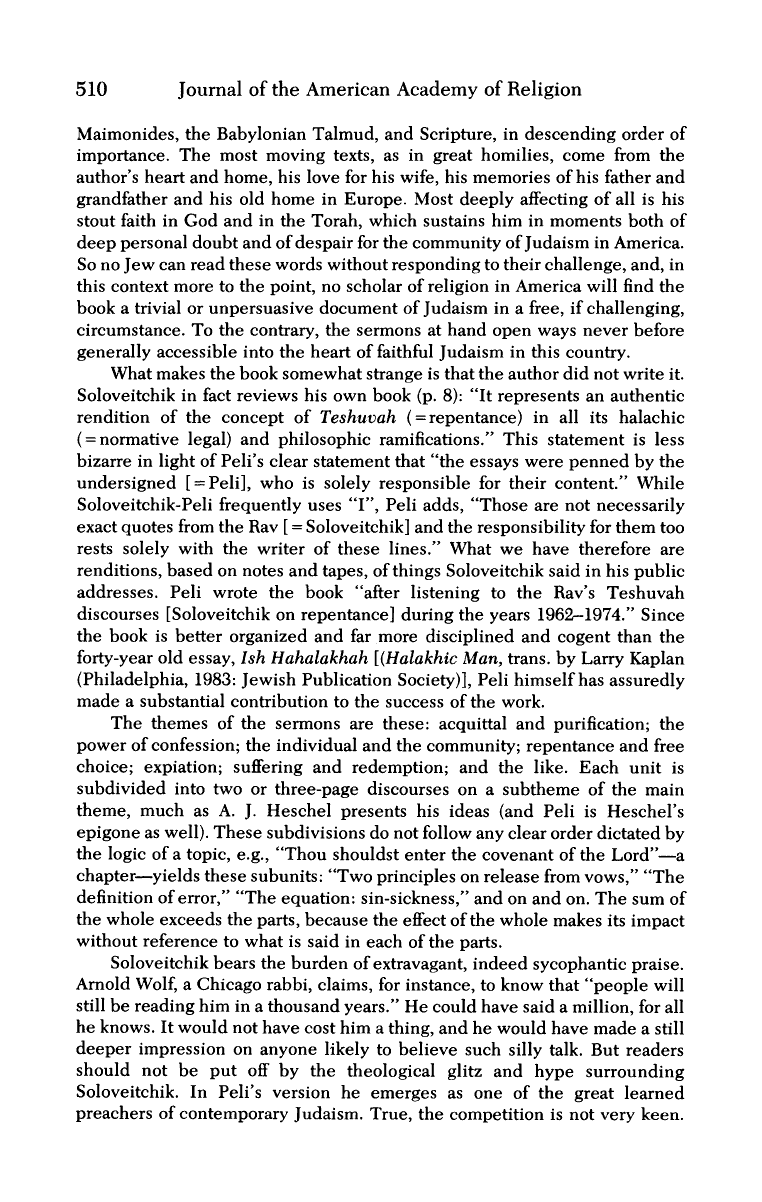
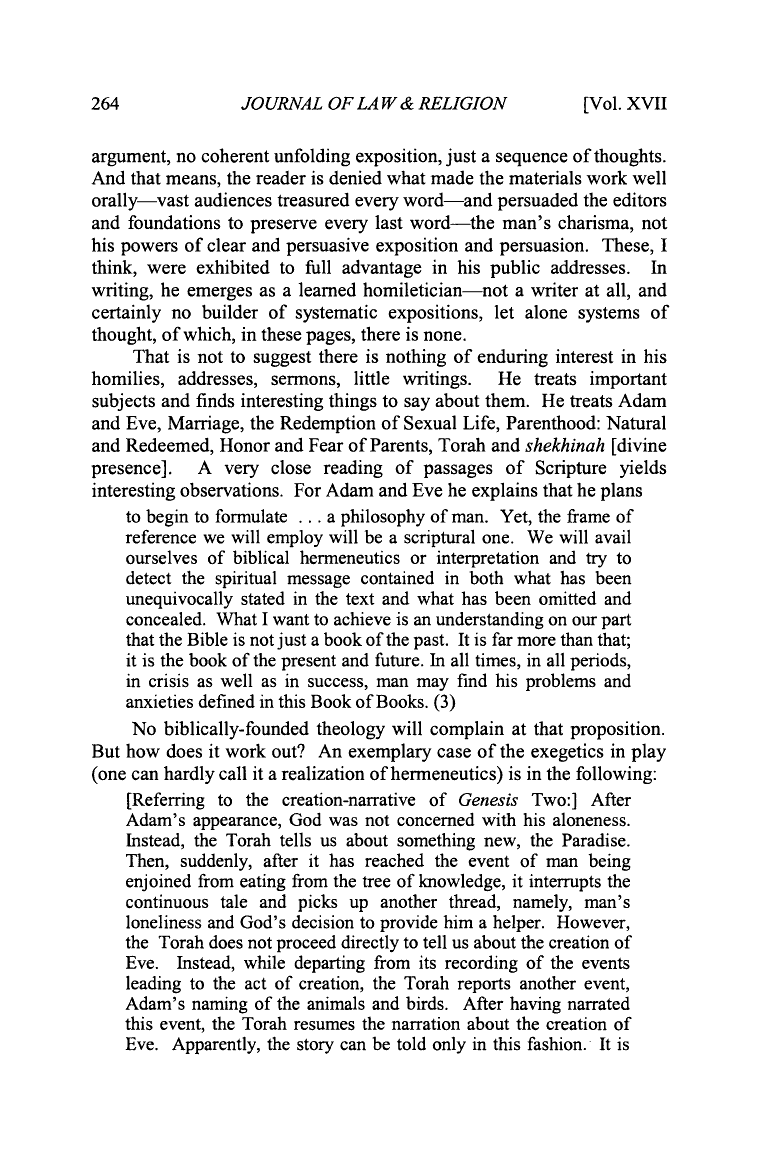
Jacob Neusner on R. Soloveitchik: two book reviews

(Click to enlarge)

He loves him:


He loves him not:

An 18th century English language witness to "ribbi"

Not that witnesses are needed given that centuries old Hebrew mss vocalize r-b-y as ribbi, but appropos this post, here is an interesting thing from the "Minute Book of the Spanish and Portuguese Congregation Shearith Israel in New York, 1760-1786" published by American Jewish Historical Society, Publications, 21 (1913) p.83.

This particular bit is dated The fourth day of the month of Adar, year 5528 [February 22, 1768]. The occasion was "a Meeting of the Parnassim, and Mr Daniel Gomez, Joseph Simson, Hayman Levy, assistants."


Those funny squiggly letters


This image is explained in this post and this post.

I'm reposting this so that I can then link to this post on my sidebar, since its a recurring subject that I get emails about.

Briefly, it spells "On the Main Line" in paleo-Hebrew letters, and for no reason other than I like it. I made the image using a font based on a particular Phoenician inscription. Further, I didn't divide the words with dots, which would be how an actual ancient Hebrew text would read: on.the.main.line. The reason why is because it didn't look that good! However, some ancient Phoenician (as opposed to Israelite) inscriptions don't divide words using lines, and the Ramban was of the opinion that the original Hebrew of the Torah didn't divide words, so I felt free to use a little creative license.

As for the transcription, it doesn't make a lot of sense if you consider that I transcribe "the" as "תחה." Now, why would I do that?

The answer is because there really is no good way of writing English using Hebrew characters, since the sounds don't match. That's why the great American president becomes "לינקולן" in Hebrew--and Hebrew doesn't have a silent ל!

So I decided to use the equivalent letter as best as possible. Since the Roman alphabet which is used in modern English is descended from Greek, which is descended from Phoenician, which is the same as Hebrew, it is possible to find some sort of one-to-one correspondence.

Thus, for "the" I was faced with two choices. I could have considered that the "th" sound in English is similar to the Greek "theta," which is based on ת, and then used a ה which became an "epsilon" in Greek and an "e" in Roman/ English, or I could have done what I did, which was note that the ת was the ancestor of "t," the ח the ancestor of "h," the ה the ancestor of "e" &c.

Truth is, I think its time for a revision of that image, but meanwhile here is the explanation anew.

Tuesday, May 16, 2006

Rabbi versus Ribbi

There are two dominant traditional pronunciations for "רבי" the rabbinic Hebrew word and title, as found in vocalized manuscripts of the mishnah and perpetuated in siddurim: ribbi (ribee) and rabbi (rahbee). Roughly speaking, Jews of eastern descent have ribbi and those of western, rabbi. This point was briefly touched upon in this English Hebraica post.

How did this happen? Which is original, in the sense of what the tannaic rabbis were actually called?

To illustrate this, its worth listening to some audio examples:

Here is an Iraqi version of the Lag B-Omer song ואמרתם כה לחי רבי שמעון בר יוחאי (as sung by Eliyahu Barazani) and a Iranian version (by Yonah Dardashty--although this version has musical accompaniment, as does this Moroccan version. The Moroccan one is especially interesting because (to these ears) the singer's pronunciation doesn't sound quite like a hirik (ribbi) and it doesn't sound quite like a seghol (rebbe). It's some vowel that somehow seems to be a combination of the two.

Which is it, rabbi or ribbi? More to come in another post, with sources, examples, some early witnesses, philology and speculation.

R. Shim'on ben Shetach saw the trees and the forest

The story in yesterday's New York magazine is making the rounds. One issue that is being discussed is comments attributed to an elderly rosh yeshiva, who I will not name here since I can't be certain he made those comments or what he intended if he did. In any case, the comment was to the effect that child molestation that doesn't involve actual penetration is not actionable in halakhah. Now, the report makes the claim that this "pesaq" was used to intimidate victims into silence. Perhaps the comment was never made. Perhaps it was made in a theoretical sense and then used to silence victims, without this rosh yeshiva's knowledge.

However, that is what I want to comment on. Suppose it was only theoretical. What then?

I'm reminded of the Gemara Yerushalmi Baba Metzia 2:5.

R. Shim'on ben Shetach made a living by selling linen. His students decided to buy a donkey for him to make it easier for him. They purchased a donkey from a bandit and it turned out that there was a precious stone dangling from it. They told him about it and said that he doesn't need to work hard anymore. R. Shimon ben Shetach said: Return it! They said to him, although gezel akum is prohibited, returning an avedah to an akum is not required!

So he said:

!?מה אתון סברין שמעון בן שטח ברברין הוה

Should they say "Shim'on ben Shetach is a barbarian?!"


בעי הוה שמעון בן שטח משמע בריך אלההון דיהודאי מאגר כל הדין עלמא

"Shim'on ben Shetach wants to hear Blessed is the God of the Jews more than anything in the world."

Monday, May 15, 2006

The heroic Hertz Chumash

A few years ago there was article article by Ami Eden in The Forward about new Torah translations.

The piece quoted Artscroll general editor R. Nosson Scherman on the archaic Hertz Chumash, the one Chumash that could be found in many, if not most, English speaking Orthodox, Conservative and Reform synagogues for decades.
"The Hertz was a masterpiece in its time, a piece of literature. What he did was heroic," said ArtScroll's Rabbi Scherman. "He was trying to convince people that the Chumash was worthwhile. He would quote Shakespeare, church fathers and other Christian sources. Nowadays, people are offended by that. Now you have people with a yeshiva education. They want to know what the Chumash means to Jews, what the traditional sources have to say."
Essentially, R. Sherman says that quoting Shakespeare, church fathers and other Christian sources in the service of promoting Torah is heroic, albeit offensive to people nowadays.

This is a very frank quotation. Would that I could have heard the entire conversation, but this is all I've got. It's an interesting admission of the point of view of R. Sherman, who authors most of the Overviews [sic] in Artscroll books, a POV which is so very different from the output of Artscroll's press. One thing to consider is to what extent Artscroll itself hasn't contributed to the idea that this approach is offensive, as well as yeshiva education.

That said, it should be pointed out that the Hertz Chumash was an apologetic commentary that used modern scholarship rather than engaged in it (discussed here).

Did a textual error cause Lag B'Omer to become R. Shimon ben Yohai's yahrzeit?

I say, not necessarily.

The j-blogosphere is abuzz about the article that appeared in Makor Rishon which suggests that the pre-existing Lag B'Omer celebration was converted to the yahrzeit of R. Shimon ben Yohai due to a textual error in the copying of R. Hayyim Vital's manuscripts (with "יום שמחת רשב"י" being abbreviated as "יום שמ' רשב"י" and then misunderstood as "יום שמת רשב"י."

(Discussed by My Ober Dicta, who is concerned with whether "cold water" should be thrown on well established customs, Jameel, who translated the article, DovBear & GH, who are reporting the issue, and who knows who else.)

I haven't seen the manuscripts, but I assume that they bear out this claim. After all, either documents showing this exist or they don't. But let's say it is true that such a textual error occurred. Is it then impossible that in the original, "יום שמתת רשב"י" could not have referred to the yahrzeit of, but the celebration of רשב"י?

To this I say: not necessarily. There is a well known phenomenon in language in which words acquire opposite meanings. Whether it's in pop slang or Tanakh (Job 2:9). The phenomenon is called לשון סגי נהור in rabbinic literature. It means "the language of a lot of light," with סגי נהור, a lot of light being a euphemism for blind, and the expression itself basically means "euphemism."

A good article on the topic is "Some Effects of Primitive Thought on Language" by Robert Gordis (AJSLL Vol. 55, No. 3 (Jul., 1938) , pp. 270-284) which begins discussing "words of mutually opposed meaning" noting "the existence of a large number of roots that possess mutually opposed meanings either within the same language or in different members of the same group."

What I am suggesting is that along these lines maybe "יום שמתת רשב"י" was intended as a euphemism for his yahrzeit, in which case there could have been a textual error, but not a change in the intent. At the very least, in keeping with the text criticism principle lectio difficilior*, the more difficult reading is preferred, this possibility should have been explored.

That said, I realize that there is no ancient tradition that R. Shimon ben Yohai died on the 33rd day of the Omer, but the question here is whether the 16th century kabbalists of Safed considered that to be his yahrzeit or not.

*This was noted by Jeffrey Woolf at My Ober Dicta.

Friday, May 12, 2006

Hebrew dialects in the Hebrew Bible?

There are traces of different spoken dialects of Biblical Hebrew in Tanakh. The most famous one, indeed, one of the most famous incident pertaining to language in recorded history, is in Judges 12:5-6:
5 And the Gileadites took the fords of the Jordan against the Ephraimites; and it was so, that when any of the fugitives of Ephraim said: 'Let me go over,' the men of Gilead said unto him: 'Art thou an Ephraimite?' If he said: 'Nay'; 6 then said they unto him: 'Say now Shibboleth'; and he said 'Sibboleth'; for he could not frame to pronounce it right; then they laid hold on him, and slew him at the fords of the Jordan; and there fell at that time of Ephraim forty and two thousand.

In fact, this incident gave birth to the English words shibboleth and possibly sibilant (my own suspicion, anyway).

But this isn't all. Other clues about variation in pronunciation and even vocabulary are found in Tanakh.

Here are a couple of nifty examples, which I picked up in an essay by Steven Fassberg called Languages of the Bible.

There might be traces of difference in dialect in the northern kingdom of Yisrael and the southern kingdom of Yehudah. This can be discerned in Bible stories which take place in the north, such a the Elijah and Elisha narrative in Kings.

Example: in northern stories the feminine form of the Hebrew "you" ( 'at, עת) can be found written as 'aty , אתי, as in 2 Kings 4:16:
ויאמר למועד הזה כעת חיה אתי חבקת בן
This, by the way, reflects the ketibh (how it is written), while the keri (how it is read) is the more usual
את. Other examples of this useage are 1 Kings 14:2 and 2 Kings 8:1. Is this definitive proof another useage in the north? I'm not sure, but its an echo.

Then there is extra-biblical evidence of a northern dialect found in an ostraca (a piece of pottery with writing on it) from Samaria. In it, "year" is written as sht, שת instead of shanah, שנה and "wine" is spelled yn, ין as opposed to yyn, יין.

Because of this evidence, its been proposed that we can understand a prophecy of Amos in a new light. Amos 8:1-2:

כה הראני אדוני ה' והנה כלוב קיץ
ויאמר מה אתה ראה עמוס ואמר כלוב קיץ
ויאמר יהוה אליי בא הקץ אל עמי ישראל לא אוסיף עוד עבור לו

The bolded words mean "summer," which is pronounced qayitz and "end," which is pronounced qeitz.
So if we understand the situation correctly, and in the north ay was contracted to ei, then we may have here a pun. Amos was using words which sounded identical to convey the message:

"Thus the Lord God showed me; and behold a basket of summer fruit. And He said: 'Amos, what seest thou?' And I said: 'A basket of summer fruit.' Then said the Lord unto me: The end is come upon My people Israel; I will not again pardon them any more."

This may have sounded quite nice in northern Biblical Hebrew--that is, if one didn't think about the message!

EDIT:

It has come to my attention that in Samaritan Hebrew the feminine "you" is none other than
'aty , אתי.

Thursday, May 11, 2006

Why black clothes?

An amusing post by the 'Ish ha-mehqar that I overlooked, concering the signifigance of black clothing. Essentially, there are two shittos: One, because black was the color of Yissachar's stone. Two, because it is a group identity thing. And three, Yissachar's stone was blue.

Read his post!

Did Rashi mean Canaanite?


:צידנים יקראו לחרמון שרין והאמרי יקראו−לו שניר

"Sidonians would refer to Hermon as Sirion, and the Amorites would call it Senir" (Artscroll)

On this verse, Rashi comments:

:שניר − הוא שלג בלשון אשכנז [שנעע] ובלשן כנען

Rashi explained that senir, שניר means שלג, snow, in the languages of Ashkenaz and Canaan.

Although Biblical Ashkenaz wasn't Germany, it is obvious that לשון אשכנז means German, for in Rashi's day Germany was called Ashkenaz. As discussed here, in Rashi's time Canaan reffered to the Slavic and Baltic territories. So Rashi is saying that Biblical "senir" is similar to the old German and Slavic words for snow, which Rashi transliterates as שנעע, s-n-'-' (roughly, snow).

How does Artscroll translate the words "לשן כנען"?

Canaanite. Rashi is saying that "senir" is "snow" in the German and Canaanite language.

How did Rashi know the Canaanite language? What was the Canaanite language?

The answer to the second question is, roughly Biblical Hebrew (see Isa. 19:18 שפת כנען and related commentaries, also see related). If so, that certainly answers the first question, since Rashi did know Biblical Hebrew! But that isn't what Rashi is talking about at all. It would be like assuming that ancient Italians spoke Pig Latin.

The Judaica Press Tanach with Rashi translatesmore or less correctly (even if using 19th century lingo) as "Slavish," citing Abraham Berliner (1833-195) who published the first critical edition of Rashi in 1866. Who is responsible for the Judaica Press Tanach with Rashi? Rabbi A.J. Rosenberg. Who is Rabbi A.J. Rosenberg? He has worked extensively for Artscroll, putting out many editions of their Yad Avrohom Mishnayos.

If an Artscroll associated rabbinic scholar plainly knew how to translate לשן כנען then why the error in Artscroll's edition? Clearly this isn't esoteric maskilische knowledge.

For what its worth, the same error can be found in the Metsudah Chumash with Rashi.

So here's the question: why did Artscroll get it wrong? Metsudah is a solitary enterprise, although I assume R. Avrohom Davis has his works peer reviewed. Artscroll is a huge company with dozens of writers. Is it simply a case of one hand not knowing what the other's doing? After all, in addition to being an entity, Artscroll is also composed of hired writers of varying ability and quality. Is the sort of maskilische knowledge and source that A. isn't desirous to incorporate or cite? As will be shown in future posts, A. has an uneven record on this regard.

Wednesday, May 10, 2006

What's bothering Artscroll?

Gotta plug this new blog: What's Bothering Artscroll?

It describes itself as "An examination of the Orthodox Jewish publishing phenomenon: Mesorah Publications' Artscroll."

Oh, and I'm the proprietor.

The url is the very convenient http://elucidation-not-translation.blogspot.com.

Internet asifa in Monsey discusses blogs and other dangers

Apparently there was an asifa (gathering) in Monsey last night about the internet. Speakers included R. Ephraim Wachsman and R. Mattisyahu Solomon.

One who attended sent me the following review:
Highlights from the Asifa

First Speaker was Rabbi Waxman: He gave a long mussar schmuess on the dangers of the Internet. In a bit of hyperbole he compared the Internet to the 90 million Egyptians who chased Klal Yisroel into the Yam Suf. He said the Egyptians hired soldiers from other countries, and also magicians and sorcerers who used all their power and might to pursue them "at the speed of lightning [sic]" . This collection of evil, he said, is equal to theInternet.

Rabbi Waxman may have mentioned Internet predators in passing but he was most concerned with pornography and similar. His anecdotes included the story of the wonderful yeshiva boy who made a date with forty year non-Jew via the Internet. He seemed not to understand that such a boy was going to get into trouble even if there was no Internet.

He was also very concerned with loshon hara and mentioned a Rabbi in Flatbush who made a speech someone didn't like, so it got put on the Internet where it attracted 300 posts! He doesn't seem to appreciate that these kind of posts keep Rabbis honest. If they know there words have the possibility of being put into writing where millions can see it they will be more careful. And also why don't the Rabbi get their own blogs to make rebuttals? That seems to me to be the best way to find out the truth. Shine the light on it, and so on.

Rabbi Waxman closed by defending the idea of Internet bans, by insisting that telling people they were forbidden to have the Internet in their homes was not a real ban because its still allowed at work and he blamed the media for that mischarecterization. He also warned against leytzones saying that even a few jokes could destroy all the good accomplished at the Asifa. He referred specifically to the "leytzones had or" but I don't think he meant the blogger known as Godol Hador.

In a bit of humor, Rabbi Waxman had to stop speaking every few minutes because a latecomer would show up for his seat on the dais and everyone in the audience (about 500) would stand up to show respect. Sometimes the timing was terrible. Once he was really building up steam and yelling, when he had to break stride because of a latecomer.

The next speaker was a man from Baltimore who was introduced as an expert on the Internet. He did a power point presentation on the different things kids can do online that get them into trouble. He also shared some survey data from polls he said he had taken in other schools. I don't remember the details of all of them except that he found that Yeshiva kids are much more likely to talk to strangers on the Internet than Jewish day schools kids. He didn't explain why that was, and I don't know how valid his survey was.

His discussion was about things like Instant Message and WIFI and how all these things work. Really it was all stuff you would know if you weren't living underground for the last five years. To his credit, he spoke a lot about Internet predators. He explained how they operate and also the signs of knowing your kid might be in some trouble. He did not mention blogs.

The last speaker was the mashgiach Rabbi Matisyahu Solomon of Lakewood. His theme was that we need to be frightened, very frightened of the horrors of the Internet. He quoted the "Vsen Pachdicha" at length. Like Rabbi Waxman he was much more worried about porn and blogs than he was about predators. He spoke for a long time about the dangers of bad pictures and it was solid. When he spoke about blogs his voice dropped so I don't know exactly what he said. He did mention, though, that you can find a lot of bad science on the Internet. Again, he mentioned the danger of science and of blogs, but not of the predators. He closed by encouraging all of us to trust the Gedolim and to submit to their authority. He said that it's the rule that a mosad can't possibly accept a kid who has in his house the Internet because of the danger it might contaminate others. He also made it seem like the only solution was to ban it because if we didn't Judaism would be destroyed.

Afterwards we davend Maariv, but it was nusach ashkenaz which is very rare for a hasidic town like Monsey. You could see many confused faces in the crowd when the Chazan started with vhu rachum and not shir hammalos. (I would say the crowd was 50 percent Chasidim, and 90 percent hats and jackets/ beckeshas) Outside a guy was collecting money to defray the cost of the Asifa. He claimed it was $20,000 which seems high to rent a hall (there was no food or anything)
.

My own reaction? I have to think about it more. It's interesting that this issue has been taken head on, and in such a frank and public manner.

Update: NCO Chassid comments and gives another view of the asifah:
This account is a more accurate one than the account that appears on Yeshiva World, but it still leaves much to be desired. The powerful word picture of the forces of tumah in pursuit of Klal Yisrael at the Yam Suf has been bastardized into something unrecognizable. The central point of the parallel between the end of Galus Mitzraim and the end of out galus has been dropped.

The point of the post regarding the Rabbi that garnered 300 posts, was that those were posts of bizui, spewed anonymously, and archived forever. That is maasim bichol yom to you fellas, but an intolerable state of affairs to those who have not yet been "zocheh" to discover blogs.

The words "Rabbi Waxman closed by defending the idea of Internet bans," are almost the diametric opposite of what he actually said. He said that there was no ban in Lakewood. People were not told simply to uproot [their web connections.] The reason some people [not "the media"] described it as such is that it makes it easier to then portray the rabbonim as ayatollas.

The description of Norman Lowenthal's presentation does not mention that he described how his surveys were done and that he will make the questionnaire available for anyone interested. He was the model of straightfowardness.

I don't remember R' Mattisyahu speaking about science in the slightest. Maybe I missed half a sentence as I was trying to write down other points, but it could not have been a major topic at all.

R' Mattisyahu did speak about blogs and their correspondents. I was close to the front and heard him clearly.

[clears throat]

You know, a lot of the discussions that transpire on these blogs come down to credence in content providers: Whose content do you trust?

I love S. and Gil because they provide trustworthy content regularly. No one can be 100% and still post frequently, but they are consistent. I have a certain respect for GH because he is true to his feelings or his thoughts of the moment.

In this particular discussion, there are two topics I know personally and well: The nature of blog comments and the asifa last night. And we have two sides providing content:

R' Mattisyahu described blogs [and their comments] as a moshav leitzim. That is substantially correct all the time and dead-on much of the time.

The reporter and the commenters on this post [up to 2:11 pm when I began this] described last night's asifa as an extremefest. I know that's false.

That is characteristic of many false or falsified statements made on blogs.

There is another way. There is life beyond cyberspace. You can hang around people who try to live and study the truth.

Tuesday, May 09, 2006

What's Bothering Artscroll?

On my main blog, On the Main Line, there is a sidebar marked "On Artscroll," which links to many posts I made about Mesorah Publication's Artscroll series. Clearly this publishing giant is something I am interested in, and in due time I will explain why. But I felt the time has come to deal with subjects like the ones I dealt with at Main Line in a totally separate blog. And here it is, with the very unwieldy URL elucidation-not-translation.blogspot.com:

What's Bothering Artscroll?

I ask this question not in the sense of "What is their problem?" but in the sense of the well known question "What's bothering Rashi?" The premise behind the question is as follows: Rashi's commentaries on the Torah and Talmud contain deep insights. To really grasp them one should understand why Rashi said what he did. Sometimes Rashi asks a question, but sometimes he just makes a comment. When he comments, the punctilious student will want to know what question is underlying that comment. What was bothering Rashi, so to speak.

As Richard Elliott Friedman puts it:
Torah is not to be read. It is to be studied. And at various times during one's studies, one needs a teacher. Studying the Torah with Rashi's commentaries is a joy because he shows what questions one can ask of a text. Look here! Is this a contradiction? Look here! This can have two opposite meanings. Which is right? Why does the Torah not tell us this piece of information that we need to understand the text? Why does it give us this fact that seems to be of no significance at first glance?
Thus far Rashi. While the truth is the world can always use people dedicated to exploring What's Bothering Rashi, this blog will try to explore the Artscroll world by asking the question, What's Bothering Artscroll?

I hope to explore a wide range of Artscroll materials, from meforshim on Chumash to siddurim to biographies to children's books to promotional literature--even to cookbooks, although that may be pushing it!

But the emphasis will be mainly on the Stone Chumash which is unique in that since it is an anthology of comments rather than a primarily original work one can legitimately wonder why this or that comment was chosen, out of all the possible ones. It will also focus on the Schottenstein Talmud edition (which is never called a translation by Artscroll...).

In 1969 Harry Orlinsky published 'Notes on the new translation of the Torah', a fascinating book which is a "systematic account of the labors and reasoning of the committee that translated The Torah" (the 1962 JPS edition). Such a work should be required of anyone who translates (or annotates and elucidates) but as it can't be required and as Artscroll has never published such a work, we'll be exploring the Artscroll giant right here!

!בתאבון

Monday, May 08, 2006

Rabbanite/ Karaite folklore

A very interesting folk tale can be found in this parasha sheet from 1997 here, on Ohr Sameach's web site (given as "heard from Rabbi Zev Leff"):
During the Ottoman Empire, the Karaites attempted to gain recognition for themselves as the 'authentic Jews.' They approached the sultan, wanting to be recognized as the legitimate 'People of Israel,' and that the Jewish People should be disenfranchised as being fakes. The sultan summoned both a rabbi and a representative of the Karaites to appear in front of him at the royal palace. After hearing both their cases, he would decide who was the authentic "People of the Book."

Of course, as was the custom of the East, both the Karaite and the rabbi were required to remove their shoes before appearing in front of the Sultan. The Karaite removed his shoes and left them by the entrance to the throne room. The rabbi also removed his shoes, but then he picked them up and carried them with him into the audience with the sultan.

When the sultan looked down from his throne, he was struck by the somewhat strange sight of the rabbi holding a pair of shoes, and he demanded an explanation.

"Your Majesty," began the rabbi, "as you know, when the Holy One, may His Name be blessed, appeared to our teacher Moses, peace be upon him, at the site of the burning bush, G-d told Moses "Take off your shoes from on your feet!"

"We have a tradition," said the rabbi, "that while Moses was speaking to the Holy One, a Karaite came and stole his shoes!

"So, now, whenever we are in the company of Karaites, we make sure to hold onto our shoes!"

The Karaite turned to the rabbi and blustered:

"That's nonsense! Everyone knows that at the time of Moses, there were no Karaites!"

The rabbi allowed time for what the Karaite had said to sink in and then quietly added: "Your Majesty, I don't believe there is a need for more to be said..."
This story sounds like an echo of actual historical happenings in the 18th century, when a large number of Karaites came under Russian control, at the same time as Russian oppression of Jews began to mount. Karaite leaders tried, and succeded in convincing Russian authorities that they are Karaites, not Jews, that they were descendents of medieval Khazars who converted to the pure religion of the Old Testament, Karaism, unlike Jews whose religion was Talmudism. They actually did buy this argument, and the many disabilites placed on Jews were not placed on Karaites who lived under Russian aegis, whether in the Crimea or Lithuania. To this day there is a split between Karaites of eastern European and Middle Eastern origin. Middle Eastern Karaites call themselves Karaite Jews, are likely to live in Israel and identify as Jews, whereas Karaites from the Former Soviet Union most definitely do not consider themselves Jews.

Or maybe not. This could be an older story, reflecting something else. But it is an interesting story from a genre of like stories. Karaites had clever ones too.

Aramaic is

commenting and trackback have been added to this blog.

Overviews, elucidations and annotations

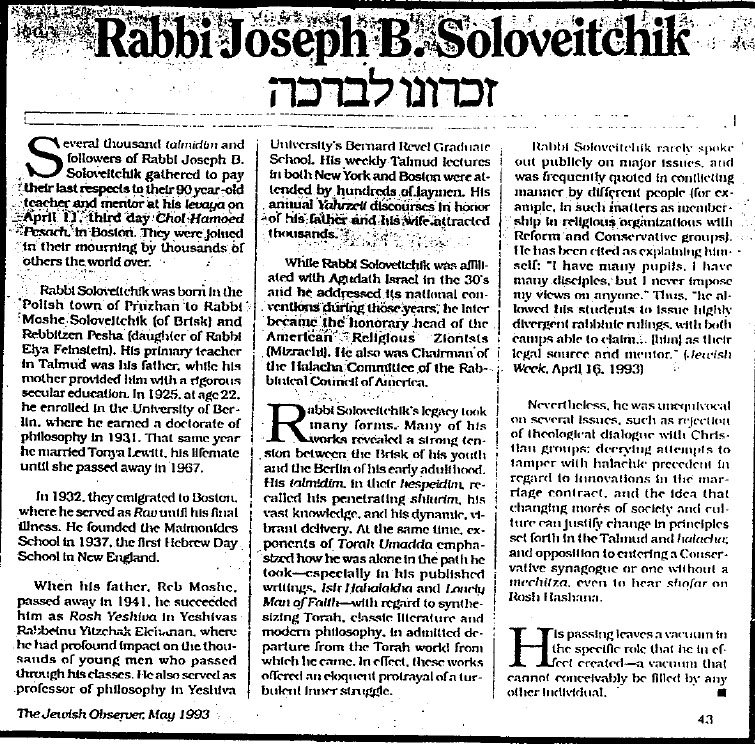
The Jewish Observer obituary for R. Soloveitchik

Agudath Israe'sl magazine The Jewish Observer maintains a modest-sized archive on the internet. However, only a small percentage of this publication's 40+ year archives are available online.

Here is one piece which as not available online, the controversial obituary penned by R. Nissan Wolpin for R. Yosef Dov Soloveitchik, which appeared in 1993 (click to read):


By the way, I know a "לצדיק" when I don't see one. But that's small potatoes.

Thursday, May 04, 2006

How critical scholarship can produce divrei Torah

Gil lists a table comparing the geneologies of the lines of Cain and Seth. It looks like this:
CAIN
  1. Adam
  2. Cain
  3. Enoch (Chanoch)
  4. Irad
  5. Mehujael
  6. Methushael
  7. Lamech
  8. Jabal, Jubal, Tubal-cain

SETH
  1. Enosh
  2. Kenan
  3. Mahalalel
  4. Jared
  5. Enoch (Chanoch)
  6. Methuselah
  7. Lamech
  8. Noah
  9. Shem, Ham, Japhet
Gil brings it up to point out that Bible source critics see herein two separate early geneologies of man (starting with the point that 'adam' and 'enosh' both mean 'man,' and noting similar names with similar meanings). Another post at Hirhurim is promised which will show the approach of Bible scholars like Moshe David Cassuto, David Sykes and Hayyim Angel who dispute that these lists show two separate source.

Whatever the case, there is certainly interesting patterns which develop when these lists are placed side by side. I think this is a fine example of where critical scholarship can flesh out certain patterns in the text which can then lead to fine parshanut, wholly apart from dismissing the patterns, as some commenters did, stating that they had similar names because they were from the same family.

English Hebraica was updated

Sabato Morais on the unity of biblical books

E.A. Speiser on the historicity of Avraham--add it to the next edition of Beyond A Reasonable Doubt

Yesterday I posted about Beyond a Reasonable Doubt. The problem I found with a particular section on archaeology was that the method the author uses is very faulty and it is designed to draw faulty conclusions. The method involves selecting quotes taken out of context, adding them up and attributing a signifigance to them that is simply not there.

The author did not use this following example, but one could easily see how he might have. In the Anchor Bible Genesis translation and commentary by Ephraim Avigdor Speiser the following is found, commenting on Gen. 14:
...Abraham was not a nebulous literary figure, but a real person who was attested in contemporary sources.
Beautiful! Add it to the next edition of the book.

The problem is, that quote is totally devoid of context. To flesh it out a little more:
...it necessarily follows that Abraham was not a nebulous literary figure, but a real person who was attested in contemporary sources. Short of a non-Israelite text mentioning an Abram son of Terah, or an Isaac son of Abram, this is as close as we can as yet come to a direct epigraphic witness of the patriarch.
Hmm. Not bad, but what's this of non-Israelite texts?

Here is a more full quote of the paragraph:
If Abraham was cited in a historical or quasi-historical narrative that was written not by Israelites but by outsiders, it necessarily follows that Abraham was not a nebulous literary figure, but a real person who was attested in contemporary sources. Short of a non-Israelite text mentioning an Abram son of Terah, or an Isaac son of Abram, this is as close as we can as yet come to a direct epigraphic witness of the patriarch.
And what is the context in which this paragraph is found?

Speiser begins the chapter of commentary on the story of Avraham and the war between the four kings and the five kings as follows:
Genesis xiv stands alone among all the accounts in the Pentateuch, if not indeed in the Bible as a whole. The setting is international, the approach impersonal, and the narration notable for its unusual style and vocabulary....One one point....the crtics are virtually unanimous: the familiar touches of the established sources of Genesis are entirely absent in this instance. For all these reasons the chapter has to be ascribed to an isolated source, here marked X.
By the way, those last two sentences could have also been used with profit, taken out of context, by the author of a similar work trying to disprove the documentary hypothesis. But I digress. Speiser's purpose, as he outlines it, is to show that the contents of Gen. xiv seem to be an outside tradition, an outside source about Avraham. Suddenly Avraham is a warrior, with armed forces, fighting and beating kings and their armies. No indication of this personality before or after. That, coupled with its "unusual style and vocabulary" led critical scholars to consider it a piece of a tale from a different origin than the rest of Genesis. Speiser also notes that in this chapter Avraham is called "אברם העברי" (verse 13), which suggest the well known principle that עברי, Hebrew was a title applied by outsiders but not one that was self referential outside of the context of non-Hebrews. Maybe it was, as he suggests, "a historical or quasi-historical narrative that was written not by Israelites but by outsiders."

That's it. There is nothing in this piece that can rise to the defense of a unified Torah min-hashamayim, mi-sinai, al pi Hashem be-yad Moshe (although it must be noted that the two positions don't necessarily contradict it, if we regard the general contents of Bereishit as having been known to Benei Yisrael, or even non-Israelites, even before Mattan Torah). In any case, the sort of quotations found in that book are of this nature. One can prove nearly anything using this method, if collecting such types of quotes and adding them up is considered to be proof.
An understatement.

Note the date, February 14, 2004.

Wednesday, May 03, 2006

When a goat isn't a goat: a Torah translation issue

Leviticus 17:7

ולא יזבחו עוד את זבחיהם לשעירים אשר הם זונים אחריהם חוקת עולם תהיה זאת להם לדורותם
Several English translations:

JPS 1917: And they shall no more sacrifice their sacrifices unto the satyrs, after whom they go astray. This shall be a statute for ever unto them throughout their generations.

Aryeh Kaplan's The Living Torah: The Israelites will then stop sacrificing to the demons who [continue to] tempt them. This shall be an eternal law for them for all generations.

Hertz Chumash (translation is the 1917 JPS, so I will reproduce the comment): satyrs. lit. 'goats.' They were deemed to be sylvan gods or demons who inhabited waste places (Isa. XIII, 21 ; XXXIV, 14).

Artscroll Stone Chumash: They shall no longer slaughter their offerings to the demons after whom they stray; this shall be an eternal decree to them for their generations.

Everett Fox: that they may slaughter no longer their slaughter-offerings to the hairy (goat-demons) after whom they go whoring. A law for the ages shall this be for them, throughout their generations.

Robert Alter: And they shall no longer sacrifice their sacrifices to the goat-demons after which they go whoring. An everlasting statute shall this be for them for their generations.

Message Bible (written in conversational English): They must no longer offer their sacrifices to goat-demons--a kind of religious orgy. This is a perpetual decree down through the generations.

Putting aside for the moment the issue of how we know that "לשעירים" in this context translates according to the consensus as given here, this word highlights an important translation issue: without knowing context, anything about what the Torah is inveighing against, how could one translate that word as anything but "to the goats," which of course would leave us with little insight as to what the passuk is getting at.

Sabato Morais on the unity of biblical books

One of the very interesting figures in the 19th century American scene was the hazzan* of the Spanish-Portugese synagogue in Philadelphia, Mikveh Israel, the Rev. Sabato Morais (1823-1897). Born in Leghorn, Italy, a follower and lifelong devotee to the legacy and teachings of Shadal.

He was one of the original founders of the JTS, which as many know was originally an Orthodox institution, primarily until Solomon Schechter was brought in--although Orthodox by 19th century American standards, which is not the same thing as 20th century American Orthodox.

After his death an article in the Orthodox newspaper Yudishe Gazeten wrote that he was "der grester fun ale ortodoksishe rabonim in amerike . . . on sofek" ("without doubt . . . the greatest of all orthodox rabbis in the United States").**

And no, I cannot say for sure if he is or isn't wearing a kippah in this photo.

I'm sure Menachem Butler can say a lot about him.

H*. Morais was a prolific writer of popular articles and essays. Here is an interesting excerpt from one article published in The American Hebrew on "Adar 5, 5642." The article was a rejoinder to an article called "Doubts" which had appeared in another newspaper, the Jewish South, concerning Bible criticism. Apparently that article was itself written about a lecture H. Morais delivered refuting Scottish Bible scholar William Robertson Smith's book "The Old Testament in the Jewish Church" (title tells you something about the biases of the age!) By the way, W. R. Smith is cited as a source in the commentary in the Hertz Chumash! But I digress.

This excerpt offers a fascinating window into 19th century American Orthodoxy, from one of its most capable leaders. Note especially the third line, which notes why he believes as he does.


*A Hazzan (or, should I say, Hhazan as an Italian would write it) on the American scene in the 19th century actually fulfilled the role of rabbi, which was why they were usually title Reverend, but not Rabbi, although hhazzanim like Sabato Morais, or Isaac Leeser, who he replaced were certainly rabbis in every sense but name.

**Courtesy of Kiron, Arthur ""Dust and Ashes": The Funeral and Forgetting of Sabato Morais"American Jewish History - Volume 84, Number 3, September 1996, pp. 155-188

Unreasonable content in Beyond A Reasonable Doubt

Some time ago someone gave me a book called Beyond a Reasonable Doubt: Covincing Evidence of the Truths of Judaism by R. Shmuel Waldman, who is described on the book jacket as 'a native New Yorker, [who] studied at Mesivta of Long Beach, the Yeshiva of Staten Island, and the Mir Yeshiva. He has been an educator for many years....[his] interest in the methods of clarifying religious belief stems from the teachings of Rabbi Avigdor Miller zt"l.'

Chapter II is called The Divine Origin of the Torah and it is divided into sections: one is called The Origins of Islam, another A Little Healthy Skepticism, etc. Here is an excerpt from the section called Archaeology:
Over a century ago, a new breed of "scholar" came into existence: the Bible critic. These were originally non-Jews, who had a stake in the attempt to disprove the Bible. (Among the early Jewish Bible critics were Reform or assimilated Jews who had already cast off observance of Torah law. In order to create a rationale for their behavior, they set out to find ways of discrediting the Torah.) Without any real bona fide proof, they would make statements like: "The stories concerning Abraham, Isaac, Jacob, the brothers, and Egypt, etc., cannot be true. Probably at a much later date, maybe during the times of Ezra, those stories were made up."

How do we respond to their claims? The response today is very simple, surprisingly simple.

Back then, when the Bible critics first made their claims, no one had any real archaeological proof one way or another. That was in the mid- to late 1800's. However, by the early 1900's, archaeological evidence started mounting. All the different discoveries showed that the stories in the Torah were accurate, down to the most minute cultural details-details that the later generations, during which the Torah was supposedly written couldn't have known, since the Biblical stories took place at a much earlier time, a time when the culture wa completelyy different from "theirs." (Whoever the supposed "theirs" is.)

For instance, if the Torah said such and such event happened at a certain time and placee, archaeologists eventually dug up evidence for it. If the Torah said such and such people in such and such locale had such and such customs, archaeology eventually confirmed it.

Virtually all contemporary Bible scholars no longer side with the conclusions of the early Bible critics. Except for a few real "diehards," they have all retracted their claims. They all now agree that the evidence stands overwhelmingly against the Bible critics and their assertions. And, thus, nowadays most of them trust the Torah to be historically true and accurate even where no evidence has been found. (emph. mine)

Of course, I would not expect you to take my word for it...
He then goes on to quote selectively from a couple of scholars, like W. F. Albright, Y. Aharoni. It's sources include Nahum Sarna's Understanding Genesis, John Bright, Encyclopedia Judaica, pseudo-scholarly popular books like Howard Blum's The Gold of Exodus: The Discovery of the True Mount Sinai, described in the footnote as a "non-fiction book," which is true. The chapter deals with Nuzi tablets, the Ipuwer Papyrus, the Gilgamesh epic, etc. It concludes with a quote from "another renowned historian, Will Durant," which, in 1950, put the lid on anything besides the following sentence: "Science is now in a position to state categorically that the Bible is factual till proven otherwise." Then a reference is given to professors at UC at Berkley, Isaac Kilkawada and Arthur Quinn who apparently demolished Wellhausen in 1989.

What's wrong here? Is trying to use assert that the Torah is true wrong? No. Is using archaeoloical findings to understand Torah wrong? No, of course not.

But the entire section on archaeology in this chapter is sheer and utter nonsense. It is close to falsehood. Can someone really say, with a straight face, "Virtually all contemporary Bible scholars no longer side with the conclusions of the early Bible critics. Except for a few real "diehards," they have all retracted their claims. They all now agree that the evidence stands overwhelmingly against the Bible critics and their assertions. And, thus, nowadays most of them trust the Torah to be historically true and accurate even where no evidence has been found."? That's it? Most Bible scholars now say "The history of early Israel and the text of the Torah as understood by Orthodox Jews is correct?"

Anyone who reads a fairly popular magazine like Biblical Archaeology Review, and many Orthodox Jews do, knows that this is such a distorted statement that it is almost a lie. Given that, it is possible that the book is not intended for Jews who do not read even the popular literature on the subject, let alone who engages in or follows actual scholarship. If it is not intended for them, because they know better, then it is intended for people who do not know better. Why is it acceptable to mislead those who do not know better?

I am reminded of a piece in Torah U-Madda Journal by Dr. Moshe Bernstein called The Orthodox Jewish Scholar and Jewish Scholarship: Duties and Dilemmas, a very interesting piece which discusses exactly what the title suggests. A quote:
I often tell the story about a friend of mine, a musmakh of a moderate right-wing yeshiva, possessor of a Ph.D. (in the sciences, of course) who once very proudly asserted to me that the discoveries in the Judean desert known as the Dead Sea Scrolls showed that both Rashi and Rebbenu Tam tefillin existed in ancient times. When I queried him regarding the biblical texts found in the same caches as the tefillin, and their variance from the Masoretic text, he replied that they were obviously placed there for genizah since they were pasul. There is clearly no place for this form of intellectual dis- or non-honesty. We cannot chose to employ Torah u-Madda in Jewish scholarship selectively; we must admit the dilemmas it may raise as well as the solutions with which is may furnish us. We cannot jump for joy over the finding of Rabbenu Tam's tefillin from such an early date, and ignore the other materials which were found side-by-side with them.
I am reminded of that piece, although in fairness I must also reproduce a quote from Encylopedia Judaica's article on tefillin
it would be erroneous to regard the difference of opinion between Rashi and his grandson Tam as to the correct order of the paragraphs in the tefillah of the head as proof that it was a re-innovation at the time, as the discovery of the tefillin in the Dead Sea area shows.
However, the EJ later extensively discusses the nature of tefillin from the Judean desert in all its forms, while reiterating the point that the makhloket Rashi and R. Tam were confirmed to be ancient points of view.

Anyway, I almost feel a little bad picking on a book like this. It isn't trying to be dishonest, I am sure of that. But what right does anyone have to tell unsuspecting people what is in the excerpt I quoted? What if they learn that it is simply wrong? Especially, especially the bit I italicized.

Why can't outreach books stop making these distortions, exaggerations and omissions to make their point? Are there any that deal with this theme which deals with them in a pure and honest manner?

Tuesday, May 02, 2006

commenting and trackback have been added to this blog.

Four Teachers

A great comment by Tzvee Zahavy:
"Just as there are four archetypes of students, some of each of those four types become teachers. It behooves us to be honest and to examine and be introspective about how the wise teacher answers, how the evil teacher answers, how the simple teacher answers and how the teacher who does not know how to teach answers. I have had all four kinds of teachers. I can tell you that modeling a proper mode of discourse is the best way to teach a student how to frame a question.

So IMHO teachers should speak more critically about their own conduct and be less dictatorial about how students should comport themselves."
It reminded me of the criticism of four kinds of rabbis, contemporary of the Maharatz Chajes, as posted here, from Dr. Judith Bleich's article 'Rabbinic Responses to Non-Observance in the Modern World' in the Orthodox Forum book 'Jewish Tradition and the Nontraditional World', ed. Jacob J. Schachter (Northvale, N.J., 1992).

HOWEVER it must also be remembered that if there are four types of teachers who give four types of answers, only one type is the 'rasha,' so indiscriminate teacher/ rebbe/ professor/ rabbi/ morah bashing is inappropriate.

Anyone know Judeo-Arabic?

From Cairo Geniza fragment T-S 8J14.18, described as Letter describing a visit to the house of Maimonides; Egypt; 12th century; Judeo-Arabic; paper.
What made Moses Maimonides laugh? Did he have a sweet tooth? Fascinating details of the daily lives of great men, hitherto only to be guessed at, are revealed in the multitude of personal letters included amongst the documents in the Cairo Genizah. In this report of a visit to the home of Maimonides, apparently to deliver a secret message, the anonymous author is overwhelmed by his host's hospitality and friendliness. "I kissed his noble hand and he received us with a most cordial welcome... there transpired that which a book would prove insufficient to describe... caskets were brought and he began to eat lemon cakes..."
I guess I'm interested in knowing what color the Rambam's shirt was. So who reads Judeo-Arabic?

Monday, May 01, 2006

On Jewish names

Orthomom posts about Jewish names:
Speaking of Jewish names, I've noticed another amusing phenomenon in my community. I was at the pediatrician's office last week with one of the OrthoKids, and the nurse came out to the waiting room to call some patients into the examination rooms. "Uh...Philip and Natalie?" Silence. "Philip and Natalie Schwartz?" At this, a little boy with a large velvet yarmulka and payos, and his sister, who was wearing a uniform identifiable as being from one of the more religious girls' schools in the area, jumped up just as their mother called out "Nechama and Paysach, our turn!" I mean, come on. We live in America. It is 2006. If the Pakistani child sitting next to me in the waiting room can get called in with the name "Kumar", and the Hispanic child across from me can have the name "Estralita" on her chart, why is it necessary to have Orthodox children addressed as "Philip and Natalie"?
It's a fair question. Notwithstanding possible concerns about the relative success of Americans with more common names as contrasted with those with more obviously ethnic names (a study a couple of years ago purported to draw a distinction between opportunities for a job interview afforded to people with very similar resumes, with the exception that one group had common American names and the other unusual ethnic sounding ones), Orthomom asks a good question. The truth is that people with relatively unusual sounding names get by in America, whether named Rutherford or Adlai or Condoleeza or Scooter. So why do young Jewish moms insist on naming their little ones Gertrude and Isadore?

While that may be a good question, the facts are that the record shows that standard Jewish behavior for millenia has been to use both purely Jewish as well as non-Jewish names. Whether we are talking about names like Shaul (Canaanite*) or Pinchas (Egyptian) or Mordechai (Babylonian) or Antigonus [e.g., ish socho] (Greek) or Aquila (Latin) or Huna (Aramaic) or Maimon (Arabic) or Zalman (Juedische) or Irving or Aidan (Sex and the City), Jews have borne all sorts of names. And we've given lots of names to the cultures of the world as well. In fact, more have probably flowed from our direction than towards our direction.

So what to make of it? I don't know. Only that there is not apparently anything unordinary about what Orthomom witnessed at the doctor's office.

Oh, and parenthetically, want to know an awesome non-Jewish Jewish name? Shadal named one of his sons Philoxene, the Latin equivalent of "Ohev Ger," the title of one of his seforim, a work on Targum Onkelos.

*Okay, you could make the case that there is little distinction between Canaanite and Israelite names, except for the theophoric element--if that.

The Shearit Hapleta Talmud

This is the title page from a very special edition of the Talmud.

The story is found here in an article title 'The Surviving Remnant.' At the outset it should be stressed that this Talmud is signifigant in and of itself because it is the only Talmud in the history of the world which was financed and published by a government: the government of the United States.

After the Holocaust, it was soon realized that there were few seforim available for survivors. Yeshivos had been re-established. The needs were great, supplies scarce. The urgency of this need prompted an appeal to American Advisor (to the US army) on Jewish Affairs Rabbi Philip S. Bernstein for help in the publication of a Talmud. He agreed that it was an excellent idea and helped actualize this project. In 1948 a 19-volume edition of the Talmud was published in a Heidelberg publishing house, one which had only shortly before been used to publish Nazi propaganda (Carl Winter Printing Plant).

Thus was the Talmud published with the financial and logistical aid of the US military, the only instance in history of a government publishing a Talmud.

It is well worth looking at an enlarged picture of the title page (click the image above) and reading the description in this link.

Incidentally, in one of R. Aharon Rakeffet's shiurim (available at yutorah.org) he relates an anecdote about a certain Boston-area Conservative rabbi who was personally friendly with R. Yosef Dov Soloveitchik (and the Bostoner Rebbe). One time, right before Pesach, he called up R. Soloveitchik with the following question: he had been preparing to make a siyyum on Massechet Makkot but he couldn't find his Gemara! He looked all over the house and had no idea where it was, or where he could find it! R. Soloveitchik made a guess and asked him if it was printed after Baba [Kamma?] in that edition. Sure enough, it was. The rabbi was incredulous and very impressed. How did you know?, he asked him. R. Soloveitchik didn't, but he had remembered an unusual edition of the Talmud which was printed about 1900, and his father had a copy, in which Makkot was printed after Baba [whichever it was]. As it turned out, this rabbi had been a chaplain in the US army and happened to have gotten a copy of this Survivor's Talmud--which was a photo offset of the earlier Talmud that R. Soloveitchik knew from his childhood. Lucky guess.

LinkWithin

Related Posts with Thumbnails
'