One of the great scandals of the rabbinic scene in the late 18th century was the publication by R. Saul Berlin of the work he titled Besamim Rosh. The work was described as a collection of teshuvot from an unpublished manuscript, the bulk of which were authored by the 13th-14th century rishon R. Asher ben Yehiel, known as the Rosh. If it were so, it would have been a very important work indeed, as the Rosh was one of the greatest halakhic decisors of all. Included with the teshuvot was a commentary by Berlin himself, called Kasa De-harsena (much Besamim Rosh information at the Seforim Blog).
Something was fishy about the work, namely that it discussed the most absurd questions one could think of--indeed, it read like a parody of she-'elot u-teshuvot--and its conclusions were often permissive to the point of suspicion.
For example: within its pages was the claim (#200) that a shohet needs to test the sharpness of his knife by running it across his tongue (interestingly enough, to give a sample of how it has influenced and penetrated what might be called popular Orthodox culture--as a child I heard that a shohet indeed must check the knife by running it [carefully, one guesses] over his tongue!]). But this is nothing. Within its pages the question of whether guests are to feast at a wedding held on Tisha B'Av due to extenuating circumstances, namely, if the bride is in immanent danger of being abducted by a nobleman (#174) or whether a one-armed man should wear tephillin shel yad along with the shel rosh on his forehead (#100). One teshuvah has the Rosh--a proud, staunch opponent of secular learning--lauding it to the sky.
Needless to say it was suspected as a forgery right away; Berlin being accused of forging it. Indeed, although the work was defended by his father--a distinguished rabbi--it sealed Berlin's already sullied reputation (having previously published an anonymous work scathingly attacking R. Rephael Cohen of Altona, Hamburg and Wandsbeck who had led the attack on Mendelssohn's Bi'ur). For his part, Berlin maintained that he most certainly did not forge it! However, with no name to his name he died shortly after the affair in London.
Assuming he did in fact forge it, the question is, why? At the time it was widely assumed that he intended the work as a sort of Trojan Horse within the rabbinic camp. Berlin, it was thought, simply meant to critique the supposed casuistry of halakhah by slipping such a work into its canon (even though a lately discovered work by a rishon would hardly be likely to become authoritative). Berlin was an early closet Reformer. A more charitable reading can be found in Talya Fishman's essay "Forging Jewish Memory: Besamim Rosh and the invention of preemancipation Jewish culture" in the Yosef Hayyim Yerushalmi festschrift. While agreeing that he intended it is a kind of critique of rabbinic culture, she suggests that his intent may not have been as radical as it seems, because there was an accepted practice of inventing hypothetical questions in order to author teshuvot, perhaps because "real" shu"t requires a timely response. Theoretical ones can be researched in much greater depth and with more leisure. In other words, perhaps the "Trojan Horse" model was not true; he never intended the work to compromise actual halakhah deciding. Indeed, the wording of the stranger teshuvot is vague and elusive.
Be that as it may, the work seems to have been cited as a normal halakhic source in subsequent shu"t literature--unaccountably so, many would say. (No one ever accused R. Saul Berlin of not "knowing how to learn.") It isn't as if criticism of it went away. Indeed, the author of Avnei Nezer claims that the only thing to do with the Besamim Rosh is to burn it--on Yom Kippur which is on shabbos! But, as Fishman notes, learned rabbis such as R. Ovadya Yosef quote from it, seemingly treating it as a halakhic work. R. Shlomo Yosef Zevin wrote that it was certainly a forgery, but one may learn from the work--but not the man [Berlin]. R. Kook too quoted the Besamim Rosh, being well aware that it was a forgery (see Rabbi Kook's View of the "Besamim Rosh").
Indeed, it was most surpising (interesting? alarming? amusing?) to find the following in R. J. David Bleich's Contemporary Halakhic Problems Vol. I see here ("A related question is discussed by Teshuvot Besamim Rosh, a work of questionable authenticity commonly attributed to Rabbenu Asher. Besamim Rosh, no. 340, questions..." -- and then devotes two pages discussing it).
Showing posts sorted by relevance for query besamim rosh. Sort by date Show all posts
Showing posts sorted by relevance for query besamim rosh. Sort by date Show all posts
Tuesday, May 29, 2007


Thursday, May 06, 2010
Golems, forgeries and images of disrobed women in rabbinic literature.
Much to my pleasure I was cited by Dr. Shnayer Leiman in his post at the Seforim Blog, The Golem of Prague in Recent Rabbinic Literature. Like all benevolent scholars, he left a few corners for gleaning so that I can hopefully add a little bit to the discussion.
First of all, just to show how deeply embedded the notion that the Maharal created a golem is, here is a note from a recently produced Torah sheet:

The Chacham Tzvi's teshuva of course does not mention the Maharal (nor was he the Maharal's grandson). It will be reproduced below. (Edit: in view of a comment which contended that I am mistaken in my point, I would like to clarify what I mean here: my point is not that the author positively asserts that the Maharal made a golem. Indeed, he writes "tale?" in a paranthetical remark. But the author is mistaken that Chacham Tzvi is the Maharal's grandson. Why should this mistake occur? See below for the teshuva which discusses his actual "grandfather." But it seems to me that when someone has it in their mind that so-and-so's grandfather is said to have created a golem, unless they're careful and unless they check, none other than the Maharal pops into mind.)
Concerning Saul Berlin's Ketav Yosher, the satire which he wrote in defense of Herz Wessely's Divre Shalom ve-Emet pamphlet concerning Jewish education, Leiman copied and translated the relevant passage, but here it is in the original (last paragraph):

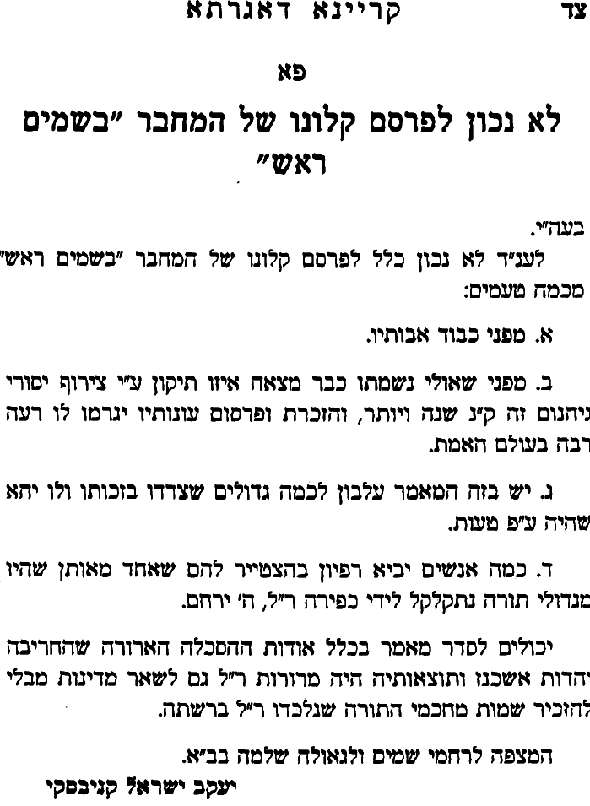
For some reason the Maharal's name is given as מוהר"ר לוי instead of לוואי or some similar spelling, and maybe this is why the passage had been overlooked. Before I put in my $.02 about this, every now and then one comes across something that seems to be symbolic of a great gap in thinking between different Jewish camps. Here is what Rabbi Ya'akov Kanievsky, the Steipler Gaon, had to say when asked about the propriety of publicly discussing the matter of the Besamim Rosh, the infamous forgery apparently created by the aforementioned Saul Berlin:
Here's a classic excerpt from the כתב יושר:
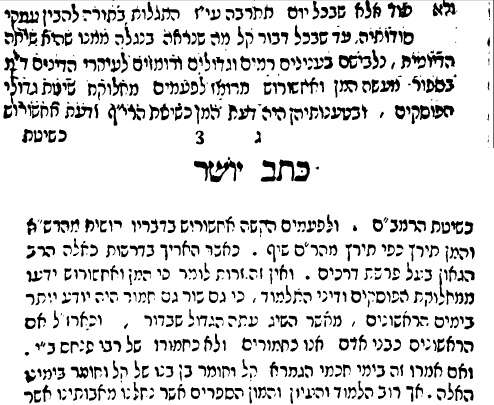
"The actions of Haman and Ahasuerus allude to various disagreements and positions of the great posekim. Haman acted as he did because he held like the Rif, but Achashverosh held like the Rambam. Achashverosh asked like the Maharsha, and Haman answered according to the Maharam Schiff. Don't protest that this is anachronistic, Haman and Achashverosh couldn't know the disagreements of the posekim and the laws of the Talmud, because even an ox and a donkey knew more in earlier times, as we see from the greats of the present generation. Like the Rabbis said, if the earlier ones were like people, we are like donkeys, but not even the donkey of Rabbi Pinchas ben Yair. If this was said by the sages of the Gemara, certainly it applies even more so in these days."
When I happened across this mention in the כתב יושר of a miracle of the Maharal juxtaposed next to another rabbi creating a golem, I was excited. The Maharal's golem is now so embedded in the public consciousness, as we see above, that people simply cannot think of a golem without thinking of the Maharal, and perhaps they can't even think of the Maharal without thinking of the golem. Yet in 1784 (when Ketav Yosher was written) or in 1794-5 (when it was probably posthumously published) the association was obviously not embedded in the mind. I initially wrote Dr. Leiman because I figured he knew which Maharal legend it referred to. Since it's funny, I'll admit publicly that I understood הוריד בירה מן השמים to mean that the Maharal caused beer to descend from heaven for the Emperor Rudolf to drink. I couldn't imagine that בירה here meant castle; the Maharal caused a castle to descend from heaven? What on earth could that mean? Dr. Leiman knew the legend and that it indeed referred to the Prague Castle.
This legend is most interesting. In 1831-32 Julius Max Schottky published a 2-volume book called Prag, wie es war und wie es ist. On pg. 361 we find the following:
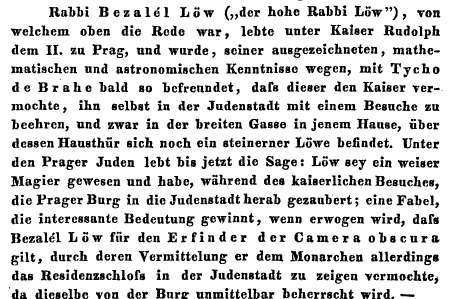
"Rabbi Bezalel Löw ("the tall Rabbi Löw") of whom we've spoken above, lived under the rule of Emperor Rudolph II at Prague, and with his excellent mathematical and astronomical knowledge became such friends with Tycho Brahe that the Emperor could honor the Jewish Quarter with a visit, in the house at the square with a stone lion in front that is still there. Among Prague's Jews there is still the following legend: They say that Löw was a wise magician, and that during the imperial visit he brought the Prague Castle into the Jewish Quarter, by magic. The legend is interesting because Bezalel Low was the inventor of the camera obscura, which was the means through which he could have shown the Monarch the Castle in the Jewish Quarter, which is right outside the Castle. "
Putting aside exactness of the translation, here we see a non-Jewish historian, relating a legend which he says the Prague Jews still told in the early 1830s. The Emperor Rudolph II had such respect for the Maharal that he visited him. As a magician, the Maharal actually conjured the Castle for him right there in the Jewish Quarter (to show his hospitality? I would have thought a beer sufficed, but I guess that's not a miracle for a royal guest). Schottky adds that the Maharal invented the camera obscura, an interesting assertion to say the least, and in his view perhaps the germ of the legend is that he was able to produce an image of the Prague Castle for the Emperor using a camera obscura. An interesting fact from the Wikipedia page: "The term "camera obscura" was first used by the German astronomer Johannes Kepler in 1604." This refers to his book Astronomiae Pars Optica. Look at the to whom Kepler dedicates this work:
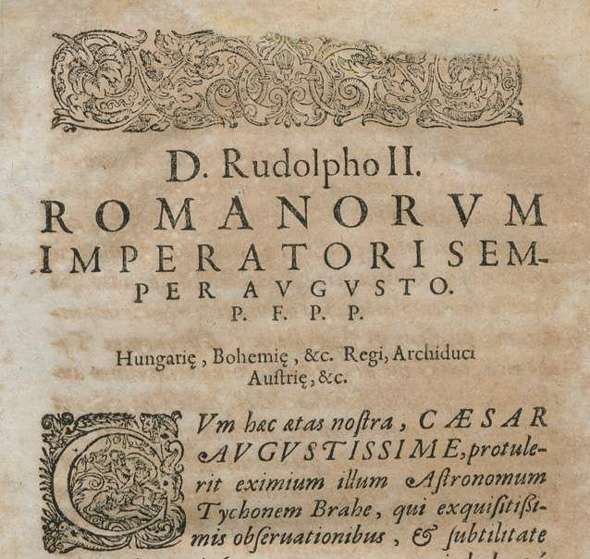
In any case, clearly this is the legend which Saul Berlin is referring to, and it seems that the legend of the Maharal being הוריד בירה מן השמים which Schottky reports in the 1830s was in circulation toward the end of the 18th century.
Before I get to other golemic matters, it is interesting to pause and note that not only have no written sources prior to 1836 been found linking the Mahral to the golem, but that once they do appear they are all in German, not in Hebrew. Why is that?
In the first part of the 19th century in Europe there was a Romantic interest in collecting and publishing the oral folklore of the people, for the existence of the rich popular imagination of the masses was thought to be a potent sign of nationhood, and for the first time collectors sought to document it. This is when Grimm's collection of fairy tales were published, and the collection which included a German version of Chad Gadya (see here), with many other examples in the respective European nations. Suffice it to say, this is a 19th century genre. Schottky's recording of the legend of the Maharal and the castle is an example of this. Jews too were swept in by this trend, and they also began to print the folklore of the Jews, the popular legends which had not made it into the existing literature.
See how Berthold Auerbach wrote of whom told the the legend of the golem:
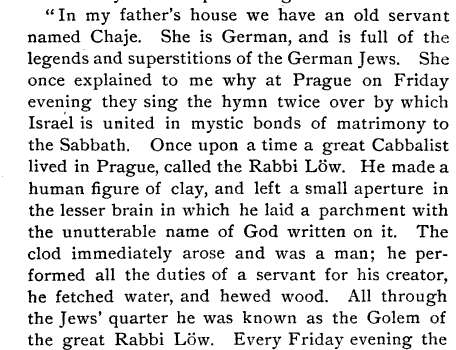
Chaya, the maid, an old woman. It was a bit of folklore, an old wive's tale. Auerbach is one of the first sources to put this story in print, in his 1837 novel Spinoza (above is an English translation from 1882).
The Jewish Romantics, writing in German, got it in the same way the others heard and then wrote down stories like Hansel and Gretel. This is why the story isn't in 'canonical' sources (ala Shu"t Chacham Tzvi) and why it appears exclusively in German in its original printed versions. It is remarkable that a story with such modest and humble beginnings eventually became a fundamental of faith. אל תטוש תורת אמך.
Here is the Chacham Tzvi's famous question concerning a golem:

He mentions that his ancestor (not grandfather) Rabbi Elijah of Chelm (also known as Rabbi Elijah Baal Shem) was reputed to have created a golem using the Sefer Yezira. Not a word about the Maharal. And why should there be? 70 years later the Chacham Tzvi's own great-grandson, Saul Berlin himself, also doesn't mention the Maharal's golem.
The question is, why doesn't Saul Berlin mention his own ancestor, Rabbi Elijah of Chelm, instead of Rabbi Naftali's golem? Here we have to guess, and my guess is that Berlin's own family was off-limits. Yes, he was mocking the concept that rabbis not only can but also did create golems, or more accurately the belief that the remains of a golem could yet be seen today, but he wasn't about to cite his own ancestor and drag him into the satire. Or maybe Rabbi Elijah Baal Shem himself could have been a target, having died 200 years prior, but mentioning him would have just drawn attention to the Chacham Tzvi, his father's grandfather. But I really don't know.
Incidentally, it seems that many believe that Rabbi Elijah Baal Shem was the Chacham Tzvi's grandfather. This is understandable, since he calls him זקני in the aforementioned responsum, and so does his son in Sheilas Yaavetz II.82:
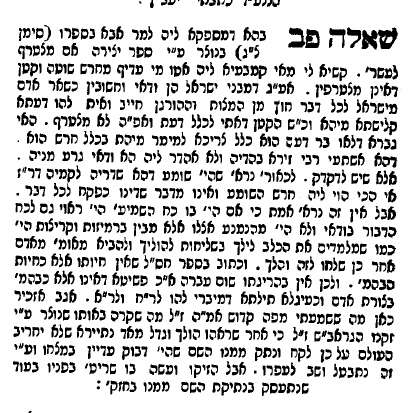
However, think about this logically. How likely is it that Rabbi Elijah (1550-1583) was the grandfather of Chacham Tzvi (1656-1718)? How much older than you are your grandfathers? Are we to believe that the Chacham Tzvi's father was in his 70s when he was born? Not only that, his maternal grandfather, R. Elijah ha-Kohen of Alt-Ofen was born in 1616. That would mean that Chacham Tzvi's father was at least 33 years older than his own father-in-law! So logically this does not make sense, even though the Jewish Encyclopedia has Rabbi Elijah as Chacham Tzvi's grandfather, a mistake repeated in both relevant Wikipedia pages (here and here). It is also repeated in the text and the notes on pg. 150 in the very interesting Artscroll book Great Jewish Letters by Rabbi Moshe Bamberger (which I intend to review). What does Chacham Tzvi's son, Rabbi Yaakov Emden say about this ancestry? On pg. 4 of Megillas Sefer he writes:
In fact the Chacham Tzvi's paternal grandfather was married to the grand-daughter of Rabbi Elijah. Regarding Megillas Sefer, see here for a recent entertaining discussion about the provenance of this autobiography.
Next is a really interesting account of a golem. Commenting on Sefer Yezira 2:5, Rabbi Sa'adya Gaon writes the following:
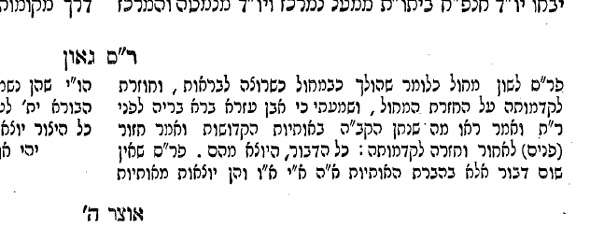
"I have heard that Ibn Ezra created a creature before Rabbenu Tam and said 'See what God allows to be accomplished through his holy letters.'"
Rav Saadya lived 200 years before them you say? Hmm.
Since this is a Maharal post, it is worth glancing at the title page of his תפארת ישראל, published in Venice in 1599 (that is, ten years before the Maharal died):
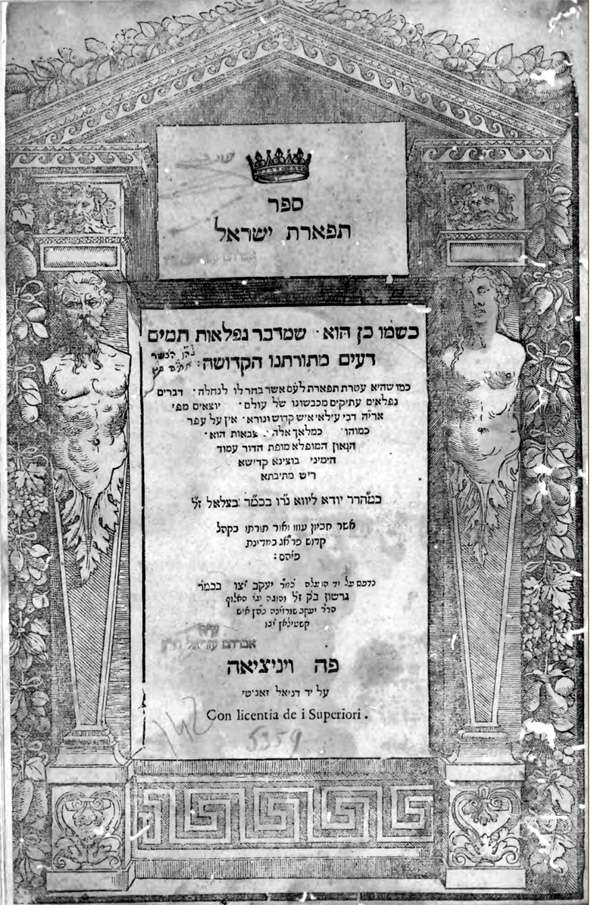
I am not arguing anything about how the Maharal viewed such things, but facts are facts. There are many more such examples of nudes on the title pages of venerable seforim. Not only were they written by important rabbis, but in many cases we know who owned them (and who, therefore, did not deface them). A future post will show an interesting example of one such sefer owned by one rabbi with an extremely zealous reputation.
In 1989 there was a reprint of a commentary on the Torah by Rabbi Menachem Avraham Ha-kohen "Rapoport" (d. 1596).
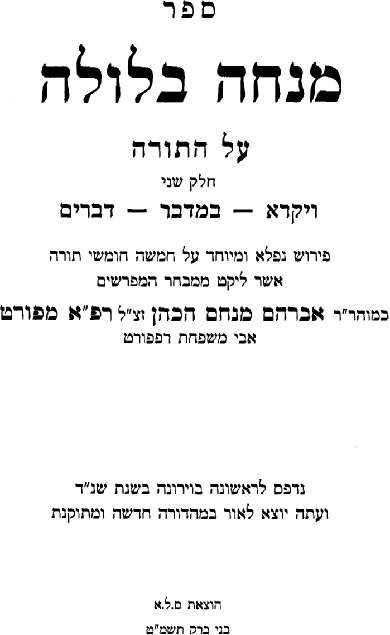
Toward the end of the second volume is a reproduction of the famous coat-of-arms of this family, except that the bare-breasted women are now wearing "shirts" (albeit tight ones!):
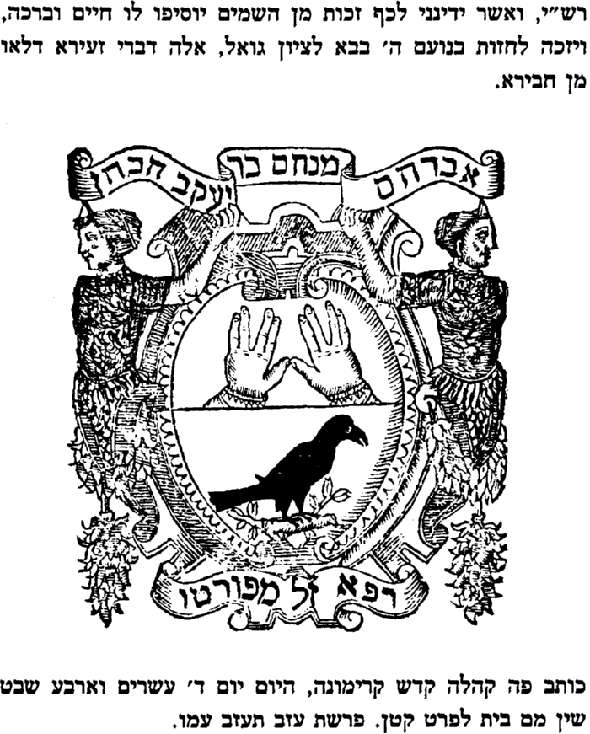
Here is the original, whichif memory serves is actually reproduced sans censorship in one of Rabbi Berel Wein's history books published by Artscroll's Shaar Press. I will check later.
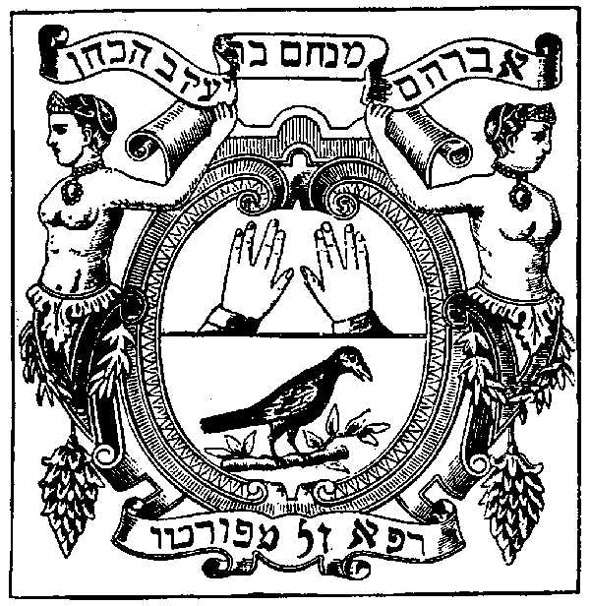
From Herald of Destiny by Rabbi Berel Wein:
Finally, a note about my discovery of the earliest known source for the Maharal's golem (link). It's a pity (for me) that it wasn't early enough to have made it into the impressive book Path of Life. Rabbi Judah Loew ben Bezalel (cal. 1525–1609). In the relevant article by Byron Sherwin, "The Golem of Prague and His Ancestors" it mentions that for a long time it was thought that the first appearance of Rabbi Loew's golem was in an 1841 article by a non-Jew, with it appearing in Jewish sources beginning in 1847. However, he writes, Shnayer Leiman showed Jewish sources from 1837, and [I forgot!] showed non-Jewish sources from that same year. I showed one from 1836, written by Ludwig A. Frankl, a Jew. I'm under no illusion that this must definitely be the first written source. Earlier ones may yet be found. However the way in which I discovered this should be mentioned. I'm not going to pretend that I printed out pages of the Oesterreiche Zeitschrift für Geschichts und Staatsunde for some light reading. Rather, the discovery is a nice piece of fruit borne out of the digitization of literature. Who knows what truly important discoveries are yet to be found in overlooked literature?
First of all, just to show how deeply embedded the notion that the Maharal created a golem is, here is a note from a recently produced Torah sheet:
The Chacham Tzvi's teshuva of course does not mention the Maharal (nor was he the Maharal's grandson). It will be reproduced below. (Edit: in view of a comment which contended that I am mistaken in my point, I would like to clarify what I mean here: my point is not that the author positively asserts that the Maharal made a golem. Indeed, he writes "tale?" in a paranthetical remark. But the author is mistaken that Chacham Tzvi is the Maharal's grandson. Why should this mistake occur? See below for the teshuva which discusses his actual "grandfather." But it seems to me that when someone has it in their mind that so-and-so's grandfather is said to have created a golem, unless they're careful and unless they check, none other than the Maharal pops into mind.)
Concerning Saul Berlin's Ketav Yosher, the satire which he wrote in defense of Herz Wessely's Divre Shalom ve-Emet pamphlet concerning Jewish education, Leiman copied and translated the relevant passage, but here it is in the original (last paragraph):
For some reason the Maharal's name is given as מוהר"ר לוי instead of לוואי or some similar spelling, and maybe this is why the passage had been overlooked. Before I put in my $.02 about this, every now and then one comes across something that seems to be symbolic of a great gap in thinking between different Jewish camps. Here is what Rabbi Ya'akov Kanievsky, the Steipler Gaon, had to say when asked about the propriety of publicly discussing the matter of the Besamim Rosh, the infamous forgery apparently created by the aforementioned Saul Berlin:
"In my humble opinion it is not at all proper to publicize the disgrace of the author of "Besamim Rosh" for several reasons:Here we have the דעת תורה which basically forbids the Seforim Blog, my blog, and many others. By the way, I happen to agree with some of these points.
"1) Due to the honor of his ancestors (Berlin's family was one of the most elite rabbinic families in all of Europe; his father, brothers, grandfathers, uncles - we're talking the heavyweights).
"2) Perhaps his soul has already achieved it's rectification in Gehinnom, being that more than 150 years had passed. Recalling his sin will cause his soul harm.
"3) This episode brings disdain on many great rabbis who supported the forgery, but were mistaken.
"4) Many men might weaken in their faith due to the confusion caused by their awareness that one who was great in Torah (i.e., Berlin) was able to stumble into heresy, God help us.
"However, it is permissible to compile an essay regarding the accursed Haskalah (here he makes a common pun which can only be seen in Hebrew, Haskalah - enlightenment - with a sin and Haskalah with a samech are homonyms of opposite meaning) which destroyed German Jewry, which departed from its heritage, and also spread to other lands, however the names of those Torah scholars who were caught up in it should be omitted."
Here's a classic excerpt from the כתב יושר:
"The actions of Haman and Ahasuerus allude to various disagreements and positions of the great posekim. Haman acted as he did because he held like the Rif, but Achashverosh held like the Rambam. Achashverosh asked like the Maharsha, and Haman answered according to the Maharam Schiff. Don't protest that this is anachronistic, Haman and Achashverosh couldn't know the disagreements of the posekim and the laws of the Talmud, because even an ox and a donkey knew more in earlier times, as we see from the greats of the present generation. Like the Rabbis said, if the earlier ones were like people, we are like donkeys, but not even the donkey of Rabbi Pinchas ben Yair. If this was said by the sages of the Gemara, certainly it applies even more so in these days."
When I happened across this mention in the כתב יושר of a miracle of the Maharal juxtaposed next to another rabbi creating a golem, I was excited. The Maharal's golem is now so embedded in the public consciousness, as we see above, that people simply cannot think of a golem without thinking of the Maharal, and perhaps they can't even think of the Maharal without thinking of the golem. Yet in 1784 (when Ketav Yosher was written) or in 1794-5 (when it was probably posthumously published) the association was obviously not embedded in the mind. I initially wrote Dr. Leiman because I figured he knew which Maharal legend it referred to. Since it's funny, I'll admit publicly that I understood הוריד בירה מן השמים to mean that the Maharal caused beer to descend from heaven for the Emperor Rudolf to drink. I couldn't imagine that בירה here meant castle; the Maharal caused a castle to descend from heaven? What on earth could that mean? Dr. Leiman knew the legend and that it indeed referred to the Prague Castle.
This legend is most interesting. In 1831-32 Julius Max Schottky published a 2-volume book called Prag, wie es war und wie es ist. On pg. 361 we find the following:
"Rabbi Bezalel Löw ("the tall Rabbi Löw") of whom we've spoken above, lived under the rule of Emperor Rudolph II at Prague, and with his excellent mathematical and astronomical knowledge became such friends with Tycho Brahe that the Emperor could honor the Jewish Quarter with a visit, in the house at the square with a stone lion in front that is still there. Among Prague's Jews there is still the following legend: They say that Löw was a wise magician, and that during the imperial visit he brought the Prague Castle into the Jewish Quarter, by magic. The legend is interesting because Bezalel Low was the inventor of the camera obscura, which was the means through which he could have shown the Monarch the Castle in the Jewish Quarter, which is right outside the Castle. "
Putting aside exactness of the translation, here we see a non-Jewish historian, relating a legend which he says the Prague Jews still told in the early 1830s. The Emperor Rudolph II had such respect for the Maharal that he visited him. As a magician, the Maharal actually conjured the Castle for him right there in the Jewish Quarter (to show his hospitality? I would have thought a beer sufficed, but I guess that's not a miracle for a royal guest). Schottky adds that the Maharal invented the camera obscura, an interesting assertion to say the least, and in his view perhaps the germ of the legend is that he was able to produce an image of the Prague Castle for the Emperor using a camera obscura. An interesting fact from the Wikipedia page: "The term "camera obscura" was first used by the German astronomer Johannes Kepler in 1604." This refers to his book Astronomiae Pars Optica. Look at the to whom Kepler dedicates this work:
In any case, clearly this is the legend which Saul Berlin is referring to, and it seems that the legend of the Maharal being הוריד בירה מן השמים which Schottky reports in the 1830s was in circulation toward the end of the 18th century.
Before I get to other golemic matters, it is interesting to pause and note that not only have no written sources prior to 1836 been found linking the Mahral to the golem, but that once they do appear they are all in German, not in Hebrew. Why is that?
In the first part of the 19th century in Europe there was a Romantic interest in collecting and publishing the oral folklore of the people, for the existence of the rich popular imagination of the masses was thought to be a potent sign of nationhood, and for the first time collectors sought to document it. This is when Grimm's collection of fairy tales were published, and the collection which included a German version of Chad Gadya (see here), with many other examples in the respective European nations. Suffice it to say, this is a 19th century genre. Schottky's recording of the legend of the Maharal and the castle is an example of this. Jews too were swept in by this trend, and they also began to print the folklore of the Jews, the popular legends which had not made it into the existing literature.
See how Berthold Auerbach wrote of whom told the the legend of the golem:
Chaya, the maid, an old woman. It was a bit of folklore, an old wive's tale. Auerbach is one of the first sources to put this story in print, in his 1837 novel Spinoza (above is an English translation from 1882).
The Jewish Romantics, writing in German, got it in the same way the others heard and then wrote down stories like Hansel and Gretel. This is why the story isn't in 'canonical' sources (ala Shu"t Chacham Tzvi) and why it appears exclusively in German in its original printed versions. It is remarkable that a story with such modest and humble beginnings eventually became a fundamental of faith. אל תטוש תורת אמך.
Here is the Chacham Tzvi's famous question concerning a golem:
He mentions that his ancestor (not grandfather) Rabbi Elijah of Chelm (also known as Rabbi Elijah Baal Shem) was reputed to have created a golem using the Sefer Yezira. Not a word about the Maharal. And why should there be? 70 years later the Chacham Tzvi's own great-grandson, Saul Berlin himself, also doesn't mention the Maharal's golem.
The question is, why doesn't Saul Berlin mention his own ancestor, Rabbi Elijah of Chelm, instead of Rabbi Naftali's golem? Here we have to guess, and my guess is that Berlin's own family was off-limits. Yes, he was mocking the concept that rabbis not only can but also did create golems, or more accurately the belief that the remains of a golem could yet be seen today, but he wasn't about to cite his own ancestor and drag him into the satire. Or maybe Rabbi Elijah Baal Shem himself could have been a target, having died 200 years prior, but mentioning him would have just drawn attention to the Chacham Tzvi, his father's grandfather. But I really don't know.
Incidentally, it seems that many believe that Rabbi Elijah Baal Shem was the Chacham Tzvi's grandfather. This is understandable, since he calls him זקני in the aforementioned responsum, and so does his son in Sheilas Yaavetz II.82:
However, think about this logically. How likely is it that Rabbi Elijah (1550-1583) was the grandfather of Chacham Tzvi (1656-1718)? How much older than you are your grandfathers? Are we to believe that the Chacham Tzvi's father was in his 70s when he was born? Not only that, his maternal grandfather, R. Elijah ha-Kohen of Alt-Ofen was born in 1616. That would mean that Chacham Tzvi's father was at least 33 years older than his own father-in-law! So logically this does not make sense, even though the Jewish Encyclopedia has Rabbi Elijah as Chacham Tzvi's grandfather, a mistake repeated in both relevant Wikipedia pages (here and here). It is also repeated in the text and the notes on pg. 150 in the very interesting Artscroll book Great Jewish Letters by Rabbi Moshe Bamberger (which I intend to review). What does Chacham Tzvi's son, Rabbi Yaakov Emden say about this ancestry? On pg. 4 of Megillas Sefer he writes:
אבא רבה הוא הגאון החסיד שבכהונה בעל ס' שו"ת שער אפרים ז"ל, ראש ב"ד בק' ווילנא המעטירה אז בהיות בשלותה, והיה לו כתב יחוסו עד אהרן הכהן, וחתן לאחד מן בני בניו של הגאון ר' אליהו בעל שמ הזקן ז"ל, שהיה אב"ד בקק' חעלם בימים ההם
In fact the Chacham Tzvi's paternal grandfather was married to the grand-daughter of Rabbi Elijah. Regarding Megillas Sefer, see here for a recent entertaining discussion about the provenance of this autobiography.
Next is a really interesting account of a golem. Commenting on Sefer Yezira 2:5, Rabbi Sa'adya Gaon writes the following:
"I have heard that Ibn Ezra created a creature before Rabbenu Tam and said 'See what God allows to be accomplished through his holy letters.'"
Rav Saadya lived 200 years before them you say? Hmm.
Since this is a Maharal post, it is worth glancing at the title page of his תפארת ישראל, published in Venice in 1599 (that is, ten years before the Maharal died):
I am not arguing anything about how the Maharal viewed such things, but facts are facts. There are many more such examples of nudes on the title pages of venerable seforim. Not only were they written by important rabbis, but in many cases we know who owned them (and who, therefore, did not deface them). A future post will show an interesting example of one such sefer owned by one rabbi with an extremely zealous reputation.
In 1989 there was a reprint of a commentary on the Torah by Rabbi Menachem Avraham Ha-kohen "Rapoport" (d. 1596).
Toward the end of the second volume is a reproduction of the famous coat-of-arms of this family, except that the bare-breasted women are now wearing "shirts" (albeit tight ones!):
Here is the original, which
From Herald of Destiny by Rabbi Berel Wein:
Finally, a note about my discovery of the earliest known source for the Maharal's golem (link). It's a pity (for me) that it wasn't early enough to have made it into the impressive book Path of Life. Rabbi Judah Loew ben Bezalel (cal. 1525–1609). In the relevant article by Byron Sherwin, "The Golem of Prague and His Ancestors" it mentions that for a long time it was thought that the first appearance of Rabbi Loew's golem was in an 1841 article by a non-Jew, with it appearing in Jewish sources beginning in 1847. However, he writes, Shnayer Leiman showed Jewish sources from 1837, and [I forgot!] showed non-Jewish sources from that same year. I showed one from 1836, written by Ludwig A. Frankl, a Jew. I'm under no illusion that this must definitely be the first written source. Earlier ones may yet be found. However the way in which I discovered this should be mentioned. I'm not going to pretend that I printed out pages of the Oesterreiche Zeitschrift für Geschichts und Staatsunde for some light reading. Rather, the discovery is a nice piece of fruit borne out of the digitization of literature. Who knows what truly important discoveries are yet to be found in overlooked literature?
Wednesday, February 24, 2010
R.Hirschel Lewin and Moses Mendelssohn, collaberators and friends; & Wessely's -- ultimately censored -- testimony in favor of R. Jonathan Eybeschutz
In 1780 the Hofund Kammergericht (like the Justice Department) of the Prussian government requested that the Berlin Jewish community under the jurisdiction of its Chief Rabbi Hirschel Lewin [1] furnish for them a digest of the Jewish marriage, financial and inheritance laws. The purpose of this tract was to supply the state with a working knowledge of Jewish laws. At the time there was ferment in the direction of incorporating Jews into the state, and following the direction of the Jewish rights' advocate Dohm there was some interest in learning how to apply Jewish law to judge cases brought to secular courts on appeal (that is, after failure of a Bet Din to reach a satisfactory conclusion) according to Jewish law. As wild as this scheme sounds, it was probably sincere, although adjudicating cases between Jews according to Jewish law could not have been its only purpose. Another reason was probably to learn if Jewish laws were compatible with secular law. (Similar works were requested at other times. For example, the author of the responsa Noda Beyehuda, Rabbi Ezekiel Landau, produced a work on Jewish marriage law called Das mosaisch-talmudisch Eherecht for the Emperor Joseph II.)
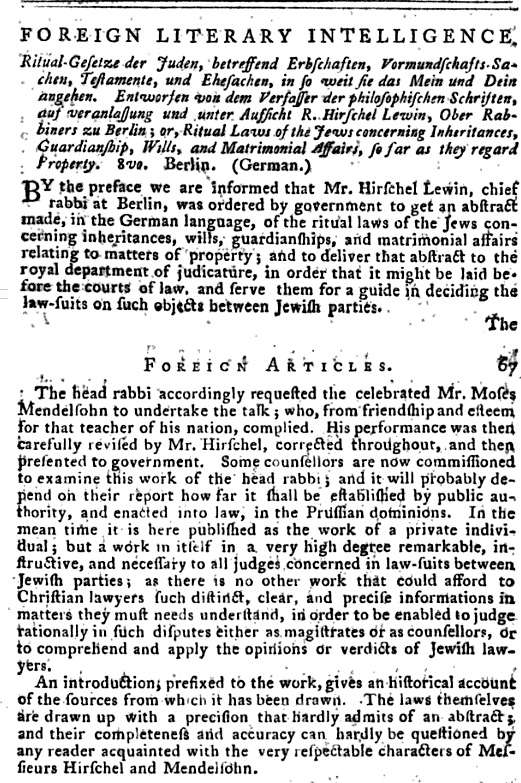
Rabbi Lewin was requested to produce it in two weeks, but it didn't appear until six years later. It was then published in 1778 under the title Ritualgesetze der Juden. Judging by the title page this work seemed to be a collaboration between Lewin and Moses Mendelssohn, in fact it was really the work of Mendelssohn. The rabbi, who was a good friend of Mendelssohn, only reviewed it and made necessary corrections.
Below are two reviews of this work (admittedly they don't tell us much) which appeared in British periodicals:
1.

2.
Rabbi Lewin was a good friend of Mendelssohn's. He was among the only rabbis whom Mendelssohn asked for an approbation for his Pentateuch translation, and certainly among the only rabbis at the time to specifically concur with the need for a a modern Jewish translation into the vernacular. The complete text of his haskamah to Mendelssohn's Biur (ie Chumash Nesivaus Scholaum) was only included in the very first edition of 1783 (at the beginning of the 2nd volume, Exodus). Excerpts from it were published in Landshuth's biography of Lewin. The entire piece, however, was printed at the beginning of the Romm edition printed in Vilna 1849. Here is the original followed by the more readable Romm version:
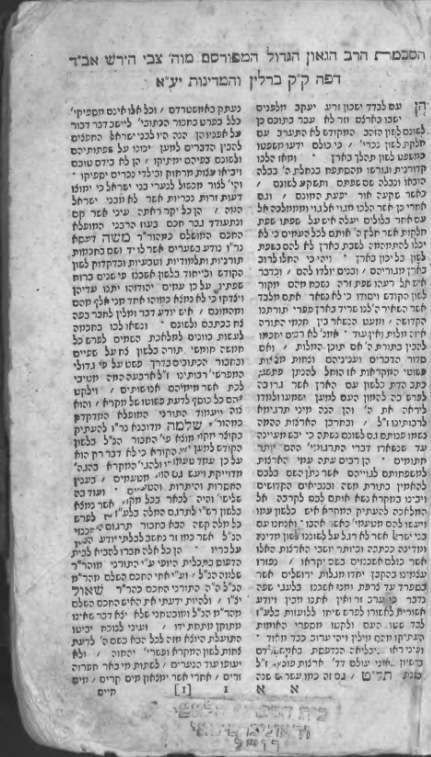

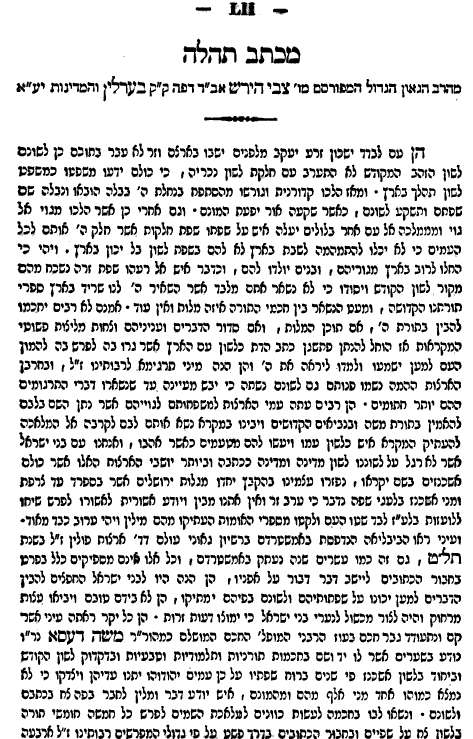
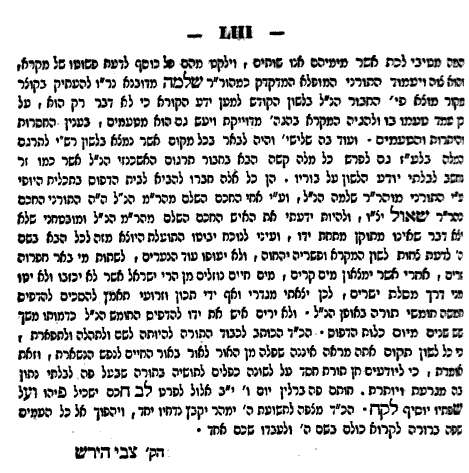
This approbation includes the observation that the Gentiles believe in the Torah and prophets, understood them and have made vernacular translations of the Bible. Yet the Jews, especially the Ashkenazim, don't speak a clear language (*coughYiddishcough*). He writes that he's seen a Yiddish Bible printed in Amsterdam in 1679, and also another one, both of which are greatly wanting, but they were the only ones available for Jews who wanted to understand Scripture. However, there were the impressive non-Jewish translations, and these are stumbling-blocks for young people. So it is that an honorable rabbi, scholar and sage, famous and expert in Torah, Talmud, science, Hebrew grammar and the German language, not one in a thousand is like him -- Mendelssohn -- has written such a needed translation . . .
Although this approbation was written in Berlin in 1778, it has been noted that their friendship dates at least as far back as 1764 - 1770, when Lewin served as rabbi in Halberstadt. In Geiger's JZWL 1872 pg. 232 a letter is printed, written in August, 1770, in which the poet Gleim informs F. E. Boyzen that Rabbi Lewin ("Herr Loebel") was an admirer and friend of Mendelssohn. (This letter is also reproduced in Latin letters in Landshuth's Toldos Anshe Hashem U-peulosam be-adass Berlin pg. 83) There is a possible earlier connection: in 1756 a German translation of sermon of Rabbi David Frankel, author of the Korban ha-Edah commentary on the Jerusalem Talmud, was printed. Shortly thereafter followed an English translation, which was reprinted many times, including in America! Rabbi Frankel was Mendelssohn's rebbe; he was also Rabbi Lewin's first cousin. It was, in fact, Mendelssohn himself who had made the German translation of Rabbi Frankel's sermon (see Gad Freudenthal's article in the EJJS 1 on this sermon). At the time Rabbi Hirsch Lewin was beginning to serve as Rabbi Hart Lyon in London, where the English version of the sermon appeared. Although I've no proof to give of any involvement on the part of the rabbi, much less that he and Mendelssohn knew one another yet, one might say that their circles overlapped even at this early period, although Lewin was eight years older than Mendelssohn.
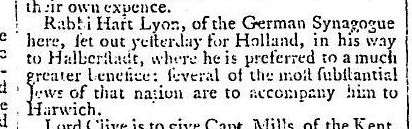
Here's a notice of the rabbi's leave of England toward his post in Halberstadt (Gazetteer and New Daily Advertiser (London England) Wednesday May 23 1764):
Ultimately their friendship was tested over a notorious incident, namely the Wessely Divre Shalom ve-Emes affair. Demonstrating that one can't always predict affinities and affiliations -- as I will elaborate -- Rabbi Lewin was outraged by Wessely's pamphlet in which he called for a restructuring of the Jewish educational system (or some might say, he called for structuring that "system") and insulted the rabbis. He was so upset that he sought to toss Wessely out of Berlin. Wessely was Mendelssohn's close friend, and their varying viewpoints came between the rabbi and the philosopher. Eventually Lewin made it clear that either Wessely goes or he goes. In fact, neither went.
What I meant by not being able to predict affinities was that one of Mendelssohn's fiercest rabbinic critics, Rabbi Elazar Fleckeles, the foremost student of the Noda Beyehuda, appears to have held a fairly mild, and even positive view of Wessely. In addition to quoting him several times in his writings, it seems they also had a correspondence, although I'm not sure how extensive. In 1800 Rabbi Fleckeles published Ahavat David, a stridently anti-Frankist/ anti-Sabbatian tract, based upon sermons he had given on the subject (see this excellent post by Rabbi Eliezer Brodt). The book included a 1796 letter from Wessely, which Fleckeles offered as evidence that Rabbi Jonathan Eybeschutz was innocent of Sabbatianism! I'll get to the content of the letter in a moment, but first I will just note that I examined the pdf of Ahavas David twice, and I was unable to find the letter. I couldn't understand why I couldn't find it, so I asked several friends (literary men) if they knew what page it was on. Dr. Marc Shapiro replied that this edition -- a Copy Corner reprint -- is censored; it doesn't include the letter! I suppose it's theoretically possible that the censorship, ie, removal of the letter occurred long before the scanning of the book. That is to say, there's no way at the moment to tell who removed it and when, but we can probably guess why. In any case, at the same time I asked Shapiro for clarification, Rabbi Brodt told me that his copy of Ahavas David includes the letter, and he sent it to me. Here it is:
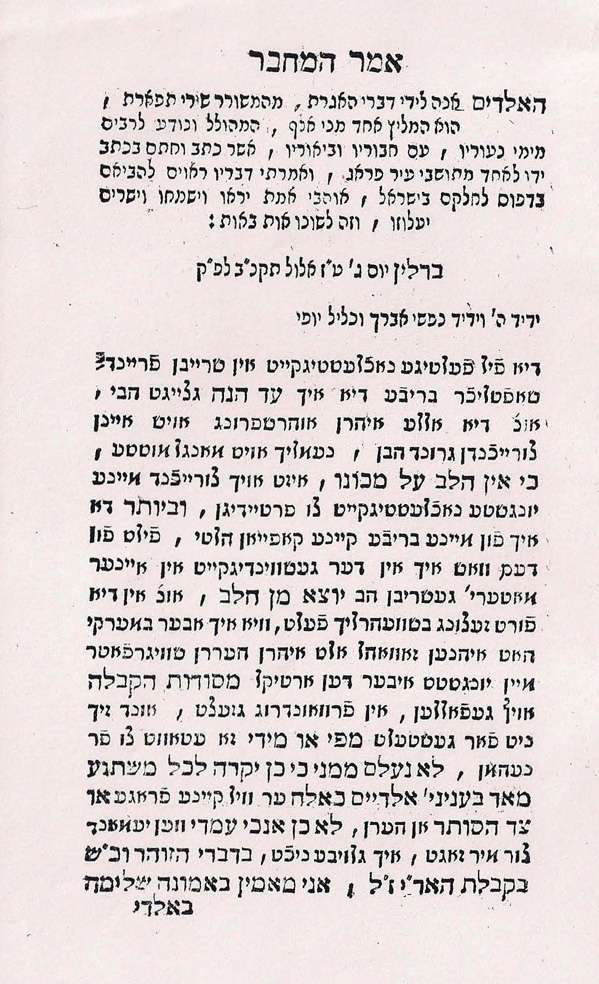

As you can see, Wessely writes:
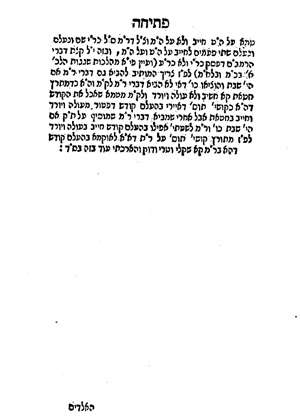
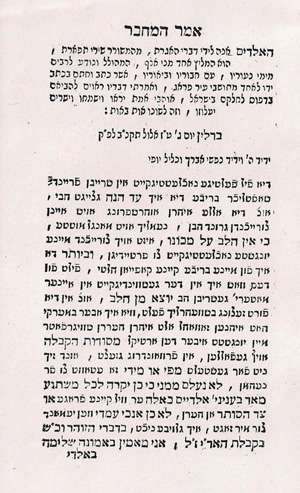
Actually, it's a crude case of censorship, because the eagle-eyed reader could notice that the last page of the introduction promises that the first word on the following page will be האלדים. Instead the first word is אשר. As you can see, when these two pages are inserted properly the leading words are quite correct:
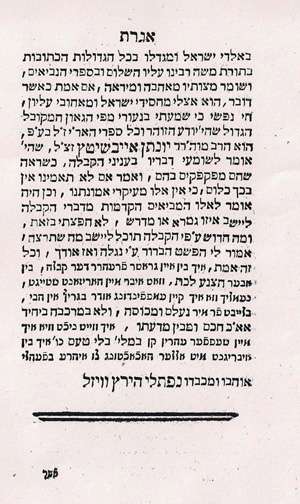
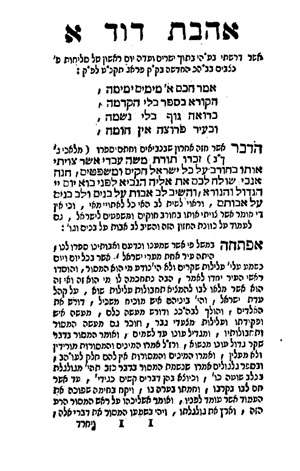
In any case, the complete letter was also printed in Hameliz 48 pg. 750, May 7, 1886:

Finally, it doesn't seem inappropriate to add something interesting relating to the controversial son of Rabbi Lewin, Saul Berlin (1740-1794), known as the forger of the Responsa Besamim Rosh. In 1844 an old man living in London named Meyer Joseph submitted a piece for Julius Furst's Literaturblatt des Orients. Joseph had been a close friend of Saul Berlin in his youth:
It was in the year 1794 when this exceptional man died here, and I think I have the right to publish this article as I was the only friend he had here. He was on a long journey, the object of which I do not remember anymore, and intended also to stay in London for some time. I visited him daily, we remained often together for hours at a time, and, although I am now 83 years old, the impression he made upon me, his eloquence and his whole personality remain unforgettable to me. A few months after his arrival he fell ill with cramp and it was I who closed his dying eyes. On his death the London community paid him respect. He was buried with great honors on the 25th of Marcheshvan, 1794. On arranging the things he left behind him I found his will, which I then copied for myself. (translation by David S. Katz in 'The Jews in the History of England,' 1485-1850, pg. 325, except that he translated "Heshvan" while I preserved the "Marcheshwan" of Joseph's original) The piece included the will, which Joseph himself copied:

Writing to the Jewish Chronicle on October 4, 1935, Cecil Roth noted that as Yom Kippur approaches, it should be noted that in "most London synagogues" there is Yizkar recitation of a list of rabbis, but it seemed this custom was on the wane. So as to "refresh [the] memories" Roth included a list of the 10 rabbis. Number 6 is Rabbi Saul ben Rabbi Zevi, ie, Saul Berlin. His name is included in the list "out of compliment to his father, and in view of the fact that he died in London."
[1] Rabbi Tzvi Hirsch ben Aryeh Leib ha-Levi (1721-1800), also known to history as Hart Lyon, was the Ashkenazic Chief Rabbi in London between 1757 and 1763. He was appointed Chief Rabbi of Berlin in 1772. His youngest son Zalman (1761-1842) would achieve fame as Rabbi Solomon Hirschell of London. Another son, Saul would achieve notoriety as the presumed forger of the Besamim Rosh.
Here is his portrait:

Many thanks to Rabbi Eliezer Brodt, who sent me much valuable information regarding Rabbi Fleckeles and his attitude toward the Zohar.
Update: November 22, 2010 - Recently HebrewBooks added an uncensored version from the Chaim Elozor Reich Collection, which you can access here.
Rabbi Lewin was requested to produce it in two weeks, but it didn't appear until six years later. It was then published in 1778 under the title Ritualgesetze der Juden. Judging by the title page this work seemed to be a collaboration between Lewin and Moses Mendelssohn, in fact it was really the work of Mendelssohn. The rabbi, who was a good friend of Mendelssohn, only reviewed it and made necessary corrections.
Below are two reviews of this work (admittedly they don't tell us much) which appeared in British periodicals:
1.
2.
Rabbi Lewin was a good friend of Mendelssohn's. He was among the only rabbis whom Mendelssohn asked for an approbation for his Pentateuch translation, and certainly among the only rabbis at the time to specifically concur with the need for a a modern Jewish translation into the vernacular. The complete text of his haskamah to Mendelssohn's Biur (ie Chumash Nesivaus Scholaum) was only included in the very first edition of 1783 (at the beginning of the 2nd volume, Exodus). Excerpts from it were published in Landshuth's biography of Lewin. The entire piece, however, was printed at the beginning of the Romm edition printed in Vilna 1849. Here is the original followed by the more readable Romm version:
This approbation includes the observation that the Gentiles believe in the Torah and prophets, understood them and have made vernacular translations of the Bible. Yet the Jews, especially the Ashkenazim, don't speak a clear language (*coughYiddishcough*). He writes that he's seen a Yiddish Bible printed in Amsterdam in 1679, and also another one, both of which are greatly wanting, but they were the only ones available for Jews who wanted to understand Scripture. However, there were the impressive non-Jewish translations, and these are stumbling-blocks for young people. So it is that an honorable rabbi, scholar and sage, famous and expert in Torah, Talmud, science, Hebrew grammar and the German language, not one in a thousand is like him -- Mendelssohn -- has written such a needed translation . . .
Although this approbation was written in Berlin in 1778, it has been noted that their friendship dates at least as far back as 1764 - 1770, when Lewin served as rabbi in Halberstadt. In Geiger's JZWL 1872 pg. 232 a letter is printed, written in August, 1770, in which the poet Gleim informs F. E. Boyzen that Rabbi Lewin ("Herr Loebel") was an admirer and friend of Mendelssohn. (This letter is also reproduced in Latin letters in Landshuth's Toldos Anshe Hashem U-peulosam be-adass Berlin pg. 83) There is a possible earlier connection: in 1756 a German translation of sermon of Rabbi David Frankel, author of the Korban ha-Edah commentary on the Jerusalem Talmud, was printed. Shortly thereafter followed an English translation, which was reprinted many times, including in America! Rabbi Frankel was Mendelssohn's rebbe; he was also Rabbi Lewin's first cousin. It was, in fact, Mendelssohn himself who had made the German translation of Rabbi Frankel's sermon (see Gad Freudenthal's article in the EJJS 1 on this sermon). At the time Rabbi Hirsch Lewin was beginning to serve as Rabbi Hart Lyon in London, where the English version of the sermon appeared. Although I've no proof to give of any involvement on the part of the rabbi, much less that he and Mendelssohn knew one another yet, one might say that their circles overlapped even at this early period, although Lewin was eight years older than Mendelssohn.
Here's a notice of the rabbi's leave of England toward his post in Halberstadt (Gazetteer and New Daily Advertiser (London England) Wednesday May 23 1764):
Ultimately their friendship was tested over a notorious incident, namely the Wessely Divre Shalom ve-Emes affair. Demonstrating that one can't always predict affinities and affiliations -- as I will elaborate -- Rabbi Lewin was outraged by Wessely's pamphlet in which he called for a restructuring of the Jewish educational system (or some might say, he called for structuring that "system") and insulted the rabbis. He was so upset that he sought to toss Wessely out of Berlin. Wessely was Mendelssohn's close friend, and their varying viewpoints came between the rabbi and the philosopher. Eventually Lewin made it clear that either Wessely goes or he goes. In fact, neither went.
What I meant by not being able to predict affinities was that one of Mendelssohn's fiercest rabbinic critics, Rabbi Elazar Fleckeles, the foremost student of the Noda Beyehuda, appears to have held a fairly mild, and even positive view of Wessely. In addition to quoting him several times in his writings, it seems they also had a correspondence, although I'm not sure how extensive. In 1800 Rabbi Fleckeles published Ahavat David, a stridently anti-Frankist/ anti-Sabbatian tract, based upon sermons he had given on the subject (see this excellent post by Rabbi Eliezer Brodt). The book included a 1796 letter from Wessely, which Fleckeles offered as evidence that Rabbi Jonathan Eybeschutz was innocent of Sabbatianism! I'll get to the content of the letter in a moment, but first I will just note that I examined the pdf of Ahavas David twice, and I was unable to find the letter. I couldn't understand why I couldn't find it, so I asked several friends (literary men) if they knew what page it was on. Dr. Marc Shapiro replied that this edition -- a Copy Corner reprint -- is censored; it doesn't include the letter! I suppose it's theoretically possible that the censorship, ie, removal of the letter occurred long before the scanning of the book. That is to say, there's no way at the moment to tell who removed it and when, but we can probably guess why. In any case, at the same time I asked Shapiro for clarification, Rabbi Brodt told me that his copy of Ahavas David includes the letter, and he sent it to me. Here it is:
As you can see, Wessely writes:
"By my life, I heard in my youth from the mouth of the great kabbalist, who knew the Zohar and all the works of the Ari by heart, the rabbi, my master, Rabbi Jonathan Eybeshutz ZZ"L, that he used to say to his audience when they were hesitant to accept a kabbalistic teaching, 'if you don't believe it, it's no matter, because it isn't from the fundamentals of faith.' So he used to say to those who brought kabbalistic teachings to explain a piece of Gemara or Midrash, 'I don't desire this. What's the use? According to kabbalah you can explain anything you want to; just tell me the simple meaning via "niglah"' -- it's completely true!"One imagines that Rabbi Fleckeles sought such information which had the two-fold advantage of showing that a great Kabbalist like Rabbi Eybeschutz ultimately marginalized kabbalah, something which was important in combating Frankists and the vestigial Sabbatean movement. Secondly, it also strongly suggested that Rabbi Eybeschutz himself was innocent of the charge that he himself was a secret Sabbatean. As a student of Eybeschutz, Wessely was in position to recall his master's views for the benefit of Rabbi Fleckeles, nearly 30 years his junior, who was only 10 years old when Rabbi Jonathan Eybeschutz died.
Actually, it's a crude case of censorship, because the eagle-eyed reader could notice that the last page of the introduction promises that the first word on the following page will be האלדים. Instead the first word is אשר. As you can see, when these two pages are inserted properly the leading words are quite correct:
In any case, the complete letter was also printed in Hameliz 48 pg. 750, May 7, 1886:
Finally, it doesn't seem inappropriate to add something interesting relating to the controversial son of Rabbi Lewin, Saul Berlin (1740-1794), known as the forger of the Responsa Besamim Rosh. In 1844 an old man living in London named Meyer Joseph submitted a piece for Julius Furst's Literaturblatt des Orients. Joseph had been a close friend of Saul Berlin in his youth:
It was in the year 1794 when this exceptional man died here, and I think I have the right to publish this article as I was the only friend he had here. He was on a long journey, the object of which I do not remember anymore, and intended also to stay in London for some time. I visited him daily, we remained often together for hours at a time, and, although I am now 83 years old, the impression he made upon me, his eloquence and his whole personality remain unforgettable to me. A few months after his arrival he fell ill with cramp and it was I who closed his dying eyes. On his death the London community paid him respect. He was buried with great honors on the 25th of Marcheshvan, 1794. On arranging the things he left behind him I found his will, which I then copied for myself. (translation by David S. Katz in 'The Jews in the History of England,' 1485-1850, pg. 325, except that he translated "Heshvan" while I preserved the "Marcheshwan" of Joseph's original) The piece included the will, which Joseph himself copied:
Writing to the Jewish Chronicle on October 4, 1935, Cecil Roth noted that as Yom Kippur approaches, it should be noted that in "most London synagogues" there is Yizkar recitation of a list of rabbis, but it seemed this custom was on the wane. So as to "refresh [the] memories" Roth included a list of the 10 rabbis. Number 6 is Rabbi Saul ben Rabbi Zevi, ie, Saul Berlin. His name is included in the list "out of compliment to his father, and in view of the fact that he died in London."
[1] Rabbi Tzvi Hirsch ben Aryeh Leib ha-Levi (1721-1800), also known to history as Hart Lyon, was the Ashkenazic Chief Rabbi in London between 1757 and 1763. He was appointed Chief Rabbi of Berlin in 1772. His youngest son Zalman (1761-1842) would achieve fame as Rabbi Solomon Hirschell of London. Another son, Saul would achieve notoriety as the presumed forger of the Besamim Rosh.
Here is his portrait:
Many thanks to Rabbi Eliezer Brodt, who sent me much valuable information regarding Rabbi Fleckeles and his attitude toward the Zohar.
Update: November 22, 2010 - Recently HebrewBooks added an uncensored version from the Chaim Elozor Reich Collection, which you can access here.
Sunday, March 01, 2009
R. Hayyim Palaggi meets a British missionary
I came across an interesting description of an encounter with R. Chaim Palaggi, Chief Rabbi of Izmir (Smyrna). The narrator is a 19th century Jewish Christian missionary, Moses Margoliouth (of whom I've written about here, here and here).


The work referred to in the account is חיים תחילה ודרכיו למשה (read it here.)
Incidentally, the Dr. Herschell referred to above is Solomon Hirschell, the de facto Chief Rabbi of the British Ashkenazim. His brother, incidentally, was Saul Berlin, forger and creator of the Besamim Rosh (although, it has to be said, this is but a footnote). Dr. Adler, of course, is Nathan Marcus Adler of Hanover, his successor as Chief Rabbi.

Wednesday, May 22, 2013
Recalling the musical 'aptitude' of British Chief Rabbi Solomon Hirschell, and his attitude toward singing Kaddish to a tune from the opera Don Juan
Something about history which fascinates me is - time. The passage of time. And for this, reminiscences are important. There are many people who can tell you things about people and events which too place 80 years ago, and certainly 50 years ago (hopefully some of them are reading!). Talk to them, ask them. And then, you should live long, tell people yourself what you heard in 30 or 60 years from now - and just like that: someone gets to hear something close to a firsthand account that is almost one and a half centuries old. It may be 2013, but there are people who can still tell you all about people they knew who were born before Lincoln was elected president.
Related to this: to me, in some ways, the 1870s don't seem that long ago. But the 1810s? Well, that's already getting remote. So I really enjoy reading things like the following, a reminiscence of Rabbi Solomon Hirschell (d. 1842), Chief Rabbi in London, which was published in the Jewish Messenger in 1873.
True, much of it is about how Hirschell kind of had a lousy singing voice, but the descriptions of his preparations for leading the Ne'ilah prayer, the coaching by two singers, his booming and intense Shema, are fascinating. Also the anecdotes about how he barred the use of musical notes and a tuning fork - it had to be explained to him what a tuning fork was - and how one particularly zealous worshiper (a man of note) tattled to him, to say that the Chazan has used a piece from the opera Don Juan in singing Kaddish - and the attempts to explain to Hirschell what the opera Don Juan was, and that Don Juan was not a person who did not belong in shul - all interesting. "The synagogue is not an opera house," Hirschell concluded, not really caring in the end if Don Juan was a person or an opera.
Finally, the writer of this piece makes a contribution to the "rabbis becoming doctors" trope (often attributed to Milton Himmelfard, which I blogged about here: Sadly, the first part of the quote is illegible. But here is the rest of it:
"In those [days]... those who held rabbinical offices. This may have arisen from the circumstances that then there was but little spiritual sickness in Israel, hence they wanted no Doctors, while now sluggishness and indifference have caused so much mental disease, as to require doctoring. Hence, I suppose, it occurs that the Rabbi has been superceded by the doctor."
I'm not precisely sure when "those days" were - but one imagines it could have been the 1810s, or perhaps early 1820s.
Here's Hirschel, roughly the same age as the Chasam Sofer, younger brother of Saul Berlin, of Besamim Rosh infamy:
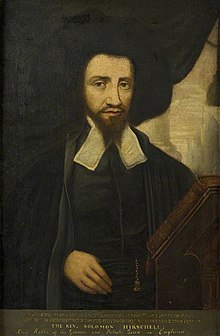
And the article:


Subscribe to:
Posts (Atom)
LinkWithin

Subscribe To On the Main Line


 Posts
All Comments