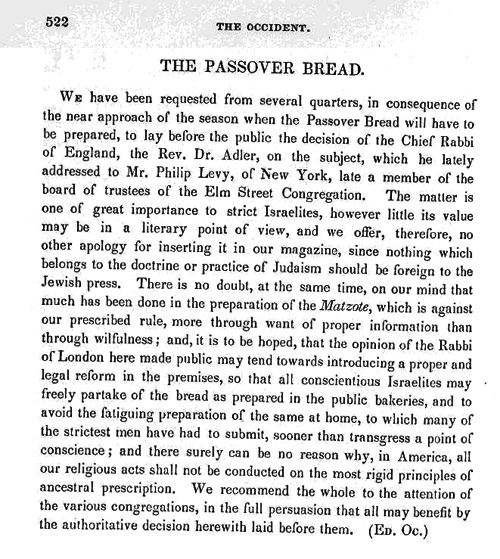
Allegedly ascended, anyway. Manuscripts, no Golem.
From the American Israelite Feb. 22, 1861.
Monday, February 18, 2013
Heinrich Graetz endorses the future of Judaism in America in 1854
Here is an interesting 1854 letter from Heinrich Graetz to the Zion Collegiate Association, which was basically an American Jewish plan to establish schools to train Jewish ministers, or at least at this stage, a plan to establish such a school in connection with an American university.
As you can see, he writes that "no other land on the globe is as eminently qualified as the United States, to unfurl the grandeur, dignity, and sanctity of Judaism" because it is "the land of absolute liberty" and therefore it doesn't have to contend with prejudices and various other things, including the idea that such an institute would not be the "accommodating idol of any sect."
Printed in the American Israelite.
Sunday, February 17, 2013
Thursday, February 14, 2013
A beggar in Vilna who begged for others
Here's a heartwarming story from 1875 in the American Israelite about a man who spent his days begging in the streets of Vilna for 30 years and is said to have ultimately acquired and distributed 90,000 rubles to the needy. At 3000 silver rubles a year - well, I don't know if that amount is plausible, but a nice story of giving it certainly is. As the blurb says, this man who worked at night for his own living, "was poor for himself and rich for others."
Wednesday, February 13, 2013
On the Vilna Gaon yeshiva in Harlem, and 100th yahrzeit rumor from 1897
Here is the announcement of the formation of a yeshiva in Harlem called Yeshivas Ha-gaon Eliyahu Vilna in 1907. If f anyone has any further info if this actually occurred beyond what was stated here (45 students), please let me know. From the American Hebrew.
And here is an interesting story about a rumor, apparently sweeping eastern Europe, that a letter from the Vilna Ga'on was going to be publicized for his 100th yahrzeit as per his alleged instructions. American Hebreew 1897. (This rumor does not, by the way, refer to Alim li-Trufah, the well-known letter by Rabbi Eliyah Wilna, which was already published in 1849, and perhaps earlier.)
Rabbi Mayer Bar Ilan's visit to Chaim Berlin in 1914
From the American Hebrew.
And since fake Jewish names are always fun, here's one from 1905: Chajim Berlinerblau.
Tuesday, February 12, 2013
Rav Soloveitchik threatens a herem on El Al
Jerusalem Post 12.24.1963.
Note, it quotes him saying that he'd never made a cherem in 32 years, but "this time I cannot avoid it."
Monday, February 11, 2013
A Lithuanian rabbi grapples in a most fascinating way with English in early 20th century America
I wanted to call attention to something really fascinating I found in the Reverend Benjamin Safer Digital Collection at the University of Florida. Safer was a Lithuanian rabbi in Jacksonville, FL, although he used the title Reverend because he did not have semicha. I'm not quite sure when he was born and died, although he was alive in 1954, the date of one letter of his I looked at, and he came to Florida in 1901. Here are pictures of him from that website, young and older.

What I wanted to point to are a few of his writings and jottings which would seem to show his efforts to acquire English, and what specifically he found difficult, and what he was comfortable with.
So here is a couple pages from one of his notebooks:


What I wanted to point to are a few of his writings and jottings which would seem to show his efforts to acquire English, and what specifically he found difficult, and what he was comfortable with.
So here is a couple pages from one of his notebooks:

As you can see, what he was doing was writing down English words with their transliteration and definition in Yiddish. There seems to be no pattern as to which words he chose; "devoid" "gust" "inertia" "vary" "haunt" and so on. My guess is that these were words that he came across in speech or reading and he wanted to remember them, or they gave him trouble or something. He probably wrote them as he came across them.
Next, is part of the text of a "sermonette" for Chanukah, for children. What is fascinating about this one is that it is entirely in English - written entirely in Yiddish/Hebrew letters. Evidently reading English was difficult, or still difficult, for him, although my guess is that he understood it and spoke it without too much difficulty. One wonders how many in his congregation realized that he was doing what we see below.
I haven't tried to read it yet, but you can see it begins with a Bible quote:
"רימעמבער דהי דייז אוו אלד".סשו מאזעס ספאק טו היז פיפל דזשאסט ביפאר היז דעטה
"Remember the days of old"So Moses spoke to his people just before his death.
Etc.
I should point out that much later we see whole letters written in English, so evidently he worked out whatever issues he had acquiring it. Without a doubt this collection is a treasure trove.
Sunday, February 10, 2013
Wednesday, February 06, 2013
A 17th century Jewish physician warns against the evil effects of alcohol
Came across a fascinating passage in the 17th century Hebrew medical book Ma'aseh Toviyah (link). Fascinating for its remark about drinking alcohol and fascinating to the 8 year old in me for the amusing, to modern English ears, turn of phrase highlighted by me in red.
"Of drinks, they drink whiskey that burns the heart and soul, and mead and beer, and other improper alcoholic drinks. Without a doubt these cause illnesses, and a smoky head causes headaches, dizziness, dementia, ringing in the ears, and eye maladies. Galen had said that even honey itself, when eaten too much, causes boils, because it burns the blood and causes and increase of redness (medical historians, jump in).
Now, of the intoxicating drink known as beer, it is already known to all who drink two kinds (?) causes the condition of dripping urine known in Latin as stranguria and in German as die kalte piss. We also discover in books that poisonous honey, derived from various herb species which are poisonous, kill all who eat or drink it.
Now that God has made all this known to us, do not wonder at the bad diseases which befall them because of their terrible practices, but wonder how they are even alive at all."
Monday, February 04, 2013
Sacrebleu! notice of a Jewish artist from 1844
Here is a fantastic art review (ok, notice) in the Archives israélites de France from 1844 (pg. 346). It concerns an exhibit in the Louvre:
"Regarding art, we have visited the painting exhibition at the Louvre and we noticed the following pieces by our coreligionists: # 818, Goldschmidt 928 the Sybil of Cumae, 929: Simon Hertz Offering to the Virgin (oh!) and a Procession to the Corpus Christi (oh! oh!)."
Saturday, February 02, 2013
An appeal to readers - please donate
Dear Readers,
Necessity has compelled me to appeal for donations. If you enjoy On the Main Line, please donate something, whatever you can in accordance with your capability and how much you feel I've given you. I am doing this once again because my family and I need me to use my blog as a platform to generate much-needed income.
Please note that you do not have to have a PayPal account to click the link below and donate. Thank you.
Note: I am constantly adding new posts. Please check below - and comment!
Friday, February 01, 2013
A British court tries to make heads of tails out of halacha in a libel suit in 1911, Part. I
The year was 1911. A Jewish butcher bought a libel suit against the "Investigating Officer of the Shecheta Board," as well as against the Jewish Chronicle, for printing an advertisement on February 10 of the prior year that argued that the butcher's meat was treife.
Here is the ad:
As you can see, this sort of announcement must have been fairly routine. Four of these announcements, one top of each other, but only one sued. The butcher, Marcus Hirsch, argued that his meat was not in fact unkosher at all, and he was therefore libeled, by the board (in the person of its inspector, Simon Myers) and by the newspaper. The defendants of course had to argue that it was true. The February 17, 1911 issue gave a lengthy account of the trial proceedings, some of which are quite interesting.
Here is a picture of the presiding judge, since I can virtually guarantee that reading the following will be more entertaining if you picture it occurring in front of him:
Famed novelist Israel Zangwill was called as an expert witness for the plaintiff. He testified that this Board of Shechita was rejected by one group of London Jews, the ultraorthodox Machzikei Hadass, the point being that it isn't some kind of universal authority on kashrut.
Then a controversy ensued as to whether or not Zangwill was an expert, and whether an expert who admitted he was not expert in all of Jewish law could be an expert. The judge pointed out that many people in the legal profession do not know the entire law which they practice. Zangwill had begun his testimony by giving his qualifications as an expert, saying that he knew much about Jewish law and customs, but when asked, acknowledged that he did not know as much as a rabbi or rabbinical students did. Pressed to be specific by the judge, he said that he could read "all but the most difficult" Hebrew, had learned very little Talmud, but had read much of the Jewish Encylopedia, and parts of the Shulchan Aruch, both in the original and in translation. The lawyer for the defendant wanted him to not be admitted as an expert. Then a discussion about the nature, appointment, and authority of rabbis took place.
In any case, the crux of the matter here was, what authority did the Shechita Board have, and are just any Jews authorized to perform shechita? To be sure, the Board of Shechita was an arm of the London Beth Din under the auspices of the Chief Rabbi. So with that in mind, the Chief Rabbi Hermann Adler was called as witness.
He gave testimony concerning the workings of Jewish law, whether or not there existed a translation of Yoreh Deah, and if there was, would it have any authority (no, he said), what is the process for appointing a shochet, that a simple minyan of ten Jews does not constitute a kehilla (congregation), and he gave a citation from the Pische Teshuva and Be'er Hetev to the effect that if a community had issued a proclamation that only a known shochet can act, then if someone contravenes it, according to some that shechita is forbidden.
Upon cross examination the lawyer made a little to-do over the fact that the law that kabbalah has to come from a rabbi is a gloss (a hagah of the Rema) and not in the text of Yoreh Deah proper! I think we are starting to understand why the case against Hebrew National and Triangle-K was thrown out of court, right? (See here.) For another example of a failure to understand the role the Rema plays in the Shulchan Aruch, see this earlier post of mine (here).
When asked about his own authority, Adler said that he basically has authority over all the Jews, except the Reform Jews who kind of sort of recognize his authority - sometimes, and a group of "Liberal Jews" (i.e., Britain's radical Reform) who do not acknowledge his authority at all, and also the group called Machzikei Hadass. Regarding the latter he claimed that their secessionist tendency was no longer an issue and they do at that point in time acknowledge his authority!
Then there was further discussion, really splitting hairs, about which other groups and individual congregations accept his authority. Then it moved back in time to the 18th century, and a detailed examination of the nature of the English rabbinate at that time was discussed, and the fact that they too had shochetim, and how it was that they were appointed.
To be cont.
Thursday, January 31, 2013
A "mash giach" and the additional expense of kosher meat explained in a Supreme Court case from 1916
This is a page from the transcript of the U.S. v. Hamburg-Amerikanische Packetfahrt-Actien Gesellschaft, 239 U.S. 466 in 1916.
As you can see, the Hamburg-Amerikanische Packetfahrt-Actien Gesellschaft argued that its rates are reasonable and, actually, should be higher than other lines because they have a "mash giach" and only serve kosher meat, since it doesn't make sense to have two kinds of meat and therefore it costs them more to feed the passengers. I have absolutely no idea what problem the U.S. had with this shipping company, but I suppose it had something to do with the Sherman Act. You see, there are more than 10,000 pages of this case to go through.
Tuesday, January 29, 2013
A tale of two pamphlets; a blood libel pamphlet and its strident rebuttal in England in 1656
In 1656 a small pamphlet was published in London called The Case of the Jevvs stated: or The Jewes Synagogue Opened. With Their preparations in the morning before they go thither, and their doings at night when they come home. Their practices in their Synagogues and some select actings of theirs in ENGLAND, upon Record.
While much of it only mildly hostile to Judaism (the Jews blaspheme when they praise God for bestowing the cock with wisdom!") the reference to "some select actings of theirs in England, upon Record" refers to the blood libel, which this book wastes no time in stating as a historical fact on the first page of the pamphlet. Here is the title page:
A little later that year a man named Joseph Copley published a vigorous, really vehement rebuttal called The Case of the Jews is Altered and Their Synagogue Shut To all Evil-Walkers. Or, a Vindication of the JEWES From the false Imputations laid upon them in a scrurrilous PAMPHLET, INTITLED The Case of the Jews Stated, etc. Presumably Joseph Copley was really a pseudonym for Yankel Koppelberg. No, I'm kidding. I am not sure who he was, but here is his title page:
Although not really stated much in either of these two pamphlets, there can be little doubt that the background has to do with the question of the readmission of the Jews, which some in England were debating at the time. The year before Menasseh hen Israel had been a guest of Oliver Cromwell's in London, where he formally petitioned for the readmission of the Jews. Menasseh ben Israel is referred to twice in the second pamphlet, in defense of the Jews, whereas opponents of resettlement pointed to what they probably believed were the historical crimes of the Jews, as a reason for not allowing them back in England after 350 years. The background of the resettlement question can be read in this good Wiki entry here.
I will post both pamphlets in their entirety below, but here is some summary.
1. Against.
The writer begins by describing synagogues, and states that when the Jews "were in England (as Matthew Parris hath recorded...) [they] used every year to steal a young Boy (the child of a Christian, and to circumcise him, and then in their Synagogue sate in solemn Assembly, chusing one of themselves to be Pilat, who out of their Devillish malice to Christ and Christians condemned the child, and crucified him to death; and this was discovered at Norwich, where they circumcised a Christian child and called him Jurnin, and condemned him to be crucified, it was discovered, for which four Jews being convicted were drawn at horses tails, and hanged on a Gibbet, and 18 Jews were drawn and hanged for thus crucifying of one Hugh Lincoln. They were banished...and their houses was given to the Master of the Rolls." He continues, noting that the Jews above age seven were then obligated by law to wear a piece of wool on their chest "to be known."
That pleasantry out of the way, the pamphlet now described what a Jew does when he wakes up. Or, rather, first: the wife wakes up the husband before dawn, since they are supposed to pray with the sunrise. How did the wives wake up? He describes superstitions about unclean spirits that require washing, and says that the Jews blaspheme when they wash their hands after because they utter the blessing "Blessed be thou O God our God, King of all the world, who hast commanded us to wash our hands."
Upon entering the synagogue they "endeavour chearfulness," clean their shoes at the door, deposit a halfpenny in the tzedakah box, and bow toward the ark and reciting Scriptural verses "expressing a high esteem of the House of God," as this man who accepts the blood libel as a historical fact, writes. He describes the blessings, prayers, and how it includes a prayer for the destruction of Christians. He gives a complete translation of the Velamalshinim blessing, and the rest of the service, and then the men go home. Then "the Good-wife" at home sweeps in anticipation of her husband's return, and "layeth him a book on the table" from which he doth learn from for "an hours space." Then at 11:00 she serves him dinner. At 5:00 the schul klopper, or as he calls it, the Scholae pulsator, knocks on their doors to get the Jews to return to the synagogue. He describes the prayer, supper, going to bed and concludes by saying that Jews are really raunchy in the bedroom: "their chamber morals are so lascivious written upon their walls, as is unfit for chaste ears," meaning that they have some kind of pornographic (?) things written on their walls. It concludes with a quotation from Corinthians: "If any man love not the Lord Jesus, let him be Anathema Maranatha."
2. For.
This pamphlet is not anonymous, as I said. Its author, Joseph Copley, begins with both fists swinging. He calls it a Libel, and paranthetically adds that he is told that its author once "did pennance in a sheet," meaning that he is a man of low character, according to rumor. He says that one would be impressed to find so much venom in the body of a little spider, as the author (much venom, is a little spider). The insults he pours on this man goes on for lines. His heart is "filled with envy and malice" "his noddle is well gifted with a goodly talent of beastly ignorance."
The blood libel quoted from Matthew Parris is a "ridiculous fable": "'tis a likely matter, that the Jews should first circumcise a Child to make him a Jew, and then murder him." He says that it is absurd to say that one of the Jews pretends to be Pontius Pilate "when none of them that I ever spake with, believe there was any such person" - which tells you both that Copley met Jews and that they didn't believe in Pilate and therefore presumably much of the narrative about Jesus from the New Testament. Finally, Copley says that if there was any truth to it they would have given the child a Hebrew name and not "Jurnin."
He then says something amazing. True, he writes, the Jews were accused of these things, and also poisoning the wells. But guess who actually did these things? "None but the Monks and Friers." That is, the priests, who besides being sorcerers also "did frequently murder children in their Monesteries, to keep their unclean conversation from the knowledge of the world, they moved by envy at the prosperity of the Jews, crucified Children, and poisoned Wells" and blamed the Jews and provoked hatred of them among the common people. To reiterate: he assumes that the children were crucified and the wells poisoned - but it was the medieval Catholic priests who did it and blamed it on the Jews!
He continues and says that he thinks that the terrible sin of persecution of the Jews is something which the present generation may no longer be guilty of, if the Lord will "give us good hearts toward this poor afflicted people, who are therefore dispersed amongst us." We should, he says, exercise mercy and hospitality toward the Jews, for God will judge whether "we will like savage Cannibals devour strangers, or with good Abraham and Lot, receive them kindly into our houses."
He then takes on the idea of forcing the Jews to wear an identifying mark, which had been done in England in the past, as was then the rule in Rome, and asks, should we imitate the Papists? Doesn't the author find in the Gospel that we must do good to those who persecute us? Kal ve-chomer we should not persecute those who do us no hurt, i.e., the Jews. He says that the man is not promoting the coming Kingdom of Christ, but is the voice of an Antichrist. Amazingly, he then says that some Jews living in England are obliged to be Jewish in secret because of their friends in Spain and Portugal and some parts of Italy, and if they would be forced to wear a mark identifying them as Jews, these friends would be in harm's way. To protect foreign secret Jews, Jews in England should be allowed to blend in as well as they want to.
He continues, attacking the anonymous pamphleteer's view of the prayers of the Jews, saying that it is a lie, and he quotes R. Yehuda Aryeh Modena's book, in Chilmead's translation. So, he says, the man "lyes...mingle[s] false with true." It's true, many of the blessings and ceremonies are done by the Jews, and they are not to be blamed for it. But he is simply wrong for asserting that the Jews believe God has need of rest. He makes some nice puns about Cocks and, as for the blessing in the bathroom, "when he comes to the privy he paddles to the very throat in stinking lyes, and there we will leave him" - in the bathroom - "to play the Gold-finder, for 'tis a place much fitter for him than the Pulpit." I suppose that is a hint that the author of the anti-Jewish pamphlet was a clergyman.
He says that the idea that the Jews constantly curse the Christians in their prayers is not true, the opposite is. They pray for the peace of the nations among whom thjey live, for the honor, safety and power of their temporal ruler. He then refers to Menasseh ben Israel's book. And if the man had read his book - here comes the best insult yet - reading it "might have stopt this Fellows mouth, and prevented his ugly, abortive, unlick'd Cub from creeping into the view of the world." He then says the idea that the Jews have "lascivious Motto's" adorning the walls of their homes is just nonsense. It is possible that a lewd Jew had it, and he adds parenthetically that perhaps the author knew such coarse Jews, but actually if Jews put such things up in their homes then the frummer Jews - "the graver sort, who do frequently visit the houses of the rest, would tear it down." And then he gives the interesting information that he has visited the homes of many Jews, and you know what they have hanging on their walls? "Pictures representing Bible-Histories." So now we know what Jews hung on their walls in the 17th century. And if he had actually seen such a thing in a bad Jew's home, "is it not madness in him to charge the whole nation with it? Some of all nations and religions are bad, must therefore all the men in the world be so?" He says that if not for the time of the year it was actually published, you'd think it was the Mid-summer Moon which fried this guy's brain. He picks apart the closing verse from Corinthians and the idea of anathemas.
He closes saying that he has "vindicated the honorable Nation of the Jews from the fowl aspersions of a black-mouth'd slanderer, which, if I have done with some sharpness," he understates, "it is but what his folly hath merited." He then basically warns the next pamphleteer who slanders the Jews that next time he will not use a rod of chastisement, but he will send him a rope, to make a noose and hang himself. He says he could say many nice things about the Jews, and what good they could do in England, but he can't say it better than Menasseh ben Israel. His closing verse is מִי יִתֵּן מִצִּיּוֹן, יְשׁוּעַת יִשְׂרָאֵל בְּשׁוּב יְהוָה שְׁבוּת עַמּוֹ יָגֵל יַעֲקֹב יִשְׂמַח יִשְׂרָאֵל.
Here are the full pamphlets:
Subscribe to:
Posts (Atom)