Monday, May 02, 2011

On the Mrs. Chasam Sofer Haggadah, Mendelssohnian German, Hannibal and Yiddish.

Continuing my tradition of Pesach posts after Passover - for example, see my Chad Gadya post from last year, which is one of my favorite posts of all time. I hardly need to explain that there isn't a lot of time for posting on Chol Ha-mo'ed. There almost isn't enough time for doing Yom Tov-appropriate things. A friend of mine told me that he printed up the 18th century English Haggadah which I posted about here, and he "aspire[d] to use the Prague Haggadah on the first night and this one on the second, but will probably be stuck with a Maxwell House Hagaddah in one hand and a kid in the other." I know how it is. But I digress.

On Pesach I discovered a Haggadah that I'd heard about, but never seen. It turns out that my grandfather owned a facsimile copy of a famous Haggadah. The Haggadah was beautifully written by a student of the Chasam Sofer in honor of the latter's wedding to Sorel, daughter of R. Akiva Eger, in 1815. It was evidently intended as a present for Sorel. I am unclear regarding the circumstances, if the Chasam Sofer commissioned this Haggadah as a present for his wife, or if it was essentially a present for him and the initiative was from the student. If that were the case, that's pretty bold of him to write it for the Rebbetzin (and it is written for her, as can be seen from the blessing for her husband in the bentching). In any case, my grandfather had a facsimile copy. Not only that, to my pleasure it was wine-stained, which meant that he didn't only own it, he used it.

The facsimile edition which I now have was printed in Brooklyn in1951. Unfortunately it is black-and-white, while the original was colored. In Meir Hildesheimer's essay "The Attitude of the Hatam Sofer toward Moses Mendelssohn" (PAAJR 60 1994) he refers to this Haggadah and its reprints - Berlin 1924, Bnei-Brak 1980 and Brooklyn 1986. But he missed Brooklyn 1951.

In any case, as it happens the JNUL just put up a digital copy of the 1924 facsimile a few weeks ago (link), and I will use pictures from that edition.

There are numerous interesting things about this Haggadah. To begin with, obviously, is the fact that included a translation into German (with Hebrew letters). Now I know that some might prefer to think that the translation is Yiddish, but it is not. Not only is this clear from the translation itself, but as it happens this student copied his translation from the Berlin 1785 Haggadah (link, to the 1786 reprint). This Haggadah's translator was Joel Brüll, who was one of the most notable students of Moses Mendelssohn. He was a Meassephist (editor and contributor to Ha-Me'asseph, the Hebrew periodical of the emergent Haskalah) and a Biurist (German translator and Hebrew commentator to many books of Tanach). He is also the first to translate the Haggadah in German. Here is the title page


It shouldn't really surprise anyone that this became a sort of typical template for a German version of the Haggadah. Surely no one would expect that the student would make his own translation. So it is Brill's that he used.

Regarding the language, even without the knowledge of the source and the ability to compare them, it is clearly German and not only that, it is clearly Mendelssohnian. For example, in the Mrs. Chasam Sofer Haggadah God's name is translated עוויגר, or Ewiger, which means (in this context) the Eternal One. This is not a traditional term for God (although it's use is quite clever and well-reasoned). It is in fact Mendelssohn's idea. In his Torah translation he uses עוויגע. In his comment to Exodus 3:14 ("Ehyeh asher ehyeh") he explains his use of this term, namely that he wanted to capture the meaning assigned to the Tetragrammaton by rabbinic tradition (God was, is, and will be) with one German word that connoted eternity. He also noted that other translations had used the same idea. The translations he is referring to would seem to be Calvin's Geneva Bible, which uses l'Eternel, and also the apocryphal book of Baruch, which used a Greek word with the same meaning.

As an aside, I just came across something very interesting. Here is the inside page of a sefer owned by the Chasam Sofer and his son, R. Avraham Shmuel Binyamin, the Kesav Sofer.


What makes this interesting is that it apparently contains the youthful handwriting practice doodles of the Kesav Sofer. That's "Samuel Wolf Schreiber" on the upper right. You can also see שמואל וואלף written numerous times. The image comes from this item, auctioned by the Kedem Judaica auction house March 2. The particular sefer is the 1832 Lemberg edition of מגן גבורים.

All this talk about the Chasam Sofer and German, and the fact that he made sure his own children knew the language (also see here) got me thinking. I think his views on Yiddish have been greatly misunderstood and misrepresented. First of all, the Yiddish spoken by his native German Jews was much closer to German than the dialect spoken in the East. Secondly, it was close to the native tongue. In Poland or Russia it was very different from the native tongue. Given this fact, given the fact that he ensured his children knew the language, given his contention that Yiddish was a planned corruption of German in fulfilment of a Yerushalmi, but that of course the correct vernacular was known (see here), and given that he opposed the use of German in preaching, I think these create a sort of confluence. His intention was never that the people should be so estranged from the language around them that they could not function. Knowing and speaking in the Judeo-German of his time was probably more analogous to the you-know-what dialect of English people speak today. It definitely set Jews apart. Getting up in shul and giving a speech that begins "There's a peledige Rashi on this week's parsha" is probably closer to what he had in mind than "Es shtayt in posuk." Of course there is the matter of alphabets. What I think he did have a problem with would have been something like "The commentators offer a striking explanation of the verse." This is, I think, the kind of German he was against. He was, in other words, a proponent of Yeshivish English - not Yiddish. This is of course an impressionistic, still-formulating idea. Feel free to rip it apart.

Back to the Haggadah. As you can see by the title page, the student (Moshe ben Nosson ha-Kohen) was a very talented calligrapher, but not necessarily such a talented artist. I grant that this is only my opinion, but I think I will be able to persuade you.


Immediately following is a rather tasteful colophon, which requires a lot of Haggadah-twisting to read.


Since I don't think you'll find it anywhere online (or necessarily even in a book) I'll write it out. I almost feel like this is hardly appropriate to have been written by the student, so I wanted to say that that it was written by the Chasam Sofer himself - almost a love note - but it's also a love note to him, and definitely signed and therefore written by the student:

שייך להרבנית האשה החשובה, צנועה מכל הנשים באהל תבורך, מפז היא יקרה, ומפנינים מפוארה, לאישה היא עטרה, כל כבודה פנימה, פרשה לעני כפה, ושלחה לאבין ידיה, אילת אהבים ויעלת חן, אשת חיל מרת שרל אשת הגאון הגדול מוהרר משה סופר אב"ד ור"מ דק"ק פ"ב יע"א, לשם תפארת ותהלה, ולתת שבח והודיה, לשמות הגדולים הנזכרים, ונעשים פה בראשי תיבות, ואלו הן * שירות רוממות להגיד אף שארי תהלות הבורא, גבורותיו אגיד ורב נפלאותיו, הוא גדר דרכי, ויפנה לי מסילה, ויביאני האהלה רב רבי משנתו שמנה ההלכות סגולתו ותפארתו, פועל רברביא, איש ברורה דברתו, והוא ריש מלכיא דאורייתא, קול קדושת פיו בוטא יקרת עילת אלהא דשמיא וארעא יתברך בפי על כי הגדיל לעשות לי כל הכבוד הזה, להעביר מנחה הבאה בידי ה"ק משה הכהן

The acrostic, of course, spells out שרל אשת הגאון הגדול מוהרר משה סופר אב"ד ור"מ דק"ק פ"ב יע"א, or, Sorel, wife of the great Gaon my Master and Rabbi Moshe Sofer, Chief Rabbi and Rosh Yeshiva of the Holy Congregation of Pressburg, God protect it.

As I said, Moshe ben Nosson Ha-kohen was a beautiful calligrapher, but not a terribly great artist. The Haggadah contains 4 full page illustrations. The individuals depicted aren't fully developed or well-proportioned. Some might wish to argue that they aren't fully developed for pietist reasons, but I think that would be more plausible if the artist had demonstrated ability. Here's an example:


Since I don't want to belabor the point of his lack of artistry, and concentrate on what he did do beautifully, I'll give only one more example because it is so interesting. Everyone always wants to see how the Four Sons are depicted in a Haggadah. Here it is:


This is a famous image; a couple of weeks before Pesach I posted Israel Zangwill's review of a Haggadah. It used this same image. Zangwill was not a fan. He wrote:
Another piece of rich artistic humour is the illustration of the four sons. The חכם is represented in a long gabardine and with his right hand extended as it to receive a stroke from a cane. The " wise son " is the oldest and tallest of the four and lifts up his gabardine as though crossing a muddy road. The רשע is depicted as a warrior with buckler on arm and spear in hand, and he is running away as fast as his legs can carry him. Presumably from the Seder. תם, the simple son who artlessly observes: " What is this? " is drawn as a ploughboy idiotically digging a spear or a staff (it is not clear which) into the ground. But the fourth son, the one who "hath no capacity to enquire," takes the (Passover) cake. He is represented as a dwarf (the four sons grow smaller by degrees and beautifulyl less.) He is clothed in a gaberdine which only reaches to his stockings, and in a black skull-cap. His right arm is held out slightly curved, while his left hand points perpendicularly to the sky. What this attitude, which looks like that of a vociferous Maggid, has to do with an incapacity for enquiry, I will not even pretend to guess.
This illustration has been used in many Haggadahs. For example, Wolf Heidenheim's 1822 Haggadah, which I use, uses it. I checked two random 18th century Haggadas - both use it (here and here).The illustration originally appeared in the 1695 Amsterdam Haggadah. A reader pointed out the early history of this illustration, recounted by Yosef Hayim Yerushalmi in his seminal Haggadah and History (this famous book on the history of the Haggadah was recently called "Yerushalmi" by "Yosef Hayim" in the My Machberes column of the Jewish Press (link).

Here is the picture from the 1695 Haggadah:


The engraver, whom some say was a convert but according to my reading of his name (הבחור כמר אברם בר יעקב ממשפחת אברהם אבינו) he was more likely a grandson, or son, of a convert, based his illustrations on the engravings of Matthäus Merian. I realize that I'm taking on big guns like Steinschneider and Cecil Roth, but until I see the proof that he was a convert, I'm sticking with my interpretation of his name. More on him and the issue of whether he was a convert below.

Merian's engravings are primarily from the 1630 Historische Chronica and the figures are as follows: the Wise Son is Hannibal's father making his son swear eternal enmity to Rome, the Wicked Son is a soldier from one of Merian's battle scenes, the Simple Son is from Merian's illustration of Saul being anointed by Samuel, and the Son Who Knows Not to Ask is Hannibal himself, from the same engraving. Incidentally, it appears that Yerushalmi made a mistake. I stress that I don't have his book in front of me, but I saw various descriptions online which seem to be citing from him, and it seems that he gave the wise son as Hannibal, and the sone who cannot ask as another figure in the illustration. The wise son is Hannibal's father. And, therefore, the son who cannot ask is Hannibal himself.

Here are two view of the Hannibal engraving from the Historische Chronica:


Rachel Wischnitzer already pointed this out in 1931 (link; but also in a more accessible form in Commentary in 1951 - link). Frankel, cited above, gives the image:


Here are all the illustrations from Wischnitzer's 1939 article:


Incidentally, in the link to Wischnitzer's small letter to Commentary in 1951 it says that the image is David, rather than Saul, being anointed. Rather than assume that she made a mistake and forgot her own research, my guess is that a less-than-biblically-literate editor at Commentary was insufficienly familiar with the Book of Samuel, and "corrected" her mention of "Saul" to "David bending his head while receiving the anointing oil was used for the dull son."

Getting back to the issue of whether this engraver was a convert - it has been noted that when the Haggadah was reprinted in 1712, although his illustrations were used again, his name does not appear. Assuming that he was a convert, Cecil Roth had the following interesting thing to say: "In the 1712 reprint, however, the plates are ascribed to 'a most zealous workman in the craft of engraving'. Clearly, the publishers were by now no longer so happy in his collaboration, and it is not out of the question that his experience of Judaism had not in the end turned out so satisfactorily as had formerly seemed to be the case. It is however not without its significance, in view of the constant allegations of narrow-minded exclusiveness that are levelled against Judaism even today, that the most familiar illustrations to the most beloved of Hebrew service books are from the hand of a proselyte!"

I already explained my reason for doubting that he was a convert. As I'm composing this post I noticed that David Frankel, too, doubted that Abram ben Jacob was a convert. See Illustration, allusion, and commentary: Choosing the four sons in 1695 in Images 4 (2010). He basically notes that it's "an oft repeated story" based entirely on the man's "surname" ממשפחת אברהם אבינו.

What he doesn't note is that there is a somewhat formidable reed which this "of repeated story" is based upon. Namely, Johann Christoph Wolf apparently mentions him in Vol. 3 of his Bibliotheca Judaea (1727):


And, perhaps, once again in Vol. 4, (1733), pg. 763:


As you can see, he is described as a Swiss Minister living in the Rhine region. He converted to Judaism in Amsterdam, and produced a Hebrew map of Palestine. Since the same engraver we have been discussing did indeed engrave the Hebrew map of Israel, which was printed in the 1695 Amsterdam Haggadah (indeed it was advertised on the title page), it is clear that according to Wolff he was a converted minister. The second mention by Wolf - if it is him - claims that he produced a 130-year Jewish-Christian calendar in 1714. Still, I find the lack of any other documentation and his unusual name to be a reasonable objection and more proof is wanting. If the proof already exists then of course I will be very happy to know what it is. Of course opposing my problem with the name is Wolf, who apparently had no problem presenting an Abraham ben Jacob as a convert - perhaps two of them, if these aren't the same men, which is also possible.

Here is what the aforementioned Frankel writes about the question:
Abraham ben Jacob, the engraver who illustrated the 1695 Haggadah, is rarely mentioned without the epithet “the proselyte.” Another often repeated story identifies him as a German clergyman who moved to Holland when he converted to Judaism, while Roth goes so far as to suggest that his name was omitted from the revised 1712 edition because “his experience of Judaism had not turned out so satisfactorily as had formerly been the case.” Dr. Edward van Voolen of the Joods Historisch Museum, Amsterdam, has suggested to me that this common view may well be mistaken. He proposes that אברם בר יעקב on the title page of the Amsterdam Haggadah could be read as Abraham b[en] r[abbi] Jacob rather than as Abraham bar Jacob: that is, seeing Abraham as the son of a rabbi, not as a proselyte.

It is possible that the identification of Abraham ben Jacob as a convert has also been encouraged by three general if unjustified assumptions and attitudes. The first is that there were few, if any, trained Jewish craftsmen; the second, the often mentioned irony that these most popular Jewish illustrations were based on the work of a non-Jew and prepared by a convert; and the third, that his non-Jewish (perhaps educated or religious) background would have given Abraham ben Jacob an unusual knowledge of Merian’s biblical and other secular work. None of these need have been so. In addition, it is important to recognise that, despite the generous praise of his efforts and inspiration on the title page of the 1695 Haggadah, Abraham ben Jacob is unlikely to have been solely responsible for selecting the images: this must have been done in close consultation with, or following the advice of the publishers, editors, and printers involved in the production of the Amsterdam Haggadah.
I must point out that "בר" doesn't mean "son of a Rabbi." I mean, it means that too, but it also means anyone and everyone. In the 17th and 18th century (and the 19th and 20th and 21st) everyone and anyone gets an "ר," especially if you're referring to your own father! Even a כמוהרר doesn't really mean that we're talking about a rabbi. Frankel's other point is excellent, particularly the first of the three, that the fact that there were few trained Jewish craftsmen may have encouraged the identification of the man as a convert. As I said, Wolf apparently makes the claim but, not insignificantly, he only mentions the map and not the Haggadah. Looking at Wischnitzer's 1939 article, she cites Haggadah-collecter Albert Wolf as making my same observation, and also doubting that he himself was a convert. Wolf noted that the appellation referring to Avraham Avinu doesn't appear in his own signature in the illustration to the 1698 Shelah, and that "בר" also has the dual meaning we discussed.

Speaking of the 1698 Amsterdam Shelah, this talented man also illustrated the title page, which he signed simply אברם בר יעקב. He also engraved this, and several other pages in Amsterdam seforim of the late 1690s - early 1700s.

Incidentally, I mentioned before that Wolf mentions him in 1727 (and, possibly, 1733). There is another source from 1727 mentioning him. I am speaking of Hermann von der Hardt's Historia Universalis Judaeorum In Aenigmate, In Liturgia Festi Paschatis, of course. This work, which also has a Hebrew title "חד גדיא," mentions the 1695 Haggadah and basically writes what we already know, that he was a convert, etc. However, he seems to have derived this information from reading the Haggadah's title page, whereas Wolf somehow has detailed info about his origin (Swiss, Rhenish, etc.).


Following the text of Chad Gadya Hardt prints Greek, Latin and German translations of the song. So you know it's a good book.

But this is a Chasam Sofer Haggadah post, is it not?

The Haggadah written and illustrated for Sorel has a few more points of interest. There if the aforementioned blessing in the bentching:


This is custom written for her, את בעלי מורי מורינו רב בעל הבית הזה. The formula מורי מורינו רב is very regional. In Hungary and related regions rabbis were called to the Torah with the title מורה מורינו הרב.

It is notable (to me) that the text is fairly vulgar. I'm not sure if the author copied any one particular text, but the vocalization is hardly precise. For example, it uses the idiosyncratic שֶׁנֶאֵמַר.

The use of Rabbi with a patach, rather than the authentic traditional chirik is, I think, probably less a nod to newfangled grammarian theories, and more just a general cluelessness over the issue:


Sof davar, I hope I wasn't too hard on poor Moshe ben Nosson. He was more artistically talented than I'll ever be, and he produced a beautiful, tasteful work that is worthy of its many reproductions. I'm glad to own a copy, and I imagine I will be using it for many years to come.

Sunday, May 01, 2011

A 19th century Yom Kippur solidarity prayer for victims of the Spanish Inquisition.

Here is a rather striking passage in the Yom Kippur mahzor, a misheberach "prayer for all our brethren confined by the Inquisition," or מי שברך על כל אחינו האסורים בבית הסהר מן החקירה. (I dare Hakirah to give itself the English subtitle "Inquisition.")

According to Hhm. Shemtob Gaguine the custom to recite it amongst a number of Misheberachs appended to the Kol Nidrei was common to the Amsterdam and London communities (כתר שם טוב v.4-5 pp. 297-99 London 1954). He writes that the Amsterdam Sephardim, however, had ceased to make the Misheberach once the Inquisition(s) had officially ended. As you can see, the prayer incorporates a few words of Portuguese in the Hebrew - "to all our brothers arrested by the Inquisition."


This particular Machzor is the Forms of Prayers According to the Custom of the Spanish and Portuguese Jews by Abraham de Sola. The Machzor first appeared around 1852-57, but this edition was printed in Philadelphia 5638/ 1878.

This prayer was intended to be recited by the Shaliach Tzibbur, and is part of a whole series of prayers included as an appendix to the Kol Nidrei. Before the Torah scrolls are returned, and immediately following Kol Nidrei is a prayer for the Queen (or, "a Republican Government" in the case of Holland or the United States), another for the congregation itself, then one for - of all things - the Hatan Torah, then another one for the Hatan Bereshit, then one for all Jewish congregations, then the one for the captives of the Inquisition, a prayer for those traveling by land or sea (although this is general, it appears to me to have been intended to bless those escaping the Inquisition, because of the Portuguese words incorporated within it), and finally, a prayer to be recited in the event of some specific calamity, should there be one (like a war, I suppose). Then the Torah scrolls are returned and Arbit ensues.


Since it was also part of the Kippur liturgy of the Amsterdam Sephardim, I thought it would be interesting to show how it appears in Dutch translation in the 1791-3 Dutch Machzor the Gebeden der Portugeesche Jooden.


Here is the title-page of that four-volume Machzor (and a link to all the volumes):


Since I recently posted about translations of mei raglayim (here) I thought it worthwhile to show the translation as it appears in the same Dutch Machzor, from 1793:


As you can see it did not translate the term. It transliterated it as mé raglaïm. However, the footnote clarifies that Eenige Rabbynen zyn van gevoelen, dat mé raglaïm water van eene bron, genaamt Rogel, is ; anderen, dat het urina betekent, or, Some of the Rabbis feel that mei raglayim means water from a spring called Rogel; others hold that it means urine.

In any case, if it's true that "Nobody expects the Spanish Inquisition," sadly, for well into the 19th century for some Western Sephardim it was only all-too expected.

Thursday, April 28, 2011

The Chasam Sofer's not-as-unlikely-as-you'd-think approbation to an 1833 German translation of Rashi.

Leopold (Leib) Dukes was born in Pressburg in 1810, and not surprisingly he learned Torah in the Chasam Sofer's yeshiva. After receiving ordination, he travelled to Wuerzberg, where he was able to continue studying Torah, and secular subjects. (Apparently this was not possible in Pressburg - see more below.) He was quite bright, as he brought to light a German translation of Rashi on Genesis (Prague 1833). Given the transitions of the period, the German text was printed with Hebrew letters, which was still the most comfortable way of reading for many, if not most, Central European Jews.

Not only don't I know too many 22 year olds who are capable of translating Rashi, but this volume featured his learned footnotes and 33-pages of introductory essays, signed 3 Elul 5592.[1]

The essays gave a synopsis of parshanut, a small biography of Rashi, a section on Tradition (=Oral Law in the Torah), another on Symbolism and Allegory, Middah Ke-negged Middah, Personification, Smichus ha-Parshios, Hebrew linguistic puns, and Gematrios. At the beginning of the volume were haskamos, or congratulatory letters, from the Chief Rabbi of Prague, RabbiShmuel Landau (son of Noda Beyehuda) and R. Shmuel Freund, who was on his Beis Din. In addition, there is a letter to Dukes' father from Moshe Landau, who was R. Shmuel's nephew, the printer of this work, a community leader of Prague, and a famous scholar in his own right. Toward the end there is a 12 page letter, including an epic poem, by Dukes' very good friend and Pressburg native, Mendel Stern.

But without a doubt the coup de grâce is the effusive haskamah from none other than Rabbi Moshe Sofer, the Chasam Sofer, demurely placed after the work proper (after the Rashi translation is about 30 pages of haftaros, and then the haskamah). This haskamah was singled out by both R. Landau and R. Freund in their own approbations. Here it is:


Essentially, the Chasam Sofer writes that Dukes learned in his Beis Midrash from his youth, and grew in studying Gemara, Rashi and Tosafos, and afterward entered "other vineyards," and grew wise in secular studies and languages, and he did well. Upon seeing him back home in Pressburg, he was impressed with his continuing piety and fear of Heaven. He presented his rebbe with his translation of Rashi, from Hebrew to German, and "I saw a great purpose for it," because many Jews in these days speak a foreign tongue (=German) and only read books printed in foreign languages. Furthermore, most translations of the Torah only adhere to the peshat (plain, literal sense) without giving attention to the interpretations of Chazal. But Rashi, the foremost commentator, who followed closely in the footsteps of Chazal, brings the Sages' interpretations that are closest to the plain sense. But since his commentary is in Hebrew, only a few in this generation learn it - it is almost being forgotten!

However, a very mighty young man, a scholar and expert in [these] two languages, who understands Rashi and knows where to find his sources in the writings of Chazal, has translated Rashi into German - this is a great thing for the Jews. He presented to me his translation of all of Genesis with its wonderful introduction (emph. mine), and I looked at much of it, and found it to be correct, and his words beautifully illumine the subject. Therefore I "place my hands upon it," and once it is printed I will purchase one copy at whatever the asking price is, and others should do the same as me, and help support the work of [Dukes].

Not bad, huh?

Interestingly, there is a behind-the-scenes look at the matter of obtaining the haskamah. Although it seems clear that Dukes personally met with the Chasam Sofer, and presented him with a copy of his work, evidently he did not receive a haskamah straight away (which makes sense, since naturally it would take some time to look over the work - the approbation happens to be dated 2 months after the introduction, which must have been written after the translation was completed). It seems that Dukes' friend Mendel Stern actually picked up the haskamah from the Chasam Sofer, and sent it to Dukes. Mendel Stern, by the way, would go on to publish the influential journal Kokheve Yizhak. At the time he was employed by the Chasam Sofer to teach his children Hebrew language and dikduk.

In any case, Ignaz Reich's Beth-el: Ehrentempel verdienter ungarischer Israeliten included a biographical sketch of Leopold Dukes in its first volume (1867). Aside for the interesting fact that Dukes was so pious (per the essay) that he wore Rabbenu Tam tefillin after his Bar Mitzvah, it includes a fascinating letter, dated München 4 November 1832, from Dukes to Mendel Stern. If all that I have written about the haskama thus far doesn't impress you, dear reader, in the article itself it says that Stern obtained it from "dem als hyper-orthodox verschrienen Sophar!" - "the one who is decried as Hyper-Orthodox, Sophar!"

Dukes had just received the haskamah in the mail, and the letter is his acknowledgement of its receipt. Dukes thanks Stern, and then referring to "Die Haskomoh von meinem Lehrer — (den Gott lange erhalten möge!)" says, rhetorically, that one knows the drill about all haskamos (=they exaggerate about the greatness of the author). He will need to work hard to make everything written in the haskamah true about himself! He then says that the haskamah makes him respect the Chasam Sofer, whom he has long respected a great deal, even more. He didn't really expect to receive a haskamah, and if he did receive one, he thought it would be only a few lines so that a former student would not go empty-handed. But now that he sees it, it's a different matter - the Chasam Sofer is perfectly happy with his work! Both Dukes and the pious buying public ("dem frommen kaufenden Publikum") can't be happier with such words as those written by the Chasam Sofer.

He then asks a very good question: Who knows if anyone had done this 20 years earlier, if the Chasam Sofer would have said the same things! This Godol ("der große Mann") is attuned to the "Zeitgeiste" (the spirit of the time). Evidently he ignores the shrill, ignorant "Frömmler" (bigots) in their dear hometown (=Pressburg). And what a bad light this haskamah puts these Pharisees (!) ("jene Pharisäer") in, those who combine ignorance and conceit! Many things would not have happened if two decades earlier the luminaries, the rabbis ("die Koryphäen unserer Rabbinen") had given a little attention to the spirit of the age. They could have saved themselves and their orthodox brethren some annoyances. What they did not then do willingly, they will be forced to do by the times.

On the one hand one wonders if the Chasam Sofer would have been so keen if he had known what Leib Dukes' private thoughts were. On the other hand why should anyone think that the problem of today's generation didn't exist then? Furthermore, according to some, private thoughts don't count. Of course either way the facts laid out by the Chasam Sofer do not change: in his opinion it was a very good work, and very badly needed.

Dukes would go on to complete the work in four more volumes, printed in 1838. He also spent many years in the greatest Judaica libraries in Europe, including a 20-year stint in England where he worked at Oxford's great collection in the Bodleian Library, publishing and revealing much of our great works of the past. He died in 1891.

[1] I mentioned that I am impressed at the ability of this 22 year old, but in fairness it should be pointed out that a translation of Rashi into a European language already existed. In 1710 Johann Friedrich Breithaupt published his Latin translation of Rashi, R. Salomonis Jarchi, Commentarius Hebraicus, etc.. Dukes refers to it in his own introduction.

Interestingly, in the same year (1833) one L. Haymann printed Rabbi Salomo Jarchi's ausführlicher Commentar über den Pentateuch in Bonn. This translation of the Genesis commentary was entirely in German letters and although I cannot say if there was anything in it content-wise of which the Chasam Sofer would not have approved, the format indicates that it was from and for a different world (it didn't even include the Hebrew text of Rashi, as Dukes did). Considering CS's gloomy prognostication about Rashi in his time - see later in the post from above (if you actually came to this footnote in its proper place in the post) - it seems that the immanent existence of Haymann's volume should cast at least a little doubt on that same gloomy outlook. Clearly there was a perceived audience for Rashi in German, even if Haymann's was apparently more connected with European Bible scholarship than the edification of a lay Jewish public. There can be little doubt that Dukes and Haymann worked entirely independently and neither's edition has anything to do with the other.

If anyone is interested, here is the book's front matter, which included our friend Karl Fischer, the censor of Prague's, note. He too references the Breithaupt translation:

Friday, April 22, 2011

On the photographic treasures of a barely known 80 year old Jewish encyclopedia.

The Judisches Lexikon, a very good but often overlooked Jewish encylopedia produced in the 1920s Berlin, is now online. Naturally it's in German which means it isn't accessible to everyone, but it includes many fantastic pictures and it's really worth looking through them for the pictures alone.

For example, in volume 5 (S - Z) pg.756 there is the following, captioned "Prager jüdischer Student im 18. Jahrhundert" (Jewish student of Prague in the 18th century):


Unfortunately the sources for these pictures aren't given, but I assume that it is an authentic image. So if you ever wondered what a Central European yeshiva bochur looked like in the 18th century, now you know.

I also saw a portrait of Shlomo Yehuda Leib Rapoport which I don't think I'd seen before:


The entry on R. Jacob Emden called to my attention the illustrations in his ספר שמוש (Amsterdam 1758), which I had never seen before. Check out this one:


Yes, that gargoyle is a Christian, Jew, and a Muslim (per the caption). The point is that the Frankists are creating a monster-hybrid, with no legs to stand on.

Here's a picture of Herz Homberg. I have a vague idea that I've seen a portrait of him before, but not this one. I have to say, he looked just like you'd think he would.


This is just from the standard portrait of R. Yonasan Eybeschutz, but it has his signature in the Latin alphabet.


This is Rabbi Jacob Joseph Oettinger, the last traditional rabbi of Berlin. As I posted here, he is really the one who claimed that while Zunz knows with what sort of tobacco Rashi indulged, but he knows what Rashi said and taught. This notable quip is regularly misattributed to Rabbi Jacob Ettlinger, a far more famous rabbi with a similar name.


Here's a portrait of Isaac Hirsch Weiss, which differs from the more commonly seen one.


Here's R. Chajim Soloweitschik, drawn by the master judaica sketcher of the time, Hermann Struck.


There are, needless to say, many beautiful pictures of objects and places, but since the scan quality isn't so great I'm not going to show them. At the end of each volume is two or three pages listing all the images and their page number.

One of the things I always like to look for in any work of this sort is how aware and how comprehensive are they in covering people and things outside their comfort zone. Thus, in an Orthodox oriented almanac or encyclopedia the thing to look for is how it covers contemporary non-Orthodox Jews and things, and in a non-Orthodox publication like this one the thing to look for is how aware it is of contemporary Orthodoxy. In this case, it's almost a double task because of the issue of how German Jews related to Eastern European Jewry (although admittedly the situation was worse before WWI). This is one reason why the first Encylopedia Judaica gets high marks and the newer second edition gets very low marks. The first EJ knew and cared all about who was who in Orthodoxy. The second edition doesn't seem to have heard of the major 21st century players.

Naturally it has entries on the Chasam Sofer, R. Akiva Eger and the Vilna Gaon, but of course it would. I was more interested in contemporary coverage (in this case, late 1920s). I looked in vain to see if the Chafetz Chaim is in the Judisches Lexikon, but it has entries on R. Moshe Mordechai Epstein, R. Kook, R. Jechiel Weinberg, R. Yitzchak Elchanan, R. Bernard Revel, R. Yissachar Dov Ber Rokeach of Belz (includes a picture), many German Orthodox rabbis, and, as you can see from above, an entry on R. Chaim Soloveitchik (and his father). It also has entries on davening ("dawnen") and mitzva tanz, and many other small details about Jewish life and culture and, most importantly, bibliographies in each entry. The importance of a pre-war encyclopedia like this one is also that, sadly, there is almost no doubt that many of the pictures are of objects that are forever lost. While the Judisches Lexikon was not as comprehensive or detailed as the original German Encylopedia Judaica, which was published during the same period, the EJ only went up to Lyra. The other advantage is that quite simply the prominence of people, things and places changes over time. There are doubtlessly entries which merited a certain amount of attention in the late 1920s which would scarcely be mentioned at all today. So you have little choice but to consult an older work such as this one; that applies to the Jewish Encyclopedia of 1906 as well and, indeed, to all older reference works.

Sunday, April 17, 2011

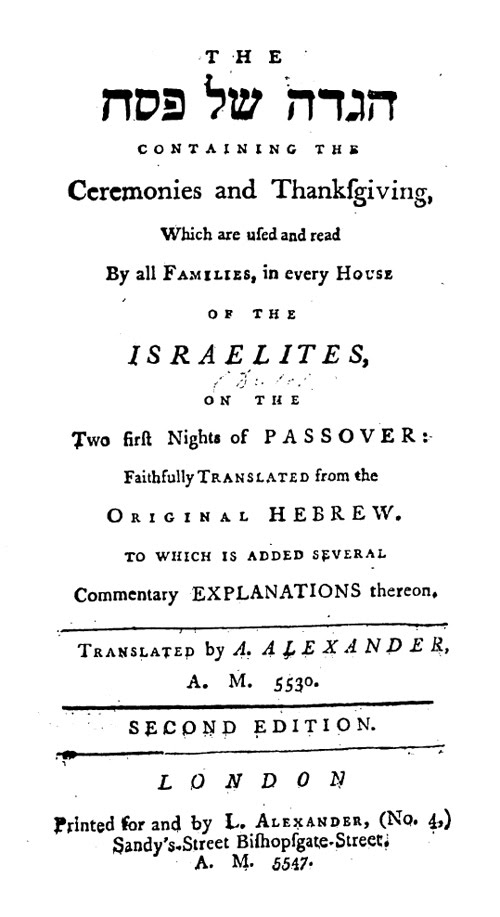
On the first English Haggadah; a short summary of Alexander Alexander's translation and comments.

I've decided to put Alexander Alexander's Haggadah online; you can download it here.

This is the second edition, printed in 5547 (1787), by his son Levy ("L. Alexander"). According to the title page the translation proper was made in 1770. Alexander Alexander (אלכסנדר בר יהודה ליב) was a Hebrew printer active in London in the 18th century.


The second page includes an engraving of Moses slaying the Egyptian, with the caption "Engraved for the Hebrew & English Hawgoda," - and you think we have transliteration problems today. According to the book Judaic Treasures of the Library of Congress the engraving was not for this Haggadah, as the caption misleadingly suggests.

This Haggadah includes interesting customs and interpretations. Here are some of them:

1) In explaining how three matzos are to be set, representing Kohen, Levi and Yisrael, Alexander writes that all three matzos have one, two or three "notches" made into them so that the special designated matzos will not be mixed up. Thus, the Kohen matza laid on top has one notch. He also writes that a fourth matza is added, known as the ספק (i.e. doubtful) because if one of them breaks, it will be used instead. Since we don't know which one it may be used for, hence the doubt, etc. So if anyone spends a lot of time today trying to ensure only whole matzs are used, or has cause to fret while some family member does it, here is a Haggadah where you are instructed to make notches in the matza.

2) He writes that one places "a stick of horse reddish [sic] with the green top to it" on the seder plate. He notes that the reason is "in rememberance of the hard labor, which made the eyes water, and the green top is in remberance of the bitterness of the labour." This is an interesting syncretistic explanation, is it not? Takes care of the problem that horseradish is sharp, not bitter.

3) Writing of the Charoses, he states that it is "made of bitter almonds, pounded with apples, &c."

4) He writes that the Master is given "three chairs set close together, in imitation of a couch." I guess they had armless chairs but not couches in London.

5) "The meannest of Hebrew Servants are seated at the Table . . . with the rest of their superiors."

6) He writes that the Kos shel Eliyahu is drank by the youngest.

7) He explains that the reason why Keha Lachma Anya "is in Caldaic תרגום language, is on account it was customary with our ancestors to elevate their table on some high place in the room and open the door, and invite the poor to come and partake of the Psachal; and this being the language of Babel, the country where they were captives at the time this hgdh was first composed, and the common sort of people at that time, did not understand the Hebrew, therefore they were addressed in that language."

8) He translated Bene Berak as ". . . were entertained amongst the children of Berak." The foonote explains that this is "A name of a place inhabited by Proselytes, Jews descended from Haman."

9) In Vayehi Sheamda he very circumspectly translates שבכל דור ודור עומדים עלינו לכלותינו as "even in several generations they arose up against us to destroy us."

10) Tze U-lemad, "Go forth and learn how Laban the Amarite thought to *serve* our father Jacob." (!)

11) A lot of the language is quaint simply because of the linguistic distance from our own time. So for רבי יהודה היה נותן בהם סמנים he translates "Rabbi Judah makes remarks thereon." In the very next paragraph were are told of "Rabbi Jose of Gallicia." So if anyone ever asks you if any of the Tannaim were Galicianers, you can say truthfully that, yes, according to Alexander Alexander of London, רבי יוסי הגלילי was a Gallician.

12) He has instructions to use the green top (leaves) of the "Horse-Reddish" for Marror, but a "[cut] piece" of the horseradish for Korech. It also doesn't seem like you are supposed to make a sandwich (i.e., marror between two layers of matzah). Rather, he writes that you take the matzah and marror and "put one on the other."

13) Everything is translated into English; however Echad Mi Yodeya is translated to Yiddish and English, and Chad Gadya is only translated to Yiddish (Ein Zicklein). In addition, the Shelah's increasingly rare version of Adir Hu, the נון בויא דיין טעמפיל שירה is included.

As usual, the English here is . . . interesting. For example, in Echad Mi Yodeya you get lines like "Nine is the nine months of pregnance."

Here are four pages from the introduction, which I partially covered.


On a Karaite Haggadah

Here's a Karaite Haggadah printed in Egypt 1903. (The entry in HebrewBooks.org demurely calls it סדר הגדה של חג הפסח כפי מנהג הישראלים, whereas you can plainly see that it is "מנהג ישראלים הקראים.")

There are several interesting aspects about it, including its brevity (only 14 pages including the title page and a page of copyright warning in Hebrew and Arabic). Naturally it consists mainly of relevant biblical passages, including much of what we Rabbanites call Hallel. Interestingly there are a few berachot (blessings) which are very similar in form and content to rabbinical blessings. For example, there is a berachas shehechiyanu (pg. 11) which differs only by the insertion of the word בשלום.


There is a cup of wine, to be held while reciting some ki le-olam chasdos. The בורי פרי הגפן is vocalized with a qomatz, thus showing that the Karaites agree with the grammarians (and most present-day Ashkenazim). Famously the Chacham Tzvi is reputed to have mocked people who said "borei peri ha-gafen," which I think predominates today.

Chacham Tzvi's attitude is quoted by his son in לוח ארש pg. 67a:


There is a combined beracha for matza and marror, and an interesting beracha of "hamotzi lechem ani min ha'aretz."


There's also a form of Kiddush to make - if Pesach falls on Shabbos.

Tuesday, April 12, 2011

Moses Mendelssohn's library.

This is kind of interesting. A book I've been looking for for a long time is finally online. I mean the Verzeichniss der auserlesenen Büchersammlung des seeligen Herrn Moses Mendelssohn (Berlin, 1786). As you know, after you die people go through your stuff. This book is a catalog of Ramad's library. Unfortunately it didn't catalog his seforim, which is a real pity. What's also interesting is that the book was reprinted photomechanically in 1926 by the Soncino-Gesellschaft der Freunde des Jüdischen Buches - and the copy which Google scanned is the reprint. Since it is post-1923 I imagine it wasn't supposed to be available at all, yet Google let it slip through. Here is the title page:


As was the fashion in those days, the catalog listed the books by size, rather than subject. So the list is 108 in Folio, 307 in Quarto, 662 in Octavo and) 37 in Duodecimo, or a total of 1114 volumes (the list includes multiple volumes; for example, the very first entry is numbered 1 to 28 and consists of 28 volumes of the Encyclopédie), The books are in Latin, German, French, English, Dutch and Spanish, and include many dictionaries and grammars for all sorts of different languages.

Since I'll probably go through a list of over 1000 books carefully only when I am old and gray, I'll just list all the English books and some others of interest which catch my eye. I'm not going to do philosophy, since I am not interested in philosophy.

1) Mischnam sive totius Hebraeorum Juris, etc. Cum Commentariis Maimonidis & Bartenorae 1698.

This is Surenhuys's Latin Mishnah, with translation of the Mishnah commentaries of the Rambam and Bertinoro. See my post about this beautiful edition.

2) Buxtorfii Lexicon chaldaicum, talmudicum & rabbinicum 1639.

and

3) Lexicon Hebraicum & chaldaicum. Basil, 1698.

Buxtorf's famous lexica of Aramaic and rabbinic words were used by Rabbi Dr. Benjamin Mussaphia in his Mussaph Ha-aruch, the glosses on R. Nathan of Rome's Aruch which are incorporated in all subsequent editions. R. Nathan accurately passed on the traditional meaning of Talmudic words, but he didn't know Greek. Mussaphia did, or rather, he used Buxtorf.

4) Flavii Josephis juedische historien 1687.

Evidently a German book about Josephus. He had quite a few books on Josephus.

5) Johannis Seldeni de jure naturali etc. 1640.

John Selden was one of England's greatest experts on rabbinic law. He did indeed know his stuff, but that didn't stop R. Isaac Herzog from writing an article in a law journal basically seeking to demonstrate that Selden was not a talmid chochom, although he conceded that Selden's "wide readings in Rabbinics" are a fact and that the Dictionary of National Biography's description of his "extraordinary Talmudic-Rabbinic erudition" is "not far from the truth." Interestingly, R. Herzog laments that Selden did not produce a (Latin) translation of the Mishneh Torah which would have been a "great service to learning."

6) Joseph Priestley's Geschichte der Elektricitat.

A German translation of this English (and eventually American) theologian's History and Present State of Electricity. Joseph Priestley was involved in polemics over Judaism with David Levy, my favorite hatmaking Jewish lexicographer of the 18th century.

7) Buxtorf's Tiberias sive commentarius masorethicus (1665).

This is Buxtorf Sr.'s great work on the Massorah (2nd edition, with additions by his son). This book is basically a refutation of R. Elya Bochur's view on the age of the masorah, nekkudos and te'amim, taking the so-called conservative and supposedly traditional approach that they are much older than the Talmud. This view is explicated in Mendelssohn's introduction to the Torah.

8) Der Koren mit Noten, etc. by Theodor Arnold 1746.

What it sounds like.

9) Kabbala denudata, Sulzbach 1677.

"Kabbalah Laid Bare." See my post about this book, which includes many excerpts from the Zohar translated to Latin.

10) Part 2 and 3 of Wolff's Bibliotheca Hebraea.

No seforim fan's library is complete without one.

11) Lettres de quelques Juifs portugais & allemands. de Voltaire. Paris 1772.

A book attacking Voltaire's attacks on the Bible. This book included Isaac de Pinto's famous, or infamous, argument that actually the Ashkenazim are terrible, but the Sephardim are wonderful!

12) Simon Ockley's Geschichte der Saracanen, etc. 1745.

I include this history of the Muslims (translated from English) because of its author, who besides for being an expert on Arabic and Islam, also translated R. Yehuda Aryeh Modena's book about Judaism, the Riti, from Italian (see here).

13) Der Spinozismus in Judenthums, etc. Amstedam 1699.

Da ma she-tashiv.

14) Romeo e Giulia Dramma per Musica, etc. 1773.

Romeo and Juliet in Italian? Cool/ random.

15) Elucidarius Cabalisticus, etc. by Wachter. Rome 1706.

The Kabbalah Center should sell print on demand copies of this for $360.

17) Ein arabisches Manuscript vom Koran, auf geglaettetem Papiere.

What it sounds like: an Arabic Koran manuscript, on paper.

English books:

1) A Treatise of Algebra both historical and Practical. London 1685.

2) Isaiah, a new translation by Lowth. London 1779.Mendelssohn was a big fan of Bishop Lowth, even referring to him as כבוד רבי in an inscribed edition of his Chumash, which he sent to him in London.

3) Hermes, or a Philosophical Inquiry concerning universal Grammar by James Harris 1775.

4) Three Treatises by James Harris, 1772.

5) The Fable of the Bees, 1728 London.

Bernard Mandeville's classic parable on economics.

6) Interesting historical Events relative to the Provinces of Bengal and the Indostan, by Holwell, 1766.

In Jerusalem Mendelssohn makes a couple of references to Indians. Presumably this book and/ or other reference works were his source.

7) Several volumes of the Monthly Review.

8) An Essay Concerning Humane Understanding (or "Understandiry" - Mendelssohn new English well, but the compiler of this library catalog obviously didn't. There are numerous such misspellings of English words in the list.)

9) The Works of Alexandre Pope Esq. in Ten Volumes complete, etc. 1762.

10) The State of the Printed hebrew Text of the old Testament considered. A dissertation in two Parts by Benjamin Kennicott. 1753.

Textual criticism of the Hebrew Bible, big time. See here about Mendelssohn's opinion of Kennicott and textual criticism (not good).

11) The Elements of physical and geometrical Astronomy. Vol. 1. London 1706.

12) A Discourse concerning the certainty of a future and immortal State. London 1706.

13) Letters to Serena, by Mr. Toland. London, 1704.

The same John Toland who wrote so passionately about extending rights to Jews in England.

14) A Catalogue of the Rarities to be seen at Don Salteros Coffee House in Chelsea.

You could think for a month and not come up with as great a title as that. Apparently it was a museum founded by a guy named John Salter (Don Saltero). My guess this is the closest thing to a comic book in his library.

15) The Life of Socrates collected from the memorabilia of Xenophon and the Dialogues of Plato. London 1750.

16) Christianity Not Mysterious, etc. by John Toland. London 1702.

Christian apikorsus. (Read that sentence carefully.)

17) Experiments and considerations touching Colours, by Robert Boyle. London, 1670.

18) The Works of the Right honourable Addison Esq. 1722.

====

If I checked carefully, that's 18 English entries in the catalog (including, of course, the periodical Monthly Review). In addition, I listed 17 additional books. What a pity that his Hebrew and rabbinic library were not cataloged. Doubtlessly a very skeletal list can be drawn up from his writings, but that's not the same.

Sunday, April 10, 2011

A sketchy sketch on Chasidism by a sketchy (?) character from 1930.

Here is an interesting, albeit not too flattering, article about Chassidim by Maurice Chideckel in the Baltimore Sun Nov. 23, 1920 (click to enlarge and read). "Coué Cult" is a reference to Émile Coué's "method of psychotherapy and self-improvement based on optimistic autosuggestion." Not surprisingly Chideckel, who was a physician and a Litvak, didn't think very much of "methods of psychotherapy and self-improvement based on optimistic autosuggestion."


The article begins noting that "a Rebbe is not a Rabbi. A Rebbe performs miracles and a rabbi does not," and that the greatest such miracle is "called in Hebrew kfizath H'derech," explained as how distance and time lose their relationship so, for example, the 3000 mile distance between New York and San Francisco would seem to shrink as to a few feet.

It includes plenty of vintage Misnagdism: "Basht [sic] never wrote a word, for the adequate reason that he could not write" - and also includes chestnuts like the fact that today (i.e., 1930) Chassidim call Misnagdim Litvak Chazir ("Litvak pig" - this is confirmed from other sources to be a true insult). He seems to admire R. Schneur Zalman of Lyady ("the greatest of all Rebbes . . . the one who purged Hasidism of its vulgarities.")

His conventional history of Chassidus isn't particularly interesting, but his account of contemporary infighting is. Does anyone know what this is referring to? "A few weeks ago a Rebbe was tried criminally in a Galician court for desecrating the dead by spitting on the hearse of his rival as it was carried to the cemetery." He claims that "more than once" he "witnessed a long beard transferred from the chin of its owner to the hand of the antagonist."

He includes a vintage cynical Rebbe joke about fish and playing cards, and a couple of ridiculous blessing stories. Finally, he closes by writing of a fake rebbe he claimed to have known - a particularly boorish man known as "Yankel the informer." Five years after having seen him last, he writes, he saw the same man reborn as the "Broder," or a rebbe from Brody, dressed in fur and silk. When Yankel spotted him, he called him over and whispered to him that he should please take pity on his children and not say anything." His "gabba" claimed that he could not give a drosho on account of a sore throat, and loads of people came for blessings. In other words, he stood by and allowed tons of people to be suckered? Okay.

I don't know much about Chideckel, but I did discover that he came to the United States in his late teens, and in 1900 his wife showed up in Baltimore demanding support. He was arrested and ordered to give said support ($2.50 a week). He in turn claimed that he had been forced to marry this women, who was nine years older than he, when he was 16 (in 1893) and that they never lived together. Hm. It seems that he tried to have the marriage legally annulled, and succeeded once it came to light that he was a minor when the marriage had taken place. Interestingly, his obituaries in 1958 claimed he was 74 years old. If anyone can figure out what happened to the missing 8 years, please let me know.

In addition to editing a Yiddish newspaper (Der Vegvayzer; 1901-1910), he was a physician (whose speciality seems to have been lesbianism), columnist for the Baltimore Sun, and an author of books, such as the awesomely named Fakers Old and New. This book is barely fixated on Jewish fakers, but it does naturally include one such chapter, with a rogue's gallery including Bar Kochba, Shabbatai Tzevi and Jacob Frank, and a section on the Chasidim (surprise!). He doesn't consider the Baal Shem Tov a faker, but he writes (pg. 207) that "the first notorious impostor was the immediate successor of the Baal Shem Tob, Dob Beer. Beer was no visionary. He was a clever faker who is still held in reverence by some members of the sect known as Hasidism." His learning is held against him, and Chideckel writes that "his spies would be a credit to Scotland Yard," and he accuses people working for him of committing robberies so that he could be credited with telling them exactly where their stolen things could be found.

Thursday, April 07, 2011

Solomon Schechter's Genizah gossip from 1898.

Here's an interesting article from the Jewish Chronicle, April 1, 1898. This Cambridge-Cairo Genizah article is one of Solomon Schechter's earliest progress reports, which included some of his more preliminary impressions of the Genizah.

Interesting from a historical perspective, but I will have to take issue with at least one things. He writes, "On one biblical fragment I found some gilt letters. Gold ink was well known to the Jews of antiquity. . . . But its use in the writing of the Scriptures was early forbidden by the Rabbis. The prohibition was meant only to apply to copies intended for public reading in the synagogues. . . . The fragment in question forms a rare exception and must therefore date from an age when simplicity and uniformity in the materials used for writing the Bible had not yet become the rule."

Right, or it was not intended for synagogue use. Although he had the fragment, not me, but I seriously doubt that it was a piece of a Torah scroll, and he doesn't quite say that he thinks it is. So I think his conclusion is imaginary. .

He also mentions the famous children's אלפא ביתא primer (which I posted about here). He calls it a "'Reader without Tears' of the Old World." See here for a related post.

His explanation for why children would begin with Vayikra (Leviticus)? "The Jew of ancient times was not given to analysis [vis a vis education]" and they saw "in every babe, the budding minister." If this sounds disdainful (and it is) note though that he is very positively contrasting it with modern educational theories, which would find Leviticus to be a very improper beginning for children!

He interestingly notes that of the many palimpsests uncovered so far, only two turned out to be Hebrew on Hebrew. The rest are Hebrew on "Greek, Palestinian Syriac, Coptic or Georgian." A palimpsest, in case any reader is unacquainted with the term, is when the ink is removed from a paper or vellum sheet and reused for writing. Over time the original ink becomes faintly visible once again. Schechter points out that it turns out the "the under writing is usually of more importance than the later surface writing."

Next he writes of the exciting discovery of some fragments of the Greek translation of the ger Aquila, which had previously been known only through quotations and from Origen. He notes that the Tetragrammton in the Aquila fragments are written in the ancient Hebrew script.

Finally, he has some unkind words for modern critics, such as Wellhausen. He notes that even though "modern learning . . . has people these very centuries [i.e., 450 to 160 B.C.] with lawgivers, prophets, psalmists, and apocalypse writers," in reality it is still a very obscure period, and many modern theories are "mountains suspended on air," no better than views they are meant to replace.

As one expects, Solomon Schechter is a chatty, interesting writer.

Wednesday, April 06, 2011

Guest post: The Chief Rabbinate and the composition of the London Beth Din, 1840-1984 by Dr Benjamin Elton

I'm pleased to present this guest post by a friend and distinguished scholar. Ben edits Degel, a fantastic journal subtitled "Torah and Jewish Studies From Alei Tzion," a publication of the Alei Tzion synagogue. He submitted this post to me after we discussed the image of the London Beth Din in the 1920s, which I posted here. I thoroughly enjoyed Ben's essay, and I hope other Judeo-Anglophiles will as well.

Although the British Chief Rabbinate has been officially a free-standing institution over its history, it has necessarily developed very strong connections with other Anglo-Jewish institutions, notably the Board of Deputies of British Jews, the United Synagogue, Jews’ College and the London Beth Din. In 1840 the London Beth Din consisted of the Rabbi of the Great Synagogue, already known as ‘Chief Rabbi’ as the Av Beth Din, and a number of rabbinical colleagues. It was axiomatic that the Chief Rabbi would be the head of the court because he had been appointed to his position precisely because of his learning and expertise in Jewish law. His duties as rov required him to answer halachic questions, which he was able to do as a single individual. However some vital functions, such as the granting of a divorce, a conversion or the judgement of a civil legal dispute required the presence of a beth din of three dayanim. In such cases the Chief Rabbi would assemble two colleagues to join him to convene a formal court. As the need for such a court arose frequently a number of men were appointed dayanim, even if the payment was irregular. The Chief Rabbi was therefore Av Beth Din in name, in function and in ability. Today the London Beth Din retains the Chief Rabbi as Av Beth Din but he rarely takes part in its proceedings, and its de facto head is the Rosh Beth Din, the senior dayan of the court. Moreover, the Chief Rabbi is not expected to be a great expert in Jewish law. He is appointed to be a spiritual leader and other men are sought to involve themselves in the complex legal decisions required by a court of Jewish law. But far from being a recent development, this has long been the arrangement, indeed it is one of the defining characteristics of the emergence of a new type of Jewish religious leader in the office of British Chief Rabbi.

From 1802-1842 the Rabbi of the Great Synagogue and Av Beth Din was R Solomon Hirschell. He was assisted during his time as head of the Beth Din by R Samuel of Lissa, R Solomon Aarons, R Zev Wolf, R Hanoch Zundel of Jerusalem, R Azriel ben David Levy, R Aaron Lisser and R Aaron Levy. The Beth Din was kept busy with divorces, law suits and other functions, including the supervision of foreign communities under Hirschell’s authority; on one famous occasion Hirschell sent R Aaron Levy to execute a divorce in Australia. When Hirschell died in 1842 and the community looked for a successor they sought a man who could perform the functions of halachic decisor, fit to head a beth din, as they said, ‘possessed of great Jewish learning and versed in depths of Talmud’ although they also wanted him to have a modern education. The successful candidate was Rabbi Dr Nathan Marcus Adler, previously Chief Rabbi of Hanover. From 1845 until his semi-retirement to Brighton in 1879 Adler fulfilled his functions as Av Beth Din just as his predecessor had done. As colleagues retired or died they were replaced, but that Adler himself was the senior member of the court, both in name and in learning was not contested. In 1876, then, the London Beth Din consisted of the Chief Rabbi, his son Hermann Adler who had rabbinical ordination from Prague, and European immigrant R Dov Ber Spiers, who was also Librarian of the Beth Hamedrash and a traditional Talmudist whose work Divrei Dvash was published posthumously and who was regarded highly by traditionalist East End Jews. We have then a beth din on the same pattern as 1840, the Chief Rabbi, the greatest Jewish scholar in the country, assisted by two learned colleagues. That pattern was broken in 1879 and with exception of one period of five years, never returned.

Monday, April 04, 2011

Should you really eat grated horseradish on Passover? Evidence from an Angleterrish Haggadah from New York, 1837.

Speaking of Haggadahs, Dan Rabinowitz called my attention to the fact that the JNUL added the 1837 edition of the Haggadah, published in New York (and, supposedly, the first Haggadah printed in the United States). See here.

Couple of interesting points. First of all you have to love the reference to "English" as לשון ענגלאטירא, the language of Angleterra. Fancy. The translation was made by David Levi (see here for my prior posts which mention David Levi, that most interesting of 18th century British haberdasher talmid-chachams).


Secondly, I thought this reference to horseradish as marror was interesting.


The "green top of the Horse-radish?" Do you know anyone who uses that, rather than the root? Are all of us who use the grated root being fools? (Full disclosure: I don't use horseradish at all.) How interesting.

Incidentally, in the early days of using horseradish for marror, most likely people did use the leaves. After all, the Semag quotes Rabbenu Tam prohibiting root vegetables for marror. The Maharil forbids using the root based on Rabbenu Tam. Many, many other halachic sources also forbid the root, which of course only highlights the fact that people were using - the root. Later, the Magen Avraham and others recognized a compromise: the leaves should be used for marror, and the grated root for korech.

Finally, since we're talking about Haggadahs, here's an example of an editor who didn't just talk about making an emendation, he went ahead and did it. I'm talking about the problematic phrase from bentsching, where God's hand is described as "full, open, holy and broad." With the change of one very similar sounding consonant in Hebrew, the phrase becomes "full, open, enlarged and broad."

This is from a Haggadah from Leipzig, 1844 (here; unfortunately the title page is missing and I have no other data):


See Baruch She'amar by Rabbi Baruch Epstein, page 211-2, for a good explanation of why הגדושה makes more sense than הקדושה. It will of course be observed that R. Epstein (b. 1860) obviously was not the first to be struck with this idea.

On the Damascus Blood Libel Haggadah and a Kafkaesque Yom Kippur in Upstate New York, 1928.

I once posted about the "Haggadah" the Times of London posted on its page 3 on August 17, 1840. Since I'm having computer woes, and since it's still interesting and timely, here goes another round.

Here it is, click to enlarge, and also feel free to download it as a pdf (here, or even view it as a Google Doc here):


The background is the Damascus Affair of 1840 where Jews were accused of killing a priest who disappeared in February of that year. Jews were arrested and tortured, and confessions extracted. Since, as far as Western Europe was concerned (or at least the liberal elements), this was 1840, the fact that such a medieval and irrational event was occurring was seen as profoundly disturbing.

The Times carried a lengthy translation of most of the Haggadah, following a story on the Persecution of the Jews at Damascus and a couple of letters, one of whom basically writes that whatever the facts in Damascus are, you can't prove or disprove it from Jewish texts and teachings! His point is that people don't always do what books say they do or do not do, and if we're going to try to marshal evidence from books then we're not really following the proper rules of evidence, and this can blow back in disastrous ways. Although he does throw in a few not-very-nice remarks about Judaism, I hate to say it, but the man is kind of correct. But I digress.

Although it may be true that the facts of one particular case can't be proved or disproved from texts, the fact is that when such an accusation is made people want to know what it is those accused believe and what it is they read. So the Times felt it was a good idea to print a translation of the Haggadah sent in by a correspondent. Admittedly I don't know why anyone would have thought that the Haggadah made any sort of open reference to using Christian blood; and if it did then of course no one defending the Jews would have produced it. Still, given the association of the blood accusation and Passover, apparently it was thought a good idea to show exactly what takes place at the Passover night ritual.

As I mentioned in my older post, the truth is that it left out the שפוך חמתך. But I think it's understandable, since this is an apologetic piece and there was no room for nuance. Furthermore, the reality is that readers of the Times of London in 1840 would almost certainly not believe that Englishmen could possibly be included in הגוים אשר לא ידעוך (the nations that don't know [God]) or described as a ממלכת אשר בשמך לא קראו ([a] kingdom which does not call out in [God's] name). These are clearly speaking about heathens and since Western Europe was busy exploiting and tutoring the heathens all over the world at that particular moment in time, it never would have occurred to anyone that it might have meant Europeans.

Furthermore, even if all this is not true, of course שפוך חמתך still has nothing to do with blood. There's nothing about drops of wine though. I guess the best you can say is that this was before Wikipedia and it really was possible to present edited, apologetic material. Note for readers who may not be understanding everything: nothing of any grave importance was omitted and nothing changes. Just two or three moments that would require to much explanation or make people uncomfortable. So, there is no mention of the prayer Shefoch Chamascha, which asks God to pour out his wrath on the nations which don't know God, no mention of the dripping of wine, no reference to "Blood, fire and plumes of smoke," and no reference to some optional songs at the end, which were in any case certainly well known (at the time they were still trying to sort out if Chad Gadya comes from the House That Jack Built or the reverse. See here for my attempt to do just that, from last year). As I put it in the 2008 post, 1840 "was a time of almost comical erudition about all sorts of obscure topics in the mainstream press." So no deception was or could have been intended. It was simply an effort to help spread the truth about the Damascus incident in particular and blood libels generally.

Most people probably don't know that there was a blood libel; or a near one, in New York in 1928. You can read my friend Dr. Yitzchok Levine's article An American Blood Libel - It Did Happen!

The event is the Massena blood libel. What happened was, a 4-year old girl disappeared. Somehow a rumor began that the Jews of Massena (19 families) had killed her for some ritual purpose. One Jew, who was possibly mentally challenged, was questioned by the police, and he did not leave the state trooper convinced that Jews do not make ritual murders. He told the police that he doesn't know very much about Judaism, and when was asked if "it was true that in the old country Jews had the custom of using Christian blood in the holiday services, passing it on to the members of the congregation," apparently he replied that he didn't know if there was such a custom in the old country, but he knows there is no custom like it in America.

So (!) they hauled in the town's rabbi, named Berel Brennglass, for questioning. It was Erev Yom Kippur. According to one report a crowd of 300 to 400 people were outside the police station, who made some kind of menacing remarks when he was brought in. Time Magazine quotes the line of questioning as follows:
"Is tomorrow a big holiday, a fast day? Can you give any information as to whether your people in the old country offer human sacrifices?"
Naturally he was not only outraged, but shocked, and told them so. It is not only you and I who did not expect a blood libel in the United States, but also Rabbi Berel Brennglass in 1928.

Oh, and thankfully the young girl was found the next day - alive. Here is one record of what occurred in the police station, and afterwards:


To continue where this clipping leaves off, after the girl was found and doctors determined that she was uninjured, she explained that she had wandered into the woods to find her 7-year old brother. She became lost, and fell asleep in the woods over night. In the morning she woke up and wandered around, trying to find her way out, until she was discovered.

On Tuesday - the day after Yom Kippur - the mayor met with some of the Jew in the synagogue, and he admitted that the idea that the Jews may have been responsible for the missing girl was his, and that he regretted it. They told him that they can't accept his apology, because it's not just a local matter.

So national publicity was drawn to the case, after which, the mayor of Massena apologized to Brennglass, and the state trooper was reprimanded and suspended. He apologized, too. Here is what he wrote:
October 4, 1928
Rabbi Berel Brennglass.
Massena, New York,

My Dear Rabbi,

I am writing to say that I regret more than I can tell you and am very, very sorry for my part in the incident at Massena.

After the hearing today, I realized as I did not before, how wrong it was of me to request you to come to the Police Station of Massena to be questioned concerning a rumor which I should have known to be absolutely false. I was terribly excited and fatigued at the time, having been on duty for many hours without food or rest. Otherwise I would have thought of the consequences of such an act and would not have done what I did.

I mean every word of this apology and I hope you will take it in the spirit in which it is written.

Sincerely,
Corporal H. M. McCann
Sounds to me like the mayor was a real moron.

Sunday, April 03, 2011

The original Shlock Rock: R. Yisrael Najara's 16th century religious Hebrew poetry set to Middle Eastern rock music.

Everyone knows the Sabbath hymn יה רבון עלם ועלמיא, by Rabbi Yisrael Najara. My guess is that most people don't know that he published this, and many other, songs in Safet in 1586 in his book זמירות ישראל. At the start of each of his poems he gives a short instruction, telling the reader how to sing it. So, for example, in the beginning of Kah Ribbon, he writes "לחן ייא ראבי שאלים שאילמי ערעבי ראשע."

Here are the pages in the first two editions (second is more clear):


What he means to say is that the לחן, or melody, is to the tune of the Arabic ייא ראבי שאלים שאילמי in the mode of ראשט. So if you know how to sing ייא ראבי שאלים שאילמי you're good to go. In case this isn't clear, it would be like the instruction to sing אשר ברא to the לחן of לאנד דאוון אנדר only in this case it would אוסטריליאש rather than ערעבי.

Najara's hymn book is full of instructions of this sort. The melodies are not only Arabic, but also תורקי (Turkish), Spanish and Greek. Almost every song is written to be sung to some kind of non-Jewish tune. In the introduction he writes that his purpose is basically to provide Jewish, religious songs for the youth.

It should be noted that he didn't know dozens and dozens of gentile songs by accident. He spent a lot of time in environments where he learned these songs, which was not lost on contemporaries who did not consider it a particularly pure pastime to hang out in clubs all night, so to speak. R. Chaim Vital wrote that it's true that his songs are alright, but he was drunk all the time. He also accuses R. Yisrael Najara of homosexual behavior, and of sleeping with a married woman. And cooking on shabbos.

Whatever anyone thinks of this stratagem (and/ or the sincerity of the author) he was hardly the first to try his hand at writing religious Jewish songs meant to be sung to non-Jewish tunes. We generally know about the practices from its condemnation. So, for example, the great Masoretic scholar R. Menachem di Lonzano doesn't mind the idea of singing the Jewish liturgy in synagogues to non-Jewish songs, but he is bothered by the idea of specifically writing a Hebrew song with the words meant to correspond with a secular gentile tune in the form of sound alikes. The example he gives is how the words שם נורא sound just like the word signora (שתי ידות [Venice 1618], pg. 142a). It's unclear to me if he is talking about an actual song, or a potential one. In the next paragraph he goes off on R. Yisrael Najara.


Possibly the most notorious user of this technique was famed 18th century Sabbatian Trinitarian Kabbalist Nechemia Chiya Chayon, who seemed to have been particularly fond of the consonance between "La Bella Margherita," a popular Italian song about a beautiful woman named Margaret ("as white as a flower"), and the Aramaic phrase "לא באלהא מרגליתא." His ditty, to be sung after reading the Zohar and Idra, begins like this:

לא באלהא מרגליתא בפום דכל בר חי
כי אם בפום רבינו הוא שמעון בר יוחאי

Or at least that's what his opponents said. He himself did not deny it, but pointed out that this is something that Jews do all over the Ottoman lands where he was from. Here is the verse, at the end of his רזא דיחודא:


See these two posts (here and here) for some examples of Hebrew poetry that also work as Italian poetry. These are a little bit different, as they were original works in both languages.

LinkWithin

Related Posts with Thumbnails
'