Here is an excerpt from a review by Zvi Zohar of Artscroll's Aleppo; City of Scholars by David Sutton (link):
Censorship and 'Correction' of 'Improper' Sources Cited in Previous Editions
Not only does Rabbi Sutton ignore academic literature and conceal his use of non-religious sources, he also censors 'improper' sources mentioned in previous editions of LiKedoshim Asher Ba'Aretz. For example: both previous editions quote in full the short work Zichron Divrei Aret"z, by Rabbi Abraham Dayan, which first appeared in 1850.42 In that composition, Rabbi Dayan included a variety of anecdotal information that had reached him regarding the city of Aleppo and the Jews within it, from antiquity until his own times.43 Inter alia, Dayan relates that one elderly scholar told him of a tradition according to which, in each one of the old city's gates was preserved a wondrous ancient object. Thus, in one of the gates there was the tooth of an ancient fish, two feet long, in another gate 'the nail of one of the giants, as [large as] a pillow and a duvet', and in a third gate, a jug of sand from the river Sambatyon. Rabbi Dayan knew that some people tend to discount the factuality of information such as this, and so he wrote:
And as I have seen some persons, wise in their own eyes, who say that “the world goes according to its ways”,44 and they believe nothing unless they see it with their own eyes or unless it's written in the books of Hamirs,45 therefore I shall transcribe for them here what was written in the book of Me’or Eynayim by dei Rossi on p. 88, in the name of the head of the Christian scholars,46 book 15 chapter 9, about the size of the giants' body. That [scholar reported that] he saw the tooth of a man which, if cut according to the measurement of our teeth, could be divided into one hundred [of our] teeth.
In other words, in order to put an end to these skeptics' criticism, Rabbi Dayan reveals that he read Azariah dei Rossi's Me’or Eynayim, and that the author quoted there information from the book of a very major Christian scholar. This Christian scholar reported that he saw a huge human tooth, and this finding verifies the fact that giants existed in the past. From this, the above-mentioned skeptics may conclude, that there is no reason to doubt the report about the giant's nail found in one of the gates of the City of Aleppo.
Let us now see, how the paragraph quoted above is paraphrased in Aleppo:
I have seen some people, convinced of their own intelligence, who think that nothing exists beyond nature and don't believe what they haven't seen with their own eyes or in secular sources. Therefore, for these skeptics I cite a book which quotes secular sources concerning the existence of ancient giants. He writes of scientific finds of the teeth of giants that are one hundred times the size of average human teeth.47
The contrast between this "translation" and the original text is striking! The title Me’or Eynayim has been exorcised and it is now cited anonymously as "a book", and the information dei Rossi attributed to “the head of the Christian' scholars” is now attributed to "secular sources". Furthermore, while that Christian scholar reported [one!] giant tooth that he saw with his own eyes, in Aleppo's rewriting this report became "scientific finds" of "teeth of giants" [=many teeth of many giants].
In order to explain this amazing transformation we should recall, that the book of Me’or Eynayim raised a huge debate when it was published, for the writer was of independent critical thought and dared to raise difficult questions regarding various traditions found in Rabbinical literature. The Rabbis of Venice imposed a ban (herem) upon ownership of the book and upon reading it, and the same was done by Rabbis in other towns in Italy, as well as by the Rabbis of Safed. The Mahara"l of Prague attacked Azariah dei Rossi and Me’or Eynayim in his book Be'er haGola.48
The fact that Rabbi Abraham Dayan, son of the most aristocratic Jewish family in Aleppo and author of several 'kosher' religious books, read Me'or Eynayim, treated it as a reliable source and attributed credibility to information quoted in it in the name of a major Christian scholar – does not at all cohere with the portrait of the characteristics of the Aleppo community and its scholars, which Rabbi Sutton would like to cultivate among his readers. Based on his (not unfounded) confidence that nobody within the English speaking Aleppan community would be likely to discover the change, Sutton permitted himself to 'purify' the original text by Abraham Dayan – a text that neither David Zion Laniado nor Mordechai Attiah had thought to change. Furthermore, knowing that English readers in the early 21st century attribute credibility to scientific findings, Sutton decided to write that in this anonymous text there are "scientific finds of the teeth of giants" – even though all that really appears there is the testimony of one man who saw one tooth.
But this Ultra-Orthodox censorship led the writers of the book to a place where they would surely be surprised to find themselves. For who is this Christian scholar, whose words they converted to "scientific finds"? If one reads the text of Me'or Eynayim one finds that Rabbi Azariah dei Rossi is citing none other than … Augustine of Hippo! Indeed, in his City of God, book 15 chapter 9, Augustine seeks to confirm belief in the veracity of the Bible's reports about the bodily measurements and the life spans attributed by the Bible to pre-diluvian humans. He testifies that on the sea shore by Utica (a city sited in what today is Northern Tunisia) he saw the molar of a human being, apparently one of the giants of yore, that was one hundred times larger than one of 'our' teeth. The bottom line is, then, that the Syrian community inBrooklyn and elsewhere were treated, thanks to Sutton's efforts at censorship, to a text in which the words of St. Augustine in his book 'City of God' were raised to the level of "scientific finds" with an Ultra-Orthodox "hechsher" from Artscroll Publishing! To which we can only say: "this is 'Torah' and this is its reward."
42 The work was published in Livorno in 1850, together with other works by the author: Holech Tamim and Poel Tzedek.
43 This is how Yaron Harel summarizes the contents of this work: 'a random enumeration of various historical events which took place in Aleppo, as traditionally told in the city. Beginning with legends about the city's conquest by Yoab ben Seruyah, and ending with events which took place in the author's times' (Yaron Harel, ibid n. 19, p. 48).
44 Hebrew: Olam ke-Minhago Noheg, i.e., reality follows the laws of nature (and thus, such anecdotes are suspect).
45 The books of Hamirs = the books of Homerus = books considered to be credible by the educated world.
46 Examining the source in the Me’or Eynayim (Mantova 1674 p. 88) reveals that Rabbi Dayan omitted one word here, maybe because it seemed unclear to him. And here is the original text: "the head of the Christians' scholars wrote in his City in book 15 chapter 9, about the size of the body of giants, that he saw the tooth of a man which if cut to the size of our teeth, would be divided into one hundred teeth." For further identification of this source, see text below.
47 P. 11.
48 See Joseph Dan, ROSSI, Azariah, in: Encyclopedia Judaica (1973) 14:315-31, and see also the editor/translator's introduction in Light of the Eyes, Azariah de´ Rossi; Translated from the Hebrew, with an introduction by Joanna Weinberg, Yale University press, 2001.
Please see my prior post 'What would R' Azaryah surely have resented? The portrayal of a controversial rabbi by Artscroll.,' which is probably the first and last time that the name of R. Azaryah de' Rossi will be mentioned in an Artscroll publication. De' Rossi's work Me'or 'Enayim was not only cited by obscure (at least outside of Aleppo) rabbinic figures like Abraham Dayan, but he was also cited by the author of Minhas Shai on the Bible - a massoretic commentary with accepted halakhic authority - by R. Yaakov Emden, by a Lithuanian roshei yeshiva such as Netziv, by modern scholarly rabbis like Menachem Kasher, whose works are considered very valuable and certainly acceptable in the faithful communities which Artscroll hopes to shape the religious thinking of.
Read the rest of Zohar's review (in English translation, as linked above, or in the Hebrew original). It includes such chestnuts as the fact that the book reproduces a photograph from an out-of-print work on Aleppan Jewry from 1910 - by a Jewish Christian missionary without explaining who he is; the book helpfully misspells his name, ve-ha-mevin yavin. Incidentally, this Joseph Segall was allowed by the communal leaders to photograph a page of the Aleppo Codex, which is wonderful because it meant that the Ten Commandments in Deuteronomy from the Codex was preserved (see its image here); but also not so wonderful, since it may well be that the reason why after this point the Aleppan rabbis and communal leaders steadfastly refused to allow the entire codex to be photographed by anyone, was because of the Segall incident - a consequence that proved most unfortunate, since a lot of the Codex is now missing, unphotographed).
Monday, May 05, 2008


Monday, April 14, 2008
Re-illustrating the sensibilities of 16th century Jews; a great Holy Hyrax post:
Holy Hyrax has an excellent post about a modern facsimile of a 17th century Haggadah which censors many images in line with current Orthodox sensibilities. The reprinted Haggadah in his possession was distributed by the kiruv organization Arachim, however HH allows that he is not sure if they comissioned the changes, or if they simply distributed an already changed Haggadah. He did email to ask, but has of yet received no reply. In any event, it is very interesting; sleeves were added to women with rolled up sleeves in the original, statues and naked babies disappeared and more. See his post for images and explanation: link
Thursday, April 10, 2008
Doing Daf Yomi in London, 1849*; along with a Christian theory as to the origin of Reform and modern Tanakh study among the Jews
Thanks to the New York Public Library Google has many issues of the mid 19th century periodical Journal of Sacred Literature, edited by John Kitto.
In the third volume, published in 1849, there is an interesting article called 'The Schools of the Hebrews,' translated from the French original by Dom. Augustine Calmet. 'The Schools of the Hebrews' purports to give an account of Jewish education and academies throughout the ages, and is supplemented by the translator's account of modern Jewish learning societies in Europe (beginning pg. 103).
First mentioned is the Chevra Shas. "Every member must read a folio every morning . . . Once in seven years the whole of the Talmud is concluded; when a grand feast is made null and void . . . (See pg. 104 for the interesting account given between my dots ( . . . )).
There is much more of interest, but let me just mention one note towards the end (pg. 106): "The fourth association is termed [Chevra Mikra] or Scripture Society . . . The members of the society have a profound knowledge of the Scriptures . . . Since the 'London Society for promoting Christianity amongst the Jews' began to accommodate the Jews abroad with cheap copies of the Old Testament free from all the above commentaries [ie, Rashi, Radak, Ibn Ezra, Abarbanel, Metzudoth, etc.] there is generally to be found in every large town inhabited by Jews in Poland and Russia, a society of young men called Chevrah Tanach, whose object is to read the Bible without any comment; for which purpose these young men have a room for themselves; for the Beth Hamedrash would not be allowed for that purpose. All these young men are sceptical about the Rabbinical oracles, and it is most probable that the present movements amongst the Jews, and the cry for reformation and 'no Rabbinism,' owe their existence, under God, to the London society, in giving free course to the oracles of God amongst the Jews, to whom they were first committed."
*Edit: tz"l 1843. MenachemMendel pointed out the following: This is actually from Moses Margoliouth's The Fundamental Principles of Modern Judaism Investigated, pp. 84 ff., which can be seen here (I hope). This was published in 1843. It was taken either directly from there or from the Rev. W. Ayerst's The Jews of the Nineteenth Century, which quoted Margoliouth and was published in 1847. I came across this last year while who knows looking for what.
Margoliouth's name came up in the post about the Rambam image the other day.
Wednesday, April 09, 2008
Haggadah of the Times of London, 1840: a civilised response to the Damascus Blood Libel.
The background to the Damascus Affair (ie, the 1840 blood libel against Jews that became famous around the world) is or should be well known. If not, click the link.
What is most interesting is that in reaction the Times of London printed a translation of virtually the entire Haggadah on page 3 (August 17, 1840 edition) titled "Celebration of the Passover by the Jews."
It begins "A correspondent has furnished the annexed very minute account of this ceremony, which will be exceedingly curious in itself to most of our readers, and has at the same time an evident bearing on the Damascus case. It repels strongly the barbarous notion that human blood, or blood of any kind, is essential to its celebration:-- (click below to enlarge)


It must be noted that shefoch chamoscha is not mentioned (nor Chad Gadya, the other songs at the end or the declaration of Lshana Habaah be-Yerushalayim). One cannot help but get the impression that it was not mentioned not because the editors of the Times were duped by whomever prepared this translation and account. It was a time of almost comical erudition about all sorts of obscure topics in the mainstream press.
As Simon Winchester writes of a slightly later period in "The Meaning of Everything: the Story of the Oxford English Dictionary," "[F]or very many they were also cultured and learned times besides. . . . It is perhaps worth recalling just how very well educated people were in those days - or at least to recall how very well educated the educated clases were. . . . [p]eople, or people of a certain kind in the Britain of the day, were quite simply possessed of much time and much learning, and in far greater abundance than many like people possess it today. Items from the newspapers of the time hint at the almost incidental, quite casual cleverness of the cleverest of the reading public. An illustration of the kind of things appears that day in the 'Telegrams in Brief' section of The Times, in which it reports, without explanation or adornment, that:
Further hostilities are reported between the Zaranik tribe and the forces of the Zaidi Imam Yahya of Sana'. The Zaranik attacked a Zaidi detachment at Mansuria, near Hodeida, and have been plundering caravans trading with Sana'.
No further details are offered to suggest where all this fighting was (Yemen, one imagines), nor the identities of the parties to the feud. The newspaper's editor presumes that readers, quite simply, had sufficient education to know.
In short, I suspect that the reason why the last hour of the seder is summed up in a paragraph mentioning birchas ha-mazon, but not what can legitimately be seen as a dark moment of the seder (shfoch chamoscha), or the messianic hopes of the Jews (leshana habaah be-Yerushalayim) was because the editor thought it best not to mention it, fearing that such moments would distract from the thesis the paper was trying to present: that what actually happens and what is actualy said by a Pesach seder "repels strongly the barbarous notion that human blood, or blood of any kind, is essential to its celebration."
Further reading: 1841 English translation of Effés Dammim: A Series of Conversations at Jerusalem Between a Patriarch of the Greek Church and a Chief Rabbi of the Jews, Concerning the Malicious Charge against the Jews of using Christian Blood by the maskil Rival (Yitzchak Baer Levinsohn), author of Teudah Be-yisrael. Appended to this particular book is a must-read: extracts from "Reuchlin's defense of the Talmud," pp. 201-208.
Tuesday, April 08, 2008
On that famous picture of the Rambam
There's a famous image portraying Rambam (Maimonides) that we've all seen. link
Perhaps you remember it from the cover of that blue 'Machberes' notebook you used as a child:

(Like the image above; sorry, I can't locate a picture of the older ones with the Rambam image).
Perhaps you remember it from Israeli currency:

There's a statue in Córdoba of the famous son of Córdoba:

This is from the 1906 Jewish Encylopedia:

The point is, this is the image you know. But where is it from? I certainly would not have imagined it to be very old, but considering the Jewish Encyclopedia, my guess was that it is from the 19th century.
In fact, it is from the 18th. I could have learned this by visiting the Yale Maimonides 800th yahrzeit exhibit (or site), but I came across the info in a more interesting way.
Apparently this image was 'discovered' in the mid 19th century by Italian scholar Yashar (R. Isacco Samuele Reggio, 1784-1855). Reggio found the following portrait in a 34-volume encylopedic work called ' Thesaurus antiquitatum sacrarum' (1744-69).
Here it is:
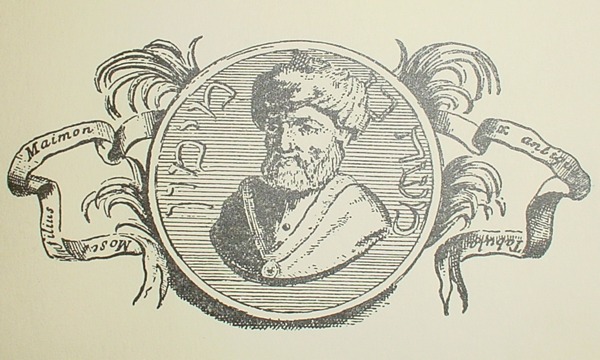
Read an excerpt from an interesting letter, dated 1847, by a Jewish Christian missionary living in England named Moses Margoliouth:
"I know you [ie, Rev. Dr. J. Horlock] are a profound admirer of that Hebrew sage. I think you will be pleased, therefore, with the accompanying miniature portrait of him. You may have seen it before, for I printed it as a heading to the prospectus of the Philo-Hebraic Society. If not, here it is. I do not think that anybody in England ever saw it before I introduced it. You will, however, wonder whether it is a real likeness, or merely a fictitious one. I will, therefore, give you all the information I possess about it, and judge for yourself. The famous Italian-Hebrew Scholar, Reggio, discovered it first in that masterpiece of a work, "Thesaurus Antiquitatum," published at Venice, by Blaseus Ugolinus. He sent a sketch of his discovery to his friend, Herr Solomon Stern, of Berlin. The latter was naturally anxious to know whether the representation was real or imaginary. Reggio, therefore, sent the following explanation; " In the celebrated work, ' Thesaurus Antiquitatum Sacrarum Blasie Ugolini, Venetiis, 1744,' in the first volume, p. 384, is found the likeness of Maimonides, which the author [of ' Thesaurus Antiquitatum'] says was taken, ' ex-antiqua tabula,' without, however, stating more fully and circumstantially how he came to the possession of this tabula, where it existed, and if any one bore testimony to the authenticity of the likeness. However, as Ugolinus is known as an industrious, honourable man, acquainted with his subject, and who cannot easily be suspected of fraud, there is nothing against assuming the probability that at the publication of his work he had really before him such a tabula."
"Herr Solomon Stern printed on one sheet of paper a few copies of the above miniature, accompanied by a copy of Reggio's letter. I was fortunate enough to get a copy of that document, sent to me by a kind friend from Berlin, who knows my partiality for such literary curiosities."
So there you have it. The image is certainly from 1744, but the editor of the Thesaurus antiquitatum sacrarum claimed that it was copied from an old image. Margoliouth must be believed that it was not common in England in 1847, even if it isn't literally true that it was he who 'brought' it to England - not that it needn't be. By 1906 it must have been widespread, thus it seems to have originated in the mid 18th century, been 'discovered' in the mid 19th by Reggio, and disseminated from there.
(If you want to read something really interesting, continue reading Margoliouth's account of the image, where he digresses to complain at ill-treatment by a Jewish scholar to whom he called the image's attention to:
"...did Dr. A. Benisch acknowledge publicly that he was indebted to me for Maimonides' likeness, as well as for Reggio's letter ? No, no. I am a Christian Jew ; it would be an acknowledgment that converted Jews have been misrepresented, as to their characters and principles. Besides, what would the Jews, at large, say? " Dr. Benisch was actually applying for information on Jewish literature to a M'shumad (an apostate), and we have all along maintained that converted Jews know nothing about our learned men, and that it is only the ignorant who are entrapped in the conversion nets." I can understand all this; but common justice asks, " Is it right?"
link).
Perhaps you remember it from the cover of that blue 'Machberes' notebook you used as a child:
(Like the image above; sorry, I can't locate a picture of the older ones with the Rambam image).
Perhaps you remember it from Israeli currency:
There's a statue in Córdoba of the famous son of Córdoba:
This is from the 1906 Jewish Encylopedia:
The point is, this is the image you know. But where is it from? I certainly would not have imagined it to be very old, but considering the Jewish Encyclopedia, my guess was that it is from the 19th century.
In fact, it is from the 18th. I could have learned this by visiting the Yale Maimonides 800th yahrzeit exhibit (or site), but I came across the info in a more interesting way.
Apparently this image was 'discovered' in the mid 19th century by Italian scholar Yashar (R. Isacco Samuele Reggio, 1784-1855). Reggio found the following portrait in a 34-volume encylopedic work called ' Thesaurus antiquitatum sacrarum' (1744-69).
Here it is:
Read an excerpt from an interesting letter, dated 1847, by a Jewish Christian missionary living in England named Moses Margoliouth:
"I know you [ie, Rev. Dr. J. Horlock] are a profound admirer of that Hebrew sage. I think you will be pleased, therefore, with the accompanying miniature portrait of him. You may have seen it before, for I printed it as a heading to the prospectus of the Philo-Hebraic Society. If not, here it is. I do not think that anybody in England ever saw it before I introduced it. You will, however, wonder whether it is a real likeness, or merely a fictitious one. I will, therefore, give you all the information I possess about it, and judge for yourself. The famous Italian-Hebrew Scholar, Reggio, discovered it first in that masterpiece of a work, "Thesaurus Antiquitatum," published at Venice, by Blaseus Ugolinus. He sent a sketch of his discovery to his friend, Herr Solomon Stern, of Berlin. The latter was naturally anxious to know whether the representation was real or imaginary. Reggio, therefore, sent the following explanation; " In the celebrated work, ' Thesaurus Antiquitatum Sacrarum Blasie Ugolini, Venetiis, 1744,' in the first volume, p. 384, is found the likeness of Maimonides, which the author [of ' Thesaurus Antiquitatum'] says was taken, ' ex-antiqua tabula,' without, however, stating more fully and circumstantially how he came to the possession of this tabula, where it existed, and if any one bore testimony to the authenticity of the likeness. However, as Ugolinus is known as an industrious, honourable man, acquainted with his subject, and who cannot easily be suspected of fraud, there is nothing against assuming the probability that at the publication of his work he had really before him such a tabula."
"Herr Solomon Stern printed on one sheet of paper a few copies of the above miniature, accompanied by a copy of Reggio's letter. I was fortunate enough to get a copy of that document, sent to me by a kind friend from Berlin, who knows my partiality for such literary curiosities."
So there you have it. The image is certainly from 1744, but the editor of the Thesaurus antiquitatum sacrarum claimed that it was copied from an old image. Margoliouth must be believed that it was not common in England in 1847, even if it isn't literally true that it was he who 'brought' it to England - not that it needn't be. By 1906 it must have been widespread, thus it seems to have originated in the mid 18th century, been 'discovered' in the mid 19th by Reggio, and disseminated from there.
(If you want to read something really interesting, continue reading Margoliouth's account of the image, where he digresses to complain at ill-treatment by a Jewish scholar to whom he called the image's attention to:
"...did Dr. A. Benisch acknowledge publicly that he was indebted to me for Maimonides' likeness, as well as for Reggio's letter ? No, no. I am a Christian Jew ; it would be an acknowledgment that converted Jews have been misrepresented, as to their characters and principles. Besides, what would the Jews, at large, say? " Dr. Benisch was actually applying for information on Jewish literature to a M'shumad (an apostate), and we have all along maintained that converted Jews know nothing about our learned men, and that it is only the ignorant who are entrapped in the conversion nets." I can understand all this; but common justice asks, " Is it right?"
link).
Friday, April 04, 2008
Mordecai Kaplan and Louis Ginzberg discuss the relative merits of derashas vs ancient (and modern) laundry lists
Here's a record of a fairly interesting exchange between Louis Ginzberg and Mordecai Kaplan, recorded in the latter's diary (as published by Mel Scult; Communings of the Spirit: The Journals of Mordecai M. Kaplan, 1913-1934):

Monday, March 31, 2008
R. Nathan Marcus Adler's instructions for his family
Throughout the mid-19th century, one figure dominated the religious life of Jews in Great Britain, Chief Rabbi Nathan Marcus Adler (1803-1891).1 In addition to bearing such distinctions as being Europe's first Orthodox rabbi with a doctorate (1828; for his dissertation De idea summi Numinis), a personal friend of Queen Victoria's husband Albert from his youth, and generally successfuly navigating political minefields, he was also an accomplished talmid chochom, author of a valuable study of Targum Onqelos, Nesina Le-ger (his most famous work; he also wrote other scholarly works, many halakhic teshuvos and chiddushim on Talmud), and despite his British Hanover-origin, (ie, he was "German") he was veddy, veddy British; when he was appointed Chief Rabbi it was on condition that he learn to speak English within two years. He accomplished it in one. (Interestingly enough, another serious candidate was R. Samson Raphael Hirsch. Although he found his niche, one wonders what a Britified R. Hirsch might or might not have eventually accomplished and what his career might have looked like.)
Here are some interesting excerpts and summaries of his Last Will & Testament written for his descendants on "December 31, 5644 - 1883." The matters discussed here shed valuable light on his own priorities as well as what rabbinic concerns within Britain were at the time. His words alone are in inverted commas.
"I have been very ill and near death, but Almighty God in His mercy has so far restored me to health that I am able, although inadequately, to write. Being in Brighton, and no longer surrounded by members of my family, I feel bound to lay the following religious duties to the hearts of my children, grand- and great-grandchildren, with the earnest wish that they may always observe them, and thereby keep my memory fresh and green."
Adler goes on to explain why it may seem that he will speak less of "moral duties" than "religious duties." It is not because the former are less important - on the contrary, they are also mitzvos and thus commanded by God. However, in his time there is a greater spirit of laxity in the aforementiones religious duties, and therefore his family faces a greater temptation to neglect them. Adler then writes that the main principle of Judaism is conained in Deut 6. They must always remember "ushmartem va'asitem," (Lev.19.37).
Next Adler explains that Tanakh, our Bible, is our most precious book, because it "affords us guidance through life," and also "it teaches Israel his origin, his history, his mission to influence mankind in the knowledge of the only one God." Furthermore, it introduces the concept of the eventual arrival of the moshiach, when the whole world will know the one God. Given how important Tanakh is, Adler councils his family, cause your children to read one perek daily, perhaps after morning prayer.
Having mentioned the centrality of Tanakh, he then stresses the importance of Torah she-be-'el peh - Oral Law - giving by way of illustration the examples of tefillin and mezuzah. Then he asks them to read the weekly sidra with targum ("or an easy commentary"), or even with English translation should his descendants not know Hebrew sufficiently. (Interestingly, he does not stress the importance of Hebrew proficiency. Perhaps these are the words of a man resigned to the fact that not all of his descendants could be counted upon to know Hebrew. It should be remarked that Adler was party to the establishment of a society for the promotion of the revival of Hebrew, spearheaded by Eliezer Lipmman Silbermann, editor and founder of Ha-maggid.) Also - study rabbinical literature so that they would be acquainted with it - at the very least, on shabbat.
Next Adler turns to the home, which he says is the most important Jewish institution and the center of Jewish life. Parents must keep kashrut with rigor and they must teach their children to keep it just as strictly outside of the home. The wife must take care that nothing trefa enters the premises and - interesting! - she should not be ashamed to involve herself in the kitchen to ensure that the servants are keeping kashrut, especially basar ve-chalav (ie, the separation of meat and dairy).
"Do not listen, my dear children, as regards the Law 'Thou shall not seethe a kid in its mother's milk' (Ex. 23.19, 34.26, Deut. 14.21), to the criticism of the so-called Neologians (ie, Reformers. 'Neolog' was the term current among Hungarian Jewry. In Reform in general, but especially in Britian, there was a decided neo-Karaite tendency), who assert that the Law must be taken literally, for this would be senseless. Depend upon it, from the very time of its promulgation it was expounded and carried out in its extended sense." Adler emphasizes that the threefold repetition in the Bible teaches us to keep it scrupulously - "Depend upon it."
Furthermore, they should know that there are also the commandments called chukim, for which we do not know a reason for its command, whether such a reason is "spiritual, moral or sanitary or all three together" - but we do know that no mitzvah is without beneficient motive.
Next he discusses behavior for all week long: integrity and scrupulousness in business is a must. He reminds them that such behavior will give them a good name and make their reputation, but above all, it will constitute a kiddush Ha-shem.
He then tells them forcefully: shun usury! "Whatever your calling, shun, oh my dear ones, every kind of usury, for usury still constitutes, alas! the malignant canker which sullies the fair name of our nation."
Moving away from the week, he tells them that as industrious as they must be during the week, they must rest and keep the shabbat. The shabbat teaches the greatest truths of Judaism. It has been "the cause and moving spirit of Israel's preservation." (Ahad Ha'am may have coined the clever phrase that the Sabbath kept the Jews even more than the Jews kept the Sabbath, but you can see that the sentiment predated that.) What should their shabbat be like? It should be joyous, a day of joy and tranquility. They must "distinguish it with a better meal, better dress" and with exercise in the fresh air, but above all a "higher rest," which sanctifies God's name.
Although he already mentioned that they ought to study the sidra with Targum and also rabbinic literature, he reemphasizes this point. On shabbat they must show an even greater devotion to and more zealous study of Torah (than, presumably, during the week). He suggests that on the shabbat they give their children examinations to see how they've advanced in their Torah study.
What else mus they do for shabbat? They must keep shabbat holy - from beginning to end. There must be no business, writing or riding - no matter how early shabbat begins (presumably here we see that a tendency toward laxity with the beginning of shabbat, when it started early during winter, was rampant). Adler reminds his family to remember Neh. 13.15-23, wherein the profanation of the beginning of shabbat brought about great evil.
He assures them that if they lead a pious life, they could expect to escape the punishments which God warned sinners of, and they will instead partake of the choice blessings that he promised the individual and the nation. They can be assured that they will enjoy this world and the world to come. שֹׂבַע שְׂמָחוֹת, אֶת-פָּנֶיךָ; נְעִמוֹת בִּימִינְךָ נֶצַח - forevermore!" (Ps. 16.11)
He concludes "Most solemnly" that they are to "be good Jews and Jewesses," and are to keep in mind future reward and punishment, to lead a life of firm morality and strict observance!
I obtained the text of R. Nathan Marcus Adler's will from Ethical Wills: A Modern Jewish Treasury, by Jack Riemer and Nathaniel Stampfer.
Further reading, see the interesting tribute "The Late Chief Rabbi, Dr. N. M. Adler זצ״ל," by M. Friedländer in JQR Vol. 2, No. 4. (Jul., 1890), pp. 369-385.
1 It should be noted that he pioneered an interesting technique for asserting his rabbinic authority: he all but banned other rabbis from operating as such in Great Britain. To such an extent did he personally enjoy hegemony over the rabbinate in Britain, that dayyanim serving under him were unable to even use the title "rabbi," - when they were being called to the Torah or otherwise!
Thursday, March 20, 2008
Rabbi Chid"a and chocolate
In R. Haim Jos. David Azulay's travelog מעגל טוב there is an interesting passage (one of many) which records events that took place on January 6-7, 1766:
"We departed from Nice at noon . . . and crossed two mountains and a hill . . . we came upon a mountain with such deep snow that we could even stand; us and all of our things sank into the snow. So we hired four gentiles to assist us . . . It was a sunny day and I was wearing two samaras2 and two pairs of socks, but even so I was in great distress from the cold. It was a good thing I had chocolate with me - I ate more than a litre!

1 The title is from Proverbs 2.9.
2 Spanish sheepskin coats
Monday, March 17, 2008
Can a woman be מדקדק?
Shulchan Aruch Orach Chaim 61.24
One must recite the Kerias Shema with cantillation, as the Torah is read. Rema's addendum: But this isn't customary in our [Ashkenazi] countries. Nevertheless, the grammatically-inclined are stringent in this matter.
Here is a typical example of Kerias Shema as found in Artscroll siddurim ("Everyone should have a copy").

(click above to enlarge or click here)
But here is the Kerias Shema as found in the Artscroll Ohel Sarah Woman's Siddur, where the cantillation is not included "for the convenience of those who recite in the manner it is read from the Torah":

Interestingly enough, in the Artscroll "chinuch edition" siddur (Chaim Shlomo) for schoolchildren the cantillation is present (without the note explaining why there is cantillation).
Hat tip goes to Moshi.
צריך לקרות קריאת שמע בטעמים כמו שהם בתורה. הגה: אבל לא נהגו כן במדינות אלו, ומ"מ יד המדקדקים מחמירים בכך
One must recite the Kerias Shema with cantillation, as the Torah is read. Rema's addendum: But this isn't customary in our [Ashkenazi] countries. Nevertheless, the grammatically-inclined are stringent in this matter.
Here is a typical example of Kerias Shema as found in Artscroll siddurim ("Everyone should have a copy").

(click above to enlarge or click here)
But here is the Kerias Shema as found in the Artscroll Ohel Sarah Woman's Siddur, where the cantillation is not included "for the convenience of those who recite in the manner it is read from the Torah":
Interestingly enough, in the Artscroll "chinuch edition" siddur (Chaim Shlomo) for schoolchildren the cantillation is present (without the note explaining why there is cantillation).
Hat tip goes to Moshi.
Thursday, March 13, 2008
What's peshat with peshat? Is there a place for peshat in Orthodoxy?
In this comment thread (link) commenter SB critiques the forthcoming YU-OU Day of Peshat conference (see here* - I think I'll be there).
He writes:
"WADR, if one would read the list of topics, one would think that Pshat and the academic study of Tanach, as defined and severely critiqued by R Moshe Lichtenstein are the only or preferred means of Parshanut HaMikra. Like it or not, Rashi and Ramban both spend much time delineating what is Pshat, Drush and which Medrash is worth considering and which is far fetched from the Pshat. Ibn Ezra cites but also for the most part vehemently rejects Karaite based interpretations. It is too bad that noone is on the listof speakers who can deal with the issues of the borderline between Pshat and Drash."
...
"FWIW, the Abarbanel is very critical of Ibn Ezra's intimation that Joshua Bin Nun wrote part of the Torah ( Bamidbar 21:1)."
To which I reply:
"The homiletic style is sovereign within Orthdoxy right now (as partially evidenced by your fine parasha roundups), with peshat being almost considered illegitimate these days.Thus, a better critique would be for the drush establishment to integrate some peshat a bit more, rather than for some solitary occasions like this one, which are trying to return peshat to a legitimate endeavor within Orthodoxy, to be asked to integrate homiletics. Homiletics is strong, now let's support peshat too."
and I ask:
"Will you cherry pick to find commentators who are critical of Abarbanel's unorthodoxies? Or to criticize the Gemara's intimation that Yehoshua wrote part of the Torah?It isn't the Orthodox exegetical establishment that is beleaguered, within Orthodoxy, these days. My recommendation is to allow Ibn Ezra and Neo-peshat some space to function within Orthodoxy, if not for their own intrinsic value, then at least so that the part of our community which is incapable of being edified by gematriah and farfetched non-literal explanations can also be edified by the study of Tanakh."
* And here for the list of speakers and topics.
Wednesday, March 05, 2008
The הברה אשכנזית in a 17th century English book
It isn't all that often that one sees this.
Have a look at the spelling of the word לילית in the following from the book The present state of the Jews by Lancelot Addison, London 1675:


Have a look at the spelling of the word לילית in the following from the book The present state of the Jews by Lancelot Addison, London 1675:
Sunday, March 02, 2008
To think that I shall never see,
A Poem lovely as a . . .19th century Hebrew forgery scandal
Here's a slightly bizarre poem about the Shapira strips affair, which appeared in Punch (London, England), Saturday, September 08, 1883.


Thursday, February 28, 2008
Jerome's Hebrew

I posted a comment in the Lieberman post directly below this, and I liked the way I brought out my point, so it's becoming its own post. It concerns Jerome.
Shmuel noted that Jerome "actually did know some Hebrew, having lived in Israel and who was tutored by a local Jew in the Hebrew language and the Tanach." I wanted to broaden that, and acknowledge that Jerome's Hebraic knowledge did exceed the way that sounded, despite the fact that he is cut down as a Hebrew authority by the Jewish Encyclopedia's (1906) thorough entry on him (link, saying that his "knowledge of Hebrew is considerable only when compared with that of the other Church Fathers and of the general Christian public of his time. His knowledge was really very defective. Although he pretends to have complete command of Hebrew and proudly calls himself a "trilinguis" (being conversant with Latin, Greek, and Hebrew), he did not, in spite of all his hard work, attain to the proficiency of his simple Jewish teachers."
However, keeping in mind Shmuel's statement that he "knew some Hebrew," I say: He knew more than some Hebrew. He knew Hebrew well, not only having lived in Israel, not only having been tutored in Hebrew (and Jewish interpretations) by JewS, but I know he knew Hebrew well also because he translated the Bible into Latin from Hebrew. Whether or not the Vulgata is the *best* translation ever it is no mean feat to translate the entire Tanakh from Hebrew. (As it happens, it is pretty good, although it naturally also Christological, which makes it Christo-midrashic rather than always literal or peshat oriented.)
Doing only a reasonable job on a translation is impossible without knowing Hebrew well. It is not like today where you can sit down with a stack of translations, Hebrew dictionaries, concordances and references, and so in theory someone who only knows the slightest amount of Hebrew could pretend to make a translation, and perhaps pass it off as something original and even "reasonable." Jerome was working from scratch. He was also an exegete, and he wrote quite a bit about the Hebrew language itself. (Incidentally, he knew Punic, which is cognate with Hebrew. Since he engaged in a little bit of comparative linguistics, I suppose his knowledge of that language helped him. He was no stranger to the tongues of the Shemites, Hebrew included.)
When one considers that the science of Hebrew grammar had barely developed yet, if at all - and that meant that knowledge of Hebrew was achieved through intensive steeping in the texts of that language, nurturing a good intuition and feel for the language - fluency probably would have been achieved in an almost osmosis-like fashion. And how was that done? It would have meant a classic rabbinic education of the time. He therefore did knew Hebrew well.
Jerome achieved what he did in the language (including being able to describe it with sometimes excellent insights) without being, essentially, a צורבא מרבנן.
Monday, February 25, 2008
R. Saul Lieberman on being historical: tikkunei soferim and not conflating ancient with modern sensibilites
Saul Lieberman,"Corrections of the Soferim," in Hellenism in Jewish Palestine, pg 33-34 1994 edition:
"Jacob Reifmann collected a great number of Biblical passages which contain rougher expressions than many of those included among the corrections of the Soferim. Why then, he asks, did the Soferim (or the verse) modify some utterances while they left others unchanged? Why the inconsistency."
"However, we cannot apply our modern standards to the ancients. We are not in a position to measure their sensitivity to certain expressions and their definition of rudeness of style. We really find no consistency in the use of euphemisms even in later rabbinic literature. We are in no position to judge the ancients for their seeming inconsistency; they were guided by their own standards and reasons. We must also take the individuals, times and places into consideration."
Thursday, February 21, 2008
A wedding poem in honor of Ramchal and Mrs. Luzzatto, with non-pc imagery
An Italian* Jewish wedding custom was to compose poetry in honor of the bride and groom. The poems would be distributed to the guests and read at the wedding. This custom persisted into the 20th century.
Here is a description:
The wedding poems, or epithalamia, in The Jewish Theological Seminary's collection date from the 17th - 20th centuries. They are written in Italian, German or Hebrew in verses praising the bride and bridegroom and praying for their prosperity. Designed primarily as celebratory poems praising the newlyweds and their families, Jewish epithalamia are characterized by a common structure. An introduction consisting of honorific statements introduces the names of the groom and his father. Frequently, the bride and her lineage are also noted. In the central section the author presents the poem itself employing any one of a variety of literary formats. The third section usually consists of the author's final salutations and a signature, using either the poet's full name or initials. While many of the poems are printed, the few handwritten examples that remain attest to the personal nature of such verses.
The following is one such poem from 1730, in honor of the wedding of Moshe Chaim Luzzatto to Zipporah Finzi (by Raffaele Haim D’Italia).

Even if this charming custom were to reappear, I doubt the nude cherubs would prove a popular stationary choice these days.
Be sure to check out the JTS Digital Collection (which includes over 200 wedding poems, including another one in honor of 23-year old Moses Hayyim and Zipporah).
Related: Racy title page series at the Seforim Blog.
*To a more limited extent, this custom existed in other lands, including Germany.
Here is a description:
The wedding poems, or epithalamia, in The Jewish Theological Seminary's collection date from the 17th - 20th centuries. They are written in Italian, German or Hebrew in verses praising the bride and bridegroom and praying for their prosperity. Designed primarily as celebratory poems praising the newlyweds and their families, Jewish epithalamia are characterized by a common structure. An introduction consisting of honorific statements introduces the names of the groom and his father. Frequently, the bride and her lineage are also noted. In the central section the author presents the poem itself employing any one of a variety of literary formats. The third section usually consists of the author's final salutations and a signature, using either the poet's full name or initials. While many of the poems are printed, the few handwritten examples that remain attest to the personal nature of such verses.
The following is one such poem from 1730, in honor of the wedding of Moshe Chaim Luzzatto to Zipporah Finzi (by Raffaele Haim D’Italia).
Even if this charming custom were to reappear, I doubt the nude cherubs would prove a popular stationary choice these days.
Be sure to check out the JTS Digital Collection (which includes over 200 wedding poems, including another one in honor of 23-year old Moses Hayyim and Zipporah).
Related: Racy title page series at the Seforim Blog.
*To a more limited extent, this custom existed in other lands, including Germany.
Friday, February 15, 2008
Is Lakewood Yeshiva - BMG going to have a web site?
Domain Name: BMG.EDU

Registrant:
  BETH MEDRASH GOVOHA
  601 Private way
  LAKEWOOD, NJ 08701
  UNITED STATES

Administrative Contact:
  AARON KOTLER
  BETH MEDRASH GOVOHA
  509 CAREY STREET
  Lakewood, NJ 08701
  UNITED STATES
  (732)367-1060 x295
  akotler@bmg.edu

Technical Contact:
  Pessy Pollack
  BETH MEDRASH GOVOHA
  601 Private way
  Lakewood, NJ 08701
  UNITED STATES
  (732)367-1060 x298
  ppollack@bmg.edu

Name Servers:
  NS1.SPEAKEASY.NET
  NS2.SPEAKEASY.NET

Domain record activated:    25-Jan-2001
Domain record last updated: 08-Jun-2006
Domain expires:             31-Jul-2008
Wednesday, February 13, 2008
The history of the supposed credo of Karaism
Sometimes when I come across something particularly interesting, I jot a note down for myself. Here's something I found, but I don't remember where I read it, so sorry to whomever I stole the thought from.
A cardinal principle of early Karaism (and perhaps a popular saying among Karaites still, although I am unsure of that) is the following, which is attributed to Anan ben David, possibly a seminal figure in the founding of Karaism, but certainly a seminal figure in Karaism in general.
His saying is as follows:
חפישו באורייתא שפיר ואל תשענו על דעתי
"Search diligently in the Torah and don't rely on my opinion."
This credo really sums up the Karaite attitude toward Scripture. Independence of interpretation being seen as a desirable thing, even as it informs practical halakhic practice.
Someone pointed out that the first half is in Aramaic, while the second half is in Hebrew. Thus it would seem plausible that the second half is actually a gloss on the first. Perhaps Anan did say "Search diligently in the Torah," but perhaps someone else said "and don't rely on my opinion."
Tuesday, February 12, 2008
'Facing the Truths of History' revisited, pt. II; on the Weinberg-Atlas correspondence
The whole Weinberg-Atlas correspondence thing has renewed itself, in a discussion here about this symposium. For the unfamiliar, see my overview on the subject from almost two years ago.
Here is a quote from the Chopping Wood blog:
"While Dr. Shapiro's thesis about the Seridei Eish might certainly be true, the letters that he published were truly private. Rabbi Weinberg never published them, but instead sent them to a friend in confidence. After all, aren't private letters supposed to be confidential. In fact, Dr. Atlas saved his letters but never disseminated them publicly, and it was only his widow - who really had no appreciation for the implications of the publication of those letters -- who gave final permission for him to use them.
"To me, this raises the complicated issue of rabbinic privacy. Of course the Seridei Eish was a gadol, and his halachic works and other public writings have defined him for posterity. But does that public persona then make his entire life "public property"? Doesn't he also deserve to have a private life?" (emphasis mine)
The answer to that question must be "yes," however there is a common and widespread tradition in both Torah and Western scholarship of collecting and publishing the correspondence of notable people, particularly of the non-mundane variety (sometimes shopping lists are published, but you've got to be a George Washington for that, not a John Paul Jones). While this doesn't mean that there is therefore no such thing as the private life of the notable person, it does mean that the notable person does not write letters under the mistaken impression that they will never see the light of day.1 It is unlikely that R. Weinberg expected Prof. Atlas to destroy the letters he sent him, or that he could have had the expectation that no one would ever publish them.
Finally, there is the question of the judgment that the correspondence between a respected Orthodox rabbi and a Talmudic scholar in a Reform theological school2 would be embarrassing to the respected Orthodox rabbi. One could make a case that respected Orthodox rabbis who carry intimate correspondence with a Talmudic scholar in a Reform theological school are simply not like other Orthodox rabbis in the first place, and assuming the correspondence to be embarrassing is merely projection onto the respected Orthodox rabbi on the one hand, or perhaps the embarrassment is to elements within Orthodoxy that respect the rabbi on the other.
Indeed, in one of Prof. Atlas's published studies on the Talmud3 there is a letter from R. Weinberg printed, which highly praises these studies and wistfully observes that he wished that the traditionalist Torah students would read these studies and learn how to express themselves clearly, precisely and scientifically in Hebrew. Was this letter a secret and was Prof. Atlas wrong to have printed it?
R. Spolter (the Chopping Wood blogger) continues that he got when he challenged Shapiro on the issue of privacy, the latter agreed that he wouldn't be the one to reveal that a respected rabbi had an illegitimate child, provided that the rabbi had acted correctly as a father to that child. On the other hand, if the rabbi had not then he would publicize that fact. This then shows that even Marc Shapiro agrees that gedolim are entitled to a degree of privacy, even posthumously.
It is indeed interesting that Marc Shapiro personally feels that having an illegitimate child is not per se a diminution of the gadlus of a rabbi, but it is no chiddush that a responsible historian must distinguish between gossip and something of importance, nor is it a chiddush that sometimes what is or isn't gossip is basically a matter of opinion. These are problems, to be sure, but nothing ever leaves everyone happy.
Hat tip.
1 I would agree that a distinction might be made between letters from the notable person's youth--before they were notable--and afterward. People cannot predict their future, but the Weinberg-Atlas correspondence which was published in TUMJ begins in 1946.
2 Also notable is that R. Weinberg published a paper jointly with Paul Kahle in the Jewish studies annual of this very Reform theological school (see here if you want to read that paper). Perhaps the reader wishes to make a distinction between the relatively private life of R. Weinberg after WWII, and before when he was Rector of the Berlin Rabbinerseminar? While the Weinberg-Atlas letters were indeed from after the war, the HUCA article is from 1935.
3 I don't remember the name or much about it. I found it lying unloved on a shul's bookshelf, and only got to look at it for about twenty minutes.
Thursday, February 07, 2008
...and 'like an olive' used to be 'like an olive,' too...
Ari has an excellent post about how 18th century Jewish women knew what time to light the Shabbat candles.
"In today’s age we are extremely punctilious when it comes to various zemanim (assigned times). Take Shabbat, for example—we begin and end at a precise minute, and one that varies from week to week. I always wondered, however, exactly how in an era before clocks and watches were household items did people know when to light Shabbat candles. I assume most people did not own a sundial and you can’t always rely on the skies. So how did they know it was 4:53 pm and time to light the candles? Or that the eighteen minutes were up and you had to park your horse and walk home?Read the entire post.
"A few years ago I discovered the answer of how they told the difference between 4:53 and 5:07.
"Answer: they couldn’t tell the difference.
Subscribe to:
Posts (Atom)
LinkWithin

Subscribe To On the Main Line


 Posts
All Comments