Tuesday, April 17, 2007

Rashi tells us how Amen is pronounced according to Old Ashkenazic Hebrew

It's well known that Ashkenazim distinguish between the qomatz and patah vowels (אָ and אַ), while the Sepharadim and Mizrahim don't, pronouncing both as a patah (with the notable exception of the Yemenite Jews who do distinguish between them, pronouncing the qomatz much like the Ashkenazim).

For those who are not following, here is a graphic illustration: Ashkenazim would pronounce the word 'luck' and 'lock' as we are accustome, but Sepharadim would pronounce them both as 'lock,' were these two words Hebrew.

These two distinct pronunciations is paralleled in the two ways that Syriac is spoken by Christian Aramaic-speakers; a point noticed by Samuel David Luzzatto, which he took as evidence in favor of the correctness (in the sense of conforming to Tiberian Hebrew) of the Ashkenazic qomatz, at a time when Ashkenazic Hebrew was viewed with disfavor (early 19th century, but that view never seems to have properly faded). The difference: there are those Syriac Christians who say 'Abun di-bishmayo' and those who say 'Abun di-bishmayah,' in The Lord's Prayer (both mean 'Our Father who art in Heaven').

An interesting fact in the history of Ashkenazic Hebrew is that, apparently, Ashkenazim (Franco-German Jews) did not always distinguish between these two vowels, like their Spanish, North African and Middle Eastern counterparts. This is attested in early Ashkenazic manuscripts in which confusion between these two vowel's graphic symbols (ָ and ַ) are found in great abundance, exactly as in Sepharadic manuscripts. Although I don't have a handy example of a genuine Ashkenazic manuscript, a picture is worth a thousand words, and I reproduce an image which adorned my post How a 12th century English gentile vocalized Hebrew:
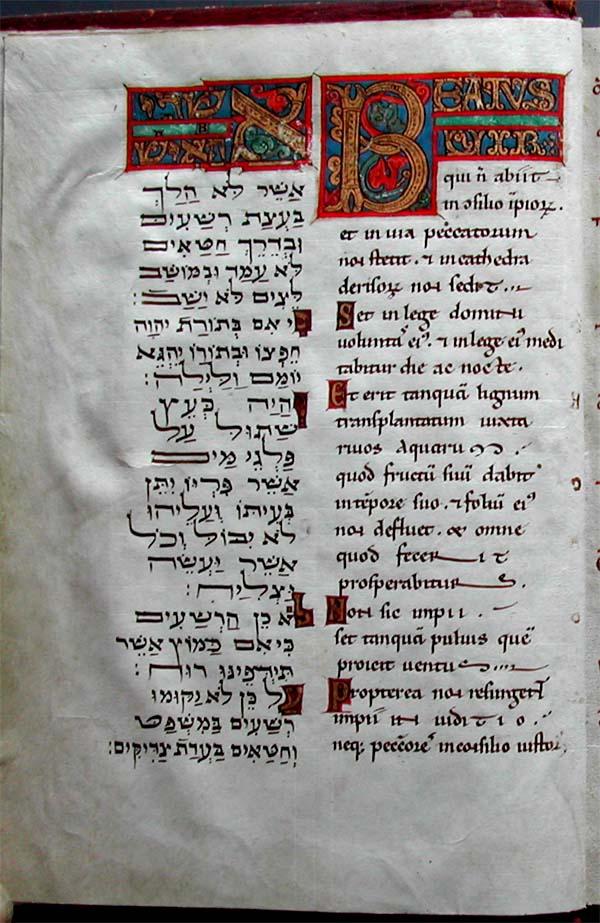
(click to enlarge; the heh in the last word on the second line should have a qomatz, but it has a patah, reflecting the vocalizer's pronunciation.)

But manuscripts are only part of the evidence.

A juicy piece of evidence[1] for this can also be found in Rashi's (1040-1105) comment on TB Berakhos (or should I say Berakhoth, in homage to early Ashkenazis?) 47A. There the Gemara discusses amens, and says ...אין עונין לא אמן חטופה , "the Amen uttered in response should be neither hurried..." To this Rashi gives the interpretation of what an hurried Amen is: שקורין את האלף בחתף ולא בפתח ואמר אמן והוא שצריך לומר אמן, "He reads the 'aleph with a sheva (אְמֵן, [short first sylabble] E'mein) and not with a patah (Ahmein)" (presumably in Rashi's text the two אמןs were vocalized, but in the standard printed editions Rashi is never pointed).

Thus, we see that Rashi said a word written אָמֵן as if it were written אַמֵן, just like the Sepharadim. Rashi said ahmein, not ohmein. It should be noted that in Artscroll's Schottenstein Talmud the explanatory notes say that Rashi terms the qomatz godol a patah and gives several references; but it does not explain why. Patah itself means that the mouth is to be opened wide; that is how the ah sound results.

Rabbi Dr HJ Zimmels, in his classic Ashkenazim and Sephardim: Their Relations, Differences, and Problems As Reflected in the Rabbinical Responsa discusses their respective pronunciations and adduces other proofs, among them the fact that Rabbenu Asher (13th century), who moved from Ashkenaz to Sepharad, becoming one of the foremost leaders in Spain, discusses the differences between the Hebrew scripts used by the respective communities but doesn't seem to notice any difference in pronunciation at all.

In any event, following Rashi, over the last hundreds of years Ashkenazic Jews pronounced, and still pronounce, amen as something sort of like 'ohmein.' But evidently at this early period in Ashkenazic history the qomatz was not yet pronounced distinctly, and pronounced ah, like the Sepharadim.

The question is when and why and how did this change? Did this come about due to a happy accident, normal sound shifting? That seems unlikely if these two vowels were pronounced identically. How could normal changes come about conforming correctly to the graphic differences in the written texts? Rather it seems like a deliberate effort to conform to the Tiberian pronunciation. Could this have really happened? I don't think there is any evidence that it did. But perhaps gradually it was noticed that Hebrew was spoken in a 'mistaken' fashion, meaning that it did not conform with the graphic symbols, the signs devised by the Tiberian Masoretes. Like other, periodic efforts to improve spoken Hebrew, perhaps somehow this change occurred. Maybe it first occurred among exacting Torah readers. Maybe some pedantic melamdim (children's teachers) taught it to their 3 and 4 year old charges. In any case, it seems irrefutable that at some point in the past 900 years (and perhaps in the past 700 or even more recently) Ashkenazim begun pronouncing the qomatz properly, in the sense that it is distinct from the patah, and in the sense that Tiberian Hebrew is proper Hebrew.

However one lingering doubt remains in my mind: it is generally believed that Ashkenazic Jewry had roots in Eretz Yisrael at a later date than Mizrahi and Sephardi Jewry, whose roots seem to be in Bavel. This is reflected in various Ashkenazic customs and liturgies which stem or seem to stem from an Eretz Yisrael origin. Historically and politically it makes some sense as well, since it is generally presumed that the core Ashkenazic community emigrated from Italy and other areas of Europe which were Christian and thus this Jewry was under the influence of Eretz Yisrael, also under Christian rule, rather than Bavel, then under Islamic rule. If so, it would seem natural that Ashkenazic Hebrew would be more greatly influence by Tiberian Hebrew at the outset. צריך עיון.

( By the way, I recently had my two year Bloggiversary.)

[1] Credit where credit is due. I came across this reference in a Mail-Jewish post by Mechy Frankel.

Friday, April 13, 2007

Baltimore rabbis take a clear, emulation-worthy first step

on sex abuse in their community.

Not that I know all the players, but it seems like the major ones are squarely represented.

On the one hand it's a local matter so it's none of my business. On the other hand--well, you know the other hand.

Yasher koah.

Via Presence.

Yiyshar kohakhah, Artscroll.

Perusing The Early Acharonim by R. Hersh Goldwurm z'l I learned that Dinim de Sehita y Bedica was written by R. Menasseh Ben Israel.

Electric menorah in the Beis Hamikdosh?


"I hold it to be clear and simple that, if electrical lighting had been extant in Temple times, most certainly it would have been employed in the Temple candelabrum. for it is inconceivable that we should illuminate our private homes with that great, wonderful electric light, which is verily after a heavenly model - and yet illuminate God's holy palace with olive-oil, which even the poorest of the poor despise in our time. It is therefore obvious that we shall illuminate the future Temple, may it be built speedily in our days, with electrical lights. Amen"

(R. Yosef Messas; Ner Mitzvah, 1939. Trans. Zvi Zohar: Jews of the Middle East and North Africa in Modern Times, p.76)


Via Pierre Sogol, who likes the "seemingly "modernist-romantic" sentiment towards electrical light."

Thursday, April 12, 2007

Friday, March 30, 2007

Busy, busy, busy

*Head explodes*

No, not really. Still, not being sure that I'll have the time, dear readers (lurkers and commenters alike), have a wonderful Yom Tov. I'll be back, probably with Pesah on my mind!

Thursday, March 29, 2007

Wacky Hebrew etymologies

From a review of the 1837 Complete Hebrew and English Critical and Pronouncing Dictionary by William L. Roy:

Take a look, particularly, at the etymology it gives for the word mol מל, to circumcise:

"From yom, a day, an al, a yoke" et cetera


Monday, March 26, 2007

Why Mendelssohn? A Chassidic tradition. Fascinating Footnotes I

It was reported in the name of Rabbi Chaim of Zanz that Mendelssohn was a great Torah scholar and potentially had the power to do tremendous good, but his soul's source was intrinsically evil and therefore he sinned and caused others to sin as well. In fact he was a reincarnation of "Oto ha-Ish" who had visited the world three times: Before the destruction of the Second Temple, as Mendelssohn and as one of the Maskilim of Italy [the writer had forgotten his name. Possibly Samuel David Luzzatto (Shadal)]. To counter Mendelssohn, God had sent the soul of the Chasam Sofer to the world. (She'elot u-Teshuvot Levushei Mordechai, Yoreh De'ah (Tolcsva 1912), Siman 88.)
R. Y. Tassuig, Beit Yisrael ha-Shalem, 4 (Jerusalem 1976), p. 100, cited in the name of his rabbi, Rabbi Shmuel Rosenberg of Hunsdorf.

Sunday, March 25, 2007

On the Golem

at What's Bothering Artscroll?

Artscroll on the Golem of Prague

There is a tradition which has not been established, that in the face of these threats, Maharal created a Golem, a humanoid figure formed from mud and brought to life by secret prayers and Kabbalistic sayings.

link

Or, if you like

The illustrious Maharal of Prague is best known as the creator of the famous Golem, but that was hardly his greatest accomplishment. He composed an enormous body of dazzling literature that forms the essence of much Torah thought to this day.

link

The Reb Chaim Brisker Of Bible Scholars

Rabbi Shalom Carmy's tribute to Rabbi Mordechai Breuer.

There are great teachers whose impact is limited to their students. Greater still are those whose students initiate students of their own. The greatest teachers, however, influence not only the direct line descending from them, but an entire climate of thinking. All of us are their talmidim.

Twentieth-century Orthodox Bible study boasts two such figures. Nechama Leibowitz’s writing, teaching and broadcasting turned the exacting, microscopic study of Jewish parshanut into an exciting and popular pursuit. And Rabbi Mordechai Breuer fashioned the tools that enabled Orthodox students to confront the literary problems raised by modern biblical criticism. He entered a situation where the Orthodox approach was an apologetic one, in which the Torah was to be defended against heretical assault.

By the time he died last month, Rabbi Breuer had transformed the encounter with kefira into a positive act of Torah study. Where his influence is felt, the literary questions posed by the Bible critics are treated no different from other interesting questions endemic to Torah study: questions are a spur to chiddush and deeper understanding rather than a cause for discomfort or panic.

Read the rest (Jewish Press 3/21/07)

Rabbi Shalom Carmy is professor of Jewish studies and Jewish philosophy at Yeshiva University and editor of the Torah journal Tradition.

Friday, March 23, 2007

A rebbeshe tale from the JTS rare book room

When I was working in the JTS rare book room a rebbe came in one day with his gabbai. the gabbai asked me if we had any holograph kisve yad from gedolim. I asked him to be specific and he asked me if I understood what a gadol was. I said yes, but that I could only bring him a ms. if he requested a specific one. After going back and forth I asked exactly why he needed a gadol's ms. and he responded that the rebbe needed some mss. in order to commune with the spirits of their authors.

...in this situation should I really have pulled for him an original Rambam autograph letter so he could commune with the Rambam's neshamah?

There are good comments.

Did Ben Tsitsis Ha-kesses have long, curly hair? What can we learn from Aramaic and Greek and simple, careful readings of texts?

Avakesh posting about Jewish names quoted a very interesting Avodah post from six years ago, by Yisrael Dubitsky, regarding the name of the Talmudic sage Rabbi Kruspadai, כרוספדאי. (mentioned, e.g, BT Rosh Hashana 16b -- א"ר כרוספדאי א"ר יוחנן שלשה ספרים נפתחין בר"ה אחד של רשעים גמורין ואחד של צדיקים גמורין ואחד של בינוניים).

What sort of name is this?

Targum Onkelos gives the Armaic for tsitsis (Bemidbar 15:38) as כרוספדין.

The learned Dubitsky reminds of the character Ben Tsitsis Ha-keseth, בן ציצית הכסת, one of the wealthy men of Jerusalem, familiar to all children who have spent the Three Weeks at sleepaway camp or who have learned Gittin 56a (the story here). The Gemara there explains his name

"Ben Zizith Hakeseth was so called because his fringes [zizith] used to trail on cushions [keseth]. Others say he derived the name from the fact that his seat [kise] was among those of the nobility of Rome."

Reb Yisrael notes that there is good reason to think that Kruspadai, כרוספדאי essentially meant tsitsis. Alexander Kohut in his Artscroll-approved Arukh Completum notes that in other places in Chazal this Rabbi Kruspadai's name appears in the variants Kryspa or Kruspa. To Kohut this might be a variation of the Greek name Crispus, meaning curly-haired. Was Rabbi Kruspadai curly-haired? Maybe. Note that Ezekiel 8:3 uses the word ציצית to denote a lock, perhaps curl, of hair. (וַיִּשְׁלַח תַּבְנִית יָד, וַיִּקָּחֵנִי בְּצִיצִת רֹאשִׁי And the form of a hand was put forth, and I was taken by a lock of my head.)

But even more interesting might be to get back to Ben Tsitsis Ha-keseth's name. The translation used above (Soncino) follows Rashi, that the tsitsit on his garments dragged on fine cushions as he walked.

But if tsitsit means curly hair too, and if people were so named because of it....perhaps he was so-called because his tsitsit, his long, curly hair dragged on fine cushions as he sat or lay.

Incidentally, it might be nice to quote Israel Abrahams in his By-paths in Hebraic Bookland (pg 64-65) on the Arukh:

It is remarkable, indeed, how well the sense of Greek words was transmitted by Jewish writers who were ignorant of Greek. They often are not even aware that the words are Greek at all; they suggest the most impossible Semitic derivations; but they very rarely give the meanings incorrectly.

Now that's mesorah!

Thursday, March 22, 2007

Horseradish in Syria

"So, erev Pesach, when you stand there grating the horseradish and tears flow down your cheeks, think of your grandparents performing the same function, the same way, in some little town in Lithuania, Poland, Hungary or Syria."

Link.

The gist of the above, from an article by the Yated editor Rabbi Pinchos Lipschutz is that the YCT brouhaha comes down to one thing: mesorah. YCT ignores it, says Rabbi Lipschutz, while all other authentic Orthodox Jews don't.

"It is our conviction that the rank and file of contemporary Orthodox Jewry - Modern, Chareidi and everything in between - still possess authentic Torah sensibilities which are repulsed by the erasing of historic conceptual boundaries on the part of YCT faculty and students. "

Now let me say that horseradish in Syria is a minor thing. It is. It is no big deal that the Syrians don't grate horseradish for marror. But the problem is that this minor thing is symptomatic of a larger thing. Much (how much?) of what Rabbi Lipschutz is convicted is mesorah is projection and not mesorah. As someone on the Areivim mailing list astutely pointed out, Rabbi Lipschutz presupposes that an intellectual approach to Yiddishkeit (hey, did you know that "Yiddishkeit" doesn't mean Judaism, but Jewish culture and was coined by secular Yiddishists?) is against the mesorah.

"RPL is certainly within his rights to espouse the avowedly anti-intellectual hashkafa; like it or not, there is certainly such a strain within Torah hashkafoth. However, when he implies that anyone who is unwilling to accept this approach places himself outside the pale, this is another matter. There are other legitimate hashkafoth, even within the haredi world. "

Now I know that will be argued that the approach at YCT is not equivalent to "an intellectual approach to Yiddishkeit," but my point is that if mimeticism would lead one to project the present onto the past, sometimes in a very misleading way, well, sometimes something a bit more critical and a bit more investigative can also lead to some emes, maybe sometimes to even more.

c.f, "What’s the Truth about ... Using Horseradish for Maror? "via Parsha Blog

Hoard your old books because you never know if you've got Yellin's Aleppo Codex Bible

Ari Kinsberg has a great post about the famed Bible of Rabbi Shalom Shachne Yellin (1790-1874) (via Ha'aretz.)

Rabbi Yellin was a Lithuanian expert in Tanakh (a "scroll checker") who emigrated to Israel in 1854 with the express purpose of traveling from there to Aleppo (Halab, Aram Soba), Syria in order to examine the Taj, the Crown, of Aleppo; the Aleppo Codex. His wish was to copy all the minute details of that famed text. He received for that purpose a letter of introduction from the prominent rabbanim of Jerusalem. And here it is (click to enlarge):


In any event, as fate would have it Rabbi Yellin was unable to make the trip due to ill health. Instead, ten years after the project was initiated, his son-in-law Yehoshua Kimchi made the trip, armed with a Tanakh belonging to his father-in-law and with detailed instructions he succeeded in noting all the notable details in the Keter. Evidently this Tanakh was consulted in Jerusalem until it disappeared in 1915.* It resurfaced in 1987 when Aleppo Codex scholar Yosef Opher learned that a house belonging to a family called Yellin was slated for demolition and that some old books from the attic could be purchased. A lightbulb went off in this keen Massoretic scholar's head, as the name "Yellin" should. He learned that, in fact, some books had been sold to a book store in Meah Shearim. At the book store he found his prize: Yellin's Tanakh with detailed notes!

Ofer returned the Tanakh to the family (who donated it the Ben Zvi Institute in Jerusalem), who allowed him to study it and publish its readings.

Here is a page from this plain-looking but important Bible (click to enlarge):


The importance of this Tanakh is that most of the Pentateuch (and other portions) is presently missing in the Aleppo Codex. So a missing witness to the textual details (most importantly, the pesuchot and setummot) was recovered and was an added, much missed piece of the puzzle that is used to reconstruct the text of the Aleppo Codex as in, for example, the Keter Yerushalayim Bible.

As Ari says, never throw anything out!

(On the teacher of Yoseph Ofer, the late Massorete Rabbi Mordechai Breuer's acquisition of facsimiles of the Codex in a time when only insiders were given access, from Ha'aretz:

And then he managed to get hold of facsimiles of the Aleppo Codex. The circumstances are unclear even to his son and his student, Ofer. The son knows only that "the day Dad came home with a copy of the Aleppo Codex, he was acting like an accomplice to a crime." )

*A great article on this subject by a descendant, Tamar Yellin.

Wednesday, March 21, 2007

Living in an Aramaic World (also, where does “עבודה זרה” come from?)

I started out by proceeding from the better known Hebrew to the lesser known Aramaic. I used Hebrew to understand Aramaic, which was only natural. But, at a certain point, I realized that I could use Aramaic to understand Hebrew. I do not remember exactly when it was that I learned that Hebrew עבודה זרה “foreign, hateful worship” was a back translation of the Aramaic פולחנא נכראה, but when I did, I had effectively become aware of the cultural universe of Aramaic. Once again, I realized that Jews used Aramaic because they lived in an Aramaic world. In retrospect, it is all so obvious, and yet it took me some time to switch gears.

Baruch A. Levine reflecting on his youthful studies in the Epilogue to Semitic Papyrology in Context : A Climate of Creativity: Papers from a New York University Conference Marking the Retirement of Baruch A. Levine, ed. Lawrence Schiffman, pg. 272.

Tausves-Jontof


From 'Disputation' by Heinrich Heine.

Tuesday, March 20, 2007

There's more to life than Gemara?

At YNet Uri Orbach writes as an adult recalling the pure torture that learning Gemara was for him and, he says, many other kids in school (he is writing about Israeli schools).

“What can I say? Gemara classes bored me. Hours upon wasted hours, I would sit there in my yeshiva high school, as words like “sugyot”, “braitot”, “Rashi”, “Tosefot”, and even “Shev Shmateta” (I received three copies of the latter for my bar mitzvah) swirled around my head.”

His complaint is certainly nothing new. I've heard it voiced countless times. I've even voiced variations of it myself. The question is this: is the Gemara meant for everyman (child)? If it is, why is it that so many kids never "get" it? Why are so many kids bored? Why are potentially more interesting topics skipped? Does it make sense to begin instruction without any knowledge of the language (to say nothing of the idiosyncratic syntax)? Complaints and questions of this nature have seemingly been voiced since time immemorial. One can trace distant echoes of this question in the pedagogic reforms advocated by the Maharal in the 16th century (to dethrone the Tosafos from quite the place of prominence) or against authentic Polish pilpul (opposed by the Gra). I once posted what amounts to a first cousin of this lament: Are Some Yeshivos using Archaic Methods?--about an article written by Ludwig Blau one hundred ten years ago.

Orbach would like to see yeshivos for children concentrating on other classic Jewish texts that may better capture the interest of students:

For instance, they should delve into “The Kuzari”, “Duties of the Heart”, and “Path of the Just”.

“Students should be introduced to entire chapters of Maimonides’ “Mishneh Torah” and should probe the “Sefer HaChinuch” and works by Rabbi Kook and the Chafetz Chayim. The boys must study the laws of Shabbat and kashrut, Mishnah, the reasons behind the mitzvot, and Bible with the commentaries.”

“Do they know what to respond and what to ask? Are they familiar with the prayers and the fundamental principles of the Jewish home? Have they become acquainted with our land through the Bible and with the Bible via the land?”

“Orthodox girls do all of these things and much more. Thus, their religious world is more complete and more vital than the boys’ world – even without wholesale Gemara. ”

and then he draws a questionable conclusion

“And that’s why the girls are likelier to remain observant.”

His experience and plaint is summed up thus

“Why squander 1,000 hours a year (!) on a mere 30 to 40 Gemara folios?”

“In hindsight, we graduated high school with a limited amount of Torah-related knowledge and a great deal of frustration.”

Why indeed?

“If they learn Gemara now – in Aramaic and without Rabbi Steinsaltz’s translation – they’ll have an easier time later. Why? Again, just because. Stalemate, or as they say in the yeshivas, “Teku” (i.e., Elijah the Prophet will come and resolve the dilemma).”

He essentially says that the Talmud properly belongs in advanced yeshivos, to rabbis and judges and to people who voluntarily go to Talmud classes in the synagogue, a point I am ambivalent about, to say the least.

He has overlooked one thing which should not be overlooked. Although he has perhaps shown that the Talmud isn't for everyone, he overlooks the fact of popularization of what had always been a closed text for most Jews, and yet the most important text! Or more importantly, what would be the effect on the common man of rolling back its popularization? He is an observant, Orthodox Jew which means that whether it bores him or not the Talmud will continually be relevant to his life. Does he really wish that the foundational text of halakhic Judaism become even more esoteric than it already is, in an era when more people are accessing it? While שור שנגח את הפרה ("An ox that gored a cow," Massekhet Babba Kamma 5) doesn't fire the interest of too many children who nevertheless must study it without, necessarily, demonstration that the best methods are being employed or that the intellectual justification for it has been made--be careful what you ask for.

Related.

Friday, March 16, 2007

The Da Vinci Codization of Jewish history

Presence links to a review by Allan Nadler in the Forward of a book called A Murder in Lemberg: Politics, Religion, and Violence in Modern Jewish History by Michael Stanislawski.

"On September 6, 1848, a young Orthodox Jew with the very inauspicious name of A.B. Pilpel (Hebrew for pepper), bearded with sidelocks and dressed in a black hat and a long caftan, entered the kitchen of the district rabbi of Lemberg, Abraham Cohen, and, pretending to light his cigar from the stove, poured arsenic into the Cohen family’s soup. Within hours of their supper later that evening, the entire Cohen family was severely ill. And by 3 o’clock the next morning, Rabbi Cohen and his infant daughter, Teresa, were dead."

Stanislawski tries to connect this incident with the Rabin assassination (you know, exceptions that prove the rule) and makes entirely too much hay out of it. It struck me as a bit of a Da Vinci Code tendency in modern semi-scholarly literature. Get the sexy angle, in this case Orthodox Jewish violence, and hopefully more people will notice your book about 19th century Lemberg. zZzZz

I read it because it's the type of thing *I* read--but without the Rabin angle, how many people might read it?

LinkWithin

Related Posts with Thumbnails
'