Wednesday, May 20, 2009

Kriticizing Kennicott; a learned Critick attacks 18th century textual criticism of the Bible, w/a surprising appearance by the Vilna Gaon in this post

I have previously posted about the Bible collations of Benjamin Kennicott (here). It is only fair that I follow it up with an attack on the specific point I covered in my post, namely the discrepancy between the spelling of דוד and דויד in the earlier and later books of the Bible. But first, I should mention an interesting fact: Kennicott's project included a search for as many Hebrew Bible manuscripts as he could find in Europe and beyond (including as far afield as China; more on Chinese Bibles in a forthcoming post). How did he go about collecting these manuscripts? Cecil Roth notes that his messengers to Jewish communities carried letters of introduction from, among others, Rabbi David Tevele Schiff (d. 1791)

A more pleasing episode of external relations during Tevele Schiff's Rabbinate was collaboration with the Oxford scholar, Dr. Kennicott, while he was engaged in his great work on the text of the Hebrew Bible. There are extant the letters of recommendation to Jewish scholars abroad which he received in 1770 from the two senior London communities, the Great Synagogue's being signed by the Rosh haKahal Aaron Franks and the Warden Aaron Goldsmid, as well as by the Rabbi himself.

So if anyone ever tells you that a model European rav of the old school wouldn't recommend placing your antique Tanakh manuscripts at the disposal of a Christian Bible scholar, show them this post. Lest anyone question what sort of rabbi R. Schiff (a talmid of the Pnei Hayeshua) was, here is an excerpt from his letter to his brother, which concerns Wessely's Divre Shalom ve-Emes, as published in Charles Duschinky's The Rabbinate of the Great Synagogue of London (1921; letter VIII, Hebrew pg. 177-78; English translation):


Rabbi David Tevele Schiff:


Getting back to the subject of this post, Kennicott believed that the text of the Hebrew Bible contained mistakes, but none of those mistakes were critical to matters of (Christian) faith. However, naturally more conservative scholars were not as sure that his formula was sustainable, and rejected the implication that the text contained errors at all. One such critic, an anonymous French abbe, voiced his views in a pamphlet sharply critical of Kennicott's State of the Printed Hebrew Text of the Old Testament Considered. It was translated from French to English as the Letters of mr. the abbot of *** ex Professor of the Hebrew Language, in the University of *** to Mr. Kennicott.

Here's a taste:

Text not available
Text not available

i.e., who cares?

However, he goes on to say that he would have thought Kennicott's work simply useless, however it is actually insidious, since Kennicott also treats a verse crucial to the faith, Psalm 16.10 (לֹא תִתֵּן חסידיך לִרְאוֹת שָׁחַת is taken as referring to Jesus, "the sole and peculiar object of this psalm," according to the abbe). On pg. 107 of Kennicott (second volume) we find the point that חסידיך is the כתיב while חֲסִידְךָ is the קרי. The former should be plural, as if to say "thy saints," rather than the singular "thy saint, ie, Jesus." This is troubling as this verse is cited by Peter and Paul as referring to Jesus. If so, how could the real Bible text read חסידיך?

Keniccott notes a fortuitious discovery:

Text not available

In other words, an examination of many manuscripts show that the singular reading is correct. The apostles, vindicated!

The abbe hates this.

Text not available

He saw Kennicott claim that nothing in his text critical project concerned matter of faith, only mere details, and then a few pages later he places it all on the line with a mere י! Have no fear, seems to be Kennicott's view, the manuscripts vindicate the faithful reading. But would he really place it at the mercy of a iod?!

How does it make him feel?

Text not available

Later he gets onto the matter of דוד and דויד. Refer to the earlier post where the relevant Kennicott pages are shown. Here the author is really annoyed. Kennicott's contention is that the name was spelled דוד before the exile and דויד afterward. Kennicott's problem is that in one place in Amos (סֻכַּת דָּוִיד הַנֹּפֶלֶת) it is written with the י, but certainly Amos is from before the exile. However, all you have to do is open the first Rabbinic Bible printed in Venice in 1518 and you see this:


The same thing with the other דויד in Amos. Furthermore, the problematic דויד in Hosea is written דוד in the same Venice edition.

The critic notes the absurdity of this. First of all, of looking for the Bible to support your reading, and secondly for accepting Mafforetical circles when they are convenient. But, hold on! In the same Venice Bible there is a קרי וכתיב circle at חסידיך in Psalm 16.10, that is, read it without the י, which vindicates the Christian reading. Why didn't Kennicott call attention to it? Instead, he counted manuscripts, a happy discovery.

In short, his intention is to artificially increase the value of his manuscripts, by showing a large problem and solving it with his manuscripts alone.

This continues for pages. I heartily recommend printing it to read during chazaras hashatz.

An illustrated 17th century guide to the graves of Tzadikkim

You never know when you'll come across something interesting.

Ths Cippi Hebraici of Johann Heinrich Hottinger, printed in 1662, contains the full text of the so-called יחוס האבות, (also known as אלה מסעי בני ישראל), an early 16th century guide to the holy gravesites in Eretz Yisrael and elsewhere. It looks like this:

Text not available

(It's a really interesting text, so be sure to read it. You could read it as well in this book, published in 1930; around page 220.)

Here's a timely passage:

Text not available

What was fun to find was the illustration of these graves:

Text not available

Also included are some illustrations of (fanciful or counterfeit) coins:

Text not available
Text not available
Text not available
Text not available

The missing Mendelssohn Pseudo-Tze'enah U-re'enah edition of 1822

One of Artscroll's many useful translations is a two-volume book called The Weekly Midrash, subtitled "Tz'enah ur'enah the classic anthology of Torah lore and Midrashic commentary."

A good overview of the צאינה וראינה can be read here, or in the introduction to the English volume under discussion.

The following appears in that introduction:


I thought the usage of "pirated" is strange. After all, the titles of many classic Jewish works are reused without such a harsh description as "pirated." Okay, maybe that's style. I would have said recycled, and some would say that's not really a good term to use either. But I wondered about the 1822 Basle edition of the Mendelssohn Bible. (Parenthetically, at this point it should be clarified that Mendelssohn's Bible was only a Pentateuch. However, in the generation after Mendelssohn's death, followers of him and his approach translated the rest of the Bible into German and wrote commentaries, according to the principles of his edition of the Pentateuch. Many later editions of the Bible included the original Biur to the chumash alongside the other biblical books. So it seems that is the sort of work this introduction is talking about.)

In any case, I tried to find the edition of the Biur deceptively (or mischievously) called צאינה וראינה, and I came up with nothing. In fact, there was a Mendelssohnian Bible printed in Basle in 1822 (2 volumes, printed by Wilhelm Haas, edited by Schlaume Kasselberg). But it was not called צאינה וראינה. It was called חמשה חומשי תורה כאשר ניתנה למשה מפי הגבורה.

Maybe the title page of the second volume read צאינה וראינה? In any case, I am unable to locate a reference to *any* edition of the Mendelssohn chumash or Bible with that title, even one besides the 1822 Basle edition.

I realize that the excerpt actually says that the words צאינה וראינה were embossed on the outer cover; taken literally, I am not looking for such a Bible called צאינה וראינה in catalogs. I am looking for the cover, which I do not have access to at the moment, or any time soon. That said, it seems highly improbable that the book truly rolled off the presses and was shipped with the non-sequitur צאינה וראינה on the cover. As cute and devious as that would be, the publishing house of Wilhelm Haas was trying to sell deluxe new Biurs, and this could not be accomplished by fooling innocent eastern European Jews into thinking they were buying a homey Yiddish Woman's Bible. (For actual quasi-deceptive efforts to spread the Biur Chumash in the east, wait for a future post.) On the other hand, either the translator of the Artscroll work saw such a copy herself, or read of it somewhere. Barring the possibility that her source simply made it up, I wonder if the source for this assertion lies in a single copy of this Bible, somewhere, which someone did emboss, probably mischievously, with צאינה וראינה on the cover. As we know, to this day it is common practice (at least in the Orthodox community) to emboss names onto the cover of books. If this is the case, than all we are talking about is a single copy of the Bible, or just a few.


On the other hand, maybe I am wrong and what she was talking about did not turn up in my, admittedly inexhaustive, research for this post.

However, also bear in mind that at a much later date there were several new German titles (for German Jews, not eastern Europeans) with that name. See this one by Emanuel Hecht subtitled der Pentateuch in lehrreichen und erbaulichen, and printed in 1862. Or the Tsenerene by David Schweitzer (1861), which openly spoke of the original version as "unsuitable and even obscene."

The written word as a potion for reminding, not for remembering

In a remark about the truly oral nature of Jewish teaching before its commission to writing in the Mishna and Gemara, Samuel David Luzzatto footnotes the following:


Which means:

*In relation to this precaution of the ancient Hebrew scholars, a passage from Plato (toward the end of Phaedrus) is notable, where he introduces the Egyptian king Tamus, speaking with Theuth, the inventor of writing:


Or, see the *nicer translation cited by Rubin in his edition of the Prologemeni (pp. 7-8):

"and now, since you are the father of writing, your affection for it has made you describe its effects as the opposite of what they really are. In fact, it will introduce forgetfulness into the soul of those who will learn it: they will not practice using their memory because they will put their trust in writing, which is external characters and depends on signs that belong to others, instead of trying to remember from the inside, completely on their own. You have not discovered a potion for remembering, but for reminding; you provide your students with the appearance of wisdom, not with its reality. Your invention will enable them to hear many things without being properly taught, and they will imagine that they have come to know much while for the most part they will know nothing. And they will be difficult to get along with, since they will merely appear to be wise instead of really being so."

This post, by the way, is itself an excellent illustration of this in certain ways. Let us look at various elements of this post, which could give the impression of greater learning and knowledge on my part, than I actually have:

For starters, there is the matter of access. It would have been no small thing to pull out a copy of a slim Italian volume on Hebrew printed only one time, in 1836. Now, instead of visiting a research library, I simply downloaded it, made a little image and posted it. Furthermore, I don't really know Italian, so I used Rubin's translation of the little bit before Shadal's Latin quote. Next, I had never read Phaedrus before. In fact, I didn't even know there was a bit about the invention of writing in it. Even though I only learned of it from Shadal's quote (he knew Phaedrus) I could have pretended to greater erudition by either leaving him out of the picture, or simply not admitting that I hadn't read it. Then, I could have only posted the translation of the Latin which Rubin quoted (it's not his own translation). Or, I could have made my own translation using any of a dozen ones I could have found online. I could have posted the Greek original and made it seem as though I translated it. I chose to post an English translation from 1792, getting back to my original point about access. In short, this post took about five minutes, required nothing more than my having taken Luzzatto's point (relating it to תשבע"פ) as interesting and provocative, and I could have done it in such a way that really showed me to be more broadly learned than I am. This is not exactly the same as book-learning vs memory and internalization, but I think there is a parallel. Today, it's easy to be a faker or "concordance scholar", as Saul Lieberman mockingly called it.

Tuesday, May 19, 2009

Mendelssohn's Chumash reviewed in an 18th century English journal

In line with my principle that you never know when and where you'll come across something quite interesting, below is a review* from 1784 of the famous Liber Tramitum Pacis. What, not famous? I meant the famous ספר נתיבות שלום והוא חיבור כולל המשת הומשי התורה עם תיקון סופרים ותרגום אשכנזי ובאור, ie, Moses Mendelssohn's Bi'ur.

As you can see, the review is in fact a review of the introduction to the Bi'ur, the אור לנתיבה. It's a factual recounting of what the contents are about, with merely one line critical of its essentially traditionalist approach: "Mr. M. repeats some assertions long since supposed to have been confuted [by modern Bible scholarship]."

I must confess that I can't quite figure out one thing: was the introduction in front of him the familiar Hebrew version, or was it some sort of Latin translation that I am unaware of? As you can see, when he cites in he does so in Latin. Although this is confusing to me, perhaps the simple explanation is that the reviewer translated it into Latin himself for the quotation. Not wishing to quote Hebrew for readers who may not have understood it, but still wishing to set the text apart in a scholarly language other than the vernacular, Latin would serve well for an audience which would certainly understand it. It may have been something so simple as the publisher not possessing a good case of Hebrew fonts.


* In (A New review: with literary curiosities and literary intelligence v. 6 -- if on your screen a chunk of text does not appear, click here to see what fills in the blank.)

They don't make Hevra Kadishah guidebooks like they used to.

Pirates of the Kadishah?


Amsterdam, 1810. cf, They don't make tombstones like they used to.

Friday, May 15, 2009

Become erudite

All you need to know about everything, assuming it's 1770:

The Elements of Universal Erudition: Containing an Analytical Abridgment of the Sciences, Polite Arts, and Belles Lettres

Arnold Ehrlich update

In response to this post I received an email from a descendant of Arnold Ehrlich. She felt the post contained information which wasn't true, and she understandably wanted to correct the record regarding her distinguished ancestor. I offered to allow her to correct the record, as she sees it, and would post it. Furthermore, I told her I would post her email to me if she wanted me to. Since I never heard back, I won't do that. However, I see that Ehrlich's Wikipedia entry is now greatly expanded, and I believe it is due to her efforts. So, if you want much more detailed and specific information about Arnold B. Ehrlich, have a look at http://en.wikipedia.org/wiki/Arnold_Ehrlich!

On the Talmud, in Irish

Text not available

40,000 copies of select Talmudic tractates sold in one year in Berlin, 1868

Interesting:

Text not available
Text not available

Tuesday, May 12, 2009

The role of the Talmud Bavli as seen in 1665


Somehow its jarring to read this in English (or Englifh).

From Clement Barksdale's 1665 summary of many of the main arguments of Buxtorf's Tiberias, titled Masora. A collection out of the learned Master Joannes Buxtorfius's Commentarius Masorethicus.

Monday, May 11, 2009

The excitement of a bibliophile who also loves what is inside books:

R. S.J. Rapoport's Erekh Millin, introduction, pg. XI::


"There is a wonderful introduction to the first edition of the Sefer Yuchasin (Constantinople, 1566), printed from manuscript by the great scholar R. Samuel Shulam, which was omitted from all subsequent printed editions of the Yuchasin. In it I found the following: "Know that the author of the Yuchasin was greatly learned, expert in the entire Talmuds Bavli, Yerushalmi, Sifra, Sifre and midrashim. All were at this fingertips, which is evident to anyone who examines this book." [No one will dispute this--Rapoport] "He also composed another work, to complete that which the author the Aruch left incomplete. This extremely wonderful work can be found in Damascus. In addition to this wisdom, the author was in possession of immense knowledge of secular subjects, and a professor [a teacher in a cathedra, ie, professorial chair] at Salamanca, etc." Thus far the quote from Shulam's introduction."

"This wonderful writing also might be of great use, not only for his explanations of obscure words, but also in providing alternate readings of old books. See how many such readings are found in the Sefer Yuchasin, which are all worthy of great attention, as well as explanations he quotes from great scholars of the past. We know that he had before him a copy of the Aruch of Rav Zemach Ga'on [ie, which we do not possess]; who knows how many explanations from this same source are to be found in that wonderful expanded Aruch of his? Only 300 years have passed since this work was to be found in Damascus, and it's probably still there, or in its environs. It would be proper for learned travellers of the East to set their eyes and heart on this object, to inquire about it from all that love collecting old manucripts. Maybe one will come across it and make a copy and publish it to the joy of all who love learning!"

This excerpt gives a flavor of the time he was writing (1850s) when there was genuine cause for hoping that a book referred to 300 years earlier in a certain place was still there, could be obtained or copied and published.

Wednesday, May 06, 2009

A curious reference to David Levi as translator for Lord George Gordon

Having previously posted about George Gordon, an 18th century rabble rousing British lord turned Jew, who spent years in jail for defaming Marie Antoinette (think: they got Al Capone for tax evasion) I came across a "veiled" reference to him in a bizarre little book published in 1798 called The Regal Rambler (subtitled "Eccentrical Adventures of The Devil in London... "translated from the Syriack MS. of Rabbi Solomon, recently found in the Foundation of the Hebrew Synagogue.") No such thing occurred, but see how it is presented in the introduction:

Text not available
Text not available
Text not available

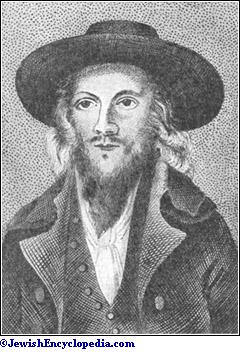
"Rabbi Levi" is David Levi, a hatter by trade, and prolific author and translator. In addition to a series of polemical works against the attacks on Judaism of Joseph Priestley and Thomas Payne, he also translated the Machzor according to both the Ashkenazi and Sefaradi minhag, and a really wonderful Hebrew-English dictionary/ encylopedia; grammar called Lingua Sacra. According to this anonymous author, Levi translated works for "the benefit of Israel Abraham G___ G___," which is, of course, George Gordon. I had never heard this before and don't know if it's true, but it's interesting. (Speaking of interesting, it is said that while in prison Gordon refused to allow Jewish visitors without beards. Apparently he had become quite the kannoi. (surprising that isn't, since he was a kannoi beforehand.) Levi looked like this:


and Israel (ben) Abraham George Gordon:

)

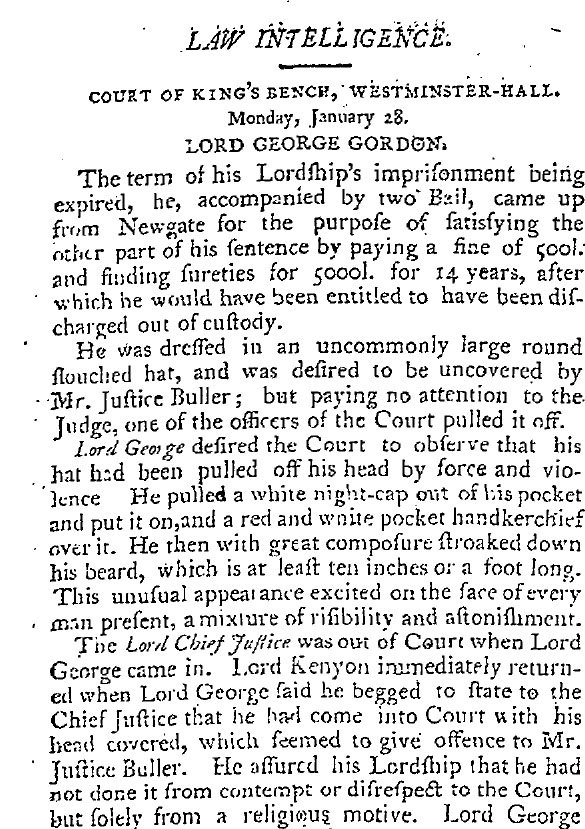
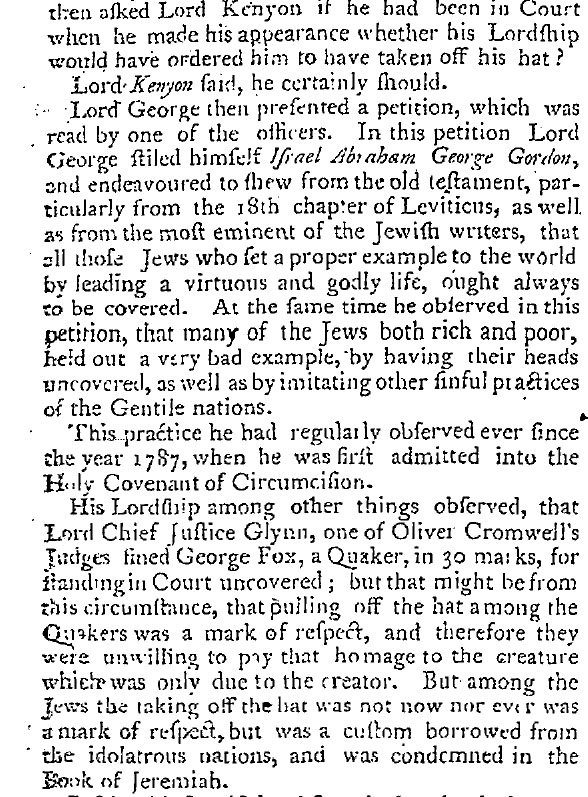
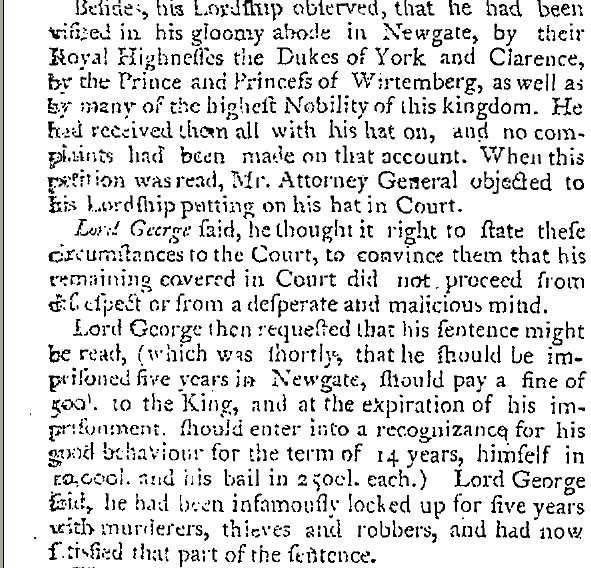
In any case, later in The Regal Rambler we come upon a parodic description of the famous courtroom scene where, at a bail hearing, Gordon refused to remove his hat, had it forcibly taken off, tied a kerchief to his head and made a statement indicating that he wished the court to take notice that his hat was removed violently. Then he preceded to read a paper he'd written called "The petition of Israel Abraham George Gordon, commonly called Lord George Gordon," in which he explained that he intended no disrespect to the court by appearing with a hat, but was merely following his convictions. Furthermore, the paper contained halachic arguments for covering the head, quoting various authorities. (How I wish I could find a copy of his petition! I'd love to see what he had compiled.)

Here is how it is described in The Regal Rambler:

Text not available
Text not available
Text not available
Text not available

and here is how the more sober Times of London described it:


Monday, May 04, 2009

With haskamos like these, it has to be a good book.

I refer to the travelogue Even Saphir (volume I, Lyck, 1866, and II, Mayence, 1874) by R. Ya'akov Saphir (or Sappir).

The book recounts his extensive travels among various Jewish communities of the world that were still remote, intact and traditional. For example, some of his most interesting material concerns his visit to Yemen (parts of this was actually translated and published by Feldheim as My Footsteps Echo: The Yemen journal of Rabbi Yaakov Sapir in 1997). He describes in detail the customs of the Yemeni Jews, such as their careful reading of the Torah, their retention of the meturgeman, quality of their pronunciation, etc. While much of this sort of material is well known, it must be realized that at the time of the publication of his book most of it was entirely unknown and a shocking, exotic and pleasant surprise to his readers. In addition, he brought manuscript material back from Yemen, including a centuries-old grammatical and masoretic treatise called מחברת התיגאן (published in 1870 by J. Derenbourg in the Journal Asiatique under the title Manuel du Lecteur. He informed the rest of the Jewish world of a large corpus of unknown midrashim . While in Egypt he gained the honor of being the second foreigner1 to gain access to the Cairo Geniza. Although he managed to find nothing (!) to speak of there, he is essentially responsible for informing the Jewish world of the Geniza's existence. There is an Aleppo Codex connection too, but I'll just advise readers to read it and find out for themselves. In any case, these volumes make very interesting reading.

What are the haskamos (approbations) I speak of?

They are from the Malbim, two notable maskilim and Karaite Hacham Abraham Firkowitsch (known as Even Reshef).

Malbim:


Solomon Munk and Senior Sachs (who goes on for pages, so I'm not showing it):


And Firkowitsch:


Incidentally, naturally I was curious about the following remark: " אמרו חז"ל כבוד האיש לעשות רצונו." My encyclopedic familiarity with rabbinic literature didn't help me, but some text searching did. Naturally the phrase does not appear in rabbinic works, so I believe we are speaking of an alternate חז"ל. Interestingly enough, the only other instance of this remark I could find was by Firkowitsch himself, on pg. 74 of his אבני זכרון. Here he does not mention חז"ל, thus I am unclear if he is truly quoting Karaite sages or himself (in which case he is probably trying to be clever here). (Incidentally, the following appears in R. Rafael Nahan Nata Rabbinowicz's Dikduke Soferim VI 1874 on Pesachim, introduction pg. 2: "רבן של כל בני מקרא כמ׳ אברהם פירקאוויץ נב״ת מכונה אב״ן רש״ף."

In any case, there will be another (or several) Firkowitsch posts in the future. But first, a photo of him:


and Saphir:


1 Trivia gatherers may be pleased to know that the first traveler to visit the Cairo Geniza, that we know of, was Heinrich Heine's grandfather's brother, Simon van Geldern, in the 18th century.

LinkWithin

Related Posts with Thumbnails
'