Sunday, February 22, 2009

Valmadonna photos and comments

A couple of random pictures:


It was fun to find specific books, considering that they were needles in haystacks. (Okay, not really. After all, many of the interesting titles were places at least reasonably within eye level, and arranged by region of printing.)

Here is a title I was gratified to find (you can read this very edition here):


This is the 1728 edition of the Mikra'os Gedolos, the first produced by Jews, titled Kehilot Moshe. You can't tell from the photo just how large this edition is. The volumes are as large as a real chosson shas. This is the very edition Jean-Philip Baratier's father bought for him:


I found the Elijah Levita shelf:


Wessely:


And of course, Shadal:


From the manuscript room, the 12th century Samaritan Pentateuch:


It was a lot of fun to eavesdrop there, and to see the show-offs who tried to demonstrate that they could read it. You know who you are, people. You read it as well as a 5 year old reads Ashrei.

For some reason, R. Yitzchak Lampronti's 32-volume hand-written revision of the Pachad Yitzchak moved me more than almost anything. (Although I am unclear if it is in his own hand, or if this is by a copyist.)


Here is a detail of the 12th century English Pentateuch manuscript, which was one of the centerpieces of the collection:


A lot of people don't realize that one of the key medieval Hebrew grammarians and masoretic scholars lived in England: משה הנקדן (albeit, he was born after the above codex was written).

The following Franco-German (ie, Ashkenazic) codex was quite fascinating from a historical perspective, being that it is dated to the 10th or 11th century, making it quite possibly (even likely) older than Rashi himself. Not bad to see a Chumash from Rashi's region that predates him!


Here is simplicity and beauty; a private 18th century Italian translation of Daniel:


I'm not one of those people who get excited about Incunabula (at least not more so than printed books from after that arbitrary demarcation line, 1500). But it was fun to see so many of them all at once.

I couldn't believe the pristine condition of this edition of Yosippon (Gorionides; Pseudo-Josephus):


It was over 500 years old, and for all intents it looked like a fascimile printed on fine paper last week.

Everyone is interested in the censor's black ink, and here is one:


(If you enlarge the image, you can read the censored text through the ink. What's particulary fascinating is how the words meaning "God" and "godliness" were spared the ink by the censor.)

Moving on to the not-entirely-accurately-title "Reading Room":

God save the Ashkenazim!


Unfortunately I did not get a clear picture of the Hutter Bible, but it was exciting for me to see it.


Elias Hutter came up with a brilliant idea, and printed a Hebrew Bible with his innovation, which consisted of using two fonts. One was normal, and the other had a hollowed-out appearance. He printedeach word using these two fonts; the radical letters (שורש) in the normal font and the servile letters in the hollow font. In this way, the root of each Hebrew word could clearly be identified.

Since my picture is so poor, here is the title page from the edition in the Library of Congress:
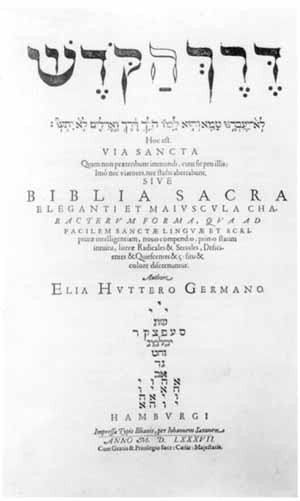


As you can see, the ה in the words דרך הקדש is hollow, for it is not part of the root.

Unfortunately my camera ran out of power and I was unable to get a photo of an interesting book from the 16th century; a book of haftarot, with Yiddish translation (albeit at that time the speakers of that language did not call it Yiddish; they called it טויטש, evidently because that is what they believed themselves to be speaking; Deutsche, ie, German.

What was interesting to me was the word haftaros, which was incorrectly spelled (in square script) הפטורה. This was wonderful, because the explanation is most likely that the pronunciation of the קמץ among Ashkenazim at the time was very, very close to חולם וי"ו, hence the confusion. Indeed, to this day many pronounce haftarah as if it were haftorah, and even haftoyrah, albeit probably because of the phonetic similarity to the word Torah.

You've got your congratulations-you-are-now-a-physician poem in honor of the son of R. Yitzchok Lampronti.


Your here's-Shabbesai-Zvi-and-his-prophet announcement in Dutch:


Future post to follow.

Friday, February 20, 2009

I gently correct a 143 year old spelling mistake, or, how should "Peshitta" be spelled in Hebrew letters?

I've posted some things about the Peshitta (aka ܦܫܝܛܬܐ, Peshitto, Peschito, ' וגו) a few times. If the name doesn't ring a bell, the Peshitta is what the Syriac Bible is commonly called, Syriac being a dialect of Aramaic used by Eastern Christians.

Since the word is generally written out in Latin letters as "Peshitta" (if we are talking about this century and from a bit of an Anglo perspective) most people probably don't realize that the /tt/ represent two different Syriac letters. In Hebrew script, they are טת; that is, פשיטתא. Since in Syriac grammar, as I understand it, the ת here is pronounced רפה, that is, soft, the word is really pronounced Peshittha (with the /th/ being like the word /with/). If you like havoro Ashkenazis (for all you Ashkenazi Syriacs) then you'd say "Peshitsa," the same way an Aramaic baalebuste is an "itsa," איתתא. However, under the classical scholarly and modern Israeli convention of following allegedly Sephardic pronunciation, most people just wrote "Peshitta," and consequently a lot of people pronounce it that way instead of "Peshittha" or "Peshitsa" (which is not Syriac, so I don't know that it's more correct).

So it was with great fun that I found the following:

Text not available

i.e.

Text not available

Okay, granted he is technically correct that the תרגום סורי is מכונה פשיטא. Like I said, that's what loads of people call it!

Wednesday, February 18, 2009

Viva Valmadonna; what to do today if you can be in Manhattan and love books.


As surely most readers of this blog know, the mind-boggling Valmadonna Trust Library is now on exhibit at Sotheby's, NYC (York Ave. & E. 72nd St). If you are in or near New York City you
  • have only today and tomorrow to view it
  • will regret this once-in-a-lifetime opportunity if you don't
Words can't describe how extraordinary, unprecedented and flat-out wonderful this exhibit is, and what a privilege it is to see it. All who love seforim, all who love art, all who love beauty, all who want confirmation of the nagging suspicion that today all we produce is ugly, ephemeral crapola should go. Go today! Go tomorrow, just go!

Before it's too late and it's all packed away and sold to whoever has $40 million and is responsible.

As Menachem wrote:

Just as the Talmud (Sukkah 51a) records that one who hadn't seen the Simchat Beit Ha-Shoeva in Jerusalem hadn't seen true happiness, one day historians will add that one who hadn't seen the Valmadonna Trust Library during the one week that is was available to be viewed in New York, hadn't seen the true literary grandeur of the Jewish people.


And he happens to be right.

Good New York Times article and slideshow here.

A future post will be illustrated with photos I took, descriptions and reflections.


Rabbi Norman Lamm's sermons

I came across this interesting resource:

Derashot Shedarashti: Sermons of Rabbi Norman Lamm.

Here is a collection of the sermons given by Rabbi Lamm from 1951-2004. Included are his handwritten and typed notes. It is a veritable trove for the armchair historian interested in many aspects of American Modern (I mean "Centrist") Orthodoxy in the latter half of the 20th century, and undoubtedly a treasure trove for the critics of such.

It contains everything from a tribute to Albert Einstein on the occasion of his 75th birthday, to critiques of Conservative Judaism to reflections on the Nixon tapes, to more conventional inspirational and learned derashos, and being of that time period, much usage of the term "Please G-d."

Here, for example, is an excerpt of a sermon delivered in 1955 in honor of the 750th yahrzeit of the Rambam.

Image Hosted by ImageShack.us

Monday, February 16, 2009

R. Akiva Eger reminiscences from the Breslau Jewish Theological Seminary

Text not available
Text not available
Text not available

From Gotthard Deutsch's chapter on Layser Lazarus in his Scrolls: Essays on Jewish History and Literature, and Kindred Subjects.

Layser Lazarus was the rector of the Seminary following the death of Zechariah Frankel; he had been a student of R. Akiva Eger.

Gotthard Deutsch was eventually a prominent Reform rabbi and teacher in America. Apparently R. Akiva Eger on shaving with a razor was a favorite example of his.

See the following, from his essay "The Theory of Oral Tradition":

Text not available

Read the very interesting responsum here.

Sunday, February 15, 2009

R. Jonathan Eybeschuetz in a nearly contemporary* German periodical

Text not available

From the January 1792 edition of the Allgemeine Literatur-zeitung. Anyone want to tell us what it's about? (And, yes, I see it mentions "heterodoxie," R. Raphael Cohen and Benjamin Mussaphia.)

*Well, not really.

Thursday, February 12, 2009

Jean-Philipe Baratier; Christian child prodigies with Hebrew knowledge, part II


Take your pick.

I came across the story of Jean-Philipe Baratier (1721-1740) by accident. Born in Germany to French Huguenot parents, it was apparent from an early age that the boy was extremely gifted in languages, but more than that, he also had understanding.

Many people are familiar with him, having read of him in the works of Samuel Johnson, who had written an article about him in the December issue of the British periodical The Gentleman's Magazine (link, cont. Feb. 1741, link). However, I wasn't until I came across a work for children from 1801 called The Juvenile Library (including a complete course of instruction on every useful subject), in the section titled Lives of Celebrated Children (No. VI.) that I heard of young Baratier, whose significance I will get to shortly. But first I cannot help but to point out that someone apparently thought it would be really inspirational for children to read about famous kids who are big overachievers. Me, I'm thinking kids probably really hated to read that stuff. But I digress. The Juvenile Library volume looks like this:


So, this Baratier kid turned out to have a natural knack for languages. Under his father's tutelage, the boy knew German and French (his adopted home and family's languages), as well as Greek, Latin, at five years of age. His father was especially pleased at discovering that his son was so precocious, and so he taught him Hebrew, allowing him to read the Bible in Hebrew within the year. By age nine he is supposed to have been capably able to translate the Bible from Hebrew into Latin, and then translate back from the Latin into Hebrew anew. He knew Psalms by heart, in Hebrew. By ten he had written a Hebrew grammar. Even allowing for exaggeration in the accounts, there is no doubt about some facts:

At ten he had become very interested in rabbinic literature, so his father bought him the 1724-8 Amsterdam edition of the קהילות משה Mikra Gedola (the 7th; which happens also to be the first Mikraos Gedolos edition fully published by Jews), which he soon knew very well. In case there is any doubt, he wrote an article about it which was published in the prestigious journal Bibliothèque germanique (this was a French-language journal based in Germany and intended to introduce German scholarship to the rest of Europe in the first half of the 18th century; unfortunately the volume with this article is not yet online [not that my French is good enough anyway], but here is an announcement from the 1732 volume on something by Baratier [see next paragraph]).

When he was only 12 years old he published a complete annotated translation of The Travels of Benjamin of Tudela from Hebrew into French link (or link).

His many other academic achievements in his short life are noteworthy, but not of particular interest to this blog: he was also skilled in math and science, having graduated university with a Masters of Arts at 14, and granted lifetime membership as a fellow in the Berlin Royal Society. He published several books in his other areas of interest. He was a smart young guy, who sadly did not recover from illness at age 19.

No matter what one thinks about his attainments, there is something romantic about the image of a 10 year old Huguenot boy poring over a set of Mikraos Gedolos. In his time, he was a philological Doogie Howser.

Postscript: I saw something interesting in another 18th century book (on certain British women). In a discussion about a Miss (Maria) Howel (who we are told was 11 in 1741), we find her compared to Baratier, and she fares better. Firstly, I don't know if anyone would have said this about him, but this is said of her: she had "all the charms of body that the hand of nature could put into one human frame" as well as a "soul so bright and luminous, knowing and comprehensive, so good and gentle, divine and spiritual, that she seems, in the perfections of her understanding especially, to be a specimen of the vast capacitys the human mind is capable of acquiring," who, "as a Christian" had "received all that can be given by regeneration and the grace of the holy Spirit."

Not only, does this author write, did she attain similar literary accomplishments as Baratier, but she had better judgment!

Here is the footnote on Baratier:

Text not available
Text not available
Text not available

Some girl! (link)

Monday, February 02, 2009

Christian child prodigies with Hebrew knowledge, part I.

This is the first in a series of posts on Christian child prodigies who knew Hebrew. Although this first one has a rather legendary quality to it, the next post will be highly interesting and no legend.

As you can see, this account is from 1679, and concerns a three-year old child of Manchester named Charles Bennet, who "doth speak Latine, Greek and Hebrew, though never taught those Languages; and answers all Questions relating to the Bible, &c., in a wonderful manner."

Image Hosted by ImageShack.us

Image Hosted by ImageShack.us

Image Hosted by ImageShack.us

Image Hosted by ImageShack.us

Image Hosted by ImageShack.us

Image Hosted by ImageShack.us

Image Hosted by ImageShack.us

Tuesday, January 27, 2009

So you want to cantillate a Hebrew text yourself? R. Samson Rafael Hirsch's approbation to Seligmann Baer's Thorath Emeth, and Franz Delitzsch

Here is a haskama by R. Samson Rafael Hirsch to the book תורת אמת by Seligmann Baer.


Image Hosted by ImageShack.us


In addition to being a complete guide to the masoretic accents and cantillation of the 21 prose books of the Bible, and including an important letter by Shadal on the accents, there is a section which purports to teach the rules for cantillating a free standing Hebrew text:

Image Hosted by ImageShack.us


This comports well with Baer's methodology, which earned him the designation as a latter-day Massorete in the evaluation of critics, that the way to edit a biblical text was not to reproduce a manuscript, but to freshly apply the massoretic rules, whether as found in massoretic manuals or as discovered by experts like him, to the text anew. Interestingly, he published his editions of the Tanakh, complete with lengthy introductory essays in Latin, in conjunction with Franz Delitszch, the great Christian Hebraist, Judeophile and missionary.

This last point is particularly interesting, because one simply cannot imagine a Jewish editor of a Bible collaberating with a Christian missionary today, and one simply can't imagine one such as R. Samson Rafael Hirsch thinking warmly of the person that did so. (Granted, this part is speculative, as the collaberation was later. However, it seems difficult to conceive of Seligmann Baer of Thorath Emeth being essentially different from the more mature Seligmann Baer, who was certainly still highly regarded as a religious scholar of the highest caliber.) My guess is that at the time in Europe, a friendly figure such as Delitzsch whom, moreover, tended to accord respect and sympathy to Judaism and to actual, living Jews (even while he hoped and worked for the conversion of the Jews) was of sufficient rarity that such a figure was appreciated rather than shunned. In addition, today, whether in America or Israel, there is a certain amount of independence and self confidence which circumstances affords today's Jews who might be more discriminating in who it sees as its friends or people worthy of being acquainted with.

(As an example of the kind of warm feelings for Judaism and Jewish texts that Deltzsch had, see the following excerpt from his Iris: Studies in Colors:

Text not available

Truly it takes a sincere אוהב ישראל to look for and see the beauty in בדיקות.

Franz Delitzsch:

)

LinkWithin

Related Posts with Thumbnails
'