Friday, July 13, 2007

No shittos vs metzius allowed at Cross Currents?

Evidently I hit some kind of a nerve at Cross Currents, because I wasn't allowed to respond to a comment directed at me on this post. Although Cross Currents moderates posts, they're somewhat open to critical and opposing comments (at least of a moderate sort; pun intended). So it surprised me that my benign comment should not be allowed through. I posted it days ago. Nothing. So a couple of days ago I posted another comment asking why they couldn't put mine through and allow me to respond. Since that was already two or three days ago, I'll post it here. See, the thing is, Cross Currents can choose not to post comments, but anyone can then post it anyway and talk about how they won't allow it through. Oh well.

So here goes. The background: in that post R. Yitzchok Adlerstein yearns for normalcy with frumkeit:

A frum psychologist once drew the line for me between Leningrad and the present. (Don’t even try to guess. No, it is not Dr Twerski; besides, he’s a psychiatrist, not a psychologist.) He was dismayed by what he saw as a trend in certain parts of the community – belief in what should not be believed by rational people. He was disappointed that so many could accept notions like facilitated communication (reports that autistic children when given keyboards would break their silence to write long documents in Yinglish exhorting people to repent) and over-reliance on alternative medicine to the exclusion of conventional medical intervention. He argued that too many people were pressured into a life style that really was not meant for everyone, and which suppressed ordinary and basic human needs that HKBH programmed into us, like self-reliance, and providing for one’s family. Sensing that their lives were not in synch with what much of humanity (and, on some level, they themselves) regard as “normal,” they had to turn their backs on the value of the normal and embrace the paranormal.

I’ve mentioned Rav Yaakov Kamenetsky zt”l’s frequent byword before in these pages: Man darf zein normal – a person ought to be normal. [...]


So I commented, and they posted it:

Unfortunately you can’t simultaneously immerse children into an environment in which they will be told rebbeshe mayselach (or Aggadah) and allow them to believe it to be true and historical and then expect fully rational people to emerge. Furthermore, you can’t simultaneously expect people to dismiss science and yet consume it and then distinguish it from pseudo-science.

If we’re looking for normal, we’d need to be normal.


Later R. Adlerstein responded to me:

The Rambam (Hakdamah to Mishnah) disagrees with you. Champion of an allegorical approach to Chazal though he was, he nonetheless asks the question of why the Rabbis didn’t just come out and say what they meant, rather than speak in code. One of his answers is that they employed the best approach for children. I believe that what he means is that it is quite healthy for children to grow up with a simple understanding of some of the more dramatic stories in Chazal. They can change over to the more “sophisticated” adult understanding later in life. Failure to convey the power of the message of Chazal (in the final analysis, the core message is a true one, whether understood simply or allegorically) to children would be a mistake. Depending on the needs of the individual, transitioning to “normal” adulthood would only require exposing him/her to the possibility of an allegorical intent later in life.

My response, which never got posted was something like this:

It's an issue of metzius (reality) and not shittos (views; esp. when opined by what may be considered canonical Sages).

My meaning was that it's all well and good that Rambam's view (according to R. Adlerstein) is that it is appropriate to teach the literal meaning of aggadah to children (note: my main point concerned "rebbeshe mayselach"). However, that doesn't then mean that what I wrote--"Unfortunately you can’t simultaneously immerse children into an environment in which they will be told rebbeshe mayselach (or Aggadah) and allow them to believe it to be true and historical and then expect fully rational people to emerge. Furthermore, you can’t simultaneously expect people to dismiss science and yet consume it and then distinguish it from pseudo-science."--isn't true! We see it. I see it. You see it.

Another example of this phenomenon (choosing shittos over metzius) pertains to historical matters. A favorite example of mine is the matter of the origin or evolution of language. People may say that "the original language of man" was Hebrew, despite all evidence to the contrary, putting aside the question if there even was "an original language." Yes, citing shittos and studying them is talmud Torah. But it isn't metzius if it isn't also how it happened.

Getting back to my contention that the Rambam's view of how to present Aggadah to children doesn't change my point--sure, it's my opinion and I didn't make any formal surveys, so I suppose you can challenge me that it's metzius. So challenge me.

In theory one can agree with me and also the Rambam, namely that today such teaching leads to arationality in our time that spills over into acceptance of bogus fads, but in the Rambam's time it needn't. After all, the Rambam's time was quite foggy by contemporary standards in terms of actual knowledge of many things about the world that we've at least come to clarify. A favored example of mine is Prester John. For centuries it was widely believed that there was a Christian king known as Prester John who headed a mighty empire in either Ethiopea or Arabia. It perplexes the modern mind how people could believe that this king--who, by the way, no one had ever met or truly corresponded with--existed. Century after century. Apparently it didn't occur to people that if it is now 1400 and I think this guy exists, why did people in 1200 also think he exists? Makes no sense, right?

But that was the pre-modern world.

And, by the way, there *were* copies of correspondence with Prester John, that great Christian hero, the emperor who lived in the heartland of the Infidel (i.e. the Muslims). Of course, the correspondence was all fake but it was copied and circulate and believed for centuries. (Jews knew of it and believed it as well; having our own legends, our own travelers with fake stories. Our own chronicles and historiography ALSO incorporated legend with fact.)

That being so, clearly the idea that eschewing miracle stories and fantastic legend was really an option then is untenable.

In any case, here is my comment, which now is a lengthy post instead of two lines which no one would have noticed anyway.

Edit: in the comments David suggested that my term "shittos" might have been inadvertently blocked by Cross Currents because of its unfortunate first four letters and that my comment (two comments) may not have been submitted innocently, since the moderators may never have seen them in the first place!

So I emailed Reb Yaakov Menken of Cross Currents to see if that indeed happened. He replied that it shouldn't have filtered out a word like "shittos," but nevertheless for some reason only the second comment appeared in moderation, and since it was inexplicible, having not seen the first one, it wasn't posted.

Therefore, in light of this knowledge I must retract my charge (reasonable, I think) that C-C refused to post my comment. Nevertheless, this is a post so I'll leave the substance, my opinion, as it stands. But let me stress that I no longer believe that my comment was not allowed to be posted.

Thursday, July 12, 2007

Do you have to know how to write a kosher get or believe the correct things for a get you've written to be kosher?

I ask, because here it is said that "The late Conservative Rabbi Boaz Cohen comes to mind. His gittin were accepted by the Rav and the RCA."

and here R. Boaz Cohen wrote

"I am convinced that only through creative interpretation shall we be able to solve our present-day problems in the spirit of the great exponents of historical Judaism, such as Frankel, Graetz and Schechter."

Wednesday, July 11, 2007

Rav Yisrael sof hor'ah

Thanbo weighs in on the "minimizing the Arukh Ha-shulhan" campaign (discussed in this review) of the new Oz Ve-hadar edition.

Also at Seforim.

Tuesday, July 10, 2007

Knowing "אמר רבא" late in the game.

There was an interesting discussion in the comments of this post, by Menachem Mendel, about whether or not and to what extent coming from a yeshiva background gives an advantage to critical scholars of rabbinic literature.

Were there loads of siddurim (prayer books) in the time of the tosaphot?

No.

תוספות מסכת תמורה דף יד עמוד ב
דברים שבכתב אי אתה רשאי לאומרם בעל פה - וא"ת היכי קאמרינן מזמורים על פה וי"ל דאין להקפיד רק מה שכתוב בחומש אמנם קשה היכי קרינן ויושע וקריאת שמע וי"ל דאין להקפיד אלא בדבר שמוציא אחרים ידי חובתן

Commenting on the Talmudic law that Bible may not be said by heart, the tosaphot asks why "we" say psalms by heart (as you can soon see, from context it is talking about the psalms that are in the daily prayers, like the pesukei de-zimra). If the answer is that the Talmud's rule really only applies to Torah, then it is necessary to explain how in the daily prayer service "we" read additional parts of the Bible from the Torah, the Song of the Sea in Exodus and the Shema, from Deuteronomy, by heart. (The tosaphot's answer is not relevant to this discussion, but I posted it anyway).

This tosaphot seems to incidentally present proof that in its time and place prayers were mainly recited by heart and, presumably, siddurim (prayer books) were scarce.

Conversely, it might not be taken as proof for that assertion since when the tosaphot asks היכי קאמרינן מזמורים על פה it may not mean that the usual practice was to recite by heart. Maybe it meant occasionally people look away from the siddur, just as today many, or most, say aleinu by heart. We certainly have siddurim. In other words, perhaps it is asking how we can justify reciting the psalms in pesukei de-zimra by heart, as people are sometimes wont to do, if one looks outside the siddur.

I think that's the weaker interpretation, for a couple of reasons.

1. Who said that's justifiable? If everyone has a siddur and someone chooses or happens to say pesukei de-zimra by heart, but could read it, why is it a given that this is acceptable? [1]

2. Books had to be hand copied then, and we know that they were not cheap. I just did a quick check of how many words the daily shacharit alone is, and although I used a contemporary nussach and the text included things like multiple repetitions of kaddish, I counted over 12,000 words. Even if we reduce the number to 10,000, that is not such a short text. Producing one of those hand-written--and, mind you, this is only the text of shacharit, and not many other daily prayers, it doesn't include hallel, etc. for each and every person is unlikely.

[1] Alternatively this could be a type of thinking formerly found in rabbinic literature (although occasionally still), where popular practice was assumed to be proper, rather than improper. However, I don't think this is the case here because these kinds of justifications didn't pertain to the occasional, individual practice, but rather to things which masses of people did which would seem to contravene halakhah, hence the assumption that it didn't so one only had to try to understand why not.

Monday, July 09, 2007

Artscroll: one should not be dogmatic.

משנה עדיות א''ד

ולמה מזכירין דברי שמאי והלל לבטלן ללמד לדורות הבאין שלא יהא אדם עומד על דברו

“And why do we mention the words of Shammai and Hillel to nullify them? To teach future generations that a person should not stand by his words--”

note 2. (Schottenstein ed.) reads:

I.e. one should not be dogmatic, which is a serious character flaw and a great impediment to arriving at the truth (Tiferes Yisrael).

Wow!

(Actually, the Tiferes Yisrael (יכין) says here להיות (רעכטהאבריש) שהוא חסרון גדול בנפש האדם ומניעה גדולה מלבוא אל האמת .

רעכטהאבריש , rechthaberisch means all-knowing or overly opinionated.)

Artscroll: “One should not be dogmatic”

at WBA?

Friday, July 06, 2007

The Mishna contains

557 Biblical citations.

I didn't count. But Jason Kalman (The Place of the Hebrew Bible in the Mishnah, MA thesis, McGill U, 1999) did.

Thursday, July 05, 2007

Lonely tefillin in an Indian mound.

One day in 1815 Captain Joseph Merrick of Pittsfield, Massachusets plowed his field on his farm, built on what had been called "Indian Hill" in the 18th century (later a fort was established there in 1754, and so in his time it was called "Fort Hill."

In turning up the earth out popped tefillin--which is what it proved to be, although he didn't know it. A local resident named Elkanah Watson (note the last name; don't be fooled by the first) heard about it and went to investigate. At Merrick's house he found several Christian clergymen, all of whom were excited, realizing it must have belonged to a Jew. This Watson knew of the theory that the Native American Indians were descended from the ten lost tribes of Israel, and was excited.

What is interesting is that he claimed to compare "this phylactery with those described in the Old Testament." I'd like to know where! In any case, he wrote that they "are described in Scripture as composed of five folds of raw hide or leather, sewed completely together by the entrails of animals. In order to understand the appearance of this discovery, imagine five pieces of leather or raw hide, or some composition similar to India rubber, and capable of resisting the ravages of time and exposure, cut into squares of two inches, sewed together with entrails. Suppose, also a hole in the center, half an inch in diameter made to admit a tube two and a half inches long with eyelet holes at the corners to receive strings--and you will have an idea of this article."

In any event, Watson described the difficulty of opening it and how he "drew out from the tube three of four scrolls of parchment, which it contained when found, and inscribed with texts of Scripture, written in beautiful Hebrew in an elegant manner, and the ink of a beautiful jet black. The parchment, writing, ink, were all perfectly fresh."

Locals declared that it belonged to early Jewish settlers in Pittsfield, perhaps one from Germany who was remembered, who had since gone.

On the other hand, some investigators wished that it were Indian, and so declared that it was (the hill happened also to be an Indian burial ground).

Lee M. Friedman, whose article "The Phylacteries Found at Pittsfield, Mass," PAJHS, 1917, 25, pp. 81-85 is where this info comes from, noted that upon investigation an Isaac Isaacs appeared on the Pittsfield military rolls of 1780-1781. However, he sees no evidence that this person was Jewish and in fact might have belonged to the non-Jewish Isaacs of Connecticut.

On the other hand, five separate men called Isaac Isaacs show up in the 18th century in A Biographical Dictionary of Early American Jews by Joseph R. Rosenbloom. However, they are all in New York City or Long Island, and even if one of them is also Isaac Isaacs in the army in Pittsfield, we still haven't even come close to showing that the tefillin were his.

So....

?

Lonely tefillin in an Indian mound

"One day in 1815 Captain Joseph Merrick of Pittsfield, Massachusets plowed his field on his farm, built on what had been called "Indian Hill" in the 18th century (later a fort was established there in 1754, and so in his time it was called "Fort Hill."

"In turning up the earth out popped tefillin...

at English Hebraica.

Yeshivishists

The mighty Philologos continues his discussion of Judeo-English here and here (original column is here; previously discussed on my blog here.)

In his second column, he allowed that Yeshivish is Judeo-English. I'd like to think that my comment in the first column contributed to his investigation of the matter. Although he does not act as if his question “Judeo-English.” Is there such a thing? was not intended as rhetorical, there was no indication in the original colum that it was, or that he'd ever heard of Weiser and Frumspeak. And Philologos himself went to Ramaz, many moons ago, so one cannot say that he is familiar with Yeshivish from his own experiences of his youth.

In any case, a comment at the Forward in the third colum provided fodder for thought. Someone said “How about "by", which in Heimishe-Reid is used to mean "at....'s [place]". "I'm by Chaim", instead of "I'm at Chaim's". "I'm staying by my brother", instead of "I'm staying at my brother's",” to which I replied that "by" is a Yiddishism, ביי, from German "bei," which means "with."

But then I thought about it. Although Yiddish ביי and German bei are not English by, do all Yeshivish speakers realize this? Clearly not, as I never used to realize this when I spoke in this manner. Like most of my generation (yes, I'm admitting I'm not 60) we did not understand Yiddish, at least not as young teenagers. Many words, sure, but not Yiddish per se. When I'd say something like "I'm eating by Chaim" I thought I was saying "I'm eating by Chaim" and not "I'm eating ביי Chaim."

Another example: when Yiddisher Yidden studied Torah we might say they'd lern. We Americans learn. Yes, English learn is derived from Old German lernen, and so is Yiddish לערנען, but in Yiddish it doesn't only meant to acquire knowledge, as it does in English, but to study Torah (even if only reviewing). Now, we bochurim surely knew that we meant study, but did we think we were saying lernen or learning? Surely the former. In fact, we wouldn't (and I don't) ever say "I will learning Torah," rather I'd say "I will learn Torah." And לערן is not a word in Yiddish (I think?), only לערנען. So there's already a new word right there: learn, in the sense of study---which is not לערנען or the non-existent לערן. And it is English, but it merely sounds like Yiddish.

My question is this: if Anglo Yeshivish speakers think they're speaking English even though they're using English words which sound Yiddish, what are they speaking?

Tuesday, July 03, 2007

A notable comment

Here.

Be curious about "a R. Akiva Eger" AND "R. Akiva Eger"

An interesting discussion ensued in the comments here.

Someone chided Chareidim for lacking curiosity; someone else responded that he should "be curious about a R' Akiva Eiger!"

To which I responded:

“Also be curious about R' Akiva Eiger and not only a R' Akiva Eiger.”

“If you were, for example, you'd learn that he gave a haskamah to a reprinting of Mendelssohn's Bi'ur in 1832 and bought a copy himself. Should this rock your world? Not necessarily, but it should allow you to begin to realize that R' Akiva Eiger may not have precisely been who you think he was. Recall that this is the same Mendelssohn whom the Yated appends “sheim reshoim yirkav” to. If that is their opinion, fine. But it was not R' Akiva Eger's opinon.”

“You have no idea about R' Akiva Eiger because all you were exposed to is a narrow snapshot of him, and in fact, of almost all gedolei Yisrael. There is no doubt that some gedolei Yisrael of all ages were hashkafically very much like contemporary charedi gedolim, but by the same token there are many differences as well.
”

My other comments cite Meir Hildesheimer's article on the image of Mendelssohn in 19th c. rabbinic literature in PAAJR, where he writes:

“In 1831-33, the M'Kor Hayyim Pentateuch was published in Berlin...The Book of Exodus contained the haskamah of Rabbi 'Akiba Eger, the celebrated rabbi of Posen and father-in-law of Rabbi Moses Sofer (Hatam Sofer). His approbation, written in 1832, praised the elegant edition containing translations, Rashi's commentary, Tikkun Soferim and Bi'ur la-Talmid. Rabbi Eger expressed his hope that the work would be completed, and noted that he had subscribed to purchase it.”

The note there reads:

“In 1815 Rabbi 'Akiba Eger came out against prayers in foreign languages. In support of his view he cited the translation by “the 'head scribe,' Rabbi M. Dessau, of the verse, 'Hear O Israel' [Deut. 6:4]: 'Der Ewige unser G-tt ist ein einzig[es] ewiges Wesen.' He substituted the word Elokim with the word Hashem” (Liqqut Teshuvot ve-Hiddushim mi-Rabenu 'Akiba Eger, Bnei Brak, 1968, para. 2).”

Finally, I note

The point is that the issue about the Bi'ur in its time was about German. When that issue faded away, so did the objection--except in circles where the vernacular remained an issue, which is why among 19th century Chassidim the Bi'ur remained an issue.

The question is why today in circles where the vernacular does not remain an issue that it is still an issue. I will tentatively speculate that it is because of ahistoricity. The Chasam Sofer didn't like it, and various rebbes didn't like it, and for goodness sake, the Noda Be-yehuda didn't like it--and that is enough.

But, as I pointed out in these comments, R' Akiva Eger had no problem with it, because the Noda Be-yehuda's problem wasn't his problem and the Chassidim's problem wasn't his problem and, well, he was a bar plugta with the Chasam Sofer, of course. This is not the same as saying that the historical RAE wasn't very, very close in outlook to the historical CS or even that the historical RAE wasn't very, very close in outlook to many of today's contemporary chareidi gedolim--only that this whole discussion was precipated by the suggestion that no sources, precedents and great people existed who offer justification for an Orthodox Judaism which isn't chareidi. And that is why someone could suggest that curiosity should only be satisfied by knowing *A* Rabbi Akiva Eger, when ironically, also knowing *Rabbi* Akiva Eger would lead one to discover that he just might not be a "Maran" in Bnei Brak. Perhaps he might--but that remains to be discovered through curiosity, not axioms.


The conversation is still ongoing.

Monday, July 02, 2007

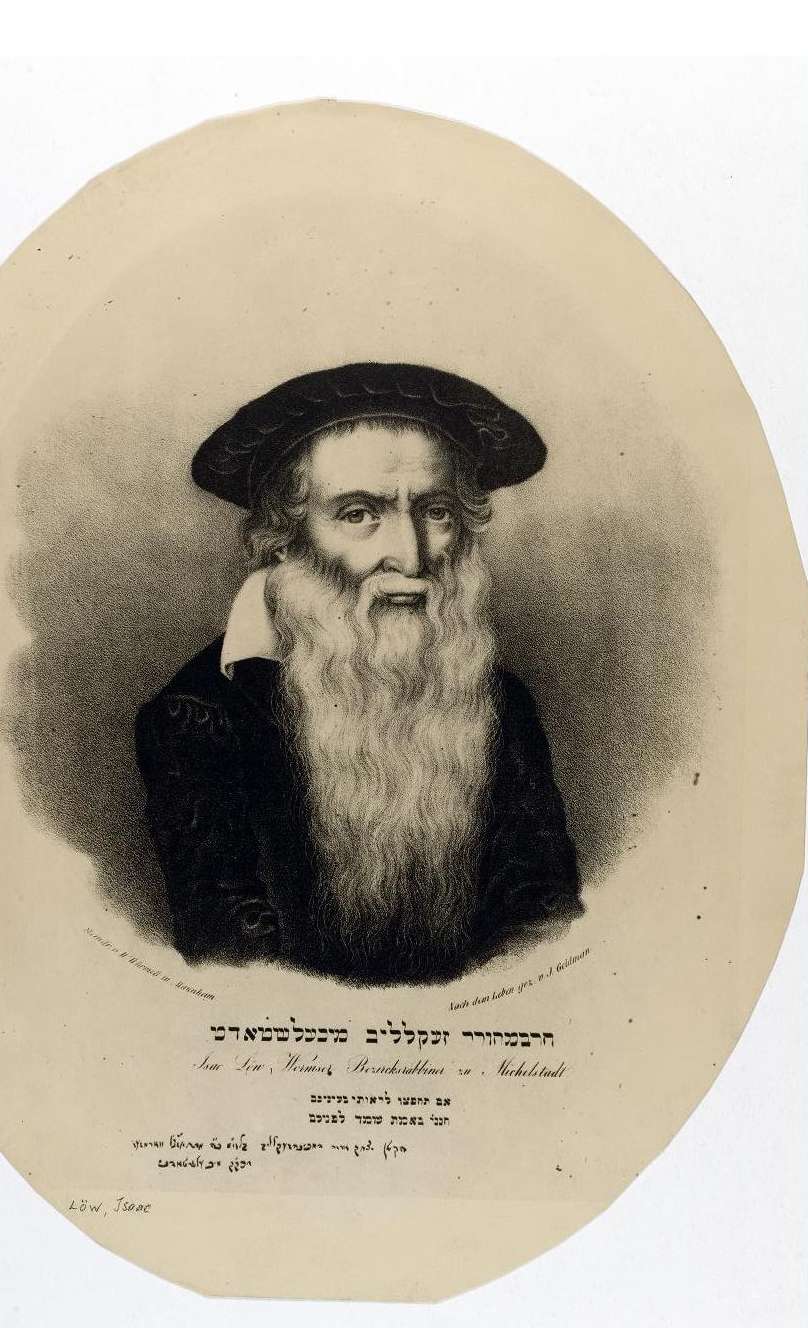
Yekkes in black hats.

Two to three hundred years ago most Jews in Germany and Holland wore a specific type of hat called the barrette (rabbis wore a different hat). Barrettes were round and flat and made of felt or wool. It was originally a popular hat worn by scholars all over Europe in the fifteenth and sixteenth century. It was first worn daily by Jews but gradually became reserved exclusively for shabbos hence it became known as the schabbes deckel.

The following image (which can be enlarged) is from 1800. Many, many more images from the 18th century (and even into the 19th) show Jews wearing this distinctive hat. (Look at the kallah maidelach to the left, as well as the little boy).


An 18th century example survives (in the Bayerisches Nationalmuseum, Munich):


(images are from here)

This is a portrait of R. Seckel Lebi Wormser, the so-called Ba'al Shem of Michelstadt (1768-1847), wearing a version of the hat. Given his evident advanced age in the portrait, we see it being worn still quite late:

Tuesday, June 26, 2007

Monday, June 25, 2007

“Rational inference,” “The rules of grammar,”--On neither knowing what Rashi wore nor what Rashi said.

I must repost the introduction to this post
“If you wish to know what brand of tobacco Rashi used, ask Leopold Zunz. If you wish to know the interpretation of Rashi's writings, ask me.”

--remark traditionally attributed to...R. Jacob Ettlinger (1798-1871) of Altona (quoted from “Bernard Revel Builder of American Jewish Orthodoxy” by Aaron Rothkoff, pg. 241)
“The great historian of the Jewish past, Heinrich Graetz, got most of his facts right in his monumental work, History of the Jews. But his obvious bias against traditional Judaism and his almost obsessive hatred of the rabbis of Israel spawned a school of Jewish history that did great damage to the Jewish people. They may have known what color shirt Rashi wore, but they ignored what Rashi really stood for and his immortal contribution to Jewish survival and destiny.”

--R. Berel Wein, published originally in the Jerusalem Post and reprinted here
in light of new facts (in old flasks; from 2004):
Gedolei Yisroel Warn Against Series of Books Containing Alterations in Siddurim and Chumoshim

“Woe to a generation in which every man does as he sees fit. And the matter should be publicized to prevent others from being drawn in by their ways,” write maranan verabonon gedolei Yisroel headed by Maran HaRav Yosef Sholom Eliashiv shlita, in a letter opposing the publication of “precise” (“meduyak”) editions of Chumoshim and Tehillim as well as new siddurim and machzorim that contain grave breaches and changes from the accepted tradition handed down to us.

The letters appear at the beginning of a leaflet titled,
“Ligdor Peretz,” distributed in Torah halls and botei medrash of every stream and background. Gedolei Torah encouraged the publication of the leaflet to express opposition to attempts to introduce new versions and foreign ideas in what is billed as a “precise siddur” (“Hasiddur Hameduyak”) in the nusach of Eidot Hamizrach containing “emendations” of the accepted nusach -- changes that threaten to damage the foundations of Judaism and cause breaches beyond our forefathers' imagining.

Similarly, emendations in the books Tikkun Sofrim Hameduyak, Tehilim Hameduyak and Hachumash Hameduyak were based on
“rational inference” and “the rules of grammar,” contradicting the accepted tradition practiced by Klal Yisroel.

The publishers declared their intentions to disseminate the books widely in an attempt to replace the Chumoshim currently used by all kehillos. The book, Hachumash Hameduyak, represents an additional breach by supplanting Rashi's age-old commentary with a new commentary called Peninei Rashi Umidrashim, which leaves out numerous entries from Rashi's classic commentary and includes other midroshim of the editor's choosing instead.

About ten years ago, following an attempt to publish a Chumash with a similar commentary, Maran HaRav Shach, zt”l, and ylct”a HaRav Eliashiv, wrote a letter reading, “ . . . And this is a terrible breach that should strike dread in the hearts of all who hear, for who can predict what it could lead to?”

Talmidei chachomim asked to examine these books were dismayed, and when the matter was brought to the attention of gedolei Yisroel they were told the changes are cause for serious concern, particularly since the publishers openly declare that all of Klal Yisroel should adopt the new nuscho'os.

The letters written by gedolei Yisroel express unyielding opposition to the books, whose editors failed to heed various warnings by the leading Acharonim not to alter the tefilloh by abandoning the nuscho'os we received from our forefathers. “ . . . And even more shocking is that they [grant themselves] the power, like Chazal, to issue decrees and to uproot, by omission, the nuscho'os of the Kadmonim” due to what they assert to be the needs of the hour.

Among the alterations was the deletion of the word “meheiroh” from the Sephardic nusach of Bircas Ahavat Olom before Shema. Although Shaar Hakavonos of HaRav Chaim Vital includes the word, the editors insist on removing it despite HaRav Chaim Vital's assertion it was brought down from the Arizal himself.

The editors also altered Oleinu Leshabei'ach, “based on the rules of grammar and speech,” replacing the words
“vegoroleinu kechol hamonom” with “velo goraleinu kechol hamonom.” This alteration contradicts Rav Yehuda Hachossid and the Rokeach, both Rishonim who stated that Yehoshua Bin Nun formulated this prayer with exactly 152 words. This same “emendation” is recorded in the history books as one of the changes proposed by Nosson Ho'azosi, a talmid of Shabsai Tzvi yimach shemo.

The leaflet Ligdor Peretz quotes poskim from various generations who say that one should strictly adhere to the tradition handed down to us from our forefathers and practiced in Klal Yisroel for generations and who rule out making changes even in cases where the text contradicts the rules of grammar. Some poskim even write that one who alters seforim based on logical inference should be excommunicated. The various “medakdekim” have always been known for initiating dangerous trends that must be stopped to keep them from entering the botei medrash.

The rabbonim said the revisions to Rashi's classic commentary are in the spirit of the Haskoloh.

The letter was signed by [rabbis].

Appended to the letter is a note by the leading Sephardic rabbonim which reads, “We hereby remonstrate against the changes in the holy writings and the longstanding nuscho'os of the tefilloh, based on logical inference they invented and the rules of grammar, and particularly against the terrible disdain, Rachmono litzlan, in the nusach of bircas Ahavas Olom appearing in Shaar Hakavonos. And all the words of those who make changes have no significance.” This addition was signed by [rabbis].

In a separate letter HaRav Shmuel Halevi Wosner backed the letter by maranan verabonon and wrote, “Today nobody has the power to undo decrees by our Kadmonim, even through mere omission, and this sin marked the beginning of the attempts to innovate that brought destruction upon all of Knesses Yisroel.
In reference to the text I highlighted in red above it occurs to me: today there are those who neither want to know what color Rashi's shirt was nor what Rashi said.

Then again, do they even know that they don't even say
“rabbi” the way Yisroel Sabbo did a mere seven generations ago? (see.)

Zeh beith midrasho sheh-le-rabbi Eli`ezer ha-qappar

Here is a fascinating archaeological find from Dabbura in the Golan Heights.


It is the lintel from what is apparently the Beit Midrash of רבי אלעזר הקפר (unless it was named for him).


(You can click the second image to see it much larger. I scanned it from Lawrence Schiffman's From Text To Tradition pg. 230. The first is the only photo I could find online.)

The inscription says זה בית מדרשו שהלרבי אליעזר הקפר / Zeh beith midrasho sheh-le-rabbi Eli`ezer ha-qappar / This is the Study House of Rabbi Eleazar Ha-qappar.

I cannot say what the validity of the following hunch is, but here is Steven Fine in Private Households and Public Politics in 3rd–5th Century Jewish Palestine, AJS Review 31:1, pg. 180-182:

“Though the discoverer (Dabbura is not yet excavated) suggested a relatively early date for this text—the mid-third century—my own hunch is that this inscription is two or three centuries later than the life of Eleazar ha-Qappar (a fifth-generation tanna) and reflects a hagiographic impulse. I wonder whether by the Byzantine period, this inscription may have served not to mark the earlier bet midrasho shel Rabbi Ele'azar ha-Kappar but to rabbanize the landscape of Byzantine Palestine (a process that quickened in subsequent centuries). ”

Be that as it may, it's nice to see--eagles, interesting orthography and all.

Friday, June 22, 2007

A medresh and a sedra and a rebbe II

Updated and continued from this post:

Commenter Nachum Lamm says the following:

“For a real laugh, see what the author of “Surpassing Wonder” says on this. He says Jews owe Christians a lot, because without the NT, we wouldn't know that it's “Rabbi.”

“ a) It's that important that we knew that?

“ b) It isn't
“Rabbi” in Hebrew.

“ c) We would have known anyway.

“ Eh. It's part and parcel of his whole book.”


The book he refers to is Surpassing Wonder: The Invention of the Bible and the Talmuds by Donald Harman Akenson. The book is described thus:

“ Elegant and inventive, "Surpassing Wonder" uncovers how the ancient Hebrew scriptures, the Christian New Testament, and the Talmuds of the Rabbis are related and how, collectively, they make up the core of Western consciousness. Donald Harman Akenson provides an incisive critique of how religious scholars have distorted the holy books and argues that it was actually the inventor of the Hebrew scriptures who shaped our concept of narrative history--thereby founding Western culture.”

I skimmed this book years ago (the publishing date is 1998, and that sounds about right). I didn't take much, but I remember being impressed that a Christian was according a fair shake to Rabbinic Judaism (I have since learned that this is not altogether rare).

In any event, on to the substance of what Nachum is talking about. He is actually quoting Judah Goldin. Here is the quote:

“Judah Goldin, long an opponent of needless esotericism once gently rebuked some of his more parochial colleagues by noting, “by the way, the Hebrew alphabet has only consonants, and quite often it is hard to decide how a word is pronounced; it is from the New Testament, which is written in Greek, that we learn that the Hebrew consonants r, b, y should be pronounced 'Rabbi.'”

(The author, by the way, is a student of Goldin and thinks very highly of him, as attested by a number of comments scattered throughout the book.)

In any event, my gentle rebuke must be directed at Goldin more so than the talmid who merely quotes his rby.

While logic (or rather, grammar) would seem to dictate that historically rby was pronounced 'rabbi' there is more Greek evidence besides for the New Testament. There are numerous ancient inscriptions in Greek and Latin with the title 'rabbi' given to the men that slumber beneath the epigraphs.

Here is a sampler (although I am only using Latin letters all that are italicized are Greek [except for one Latin example):

Latin (from Italy, uncertain date): “Benus filia rebbitis Abundanti.”

Greek (from Cyprus, 3rd c.): “Rabbé Attikos.”

Here's a good one:

Greek (from Bet Shearim): Hebrew יוסף בן יצחק followed by Greek “Ribbi Iose the pious, son of Isakios.”

Another Hebrew/ Greek one from Bet Shearim:

Hebrew יהוסף followed by Greek “Rib Yoaas[ph]” (this means that the Greek letter Phi is missing from the end due to the ravage of time, but it surely was there).

Also in Bet Shearim רבי גמליאל followed by Greek “Rabi Gamaliel.”

There's a Greek “Rabbi Anianos the dwarf.”

There's a “Rib Samuel who arranges, and of Iudah who puts to sleep.”

There's a “Rab Iudah son of Ionatha.”

A “Samuel of Gallus Berebi.”

These are all interesting and I could go on, but let's wrap it up:

Inscriptions come as Latin Rebbi, Greek Rabbé (Ραββη), Rabbi (Ραββi), Rabi (Ραβi), Ribbi (Ριββι), Rab (Ραβ), Rib (Ριβ), Bérebi (Βηρεβι) and even R (Ρ).

In any event, I concede that there really isn't hard evidence for how it was pronounced in the 1st century. (Indeed, there is even a scholarly debate if the title rby was even used before the destruction of the Temple, meaning that its use in the NT could be anachronistic in the sense that the disciples didn't call Jesus Ραββi. However, I personally distinguish between its use as a title and as a word. As I pointed out yesterday, it is not only a title. It is also a word meaning “my master.” I see absolutely no reason why the word need not have been used informally before taking on the meaning of “rabbi,” which is to say, losing it's original definition, in which case it probably was used before 70 CE regardless of whether it's use as rabbi per se is an anachronism in the NT.)

However, the point is clear: it is naive to suggest that there is an actual correct pronunciation for a term which obviously was in flux by the very people who were part and parcel of rabbinic culture itself; the rabbis and their students. The New Testament may have captured one particular pronunciation, which later Hebrew grammarians (in the 19th century) concurred with. But the evidence shows that it is ridiculous to speak of how the word was pronounced based on grammatical rules or one line of evidence, just as it would be ridiculous in 1500 years for a linguist to decree that George W. Bush did not say “nucular.”

All the inscription information is taken from Shaye J. D. Cohen, Epigraphical Rabbis, JQR New Ser., Vol. 72, No. 1. (Jul., 1981), pp. 1-17, which you can download.

Yeshivish

This week's Philologos on the question: Is there a Judeo-English?

Short answer: he doesn't know. (My tongue-in-cheek exploration.)

I find it hard to believe that he doesn't know about the thing that Yeshivishe folks speak. So why doesn't he mention it? Could he really not know? (I say thing because, what is it? A dialect? A technical jargon?) No one seems to know for sure, and it is mostly ignored. But it exists. Of that, me and tens of thousands, perhaps hundreds of thousands, are sure. No, it is not Yinglish. It is not Uncle Murray teasing you about how ticklish you're pupick is.

There are those who argue that it is intelligible if the foreign words are explained, thus it is no different from unintelligible speech of doctors or pilots. An outsider need only be told what the words mean and they'll understand it. I am not so sure about that.

In any case, I wonder if this speech within a speech existed in Yiddish itself. In other words, there was the Yiddish language per se and the way in which yeshive bochurim and sattelite associates spoke similar? Leopold Zunz explored Yiddish in his Die gottesdienstlichen Vorträge der Juden (click the link--the exact page).

There he notes Hebraic elements of Yiddish and classifies them by category, for example the Yiddish words from Hebrew associated with religion (like yom tov, tallis, chupah, zemiros) or with daily life (luach, chayav, baal ha-bayis, assur) and also with yeshiva culture and Torah learning (kelomar, vaddai, davka, be-shlama, baki, afilu, aderraba, teyruts, tomar, qashya, pshita, stam, sofek, mi-mah nafshakh).

As far as I know, these were words that were very much used by Yiddish-speaking grandmothers and woodchoppers. Was there a different vocabulary--or usage among the yeshivishe velt in the Yiddish world? I don't know.

An interesting question is: what was it like in the US or England 100 years ago. I am reasonably certain that American yeshiva boys "asked kashyas" 100 years ago. But I am equally certain that they didn't ask their friends for "eppis ah bissel Coca Cola," unless they were speaking Yiddish.

Anyway, Judeo-English? Maybe. I don't know. Perhaps the problem is that our classification of languages has grown to sophisticated. If the present were 500 years ago and this was a way in which Jews spoke English you can bet good money that it'd have been classified as Judeo-
English.

(By the way, “Frumspeak” is a silly name. Bad choice, Aronson.)

Thursday, June 21, 2007

A medresh and a sedra and a rebbe

One of the topics I keep coming back to is how the Mishnaic Hebrew rby רבּי was historically vocalized. (Previously discussed: I, II, III.)

Briefly, in presently vocalized Ashkenazic texts this word is written as רַבִּי, which is properly pronounced ra (rhymes with "ha")--bee (as in the thing that makes honey. Ra-bee. (In contrast with the English "ra-bye.")

However, in Sephardic texts it is written רִבִּי or רְבִּי, both of which sound roughly like "rib--ee."

Historically Ashkenazic texts also vocalized רִבִּי; the historical colloquial pronunciation seems to have been רֶבִּי --"rebb-ee" (or some variation, like רֶבֶּה "rebb-eh" or רֶבָּה "rebb-uh." In other words, when being grammatical (thus requiring vocalization) all texts had רִבִּי. The great Hebrew grammarian Elias Levita wrote that רִבִּי was correct.

The question is, why? Rby רבּי means "my master" (or "my rabbi," in later usage). רַב means "master" or "rabbi." So why רַב should become רִבִּי instead of רַבִּי is a bit of a mystery, particularly in view of the fact that in the New Testament רבּי is transliterated paBBi , which would seem correct! Indeed, as I have said (and will show) Ashkenazim too wrote רִבִּי even if they said רֶבִּי! Eventually the grammatical oddity was noticed and pedantic maskilische oysvorfs began tampering with correcting canonical texts and thus was born רַבִּי, and thus all Ashkenazim who try to be correct now say Rah-bee רַבִּי (when learning Mishnayos, for example).

Here are a couple of randomly selected examples of old vocalized Ashkenazic texts which are identical with the Sephardic ones:


From a 1527 Prague Haggadah (all are courtesy of JNUL).


Lublin, 1610. Yes, that's Lublin. Poylin.


Sulzbach, 1755 (Bavaria). This is from the cradle of Ashkenaz, and it is from the lifetime of the Gra, R. Ya'akov of Emden, R. Yehonathan Eybeschuetz, the Noda Be-yehuda, R. Hayyim Volozhiner, the Ba'al Ha-tanya--all of the early modern rabbinic figures who presaged modern Orthodoxy.


Horodna, 1805. That's late.

Like most changes, you can practically date them, so long as there is a paper trail.

Finally (and I am not claiming this book is the first instance):


Roedelheim, 1822. Of course: Reb Wolf did it. (link)

figures. Look at him!


In any case, the question is why did Ashkenazim pronounce it Rebbe and not Ribbi? It would seem to be a normal sound shift following a typical pattern. Two examples: in Ashkenazic Hebrew מִדְרָשׁ is pronounced מֶדְרֶשׁ and סִדְרָא is pronounced סֶדְרָא (but always spelled correctly!). Following this pattern, spoken רִבִּי easily became spoken רֶבִּי.

On the other hand, in this regard I might mention the name שִׁמְשׁוֹן, which is to be read "Shimshon," (or "Samson" in English, following the Greek) but colloquially became שַׁמְשׁוֹן, "Shamshon" in Yiddish. Presumably this was not patterned on the German, as German Bibles have "Simson." (However, "Samson," evidently, is how the name is used in Germany.) In any case, we may or may not have an example of another /i/ to /a/ shift. That being the case, רִבִּי could as easily have become רַבִּי (or vice versa). Except that it didn't.

Perhaps the solution is that Septuagint שַׁמְשׁוֹן "Samson" was correct (in its time) and the same way it shifted to Simson שִׁמְשׁוֹן by the time written dots were invented, רַבִּי "rabbi" was the original form (as grammar would indicate) but it too shifted to רִבִּי. by the time vowels dots came into existence, thus all vocalized manuscripts show רִבִּי until it was corrected back to its conjectured original form.

One more: vanilla/ vanella.

Concerning the Study of Tanach in Our Days

“Ever since the rise of the accursed Haskoloh movement in the world, its avowed goal was to swallow up the holy Tanach and desecrate it by stripping it of its holiness, G-d forbid. The Maskilim established themselves, as it were, as guardians over the Tanach, just as their heirs and followers instituted themselves as guardians over Eretz Yisroel, and they defiled that study as a holy undertaking.

“They related to the holy figures depicted in Tanach as if they were picayune peers, our own contemporaries, more or less, paralleling the ancient Biblical times to our latter days. The brunt of their work was to reduce the greatness of those ancients and place them on par with our own generation and times, as if they were equal to us, without the vast generation gap.

“All of ancient history, including its illustrious figures, was reduced to mere tales, novel material, newspaper items. They allowed themselves a free hand to putter around, to stir up the soup of history which they concocted and doctored, and then to ladle it out according to their desired degenerate distortions, devoid of all spirituality. They critiqued and analyzed Tanach as if they were newspaper commentators of our times, removing the dividing parameters between holy and profane, and consequently between Jewry and the nations and all other such demarcations.

“The written Torah was reduced, G-d forbid, to mere literature which they rewrote and redefined according to their own standards. (See Rambam on his commentary on Ovos, Chapter One, on the Mishna: Antignos of Socho.)

“This approach to our sacred Torah roused the gedolim of recent generations throughout the Diaspora to denounce them categorically and to deny them any say on religious matters. Our leadership insisted on forbidding the teaching of Tanach to the children of our ranks before they were fully versed in the Oral Tradition and had gained the due reverence and appreciation for Torah, the teachings of Chazal and their exegeses upon the Scriptures, so that they would thus be well-grounded in the proper approach towards the study of the Written Torah Text.”

link

Wednesday, June 20, 2007

Satmar in Lakewood; on the Volozhin Revolution

Very interesting post at Circus Tent by guest poster Chaim G. on the “Woloshin* Revolution,” analyzing who won and who didn't.

*Volozhin, וואלאזשין ,וולוז'ין.

Tuesday, June 19, 2007

The ubiquity of the internet begins*

Bluke posts about a situation in Israel where the only way to get something done is to go online, in this case, to make an appointment with the US embassy. Apparently there is no way to make such an appointment by telephone. One way. Online. (via Wolf)

Of course this is only the beginning. Presumably in ten years there will be even more things which can't be done without but can only be done online.

However, I don't think this necessarily dooms the internet bans to failure. As I understand it, in Amish culture there are various exceptions to rules against technology and permissions can be granted on a case by case basis. I see no scenario where an American chareidi living in Israel will simply be without means of contacting the US embassy. This only means that the ban will have to adapt, but not necessarily that it is dead.

* If it hadn't already begun years ago.

Bluish Joggers

Josh's new Jewish blog aggregator Bluish Joggers. Looks nice!

Monday, June 18, 2007

On the alleged average intelligence of the Neziv

Some recent discussion on the Avodah list concerning the intellectual abilities of the Netziv (e.g.) remined me of the treatment by Gil S. Perl in his recent dissertation 'Emek ha-Neziv: A Window into the Intellectual Universe of Rabbi Naftali Zvi Yehudah Berlin, pp. XIX-XXII.

"In 1829, as a boy of but thirteen and a half years old, an aristocratic marriage for Naftali Berlin was arranged as well. A year later he was married to Rayne Batya, the thirteen year-old daughter ofIsaac of Volozhin (1780-1849) and, at the age of fourteen and a half, he left his parents' home in Mir for that of his in-laws in Volozhin.

"Barukh ha-Levi Epstein writes in a line that subsequently found its way into the popular imagination of the contemporary heirs of the Lithuanian Jewish community that his uncle, Neziv, was a boy of"average intelligence" who rose to the greatest of heights through his "extraordinary diligence. The available evidence, however, suggests otherwise. To begin, it is rather unlikely that Isaac of Volozhin, popularly known as Reb 'Izele, would have chosen a boy of "average intelligence" to marry his daughter. As the son of Hayyim of Volozhin who founded the Ez Hayyim Yeshivah in Volozhin, authored the highly influential Nefesh Ha-Hayyim, and was widely viewed as the preeminent student of the Ga'on of Vilna, there were few families in the Jewish world that were more distinguished than that of Reb 'Izele. Although not the innovator that his father was, Reb 'Izele succeeded his father as head of the yeshivah in Volozhin and was widely recognized as one of the preeminent communal and intellectual leaders of Russian Jewry. As such, it is rather unlikely that he would have chosen a husband for his daughter who did not exhibit promise as a budding Torah scholar.

"Furthermore, in recounting a meeting he had with Reb 'Izele in 1841, Max Lilienthal (1815-1882) writes that he was received by his "son-in-law Rabbi Lebele" a man of some 30 years and one of the most celebrated Talmudists in Russia.'" In truth, Neziv was only twenty-five years old at the time. The fact that Lilienthal's statement was first published in the late 1850s prior to the publication of any of Neziv's works and the reasonable assumption that it was composed before Neziv was appointed head of the yeshivah in 1853, suggests that Lilienthal's tangential comment is an authentic reflection of Neziv's reputation in 1841 rather than a retrospective perception of a Rosh Yeshiva's youth. As such, either Epstein's characterization of the young Neziv as a boy of "average intelligence" is incorrect, or the perception of Neziv underwent a remarkable transformation from a boy of "average intelligence" to "one of the most celebrated Talmudists in Russia" over the course of only ten years.[24]"

[24] If Epstein's characterization is incorrect, it probably results from two different factors. The flrst is Neziv's own humility to which his writings clearly attest (for example, see MD(l: 32); MD 1: 36; MD 2: 91; MD4: 24). The second is the longstanding tradition stemming from the 1856 dispute between Neziv and Yosef Baer Soloveitchik over who would lead the yeshivah in Volozhin, in which the learning style of Neziv was characterized by sweeping breadth and that of the Soloveitchik family was characterized by incisive depth. The genius and charisma of Hayyim Soloveitchik, son of Yosef Baer and son-in-law of Neziv's daughter, firmly cemented the incisive method as the intellectually superior mode of study in the imagination of Lithuanian rabbinic circles in the early twentieth century. As a result, it became perfectly plausible that, when viewed from the perspective of the proponents of Soloveitchik's methods, Neziv would be viewed as someone of "average intelligence," whose rise to prominence must have been due to the inordinate amount of time he devoted to acquiring his exceptionally broad knowledge base. While Epstein was indeed a member of Berlin's family, his high esteem for the Soloveitchik family (as evidenced by the fact that he sought rabbinic ordination from YosefBer Soloveitchik in addition to that granted by Neziv, as related in Chapter 38 of the fourth volume of his Mekor Barukh), the fact that his own method of study does not resemble that of Neziv, and the fact that his reconstruction of the Neziv's early years takes place in the 1920s, well after the death of Neziv and the rise of the Brisker school to prominence, makes Epstein's adoption of a Soloveitchik perspective on Neziv's youth all the more plausible.
In a note Perl points out that according to Eliezer Leoni, Sifra shel ha-`Ir ve-Shel Yeshivat "`Ez Hayyim," (Tel Aviv:1970), the Neziv was actually only eleven when the marriage was arranged with R. Izele's daughter Rayna Batya; the actual marriage took place when he was thirteen; but the main text favors 13 and a half for the betrothal and a year later for the marriage, which is the dates given by the Neziv's son R. Meir Bar-Ilan in Rabban Shel Yisrael (New York:1943), pg. 16-18. In other words, the discussion about whether the son of R. Hayyim would take a boy of average intelligence for his daughter or not is about the aptitude shown by an eleven or thirteen year old.

Incidentally, there is an interesting account (or more accurately, fleeting allusion) to some of the challenges a historian may face in gaining access to primary source material in possession of traditionalists who do not appreciate/ agree with the work. In this case limited access with constant supervision was granted to Perl with constant supervision (p3. 39, 52, 55-56). "When I asked to look at this reference in the manuscript, it was reviewed by two members of the...family and was denied permission to look at it. Nonetheless, I did manage to see what seemed like a legible acronym..." "My access to the manuscript was always limited to sitting next to a member of the...family who would turn to the page I wished to check and look at the specific textual anomaly before deciding whether to let me look as well. In this case I was able to peer over his shoulder and attempt to decipher the acronym..."

R David Cohen's thesis on the origin of Yiddish is limited by lack of evidence.

R. David Cohen has an interesting work (אברהם יגל יצחק ירנן) with the thesis that the emergence of Judaic languages like Yiddish and Ladino can be explained in light of passages in rabbinic literature like the following:

תלמוד ירושלמי מסכת שבת פרק א הלכה ד
מה דתני רשב"י בו ביום גזרו על...ועל לשונן

"That which R. Shim`on ben Yohai has taught: 'On that day they made a decree against [list of things]...and their language."

This speaks of a rabbinic decree opposing non-Jewish language (in a list of prohibitions including things like bread, cheese, wine, etc.).

In support he cites

שו"ת חתם סופר חלק ד (אה"ע ב) סימן יא
ולדעתי גם הקדמוני' היו בקיאי' ללועזי' בלע"ז אך בכוונה שבשו הלשונות מפני גזירת י"ח דבר שבירושלמי פ"ק דשבת דפוס וויען דף וי"ו /ו'/ ע"א ועל לשונם יע"ש ואין להאריך בזה בעו"ה
This is an attempt to account for this phenomenon. The Chasam Sofer opines that the 'correct' vernacular was known to those of earlier generations. However, they deliberately distorted it in their use of it in speech, in line with the Yerushalmi quoted above.

Indeed, the possibility of people knowing how to wield a 'proper' and an ethnic dialect of the same language at the same time is well documented and needs no elaboration here.

Thus, R. Cohen's thesis that the emergence of Yiddish and Ladino can be explained in this fashion. I believe what you have here is a classic syllogism, which is to say, that the juxtaposition of two facts (premises) are made to produce a third, previously unknown fact. In this case, the facts are

1. Yiddish and Ladino are different from German and Spanish
2. There is a rabbinic prohibition on the use of non-Jewish languages

and the result is

3. The rabbis deliberately spoke and promulgated distorted versions of the local vernaculars, and thereby is explained the emergence of Yiddish and Ladino.

Whether or not this is true is a historical question cannot be resolved by linking a 'fact' (this belongs in quotes, as I shall explain) with another fact.

The problems:

While Yiddish is different from German (and Ladino from Spanish), how different was Yiddish from the German of the time of its inception? To what extent has the development of Yiddish in non-German speaking lands influenced its divergence from German? To what extent has non Germanic languages influenced Yiddish? What of the status of dialects within a single geographical area 1000 years ago? Apparently persons living in European villages speaking dialects cultivated locally were often unable to understand people who spoke different dialects of the same language only one hundred miles away. Which German did Yiddish derive from and diverge from? What about the relationship between Ladino and Spanish? Between other Judeo dialects? Babylonian Aramaic? Palestinian Aramaic? What of Rashi's use of 'לע"ז,' which happens to be one of the most important extant source for Old French? Presumably these correct French words were being addressed to Jews for whom it was the vernacular. What of Judeo-Arabic? Suppose some counter examples are shown; perhaps only Yiddish and German (intentionally) adhered to the prohibition in the Yerushami?

These are all questions which can be answered only by examining old German literature and old Yiddish literature (actually, Yiddish literature makes a late appearance relative to the time which it probably emerged) as well as other materials which address the state of language in the Middle Ages. For example, while it is true that the German which is presently spoken is quite different from Yiddish, Yiddish itself is not so different from the strata known as Middle High German, which is the German that Yiddish emerged from, just as modern German emerged from it. That's why I placed 'fact' in inverted commas above.

However, R. Cohen's study ignores these various pieces of evidence which may be marshaled to prove or disprove the thesis. And it is a pity, because there is an enormous (even if insufficient) body of evidence to examine. But by eschewing it in favor of an interpretation of a Yerushalmi, combined with an apparent fact and supported by a Chasam Sofer (who failed to show that the 'correct' vernaculars were available all along) may have resulted in the historical truth of the emergence of Judeo languages, but it also might not have.

Indeed, for the second half of Yiddish's history, when it migrated eastward from Germany, it is an apparent fact that unlike the other places where Jews lived they did not adopt the local vernaculars, but continued speaking their own (until the well documented struggles over this issue in the 18th and 19th century). This might well be a fact worth examining in partial support of R. Cohen's thesis. It would not show that such languages were deliberately created from on high for the masses (can such a thing be? Maybe--`Ivrit?) but it might show that a conscious effort to adhere to the prohibition in the Yerushalmi. On the other hand, other factors, such as the ghettoization of the population might be the cause.

This particular thesis was cited in this letter in Jewish Action. I think there is something of a shame that both the writer of this letter and the author of the work that was the subject of this post are brilliant. But a question such as this can't be resolved by ignoring all the available evidence in favor of syllogism. Indeed, sometimes all there is is thin evidence and the only way to arrive at a working theory is through exegesis. If the only evidence appertaining to the rise of Yiddish and Ladino were the Yerushalmi and the Chasam Sofer and a few slivers of other sources I'd understand and accept such a theory.

Logical inferences are very useful in producing important new thoughts, but we all know that sitting in one's study and logically proving that the planets and stars must be attached to concentric spheres is ultimately self-limiting when one can also gaze into a telescope.

Thursday, June 14, 2007

A jubilant alternative to the Torah from antiquity?

One of the Jewish apocryphal books from the 2nd Temple period is Jubilees.

In an article called The Book of "Jubilees" and the Pentateuch by Solomon Zeitlin, New Ser., Vol. 48, No. 2, Dropsie College Jubilee Alumni Issue. (Oct., 1957), pp. 218-235--read it here--the hypothesis is put forth that this book--which reviews quite a bit of the Torah's narrative with important differences.

His contention is that this book is actually intended as an alternative to the Torah. (Perhaps that sounds milder if we call it Pentateuch?) In other words, it appears to be an alternative telling of the history of the Jewish people, the Avoth, Egypt, Exodus, etc. It knows of the age-old Jewish practices, its festivals, etc. but it gives different reasons for them. For example, it has Avraham instituting Sukkot:

Jub. 16:26-31:

26. And he blessed his Creator who had created him in his generation, for He had created him according to His good pleasure; for He knew and perceived that from him would arise the plant of righteousness 1 for the eternal generations, and from him a holy seed, so that it should become like Him who had made all things. 27. And he blessed and rejoiced, and he called the name of this festival the festival of the Lord, a joy acceptable to the Most High God. 28. And we blessed him for ever, and all his seed after him throughout all the generations of the earth, because he celebrated this festival in its season, according to the testimony of the heavenly tables. 29. For this reason it is ordained on the heavenly tables concerning Israel, that they shall celebrate the feast of tabernacles seven days with joy, in the seventh month, acceptable before the Lord--a statute for ever throughout their generations every year. 30. And to this there is no limit of days; for it is ordained for ever regarding Israel that they should celebrate it and dwell in booths, and set wreaths upon their heads, and take leafy boughs, and willows from the brook. 31. And Abraham took branches of palm trees, and the fruit of goodly trees, and every day going round the altar with the branches seven times.

Interestingly, Jubilees names Jerusalem as God's chosen place, which the Torah didn't.

Precisely because it parallels yet differs with the Torah (in many cases being "stricter") Zeitlkin believes that it was intended to replace the Torah.

Here are Zeitlin's conclusions (click to enlarge them):


Tuesday, June 12, 2007

Walk like an Egyptian

Steg calls attention to an interesting midrash, שמות רבה כב:א:

When the kingdoms would be allegorized, they would be compared to animals, and when the מצרים would be allegorized, they would be compared specifically to foxes —Rabbí El‘azar beRabbí Shim‘on said: the מצרים were tricky, therefore they were compared to foxes; and just as foxes walk while looking backwards, so too do the מצרים walk while looking backwards.

Steg points out that images of animals and humans from Egyptian hieroglyphics show them facing backward (over their shoulder, like an owl) and supplies this image:


Could be. I'm not so sure this is precisely what is intended because with a little checking it doesn't seem like human figures are always facing backward in Egyptian hieroglyphs.

However, the sort of stiffness of the human depictions in Egyptian art have long been noted, like this:


Indeed, such postures are a part of popular culture.

I believe Steg gave a beautiful explanation for the factual, historical basis of this midrash, although I think that perhaps it is a more general allusion to type of Egyptian depictions in reliefs which we are used to, rather than hieroglyphs specifically.

Or, maybe they did walk backwards!

Monday, June 11, 2007

The other Mordechai Breuer, 1918-2007

R. Prof. Mordechai Breuer z"l.

More than five words can say here

Examining the Artscroll phenomenon (on diversity, illusion of).

At What's Bothering Artscroll? I posted the full text of the interesting Jewish Press interview with R.*Nosson Scherman. I posted it mainly for posterity, since I don't know if the Jewish Press archives will always hold it. I didn't have the chance to highlight excerpts which I found interesting and worth comment; besides, R. Maryles already got to some of it.

So I thought it might be interesting to discuss another angle of the Artscroll question, namely that its critics maintain that it presents a particular Jewish hashkafah using selections from a wide (but somewhat resticted) range of classic Jewish sources without giving a true picture of the views of these sources (save, perhaps in works dedicated to one specific person, e.g., their multi-volume translation of Ramban's commentary to the Torah) and subsequently without revealing for the uninitiated that the corporate hashkafah may or may not be shared in part or in whole by the sources it quotes--certainly allowing for the impression that it does. What I mean by that, is that one may form the impression that sources ranging from R. Avraham Ibn Ezra to R. Wolf Heidenheim essentially share the general Artscroll hashkafah given that the only comments cited by these figures are of the sort that form the potpourri of views.

Here is the question and answer:

Some people claim that ArtScroll does not quote rabbis from certain camps in their works. For instance, I’ve heard complaints in Chabad circles that the Lubavitcher Rebbeisn’t quoted. The same could probably be said about Rav Kook. How do you respond?

"Authors will quote, first of all, classic sources, which almost by definition excludes almost anybody in the 20th century. My commentary on Chumash relies mostly on classic sources, and some moderns. Rav Soloveitchik is quoted there, as are Rav Kotler, Rav Feinstein and Rav Schorr. But if it’s my commentary, then I’m going to write it according to what I learned and my style of learning and how I understand it, and I’ll quote my teachers.


"There are a lot of great men who are not quoted. Rav Chaim Ozer Grodzenski was the gadol hador and I don’t think he’s quoted anywhere in the Chumash or Tanach. Neither is the Satmar Rav. The idea is that the person who’s learning it should understand the content. It’s not a question of trying to include as many names as you can for the sake of popularity. It’s a matter of trying to clarify the material."

The text I put in red is the most cogent answer I could possibly think of. Indeed, Artscroll's weltanschauung is that of their writers and contributers. Why on earth should it be anyone else's?

But this begs two questions.

One, certainly Nosson Scherman should be expected to present his teachers and his style of learning and not other's teachers and other styles of learning. But if Artscroll respects the legitimacy of other teachers and styles of learning, why isn't its oeuvre more diverse by the simple method of hiring a more diverse team of writers? In other words, I could understand if its team of mainstream sort-of-centrist yeshivishe writers would output mainstream sort-of-centrist yeshivishe product. But why should all of their writers have that background when there are other legitimate teachers and other legitimate styles to be taught?

The second is that the rest of the comment seems to negate this contention. Why then is R. Soloveitchik cited? Was he a forerunner and teacher of Nosson Scherman as were R. Kotler and R. Kamenetsky and R. Shorr? How could one escape the conclusion that R. Soloveitchik was included for some sort of cultural or political reason, and if so, why ought one not conclude that a R. Kook or a Lubavitcher Rebbe were excluded for the same reason?

edit: in relation to this question:

Some companies are $10 million companies, others, $100 million. Is there a number one can pin on ArtScroll?

No, I can’t give you a number on that. But I can say that people think that ArtScroll is a gold mine. It’s not. We have to go out and raise money. It’s very very far from a gold mine. Some books sell very well, but the profits from those books subsidize the other books.

Primarily, though, major works like the Talmud, Ramban, Divrei HaYamim etc. cannot be funded by the market.

It’s no different than a yeshiva, or, l’havdil, Harvard or a symphony orchestra that has to raise money in addition to tuition and ticket sales.


there is an interesting link.

*Now that R. Marcus Lehman is "Lehman," TRFKA R. Scherman may as well be Nosson Scherman.

LinkWithin

Related Posts with Thumbnails
'