Tuesday, July 31, 2012

Joking about expansive definitions of kosher, in 1890

Writing in 1890 as 'Marshallik,' Israel Zangwill's Morour and Charouseth columns in London's Jewish Standard were filled with much wit and ingenuity that holds even today; some more and some less. In the July 4, 1890 issue the following appears:


Someone had written an advertisement for a new store that, because of poor wording, seemed to imply that it sold "kosher lemonade, pickled salmon, firewood [and] nightlights." Haha. Zangwill goes to town on it. Kosher bacon! Little did he dream that one day . . .


ETA 8.1.2012:

Interestingly, I came across the following letter in another Jewish Standard issue:


Not publication-worthy

One of the best "we're not going to publish this letter" statements I have ever seen. Jewish Standard, June 6, 1890.


Monday, July 30, 2012

R. Chaim Leib Auerbach's whirlwind tour of the United States

Here are some accounts of Rabbi Chaim Leib Auerbach - R. Shlomo Zalman's father - the "Dean of Cabalah University" - on his visit to the United States and Canada in 1932. Read these for his views on the Great Depression, Zionism, Prohibition and more. These newspapers are from San Antonio, Sheboygan and Winnipeg.


On the Klausenberger Rebbe's wedding

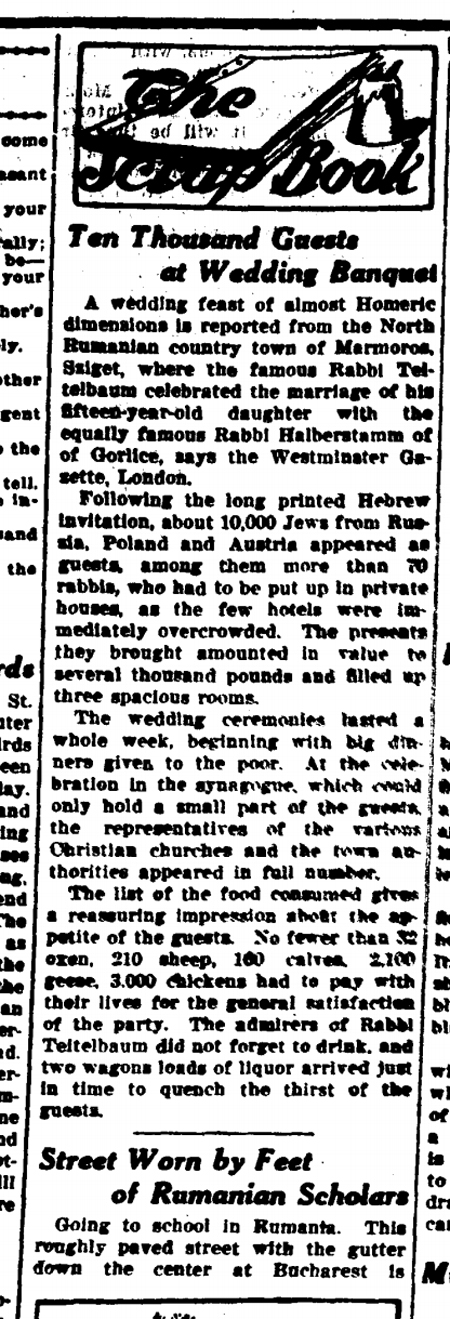
This is a report in the Le Mars Globe Post of Le Mars, Iowa of all places, from August 25, 1924, of the wedding of the Sigheter Rebbe's allegedly 15 year old daughter to none other than the future Klausenberger Rebbe. At least it seems that this must be them.


Thursday, July 26, 2012

And they say Old Testament justice was harsh

Here are accounts of some Jews who were convicted of stealing a watch and executed, from the Old Bailey records, December 1744. As you can see, the second, a woman named Hannah Moses, was married to Samuel, who was executed the February before for robbery. The writer of these accounts was the chaplain of the Old Bailey prison in London.


Wednesday, July 25, 2012

Torah in a box

Here's an interesting letter from the Debrecener Rov of Boro Park in Hamaor (5748/ 1988), about the computerization of Torah:


A follow-up in the next issue.

Tuesday, July 24, 2012

Monday, July 23, 2012

How's that for a logical inference?

It's from the time of Rashi
+ it contains Rashi's commentary
_________________________
= Rashi probably wrote it:


This is from Kennicott's annual Collation of the Hebrew [Manuscripts] of the Old Testament (1769). Kennicott collated Bible manuscripts for his master work Vetus Testamentum Hebraicum (1776), a critical edition of Tanakh comparing the masoretic and samaritan text, with all the variants he and his researches found in the many manuscripts they looked at.

Wednesday, July 18, 2012

Mea culpa

I have a very serious post to make. I apologize to Dr. Edward Breuer for plagiarizing a bit of his excellent thesis/ book The Limits of Enlightenment in this post from four years ago (link). I should have given him credit then, and I do now. את חטאי אני מזכיר היום.

Since I believe in keeping apologies simple, I will not say anything besides what I have said. 

On stringency

Here's an interesting haskamah.


Thursday, July 12, 2012

Is that a hurdy gurdy?


No, it's a פסנתרין (Daniel 3:5), allegedly. 

Here's the whole key:


And the images:


From Moses Landau's, נכדו של הגאון בעל הצל"ח, Prague 1835 edition of Psalms (link). It has tziltzele shema and tziltzelei serua.

Wednesday, July 11, 2012

A talmid chochom named Shprintza

Here is something interesting. In the beginning of Rabbi Moses Kunitz's Ben Yochai (Vienna 1815) he has a page dedicated to what a wonderful family he came from. He mentions that his great-grandmother Hendel's sister was the famous Rabbanit, Shprintze, the wife of R. Mordechai Kaempner (1700-48).
"They said about her that she was an expert in all the defective and plene spellings, as well as the massorahs of all the Biblical books. You could not quote to her a mishnah or aggadah in all of the Babylonian or Jerusalem Talmud that she did not know by heart. She was also a noted beauty, and her charitableness/ righteousness was well known"

Monday, July 09, 2012

The Maggid of Kelm's sermons against the Hebrew newspapers, as reported by one of the Hebrew newspapers

Here are a couple of vintage notices in S. J. Fuenn's journal Hakarmel, concerning the Maggid of Kelm's sermons in two cities, about the Hebrew newspapers of the time.


Bialystok. From a letter from our friend to his friend in Vilna we heard of the wonderful derashos of the Maggid of Kelm: 
This is what the Maggid of Kelm preached in the Bet Midrash of Rabbi S. Bulkowstein; there are four holy things - the Shulchan Aruch's four sections. Opposing them are are four satanic blemishes, Hamaggid, Hakarmel, Hameliz, and Hazefirah. A man eats and drinks on the holy Sabbath and fills his belly with good food, and sleeps a restful nap, beneficial to the body, and when he awakens he also wants to benefit his soul. With what pleasure does he feed it? Not with Mishna or Gemara, not with Shulchan Aruch or mussar works or kabbalah. Instead many gather in groups and read [these newspapers] - Woe to us! For our many sins, they read Hamaggid, Hakarmel, Hameliz and Hazefirah, newspapers which arrive by mail, even by telegraph (telegram?). These are the food for the soul, for the spirit. If there happens to be words of Torah in these newspapers, behold they are satanic, for this is the way of the Evil Inclination, to dress in white garments.
The next letter is from #16. The writer, from Pinsk, replies concerning the Maggid of Kelm, and says that he too heard one of his derashos in his city. He described how the Maggid mispronounced the word bildung (at least I think that's what it means) and called every enlightened man a "puschzak," an empty-headed person. Oh, no! Woe is us, continues the writer, that this befalls us in our times, when the Four Blights, Hamaggid, Hakarmel, Hameliz and Hazefirah, are among us. The maggid continues: Know without a doubt that if one sees a youth reading one of the gazettes then without a doubt he is a heretic. Whoever reads them is a heretic , a heretic in their youth, and a heretic as a man, and a heretic in their old age. The editors of these gazettes have no World to Come.

Friday, July 06, 2012

Shadal series #13 - on Sambatyon, then under English dominion (probably)

Here's a sarcastic and amusing excerpt from a letter which Shadal sent to Yehash[1] dated January 14, 1840.[2]


"I heard about, but did not understand the reason, for translating into English Rapoport's essay on the Ten Tribes.[3] Perhaps they sent a communique from across the Sambatyon River, which is undoubtedly under British dominion. Then "from beyond the rivers of Ethiopia shall they bring My suppliants, even the daughter of My dispersed" (Zeph. 3:10), a great offering to the wonderful Ga'on [i.e., Shir], and request that he come with them and become their chief. When this news reaches you, my friend, write me! Then I will immediately send you a wonderful poem which I will compose in his honor. The Sambatyonites will hear it and rejoice. My heart swells with the great joy which I will feel when the Gaon goes to the Land of the Ten Tribes and he will find countless precious books; manuscripts written by Ibn Ezra while he was eating matzah,[4] which reached the custodianship of the men of Ethiopia. But woe is me! What have I seen? A god is rising from the earth! An old man arises, and he dons a cloak - without a doubt it's Rabbenu Saadiah - with the Ten Tribes at hand, and he is shooting arrows through Ibn Ezra and Rapoport's heart (2 Sam. 28:14), since I brought them ill repute, saying that the mathematics of our ancestors were inexact. But the opposite is the case! It is a law from Moses on Sinai."
Whoa. What gives? This letter is from Shadal's Angry Period. As you can see, he is mocking the idea that an essay of Shir might be translated to English, that is, the importance of this essay and of Shir's antiquarian research altogether. Shadal and Shir, BFFs, had a major falling out. It is nice to see how as soon as he gets mad at him, the man becomes worthless. Mind you, the essay he refers to was published in Bikure Haitim in the 1820s. It was those essays which impressed Shadal in the first place and caused him to make contact with him. So, the man was touchy, but his hurt certainly manifested itself in a clever way.

Interestingly, 1838 a book appeared in Ofen called Haroeh. This was a journal published by a group of four young friends, disciples of Nachman Krochmal, who decided to take on the elder maskilim and expose flaws in their scholarship. In the second volume (link), dedicated to attacking both Shadal and Shir, the latter is actually taken to task for casting aspersions on the truth of the legend of Sambatyon (pg. 62): במאמרו על דבר היהודים החפשים העיר בהערתו ספקות רבות ע"ד נהר  סמבטיון והחליט שאין אמת בהספור ממנו ע"ש והנה מלבד שהדברים  האלה לא לו המה. "In his essay on the Free Arabian Jews in the footnotes he raises many doubts about the river Sambation and concludes that it is not true." The author of this piece, Nachman Yitzchak Fishman, goes on to note that Eisenmenger brings many of these things - implying that Rapoport plagiarized from this notorious antisemite - and and in any case it is inappropriate for a Jewish scholar to cast doubt upon this matter openly before all the Jewish public, for much evil can come from this if it were revealed to the Jewish masses!

Note that in the 19th century (and the 20th; future post) there were Jews who were very much involved and invested in the Sambatyon idea.

Speaking of Sambatyon, here is an interesting footnote concerning the name of this river from an 1783 English edition of The Travels of Rabbi Benjamin of Tudela.


A. Asher writes in his 1840 edition that Gerrans "understood very little if any thing of hebrew, and that all his learning was derived from B. Arias Montanus, L'Emperuer and Barratier." He even claimed not to have seen Baratier's edition before printing the first chapter of his own! On Baratier, a Christian child prodigy/ iluy, see here and here. Remember, Baratier was 12 years old when his scholarly, annotated translation of Masaaos Rabbi Binyamin appeared.

Anyway, after showing how Gerrans ripped off Baratier rather liberally, he gives an example of his poor Hebrew scholarship:

When in Lunel, Rabbi Benjamin writes in his Masaaos, about people he met:  והוא חכם הגדול בתלמוד והרב רבי משה גיסו ורבי שמואל החזן ורבי שלמה הכהן. Gerrans translates this as "This man is well skilled in the Talmudic writings. Here you likewise meet with that great R. Moses Gisso and R. Samuel (Hhasan) R. Salomon the Priest." גיסו of course means "his brother-in-law". Then in the footnote Gerrans gives a whole speech about how this רבי שלמה הכהן was Rashi, but "This is one of Benjamins Errors in Chronology, for רשי  was dead long before." Asher says there are almost as many errors as words in the passage, and that Gerrans 'explains' in the footnote that חזן means "sometimes a reader and sometimes an executioner." He then lists 5 separate mistakes Gerrans made about Rashi, and what arrogance he has to attribute his own error to Rabbi Benjamin himself! And of course this one line is a but a sampler of the whole book.

Much more to say about searches for Sambatyon. For starters, see Mevaseret Tziyon, published by Eliakim Carmoly in 1841. Read, e.g., the letter that "messengers of the scholars of the Ashkenazim in Eretz Yisrael sent to the Bene Moshe and the Ten Tribes." It is dated Rosh Chodesh Marcheshvan 5691/ 1831 and signed by R. Yisrael of Shklov, author of Pe'as Ha-shulchan, among others (link).
_______________________________________________

[1] Yehoshua Heschel [Osias] Schorr
[2] Iggerot Shadal V. I. pp. 656 - 59.
[3] This seems to be referring to A. Asher's edition of the Itinerary of Benjamin of Tudela (London 1840). The second volume contains dozens of notes by Shir, which were obviously translated into English by Asher, who thanks him for his correspondence in the first volume. In the second volume, pg. vi, he writes that
"The next volume of notes will contain the papers by the Revd. Rabbi Rapaport, Mr. S. Munk and Mr. Lebrecht, which from circumstances over which I had no control, it was impossible to introduce into the present volume, although I allude to them." 
Unfortunately there never was a third volume! However, the essay which he had translated was על דבר יהודים חפשים הנמצאים בארץ ערב ("On the Tribes of Free Jews in Arabia") which appeared in Bikkure Haittim 4 (Vienna 5584/ 1823).
[4] This is probably a reference to Ibn Ezra's comment that he was imprisoned in India and he and the other prisoners were fed something similar to matzah, thus Shadal means "obscure Ibn Ezra manuscripts written by him while imprisoned in India." My thanks to Dan Klein who pointed this out to me.

Thursday, July 05, 2012

A review of The Newlywed's Guide To Physical Intimacy, a sex manual for frum couples

"עת לאהוב The Newlywed's Guide To Physical Intimacy" ( Jerusalem 2011) by Jennie Rosenfeld, PhD and David S. Ribner, DSW, is a remarkable book ( link). The Hebrew title, a time for love, (from Ecc. 3:8), may well have been called עת לעשות. It is a book about sex for newly married Orthodox couples that is actually about sex, notwithstanding Steven Bayme's plaint that the book is flawed because it "ignore[s] the actual sexual behaviors of Modern Orthodox Jews" and instead takes a relatively traditional, by the book approach and does not deal with premarital fooling around or whatever (notwithstanding that it does do this, albeit in passing) (link).

I read it, and had my thoughts, but I also asked the authors some questions, and Dr. Rosenfeld was kind enough to reply. 

The book begins with an introduction explaining who the audience is - brides, grooms, chassan and kallah teachers, rabbis and "anyone in the Torah-observant community with questions about sexuality," but it is primarily for couples about to get married and for their first year (i.e., as newlyweds). It includes a pep talk about how special and pleasurable sex is, and some religious words about how it is a gift from God (not "G-d"), like other pleasures in life. It notes that is it not an exhaustive resource, and some things should be discussed with a doctor. Nor is it a halachic work, although it is designed with Torah-observant (it doesn't say Orthodox) people in mind. They believe they have accommodated a wide range of viewpoints, but if anyone has religious questions you should feel free to consult a rabbi who knows you, the couple, and is competent in this area of halacha (nice disclaimer!). Finally, they explain why they wrote the book. Both are Torah-observant Jews who are involved with the issue of sexuality in the Orthdox and Haredi communities. Dr. Ribner is a sex therapist who has seen hundreds of couples in more than 30 years, and Dr. Rosenfeld has worked on sex education for only a few years, but both have experience in the kind of questions and problems couples have and in many cases these could have been prevented with adequate information. They write that they have seen people who felt isolated for feeling things which are completely normal, people who suffered from lack of familiarity with their own sexuality, and had difficulty forging a deep sexual connection with their spouse. So they decided to write this book, to address these issues. I would add that without being a sex therapist, but just by having experience in Orthodox communities and reading many different kinds of personal accounts, viewpoints and questions in various online forums, the idea that Religious Jews "have been happily shagging for millennia [...] Jews never had the concept of "original sin." only tells part of the story to say the least.

The first thing which struck me is that the book lacks a rabbinic approbation, or any notice of any kind of rabbinic input, and that is unusual for a book intended for a religious audience. Assuming this was not an accident, I asked why they chose not to pursue, or use, a haskamah (rabbinic approbation). I wondered this because it occurred to me that a certain percentage of the intended audience might be reluctant to use it without one, and since they must have known that, I assumed they did a cost-benefit analysis and concluded that it was better to publish it without one. It did not occur to me that they could not obtain one, because I am sure they could have. Dr. Rosenfeld replied that they hoped that the book "would speak to the gamut of Orthodoxy (from the Haredi to Chassidish to Centrist to Modern to Left-wing, etc.), we didn't want the haskama to alienate any of the potential readers. Seeing a rabbi to the right or to the left of one could cause them to think that the book is only for that particular group. And the book is really designed to speak to everyone. Ideally, couples could take the book to their rabbi to get his advice, or receive the book from their chatan and kallah teacher, with the teacher's halakhic input. That was our thinking. In terms of whether we would have been able to get the haskamot had we decided we wanted them, I really don't know."

I also noticed that while the book is surely modest by current secular norms, it is still quite frank - and it also includes a further reading list; more on that later. In addition, while clearly religious in orientation, it is almost entirely lacking in what they call "hashkafah," not to mention fluff. It is not coldly clinical at all, but there are no stories of rabbis, vertlach and facile analyses of the Mars/ Venus type, and where such generalizations do occur they clearly label them with terms like "may" or "tend to." There are no platitudes or quotations from various famous "Holy Letters." I assumed this resistance to turn the book into a piece of moralistic literature was not an accident either, and Rosenfeld confirmed that the lack of hashkafah comes from the same place as the lack of haskamah, on theone hand. On the other hand, she pointed out that such books already exist, but this one did not. I think it was a wise decision, because such books often feel preachy. Furthermore - more below - there is no laundry list of halachic or customary restrictions in this book, which are commonly disseminated by chassan and kallah teachers, and presumably  they are the cause of not a small amount of what they have to deal with in therapeutic situations (this is my inference). Consult your rabbi if you need to, is all they suggest.

The first chapter is called His Body/ Her Body and Arousal. Taking no chances and making sure that everything is completely clear to whomever reads it, it begins with noting that no two bodies are alike and each responds differently to different stimulation. It even goes through some basic descriptive info about what male and female bodies look like! - as well as to explain what erogenous zones are, and what are some of them. While these things may seem obvious, or at least something intelligent people will figure out themselves, they take no chances and do not want readers who need to begin at the beginning to be left behind. Finally, there is a detailed description of the female and male body and the physical act of sexual intercourse itself.

The second chapter is called Getting Sexual. It begins with guidelines, such as that sex should be a learning experience, enjoyable, people should expect it to be different from what one may have seen or heard, and that men and women tend to have different needs and respond in different ways. Finally, if things are just not working, one should not hesitate to seek professional help. It then discusses the importance of communication, clearly knowing and labeling body parts, as well as the terms relating to sexual activity and response. Their point is that couples who bashfully talk about that thing with the thing - or no talking at all - are not going to end up on the same page, except by luck or chance. In this chapter, as well as in the others, there are gray boxes labeled "We were wondering..." which represent commonly asked questions (and Rosenfeld confirmed that these truly are common). So in this chapter, for example, one is about talking about sex before marriage and another is about discomfort with being naked. Also discussed in this chapter is all aspects of sex, from physical and mental preparations, to foreplay to kissing. To inject a personal note, someone told me that men and women kiss on the mouth and he cited Rashi to Shir Hashirim 1:2 (which is the false meaning, according to you-know-what). The authors, as I indicated, do not bother with such things. Two pages of this thin book (about 100 pages) is devoted to the female orgasm, with a promise, later to be fulfilled, about treating this in detail later. This chapter's "We were wondering..." includes questions about smell, painful intercourse, and experimentation. 

The next chapter is called Alternate Intimacies. This leads me to the observation that the book seems to really try to push the envelope, but not be sexy itself. No one can accuse this instructional manual of being erotic! I am reasonably certain that mutual oral stimulation was never written about so pareve. But it is there. Two word summary of the chapter: oral, manual. 

The next chapter is about managing time, niddah, pregnancy, babies, etc.

Chapter Five, When Your Sex Life Isn't Working, raises issues from physical to mental barriers, as well as childhood sexual abuse, negative body image, homosexuality and pornography, which they say should not be automatically viewed as addictive.

The next three chapters are called She Asks. He Asks. and They Ask. All of these are very frank discussions of common concerns, going into much greater detail than the small "We were wondering" sections. These discuss much of what you think they will, including less obvious things like frustration with niddah. As Bayme wrote in his review, they don't dismiss it with platitudes about how special niddah is. Nor do they wink, wink. They take it seriously, dignifying the issue, and assume that the couple is committed to niddah observance, and offer suggestions for dealing with it.

The book ends by asking readers to engage them in a dialogue, and requests feedback, leaving an email address.

Afterwards, there is a section called Resources, which include books with titles like Guide to Getting it On. Which led me to wonder, what this book has that Guide to Getting it On, which they really recommend, doesn't? The answer to me was obvious. Many people will read The Newlywed's Guide to Physical Intimacy, but they will not read Guide to Getting it On. Or they would not read it until after reading a book like this, which recommends a book like that, in the following manner: "Though this book uses slang and "street language," no other book can compete with its comprehensiveness, and its wit sets a comfortable tone." Although this section includes a disclaimer that the resources may "have content that is not relevant or appropriate for you" my impression was that they hoped that readers would 'graduate' to such books and learn about that which they were unable or unwilling to write.

Finally - the envelope. Pasted inside the back cover is an envelope with the following note printed on a sticker sealing it shut:


While I am tempted to show one of these illustrations, of course I will not. Suffice it to say they are perfectly correct, adventurous (by conservative standards) and utterly unsexy. I guess I sort of knew the answer, but I asked Rosenfeld about it, and she replied: "That was definitely intentional-- we didn't want them to feel like pornography. Especially for the many frum men who have looked at pornography in their past, we didn't want the pictures to evoke discomfort/ memories of their past experience with pornography. The goal was to be educational, without being arousing/ erotic, and it seems we achieved that goal.."

My impressions. The book seemed to try to push the envelope, for a worthy cause, and in certain respects did that. I don't know if female masturbation is a third rail or not, but the book does not mince words and clearly considers it a normal, even necessary part of sexual discovery (I know!). Although I make this inference myself, I assume that the lack of the same for men is due both to the halachic issue as well as the reality that in practice this is most likely ignored at least some of the time by most men anyway. At the same time, the book does not strive to be fun or light. Practical might be the best word to describe it's tone. It is also encouraging, delivering the message that most likely the reader is normal whatever they are experiencing, that there is much they can do themselves, primarily through education, communication, and practice and, finally, there are people to turn to if things are not working out.

The only real criticism I have is that the book missed an opportunity to deal with a probable cause of much sexual dissatisfaction in some frum communities, namely uniformly stringent approaches taught as normative and obligatory law, and in some cases these restrictions have little relation to contemporary sexual needs which even sheltered people have. Vehamevin yavin. (Another cause, of course, is the negative messages about sex that many receive for nearly their entire life.) However, I suspect that there was little the authors could do about this. To counter, or at least offer an alternative to such approaches on a textual basis, would be to enter the lists as a halachic, or purportedly halachic work, and that could have caused the book to be eschewed or even denounced. One hopes that eventually someone will publish such a work, in English - even to include stringent alongside lenient views, if that is necessary to get people to be aware of the true range of rabbinic views on sex. Word is, someone is thinking of doing just that.

LinkWithin

Related Posts with Thumbnails
'