Hillel and Torah she-be-'al peh at Maven Yavin.
Tuesday, November 29, 2005


Monday, November 28, 2005
What can I do to get you to comment?
I admit it. I really love to hear from you, Dear Reader. Not only do I love to hear what you have to say even if its to tell me I'm wrong, I love when you use my posts as a jumping point for good conversations whether or not it stays on topic.
I can tell that a lot of you are reading. So what can I do to get more of you to say something?
I can tell that a lot of you are reading. So what can I do to get more of you to say something?
Whether the Slifkin matter is over or not....
The following letter is printed in this month's Moment Magazine. As the letters aren't reproduced online I thought it may be of interest.
and
Edit II: The following letter of interest also appears in this issue:
I would like to register my complaint against the irresponsible and sloppy recording of my views in Jennie Rothenberg's article regarding the ban on the books by Rabbi Nosson Slifkin.
The author reports "[Rabbi Feldman] coondemned Slifkin for defending himself." This has no basis in fact.
Rothenberg continues, falsely giving the impression that this is a reason for her previous statement, that "Felman lamented that Slifkin...has made the ban's signers look like simple-minded fools." A responsible writer would have made it clear that this quotation is part of my introductory comments to an eight-page article aimed at showing that they were not fools.
Rothenberg's slopiness had one beneficial side-effect. Since I was born and raised in Baltimore and the English language is my native tongue, anyone who knows me found her revelation that I "speak English with a thick Yiddish accent" quite amusing.
Rabbi Aharon Feldman
Baltimore, MD
and
Jenni Rothenberg responds:Edit: Romach asks a question that I didn't even know I had.
Although the goal of Rabbi Feldman's article was to defend the ban's signers, his personal criticism of Rabbi Slifkin created a great deal of buzz in the Orthodox world and was thus relevent to my story. I interviewed many respected rabbis who had read Rabbi Feldman's essay and were concerned by statements such as these: "The ban was met with resistance by Slifkin, who vigorously defended himself on his Internet site....He portrayed the dispute as pro- or anti-science, with himself as a champion of truth and his detractors as uneducated deniers of the discovereis of modern science.... Slifkin's campaign was eminently successful.... As a result, many thoughtful, observant Jews were beset by a crisis of confidence in the judgement of the signatories." A number of rabbis were deeply troubled by Rabbi Feldman's implication that Slifkin ought to have remained silent instead of explaining his views. A few wrote public critiques that can be found at zootorah.com.
I wish to apologize for incorrectly characterizing Rabbi Feldman's accent as Yiddish. Our phone conversation took place via a rather scratchy transatlantic phone connection and I mistook his inflection for a Yiddish accent. This mistake was immediately corrected in the version of the article that appears on Moment's website.
Edit II: The following letter of interest also appears in this issue:
I read Jennie Rothberg's article "The Heresy of Nosson Slifkin" and found it to be excellent. Really well-written and probably the most accurate article written on the subject, both in terms of facts and the larger context.
Rabbi Gil Student
President of Publishing
Yashar Books
Brooklyn, NY
Friday, November 25, 2005
Dickdook Leshon Gnebreet
Judah Monis (1683-1764) was North America's first Hebrew instructor. He taught at Harvard, and was from an Italian family Portugese conversos (he himself converted to Christianity in N. America).

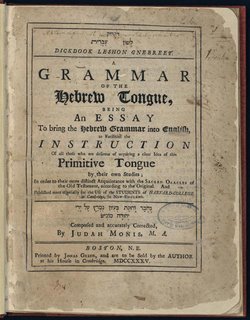
Note the title. I thought this was pretty cool.
On the Main Line, now with helpful tags: hebrew

Note the title. I thought this was pretty cool.
On the Main Line, now with helpful tags: hebrew
Wednesday, November 23, 2005
Tuesday, November 22, 2005
Things I learned in yeshiva....and things I didn't learn in yeshiva
Wolfish Musings once had a great post called Things I Learned In Yeshiva...And Things I Didn't Learn In Yeshiva. It's worth looking at his list. Bear in mind that I'm not discriminating between what I was taught in 6th grade or 10th. Here is mine:
Things I learned in Yeshiva...
And things I didn't learn in Yeshiva...
Long hair is forbidden by halakha for men
Long hair is not forbidden for men by halakha. While there are halakhic issues with how long hair lies when putting on teffilin, al pi din a man can wear his hair like King John or John Lennon if he wants.
Christianity is about repressing sexuality and insane asceticism, Islam is the same only in reverse.
Like a lot of stereotypes, there are kernels (or even whole ears) of truth to it. But a true assessment of these religions is far, far more complicated. It's like the old saw about how Judaism is all legalistic show without substance. There were trends, movements, currents and cross currents in Christianity and Islam such that they cannot be boiled down to a trite stereotype. Besides, Judaism, at least as presented to thewalking hormones teenagers we were in yeshiva is not exactly providing a sexually healthy environment at all times.
Moses Mendelssohn was the founder of Reform (not Reform Judaism, as it could only be called 'Reform')
While there is simply no way one can maintain that Mendelssohn was Orthodox (even though the term is anachronistic--it was, by the way, acknowledged that he was Orthoprax). However, nothing about Mendelssohn and his chevra was acknowleded apart from the 'fact' that from Mendelssohn came Reform and non-Jewish grandchildren. That the nature of the controversy was over the fact the the Bi'ur was a passport to German literacy (like the KJV of the Bible was earlier), I never heard. Nor, that R. Itzele Volozhiner had a seder in Parshat Hashevua with Bi'ur.
Non-frum and non-Jewish Bible scholars hate the Torah, Hashem and Judaism.
Again with the stereotypes. There were and are Bible scholars who hate some or all of the above (although I keep thinking of nineteenth century Germans when I try to think of names). Its abundantly clear from reading commentaries, studies and articles by Bible scholars that many of them have an abiding love for Torah, Judaism and Hashem (or some combination). In fact, often people become scholars in a field precisely because they love it.
There is a listable group of rabbis called The Gedoilim, most of whom, ironically, are of the Lithuanian yeshiva tradition with a couple of Chassidishe rebbes and an occasional Sephardi Haham thrown in for good measure.
Need I elaborate?
R. Moshe Chaim Luzzatto was so great that the Vilna Gaon said he would have walked to Italy to meet him. The Vilna Gaon said x% of the Mesilat Yesharim was written al pi ruah ha-qodesh.
Yes, but. R. Moshe Chaim Luzzatto was highly controversial and not without reason. He may have had messianic pretentions of some sort, wrote secular poetry and plays in Italian and attended the University of Padua.
Ad kan for now.
Things I learned in Yeshiva...
And things I didn't learn in Yeshiva...
Long hair is forbidden by halakha for men
Long hair is not forbidden for men by halakha. While there are halakhic issues with how long hair lies when putting on teffilin, al pi din a man can wear his hair like King John or John Lennon if he wants.
Christianity is about repressing sexuality and insane asceticism, Islam is the same only in reverse.
Like a lot of stereotypes, there are kernels (or even whole ears) of truth to it. But a true assessment of these religions is far, far more complicated. It's like the old saw about how Judaism is all legalistic show without substance. There were trends, movements, currents and cross currents in Christianity and Islam such that they cannot be boiled down to a trite stereotype. Besides, Judaism, at least as presented to the
Moses Mendelssohn was the founder of Reform (not Reform Judaism, as it could only be called 'Reform')
While there is simply no way one can maintain that Mendelssohn was Orthodox (even though the term is anachronistic--it was, by the way, acknowledged that he was Orthoprax). However, nothing about Mendelssohn and his chevra was acknowleded apart from the 'fact' that from Mendelssohn came Reform and non-Jewish grandchildren. That the nature of the controversy was over the fact the the Bi'ur was a passport to German literacy (like the KJV of the Bible was earlier), I never heard. Nor, that R. Itzele Volozhiner had a seder in Parshat Hashevua with Bi'ur.
Non-frum and non-Jewish Bible scholars hate the Torah, Hashem and Judaism.
Again with the stereotypes. There were and are Bible scholars who hate some or all of the above (although I keep thinking of nineteenth century Germans when I try to think of names). Its abundantly clear from reading commentaries, studies and articles by Bible scholars that many of them have an abiding love for Torah, Judaism and Hashem (or some combination). In fact, often people become scholars in a field precisely because they love it.
There is a listable group of rabbis called The Gedoilim, most of whom, ironically, are of the Lithuanian yeshiva tradition with a couple of Chassidishe rebbes and an occasional Sephardi Haham thrown in for good measure.
Need I elaborate?
R. Moshe Chaim Luzzatto was so great that the Vilna Gaon said he would have walked to Italy to meet him. The Vilna Gaon said x% of the Mesilat Yesharim was written al pi ruah ha-qodesh.
Yes, but. R. Moshe Chaim Luzzatto was highly controversial and not without reason. He may have had messianic pretentions of some sort, wrote secular poetry and plays in Italian and attended the University of Padua.
Ad kan for now.
Monday, November 21, 2005
We told you so
File this one under 'weird'.
Aish HaTorah reprints an article that appeared in Commentary last month by Conservative rabbi Dr. Jack Wertheimer.
Aish HaTorah reprints an article that appeared in Commentary last month by Conservative rabbi Dr. Jack Wertheimer.
Sunday, November 20, 2005

Friday, November 18, 2005
Thursday, November 17, 2005
Tuesday, November 15, 2005
Maven Yavin
Lamed Zayin, Krum and I have started a new group blog called Maven Yavin.
Let's see if three heads are better than one!
Let's see if three heads are better than one!
Monday, November 14, 2005
Jewish issues online
After a long time reading Jewish mailing lists, bulletin boards and blogs I've noticed that there are certain topics that come up over the years and then over and over again. These topics include things like lower (textual) criticism of the Torah, the Documentary Hypothesis, the age of the universe, Who Is A Heretic, how are we to understand fantastic midrashim, the nature of rabbinic authority and so forth. These topics recur again and again, over years and in many forums online.
Why? There is so much more in Torah. There are "famous" sugyas in Gemara. It seems like a relatively little amount of discussion about these issues, as opposed to more foundational or hashkafic issues that seems to occupy us online.
I guess it may that these are the issues that are neglected "in the real world". If you want stimulating discussion or a seder on these issues, it might be hard--or for some, impossible--to find offline. If its so, that these issues aren't discussable in the real world, then it probably indicates a failure of sorts, whether educational, institutional, rabbinic etc. These are things people are thirsty to talk about!
What other reasons might there be?
Applauding at windmills
Yitzchok Adlerstein at Cross Currents on the fortieth anniversary of Nostra Aetate, the document with which the Catholic Church exonerated all Jews of deicide.
Adlerstein writes that "Nostra Aetate....affirmed that G-d’s covenant with the Jewish people is unbroken and eternal. "
It did no such thing. The text is here, see for yourself. The Catholic Church can and will no more agree that there is another Israel--the Jews--then the Jews can agree that the Church is Israel. It could barely bring itself to recognize a sovereign nation called Israel, and it didn't do that for another 30 years. "Although the Church is the new people of God, the Jews should not be presented as rejected or accursed by God, as if this followed from the Holy Scriptures."Adlerstein writes "Jews – especially traditional Jews filled with a sense of the permanence of G-d’s Word – wonder how this could be done. How do you change a belief that the faithful assumed century after century? They do not understand that the Church does not see change as impossible. The Catholic Church overflows with tradition; it allows only for very slow change. But it does allow for it. Later generations can and do rethink old issues as society develops."How is this different from traditional Judaism? "Judaism overflows with tradition; it allows only for very slow change. But it does allow for it. Later generations can and do rethink old issues as society develops."
Who is a hakham?
He who learns from all people.
Bible scholar and popular Documentary Hypothethist Richard Elliott Friedman writes
Bible scholar and popular Documentary Hypothethist Richard Elliott Friedman writes
In my student days it occurred to me that if I would ever be able to read that list of cubits and materials and care, then I would be a scholar. (In Who Wrote the Bible?, pg. 176)
Friday, November 11, 2005
Am I the 'heir' of the great Godol Hador? GH said I could be; there is a discussion about it at DovBear.
The truth is, there are numerous differences between me and GH, and our respective blogs. There is plenty of common ground as well.
This post is just a marker. On the weekend I plan to post more about this, analyzing my own blog and purpose and contrasting it with GH's--and a separate post in tribute of the great Godol Hador blog (yes, I know that's like saying the Godol Hador Godol blog).
Also, stay tuned for some new j-blog info that cannot be disclosed right now.
A good shabbos to all, and remember to spend time on our father Avraham and the rich sidra of the week this shabbos.
Thursday, November 10, 2005
Karaism: on origins and what they were about Pt. II
As we saw in part one, the Karaites were not liberal Jews. The essence of their disagreement with the majority of Jews, the so-called Rabbanites (rabbanim) began with the issue of the authenticity of Torah she-be-al peh and the authority of the Talmud.
In a surprising fact, 'Anan ben David, made extensive use of the 13 rules of R. Yishmael. This isn't hypocritical--'Anan thought they were good logic, just not divinely revealed or the property of the tannaim. Later Karaite scholars used some of those principles as well in interpreting Torah and deriving law from it. The most commonly used rule was heqesh.
'Anan was not the true founder of Karaism, as we said. In fact, in an early phase of Karaism there was a backlash against 'Anan. Not him per se, but his views. Perhaps they were cognizant of the expression he coined, "Search thoroughly the Torah"--"and do not rely on my opinion", which was the later gloss on his words, attributed to him and repeated constantly by Karaite scholars. 'Anan offered many severe interpretations, as we shall see. At the same time, he also wrote that a believer who sincerely studied scripture and came to conclusions that opposed the majority must follow their own understanding. Of course, this is a prescription for anarchy, which is why Karaism ultimately did stabilize.
'Anan interpreted lehem 'oni (matza) to mean matza made only from barley rather than wheat or any of the other "five grains" . He introduced the idea of the dark Friday nights--which Karaites quite literally observed until well into the Middle Ages. He forbade sex on shabbat. He advocated a yearly 70 day fast (although no one listened), modeled on Ramadan, ostensibly. He required the bris milah to be performed on the 8th day--of the month. Thus, if a baby was born on the 7th day, he'd have to be circumcized the following day. If the baby was born on the 9th day, he'd wait a month. He introduced ascetic practices in mourning for the Temple, like forbidding wine (perhaps one is beginning to see why many Jews thought that Karaism was overly Islamized; another was the practice of removing shoes in the synagogue, which he based on the story of Moshe by the burning bush). 'Anan also outlawed all meat besides venison.
In any case, his word was not law, and that itself was a pillar of Karaism. Karaite scholars, taking off from where 'Anan left off, greatly expanded the types of forbidden marriages. For example, they believed that the rabbinic permission to marry one's niece opened the possibility of marrying one's own daughter! Keitzad? A man marries his brother's daughter and dies childless. His brother could the be obliged to marry his own daughter (yibbum). It reached a point where such a complicated web of fobidden marriages between relatives were woven that in smaller Karaite communities there was a shortage of marriage material.
Karaites, naturally, reintroduced the practice of observing the moon to declare rosh hodesh. They took literally the idea of displaying the cloth of a virginal bride as in Deut. 22:17 (Karaite hatanim had two best men, whose task it was to collect and display the sheet).
They had tefillah twice daily, modeled after the daily temidim offerings in the Temple, not unlike the Rabbanite Jews. (Again, this isn't hypocrisy--there is a verse (Hosea 14:3) which specifically equates prayer with sacrifice for the times without a Temple.) Following that route, they added a mussaf prayer on occasions which warranted it--and the mussafim were cumulative. So, for example, if Rosh Hashana happened on shabbos they prayed three mussafim, one for rosh hashana (or Yom Teruah, as they only called it), one for rosh hodesh and one for shabbos. The contents of their tefillos were different, as they dropped the shemona esrei, and substituted intially exceprts from Tanakh and later included some piyuttim by Karaite poets.
Later Karaite scholars came up with new interpretations which they tried to persuade each other and make normative. Daniel al-Qumisi, for example, decided that no birds besides pigeons were permissible, as [we] didn't know the precise meaning of the birds listed in the Torah (aside from pigeons, apparently). Many Karaites ate no eggs or bee honey (because of bee particles in it). They did eat milk and meat (but would never seethe a kid in its mother's milk, of course). They retained, at least initially, the terumos and ma'asros (with unique interpretations) due to kohanim and levi'im. And they paid.
Again, it must be stressed that not every rumor cited in a polemical source about them is true. To show the point in reverse, I will cite the great Karaite scholar Ya'akub al-Qirqisani. In his polemical writings against the Rabbanites he asserted that the Jews in Eretz Yisrael and Bavel criticize each other over the one day/ two days of Yom Tov issue by citing Deut. 13:1 against each other. The Israelis say that the Babylonians are adding and the Babylonians say the Israelis are diminishing from the Torah. Of course we know that this is false. It seems that a rabbinic practice of scorn was kiddush, which the Karaites interpreted and exaggerated. Salmon ben Yeruham attacked R. Sa'adya Ga'on's "lightheadedness" because "this inebriate drinks during the very time of prayer." Similarly, polemical material from our camp also stereotyped and misrepresented opinions and misinterpreted divisiveness in the other camp.
For a time many Karaites rejeted medical attention of any kind because of Ex. 15:26 and Chron. 16:12. Although not empowered to enact any of the punishments prescribed in the Torah, they believed and advocated in an academic sense "an eye for an eye", the death penalties etc.
Now it should be apparent that the cacaphony I described is simply impossible to maintain for long. After some centuries Karaism began to stablize and moderate some of its excesses. They readmitted much traditional lore and practices under the influence and guise of a widely accepted Islamic principle of the day called "idjna", which means "common consent" (they called it "ha'ataqah"). They agreed that wherever ALL Jews agreed on an interpretation then it surely must be the original meaning.This was a saner approach and greatly enabled Karaism to begin to flourish. (It should be noted that it bears some similarity to Solomon Schechter's "Catholic Israel".)
Before any gets smug about the strange development of Karaite halakhah and related things, consider this: One, they never claimed to be strict literalists, and, two, this information was uncovered through historical scholarship, which sees similar things in the development of our own traditions, albeit on a different track, third, their view didn't require the kind of perception of stability in practice that our does.
Two final notes on interesting phenomena. It seems that the still-current practice of calling every Yankel, Shmerel and Berel "rabbi" or "reb", in our version, was a reaction among Rabbanite Jews to Karaism. It was a kind of winking dig at the Karaites. Secondly, Karaites often called their own scholars "rabbi", which after all means "my master". 'Anan was called "Rabbenu" by Yehuda Hadassi, for example.
A third installment to follow, including info about later Karaite developments, the Crimea, the issue of Karaite "Jewishness" and so on.
Subscribe to:
Posts (Atom)
LinkWithin

Subscribe To On the Main Line


 Posts
All Comments