Thursday, November 17, 2011

A Mormon elder meets an av beit din

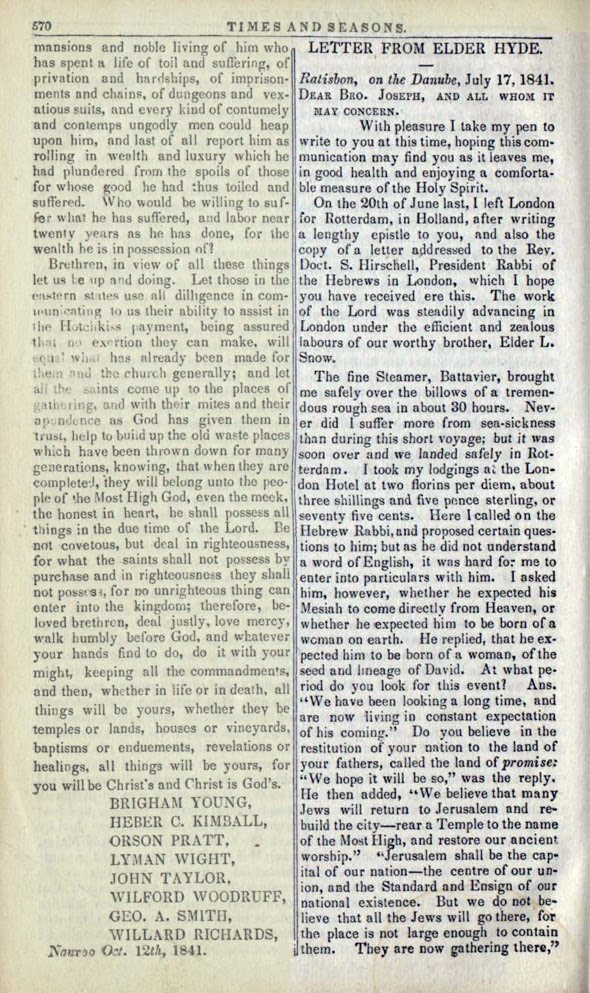
So it's 1841. You're an LDS and you receive your latest copy of Times and Seasons in the mail. (Or buy it in the General Store? I have no idea.) You open it up to page 570 and you get to read Orson Hyde's fascinating letter from Ratsibon about his attempt to deliver a letter to Rabbi Solomon Hirschell of London and engage him in a little theological dialog. Sounds like Hirschell played (and played up) the "No speak English!" card a little. Still, some interesting talk did ensue. Rabbi Solomon made two interesting comments:

1. The land of Israel is not really big enough for all the Jews.
2. He connected the messianic era with the aliyot taking place in the 19th century.
Wednesday, November 16, 2011

Unexpected experiences in Jewish Berlin, 1860.

Ah, old newspapers.

This piece from Hamaggid (1860) describes a visit to Berlin. The writer describes how he went to shul (or shall I say, schule) Friday night and was most impressed by the beauty, the spirituality, the quality praying. It even had gas lamps! "Is this Berlin," he thought, "about which they say that most of our brethren nowadays lack faith and reverence for God?" He mostly praises the cantor, named Lichtenstein. And notes that there was a choir of children.

(There was an old joke about a yeshiva bochur who went to Paris, and the entire time he was in a Beis Midrash. After his trip he said, "I don't get what everyone's always going on about Paris [how immoral it is]/ What are they talking about? I learned Torah the entire time I was in Paris!)

The visitor goes on to describe the next morning, which featured an excellent baal kriah (Torah reader). Then he describes the sermon by the famous Michael Sachs, and boy was he impressed. He really, really like Sachs's sermon, which was a major feat of oratory, exhorting the masses to observe the sabbath meticulously. It was unlike the sermons of the Reformers, who stand before the Ark without reverence, like they are on stage in a theater, and they preach a new Torah, etc. Sachs ascended and descended the bimah reverently. He addressed everyone sweetly. He explained Tanach, Talmud, Midrash and the other holy books to his flock. He labored faithfully for the needs of his congregation, and at home one could find him studying Gemara, Rashi and Tosafos. He also had a great and precious personal library. Lucky is the congregation which chose someone like him!

Sigh . . . Dr. Michael Sachs.

Then he had a nasty surprise on Sunday. He was shown the new cemetary, which was renowned. He says that if not for the gravestones you'd have thought you were in a beautiful park. etc. etc.

Then he was shown the row reserved for rabbis and scholars and !!!!!!! he saw the grave of Dr. Samuel Holdheim, the Reform rabbi in Berlin, and he was also buried in the rabbi's row. His community had erectd a nice head stone, and one of the Russian maskilim wrote a poem, which was inscribed on it. At the top it said "Here lies, etc. "Gadol me-rabban Shemo . . ."

The traveler's reaction can best be described by the extra large type he used and the pregnant "!?" "Woe," he writes, "to the generation that saw this!"

Then he saw the hospital, but didn't get the chance to visit.


As you'd expect, there was a whole history to this. It wasn't happenstance that Holdheim wound up in the rabbi's row. In fact, the aforementioned Michael Sachs opposed it.

First, a note about Holdheim. He was one of the most radical reformers, so even people who were for some reforms felt he went much too far. For example, it was he who infamously moved Shabbat to Sunday. A word about a very, very famous quotation of his is in order. Everyone says that Holdheim said "The Talmud was right in its day and I am right in mine." Even a responsible, meticulous scholar like Jay M. Harris quotes this ("How Do We Know This? Midrash and the Fragmentation of Modern Judaism," p. 167), albeit the correct version (in translation): "The Talmud speaks out of the religious consciousness of its age and for that time it was right; I speak out of the higher consciousness of my age and for this age I am right."

Now, there isn't much about the context that changes the meaning - yes, he meant what it sounds like - save for one important point. In context it is not nearly so arrogant as it sounds, since he did not mean to say that he alone, Samuel Holdheim, was right. What actually happened was that the reform rabbis at the 1844 conference in Braunschweif were giving their opinions, but they were all trying to ground them in the Talmud in some way. Holdheim believed that this approach was erroneous. He believed that the Talmud truly did not support Reform Judaism, but that was alright, because the Talmud is not binding. And the reform rabbis should have the courage to acknowledge it. So he said ". . . Dr. Herzfeld should not place before us so absolute and general a statement as: "The Talmud is right." Rather, he should say, "The Talmud speaks out of the religious consciousness of its age and for that time it was right; I speak out of the higher consciousness of my age and for this age I am right." (Translation by W. Gunther Plaut, and quoted by Michael Meyer.)

See the difference? He was not saying "The Talmud was right then, but I, Holdheim, am right now." He was saying "The Talmud was right then, but we are right now." It could of course be argued that it is still arrogant to say that a room full of a couple of dozen men were "right" when millions of other Jews would not agree, but to serve truth it is important to note that he did not place himself, alone, as the one person on earth who was right. (Maybe he did so in practice . . . )

So when Holdheim died, the members of his congregation wanted him buried in the rabbi's row in the aforementioned Berlin cemetery. Michael Sachs, the modern preacher (and Wissenschaft scholar) mentioned above - who was, incidentally, considered by the Frankfurt separatist Orthodox community who hired Hirsch instead - opposed it. However, the Chief Rabbi Jacob Oettinger (he of the "Zunz knows what Rashi smoked, I know what Rashi taught" quip - see here) decided that it was okay for Holdheim to be buried there. Which is interesting, I suppose. This Yiddish-speaking, 'last traditional rabbi' of Berlin didn't oppose it, but Michael Sachs, very much a modern rabbi - not even exactly a rabbi, actually - did. If you think about it, perhaps it's not so surprising. However, it certainly seems ironic on the surface.

See this post at the lamented Ishim Veshitos blog for Rabbi Oettinger's reported words: ""Holdheim is dead? Boruch dajin emmes--he was a great lamdan; whatever else he did and his turn of thought--for that he will now have to render account to God. Death blots out everything. I have nothing against his being buried in the row of the rabbis." (This translation is by Michael Meyer, from "Most of My Brethren Find Me Unacceptable": The Controversial Career of Rabbi Samuel Holdheim Jewish Social Studies - Volume 9, Number 3, Spring/Summer 2003 (New Series), pp. 1-19.)

Here is how Rabbi Oettinger appeared in 1860:


and here is Dr. Sachs:


And to remind, here was Shadal's mention of Holdheim in a note to Geiger, where he compared Rabbi S.R. Hirsch's use of German to Holdheim and Geiger himself:


Thinking about it, I wonder what Geiger thought about being equated with Holdheim - or Hirsch. From here.


Tuesday, November 15, 2011

How Jewish communities ought to view one another, according to R. Yehuda Azsod

Here's a fantastic, interesting paragraph buried in a very lengthy responsum on the kashrut of the turkey and related birds. It is #92 in R. Yehuda Aszod's יהודה יעלה (link).


The issue concerns the apparent requirement of a mesorah, a tradition, of kashrut for any bird, despite the fact that this is not a Talmudic requirement (see Rema YD 82:3). Since the turkey is a New World bird, there could never have been a mesorah, and yet it is clear that the bird was accepted as kosher. By the 19th century the question was more about how or why it could be, rather than any serious attempt to rule that it isn't kosher. The question often focused on whether or not a community may rely on another community's tradition, and especially whether this is permissible when previously one's own community had not availed themselves of relying on another tradition. That being the case, maybe not eating the bird in question is itself a tradition, not to be discarded. (On this issue generally, see this article by Rabbi Ari Zivotofsky.)

In addition, the sources also reveal a certain confusion as to whether or not everyone is even speaking of the same bird, as well as what the actual place of origin of the bird is. It is no secret that the turkey was widely thought to originate in India, or somewhere else in the East. In this excerpt, addressed to R. David Deutsch, R. Aszod discusses the idea that perhaps we cannot accept a tradition from India, since it lacked great Torah scholars. He rejects this suggestion as worthless, because actually we don't know that they don't have Torah scholars. Absence of evidence is not evidence of absence. He gives the analogy of Eretz Yisrael which at present has 7000 Sephardi men residing there. There is no doubt, he writes, that they have many gedolim, ge'onim in Torah and the two Talmuds and the posekim. We simply have never heard of them, and we never read their writings. Similarly, in India there are many cities and villages with Jews, in the thousands, as we can see in Sefer Shevilei Olam by Rabbi Samson Bloch. We also see this in Maggid Chadashos (the essay on the Cochin Jews) by Rabbi Naftali Herz Wessely Zatza"l, in Hameassef 5550 (1790). Israel is not orphaned in any place they reside. Every large settlement has posekim, gedolim, zaddikim, and scholars, in all times, even if we have not heard of them. If it is permitted in a location, it is because their Bes Din established that their mesorah is valid, with proper procedures, and therefore it was permitted to them.

He then cites an unnamed German rabbi who states that in locations where itis known that there are no Bnei Torah, gedolim or posekim, then you cannot bring proof from their practice.

All of this pertains, by the way, not only to India, but also to England. He had conducted a correspondence with Rabbi Nathan Marcus Adler of London about the kashrut of the English hen, and he was assured that in London they have a mesorah to eat it. He goes on to continue that this unnamed rabbi took London out of the equation, because it is and was a town full of Jewish sinners. He even quotes the Chasam Sofer to that effect, that even 80 years earlier, that was how London was to be characterized. R. Aszod dismisses that point, because at the time London had a great ga'aon for an Av Bet Din, namely Rabbi Tevele Schwar [sic; a printer or transcription error; I am pretty sure he means Tevele Schiff, who was the rebbe of R. Nathan Adler, the Chasam Sofer's own rebbe. On him, see here). This same rabbi exerted great efforts to make sure that things were conducted according to halacha.

We see important things here.

1. He expresses what I believe is the real traditional attitude toward other Jewish communities, that their status as kehila kedosha is real and undisputed (it derives from the presumed presence of scholars and pious people).
2. He quotes Samson Bloch and Wessely (from Hameasseph, no less) and he adds Zatza"l.

Rabbi Yehuda Aszod (1796-1866) wasn't some liberal, nor was he unaware of or disconnected from the struggles over Reform and other kinds of changes in the religion of the day.

Incidentally, the story around his portrait is pretty gruesome and outrageous. For pietistic reasons he refused to pose for a photograph. It is claimed that the following portrait was taken upon his death, when he was dressed, given a Gemara to hold, and his body arranged in the pose. However, it should at least be mentioned that reportedly the proceeds from the sales of this portrait were used to help marry off his daughters.


Another version, clearer photograph:


For more information, see the sources cited in Richard I. Cohen's Jewish Icons: Art and Society in Modern Europe. and this great Seforim Blog post (link).

Getting back to the idea I was discussing, we may find a similar thing in the writings of the Chasam Sofer. An issue arose concerning whether or not a shaliach tzibbur should not wear wool, which developed as a Chasidic custom. The Yismach Moshe defended it, and also claimed that the Sephardim have such a custom, and it is Lurianic. The Chasam Sofer writes (OC 16) that he knows that of the Western Sephardim of Amsterdam, London and Hamburg, this is not true. What do we see from this? Even though the Western Sephardim were clean-shaven, even though they were mostly descended from Conversos, even though they didn't cover their heads all the time, even though they dressed like English or Dutch or German gentlemen, even though their rabbis were called Reverend Dr (at least in London) - they are the Sephardim, and their customs will tell us what the authentic Sephardic custom is, and that's how to establish the facts.

This, by the way, was the Haham of the London Sephardim at the time:

Monday, November 14, 2011

So what's up with 'Shamshon'?

So what's the deal with the name "Shamshon," which somehow only seems to be applied to Rabbi Samson Rafael Hirsch?[1] Now, here is a case where that "drop of tradition is worth a ton of acumen," as Ludwig Blau reputedly would say. A living tradition would be best. Lacking that, let's apply some acumen.

It seems that "Shamshon" is simply how the name was pronounced in Lithuania, and indeed, Russia. For example, we find the historian Jacob Schamschon of Kovno:


One might surmise that the Lithuanian tendency to exchange /sh/ and /ss/ sounds was at work. (Most people know that Lithuanians did not pronounce the shin. Less well known is their tendency to change a sin to a shin. Sibboleth, indeed.) So "Shamshon" was simply the pronunciation of "Samson" in that particular Yiddish dialect. Do not be surprised at the idea of a "Yiddish" name being based on the Gentile version of the name (Zalman = Salomon). Here's a page from a subscription list from an 1818 edition of the Five Megillot:


And these are only some of the Moses. (Or is that Moseses?) The next page has 17 more.

An extremely useful book, published in Warsaw, 1908, makes it clear that this is the pronunciation in what it calls Russia (Rusland):


And note that it also transliterates it Schimschojn, the Polish (or shall we say Pojlish) pronunciation. (See יודישע שפריכווערטער און רעדענסארטען by Ignatz Bernstein and B. W. Segel)

So we've solved that element. If anyone wants to know why yeshivishe people say "Shamshon Refoel," it's because that's what the man was called in the heartland of where yeshiva culture developed.

But it's not as simple as that. Although I surmise that Rabbi Hirsch actually went by Samson - pronounced something like Zamzun, but with the "u" being more like a combination of the English "u" and "o" - there are also many sources indicating that "Schamschon" was a German pronunciation as well.

Before I get to these, let's go back to the beginning. Although the Masoretic text of the Bible spells it with a chirik, and thus "Shimshon," the vocalization in Tanakh is late. So although an ounce of tradition is worth a ton of acumen, and we are not to disregard this, the Septuagint is an earlier vocalized source, and it uses an alpha - Σαμψών, not Σιμψών. This is why the name is "Samson" in English and the various other tongues. Interestingly, with the rise of Protestantism and an interest in the Hebrew Bible, the alternate form Simson, based on the Masoretic text, entered the Christian consciousness. See, e.g., Luther's Bible, where he writes "Simson." I guess we have to thank Martin Luther for the Simpsons, whom otherwise might be the Samsons, or more likely, the Smiths.

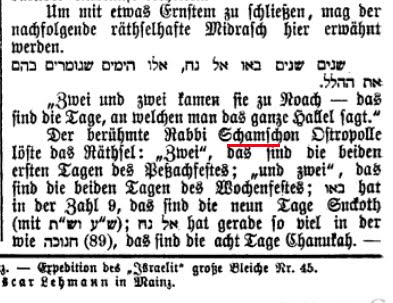
In any case, there are a number of (Jewish) German sources which use "Schamschon." For example, this excerpt from an 1887 article in the Israelit refers to Rabbi Schamschon Ostropolle:


Lest it be argued that this was an attempt to give his name in "Jargon," as he was a 17th century Polish rabbi, here is an anecdote about the 17th century Viennese Court Jew Rabbi Samson Wertheimer, where he is called "Rabbi Schamschon Wien," evidently his 'traditional' name:


Thus, it seems to me that there was at least the perception that this was the traditional way in which German Jews pronounced the name, no less so than in Rusland. In reality, probably many German Jews pronounced it that way still in 1905, which is when the excerpt above appeared. Since it is a great anecdote, I will explain what it says.
Rabbi Samson Wertheimer employed a tutor for his family named David, who was an apt Talmudist. He later received a position in the rabbinate, on R. Samson's recommendation. Since he was just the tutor working for him, he couldn't bear to call him "Rabbi," but continued to call him David, as before. Once R. Samson was on a trip, and stayed in the community where David was. He visited him, and saw that Rabbi David was studying Mishnah Shabbat 3:12, where it says "If he wrote [two letters; the name] 'Shem' (shin-mem) of 'Shimon' or of 'Shemuel'." So he asked Rabbi David, why didn't Rabbi, the Redactor of the Mishnah (and in fact the direct source of this statement!) say "Shimon, Shmuel, or Shimshon"?

David answered, "The reasons seems to be that Rabbi did not say "Shimshon," because Shimshon did not say "Rabbi!"
Here is what "Reb Shamshon Wiener" looked like, by the way. From Wikipedia.


Hopefully we have proved our case, that "Shamshon" is simply what the Jews over a wide geographic area actually called their Shimshons.

Finally, I came across the following in a list of Jewish folk expressions, from 1898.

Schimschon in Ruh und Schamschon in der Wickel.

Something like "Shimshon in calm, and Shamshon in distress." Does anyone have any idea what this is supposed to mean? If I had to guess, I would say that it is like a reference to correctness, Shimshon, and the vulgar jargon, Shamshon. When calm, he is a sedate gentleman, and he says Shimshon. Rile him up, and he reverts to the ghetto Jew, Shamshon.

[1] Of course, strictly speaking this is not true. There are many people today who are named for him, or named for those named for him, who also use the form "Shamshon."

Friday, November 11, 2011

Shadal series #6 - On facing the truths of history and autobiography

Much attention has been given over the past 20 years to a phenomenon which, rightly or wrongly, has been linked to Artscroll, namely the question of sanitized, legendary or inaccurate biographies which are supportive of ideology (or inspirational).

It will probably come as not too much of a surprise that Shadal, whose 146th yahrzeit was this past Yom Kippur, already had much to say on the subject, and it was the very opposite of the supposed Artscroll approach.

Some background: Shadal wrote a lot of autobiographical material. This was motivated by his belief that ideally every human being - great or small, good or evil - should write an autobiography, provided that it is truthful. As one who derived great pleasure from the smatterings of biographical material scattered over all of Jewish literature, he lamented the fact that we will never know the inner life of great (and regular) people, and we will never know how they developed. The only cure for this is not to make the same mistake, and so we should truthfully record our own history and our own development.


That was written in 1858. In 1862 he wrote the following:


Thus he did not neglect his own duty, and wrote a great deal of his own autobiography, in several versions, with a special emphasis on his first 20 years. Predictably many readers were puzzled by certain trivial things he mentioned, e.g., he writes about how he remembers one night that the family's cat gave birth to a litter on his bed, so rather than disturb it he sat up all night translating a poem by Mestasio, which can be found on pg. 84 of his Kinnor Na'im. But for Shadal this was the point. Obviously it would be impossible to truly write of everything one ever did, every thought one ever had. But the point of autobiography could not be to write with the reader in mind. That would compromise truthfulness and, frankly, lead a person to self-censor so as not to be embarrassed.

I'll save the history of his autobiographies for the footnote,[1] but suffice it to say that here is a quote from the one he wrote in Italian, right at the end:
"La mia fiducia fu anche per qualche temp alimentata da un accidente da nulla accadutomi nel 3 Ottobre (la notte di Kippur), del 1816, e da me, dietro il Talmud (in fine di Joma) superstiziosamente interpretato qual pegno della celeste protezione. Anche questo avvenimento fu da me nell'Ottobre del 1817 celebrato in un- Ode di ringraziamento a Dio."

"My confidence was fueled by an accident which happened to me on October 3, 1816 (the night of Yom Kippur), which I superstitiously interpreted as a pledge of heavenly protection, following the Talmud in Yoma. This event was celebrated by me in October of 1817 in an ode of thanks to God."
At which point most people are probably thinking, Huh?

Whether we will want to say that Shadal was being completely truthful in Italian, or not, can be debated. But he certainly was being truthful in the version of his autobiography published as a serial in Hamaggid where we find the following (Hamaggid, Year 6, #16, April 23, 1862, pg. 125):


Which is probably not what you were expecting. What he says is that on the night of Yom Kippur 5577 (1816) he experienced a nocturnal emission. Since it is written in the Shulchan Aruch (OH 615b) that a person who has such an emission on Yom Kippur should worry the whole year that he will die, but if the year passes it is a good sign that he is destined for Olam Habah (which follows Yoma 86a), then that is just what 15-year old Shadal did. He marked off the year, until it had passed, and then he wrote a song of thanks to God. These "memories," incidentally, are actually based on entries from his diary from that era.

Contrast this with Moshe Leib Lilienblum's description of the same event in his youth, which caused him absolute terror. Lilienblum's own autobiography, which he says was in part inspired by Luzzatto's (although he says that Shadal's is as dry as corn) ,was called חטאת נעורים, the 'Sins of Youth.' Lilienblum quotes Shadal as saying that he much prefers autobiographies to novels, and non-fiction to fiction, while Lilienblum says that he gained nothing from biographies, but gained much from novels. However, Lilienblum agrees that a good biography caould be much more inspirational than the best novel.

His book is a record of his life beginning as a standard, traditional Jewish boy, a proficient Talmud student, and an early marriage, to his time as a young rosh yeshiva, and then his transformation to a persecuted heretic.

A theme in the book is that he did not want to become a heretic. Whenever he had doubts, he looked for some Talmudic source to lean on. If he couldn't find one, he would force himself to believe, even though as of the writing he recognizes that you can't force yourself to be a believer.

He writes that his "stupid" uncle told him two real gems:

1. you shouldn't sleep on the night of Rosh Hashana or Yom Kippur. Rosh Hashanah, in case you will have a nightmare, which is an ominous omen for the coming year.
2. Yom Kippur, in case you will have a nocturnal emission, as mentioned.

He says that he was never concerned about bad dreams, but the Yom Kippur issue terrified him. In 1861 (so he was then 17) he had a particularly spiritual Rosh Hashanah. He managed to concentrate on God wherever he went, in accordance with the expression "שויתי ה' לנגדי תמיד." He maintained this state of spiritual ecstasy for the two days of Rosh Hashanah and Shabbos Shuva - three days in a row, like this past year - but on the fourth day he began to have doubts about God. He says that his doubts were not rational. If they had been rational, then he could have addressed it rationally. But he believed that it came about because of his intense concentration on God, and he was tormented by an inner voice saying "Who knows if there is a God?" He tried desperately to rid himself of his thoughts, to no avail. Then:
אחרי תפלת "כל-נדרי" התודיתי את הוידוי הגדול, קראתי את הארבע פרשיות הראשונות של תהלים, כדרכי תמיד, שהן סגולה למקרה לא טהור – ועליתי על משכבי לישון. באמצע שנתי נתעוררתי בחזקה, וימת לבי בקרבי... ראיתי... כי חייב אני לדאוג כל השנה

.אל תשחק, קורא משכיל, שמא תלבין פני ברבים

After Kol Nidre he said Viduy and the four chapters of Tehillim considered a segulah against a nocturnal emission, and then he went to sleep. He awoke, and his heart sank because of what he saw. He'd have to worry all year . . . "Don't laugh at me," he warns the reader. He continues that he was terrified and haunted. For the next 30 days he recited a certain litany of prayers meant to counteract the evil effects of what he experienced. Evidently this mentally exhausted him. He says he throw himself back into Shas and Poskim.

Getting back to Shadal, was that TMI, perhaps? Apparently it was for some. In a letter to Eliezer Lipmann Silbermann, the editor of Hamaggid, Shadal writes about these
[negative responses aren't] directed toward me; they are toward my Autobiography, because they are of the view that I expound on minor and irrelevent things. I know that many readers feel this way. However, I will not change from my way, and if the reader won't be receptive, I won't respond. But to tell my autobiography without referring to small matters, and minor things that are in my memory, what I did and what I thought in my childhood - God forbid that I would not - for my purpose is to reveal the truth, and now that I am engaged in that enterprise, should I not fulfil it? All my days I have been disturbed by the sparse records of our earlier and more recent ones, which we only know through spotty references and legends. So should I not do what depends completely on me? How much good has been lost through fear of the scoffers! In my old age I shall not neglect this important duty. Is there anything more unappealing than a nocturnal emission? But see the recent edition of Kochebe Yizchak, where I published my hymn of thanksgiving that I wrote 46 years ago. I was not ashamed to see it in print. I was glad to see what my contemporaries have to say about it. Maybe now, people will be forthcoming. I'm also glad that now that I have written about it, there is a context for that hymn which I published, which otherwise would be lost on readers. (Igg. Shadal Vol. II pg. 1388 - 89).
Now that is laying down the law.

There's also a letter, date Feb. 2, 1842, where Shadal writes Shir (=S.J. Rapoport) about a letter he had written which contained some personal information. He had wanted it printed (in Kerem Chemed, presumably) but Shir thought it was private and should not be printed for the public. So here is what Shadal writes back to him:
I'm surprised that a scholar of your caliber, engaged in careful researches into antiquities, how could you rob the historians of 800 years from now of such gems as these [that I wrote in the letter]? Wouldn't you yourself rejoice if you found a letter like it from the ancients? - even an insignificant one like myself (if it were possible for a rishon to be minor, like an acharon) although us Jews know that "there is no generation which doesn't have one like an Abraham, a Jacob, a Moses, or a Samuel" (Midrash Samuel 9).
There are many other interesting things in his autobiograph(ies) and here are a couple: Although he makes it clear that he was quite the child prodigy, he nevertheless offers plenty of material showing his childish mistakes and immature ideas. (In fact, his childhood seems to have been a curious blend of, well, childhood, and deep immersion in books and ideas that one generally would think are too big for a child's britches.) For example, he writes that when he was 8 years old he was convinced that he would write commentaries on the Bible that were as good as Rashi's. Apparently he boasted of his own innovative Bible comments to his classmates, who asked for samples. So he proudly told them that he had solved the mystery of which land is "the land of Uz" (Job 1:1). It was Bet El! For we find in Gen. 35:6 as well as Joshua and Judges, that Uz is the former name of Bet El: "So Jacob came to Uz, which is in the land of Canaan--the same is Beth-el--he and all the people that were with him." To his chagrin, he later realized that the verse actually reads "So Jacob came to Lutz," not "Uz!"

As I said, there were two-three versions of the autobiography. The Italian one (which was translated to English, German and Hebrew) contains his family's history. Here is an interesting sample from that. Shadal, whose great-grandfather was R. Moshe Chaim Luzzatto's brother, was quite poor. His father was employed as a wood-turner, and the son attests that his father was quite skilled -indeed his chair and writing desk were built by his father - but he never made an adequate living. Although the son does not say that this is the reason, he describes his father as spending every spare minute learning, and one sometimes gets the sense that he didn't vigorously pursue work at all so that he could learn. On the other hand, Shadal dramatically describes how his father did plan for him to have a career, first ensuring that he learned Latin so that he could become a physician, then apprenticing him in wood-turning. When it became clear that the boy had no intentions of doing any of these things, no intentions of doing anything besides learning, writing and teaching (although no one knew that yet) his father wrote him a dramatic document basically saying that he fulfilled his duty as a father to teach his son a trade and now it's on his son's head. In any case, the Luzzattos were a famous Italian Jewish family - and a wealthy one. Or had been. Why was his branch poor?

Shadal writes that there had been money in the family, but his grandfather was disinherited over the following incident, which occurred in Venice in 1737: his grandfather Benetto (Baruch; b. 1713) was as yet unmarried, and he spotted a woman reciting Psalms, very exactly and impressively. He was smitten. He said, If I found a woman who could read Psalms like that, I would marry her! The woman politely declined - because she was already married, but said that her sister wasn't married, and she could zug tehillim with the best of them (better than herself, is how Shadal tells it). And that's the woman he married. Rachel, the daughter of the deceased Rabbi Anselmo Isaac Grego, came with a dowry of 1100 ducats, but it never materialized. Because of this his mother did not approve of this match and threatened to disinherit him if he married her. He did anyway, and she did, and the rest was history. Shadal says that the portion he lost was 2000 ducats, and this plunged him into poverty. He says that his grandfather worked as a teacher and a dealer of cloth, iron and wood, and his grandmother spun silk, and that is how they honorably eked out a living.

A second, minor point of interest is that Shadal refers to a Hebrew translation of the poem La Liberta a Nice by Metastasio made by a relative of his, which contained the following superscription: העתקתיה במצות המשורר הקיסרי כ"מר ממסטזיאו. Thus it was commissioned by Metastasio himself. He says this is "la prima volta che io trovo il titolo כ"מר, cioe: l'Onorand Ecc. Rabbi כבוד מעלת רבי applicato a un non ebreo," "the first time I saw the title "כבוד מעלת רבי" applied to a non-Jew." Thus, we see another example of a non-Jew with "rabbinic ordination." (See here.)

Since we began by speaking of Yom Kippur, the day of Shadal's yahrzeit, the anniversary of a . . . memorable moment in his life, it makes sense to mention that when he was 15 he wrote his own version of the Seder Avodah for Yom Kippur, which he included in his poetic collection Kinnor Na'im (Vienna 1825). Here it is:


[1] Regarding his autobiography, the first published version appeared in Isidor Busch's German periodical in the late 1840s, and it covered his family history and his youth up to age 18 (which he considered a distinct period in his life). Busch had asked him for a contribution, suggesting an autobiography. Shadal's introduction explains and justifies why it is that he, who is of little account, should comply. He quotes Massekhet Shabbat 118a "יודע אני בעצמי שאיני כהן אם אומרים לי חבירי עלה לדוכן אני עולה," "I know that I am not a kohen; but if they say to me 'Ascend to the platform,' I will ascend." It was written in Italian, and Busch or someone else translated it to German. Part of this appeared in English translation in the pages of the Jewish Chronicle, and then again in the M.H. Bresslau's Hebrew Magazine in 1859. A Hebrew version, actually written earlier than the Italian one, appeared in a Hebrew book of letters, מכתבי שפת קודש in 1857. Finally, a much fuller Hebrew autobiography was serialized in Hamaggid from 1858 to 1860 and then 1862 to 1863. The complete Italian autobiography was serialized in the periodical Mose in 1880, and was eventually published as a single volume called Autobiografia. This version was also translated to German, to English (by Sabato Morais) and finally, to Hebrew, by M.A. Shulvass and published in Yeshiva University's Talpiot, and then printed as a separate volume called Pirke Chaim. All these versions agree on particulars, but they all include information or details that the others omitted, so all should be read.

Thursday, November 10, 2011

On the Main Line themes

I'm working on a list of what this blog is really about. Here are some.

1) The details are fiendishly interesting.
2) Accept the truth from whatever the source is the better approach.
3) Everything you've thought of was already hashed out more than 100 years ago.
4) It's fun to give the microscope treatment to the Christian Hebraists/ ethnographers who did that to the Jews.
5) Fancy wig curls and beards go together very nicely, thank you very much.

Kadish, or shall we say, Kadosh

Here's the Kaddish as it appears in the siddurim of the West London Synagogue, Britain's first Reform synagogue, established in 1840.

The text was translated by its rabbi, David Woolf Marks. The purported reason for the Hebrew version of such a famous Aramaic text is that it was meant to imply a sort of anti-Talmudic statement. Note that this is not the first edition of this text; the first edition contained some grammatical mistakes, such as יתגדל ויתקדש שם הגדול for יתגדל ויתקדש שמו הגדול, which were eventually corrected to what you see here.

Wednesday, November 09, 2011

How to save an On the Main Line post

More than one person has asked me how to save or print a post without all that extra stuff on the side. The best solution I found was to begin by using the mobile version of the blog.

How do I use the mobile version, you ask? By adding /?m=1 to the url, so instead of http://onthemainline.blogspot.com/ you would use http://onthemainline.blogspot.com/?m=1.

You would now have a cleaner version of the blog without most the extras.

You could print up a post directly that way, or save it as you would any page, or convert it to a pdf. Some browsers make it easy to save a page as a pdf. But there is another option. There are several free services which will convert a web page, such as http://pdfmyurl.com/. The instructions are simple; it is probably just best to use the mobile url of any given post which, recall, is the same as the normal post, only adding /?m=1 to the end.

This of course works for any blog. Mobile url = cleaned up version of the page.

Sliding to the Right in Denmark in 1909.

Here is a fiendishly interesting article printed in The Reform Advocate (Oct. 9, 1909). This was translated from the German original in the Allgemeine Zeitung des Judentums.

This 'chapter treating of the history of modern orthodoxy' discusses the many contradictions the German (reform) writer perceived in the Orthodoxy of Copenhagen, combining the fasts of בה"ב with the singing of poems in Danish; confirmations of boys and girls, with 6 hours of kinnos on Tisha B'av; with the dropping of piyuttim and yekum purkan with the banning of umbrellas on the sabbath. Basically, everything which had been flashpoints in Germany seemed to have had no effect at all in Denmark. On the other hand, the writer perceived the encroachment of German-style orthodoxy. First kosher butter - who knows what will come next!

Monday, November 07, 2011

More on the 'Sephardi Signature'

I have a few candidates for Subjects That I Can and Probably Will Post About a Dozen Times. This must certainly be one of them.

Here is an interesting exchange of letters in the April 1888 Jewish Standard:


This elicited a reply from S. M. Schiller-Szinessy, a bona fide character if there ever was one.


And then a week later he added:


Here are at least four earlier posts which touched on the subject (I, II, III and IV).

Thursday, November 03, 2011

Three students

In Rabbi Yechiel Yaakov Weinberg's Seride Esh Vol. IV, in the back, there is an essay on mussar. Writing about R. Yisrael Salanter, he says that he had three primary students, each possessing a unique quality.


R. Itzele Peterberger was the lamdan (scholar), R. Naftali Amsterdam was the chassid (pietist) and R. Simcha Zissel Ziv was a chacham (wise).

Obviously this is not R. Weinberg's own formulation, but probably what "they" used to say.

As soon as I read this I remembered an earlier, very similar list. After Israel Baer Kursheedt (1766-1852) died, R. Morris Raphall wrote his obituary in the Asmonean (May 7, 1852). Noting that in Frankfurt he studied under the
"Chief Rabbi, Nathan Adler, the uncle and namesake of the president Chief Rabbi of London. Among his fellow students two were particularly distinguished and attained considerable eminence - R' Abraham Bing, subsequently the Chief Rabbi at Wurzburg in Bavaria, and the celebrated translator and commentator of the Machsor, R' Wolf Heidenheim at Rodelheim. With these two great men, I. B. K. was held in equal estimation by their gifted teacher, who used to say that R' Abraham was a churiph (acute logician), R' Wolf was a medackdeck (grammarian and philologist), bur R' Israel was a chochem, a wise man, because his attainments were universal."
I, of course, preserved the original spelling. I normally would like to post an image of the actual page, being a lover of typography and all, but in this case I only have a badly photocopied page, which was subsequently sent as a fax, and then scanned into a pdf. My thanks to Dr. Yitzchok Levine who sent it to, and indeed, wrote a fine article on Kursheedt (link and here).

Note two things: (1) R. Nosson Adler was not the Chief Rabbi of Frankfurt at all. (2) Guess which student of R. Nosson Adler is not mentioned?

I don't know what Raphall's source is. On the one hand it would be hard to believe that Kursheedt told him that himself. On the other hand, you never know. On the third (and hopefully final) hand, the source could well have been a story floating around, just the same as R. Weinberg's reference to R. Yisrael Salanter's students. I will even permit myself to conjecture that it is even possible that in other versions of the story it is indeed the Chasam Sofer who is the chochem, but that never made it across the Atlantic, and when it did it was transformed to fit America's own rabbinic scholar, Israel Baer Kursheedt. There is another possibility, which is that the idea of the Chasam Sofer as being considered R. Nosson's most prominent pupil may not actually date to the time when he was his pupil.

Here is his portrait:


And here is a Kevarim.com post about his burial location in Queens (link). Evidently people come to oren at his kever:

The controversial acronym "akum." Also, how censored texts play with the meaning of the Gemara.

Having recently posted about the Dikduke Soferim, the first great collection of variant Talmudic readings based on an important complete Talmud manuscript, I thought I'd discuss how these variants can make a difference in our understanding of the text, even if only in a minor way.

People who study Talmud, whether they learn it or read it (wink, wink) will notice occasionally that suddenly a Samaritan (a Kuthi) shows up, or a Sadducee, or a min, and many other such terms. It isn't always clear why so-and-so is identified the way they are, and sometimes it seems to make little sense and seems arbitrary. As a point of fact, many of these terms are arbitrary and they were changed by Christian censors. Other examples are changing the names of nationalities, Bavel for Edom and so forth. Does it always really make a difference? No. But let's look at one passage, Shabbos 88a - 88b.

ההוא צדוקי דחזייה לרבא דקא מעיין בשמעתא ויתבה אצבעתא דידיה תותי כרעא וקא מייץ בהו וקא מבען אצבעתיה דמא א"ל עמא פזיזא דקדמיתו פומייכו לאודנייכו אכתי בפחזותייכו קיימיתו ברישא איבעי' לכו למשמע אי מציתו קבליתו ואי לא לא קבליתו א"ל אנן דסגינן דסגינן בשלימותא כתיב בן תומת ישרים תנחם הנך אינשי דסגן בעלילותא כתיב בהו וסלף בוגדים ישדם

The text was taken from the Shas on HebrewBooks.org, which uses Moznaim - Vaghsal, a very standard text. Here is how Soncino translated it:
There was a certain Sadducee who saw Raba engrossed in his studies while the finger[s] of his hand were under his feet, and he ground them down, so that his fingers spurted blood. ‘Ye rash people,’ he exclaimed, ‘who gave precedence to your mouth over your ears: ye still persist in your rashness. first ye should have listened, if within your powers, accept; if not, ye should not have accepted.’ Said he to him, ‘We who walked in integrity, of us it is written, The integrity of the upright shall guide them. But of others, who walked in perversity, it is written, but the perverseness of the treacherous shall destroy them.
So what happened was, a Sadducee saw Raba (=Rava) shteiging intensely, so engaged in his Torah study that he drew blood from his own hands. The Sadducee believed that this was wild behavior, and chastised Rava, saying that "You people (i.e., the Jews) are impulsive; just as you spoke before you heard (a reference to na'aseh ve-nishma [Exodus 24.7], 'we will perform the Torahs laws and we will hear', which had just been discussed) you are still impulsive. You should have listened first and only then agreed to accept the Torah. Rava, of course, has a ready reply.

It should instantly be wondered why it was a Sadducee. Where there actually Sadducees in the generation of Rava, a Babylonian Amora born 200 years after the Temple's destruction (link)? Even if this could be explained away, that 'Sadducee' was a generic term for a heretic, as it was during the time of the Karaites and - in fact - during the rise of Reform Judaism, the next question must be how could a Sadducee refer to the Jews as "Ye people?" The Sadducees were Jews. In fact, there own ancestors also said na'aseh ve-nishma. The first explanation could be sufficient for some references to Sadducees in the Talmud, but not where it is evident that he isn't Jewish, as in this case.

This is so obvious, that I once heard a talmid chochom quote this Gemara and he derived a didactic point from it: See how far heretics stray? This Tzedoki, a Jew, refers to the Jews who are on the proper path as "You people." This explanation is something along the lines of how in the Haggadah the Wicked Son refers to "you" doing mitzvos, and excludes himself.

To me it was clear that this is not what is going on. Since I well knew that these sorts of terms are all mixed up in the Talmud, I decided to call this to the rabbi's attention. But first I wanted some kind of proof backing me up. Fortunately there was an Ein Ya'akov on hand, and I found the passage, and in no time I could see that in the Ein Ya'akov it says ההוא מינא, a certain min, not ההוא צדוקי, a certain Sadducee. I felt that I had backed up my point fairly well in a preliminary sort of way.

Here is the Ein Ya'akov inside (link):


I later checked the Soncino and here is what it footnotes:
"(33) There were no Sadducces in Raba's time, and the word is probably a censor's substitute for Gentile. In J.E. X, 633 bottom it is suggested that he was probably a Manichean. [MS.M: Min (v. Glos.)]."
Artscroll ignores it altogether, not even acknowledging the difficulty.

I also checked the Dikduke Sofrim, and naturally it also says hahu mina:


Thus there is no difficulty whatever, it was not a Jew. And from this there is no jibe at heretics who are so far gone that they don't even include themselves as Jews and taunt other Jews for accepting the yoke of the Torah. (Paranthetically, if this had been the correct, original reading, then it could comport well with the the Doros Ha-rishonim's view of the Tzedokim as opportunists and not even a real religious sect.)

Then I heard him the rabbi say it again a few weeks later.

Is this a really huge deal? Not at all. But (1) knowing that these sort of terms are to be suspected in the first place and (2) recognizing the difficulty, we could correctly understand the Gemara, or at least avoid understanding it incorrectly. Speaking of such textual issues, there is a story which exists in two versions, about Rabbi David Zvi Hoffmann. In Dr. Eliezer Berkovits's appreciation for "Rabbi Yechiel Yakob Weinberg זצ"ל My Teacher and Master" (Tradition 8:2 (Summer 1966) we see the following:
I doubt there was anyone among theTalmudical authorities of his generation who spent so much effort in establishing a correct reading, and who was able to solve as many problems by ascertaining the right Girsa. Characteristic of his attitude was a story about the Gaon and great scholar, Professor David Hofman זצ"ל. I heard it first from Dr. Wohlgemuth זצ"ל, but again and again from the lips of Rabbi Weinberg זצ"ל himself. Professor Hofman was spending a summer vacation in one of the resort in Germany which was also frequented by numerous Rabbis from eastern Europe, among them many Gedolei Torah (Torah authorities). One morning he was asked for the explanation of a difficult passage in Rashi. Professor Hofman looked at it and answered simply that there was a misprint in the text which caused all the difficulty. The questioner remained unconvinced. He did not feel that it was proper to explain a diffculty by a misprint. He called on one of the Gedolei Hatorah from eastern Europe who-interpreting the difficulty-proceeded to construct a proposition of the Gag-al-Gag type and thus solved the problem. The questioner, however, could not withstand the temptation of telling that eastern European Gadol the answer which Professor Hofman gave him. When the two happened to meet, Professor Hofman listened with respect to the Gadol's interpretation. When the latter finished, Professor Hofman said to him: "Do you know what the difference is between you and me? In one-hundred twenty years we shall both come to the Olam Ha'emet. When I enter and they announce that I have arrived, the saintly Rashi will come to greet me. The printers distorted his meaning; I have restored it. Out of gratitude, Rashi will bid me welcome. But when you arrive and will be announced, who will come to greet you? The printers! You have explained and justified them extremely well." Rabbi Weinberg relished this story. It illustrated his own attitude to both Pilpul and the fundamental importance which he attached to the correct Girsa.
Let it only be noted that in Rabbi Weinberg's own version of the story, which he himself printed, in Seride Esh v. 1 pg. 364, he says it was an explanation of the Bertinoro, as well as more details. I give this from memory, as I don't have a copy handy. I haven't had the chance to look up the page number, which was supplied to me by someone who did, and I will name him if he wants.

Also see David Zilberberg's excellent post at the Seforim Blog about the way a censored Talmud text changes it's meaning of (link).

Getting back to the topic at hand, it makes sense to discuss "akum" now. The acronymous and, as well shall see, acrimonious, term עכו"ם is not native to rabbinic learning at all. Standing for עובדי כוכבים ומזלות, Star -and Constellation Idolaters, the term frequently appears in rabbinic literature. It is entirely absent in early manuscripts and printed editions. If it does appear in an old manuscript, it is evident that what was originally written was erased and the term added. It appears to have been an invention of Christian censors of Jewish literature. This was certainly known to later Church censors, who considered the term acceptable, as they should have given that they themselves had invented it. For example, Domenico 'Yerushalmi,' the author of the censorship manual Sefer Ha-zikuk (see here) gives to this term as an acceptable replacement for 'goy.' As you can see in the guidelines sketched in that post, that Yerushalmi actually took care to instruct censors to not be wanton with this term, for sometimes the texts are clearly referring to contemporary gentiles, and it would ruin the whole point by calling contemporary Christians "akum."

It should surprise no one that despite the origin of this acronym, specifically designed by Christians to differentiate Christians from ancient pagans, people with an uncharitable attitude toward the Jews accused the Jews of meaning by this term not עובדי כוכבים ומזלות, but עובדי כריסטוס ומרים, Worshippers of Christ and Mary (in some versions ומריא). For example, here is Wagenseil in Tela ignea Satanae (1681; p. 120), disagreeing with Buxtorf who explained it as Star Worshippers:


Whether it could be argued, as I'm sure it was, that Jews reinterpreted the acronym this way I cannot say. But this understanding on the part of scholars hostile to the Jews ended up having dangerous practical application. In his old age the famed scholar and printer Rabbi Shabbetai Bass (author of Sifsei Chachamim on Rashi and the Sifsei Yeshenim bibliography) was actually arrested in Prague because of a book which he had printed, which the Jesuits claimed was full of blasphemies, including the use of the term akum, and he was required to answer the charges. He was acquitted and released, both because of his own testimony and Christian experts on rabbinic literature. The entire matter is discussed in Ludwig Oelsner's R. Sabbathai Bassista und sein Prozess (Leipzig 1858), and the transcripts from the testimony is printed.

But first, a little about the specific charge. What had happened was, Bass had reprinted שערי ציון (Prague 1692) by R. Nathan Nata Hanover, which contained the tikkun chatzos service. This book, in fact, was how tikkun chatzos spread from Italy to the rest of Europe.


Inside was the poem Dodi Yerad Legano, written by Rabbi Chaim Cohen, a disciple of Rabbi Chaim Vital:


Among other things, the following problem was noted:


This means:
I will dress in vengeance [with] the flame of God,
and I will burn the house of akum, and those who afflict.
I will repay half the blood of those killed and captured,
and this will be my consolation.
Not surprisingly this was seen to be an attack on Christians. If not them, it surely meant the Muslims in the Holy Land. (I'm not sure, and here I'm speculating, but it could be that this is indeed what is meant. "Beis ha-Mitzris," which means "those who afflict" could be a pun meaning the Muslims, since "Mitzris" also means an Egyptian. Thus it means the churches and mosques.

So R. Shabbetai found himself arrested (along with his son), the books impounded, and compelled to defend himself. The first charge, as mentioned, was that akum is an acronym for "ovdei christos u-miram." He of course argued that it stood for "ovdei kokhavim u-mazalos." The other two charges were, in the second line of the Aleph stanza, the words "אשת זנונים" appear. The accusation was that the poem compares the church to a harlot. The defense, as amazing as this seems, is that the term refers to a wife. That this is a quote from Hosea 1:2, where it means "wife of harlotry," should be obvious. Genesis 16 was also cited, to show that the term אשת always means wife. How this answered anything I don't know, but I must stress that the charges were dropped. The other charge was that it compared the church to "ass flesh" (see the Kaph stanza). Here is was pointed out that since it is a Jerusalem song, how could it be talking about the church?

Note that the testimony was given to two experts, not the judges, because how could they rule on something they didn't understand? Gottfried Pahl, the Christian Hebraist who took the testimony, ruled that there was no reference to Christianity in the book whatsoever. He too argued that Turks, not Christians, controlled Jerusalem, and that akum doesn't mean ovdei kristos u-miriam, and if it did it would be spelled with a quf, not a kaf, עקו"ם, not עכו"ם! Furthermore, the acronym was used in the Frankfurt edition of the Talmud, which was approved by the Emperor himself - who had commanded the investigation in the first place. Note that it is possible that Pahl didn't really think it was so completely free of invective against Christianity. Even though this was 1712, there were certainly people who would find such a proceeding to be unjust, and Pahl may have been a man like that.

The matter hardly ended in the first decade of the 18th century (1712, actually, when the event just described occurred). So we find the following in a lexicon by Joseph Jacobs included in his 1897 Jewish Year Book:


He didn't appear to know that it isn't even an authentic rabbinic term in the first place.

It's also worth pointing out that later there were those who said that for all the accusers knew the Jews meant "עובדי כוראן ומוחמד." August Rohling, in his famous attacks on the Talmud, actually refuted this using Pahl's argument! It can't stand for "Koran," otherwise it would be spelled with a quf. And כריסטוס?

Before I return to akum, I also want to point out that the censors were also allergic to the term avodah zara (idolatry) and under their influence an entire Talmudic tractate was renamed. There are many examples, but here are two. The first is from a Tikkun Leil Shavuos printed in 1727, called Yad Kol Bo:


The second is R. Yisrael Lipschuetz's Mishnayos Tiferes Yisrael (Danzig 1845):


As you can see, Masseches Avodah Zara became Masseches Avodas Kokhavim (Star Worshippers).

In 1855 Yitzchak Baer Levinsohn printed the second edition of his Te'udah Be-yisrael, with some additions (see here where I posted about his addition of a footnote in the 2nd ed. of his Beis Yehuda [1859]), which tackled the contention that the Torah was written by Ezra and not Moses). One such newly added footnote is the following:


Here he notes that in the Slavuta edition of the Talmud contains many absurdities due the overzealousness of a foolish censor who didn't understand the material. He gives some examples. I didn't find an actual Slavita Talmud to show these examples, but here is one of them from the Warsaw 1864 edition. The background is a very interesting pair of statements on language, which incidentally was cited many times in the controversies over Yiddish and German (or Russian, Polish, etc.). A Beraisa is quoted, "Rabbi said, why speak Syriac in Eretz Yisrael? Speak Hebrew or Greek! Rabbi Yose said, why speak Aramaic in Babylon? Speak Hebrew or Persian!"

Here is how it appears in that 1864 Talmud:


So sensitive were the censors about any perceived slight against Russian (Greek) Orthodoxy, that instead of saying "Speak Hebrew or speak Greek," it says "Speak Hebrew or speak the Akum language." You couldn't even say the word "Greek." And here is it unquestionably a positive connotation!

A very interesting comment of Rashi should be pointed out. In the parallel passage, Sota 49b, Rashi writes explains what "לשון סורסי" means:

קרוב הוא ללשון ארמי ואומר אני שזה לשון גמרת ירושלמי ואומות העולם קורין אותו לינג"א שוריי"א
"Similar to Aramaic. I say that this is the dialect with which the Jerusalem Talmud is written. The Gentiles call it lingua syria."
Note that Tosafos here here (Bava Kamma 49a) also explains Syriac to be Aramaic, albeit an altered form, according to Rabbenu Tam, since Onkelos translated the famous two Aramaic words in the Torah into dialectically different Aramaic. So Rabbenu Tam gives his opinion that the words spoken by Lavan were Syriac! Interested readers will surely want to know that the Syriac Peshitta renders יגר שהדותא as יגרא דסהדותא.

Back to akum. As we saw, Yitzchak Bar Levinsohn was the first to call attention to these absurdities in the Slavuta Talmud. Many later writers have done so as well, but they are all repeating one another. A second source bringing this information is Shafan Ha-sofer (Shmuel Shraga Feigensohn), editor and general manager of the Romm Printing Press in Vilna. In his Elbona Shel Torah (Vilna 1929) pg. 11 he wrote the following, concerning the Vilna Talmud of 1840-5:


He actually names the censor, an apostate named Rosen. In his additions to the Essay on the Printed Talmud in an updated edition of the Dikukei Soferim, A. M. Haberman added a parenthetical remark concerning this Talmud, quoting Shafan Ha-sofer. He in turn was quoted by R. Dovid Cohen in Avraham Yagel Yitzchak Yeranen (p. 102 - 3), only he doesn't cite where he read this, and he decided that the apostate was actually a "maskil." Yes, I know, they all look alike.


Interestingly enough, it is possible that Levinsohn was not the first to publicize these things. (I say publicize, since plainly many people noticed them. Here we are discussing who first called them to the attention of the public.) I saw that "akum kitniyos" (instead of "min kitniyos") and a few others are supposed to be mentioned by Steinschneider in his catalog of the printed Hebrew books in the Bodleian Library. I haven't seen it. But it was issued in parts from 1852 to 1860. If this entry came before 1855, then Steinschneider gets the prize. If not, then Levinsohn does. In either case, there is a possibility that the one got it from the other. I see that Levinsohn doesn't mention Steinschneider. It remains to be seen if S. mentioned L., if he indeed came in second.

When a post reaches this length, it's best to stop.

Wednesday, November 02, 2011

Who was the mysterious Peter Oaktree, 17th century Hebrew printer?

Sorry for the sparse posting recently. Hope to change that soon.

A חבר טוב sent these interesting images from a Bible printed in 1617.


So who is "כאפא אילון" and what kind of name is that? Kappa Ilon?

It seemed likely at the outset that כאפא was supposed to be something like כיפא, which is Aramaic for 'rock.' Thus, we are dealing with a 'Peter,' Peter being derived from petra, 'rock' in Greek. As it happens, כאפא is the Syriac form of this word. This is how it appears all over the Peshitta (it should probably be pronounced Khiphei or Kheiphei). As for אילון, that seems to refer to an oak. So who was Peter Oak, the printer?

Turns out that we are talking about Pierre de la Rovière. Pierre is Peter, כאפא , but is Rovière 'oak'? As a fairly common French name, but as far as I can tell, not exactly a French word, it wasn't so obvious. But it turns out that the name Rovière comes from the Latin word robur, which primarily connotes strength, but also an oak tree. So there we have it.

In the course of looking into this, I found a note in a bibliography of a personal library called Ohel Baruch, which I understand eventually wound up in the Yeshiva University library. Ohel Baruch listed the 5 Megillos from this edition, and it says that on the back of it is written:
Moses Henriques is my name,
England is my nation,
London is my dwelling place
and G-d my salvation.
Random, but cool. Actually, what is cool is that it may have actually said "G-d" (with the dash) because in the entry it has "dwelling" spelled "dwel(l)ing," indicating that an "l" was actually missing. There were many Moses Henriques, so sadly I can't know when this was written, but I'm sure it was at least 19th century. If so, that makes Gee-dash-dee older than I imagined.

Incidentally, if you look at the entry for Geneva in the Encyclopedia Judaica (2nd ed.) you will see:


Fully apart for the unfortunate mistake reversing the name (and skipping a yud in אילון) we can also see that the doubt raised as to whether גנווא is Geneva or Genoa evaporates, Pierre de la Rovière printed in Geneva.

My friend pointed out several other interesting features of this Bible, but I will not steal his material.

LinkWithin

Related Posts with Thumbnails
'