Thursday, May 17, 2007

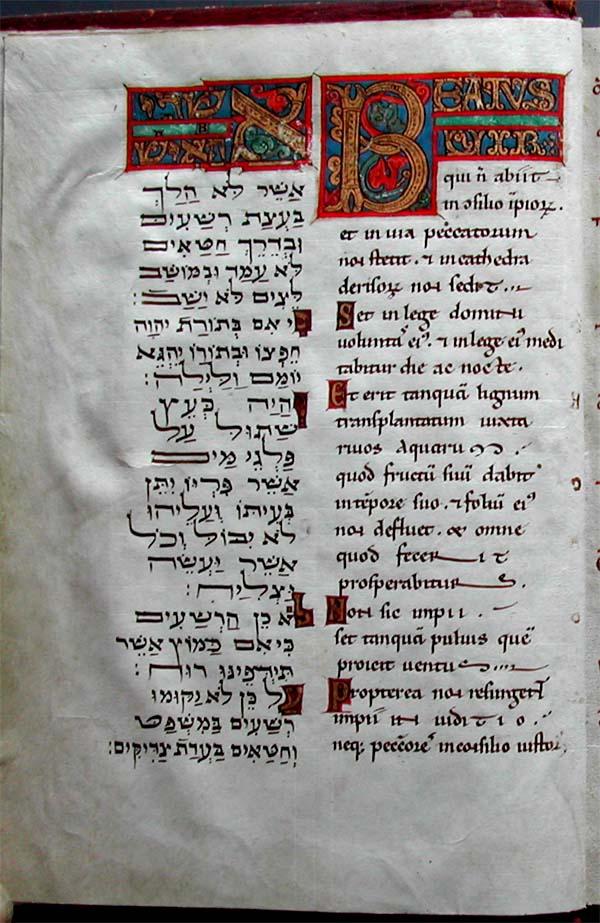
Was Punic a sister of Hebrew? Cousin? Lost neighbor? Punic prose preserved in Plautus's play.

A comedy written by the Latin playwright Plautus (254-184 BCE) called Poenulus survives. The title means something like "Little Punic Guy."

The Punics were a people who dwelled in Carthage (קרת חדשת), North Africa who originated in Pheonicia (Northern Canaan). References to מדינת אפריקי, "the country" (or people, or language) "of Afriqi" in the Talmud usually* refers to them, but the Talmud also calls the place קרטיגני--Carthage. As former Canaanites, they spoke Punic, that is, a dialect of Semitic that is cognate with Hebrew and the other Semitic languages. Their leaders were called ΣΠΘΜ; שופטים; perhaps pronounced suphethim. The name of the most famous Punic, Hannibal, is something like חן בעל (with the case ending). The language may have survived as late as Augustine (5th century CE, North Africa) who writes that he translates his Punic sayings into Latin so that a wider audience could understand them. A theory has it that Punic never truly died, but evolved into the North African Maghrebi dialect of Arabic, but I don't know about that. In addition, their writing system was awfully close to what I prefer to call the paleo-Hebrew (naturally). So if you could read the one, you could basically read the other.

The play. So, in Poenulus the Punic character Hanno delivers ten lines--in Punic (Act V).

They are:

1 Yth alonim ualonuth sicorathi symacom syth
2 chy mlachthi in ythmum ysthyalm ych-ibarcu mysehi
3 li pho caneth yth bynuthi uad edin byn ui
4 bymarob syllohom alonim ubymysyrthohom
5 byth limmoth ynnocho thuulech-antidamas chon
6 ys sidobrim chi fel yth chyl is chon chen liful
7 yth binim ys dybur ch-innocho-tnu agorastocles
8 yth emanethi hy chirs aelichot sithi nasot
9 bynu yid ch-illuch ily gubulim lasibithim
10 bodi aly thera ynnynu yslym min cho-th iusim


What does this mean? Well, the first line reads thus (as reconstructed by Cyrus H. Gordon):

syth symacom sicorathi ualonuth alonim yth
את אלונים ואלונות זכרתי שמקום זאת
"I call to mind the gods and goddesses of this place."

the sixth:

liful chen chon is chyl yth fel chi sidobrim ys
יש שדוברים כי פעל את כל אש כָּן כֵּן לפעל
"there are those who say that he has done all what was right to do"

As for Hanno, his full name is Anno byn mytthymballe, that is חנא בן מַתַּנבעל.

Finally, at one point Hanno greets with the word "avo," that is חַוֹו! "Live!"

You figure out the rest.

*I only say usually since I have heard that in at least one case Afriqi might refer to a place in the land of Israel rather than Carthage (but named after Carthage). But certainly in the famous Gemara about the lawsuit brought before Alexander the Great by people of Afriqi it refers to Carthaginians:

BT Sanhedrin 91a

ת"ר בעשרים וארבעה בניסן איתנטילו דימוסנאי מיהודה ומירושלים כשבאו בני אפריקיא לדון עם ישראל לפני אלכסנדרוס מוקדון אמרו לו ארץ כנען שלנו היא דכתיב (במדבר לד) ארץ כנען לגבולותיה וכנען אבוהון דהנהו אינשי הוה אמר להו גביהא בן פסיסא לחכמים תנו לי רשות ואלך ואדון עמהן לפני אלכסנדרוס מוקדון אם ינצחוני אמרו הדיוט שבנו נצחתם ואם אני אנצח אותם אמרו להם תורת משה נצחתכם נתנו לו רשות והלך ודן עמהם אמר להם מהיכן אתם מביאים ראייה אמרו לו מן התורה אמר להן אף אני לא אביא לכם ראייה אלא מן התורה שנאמר (בראשית ט) ויאמר ארור כנען עבד עבדים יהיה לאחיו עבד שקנה נכסים עבד למי ונכסים למי ולא עוד אלא שהרי כמה שנים שלא עבדתונו אמר להם אלכסנדרוס מלכא החזירו לו תשובה אמרו לו תנו לנו זמן שלשה ימים נתן להם זמן בדקו ולא מצאו תשובה מיד ברחו והניחו שדותיהן כשהן זרועות וכרמיהן כשהן נטועות ואותה שנה שביעית היתה

Our Rabbis taught: On the twenty-fourth of Nisan the revenue farmers were removed from Judah and Jerusalem. For when the Africans came to plead against the Jews before Alexander of Macedon, they said, 'Canaan belongs to us, as it is written, The land of Canaan with the coasts thereof; and Canaan was the ancestor of these people [i.e., ourselves].' Thereupon Gebiha b. Pesisa said to the Sages, 'Authorise me to go and plead against them before Alexander of Macedon: should they defeat me, then say, "ye have defeated but an ignorant man of us;" whilst if I defeat them, then say to them thus: "The Law of Moses has defeated you." 'So they authorised him, and he went and pleaded against them. 'Whence do ye adduce your proof?' asked he. 'From the Torah,' they replied. 'I too,' said he, 'will bring you proof only from the Torah, for it is written, And he said, Cursed be Canaan; a servant of servants shall he be unto his brethren. Now if a slave acquires property, to whom does he belong, and whose is the property? Moreover, it is now many years that ye have not served us.' Then Alexander said to them, 'Answer him!' 'Give us three days' time,' they pleaded. So he gave them a respite; they sought but found no answer. Immediately thereon they fled, leaving behind their sown fields and their planted vineyards. And that year was a Sabbatical year.

Tuesday, May 15, 2007

Unexpected Recanati quote in a 17th century English Hebraica publication.


This little booklet from 1647 is basically a compendium of Biblical Hebrew synoyms transliterated into Latin characters, with the occasional definition given in Latin (authored by John Beaton).

What's quite interesting is the Hebrew motto on this frontspiece, which reads

:אין בתורה אפילו אות אחת שאין הררים גדולים תלויים בה

"There isn't even a single letter in the Torah which doesn't support great mountains."

This is a quote from the Kabbalistic Torah commentary by R. Menachem Recanati (a 13th century rabbi from Recanati, Italy) on Deut. 10:17.

Here is the entire passage in context:

(יז) כי יי' אלהיכם וגו' [שם יז]. כבר הודעתיך כמה פעמים כי אין בתורה אפילו אות אחת שאין הררין גדולים תלויים בה, והבן כי הזכיר כאן כי השם המיוחד תחלה, ואחריו אלהי האלהים, ואחריו אדוני האדונים. וכן במזמור הודו ליי' כי טוב [תהלים קלו, א] אחריו הודו לאלהי האלהים, ואחריו הודו לאדני האדונים. והרמז בהם לג' הויות הראשונות, ועל הראשון הזכיר לעושה נפלאות גדולות לבדו כענין הנאמר בספר יצירה [פ"א מ"א] בל"ב נתיבות פליאות חכמה, ועל השני אמר לעושה השמים בתבונה, ועל השלישי לרוקע הארץ על המים וגו

Interestingly, the English book "corrects" one word, exchanging הררים for הררין, for the latter is a Mishnaic Hebrew form (with it's ן ending)--although it is possible that the Recanati text Beaton saw had הררים. In addition, the text is pointed, almost certainly not the case in the edition the editor of this work read, as it is not the practice among Jews to point texts which aren't biblical (and today, also prayer books, poetry and children's books). I suppose the pointing was meant to display erudition, as an aid the reader but also ideologically driven (see footnote 4 to this post, as well as this post).

There is this nifty poem on the second page, a plea to learn Hebrew and spread Hebrew


At Babels building tongues confounded were,
The gift of tongues doth new-Hierus'lem reare,
By language lost Japhet was forc't to stray
From tents of blessed Sem, the ready way
Of his reduction is for every man
To learne anew the tongue of Canaan.
Lo here, a Scholar of great Broughton brings
Some stones and timber-work, free-offerings
To help the building, if that every one
By his example would but bring a stone,
One single beame, or plank, few yeares would show
Hierusalem high-builded, Babel low.
Few yeares would bring that day when Nations all
Will Hallelu-jah sing at Babel's fall.

(typed out so that Google can index it)

Here is a sample of the work itself


As you can see, these are the 12 stones from Aaron's breastplate (Ex 28:17).

Two more examples. Names of God:


and this one, under the entry that begins with גו, a definition from Ibn Ezra


Yes, "vagina"did mean "sheath" or "scabbard" in Latin.

Unexpected Recanati quote at English Hebraica

If this teaser doesn't pique your curiosity

At Babels building tongues confounded were,
The gift of tongues doth new-Hierus'lem reare,
By language lost Japhet was forc't to stray
From tents of blessed Sem, the ready way
Of his reduction is for every man
To learne anew the tongue of Canaan.
Lo here, a Scholar of great Broughton brings
Some stones and timber-work, free-offerings
To help the building, if that every one
By his example would but bring a stone,
One single beame, or plank, few yeares would show
Hierusalem high-builded, Babel low.
Few yeares would bring that day when Nations all
Will Hallelu-jah sing at Babel's fall.


to have a look at the unexpected Recanati quote at English Hebraica, then nothing will.

Monday, May 14, 2007

Bamidbar vs Bemidbar

Some of us pedants are always amused/ angry that folks call the forthcoming sidra/ sepher Bamidbar (בַּמִדְבָּר) instead of the pedantically accurate Bemidbar (בְּמִדְבַּר).

Since you can prove anything with Google:

Bamidbar: an impressive 218,000 results!
Bamidbor (alt.): 665 results.

vs

Bemidbar: Only 49, 600.
Bemidbor (alt.): just 7.

Of course there are a few oddballs, eg, B'midbar with 9,250 and B'midbor, with 3.

And yet, oftentimes instinct makes a great deal of sense, and it would seem that people's instinct is to prefer the technically incorrect. Why?

Well, how about this for a guess? Although the book is named for the word במדבר which appears in the first verse (Numbers 1:1) the word in that context cannot really stand alone. בְּמִדְבַּר means "in the wilderness of," so it needs the following word, Sinai. However בַּמִדְבָּר means "in the wilderness." No, בַּמִדְבָּר / "in the wilderness" is not actually part of the first verse. But "in the wilderness" doesn't hang like "in the wilderness of" does.

Masses 1 Pedants 0

edit: Looks like I was scooped by Philo "Hillel Halkin" Logos. But I think I was funnier.

There are two new gedolim

link

All kidding aside, perhaps Agudath Israel would consider explaining what is meant by מועצת גדולי התורה so that cynical or gently mocking comments like this post can't be made.

A threat to Tehillim? Dead Sea Scrolls in the Jewish Tribune.

A friend sent me a clipping of the following letter from last week's Jewish Tribune (a London Agudist newspaper), regarding "Tehillim and the Dead Sea Scrolls":


(click to enlarge)

It contains the following assertion: "Secular and non-Jewish scholars have to admit that the Tenach scrolls are word-for-word identical with our texts and not with those of Samaritans (Kusim) and early translators (Septuagint - Greek, Targumim in various Aramaic dialects, et al)." However, there are differences in spelling, differences in the use of vavs, yuds and alephs, etc.

I found this assertion astonishing! But then I remember that I'd heard it before...

In any case, although the letter writer actually subscribes to some non-traditional, modern scholarly positions (e.g., that the graphic symbols of the nekkudot are post-Talmudic, that the canon of the Bible was not fixed until Jamnia [1] (יבנה), etc.) there is no traditional position on the Dead Sea Scrolls. But perhaps his view is widely shared in the Orthodox community; roughly that the texts match our massoretic text. On the other hand, divergences are meaningless because either they are sectarian or they are simply passul [2] texts that were placed in the desert as shemos [3] (our letter writer adopts the latter position).

Putting aside the question of who wrote the texts and why, the assertion that word for word these texts are massoretic is simply not true. It is false; so false that it crazy that anyone could believe it who has seen the evidence! And if one hasn't seen the evidence, what business does one have saying such a thing? And where does it even come from, so far from the actual picture is it.

In fact three or four kinds of Hebrew texts were found at Qumran (depending on how you divide it). The first are Bible texts that are much like the masoretic text (and comprise about 60% of the material), the second seems to be a type of Hebrew text that the Septuagint was translated from (only about 5%), the third is like the Samaritan Pentateuch, lacking only the ideological changes that are present in the Samaritan version (also about 5%). A fourth type are texts that can't be placed into any of these categories (about 105), and finally there are non-Biblical Hebrew texts which are unique to Qumran, comprising about 20% of the total. In other words, exactly the opposite of what the writer claimed.

As it happens. in a backward sort of way the Dead Sea Scrolls was a gift to the massoretic text. It is true that its authenticity as an ancient (much less the ancient) Hebrew text had long been doubted or denied, at least since the Samaritan Pentateuch was discovered and brought to Europe by Pietro della Valle in the 17th century. Furthermore, it was also thought that the Septuagint reflected a different, more original Hebrew text for the following reason: the oldest existing Hebrew Bibles were from about the year 1000 CE. The oldest Septuagint texts were hundreds and hundreds of years older than that. It seemed fairly evident that the Septuagint had been translated from a Hebrew text that had different readings from the masoretic Hebrew. So what conclusion was there besides that the assumed Hebrew vorlage of the Septuagint was the older? [4] The reasoning was reasonable, but as it turned out, incorrect. The Dead Sea Scrolls introduced Bible texts more than a thousand years older than what had previously been known into the discussion. And the Dead Sea Scrolls proved beyond a shadow of a doubt that the massoretic text is not late, it is at least as old as the Samaritan and the Hebrew Septuagint. Conversely, it also proves that 2000 years ago "the Bible" was not exclusively massoretic.

That's the good news, if indeed this is good news. But its important to understand that these massoretic Dead Sea texts are actually massoretic-like, not identical with our own text. This means that many words as spelled differently in ways that don't matter, as the letter writer notes, but also that many words are not the same at all.

Here is a small sample of examples. The first is our massoretic reading, the second the Qumran reading. The text being compared is an Isaiah scroll (1QIsaa):

Is 46:11
M: והמתי ברעב שרשך ושאריתך יהרג
1QIsaa: והמתי ברעב שרשך ושאריתך אהרג

the former reads "it shall slay" and the latter "I shall slay."

Another example will compare the massoretic with a Qumran Samuel:

1 Sam 1:23
M: אך יקם יהוה את דברו
4QSama: אך יקם יהוה היוצא מפיך

the latter, by the way, seems to be the Hebrew which the Septuagint used (in translation: "may the Lord establish that which comes out of thy mouth," as opposed to the massoretic "only the Lord establish His word.")

Are these the only two examples? No, they are only two examples. [5]

[1] Sid Leiman wrote his doctorate on the Talmudic and Midrashic evidence regarding the canonization of Tanakh. He concluded that from the evidence--and he collected essentially every piece of rabbinic writing that had some bearing on the canon--it is completely baseless to conclude that the Bible was canonized at Jamnia; it must have been canonical earlier. Given that this scholarly trope is based entirely on rabbinic writings, it seems to me that he has a point.
[2] Unfit for ritual use, eg, reading from it in a synagogue.
[3] Hebrew writings made sacred because of the presence of a name of God. Such writings are to be respectfully stored away rather than thrown into garbage.
[4] Would it surprise anyone that ideology was also a factor? Although going strictly by the evidence this was a logical conclusion--that the Septuagint reflected an older Hebrew Bible--the matter can not be separated from internal disputes then raging in Christendom. The Protestants eschewed the Latin and Greek translations of the Hebrew Bible as a mediating presence between them and God's pure word in its original tongue. The Roman Catholics had an interest in discrediting the Hebrew text, to show that true Biblical authority lay with the text canonized by the Church (the Latin) and that, in fact, the Hebrew was a corrupt text compromised by its Jewish custodians and thus useless in interpreting God's word.
[5] Pages 111, 114 in 'Textual Criticism of the Hebrew Bible," Emanuel Tov, Minneapolis, 1992.

Monday, May 07, 2007

Don't ask good questions if you don't have a good answer? Or maybe the questions aren't good? Dead Sea Scrolls, Karaism, Tradition (got that, Google?)

I was perusing the very first issue of Tradition (1.1, Fall 1958) and in doing so read a very interesting and very dated article called Halakchic Implications of the Dead Sea Scrolls by Sidney B. Hoenig (the article's byline says he was then Director of the Yeshiva University Department of Adult Education, as well as a professor of Jewish History--here's a no doubt partial bibliography of his scholarly writings).

In any event, after a brief overview of what the scrolls are, what non-Jewish scholars and theologians were then making of them, Hoenig asks many questions about them as they might pertain to Judaism. Assuming that many of the finds are older than the Mishna and the earliest rabbinic literature--they are as follows:

1) What to make of the presence of 23 biblical books and the apparent absence of one (Esther)? This leads to certain questions, such as: "Are we to conclude that Jews did not observe Purim in the Second Commonwealth, and that only "the Day of Nikanor," recorded in the Second Book of Maccabess was observed? Was Purim as a religious festival instituted only after Yabneh and Usha? Is the first actual reference to the reading of the Megillah that of R. Meir who wrote his own Megillah when in Asia Minor? We know it was R. Joshua ben Levi (3rd century) who prescribed that the Megillah be read at night. Was it practised before?" Since Esther does not include God's name, does its absence from the Qumran canon corroberate its singularity? Did Esther have no sanctity and was it included in the canon only due to popular request--כתבני לדורות (Megillah 7a)?

2) What of the order of parshiyot in our Tefillin as compared with tefillin found among the scrolls in the Judean Desert?

3) What of the non-massoretic biblical readings?

4) What of the scribal rules apparently violated by these scrolls, eg, crossing out mistakes rather than erasing them?

5) What of the calendar, which is found in the Jubilees Scroll? "Was the calendrical system now rediscovered...the authentic one...and our system only the result of R. Joshua and Rabban Gamaliel...?"

6) What about theology? For example, the Pesher Habbakuk speaks of a moreh tsedek who is to supplant the kohanim in the Temple.

7) If the Qumran scrolls are siphrei minim, are they worse than the apocryphal books, such as Ben Sira, which was revered by amoraim? Or ought they be destroyed (theoretically)?

In short, what are the implications of these scrolls?

Then, Hoenig shlugs up[1] all the kashyas[2] in one fell swoop:

Following the unique, ahem, eccentric view of Solomon Zeitlin at the time (which, come to think of it, was also endorsed by William Chomsky in his marvelous Hebrew language history "Hebrew: The Eternal Language") Hoenig says that the documents are not ancient, they are medieval, they are Karaite and they say nothing about Judaism.

"One recognizes that the Karaites were devoted to the Torah. חפישו באורייתא שפיר was their slogan. But they often copied biblical texts as they saw fit, sometimes agreeing with the masoretic text and at times introducing their own readings.* Carelessness and ignorance were also some of the outstanding qualities of these Karaitic scribes.** Purim, being a festival ordained by rabbinic dictum, not unlike Chanukah, may have been rejected by these biblically minded sectarians.*** The Tefillin, being מדאורייתא, on the other hand, may not have been different from those used by the Gaonim.**** All the discrepancies in the scrolls can be explained by this defection of the predecessors and followers of Anan, who hated Hillel and the Rabbanites and considered themselves followers of Shammai. Indeed, the pecularities of Halakhah among them, too, can be seen in their out-Shammaing Shammai.

"What we really possess in these scrolls are early Karaitic writings....The Torahs found in the Dead Sea Scrolls have no sanctity; we need not, therefore, be disturbed by any conclusions of halakhic import, for there are none..."


He then dismisses the option that a pre-rabbinic Judaism existed in Second Temple times.

"Maimonides' Ninth Principle remains true: "This Torah will not be changed nor will there be another Torah revealed by the Creator."

Needless to say I well understand how in 1958 Zeitlin's outsider view (that the scrolls were medieval and Karaitic) was seen as another valid scholarly point of view. So naturally there is nothing to be complained about Prof. Hoenig's adopting that view; he was persuaded by the evidence for that position, which we now know is entirely fantasy.

[1] Shlug means "beat" or "hit" in Yiddish and shlugs up is a yeshivish idiom for really trouncing an argument with good answers.
[2] Kashyas, questions.
* No.
** No.
*** No. Purim is biblical and that is important. Karaites indeed never celebrated Chanukah, since it is not from one of the 24 Bible books. But from the Karaitic point of view Purim isn't "מדרבנן," it's מדאורייתא--biblical--as it indeed is.
*** Hoenig means that tefillin matching Rabbenu Tam's order were found at Qumran. According to him this order is found in a responsum of Rav Hai Ge'on, meaning that Rashi supported the Eretz Yisrael order and Rabbenu Tam, the Ge'onic, or Babylonian order. But as Prof. Moshe Bernstein notes, tefillin of types in addition to Rashi and Rabbenu Tam were found. (Perhaps Hoenig did not know this, or the discoveries hadn't yet been made publich--he also doesn't mention Rashi tefillin.) In any case, Karaites do not and never did wear tefillin. It's דאורייתא status, noted by Hoenig involves accepting the rabbinic דרשה of the relevant verses which the Karaites do not do. Not impossible, if non-rabbinic groups at one point agreed with that דרשה, but in fact the Karaites never did.

Jihad in the Rosh Hashanah Machzor

at What's Bothering Artscroll?

al tiqreh "skirmish," "battle" or struggle," elah "jihad."

Jihad in the Rosh Hashanah Machzor


XGH posts about the Sufi Islamic influences on R. Bahya ibn Paquda's חובת הלבבות Chovas Ha-levavos (Duties of the Heart).

XGH reports that every time his "chavrutah tells me that everytime the Choyvos Halevovos brings down a story of a 'chasid' (which he does many times), he's actually talking about a Sufi pious man, and not a Jew."

Every Rosh Hashana as I recite Tashlich I notice anew a passage in Artscroll's Tashlich commentary (of course, if I learned Chovas Ha-levavos more then it wouldn't take Tashlich for me to notice it):

Chovas HaLevovos (Shaar Yichud HaMa'aseh 5) tells of the pious man who went out to greet the troops returning from the battlefront. He said to them, 'You are returning from a minor skirmish to enter into the major battle--man's lifelong struggle with his Evil Inclination.

And I think, al tiqreh "skirmish," "battle" or struggle," elah "jihad."

Two versions of a hadith (of three possible kinds: marfu`, a Prophetic saying, mawquf, a Companion-saying or maqtu`, a Tabi`i, or later-saying):

  1. Some troops came back from an expedition and went to see the Messenger of Allah MHMD sallallahu `alayhi wa-Sallam. He said: "You have come for the best, from the smaller jihad (al-jihad al-asghar) to the greater jihad (al-jihad al-akbar)." Someone said, "What is the greater jihad?" He said: "The servant's struggle against his lust"(mujahadat al-`abdi hawah).
  2. The Prophet MHMD upon him and his Family and Companions blessings and peace returned from one his expeditions and said: "You have come for the best. You have come from the smaller jihad to the greater jihad." They said, "What is the greater jihad, Messenger of Allah?" He said: "The servant's struggle against his lust.

link

Nu, so Was hat dem Judentume aus Mohammed aufgenommen? Wink, wink.

Hm. This is a Chovas Ha-levavos post and not really an Artscroll post.

Thursday, May 03, 2007

Legends of Louis Ginzberg

An anecdote concerning Louis Ginzberg and his close friend Alexander Marx (who was the disciple and son-in-law of R. David Zvi Hoffmann, in addition to being the world class librarian that he was):

From the age of twenty-one when he earned Semikhah-the right to judge under Jewish law--until his death at the age of eighty, Louis Ginzberg devoted considerable time and effort to this task. He never held a position in the Jewish community which would have required him to decide matters of law, as was the duty of an active rabbi or a member of the law courts; Louis Ginzberg's concern with law had a different origin and motivation.

As knowledge of his reputation as a talmudist spread, those who wanted to know the law on any difficult issue sought his opinion. His major decisions were in the nature of advisory opinions, although he was drawn into a few cases where active conflicts raged, usually between an individual or group of individuals and the rabbi or the board of directors of a congregation.

His legal opinions covered a wide range of subjects, including those on which he could bring his sense of humor to bear. He was fond of telling the story of being asked by his colleague Dr. Marx, shortly after the latter's arrival in this country, whether one was permitted to use an elevator on the Sabbath. My father replied that it was not permitted, and Marx started his climb of six stories. My father, always restive when confronted with the rigidities of German orthodoxy, awaited the return of the elevator to the ground floor, stepped in, and rode up. Marx, astonished, reminded him that he had just stated that using an elevator was not permitted. He replied: "I didn't ask for an opinion!"


Eli Ginzberg (his son) published the text of a letter his father received while on vacation in 1948, a letter which greatly disturbed him.

Levi of Neistadt:

Your life has been a failure. Not only have you made the Torah a Kardom Lachpor Bo, and you glory in the designation of Professor of Talmud and great authority on "Halakhah," when you know that there are scores of men superior to you in Talmud in this city; not only have you helped produce "Rabbis" who are in almost every single case Boale Niddot and Chot'im and Machti'im et Harabim; not only are you a Poresh Min Hatzibur of the real Talmidei Chachamin who toil for the welfare of Klal Yisroel; but you have cast aspersion on the Talmud and supported the Kofrim: you declared at least twice (once in your Legends and once in your Students, etc.) that the Rabbis of the Talmud uttered their Hagadic statements on the spur of the moment (May the Almighty forgive you), and you support Weiss in his denial of the authenticity of a great part of Torah Shebdal Peh. Your works are full of echoes of the Kofrim. Remember your childhood hopes, and now see yourself not only as an associate of M. Kaplan (Yimach Sh'mo) but also in part responsible for him and for others like him. For you, the authority, have undermined the faith of these Am Ha'aretz. May the Almighty open your eyes and help you to recant, to recall the harmful books, to repudiate your associates the Kofrim, and to return to the Tzibbur of Talmide-Chachamim.

Yours sincerely,
A Friend.


Eli Ginzberg relates that this letter greatly upset his father and "within twenty-four hours he had a severe case of herpes zoster (shingles), and although the acute infection subsided after a time, he was left with an aggravated neuralgia which plagued him every day and night until he died."

Eli Ginzberg, Keeper of the Law : Louis Ginzberg, 1st ed. (Philadelphia: Jewish Publication Society, 1966) pp. 214-215 & 265-266

Thursday, April 26, 2007

Just ban the man already!

Interesting interview with Dr. Marc B. Shapiro at the Jewish Press.

Excerpt:

Q: What will your next book be about?

A: My next book is called Studies in Maimonides and His Interpreters...And then, following that, I have a contract to do a book that will be called Changing the Immutable: How Orthodox Judaism Rewrites Its History. It’s about how uncomfortable ideas, which used to be acceptable, have basically have been moved out of the tradition through censorship.


But what really might do it is a paper to come out before that:

Q: In one of your recent works you mention that you are writing an article discussing many laws found in the Shulchan Aruch that were not or are not kept by Jews. Can you elaborate?

A: It’s just another misconception people have that the Shulchan Aruch is always the last word in halacha, when there’s plenty of things we do which are not in accordance with it.

According to the Shulchan Aruch, when you lend money to someone, you need to do it in front of witnesses. Despite that ruling, however, nowadays if you lend your friend 50 dollars, you don’t do it in front of witnesses. Already the acharonim want to know why we don’t follow the Shulchan Aruch.

There are loads of examples. Some halachos in the Shulchan Aruch didn’t become accepted because other poskim argued or there was a tradition predating the Shulchan Aruch; others, because they were too difficult to keep, and then later poskim came and found justifications.

I think this sounds more explosive than it is. Everyone who knows halacha knows that there’s plenty of stuff we don’t do according to the Shulchan Aruch; this is not controversial.


Right.

Tuesday, April 24, 2007

Klinghoffer sets aim at Gerschom Scholem, enjoins apologists to counter atheists, claims Mishnaic authority.

David Klinghoffer calls for apologetics in defense of religion when it is blasphemed, in the grand old tradition, he writes, of CS Lewis or Maimonides. link

Although he is chiefly concerned with attacks on religion in general (in popular books that just do not interest me, by Sam Harris, Richard Dawkins and, now, Christopher Hitchens) he also takes the time to jab at academic study of religion, carefully placing Gershom Scholem in his crosshairs (for finding the Zohar to be a medieval and not tannaitic work; in Klinghoffer's dramatic telling, "a cynical medieval hoax masquerading as the more ancient work it purports to be,"--as if that is what Gerschom Scholem concluded!) .

In any event, Klinghoffer cites the Mishna Avos 2:14, ודע מה שתשיב לאפיקורוס:

In fact, the Mishnah makes it every Jew’s obligation to be an effective apologist, an obligation that most of us ignore nowadays: “Know how to answer an unbeliever” (Pirke Avot 2:14) — with the word for unbeliever being apikorus, a follower of Epicurus, the Greek philosopher.

Epicurus is known as a primary exponent of materialism, the belief that material reality is all there is in the universe. And materialism happens to be one of the most serious challenges that religion is up against today.


Now, we know--assume--that אפיקורוס comes from the Greek for a follower of Epicurus. And Klinghoffer, who eschews academic study of religion assumes, perhaps, that his explanation that Epicurus was the primary exponent of materialism is the Mishna's intention. Although in later Jewish history apikorus אפיקורוס becomes a synonym for unbeliever, Klinghoffer shows how erudite he is by telling us what it is the Mishna is attacking: materialism.

I am reasonably certain he did not find this explanation in the Ra"v mi-Bertinoro or the Tosfos Yom Tov, or perhaps in Rashi someplace. So how does he know who and what Epicurus is or what Epicurianism is?

Okay, that isn't really serious. I accept that he is not a Torah-Onlyist, nor does he purport to be.

However, how did the rabbis understand apikorus אפיקורוס? Did they truly mean an Epicurean?

Let's look at the tape.

Firstly, the Gemara explains ודע מה שתשיב לאפיקורוס in BT Sanhedrin 38b:

ודע מה שתשיב לאפיקורוס אמר ר' יוחנן ל"ש אלא אפיקורוס גוי אבל אפיקורוס ישראל כ"ש דפקר טפי

R. Johanan commented: They taught this only with respect to a Gentile Epikoros; with a Jewish Epikoros, it would only make his heresy more pronounced.

IOW the very rabbinic sources which enjoin us to make an apologia against Epicureanism enjoin us not to do so with a Jewish Epikoros. So much for Hitchens and Harris.

And what is an apikorus according to the rabbis? The Mishna Sanhedrin 11:1 says that an אפיקורוס has no share in the World to Come.

The Gemara (BT Sanhedrin 99b) will offer opinions, but before it does, the term itself is used as one possible meaning of a verse that is used in connection with another person mentioned in the Mishna who has no share of the World to Come, האומר אין תורה מן השמים him who maintains that the Torah is not from Heaven. But there is another interpretation of the verse: ד"א כי דבר ה' בזה זה אפיקורוס, "Because he hath despised the word of the Lord," Numbers 15:31, refers to an epikoros. But we still have no clue what an apikorus is (gotta vary the spellings for Google archiving ;) ).

Finally we get to the explanation of the Mishna San 11:1

רבי ורבי חנינא אמרי תרוייהו זה המבזה ת"ח

Rab and R. Hanina both taught that this means one who insults a scholar.

and also

רבי יוחנן ור' יהושע בן לוי אמרי זה המבזה חבירו בפני ת"ח

R. Johanan and R. Joshua b. Levi maintained that it is one who insults his neighbour in the presence of a scholar.

Further clarification of the term is given

אמר רב יוסף כגון הני דאמרי מאי אהנו לן רבנן לדידהו קרו לדידהו תנו

R. Joseph said: E.g., Those who give, 'Of what use are the Rabbis to us? For their own benefit they read [the Scripture], and for their own benefit they study [post-Scriptural learning, particularly the Mishnah]'.

An anecdote

לוי בר שמואל ורב הונא בר חייא הוו קא מתקני מטפחות ספרי דבי רב יהודה כי מטו מגילת אסתר אמרי הא לא בעי מטפחת אמר להו כי האי גוונא נמי מיחזי כי אפקירותא

Levi b. Samuel and R. Huna b. Hiyya were repairing the mantles of the Scrolls of R. Judah's college. On coming to the Scroll of Esther, they remarked, 'O, this Scroll of Esther does not require a mantle.' Thereupon he reproved them, 'This too savours of אפקירותא.

and finally,

רב נחמן אמר זה הקורא רבו בשמו

R. Nahman said: [An epikoros is] one who calls his teacher by name.

In short, whatever an apikorus is, there is also what it was. I don't think Klinghoffer is one who will explain a Mishna in a way unlike the Gemara, and there is no internal evidence in the Mishna to define an apikorus. Therefore, whatever דע מה שתשיב לאפיקורוס means, I am not at all sure it means to defend against materialists. Perhaps it means to defend against rabbi bashing? Sure. But to take up the cudgel against Dawkins? That may be a practical consideration for believers, but the Mishna doesn't say so!


Interesting historical note for all you On the Main Line chroniclers: when I first begun my blog I had spent a couple of years reading other blogs, and several months commenting on them. Realizing I wanted to say some things, I jotted down some thoughts which I planned to make posts out of when I would begin blogging. Having just finished Klinghoffer's Why the Jews Rejected Jesus, in which he informs the world that Jews don't like Jesus, but that without the Jews crucifying Jesus, America and Europe would be Muslim today. Well, that's basically the gist of his book. I wrote a long exhasperated fisking of that book. Never posted, but just so you know.

Le-moshol: Why did the dinosaurs die?

Larry Lennhoff presents a beautiful fable:

"When the time came for Hashem to give the Torah, he went to all the species of dinosaurs. Hashem approached Tyrannosaurus Rex and asked "Will you accept my torah?" T. Rex asked "What does it say?" Hashem said "Of all the animals that walk on the land, these you may eat..." T. Rex said "I am the mightiest carnivore to ever walk on the land. Anything and everything is my prey. I will not accept the Torah."

Then Hashem approached the Apatosaurus. "Will you accept my Torah?" "What does it say?" "The fire shall be kept burning on the altar continually, it may not be extinguished." "Oh no", the Aptosaurus replied. "Fire is wild and uncontrolled, and when the land burns we must flee before it or die. I couldn't keep a fire burning. I won't accept the Torah."

Hashem went to the Velociraptor, from there to all the other species of dinosaurs. None would accept the Torah.

Then a small Hadrocodium wui, the earliest mammal spoke up. "I will accept the Torah, Hashem". Hashem said "But you are too small and feeble - you cannot fulfill the mitzvot. But because your desire to serve me exceeds your ability, I will make sure your descendants have the ability you desire. And the dinosaurs shall learn that without my Torah they have no purpose."


This could have come from the Hertz Chumash, והמשכיל ידום.

Monday, April 23, 2007

When a rebbe slaps you for impudent questions, don't get mad--open a museum.

Many people are aware of the Living Torah Museum in Boro Park. On the other hand, many are not.

A couple of years ago Hershel Shanks profiled this museum in his Biblical Archaeology Review (30:06, Nov/ Dec 2004):

I have often lamented that, although there are thousands of museums in the United States devoted to every conceivable topic, there is not a single museum here devoted to Biblical archaeology.

I have recently been challenged on this assertion—and from a most unlikely source. I am wrong, I am told. There is a Biblical archaeology museum above a little shtibl in Boro Park, led by a chasidic rabbi.


The article describes it as the brainchild of its founder, Shaul Deutsch. How did he get interested in Biblical archaeology? Why did he create this museum (which has some impressive artifacts)?

When Rabbi Deutsch was eight years old...Shaul and his teacher were studying the [Mishna] tractate on damages, Baba Kama. The particular passage concerned what would happen if a person left a kad in a public place: What if someone stumbled over it and broke it: Was the man who stumbled over it and broke it liable for damages? What if someone slipped on the water released by the kad and injured himself or was hurt by the broken pieces of the kad? Was the owner of the kad liable to the injured person for his injuries? In English translations, kad is variously translated pitcher, jug or pot. Shaul asked his teacher what a kad looked like. The teacher slapped him twice across the face. His teacher thought he was “acting up,” being a smart aleck, questioning the text. According to traditional study, everything is there in the text—no need to ask a question like this.

As Rabbi Deutsch now puts it, he was never one to take “no” for an answer. So he kept asking. Gradually, he looked at books. And he found answers—in archaeology. And he asked other questions. And he found more answers. And he became fascinated with archaeology. He was not becoming an apikoros (a heretic); he simply wanted to see the realia (although he would not use that word) that the holy texts were describing.

Read the rest of the BAR article.

He says he has had no opposition from the observant, devout community in which he lives. Yeshiva students (a yeshiva is a traditional rabbinic academy) are flocking to the museum, he says. He recalls for them a passage or an episode from the holy texts and then points to the item that is being referred to in the text. That is what he wants to do, he says: to teach Torah (in its broadest sense, all religious learning) through archaeology. Even the heads of leading yeshivot have come to see and admire his museum, he says.

A dissenting view by Freelance Kiruv Maniac (surprised?).

The museum is located at 1601 41st Street in Brooklyn. Hours: 9 a.m. to 6 p.m. and 8 p.m. to 11 p.m. daily. Closed Friday afternoon and Saturday until 1 hour after sundown and on Jewish holidays. Telephone: 718–686-8174. Website: www.torahmuseum.com.

Thursday, April 19, 2007

Is pardes--peshat, remez, derush, sod--a Biblical-era acronym?

No, of course not.

But read about it at English Hebraica.

'Pardes,' from a 'Talmud Babylonicum' introduction: complete with a gaping anachronism.

In the October 1867 issue of the British periodical the Quarterly Review appeared an article called "Talmud Babylonicum," which meant to inform readers "What is the Talmud?" The article noted (claimed?) that "Turn where we may in the realms of modern learning, we seem to be haunted by it," and "that strange production of which the name, imperceptibly almost, is beginning to take its place among the household words of Europe." In short, this article was meant for the curious.

I uploaded the whole thing for download.

Here is an interesting excerpt:


Nothing new, of course, but it is noteworthy that at this relatively late date (1867) Jewish learning was still sufficiently shrouded in mystery that a simple anachronism is committed: pardes as an acronym for peshat, remez, derush and sod is a medieval mnemonic and thus does not apply to anything related to the Talmud, much less to the period of Chronicles (given that the term midrash first appears in that book), when this article assumes the term came into use!

Wednesday, April 18, 2007

What's peshat with the Peshitta, Part III: Jewish? Christian?

Having twice posted about the פשיטתא, Peshitta ('What's peshat with the Peshitta I, II) I now return for round three.

As previously mentioned, an interesting (and to my mind) attractive theory of the origins of this Syriac translation of the Bible ascribes is to Jewish origin; perhaps it was even prepared for the Syriac-speaking Jewish converts of the royal house of Adiabene (חדיב) in the 1st century CE.

In any case, J. Perles, in 1859, first advanced the notion of a Jewish origins for the Peshitta in his doctoral dissertation Meletemata Peschitthoniana.

He noted many quirks which, he felt, could only be explained by a Jewish origin. Here are several examples:

1) Gen. 8:4. Ararat, אררט, given as Qardu, קרדו, in Targum Onqelos. So too in the Peshitta.

2) Gen. 30:28. Noqbhoh, נקבה, translated as 'appoint' in JPS, 'name' in Kaplan's Living Torah, and so forth, is rendered פריש, which literally means 'to separate' or 'set aside.' This is just what the Peshitta translates it as. Evidently this usage comports with a Jewish dialect of Aramaic.

So much for lone words. Now comes the matter of translation which is looser, but richer in interpretation.

3) ii Chr. 33:7. 'he set the graven image of the idol,' (JPS). The Peshitta takes this further and writes לצלמא דארבעה אפין (I didn't actually do my homework yet, and I need to look up the exact wording and spelling; this is from memory), 'a statue of four faces.' This is found in BT Sanhederin 103b (look it up!), commenting on this verse:

[Scripture writes, And he set] the graven image,' but it is also stated, [And the groves and the] graven images, [which he had set up].R. Johanan said: At first he made it with one face, but subsequently he made it with four faces. (Soncino)

4) Ezra 9:4. The verse says "at the evening offering," (JPS). The Peshitta foreshadows BT Berakhos 26a, in that it renders this as 'at the ninth hour,' i.e., the precise rabbinical time of the 'afternoon.'

Seems Jewish, doesn't it? However, another school of thought (begun by Gesenius) held that it did not have Christian origins. In response to these things this school modified its position a bit and allowed that the translator(s) might have been Jewish, but could well have been a Jewish Christian.

They noted that the Peshitta includes christological translations, such as in Is. 7:14, giving `almah as betulta (virgin) instead of tselaymeta, as used elsewhere for `almah. The response to this, naturally, is that it might have been a later interpolation. Of course this may be, but there obviously is no proof that it is.

Secondly, Is. 53:8 (the suffering servant part) translates lamo as to him, instead of to them, which is theoretically the Christian and not Jewish interpretation of this chapter. This is, in my opinion, a particularly slender reed.

Finally, an interesting piece of evidence for the Christian side was advanced by L. Hirzel in 1825: that the list of unclean birds in Lev. 11 sometimes transliterates from the Hebrew, rather than translates, and in some cases skips terms entirely. The interpretation given to this fact was that this sort of negligence could only have come from a Christian translator who was a) less fluent in the Hebrew original than would be expected of a Jew, and b) such matters as the dietary laws of the Old Testament would be of great concern to a Jew, but of considerably less to a Christian, therefore this sort of haphazard translation must have been the work of a Christian.

The reply to this, of course, is perhaps the translator was merely at a loss for the correct Syriac word to use.

Tuesday, April 17, 2007

Rashi tells us how Amen is pronounced according to Old Ashkenazic Hebrew

It's well known that Ashkenazim distinguish between the qomatz and patah vowels (אָ and אַ), while the Sepharadim and Mizrahim don't, pronouncing both as a patah (with the notable exception of the Yemenite Jews who do distinguish between them, pronouncing the qomatz much like the Ashkenazim).

For those who are not following, here is a graphic illustration: Ashkenazim would pronounce the word 'luck' and 'lock' as we are accustome, but Sepharadim would pronounce them both as 'lock,' were these two words Hebrew.

These two distinct pronunciations is paralleled in the two ways that Syriac is spoken by Christian Aramaic-speakers; a point noticed by Samuel David Luzzatto, which he took as evidence in favor of the correctness (in the sense of conforming to Tiberian Hebrew) of the Ashkenazic qomatz, at a time when Ashkenazic Hebrew was viewed with disfavor (early 19th century, but that view never seems to have properly faded). The difference: there are those Syriac Christians who say 'Abun di-bishmayo' and those who say 'Abun di-bishmayah,' in The Lord's Prayer (both mean 'Our Father who art in Heaven').

An interesting fact in the history of Ashkenazic Hebrew is that, apparently, Ashkenazim (Franco-German Jews) did not always distinguish between these two vowels, like their Spanish, North African and Middle Eastern counterparts. This is attested in early Ashkenazic manuscripts in which confusion between these two vowel's graphic symbols (ָ and ַ) are found in great abundance, exactly as in Sepharadic manuscripts. Although I don't have a handy example of a genuine Ashkenazic manuscript, a picture is worth a thousand words, and I reproduce an image which adorned my post How a 12th century English gentile vocalized Hebrew:

(click to enlarge; the heh in the last word on the second line should have a qomatz, but it has a patah, reflecting the vocalizer's pronunciation.)

But manuscripts are only part of the evidence.

A juicy piece of evidence[1] for this can also be found in Rashi's (1040-1105) comment on TB Berakhos (or should I say Berakhoth, in homage to early Ashkenazis?) 47A. There the Gemara discusses amens, and says ...אין עונין לא אמן חטופה , "the Amen uttered in response should be neither hurried..." To this Rashi gives the interpretation of what an hurried Amen is: שקורין את האלף בחתף ולא בפתח ואמר אמן והוא שצריך לומר אמן, "He reads the 'aleph with a sheva (אְמֵן, [short first sylabble] E'mein) and not with a patah (Ahmein)" (presumably in Rashi's text the two אמןs were vocalized, but in the standard printed editions Rashi is never pointed).

Thus, we see that Rashi said a word written אָמֵן as if it were written אַמֵן, just like the Sepharadim. Rashi said ahmein, not ohmein. It should be noted that in Artscroll's Schottenstein Talmud the explanatory notes say that Rashi terms the qomatz godol a patah and gives several references; but it does not explain why. Patah itself means that the mouth is to be opened wide; that is how the ah sound results.

Rabbi Dr HJ Zimmels, in his classic Ashkenazim and Sephardim: Their Relations, Differences, and Problems As Reflected in the Rabbinical Responsa discusses their respective pronunciations and adduces other proofs, among them the fact that Rabbenu Asher (13th century), who moved from Ashkenaz to Sepharad, becoming one of the foremost leaders in Spain, discusses the differences between the Hebrew scripts used by the respective communities but doesn't seem to notice any difference in pronunciation at all.

In any event, following Rashi, over the last hundreds of years Ashkenazic Jews pronounced, and still pronounce, amen as something sort of like 'ohmein.' But evidently at this early period in Ashkenazic history the qomatz was not yet pronounced distinctly, and pronounced ah, like the Sepharadim.

The question is when and why and how did this change? Did this come about due to a happy accident, normal sound shifting? That seems unlikely if these two vowels were pronounced identically. How could normal changes come about conforming correctly to the graphic differences in the written texts? Rather it seems like a deliberate effort to conform to the Tiberian pronunciation. Could this have really happened? I don't think there is any evidence that it did. But perhaps gradually it was noticed that Hebrew was spoken in a 'mistaken' fashion, meaning that it did not conform with the graphic symbols, the signs devised by the Tiberian Masoretes. Like other, periodic efforts to improve spoken Hebrew, perhaps somehow this change occurred. Maybe it first occurred among exacting Torah readers. Maybe some pedantic melamdim (children's teachers) taught it to their 3 and 4 year old charges. In any case, it seems irrefutable that at some point in the past 900 years (and perhaps in the past 700 or even more recently) Ashkenazim begun pronouncing the qomatz properly, in the sense that it is distinct from the patah, and in the sense that Tiberian Hebrew is proper Hebrew.

However one lingering doubt remains in my mind: it is generally believed that Ashkenazic Jewry had roots in Eretz Yisrael at a later date than Mizrahi and Sephardi Jewry, whose roots seem to be in Bavel. This is reflected in various Ashkenazic customs and liturgies which stem or seem to stem from an Eretz Yisrael origin. Historically and politically it makes some sense as well, since it is generally presumed that the core Ashkenazic community emigrated from Italy and other areas of Europe which were Christian and thus this Jewry was under the influence of Eretz Yisrael, also under Christian rule, rather than Bavel, then under Islamic rule. If so, it would seem natural that Ashkenazic Hebrew would be more greatly influence by Tiberian Hebrew at the outset. צריך עיון.

( By the way, I recently had my two year Bloggiversary.)

[1] Credit where credit is due. I came across this reference in a Mail-Jewish post by Mechy Frankel.

Friday, April 13, 2007

Baltimore rabbis take a clear, emulation-worthy first step

on sex abuse in their community.

Not that I know all the players, but it seems like the major ones are squarely represented.

On the one hand it's a local matter so it's none of my business. On the other hand--well, you know the other hand.

Yasher koah.

Via Presence.

Yiyshar kohakhah, Artscroll.

Perusing The Early Acharonim by R. Hersh Goldwurm z'l I learned that Dinim de Sehita y Bedica was written by R. Menasseh Ben Israel.

Electric menorah in the Beis Hamikdosh?


"I hold it to be clear and simple that, if electrical lighting had been extant in Temple times, most certainly it would have been employed in the Temple candelabrum. for it is inconceivable that we should illuminate our private homes with that great, wonderful electric light, which is verily after a heavenly model - and yet illuminate God's holy palace with olive-oil, which even the poorest of the poor despise in our time. It is therefore obvious that we shall illuminate the future Temple, may it be built speedily in our days, with electrical lights. Amen"

(R. Yosef Messas; Ner Mitzvah, 1939. Trans. Zvi Zohar: Jews of the Middle East and North Africa in Modern Times, p.76)


Via Pierre Sogol, who likes the "seemingly "modernist-romantic" sentiment towards electrical light."

Thursday, April 12, 2007

Friday, March 30, 2007

Busy, busy, busy

*Head explodes*

No, not really. Still, not being sure that I'll have the time, dear readers (lurkers and commenters alike), have a wonderful Yom Tov. I'll be back, probably with Pesah on my mind!

Thursday, March 29, 2007

Wacky Hebrew etymologies

From a review of the 1837 Complete Hebrew and English Critical and Pronouncing Dictionary by William L. Roy:

Take a look, particularly, at the etymology it gives for the word mol מל, to circumcise:

"From yom, a day, an al, a yoke" et cetera


Monday, March 26, 2007

Why Mendelssohn? A Chassidic tradition. Fascinating Footnotes I

It was reported in the name of Rabbi Chaim of Zanz that Mendelssohn was a great Torah scholar and potentially had the power to do tremendous good, but his soul's source was intrinsically evil and therefore he sinned and caused others to sin as well. In fact he was a reincarnation of "Oto ha-Ish" who had visited the world three times: Before the destruction of the Second Temple, as Mendelssohn and as one of the Maskilim of Italy [the writer had forgotten his name. Possibly Samuel David Luzzatto (Shadal)]. To counter Mendelssohn, God had sent the soul of the Chasam Sofer to the world. (She'elot u-Teshuvot Levushei Mordechai, Yoreh De'ah (Tolcsva 1912), Siman 88.)
R. Y. Tassuig, Beit Yisrael ha-Shalem, 4 (Jerusalem 1976), p. 100, cited in the name of his rabbi, Rabbi Shmuel Rosenberg of Hunsdorf.

Sunday, March 25, 2007

On the Golem

at What's Bothering Artscroll?

Artscroll on the Golem of Prague

There is a tradition which has not been established, that in the face of these threats, Maharal created a Golem, a humanoid figure formed from mud and brought to life by secret prayers and Kabbalistic sayings.

link

Or, if you like

The illustrious Maharal of Prague is best known as the creator of the famous Golem, but that was hardly his greatest accomplishment. He composed an enormous body of dazzling literature that forms the essence of much Torah thought to this day.

link

The Reb Chaim Brisker Of Bible Scholars

Rabbi Shalom Carmy's tribute to Rabbi Mordechai Breuer.

There are great teachers whose impact is limited to their students. Greater still are those whose students initiate students of their own. The greatest teachers, however, influence not only the direct line descending from them, but an entire climate of thinking. All of us are their talmidim.

Twentieth-century Orthodox Bible study boasts two such figures. Nechama Leibowitz’s writing, teaching and broadcasting turned the exacting, microscopic study of Jewish parshanut into an exciting and popular pursuit. And Rabbi Mordechai Breuer fashioned the tools that enabled Orthodox students to confront the literary problems raised by modern biblical criticism. He entered a situation where the Orthodox approach was an apologetic one, in which the Torah was to be defended against heretical assault.

By the time he died last month, Rabbi Breuer had transformed the encounter with kefira into a positive act of Torah study. Where his influence is felt, the literary questions posed by the Bible critics are treated no different from other interesting questions endemic to Torah study: questions are a spur to chiddush and deeper understanding rather than a cause for discomfort or panic.

Read the rest (Jewish Press 3/21/07)

Rabbi Shalom Carmy is professor of Jewish studies and Jewish philosophy at Yeshiva University and editor of the Torah journal Tradition.

Friday, March 23, 2007

A rebbeshe tale from the JTS rare book room

When I was working in the JTS rare book room a rebbe came in one day with his gabbai. the gabbai asked me if we had any holograph kisve yad from gedolim. I asked him to be specific and he asked me if I understood what a gadol was. I said yes, but that I could only bring him a ms. if he requested a specific one. After going back and forth I asked exactly why he needed a gadol's ms. and he responded that the rebbe needed some mss. in order to commune with the spirits of their authors.

...in this situation should I really have pulled for him an original Rambam autograph letter so he could commune with the Rambam's neshamah?

There are good comments.

Did Ben Tsitsis Ha-kesses have long, curly hair? What can we learn from Aramaic and Greek and simple, careful readings of texts?

Avakesh posting about Jewish names quoted a very interesting Avodah post from six years ago, by Yisrael Dubitsky, regarding the name of the Talmudic sage Rabbi Kruspadai, כרוספדאי. (mentioned, e.g, BT Rosh Hashana 16b -- א"ר כרוספדאי א"ר יוחנן שלשה ספרים נפתחין בר"ה אחד של רשעים גמורין ואחד של צדיקים גמורין ואחד של בינוניים).

What sort of name is this?

Targum Onkelos gives the Armaic for tsitsis (Bemidbar 15:38) as כרוספדין.

The learned Dubitsky reminds of the character Ben Tsitsis Ha-keseth, בן ציצית הכסת, one of the wealthy men of Jerusalem, familiar to all children who have spent the Three Weeks at sleepaway camp or who have learned Gittin 56a (the story here). The Gemara there explains his name

"Ben Zizith Hakeseth was so called because his fringes [zizith] used to trail on cushions [keseth]. Others say he derived the name from the fact that his seat [kise] was among those of the nobility of Rome."

Reb Yisrael notes that there is good reason to think that Kruspadai, כרוספדאי essentially meant tsitsis. Alexander Kohut in his Artscroll-approved Arukh Completum notes that in other places in Chazal this Rabbi Kruspadai's name appears in the variants Kryspa or Kruspa. To Kohut this might be a variation of the Greek name Crispus, meaning curly-haired. Was Rabbi Kruspadai curly-haired? Maybe. Note that Ezekiel 8:3 uses the word ציצית to denote a lock, perhaps curl, of hair. (וַיִּשְׁלַח תַּבְנִית יָד, וַיִּקָּחֵנִי בְּצִיצִת רֹאשִׁי And the form of a hand was put forth, and I was taken by a lock of my head.)

But even more interesting might be to get back to Ben Tsitsis Ha-keseth's name. The translation used above (Soncino) follows Rashi, that the tsitsit on his garments dragged on fine cushions as he walked.

But if tsitsit means curly hair too, and if people were so named because of it....perhaps he was so-called because his tsitsit, his long, curly hair dragged on fine cushions as he sat or lay.

Incidentally, it might be nice to quote Israel Abrahams in his By-paths in Hebraic Bookland (pg 64-65) on the Arukh:

It is remarkable, indeed, how well the sense of Greek words was transmitted by Jewish writers who were ignorant of Greek. They often are not even aware that the words are Greek at all; they suggest the most impossible Semitic derivations; but they very rarely give the meanings incorrectly.

Now that's mesorah!

Thursday, March 22, 2007

Horseradish in Syria

"So, erev Pesach, when you stand there grating the horseradish and tears flow down your cheeks, think of your grandparents performing the same function, the same way, in some little town in Lithuania, Poland, Hungary or Syria."

Link.

The gist of the above, from an article by the Yated editor Rabbi Pinchos Lipschutz is that the YCT brouhaha comes down to one thing: mesorah. YCT ignores it, says Rabbi Lipschutz, while all other authentic Orthodox Jews don't.

"It is our conviction that the rank and file of contemporary Orthodox Jewry - Modern, Chareidi and everything in between - still possess authentic Torah sensibilities which are repulsed by the erasing of historic conceptual boundaries on the part of YCT faculty and students. "

Now let me say that horseradish in Syria is a minor thing. It is. It is no big deal that the Syrians don't grate horseradish for marror. But the problem is that this minor thing is symptomatic of a larger thing. Much (how much?) of what Rabbi Lipschutz is convicted is mesorah is projection and not mesorah. As someone on the Areivim mailing list astutely pointed out, Rabbi Lipschutz presupposes that an intellectual approach to Yiddishkeit (hey, did you know that "Yiddishkeit" doesn't mean Judaism, but Jewish culture and was coined by secular Yiddishists?) is against the mesorah.

"RPL is certainly within his rights to espouse the avowedly anti-intellectual hashkafa; like it or not, there is certainly such a strain within Torah hashkafoth. However, when he implies that anyone who is unwilling to accept this approach places himself outside the pale, this is another matter. There are other legitimate hashkafoth, even within the haredi world. "

Now I know that will be argued that the approach at YCT is not equivalent to "an intellectual approach to Yiddishkeit," but my point is that if mimeticism would lead one to project the present onto the past, sometimes in a very misleading way, well, sometimes something a bit more critical and a bit more investigative can also lead to some emes, maybe sometimes to even more.

c.f, "What’s the Truth about ... Using Horseradish for Maror? "via Parsha Blog

Hoard your old books because you never know if you've got Yellin's Aleppo Codex Bible

Ari Kinsberg has a great post about the famed Bible of Rabbi Shalom Shachne Yellin (1790-1874) (via Ha'aretz.)

Rabbi Yellin was a Lithuanian expert in Tanakh (a "scroll checker") who emigrated to Israel in 1854 with the express purpose of traveling from there to Aleppo (Halab, Aram Soba), Syria in order to examine the Taj, the Crown, of Aleppo; the Aleppo Codex. His wish was to copy all the minute details of that famed text. He received for that purpose a letter of introduction from the prominent rabbanim of Jerusalem. And here it is (click to enlarge):


In any event, as fate would have it Rabbi Yellin was unable to make the trip due to ill health. Instead, ten years after the project was initiated, his son-in-law Yehoshua Kimchi made the trip, armed with a Tanakh belonging to his father-in-law and with detailed instructions he succeeded in noting all the notable details in the Keter. Evidently this Tanakh was consulted in Jerusalem until it disappeared in 1915.* It resurfaced in 1987 when Aleppo Codex scholar Yosef Opher learned that a house belonging to a family called Yellin was slated for demolition and that some old books from the attic could be purchased. A lightbulb went off in this keen Massoretic scholar's head, as the name "Yellin" should. He learned that, in fact, some books had been sold to a book store in Meah Shearim. At the book store he found his prize: Yellin's Tanakh with detailed notes!

Ofer returned the Tanakh to the family (who donated it the Ben Zvi Institute in Jerusalem), who allowed him to study it and publish its readings.

Here is a page from this plain-looking but important Bible (click to enlarge):


The importance of this Tanakh is that most of the Pentateuch (and other portions) is presently missing in the Aleppo Codex. So a missing witness to the textual details (most importantly, the pesuchot and setummot) was recovered and was an added, much missed piece of the puzzle that is used to reconstruct the text of the Aleppo Codex as in, for example, the Keter Yerushalayim Bible.

As Ari says, never throw anything out!

(On the teacher of Yoseph Ofer, the late Massorete Rabbi Mordechai Breuer's acquisition of facsimiles of the Codex in a time when only insiders were given access, from Ha'aretz:

And then he managed to get hold of facsimiles of the Aleppo Codex. The circumstances are unclear even to his son and his student, Ofer. The son knows only that "the day Dad came home with a copy of the Aleppo Codex, he was acting like an accomplice to a crime." )

*A great article on this subject by a descendant, Tamar Yellin.

Wednesday, March 21, 2007

Living in an Aramaic World (also, where does “עבודה זרה” come from?)

I started out by proceeding from the better known Hebrew to the lesser known Aramaic. I used Hebrew to understand Aramaic, which was only natural. But, at a certain point, I realized that I could use Aramaic to understand Hebrew. I do not remember exactly when it was that I learned that Hebrew עבודה זרה “foreign, hateful worship” was a back translation of the Aramaic פולחנא נכראה, but when I did, I had effectively become aware of the cultural universe of Aramaic. Once again, I realized that Jews used Aramaic because they lived in an Aramaic world. In retrospect, it is all so obvious, and yet it took me some time to switch gears.

Baruch A. Levine reflecting on his youthful studies in the Epilogue to Semitic Papyrology in Context : A Climate of Creativity: Papers from a New York University Conference Marking the Retirement of Baruch A. Levine, ed. Lawrence Schiffman, pg. 272.

Tausves-Jontof


From 'Disputation' by Heinrich Heine.

Tuesday, March 20, 2007

There's more to life than Gemara?

At YNet Uri Orbach writes as an adult recalling the pure torture that learning Gemara was for him and, he says, many other kids in school (he is writing about Israeli schools).

“What can I say? Gemara classes bored me. Hours upon wasted hours, I would sit there in my yeshiva high school, as words like “sugyot”, “braitot”, “Rashi”, “Tosefot”, and even “Shev Shmateta” (I received three copies of the latter for my bar mitzvah) swirled around my head.”

His complaint is certainly nothing new. I've heard it voiced countless times. I've even voiced variations of it myself. The question is this: is the Gemara meant for everyman (child)? If it is, why is it that so many kids never "get" it? Why are so many kids bored? Why are potentially more interesting topics skipped? Does it make sense to begin instruction without any knowledge of the language (to say nothing of the idiosyncratic syntax)? Complaints and questions of this nature have seemingly been voiced since time immemorial. One can trace distant echoes of this question in the pedagogic reforms advocated by the Maharal in the 16th century (to dethrone the Tosafos from quite the place of prominence) or against authentic Polish pilpul (opposed by the Gra). I once posted what amounts to a first cousin of this lament: Are Some Yeshivos using Archaic Methods?--about an article written by Ludwig Blau one hundred ten years ago.

Orbach would like to see yeshivos for children concentrating on other classic Jewish texts that may better capture the interest of students:

For instance, they should delve into “The Kuzari”, “Duties of the Heart”, and “Path of the Just”.

“Students should be introduced to entire chapters of Maimonides’ “Mishneh Torah” and should probe the “Sefer HaChinuch” and works by Rabbi Kook and the Chafetz Chayim. The boys must study the laws of Shabbat and kashrut, Mishnah, the reasons behind the mitzvot, and Bible with the commentaries.”

“Do they know what to respond and what to ask? Are they familiar with the prayers and the fundamental principles of the Jewish home? Have they become acquainted with our land through the Bible and with the Bible via the land?”

“Orthodox girls do all of these things and much more. Thus, their religious world is more complete and more vital than the boys’ world – even without wholesale Gemara. ”

and then he draws a questionable conclusion

“And that’s why the girls are likelier to remain observant.”

His experience and plaint is summed up thus

“Why squander 1,000 hours a year (!) on a mere 30 to 40 Gemara folios?”

“In hindsight, we graduated high school with a limited amount of Torah-related knowledge and a great deal of frustration.”

Why indeed?

“If they learn Gemara now – in Aramaic and without Rabbi Steinsaltz’s translation – they’ll have an easier time later. Why? Again, just because. Stalemate, or as they say in the yeshivas, “Teku” (i.e., Elijah the Prophet will come and resolve the dilemma).”

He essentially says that the Talmud properly belongs in advanced yeshivos, to rabbis and judges and to people who voluntarily go to Talmud classes in the synagogue, a point I am ambivalent about, to say the least.

He has overlooked one thing which should not be overlooked. Although he has perhaps shown that the Talmud isn't for everyone, he overlooks the fact of popularization of what had always been a closed text for most Jews, and yet the most important text! Or more importantly, what would be the effect on the common man of rolling back its popularization? He is an observant, Orthodox Jew which means that whether it bores him or not the Talmud will continually be relevant to his life. Does he really wish that the foundational text of halakhic Judaism become even more esoteric than it already is, in an era when more people are accessing it? While שור שנגח את הפרה ("An ox that gored a cow," Massekhet Babba Kamma 5) doesn't fire the interest of too many children who nevertheless must study it without, necessarily, demonstration that the best methods are being employed or that the intellectual justification for it has been made--be careful what you ask for.

Related.

Friday, March 16, 2007

The Da Vinci Codization of Jewish history

Presence links to a review by Allan Nadler in the Forward of a book called A Murder in Lemberg: Politics, Religion, and Violence in Modern Jewish History by Michael Stanislawski.

"On September 6, 1848, a young Orthodox Jew with the very inauspicious name of A.B. Pilpel (Hebrew for pepper), bearded with sidelocks and dressed in a black hat and a long caftan, entered the kitchen of the district rabbi of Lemberg, Abraham Cohen, and, pretending to light his cigar from the stove, poured arsenic into the Cohen family’s soup. Within hours of their supper later that evening, the entire Cohen family was severely ill. And by 3 o’clock the next morning, Rabbi Cohen and his infant daughter, Teresa, were dead."

Stanislawski tries to connect this incident with the Rabin assassination (you know, exceptions that prove the rule) and makes entirely too much hay out of it. It struck me as a bit of a Da Vinci Code tendency in modern semi-scholarly literature. Get the sexy angle, in this case Orthodox Jewish violence, and hopefully more people will notice your book about 19th century Lemberg. zZzZz

I read it because it's the type of thing *I* read--but without the Rabin angle, how many people might read it?

Thursday, March 15, 2007

Kupat Ha-`ir sinks to a new low in scare tactic fund raising

In essence: Daf Yomi participants put themselves in danger by learning Massekheth Mo'ed Katan (laws of mourning). So give charity to Kupat Ha-`ir.

@Jewish Worker

Wednesday, March 14, 2007

Rapoport's tombstones


Thanks to Google you can read Rabbi Shlomo Yehuda Loeb (Shir) Rapoport's survey of medieval tombstones, ranging from the year 941 to 1787: Anthology of One Hundred Seventy Tombstones in the Old Cemetary of Prague, Gal ʻed: ḳovets meʾah ṿe-shivʻim kitve luḥot avne zikaron bi-śedeh ha-ḳevurah גל עד קובץ מאה ושבעים כתבי לוחות אבני זכרון בשדה הקבורה ישן נושן ק''ק פראג . In German and Hebrew.

Tuesday, March 13, 2007

Eleazar Ha-kalir's name: Cyril?

The great poetan* Eleazar Ha-qalir אלעזר הקליר wrote many of the liturgical poems of Judaism, some used by Ashkenazim on the High Holy Days.

What sort of name is קליר? There have been several suggestions. The first, quoted in the Jewish Encyclopedia, is in the name of the 'Arukh (11th century), who derives the name from the Greek kollura κολλuρα "a small cake," claiming that he obtained his name from eating a cake inscribed with Biblical verses, which was given to him to eat (as a child?) as a sort of charm to obtain wisdom: יש מקום שקורין לעוגה קליר על כן נקרא רבי אליעזר הקליר שאכל עוגה שהיה כתוב בה קמיעא ונתפקח

However, this suggestion is difficult because in his acrostics Kalir typically spells out אלעזר ברבי קליר ** indicating that קליר is to be understood by us as his father's name. As an aside, in a few of his acrostics קליר is spelled קיליר, indicating that is Kilir is probably more correctly how this name was pronounced.

Another derivation is suggested by Paul Kahle (The Cairo Geniza pg. 20 n.3):

[I]n old Geniza fragments the name is given in the acrostics as Kilirr (קילירר) with double r, and this shows clearly that the name goes back to Cyrillus, with metathesis of r and l.

I'm not sure how clearly it shows it relative to how clearly it is claimed, but we're getting somewhere. Least compelling in my view is that it is derived from the name of the Italian city Cagliari.

*Poetan פיטן; to use the charming orthography preferred by English writers of the 19th century
** Eleazar son of Rabbi Qalir

LinkWithin

Related Posts with Thumbnails
'