Tuesday, September 05, 2006

Hebrew influencing Nathan Bailey's 18th century English dictionary

English is a very dynamic language. It expands at a rate no other language can (or wants to) match. By the 17th century literally thousands of words were being added yearly and people were very conscious of this fact. The language was in a state of ferment, England's power was on the rise and the French and Italians had already established language committees to keep their respective tongues pure (this, 300 years before there was a nation called Italy).

In England it was believed by many that the English tongue had reached a stage of sufficient maturation and magnificence that it now needed to be protected, for its fate would be degradation without some way of fixing it in place. While we now know that this is essentially impossible to do with a dynamic language, at that time, the scientific method was ascending and the necessity of defining and fixing all sorts of things was agreed. Exactly how long was a yard? What exactly is the color red? All those questions and more were being considered and the move was in the direction of precision. So although one might think Jonathan Swift stuffy for objecting to the contraction "couldn't" (*gasp*), few among us would think the idea of a uniform orthography (spelling) is stuffy. In fact, most people can't really understand how there could not have been one. Bear in mind also that at the time the flux and ferment in English was far more extensive, and more importantly, visible than it is for us.

This would mean, at the very least, the assembly of a lexicon or word list. Several modest attempts were made in this direction, such as Henry Cockeram's The English Dictionarie: or, an Interpreter of hard English Words (1623). By the eighteenth century English dictionaries were being produced with many tens of thousands of words. Naturally the most celebrated achievement in that century was Samuel Johnson's, but the march towards better dictionaries continued unabated before and since.

To backtrack before Johnson, one such dictionary of English was compiled by Nathan Bailey, whose Dictionarium Britannicum Or, A Compleat Etymological English Dictionary Being Also An Interpeter of Hard and Technical Words (1721) was a monumental work which served as the bedrock for Johnson's.

In it there are some interesting supposed Hebrew etymologies for English words. Some of them are fanciful and some are, of course, derived from Hebrew. Here are some:

1.

The root here, אבך, is meant in the sense of וַיִּתְאַבְּכוּ in Isa. 9:17 (to roll up, " they roll upward in thick clouds of smoke.") OED knows nothing about it.

2.

In modern Hebrew, אויר avir, certainly sounds a lot like air! Is אויר derived from ו?אור

3.
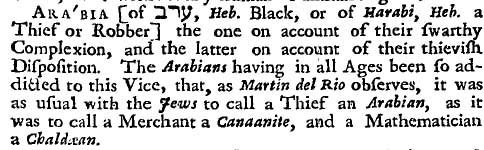
No comment.

Okay, one comment: I've seen some speculation that ערב is the same root as עבר with some natural letter transposition. In other words, think of Arabs as Herbews. Maybe.

4.
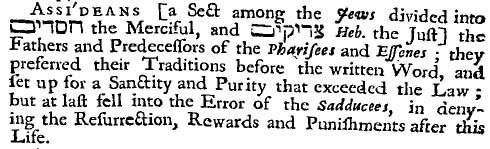
This word seemed interesting in its own right. Before the OED (Oxford English Dictionary) no serious attempt to catlogue every word in the English language was made. The task was too herculean to contemplate (see Simon Winchester's The Meaning of Everything for the ingenious solution the OED used to achieve the feat it did; which even then did not literally catalogue every word, and besides took almost 70 years to do it) . Bailey's dictionary, as others, were generally one-man attempts to catalogue as much as one could. Since they were not exhaustive, the words chosen do reveal some window into the worldview of the lexicographer as well as in some sense into the culture of the time. Words like this are included, as well as many, many other biblical allusions, Hebrew weights, ancient Near Eastern gods etc.

5.
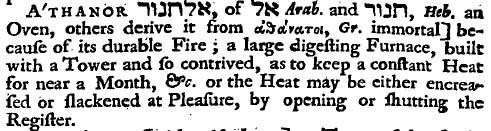
This word is pretty archaic, but according to the OED an athanor is "a digesting furnace used by the alchemists[...]" and made its way into English through Arabic (hence the "a-" prefix) but a tannur תנור should be pretty recognizable to anyone who learns Talmud, or a six year old who learns Mishna (e.g, Akhnai's Oven (תנורו של עכנאי).

6.

Fun archaic word. I doubt that "cock-loft" is from גג. Call me a cynic.

7.
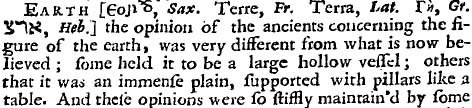
This one is a bit predictable, and interesting also because as far as I can tell a ד should be able to switch to a צ (shouldn't it?). But, alas, the English word "earth" didn't form fully from a Hebrew womb, but comes from a common Old German word. Biblical influences on English are very plausible. Biblical influences on ancient Teutons are less so. Edenics aren't my cup of ch'a.

8.

This one was chiefly interesting to me because I learned that the word comes from the coin it cost to read the newspaper. It would be as if many newspapers were called dimes or whatever they originally cost. The Daily Dime sounds nice.

9.

I think this etymology is a Bailey original. OED and the Online Etymology Dictionary basically have no clue where this one comes from, except that it shows up around 1300. Hebraism in England had already begun by that date, so I leave open the window about a millimeter on this one. If no one knows, then who knows?

10.

One of the many words which are English but are actually Hebrew, thanks to the Bible. Of interest is that its meaning reflects some of the debates in biblical scholarship of the day.

11.
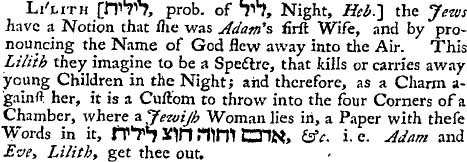
Outsider perception is always interesting.
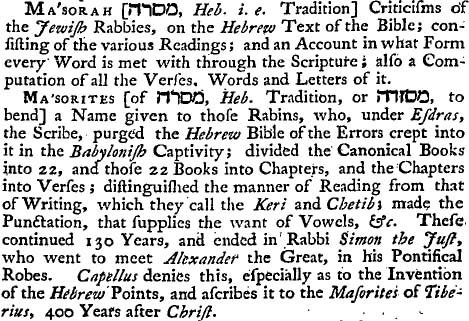

12.
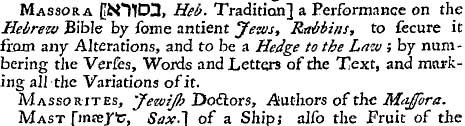
This reflects the debate which raged for a couple of centuries on the origin and authority of the nekkudot (see here and here). Bailey seems to favor the view that they were originated by Ezra (and in so doing indicates his more traditionalist bent), but is gracious enough to mention the other view.

13.

I have no idea if there is any relationship between the Greek and Semitic סתר, but I suppose its possible. After all, those two regions were only a sea away, and the two language groups did influence each other.

14.

This one is great!

To clarify, Nisan is the first month of the Jewish calendar and correlates, roughly, with April. However, the Jewish New Year is in the seventh month, Tishrei (don't ask! ;) ). Presumably Bailey knew that Nisan is the first month and knew of Rosh Hashanah in the seventh month. As there is no entry for Tishrei, he must have figured that Nisan is the seventh month in which the New Year occurs.

15.

Fanciful, but fun.

16.

This one is really something. I think there are parallels for such etymologies in rabbinic literature, although I can't offer an example at the moment.

17.

Sign of the times. Deism and free-thinking enjoyed a particularly good reputation in the 18th century, thus projecting themselves onto the ancient Sadducees.

Thursday, August 31, 2006

Only Nixon can go to China, or, it Takes a Hassid to Attribute Post-Mosaic Authorship in the Torah

In this Hirhurim thread an interesting discussion ensued about the case of post-Mosaic attribution to bits of the Torah by a prophet in a manuscript of R. Yehuda Ha-hassid (let it be mentioned that R. Moshe Feinstein's view was that this was an interpolation by an erring student).

Naturally this discussion also dealt with the question of 'Ibn 'Ezra and post-Mosaic authorship and the possibility that R. Yehuda Ha-assid was influenced by him. Be that as it may, one distinguished commenter noticed that the Abenezra felt this idea needed to be kept secret while hakhmei Ashkenaz did not and asked why not.

I mused that, according to the stereotype, there was far more piety and orthodoxy in Ashkenaz and its environs than Sepharad (not to mention more Karaism). Is it possible that, paradoxically, this "frummer" environment made it possible to say some seemingly radical things?

Let me explain: we know of tales like the Berditchiver "suing" God due to persecution of Jews. Whatever Litvaks think of such a story, I would bet that people who don't bat an eyelash by it would be pretty upset if Eric Yoffie sued God.

Sort of a medieval version of "only Nixon can go to China.
"

Fleshing out this thought further, maybe somehow the quote-unquote more orthodox environment of Ashkenaz lent itself to occasional lapses into unorthodoxy that went unnoticed, maybe because there was a perception that "everyone is 'frum,'" certainly someone called a Hasid!

I will say that in my experience in very Orthodox environments there isn't always the self awareness to notice departures from what should, in theory, be orthodoxy (and in other environments too!). For example, I once heard a shiur by a very popular rabbi about Metatron and how he was Enoch turned into an angel and so holy is he that one cannot even say his name; you have to say Metat!

It seemed to me, even being somewhat aware of the pedigree of the Metatron idea in Judaism, that something should have struck people as funny about a person becoming an angel and you can't even say his name, even though it is "in seforim." Is there anyone besides God whose name one doesn't say? You'd think it would strike people as odd, including the maggid shiur, but evidently it didn't, or didn't seem to raise such questions.

Maybe this is a similar phenomenon: in Ashkenaz such lapses may not have always been noticed, strange as that would seem. Of course I'm also positing that R. Yehuda Ha-hasid himself would not have been aware that what he was saying was really radical and would probably get you tarred and feathered if 1) someone else had said it and certainly 2) said it in Sepharad. Maybe.

Hebrew colors

Balashon - Hebrew Language Detective has a great series on colors.

Red, orange, yellow, blue, violet, green, brown, black and white.

Tuesday, August 29, 2006

A communication between Cassuto and Kahle about the Aleppo Codex

Aleppo Codex enthusiasts will be interested in this short letter Moshe David (Umberto) Cassuto[1] sent Paul Kahle, printed in Kahle's 1953 review article The New Hebrew Bible, Jerusalem 1953 in Vetus Testamentum, Vol. 3, Fasc. 4. (Oct., 1953), pp. 416-420. (orig. in Italian, trans. by Kahle).

For those who are not yet enthusiasts there will be some brief background toward the end of the post[2]:

The Aleppo manuscript, however, destroyed by vandal barbarians, if the accounts given in the press are true[3], was examined by me at length during a visit which I paid to Aleppo for the purpose four years ago. Direct examination of the codex aroused great doubts about its identification with the codex which was in the hands of Maimonides. This tradition which you regard as indubitable (emph. mine) is certainly very old, but it is not proved, and there are some reasons to query it. That the codex used by Maimonides is that of which the part containing the Prophets is preserved to day at Cairo, is mentioned only in a tentative way in the prospectus attached to the edition of Jonah (ie, in the 1953 Hebrew University Bible), and is not more than a conjecture. All the same, the reasons which you advance to the contrary are not so strong as to exclude this possibility.

...Of the Codices of Cairo, London and Leningrad I have with me complete photographs, and of that of Aleppo as much as I could copy at the place. I am the only modern scholar who has succeeded in obtaining (and with how great and how many difficulties!) permission to study at leisure this codex. In spite of all my efforts I could not obtain permission to photograph it, because the leaders of the community at Aleppo were convinced that they would have been exposed to all the curses written in the codex
[4]. Naturally it is impossible to overcome such a superstition coupled with the fear of death. Not even the danger of the destruction of the codex, which had been foreseeable for some time, and which I put before the leaders of the Community, was sufficient to convince them of the usefulness of a photgraph. For them the codex was a sort of palladium which protected them and did not need to be protected. In their eyes it was something sacrosanct, rich in thaumaturgic value, which a photograph would have profaned and for which no photograph would have been able to provide a substitute.

[1]Here is a photo of Cassuto:


[2]Brief background promised, now less brief then I intended:

The Aleppo Codex (כתר ארם צובא) was the possession of the Jewish community of Aleppo, Syria for centuries. It was regarded as a treasure, which is why it was called by them The Crown; הכתר or 'el-Taj. By tradition it was regarded as having been written (or rather vocalized) by the greatest Masorete, 'Aharon (ben Moshe) ben 'Asher, which is what a colophon page in the book claimed. Furthermore, it was believed that this was the very book which the Rambam consulted in writing his own sepher Torah, as recounted in Mishne Torah Hilkhot Sepher Torah 8:5.

Now there is nothing wrong with such a tradition--especially considering that this turned out to be perfectly genuine--aside for the fact that such traditions are often faulty (and such colophons are often written by later hands). Given this, the fact that this particular great Bible codex was 1) written by this ben 'Asher and 2) the one the Rambam consulted in Egypt was not established. Proof would be needed.

Although for centuries various Jewish communities had been sending representatives to consult the codex, it was not (in theory) until the 1940s when permission was granted to a modern Bible scholar, Professor Rabbi Umberto Cassuto, that the codex could be examined with, as parts of its goal, an eye toward determining if this really was the codex the Rambam used. As one can see in the letter to Kahle, it was not easy to get permission to view it and he was forbidden from having it photographed. Be that as it may, he spent many hours with it (around 24 in total) and took extensive notes. He returned to Jerusalem with a verdict: this is not the codex the Rambam used. This opinion of his was reflected in the letter above; he told Kahle he is wrong for thinking it is that same codex.

In any case, he never got the chance to publish his reasons why he was sure it was not the right codex although it was known that one of the reasons was because the AC didn't match the Rambam's description.

Although there is a more extensive history, suffice it to say that the first convincing rebuttal of Cassuto's formidable opinion came in 1960 in the first issue of the Hebrew University Bible Project's annual journal Textus. M.H. Goshen-Gottstein pointed out that Cassuto probably objected to the following facts:

1) In the Mishne Torah the Rambam says that the shirah of parashat ha'azinu must be written on 70 lines in a Torah (fully in accord with massekhet sopherim, I believe, sorry no cite at the moment).
2) In the Aleppo Codex this is written on 67 lines.

This would seem reason enough to conclude that this wasn't then the codex used by the Rambam, even with the long tradition.

However, pointed out eagle-eyed Goshen-Gottstein, there is a mistake. It says 70 lines in all printed editions of the Rambam. What about old manuscripts? Sure enough, in the most authoritative manuscript of the Mishne Torah (in Oxford's Bodleian Library, the Huntington 80 mss) it says 67 lines, not 70. (Why is this the most authoritative manuscript? Because this appears in it.

Of course there are other reasons why this has to be the right codex. It matches every description of the codex through every century. Long story short, this is the one. Although there is some question whether this is really the best masoretic manuscript there ever was, there is no question that it is the most accurate extant, in the sense that it agrees with itself in a way that no other masoretic manuscript comes close. In other words, there is a good reason it had the excellent reputation it had, which is why the Rambam used it.

[3]Obviously these early reports were not true; even though the synagogue in Aleppo was in flame, about 2/3rd of the AC survived and was smuggled into Israel in 1958. Many regard the other third, including most of the Torah, as missing rather than destroyed since at least one missing leaf has turned up since and the AC does not appear to have been touched by fire at all.

[4] Presumably to those who remove it from its location. Such blessings and curses are common in massoretic codices. Although I don't have the text of the one in the AC handy, Paul Kahle (Cairo Geniza pp.112-115) reproduced the text in the colophons of the Codex Cairensis (Cairo Codex), which was written by Moshe ben 'Asher, the father of the AC's masorete 'Aharon ben 'Asher. Here is a sample (there is an earlier introduction by Moshe ben 'Asher, praising and blessing the owner of the codex; presumably he paid big $$ to have it written, one Ya'abes ben Shelomo. In addition, there are other paragraphs added long after Moshe ben 'Asher's time. I am assuming that such an introduction as the one here is also in the AC; I don't know for sure, I only know that the AC has (or rather had) one:

אני משה בן אשר כתבתי זה המחזור שלמקרא על פי כיד אלהי הטובה עלי באר היטב במדינת מעזיה טבריה העיר ההוללה כשהבינו עדת נביאים בחורי יי קדושי אלהינו המבינים כל נסתרות והמשפירים סוד חכמה אילי הצדק אנשי אמנה לא כיחדו דבר ממה שניתן להם ולא הוסיפו מאמר על מה שנימסר להם והעצימו והגדילו המק' עשרים וארבעה ספרים וייסדום באמונתם בטאמי שכל בפירוש דיבור בחיך מתוק ביופי מאמר יהי רצון מלפני יוצרנו שיאיר עינינו ויגיה לבנו בתורתו ללמד וללמד ולעשות בלב שלם ובנפש חפצה ולכל ישראל אמן

נכתב לקץ שמונה מאות שנה ועשרים ושבע שנים לחורבן הבית שני שיאמר יוצר נשמות וישוב עליו ברחמים ויבנהו באבני אקדח וספיר וכדכד בנין שלם בנין מקויים בנין שלא ינתש ולא יהרס ולא ינתץ לעולם ולעולמי עולמים במהרה בימינו ובימי כל ישראל אמן

וכל המשנה מן המחזור הזה או מן הנשתון הזה דבר או מוחק ממנו אות או קורע ממנו דף אלא אם צן יבין וידע שיש בו דבר ששגינו בו בכתב או בניקוד או במסרת או בחסר או ביתר אל יהי לו לא מחילה ולא סליחה ואל יחזה בנעם יי ולא יראה בטוב הצפון ליריאיו ויהיה כעשה נדה וכמצורע מוסגר כתת אבריו ולשבור גאון עזו ולכלות בשרו מראי ולשפות עצמותיו שלא יראו אמן

הקורא ישמע והשמע יבין והראה ישכיל שלום


I, Moshe b. Asher, have written this Mahzor of the Scriptures, according to 'the good hand of my God upon me' (Neh. 2.8), 'very plainly' (Deut. 27.8), in the city of Ma'azya Tabariyya, 'the renowned city' (Ezek. 26.17), as it was understood by the congregation of the Prophets, the chosen of the Lord, the Saints of our God, who understood all the hidden things and embellished the secret of wisdom, the chiefs of righteousness, the men of faith. They have not concealed anytihg of what was given to them, and they have not added a word to what was transmitted to them, and they have strengthened and made mighty the Scriptures, the Twenty-Four Books, and they have established them in their integrity, with explanatory accents, with a commentary of pronunciation, with sweet palate and beauty of speech--may it be the will of our creator to enlighten our eyes, and to illuminate our heart in His Tora, to learn and to teach and to act 'with a perfect heart and with a willing mind' (1 Chron. 28.9)--and for all Israel! Amen.

It was written at the end of the year 827 after the destruction of the Second Temple, about which may the Fashioner of souls ordain, and may he return to it in compassion, and may he build it with rubies and sapphires and carbuncles (Isa. 54. 11, 12) as a perfect building, as a well-established building, a building which shall neither be plucked up, nor demolished, nor destroyed, for ever and for ever and ever, speedily, in our days, and in the days of all ISrael. Amen!

Whoever alters a word of this Mahzor or of this writing, or erases from it a letter, or tears off from it a leaf--except that he understands and know that there is in it a word in which we have erred, in writing, or in punctuation, or in Masorah, or in defective or in plene, let him not have pardon or forgiveness, neither let him behold the beauty of the Lord (Ps. 27.4), nor let him see the good that is reserved for those who fear him (Jer. 29.32) He shall be like a woman in impurity, and like a leprous man who has to be locked up, so that his limbs may be crushed, the pride of his power be broken, his flesh be consumed away that it cannot be seen, and his bones that are not seen stick out (Job 33.21). Amen.

Whoever reads shall hear, whoever hears shall understand, whoever sees shall perceive. Peace!

Thursday, August 24, 2006

Nehama Leibowitz on why she accepts truth from whoever says it

This interesting thread on Hirhurim led to a mention of a letter written by Nehama Leibowitz on the theme of accepting the truth from those who speak the truth. That letter was translated by Avidan Freedman in YCT's journal Milin Havivin vol i. Although I admit that I have no authority to do so, here is the letter, as well as a PDF of the article itself (as opposed to the entire journal, which you can also download by clicking the link above). I will remove it if the proper authority should ask me to.

Note the references to Benno Jacob, Martin Buber, Umberto Cassutto etc.


(all these can be enlarged by clicking on them.)

When in doubt, go Ashkenaz

Tuesday, August 22, 2006

Shadal's 10 Principles for commenting on Tanakh part I

I recently came across a wonderful piece by Shadal from his introduction to ספר ישעיה, his ten principles for parshanut ha-miqra (interpreting Scripture).

They are:
  1. Believe in God as creator *
  2. Believe in the divine providence of reward and punishment *
  3. Believe in miracles and prophecy *
  4. Dedicate oneself to the true interpretation of the text rather than reading in your worldview onto it *
  5. Put oneself back in time in order to understand Tanakh in the context in which it was understood by its original biblical audience *
  6. Be fluent in reading and writing Hebrew and ancient Jewish texts *
  7. Be expert in the טעמי המקרא, (cantillation) and know how to derive meaning from them *
  8. Have or nurture a poetic spirit in order to understand biblical poetry *
  9. The explanation of חז"ל might not be the פשט *
  10. The ספרי הקודש were always faithfully guarded and maintained *
(each asterisk links to an image of the text.)

This is a very interesting and wonderful list. Of course my short summary is only that. At this time I have not prepared a translation of his principles, but a better summary can be read here (click for easier reading) :


(from Samuel David Luzzatto as Exegete by Israel Abrahams in JQR 57:2 (Oct. 1966)

Some are rather straightforward but some need additional explanation and background. For example, the fifth יסוד seems to be identical to the historical-critical method, but it is not, because Shadal accepted upon himself dogmatic constraints. Furthermore, what reasonably seemed to be in no way reading into texts in the 19th century might very well be considered to be that today and that ought to be kept in mind.

The tenth is open to question since there is a minimalist and maximalist interpretation of that idea expecially given Shadal's own practices one must wonder what he meant by that.

I intend to explore some of the principles as well as seeming contradictions in Shadal in the next post, Part II.

Sunday, August 06, 2006

Now that the UOJ cat is out of the bag...

Hm. I don't know what to think.

I guess these thoughts come to mind.

1) He wasn't kidding about his family
2) There's no such thing as being anonymous online
3) The one thing he accomplished, which seems credible, would never have been accomplished otherwise
4) There seems to be some poetic justice here
5) But this should not in any wise take away from the real issue he called attention to
6) It probably will anyway

How did Rava pronounce Hebrew? II

In this post I brought probable proof that Rava either did not know that the letter ב has a hard and soft pronunciation, meaning that it did not yet have the dual pronunciation of /b/ and /v/ or if he did then the difference to him was far slighter than the /b/ /v/ difference to us. Perhaps this would be akin to the difference between a properly pronounced ח and ה (/h/ and /h/) which is slighter than the difference between a כ and ה (/kh/ and /h/). Of course the difference between the two kinds of bets might have been even smaller.

However in the comments Steg and especially Kylopod argued that this needn't be the case at all.

I am not yet convinced they are right, but they argued it well enough that it deserves mentioning as a third possibility, which is this:

Even if the distinction had been fairly wide it is possible that Rava was unaware of it even though he naturally made a distinction himself. Not only that, the distinction may have been our own /b/ /v/.

Let's explain. First, we are obviouyly assuming that at that time the dagesh notation didn't yet exist, which means that there was only one way to write a ב. The question is only if there were two kinds of בs as there are now, one we write with a dot and one without, but they wrote them both as ב, yet pronouncing them two ways--perhaps /b/ and /v/.

The point is that most people are unaware of the actual sounds in their language because written language is a particularly poor way to capture the sounds of spoken language. The example Kylopod gave, which I've seen elsewhere is the /s/ sound in the word dogs. Most people are unaware until it is pointed out to them that the /s/ in dogs sounds like /z/. It is certainly different from the /s/ sound in snake.

Suppose there were no letter z at all, but the s in dogs still sounded like /z/. Most people wouldn't realize that there is a sound they make which can't be written. An example of this would be the /zh/ sound in vision. Now, it is true that by writing /zh/ you probably know what I mean, but strictly speaking that sound (written as /j/ in French, as in deja vu) has no English equivalent. As a sound it exists in English, obviously, but is written with an s (vision, lesion &c).

What am I getting at?

It's possible that at the historical stage of the game where Rava was that the ב already had a dual pronunciation which was influenced by the surrounding vowels, much as our own is. Yet Rava need not have been particularly aware of it. In fact it wasn't until linguists examined the language that it was noticed. These linguists mapped out the language and they were the ones who added nekudot, including the dagesh, to mark the discoveries they made about Hebrew. It would be like a contemporary linguist first noticing that sometimes an s is pronounced like it is in hiss, sometimes as a z as in dogs and sometimes like zh as in vision.

Before anyone protests that 1) Rava certainly was an expert in Hebrew and 2) how could he have not noticed what is so obvious to us, let me point out two things:

One could certainly imagine someone saying "Don't slur the words dog's sled together," even though we are talking about the /z/ /s/ sound and not an /s/ /s/.

What is obvious is not obvious until it is discovered. I assume most people who are aware of the triliteral root theory of Hebrew think it is obvious, but it wasn't discovered until about a thousand years ago.

All in all Rava may have cautioned against slurring the words esev besadecha together thinking that the ב sound was the same at the end of the first word and beginning of the second even though it wasn't.

On the other hand he may have been fully aware that they had two separate sounds, but lacking the visual cue from the dagesh had not been predisposed, as we are, to almost think of the ב as two separate letters.

In short, this example needn't be the historical linguistic clue that it would be so cool if it was.

Did the NY Times ever say Jews shave with a ram's horn?

There is a discussion in an email list about an urban legend that the New York Times once reported that Orthodox Jews shave with a ram's horn. (Need I say they don't?) Someone conjectured that this happened because a reporter asked an Orthodox Jew with an accent how he shaved and he answer "Wit ah shafer." The reporter, not realizing that he was told "with a shaver" asked someone else "Do you have any idea what a Jewish ritual item that sounds something like "shafer" is?" and of course the person told him that it's a ram's horn. (Get it? Shafer = shofer. Who knows, maybe the reporter asked a Litvak.)

Anyway, this is an urban legend since no one seems to have actually seen the ram's horn story. But there is the following from December 24, 1922 which might have been the source of it. Note "removed with bone knife":


Here is the entire article.

Wednesday, August 02, 2006

9 Av

Ketav `ivri in municipal emblems

Hat-tip to Jeff for pointing out that the municipal emblem of Nahariya has ketav 'ivri, paleo-Hebrew writing on it.


It says ברוך מבנים אשר which is a quote from Deut. 33:24.

Here is an explanation of the symbol.

How did Rava pronounce Hebrew?

The Gemara Berakhot 15b discusses the requirement to enunciate words carefully when reciting qeriat shema. In doing so we are unwittingly given some interesting linguistic evidence about Hebrew pronunciation at the time of the 'amora Rava (3rd-4th c.).

To whit:

תני רב עובדיה קמיה דרבא ולמדתם שיהא למודך תם שיתן ריוח בין הדבקים עני רבא בתריה כגון על לבבך על לבבכם בכל לבבך בכל לבבכם עשב בשדך ואבדתם מהרה הכנף פתיל אתכם מארץ

R. Obadiah recited in the presence of Raba: 'And ye shall teach them': as much as to say thy teaching must be faultless by making a pause 'between the joints'. For instance, said Raba, supplementing his words 'Al lebabeka [upon thy heart], 'al lebabekem [upon your heart], Bekol lebabeka [with all thy heart], bekol lebabekem [with all your heart], 'esebh be-sadeka [grass in thy field], wa-'abaddetem meherah [and ye shall perish speedily], ha-kanaph pesil [the corner a thread], etthkem me-erez [you from the land]. (trans. Soncino)

The plain meaning is probably that all these words must be pronounced carefully, with a space between them, so that the words remain distinct from one another. After all, if you pronounce words that end and begin with the same sound it is easy to mash them into one word. The issue becomes even more acute when dealing with certain kind of words. For example, if one says אלקיכם אמת quickly one ends up with something like אלקיכמת, which can sound like אלקיכם מת--a definite no-no!

Therefore we must take extra care not to allow words which tend to combine into one from doing so.

Rava's eight paired examples are interesting.

They are
  1. 'Al lebabeka
  2. 'al lebabekem
  3. Bekol lebabeka
  4. bekol lebabekem
  5. 'esebh be-sadeka
  6. wa-'abaddetem meherah
  7. ha-kanaph pesil
  8. etthkem me-erez
The first four present no questions. L + L = LL. The 6th and 8th present no question. M + M = M & Ms MM.

But what exactly is the danger of the 5th and 7th? How can the sound of an undageshed bet slur into a dageshed one? (The v of 'voice' should't be able to slur into the b of 'boys.') And how can an undageshed peh slur into a dageshed one? (The f of feather shouldn't be able to slur into the the p of 'pleasant.')

Okay, obviously these sounds are related. In fact, the soft forms are the spirantization of the hard ones. When we wonder about a v and a b it isn't as if we are wondering about how a z and an l manage to slur into each other. Nevertheless it is clear that the relationship between Rava's pairs in his 6th and 8th example is different from the pairs in the other six, involving like ls and like ms.

So what gives?

The answer might well be as follows:
  1. For Rava there was no distinction between the bhet and bet.
  2. Or there was a slighter distinction than the one we know of.
  3. Or these words did not then have the distinction which appears in the later masoretic codices and indicated by a dagesh which would indicate that the underlying rules which establish when letters are pronounced hard or soft were not yet firmly established.
Source: Werner Weinberg 'Observations About the Pronunciation of Hebrew in Rabbinic Sources,' Hebrew Union College Annual Issue: 56 (1985) p.117

Is it possible that the same distinctions existed then?
Artscroll Gemara (Gittin 55b-56a in English)

Tuesday, August 01, 2006

What does maskilic mean?

An interesting comment thread developed around this post at Dan's Seforim blog, regarding a ban of R. Dov Eliach's iii volume biography of the Vilna Ga'on, הגאון, particularly the wording which considers the book to contain דברי המשכילים, so that it is maskilic in nature.

Since the book does nothing more than reproduce authentic texts I whimsically commented that as far as I can tell "maskilic" means the systematic use of primary sources critically examined, when they produce undesirable results. There isn't any falsehood in the book (barring, possibly, interpretation, which after all is a matter of interpetation). It compiles information that, presumably, produced an undesireable result.

With that in mind I thought of an interesting letter which appeared in the Journal of Halacha and Contemporary Society vol XV, pg. 120 (New York: 1988) (having read it recently).

The letter is from R. Dovid Cohen, who is well known and needs no introduction. It seems that he was responding to an article which appeared in vol XIV by R. Israel Poleyeff. In fairness I have not read that article, nor is the title of the article specified either by R. Cohen or R. Poleyeff in his response. After pointing out a few slight corrections in the nature of typos affecting footnotes and interesting info about an uncensored text, R. Cohen writes that
Historical and cultural context is Haskalic. Since one does not want to be Haskalic, R. Poleyeff replies that R. Cohen is right in surmising what the author intended to indicate, which is to say that "there was no intent to suggest that rabbinic views and halakhic decisions are influenced by environmental factors."

Of course R. Poleyeff does say that they he does not agree that this is the case, and R. Cohen calls it a mistaken impression, implying it is to make a Haskalic comment. Interestingly enough, later in the letter R. Cohen cites Jacob Katz's Exclusiveness and Toleration on the Me'iri.

This brings me back full circle: haskalah is a dirty word because it produces unwanted results.

(As I prepared to push the PUBLISH POST button it occurred to me that there is irony here in that this post does not give any historical context as to why words deriving from the root s-k-l are dirty. In my defense, I linked to Wikipedia. Do your own research. ;-) )
Mishmar.

Monday, July 31, 2006

What's peshat with the Peshitta II

Pt. I

Paleo Judaica links to an article on CBS11TV about the Peshitta (via Tyler Williams and Christian Brady. They all point out that it is not every day that the Peshitta makes the news, so to that extent it is a good day! But naturally the article is full of errors, including the entire baisc premise, which is that the New Testament was translated from Aramaic to Greek on specious grounds like the idea that "Neither Jesus, nor his immediate disciples, who were illiterate fishermen, nor his Galilean Followers, knew or spoke Greek."

One gaping flaw with the argument that the New Testament was originally the Peshitta is that it is written in an Aramaic dialect that was spoken way Northeast of ancient Galilee, which is why the idea that there is an Aramaic and a Syriac is justified (as opposed to just Aramaic, or Chaldaic or whatever)! Even if we grant the premise that they didn't know or speak Greek, they certainly didn't know or speak Syriac.

In any case, the Peshitta (פשיטתא in Hebrew characters) is an interesting topic. Although today it is the Bible of certain eastern churches, there is a theory (admitedly of unknown provenance to me) that the first part, the translation of Tanakh was originally a Jewish Targum. One theory is that it was prepared for the converts (in Adiabene in modern Kurdistan), of whom הילני המלכה and her son מונבז המלך are well known to anyone who learns Gemara, eg., Gittin 60, Sukkah 3, Nazir 19).

In Hebrew letters the פשיטתא begins like this:

ברשית ברא אלהא ית שמיא וית ארעא

Compare with 'Onqelos:

בקדמין ברא יקוק ית שמיא וית ארעא

and with Yonathan:

מן אוולא ברא אלהים ית שמייא וית ארעא

Not radically different, but sometimes the differences are very acute. Sometimes the Peshitta also translates names into Syriac, while 'Onqelos and Yonathan generally retain the Hebrew names.

Thus, in the Peshitta משה is מושא and ישראל is איסריל etc.

Friday, July 28, 2006

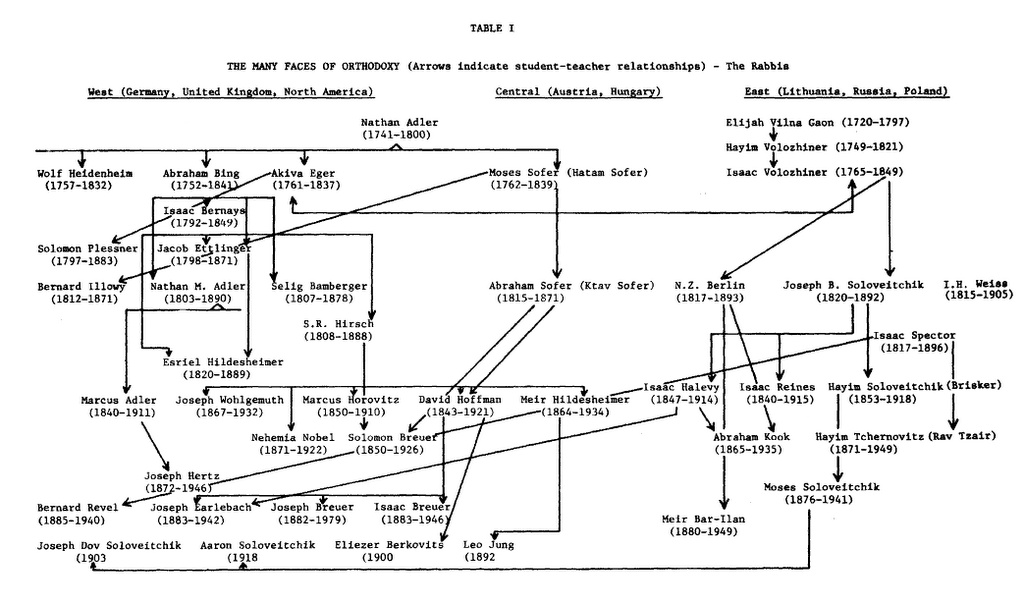
19th-20th c. E & W European rabbi-student chart

(How's that for an elegant post title?)

Here is an interesting chart (click to enlarge).


From Samuel C. Heilman Modern Judaism, Vol. 2, No. 1. (Feb., 1982), pp. 23-51.

Thursday, July 27, 2006

Newly published 2nd volume Writings of the Wuerzberger Rav

Just passing this along.

===================

Announcing publication of "Kisvey Rabbeinu Yitzchak Dov Halevi
Me-Wuerzburg" (Volume 2) based on newly discovered manuscripts of
Rabbi Seligman Baer Bamberger of Wuerzburg (1807 - 1878) "The Wuerzburger Rav".

The present volume is divided into six sections and includes Rav
Bamberger's novellae on Talmud (Babylonia) , Mikvaoth (Ritual Baths)
, "Koreh B'emmeth" explanations on "Al Tikris" in Talmud and
commentaries, also letters and correspondence of the Rabbi, his sons,
Rabbinic contemporaries and his disciples.

A few copies of volume I is also available.

To order send $ 35.00/each ppd to:
Rabbi B. Bamberger
109 West Penn Street
Long Beach, NY 11561-4040

BAMBERGER FAMILY LIBRARY

Greek in Targum Yonathan

In June someone posted the following question to the Avodah mail list:
In last week's parsha [Behaaloscho 11:26] Targum Yonoson has a lengthy
version on the Eldad uMeidad prophecies, including details of Achris
Hayomim and Milchemes Gog uMagog in EY [see also Targum Yerushalmi],
with the situation saved by Kiris.

Does anyone have any idea who Kiris is?
Either no one knew the answer or no one noticed the question, because it was only answered two days ago by Yisrael Dubitsky, who points out what I will mention after posting the relevent passage.

יונתן במדבר יא:כו הא סלוי סלקין מן ימא וחפיין כל משריתא דישראל ויהוי לעמא לתוקלא ברם תריהון כחדא מתנבין ואמרין הא מלכא סליק מן ארעא דמגוג בסופ יומיא ומכנש מלכין קטרי תגין ואפרכין לובשי שריונין וכל עממיא ישתמעון ליה ומסדרין קרבא בארעא דישראל על בני גלותא ברם קיריס איטימוס להון בשעת אניקין ומקטל כלהון ביקידת נשמתא בשלהובית אשתא מתחות כורסי יקרא ונפלין פגריהון על טווריא דארעא דישראל וייתון כל חיות ברא וציפרי שמיא וייכלון קושמיהון ומבתר כדין ייחון כל מתיא דישראל ויתפנקון מן טוורא דאצטנע להון מן שירויא ויקבלון אגר עובדיהון

The 1862 English translation of Targum Yonathan by John Wesley Etheridge renders this passage as follows:
Medad prophesied, and said: Behold, quails come up from the sea, and cover all the camp of Israel; but they will be to the people (a cause of) an offence. And both of them prophesied together, and said: Behold, a king will arise from the land of Magog, at the end of the days, and will assemble kings crowned with crowns, and captains wearing armour, and him will all nations obey. And they will set battle in array in the land of Israel against the children of the captivity; but already is it provided that in the hour of distresses all of them shall perish by the burning blast of the flame that cometh forth from beneath the Throne of Glory; and their carcases shall fall upon the mountains of the land of Israel, and the wild beasts of the field and the fowls of the sky shall come and consume their dead bodies. And afterward will all the dead of Israel live (again), and be feasted from the ox which hath been set apart for them from the beginning, and they shall receive the reward of their works.
This is in general a sufficient translation, however Etheridge missed the boat on our word kiris, kind of sort of skipping it (but not the word after it).

As Yisrael Dubitsky pointed out kiris, קיריס, is Greek. It is the word which is means lord and is used as the Greek equivalent of adonay in place of the tetragrammaton. If each letter was changed to English it would be kyrios, but it is actually spelled kurios in the Latin alphabet. Dubitsky cites five additional cases where Targum Yonathan uses קיריס (Teh. 53:1, 97:10, 114:7; Iy. 3:19, 5:2).

As for the second word etimos, איטימוס, it is obviously also Greek. Although my Greek is better than my Mandarin, its worse than my Aramaic. So while I strongly suspect that the spelling is incorrect it will have to do.

It means near or ready or present and is used in the Septuagint in place of the Hebrew נכון.

So the correct translation of קיריס איטימוס means something like "God is near" or "ready."

Of course the question why Targum Yonathan says God is near in Greek obviously follows.

I don't know. But to take a page from R. Saul Lieberman, "almost every foreign word in rabbinic literature are quotations." (S. Lieberman, Greek In Jewish Palestine, NY 1942, p.6.)

If so it is possible that the expression קיריס איטימוס was somehow meaningful in the time and place of the composition of Targum Yonathan. Your homework: tell me how and why. ;)

Tuesday, July 25, 2006

Shadal on his father and kabbalah

In Shadal's autobiography the following interesting paragraph appears (translation into English courtesy of R. Sabato Morais from The Jewish Record, Philadelphia, Aug. 3, -Oct. 26, 1877):
Before my father had given up his Cabbalistic notions, he invented a very singular method for explaining the text of the Pentateuch, which we occasionally read together for our mutual edification. The first twenty-five chapters of Genesis contain, on each sentence, a number of remarks of a mystic nature, accompanied with a corresponding number of elucidations. I present here some illustrations of the queer system chosen. My parent would reckon how many times the letter "Aleph" was found in the same verse; how many times "beth," then the "Gimel," and so on. Having done that, he would arrange such letters this way. The one which occurred oftener than the rest, was placed first in rank, that which happened with less frequency next, ending with that which was met only once. Setting them all in array, according to alphabetical order, my father would then proceed in coining novel words. But as the fantastic plan did not produce words to which any sense might be attached, he tried by having recourse to the rules of permutation, to make what was devoid of meaning, convey new ideas. I myself filled many a sheet of paper with these monstrosities, not because I believed in mysterious interpretations, but because I wished to spare my parent the hard labor of finding out what he eagerly sought after. At length the author of that odd system of exegesis, recognized its groundlessness and drew two perpendicular lines across his magical notes.*

*(Trans. footnote) In a Hebrew manuscript, which _____ had forwarded, our autobiography illustrates the results of his father's method by quoting words forced to signify what bears no analogy whatever with the original. For instance, by exchanging one letter for another, the sentence "In the beginning God created the heavens and the earth." was made to foretell that "instead of a righteous son, (Isaac) a ram would (in future) be offered."


The footnote goes on to explain that by "permutation" is meant the system of at-bash (only calling it "temurah"), and discusses the famous "sheshech"and "Lev Kami" in Jer. 51.

You can download his ויכוח על חכמת הקבלה.

Torah TrueTM

There is an interesting footnote in Haym Soloveitchik's (seemingly) famous article Rupture and Reconstruction: The Transformation of Contemporary Orthodoxy Tradition, Vol. 28, No. 4 (Summer 1994).
...“Torah-true.”...86

86 This was a creative mistranslation of the German "Thoratreu" (faithful to the Torah), used by the neo-Orthodoxy of Germany. It was first used by modern Orthodoxy but subsequently attained far greater currency among, what is called, right-wing (though not haredi) Orthodoxy. See Jenna W. Joselit, New York's Jewish Jews: The Orthodox Community in the Interwar Years (Bloomington: Indiana University Press, 1990), p. 4.
I know the latter point (that it "was first used by modern Orthodoxy," e.g., it is a ubiquitous phrase found in the writings from the 1930s by rabbis like Leo Jung). What I did not know what its origin in German neo-Orthodoxy, "thoratreu." I guess I always assumed it stemmed from the expression תורת אמת. Of course, it might have anyway.

Monday, July 24, 2006

Geniza research by the Seridei 'Esh and Paul Kahle in 1935

I thought it might be interesting to provide the following article:

Kahle, Paul; Weinberg, Jechiel The Mishna text in Babylonia, fragments from the Geniza. Hebrew Union College Annual 10 (1935), p. 185-223:


"J. Weinberg" is, of course, R. Yechiel Yaakov Weinberg, author of the שו"ת שרידי אש, Seridei 'Esh .

(A brief sketch by Dayan Dr. I. Grunfeld which appeared in the Jewish Observer can be found here, an article in the Edah Journal by Dr. Marc B. Shapiro here.)

The entire HUCA article can be downloaded here.

Now, although it is evident that this article was based on the joint research of Dr. Paul Kahle and R. Weinberg, I wondered at the latter's involvement in the publication of this article. After all, throughout it is the voice of Paul Kahle speaking. ("I have decided to publish as much of this Babylonian material as can be read with certainty. I shall publish these Fragments together with Dr. J. Weinberg, Docent in the Berlin Rabbinical Seminiary; we have divided the work so that I shall deal with the philological publication of the text whilst he, in special investigations, will show the importance of these texts for the history of the Mishna text.")

So I asked someone who knows and was told that as I surmised, it was Kahle who authored the article, but as can be seen from the excerpt I quoted the intention was for the Seridei 'Esh to write the follow-up (and you can download it to read it all in context). In addition, R. Weinberg referred to himself as an author of this essay.

Said person who knows also pointed out a specific example of the Seridei 'Esh's fingerprints on this article, in footnote 10 on page 218 (34 in the PDF) with the reference to the תוספות יום טוב, which is almost certainly a contribution by R. Weinberg.

Since the article is very technical and I know some readers won't download it, here is an image of part of the meat and potatos of the article:

Thursday, July 20, 2006

On Chabad, 1826

Quite by accident I came across this interesting reference to Chabad Chassidim in an 1834 article. The publication was called The Biblical Repository, founded by Edward Robinson.

The article, from the October 1834 issue, is called The Karaites, and other Jewish sects and contains material from a book called Biblical Researches and Travels in Russia (London, 1826) by Ebenezer Henderson.

He informs the reader that
"The most popular sect among the Jews, is that known by the name of Rabbinists, or Talmudists, i.e. such as yielf implicit obedience to the doctrines and institutions of the Rabbins, as delivered in, or deducible from the Talmud, and who, according to the general acceptation of the term, may be accounted the orthodox....They are precisely, in the present day, what the Pharisees were in the time of our Lord....But although the Rabbinists compose the great body of Jews in Poland, there exist other denominations, the numbers and pecularities of which are too considerable not to strike the inqisitive traveller.

These are the Karaites, the Chasidism, and the Zoharites, or followers of Sabbathai Tzevi."
After describing a version of the history of Chasiddus, he writes


I think it would be interesting to trace the earliest English language reference to Chassidus that there is. I'm on it.

When the Rav isn't the Rav


This advertisement appeared in Yated Ne'eman last week.

Why is there only one word in Hebrew in this ad (רע 'ב)?

To avoid ambiguity, I suppose. Without it it would have read "Every volume contains the complete Rav commentary in Hebrew."

;)

Wednesday, July 19, 2006

For all you 'aleph-bet/ 'aliph-ba' lovers out there


(click to enlarge)

Here's something nice. Its described here as
MANUSCRIPT, Hebrew & Arabic. Miscellany of Hebrew and Arabic stories and poetry from North Africa, 18th - 19th centuries. • C. 145 fols, 206 x 148 mm in various mashait and cursive hands: first 2 (?) leaves missing. With ownership entry in French of Salomon Cabessa, Oran, dated 1851. A well-preserved manuscript, rebound in an 18th century blind-stamped leather over wood binding (spine and corners repaired), possibly of local origin.
Unfortunately it is sold. :(

As you can see, it is written in a beautiful Hebrew Sephardic (so-called Rashi) cursive script that to me resembles Arabic.

Monday, July 17, 2006

Geniza amidah

Interesting post here, shows the following chart comparing parts of the present Ashkenazi nussach of the shemonah esrei with a nussach from the Cairo Geniza:The chart comes from info in Yosef Heinemann's ' התפילה בתקופת התנאים והאמוראים.'

Friday, July 14, 2006

Bandits, sons of bandits

I wasn't planning on posting anything about the current war (?). Current events aren't really what my blog is about. There are a lot of things I am deeply interested in and concerned with that I don't blog about, so this wasn't going to be exception.

But I am so mad that I must get this out.

Vatican condemns Israel for attacks on Lebanon
VATICAN CITY (Reuters) - The Vatican on Friday strongly deplored Israel's strikes on Lebanon, saying they were "an attack" on a sovereign and free nation.

Vatican Secretary of State Cardinal Angelo Sodano said Pope Benedict and his aides were very worried that the developments in the Middle East risked degenerating into "a conflict with international repercussions."

"In particular, the Holy See deplores right now the attack on Lebanon, a free and sovereign nation, and assures its closeness to these people who already have suffered so much to defend their independence," he told Vatican Radio.

Israel struck Beirut airport again on Friday and bombed Lebanese roads, power supplies and communication networks in a widening campaign after Hizbollah guerrillas seized two Israeli soldiers and killed eight.

Sodano said the Vatican condemned both "terroristic attacks" and military reprisals.

Hizbollah, which wants to trade its captives for prisoners held in Israel, has showered rockets across the frontier in its fiercest bombardment since 1996 when Israel launched a 17-day blitz against southern Lebanon and Hizbollah.

But Sodano reserved his harshest words for Israel.

"The right of defence on the part of a state does not exempt it from its responsibility to respect international law, particularly regarding the safeguarding of civilian populations," he said.
I am simply incensed at this malicious, hateful, spiteful, still corrupt entity known as the Vatican. Since you can't give us the lives of our antecedents back, give us our seforim and property back, you bandits, sons of bandits who suck the marrow out of the world.

I do apologize to any Catholics reading these words. I don't want to make anyone feel bad or attack something they hold dear. But this is too much.

Thursday, July 13, 2006

A young boy's experience with Nazi hatred of the Talmud

Great article in Yated R. Yosef Friedensohn about Nazis and sepharim and book burning. Read especially the last paragraph I quote here--but also read the first ones, and the whole article!
There was nothing there that should have interested them, and I was surprised to see them eye them with interest studying the Hebrew lettering on the backs of the seforim which they surely could not read. A few moments passed before one of them fixed his sight upon my father's new Vilna Shas which he had bought that summer. The outsized volumes must have aroused their curiosity, for suddenly, one of them removed one and shouted at me, "Come here, you!"

Terrified, I approached. "Can you read this?" he asked me.

I nodded affirmatively, stuttering the information that it was the Talmud.

At the sound of these words, both officers leaped back, as if they had been scalded with boiling water. The first one began screaming at the top of his lungs, his face crimson, his feet stomping the ground. He threw the volume to the ground, trampling it in rage. The two began removing all the volumes and throwing them violently to the ground and stamping on them with their hobnailed boots, attempting to rip them apart.

This activity did not satisfy their blood lust for when they saw that they could not tear them with their feet, they slung their bayonets off their shoulders and began puncturing them. The points and blades were very sharp and succeeded in ripping most of the volumes. But this did not yet assuage their rage for they took the remaining ones and flung them out the window down to the courtyard.

I don't recall how long this terrible scene played itself out, perhaps during the space of half-an-hour. When they finally tired of the exertion of piercing the texts and trampling them underfoot, they turned their attention to the smaller volumes in the bookcase. They selected the ones with the more ornate bindings which my father had purchased together with the Shas, a few weeks before the outbreak of the war.

To this day, I am baffled by the fact that they did not force me, a young lad standing by, to help them in their destructive project. Perhaps they wanted to reserve the pleasure all for themselves. At any rate, after having succeeded in emptying half of the bookcase of its contents, one of them shouted, "Enough for today."

They took a few volumes along with them, perhaps to boast to their friends and, with a vociferous promise of, "We'll be back!" they finally left.

...

Abba continued and said to me, "Why are you so surprised about the pogrom which they perpetrated on our seforim? You read newspapers I know, and you must be aware that the Nazis began their political career by burning books. Not only our seforim, but also those that downgrade war and praise peace. They despise them and torched them all, including their own revered classics. They cast them into huge bonfires and removed them all from their libraries.
While the Nazi persecution was on a much worse scale, I'm reminded of the papal decree banning the Talmud in the 1553. A later pope decided to reallow the Talmud in 1564 but required that the name Talmud not be printed on the books! The very word 'talmud' was like a red flag before an angry bull. Acceptable options included 'gemara,' 'shas,' and 'limud.' But definitely not 'talmud,' so hated was that word.

Edgar Allan Poe on a 17th of Tammuz story in Talmud Yerushalmi

Dan of Seforim postsan interesting find: an 1850 Edgar Allan Poe story A Tale of Jerusalem which is based on a Yerushalmi in Massekhet Taanit (4.5) regarding the suspension of the qorban tammid on the 17th of Tammuz.

Very interesting. What I wonder about is less how Poe came across this story and more about the date he used in it. The story begins "in the year of the world three thousand nine hundred and forty-one," which corresponds to the year 181 CE if we assume 2006 CE to be 'the year of the world five thousand seven hundred and sixty-six." Whenever the incident occurred, it was before 70 CE.

Did Poe make a mistake in not using the Jewish calendar or was he using some other calculation of a biblical calendar since creation?

EDIT: Aha! The solution is here. Nachum points out that the standard Christian date for creation if 4004 BCE.

That puts the story in 63 BCE, which is when Rome annexed Judea. I'm not sure why Poe placed the story then, but at least this date has some basis, rather than 181 CE.

Also, Poe puts the story on the 10th of Tammuz. So what we have, in effect, is a makhloket Edgar Allan Poe and a Yerushalmi. Poe puts the incident on 10 Tammuz in 63 BCE and the Yerushalmi records it as happening on 17 Tammus around the time of the hurban bayit more than a 130 years later.

Worst Vort of the Year

here

Wednesday, July 12, 2006

Klafter's 13 ikkarei hashkafa for the 21st century

Infrequent but great j-blog commenter Nachum Klafter posted his list of "13 ikkarei hashkafa* for the 21st century" at Hirhurim. He is obviously being somewhat tongue-in-cheek, writing, "I believe that anyone who does not master this list should have no chelek in Cyberspace." But I think that tongue is only somewhat in cheek.

It isn't necessarily my list, I don't endorse it or agree with each point, either in whole or in part, but it's a great list and bears repeating:
1. It is important to know the difference between a posuk and a medrash.
2. It is important to know the difference between a ma'amar halakha and ma'amar aggadata.
3. It is important to know the difference between aniquated scientific and medical beliefs reported in the gemara which originate from ancient goyishe philosophers, and spiritual truths which are reported in the gemara which originate in a mesorah from har sinai.
4. It is important to know the difference between pesukim which are metaphors and pesukim which are literal.
5. It is important to know the difference between halakha and chumra.
6. It is important to know the difference between halakha and minhag.
7. It is important to know the difference between the private hanhagos of the Gr"a and his piskei halakha.
8. It is important to know the difference between "gedolim" who can say a good vort or who can give good shiur on the sugya, and real posekim who have a sophisticated understanding of politics, sociology, psychology, medicine, and science.
9. It is important to know the difference between a true machlokess le-shem shamayim and the machinations of a group of despicable, small minded, hateful, vengeful, power-hungry rashayim.
10. It is important to know the difference between examining your ma'asim and examining your mezuzos.
11. It is important to know the difference between ga'ava and yir'as shomayim.
12. It is important to know the difference between chochma and "da'as Torah".
13. It is important to know the difference between situations that call for pesak halakha, and those which call for etizah.
Oh, and:
However, it is NOT important to know the difference between metzitza be-peh and metzitza be-feh.
Posted here.

*ikkarei hashkafa = fundamentals of Orthodox Jewish thought. The list is a takeoff of Maimonides's list of 13 cardinal principles of Jewish faith.

Tuesday, July 11, 2006

C. D. Ginsburg in Emes Le-Ya'akov by Rav Yaakov Kamenetzky

From page שפח of by אמת ליעקב by R. Yaakov Kamenetsky:
וראיתי בחמשה חומשי תורה עם הגהות מן כתבי יד עתיקים (מן כ. ד. גינזבורג-לונדון תרס"ט) שהביא נוסחא...א

"I saw in the Torah with variant readings from manuscripts published by Christian David Ginsburg (London, 1909)..." [this, probably].

It goes on to cite a reading in the Samaritan Torah, the חומש השומרונים.

Why this post? No special reason except that in the future when people google some variation of R. Yaakov Kamenetzky and שמע האמת ממי שאמרה or "accept the truth" or "kabel et ha-emet mi-mi she-amaro" or anything to do with variant readings, manuscripts, the Samaritan Torah (or Pentateuch) then the truth will pop up, archived right here: the author of אמת ליעקב did indeed seek the אמת where it could be found. Don't let anyone tell you that you can't read this or that or this publishing house or this author.

(Two posts on C. D. Ginsburg: I, II.

Also, six volumes of Ginsburg's work The Massorah can be found at seforimonline.org here, where they write
The Massorah is an encyclopedic work siting all various readings of the Tanach from different manuscripts through out the world. In the first four volumes, the original text of the masorah (in Hebrew) is arranged alphabetically with many additional notes drawn from manuscripts. The fifth volume contains supplements, and some masoretic tractates. The sixth volume renders into English all Hebrew entries of the first volume up to the letter "yod," with explanatory notes. Christian David Ginsburg himself was a Jewish apostate who originally learned in the Yeshivas of Poland but later converted to Christianity (thus adopting the name Christian) and moved to England. Inspite of his personal status his works are still cited and used by many present day talmidei chachamim and serve as an invaluable work towards preserving the massorah of the correct text of Tanach.
In fact, his work contains errors that the intervening 100+ years of massoretic scholarship advanced from, but it is still a monumental labor even if dated.)

On The Haredim: A Defense (from Azure)

There is an initially promising article in the new Azure called The Haredim: A Defense by Aharon Rose, subtitled on the main page 'How scholars have misunderstood the ultra-Orthodox.' I thought it would be something about how academia misunderstands things about haredim, but it isn't, it's a piece about how academia disagrees with haredim. Basically it is an extended Cross Currents post.

It attacks the prevailing concept in academic Jewish studies of haredism that haredism is a relatively new Jewish phenomenon, a position at odds with the haredi self-view of itself as an uninterrupted continuation of timeless Jewish values and ways. The academics view haredism as new because they believe that several of its prominent values are emphasized out of proportion with their traditional, historical roles in the canon of Jewish ways and values. Examples include the notion of daas Torah, a rigid dress code, emphasis on full time yeshiva learning for nearly all men. Academics believe that the record shows that these are not timeless, traditional, historical Jewish values with this degree of emphasis, but a modern incarnation derived partly from the past and partly in response to modernity. (Disclosure: I agree.)

Aharon Rose argues that this is distorted, basically because haredim think it is. While I agree with him that haredim are often wildly misunderstood by academics (in fact, I think all groups are often wildly misunderstood by those who study them) it seems like the thrust of his argument is that haredim view themselves as a timeless link in a chain. And therefore...?

Rose says that what scholars see as evidence for shifts in attitudes and behaviors among Israeli haredim, for example, being sighted in shopping malls, drinking capuccino &c. are no evidence--because these don't represent shifts in the ideals! In other words, Platonic haredism isn't becoming more materialistic or open, even ever so slightly, to new ideas. Platonic haredism is whatever it was ten years ago, or forty years ago--or 3300 years ago, according to many haredim.

I think that's a distinction without a difference because ultimately societies are what they are as much, or even more, than what they desire themselves to be. Besides, ideals do shift as societies shift even when it happens under the radar. It may be the perception of the Israeli haredim that their Platonic ideal is exactly the same as the Platonic ideal of traditional Jews three hundred years ago, but that doesn't make it so. While Rose is right to give weigh to self-perception, it isn't everything.

Rose writes:
Some years ago, I began my journey from the Haredi society in which I grew up-the world of the Belz Yeshiva and a generations-old Hasidic family-to the “outside world.” In the world I had left behind, I was filled with questions; in my new life, I searched for answers. This journey led me, among other places, to the pages of the research to which I have referred above. For the first time, I looked to academic books on the history of Orthodoxy and Hasidism to serve as my guides to the society of which I was once a part. Through them, I was able to look at the Haredi community from a new, critical perspective. I found, however, that along with penetrating insights, these books contained much flawed analysis. Often, these flaws stemmed from sheer intolerance and a not-inconsiderable level of hostility.
He is right, of course, although he doesn't explain who he is talking about. Does he mean Jacob Katz? Lawrence Kaplan? I don't think that's fair. Menachem Friedman? Who does he mean?

He then continues explaining that when academics judge haredim through their own values they are sure to find haredim lacking in the ability to live warm, meaningful lives. He's right. That is an inappropriate way of studying people. I am reminded of something I wrote last year about the book Mystics, Mavericks, And Merrymakers: An Intimate Journey Among Hasidic Girls by Stephanie Wellen Levine. At the time I wrote
When she told her PhD advisor at Harvard (this is from memory -- when I get home I will check and make sure that's who it was) her intention to study the girls he basically expressed doubt if girls in such a male-dominated and restrictive society would even have individual personalities. Levine is happy to report that they do; they're happy, they have hopes, dreams, creativity etc. When I read that I knew that even though I was not a Lubavitcher I am an Orthodox insider and really consider the preconception that these girls would be automatons absurd. Because I know better. I know that Orthodox Jews, even haredim, love and laugh and think. But you wouldn't know it if you didn't, well, know it. That's a limitation that some books about things have.
Oh, and I would also add that her advisor was a fool for thinking otherwise.

So Rose is right; haredim often get a bad rap. I've seen it too. But he is wrong that by definition disagreeing with haredism's own view of itself as the timeless, historical expression of traditional Judaism that never changes and never changed (except when it degrades due to yeridot ha-dorot) is unfair or hostile, although frankly I understand why it is perceived as an attack.

In a footnote (18) Rose writes
It is interesting to note that those researchers and intellectuals who are not experts in the history of the Jewish people are more respectful of the Haredi experience of continuity.
It may be interesting, but it is also sort of the reason why academics disagree with the haredi self-concept: evidently a less historical perspective is required to give credence to the less historical self-concept of haredim. Is it interesting that people who aren't experts in history agree are more likely to agree with people who aren't experts in Jewish history? I suppose.

In any event, apparently Aharon Rose, who is "an undergraduate in the department of Israeli history at the Hebrew University," has not gone native though. Good for him.

Thursday, July 06, 2006

Geek in Jewish Palestine*

Evanston Jew on Geek JewsTM:
I think of Geek Judaism as the Judaism of people whose primary form of worship is the scholarly study of the books and ideas of historical Judaism, and the attempt to understand the philosophical and theological underpinnings associated with these books and ideas. I once heard Yehuda Liebes, the great Kabalah scholar say that in our time the way to find God is only inside the book, on the page. He said “God resides between the lines”.

On this definition an Orthodox student of Torah is a geek if his primary connection to religious life is the study of Torah. An observant Jew, whose primary connection to his religion is daily prayer 3 x a day, is not a geek. A Jew whose primary form of service (avodath hashem) is charity or organizational work is also not a geek.

A person can be a Geek Jew and not be Orthodox. A person can be a Geek Jew and not be observant. He can have a deep and abiding interest in the classic Jewish books and not keep Shabus. Gershom Scholem, Martin Buber, Leoplod Zunz and Moritz Steinschnider are famous examples of Jews who certainly were geeky, Steinschneider was unbelievably geeky, but were neither Orthodox nor observant. Yehuda Liebes, Joseph Dan , Rachel Elior and Moshe Idel, may they be separated in life, are some of the stars (gedolim) of the Hebrew University branch of Geek Judaism, who are neither Orthodox nor observant.

Can you be an apikoiris (a heretic) and be a Geek Jew in good standing? For sure.

Read it all
*

Wednesday, July 05, 2006

The R. Louis Jacobs question

There's been a lot of talk about the passing of R. Dr. Louis Jacobs.

The talk seems to be centered around the following two positions (with a peripheral third one that is basically not a part of the discussion around the first two positions, but one given on other blogs):

  1. Feh. An apikores. Good riddance, [I won't] see you in Hell, Korach!
  2. What is your problem? He was a good Jew. He was a brilliant talmid chochom and intellectually honest with himself. Besides, who give you the right to judge him a heretic? He was hounded in his life and now he's being hounded in death.
  3. What a scholar! Farewell and may his memory be a blessing.
The truth is that those who are arguing the second point simply do not have a leg to stand on from an Orthodox point of view. They may be right that it is inelegant, unnecessary, even cruel to attack him just when he died. But the facts are that there is simple no formulation of Orthodoxy which accepts his views on Torah min ha-shamayim.

It's obvious that many of the people in these discussions never read anything he wrote. I have. There really is no way to make his beliefs compatible with Orthodoxy, even though he advocated halakhic observance. Putting aside the issue of beliefs, what sort of halakhic observance did he advocate? Not Orthodox halakhah. How could he? Was he saying that Orthodox posekim alone possess the authority to interpret and rule on halakhic matters? Of course not.

Furthermore, while I do not say he was a venomous writer--he was not--his writings ridiculed Orthodoxy as basically being intellectually bankrupt (although these were always tangential points. He was never obsessed with Orthodoxy, at least not in his writings, and he also criticized Reform and even American Conservative Judaism) Whether he was right or not is not the point. If you believed Torah min ha-shamayim today he thought you were a fool and a fundamentalist who either deliberately keeps yourself ignorant of the true facts, as he would put it, or were intellectually dishonest and/ or lacking the ability to think criticially that you missed it.

This is is no way more venomous that any of the standard Orthodox evaluations (let alone attacks) on other Jewish movements or personalities. So he needn't be judged as someone who wielded a poison pen. He didn't. But it isn't as if he was simply bursting with love for Orthodoxy, which isn't being reciprocated. He thought Orthodox Judaism is daft.

That said, anyone who has read his books know that he was a font of valuable learning. I don't need to demonstrate this for anyone.

An interesting aside, not that long ago he did an interview where he was asked who, if anyone, he would like to meet. His answer was the Rogatchover Gaon, R. Yosef Rosen. I wish I could find the text and quote him exactly, but for the moment I can't.

Now, Dr. Jacobs was under no illusion about who the Rogatchover was--a very traditional east European Orthodox rabbi--or what he undoubtedly would have thought of him, had he known his views. He would have been as vehement, or more so even than the commenters who espoused the first position. Furthermore, Dr. Jacobs knew full well that the Rogatchover believed things that he felt were impossible for intellectually honest people aware of the 'true facts' to believe.

So what's going on? The answer is that he learned to get over one of the biases that I find many people have: their inability to relate to people of other times and places who are from a different background with different points of view, the ability to put people into context. Not achieving the mastery over this bias, I find that many j-blog skeptics can't possibly see good things in Rashi, for example. Rashi believed there were mermaids. So what? This only troubles people who believe that Rashi should not have believed in mermaids. But there wasn't anything intellectually troubling with believing in them in the 11th century.

In fact, Josh at Parsha Blog is exploring this right now, in a series of posts dedicated to proving that Chazal often did believe in the literal and historical truth of many of the fanciful things they said, even if we won't believe in them in the same way, because we must recognize that our "social and intellectual inputs" are not the same.

So if we can learn anything from Louis Jacobs I would say it is this: learn to get over this bias, if you haven't. איזהו חכם הלומד מכל אדם.

Of course one can point out that if Louis Jacobs made allowances for early 20th century rabbis he ought to have made allowances for mid-to-late 20th century Orthodox Jews given that they've also got an intellectual and cultural context of their own.

תיקו.

LinkWithin

Related Posts with Thumbnails
'