Wednesday, March 08, 2006

Plugging English Hebraica


Come on, you know you want to visit my new blog!

;)

1798 Encylopedia on Masorah

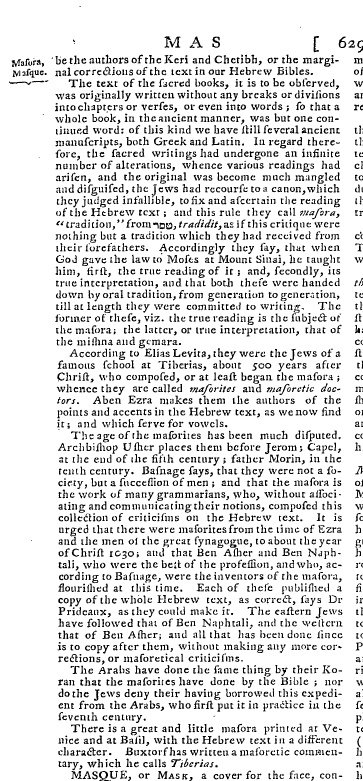
Our Sages say אין אדם לומד אלא ממקום שלבו חפץ (Avoda Zara 19a). Well, one of the fields of learning that my heart desires is that related to the Masorah (מסורת). With this spirit, here is the entry for MASORA in the first American edition of the 18 volume "Encyclopaedia; or, A dictionary of arts, sciences, and miscellaneous literature...," published by T. Dobson in Philadelphia in 1798. The encyclopedia was based on the third edition of the Brittanica, issued between 1790 and 1797.


So far I can't figure out who wrote this particular entry, but I when know I'll update accordingly.

Tuesday, March 07, 2006

Odds and ends about the Rambam

Here are a couple of early mentions of the Rambam.

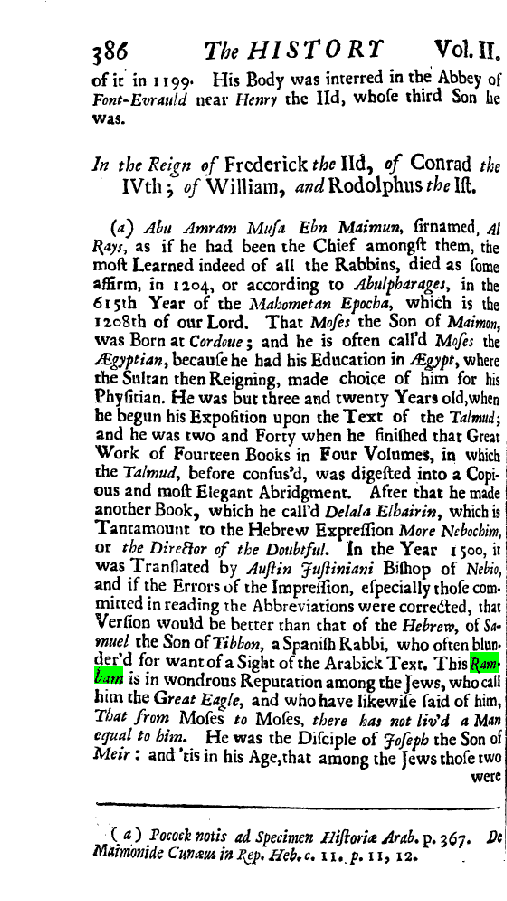
The first is from an English translation of an encyclopedia called "Le grand Dictionaire historique, ou le mélange curieux de l'histoire sacrée et profane" by Louis Moréri, published in 1688 under the title "The great historical, geographical, genealogical and poetical dictionary; being a curious miscellany of sacred and prophane history. "


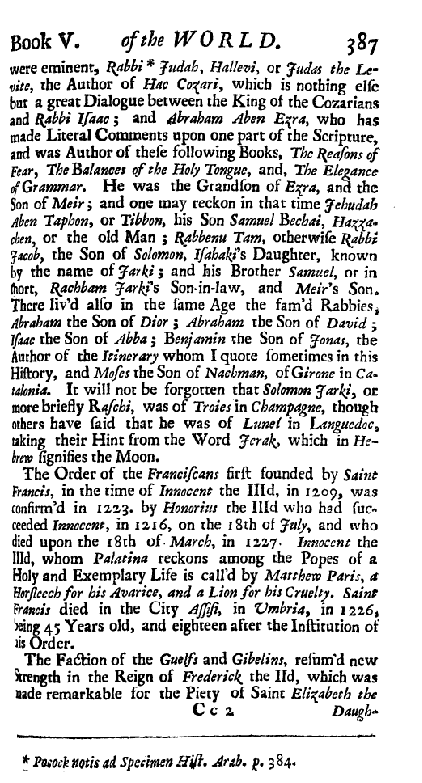
Another view of the Rambam is from Urbain Chevreau's "The history of the world, ecclesiastical and civil: from the creation to this present time. With chronological remarks," (originally Histoire du monde published in London in 1703.


The second page refers to Rashi as "Jarki," Hebraist-speak for Rashi. In this case an explanation is offered that Rashi was so-called because he lived in Lunel. Lunel = moon = month = yarkha = "Jarki."

Stay tuned for posts about the Rambam's views, as seen in early English publishing.
Welcome English Hebraica.

English Hebraica beginsica

I'm still not sure what to call this blog. 'English Hebraica' might not sound exactly right. Anglica Hebraica? Anglica Judaica? Judaica Hebraica?

In any event, I am launching this blog because of these posts at On the Main Line:

I
II

I have long been fascinated by the phenomenon of Christian Hebraism. Why? Basically because Hebraism is a sort of mirror which reflected Judaism and can show how Judaism was perceived in various times and places, misperceptions and errors often, but right on target often as well. There are some surprises in these works and some things reassuringly familiar. It's interesting to trace the awareness of Judaism throughout the centuries. The trajectory tends to be from religiously motivated contempt for Judaism (antisemitism) to interest and even admiration for Judaism (philo-semitism), with varying degrees of normal curious interest in "the other" mixed in. There are historical and theological reasons for these movements, which I hope to post about.

Also illuminating in many of these works are diagrams contained within pertaining to all sorts of matters Jewish. In addition, the transliterations and definitions of Hebrew terms reveal a lot about the perceptions of Jews and Judaism.

In addition to Christian Hebraism, I've also been fascinated by Jewish works in non-Jewish vernaculars. English being my native tongue, this blog will be dedicated to some of them. Until recently I only had scant awareness of how old such works were. I hope to introduce not just myself, but interested readers to some of these things.

Good luck to me!

The young and the beardless*

Yitzchok Levine put up an interesting page which features pictures of various rashei yeshivot in their youth.

*I didn't come up with that myself. I will give credit to the one who came up with it if s/ he doesn't mind.

Monday, March 06, 2006

English Hebraica
Hebraica Anglica

or something.

Coming soon.

William Wotton's English mishnayos--I think I need another blog for this

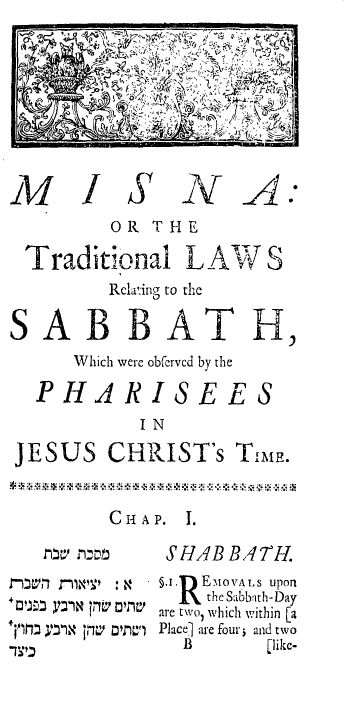
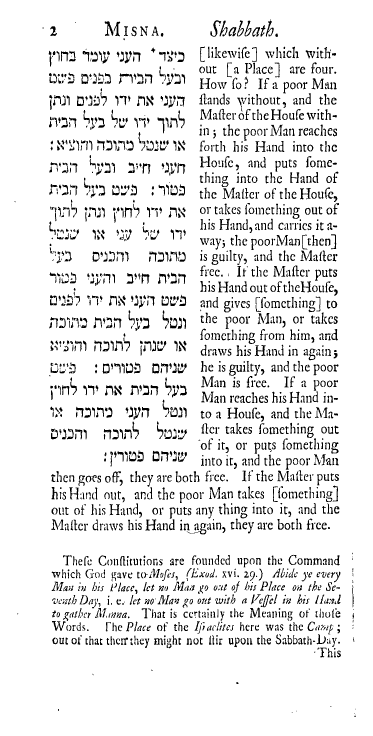
Here are the first three pages of an interesting work by William Wotton, published in 1718. It is a translation of mishnayos Shabbos and Eruvin titled "Miscellaneous discourses relating to the traditions and usages of the scribes and pharisees in our blessed saviour Jesus Christ’s time."

Bet you didn't know there was an English mishnayos 290 years ago!


These things are too interesting and too important not to be more widely known. But these types of posts take up so much space. I'm considering maintaining a second blog for this stuff. Stay tuned.

Sunday, March 05, 2006

English seforim from the 18th century


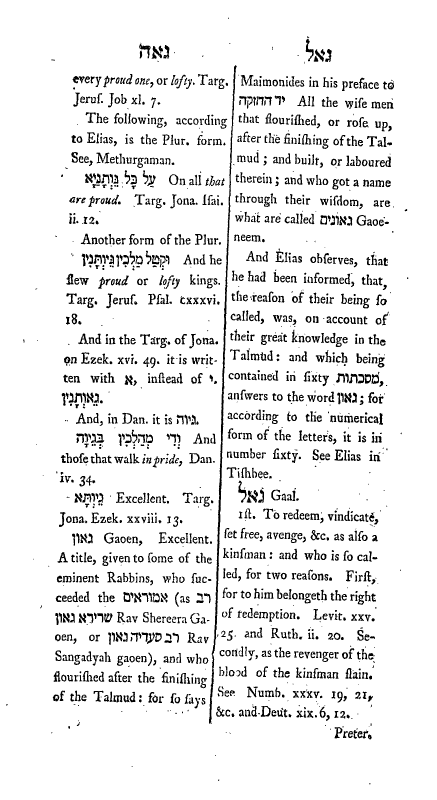
Came across a very interesting work by a David Levi called Lingua sacra: in three parts. It was published in London in 1785-88. This excerpt is from the second volume, which is a Hebrew-English dictionary. Very interesting entry on 'gaon.'

The Jewish Encyclopedia has, for David Levi:
Hebraist and author; born in London 1742; died 1801. He was destined by his parents for the rabbinate; but the design was abandoned, and he was apprenticed to a shoemaker. Subsequently he set up in business for himself as a hatter; but, meeting with considerable losses, heabandoned this business and turned his attention to dressing the material for men's hats. Meantime he continued to pursue his studies in Hebrew, especially in the Prophets.


Levi also wrote a book called Rites and Ceremonies of the Jews, published in 1783. Here is an illustration from the book:


and an excerpt from his chapter on Torah she-be-'al peh:


And on it continues. Very interesting example of 18th century Jewish writing in English (pre-Artscroll).

Friday, March 03, 2006

R. Y. B. Soloveitchik and R. Saul Lieberman

Menachem Mendel posts about an article by Michael V. Fox about critical scholarship and personal religious belief.

Dan comments:
I heard the following story. There was a student at JTS who went to one of the Rav's shiurim. He was blown away when the Rav explained a slight difference in the text between two seemingly parallel passages in the Gemara. He was profoundly moved. He then went back and told this particular thought to R. Saul Lieberman who proceeded to show him manuscript evidence that the entire premise- that there was a textual difference - was not borne out from the manuscripts thus undermining the whole speech and leaving the student rather disappointed.
This reminded me of an incident recorded in R. Aharon Rakeffet's book The Rav (blogged about here). Here it is again:
I remind myself, I had an encounter quite a number of years ago with a representative of the so-called Hokhmat Yisrael. He was a very outstanding scholar. He told me that lately they had discovered a parchment, a megillah, in which it was stated unequivocally that a kohen is enjoined from defiling himself with a sheretz*.

So I said to him: "Do you take it seriously?"

"Of course," he answered, "very seriously." You know, they [the devotees of Hokhmat Yisrael] have the answer right away. It is a different kabbalah, a different tradition. They operate with "traditions" in the plural.

So I mentioned a name to him. The name was known to him, and I knew that he did not like the person. I asked him: "Do you know him?"

"Yes," he answered.

"Is he a scholar?" I asked.

"No, he is a boor and an am ha-aretz mide-oraita," he answered.

I said to him: "So only we have a monopoly on boors and amei ha-aretz mideo-oraita? Fifteen hundred years ago there were also boors and amei ha-aretz. Since there was no paper, the boor had to write on parchment. So you found a nice hiddushei Torah, so what!"
R. Rakeffet repeated this incident with a bit more detail in a lecture available on yutorah.org.

Thursday, March 02, 2006

Artscroll on 'Pharisees'

Mishna Sotah 3:3
; והוא היה אומר, חסיד שוטה, רשע ערום, אישה פרושה, מכות פרושים--הרי אלו מבלי עולם
Soncino Talmud translation:
HE USED TO SAY, A FOOLISH PIETIST, A CUNNING ROGUE, A FEMALE PHARISEE, AND THE PLAGUE OF PHARISEES BRING DESTRUCTION UPON THE WORLD.
Artscroll Schottenstein Talmud translation:
He used to say: A foolish pietist, a cunning evildoer, an ascetic woman and the wounds of the ascetics these are the ruiners of the world.
Gemara Sotah 22B
ומכות פרושין וכו': ת"ר שבעה פרושין הן פרוש שיכמי פרוש נקפי פרוש קיזאי פרוש מדוכיא פרוש מה חובתי ואעשנה פרוש מאהבה פרוש מיראה
Soncino Talmud translation:
AND THE PLAGUE OF PHARISEES etc. Our Rabbis have taught: There are seven types of Pharisees: the shikmi Pharisee, the nikpi Pharisee, the kizai Pharisee, the 'pestle' Pharisee, the Pharisee [who constantly exclaims] 'What is my duty that I may perform it?', the Pharisee from love [of God] and the Pharisee from fear.
Artscroll Schottenstein Talmud translation:
AND THE WOUNDS OF THE ASCETICS etc. [are ruiners of the world]. The Rabbis taught in a Baraisa: THERE ARE SEVEN types of insincere ASCETICS: A SHECHEMITE ASCETIC, A KNOCKING ASCETIC, A BLOODLETTING ASCETIC, A PESTLE ASCETIC, A "WHAT IS MY OBLIGATION AND I WILL DO IT" ASCETIC, AN ASCETIC OUT OF LOVE of reward AND AN ASCETIC OUT OF FEAR of punishment.
As you can plainly see, something's goin' on here. What's peshat, Pharisees? Ascetics? What does the Mishna or the Gemara mean by "פרושין"?

First, it should be noted that in a technical sense the Artscroll translation is correct. A reasonable translation of "פרושין" is "ascetics."

Here's the first definition given by the Oxford English Dictionary for "Pharisee":
1. A member of a religious party within Judaism between the second cent. B.C. and New Testament times, distinguished by its rigorous interpretation and observance of the written Mosaic law as well as the traditions of the elders.
And here is its etymology (skipping some steps that are irrelevent here):
Aramaic pr{imac}{shacek}ayy{amac}, emphatic plural of pr{imac}{shacek} separatist (lit. ‘separated’), cognate with Hebrew p{amac}r{umac}{shacek} separatist, seceder, Pharisee (lit. ‘abstemious, self-denying’
So what we have are two different views. In the one, the world of the OED (and as reflected by the Soncino translation) a particular group of Jews (think of them as proto-Hazal and their followers if you like) existed about 2000 years ago, they were called פרושין, which deservedly should be rendered Pharisees in English. The other view is that 2000 years ago there were people who were פרושין, that is, they were ascetics.

There is certainly some merit to the Artscroll approach, because it is likely that this is how ancient Jews understood the situation, even though Josephus identifies Pharisees as a distinct group, along with the Sadducees and Essenes. However--and here is the rub--even though the Artscroll approach may well be correct, at the same time it is impossible to escape the fact that there is a concept of "Pharisees," and its likely, if not certain, that the Mishna in Sotah is talking about the very same people which Josephus and the New Testament called Pharisees. Artscroll doesn't even hint to this fact, not in its "elucidation" nor in its annotation.

What does the oilam think, is this an error on Artscroll's part? Is this particular bit of translation more confidently Jewish than Soncino's? Should A. have pointed out in the notes the other meaning of פרושין?

"was educated as a Jew" vs "was a Polish Jew"

From the Bowes Park Weekly News Saturday March 14, 1914, obituary for Christian David Ginsburg:
Dr. Ginsburg, the grand old man of Palmers Green, passed away on Saturday last, at his house in Oakthrope-road, opposite the Southgate Council offices.

Dr. Ginsburg was 83 on Christmas Day and was a native of Warsaw. He came to England as a young man....Dr. Ginsburg has two claims to immortal fame. First, he was a distinguished Biblical scholar...

Dr. Ginsburg was educated as a Jew but he adopted Christianity at the age of 15...

A remarkable incident in the doctor's career was the detection of the famous Shapira forgeries in 1887. Shapira was a Polish Jew, with a shop in Palestine, and he sold to the Prussian Government some so-called Moabite potteries, which proved to be forgeries... (italics mine)
Wilhelm Shapira too was a convert to Christianity. Apparently "grand old [men]" were educated as Jews but forgerers remain Polish Jew[s].

Interesting what one finds in 90-year old newspapers.

משנכנס אדר מרבים בשמחה

Download a version of the traditional Negro folksong Pick a Bale of Cotton performed by Leadbelly.

Edit (1.17.08): Watch it:

ADDeRabbi on transliteration, one of my favorite topics. And while we're on the topic, I recommend The conversion of scripts, its nature, history, and utilization by Hans H. (Hanan) Wellisch.

Wednesday, March 01, 2006

Aggadah, Agada, Haggadah, Halachah, Halacha, Halakhah, Halakha

by Snowy Owl (Pamela Greene)

If the Torah's law leaves you perplexed,
Then the learned halacha's your text;
But if it's a peek
At the folklore you seek,
The aggadah's the thing to read next.

Limerick via Larry Lennhoff.

Issues of concern: the truths of history

Google is interesting because it ranks searches in order of popularity, as well as relevence (I'll let the techno-geeks tear my simplistic statement apart in the comments ;-) ).

So, when you do a search yourself you can see just what it is that people are clicking on. So when I typed "yutorah" in Google it showed that second to the yutorah.org home page itself, the most popular page on that site is the seminal article 'Facings the Truths of History' by R. J. J. Schachter (Torah U-Madda Journal Vol. 8).

Maybe I'm misinterpreting the data, but it seems like this is an indication that the reshaping and whitewashing and revising of Jewish history is an issue that concerns more than a few people. Of course one would know that anyway because it is one of the most recurring themes on the j-blogosphere and on Jewish e-mail lists, but here it is in Google. Google does not lie. I think.

What is a yeshiva parent to do?

Anonymous posts a crystal clear comment about the dilemma facing some (many?) Orthodox parents:
Sending a kid to a school with opposing hashkafas is a recipe for disaster -- I speak from personal, and close-second-hand experience. The poor kid, unless he is VERY strong personally, will be pulled in 2 directions, both of which are fraught with existential problems: If he disobeys his rabbeim, he is disobeying God. If he disobeys you he is disobeying God, and in effect spitting on the people you told him to respect and to whom you have entrusted him. And this is just the tip of the iceberg.

Tuesday, February 28, 2006

Making of a[n] myth urban legend

Dan at Seforim has a great post about how an S. Y. Agnon story from 1937 became a modern kiruv legend.
Promising new blog I'm Haaretz, Ph.D.

URL is jewishstudent.blogspot.com, but I'm not sure which the baalat ha-blog wants to be known by.

Thursday, February 23, 2006

Was George Washington perfect?

It's a machlokes. Henry C. Whitney held yes but Abraham Lincoln held no.
Years later, Whitney [a Lincoln legal colleague from 1850s] recalled a lengthy discussion about George Washington. The question for debate was whether the first president was perfect, or whether, being human, was fallible. According to Whitney, Lincoln thought there was merit in retaining the notion of a Washington without blemish that they had all been taught as children. "It makes human nature better to believe that one human being was perfect," Lincoln argued, "that human perfection is possible."
From Team of Rivals by Doris Kearns Goodwin, via Lamed.

Monday, February 20, 2006

Don't forget to see the forest too

Mort Zuckerman went to Lakewood:
It was at the behest of a rabbi I study with that I went and visited the Lakewood Yeshiva. I had never been to a yeshiva before in my life and I sort of did this out of some degree of curiosity but more out of a sense of moral support for what had been such a central part of this rabbi’s life but I have to tell you when I got there I was absolutely knocked out by it. I will tell you that it was the single most intellectually active, energetic, fascinating environment I had ever witnessed. There was a sort of buzz and just sheer concentration and joy in the learning process and it was literally visible to somebody like myself.

I mean, I said it afterwards, it made Harvard Law School, which I happen to have attended, look like a kindergarten. It was absolutely extraordinary to see so many people - from various walks of life - in there for the sheer joy of learning about their religious tradition. And the sheer intensity and intellectual demands of this place made it such a unique place to visit. So for me, it was absolutely a stunning experience and I wish everybody could have the chance not only to visit it but to have a guide like I did.

Orthodox Judaism deals with Bible criticism

Maybe one day this blog title will be correct. Right now, it really should be titled "Orthodox Judaism should deal with Bible criticism."

Allow me to explain. With regards to higher or literary Bible criticism, there have been three or four Orthodox approaches.

Early on in the game, there were Orthodox scholars who took it on point by point. Well, maybe not scholars, but there was R. David Zvi Hoffman.

The second approach is the most widespread, which is to pretend it doesn't exist. I think in my entire yeshiva career I heard one roundabout reference to Bible criticism, which is to say that dealing with it meant ignoring it completely.

The third approach is to sort of introduce Bible criticism, either in a 45-minute lecture or in an essay, most of the time being spent summarizing the history of the theory and then maybe 10% devoted to highlighting a weakness or two, and then declaring that as a theory it is dead and has been dead for 90 years.

A fourth approach, which is unlikely to gain much in the way of adherents, is that typified by R. Mordechai Breuer, which allows that the prevalent theory, the documentary hypothesis, is correct insofar as it has identified four strands and the hand of a redactor, but nevertheless the Torah was written be-davka this way and is al pi Hashem be-yad Moshe, just as tradition holds.

The first approach has merits, but is exhausting. If there are a thousand 'problems' which led to the two types of explanations, the traditional Torah she-be'al peh and the untraditional documentary hypothesis, the former provides a thousand answers to the thousand problems while the latter essentially provides one answer to the thousand problems. That means that in order to really have a good grasp of how Tanakh 'works,' with the thousand problems (I made the number up, for argument's sake) one has to do a lot of juggling. On the other hand, a sweeping theory which basically answers the thousand problems in one sentence approaches Occam's Razor a bit more, although I suppose one could argue that "Torah she-be'al peh" is also a sweeping theory. Either way, when Bible criticism is taken on in every detail one usually ends up in quicksand.

The second approach makes some sense, insofar as we could probably make some sort of calculation. If a hundred students are not exposed to Bible criticism by the time they're 20 years old, let's say that 70% will either never be exposed to it, or will be entirely unwilling to entertain it. On the other hand, say that the same hundred students are exposed to it, say, by the age of bar/ bat mitzvah. Maybe then the numbers change signifigantly, maybe 70% wind up with skepticism or doubt. Or at least that must be the calculation made when students, such as myself, could spend almost two decades in an educational environment without any exposure to it (apart from my reading done on my own). But at the cost of never being exposed to what a yeshiva reponse to Bible criticism might be.

The third approach, that of lightly touching upon it and then declaring it dead is probably very good for the majority of people who the second approach dealt with. These classes and essays are like a caffeine jolt. Now the people can feel like they've been exposed to it, know what it is and that its nonsense and discredited. This works well for those who aren't really curious about it.

The fourth approach, accepting the findings but disputing the conclusions, is interesting. But it almost seems like permission to be a kofer with cognitive dissonance. Maybe that'll work for some people (I toy with it), but its hard to believe that one is being totally intellectually honest by drawing no new conclusions from the conglomeration of historical, textual, theological and other types of literary analyses which finds multiple sources in the Torah.

There is a fifth approach which has only been touched on and in my opinion badly needs exploiting.

In this Introduction to the Philosophy of Rav Soloveitchik by R. Ronnie Ziegler we are told
Let us take, for example, the question of biblical criticism. True, the Rav did not write a treatise on this topic because it held no great interest for him personally and because he felt that others, like Rav Chayyim Heller, had more specialized knowledge on the subject. However, he also makes a significant observation in "The Lonely Man of Faith" (p.10) which would suggest that biblical criticism does not pose as great a challenge as one initially would assume. The critics make their case for multiple authorship based on certain anomalies in the biblical text. Rav Soloveitchik points out in response that the Sages and the Rishonim were also sensitive to these textual anomalies, but they offered different explanations for these phenomena because they were working with different assumptions than the critics. In other words, taking note of textual phenomena is one thing, but interpreting the phenomena is something else entirely.

...

Furthermore, Rav Shalom Carmy points out that two approaches are possible when confronting critics:

A) One can respond to them point-by-point, but then one is playing in their arena and is constantly on the defensive.

B) One can offer a compelling alternate understanding. This is precisely what the Rav does in "The Lonely Man of Faith." Instead of undertaking a detailed critique of the critics' interpretation of the first two chapters of Bereishit, he undercuts their arguments entirely by presenting a cogent alternative. Thus, he DOES actually confront the critics - in an indirect yet constructive manner, rather than in a direct but defensive manner.
This is the fifth view. Whether or not something is a cogent alternative will be judged by the reader. But even though R. Soloveitchik only went down this path for one topic, it would seem to me that rather than undetake a point-by-point refuation (first view), rather then ignoring it (second view), rather than pretending to have conquered it (third view) and rather than simply accepting it and hoping people will still believe (fourth view) scholars need to prevent alternatives, not at the local level, one 'problem'/ one solution (multiplied a thousand times). But problematic 'sugyot' in Torah and Nakh ought to be taken on, as Bereishith 1 & 2 were, and a new view put forth addressing the forest rather than the trees.

Of course a cycnic will say that this is an impossible task, because apart from the one or two areas, like the beginning of Bereishith, it cannot be done. Other cynics on the other end of the spectrum will just say "Phooey, kefira." But until it's been tried, how do we know what the correct Orthodox response to Bible criticism is?

Thursday, February 16, 2006

Gerald Blidstein awarded Israel Prize in J. Thought

Mazel Tov to him.

Neshama Carlebach's Purim concert cancelled on account of J4J

Here's the story.

A few days ago it was brought to my attention that Neshama Carlebach was to perform at the following event:

Purim in the city...

As it turns out, if you clicked the link, the shul sponsoring the event was a Jewish Messianic congregation (Hebrew Christian, if that wasn't clear enough).

In the ad above, Neshama Carelbach's picture appeared as did the announcment of her performance. That has now been altered after she canceled, when it was brought to her attention that she had agreed to an engagement at that event.

She wrote the following to people who asked her about it:
Dear friends,

I was invited to sing for Congregation Beth El of Manhattan, a congregation of Messianic Jews on March 12, 2006. Naively, I had no idea what their ultimate goal and mission was when I first accepted this invitation.

Now that I have become aware of what this organization represents, I will be canceling my appearance. I absolutely believe in One G-d, and live and breathe for my own Orthodox Judaism. While I respect the ideologies and rights of all people, I feel it to be my own religious and spiritual imperative not to participate with a group that is in direct conflict with my own beliefs and way of life.

I very much feel, in the tradition and inspiration of my father, Rabbi Shlomo Carlebach, that my work in this world is to spread love, light and healing through my music.

It is very painful to know that my acceptance of this invitation may have hurt or offended anyone, just as I'm sad to know that by deciding not to go forward, I may offend some of the people who worked so hard to organize this event. I hope that the reasons for my cancellation will be understood.

I appreciate the concern that you have shown, and thank you for reaching out to me.

I pray that we can continue to be strong Jews and good people, who can, with love and respect, stand up for what we believe in while never growing callous to the impact of our actions on others.

With love and apologies,
Neshama Carlebach
Does anyone know if her late father would not have takka kept the engagement and considered it a kiruv opportunity? I am not blaming her either way, or criticizing her handling, but its an interesting question. Might one have a legitimate reason for performing at a Purim event at a J4J-type synagogue?

Google does diqduq

DNA points out:
Google does everything. Did you know that it knows dikduk? I wanted to see who Choshuv was (now that he's here commenting) so I googled part of what he said, "many of the "Orthodox" blogs are moshvei letzim." Google asks, "Did you mean: "many of the "Orthodox" blogs are moshavi letz?"
Now that is pretty funny. :D

Tuesday, February 14, 2006

Original thinking in Jewish history

In Godol Hador's mammoth post die Wissenschaft des Judentums The Science of Judaism much commenting ensues.

In the discussion the idea was raised that a many (but not all!) Jewish thinkers of long-lasting impact bucked the norms and leadership of their day, only to be vindicated by history. I wrote that:
historically the masses weren't scientists. Rabbis were--that is to say, the educated Jews were, and educated Jews were rabbis. It's a bit circular.

In fact, the historical example feeds the daas Torah view. It is 100% true that historically Jewish leaders and intellectuals tended to be talmidei chachamim. But this isn't because talmidei chachamim inherently know astronomy or politics better than those who aren't TCs, but because only those who were educated would come to excel in those fields. And a traditional Jewish education was impossible without heavy duty immersion in Torah. That's why you have all those Jewish polymaths who excelled in Torah and Talmud and whatever else they did, and it has nothing to do with daas Torah or hafoch ba hafoch ba.

All that said, a great deal of what is credited to Jews were products of Jews who thought outside the box, outside the mainstream and in many cases who clashed outright with the leadership who didn't appreciate original thinking. The Rambam is a classic example, but so is the father of modern Jewish historiography, Azaryah de' Rossi*, and others down to the present.
Along those lines I wonder if traditional Judaism is the incubator for the specific factors which produce such people. Requirements: a set of rigid religious leaders to herd the masses. They'll all be relatively intolerant of those who don't toe the line, but really they're all there to produce the setting for the people who will step out of line and do big things.

Very Maimonidean, very elitist. I don't like elitism. But is it true? Or rather, was it true?

*WRT Azaryah de' Rossi it must be mentioned that his noted antagonist, the Maharal mi-Prague was, of course, an original thinker.

Monday, February 13, 2006

Hebrew alphabet reform

Language and alphabet reform is a truly strange thing. From Esperanto to invented scripts, these projects are usually spearheaded by...unusual people (to be charitable) or autocracts (as in the writing reform of Ataturk, transforming written Turkish from Arabic to Roman characters). Most of these proposed reforms remain just that, because it seems like they can't be imposed without a gun (and often even they can't even with). Of course there are exceptions, such as the Cherokee syllabary invented by Sequoyah, an illiterate Cherokee silversmith who literally invented a syllabic alphabet for his nation upon observing white people reading and writing. With the gift of a spelling book that he could not read and his own imagination he devised a working writing system for the Cherokee, who quickly became literate.

Anyway, an example of autocratic reform imposed on an alphabet was Stalin's initial embrace of Yiddish culture in the 1930s, as a Soviet-approved Jewish culture, minus Judaism. An entire new Yiddish orthography (spelling system) was devised, designed to make Yiddish words derived from Hebrew look as far from how it was written in the Bible as possible. For example, the Soviet Yiddish newspaper 'Der Emes,' (the Truth) was spelled דער עמעס, instead of דער אמת. Writer Sholom Aleichem's name was spelled שאלמ אלייכעמ, instead of שלום עליכם, which is how he himself spelled his name (as you can see, this orthography did away with the סופית letters as well).

Anyway, this ניט--וורי--עמעס episode was rather short lived, as Stalin soon tired of his Yiddish Jews, closing down the Yiddish press in 1948 and shooting all the Yiddish writers in 1952.

It was brought to my attention (hat tip: Mis-nagid) about a wacky Hebrew alphabet reform proposed by Hugh J. Schonfield, author of the 1965 best seller The Pasover Plot. The Passover Plot was a controversial book which speculated that Jesus intended to fake his own death and resurrection (since death by crucifix typically took as much as 24 hours or more, the plan was to bribe the Roman soldiers to take him down after only a few hours, alive) but the plan went awry when he was speared by a soldier and so died. But I digress.

Schonfield apparently thought the Hebrew alphabet was ugly (!) and in a book called The New Hebrew Typography in the 1930s devised the following in its place (taken from The Schonfieldian Script Page):


As you can see, he created both lower-case and capital letters and the alphabet appears heavily influence by a sort of Cyrillic alphabet. I'm not sure what Schonfield's point was, but there you have it.

An example of Hebrew writing in his reformed Hebrew script (taken from the aforementioned web site):


No, no one took this seriously. Thankfully.

Thursday, February 09, 2006

Putting rabbinic stories in context

Lamed Zayin's post at Maven Yavin about "reclaiming" a rabbinic "story" (I, II, III, IV) by applying the correct context to it reminded me of a passage from the beginning of Making of a Godol (introduction to MoaG can be downloaded here, courtesy of Yashar Books, or if that link isn't working download it by clicking here).

Yes, you can download it and read it, but it's an important point and it should be available for posterity on the internet, so I am posting this excerpt:
There may be some stories in this book that are known to some readers--and family members of the principals--of which the author may have a different understanding than they. For example, I was told by my son R' Yoseph that R' Shlomo Fisher told him how R' Yitzhaq Kulitz, Rav of Jerusalem, was incensed with the reaction of a "present-day rosh yeshiva" to a story he was told about how R' Isser-Zalman Meltzer was going up the steps to his house and overheard the cleaning lady singing to herself while washing the floor. R' Isser-Zalman went back down to the street and paced the ground for a long while until she had finished her work, and then he returned home. The rosh yeshiva understood R' Isser-Zalman's action as indicative of how careful he was in avoiding the sound of a singing woman (קול באשה ) for the time it would have taken him to walk from mid-staricase until entering his home--when the woman would certainly have stopped singing. "In actuality," said R' Kulitz, "R' Isser-Zalman was concerned that when he would walk into the house, the woman, who enjoyed singing while on the job, would be inconvenienced by having to stop singing for the rest of her working time." Also cf. the definitive biography of R' Isser-Zalman Meltzer, בדרך אץ החיים, where that tzaddiq's grandson records the story as it occurred--and that his grandfather himself explained his action without any reference to קול באשה; it even has R' Isser-Zalman pacing on the porch just outside the door to his house--where he could likely still hear the singing (if he chose to listen)! R' Yitzhaq Kulitz was still fuming about that rosh yeshiva's misinterpretation of R' Isser-Zalman's motive because through his wrong interpretation, he had missed out on R' Isser-Zalman's extraordinary consideration for people.

Wednesday, February 08, 2006

Sanhedrin on Gemara

Daat Emet may or may not need an introduction, but I won't provide one other than to link to a piece that appeared in the Jerusalem Report, snippets of a debate between the proprietor of Daat Emet, Yaron Yadan, and Jeffrey Woolf of Bar-Ilan University.

On the Sanhedrin.org web site, Rabbi Dov Stein writes an article called "Responsa to Daat Emet (Knowledge of Truth) Pamphlets." (The piece was translated from Hebrew by Rabbi Dr. Eliyahu Schatz.)

In the article R. Stein writes something refreshing:
This authority is given to the gemara only in the legal realm. However, this is not so with respect to opinions, and views on the existence of the world, science, legends, etc. A person can explain these items in any way, and he will not be considered as having unfit ideas.
There is nothing novel about these three sentences. Indeed, they are the opinion that was expressed throughout the generations, even more than a thousand years ago. It is a reflection of a consistent tradition of ge'onim, rishonim and aharonim regarding how we can to relate to aggadah in rabbinic literature.

It's wonderful that R. Stein writes this, even in a polemical context, because it lucidly expresses that which is contradicted by the outlook of some today, of those who slammed and banned the works of R. Natan Slifkin. Given the current intellectual climate those words are indeed refreshing.
Some new J-blogs on the horizon:

  • Ger Tzadik
  • The Jewish Cube

    There are some more promising new ones that I've spotted recently, but I can't remember them just now. I have them bookmarked at home, so I'll add some more later.

    As a separate issue, the name "J-blogosphere" stinks. It was brought to my attention* that Mormon bloggers call their circle the "Bloggernacle." Now that has style!

    Let's think of something niftier, zippier and better than "J-blogosphere" and let's make it happen.

    (Please don't say "Covenantal Blogosphere.")

    *Hat tip: Mis-nagid.
  • Tuesday, February 07, 2006

    Jerusalem, 1903

    Here is a vintage article called "The Religious Life of the Orthodox Jews in Palestine" from The Biblical World, Vol. 21, No. 4, Apr., 1903. The article was written by one E. W. G. Masterman (all I could find online about him was that he was secretary of the British Palestine Society which was an organization whose purpose was to create a “community of ideals and interests between Zionism and British policy.”)

    His perceptions are quite interesting, some of which are in error (but not surprising, given that any of us would also make what are slight errors when observing an alien community). The piece is also clearly sympathetic and more than a little bit romantic.

    Here is an especially interesting quote:
    Many a man who appears in Jerusalem in all the garb and habits of ultra-orthodoxy has lived very differently in Europe in his younger days. Now, in the Holy Land, with the eyes of so many equally punctilious around him, he inevitably goes to extremes.
    Also interesting: the article is filed from "Jerusalem, Syria." Such was 1903.

    Link to pdf of the article

    German F. Pagan

    Daas Hedyot posts about receiving one of those ridiculous tickets on the NYC subway for sitting with his legs up at 1:30 AM.

    This is the ticket issued to him:


    By Police Officer German Pagan. The best of all possible worlds, huh? LOL

    A

    New series, should be 26 posts worth.

    On the alphabet: although I personally am more interested in the אלף-בית ('aleph-bet) than the אלפאבית (alphabet), several of the Hebrew letters are connected with individual letters of the Roman alphabet (e.g., I, J, and Y are all connected with 'Yod.') So it will be A-Z.

    To begin with, as far as we can tell the ancestor of the letter א/A was something that looked roughly like the following:


    Found in the so-called Proto-Sinaitic inscriptions, this symbol functioned as the consonant א in very early alphabetic writings. From there we move north to Canaan, where the letter was written in some manner of the following form:


    It should be apparent that the second one is a simplified line drawing form of the former. In either case, the name 'aleph was quite appropriate, as the Semitic/ Hebrew root "'-l-ph" meant, in fact, an ox. In the Torah this form is rare, as it is more archaic, and is used in Deut. 28:4, as an example (שגר אלפיך).

    In any event, this alphabet was in use in Canaan and through trade with Phoenicians (probably living in what is today Lebanon), the alphabet was acquired by Hellenes (Greeks). Initially they wrote without regard to direction, sometimes from right-to-left as in Semitic languages, sometimes from left-to-right and sometimes in both directions in the same document (which is called boustrophedon writing). Eventually the left-to-right writing prevailed, and with it came cosmetic changes to the alphabet. By simply taking a casual look at one representative of the early Semitic script one can see that it is well-suited for writing from right-to-left:


    When the order reversed, so did the direction of many of the letters. So the
    'aleph changed direction and came to look more like this:


    In time and with subsequent modifications and inheritances (from the Greeks to the Etruscans to the Romans) we came to its present form: A

    Although this post is titled "A" and not א I absolutely cannot resist showing some subsequent development of this particular letter:


    The earlier three are early Phoenician and Hebrew '
    alephs. The latter four are strictly developments in Aramaic, the second from right is Palmyrene Aramaic and the one all the way to the right was from Nabatean Aramaic.

    One more:

    This is a medieval 'aleph fairly typical of the massoretic codices. This one is from the Aleppo Codex (ca. 915 CE):


    Obviously there is a great, great deal I left out in this exploration (including the cursive and Rashi scripts and my leaving the letter A to its development approximately 2000 years ago).

    Future posts (B-Z) will hopefully be better, and will include traditional Jewish thought on the letters. :)

    Monday, February 06, 2006

    Iran's largest selling newspaper, Hamshahri, announced it would be holding a contest on cartoons of the Holocaust in response to the publishing in European papers of caricatures of the Prophet Muhammad. link
    Grow up.

    Friday, February 03, 2006

    Book Club!--"How to Read the Bible" by Marc Zvi Brettler

    Book: "How to Read the Bible by Marc Zvi Brettler.

    From Publisher's Weekly:
    How does a person read the Bible, which is a product of another time and culture, and have it make sense? Brettler, who chairs the department of Near Eastern and Judaic Studies at Brandeis, begins with the complicated web of doctrine, history and myth that is the Hebrew Bible and untangles it until a clear and beautifully drawn picture emerges. His mode of interpretation is the "historical-critical" method—reading the text in its historical setting, employing critical methodology to explicate and, when possible, harmonize "the multiple ancient perceptions of God, preserved in our composite Bible." After explaining his approach, Brettler takes readers through the historical periods of the Bible, placing the stories in their proper context. He explains, for example, the importance of the Jewish exile in Babylon to the people's view of the prophetic calling. He also discusses the poetic books, their formation and content, and the messages of the prophets. The result is an eye-opening journey through a familiar text, a fresh look at an old story. Written for the beginning reader as well as the scholar, this is an outstanding introduction to the Hebrew Bible and the history of Israel, and should be widely read.
    If there is interest, and by that I mean if even one more person "joins" then we will have a Book Club! We will discuss the book in future posts.

    Note: you do not have to agree with a single word of the book or the approach it takes to participate.

    "Sign up" here and stay tuned for a schedule.

    edit: NPR article on the book, including lengthy excerpt from the first chapter.

    Thursday, February 02, 2006

    Guess who said it?

    "So I say now that there are eight rhythmic modes (alhan = melodies), to each are [associated] measures of combinations of beats (tanghlm).

    As for the first of them, its measure is three consecutive beats (naghamat), and one quiescent.

    And the second, [its measure] is three consecutive beats and one quiescent, and one moving. Those two modes stir the humor of the blood and the temperament of sovereignty and dominion.

    As for the 'iqacat [rhythmical modes], which constitute the genres of [i.e. from which derive] all the rhythms, they are divided into eight modes, and they are: al-thaqll alawwal, al-thaqll al-thani, almakhuri, khafif al-thaqll, al-ramal, khaftf al-ramal, khafif al-kbafif, alhazaj.

    As for the al-thaqll al-awwal, it is three consecutive beats (naqarat mutawaliyat), then a quiescent beat, then the rhythm returns as it began.

    Al-thaqil al-thani is three consecutive beats, then a quiescent beat, then a moving beat, then the rhythm returns as it began.

    And the third, its measure is two consecutive beats-there is not between them the tune of a beat-and one quiescent, and between putting down and raising up [and raising up] and putting down is the time of a beat. And this mode alone moves [the humor of] the yellow bile, [the temperament of] courage and audacity, and what is like them.

    Etc. (the full quote takes up too much space)

    Who said it?

    The prize: my admiration for knowing it. ;)


    The Chareidi Jews of Baghdad

    In the most recent Hamodia there is a piece on the late R. Kadouri zt"l which reads, regarding his childhood circa 1900:
    He learned in the Zilka beis medrash, where the chareidi Jews of Baghdad studied.
    Anachronism alert!

    I am well aware that the term chareidi had already come into existence by 1900. But I am reasonably certain that Baghdadi Jews did not call themselves nor were they called by outsiders chareidim.

    Hat tip: an email list. I don't know if the poster would want to be named, so I won't unless he or she emails me and says that I could attribute it.

    B-b-b-b-banned...banned to the bone

    In Censorship and freedom of expression in Jewish history by Moshe Carmilly-Weinberger (pub. 1979) it is noted that roughly 300 books were subject to internal censorship among Jews over the past 2000 years, most since the 17th century. Carmilly-Weinberger's study makes the case that internal book bannings were relatively rare, although they were promulgated for a variety of reasons and were of a variety of types.

    300 in 2000 years? Even thought several more works have been banned and/ or modified or censored since 1979, somehow it seems like the most recent brouhaha (what a fun word!) began with "One People, Two Worlds," (pub. 2002). If that be the start of a recent trend then we're looking at 3 out of 300 or so--1% of the toal--in the past three-four years alone.

    Wednesday, February 01, 2006

    Guidelines for an Orthodox Jewish Torah translation

    The Italian proverb (and English cliche) goes "Traduttore, traditore," "Translator, traitor." And yet translation is vital else important works be closed to many. It is in this spirit that the many, traitorous translations of the Torah have taken place. In my opinion every one I have read, without exception, is lacking in different ways. No, I cannot do better, but I can offer some preliminary guidelines for an English translation of the Torah from an Orthodox perspective:
    1. Rigorously follow Masoretic conventions. Divide the text according to pesuchot and stumot divisions. Entirely ignore standard chapter divisions. Rigorously use the te'amim (trope) for parsing sentences.
    2. Transliterate Hebrew names and places. Forget about Moses, forget about Jacob. Every person's name should be transliterated into English characters (always using a consistent transliteration scheme). Every first instance can be asterisked: Moshe* (*Moses)
    3. No King James-isms. There is nothing wrong with striking passages which the King James committee translated well into English. But from the point of view of an Orthodox Jewish Torah translation, it is far better to think outside the box rather than employing recognizable terms from existing translations simply because its easy to just crib them. In other words, Cain (or, I should say, Qayin) does not rhetorically ask God if he is his "brother's keeper."
    4. No politics. There have been numerous instances of one or another work getting "in trouble" by critics who want the work to have done what it didn't. In the 1920s, a grandson of R. Samson Rafael Hirsch caused a stir with a literal translation of Shir Ha-shirim. Translators must resist the temptation to look over their shoulder, to render diplomatic or self-conscious translations. The only criteria must be emet, as best as possible, and there ought to be a willingness to let chips fall where they may (although deliberately seeking controversy is similarly to be avoided for the same reason).
    5. Be consistent. If the translation is going to be a Torah she-be'al peh translation, fine. Let it be so. Let it translate Gen. 21:21, Yishmael's wives as Fatima and Aisah (as Targum Y. does)--or let it not. The key is consistency, rather than slipshod cherry-picking through gemaras and midrashim and meforshim without rhyme or reason.
    I've got a few more, but I can't find my notes. More will be added later (on critical scholarship, rabbinic guidance etc).

    Feel free to rip mine apart and add your own.

    Partly relevant link.

    Critical scholarship in the olam ha-yeshiva

    Dilbert posts about a great edition of Iggeret R. Sherira Ga'on.

    The surprise, for him, was that the edition was produced by a chareidi scholar and has chareidi haskamot, but cites Rs. Azaryah dei Rossi and Saul Lieberman, and is itself a critical edition of the Iggeret, written with wonderful scholarship.

    It is a darn shame that this need be a surprise!

    This is what the Orwellian world of certain publishing companies have wrought, the impression that the yeshiva world simply lacks critical thinking. It may be that it consciously spurns whichever modern scholarship it chooses to, but it needn't be lacking in scholarship. And even Artscroll has a mixed record. For example, in their Rashi edition a lot of important work on the meaning of the Old French words were done.

    Many important works were and are written by chareidim. Every time I have been to the JTS library I have seen chareidim there to do research.

    Again, the reputation of chareidi learning has suffered because of the Orwellian things we've seen over the years, bans, distortions, censorship etc. But all in all, there is no reason why a chareidi talmid chacham is incapable of comparing texts and using his kop to produce an outstanding work.

    It is a shame that this isn't obvious, and is the fault of anti-intellectual elements which do exist.

    Tuesday, January 31, 2006

    The victors write the history books...

    "The victors write the history books. The runner-ups write the blogs."

    I'm not sure I understand it, but it's thought provoking.

    Via The Daas and the Diybur.

    edit: come to think of it, I might say "traditionally the victors write the history books..."

    Clearly that is no longer a certain given.

    Monday, January 30, 2006

    Dilbert on men wearing yarmulkes, or rather, covering their head. Very interesting post. Read it.

    What is a 'shittah'?

    There is a post on an email list about Jewish history and Orthodoxy.

    Someone wrote the following:
    All those bringing down proofs of why learning history is important are missing the point. It is certainly interesting and perhaps even important to know the reasons given for not learning history. However, the important thing to know is whether there is a genuine view that history should not be learned.

    If there is a genuine shittah that people should not study history, then whatever proofs you will bring were considered. You will not be able to Shlug up the shittah. At most you will be able to decide whether to feel bound by the shittah yourself.
    What struck me is the assumption that if there is a "genuine view," which is the commenters translation of "shittah," it means that every angle of the issue was explored in order to formulate that view. Including, I suppose, some sort of study of history. But is that so? Have those who advocated not "learning" history (telling word) done an exhaustive exploration of the matter?

    Tuesday, January 24, 2006

    From Pars to Yehud

    Iranian blogger Hossein Derakshan is, hopefully, visiting Israel tomorrow.
    If things work smoothly at the Berlin's Schoenefeld Airport, I'll be in Tel Aviv tomorrow morning. This is huge for me.

    This might mean that I won’t be able to go back to Iran for a long time, since Iran doesn't recognize Israel, has no diplomatic relations with it, and apparently considers traveling there illegal. Too bad, but I don't care. Fortunately, I'm a citizen of Canada and I have the right to visit any country I want.

    As a citizen journalist, I'm going to show my 20,000 daily Iranian readers what Israel really looks like and how people live there. The Islamic Republic has long portrayed Israel as an evil state, with a consensual political agenda of killing every single man and woman who prays to Allah, including Iranians.

    I'm going to challenge that image.

    One of the cooler things I've heard lately. I don't know enough about the situation to know how gutsy this is, but it sure is encouraging.

    Via Velveteen Rabbi

    Friday, January 20, 2006

    Agudath Israel: church-state trumps children

    Agudath Israel opposes legislation which would require clergy to report to the authorities when they have reasonable cause to believe that there's been child abuse.

    Note: the legislation would require them to report to authorities "whenever they have reasonable cause to believe a child has been abused." Which is to say, that when a clergyman doesn't have reasonable cause then he wouldn't be required to report. Which is to say that Agudath Israel opposes requiring clergy to report what they are reasonably sure is child abuse.

    Is it a church-state issue? I suppose. But it's also a child abuse issue. Agudath Israel is protecting the religion, as they see it, but who is protecting children?

    Again, the legislation would basically require clergy to report abuse if they really think they've seen abuse.

    Wednesday, January 18, 2006

    Regarding bans

    Interesting point:
    Regarding bans, what makes them most distasteful to me is that the reasoning isn’t open source so the logic can be followed by the average literate observant lay-Jew. Instead, we get books and wigs banned and the news spreads like wildfire by phone—and bonfire in the street—and the responsible Jew wants to hear the specifics… without a game of “telephone” along the way corrupting the original message. It’s like testing to see who will dare to break a chain letter.

    Tuesday, January 17, 2006

    Accepting the truth from Alan Dershowitz's daughter

    On page 123 of The Genesis of Justice: 10 Stories of Biblical Injustice That Led to the Ten Commandments and Modern Morality and Law (Chapter 6: Abraham Commits Attempted Murder--and Is Praised), Alan Dershowitz explores the aqedah:
    (My ten-year-old daughter believes that Abraham was conflicted and that the angel represents his "better instinct" [yetzer ha-tov], which eventually prevailed. If so, the "angel" was an internal, rather than an external, source.)
    Years ago I read this book and quite liked this thought. So, as recounted earlier on my sidebar I conducted a little experiment. In a discussion with a certain respected rosh yeshiva I broached this peshat, worded appropriately, and without revealing its source. The RY was modeh al ha-emes. Yes, its a nice peshat.

    That surprised me. After all, how could Alan Dershowitz's ten year old daughter have anything to contribute to parshanut? And thus I learned a lesson: Accept the truth, whatever its source.

    Yes, this dictum takes one into uncharted waters. After all how does one recognize what is true? Don't people often accept that which isn't true thinking that it is? Good questions.

    In any case, this Hirhurim post goes all R. Joseph Hertz-y, citing Wicke, Childs, Fretheim, Cassuto, Sarna and others who likely wouldn't make it onto the shelves of a bet midrash. Unsurprisingly, in the comments section the question of whether one can cite Wickes, Childs and Fretheim was raised. Then the question of whether their peshats are good even if they are the same as in classical sources was raised. And finally, whether one can cite the Abarbanel was raised. Go figure.

    Monday, January 16, 2006

    Potentially interesting discussion about Professor D. Weiss-Halivni's Peshat and Derash at Chardal.

    Commenter Tzvi's asks "why have so many orthodox people accepted Halivni as a talmid Chacham, when so much of his "hashkafa" is pure kefira in Torah She'baal peh?"

    A good question, although I wouldn't word it that way. Re-wording it might go something like this: Why have so many Orthodox people accepted [Professor] Halivni as a talmid chacham, when he used to be a professor of Talmud at JTS and a pulpit Conservative rabbi?

    I think the answer has to do with the fact that he, in fact, is a talmid chacham and many Orthodox people take seriously the dictum to accept the truth from wherever it comes. He is also viewed, I've noticed, as a bridge to halakhic sanity in a world gone fundamentalist.

    Imitate Richard Elliott Friedman, Not the Skeptics Amongst Us

    There is an interview with Professor Shalom Carmy which appeared in Hamevaser (Vol. 38 No. 1) called Imitate the Ramban, Not the Professors.
    SC: What truth-seeking person would close his, or her, eyes to a newly discovered inscription clarifying the geography or vocabulary of a pasuk that baffled the Rishonim? The Ramban's delight when, upon his arrival in Eretz Israel, he was able to revise some of his perushim in the light of the realia, should put to shame the kind of piety that disdains such knowledge. Interesting realia should never overshadow the study of devar Hashem; yet I would rather model myself on the Ramban than on the professors of Ramban.
    It is a shame that I need to mention this, but I feel that I do. A comment on Godol Hador's blog reads "The skeptics amongst us care little for similarly nazi-like gemarahs, of which there are many more examples." In truth, the commenter who said this does not normally say things like this, so I don't want to be too harsh on him. I also am willing to believe he said it as a polemical point, but to "the skeptics amongst us" who are beginning to regard our own heritage, both intellectual and spiritual, as "nazi-like gemarahs" I would suggest not to be like the Ramban, but to be like Richard Elliott Friedman:
    Studying the Torah with Rashi's commentary is a joy....What Rashi and the other commentators taught us to do was to look at a text critically. They were teaching us to do philology: the art of reading well, reading with care, and thinking about what the words of the text mean. ( read)
    It is entirely possible to be a "skeptic among us" without the unabiding disdain for and frankly anachronistic views of the great teachers and teachings of Judaism.

    It is as if "the skeptics amongst us" have chosen to regard the most extreme naive fundamentalist views as normative in Judaism in order to vehemently reject them. Said skeptics will not regard various types of midrash aggadah as something besides modern narrative texts and then they make genre mistakes, the same mistakes that fundamentalists make with them.

    Of course maybe it's no coincidence that the nevuchey ha-Orthodox don't tend to become lay Richard Elliott Friedmans.

    Thursday, January 12, 2006

    Cool

    One of the issues of Arts of Asia magazine had an article, about four or five years ago I think, about the calligraphic masterpieces sent by South East Asian chiefs, rajas and sultans to each other as letters and diplomatic missives - formal letters with top-border scrolls, a main panel in Islamic arch form, the bismullah in glorious calligraphy at the top of the text, followed by salutations and mentions of titles, with, sometimes overshadowed by everything else, the actual message text - "Sultan Babullah respectfully requests that his honoured cousin Raja Dhi Lumpor return the two fishing vessels and the goat which were inadvertently apprehended off Pulau Bukit Island, and sends twenty Spanish reales and a cloak of honour in appreciation of the consideration" - followed by end statement and scribal notations of date, time, place, and any attachments. All, of course, in fancy court Malay - which was probably not the first or even the second language of either sender or recipient (many "Malay" noble families were actually Bugis or Makasarese, and the Achinese often spoke Arabic with greater fluency than they read Malay).
    Ne'um At the Back of the Hill.

    Okay, granted, 'cool' is relative.

    Wednesday, January 11, 2006

    Negative-Historical Judaism as an 'Elu'

    Gittin 6B:
    דכתיב (שופטים יט) ותזנה עליו פילגשו רבי אביתר אמר זבוב מצא לה ר' יונתן אמר נימא מצא לה ואשכחיה ר' אביתר לאליהו א"ל מאי קא עביד הקב"ה א"ל עסיק בפילגש בגבעה ומאי קאמר אמר ליה אביתר בני כך הוא אומר יונתן בני כך הוא אומר א"ל ח"ו ומי איכא ספיקא קמי שמיא א"ל אלו ואלו דברי אלהים חיים הן זבוב מצא ולא הקפיד נימא מצא והקפיד אמר רב יהודה זבוב בקערה ונימא באותו מקום זבוב מאיסותא ונימא סכנתא איכא דאמרי אידי ואידי בקערה זבוב אונסא ונימא פשיעותא
    Commenting on the text, And his concubine played the harlot against him, R. Abiathar said that the Levite found a fly with her, and R. Jonathan said that he found a hair on her. R. Abiathar soon afterwards came across Elijah and said to him: 'What is the Holy One, blessed be He, doing?' and he answered, 'He is discussing the question of the concubine in Gibea.' 'What does He say?' said Elijah: '[He says], My son Abiathar says So-and-so, and my son Jonathan says So-and-so,' Said R. Abiathar: 'Can there possibly be uncertainty in the mind of the Heavenly One?' He replied: Both [answers] are the word of the living God. He [the Levite] found a fly and excused it, he found a hair and did not excuse it. Rab Judah explained: He found a fly in his food and a hair in loco concubitus; the fly was merely disgusting, but the hair was dangerous. Some say, he found both in his food; the fly was not her fault, the hair was. (trans. from Soncino Edition)
    Here we see the oft-mentioned, rarely invoked principle of אלו ואלו דברי אלהים חיים, elu ve-elu divrei elokim hayyim, 'Both [answers] are the words of the living God.'

    The more famous application of this principle in the Talmud is by the halakhic disputes between the schools of Hillel and Shammai. We generally decide in accordance with Bet Hillel, but nonetheless '
    Both are the words of the living God.' In the piece quoted above, from Gittin, the dispute is not halakhic but concerns historical fact. The principle is often used in a more general sense in disputes. Often the side that wishes to be or be perceived as a peace-maker will invoke it to legitimate both opinions. Sometimes the weaker side will invoke it to legitimate what it realizes is the weaker opinion, although this is often in the eye of the beholder.

    I recently heard a shiur concerning the status of the kotel and its sanctity. The issue mainly concerned the identity of the kotel. Was it a wall surrounding har ha-bayit? Was it a wall of the 'azarah itself? Posekim were mentioned for both positions. Fortunately for us the pesak is that it was a wall surrounding the har ha-bayit. What was interesting was that in the entire discussion there appeared to be no recognition of the wall itself. How long was it? Never mentioned. Does it appear to function as a retaining wall for a platform? No mention. What about the style of the cut stones? Nothing. I don't want to mention any names in this post because it doesn't particularly bring honor to them. One modern teshuva was cited which gave an ingenious proof from a mishna in Masechet Me'ila concerning the type of money used to build the walls of the Temple, sanctified or secular. It concluded that the kotel is in fact of a lesser type of sanctity and it is permitted to approach it. But it was evident from the teshuva that the posek thought that the kotel was built by Shlomo!

    I couldn't help but remember a paragraph from The End of Days : Fundamentalism and the Struggle for the Temple Mount by Gershom Gorenberg
    One reason for Al-Aqsa's sanctity [Ahmad Agbariya] explains, is that it was the world's second mosque, built by Adam forty years after the mosque in Mecca....Archaeologist say [what Muslims call Old Al-Aqsa--a pair of long vaults directly under the mosque building] were built in roman times, as passages that led from the Mount's southern gates into the Temple....Agrabiya says the halls are the mosque that Adam built at the begining of time. If so, there's a Roman style to Adam's stonework, like the pair of columns topped with floral capitals at one end of the passageway.
    What is a modern halakhic discussion doing without apparent recognition of the plain fact that the kotel is Herodian and a retaining wall for a platform built atop the peak of har ha-bayit? I wonder (okay, facetiously) if such discussion and such a shiur is divrei elokim hayyim. Is this Negative-Historical Judaism?

    In any case, the probable way out is the fact that the Gemara in Gittin quoted at top actually concerns itself with whether or not the two positions contradicted one another. If so, they cannot have both been true. But the Gemara harmonizes them and explains that they both could have been true. Could have been true, but were they? I'm not sure that is the point of the Gemara or the idea of elu ve-elu at all. If so, then I suppose that it doesn't matter if a halakhic discussion about the kotel is aware or unaware of what the kotel actually is, although I have to admit that seeing the type of thing I quoted from Gorenberg's book in modern teshuvos and shiurim throws me for a loop.

    Tuesday, January 10, 2006

    Passing the technological baton to the masses

    The Jewish Worker has an interesting post about whether or not Shlomo ha-melekh could have invented cars. (Short answer: no.)

    The conversation turned to other matters, namely an apparently famous Zohar that says "In the 600th year of the 6th millennium (approximately 1830 [sic]) the gates of knowledge above, and the fountains of knowledge below, will be opened, and the world will be prepared to enter the seventh millennium. The "gates of knowledge above" refers to the wisdom of Torah; "the fountains of knowledge below" is secular knowledge. "

    To this someone added, "This would seem to imply that this secular knowledge was unknown until now."

    Someone else pointed out that the interpretation of this passage in the Zohar "could mean that until the 7th millenium it would only be known to a select few of the generation i.e. the Gedolei Hador. After that year, the gates would break open and it would be learned by the masses."

    I suppose. That would also explain why the gedolei ha-dor don't know these things now.

    On introducing a bachur to history

    I had an interesting conversation with a twentiesh year old yeshiva bachur (don't worry, I'm not corrupting yeshiva bachurim).

    Basically the conversation centered around the fact that R. Yosef Dov Soloveitchik had a positive attitude towards Israel, as expressed in his essay Kol Dodi Dofek, and his grandfather R. Hayyim very negative attitude towards Zionism.

    The bachur (let's call him Ari) is a good boy and a serious person and just couldn't understand how the einekel* could depart from the zeide** on such a weighty issue as this. What's more, since the collective gedolim were against the establishment of Israel, so Ari told me, how can R. Soloveitchik, great man he was, go against this?

    So I introduced Ari to a concept I call "when facts change." When facts change, issues must be evaluated anew. R. Hayyim died in 1918. Israel was established in 1948. Some things occurred between 1918 and 1948. Positions on issues do not stand suspended outside time and outside circumstances. R. Yosef Ber had boundless attachment to his grandfather's ways and teachings. But he believed that a position which was tenable prior to 1918 was not tenable in 1956, when he wrote the essay, if the facts surrounding the position were different.

    You'd think this wasn't a novel idea, but it took some time for Ari to digest it. After some more discussion he agreed that it makes sense. Or at least he could understand now how R. Yosef Ber could "go against" his grandfather.

    Anyway, Ari was probably just inexperienced. But this touches on a larger issue regarding how I've observed some people, who are older, view positions of a selected set of gedolei Torah.

    *grandson
    **grandfather

    Monday, January 09, 2006

    Karaite aleph-bet

    I came across this very interesting aleph-bet.


    It is from this the Karaite congregation Orah Saddiqim's children's page.

    For an abecedarian geek like me it's pretty cool to see an alternate aleph-bet tradition that I'd never seen before. Also interesting is the sound samples on the page. Be sure to check out espeically the unique pronunciation of 'ayin, sin and samakh (there is a difference!).

    Friday, January 06, 2006

    On the Abramoff hat and Orthodox sociologists


    I enjoy reading what Samuel Heilman has to say. He is often interesting.

    But this:
    A sociologist of American Jewry at Queens College, Samuel Heilman, said that the hat Abramoff wore would be more typical for so-called yeshivish Jews. "It would be the kind of hat you might see in Lakewood, [N.J.]," the site of a large, Orthodox rabbinical college, Heilman said.
    is pretty silly. I suppose for the sake of simplicity when talking to the press he might just say its yeshivish and leave it at that, but I wonder if Heilman is really aware of the nuances he is supposed to be aware of. For an expert on Orthodox Jews he doesn't seem to realize that the hat Abramoff was wearing is about 99 parts former YU yeshivish-leaning 50 year old from Queens and 1 part yeshivish Lakewood.

    Via Hayom.

    Thursday, January 05, 2006

    Learn at home with the soothing sounds of the Bes Midrash and a glass of tea

    You can purchase a CD containing the white noise of a Bes Midrash.
    Produced by Diaspora Yeshiva Kollel Mount Zion Jerusalem, Rabbi Chaim Faecher project-coordinator.

    An original and unique CD “Hokol Kol Yaakov.” Recorded in the halls of Torah study of the holy Eretz Yisrael, and presented in a special way. A background, serving as an aid to strengthen your private Torah study, creating a holy atmosphere and providing the experience of the pleasantness and life of Torah at all times and at all hours. From now on, the Torah world is with you in your home, with the endorsements and blessings of leading Torah authorities.

    Sixteen minute sound clip (only 2 mb).

    From my chaver ha-blog ADDeRabbi

    This is a devar Torah?

    Peretz Rodman writes in the Forward about a textual issue related to this week's parasha.
    ... Verse 21 informs us: "And the population: He removed (he'evir) it (le'arim) from one end of the territory of Egypt to the other." Our first hurdle is le'arim: Should we read it woodenly as "to the cities," describing a population transfer — moving the farmers from the parched fields into the cities?...

    ...There is another possible understanding of the verse, not found in any traditional Jewish commentary because it relies on a reading different from that of the traditional text of the Torah...

    ...The Samaritan version of the Torah has a slightly different wording of verse 21, and the Jews' Greek translation, the Septuagint, reflects that same wording. There, Joseph is said not to transfer the populace to cities but to subjugate them as slaves: he'evid instead of he'evir (a simple shift of one letter to another shaped very similarly) and la'avadim instead of le'arim (the same shift with another letter added). The advantage of this reading is that it picks up on the people's own language in verse 19, cited above, when they offered themselves as chattel in exchange for sustenance. But Joseph's actions are now even more repugnant: He doesn't just resettle them, he makes them into serfs....

    ...Whatever the "correct" version of our verse, Joseph's actions can hardly be thought meritorious. Our narrator tried earlier to get us to focus on the lifesaving genius of Joseph's 14-year plan for food storage and distribution. Now he has to admit — tacitly, as good narrators do — that Joseph also engaged in profiteering and exploitation on a grand scale...
    This is a very nice Historical-Critical vort and an editorial. But this is a devar Torah?

    Feh.

    Jezzy rock n roll

    The shrekliche album referred to here is by Lipa Schmeltzer (although he is not mentioned by name). Lipa should probably say that he bought the songs from peasants who instantly forgot the tunes and elevated them.

    Beaver-hat tip: Mis-nagid.

    Just ask me what it means. I don't mind at all.

    It has come to my attention that when I post technical terms in Hebrew or Aramaic or Yiddish many readers don't understand them all.

    I will try to do a better job and explain more of them in my postings, but a lot of times it just takes away from the smooth feel of the posts and takes a lot of time from what is really a quick medium (blogging). Another consideration is that many of these words or phrases constantly come up and to explain them each time seems to be like treading water a little bit.

    So I ask and encourage any reader who has some confusion about anything I post to please, please, please don't be shy and email me an ask (I know that perhaps people don't want to show what they do not know in the comments). I promise that I am happy to clarify anything that needs clarification.

    Don't be shy--ask! :)

    Wednesday, January 04, 2006

    A Jew wrote that?

    A most unusual comment at Hirhurim.

    One rarely hears such vehement criticism of "Pharisees" these days outside, perhaps, homilies still given in some Eastern Churches.

    From the codex to the commentary to the concordance to the computer

    Reb Gil has an interesting post about a sefer on an arcane, specialized subject whose contents were compiled with* the aid of a computer. The sefer received a haskama which, I suppose endorsed the author and the work, but criticized the method:
    However, the novelty is intensified in that you have completed this entire endeavor without the counterfeit aid (siyu'a she-ein bo mamash) of machines that are being innovated constantly (ha-mitchadeshim la-bekarim), like the invention of the "computer" and the like. For anyone who touches one of them is touching the apple of the eye of the Torah! For the Torah cannot being acquired through the pressing of the finger on a button, rather through strenuous labor that literally brings one close to death!
    This is an interesting topic. The truth is that serious progress in Torah is in fact acquired with great effort. Rabbinic cites in this regard are legion, as well as common sense. No one becomes a scholar of anything via a short cut.

    But this gets into the issue of what shortcuts are. Are concordances shortcuts? There was, after all, a time when they didn't exist. What about commentaries? For half a millenium Talmudists didn't have a Rashi to learn Talmud with. Or codices (books) rather than scrolls? Or...printing? What about access to a great library of seforim? In David Weiss Halivni's Holocaust memoir he writes of a single crumply page of Shulhan Arukh that he managed to acquire when he was serving time in hard labor. He and fellow inmates pored over it and treasured it like it was made of diamond. That's toil! But ideally one doesn't learn or acquire Torah under such dire circumstances.

    Someone once pithily commented about some of the articles in, I think it was, the Journal of Halakha and Contemporary Society are basically written by doctors (or lawyers) with a Bar Ilan Responsa Project CD. True, having the ability to do research doesn't make one a great talmid chacham. And it is still a fantastic feat that people have Tanakh or Shas or posekim "at their fingertips" or "in their head." And no one is asking the authors of these articles to pasken for them. But in a way innovations like Rashi or concordances or searchable databases needn't lower the bar. They can raise the bar too.

    I was once discussing the nature of the difficulty of the Talmud with someone. He said he "think[s] the vast majority of the difficulty is self-imposed, with language barriers, poor formatting, and other artificial (or at least artificially unimproved) barriers. Restructure it into paragraphs, add punctuation and nekudot, colorize it by layer and language, and add some footnotes on the rarer words or concepts."

    Naturally this could transform the nature of talmud Torah, but then so does Artscroll (and concordances and Rashi and 'en mishpat ner mitzvah and...).

    *edit: I completely misread Gil's post. This sefer was written without the aid of a computer and the haskama was praising that fact.
    Zachary Sholem Berger set to embark on an 'Orthodox-bashing' series of the type of R. Avi Shafran's [in?]famous The Conservative Lie piece in Moment Magazine.

    Monday, January 02, 2006

    Fantastic short video clip from 1918 with R. Yosef Hayyim Sonnenfeld and R. Kook .

    LinkWithin

    Related Posts with Thumbnails
    '