Interesting page about the recent installation of a mechitza at a Baltimore shul, Beth Tfiloh. Via Cross-Curents.
Wednesday, November 30, 2005


JB (and I don't mean the scotch)
Ever hear a rabbinic story or saying that unintentionally conveyed something negative?
We have this comment on DovBear by Roni, about the old "JB" issue:
That's pretty magnanimous. Only a baal madregah may call Rav Yoseph Ber Soloveitchik "JB", but not a mere bochur. Great chinuch strikes again.
Obligatory qualification: this is obviously something that an anonymous online commenter claims his unnamed RY said. Take it for what it's worth.
edit: Happy With His Lot called Roni on it.
We have this comment on DovBear by Roni, about the old "JB" issue:
One person asked my Rosh Yeshiva--one of the gedolim on the Moetzes--if he can call RJBS "JB"--the Rosh Yeshiva answered, "Certainly not you. . . " He meant to say that no "bachur" is in the position to talk about him in a deragotory way. Don't discount this.
That's pretty magnanimous. Only a baal madregah may call Rav Yoseph Ber Soloveitchik "JB", but not a mere bochur. Great chinuch strikes again.
Obligatory qualification: this is obviously something that an anonymous online commenter claims his unnamed RY said. Take it for what it's worth.
edit: Happy With His Lot called Roni on it.
Tuesday, November 29, 2005
Who Is a Hebrew?
In an interesting article called Ivri: Naming Ourselves in Judaism Winter/Spring2005, Vol. 54, Issue 1/2, Shammai Engelmayer analyzes the appelation Ivri (Hebrew) in Tanakh.
To begin with, "Ivri" seems related to the biblical Eber, grandson of Noah through Shem. After all, they are from the same root and all Ivrim are descendents of Eber. However, not all descendents of Eber are Ivrim. Furthermore, the Torah calls descendents of Eber something else: benei ever (see: Gen. 10:21). It would thus not seem that an adequate definition of 'Ivri' is "one who is descended from Eber".
Another suggestion is that Avraham was designated 'Ivri' because he was one who "crossed over the [Euphrates] River", "me-ever ha-nahar" (Avraham is so referred in Joshua 24:3). The question then arises as to why this term should apply to Jewsisraeliteswhatever such a very long time later, particularly since a) as we shall see, not all descendents of Avraham are called Ivrim and b) early appearances of 'Ivri' in Tanakh are from the perspective of Egyptians who, it would seem, wouldn't think of the Euphrates as "the river, over". For Egyptians "the river" meant nothing but the Nile.
At this point its worth mentioning the well-known and well-established point that in the Bible Jews, Israelites--whatever you wanna call 'em--are generally seen as Ivrim (Hebrews) from the perspective of outsiders. Engelmayer notes this (as well as the theory linking Ivrim with the Hapiru, something he [and I] consider tenuous).
But he goes further. How, he asks, can Hebrew have been an ethnic designation if it only consisted of a few people at first? The answer is, presumably, that it wasn't an ethnic designation at first. If so, what was it?
Examining the texts, Engelmayer came to the conclusion that if there is an identifiable characteristic linking all who are called 'Ivri'--that is to say, something that Avraham, Yitzhaq and Ya'aqov were, but Yishmael and Esau were not--it is this: a Hebrew is 1) the progeny of family members, 2) who themselves were products of unions among family members who, in turn, 3) married family members. Got that? Again, an Ivri is someone from a specific family through both parents who were themselves from the same family by both parents, who marry other members of this same family. (a qualification will be added to this definition soon)
Yishmael's mother was Hagar, who was not part of this family, so he is disqualified. Furthermore, his wives were not from this family. Avraham, on the other hand, married Sarah who was from this, his own family. Yitzhaq was the son of Avraham and Sarah, both members of this family, and he too married into this, his own family. His sons were Hebrews too, or rather one of them: Ya'aqov married into this family as well. Esav didn't and consequently wasn't a Hebrew.
Let's look at the evidence. Just recently we read how concerned Avraham was that Yitzhaq marry into only his own family. Yishmael? The benei Keturah? That really wasn't his concern at all. As their mothers were not Hebrews, it wasn't crucial according to whatever value system there evidently was in this family of Hebrews, that they too marry Hebrews.
Esav, on the other hand, is a huge disappointment to his parents over his choice of marriage partners; he married Hittite women (Gen. 25:35). Why? Because Esav could have and should have retained his Hebrew status by taking a Hebrew wife, one that could only be obtained at this point in time back in "the old country". Ya'aqov did that. Esav didn't-- in fact, at one point Esav realized that he screwed up and tried to rectify it by marrying a daughter of Yishmael. Apparently Esav realized that his parents placed a premium on not marrying local women and marrying in the family, so he did (Gen. 28:6). Trouble is that it wasn't merely a matter of marrying kin or countrymen (namely just anyone back in Paddan-Aram). It was a matter of marrying only another who was considered an Ivri.
And now we run into a problem. Ya'aqov had children by four women, only two of whom were Hebrews. The others, Bilhah and Zilpah, were mothers of four sons of Ya'aqov. Furthermore, at least three others of Ya'aqov's sons married women who were not Ivrim, Shim'on, Yehudah and Yoseph. That leaves five who may have (the Torah doesn't actually say who the others married).
Yet Yoseph is specifically regarded as a Hebrew by the Egyptians. This isn't troublesome, as before he married an Egyptian there was no reason, according to this definition, why Egyptians wouldn't have regarded him as an Ivri. Presumably this is how Yoseph self-identified, whether or not it is correct that an Ivri is as defined above. In Tanakh, Jewsisraeliteswhatever, are found identifiying as Hebrews among outsiders. This is similar to how some people call Jews "Yidden" among insiders but "Jews" for outside ears.
What about all the brothers, though, who are regarded as Hebrews by the Egyptians (Gen. 43:32)? That shouldn't be a problem either. From the vantage point of outsiders, brothers of Hebrews could well have been Hebrews regardless of technicalities. By the way, this peshat makes what might be considered the radical case that, at least in the early part of Jewish history, not all Jewsisraeliteswhatever, were considered Hebrews. In this case, only four of the brothers would have actually been Hebrews while six others were technically not Hebrews.
This begs yet more questions. If Hebrew meant something so narrow then how did the Egyptians come to know the term and use it in the first place? What about Yoseph's claim that he came from "the land of the Hebrews"? That certainly sounds like the term represented a geographical locale. Yet at this point the Hebrews in Canaan were but a handful, even allowing for the extended family that was with Ya'aqov and not specifically enumerated in the Torah. How would the Egyptians have even understoof what Yoseph meant? It would be like a Rhode Islander implying that his "land of Rhode Island" refers to North America in general. But the Egyptians knew what he meant.
The answer might be that from Yoseph's perspective the land was indeed the "Land of the Hebrews", insofar as Hashem gave the land to Hebrews Avraham, Yitzhaq and Ya'aqov. Why would the Egyptians have been aware of Hebrews? Well, there was once an incident in Egypt with Avraham.... The Egyptians may have remembered, oh, did they remember, that Avraham the Hebrew. From their perspective Yoseph would have simply meant "the land that Avraham lived in."
In fact, the memory of Avraham may even explain why Egyptians would not dine with Hebrews: "Considering the grief that a single social contact with Abraham caused, it is not surprising that Egypt would want to prevent any further social contacts with "the Hebrew."
In any case, it is clear that the distinction between Hebrew and Jewisraelitewhatever--if there indeed originally was any--was lost on outsiders. For some reason outsiders in Tanakh regard Israelites as Hebrew.
What about the insistence of Avraham and Yitzhaq that their progeny--at least those that are Hebrew, disqualifying Yishmael--marry within, while Ya'aqov was unconcerned? Evidently this necessity of marrying within was, quite actually, a horaat shaah, a temporary measure, necessary to ensure stability in this family. Once conditions were such that it didn't matter anymore, Yehudah could marry a Canaanitess, Yoseph could marry an Egyptian etc.
As for the question of whether or not Besuel and Lavan were Hebrews--the Torah calls them Arameans--let Engelmayer take responsibility for this problem. Here are his words:
I left out portions which pertain to the definition of an eved Ivri, a Hebrew slave. According to Engelmayer at the date of the Torah's giving there were still distinctions between Ivrim and benei Yisrael, with Ivrim, perhaps, being a kind of creme de la creme of Israelite society. This explains the improved treatment that the Torah requires for an eved Ivri, who, according to this peshat wasn't merely an Israelite slave--he was an Israelite slave who was also Hebrew.
To begin with, "Ivri" seems related to the biblical Eber, grandson of Noah through Shem. After all, they are from the same root and all Ivrim are descendents of Eber. However, not all descendents of Eber are Ivrim. Furthermore, the Torah calls descendents of Eber something else: benei ever (see: Gen. 10:21). It would thus not seem that an adequate definition of 'Ivri' is "one who is descended from Eber".
Another suggestion is that Avraham was designated 'Ivri' because he was one who "crossed over the [Euphrates] River", "me-ever ha-nahar" (Avraham is so referred in Joshua 24:3). The question then arises as to why this term should apply to Jewsisraeliteswhatever such a very long time later, particularly since a) as we shall see, not all descendents of Avraham are called Ivrim and b) early appearances of 'Ivri' in Tanakh are from the perspective of Egyptians who, it would seem, wouldn't think of the Euphrates as "the river, over". For Egyptians "the river" meant nothing but the Nile.
At this point its worth mentioning the well-known and well-established point that in the Bible Jews, Israelites--whatever you wanna call 'em--are generally seen as Ivrim (Hebrews) from the perspective of outsiders. Engelmayer notes this (as well as the theory linking Ivrim with the Hapiru, something he [and I] consider tenuous).
But he goes further. How, he asks, can Hebrew have been an ethnic designation if it only consisted of a few people at first? The answer is, presumably, that it wasn't an ethnic designation at first. If so, what was it?
Examining the texts, Engelmayer came to the conclusion that if there is an identifiable characteristic linking all who are called 'Ivri'--that is to say, something that Avraham, Yitzhaq and Ya'aqov were, but Yishmael and Esau were not--it is this: a Hebrew is 1) the progeny of family members, 2) who themselves were products of unions among family members who, in turn, 3) married family members. Got that? Again, an Ivri is someone from a specific family through both parents who were themselves from the same family by both parents, who marry other members of this same family. (a qualification will be added to this definition soon)
Yishmael's mother was Hagar, who was not part of this family, so he is disqualified. Furthermore, his wives were not from this family. Avraham, on the other hand, married Sarah who was from this, his own family. Yitzhaq was the son of Avraham and Sarah, both members of this family, and he too married into this, his own family. His sons were Hebrews too, or rather one of them: Ya'aqov married into this family as well. Esav didn't and consequently wasn't a Hebrew.
Let's look at the evidence. Just recently we read how concerned Avraham was that Yitzhaq marry into only his own family. Yishmael? The benei Keturah? That really wasn't his concern at all. As their mothers were not Hebrews, it wasn't crucial according to whatever value system there evidently was in this family of Hebrews, that they too marry Hebrews.
Esav, on the other hand, is a huge disappointment to his parents over his choice of marriage partners; he married Hittite women (Gen. 25:35). Why? Because Esav could have and should have retained his Hebrew status by taking a Hebrew wife, one that could only be obtained at this point in time back in "the old country". Ya'aqov did that. Esav didn't-- in fact, at one point Esav realized that he screwed up and tried to rectify it by marrying a daughter of Yishmael. Apparently Esav realized that his parents placed a premium on not marrying local women and marrying in the family, so he did (Gen. 28:6). Trouble is that it wasn't merely a matter of marrying kin or countrymen (namely just anyone back in Paddan-Aram). It was a matter of marrying only another who was considered an Ivri.
And now we run into a problem. Ya'aqov had children by four women, only two of whom were Hebrews. The others, Bilhah and Zilpah, were mothers of four sons of Ya'aqov. Furthermore, at least three others of Ya'aqov's sons married women who were not Ivrim, Shim'on, Yehudah and Yoseph. That leaves five who may have (the Torah doesn't actually say who the others married).
Yet Yoseph is specifically regarded as a Hebrew by the Egyptians. This isn't troublesome, as before he married an Egyptian there was no reason, according to this definition, why Egyptians wouldn't have regarded him as an Ivri. Presumably this is how Yoseph self-identified, whether or not it is correct that an Ivri is as defined above. In Tanakh, Jewsisraeliteswhatever, are found identifiying as Hebrews among outsiders. This is similar to how some people call Jews "Yidden" among insiders but "Jews" for outside ears.
What about all the brothers, though, who are regarded as Hebrews by the Egyptians (Gen. 43:32)? That shouldn't be a problem either. From the vantage point of outsiders, brothers of Hebrews could well have been Hebrews regardless of technicalities. By the way, this peshat makes what might be considered the radical case that, at least in the early part of Jewish history, not all Jewsisraeliteswhatever, were considered Hebrews. In this case, only four of the brothers would have actually been Hebrews while six others were technically not Hebrews.
This begs yet more questions. If Hebrew meant something so narrow then how did the Egyptians come to know the term and use it in the first place? What about Yoseph's claim that he came from "the land of the Hebrews"? That certainly sounds like the term represented a geographical locale. Yet at this point the Hebrews in Canaan were but a handful, even allowing for the extended family that was with Ya'aqov and not specifically enumerated in the Torah. How would the Egyptians have even understoof what Yoseph meant? It would be like a Rhode Islander implying that his "land of Rhode Island" refers to North America in general. But the Egyptians knew what he meant.
The answer might be that from Yoseph's perspective the land was indeed the "Land of the Hebrews", insofar as Hashem gave the land to Hebrews Avraham, Yitzhaq and Ya'aqov. Why would the Egyptians have been aware of Hebrews? Well, there was once an incident in Egypt with Avraham.... The Egyptians may have remembered, oh, did they remember, that Avraham the Hebrew. From their perspective Yoseph would have simply meant "the land that Avraham lived in."
In fact, the memory of Avraham may even explain why Egyptians would not dine with Hebrews: "Considering the grief that a single social contact with Abraham caused, it is not surprising that Egypt would want to prevent any further social contacts with "the Hebrew."
In any case, it is clear that the distinction between Hebrew and Jewisraelitewhatever--if there indeed originally was any--was lost on outsiders. For some reason outsiders in Tanakh regard Israelites as Hebrew.
What about the insistence of Avraham and Yitzhaq that their progeny--at least those that are Hebrew, disqualifying Yishmael--marry within, while Ya'aqov was unconcerned? Evidently this necessity of marrying within was, quite actually, a horaat shaah, a temporary measure, necessary to ensure stability in this family. Once conditions were such that it didn't matter anymore, Yehudah could marry a Canaanitess, Yoseph could marry an Egyptian etc.
As for the question of whether or not Besuel and Lavan were Hebrews--the Torah calls them Arameans--let Engelmayer take responsibility for this problem. Here are his words:
What would seem to work against this answer is Laban, who would have had to marry in for his daughters to be acceptable as wives for Jacob, yet he and his father are described as Aramaeans, not Hebrews. There is sufficient evidence, however, that both Laban and Bethuel were, in fact, believers in God, albeit not exclusively. Their daughters, however, may not have supported the apostasy.
While the text does not state this, it does offer up the possibility that this was the case. Thus, Bethuel would have been born into a home in which God was known and worshipped. Certainly, in this scenario and Laban's own statement, Bethuel's father Nahor was so raised.
Working against this is Joshua 24:2-3, which states, "Then Joshua said to all the people, 'Thus said the Lord, the God of Israel: In olden times, your forefathers--Terah, father of Abraham and father of Nahor--lived beyond the Euphrates and worshiped other gods. But I took your father Abraham from beyond the Euphrates and led him through the whole land of Canaan and multiplied his offspring.…'"
Terah, then, was an idol-worshipper, according to Joshua. This obviously conflicts with Laban's statement in Genesis 31:53 that Abraham's God was also "the God of Nahor [and] the God of their father," meaning Terah.
One way to reconcile the two is to suggest that Terah was a God-worshipper, but he had begun to slip, seeking out the support of "other gods" in addition to the God of his family. God then orders him to take his family and move to Canaan, presumably to eliminate the influence Aramaean paganism is having on them. Nahor stays behind, but Terah sets out for Canaan. The pagan influence, however, is too great on him and, before reaching his goal, Terah settles in Haran. God then transfers the call to Abraham.
To sum up, a Hebrew is the progeny of a full descendant of Eber who married another full descendant of Eber and whose house adheres to an exclusive belief in God.
As the family of Abraham grew into a nation, the need for "marrying in" lessened and, eventually, disappeared. Thus, unlike Abraham and Isaac before him, Jacob makes no effort to continue the line with his children. That was important only when the Hebrews were few and far between; Jacob's large brood meant that there were more God-fearers immediately at hand from among whom he could choose spouses for his grandchildren.
I left out portions which pertain to the definition of an eved Ivri, a Hebrew slave. According to Engelmayer at the date of the Torah's giving there were still distinctions between Ivrim and benei Yisrael, with Ivrim, perhaps, being a kind of creme de la creme of Israelite society. This explains the improved treatment that the Torah requires for an eved Ivri, who, according to this peshat wasn't merely an Israelite slave--he was an Israelite slave who was also Hebrew.
Monday, November 28, 2005
What can I do to get you to comment?
I admit it. I really love to hear from you, Dear Reader. Not only do I love to hear what you have to say even if its to tell me I'm wrong, I love when you use my posts as a jumping point for good conversations whether or not it stays on topic.
I can tell that a lot of you are reading. So what can I do to get more of you to say something?
I can tell that a lot of you are reading. So what can I do to get more of you to say something?
Whether the Slifkin matter is over or not....
The following letter is printed in this month's Moment Magazine. As the letters aren't reproduced online I thought it may be of interest.
and
Edit II: The following letter of interest also appears in this issue:
I would like to register my complaint against the irresponsible and sloppy recording of my views in Jennie Rothenberg's article regarding the ban on the books by Rabbi Nosson Slifkin.
The author reports "[Rabbi Feldman] coondemned Slifkin for defending himself." This has no basis in fact.
Rothenberg continues, falsely giving the impression that this is a reason for her previous statement, that "Felman lamented that Slifkin...has made the ban's signers look like simple-minded fools." A responsible writer would have made it clear that this quotation is part of my introductory comments to an eight-page article aimed at showing that they were not fools.
Rothenberg's slopiness had one beneficial side-effect. Since I was born and raised in Baltimore and the English language is my native tongue, anyone who knows me found her revelation that I "speak English with a thick Yiddish accent" quite amusing.
Rabbi Aharon Feldman
Baltimore, MD
and
Jenni Rothenberg responds:Edit: Romach asks a question that I didn't even know I had.
Although the goal of Rabbi Feldman's article was to defend the ban's signers, his personal criticism of Rabbi Slifkin created a great deal of buzz in the Orthodox world and was thus relevent to my story. I interviewed many respected rabbis who had read Rabbi Feldman's essay and were concerned by statements such as these: "The ban was met with resistance by Slifkin, who vigorously defended himself on his Internet site....He portrayed the dispute as pro- or anti-science, with himself as a champion of truth and his detractors as uneducated deniers of the discovereis of modern science.... Slifkin's campaign was eminently successful.... As a result, many thoughtful, observant Jews were beset by a crisis of confidence in the judgement of the signatories." A number of rabbis were deeply troubled by Rabbi Feldman's implication that Slifkin ought to have remained silent instead of explaining his views. A few wrote public critiques that can be found at zootorah.com.
I wish to apologize for incorrectly characterizing Rabbi Feldman's accent as Yiddish. Our phone conversation took place via a rather scratchy transatlantic phone connection and I mistook his inflection for a Yiddish accent. This mistake was immediately corrected in the version of the article that appears on Moment's website.
Edit II: The following letter of interest also appears in this issue:
I read Jennie Rothberg's article "The Heresy of Nosson Slifkin" and found it to be excellent. Really well-written and probably the most accurate article written on the subject, both in terms of facts and the larger context.
Rabbi Gil Student
President of Publishing
Yashar Books
Brooklyn, NY
Friday, November 25, 2005
Dickdook Leshon Gnebreet
Judah Monis (1683-1764) was North America's first Hebrew instructor. He taught at Harvard, and was from an Italian family Portugese conversos (he himself converted to Christianity in N. America).

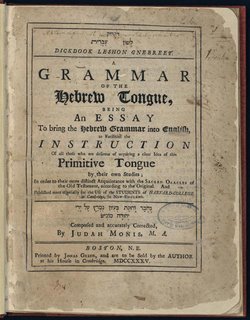
Note the title. I thought this was pretty cool.
On the Main Line, now with helpful tags: hebrew

Note the title. I thought this was pretty cool.
On the Main Line, now with helpful tags: hebrew
Wednesday, November 23, 2005
Tuesday, November 22, 2005
Things I learned in yeshiva....and things I didn't learn in yeshiva
Wolfish Musings once had a great post called Things I Learned In Yeshiva...And Things I Didn't Learn In Yeshiva. It's worth looking at his list. Bear in mind that I'm not discriminating between what I was taught in 6th grade or 10th. Here is mine:
Things I learned in Yeshiva...
And things I didn't learn in Yeshiva...
Long hair is forbidden by halakha for men
Long hair is not forbidden for men by halakha. While there are halakhic issues with how long hair lies when putting on teffilin, al pi din a man can wear his hair like King John or John Lennon if he wants.
Christianity is about repressing sexuality and insane asceticism, Islam is the same only in reverse.
Like a lot of stereotypes, there are kernels (or even whole ears) of truth to it. But a true assessment of these religions is far, far more complicated. It's like the old saw about how Judaism is all legalistic show without substance. There were trends, movements, currents and cross currents in Christianity and Islam such that they cannot be boiled down to a trite stereotype. Besides, Judaism, at least as presented to thewalking hormones teenagers we were in yeshiva is not exactly providing a sexually healthy environment at all times.
Moses Mendelssohn was the founder of Reform (not Reform Judaism, as it could only be called 'Reform')
While there is simply no way one can maintain that Mendelssohn was Orthodox (even though the term is anachronistic--it was, by the way, acknowledged that he was Orthoprax). However, nothing about Mendelssohn and his chevra was acknowleded apart from the 'fact' that from Mendelssohn came Reform and non-Jewish grandchildren. That the nature of the controversy was over the fact the the Bi'ur was a passport to German literacy (like the KJV of the Bible was earlier), I never heard. Nor, that R. Itzele Volozhiner had a seder in Parshat Hashevua with Bi'ur.
Non-frum and non-Jewish Bible scholars hate the Torah, Hashem and Judaism.
Again with the stereotypes. There were and are Bible scholars who hate some or all of the above (although I keep thinking of nineteenth century Germans when I try to think of names). Its abundantly clear from reading commentaries, studies and articles by Bible scholars that many of them have an abiding love for Torah, Judaism and Hashem (or some combination). In fact, often people become scholars in a field precisely because they love it.
There is a listable group of rabbis called The Gedoilim, most of whom, ironically, are of the Lithuanian yeshiva tradition with a couple of Chassidishe rebbes and an occasional Sephardi Haham thrown in for good measure.
Need I elaborate?
R. Moshe Chaim Luzzatto was so great that the Vilna Gaon said he would have walked to Italy to meet him. The Vilna Gaon said x% of the Mesilat Yesharim was written al pi ruah ha-qodesh.
Yes, but. R. Moshe Chaim Luzzatto was highly controversial and not without reason. He may have had messianic pretentions of some sort, wrote secular poetry and plays in Italian and attended the University of Padua.
Ad kan for now.
Things I learned in Yeshiva...
And things I didn't learn in Yeshiva...
Long hair is forbidden by halakha for men
Long hair is not forbidden for men by halakha. While there are halakhic issues with how long hair lies when putting on teffilin, al pi din a man can wear his hair like King John or John Lennon if he wants.
Christianity is about repressing sexuality and insane asceticism, Islam is the same only in reverse.
Like a lot of stereotypes, there are kernels (or even whole ears) of truth to it. But a true assessment of these religions is far, far more complicated. It's like the old saw about how Judaism is all legalistic show without substance. There were trends, movements, currents and cross currents in Christianity and Islam such that they cannot be boiled down to a trite stereotype. Besides, Judaism, at least as presented to the
Moses Mendelssohn was the founder of Reform (not Reform Judaism, as it could only be called 'Reform')
While there is simply no way one can maintain that Mendelssohn was Orthodox (even though the term is anachronistic--it was, by the way, acknowledged that he was Orthoprax). However, nothing about Mendelssohn and his chevra was acknowleded apart from the 'fact' that from Mendelssohn came Reform and non-Jewish grandchildren. That the nature of the controversy was over the fact the the Bi'ur was a passport to German literacy (like the KJV of the Bible was earlier), I never heard. Nor, that R. Itzele Volozhiner had a seder in Parshat Hashevua with Bi'ur.
Non-frum and non-Jewish Bible scholars hate the Torah, Hashem and Judaism.
Again with the stereotypes. There were and are Bible scholars who hate some or all of the above (although I keep thinking of nineteenth century Germans when I try to think of names). Its abundantly clear from reading commentaries, studies and articles by Bible scholars that many of them have an abiding love for Torah, Judaism and Hashem (or some combination). In fact, often people become scholars in a field precisely because they love it.
There is a listable group of rabbis called The Gedoilim, most of whom, ironically, are of the Lithuanian yeshiva tradition with a couple of Chassidishe rebbes and an occasional Sephardi Haham thrown in for good measure.
Need I elaborate?
R. Moshe Chaim Luzzatto was so great that the Vilna Gaon said he would have walked to Italy to meet him. The Vilna Gaon said x% of the Mesilat Yesharim was written al pi ruah ha-qodesh.
Yes, but. R. Moshe Chaim Luzzatto was highly controversial and not without reason. He may have had messianic pretentions of some sort, wrote secular poetry and plays in Italian and attended the University of Padua.
Ad kan for now.
Monday, November 21, 2005
We told you so
File this one under 'weird'.
Aish HaTorah reprints an article that appeared in Commentary last month by Conservative rabbi Dr. Jack Wertheimer.
Aish HaTorah reprints an article that appeared in Commentary last month by Conservative rabbi Dr. Jack Wertheimer.
Sunday, November 20, 2005

Friday, November 18, 2005
Thursday, November 17, 2005
Tuesday, November 15, 2005
Maven Yavin
Lamed Zayin, Krum and I have started a new group blog called Maven Yavin.
Let's see if three heads are better than one!
Let's see if three heads are better than one!
Monday, November 14, 2005
Jewish issues online
After a long time reading Jewish mailing lists, bulletin boards and blogs I've noticed that there are certain topics that come up over the years and then over and over again. These topics include things like lower (textual) criticism of the Torah, the Documentary Hypothesis, the age of the universe, Who Is A Heretic, how are we to understand fantastic midrashim, the nature of rabbinic authority and so forth. These topics recur again and again, over years and in many forums online.
Why? There is so much more in Torah. There are "famous" sugyas in Gemara. It seems like a relatively little amount of discussion about these issues, as opposed to more foundational or hashkafic issues that seems to occupy us online.
I guess it may that these are the issues that are neglected "in the real world". If you want stimulating discussion or a seder on these issues, it might be hard--or for some, impossible--to find offline. If its so, that these issues aren't discussable in the real world, then it probably indicates a failure of sorts, whether educational, institutional, rabbinic etc. These are things people are thirsty to talk about!
What other reasons might there be?
Applauding at windmills
Yitzchok Adlerstein at Cross Currents on the fortieth anniversary of Nostra Aetate, the document with which the Catholic Church exonerated all Jews of deicide.
Adlerstein writes that "Nostra Aetate....affirmed that G-d’s covenant with the Jewish people is unbroken and eternal. "
It did no such thing. The text is here, see for yourself. The Catholic Church can and will no more agree that there is another Israel--the Jews--then the Jews can agree that the Church is Israel. It could barely bring itself to recognize a sovereign nation called Israel, and it didn't do that for another 30 years. "Although the Church is the new people of God, the Jews should not be presented as rejected or accursed by God, as if this followed from the Holy Scriptures."Adlerstein writes "Jews – especially traditional Jews filled with a sense of the permanence of G-d’s Word – wonder how this could be done. How do you change a belief that the faithful assumed century after century? They do not understand that the Church does not see change as impossible. The Catholic Church overflows with tradition; it allows only for very slow change. But it does allow for it. Later generations can and do rethink old issues as society develops."How is this different from traditional Judaism? "Judaism overflows with tradition; it allows only for very slow change. But it does allow for it. Later generations can and do rethink old issues as society develops."
Subscribe to:
Posts (Atom)
LinkWithin

Subscribe To On the Main Line


 Posts
All Comments