There is currently a vibrant blog post about laypeople being critical of the gedolei Yisrael. This blog points out that laymen simply don't know what they are talking about, or rather whom they are talking about when they critique gedolei Yisrael, by way of analogy from the lack of respect shown by boxing fans toward fictional boxing champion Apollo Creed when he was acting in a way that seemed unseemly, in contrast to the respect that boxer Rocky had for him a that time, noting that the fans haven't got a clue. A boxer like Rocky knows who the champ is and what exactly about him is deserving of respect, no matter how unseemly he looks to the fans, who just aren't in a position to judge who is and who isn't a great boxer.
In another blog, someone posted that "What bothers me is when blogging laymen feel they can debate rabbis regarding halacha" and also "I've come across many blogs where the bloggers, sometimes women, quote pesukim and halachot to argue against gedolim. I think it is pathetic."
This subject is very interesting to me. I think it might be worthwhile to explore a phenomenon that I suspect is fairly modern, but even if it is not that new, it surely could have begun only since the advent of printing. I mean this: an entire class of Jews exist who have a relationship to the texts of Jewish learning which didn't exist, or at least not in such numbers, in earlier times.
Let us go back less than one hundred years to the fabled shtetl culture of eastern Europe. It is well known that there was a lot of Torah learning and there were many talmidei hakhomim of great depth, and there was a lot of love for Torah as well (putting aside the reality of the disintegration of this culture at the same time; it is still a fact that in this time these Jews still lived). Anyone reading any histories, chronicles or memoirs of this period finds that Torah classes and study groups were structure in a way which is quite foreign to anything contemporaries have seen. There were groups of Jews who studied Talmud; the chevra ha-shas. There were Jews who studied mishnayoth. There were Jews who studied chumash and there were even Jews who gathered together to recite Psalms--all according to their ability. Now, I am sure it is possible that a person who participated in a mishnayos group could have hacked it in the Talmud class. I am not asserting that there really was such a rigid stratification, but as far as I can tell, having seen this in many different places, as recently as a hundred years ago there were Jews who valued the Torah, who were pious and who hadn't a prayer of participating in or probably even understanding a Talmud class. Okay, it could be that those shas brotherhoods studied on a relatively high level, and that it was possible to teach Talmud to these less learned Jews, but it didn't happen.
I wonder if I even have to say more than two words, daf yomi, about today. There are countless laymen that attend a daily shiur and if they keep to it they are, at least, in the same room as people that will, in less than a decade, run through Shas. Yes, among daf yomi goers there is a broad spectrum. There are those who are capable of independently 'doing the daf' themselves. There are those who can hack it out with a study partner. There are those who are sufficiently learned that they can fill in when the maggid shiur is absent, if they have enough time to prepare. There are those who can fill in with the help of a Soncino or an Artscroll Gemara. There are those who have practically no idea what's going on. There are those who get some of it; or do well with certain parts of shas but not others. There is a broad spectrum, but the point is this: there are no fellowships of Psalm-sayers.
That is only the tiniest tip of the iceberg. Travel back to elementary school: I am assuming that the average yeshiva student, say, of ten years of age today is better prepared than his or her average counterpart a hundred years ago or a thousand years ago. Yes, there may have been some relative advantages in the old system lacking today. For example, there was no pop culture to distract and fill a young mind. But, conversely, there was really no pedagogical method for teaching broad masses. Individuals excelled, most gained very little. This can even be proven, I think, because we do possess materials that are very old which tell us some things about the literacy of Jews (and I don't mean only in eastern Europe, which was not the Jewish world). We find Jews who were apparently unable to write there own name. Not a great percentage, but they did exist. We find Jews who did not know how to write their own name correctly (eg, מרדחי for מרדכי), where it is obvious that such people did not read very much.
Today's child doesn't leave the heder forever at 12 or 13 or so (and the old heder did not produce average 12 year olds as learned as our average 12 year old), but has a high school Jewish education and even post-high school. Today's child or teenager is aware that there is a Rif and a Rashba that there is a Shulhan Arukh and what it looks like inside. Todays young adult may not be on the way to being a talmud hokhom but probably knows dozens of maamarei Chazal, a lot of midrashim, many 'famous' Rashis, perhaps a couple of sugyas in some shape. They acquire some hashkafah, they know about some famous shittos. They grow up and acquire some more. When you see, if you do, Joe Jew reading a translation of Maimonide's Guide you are looking at a new creature, or at least one that could not have existed when books were hand-copied manuscripts. You are talking about many, many, many thousands of people who know something about something with regards to Torah, Talmud, halakhah, hashkafah--and I do think this is something fairly new. In earlier times there were people who were very pious and as careful about halakhah as they could be, who asked rabbis halakhic questions, but who hadn't a clue what a Mishne Torah was, who the Raavad was, that the Shulhan Arukh is an abridgement of the Beis Yoseph, which itself is a commentary on the Tur and that R. Yoseph Karo had a method etc etc etc. Now, I am not saying that every Joe Jew who knows a little something, who attends a daf, who can and perhaps does, on their own, learn a lot of Torah, knows how the Shulhan Arukh works or knows what the Rif is and all of that. But such people are present in varying degrees, with various shades of knowledge. Heck, I am one of them! You get thousands of people sitting in a class, or reading on their own, in the Talmud 'הלכה ואין מורין כן,' 'don't disseminate this law'-- to whom? Everyone knows it. But there was a time when what was written in shas was not bound to become common knowledge.
My point is this: the existence of such people poses a unique challenge to rabbinic authority. No one can now tell them that the Rashbam doesn't say X, R. Hirsch didn't believe Y and the Nodah Be-yehuda didn't pasken this about that. People know these things. It may be that the laymen has a cacophony of knowledge with no ability to sytemetize them, no "mesorah," no right, an obligation to bittul daas etc.
But this is what many people are today and they're not going to not have opinions. The boxing fan may be wrong, but 1) some boxing fans are knowledgable enough that they do have a right to an opinion and 2) they're going to have an opinion regardless of whether they're right. More arcane fields, say, the study of Punic paleography, don't come with hangers on with stupid opinions.
If this isn't really the desirable way for things to be, the only solution is to stop the daf yomis, to stop the translations, to stop the laymen shiuring presenting the views of the rishonim, stop the mesivtos, and roll back the clock. When you tantalize the masses with some of the things studied in Harvard, they become semi-learned.
Reading that last bit back, it sounds more like a rant that I intended. Oh well. I meant to describe, but not prescribe. Just my two prutot.
Note: the genesis of these thoughts was from this Mishmar post and comments I made there, such as this one:
You know the expression a little knowledge is a dangerous thing? Well, be-zeman ha-zeh, the layman knows far, far more than ever before. On the one hand, laymen participation in Talmud shiurim is widely encouraged. On the other hand, the Gemara records halakhot that are en morin ken. Doesn't that imply that the assumption is simply that tens of thousands of Jews ought to be unaware of them? Yet here we are, and no one suggests that the laymen not learn some Gemara, learn some halakhah, learn some hashkafah etc.
This thing you decry is a direct consequence of that. Millions of Jews who faithfully observed the laws of taharas ha-mishpachah for many generations did not have a clue that there was anything to talk about; it's pashut, spouses are separated from their wives for a week after the period ends. Today that isn't the case. The people that in former times knew nothing of the origins of this reality now know something, even if not enough to make informed decisions, about it.
Does this somehow need to be balanced? Yes. But unless you're calling for a return to more widespread ignorance, to more tehillim zugging, you have got to expect that people who learn a little will have opinions. It is not arrogant or shameful--it is human nature, and the laymen would have opinions about medicine too if every layman was encouraged to dabble in advanced medical journals, indeed, to have a seder in medicine at least once a day, which is just what we are doing in the sphere of Torah, knowing full well as we do that not all laymen will ever develop into talmidei chachamim.
>I cannot disagree more. There were plenty of people in the prior generations who were quite learned -
I did not deny that. There were also plenty of people who lived fully halakhic lives, to the best of their ability, who didn't know as much Torah as a good 5th grader in a yeshiva, and I'm being generous. Circumstances were entirely different and that is what my comment was addressing. Today there are a lot more people who know "a little." As I said, "you have got to expect that people who learn a little will have opinions. It is not arrogant or shameful."
>and in this case you do not have to know much, it is clear from a review of the pesukim in Chumash that what we do le maaseh is far more machmir than that required by the Torah.
Of course; we're not talking about that. But we are talking about the fact that many, presumably most by far, had no idea about the nature of the shiva nekiin at all. Thus, it could scarcely have been a topic of discussion. Same applies to any major halakhic discussion. The reason why laymen enjoy discussing them is because they possess some basics. If you train someone to play a little piano, they'll play a little piano, even if they're not going to write symphonies.
>today many baalei batim would say
Nu, so reverse the trend. If the proper place in Judaism for baal habatim is to keep their minds from thinking about things they've no business thinking about, discourage them from learning Gemara. Discourage them from learning Orach Hayyim with Mishna Berura. Put 'em back into their place--you're right. It was better when pious baal habatim could read from a siddur and maybe a bissele Tzene Rena in Juedische-Deutsche (it was not written for women) and hear a rabbi give a derasha twice a year that he could not comprehend.
Friday, January 05, 2007


Thursday, January 04, 2007
Questions which R. Zecharya Frankel were asked by R. Hirsch: 19th century Neo-Orthodoxy defined

To this day when I hear the name Zecharya Frankel I think of the Chaim Potok book The Promise (and, I think also The Chosen) in which the Zechariah Frankel Seminary stands in for the Jewish Theological Seminary of America, and [Samson Raphael] Hirsch College, for RIETS.
You probably know, if you don't you can click the link, that R. Zecharya Frankel was a prime mover in a 19th century religious movement that called itself variously the Historical School or Positive-Historical Judaism. It rejected Reform, and in terms of halakhic practice could, by today's standard, be regarded as basically indistinguishable from Orthodoxy--and even in terms of hashkafah many things acceptable within parts of today's Orthodoxy would not be very different from this group. So much so, that--at least in America--a great many people were unaware of three interpretations of Judaism in the 19th century, knowing only of two: those who were not Reform and those who were. Of those who were not Reform, there could be Jews of the Historical bent. Of those who were Reform there might even be some. But basically it wasn't clear to all parties that this was a third approach, although many Reformers and many Orthodox recognized that it was.
One person who believed that it was not Orthodoxy was R. Samson Raphael Hirsch, who regarding R. Frankel with suspicion, posed the following open questions to him upon the news that he would head the about-to-be-established rabbinical seminary of Bresslau (to be called the Jüdisch-Theologisches Seminar / Jewish Theological Seminary):
1) What will revelation mean in the forthcoming Seminary? For Orthodox Judaism it is the direct word of the personal, one God to man; for it, "God spoke to Moses" is a simple supranatural fact just as one man speaks to another. Do the leaders of the Seminary acknowledge this Orthodox belief?
2) What will the Bible mean mean in the forthcoming Seminary? Orthodox Judaism believes in the divine authenticity of whole Bible and knows neither of the various authors of the Pentateuch, nor of Pseudo-Isaiah, nor of Maccabean songs under the name of David, or of Solomon's Ecclesiastes from the days of the second Temple, and so forth. What say the leaders of the Seminary of the authenticity of the Bible?
3) What will tradition mean in the forthcoming Seminary? For Orthodox Judaism it is the word which has its origin in God no less than the written word. Everything that is taught in the Talmud as d'oraita (of Torah origin) has in Orthodox Judaism the same origin and the same value as the biblical word. Orthodox Judaism knows nothing of a tradition that had a history in the course of the ages. It knows nothing of its founders who alleged the extension of the law to be divine tradition. It rejects with resentment any such thought as bringing our great and honorable forbears under undignified suspicion. How do the leaders of the Seminary stand in relation to this Orthodox principle?
4) What will be the meaning of derabbanan (rabbinic law) and minhag (custom) in the forthcoming Seminary? Orthodox Judaism recognizes it as divine obligation never to depart even from the statutes, and even minhagim (customs) have the same obligatory power as the category neder (vows). What say the leaders of the Seminary to this principle of Orthodox Judaism?*
R. Zecharya Frankel never answered these questions; although it could well be that he did not have an Orthodox answer to those questions, I assume he also regarded them as inquisitorial. Frankly, I'm not sure R. Hirsch even wanted them answered so much as to clarify his own point of view and vision of what the Seminary should be like, if it had a reason to exist.
It is interesting to see in a nutshell how R. Hirsch defined Orthodoxy, apparently vis-a-vis its positions on four key issues. Although there is no question that individual Orthodox Jews did and do not agree with all of the points in every particular, I think it's pretty fair to say that his formulation does basically reflect Orthodox positions that are still current.
There is more to this story, in that the Seminary would also employ as a member of its faculty a man with whom R. Hirsch had a personal history with, Heinreich Graetz, a former student-friend, a founder of modern Jewish historiography and author of a multi-volume magnum opus on Jewish history which R. Hirsch considered to be appalling.
* From The Growth of Reform Judaism: American and European Sources Until 1948 by W. Gunther Plaut
Tuesday, January 02, 2007
Artscroll on etymology, Paradise and the late dating of biblical books
Talmud Bavli Chagiga 14b
There were FOUR who ENTERED THE sublime ORCHARD[18]
[18]...[Accordingly one could also translate this sentence: There were four who entered Paradise. Indeed, the English word "Paradise" derives from a Greek word meaning both orchard and Paradise which in turn derives from the Hebrew pardeis.]
The above translation and note are from Artscroll's Schottenstein Talmud.
Now, it is true that the Schottenstein edition does not claim to be a scientific text. It is for this reason that I wouldn't harp on all the specifics of the note. For example, I won't fault it for noting that the English word paradise come from Greek, even though English did not come from Greek and therefore did not borrow this word from Greek; most English words which ultimately have an ancient Greek origin received it via an intermediary language, like Old French, which in turn received the word from Latin, which in turn received it from Greek. Thus, Latin received the Greek παραδεισος, paradeisos, as paradisus, and Old French had it from Latin as paradis etc.
I also will not fault Artscroll for describing the Greek word to mean orchard and Paradise; it certainly did not mean the latter in ancient Greek (the Septuagint translators used the word in the sense of Paradise). Whether orchard is the best meaning of παραδεισος, paradeisos is questionable.
These sort of generalizations are understandable. What I do not understand is where Artscroll got the idea that the Greek received it from the Hebrew פרדס. In fact, the best explanation is that Greek received it via the Persians. The OED notes that the Greeks received the word from "the Old Iranian base of Avestan pairidaeza- enclosure."
Given its long history with the Persians, and the relatively later encounter with the Jews, how and why would Greek have gotten the word from Hebrew rather than the Old Iranian? And why doesn't Artscroll cite any source for this assertion?
It occurred to me that it might have something to do with the location of the three places in Tanakh that pardes occurs: Nehemia 2:8, Ecclesiastes 2:5 and Songs 4:13. The first book was obviously written after the exile. Jews could certainly then have received a loanword from Persian. The other two books are traditionally ascribed to Solomon, who lived 500 years earlier. While it is not impossible for an Old Iranian word to end up in the vocabulary of a Judean Israelite of 3000 years ago, it is certainly less comfortable to a traditionalist sensibility than the idea that it is a native Hebrew word after all, especially coupled with the non-traditionalist view of the dating of all three books as post-Exilic.
So, am I proposing that Artscroll simply made up the assertion in note 18? Lacking a source, either traditional or modern, that seems to be the inescapable conslusion. As to the why, my guess is only that: a guess.
ארבעה נכנסו לפרדס
There were FOUR who ENTERED THE sublime ORCHARD[18]
[18]...[Accordingly one could also translate this sentence: There were four who entered Paradise. Indeed, the English word "Paradise" derives from a Greek word meaning both orchard and Paradise which in turn derives from the Hebrew pardeis.]
The above translation and note are from Artscroll's Schottenstein Talmud.
Now, it is true that the Schottenstein edition does not claim to be a scientific text. It is for this reason that I wouldn't harp on all the specifics of the note. For example, I won't fault it for noting that the English word paradise come from Greek, even though English did not come from Greek and therefore did not borrow this word from Greek; most English words which ultimately have an ancient Greek origin received it via an intermediary language, like Old French, which in turn received the word from Latin, which in turn received it from Greek. Thus, Latin received the Greek παραδεισος, paradeisos, as paradisus, and Old French had it from Latin as paradis etc.
I also will not fault Artscroll for describing the Greek word to mean orchard and Paradise; it certainly did not mean the latter in ancient Greek (the Septuagint translators used the word in the sense of Paradise). Whether orchard is the best meaning of παραδεισος, paradeisos is questionable.
These sort of generalizations are understandable. What I do not understand is where Artscroll got the idea that the Greek received it from the Hebrew פרדס. In fact, the best explanation is that Greek received it via the Persians. The OED notes that the Greeks received the word from "the Old Iranian base of Avestan pairidaeza- enclosure."
Given its long history with the Persians, and the relatively later encounter with the Jews, how and why would Greek have gotten the word from Hebrew rather than the Old Iranian? And why doesn't Artscroll cite any source for this assertion?
It occurred to me that it might have something to do with the location of the three places in Tanakh that pardes occurs: Nehemia 2:8, Ecclesiastes 2:5 and Songs 4:13. The first book was obviously written after the exile. Jews could certainly then have received a loanword from Persian. The other two books are traditionally ascribed to Solomon, who lived 500 years earlier. While it is not impossible for an Old Iranian word to end up in the vocabulary of a Judean Israelite of 3000 years ago, it is certainly less comfortable to a traditionalist sensibility than the idea that it is a native Hebrew word after all, especially coupled with the non-traditionalist view of the dating of all three books as post-Exilic.
So, am I proposing that Artscroll simply made up the assertion in note 18? Lacking a source, either traditional or modern, that seems to be the inescapable conslusion. As to the why, my guess is only that: a guess.
Tuesday, December 26, 2006
What books does the Bible quote or reference by name?
Here is a useful list of the books which are quoted in Tanakh either as sources or references for further reading. The only location I have seen handily compile the complete list is in Sid Z. Leiman's The Canonization of Hebrew Scriptures: The Talmudic and Midrashic Evidence,' and here is a reproduction of the list, so that it can endure in one useful, archiveable location: here!
Yup. Those are them.
‘ספר מלחמת ה Book of the Wars of the Lord (Num. 21:14)
ספר הישר Book of Jashar (Josh. 10:13 and i Sam. 10:25)
ספר השיר Book of Song (i K 8:53, in the LXX--some assume that the Hebrew vorlage, השיר, is a corruption of הישר)
ספר דברי שלמה Book of the Acts of Solomon (i K 11:41)
ספר דברי הימים למלכי ישראל Book of the Chronicles of the Kings of Israel (i K 14:19, 15:31 and more)
ספר דברי הימים למלכי יהודה Book of the Chronicles of the Kings of Judah (i K 14:29, 15:7 and more)
ספר היחש Book of Genealogy (Neh. 7:5)
ספר מלכי ישראל Book of the Kings of Israel (i Ch 9:1, ii Ch 20:34)
ספר דברי הימים למלך דויד Book of the Chronicles of King David (i Ch 27:24 acc. to LXX)
דברי שמואל הנביא Chronicles of Samuel the Seer (i Ch 29:29)
דברי נתן הנביא Chronicles of Nathan the Prophet (i Ch 29:29 and ii Ch 9:29))
דברי גד החזה Chronicles of Gad the Seer (i Ch 29:29)
נבואת אחיה השילוני Prophecy of Ahijah the Shilonite (ii Ch 9:29)
חזות יעדו החזה Visions of Iddo the Seer (ii Ch 9:29, probably same as 16 and 17 in list)
דברי שמעיה הנביא Chronicles of Shemaiah the Prophet (ii Ch 12:15)
דברי עדו החזה Chronicles of Iddo the Seer (ii Ch 12:15)
מדרש הנביא עדו Midrash of the Prophet Iddo (ii Ch 13:22)
ספר המלכים ליהודה וישראל Book of the Kings of Judah and Israel (ii Ch 16:11; probably not different from 5, 6 and 8 of list)
דברי יהוא בן חנני Chronicles of Jehu the son of Hanani (ii Ch 20:34)
מדרש ספר מלכים Midrash on the Book of Kings (ii Ch 24:27)
דברי עזיהו Acts of Uzziah (ii Ch 26:22)
דברי חוזי Chronicles of Hozai (ii Ch 33:19)
ספר הזכרנות דברי הימים Book of Records, the Annals (Est. 6:1)
ספר דברי הימים למלכי מדי ופרס Book of Chronicles of the Kings of Media and Persia (Est. 10:2)
Yup. Those are them.
Wednesday, December 20, 2006
Analyzing Saul Lieberman using his own method
In scholarship there is the idea that when examining a source, things said incidentally and are taken for granted impart information.
A practical example is the Gemara BT Rosh Hashana 26b which discusses the meaning of obscure Hebrew words, which the Hahamim were able to derive from listening to the regular speech of servants and others; Rabbi's maid, for example:
The Rabbis did not know what was meant by serugin, until one day they heard the maidservant of Rabbis household, on seeing the Rabbis enter at intervals, say to them, How long are you going to come in by serugin?
The Rabbis did not know what was meant by halugelugoth, til one day they heard the handmaid of the household of Rabbi, on seeing a man peeling portulaks, say to him, How long will you be peeling your portulaks? (halugelugoth).
The Rabbis did not know what was meant by, salseleah (and it shall exalt). One day they heard the handmaid of the house of Rabbi say to a man who was curling his hair, How long will you be mesalsel with your hair?... [Then comes a similar example which does not involve Rabbi Judah’s maidservant. I
The Rabbis did not know what was meant by we-tetethia bematate (of destruction), til one day they heard the handmaid of the household of Rabbi say to her companion, Take the tatitha (broom) and tati (sweep) the house.
The Rabbis did not know what was meant by Cast upon the Lord thy yehab and he shall sustain thee. Said Rabbah b. Bar Hanah: One day I was travelling with an Arab and was carrying a load, and he said to me, Lift up your yehab and put it on [one of] the camels.
What does this Gemara take for granted and what, perhaps, doesn't it take for granted? I would say it takes for granted that Hebrew was used in regular conversation among servants--or perhaps this servant was the last of the (naturally Hebrew speaking) mohicans, so to speak.
But what is not taken for granted is that the speech of maids can teach us what words in the Bible mean. The former is incidental to the story, the latter is the point of it. Therefore we can know something about spoken Hebrew from this story. What precisely that is? We need to be cautious and we need to examine other evidence. But one thing is clear: it is taken for granted that such a person spoke such a dialect. Thus, we can safely assume it to be reflective of the true situation and we now know something about spoken Hebrew in Rabbi's time, although dating the story is another matter; in theory it could be from a later time when it was assumed that the vernacular of maids in an earlier period was Hebrew. But the salient point is that the incidental information which the story-teller takes for granted tells us things.
If I am not mistaken, this principle was applied by Saul Lieberman in many of his studies on talmudic-era Israel in the Greco-Roman world, in his analysis of both rabbinic texts and non-Jewish sources.
So I thought I'd apply this same principle to determine something about R. Dr. Lieberman himself.
First, the background. In the biography of Saul Lieberman by Spiro and Schochet (pp. 175-76) one find the following distillation of his attitude towards modern scholarship in the service of Torah study, how necessary it is:
In his introduction to Tosefta Kifshuta, Zera'im, Lieberman acknowledges his indebtedness to the early commentators: "the first pioneers ... upon whose shoulders we stand and from whose wine we drink." Lieberman attributed errors on their part to the conditions of their time and to the lack of manuscripts that are available today. In particular, Lieberman calls our attention to the difficult working conditions of Moses Samuel Zuckermandel, the first scholar to publish a scientific edition of the Tosefta. Yet, in the interest of truth, Lieberman points out the limitations that constrained the scholarship of previous generations.
In short, a perfect manifesto about the need fo using modern scholarly methods to properly understand the Talmud Yerushalmi (and Tosefta).
On page 190-91 of the book, we are given an abstract of a speech R. Dr. Lieberman gave called "A Talmud Written by the People in Their Own Land:"
He "listed the publication of the Escorial manuscript of the Palestinian Talmud Nezikin as one of the '[t]hree important events [that] have taken place in the last two years with regard to the Palestinian Talmud. First, a very important manuscript was discovered by the late Professor Rosental [sic] of blessed memory of the Hebrew University, a manuscript of a part of the Talmud that will greatly enhance our knowledge and understanding of the Talmud in general. Second, a concordance of that Talmud is now being published in Jerusalem by the Israel Academy of Sciences and the Jewish Theological Seminary of America....Third, an international assembly of Orthodox rabbis has suggested that the Palestinian Talmud should be studied daily by all Jews who study the Babylonian Talmud.
Now, I'm not sure what exactly this tells us about his relationship with Orthodoxy, but I am suggesting this tells us something of his scale of values. To him, an important manuscript of the Yerushalmi, a concordance of the Yerushalmi and a call to study the Yerushalmi daily by Orthdox rabbis were important events.
Critics from a right-leaning perspective are probably not too impressed by this, but I think it incidentally imparts something about how he balanced his scales. (Not that this is surprising to those who knew him, by every account.)
A practical example is the Gemara BT Rosh Hashana 26b which discusses the meaning of obscure Hebrew words, which the Hahamim were able to derive from listening to the regular speech of servants and others; Rabbi's maid, for example:
לא הוו ידעי רבנן מאי סירוגין שמעוה לאמתא דבי רבי דחזתנהו רבנן דהוו עיילי פסקי פסקי אמרה להו עד מתי אתם נכנסין סירוגין סירוגין לא הוו ידעי רבנן מאי חלוגלוגות יומא חד שמעוה לאמתא דבי רבי דחזית לההוא גברא דקא מבדר פרפחיניה אמרה ליה עד מתי אתה מפזר חלוגלוגך לא הוו ידעי רבנן מאי (משלי ד) סלסלה ותרוממך יומא חד שמעוה לאמתא דבי רבי דהוות אמרה לההוא גברא דהוה קא מהפך בשעריה אמרה ליה עד מתי אתה מסלסל בשערך לא הוו ידעי רבנן מאי (ישעיהו יד) וטאטאתיה במטאטא השמד יומא חד שמעוה לאמתא דבי רבי דהוות אמרה לחבירתה שקולי טאטיתא וטאטי ביתא לא הוו ידעי רבנן מאי (תהילים נה) השלך על ה' יהבך והוא יכלכלך אמר רבה בר בר חנה יומא חד הוה אזלינא בהדי ההוא טייעא הוה דרינא טונא ואמר לי שקול יהביך ושדי אגמלאי
The Rabbis did not know what was meant by serugin, until one day they heard the maidservant of Rabbis household, on seeing the Rabbis enter at intervals, say to them, How long are you going to come in by serugin?
The Rabbis did not know what was meant by halugelugoth, til one day they heard the handmaid of the household of Rabbi, on seeing a man peeling portulaks, say to him, How long will you be peeling your portulaks? (halugelugoth).
The Rabbis did not know what was meant by, salseleah (and it shall exalt). One day they heard the handmaid of the house of Rabbi say to a man who was curling his hair, How long will you be mesalsel with your hair?... [Then comes a similar example which does not involve Rabbi Judah’s maidservant. I
The Rabbis did not know what was meant by we-tetethia bematate (of destruction), til one day they heard the handmaid of the household of Rabbi say to her companion, Take the tatitha (broom) and tati (sweep) the house.
The Rabbis did not know what was meant by Cast upon the Lord thy yehab and he shall sustain thee. Said Rabbah b. Bar Hanah: One day I was travelling with an Arab and was carrying a load, and he said to me, Lift up your yehab and put it on [one of] the camels.
What does this Gemara take for granted and what, perhaps, doesn't it take for granted? I would say it takes for granted that Hebrew was used in regular conversation among servants--or perhaps this servant was the last of the (naturally Hebrew speaking) mohicans, so to speak.
But what is not taken for granted is that the speech of maids can teach us what words in the Bible mean. The former is incidental to the story, the latter is the point of it. Therefore we can know something about spoken Hebrew from this story. What precisely that is? We need to be cautious and we need to examine other evidence. But one thing is clear: it is taken for granted that such a person spoke such a dialect. Thus, we can safely assume it to be reflective of the true situation and we now know something about spoken Hebrew in Rabbi's time, although dating the story is another matter; in theory it could be from a later time when it was assumed that the vernacular of maids in an earlier period was Hebrew. But the salient point is that the incidental information which the story-teller takes for granted tells us things.
If I am not mistaken, this principle was applied by Saul Lieberman in many of his studies on talmudic-era Israel in the Greco-Roman world, in his analysis of both rabbinic texts and non-Jewish sources.
So I thought I'd apply this same principle to determine something about R. Dr. Lieberman himself.
First, the background. In the biography of Saul Lieberman by Spiro and Schochet (pp. 175-76) one find the following distillation of his attitude towards modern scholarship in the service of Torah study, how necessary it is:
In his introduction to Tosefta Kifshuta, Zera'im, Lieberman acknowledges his indebtedness to the early commentators: "the first pioneers ... upon whose shoulders we stand and from whose wine we drink." Lieberman attributed errors on their part to the conditions of their time and to the lack of manuscripts that are available today. In particular, Lieberman calls our attention to the difficult working conditions of Moses Samuel Zuckermandel, the first scholar to publish a scientific edition of the Tosefta. Yet, in the interest of truth, Lieberman points out the limitations that constrained the scholarship of previous generations.
- They possessed little knowledge of the Greco-Roman world.
- They failed to understand or appreciate the uniqueness of the Talmud Yerushalmi's style and language.
- They failed to appreciate how the traditions of the Jews of Palestine differed from those of Babylon.
- They lacked manuscripts of the Talmud Yerushalmi.
- They did not pay sufficient attention to gaonic writings in order to determine accurate texts of the Talmud Yerushalmi.
In short, a perfect manifesto about the need fo using modern scholarly methods to properly understand the Talmud Yerushalmi (and Tosefta).
On page 190-91 of the book, we are given an abstract of a speech R. Dr. Lieberman gave called "A Talmud Written by the People in Their Own Land:"
He "listed the publication of the Escorial manuscript of the Palestinian Talmud Nezikin as one of the '[t]hree important events [that] have taken place in the last two years with regard to the Palestinian Talmud. First, a very important manuscript was discovered by the late Professor Rosental [sic] of blessed memory of the Hebrew University, a manuscript of a part of the Talmud that will greatly enhance our knowledge and understanding of the Talmud in general. Second, a concordance of that Talmud is now being published in Jerusalem by the Israel Academy of Sciences and the Jewish Theological Seminary of America....Third, an international assembly of Orthodox rabbis has suggested that the Palestinian Talmud should be studied daily by all Jews who study the Babylonian Talmud.
Now, I'm not sure what exactly this tells us about his relationship with Orthodoxy, but I am suggesting this tells us something of his scale of values. To him, an important manuscript of the Yerushalmi, a concordance of the Yerushalmi and a call to study the Yerushalmi daily by Orthdox rabbis were important events.
Critics from a right-leaning perspective are probably not too impressed by this, but I think it incidentally imparts something about how he balanced his scales. (Not that this is surprising to those who knew him, by every account.)
Tuesday, December 19, 2006
Whatever happened to Maven Yavin? Also, don't use a password which can be guessed.
Once upon a time there was a blog called Maven Yavin. From November 2005 through January 2006 (with some continued limping in February and March of this year) myself, Krum as a Bagel, ADDeRabbi and LamedZayin held court. At its heydey Maven Yavin was getting several times more hits than any of our individual blogs and there were some great discussions and posts.
Silly us: we used a very, very easy password (at least in regard to the relationship between the password and the character of the blog). To my chagrin I noticed today that MY was 'hacked,' and the blog has all but disappeared. So, I decided to mirror the posts for posterity.
They can be found at Maven Yavin Archive.
The politics of dreidels
I'm told that in the weekly 'Alim Litrufah[1]' newsletter that one finds in some shuls there was an article about dreidels which helpfully explained that a dreidel is a [2] ס .סביבון בלע"ז.
[[1]1Not to be confused with 'Alim Litrufah,' the prospectus and introduction of the Pentateuch translation and commentary by Moses Mendelssohn.
1[2] לע"ז means "the vernacular," but is often seen as an acronym which means לשון עם זר. Which is to say, in this case, modern Hebrew is being called a foreign language, or more precisely, the language of a foreign nation.
Thursday, December 07, 2006
R. Jeremy Wieder's Concise Methodological Manifesto
There's a very interesting audio at YU Torah called 'Concise Methodological Manifesto by R. Jeremy Wieder. It runs about 15 minutes long and was apparently spoken off the cuff at the end of a shiur. It's worth listening, to or you could read this transcript:
I just want to take two minutes to address something that I'm told the rumor mill is very active [about]. I'm not going to address the larger issue right now; I just want to address the issue that's nogeah to shiur. Everything I say is repeatable in a public forum because I want to be very clear. It doesn't need to be repeated, but it may be repeated in a public forum.
There are people who seem to have, and perhaps its my fault, a misunderstanding of the nature of shiur, of my shiur. I value very highly that which I do outside of the beis midrash as well, in all sorts of disciplines and arenas, not in any particular studies, even though that's where most of my work is. I also value very much what is known in some circles as mehqar, in other circles as academic Talmud. I think they're very interesting--to me it's very interesting because I love learning Gemara--for over two decades--and to me, when you love learning a text you tend to be attracted and interested in all the various and sundry aspects of the text; how it came to be, not just the ideas that are floating in the air. Klal Yisrael, many of our frumme Yidden have learned Gemara for a very, very long time. The baalei ha-tosafos were very concerned about how the Mishna formulates things, whether it says arbaah roshei shana hem or, whether you have a hem or you don't have a hem. Now, those questions may not fascinate me so much, but you can see what an attachment there was to the language and sometimes they're [unclear]. But it interested them. And it interests me as well. And, I look up to Rava and Abbaye and I would be interested in seeing pictures of Rava and Abbaye (even though we never will) and maybe I'd be curious in what Rava and Abbeye wore as well. However, many of those aspects themselves are not talmud Torah. I don't believe, as I think you all know, that just because something is not talmud Torah doesn't mean it isn't a worthy enterprise and worthy of our time. But there are some things which are basically--some would call it secular disciplines--even if they relate to Torah, evne if they have some value in connection with Torah. Many of the things, however, that are often associated with academic Talmud, and some of us come to them via our exposure to academic Talmud, some of us come to it via other exposure, sometimes intuitively, are tools that can be very valuable in--and yes, I used the word tools because tools are good things--are very valuable things in properly understanding the devar Hashem in all of its manifestations as has been expressed by Klal Yisrael throughout the centuries. And as such, if there's a particular tool that might now be more currently prevalent in the academy, but it is useful for a ben Torah studying, then I think it's a very valuable tool to use when one learns Gemara. One does not spend his time engaged in playing with those tools, but you rather take them and you use them in the context of your talmud Torah.
Most of these tools, if not all of them, should be non-controversial, even if somehow they have become. So, for example (and I've mentioned this before), even though we don't spend our shiur doing girsaos, nontheless, when you look at the Dikdukei Sopherim, when it was published, it had the haskamos of all the gedolei ha-dor there, starting with R. Yitzhak Elhanan Spektor, for whom our yeshiva is named. Now, R. Shlomo Kluger, R. Yaakov Ettlinger--major, major gedolim in Europe. It was a wonderful enterprise; all this tedious labor, R. Rabinovich had undertaken to produce an amalgamation of kisvei yad on the Gemara that was relevent to their beis midrash. And frankly, for the most part, he did actually what was interesting, of value to Torah study; he didn't have every vav and yod and every variant spelling; he had those things which he thought had impact on the meaning of Gemara, the part that's relevent for the beis midrash. It doesn't really matter whether or not the Gemara ohi ending or the oy ending contracted. It's very interesting if you're a linguist; its not interesting in the beis midrash because it doesn't really matter in 99.99% of the contexts.
When one talks about recognizing the layers in sugyos--this was a tool in the arsenal of the baalei ha-tosafos. It was not a invented in the 20th century by some hoqrim in the academy. It was something that was well known to many, many rishonim and they use it to explain frequently problems in sugyos and between sugyos. There's nothing new about it. It is not the end-all and be-all of talmud Torah, but it is another useful and valuable skill in learning Gemara. This can be said for--almost everything, not everything. For many things that certain people in the academy have been machshiv. Someone like David Weiss Halivni, was not interested in a lot of the modern academic Talmud, but was interested in--again, I am not commenting about specific persons--but in learning Gemara. These were different methodologies that one can add to one's arsenal. Despite my occasionally making fun (maybe more than occasionally) of myself for sounding Brisk and making fun of Brisk, conceptual analysis plays a very important role in learning. Anyone who has been in this shiur for any period of time, maybe not for one or two days--it could look different--knows that it plays a regular role because, especially you learn Nezikin and Nashim, there's no other way around it. You have to engage in it some of the time. Perhaps, some people are more inclined to see it everywhere and some people are inclined to see it in fewer places and sometimes seek out alternative solutions. But it plays a major, major role even if it didn't come down mi-Sinai, like this is the only aspect of talmud Torah one shoudl engage in, it's still very important.
So--hence, some people might walk away because what makes this shiur different, among other things, is that these are tools and methodologies that are acceptable to use. They're acceptable. Now, to supplement, to enhance and to magnify the scope of our talmud Torah, and therefore they may be emphasized because what characterizes our shiur is not--maybe it does, actually--that we learn Gemara, but let's assume for the moment that it doesn't characterize the shiur to say "What do you do in your shiur?" "I learn Gemara," because that's not really helpful, it doesn't really tell you anything--"Yeah, but so does everybody else" and say "I learn rishonim," and even if those two enterprises take up, you know, 90% of the time or more it's not useful in characterizing it, so one of the things which stands out, which gives the shiur a particular flavor, is the presence of the question of layers in sugyos more so, perhaps, than any of the other issues which come up in mehqar, but other issues as well.
Some, perhaps, have come to a misunderstanding based on that, that this is an academic shiur. We have a yeshiva, and we have many shiurim--maybe all the other shiurim that are engaged in talmud Torah--and we do academic Talmud. But unfortunately that's a false impresison, and one that, if you spend time here I think you'll figure out pretty quickly, doesn't reflect the reality. And to the extent that there are people in the institution, talmidim who seem to be under this impression , that this is an academic Talmud shiur, you might--especially if they raise the issue--point out that--in fact, you should invite them to come in, they should sit in the shiur for a week. Not to come, but just to visit and see--at the very least like you'd come into a museum to see--and this way they would be most welcome to understand what it is that we do in this shiur. Because, from my perspective, this is my passion, this is my talmud Torah, this is what I spend much of my life doing--I hope to spend most of my life doing, and I hope that my talmidim, those who continue not in Torah will walk away, enriched with their experience of talmud Torah, but not of academic Talmud. Not because academic Talmud is bad, but academic Talmud is not what you do in a yeshiva, it's what you do in the academy. Some people don't really like it there either, I don't have the same problems with that, but that's not what takes place in the koslei beis ha-midrash. The koslei beis ha-midrash is a makom for talmud Torah--in the traditional beis midrash, for the most part, although I don't see the need to restrict it to Bavli or even restrict it to Torah she-be-'al peh, but traditionally we study Gemara, we study Bavli (we do study Yerushalmi here too)--I don't think the Yerushalmi was written by a bunch of academic scholars in the 4th or 5th century of the Common Era in Palestine, I think it was written by our holy ancestors, the Amoraim, and it was studied by our holy ancestors, the Rishonim, and it was once again brought into the curriculum by the Vilna Gaon--maybe some think the Vilna Gaon was an incredible Maskil--but the Vilna Gaon was a big talmid chochom, and was a very frum man and he and his circles, those who preceeded him and followed him, thought that the Yerushalmi and all these other texts were a valuable part of talmud Torah--Torah she-be-'al peh, it belonged in the beis midrash. Maybe not Torah she-be-khetav, but Torah she-be-'al peh, certainly, in expanded scope. But that is what we do here. So if anybody is not clear on what it is, so if you can perhaps clarify that misimpression because I don't people to think, either about this shiur or about the talmidim in this shiur, that somehow they're not engaged in talmud Torah but they're engaged in something else. Because this is talmud Torah, and if someone is in fact looking for that they should go to a different address, I'm not sure where they'd go, but this is the wrong place to come. So in case someone should happen to come under that misimpression, if you could clarify that for them I would greatly appreciate it. But I think in general, sheker and lashon hara and motzi shem ra are things that are generally to be avoided, whether or not they are bemezid or beshogeg--it could be beshogeg too, but I think it's very important that people understand what exactly it is that I am about and what the shiur is about. If somebody thinks it's appropriate for them, that's wonderful. If it's not appropriate, that's fine. But this is our talmud Torah, and very much in the tradition of our ancestors even if its not what some people want it to be or not, actually, what some people realize it is.
Are there any questions?
["Chaim" asks what academic Talmud study it]
Studying what Rava and Abbaye wore, studying the economics of Mechoza, studying the sociology of Mechoza, is not Talmud Torah--its very interesting--if we could actually get to the bottom of it it'd be fascinating, because people like to watch other people's lives generally. There's a kind of voyeuristic tendency that people have--I don't know if it's a kind of vicarious enjoyment--whatever it is. So, you know, I would love to see a video of life in Mechoza. But the fact is that's not studying of mitzvos Hashem, that's not studying on the Aggadah, which is meant to teach ethics and morality, it's not study of halakhah--it's, I think, sort of--there's Torah she-be-khetav and Torah she-be-'al peh. Torah she-be-khetav is, I think, clearly defined as Scripture, Torah she-be-'al peh is the interpretation of Torah she-be-khetav, plus halakhah in general, plus Aggadah and mussar, if you want to call it that, but sociology and history and realia in their own right are not talmud Torah. They're very interesting; but they're not talmud Torah.
[questioner starts to ask something about "if one uses..."]
Derekh agav, you might learn a Gemara, if you're studying to write a paper on how the terminology of which generations quote which generations of the Gemara, you're gonna learn a lot of Gemaras in the process, there's no doubt about. On a personal level, one of the reasons I chose to PhD, in the end, in academic--in Rabbinics, and not in computer science, is because I did not think I'd have the koach to work in two completely different disciplines where there was really no overlap in the substance of them. In other words, when you work in rabbinics you do get to learn a lot of the time, in doing so. But the study, per se, itself--you know, when you sit down and actually work on the problem and you tabulate your data; when you make a table of yeush kedi kani and yeush kedi lo kani, and all the possibilities, that's talmud Torah. When you make up a table of the quotations, of which amora quotes which amora, that's not talmud Torah. It may be a very useful tool,just as science is very useful for understanding, for paskening halakhah, for understanding many things. So is it a kind of mitzvah in its own right of some general rubric? Sure. It's a machshir. But if you talk about talmud Torah itself, it is the study of Torah she-be-khetav and Torah she-be-'al peh. I think machshirim are very good as well; there's no question about that. I think studying knowledge for its own right is a wonderful thing. You know, that's what distinguishes man from animal, aside from speech, its the broad thirst for abstract knowledge. It's wonderful. But nontheless, there's talmud Torah and there's chochmas ha-olam, which is wonderful, which is not talmud Torah, and its okay. It doesn't have to be talmud Torah to be a worthwhile pursuit. But what we do in a beis midrash is talmud Torah.
Are there any other question?
[Someone asks, "there's actually a deah that Rabbi Lamm brings in his book Torah U-Madda that you would make a bracha on machshirim."]
You know, I happen to have a nice relationship with Dr. Lamm, and I won't want to do what one of my no-longer-present colleagues did who got up, and, you know, made fun of the book and something like that, I think it was one of the things he picked on--I don't know what deah that is, I think its a silly deah [student tries to interject] I understand that, I understand that. I think that part of the problem that disturbs me about that point of view is that it makes the assumption that if it weren't talmud Torah then maybe we shouldn't be doing it. That may not be what the deah says, but I don't think you make a bracha on your calculus or your physics--even though I think they are magnificent subjects, I don't mean to exclude history either, it's of a different nature--I'm belying my science and math roots here--I like things that tend more towards absolute truth then not, postmodernists aside, but the fact is that I think they're incredibly valuable, I think the study of--particularly the natural sciences--for many people, maybe the humanities for others--can be incredibly religiously inspiring, spiritually inspiring, morally furthering and they're wonderful enterprises. They're just not talmud Torah. For me, personally, what I've chosen as my life's enterprise is talmud Torah. But I think that there are many different darkhei ha-chayim, and even for the person whose primary occupation is talmud Torah there are other valuable subjects to study, but you don't have to call them talmud Torah for them to be valuable.
Wednesday, December 06, 2006
Denominationalism stinks
DovBear decries the separation between Jews caused by stringencies, particularly in kashruth, comparing it with the Temple-era when divisions were created between conscientious kohanim and `amei ha-'aretz over similar matters.
My thinking is that problem is denominationalism in Judaism. While most people then were not Perushim and were not Tzedokim, they were the `am. It was not realistic to see them as part of another interpretation of Judaism, as opposed to a simple, uneducated class. In a sense, in pre-war eastern Europe this existed a little bit as well, even though obviously there were denominations and ideological movements. But there was still a large class of people who weren't knowledgeable at all and maybe who weren't even close to meticulously observant, but who co-existed alongside those who were both. They too were viewed as simply the `am and not Zionists or Bundists or Maskilim or Hassidim.
Unfortunately this is not true today because most Jews seem to be identified with a label of some sorts, as well as the fact that most Jews are either quite removed from tradition or are wedded to other traditions.
DB points out that "This is one advantage the catholics have over us. They still have the sence of the am - even for people who are knowledgeable, and dissenters, and attached to other traditions. No one doubts that they are "real" catholics."
Perhaps that is overly idealized, and I wouldn't mind if a Catholic reader weighed in (are you there? :) ), but there's something to the idea, even if it isn't true on the ground from the perspective of Catholics. Denominationalism stinks, even if some of our own denominationalists claim on principle that there are no denominations in Judaism! The trouble is that this principle relies on a claim, that only our own interpretation is entitled to be called Judaism, which in itself is seen as divisive (rightly or not). Note that in large measure this is an Ashkenazic problem; the Sepharadim and `edot ha-mizrah also never split and have much more of a sense of `am, as far as I can tell.
By the way, Martin Buber believed that `am was etymologically derived from `im, which means 'with.' Therefore 'am connotes unity and attachment. It's a nice midrash, even if it might not be linguistically correct.
Tuesday, December 05, 2006
The importance of the Vilna Ga'on to Haskalah
You can find some interesting stuff on Google book search nowadays, as they scan more and more books. I found a chapter from The gaon of Wilna; a review of his life and influence by Mendel Silber (1905), which I decided to upload:
'Elijah Gaon of Wilna; His Importance.' You can download it or read it here.
Aside from the interest of the information contained in these ten pages in itself, it might also be of interest to readers in that it is a lucid example of how non-traditionalist Jews idealized the Vilna Gaon from an entirely different angle than traditionalists (Silber was an American Reform rabbi in St. Louis).
Excerpts:


It really is worth reading the entire chapter.
The phenomenon of individuals who people with all sorts of opposing views feel kinship with is interesting. I have previously posted about how the Rambam was one such figure. The Ga'on was another. More recent figure were R. Samson Raphael Hirsch and R. J.B. Soloveitchik. Interesting it would be to investigate all such figures and contrast them with those who opposites never tried to co-opt for their own.
Monday, December 04, 2006
Look it up!
"Reading and translating with my young teacher the book of Job, I commenced in my eighth year to enjoy a foretaste of poetical beauties, and, incited by the political events of the time, I would scribble wretched rhymes in both Hebrew and Italian. "
"The study of Job impressed me forcibly with the necessity of new elucidations to the Scriptures, and I can distinctly recall having said one day to my schoolmates, that as I grew older, I would write comments better than those of Rashi. "
"To give a specimen of the forthcoming exegesis, I told him that I would prove that the country of Job was Beth-El; for, I added, in Genesis we read that "Utz" was formerly the name for "Beth-El." To convince my juvenile audience, who listened closely, I opened the Bible; but what was my surprise and confusion when I found that Luz and not "Utz" was the appellation by which Beth El went previous to Jacobs' vision! The childish arrogance received then a due reprimand, but the spirit of research and criticism was not quenched nor discouraged."
From Autobiografia di S.D. Luzzatto (Autobiography of Samuel David Luzzatto). Translation into English by Sabato Morais, published in The Jewish Record, Philadelphia, August 3-10, 1877.
Thursday, November 30, 2006
Good press: credit where credit is due

haredi rabbis deserve credit for doing the right thing, and it should be publically pointed out in atmosphere where criticism of them runs rampant, the reason this is written in white letters is so that Google will index this post, but I think the image spoke for itself
Menachem Kellner caves on Daas Torah*; also, who wrote the Zohar?
Hirhurim calls attention to a new journal called Covenant. Menachem Kellner has an article called Maimonides Agonist: Disenchantment and Reenchantment in Modern Judaism.
In it he raises an issue which is not new, but he raises it well.
For traditionally oriented Jews, an important religious issue rests upon a bibliographical question: who wrote the Zohar?
I will get back to that.
Meanwhile, he also makes a notable concession
For years I have been convinced that the notion of da'at torah was a haredi innovation, a politically expedient if Jewishly questionable response to the challenges of modernity. However, I have been forced to change some of my cherished opinions. While it is clear that the term da'at torah is a late nineteenth-century innovation, the notion actually reflects forces that existed earlier in Judaism.
As far as I can tell this is basically all that proponents of Daas Torah have been saying all along. "We didn't make this up. It's how Jews were governed by their spiritual leaders." The difference, of course, is that Kellner isn't saying that this is how Jews were always governed and that its definitely the 'Torah opinion.' So let us say that Kellner is now a Daas Torah minimalist in that he recognizes a central claim of proponents of Daas Torah: it isn't new.
My own take on Daas Torah is to essentially agree with the notion that Jews were long governed by their spiritual leaders. However I disagree as to the import of this fact. In pre-modern Jewish society the spiritual leaders were also secular leaders (along with leading laymen). This was so not because knowledge of hilkhot treifot imbues one with 'Torah opinion,' but because the spiritual leaders were educated and they were worldly. Spiritual leaders didn't only decide religious questions, but that is a descriptive phenomenon.
One of the leading theoreticians of the Daas Torah ideology made the case that spiritual leaders have more Daas Torah the more Torah learning they possess and the less worldy knowledge. In other words, a saintly ascetic will have more 'Torah opinion' at his disposal than a scholar of equal Torah knowledge who is more worldly. Practical experience, personal knowledge, 'street smarts'--all of it lessens Daas Torah.
As far as I can tell that is the innovation of Daas Torah as a prescriptive ideology: the idea that a rabbi who spends the bulk of his time teaching Torah to 20 year bachelors is inherently better suited to practical leadership of the wider community than a rabbi who has street smarts, even if their Torah scholarship is otherwise equal.
A few months ago it was shown that a leading chareidi godol, viewed as an exemplar of Daas Torah didn't know how a credit card worked until it was explained to him. Putting aside whether this is true or not--the publication which made the claim is known to spread tall tales, but the import is that it firmly believes that his prior lack of knowledge of what a credit card is is not embarassing, but awesome--a rabbi who didn't know basic worldy information 400 years ago could have been many things; a tzadik, a hasid--but he would not have been the one making political decisions.
So this is new. My take.
***
Getting back to the Zohar, Kellner continues
Many of Maimonides' writings are best understood not only as an attempt to harmonize Torah and what he considered to be science, but also as an attempt to counteract the influence of what I have called "proto-kabbalistic" elements in pre-Maimonidean Judaism. In this, I believe (but cannot prove), Maimonides followed in the footsteps of those editors of the normative rabbinic writings who kept certain texts and allied literature out of the canon of Judaism. But the widespread acceptance of the Zohar as the work of the second-century CE Rabbi Simeon bar Yohai doomed this millennium-long attempt limiting the mystical elements of Judaism to failure. The Zohar is the central problem.
For traditionally oriented Jews, an important religious issue rests upon a bibliographical question: who wrote the Zohar? If the Zohar represents the work of Rabbi Simeon bar Yohai and a circle of colleagues and students, then the teachings of the Zohar must be seen as part of the body of normative rabbinic Judaism, carrying at least as much authority as other midrashic compilations such as the Mishna and the Talmud. No Jew today, believer or scholar, would think of claiming that the ideas and values of, say, midrashic compilations do not represent ideas and values at the heart of rabbinic Judaism. There may be questions about how to express these ideas and values in a modern idiom, how to understand them, and, for the most traditional, how to apply them, but there can be no doubt that they constitute an integral part of "classical Judaism."
If the Zohar, on the other hand, is the brilliant work of the Spanish kabbalist Moses de Leon (c. 1240--1305) and his friends, if the anonymous mystical work Sefer bahir, attributed to first century sage Nehunya Ben Ha-Kanah, is in fact a clumsy forgery, then the ideas and values embodied in these works have much less normative import for subsequent Judaism. Moses de Leon did indeed live during the period of the "rishonim" (early authorities), but had no particular credentials as halakhist or exegete that we know of.
So, putting the question rather tendentiously, is Judaism the sort of religion found in the Bible, Mishna, Talmud, and Maimonides, or is Judaism the sort of religion found in the Bible, Mishna, Talmud, and Zohar? These are very different sorts of religions and the answer to the question depends on the answers to the question, who wrote the Zohar and when?
To all intents and purposes the question has been settled in Jewish history if not by Jewish scholarship. Scholars such as Gershon Scholem accept that these works are the invention of Moses de Leon, but in Orthodox circles, the Zohar is almost universally seen as the work of Rabbi Simeon bar Yohai, with all that implies. That being the case, it is no surprise that what might be called, anachronistically, Maimonides' anti-Zoharic reform had little chance of success. In the rest of this paper I want to indicate how very little of Maimonidean Judaism can be found in the contemporary Orthodox world.
The question of how a work without a tradition can appear and be considered authoritative is one that should concern Orthodox Jews given that they place a premium on tradition. If the Yerushalmi Kodashim wasn't met with skepticism then would it not have been incorporated into the Shas? Of course the obvious response is that the Zohar was met with skepticism, but unlike the Yerushalmi Kodshim, investigation authenticated it. Nu, nu. You say Zoyhar Haqodoysh, I say Book of Enoch.
*My personal apologies to him for using a sensationalist title, but I couldn't resist. If it is brought to my attention that this is unappreciated by the author, the title can be changed in advance of Google indexing.
Tuesday, November 28, 2006
Download Dickdook Leshon Gnebreet - דקדוק לשון עברית
All the explanation is at On the Main Line but in this clean post you can download Judah Monis' Dickdook Leshon Gnebreet: A Grammar of the Hebrew Tongue (Boston, 1735) (דקדוק לשון עברית).
Download Dickdook Leshon Gnebreet - דקדוק לשון עברית
I once posted a bit about Harvard's first instructor of Hebrew in the 18th century, Judah Monis. link
At English Hebraica I posted an image of his tombstone. link
Monis was sort of a pathetic figure. Of Italian or North African birth, after (possibly) serving for a short time as a rabbi in a Long Island congregation he accepted a post teaching Hebrew at Harvard in 1722 and converted to Christianity (a necessary precondition to the appointment). There is some difference of opinion as to what the evidence shows about the sincerity of his conversion, but there is no doubt that he was never fully accepted by his peers and students (who couldn't stand him, his 100 page book which they had to copy by hand or the course he taught).
His book is unusual and a very interesting historical document. I don't think you can easily acquire a copy, so here is one I uploaded of Dickdook Leshon Gnebreet: A Grammar of the Hebrew Tongue (Boston, 1735) (דקדוק לשון עברית). (to download: click, not right click, the link. A new page loads and you'll need to wait a few seconds to download)
Re: Gnebreet/ עברית; although the learned readers fully understand his unusual transliteration of the letter ע in עברית, and although this point has been discussed on my blogs before, it would not be inappropriate to mention that Western Sepharadim and Italian Jews pronounced the ע as /ng/ (or sometimes /gn/, as in signor...I think). Although this pronunciation seems uncommon today, to the English speaking Jews of the 18th century this was ubiquitous. A charming remnant from the early 20th century remains at the end of the Hertz Chumash where the transliteration scheme is spelled out (pg 1053 in the edition I have). In explaining why the Chumash eschews various possible transliterations of Hebrew words it says
"In the transliteration of Hebrew words into English (Shema, tzedakah, and haftorah, and not Shema` or Shemang, sedaqah and haphtarah), the aim is not to bewilder the ordinary lay reader, for whom this work is primarily intended."
Monis' grammar ends with a most unusual page (click to enlarge):

For more info about Monis see
George Alexander Kohut "Judah Monis, M.A., the First Instructor in Hebrew at Harvard University (1683-1764)" American Journal of Semitic Languages and Literatures, Vol. 14, No. 4 (Jul., 1898), pp. 217-226
God's Sacred Tongue: Hebrew and the American Imagination by Shalom Goldman
Monday, November 27, 2006
Spaghetti Westernizing the Esav traditions
Search For Emes writes
A couple of months ago the following letter and response appeared in one of those free ad-heavy Jewish magazine you find in New York:

I hope it can be read clearly. The letter is about a previous writer's portrayal of Lavan as akin to Stalin or Hitler! I believe the same letter could have been written about Yishmael and Esav. The point is that it is true that these three are "bad guys" in the midrash, to a certain extent Yishmael and Lavan are "bad guys" in the text of the Torah itself. But Hitler and Stalin-esque?
The rabbi correctly noted in response that the Haggadah cites a rabbinic interpretation of Deut. 26:4 אֲרַמִּי אֹבֵד אָבִי, 'the Aramean [ie, Lavan] sought to destroy my father [ie, Yaakov]' as opposed to the peshat which might read 'a wandering Aramean [ie, Yaakov] was my father.'
That the former is not the literal translation needs very little to establish. One can simply quote the Artscroll Stone Chumash note on the words they translate 'An Aramean tried to destroy my forefather'--"The translation is that of Rashi, who follows the Midrashic interpretation of Sifre, which is also the version found in the Haggadah. Accordingly, the Aramean is the deceitful Laban, who tried to deceive Jacob at every turn, and finally pursued him with the intention of killing him, and would have done so had not God warned him not to dare harm Jacob (see Genesis 31:29-30). In the plain sense, the term is rendered my forefather [i.e., Jacob] was a lost [i.e., homeless or penniless] Aramean, meaning that Jacob lived in Aram for twenty years of his life (Ibn Ezra)."
Lest we get stuck on the discussion about the tension between the דרש and the פשט it should suffice to note that there really isn't the official midrashic portrayal of any of these characters. Yishmael is viewed in a negative light at times; in others he is truly penitent. The same can be said for the others as well.
The point is that both the rabbi and the letter writer are correct in pointing to opposing sources and opinions regarding these figures, and that only highlights the fact that there is a complex reality to their treatment in the rabbinic tradition, even if it is true that the weight of opinion would seem to be with the rabbi; albeit it is a long leap from that to treating Lavan as the proto-Hitler.
The rabbi's response ends with a postscript:
By the way, Esav and Yishmael were also related to Avrohom Avinu. Will you take up their cause as well?
I imagine the writer of the letter didn't see himself as taking up Lavan's cause so much as opposing the Spaghetti Westernization of the Torah tradition.
Another week of passion plays in shul as we make our way through Breishis. The rabbi just won't let up. Just a little while ago it was Ishmael, and this week it is Esav. This really feels like I am watching a medieval passion play. Here comes the good guy - Yaacov. He is perfect. Here comes the bad guy - Esav. He is evil. Boo, hiss...If I understand him correctly, it is not that Esav is viewed as a bad guy per se that bothers him--there are bad guys--but that he is made into the bad guy to the point that it would be parody, except that its not parody.
A couple of months ago the following letter and response appeared in one of those free ad-heavy Jewish magazine you find in New York:

I hope it can be read clearly. The letter is about a previous writer's portrayal of Lavan as akin to Stalin or Hitler! I believe the same letter could have been written about Yishmael and Esav. The point is that it is true that these three are "bad guys" in the midrash, to a certain extent Yishmael and Lavan are "bad guys" in the text of the Torah itself. But Hitler and Stalin-esque?
The rabbi correctly noted in response that the Haggadah cites a rabbinic interpretation of Deut. 26:4 אֲרַמִּי אֹבֵד אָבִי, 'the Aramean [ie, Lavan] sought to destroy my father [ie, Yaakov]' as opposed to the peshat which might read 'a wandering Aramean [ie, Yaakov] was my father.'
That the former is not the literal translation needs very little to establish. One can simply quote the Artscroll Stone Chumash note on the words they translate 'An Aramean tried to destroy my forefather'--"The translation is that of Rashi, who follows the Midrashic interpretation of Sifre, which is also the version found in the Haggadah. Accordingly, the Aramean is the deceitful Laban, who tried to deceive Jacob at every turn, and finally pursued him with the intention of killing him, and would have done so had not God warned him not to dare harm Jacob (see Genesis 31:29-30). In the plain sense, the term is rendered my forefather [i.e., Jacob] was a lost [i.e., homeless or penniless] Aramean, meaning that Jacob lived in Aram for twenty years of his life (Ibn Ezra)."
Lest we get stuck on the discussion about the tension between the דרש and the פשט it should suffice to note that there really isn't the official midrashic portrayal of any of these characters. Yishmael is viewed in a negative light at times; in others he is truly penitent. The same can be said for the others as well.
The point is that both the rabbi and the letter writer are correct in pointing to opposing sources and opinions regarding these figures, and that only highlights the fact that there is a complex reality to their treatment in the rabbinic tradition, even if it is true that the weight of opinion would seem to be with the rabbi; albeit it is a long leap from that to treating Lavan as the proto-Hitler.
The rabbi's response ends with a postscript:
By the way, Esav and Yishmael were also related to Avrohom Avinu. Will you take up their cause as well?
I imagine the writer of the letter didn't see himself as taking up Lavan's cause so much as opposing the Spaghetti Westernization of the Torah tradition.
Monday, November 20, 2006
Why didn't Shadal want to change the Kedusha? Text emendations in theory and in practice.
A correspondent asked me my opinion as to why Shadal defended the wording of the Kedusha barukh kevod versus his emendation berum kevod (as discussed here).
Thinking about it, this was my reply: Shadal was personally very conservative. Even though if we look at him in the light of the past it is clear that in many ways he wasn't traditional, he was totally unaware of that. It was he who came up with the quip, upon hearing of the removal of the yikum purkan by Reformers, that they fulfilled va-yimah et kol ha-yequm (Gen. 7:23). On the other hand, in 1821 the Austrian Emperor required that the Italian Jews under his dominion produce a siddur with translation according to the Italian minhag, and as the editor and translator he was keenly aware of the fluidity of tephillah itself (as well as its rigidity).
In addition, although he believed that text criticism of Nakh was totally permissible and even desirable, like pretty much all traditionalists who took this attitude, it stopped when it came to changing the texts themselves, as opposed to just noting the emendation for the sake of knowledge and truth. His ability to recognize the corruptness of the transmission of (some of) the texts and his need to suggest emendations was driven by his notion of truth, as was his desire to seek out the meaning of the texts according to how they were understood by the original audience. If that didn't mean that how the original audience understood it needs to inform how we understand it, this was so long as we know the difference and do not confuse the two kinds of understandings. Also, this particular emendation was only conjectural. To this day there are no ancient versions, no Dead Sea Scroll fragment which attests to this emendation (berum instead of barukh).
So, to round up, Kedusha might have come from the Navi, but it is not the Navi: it is liturgy. I would not be surprised if he had sensed a corruption in the liturgy on its own terms then he would have advocated emending it; this calls to mind something R. Saul Lieberman said: "There may be one historical truth, but the truth of a text is the truth peculiar to its one literary or oral tradition." (quoted by Dov Zlotnick in his introduction to Greek In Jewish Palestine/ Hellenism in Jewish Palestine, New York: 1994).
In other words, it is the right wording in Kedusha, even if it is not what the Navi said!
PS if you think I'm overdoing the Shadal, you ain't seen nothing yet. Shadalian: coming soon.
Thursday, November 16, 2006
Is the Agudah upset about "good" blogs too?
I wasn't sure if I was planning to post about the topic at the upcoming Agudah convention about blogging. As many people pointed out, the Agudah really isn't the pulse of any community anymore. The convention really is as much or more about networking and shidduchim as it is social responsibility. It isn't the momentous gathering of and about the community many presume it represents. I say that not as a dig at the Agudah, but rather to point out simply that the community it is thought it speaks for, American chareidim, are not accurately reflected by one entity.
It has already been covered here, here, here and here to mention only a few places. Orthomom was the first to post the title of the talk, as printed in a Hamodia ad: ...Have bloggers declared open season on Torah Authority?
But then Wolf posted on the topic and pointed out that its ludicrous to speak of "blogs" as a single entity anymore than to speak of books as an entity. There are good books and bad books. Good blogs and bad blogs.
While I agree, his post caused me to think more about what is objectionable about blogging. I think that unlike books which do not necessarily share a relationship, blogs do. For one thing, they are interactive. Even if the content is highly controlled (and approved) doesn't the blog link to other blogs? Even if all of them are approved, doesn't at least some of them link to ones which aren't? Even if none of them do, what prevents commenters from linking to their own blogs, which may not be approved? What about the fact that many people access new posts through aggregators like Jrants or Jblogosphere or JewishBlogging? Or through Google blog search? And if you click that last link, you'll see I had searched for the word "Torah." The first result as of this posting is called "Reading the Torah as Wisdom, Not Law." The second result is "Replacing Secular Values with Torah Values" on a different blog. It is very possible that the second post is something which, what I shall term Agudists for convenience, would love, maybe even print out and leave a pile in their shul. But the one right before it? Ay yi yi yi yi. And I haven't even mentioned content.
That is the point: the mixture. Even that which they'd generally consider good contains admixtures that would and does shock them. Everyone thinks Hirhurim is great, right? But even there in the comments you'll find people saying things that would literally make some people nauseous. (Putting aside the issue of a young man independently publishing his "musings" as he sees fit, which is simply an issue for Agudists.)
I can recall reading a book about peshat and derash which really didn't contain anything that untraditional. It was just in erudite English and by a person with a fancy, untraditional name who had a resume I would have considered suspect at the time. But I felt illicit. I felt lightheaded, even guilty and was sure I shouldn't be reading it. (It was a while ago.) To someone who is not used to things they have developed a sensitivity about even slight deviations, to say nothing about major ones, are shocking beyond belief.
Not that this is the Agudah attitude per se, but remember that there are people who wouldn't learn Torah from a sefer printed by specific publishing houses! Hypersensitive or not, even that which seems prima facie unobjectionable in the blogosphere is positively laced with what they think is hemlock. The best of it is still the worst of it.
In a way this is similar to the objection to `Torah U-Madda.' Yesterday Hirhurim posted a thought by R. Elhanan Wasserman. Now, R. Wasserman was known as one of the greatest critics of Yeshiva University. He repeatedly refused invitation from R. Dr. Bernard Revel to give a shiur at RIETS. Yet according to Hirhurim the thought in his post was given at the Hildesheimer Rabbinerseminar in Berlin, where students needed to get PhDs as a condition for receiving rabbinic ordination, where source criticism of rabbinic literature and philology were part of the curriculum, where even the Deutero-Isaiah position was taught by one instructor. This same seminary was actually looked down upon by Lithuanian rabbis. Why would R. Wasserman oppose RIETS more than that institution? Someone pointed out to me the simple explanation that I should not have overlooked: he objected to the idea of a Yeshiva University; to the fact that the same institution which granted academic degrees also granted rabbinic ordination. In other words, the mixture. Of course.
Agree or not, you can't just make them realize that some are good and some are bad. That would be projection onto them.
If I may borrow a graphic, here is Greg of the wonderful Presence's banner.
It has already been covered here, here, here and here to mention only a few places. Orthomom was the first to post the title of the talk, as printed in a Hamodia ad: ...Have bloggers declared open season on Torah Authority?
But then Wolf posted on the topic and pointed out that its ludicrous to speak of "blogs" as a single entity anymore than to speak of books as an entity. There are good books and bad books. Good blogs and bad blogs.
While I agree, his post caused me to think more about what is objectionable about blogging. I think that unlike books which do not necessarily share a relationship, blogs do. For one thing, they are interactive. Even if the content is highly controlled (and approved) doesn't the blog link to other blogs? Even if all of them are approved, doesn't at least some of them link to ones which aren't? Even if none of them do, what prevents commenters from linking to their own blogs, which may not be approved? What about the fact that many people access new posts through aggregators like Jrants or Jblogosphere or JewishBlogging? Or through Google blog search? And if you click that last link, you'll see I had searched for the word "Torah." The first result as of this posting is called "Reading the Torah as Wisdom, Not Law." The second result is "Replacing Secular Values with Torah Values" on a different blog. It is very possible that the second post is something which, what I shall term Agudists for convenience, would love, maybe even print out and leave a pile in their shul. But the one right before it? Ay yi yi yi yi. And I haven't even mentioned content.
That is the point: the mixture. Even that which they'd generally consider good contains admixtures that would and does shock them. Everyone thinks Hirhurim is great, right? But even there in the comments you'll find people saying things that would literally make some people nauseous. (Putting aside the issue of a young man independently publishing his "musings" as he sees fit, which is simply an issue for Agudists.)
I can recall reading a book about peshat and derash which really didn't contain anything that untraditional. It was just in erudite English and by a person with a fancy, untraditional name who had a resume I would have considered suspect at the time. But I felt illicit. I felt lightheaded, even guilty and was sure I shouldn't be reading it. (It was a while ago.) To someone who is not used to things they have developed a sensitivity about even slight deviations, to say nothing about major ones, are shocking beyond belief.
Not that this is the Agudah attitude per se, but remember that there are people who wouldn't learn Torah from a sefer printed by specific publishing houses! Hypersensitive or not, even that which seems prima facie unobjectionable in the blogosphere is positively laced with what they think is hemlock. The best of it is still the worst of it.
In a way this is similar to the objection to `Torah U-Madda.' Yesterday Hirhurim posted a thought by R. Elhanan Wasserman. Now, R. Wasserman was known as one of the greatest critics of Yeshiva University. He repeatedly refused invitation from R. Dr. Bernard Revel to give a shiur at RIETS. Yet according to Hirhurim the thought in his post was given at the Hildesheimer Rabbinerseminar in Berlin, where students needed to get PhDs as a condition for receiving rabbinic ordination, where source criticism of rabbinic literature and philology were part of the curriculum, where even the Deutero-Isaiah position was taught by one instructor. This same seminary was actually looked down upon by Lithuanian rabbis. Why would R. Wasserman oppose RIETS more than that institution? Someone pointed out to me the simple explanation that I should not have overlooked: he objected to the idea of a Yeshiva University; to the fact that the same institution which granted academic degrees also granted rabbinic ordination. In other words, the mixture. Of course.
Agree or not, you can't just make them realize that some are good and some are bad. That would be projection onto them.
If I may borrow a graphic, here is Greg of the wonderful Presence's banner.

Wednesday, November 15, 2006
Agnlicizing names; "Godlive" vs "Yechiel"; Heilman et cetera
In one of my very first posts, The Prophet Milton (PBUH) I registered my puzzlement at the convention of Anglicizing Jewish of names in English works, or really the lack of uniform convention for it. Why, asked I, should the Maharal of Prague be called Judah, something he never was called even one time in his life? (Even if it could be shown that he had a shem hol, a secular equivalent of Yehuda, like Loeb or even a direct Czech equivalent, the point is that /Joo-dah/ he never went by).
So I was perusing Dr Sam Heilman's book Sliding to the Right: The Contest for the Future of American Jewish Orthodoxy and wondered why, on pg 131 we find Joseph Caro and Solomon Ganzfried as well as Israel Kagan and Yechiel Michl Espstein.
Granted, there is no good way to Anglicize "Yechiel." But that leads to another question: why is the Hafetz Hayyim called "Israel," when he went by Yisrael Meir (so it should be written Israel Meir) and the author of the Arukh Ha-shulhan gets both his first and second name (Yechiel Michl Espstein)? If there is any rhyme or reason I don't see one, although it is noteworthy--maybe--that Dr Heilman seems to prefer R. Epstein's halakhic work to R. Kagan's.
Speaking of Anglicizing Yechiel, perhaps authors should pull a page from Rennaissance-era R Azaryah dei Rossi's Me'or 'Enayim who gave the Greek-named Philo a Hebrew name, its equivalent Yedidya. Why not "R. Godlive Michl Epstein"? I guess that would be too weird.
In any case, thinking about it, many of these persons didn't really use their Hebrew names either. Thus, Ha-Netziv, R. Naphtali Tzvi Yehuda Berlin, was known as R. Hirsch Leib (and that doesn't even take into account how "Hirsch Leib" was actually pronounced in his native Lithuanian Yiddishe). I guess it would not be so precise to write "Moshe Feinstein" rather than "Moyshe" (or "Meyseh"), so Moses suffices!
The problem with modern Orthodoxy is
that topics of interest to it are
1. Is Orthodox Judaism open to new ways of studying the Bible?
2. Is Orthodox Judaism open to critical study of the history of halakhah?
3. Is Orthodox Judasim open to new approaches to women's ritual roles?
per Freelance Kiruv Maniac.
1. Is Orthodox Judaism open to new ways of studying the Bible?
2. Is Orthodox Judaism open to critical study of the history of halakhah?
3. Is Orthodox Judasim open to new approaches to women's ritual roles?
per Freelance Kiruv Maniac.
Tuesday, November 14, 2006
Et tu The Midrash Says?
It's amazing what we don't notice when we are children.
The Midrash Says was and remains an extremely popular five-voume compendium of midrashic material on the Torah; sort of like Louis Ginzberg's Legends of the Jews. As far as I can see, children today mainly read The Little Midrash Says, which wasn't available when I was a kid, so The Midrash Says it was. It was enriching Shabbos reading; weekday reading too.
But it is more than just what the Midrash says. It is also what its compiler says the midrash means.
Equates and attacks Reform, Conservative and Modern Orthodoxy:
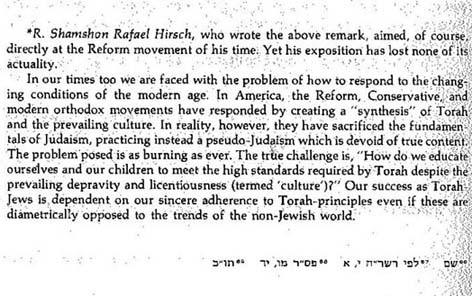
Attacks pizza shops:
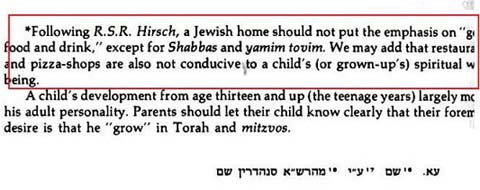
Attacks support for Israel's irrigation needs:
Against 'indiscriminate' Aliya:
Zionism contravenes Torah-opinion (Daas Torah):
Interesting. It goes without saying, or should, that this post is not about anyone's right to hold these views or to publish them, neither of which I contest!
The Midrash Says was and remains an extremely popular five-voume compendium of midrashic material on the Torah; sort of like Louis Ginzberg's Legends of the Jews. As far as I can see, children today mainly read The Little Midrash Says, which wasn't available when I was a kid, so The Midrash Says it was. It was enriching Shabbos reading; weekday reading too.
But it is more than just what the Midrash says. It is also what its compiler says the midrash means.
Equates and attacks Reform, Conservative and Modern Orthodoxy:
Attacks pizza shops:
Attacks support for Israel's irrigation needs:
Against 'indiscriminate' Aliya:
Zionism contravenes Torah-opinion (Daas Torah):
Interesting. It goes without saying, or should, that this post is not about anyone's right to hold these views or to publish them, neither of which I contest!
Thursday, November 09, 2006
Rabbi David Zvi Hoffmann's yahrzeit
It is (or will be, in a matter of hours) Rabbi David Zvi Hoffman's 85th yahrzeit.
19 Marheshvan 5682/ November 20, 1921.
19 Marheshvan 5682/ November 20, 1921.
1863 Hebrew account of the Aleppo Codex, כתר ארם צובה
In Moshe H. Goshen-Gottstein's important article "The Authenticity of the Aleppo Codex" in Textus: Annual of the Hebrew University Bible Project, Vol. 1 (1961) he notes (pg. 3, note 5) that this famous codex was first publicized by R. Jacob Berlin in the first volume of the Hebrew periodical Libanon (הלבנון) f1863. pg. 23. Goshen-Gottstein noted that copies of this periodical were "extremely rare," but luckily the Early Hebrew Newspapers project is available, via the JNUL.
And here it is, or some of it at any rate (also cf. pp. 31 and 76 of the first volume from 1863).
Goshen-Gottstein wrote that "No manuscript of the Hebrew Bible, apart from those discovered among the Dead Sea Scrolls, has been the subject of so heated a discussion as our Codex. Ever since information about it was published" above.
The controvery itself (What exactly is the codex? Who wrote it? What is its signifigance? Was it the text used by the Rambam? Is it really a Ben Asher text? The Ben Asher text?) has since been mostly settled since 1961, in no small measure to Goshen-Gottstein himself.
Incidentally, Ha-levanon was the first Hebrew newspaper in Jerusalem; its editor was Yehiel Brill.

And here it is, or some of it at any rate (also cf. pp. 31 and 76 of the first volume from 1863).


Goshen-Gottstein wrote that "No manuscript of the Hebrew Bible, apart from those discovered among the Dead Sea Scrolls, has been the subject of so heated a discussion as our Codex. Ever since information about it was published" above.
The controvery itself (What exactly is the codex? Who wrote it? What is its signifigance? Was it the text used by the Rambam? Is it really a Ben Asher text? The Ben Asher text?) has since been mostly settled since 1961, in no small measure to Goshen-Gottstein himself.
Incidentally, Ha-levanon was the first Hebrew newspaper in Jerusalem; its editor was Yehiel Brill.
Sunday, November 05, 2006


Friday, November 03, 2006
Reasonable revisited
Appropos Reb Gil's revival* of an issue I discussed in May, here are links to my two posts on R. Shmuel Waldman's Beyond a Reasonable Doubt: Covincing Evidence of the Truths of Judaism.
Unreasonable content in Beyond A Reasonable Doubt I
E.A. Speiser on the historicity of Avraham--add it to the next edition of Beyond A Reasonable Doubt II
*I'm only kidding. I am not accusing him of being influenced by my post.
Unreasonable content in Beyond A Reasonable Doubt I
E.A. Speiser on the historicity of Avraham--add it to the next edition of Beyond A Reasonable Doubt II
*I'm only kidding. I am not accusing him of being influenced by my post.
Thursday, November 02, 2006
Shadal's most famous biblical emendation
One of the cornerstones of our daily prayer is the קדושה. While familiar, it is worth showing one version of it (from abtorah.com):
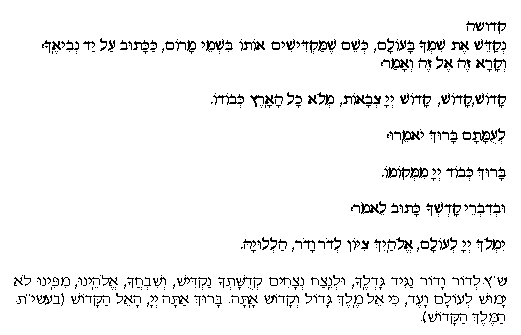
Our piece here concerns the sixth line (in that image). It is a quote from Ezekiel 3:12; the red is in the qedusha, the rest is to include the whole verse:
Then a spirit lifted me up, and I heard behind me the voice of a great rushing: 'Blessed be the glory of the LORD from His place'
Now, if we are used to thinking of the Bible as full of strange things we can chalk it up to yet another. As the spirit lifted the prophet up, he heard a great noise (angels, as it turns out) and the noise was them saying "Blessed be the glory of the Lord from His place." (Artscroll adds the explanatory word "saying" in brackets; that is to say, the noise was the saying of the blessing) The passage then contains to describe more great noise, the wing movements of the hayot and the noise of the ofanim. Okay, if that's what it says.
But exegetes are sensitive to strangeness, and R. Samuel David Luzzatto, Shadal, conjectured that בָּרוּךְ כְּבוֹד יְה' מִמְּקוֹמוֹ contains a scribal error. According to him the verse originally read בְּרוּם כְּבוֹד יְה' מִמְּקוֹמוֹ, and so it read "Then a spirit lifted me up, and I heard behind me the voice of a great rushing when the glory of the Lord rose from His place," rather than "Then a spirit lifted me up, and I heard behind me the voice of a great rushing: 'Blessed be the glory of the LORD from His place."
The error is a plausible scribal error, as the כ and מ looked very similar in the paleo-Hebrew script. Below is an illustration of what ברוך כבוד looked like in paleo-Hebrew (using a font modeled on the script of the Siloam inscription); directly below it is ברום כבוד.
In July Codex noted that the New Revised Standard Version (NRSV) translates Ezekiel 3:12 as per this emendation, "As the glory of YHWH arose from its place."
It must now be noted that
- Shadal is supposedly the first Jew to suggest emendations to the Bible (although he never countenances making them in the text, it must be noted--the above did not lead him to suggest 'correcting' Ezekiel or the Qedusha).
- In addition he vehemently--and irrationally--was opposed to any conjectural emendation of the Torah, but not Nakh.
- Paranthetically, he really felt that almost no one was technically qualified to suggest emendations.
- On that note, it is said that he came to regret making (or perhaps making known his) emendations because it unwittingly undermined that which he upheld with every fiber of his being; the authority and integrity of the Bible and tradition. (sources: Graetz 'History of the Jews,' Shalom Spiegel 'Hebrew Reborn')
- Along those lines, however, it should also be noted that he 'sat' on his Sefer Vikuah al Hokhmat ha-Kabbalah for 25 years because even though he was completely convinced he was right (that the Kabbalah was antithetical to Judaism and that the Zohar was pseudepigrephal), he didn't want to undermine the simple faith of those Jews who were mystically inclined ("It was characteristic of Shadal that he held back the publication of this work because he felt that it might do harm to the strong religious feelings of Polish Jewry, for whom the Kabbalah was a great source of solace").
However--he did publish it, in 1851. "As a result of a conversation he had with a pupil of his, who had returned from a visit to Poland, Luzzatto was persuaded that the evils of the Kabbalah's mystic cult outweighed its benefits as a bulwark of piety." (source: Margolies "Traditionalist Scholar")
EDIT: A reader says "I imagine that if the [Masoretic Text] had read ברום, some clever fellow would have come along suggesting that it be emended to ברוך. And how would we know whether he was right or wrong?
To this I say ברום reads well and wouldn't have raised a question.
In any case, he is right. All sorts of unqualified persons engaged (and to a much lesser extent engage) in conjectural emendations. Note the past tense, because today the uncontrolled excesses of the past has been checked. In fact, as I noted in my post, Shadal apparently was uncomfortable if he was to be used as a vehicle through which the masoretic text would be attacked.
But it needs to be realized that *he* was not unqualified. He was a living concordance of Tanakh and possibly the world's greatest expert on Hebrew of his day. He still holds up well. In addition, his exegesis was very rigorous. He didn't make such suggestions lightly. In fact, he was fully cognizant of an important rule in textual criticism lectio difficilior potior, "the more difficult reading is the stronger," a rule which was widely disregarded for a very long time, but as I said, is more adhered to now. The intent of that rule is to highlight the fact that in copying texts the tendency is to smooth over errors and therefore if an APPARENT error remains in the text there is a good chance that it isn't an error at all, but it only remains to be shown why the difficult spelling or reading is actually the original.
Shadal was mindful of this. If he came across a difficult reading he exhausted his mental resources AND the large manuscript and witness evidence available to him first and only then did he put forth a conjectural emendation. He spent decades on his perushim, refusing to publish them until they were worked over and over again.
In short, he wasn't full of it. It can't be proven if this truly was the original reading, but without a doubt he could not resolve the difficulty with any satisfaction any other way.
Our piece here concerns the sixth line (in that image). It is a quote from Ezekiel 3:12; the red is in the qedusha, the rest is to include the whole verse:
וַתִּשָּׂאֵנִי רוּחַ--וָאֶשְׁמַע אַחֲרַי, קוֹל רַעַשׁ גָּדוֹל: בָּרוּךְ כְּבוֹד יְה' מִמְּקוֹמוֹ
Then a spirit lifted me up, and I heard behind me the voice of a great rushing: 'Blessed be the glory of the LORD from His place'
Now, if we are used to thinking of the Bible as full of strange things we can chalk it up to yet another. As the spirit lifted the prophet up, he heard a great noise (angels, as it turns out) and the noise was them saying "Blessed be the glory of the Lord from His place." (Artscroll adds the explanatory word "saying" in brackets; that is to say, the noise was the saying of the blessing) The passage then contains to describe more great noise, the wing movements of the hayot and the noise of the ofanim. Okay, if that's what it says.
But exegetes are sensitive to strangeness, and R. Samuel David Luzzatto, Shadal, conjectured that בָּרוּךְ כְּבוֹד יְה' מִמְּקוֹמוֹ contains a scribal error. According to him the verse originally read בְּרוּם כְּבוֹד יְה' מִמְּקוֹמוֹ, and so it read "Then a spirit lifted me up, and I heard behind me the voice of a great rushing when the glory of the Lord rose from His place," rather than "Then a spirit lifted me up, and I heard behind me the voice of a great rushing: 'Blessed be the glory of the LORD from His place."
The error is a plausible scribal error, as the כ and מ looked very similar in the paleo-Hebrew script. Below is an illustration of what ברוך כבוד looked like in paleo-Hebrew (using a font modeled on the script of the Siloam inscription); directly below it is ברום כבוד.
In July Codex noted that the New Revised Standard Version (NRSV) translates Ezekiel 3:12 as per this emendation, "As the glory of YHWH arose from its place."
It must now be noted that
- Shadal is supposedly the first Jew to suggest emendations to the Bible (although he never countenances making them in the text, it must be noted--the above did not lead him to suggest 'correcting' Ezekiel or the Qedusha).
- In addition he vehemently--and irrationally--was opposed to any conjectural emendation of the Torah, but not Nakh.
- Paranthetically, he really felt that almost no one was technically qualified to suggest emendations.
- On that note, it is said that he came to regret making (or perhaps making known his) emendations because it unwittingly undermined that which he upheld with every fiber of his being; the authority and integrity of the Bible and tradition. (sources: Graetz 'History of the Jews,' Shalom Spiegel 'Hebrew Reborn')
- Along those lines, however, it should also be noted that he 'sat' on his Sefer Vikuah al Hokhmat ha-Kabbalah for 25 years because even though he was completely convinced he was right (that the Kabbalah was antithetical to Judaism and that the Zohar was pseudepigrephal), he didn't want to undermine the simple faith of those Jews who were mystically inclined ("It was characteristic of Shadal that he held back the publication of this work because he felt that it might do harm to the strong religious feelings of Polish Jewry, for whom the Kabbalah was a great source of solace").
However--he did publish it, in 1851. "As a result of a conversation he had with a pupil of his, who had returned from a visit to Poland, Luzzatto was persuaded that the evils of the Kabbalah's mystic cult outweighed its benefits as a bulwark of piety." (source: Margolies "Traditionalist Scholar")
EDIT: A reader says "I imagine that if the [Masoretic Text] had read ברום, some clever fellow would have come along suggesting that it be emended to ברוך. And how would we know whether he was right or wrong?
To this I say ברום reads well and wouldn't have raised a question.
In any case, he is right. All sorts of unqualified persons engaged (and to a much lesser extent engage) in conjectural emendations. Note the past tense, because today the uncontrolled excesses of the past has been checked. In fact, as I noted in my post, Shadal apparently was uncomfortable if he was to be used as a vehicle through which the masoretic text would be attacked.
But it needs to be realized that *he* was not unqualified. He was a living concordance of Tanakh and possibly the world's greatest expert on Hebrew of his day. He still holds up well. In addition, his exegesis was very rigorous. He didn't make such suggestions lightly. In fact, he was fully cognizant of an important rule in textual criticism lectio difficilior potior, "the more difficult reading is the stronger," a rule which was widely disregarded for a very long time, but as I said, is more adhered to now. The intent of that rule is to highlight the fact that in copying texts the tendency is to smooth over errors and therefore if an APPARENT error remains in the text there is a good chance that it isn't an error at all, but it only remains to be shown why the difficult spelling or reading is actually the original.
Shadal was mindful of this. If he came across a difficult reading he exhausted his mental resources AND the large manuscript and witness evidence available to him first and only then did he put forth a conjectural emendation. He spent decades on his perushim, refusing to publish them until they were worked over and over again.
In short, he wasn't full of it. It can't be proven if this truly was the original reading, but without a doubt he could not resolve the difficulty with any satisfaction any other way.
Subscribe to:
Posts (Atom)
LinkWithin

Subscribe To On the Main Line


 Posts
All Comments